The Luminescence of Sorrow
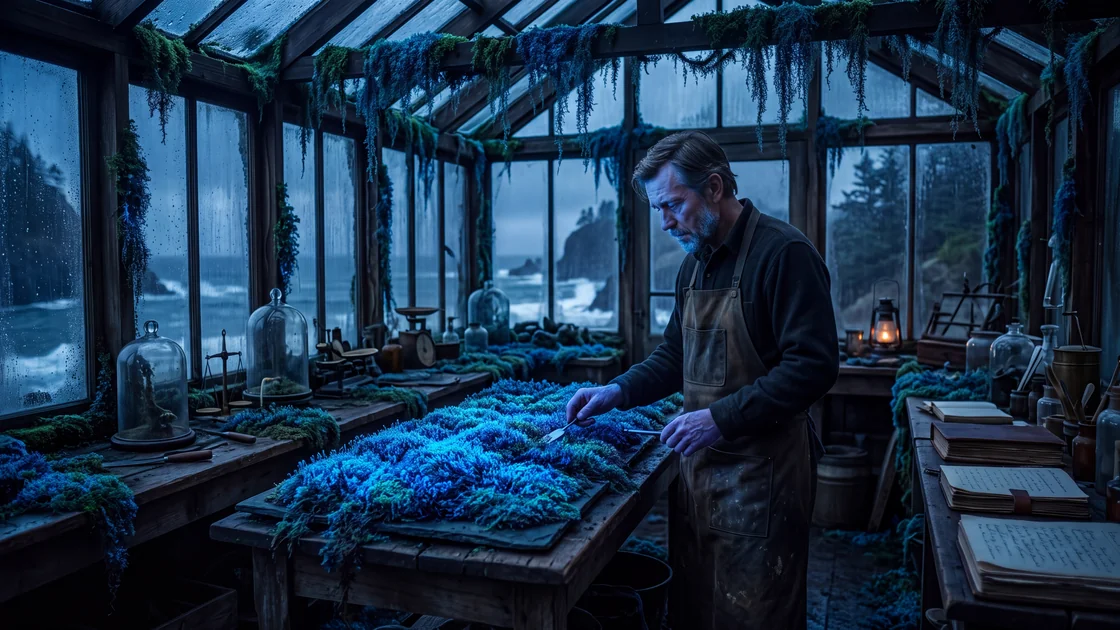
This is the story of Dr. Arthur Phelan, a grieving botanist who retreats to the rain-drowned sea cliffs of the Pacific Northwest, where he discovers an undescribed cavern moss that metabolizes human sorrow, converting emotional anguish into a cold, brilliant cerulean bioluminescence. As Arthur tests the specimen upon himself and subsequently shares it with the mourning inhabitants of a nearby coastal village, he watches the moss alleviate their unbearable pain at the cost of their emotional depth and cherished memories, ultimately forcing him to confront whether sorrow is a disease to be eradicated or the indispensable price of love.
I. The Karst of Cape Disappointment
The valley smelled of rotted cedar, salt spray, and the iron-sweet dregs of ancient rain. For seven months, Dr. Arthur Phelan had walked the limestone seam running beneath the basalt cap of Cape Disappointment, carrying an oilcloth satchel, a three-pronged brass weeding fork, and three ounces of dried beef he rarely remembered to eat. He was forty-two years old, though the skin around his temples had dried into cross-hatched fissures that belonged to an octogenarian sailor. His hands, perpetually stained with peat and copper sulfate, possessed the nervous tremor common to men who spent too much time listening to their own pulses in empty rooms.
Two years prior, in a sterile brick hospital in Portland, Arthur’s seven-year-old daughter, Clara, had stopped breathing while a sleet storm battered the double-glazed windows. Three weeks later, his wife, Sarah, had gathered her winter coats, two suitcases of linen, and the framed charcoal sketch of Clara’s profile, leaving behind a note that contained only seven words: We are only poisoning each other now.
Arthur had not argued. He had resigned his tenure at the university, sold their bungalow with its sprawling, weed-choked perennial borders, and purchased the dilapidated keeper’s cottage at Blackwood Cove. The cottage sat upon a cliff that seemed to be sliding, grain by grain, into the grey froth of the Pacific. Here, the world was reduced to simple, mineral realities: the tide charts, the salt crusting on the south-facing panes, and the silent, vegetative world that asked nothing of him.
On a Tuesday in late October, when the sky hung low and purple like an overripe plum, Arthur slipped between two collapsed slabs of shale into a fissure known locally as the Devil’s Throat.
It was not an official expedition. He was cataloging the epilithic liverworts that survived on the condensation of sea-fog within the cave mouth. Armed with a brass carbide lamp and a pair of long handled tweezers, he squeezed through a throat of dripping stone where the sound of the ocean died, replaced by the rhythmic, clock-like ticking of seepage water.
Fifty yards into the dark, the passage widened into a vaulted rotunda of grey limestone. The floor was an alluvial silt bed, untouched by boots for centuries. The air was dead, cold, and curiously alkaline, smelling faintly of old flour and dried marrow.
Arthur set the carbide lamp upon a shelf of rock. The white acetylene flame threw violent, twitching shadows against the cave walls. He knelt, thumbing the grit of the silt between his fingers.
Then he looked up.
At first, he believed the carbide flame had produced an afterimage upon his exhausted retinas. Clinging to the concave ceiling of the alcove, fifty feet above the floor, was a pelt of green. It was not the drab, olive-brown of subterranean mosses starved of solar radiation, nor the sulfur-yellow of cave molds. It was a dense, velvety cushion of an impossibly vivid peacock green, its minute gametophytes clustered so tightly they resembled wet fur.
Arthur stood up, his joints popping like dry kindling. He reached into his satchel for his monocular and trained it on the colony.
The moss was not merely surviving in the total absence of light; it was breathing. Through the lens, he could see the tiny, hair-like seta rising from the green mat, each capped with a pendulous capsule no larger than a grain of sand. The capsules were translucent, almost crystalline.
As he watched, a water drop fell from a stalactite above, striking the rock inches from Arthur’s boot. The sharp tink echoed in the hollow room.
The moss did not react to the sound.
Arthur took a deep breath. His chest hitched—the familiar, involuntary spasm that came whenever his mind drifted toward the memory of Clara’s small leather shoes standing empty by the front door. A knot of burning brine formed behind his collarbone, hot and suffocating. He dropped his head into his hands, leaning his forehead against the damp stone, and allowed himself the single, ragged sob he had spent all morning suppressing.
Above him, the cave ceiling ignited.
Arthur stumbled back, nearly tripping over his lamp.
The green pelt was gone. In its place, a constellation of cold, electric sapphire light blazed against the rock. It was not the pale, green-white phosphorus of decayed birch wood, nor the sickly glow of Armillaria mellea or marine dinoflagellates. It was an intense, piercing ultramarine, so pure it dyed the limestone walls the color of twilight over a glacier.
The light did not flicker. It pulsed with a slow, systolic cadence, sweeping across the carpet of moss in waves that coincided precisely with the hitching of Arthur’s diaphragm.
He held his breath. The blue radiance slowly subsided, fading from vivid sapphire to cornflower, then to the pale, milky indigo of skimmed milk, before settling back into an imperceptible, dormant hum.
Arthur reached out, his hand shaking. He inhaled sharply, deliberately summoning the vision of the small oak box being lowered into the wet red clay of Riverview Cemetery, the mud spattering against the polished brass handles, the look of utter revulsion in Sarah’s eyes when he had tried to take her gloved hand.
The anguish hit him with the force of an iron bar across the lungs.
The ceiling flashed into a blinding, cobalt glare. It was so bright that Arthur could see the red vascular networks inside his own eyelids, could see the individual grains of quartz sparkling in the cave floor twenty paces away.
More astonishing than the light, however, was the sensation that followed.
As the sapphire brilliance crested, the iron constriction around Arthur’s heart abruptly vanished. It did not fade; it was sucked away, as if a window had been kicked open in a room filled with carbon monoxide. His lungs filled with cool air without resistance. The memory of the cemetery remained in his mind—the grey rain, the brass handles, Sarah’s black veil—but the teeth had been pulled from it. It was like looking at an anatomical drawing of a wound instead of feeling the blade turn in the meat.
Arthur stood in the blue glow, his mouth open, weeping without grief.
II. The Chemistry of Tears
Arthur named the plant Bryum lachryma in the calfskin ledger he kept on his drafting table, though in the quiet hours before dawn he simply called it the Widow’s Weft.
Gathering the specimen had required a precarious balance atop a rotting driftwood cedar he had dragged into the cave, using a spatula to peel six square inches of the sodden turf from the stone. The rootlets—the rhizoids—had resisted, clinging to the limestone with an adhesive secretion that smelled faintly of almond paste and vinegar. When he dropped the turf into his tin specimen box, the metal had grown perceptibly cool to the touch.
In his laboratory, which had formerly been the cottage’s glass-enclosed scullery, Arthur set to work with the obsessive rigor of an apostate priest dissecting a miracle.
The moss possessed no root system in the vascular sense, relying instead on a microscopic lattice of hyphae that mingled with an endemic mycorrhizal fungus. Under forty-times magnification, the leaf cells—the laminae—revealed a structure Arthur had never encountered in any bryophyte. Instead of the typical hexagonal chloroplasts arranged like neat rows of bricks, the cells of B. lachryma were dominated by massive, star-shaped vacuoles filled with an oily, opalescent fluid.
"The luciferyl compounds are non-standard," Arthur muttered to himself on the fourth night, his pen scratching across the vellum of his journal. "No reaction to adenosine triphosphate (ATP) introduction in vitro. Unresponsive to ambient temperature variations between 4°C and 30°C. Total disregard for ultraviolet, infrared, or full-spectrum photosynthetic lamps."
The plant did not want the sun. It withered under sunlight; the delicate green phyllids blackened and rolled into thread-like scabs when he set a specimen jar on the southern sill. It wanted only moisture, limestone dust, and the peculiar, invisible vapor that rose from the human nervous system in distress.
To prove the hypothesis, Arthur constructed a closed-circuit respiration chamber. He placed three square inches of the moss inside a bell jar fitted with brass stopcocks and an array of mercury manometers.
He sat before the bell jar, stone-faced, reading aloud from a catalog of German agricultural machinery.
The moss remained dark. The needle on the chemical galvanometer did not twitch.
He then pulled from his breast pocket a handkerchief that had belonged to Clara. It was a scrap of white lawn with three yellow ducks embroidered in the corner by her grandmother. It still smelled faintly of the almond soap they had used to bathe her during the fever weeks, a stale, waxy odor that made Arthur’s stomach plunge into free fall.
He pressed the scrap of cloth against his face and remembered the sound of her voice when she was five, asking if the stars ever got wet when it rained over the sea.
The mercury in the manometer rose three millimeters.
Inside the bell jar, the moss flared.
It began at the margins of the leaves—a cold, neon fringe that spread inward toward the midrib, until the entire clump burned like an ingot of white-hot cobalt drawn from a fairy forge. The light illuminated the brass instruments, the chipped enamel mugs, the cobwebs hanging from the rafters of the scullery.
Arthur watched the galvanometer needle swing wildly. The plant was not consuming oxygen; it was not producing carbon dioxide. It was absorbing something from the air he was exhaling into the intake tube—some complex cocktail of volatile amines, skin-borne corticosteroids, and the micro-aerosols of lacrimal secretions that accompany genuine despair.
"Neuropeptide volatilization," Arthur whispered, his breath fogging the exterior of the glass. "It doesn't merely sense it. It feeds."
As the blue light reached its crescendo, the sharp, clawing ache in Arthur’s throat smoothed out. His shoulders dropped four inches. His mind, usually a hornets' nest of replays, accusations, and phantom conversations with doctors long since fled, became as flat and tranquil as a millpond after a frost.
He leaned back in his Windsor chair, watching the brilliant sapphire glow reflect off the dark ocean outside the window.
For the first time in eight hundred and forty-two days, Arthur Phelan felt nothing at all. He closed his eyes and slept ten hours without turning.
III. The Salt of Port Brecon
Three miles south of Blackwood Cove lay the village of Port Brecon, a huddle of salt-bleached cedar shake houses clinging to the lips of an inlet like barnacles to an iron piling. The town lived and died by dogfish, red cedar, and seasonal crab, and it was inhabited by families whose ancestors had traded skins with the Chinook and drowned in the Columbia River bar with monotonous regularity.
Arthur went to Port Brecon twice a month for paraffin, cornmeal, and dry tea. He spoke to no one beyond the clerk at the mercantile, a rheumy-eyed man named Gidley who smelled of chewing tobacco and wet spaniel.
In mid-November, the gales began in earnest. The Pacific hurled itself against the basalt cliffs with a dull, subterranean roar that vibrated through the floorboards of Arthur’s cottage. In town, the fleet was pinned to the docks, the small wooden trawlers bobbing like corks in the brown runoff that surged from the hills.
On a Thursday afternoon, while hauling a burlap sack of oats from Gidley’s dock, Arthur encountered Martha Finch.
She was sitting on an overturned herring crate outside the cannery shed, wearing a men’s mackinaw coat three sizes too large for her. Her hair was the color of zinc washboards, tucked beneath a woolen cap pinned with a rusted safety pin. Her hands were bare, raw-red from picking bait, her fingernails split and blackened.
Everyone in Port Brecon knew of Martha. Her youngest son, Thomas, had been eighteen when his dory flipped off North Head three years ago during the King Tide. His body had never been found; the ocean had returned only his yellow oilskin boot and a shattered cedar oar.
Martha was not weeping. Weeping was for the newly bereaved, before the water had completely dried on the floor. She was staring out at the bar, where the breakers rose like green marble walls before collapsing into foam. Her jaw was set in a hard, grinding rhythm, her eyes dry, hollowed out by a misery so ancient and dense that it had compressed her spine into a permanent hunch.
As Arthur walked past her, the burlap sack over his shoulder, he felt an almost physical sensation—a prickling behind his ears, like the static that precedes a lightning strike on an iron hill.
In his pocket, sealed in a flat brass pocket tin he had used for pipe tobacco, lay a two-inch circle of Bryum lachryma, cultivated on a bed of wet limestone gravel and damp felt.
The tin against his thigh was growing hot. Not with thermal energy—it was icy to the touch—but with a fierce, phantom vibration that seemed to draw his marrow toward the seam of the lid.
Arthur paused. The wind whipped salt spray across his glasses, blinding him for a second. He wiped the lenses with his sleeve and looked at Martha Finch.
She did not look at him. She was looking through the grey water, through the five hundred fathoms of the North Pacific, searching for the bones of an eighteen-year-old boy whose voice she was beginning to forget.
"Mrs. Finch," Arthur said. His voice was cracked, rusty from disuse.
The old woman did not flinch. "You’re the schoolmaster from the point," she said, her voice flat, like two shingles being dragged across each other. "The one what collects the weeds."
"I am a botanist, yes," Arthur said. He stepped closer. The prickling sensation grew intense, centering on the bridge of his nose. The metal box in his pocket felt as though it were trying to burrow through his trousers. "I have something... an experiment. A biological curiosity from the karst caves."
"I don't buy nothing," she said. "And the preacher already told me where Thomas went, and he was lying."
"It isn't for sale," Arthur said.
He reached into his pocket and drew out the round brass tin. It was cold enough that frost had feathered across the stamped lettering on the lid. With a click of his thumb, he popped the clasp.
Inside, the circular disc of moss lay dormant, a dull, dark parsley-green.
Martha glanced at it with vague irritation. "Moss. The hills are rotten with it. It eats the shingles off my roof and the potatoes in my cellar."
"Take it in your hands," Arthur said quietly. "Just for a moment, Mrs. Finch. Hold it between your palms."
"Why?"
"Because your wrists are shaking," Arthur lied. "And it is an absorbent for inflammation."
The old woman let out a dry, rattling breath that might have been a laugh had she remembered how to shape it. Perhaps it was the sheer strangeness of the request, or the peculiar, dead authority in Arthur’s eyes—the look of an animal that had survived the same trap—that made her reach out.
Her coarse, chapped fingers closed around the cold rim of the brass box.
For three seconds, nothing happened. The wind tore around the corner of the cannery, smelling of diesel and fish meal.
Then Martha’s fingers spasmed.
A tiny spark of blue, no larger than a flea, jumped from the center of the moss. Then another. Then the disc of vegetation flared with the violent, incandescent fury of magnesium ribbon.
A plume of sapphire brilliance erupted between her fingers, casting the shadows of her gnarled knuckles against her chest in sharp relief. The light was so bright it turned the daylight grey and muddy. A young deckhand untying lines fifty yards down the pier stopped, his mouth falling open, his arms frozen mid-haul as he stared at the woman’s hands.
Martha did not scream. Her eyes went wide, the pupils shrinking to pinpricks within her rheumy irises.
"Oh," she said. It was not an exclamation of fear, but the soft, deflated sigh of someone whose sixty-pound pack had just been cut from her shoulders by an invisible hand.
The blue light surged, pulsing in rhythm with her throat, which had begun to work convulsively. Tears, thick and yellowed, broke from the corners of her eyes and spilled down her weathered cheeks, not with the dry friction of her usual mourning, but in a torrential, easy release. As each drop hit the edge of the brass box, the moss hissed softly, absorbing the salt and moisture, the sapphire light deepening into an impossible, hypnotic royal blue.
Arthur watched her face.
The grooves between her eyebrows, carved by three years of staring into the grey sea, smoothed out like wet sand under a receding wave. Her mouth softened. The white-knuckled grip on the tin relaxed until her hands were merely cupping it, as if she were warming them over a brazier of cold stars.
"Thomas," she murmured. Her voice was entirely different now—clear, light, almost musical. "He was so loud when he came into the kitchen. Always slamming the screen door."
She blinked, looking down at the radiant azure pool between her palms.
"I haven't thought of the screen door in three years," she whispered, her voice filled with a childish wonder. "Only the water. Only the green water over his head."
The light began to dwindle, the sapphire fading to periwinkle, then to slate, until the moss returned to its velvety, silent green. But it was thicker now; Arthur noted with clinical detachment that the gametophytes had expanded by nearly twenty percent, their leaf-tips glistening with a clear, mucilaginous exudate.
Martha sat with the cold tin in her lap. Her breathing was slow, deep, regular. The salt spray blew against her face, but she did not turn away from it.
"It doesn't hurt," she said to the wood of the pier. "Where did it go?"
Arthur took the tin gently from her hands. His own fingers brushed hers; they were warm, for the first time in years.
"It went into the plant," Arthur said.
Martha looked up at him. For the first time, her eyes met his directly. There was a strange, glassy serenity in them, the look of an ocean floor after the storm has passed and the silt has settled, leaving only miles of pale, empty sand.
"Bring it back tomorrow," she said.
Arthur closed the tin. "I don't know if that is wise, Mrs. Finch."
"Bring it back," she repeated, her voice neither pleading nor angry, but hollowed into an absolute, flat demand. "Or tell me where you dug it."
IV. The Blue Greenhouse
Arthur did not return the tin to Martha Finch the following day, but he did not have to.
Grief in a coastal village is not an isolated phenomenon; it is an atmospheric condition, like the marine layer that rolls in at four o'clock, seeping under the door sills and rusting the hinges. The boy on the dock had talked. By Friday night, the rumors had drifted through the tavern, the Methodist chapel, and the bait shacks: The hermit at the Point has got a stone that shines with the dead, and when you hold it, you don't weep no more.
The first visitor came on Sunday evening, while the rain was thrashing the cedar roof of the cottage.
His name was Elias Vance. He was thirty-five, a logger whose right arm ended in a stump of puckered purple flesh below the elbow—the result of a snapped haulback cable on a spar tree two winters back. But it was not the arm that had brought him. His wife had died of childbed fever in August, leaving him with a six-month-old infant that screamed continuously until its ribs showed through its skin, while Elias sat in the kitchen with a loaded twelve-gauge between his knees, unable to find the courage to cock the hammer.
Elias did not knock; he leaned against the door until the latch slipped, nearly falling into Arthur’s hallway. He was drenched, smelling of wet wool and cheap rye whisky.
"Show it to me," Vance said, his voice shaking with a rage that barely masked an animal terror. "Show me the goddamned weed."
Arthur did not reach for his shotgun, which stood behind the kitchen door. He looked at Elias’s red-rimmed eyes, the twitching muscle beneath his left cheekbone, the trembling single hand that hung like a lead weight at his side. He saw in the logger the exact reflection of his own face in the mirror on the morning Sarah had walked out the gate.
"Sit down, Elias," Arthur said.
Arthur went to the scullery. He had expanded his cultivation over the preceding weeks. What had begun as six square inches in a tin had become four large slate trays, scavenged from an old billiard table in the village and filled with crushed limestone, charcoal, and forest humus.
The moss in the dark scullery was already glowing faintly, a nervous, flickering teal, reacting to the heavy, violent aura of misery that had entered the cottage through the front door.
Arthur lifted a shallow earthenware saucer lined with a thriving colony of Bryum lachryma. The plants were robust now, their capsules plump with spores that resembled tiny beads of lapis lazuli.
When Arthur carried the dish into the parlor, the room shifted.
The single kerosene lamp on the mantel seemed to drown in the sudden surge of blue illumination. The light did not merely fill the room; it clung to surfaces. It pooled in the creases of Elias Vance’s canvas coat; it painted the rough-hewn fir beams of the ceiling with the color of deep ocean water; it turned the tears on the logger's stubbled cheeks into drops of liquid mercury.
Elias backed away until his shoulders struck the wall. "What is it?" he choked out. "What kind of devilry is that?"
"It is only an herb," Arthur said calmly, holding the saucer out with both hands, like an acolyte offering bread. "It is an autotroph that does not require the sun. It feeds on the things we cannot carry. Put your hand upon it."
"No."
"You came three miles through a southwester on foot, Elias. You did not come to look at me."
Vance’s chest rose and fell in jagged, violent heaves. He looked at the saucer. The blue light was intensifying, shimmering with an iridescent sheen that cast long, liquid ripples across the whitewashed walls, like sunlight seen from the bottom of a well.
With a sound that was half-growl, half-whimper, the logger lunged forward and plunged his broad, calloused left hand directly into the center of the moss.
The reaction was instantaneous.
The blue light exploded with the force of a flashbulb. Arthur was knocked back a half-step by the sheer psychic wash that accompanied the luminescence—it felt like a wall of cold, high-altitude air rushing through a breached airlock.
Vance’s head snapped back against the cedar wall with a dull thud. His eyes rolled up into his skull until only the whites were visible, bathed in sapphire.
The moss did not merely glow; it writhed. The microscopic phyllids elongated, their tips wrapping around Vance’s thick fingers like threads of green silk, anchoring him to the saucer. The plant drank. Arthur could hear it—a soft, wet sibilance, like the sound of dry earth soaking up a summer shower.
Vance began to speak. It was not a prayer, nor was it a lamentation. It was an inventory:
"The flannel nightgown with the yellow pears. The kettle that didn't sit square on the back burner. The smell of her hair when she’d been baking soda bread. The way she breathed when she was asleep—short, then long, then short. Her feet were always cold. She used to put them on my shins to warm them up, and I’d swear at her. I swore at her the night before she started leaking blood. I told her to move her goddamned cold feet."
He spoke without screaming, without tears, his voice leveling into a flat, rhythmic monotone as the sapphire light pulsed through his knuckles, through his forearm, illuminating the thick veins beneath his pale skin like rivers on an illuminated map.
Slowly, the violent blue softened to indigo, then to the pale, cool grey of an oyster shell.
The plant released him. The elongated tips shrank back into the velvety mat.
Elias Vance remained standing against the wall for a long time. His head was level now. His eye was clear, the twitching cheek muscle still. He looked down at his left hand, which was covered in a thin, silvery dusting of spores that caught the dying light of the kerosene lamp.
"She’s dead," he said.
"Yes," Arthur said.
"She died four months ago, on a Tuesday morning at twenty past six."
"I know."
Vance wiped his spore-dusted hand against his trousers. He did not look at the moss again. He walked to the window and looked out at the rain beating against the glass.
"I need to fix the latch on the crib," he said, his voice entirely devoid of inflection. "The hinge has been squeaking every time the wind blows from the south. It wakes the girl."
"Elias," Arthur said. "How do you feel?"
The logger turned his head. His eyes were wide, clear, and perfectly empty. They were the eyes of a man who had looked at an eclipse through an unsmoked glass—the light had gone out, leaving only the shape of the sun burned into the void behind his eyes.
"I feel fine," Elias said. "I don't feel anything at all. It’s very quiet."
He picked up his oilskin hat from the floor, set it squarely on his head, and walked out into the gale, leaving the door wide open behind him.
V. The Apostles of Absence
By January, the scullery was no longer sufficient. Arthur cleared the broken crates and rusted fishing gear from the glass conservatory that hung over the cliff edge on the cottage’s western flank.
He lined the perimeter with tiered benches constructed from salvage timbers. Upon these benches he laid beds of crushed limestone gathered from the Devil's Throat, inoculated with spores from his primary cultures. He plumbed a copper pipe from the roof gutters through a series of drip-emitters to keep the beds perpetually damp with the acidic, cedar-stained coastal rain.
The conservatory became a cathedral of bioluminescence.
The moss did not grow in orderly clumps; it formed a continuous, undulating mantle that carpeted the benches, climbed the cedar mullions of the windows, and hung in weeping festoons from the iron rafters. In the day, it was a dull, sleeping emerald that seemed to drink the grey sky, making the room feel unnaturally dim.
At night, it was a living lantern.
They came from Port Brecon, then from Neah Bay, then from the timber camps along the Quillayute. They came by wagon, on foot through the mud of the logging roads, and in small dories that scraped against the shingle beach below the cliffs.
They were the inconsolable.
There was Clara Higgins, whose twin sisters had burned to death in a schoolhouse fire in Aberdeen. There was Captain MacCallum, who had stood on the bridge of his steam-schooner while six men drowned in the hold because he had misjudged the draft over the bar. There were young women with the pale, pinched faces of those whose lovers had vanished into the wet spruce forests and never returned, and old men whose minds were haunted by the bayonet charges of the Wilderness and Cold Harbor thirty years before.
Arthur became their priest, though he wore an apron of rubberized canvas and carried a brass soil-knife instead of a cross.
His method was systematic. He allowed only one suppliant into the conservatory at a time. He kept detailed notes in a leather-bound folio with numbered pages:
Case 14: Donald Ross, age 58. Chronic melancholia following the loss of three sons to the Spanish influenza. Subject reports persistent cephalic pressure, inability to retain solid sustenance, auditory hallucinations of children's laughter.
Exposure: 15 minutes to Bed C (Sub-strain 4B). Initial luminescence: 140 lumens (estimated), spectrum leaning toward deep violet (indicating acute, unintegrated remorse).
Post-exposure observation: Luminescence subsided to baseline after 18 minutes. Subject ceased trembling. Pulse dropped from 110 bpm to 58 bpm. When shown photographs of the deceased, subject identified them correctly by name and birthdate, but displayed no galvanic skin response. Subject stated: 'They are in the ground now. That is where they ought to be.'
Arthur watched them leave. They walked with a peculiar, buoyant stride, like divers who had suddenly been unbolted from their leaden shoes. Their faces were smooth, uncreased, their voices soft and level. They returned to the village, to the camps, to their boats, and they worked.
The village of Port Brecon was transformed.
The tavern, once a nightly theater of drunken brawls, weeping confessions, and broken bottles, fell silent. Men sat at the scarred fir tables, drank their ale with clinical efficiency, discussed the price of spruce spars and dogfish oil, and went home at nine o'clock to sleep eight dreamless hours. The women no longer gathered by the fish-drying racks to trade bitter stories of absent men and dead babes; they gutted the fish with rapid, rhythmic precision, their knives flashing in the salt mist, their eyes fixed on the silver bellies of the cod.
A profound, unnatural peace settled over the inlet. Domestic violence vanished. The cemetery on the hill became an overgrown tangle of wild blackberry canes and thistle; no one visited the graves because no one had any business with the earth that covered the silent.
Arthur saw it all, and in his journal, he wrote:
The organism is not a parasite. It is a symbiotic purifier. It performs for the psychic economy of the human community what the saprophytic fungi perform for the forest: it breaks down the toxic, unmanageable detritus of dead love and returns it to a safe, inert chemical baseline. We are not meant to carry thirty years of grief in a mammalian brain designed to last forty. We are rotting under the weight of our own devotions. This moss is the pruning hook.
Yet, late at night, when the conservatory was empty and the blue light died down to a faint, watchful glimmer along the rafters, Arthur found himself standing before the central bed—the original colony taken from the Devil’s Throat.
He had not touched it himself since that first evening in the cave.
Why?
He looked at his satchel, which still contained Clara’s embroidered handkerchief. He had not taken it out in three months. He could feel it there, a lump of cotton no larger than an apple, but his hand refused to reach for it.
He was afraid.
Not of the pain—the pain was his oldest acquaintance, his skin, his breath. He was afraid of the clarity that had settled over Elias Vance. He was afraid of the flat, grey calm in Martha Finch’s eyes when she looked at the sea that had eaten her son and saw only salt water and dead weed.
VI. The Hollow Tide
The change began in late February, during the thaw.
The winter had been unusually mild, the rain continuous, falling in warm, greasy sheets that melted the snow in the upper passes and turned the Blackwood River into a brown torrent of logs and gravel.
Arthur was working at his bench, using an ivory-tipped needle to tease apart the sporangia of a new growth stage, when he heard a noise outside the scullery door. It was not the hesitant, heavy scrape of a suppliant’s boot. It was a scratching—light, rapid, erratic, like a dog trying to dig its way through a cedar bulkhead.
He opened the door.
Martha Finch was kneeling in the mud of his herb garden. Her hands were buried to the wrists in the cold muck, tearing up the roots of his dormant hellebore and wild mint. Her mackinaw was gone; she wore only a stained calico dress, torn at the shoulder, her grey hair matted with dead leaves and pine needles.
"Mrs. Finch," Arthur said, stepping out into the drizzle.
She turned her face toward him.
The peace was gone. But it had not been replaced by grief. Her face was a canvas of pure, frantic absence. Her eyes were darting from corner to corner of the yard, like those of a sparrow trapped in an attic.
"Where is it?" she asked. Her voice was thin, a whistle through dry reeds.
"Where is what, Martha?"
"The thing from the box." She stood up, her muddy hands clawing at her apron. "The blue thing. Give it to me."
"You were in the conservatory two weeks ago, Martha. You said you were sleeping. You said the house was quiet."
"It’s too quiet," she hissed, lunging forward and seizing Arthur’s forearm with surprising strength. Her fingers were like cold iron tongs. "It’s so quiet the clock sounds like an ax falling on a cedar log. Tick. Tack. Tick. Every second, like it’s splitting my head open."
"That is natural after years of—"
"I can't see him," she interrupted, her voice rising to a shrill, ragged pitch.
Arthur froze. "What do you mean?"
"Thomas." She stared into Arthur’s eyes with a desperate, furious scrutiny. "I know he was six feet tall. I know he had a mole on the side of his neck the shape of a kidney bean. I know he wore blue trousers with bone buttons. But I can't see him. When I shut my eyes, it’s just... white. Like someone took a knife and scraped the paint right off the canvas."
She began to hit her own forehead with the heel of her muddy hand, dull, wet thuds that made Arthur wince.
"I tried to cry," she whispered. "I went down to the spit where his dory came ashore. I took off my boots and walked into the surf until the water was up to my chin. I wanted to feel it. I wanted to remember how cold it was for him when he went over. But it was just... cold water. Just salt. I didn't care. Arthur—I didn't care."
She fell to her knees in the gravel path, her face upturned to the grey sky, her mouth working without sound.
"He’s dead twice," she cried at last. "The water drowned his meat, and that blue devil in your glass house ate his ghost. Give him back to me. Give me back the pain. I’d rather crawl on my belly through broken glass and howl his name than sit in that kitchen with the clock and feel nothing. Give him back."
Arthur stood over her, his boots sinking into the wet loam.
In the conservatory behind him, the moss was reacting. The entire glass structure was glowing with a strange, dissonant color—not the pure sapphire of absorbed sorrow, but an unstable, oily violet that flickered with rapid, arrhythmic spasms. The hyphae along the window panes were vibrating, producing a high-pitched, harmonic hum that caused the glass to shiver against the lead cames.
"I cannot give him back, Martha," Arthur said softly. "The moss does not store it like a battery. It converts it. It uses it for cell division. For the spores."
Martha looked down at her muddy fingers. Her jaw began to work again, but there were no tears. The tear ducts were open, her eyes were wet from the sea-rain, but there was no water from the heart. Her soul had been scrubbed clean with caustic lye, leaving only the raw, scarred flesh that could neither feel nor bleed.
She stood up slowly, her knees cracking.
"You're a murderer, Dr. Phelan," she said, her voice dropping back into that dreadful, dead monotone. "You and your little tin boxes. You’re killing this town faster than the bar ever did."
She turned and walked down the path, her feet dragging through the mud, her back bent, disappearing into the spruce woods like a phantom that had forgotten where its grave was.
VII. The Morphology of the Bloom
Arthur locked the conservatory door that night for the first time.
He sat at his laboratory table, the kerosene lamp turned down to a yellow slit. Across from him, under a glass bell jar, sat the primary specimen he had brought from the Devil's Throat four months before.
It had altered its morphology.
Bryophytes are ancient, primitive organisms; they do not have true vascular tissue, nor do they produce flowers or nectar. Their reproductive cycle relies on the alternation of generations—water-borne sperm swimming to the archegonium, producing a simple sporophyte that sheds its dust to the wind.
The specimen before him was defying every known law of cryptogamic botany.
The gametophytes had fused into a single, fleshy mass that resembled a slab of liver, three inches thick, covered in an epidermis of minute, shimmering scales. From the center of this mass had risen not a slender seta, but a thick, purple-black stalk as thick as a man’s thumb.
At the summit of the stalk was a bud.
It was three inches long, shaped like an inverted teardrop, wrapped in overlapping bracts of an oily, indigo-black substance that smelled intensely of musk, ambergris, and the breath of a feverish child.
As Arthur watched, the bud twitched.
A single bract peeled back, revealing a sliver of the interior. It was packed with thousands of microscopic, thread-like filaments of a luminous, phosphorescent cerulean. They were writhing. Not passively drifting on air currents, but undulating with a purposeful, search-like motion, reaching out toward the glass walls of the jar like the tentacles of an anemone.
Arthur reached for his notebook. His hand was shaking so badly he could barely form the letters:
February 28. The organism has entered a reproductive phase not observed in its natural habitat. Hypothesis: The cavern of the Devil’s Throat provided an environment of scarcity. The occasional intrusion of an animal in distress, or the faint, ancient seepages of dissolved organic compounds through the limestone, kept the colony in a state of suspended stasis for centuries.
In Blackwood Cove, I have overfed it.
I have introduced into its metabolic cycle the concentrated psychic despair of sixty-four individuals over a period of ninety days. The influx of neuropeptides and volatile emotional amines has triggered a catastrophic hyper-growth. It has accumulated enough energetic surplus to attempt a massive, general sporulation.
He leaned closer to the glass.
The blue filaments inside the bud suddenly stiffened. They turned in unison toward him, pointing directly at his face through the double-walled glass of the bell jar.
A low, resonant tone—like the vibration of a wet finger around the rim of a crystal goblet—hummed through the scullery.
Arthur felt a sudden, violent pull in the center of his forehead. It was not a physical headache; it was a spatial dislocation, a feeling that his thoughts were being drawn forward through his optic nerves, drawn toward the dark indigo bud like water through a siphon.
Clara.
The name hit his consciousness not as a thought, but as a scream.
He saw her face—not the dead child in the hospital bed, nor the small shoes by the door, but Clara at four years old, running through the salt-meadows at Gearhart, her yellow hair flying behind her like a banner of wheat, laughing with such ferocious, unconditional joy that Arthur had dropped his collecting trowel and wept simply to be her father.
No, Arthur thought, his hands gripping the edge of the table until the wood groaned. Not that. Leave that.
The blue filaments pulsed with blinding intensity. The bud opened another fraction of an inch.
The moss did not want only the pain.
Arthur understood now, with a clarity that felt like ice water poured into his skull. The moss did not distinguish between the grief and the love that had created it. To the moss, they were the same chemical substrate—the same neural electricity, the same hormonal storm, the same fundamental human refusal to accept the reality of entropy and loss.
Grief was merely the shadow that love cast when it was blocked by the wall of death. And to drink the shadow, the plant had to consume the light that threw it.
If he stayed in this room, if he allowed the bud to open, the moss would take the pain of Clara’s death—and in taking it, it would take the sound of her laughter in the salt-meadows. It would take her small hand slipping into his coat pocket. It would take the pride that had swelled in his throat when she had learned to read her first Latin binomial: Bellis perennis, the common daisy.
He would be like Martha Finch. He would sit in the cottage with the sea roaring outside, looking at the empty chair across the hearth, knowing that something had been there, but unable to remember why he had ever chosen not to let the waves have him.
Arthur lunged forward, grabbed the heavy iron pestle from his mortar, and brought it down with all his strength against the glass bell jar.
VIII. The Night of the Spores
The jar did not shatter; it exploded.
The internal pressure within the micro-climate had reached several atmospheres. The shards of lead-glass blew outward like shrapnel, slicing through Arthur’s cheek and embedding themselves in the cedar door behind him.
The bud ruptured.
A cloud of spores—not grey or yellow like the dust of ordinary mosses, but an ultrafine, incandescent indigo vapor—erupted into the air of the scullery. It did not drift down toward the floor; it rose, boiling against the ceiling, expanding with terrifying speed through the doorway into the conservatory.
Arthur stumbled back, spitting blood and glass, his sleeve pressed against his mouth and nose.
In the conservatory, the effect was apocalyptic.
As the cloud of spores touched the sprawling beds of Bryum lachryma, the entire room detonated into light.
It was no longer the soft, tranquil sapphire of the early experiments. It was a blinding, electric violet-blue that burned with a cold, hissing fury. The light was so intense that the panes of glass in the conservatory became mirrors, reflecting the brilliance back into the room until the space seemed infinite, an endless colonnade of glowing blue arches hanging over the dark sea.
The spores were not dying in the air; they were germinating in suspension, feeding on the invisible vapors that hung in the old house.
Through the roaring in his ears, Arthur heard a sound from the road above the cove.
Voices.
He rushed to the western window of the conservatory, shielding his eyes from the glare.
They were coming down the path from the village. In the blue radiance that poured from the conservatory windows—a beacon that could now be seen all the way to North Head—a procession of silhouettes was moving through the drizzle.
They were walking with the slow, synchronized cadence of sleepwalkers.
Elias Vance was at the front, carrying his dead wife’s shawl looped around his single wrist. Behind him was Clara Higgins, holding an unburned spindle from the schoolhouse stairwell. Behind her were twenty, thirty, fifty people from Port Brecon—the loggers, the gutting-women, the old soldiers, the children whose mothers had gone cold in the winter.
They were not coming to be healed.
They were coming like moths to a chimney fire. The plant was calling them—not through sound, but through an atmospheric inversion of pure, synthetic desire. It was broadcasting its emptiness into the night, creating a vacuum that their wounded nervous systems could not resist.
They converged on the conservatory door.
"Arthur!" Elias Vance’s voice was high, thin, stripped of all humanity. "Open the latch! Arthur! It’s cold out here! It’s too cold!"
They began to throw themselves against the heavy fir door. The wood bowed inward, the iron hinges groaning in their mortises.
Through the glass, Arthur saw their faces. They were ghastly in the indigo glare. Their mouths were slack, their eyes wide and milky, their hands clawing at the panes, leaving smears of blood and mud on the glass. They did not look like men and women; they looked like the drowned who had climbed from the breakers, seeking the warmth of an iron stove that could never warm them.
Above them, the festoons of moss hanging from the rafters began to drop their capsules.
A gentle, phosphorescent rain of blue spores drifted down through the air of the conservatory, settling on Arthur’s hair, on his shoulders, on the open pages of his ledger. Where they touched his skin, they burned with a tiny, prickling coldness, like drops of liquid air.
He felt his mind beginning to drift.
The pain in his chest—the old, faithful stone he had carried since the hospital room in Portland—was beginning to soften. It was melting like a cube of sugar in a cup of boiling tea.
Clara, he whispered.
The image of her face was wavering. The edges of her hair were blurring into the indigo fog that filled the room. He reached into his pocket and hauled out the handkerchief with the three yellow ducks.
He held it to his face.
The scent of the almond soap was faint now. Almost gone. He could only smell the vinegar-and-almond musk of the moss, the cold, metallic ozone of the spores.
"No," he said to the empty room. "No. You cannot have her."
The people outside hit the door again. A cedar hinge sheared with a sound like a rifle shot. A hand—pale, scarred, missing two fingers—thrust through the broken lower panel of the door, grasping at the air.
"Let us in!" Clara Higgins shrieked from the darkness. "Let us forget! Arthur, let us forget!"
Arthur looked around the conservatory.
There were four large slate beds, thirty feet of timber benches, and two hundred square feet of hanging mats. If this colony were allowed to shed its seed into the gale that was now rising from the southwest, the spores would be carried across the mouth of the Columbia, through the Willamette Valley, into the cities, into the hospitals, into every room where a mother sat beside a cradle that had stopped rocking.
It would bring peace.
A vast, silent, immaculate peace. The hospitals would become as quiet as libraries. The prisons would empty. The war memorials would be plowed under for turnip patches, because no one would remember the names carved into the stone, and no one would care to ask.
It would be a world without grief.
And it would be a world without a soul. A world of men who looked at the sea and saw only salt, who looked at their children and saw only small biological engines, who walked through the brief, miraculous spark of human existence without the capacity to understand what it meant to hold something so precious that its loss could tear the heart out of their ribs.
Arthur dropped Clara’s handkerchief onto the table.
He reached beneath the center bench and pulled out the two five-gallon carboys of kerosene he kept for the heating stove.
IX. The Fire and the Salt
Arthur unscrewed the brass caps of the carboys. The pungent, greasy reek of petroleum filled the room, cutting through the musk of the spores like a razor through velvet.
He did not hesitate.
He tipped the first carboy over the slate billiard tables, sloshing the clear fuel across the velvet pelt of Bryum lachryma.
The moss shrieked.
It was not a metaphor. The sudden contact with the hydrocarbon solvent caused millions of microscopic vacuoles to rupture simultaneously, releasing pressurized gases through the sporangia with a high, thin whistle that sounded like thousands of bats trapped in a chimney.
The light shifted violently. The indigo and sapphire died instantly where the oil touched, replaced by a sick, curdled yellow-grey, the color of bile.
"Arthur! No!"
It was Elias Vance. The door had finally given way. The logger tumbled into the room, followed by five or six men from the village, their clothes soaked, their faces wild with a horrifying, desperate hunger.
They did not look at Arthur. They threw themselves toward the benches, their hands outstretched to scoop up the dying moss, trying to press the kerosene-soaked sod to their faces, to their chests, to their throats.
"Keep back!" Arthur shouted, raising the second carboy above his head and hurling it against the central brick support of the conservatory.
The glass container shattered. Ten gallons of kerosene now covered the floorboards, soaking into the dry cedar joists below, mingling with the mud and the limestone dust.
Arthur reached into his vest pocket and pulled out his brass match safe.
Elias Vance turned toward him, his face streaked with muck and blue slime. "Arthur, don't do it. Please. You don't know what it’s like... the mornings... the empty bed..."
"I do know," Arthur said. The tears were running down his face now, hot, stinging, pure. "I know better than any man alive, Elias. That is why I have to burn it."
"Give me just a handful!" Vance begged, dropping to his knees in the fuel, his single hand clawing at a patch of moss that had escaped the drenching. "Just enough for tonight! Just enough to stop the dreaming!"
"The dreaming is the only thing that proves she was real," Arthur said.
He struck the match against the ridged bottom of the safe.
The sulfur flared yellow.
For a split second, the small flame looked pitiful against the dying blue phosphorescence of the room—a tiny, fragile spark of human warmth in a cathedral of cold, mineral intelligence.
Arthur dropped it into the pool at his feet.
The world vanished into a roar of orange fury.
The kerosene ignited with a concussive whoosh that blew out the remaining glass panes of the conservatory, showering the ocean below with a thousand needles of fire. The flames raced along the benches, leaping into the hanging mats, climbing the cedar rafters like fiery serpents.
The moss burned not with the smell of wood or grass, but with a terrible, sweet stench of animal fat and burning hair. As the flames consumed the colonies, the blue light did not disappear; it was released all at once.
A pillar of sapphire fire, sixty feet high, erupted through the shattered roof of the conservatory, punching through the rain-clouds into the black night.
Inside the blaze, the villagers did not burn—not at first. The backdraft hurled them out through the broken doorway into the garden, coughing, weeping, their eyebrows singed, their coats smoking.
Arthur stood for a single moment in the center of the inferno.
The heat was blistering his skin, the wool of his trousers smoldering. But in the heart of the blue-and-orange flame, he saw something that made him stop.
The smoke was not drifting with the wind. It was gathering in the air above the drafting table, swirling into a distinct, translucent form.
For three heartbeats, he saw her.
Not the memory. Not the sketch. Clara was standing in the blue smoke, her yellow hair bright, her eyes clear, looking at him through the heat-shimmer with a grave, infinite understanding. She reached out her small hand, not to take something from him, but to return it.
The pain returned to Arthur’s chest.
It hit him with the weight of an anvil, tearing a scream from his throat that was lost in the roar of the fire. It was agony—pure, unmitigated, jagged agony. The realization of her death, the three years of her absence, the horror of her small, cold hands in the Portland hospital.
He welcomed it.
He pulled the agony into his lungs like air after a near-drowning. He fell to his knees on the burning floorboards, weeping with a savage, triumphant joy, feeling every jagged edge of his broken heart grinding against his ribs.
I remember you, his mind screamed into the fire. I remember you, and I will carry you until the meat drops from my bones.
A beam collapsed above him, showering him with sparks.
Arthur turned, covered his face with his scorched canvas apron, and threw himself through the shattered frame of the western window into the dark, cold void above the sea.
X. The Salt Cairn
The water of Blackwood Cove was forty-one degrees.
The impact with the swell knocked the wind from Arthur’s lungs, but the thick wool of his clothes and the buoyancy of his rubberized apron brought him back to the surface. He choked on salt water, kicked his boots off with a desperate effort, and paddled through the kelp beds toward the shingle beach below the cliff.
Above him, the cottage at Blackwood Point was a torch against the sky.
The conservatory was gone, a skeleton of blackened iron framing a furnace of orange fire. The rain was falling harder now, a deluge that hissed against the embers drifting out over the water.
He dragged himself onto the stones, his fingers digging into the cold gravel. He lay there for a long time, the tide lapping at his shins, listening to the cedar timbers of his home collapse into the cellar one by one.
Beside him, sitting on a drift-log half-buried in the shingle, was Martha Finch.
She was soaked to the skin. Her calico dress was plastered to her thin frame, her grey hair streaming down her face like sea-wrack. She was looking up at the fire on the cliff.
Arthur rolled onto his back, his breath coming in wheezing, ragged gasps. His hands were burned, his face blistered, his trousers torn to ribbons.
Martha did not look down at him.
"You burned it," she said.
Arthur spat a mouthful of sea-water and blood. "Yes."
"The whole hill smelled of it," she said. "Like grease on a stove."
She raised her hands to her face. They were shaking. The tremor had returned to her jaw, the deep, ugly grooves between her eyebrows carved once more into the flesh by the chisel of her seventy years.
A single sob broke from her chest—a sound so raw, so full of grease and iron and sea-salt, that it made Arthur turn his head away.
Then came the tears.
They were not the smooth, luminous drops she had shed in the scullery. They were the ugly, bitter tears of an old woman whose son was rotten at the bottom of the Pacific, tears that tasted of nothing but salt and failure and thirty years of washing other people’s grease from the cannery floors.
She wept until her voice failed, until she was merely rocking back and forth on the drift-log, her forehead resting against her knees, her hands clutching her thin shins as if she were trying to keep herself from flying apart into the wind.
Arthur pulled himself up until he was sitting against the log beside her.
He did not touch her. He did not tell her that Thomas was in a better place, because he knew that Thomas was nowhere at all, save in the scarred, bleeding memory of the old woman sitting in the rain.
"Martha," he said, his voice a whisper through his cracked lips.
"He... he didn't like the boots," she wept, her words muffled by the wet hem of her dress. "He told me... he told me the rubber pinched his heels. He asked for the leather ones with the brass eyelets for his birthday. And I didn't get them. I bought the flour instead. I sent him out in the ones that pinched."
"He knew you loved him, Martha," Arthur said, and the words were like broken glass in his own throat.
"It hurts so bad, Arthur," she cried, lifting her face to the rain, the tears cutting clean white tracks through the soot on her cheeks. "Oh God, it hurts so bad."
"I know," Arthur said. He looked down at his own hand, opened it, and saw that he was still clutching the scrap of white lawn with the yellow ducks. It was blackened at the edges, soaked with salt water, but the stitching was still there.
"That is how you know he isn't gone," Arthur said. "The pain is the bridge. Don't you dare burn the bridge."
They sat together on the shingle beach while the rain beat the ruins of Blackwood Cottage into cold ash.
XI. The Karst Revisited
In the spring, when the salmonberry bushes were blooming along the margins of the skid roads, Arthur Phelan walked back to the Devil’s Throat.
His hair had grown back white where the fire had scorched his scalp, and his left hand was stiff, the skin across the knuckles drawn tight and shiny like parchment. He carried his old oilcloth satchel, newly patched with canvas, and a miner’s pick.
The village of Port Brecon was different now.
It was not peaceful. Elias Vance had spent three weeks drunk in the woods before returning to his baby daughter, his face drawn, his eyes wild, his single arm working the pump handle in the yard until the water ran clear. He had cried over the cradle until his shirt was soaked, and then he had picked the child up and held her against his chest, singing a tuneless, clumsy song about a lumber schooner that his father had taught him.
The cemetery on the hill had been cleared. The brambles were cut back with scythes; Martha Finch had planted white clover over the empty plot where Thomas’s name was carved into the granite headstone. She walked up the hill every Sunday after service, her gait slow, her back bent, carrying a tin cup of fresh water to set upon the stone.
She did not smile, but when Arthur passed her on the plank road, she nodded to him—a short, fierce nod of mutual endurance.
Arthur reached the fissure in the limestone.
He lit his carbide lamp. The acetylene flame hissed into life, white and hot, casting long, familiar shadows across the alluvial silt.
He crawled through the throat of stone into the vaulted rotunda.
He did not look at the ceiling at first. He walked to the center of the silt floor, where the water drops still fell from the stalactites with the slow, eternal measurement of the world’s clock.
Tink. Tink. Tink.
He raised the lamp.
High above, in the concave alcove where the sea-mist could not reach, the small green pelt was still there.
It was tiny now—no larger than the palm of a child’s hand. The great hyper-bloom had not reached into this deep, starved sanctuary; this was the mother colony, the slow, ancient seed that had survived since the glaciers retreated twelve thousand years ago.
It was green. A dull, dusty, indifferent green.
Arthur stood beneath it for a long time, the carbide lamp held steady in his scarred left hand.
He thought of Clara.
He thought of the hospital room, the smell of the yellow laundry soap, the charcoal sketch on the wall of the bungalow in Portland, the sound of Sarah’s shoes on the gravel path as she walked away toward the carriage. He thought of the five hundred fathoms of green water over Thomas Finch, and the arm that Elias Vance had left beneath the spar tree.
He felt the old, familiar ache. It was not less than it had been; if anything, it was heavier, more profound, a stone that had been polished by the sea until every facet was sharp and clear.
He watched the moss.
A tiny, faint spark of blue—the palest turquoise, no brighter than the reflection of a star in a stagnant puddle—flickered at the tip of a single leaf.
It pulsed once. Twice.
Then it died.
The colony was too small, the cave too cold, the distance between the stone and the man too great. The plant could not feed on what Arthur was not willing to surrender.
Arthur lowered the lamp.
He reached into his satchel, pulled out his pick, and with three sharp, ringing blows against the limestone ledge below the colony, he shattered the hand-holds he had cut six months before. The limestone tumbled down in a shower of white dust, burying his old bootprints in the silt, sealing the high alcove from any hand that might reach for it in the centuries to come.
"Grow slowly," Arthur whispered to the dark. "Starve, and live."
He turned his back on the alcove, hoisted his satchel over his shoulder, and walked toward the small circle of grey daylight that marked the entrance to the world of men.