The Master of Every Threshold
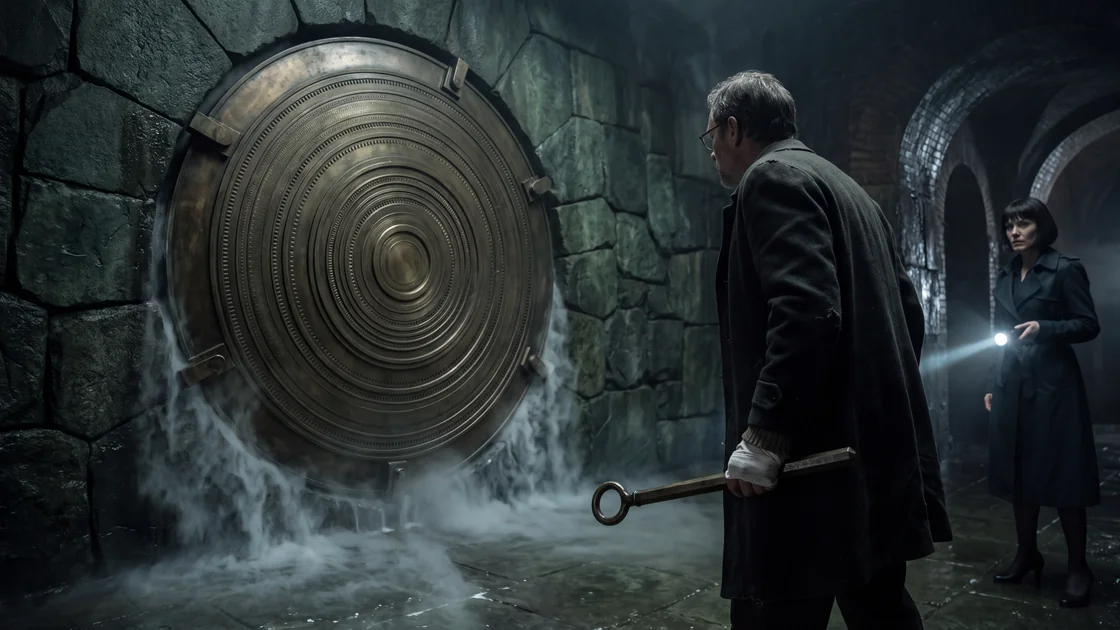
When Arthur Pym, a debt-ridden senior curator at London’s Holburne Institute of Antiquities, purloins an uncataloged bronze rod from the neglected bequest of an eccentric occultist, he imagines selling it to a private collector to clear his sister’s medical debts and save himself from professional ruin; instead, he discovers that the ancient, tarnished implement shifts its geometry to open any physical or conceptual barrier it touches, dragging him from the quiet corridors of academia into a clandestine underworld of competing secret societies, impossible vaults, and the terrifying metaphysical truth behind why humanity began locking doors in the first place.
Act I: The Catalog of Forgotten Things
The basement archives of the Holburne Institute smelled primarily of vinegar and crushed limestone. It was an aroma Arthur Pym had inhaled five days a week for twenty-four years, an atmosphere thick enough to coat the palate, tasting faintly of gypsum and dead centuries. To the trustees on the fifth floor, who sat around a mahogany table beneath oil portraits of men with muttonchops and mutton-headed expressions, the basement was simply a ledger entry: Sub-level 3, Long-term Storage, Non-circulating. To Arthur, it was a mausoleum for things the world had deemed too obscure to admire, too redundant to display, or too unsettling to understand.
Arthur was fifty-one, though his spine felt several decades older. His cardigan, charcoal wool with frayed leather buttons, was perpetually powdered at the elbows with white dust from storage crates. He held a grease pencil between his teeth and turned a heavy cardboard box labeled Bequest of H. R. Vane, Esq. (1911)—Unsorted Metalwork under the stark tungsten lamp of his workbench.
Harlan Ross Vane had been one of those late-Victorian eccentrics who combined vast inherited coal wealth with an unwholesome enthusiasm for the Levant, illegal excavations, and private printing presses. When Vane dropped dead of apoplexy in an Alexandrian opium den, his sister had shipped forty-two zinc-lined crates to the Holburne to clear the estate tax. The institute had unpacked seven, found mostly broken Roman oil lamps and late-Byzantine horse harnesses, and shoved the remaining thirty-five into the vault beneath the drainage main.
That had been ninety-eight years ago.
Arthur checked his pocket watch—an inexpensive nickel Elgin that ran four minutes slow every afternoon. It was 8:14 PM. The night watchman, a retired boilermaker named Higgins whose knees announced his approach twenty yards in advance, would not pass the western cage until nine.
Arthur’s hands shook slightly as he lifted the box’s lid.
The tremor was not caused by scholarly excitement. It was caused by three letters folded inside his breast pocket, each printed on the heavy, cream-colored bond paper favored by the finance department of St. Jude’s Private Convalescent Home in Sussex. The most recent carried an ink stamp in red: FINAL NOTICE PRIOR TO DISCHARGE OF PATIENT. His sister, Clara, had not recognized him in eighteen months, but she still needed clean sheets, three daily doses of chlorpromazine, and a nurse to turn her so the bedsores did not turn gangrenous. The monthly fee was four times Arthur’s salary as Senior Assistant Keeper of Unclassified Antiquities. He had sold his grandfather’s books, his flat in Camden—moving into a damp bedsit above an upholstery shop in Kentish Town—and, two weeks earlier, had surrendered the small gold signet ring his father had given him for his matriculation at Durham.
There was nothing left to sell except what did not belong to him.
Inside the crate lay nestings of wood wool, brittle and yellow as dried bone. Arthur brushed it aside, coughing into the crook of his elbow. Beneath lay three cast-iron door knockers, five corroded spear points from some forgotten Ottoman skirmish, a lead curse tablet folded like a pastry, and, wrapped in greased butcher paper that had rotted into lace, a heavy, dark object roughly the length of a butcher’s knife.
Arthur picked it up.
It was bronze, but bronze of an extraordinary, unpleasant density. It weighed easily four pounds—far too heavy for its volume, which was no larger than a piece of domestic kindling. The surface was mottled with dark verdigris, not the bright turquoise of coastal copper, but the greasy, black-green crust of metal that had spent centuries submerged in foul mud or bilge.
It had no maker’s mark, no stamp of a foundry, no decorative filigree. At one end, it was shaped into a simple, thick ring, wide enough to slip three fingers through. From this ring extended a shaft—not round or square, but heptagonal, its seven narrow facets cold against his calloused palms. Along the shaft, twenty-one small, irregular notches had been cut, not with a file, but as if pressed into the bronze while it was as soft as wax. At the terminal end, instead of a blade or a point, the metal broadened into a spade-like tongue, perforated by three square holes.
Arthur held it under the magnifying lamp.
"Votive rod," he muttered to himself, the professional instinct firing automatically against his mounting panic. "Late Hellenistic or Levantine. Syncretic. A symbolic key, perhaps. Cult of Hecate? Or a temple bar."
He pulled the ledger toward him, dipping his steel-nibbed pen into the black ink. He hovered above the page.
Item 1911-V-84: Bronze implement, cast, unknown provenance. Approx. 32 cm. Decorative or ceremonial.
If he wrote it down, it entered the registry. Once in the registry, it had a soul in the eyes of the Institute; it had a number, a card in the drawers upstairs, a duplicate entry in the microfiche at the University of London. If it disappeared after that, there would be an inquiry. Higgins would be questioned. The locks would be changed. Arthur would be searched.
If he did not write it down...
The crate had sat unopened since the year George V was crowned. No living human being knew this piece of bronze existed.
Arthur closed the ledger. His heart beat with a dry, papery flutter against his ribs, like an owl trapped in a chimney.
He took a clean rag, wiped the loose dust from the shaft, and slid the bronze rod into the deep internal poacher’s pocket he had sewn into his overcoat three winters ago. The weight pulled the left side of the coat down immediately, distorting the cut of the wool, dragging at his collar like a heavy stone.
He replaced the lid on the crate, pushed it back against the damp brick wall, switched off the desk lamp, and stepped into the corridor just as the distant, rhythmic squeak of Higgins’s right shoe rounded the corner from the bone archives.
Act II: The Anatomy of Tumblers
Arthur’s bedsit in Kentish Town was accessible by a narrow exterior staircase of rusted iron that vibrated whenever a lorry rumbled down the high street. The room was furnished with an iron cot, an electric radiator that smelled of scorched dust, and a monumental mahogany roll-top desk he had bought for four pounds from a liquidator in 1982.
The desk had a central drawer that had been locked since the day he bought it. The liquidator had lost the key, and Arthur, lacking the patience or the tools to force the brass plate, had simply used the side drawers, leaving the center sealed. For nineteen years, it had remained shut, an immovable, stubborn square of figured veneer.
He set his briefcase on the table, took off his coat, and extracted the bronze rod.
In the yellow glare of the bare sixty-watt bulb, the artifact looked even less impressive than it had in the institute’s basement. It was dirty, crude, and smelled faintly of wet coal and old river water.
"A private collector in Munich," Arthur whispered to the empty room, rubbing his temples where a dull, throbbing headache had taken root. "Dr. Bauer. He buys unprovenanced bronze. He doesn't ask for export permits. Three thousand pounds. Maybe four. Enough for two months of St. Jude's. Enough to breathe."
He set the rod down on the desk.
The terminal tongue of the bronze clinked against the brass escutcheon of the locked center drawer.
The sound was not the dull strike of metal against metal. It was a sharp, musical ping, like a tuning fork struck against crystal.
Arthur paused. He looked down.
The tongue of the rod—a flat, three-holed spade of bronze at least an inch wide—was touching the keyhole of the desk drawer. The keyhole was a narrow, Victorian vertical slot, less than an eighth of an inch across.
Yet, as Arthur watched, the metal of the bronze rod seemed to shudder.
It was not an optical illusion born of his tired eyes, nor was it the vibrating stairs outside. The bronze did not bend; it did not melt. Rather, the space around the tip of the rod appeared to compress, the dark green verdigris rippling like oil on the surface of warm broth. The spade end slipped into the keyhole.
It did not fit it; it occupied it. It passed into the narrow slit as though the brass plate were made of warm grease.
Arthur jerked his hand back, gasping.
The rod remained suspended, horizontal to the floor, protruding from the locked drawer like a crank handle.
For a full minute, Arthur did not move. The electric radiator ticked. Down in the street, an engine sputtered, backfired, and died.
He stepped forward, his mouth dry, his palms slick. He reached out with two fingers and touched the heptagonal shaft. It was no longer cold. It was skin-warm, humming with a vibration so high and delicate it felt like the buzzing of a wasp’s wing trapped against glass.
He took the ring in his palm, his three fingers sliding naturally into the loop, and turned it.
There was no resistance. None of the grating, stiff scrape of century-old steel levers sliding against oxidized springs that one would expect from an antique lock. Instead, Arthur felt something inside the wood—and inside the floorboards beneath him, and inside the air of the room—align. It was the physical sensation of a heavy weight tumbling across a balance point.
Clack.
The sound was heavy, deep, and resonant, like a stone slab settling into a trench.
Arthur pulled gently.
The center drawer slid open smoothly on runners that had been glued with dust for two decades.
Inside lay three steel nibs, a dried cake of carmine watercolor, a bone-handled letter opener, and a bundle of letters tied with black seam binding, their envelopes stamped with postmarks from Bombay, dated 1894.
Arthur did not look at the letters. He looked at the bronze rod.
He drew it backward out of the keyhole. The spade end slipped from the narrow slot with a wet, sucking sound, entirely whole, its three square perforations intact, its dark, crusted patina undisturbed. It was wide, blunt, and impossible. It could not have entered that hole any more than an oar could enter a needle’s eye.
"A bypass," Arthur whispered, his voice cracking. "A skeleton... no. That's absurd. The mechanical tolerances are impossible."
He looked at his front door.
The door of the bedsit was three-ply plywood over pine, hung on cheap butt hinges, secured by a modern, five-pin cylinder rim lock—a standard brass Yale lock installed by the landlord after a burglary in the winter of 1996.
Arthur walked to the door. He turned the thumb-turn to throw the bolt. The door was locked. He checked it twice, pulling the knob against the frame until the jamb rattled.
He raised the bronze rod.
The tip of the bronze spade was at least four times larger than the curved, paracentric keyway of the Yale cylinder. He brought the spade against the plug.
The moment the bronze touched the brass, the cylinder didn't resist. The metal parted, or rather, the keyway dilated—not physically, for the brass face did not tear, but the void within the lock widened to receive the bronze. The heptagonal shaft slid in to the fourth notch.
Arthur turned his wrist.
The cylinder rotated. Inside the mechanism, Arthur could feel the five brass pins—normally driven down by tiny spiral springs to catch the shear line—retracting. But they did not merely lift; they dissolved their tension entirely, yielding to the bronze like water giving way to a diving bird.
The spring bolt snapped back into the casing.
The door swung inward into the drafty hallway.
Arthur stood in the doorway, staring down the dark, carpeted stairs toward the street door below, his heart hammering against his ribs like a sledge on soft earth.
"Any lock," he whispered.
He pulled the key back out. The lock remained undamaged. The brass plug sat in its housing, pristine and blank, waiting for its five-cut serrated steel key.
He closed the door, threw the latch, and sat on the edge of his cot, holding the bronze implement between his knees with both hands, staring at it until the grey light of dawn turned the soot-stained window the color of watered milk.
Act III: The Logic of the Open Gate
To understand Arthur Pym, one must understand that he was not an adventurous man. He did not possess the iron nerve of a burglar or the grand, predatory imagination of a conqueror. He was a clerk who had spent thirty years learning to distinguish between eleventh-century Northumbrian minuscules and ninth-century Carolingian script. His mind was built of indices, cross-references, provenance chains, and conservation protocols.
Therefore, when presented with an object that violated the fundamental laws of classical mechanics, his first impulse was not to rob the Bank of England, but to classify the phenomenon.
On Tuesday night, wearing his oldest mackintosh and a flat tweed cap pulled low over his spectacles, Arthur walked.
He took the Northern Line to Camden Town, his hand shoved deep into his pocket, his fingers wrapped tight around the seven facets of the rod. He walked past the canal locks, through the reeking alleys behind the market where crates of rotten cabbage lay waiting for the morning refuse carts, and stopped before the rear entrance of a Victorian electrical substation.
The door was sheet iron, secured by an industrial Chubb battleship padlock—a monster of drop-forged steel, four inches wide, with a boron-alloy shackle as thick as a thumb. It was designed to withstand four tons of hydraulic shearing force and ten minutes of direct attack with an oxyacetylene torch.
Arthur looked left, then right. The alley was empty, save for an orange tomcat rooting through a spilled grease-can.
He pressed the spade of the rod against the narrow key slot of the Chubb.
The same musical chime echoed softly in the damp air. The bronze slid into the hardened steel as though it were warm tallow. He turned the ring thirty degrees clockwise.
There was no sound of tumblers falling. Instead, there was a deep, hydraulic sigh. The massive curved shackle leaped from its housing with such violence that it nearly jumped from Arthur’s fingers.
He did not open the door. He didn't care about the high-voltage transformers humming inside. He pushed the shackle back into the padlock. It clicked shut. He touched the rod to the slot again, turned it counter-clockwise, and felt the internal levers lock down with an authoritative, definitive thud. The lock was once again impenetrable.
He moved on.
At 2:15 AM, he stood outside the Church of St. Jude the Martyr in Kentish Town—the church where his sister had been baptized, and where the crypts had been closed since the cholera outbreak of 1854. The crypt entrance was an angled set of double doors of English oak, six inches thick, strapped with rusted wrought iron and bound by a horizontal chain with links like ship’s cable, secured by an old screw-thread padlock from the early Regency period.
Arthur knelt in the wet nettles. The rain had begun, a cold, needle-like drizzle that misted his spectacles.
He touched the rod to the Regency screw-lock. It turned. The chain slithered to the wet flags like a dead adder.
He pulled the oak doors open an inch. The smell that billowed out was terrifying: wet lime, earth that had not tasted air since Victoria was a girl, and the sweet, greasy reek of lead coffins that had cracked under the settling of the foundations.
He did not enter. He locked the chain back, his breath coming in ragged white plumes.
Then came the third test—the test that broke the hypothesis of mechanical manipulation.
Two streets over, behind an empty greengrocer’s shop, sat a modern commercial waste container—a dumpster. The lid was held down by a common steel cable with a plastic-coated, five-dial combination lock. There was no keyhole. No cylinder. No ward. Only five rotating rings of stamped aluminum, each bearing the digits zero through nine.
Arthur stood in the rain, staring at the five numbers: 7-2-4-1-9.
He held the bronze rod.
"There is nowhere for you to go," Arthur said aloud, his voice trembling in the dark alley. "You are an instrument of levers. You are a key. You require an aperture."
The rod did not answer, but the weight of it in his hand seemed to alter, shifting its center of gravity toward the spade end.
Arthur hesitatingly pressed the blunt bronze spade not against a keyway, for there was none, but directly against the seam where the two halves of the brass casing met around the five dials.
The bronze did not penetrate. But as it touched the seam, the five dials began to spin.
They did not spin freely, as if brushed by a hand. They spun with terrifying, frantic speed, a blur of silver metal humming like a small turbine. Then, one by one, with the speed of a machine-gun bolt:
Click. Click. Click. Click. Click.
The dials locked into place: 0-0-0-0-0.
The cable popped open.
Arthur stepped back, his boots splashing into a puddle of greasy water. He was trembling so hard that his knees knocked together beneath his mackintosh.
It was not a key.
A key is a tool designed to match a specific arrangement of obstacles within a specific mechanical gate. It is a passive participant in a lock’s architecture.
This thing was not a key. It was an injunction.
It did not solve locks; it commanded them. It did not care whether the lock was a tumbler, a ward, a lever, a pin, a disc, a combination, or a chain. It was an assertion of entry against which the very concept of closure could not maintain its integrity.
Arthur looked down at his right hand. The skin of his fingers where they had touched the heptagonal shaft was stained with faint, yellowish-green rings—the copper salt leaching into his pores. He wiped his hand against his coat, but the mark did not come off. It smelled of old copper and ozone, the smell of air after a lightning strike on an open marsh.
He thought of Clara’s hospital bill.
He thought of the Holburne Institute’s director, Sir Reginald Thorpe, who had that very morning informed Arthur that the curatorial pension fund had suffered a twelve percent "downward adjustment" due to investments in Argentine railway stock that had failed to materialize.
He thought of the vault beneath the Bank of Scotland on Threadneedle Street.
And then, with a sick, cold hollow opening in the bottom of his stomach, he thought: If this can open what men have closed, what was it made to keep shut?
Act IV: The Threshold of Threadneedle
The decision to become a criminal is rarely a dramatic plunge; it is usually a slow, damp descent down a series of shallow steps.
Arthur did not go to Threadneedle Street. He lacked the nerve to walk into a central London clearing bank with a magic wand in his mackintosh. Instead, he went to a place he knew with the intimacy of a man who had spent his life among the possessions of dead men: the private depository of the Duke of Cumberland’s Trust on Greek Street in Soho.
The Trust was an anachronism—a private, five-story Georgian townhouse converted in the 1890s into a high-security storage facility for the aristocratic families of Mayfair and Belgravia who did not trust the modern joint-stock banks. It held family plate, unlisted bonds, the jewelry of mistresses, and the correspondence of cabinet ministers who had misbehaved in Paris.
Arthur knew it because the Holburne had, in 1974, surveyed the Trust’s collection of Stuart-era charters. The vaults were located in the double cellars beneath the street, protected by an outer gate of wrought iron, an inner door of laminated manganese steel built by Milner’s of Liverpool in 1898, and an electric contact alarm connected to the local police station in Bow Street.
It was 3:40 on a Thursday morning when Arthur slipped down the basement area steps of Greek Street.
He wore his best dark suit, now filthy at the knees, and carried an umbrella to appear like an eccentric civil servant caught in the night rain. His heart was no longer racing; it had entered a state of dull, rhythmic thudding that felt almost mechanical, like the engine room of a coal barge.
The outer gate’s lock—an eight-lever mortise lock of massive proportions—opened with a turn so light it felt as though Arthur were turning a stick through warm milk.
He pulled the gate shut behind him, stepping into the dead, unventilated air of the outer cellar.
Ahead lay the Milner door. It was an iconic piece of late-Victorian security engineering: a circular slab of steel eight inches thick, painted dark bottle-green with gold leaf pinstriping around the circumference, its massive central wheel connected to four horizontal and four vertical sliding bolts four inches in diameter. At its center sat two keyholes, each designed for a twelve-inch steel pipe-key, requiring two separate key-holders to turn simultaneously.
On the wall to the left of the door sat a small, mahogany box with a bevelled glass window: the alarm contact. A circuit of copper ribbon ran from the frame into the jamb. If the door opened without the alarm being shunted with a special three-pronged plug, the drop-relay inside would trip, sending twenty-four volts of direct current through the telegraph line to Bow Street.
Arthur did not have the three-pronged plug.
He walked to the alarm box.
The box was locked with a tiny, brass Bramah lock—a jewel of eighteenth-century micro-mechanics, its circular barrel containing seven sliding steel vanes.
Arthur touched the bronze spade to the Bramah lock.
The rod’s heptagonal shaft seemed to stretch, narrowing itself until the terminal tongue clicked into the tiny circular slot. Arthur turned it.
Inside the mahogany box, the clockwork mechanism did not trip. Instead, the brass arm of the relay simply stayed frozen in the up position, suspended by some unseen tension, though the balance spring had been released.
He pulled the rod back. He turned to the Milner door.
This was the test. A door of twenty tons of laminated steel.
There were two keyholes. Arthur had only one rod.
He stepped to the left keyhole. He inserted the rod.
It went in to the seventh notch.
He turned the ring.
A deep, groaning vibration passed through the iron plate beneath his feet. Far back inside the massive steel sandwich of the door, four of the eight massive sliding bolts withdrew into their housings with a subterranean boom that rattled Arthur’s teeth in their sockets.
He withdrew the rod. The door was half-open, mechanically speaking; the right-hand bolts were still fully extended into the stone masonry of the wall.
He moved to the right keyhole.
He inserted the rod.
Before he could turn it, the heptagonal shaft in his hand began to grow cold.
Not the cool dampness of the basement, but an arctic, devouring chill that made the moisture on his palms freeze instantly to the bronze. A thin crust of white rime blossomed across the verdigris, spreading down the shaft toward his fingers.
Arthur cried out, trying to pull his hand away, but the skin of his palm was stuck to the frozen metal.
From deep within the keyhole—from the very center of the twenty-ton door—came a sound that was not the sliding of bolts.
It was a voice.
It was not a human voice speaking words in English, Latin, or Greek. It was the sound of a voice spoken through stone, muffled as though coming from the bottom of an ocean trench, a rhythmic, guttural chanting that had the cadence of an inventory:
"...the door of the cattle-pen, shut. The door of the sheep-fold, shut. The gate of the city wall, shut. The lips of the dead man, shut. The eye of the salt pit, shut. Who commands the unfastening? Who brings the iron against the seal?..."
Arthur pulled with all his strength, tearing the skin of his palm, leaving a red, weeping smear on the frost-whitened bronze ring.
The rod did not come out.
The second set of bolts was not retracting. They were creeping out. The steel wheel on the front of the door was spinning on its own, not unlocking, but driving the bolts deeper into the stone, crushing the mortar, groaning under a force that was bending the four-inch steel rods like willow twigs.
The door was not simply locked. It was trying to fuse itself to the earth.
"Who unfastens what was bound?" the voice whispered, rising now from the floorboards, from the brick walls, from the damp mortar between the stones of Greek Street.
Arthur lunged forward, ignoring the searing pain in his torn palm, grabbed the ring with both hands, and twisted it counter-clockwise—not toward Open, but toward Shut.
He turned it with the desperate, frantic strength of a drowning man trying to turn an air valve.
The bronze resisted. It felt as if he were trying to twist an axle connected to a locomotive flywheel. His shoulders screamed with strain; the seams of his mackintosh tore under the armpits.
"Close!" he choked out, his spit spraying the green-painted steel. "Close, damn you!"
CLANG.
The Milner door snapped shut with the force of an artillery piece firing. The shockwave knocked Arthur flat on his back against the damp flagstones.
The bronze rod leaped from the right keyhole, cartwheeling through the air, and landed with a dull, heavy splash in a pool of standing drainage water near his boots.
Silence returned to the cellar.
It was total. The hum of the street above, the distant rumble of the night mail trains from Euston, the drip of water—all of it seemed to have been snuffed out, as if the room had been dropped to the bottom of the North Sea.
Arthur lay on the cold stone, chest heaving, his right palm a raw, bleeding stripe where the frost had ripped away the epidermis.
Beside him, in the puddle, the bronze rod was steaming.
The water around it was boiling, tiny grey bubbles rising from the heptagonal shaft, smelling not of steam, but of old, dried blood and wet copper.
Act V: The House of the Clauditores
He did not go back to his bedsit.
He knew, with the ancient, instinctive paranoia that lives in the hindbrain of every archivist, that something had noticed him. The voice in the door had not been a mechanical echo. It had been an interrogation.
By dawn, Arthur was sitting in the corner booth of an all-night Lyons Corner House near Charing Cross, his right hand wrapped in a dirty linen tea towel he had stolen from his landlady's drying line. The bronze rod lay inside his briefcase, wrapped in three layers of greasy greaseproof paper and two wool scarves, resting between his shins like an unexploded mortar shell.
Across the formica table sat a mug of chicory-heavy coffee he had not touched.
"Arthur."
The voice was light, dry, and precise.
Arthur jerked his head up.
A woman had slid into the booth opposite him without making a sound. She was perhaps forty, with sharp, bird-like features, pale grey eyes that did not seem to blink with normal frequency, and dark hair cut in a severe, practical bob that had gone out of fashion sixty years earlier. She wore an expensive, charcoal-grey trench coat of gabardine, unbuttoned to reveal a high-necked white blouse secured at the throat by an unusual brooch: an iron padlock, no larger than an almond, depicted with its shackle snapped in two.
"You have been making an unforgivable amount of noise," she said.
Arthur reached down toward the handle of his briefcase.
"I wouldn't," she said, her voice dropping an octave. Her hands remained on the table. Her fingers were long, thin, and the tips of her thumbs were marked by thick, calloused pads, like those of an archer or a safe-cracker. "If you open that clasp in here, every lock in Charing Cross will trip its tumbler within five seconds. The till behind the counter will eject its drawer into the waitress’s apron. The safe in the manager’s office will spit its door across the carpet. And the two men sitting in the Morris Minor outside will come through that window with heavy canvas sacks."
Arthur withdrew his hand from the briefcase. "Who are you?"
"My name is Vance. Evelyn Vance. Officially, I am an archivist for the British Steel Corporation’s historical holdings. Unofficially, I belong to an organization that has had eighty-four different names since the reign of Diocletian, none of which look particularly well on a business card."
"The Holburne..." Arthur began.
"The Holburne knows nothing," she interrupted. "Sir Reginald Thorpe thinks you have taken a leave of absence to tend to your sister’s decline. We arranged that this morning. We paid the St. Jude arrears, by the way. Two quarters in advance. The account is clean."
Arthur felt a sudden, terrifying rush of cold relief that felt almost like nausea. "Clara?"
"She is asleep. She had an orange with her breakfast. She is quite well, Arthur, provided you do not do something monumentally stupid with the implement beneath your feet."
Arthur leaned back against the red vinyl booth. His spectacles had slid down his nose; he pushed them back with a trembling, bandaged hand. "It isn't a key. I thought it was a skeleton key. Some kind of Roman pneumatic... but it isn't."
"No," Vance said, waving two fingers at the waitress to indicate they did not want menus. "It is not a key. A key is a tool of access. What you have in that case is the Opener of the Ways. In the records of the Vatican secret archives, it is cataloged as the Clavis Clauditorum. The Key of the Shutters."
"The Shutters?"
"Tell me, Arthur—you’re a historian. What is the oldest lock ever discovered?"
Arthur blinked, his academic training momentarily overriding his terror. "Khorsabad. The palace of Sargon II. Eighth century BC. Pin-tumbler lock made of wood."
"Correct," Vance said, nodding once. "And why did Sargon build it?"
"To protect his storehouses. His grain. His women."
"Nonsense," she said coldly. "Men have had grain and women since the Pleistocene, and they protected them with spears, dogs, and brothers. You do not spend three tons of cedar and forty pounds of bronze pins to keep out a hungry peasant. You build a lock when there is something on the other side of the door that you do not want to let out—or when there is something outside that cannot be stopped with a spear."
She leaned forward across the formica. Her eyes, Arthur noticed, were flecked with tiny brown spots around the pupil, like rusted iron shavings in water.
"In the third millennium before Christ, humanity discovered that the world is porous," she said. "There are spaces between things. Places where the skin of what we call here is no thicker than the skin on boiled milk. Things lived in those spaces. Things that do not possess bodies, but possess appetites. They do not walk through walls; they walk through openings. A doorway is an invitation. A gate is a wound in the continuity of stone."
Arthur listened, his tea-towel-wrapped hand throbbing with every beat of his heart.
"The first lock was not an invention of carpentry," Vance continued. "It was an act of metaphysical quarantine. The bolt is an iron bar across a rupture. The tumblers are an oath. When you close a lock, you are not merely engaging a mechanical catch; you are asserting that this space is separate from that space. You are creating an absolute boundary in a universe that despises boundaries."
"And the rod?" Arthur whispered.
"The rod is the denial of the boundary," she said. "It was cast in Ur, during the reign of Shulgi, from bronze that had been quenched in the blood of thirty-seven executed gate-keepers. It was designed to undo the work of the Great Closure. It is a master key, yes—not because it is clever, but because it carries the authority of the original, unformed Chaos. To the Clavis, there is no such thing as inside and outside. There is only the void, which cannot be locked."
Arthur looked down at his briefcase. "Why did Vane have it?"
"Harlan Ross Vane was an idiot," Vance said with venomous calm. "He thought it was an amulet of Nergal. He kept it in a box with some stolen Roman buckles because he didn't know how to wake it. You woke it, Arthur. You woke it because you were desperate. The Clavis does not answer to curiosity. It answers to need. The need to cross what cannot be crossed."
"Take it," Arthur said suddenly. He pushed the briefcase forward with his shins. "Take it back. Pay for Clara. Take it and throw it into the Atlantic."
Vance smiled—a thin, bitter line that didn't reach her pale eyes.
"We cannot take it, Arthur."
"Why not?"
"Because it has touched your bone," she said, pointing a finger at his bandaged hand. "You held it when it struck the Milner door. You heard the inventory, didn't you?"
Arthur felt the skin of his scalp prickle. "Who unfastens what was bound?"
"The Clauditores—the Shutters—have maintained sixty-four Great Seals across this continent for two thousand years," Vance said. "Vaults beneath Paris, beneath Rome, beneath the salt mines of Cheshire. Places where the things that were put away when the world was young are kept behind stone twelve cubits thick, bound by locks that have never been turned since the day they were oiled with the fat of consecrated bulls."
She reached into her trench coat and pulled out a small, black-and-white photograph, sliding it across the table.
The photograph showed a circular stone archway set into a wall of cyclopean granite masonry, somewhere deep underground. The arch was filled not with a door, but with a massive disc of dull, greenish bronze, covered in hundreds of tiny, raised notches—identical to the notches on the heptagonal shaft of the rod in Arthur’s case.
At the center of the bronze disc sat a single, heptagonal hole.
"Where is this?" Arthur asked.
"Beneath the foundations of the Tower of London," Vance said. "Sub-cellar D. Four levels below the Traitor’s Gate, beneath the reach of the tide. The lock on that door has not been inspected since 1649. Two hours ago, when you forced the Milner door in Greek Street, the outer ring of that disc turned three inches."
Arthur went white. "I closed it. I turned it back."
"You turned it back against the Milner door," she said. "You did not turn it back against the world. Every time the Clavis is used to force a threshold, the tension in the Great Seals slackens. It is a hydraulic system, Arthur. You pump the lever here, and a piston rises fifty miles away. The seal beneath the Tower is weeping salt water. The ravens on the green have been killing their young since midnight."
She picked up the photograph and returned it to her pocket.
"You have two choices, Mr. Pym. You may walk out of this Corner House with that case. You will be dead before you reach Leicester Square. Not because we will kill you, but because the things that are smelling the air through the slackened seals are already tracing the scent of that bronze. Or you may come with me, take the rod to the Sub-cellar, and seat it in the central hub."
"To open it?" Arthur gasped.
"No," Vance said, her eyes flashing like cold flint. "To strike the last tumbler. The lock was never completed. In 1649, the regicides killed the only man in England who knew the sequence of the twenty-one notches. The seal has been resting on a hair-trigger for three centuries, held shut only by the weight of the bronze."
She stood up. The gabardine coat fell straight and stiff around her shins.
"You are going to lock it, Arthur. You are going to take the tool that opens every door in the world, and you are going to use it to close the one door that must never be unfastened."
Act VI: The Anatomy of Sub-Cellar D
The route to Sub-cellar D did not pass through the ticket booths of the Tower of London, nor through the vaulted stone archways where Yeoman Warders in Tudor uniforms posed for German tourists.
It began in an abandoned pump-house belonging to the Metropolitan Water Board, situated behind a scrap-metal yard in Wapping. Inside the pump-house, beneath a rusted cast-iron floor-plate that required the bronze rod to release its seized dog-bolts—a process that made Arthur’s teeth ache with that same hydraulic groan—lay a vertical brick shaft sixty feet deep, fitted with an iron ladder whose rungs were slick with sewage slime.
Arthur climbed down in the dark.
Vance climbed below him, her movements methodical, silent, and swift. Above them, two men in dark boiler-suits—the men from the Morris Minor—closed the floor-plate, cutting off the grey daylight of London with the finality of a spade dropping dirt into a grave.
At the bottom of the ladder lay a tunnel.
It was not a modern tube tunnel of circular cast-iron rings, nor was it a Victorian brick sewer. It was older. The walls were made of small, flat Roman tiles laid in mortar that had turned as hard as basalt, bound together with pozzolanic cement that smelled of sulphur and dead river-mud.
Every twenty yards, Arthur saw small, rectangular niches carved into the tile. In each niche sat an object: a rusted iron key, a broken padlock shackle, a lead seal stamped with the image of a two-headed dog, or a flat river-stone wrapped in copper wire.
"The Stations of the Bolt," Vance said, her flashlight beam cutting through the damp, drifting fog. "Every custodian who has served this tunnel since the reign of Constantine has left a token of closure. A reminder to the stone that it is meant to be a wall."
Arthur walked with his briefcase clutched to his chest with both arms. His bandaged right hand was throbbing with a dull, rhythmic heat, the pain shooting up his forearm to his elbow. He could feel the bronze through the leather, through the greaseproof paper, through the wool. It was no longer cold.
It was hot.
It felt like a baker’s peel fresh from an oven, radiating a dry, prickling heat that made the hair on his forearms stand up.
"It knows where we are," Arthur whispered.
"Of course it knows," Vance said without turning around. "You are bringing the key to the lock. The lock is a vacuum; the key is the pressure. They have been trying to find each other since the foundation stones of the White Tower were dragged from Caen."
They reached a set of steps—three dozen narrow, irregular slabs of limestone worn into smooth troughs by centuries of leather-shod feet.
At the bottom of the stairs, the tunnel opened into an octagonal chamber thirty feet across.
The architecture was unlike anything Arthur had cataloged in his three decades at the Holburne. It was not Roman, not Norman, not Saxon. The stones were enormous, irregular polygonal blocks of Cornish greenstone, fitted together without mortar with such precision that Arthur could not have slipped a single sheet of Bible paper between the joints.
In the center of the opposite wall sat the disc from the photograph.
In person, it was terrifying.
It was nine feet in diameter, cast from the same greasy, dark-green bronze as the rod in Arthur’s hands. Its surface was not flat; it was slightly convex, bulging outward into the room like the lens of a great, blind eye.
The disc was divided into three concentric rings, each covered in thousands of tiny, chisel-cut notches. Along the outer edge, sixty-four heavy bronze sliding dogs, each as thick as a horse’s leg, projected into deep sockets cut into the polygonal greenstone.
Forty of the dogs were fully seated.
Twenty-four of them had withdrawn three inches from their sockets.
From the gaps around the edges of the bronze disc came a sound that made Arthur stop at the base of the stairs, his boots frozen to the limestone.
It was the sound of an ocean beach at night, when the tide drags millions of tiny pebbles back down the shelf—a wet, rattling, endless shhhhh-clatter, shhhhh-clatter. But there was no water. The air was dry, hot, and smelled powerfully of cinnamon, ammonia, and burning hair.
"It’s breathing," Arthur said.
"The pressure is rising," Vance replied. Her voice had lost its dry, bureaucratic chill; for the first time, Arthur heard a sharp, brittle tremor in her throat. "The Greek Street door was an anchor. When you shook it, you slipped three of the lower dogs. Look."
She pointed her flashlight at the center of the disc.
There, in the middle of the inner ring, sat the heptagonal hole.
It was not empty.
Broken off flush with the surface of the bronze sat the stump of an iron rod. It had been sheared off with tremendous violence; the metal of the stump was twisted like a stick of pulled sugar, its center rusted into a dark, crumbly red.
"The regicide," Arthur whispered. "1649."
"Thomas Chaloner," Vance said, her light steadying on the broken stump. "He was one of the King’s judges. He was also our Grand Prior. When Cromwell’s men broke into the Tower mint to seize the bullion reserves, they didn't know what was down here. Chaloner came down alone to ensure the seal was secured. He found the inner ring slipping. He tried to force the bolt home with the secondary key—an iron surrogate. The surrogate wasn't strong enough. The torque snapped it."
She turned to Arthur. Her face in the harsh beam of the flashlight was as white as parchment, the skin pulled tight over her cheekbones.
"The surrogate was iron. It rusted. The bronze of the Clavis does not rust. The Clavis is the original pin. It was made to seat into the hub, pass through the core of the disc, and drive the seven central sprags into the living bedrock beneath the river."
"And if it doesn't?" Arthur asked.
The disc answered for her.
With a sound like an iron bridge buckling under a train, the outer bronze ring jumped.
It did not move three inches. It moved six.
Three more of the massive bronze dogs slid out of the greenstone masonry with a screech that made Arthur drop his briefcase. He clapped his hands to his ears as the sound tore through the octagonal chamber, vibrating through the bones of his skull until his vision blurred.
From behind the disc, the wet, pebble-dragging sound stopped.
In its place came a silence so total that Arthur could hear the blood rushing through his own carotid arteries.
Then, from the dark seam where the dogs had withdrawn, something emerged.
It was not a claw. It was not a tentacle. It was a vapor—a thick, grey-white ribbon of mist that did not rise toward the ceiling, but flowed down the face of the bronze disc like cold milk poured into a bowl. It smelled of things that had never seen the sun: blind fish in cavern pools, wet slate, and the terrible, flat sweetness of stagnant honey.
Where the milk-colored vapor touched the floor, the ancient greenstone didn't crack.
It smoothed.
The joints between the stone blocks—joints that had stood for three thousand years—simply ceased to be. The stone became a single, glassy, featureless plane, its structure undone, its boundaries erased, its identity as an assembly of blocks wiped clean.
"Arthur," Vance said. Her gun was out—a small, blue-steel Walther automatic—though her hand was shaking so badly the barrel wandered across the stone face of the disc. "Arthur, the case. Now."
Arthur did not run.
There was nowhere to run. Behind him lay sixty feet of vertical sewer ladder and three miles of London streets that would, within minutes, begin to lose the ability to tell their inside from their outside. He could imagine it with the terrifying clarity of his trained mind: the walls of the houses melting into the pavements, the doors of the hospitals vanishing into the wards, the cells of the prisons becoming one with the courtrooms, the boundary between the living tissue of his sister’s brain and the pillow beneath her head dissolving into a single, grey paste.
He knelt. He unlatched the briefcase.
He did not use the tea towel. He reached into the greaseproof paper with his bare, weeping, ruined right hand and closed his fingers around the heptagonal shaft of the Clavis.
Act VII: The Unfastening
The moment his skin touched the bronze, the pain stopped.
It did not fade; it was cancelled. His nervous system seemed to detach from his flesh, leaving him with an icy, absolute lucidity that felt less like life and more like the cold geometry of an astronomical table.
He could feel the twenty-one notches along the shaft.
They were not arbitrary cuts. They were teeth. Not mechanical teeth, but logical ones—each notch corresponded to an assertion of limit:
The depth of a grave. The boundary of a field. The skin of a fruit. The wall of a house. The term of a life. The seal of a testament.
He rose to his feet. He did not feel the weight of his fifty-one years, nor the ache in his lumbar spine, nor the exhaustion of the three sleepless nights. He walked across the glassy, smoothed stone toward the nine-foot disc.
The milk-colored mist curled around his boots. It did not feel cold. It felt like nothing—the absolute absence of texture, the void against which no sensation could register.
He stood before the central hub.
The broken stump of the 1649 iron surrogate blocked the heptagonal aperture. It was rusted tight, wedged into the socket by three hundred years of river damp and forty tons of lateral shear from the slippage of the rings.
Arthur did not have a punch. He did not have a cold chisel.
He raised the Clavis.
He did not bring the spade end against the stump. He brought the heptagonal shaft against it, parallel to the bronze disc, and laid the seven facets of the rod against the twisted iron rust.
"Yield," he said.
The word was not loud, but it was spoken with the quiet, devastating finality of a magistrate closing a session.
The iron stump did not break. It did not slide out.
It simply departed.
It ceased to occupy the space within the hole, not falling to the floor, but vanishing into the non-space between the tumblers, as though it had never been mined from the hills of Sussex, never forged in the Tower smithy, never broken in the hand of the regicide.
The heptagonal hole lay empty.
Deep within the core of the disc, Arthur could see seven small, triangular bronze pins protruding into the channel. They were precisely positioned to match the three square perforations in the spade of his rod.
Behind the disc, the voice spoke again.
It was no longer muffled by the Milner door. It was separated from him only by three inches of bronze.
"Opener," it sighed. The voice was sweet, soft, and vast, like the rustling of a million dead leaves across an endless dry lawn. "Drawer of the Bolt. Bringer of the Day. Let the salt come in. Let the cattle leave the pen. Let the ribs of the chest spring wide. Why keep the room small? Why keep the breath narrow? We are the Wide Space. We are the Room Without Corners."
Arthur’s hands did not shake now.
He looked at the spade end of the rod.
He knew what would happen if he pushed it in and turned it clockwise.
He would not merely open the Sub-cellar. He would open everything.
Every bank vault in the City of London would spill its sovereigns and ledgers into the gutters. Every cell in Brixton and the Old Bailey would swing wide. The locks on the poison cabinets in every apothecary would pop their latches; the gates of every cemetery would unfasten; the very cells of his own body would open their membranes to the air, releasing him forever from the small, grey, miserable labor of being Arthur Pym.
Clara would not be sick anymore. She would not be anything. She would be part of the Room Without Corners.
"It is so heavy," Arthur murmured, his eyes reflecting the dull, sickly green of the bronze disc. "Carrying the keys. Remembering the numbers. Paying the quarters. Locking the drawers every night."
"Yes," the sweet, vast voice whispered. "Throw the bolt. Unmake the latch. Let the world rest from its boundaries."
Behind him, from the base of the limestone stairs, came the sound of a dry, choking gasp.
Arthur turned his head.
Evelyn Vance had fallen to her knees. The milk-colored mist had reached her. Where it touched her wool trousers, the grey fabric was not dissolving; it was simply merging with the stone of the floor, her legs losing their separation from the masonry, her skin turning the flat, translucent grey of paraffin wax.
She did not look at him with terror. Her eyes were fixed on the almond-shaped broken padlock brooch at her throat.
Her lips moved, though her vocal cords were already losing their tension, the sound flat and hollow:
"...the gate... of the city wall... shut..."
Arthur looked down at his own bandaged hand.
Beneath the linen, the skin of his palm was marked by the three square perforations of the spade—burned into his flesh by the frost of the Milner door, three red, crusty scars that formed a triangle.
He had spent thirty years in the basement of the Holburne Institute.
He had cataloged eighty thousand objects. Each one had a number. Each one had a box. Each one had a card in a drawer, separated from every other object by a partition of grey millboard, preserved against the damp by its own small envelope of oil-paper.
It was a narrow life. It was a tedious life. It was a life of dust, vinegar, and small, unpaid bills.
But it was a life where a thing was itself.
A Roman oil lamp was not a horse harness. A lead curse tablet was not a ledger. A man was not the stone he knelt upon. And his sister, sitting in her wicker chair in Sussex, staring out at the rain with her dull, vacant eyes, was still Clara—separate, distinct, held together by the frail, stubborn miracle of her own closed skin.
"No," Arthur said.
He did not insert the spade end of the rod.
He reversed it.
He took the spade in his raw, ruined right palm, ignoring the screaming agony of the fresh scars, and aimed the heavy, circular ring of the handle at the heptagonal hole.
It did not fit. The ring was three inches wide; the hole was an inch across.
Arthur did not wait for the metal to yield. He did not ask the key to command the lock.
He threw the entire weight of his shoulder, his hips, and his thirty years of quiet, desperate, stubborn patience into the blow, driving the ring against the stone face of the hub like a mason driving a wedge into slate.
"SHUT!" he roared.
The bronze did not chime.
It broke.
The heptagonal shaft—the tool that had survived the sack of Ur, the burning of Persepolis, and the fall of Rome—did not bend. Under the impact of Arthur’s will, applied not to open, but to deny entry, the seventh notch along the shaft snapped.
The fracture was not a clean break; it was an explosion.
A blinding, violet discharge of static electricity erupted from the core of the rod, throwing Arthur backward across the glassy floor. The air in the chamber cracked with the sound of a thunderbolt striking an iron steeple, a concussion so violent that it blew the dust from the joints of the greenstone blocks seventy feet above them in the London street.
The broken half of the rod—the spade end—shot into the heptagonal hole like a bolt from a crossbow.
It did not slide. It jammed.
It wedged itself into the seven internal sprags, its twenty-one notches catching the teeth of the disc with a frantic, cascading clatter-clatter-clatter-BANG.
The outer bronze ring did not slide.
It slammed back into the greenstone masonry. All sixty-four dogs leaped into their sockets simultaneously, driven by the release of three thousand years of accumulated tension.
The seam was sealed.
The milk-colored mist did not retreat. It died. It evaporated into the dry, hot air of the chamber, leaving behind only the smell of burnt copper, cold river-water, and the sharp, clean scent of crushed limestone.
The silence returned.
It was not the dead silence of the void.
Above them, through eighty feet of earth, tile, and stone, came the faint, unmistakable, beautiful sound of a London red double-decker bus shifting its gears as it rounded the corner onto Tower Hill.
Act VIII: The Inventory of the Closed Desk
The office of the Senior Assistant Keeper of Unclassified Antiquities was cold, but Arthur did not turn on the electric radiator. He liked the smell of the damp limestone; it smelled of things that were staying precisely where they had been put.
His right hand was held in a neat, professional splint of white birch and medical adhesive tape, courtesy of a private surgeon whose bill had been settled by the British Steel Corporation’s historical division.
On the desk sat the ledger: Bequest of H. R. Vane, Esq. (1911)—Unsorted Metalwork.
Opposite him stood Evelyn Vance.
She looked tired. Her trench coat was freshly pressed, but there was a faint, stiff awkwardness to her left knee when she walked, as though the joint remembered being made of greenstone for thirty seconds beneath the river.
"Sir Reginald Thorpe was satisfied," she said, resting her leather-gloved hands on the edge of his desk. "The board accepted your report. The missing item from the Vane bequest was cataloged as a nineteenth-century forgery of a votive staff—lead-weighted bronze, low artistic merit, discarded due to severe core-rot."
Arthur dipped his steel-nibbed pen into the black ink.
"And the foundation beneath Sub-cellar D?" he asked.
"Twelve tons of high-alumina cement," she said. "Poured under fifty pounds of pneumatic pressure. The disc is encased in four feet of concrete. A new electrical substation has been commissioned for the surface site. It will appear on all city maps as an auxiliary switching yard for the District Line."
Arthur nodded. His pen hovered over the page.
Item 1911-V-84: De-accessioned. Disposed of in accordance with conservation protocol.
He blew on the wet ink until the black sheen turned to the dull, velvety grey of dry soot.
"The ring," Vance said, her eyes dropping to his coat pocket. "The other half."
Arthur did not reach for his pocket.
"The shaft broke at the seventh notch," he said, his voice flat, steady, and clear. "The spade is welded into the core. It has no teeth. It has no facets."
"A fragment of that bronze is still a dangerous thing, Mr. Pym."
"A fragment of that bronze is an anchor," Arthur said. He looked up from his ledger, his spectacles reflecting the dull light of the tungsten lamp. "Every door needs a stop, Miss Vance. Otherwise, it’s just a hole in the wall."
She looked at him for a long moment. The grey eyes were no longer flint; they had softened into something resembling the tired respect one old clerk gives another at the end of a seventy-hour week.
"The account at St. Jude’s," she said softly. "The Trust has established an annuity. Clara will have the corner room. The one with the cedar tree outside the window. As long as she lives."
"Thank you," Arthur said.
She turned to go. Her shoes made a sharp, clean, clicking sound on the concrete floor of the corridor.
At the door of the archive, she paused.
"Arthur."
"Yes?"
"Does your desk drawer still open?"
Arthur looked down at the great mahogany roll-top desk. The center drawer sat tight in its frame, its figured veneer flush with the pedestals, the brass escutcheon scratched and empty, showing only the narrow, vertical darkness of the keyway.
"No," Arthur said, and for the first time in twenty-four years, he smiled. "I’ve tried three different picks. The brass has seized completely. I’d have to take an axe to the front to get it open."
"Good," Evelyn Vance said.
She stepped through the doorway, pulled the heavy oak fire-door shut behind her, and Arthur listened with immense, solitary pleasure as the spring-latch dropped into the strike plate with a definitive, immutable clack.