The Memory in the Temper
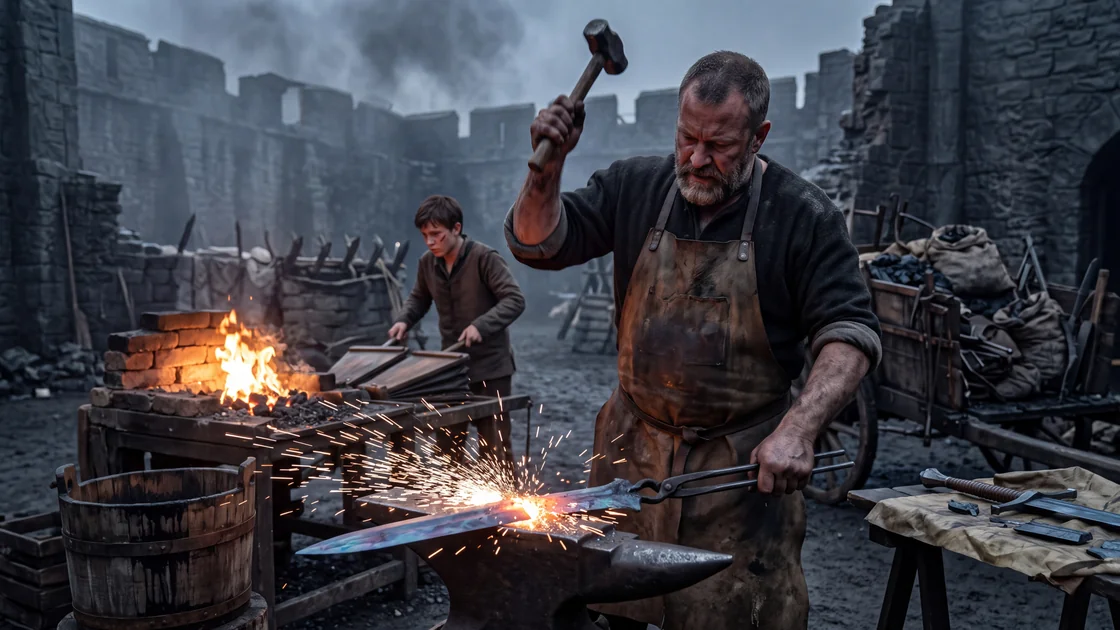
This is the tale of Orson Vance, a wandering smith who travels the war-blighted borderlands hauling an iron cart and a stone anvil, possessing the uncanny gift to reforge shattered weapons so that the muscle memory, tactical genius, and lethal instincts of their dead wielders live on in the steel; when a desperate garrison captain presents him with the broken grand-sword of a legendary traitor-hero to turn the tide of an apocalyptic siege, Orson must forge a weapon that holds not only peerless skill, but the devastating truth of how its original master died.
I. The Bone-Scale on the Road
The road through the Grey Marches did not permit haste. It was paved in limestone crushed beneath the iron tires of supply wagons two centuries dead, now churned into a pale, pasty slurry whenever the coastal mists crept inland. Orson Vance leaned his weight against the leather breast-harness, his calves burning beneath salt-stained wool trousers, his boots finding purchase between wet ruts. Behind him, the cart groaned—a low, rhythmic wooden complaint that he had come to understand better than the dialects of the frontier folk.
It was an unusual cart, narrow enough for goat paths but reinforced with banded yew and iron plates along its undercarriage. In its bed rested two hundredweight of stone coal from the northern pits, three sacks of ground horn and dried hoof-shavings, a barrel of rancid linseed oil, a square-faced anvil of fifty-two pounds whose horn had been snapped off in some forgotten skirmish, and the forge itself: a collapsible box of hearth-bricks bound with hoop-iron.
Strapped to the sides, dangling like the desiccated tongues of hanged men, were pieces of iron that ordinary scavengers left to rot. Snapped crossguards. Pommels worn smooth by sweating hands until the heraldic beasts upon them were mere lumps of grease-trapping silver. Triangular points of thrusting daggers broken off in ribs.
Orson stopped where the cart-track skirted an abandoned boundary ditch. A row of pollarded willows stood against the low grey sky like amputated limbs, their new shoots whipping thin in the salt wind.
Sitting against the root-hump of the largest willow was a girl. She could not have been older than fourteen, wrapped in a soldier’s coarse mantle that had been cut down at the hem with a dull knife so that its threads trailed in the muck. In her lap lay two pieces of iron.
Orson did not drop his harness immediately; to drop a smith’s harness abruptly was to invite a muscle spasm across the lower spine that would keep a man from swinging a four-pound hammer for a week. He backed into the cart’s shafts, eased the wooden prop down with the heel of his right boot, and only then slipped the greasy leather straps over his shoulders.
He stood six feet tall, broad across the shoulders with one arm noticeably thicker than the other—the right shoulder pitched slightly higher from thirty years of downward blows upon the face of the anvil. His beard was short, peppered with grey and pitted with tiny black pocks where spitting scale had caught the hair and burned down to the skin.
"The bridge at Oakhaven is down," the girl said. Her voice was cracked, the dry scrape of slate over slate. "The mercenary company from the delta took the timbers to build their breastworks. If you're going south, you'll drown your pony."
"I have no pony," Orson said. His own voice sounded like coals shifting in an empty hearth. "Only me. And I am not going south. I am going where the iron is loudest."
The girl looked down at her lap. Her hands were small, red-knuckled with chilblains, dirt packed hard beneath nails that had been gnawed to the quick. "This one doesn't make a sound."
Orson walked toward her. His limp was slight, favored toward the left knee which had taken the brunt of an unseated coulter during an ox-panic in his twentieth year. He stopped three paces away, smelled the wet sheep-grease of her coat and the faint, unmistakable vinegar stench of starving flesh.
"Everything that has been folded three times has a voice," he said. "Show me."
She hesitated, then lifted the pieces. It was a bill-hook, or had been: an agricultural tool converted by some desperate hedge-carpenter into a partisan. The socket was split where the ash pole had rotted or been torn out by main force. The blade itself, curved like an owl’s beak with a short thrusting-spur at the back, had fractured cleanly across the belly, three fingers above the eye. The metal was grey-black, pitted with rust, but along the fracture line the crystalline structure was bright and fine, like broken sugar.
"My brother," she whispered. "His name was Alain. He was with the third levy at the ditch. When the horsemen came over the earthworks, they didn't have room for lances. They had short broadswords, wide as shingles. Alain took two of them down from their stirrups. I saw him. He didn't drop the hook even when the red horse rolled on his leg. Then an officer with a fluted sallet came down and struck the blade with a poleaxe. It snapped. And Alain... Alain stayed there."
Orson crouched. His leather apron, stiff with decades of lard and tallow, crackled like parchment. He did not touch the metal yet. He looked at the fracture.
"You've been trying to fit them together," he observed.
"Every night," she said. "If you press the edges hard enough, they bite. But they don't hold."
"No. Steel isn't bone. It has no marrow to knit through waiting. It requires violence to remember itself." He extended a palm, broad and calloused until the skin looked like boiled leather. "May I?"
She gave him the broken halves.
As his fingers closed around the rust-pocked socket, Orson closed his eyes. The sensation was not a sound, nor a vision; it was a sudden, violent tension in the flexor tendons of his forearm. His right wrist hitched involuntarily to the left—a hooking motion, low and vicious, intended to catch the unprotected tendon behind a horse’s hock. A sour taste rose at the back of his tongue: dry oats, cheap beer, and the copper tang of terror.
A tall boy, Orson knew instantly. Long-waisted. He had bad footwork—leaned too far on his toes—but he had the grip of a wood-cleaver. He didn't parry; he snagged.
"Alain was left-handed," Orson said, opening his eyes.
The girl stared at him, her pale eyes widening. "He was. The bailiff used to strike him with a willow switch to make him use the scythe right-handed, but he couldn't."
"He used this left-handed at the ditch. When the horse went down, he didn't pull back. He tried to hook the rider's throat-latch through the fall. That’s why it broke here—lateral stress against a cold weld." Orson stood up, the iron light in his hands. "Come to the cart. I need dry wood for the charcoal bed. If you want the iron to know your brother again, you will pump the bellows until your lungs taste like tin."
"Will it... will it bring him back?"
"No," Orson said, turning his back on her to unlash the forge. "It will bring his strike back. The earth has Alain. The iron only keeps the thing he did when he was most awake."
II. The Craft of the Wakeful
They set their camp in the lee of a ruined lime-kiln three miles further along the ditch-track. The girl’s name was Tressa. She was hungry, but when Orson offered her a piece of hard salt-pork boiled with dry peas, she ate only half, wrapping the remainder in a dock leaf and tucking it into her sleeve with the unthinking hoarding reflex of the displaced.
The work began at dusk. Orson did not use a bellows-boy's double-lung bag; his bellows were two small box-feeders worked by parallel treadles, requiring a steady, alternating step like a man climbing an endless ladder.
"Steady," Orson commanded, watching the charcoal glow from cherry to the bright, dangerous orange of a ripening melon. "Faster on the left. The air must enter from beneath the tuyere like a draft under a church door. Don't look at the fire; look at the coal-bed around it. When the coal looks like grease, tell me."
He had laid the two pieces of the bill-hook in the hearth, but he had not placed them edge to edge. Instead, he had taken a sliver of clean Swedish iron—soft, malleable, devoid of memory—and laid it between the broken faces like a tongue between teeth.
"Iron remembers its last heat," Orson said, his voice rhythmic as he adjusted his heavy hammer-tongs. "If you take a sword to the heat and hammer it out flat to make a plowshare, the plowshare will always want to strike rock. It will fight the furrow. The peasant thinks the field is cursed; the smith knows the metal is merely homesick for blood."
He pulled the joint from the fire. It was white-hot, spitting tiny yellow stars that died before they reached the dirt.
"Now," he said.
With his left hand, he held the pieces flat upon the anvil horn. With his right, he brought down the four-pound rounding hammer. The blow was not loud; it was a dense, wet thunk, the sound of lead hitting butter. The slag squeezed out in a fiery ribbon, hissing into the damp soil.
He struck once, twice, three times, rotating the iron with an intuitive roll of his wrist that kept the grain aligned. But with the fourth strike, Orson did not guide the hammer.
His shoulder twitched. A sharp, convulsive spasm ripped through his trapezius. His forearm jerked downward and backward in a short, brutal arc, the face of the hammer clipping the corner of the anvil and throwing a shower of cold blue sparks into his apron.
Orson ground his teeth, his jaw muscles bulging beneath his grey beard. "I feel you, boy," he muttered through his nose. "Clear the throat. Clear the stirrup. But you must hold the heat first."
"What happened?" Tressa gasped, her legs faltering on the treadles. The bellows wheezed.
"Keep the air!" he roared. "Let the bed cool now and the grain freezes in two minds! Pump, girl!"
He shoved the iron back into the heart of the coals. The fire swallowed it. Orson stood with his eyes shut, breathing through his nostrils, his right hand trembling where the hammer rested against his leather-sheathed thigh.
In his mind's eye, he was not in the lime-kiln. He was in the ditch. The rain was cold; it tasted of marsh-gas and old peat. A massive dark bulk was descending upon him—a destrier with iron shoes broad as plates, eyes rolled white in terror, foam flying from its bronze curb-bit. The boy’s hand—not Orson’s, but Alain’s—was screaming with the ache of torn cartilage. Alain had not wanted to kill the horse. He had loved horses; he had raised two colts for the manor. But the hoof was coming for his face.
Down. Hook the tendon. Twist the point to break the fall.
Orson opened his eyes. The charcoal had reached the greasy stage.
He drew the weapon forth once more. The iron was glowing with that subtle, violet-tinged heat that ordinary smiths missed—the color that lasted only three seconds between the yellow of the fire and the dull red of the air.
He struck. This time he did not fight the boy’s jerk. He let his arm become Alain’s arm, but he lent it the iron bones and four-pound weight of forty years of hammer-work. He took the clumsy, frantic reflex of the dying peasant and drove it down into the clean Swedish iron, forging the panic into a precise, geometric line. He folded the seam once, twice, drawing the edge out thin, until the bill-hook was no longer a rude ditch-tool, but something leaner, darker, its nose weighted like a butcher’s cleaver.
When the red faded to slate, Orson did not plunge it into water. He plunged it into a wooden trough filled with sheep tallow and pulverized elder-bark.
A foul, grey smoke billowed up, thick enough to hide the stars. The grease hissed like a basket of vipers.
Tressa stopped the treadles, sinking to her knees in the ash, her face smudged with soot and streaked with tears that she had not realized she was shedding.
Orson reached into the grease with his long tongs and drew the blade out. It was black as a wet coal, smoking faintly, the line of the weld invisible save for a faint, wavy grain that ran through the neck like the pattern in watered silk.
He wiped the blade with a rag soaked in urine and vinegar to strip the scale, then turned to the girl. He held the weapon by the iron socket, offering the handle to her.
"Take it," he said.
"I can't... I don't know how to fight," she whispered, shrinking back against the kiln’s lime-encrusted stones. "I was only supposed to carry the meal-sacks."
"Take it by the socket."
She reached out a trembling hand. The moment her fingers closed around the cold iron, something happened to her carriage. Her chin dropped two inches, tucking behind her clavicle. Her left foot slid back, the knee flexing, her center of gravity dropping three inches toward the earth without her conscious volition. Her small, thin hand did not grip the iron with the clumsy clutch of a girl; her index finger slipped over the balance ridge, her thumb locking down with the practiced hardness of an executioner.
A startled gasp broke from her lips. She tried to pull her hand away, but her fingers remained locked, her wrist adjusting with minute, lightning-fast corrections as the night wind caught the flat of the hook.
"He is there," she breathed, her pupils huge in the embers' glow. "He’s... he’s watching the ditch."
"He isn't watching anything," Orson said coldly, though his own shoulder throbbed with Alain’s remembered ache. "The boy is gone to the worms. But the ditch is in the iron now. If an ox tries to trample you, your hand will know where to put the point before your brain knows you are afraid. Keep it greased. If you let it rust, the memory goes sour, and it will draw your wrist into bad cuts."
He turned back to his cart, picked up a horse-rasp, and began to clean the face of his anvil.
"Where are you going?" she asked, rising to her feet with an eerie, predatory balance that looked grotesquely out of place on her childish frame.
"North," Orson said. "To Fort Malakor. They broke the Duke’s line three weeks ago. There will be enough broken iron there to pave a road to hell."
III. The Bastion of Broken Skulls
Fort Malakor was not a castle; it was an iron fist driven into the throat of the Red Pass. Built during the three-hundred-year wars between the Archduchy of the Weald and the Iron Princes of the Coast, it consisted of seven concentric walls of dry-laid basalt, each eight cubits thick, stepped up the side of a jagged volcanic spur like the ribs of an ancient leviathan.
When Orson reached the base of the approach, the air was already thick with the smell that accompanied his trade: not charcoal, but lime, boiled fat, gangrene, and the sweet, dizzying musk of unburied horses.
The lower gate was gone. In its place was a barricade made of shattered wagons, barrels filled with river rocks, and the bloated carcasses of pack-mules covered in quicklime. The sentries who stood atop the basalt lip did not wear the polished mail of the Weald-Guards; they wore breastplates taken from three different armies, lashed together with rawhide cords, their faces wrapped in linen against the stench.
Orson did not wait to be hailed. He stopped his cart twenty paces from the gap, reached into his tool-box, and took out an iron triangle three spans wide. He struck it once with his light chasing-hammer.
The note was extraordinarily pure. It did not ring; it sang, a long, bronze-colored vibration that cut through the wet wind and the croaking of the ravens on the scree.
Above the rampart, a man stood up. He was lean, missing his left ear, his leather jack stained with dark patches that had dried stiff as boards.
"We have no coin for tinkers!" the man shouted down. "If you have meal, we take it by requisition. If you have salt, we pay in paper scrip signed by Captain Valen. If you have nothing, turn your cart before the archers use your legs for practice."
Orson took a second piece of metal from his belt—a cavalry broadsword, its blade snapped six inches below the hilt, which he had pulled from a ditch near the marsh-crossing. He held it up by the broken stump, tapped the crossguard with the hammer.
A different note—sharp, angry, ending in a low, resonant drone that sounded like a hornet trapped in a flask.
The sentry leaned over the stone. "The cart has an anvil," another voice muttered from behind the parapet. "Look at the tires. Steel-banded. That’s Vance. The one they call the Grave-Welder."
There was a muffled argument above, the scrape of boots over loose basalt, and then a basket was lowered down the wall by a hemp cable. It did not contain coin or meal. It contained a bundle wrapped in oilcloth, bound with three strands of copper wire.
"The Captain says come through the sally port," the sentry called down. "Leave the cart at the barrier. We have four men to haul the anvil if you can't lift it."
"Nobody touches the horn," Orson replied, his voice flat. He reached up, untied his breast-harness, and adjusted the cart's balance. "Clear the barricade. My cart goes where my tools go. If I have to forge in a ditch, I can do it without your leave."
Ten minutes later, the low timber gate of the third tier swung back with the squeal of ungreased gudgeons.
The interior of Fort Malakor was a charnel house with stone walls. In the courtyards, three hundred men lay on beds of wet bracken, their limbs wrapped in grey bandages that wept yellow water. A surgeon with sleeves rolled to his armpits was boiling needles in an iron pot over a fire of broken packing crates. The horses were kept in the chapel; their dung had turned the porphyry floor into a slick, green mire that smelled of rot and holy incense.
In the inner hall, beneath the vaulted roof that had been blackened by smoke from torches that had burned day and night for six months, Captain Brand Valen sat at a trestle table.
He was thirty years younger than Orson, with the high, delicate bridge of a river-noble, but his eyes were sunken back into his skull like two grey marbles dropped into deep wells. His right arm was supported in a sling made from a silk altar-cloth; beneath the silk, the forearm was splinted with two pieces of barrel stave, bound tight enough to make his fingers swell into purple sausages.
On the table between them lay the oilcloth bundle from the basket.
"You took your time, Vance," Valen said. He did not offer wine or bread. "The passes are closed. The Duke's vanguard is at the mouth of the canyon. They have two siege-catapults that throw limestone blocks the size of oxen, and three thousand levies behind them. We have eighty men who can stand and forty who can crawl."
"Then you should run," Orson said, dropping his heavy leather gloves onto the floor. He began to unpin the brass brooches of his cloak. "A blacksmith can mend iron, Captain. He cannot make one man’s spine do the work of forty."
"I am not asking you to mend common iron," Valen said.
He reached out with his left hand—awkward, trembling with exhaustion—and tugged the copper wire from the bundle. The oilcloth fell away in three stiff folds.
Orson stopped unpinning his cloak. His eyes narrowed.
On the greasy linen lay seven pieces of steel.
They had belonged to a great-sword—a two-handed war-blade of the old style, nearly five feet of metal from the melon-shaped pommel to the spatulate point. The steel was not grey like common frontier iron; it had a faint, smoky blue iridescence, like the wing-cases of certain beetles that breed in peat moss. The fuller was wide and deep, flanked by double channels near the ricasso that had been inlaid with silver characters in the old script of the High Duchy.
The blade had not been chipped or bent. It had been systematically, methodically smashed. The breaks were square, clean, the result of immense, rhythmic force—such as might be dealt by a master using a six-pound sledge against an anvil horn.
Only the hilt remained intact: twenty inches of wire-wrapped ash, with a double-ringed guard whose edges were chased with dry-leaf patterns.
"Aldous’s blade," Orson whispered. The draft through the hall seemed to drop three degrees.
"You know it?"
"Everyone between the salt-marsh and the mountains knows it," Orson said, his voice dropping into the low register he used when speaking to the hearth. "Severance. Carried by Saint-Marshal Aldous at the Siege of the Seven Gates. They say he held the water-gate against thirty dismounted knights for three hours while the townsfolk took to the rafts. They say he never took a step backward."
"They say many things," Valen remarked, his voice sour as crab-apples. "The priests made him a saint because he died before he could tell them what he thought of their prayers. But the weapon... the weapon was real."
"Where did you get it?" Orson reached out, but his fingers hovered two inches above the broken pieces. Even at that distance, the hair on the back of his forearms stood straight up.
It was not the simple twitch he had felt from the boy Alain’s hook. This was an electric hum—a high-frequency shriek that vibrated in the fillings of his teeth. The air above the shards shimmered faintly, like the air above a lime-pit in summer.
"My grandfather was with him when he fell," Valen said. "Not at the water-gate. Later. After the army broke. They say the Marshal went mad with grief. He took his own blade to the rock on the summit of the Red Ridge and struck it until it was seven teeth of steel. He died with the pieces in his leather scrip."
"He broke it himself?" Orson’s brow furrowed. "A knight does not break his own steel. Not if he has blood left to give."
"Does it matter why he broke it?" Valen leaned forward, the smell of vinegar and dried pus rising from his sling. "Look at my men, Vance. They aren't soldiers. They are sheep-shearers and barge-men that I dragged out of the taverns at the ford. When the Duke's knights hit the gate, my men will run before the timber splinters. But if they see Severance whole again... if they see that steel in the breach..."
"It will not be a symbol," Orson warned, his voice hard as an old shoe. "You know what I do, Captain. You sent for me because you know what happens when I close an edge."
"I know."
"If I reforge this blade, Aldous is in the iron. Not his name. Not his glory. His hands. His eyes. The way he drew his breath when the shield-wall buckled. The man who takes this sword will not wield it. He will be wielded by it. It will drink his sinews until he has no will left to lift a spoon."
Valen stood up, his face grey, his breath whistling through nostrils clogged with dry blood. "Then give it to me. My right arm is dead anyway. Let the Marshal have the rest of the carcass."
Orson looked from the captain’s hollow eyes down to the shattered blue steel on the table.
"It will take twenty-four hours," the smith said softly. "I need your best charcoal. I need three gallons of horse-blood, drawn cold from a mare that has never known the harness. And I need a boy who can hold an iron rod without crying when the sparks burn through his shirt."
"Take Joram," Valen said. "He’s my squire. His father died at the ditch. He doesn't cry. He hasn't spoken a word since the Feast of Saint Jude."
IV. The Blood and the Bellows
The forge was set up in the lower courtyard, against the third basalt wall where the stone was thickest and the wind from the canyon could be channeled through an embrasure directly into the ash-pit.
A circle of salt had been sown around the anvil—not for religion, but because salt absorbed the greasy dew that gathered when old metal was brought to the white heat.
The boy, Joram, stood by the bellows. He was sixteen, with the broad, flat face of the western clans, his eyes yellow-hazel like a hawk's. His left cheek was scarred by a crossbow bolt that had grazed the skin from ear to lip, leaving a shiny, hairless track that twitched whenever he swallowed.
"You speak?" Orson asked him, laying out his hammers in order of weight: the two-pound setter, the four-pound fuller, the six-pound sledge, and the heavy eight-pound cross-peen that he rarely used except for breaking blooms.
The boy shook his head once.
"Good. Don't start now. If you drop the treadle while I am setting the scarf, don't look for an apology; I will strike you with whatever tongs are in my hand."
Orson picked up the first two shards—the point and the section immediately behind it.
The metal was cold, but when he held them together, they repelled each other with a faint, oily resistance. The memory within was not settled; it was chaotic, jagged, like a dog that had been beaten with a shovel and left in a cellar.
"He didn't break it on a rock," Orson muttered to himself, his thumbs tracing the fracture. "The grain is compressed from the side. He took a heavy hammer to it while it was still hot. Why would a man heat his sword to break it?"
He shook his head, clearing his mind of questions that had no edges. The craft did not care about why. The craft only cared about the heat and the blow.
He set the point into the coals.
"Air," he commanded.
Joram stepped onto the treadles. His movement was silent, machine-like. The box-bellows puffed, a low, rhythmic chug-shuck, chug-shuck, and the charcoal around the blue steel began to glow.
Orson watched the blue iridescence fade. Steel lost its memory in the cherry heat—or so the scholars in the southern academies believed. But they were fools who worked with clean iron fresh from the Catalan forges. They did not understand that when a sword has killed forty men, the blood does not stay on the surface; the iron absorbs the phosphorus, the nitrogen, the faint traces of salt from their sweat, until the very crystal lattices are warped by the ghosts of what they have sheared.
"Aldous," Orson whispered.
He closed his eyes.
The world vanished into a roar of red light.
Suddenly, Orson was not five feet ten inches tall. He was massive. His shoulders were wide enough to block a doorway. The weight of his own breastplate was an old ache across his collarbones, like an ill-fitting pack that had been carried for twenty years.
The gate is gone, a voice said inside his skull. It was not a thought; it was a physical sensation of cold rain hitting the back of a neck that was slick with lard to keep the mail-rings from chafing. They brought the pig through the arch. The timber is burning. My knees are wet. Why are my knees wet?
The smith felt his fingers curl. On the table, the iron shard began to hum.
Hold the line, the voice snarled. It was a voice that had shouted down the thunder of war-horns for forty years. Don't look at the eyes. Look at the balance point of their gorgets. If they step with the left, the shoulder drops. When the shoulder drops, drive the point three inches through the mail-tie.
"Now!" Orson shouted.
He hauled the two shards from the fire with his heavy duck-bill tongs. The steel was blinding white, the edges fuzzy with the incipient melt.
He slapped them together on the anvil. Slag flew in a fan of white-hot needles, piercing his wool shirt, stinging his cheeks.
"Strike!" he roared at Joram.
The boy did not hesitate. He caught up the four-pound hammer with both hands and brought it down where Orson’s tongs pointed.
BANG.
The sound was not metallic. It was like an axe striking a dead hog.
The two pieces did not weld smoothly; they bucked. The tongs were nearly ripped from Orson’s grip. A terrible nausea rose in his gullet—a sensation of falling, of betrayal, of a man looking down at his own men and seeing them drop their spears and run while the horsemen circled like crows.
"Again!" Orson yelled. "Hit the seam! Don't look at the fire, boy! Hit the seam!"
Joram struck again.
BANG.
The shock traveled up Orson’s left arm, through the tongs, into his marrow. His teeth clicked together so hard that a flake of enamel broke off against his tongue. In his mind, the red roar shifted to a grey, sickening clarity.
It was not thirty knights, the iron whispered. It was my own guard. They wanted to open the gate. They had the gold in their scrips. I killed them all. Seven of them. My own boys. I killed them on the flagstones before the Duke's men even touched the oak.
Orson’s breath caught in his throat. His eyes bulged as he fought the tongs.
"God," he wheezed. "Aldous... you butcher."
The steel resisted the hammer with a wild, vibrating spite. The weld was cold on the left side; it was spitting grey sulphur, refusing the flux of ground bone and salt.
"Bring the horse-blood!" Orson yelled.
Joram dropped his hammer, seized the wooden bucket that stood in the shade of the wall, and swung it up.
Orson did not wait for the steel to cool to red. He drove the white-hot, partially welded blade straight down into the bucket of cold mare's blood.
A column of steam erupted—red-tinged, smelling of iron, sweat, and the wild, open pastures of the mountain folk. The liquid boiled violently, frothing over the staves, splashing Orson’s boots with dark, curdled scum.
Beneath the blood, the steel screamed. It was a long, thin, human sound—the whistle of a lung pierced by a bodkin point, releasing its last breath through a mouthful of pink foam.
Joram staggered back, his hawk-eyes wide, his hand flying to his throat where the scar twitched like a living grub.
Orson held the tongs with both hands, his knuckles white, his heels dug into the ash. He was shaking from his shoulders to his calves. The bucket shook with him, the blood slopping against the sides in a frantic, irregular rhythm.
"I have you," Orson hissed down into the steam. "I know what you did at the gate. I know why you broke the blue steel. You couldn't bear to let them bury you with the blade that cut down your own flesh."
He leaned down until his face was two inches from the frothing scum. His beard was wet with the steam.
"You don't get to die clean, Marshal," he snarled. "The Duke is at the gap. The sheep-shearers are in the ditch. You owe the world four more hours of iron."
The boiling slowed. The scream died down into a low, sulking hiss.
Orson drew the blade out.
The point and the first section were one piece now. The weld was an ugly, raised scar, swollen like an addled joint, but when Orson laid it upon the horn and tapped it with the small hammer, the note was no longer chaotic.
It was a deep, sullen bong, like a cathedral bell muffled in wet felt.
"Next piece," Orson whispered, wiping blood from his forearm with the greasy sleeve of his shirt. "Move the treadles, boy. We have five more seams to close before the sun finds the scree."
V. The Seven Seams of Aldous
All through the black hours, the lower courtyard of Fort Malakor sounded like an executioner’s cellar.
Orson did not rest. He took neither water nor bread. His eyes were red-rimmed, his eyelashes singed off by the flare of the coal-bed, his right shoulder moving with the heavy, hydraulic certainty of a mill-wheel.
With each shard welded, another year of the Marshal’s life was forced back into the steel.
The third shard brought the memories of the marsh-campaigns: the cold, the ague, the smell of burnt thatch, the endless thrust-and-parry against men whose languages Aldous did not know, whose faces were merely grey blurs through the eye-slits of rusted iron caps.
The fourth shard was worse: it was the technique.
Orson felt it settling into his own joints. His wrists, thick and blunt from years of shoeing draught-horses and drawing out tires, began to adjust themselves to the incredible delicacy of the long-blade. His fingers learned the mort-schlag—the technique of seizing the sword by the bare blade with gauntleted hands to use the heavy crossguard as a war-pick against plate armor. His left foot learned the circling, predatory shuffle of the Liechtenauer masters, the balance shifting between the ball and the heel so smoothly that not a single pebble moved beneath his boots.
"He was an artist," Orson murmured, his hammer falling with a lighter, faster cadence. Clang-clang-tap. Clang-clang-tap. "A butcher who knew how to balance an ounce of silver on a five-foot edge."
By the sixth shard, the dawn was beginning to bleed over the jagged teeth of the eastern mountains—not light, but a thin, slate-colored greyness that revealed the low clouds dragging their bellies across the basalt cliffs.
From the valley below came the first sounds of the siege.
It was not shouting. It was the vast, dull rumbling of wheels—iron tires on stone, the creak of green ash timber under immense strain, and the rhythmic, hollow thump of the Duke’s drums, three miles back, setting the pace for the heavy infantry.
Captain Valen came down the stone stair from the second tier.
He had not slept. His face was the color of a turnip that had spent the winter in a root-cellar. He had strapped a light mail-shirt over his chest with rawhide thongs, though his right arm remained bound to his ribs by the silk altar-cloth.
Behind him came four soldiers—the only ones who still had whole iron caps and halberds. They smelled of lard and panic.
"Is it done?" Valen asked. His voice was barely a croak.
Orson did not answer immediately. He was working the final seam: the junction between the blade and the long, wire-wrapped tang that slipped through the crossguard to be peened down by the melon-pommel.
The blue steel was cold now. It lay across the anvil, five feet of iridescent, scarred iron.
It was not a pretty thing. The seven welds showed like the scars across a galley-slave's back—raised, uneven lines where the metal had fought the hammer and lost. The silver lettering in the fuller was charred, the characters for JUSTICE and TEMPERANCE half-eaten by the heat and the horse-blood.
But it was whole.
Orson took a stone hone from his cart—a grey water-stone from the Ardennes, soft as cheese—and spat upon it. With slow, rhythmic strokes, he began to draw the burr off the edge.
Scritch. Scritch. Scritch.
With every pass of the stone, the hair on the soldiers’ necks stood up. One of them, a man with a goiter and two teeth, backed away until his shoulders hit the basalt wall.
"That's not Aldous's sword," the goitered man whispered. "That's... that's the thing that was in the room when my grandfather died. I know that smell."
"Shut your face, Corin," Valen snapped. He stepped toward the anvil, his left hand reaching out for the wire-wrapped hilt. "Vance. Give it to me."
Orson stopped the hone. He looked up from the bench. His eyes were small, red, and completely empty—the eyes of a man who has looked down into a well and seen the bottom was full of teeth.
"You can't hold it, Captain," Orson said.
"I have my left hand. I can use a buckler. I've taken the low guard before."
"It doesn't want your left hand," Orson said. He stood up, towering over the crippled officer. He was holding the sword by the leather ricasso, not the grip. "The sword doesn't know you. You have the heart of a bailiff, Valen. You think in terms of sacks of meal and days of delay. Aldous was a wolf who ate his own puppies when the frost came."
"I am the commander of this bastion!" Valen's voice cracked, rising into a hysterical shriek that echoed off the damp stone. "I paid you with thirty bushels of oats and the Duke’s paper! The sword belongs to the Duchy!"
"The sword belongs to the ditch," Orson said.
A tremendous crash shook the lower gate.
The basalt beneath their feet jumped two inches. A plume of dust, smelling of old lime and pulverized slate, puffed from the embrasures of the outer wall. A long, groaning shriek followed—the sound of three-hundred-year-old oak beams splintering beneath the bronze snout of a battering ram.
The Duke had entered the throat.
VI. The Dance of Seven Corpses
The four soldiers did not wait for Valen’s orders. Two of them dropped their halberds with a clatter that sounded like dry sticks falling on rock, turned, and bolted for the upper terrace—toward the horse-chapel and the scree paths that led to the high, barren peaks where a man might starve before the Duke's horsemen could hunt him down.
The goitered man fell to his knees, his hands clasped over his iron cap, rocking back and forth and humming a children’s hymn about the barley harvest.
Valen drew a short, rusty dirk with his left hand, his teeth bared, his eyes wild. "Give it to me, you grey dog, or I'll have the archers—"
A second crash cut him off. The inner timber barrier of the lower courtyard gave way.
Through the breach came three men.
They were not levies. They were dismounted lancers from the Duke's personal household—heavy men in blackened plate armor that had been oiled until it looked like wet slate. Their helmets were narrow-snouted pig-faced bascinets with brass grills over the breath-holes. They carried short, thick-bladed poleaxes with three-inch diamond spikes at the crest.
They saw the forge. They saw the cart. They saw Valen with his sling and his dirk.
The center knight—a man with three white lilies painted on his left pauldron—did not even raise his axe. He walked forward with the slow, contemptuous gait of a butcher entering a pen of sick calves.
"The blacksmith," the knight said through his grill, his voice muffled and metallic. "Tie his hands. The Duke wants the tools."
Valen lunged.
It was a pathetic strike—a wild, left-handed poke that would not have pierced an ordinary wool gambeson. The knight did not bother to parry with the axe. He simply brought his left elbow up; the flared edge of his couter caught Valen’s dirk, snapping the iron at the hilt, while the knight’s right foot—plated in articulated steel lames—came forward in a short, brutal kick that took the Captain in the pit of the stomach.
Valen collapsed into the ash, vomiting thin green bile, curling around his splinted arm like a kicked dog.
The knight did not look down at him. He took another step toward Orson. "Old man. To your knees."
Orson looked at the boy, Joram.
The squire was standing by the cold bellows, his hawk-eyes fixed on the three lilies on the knight's pauldron. His jaw was set so hard that a trickle of blood was running down his chin from where his teeth had cut the inside of his lip.
"Boy," Orson said.
He did not offer the sword by the blade. He swung the hilt around and drove the pommel into Joram’s chest.
"Catch," the smith said.
Joram’s hands came up by instinct.
The moment his fingers touched the wire grip, the boy’s back straightened with a sound like a dry pine branch snapping in winter.
His head jerked back. His jaw dropped, his mouth opening in a silent, jagged scream that showed his black tongue and his missing molars. His hazel eyes rolled up into his skull until only the veined whites were visible, then snapped down again—not with the dull stare of a mute squire, but with a terrible, icy, mathematical focus that froze the three knights in their tracks.
The great-sword did not rise clumsily.
It came up in an ox-guard so smooth, so effortless, that the five-foot blade seemed to weigh no more than a willow wand. The blue iridescent point hovered precisely three inches in front of the lily-knight’s visor grill, vibrating with a micro-oscillation that was almost invisible to the eye.
"What is that?" the second knight muttered, his axe rising to both hands. "A peasant with a spadone?"
The lily-knight did not answer. He was an experienced man; he knew the stance. He had seen it in the grand tourneys at the capital, practiced by old men who had fought in the eastern wars.
"Spread out," the lily-knight said, his voice dropping an octave. "Crowd him. The blade is too long for the wall."
They took one step.
Joram did not move forward. The blade moved Joram.
The boy’s feet did not step; they flowed over the basalt flags, his knees bent low, his body serving merely as a mobile platform for forty pounds of dynamic leverage.
The blue steel flashed.
It was not a slash; it was a short, circular parry that engaged the lead knight’s poleaxe three inches below the head. The sound was a high, crystalline tink. The knight’s axe was not merely deflected; the leverage was so absolute that the knight’s own hands were twisted in his leather gauntlets, tearing his left thumb from its joint.
Before the axe could touch the stone, Severance reversed.
The movement was horrific because it was entirely devoid of passion. It had the cold, rhythmic precision of a water-powered saw in a lumber mill.
The point went into the breath-holes of the visor.
Three inches. No more. The diamond tip pierced the brass grill, entered the knight’s upper lip, broke through the hard palate, and sheared into the base of the brain.
The boy did not wait for the man to fall.
As the lily-knight’s legs went slack, Joram twisted the hilt ninety degrees, using the stuck blade to lever the dying man’s bulk directly into the path of the second attacker. The second knight stumbled, his poleaxe caught in his comrade’s falling mantle, and in that half-second of fouled balance, Joram’s right hand left the hilt.
He seized the middle of his own blade with his bare, calloused hand—the half-sword grip that Orson had felt in the forge.
The crossguard became a mace.
Joram drove the heavy, bronze-chased pommel downward with the entire weight of his torso. The melon of iron struck the second knight’s left temple. The bascinet caved in with a dull crunch like a horse stepping on a turnip. Bone fragments and grey pulp squirted through the ear-slits.
The third knight—a younger man with red plumes on his helmet—stopped.
He looked at his two companions, who had been killed in less time than it took a man to draw a single breath. He looked at the boy.
Joram was not breathing hard. He was not sweating. But his skin was turning a ghastly, mottled grey, the veins in his temples standing out like blue earthworms. His eyes were wide, unblinking, fixed on the red plumes with the vacant, terrifying hunger of a corpse that had been told it could sleep only after the room was cleared.
"Demon," the red-plumed knight whispered.
He turned and ran. He did not run toward the breach; he ran toward the sally-port, his greaves clattering against his thighs, his axe thrown into the dirt.
Joram took two steps to follow.
His right leg hitched—a sudden, violent cramp that twisted his foot sideways. The Marshal’s old wound. The broken knee from the ditch at the Seven Gates.
The boy fell heavily onto his left side, the great-sword clattering onto the flagstones.
The moment his fingers lost contact with the wire grip, Joram curled into a ball. A long, thin wail broke from his throat—a sound of pure, unadulterated agony, the cry of an animal that has had its marrow scraped out with an iron spoon. His hands, clawed and trembling, reached toward the sword as if he were freezing to death and the blue steel were the only hearth in the world.
"No," Orson said.
The smith stepped forward. His heavy boot came down upon the flat of Severance, pinning the iridescent steel to the basalt flags.
"Leave it, Joram," Orson said softly. "The Marshal is done."
VII. The Slag at the End of Day
By noon, the Duke’s men had not taken Fort Malakor; they had abandoned the approach entirely.
It was not Joram’s work that had broken the siege. A messenger had arrived through the high scree paths: the Duke’s second son had been taken prisoner at the river-crossing twenty miles south, and the southern militia had cut the supply lines through the delta. The army was falling back to the plains before the autumn rains turned the Red Pass into a stone sluice.
The courtyard was quiet, save for the ravens that had finally ventured down to the lower tier to investigate the two dead lancers.
Captain Valen sat on the edge of the horse-trough, his good hand holding a bowl of cold water that he did not drink. He looked at the three lilies on the dead knight’s shoulder, then at Orson, who was systematically packing his cart.
The hearth-bricks were cold now, stacked neatly in their iron frame. The coal was tied into its sacks. The anvil had been hoisted back into its bed, its snapped horn pointing toward the tailgate.
"Leave the sword," Valen said. He did not look at Orson. His voice had the flat, dead tone of a man who knows he has survived only to face an audit by the Duchy’s clerks. "It belongs to the garrison. We can... we can send it to the Duke as a peace-pledge."
Orson did not look up from lashing his bellows. "The boy is dead, Captain."
Valen blinked. He turned his head slowly toward the wall of the lime-kiln.
Joram lay on a heap of dry bracken. He was not bleeding. There was not a mark on his flesh, save for the old scar on his cheek. But his fingers were permanently curled into two rigid hooks, the tendons of his forearms standing up like dried cords. His face was the face of an eighty-year-old man who had died of the bone-rot.
"His heart broke," Orson said, his hands moving with rhythmic efficiency over the knots. "A boy’s ribs are too thin to house a Saint-Marshal. Aldous took thirty years of campaign-rage and drove it through that child's veins in forty seconds. If you pick that blade up now, Captain, it won't even give you forty seconds. It will take what little marrow you have left before you reach the gate."
Valen looked at Severance.
The sword lay on the timber trestle where the boy had dropped it. In the thin mountain daylight, the blue iridescence was gone. It looked grey, tired, scarred by seven ugly seams that had begun to weep a fine, reddish-orange rust along the hammer-lines.
"Then what was it for?" Valen’s voice broke into a dry sob. "The boy... my arm... the garrison... what was any of it for?"
Orson hauled the leather breast-harness over his shoulders. He backed into the shafts, felt the familiar, dull weight settle across his clavicles, and kicked the wooden prop up with his heel.
"It was for forty seconds," Orson said. "The iron doesn't care about the peace-pledge. It doesn't care about your Duke. It only knows how to do the thing it did when it was hot."
He turned the cart toward the broken archway.
The iron tires groaned as they hit the wet limestone ruts. He did not look back at the dead lancers, nor at the boy on the bracken, nor at the Captain sitting by the horse-trough with his broken arm.
Behind him, upon the trestle table, the blue steel lay in the grey mist.
As the cart’s rumble faded down the canyon track, a single drop of coastal rain fell from the basalt archway, striking the flat of the blade near the third weld.
The metal did not ring.
It gave a low, faint sigh—the sound of an old man turning over in his wool blankets, pulling the rough hem up over his eyes, and finally, mercifully, letting the fire go out.