The Memory of Linseed and Bone
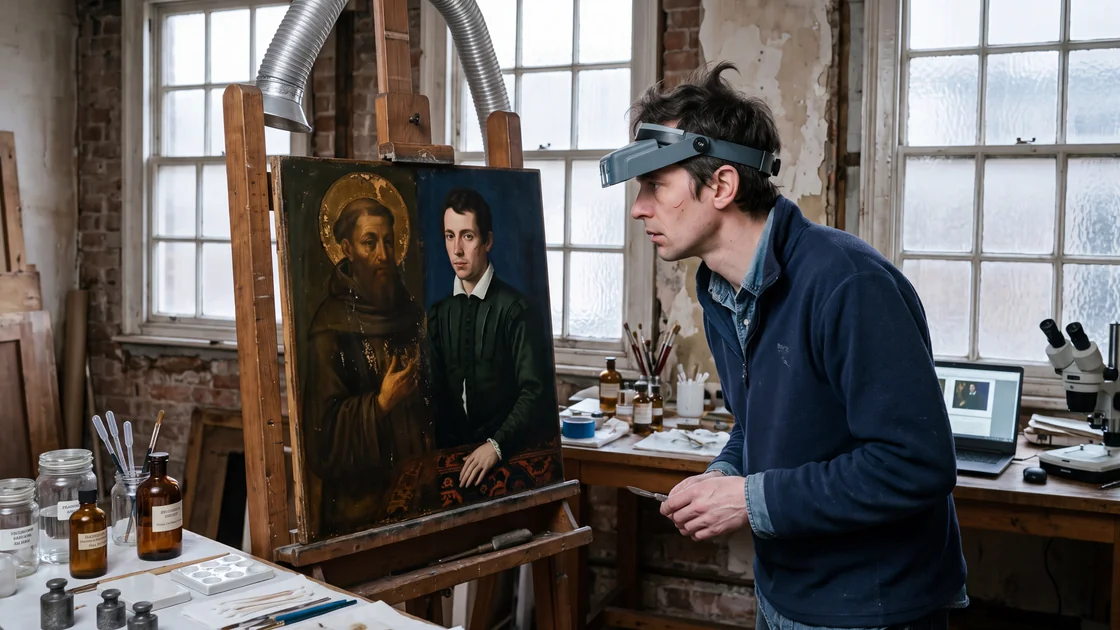
This is the account of Julian Ward, a solitary conservator of historic art working in a draughty Spitalfields workshop, who accepted an uncataloged, soot-darkened sixteenth-century panel painting for cleaning and stabilization, only to find that the centuries of discolored sandarac, greasy tallow, and pious overpainting concealed an impossible secret: beneath the devotional facade lay an exquisitely preserved secular portrait bearing his own face, down to the asymmetry of his pupils and a childhood scar, forcing him into a harrowing confrontation with the mechanics of time, memory, and the enduring flesh of oil and pigment.
Act I: The Anatomy of Decay
The studio was situated on the topmost floor of an eighteenth-century silk weaver’s house in Fournier Street. It smelled, as it had smelled for the twenty-two years Julian had occupied it, of cold linseed oil, redistilled turpentine, rabbit-skin size, dammar crystals melting in jars of petroleum spirit, and the faint, dry dust of aged timber. A northern exposure was granted by six tall, sash-hung windows whose glass was rippled and bubbled with age, filtering the gray London daylight into something even, cold, and entirely devoid of sentiment.
Julian Ward was a man of forty-two, though the precision of his movements and the stillness of his posture often made him appear older. His hands were long, pale, and dry, their fingertips hardened from decades of holding scalpels, hog-bristle brushes, and swabs wrapped tightly around bamboo skewers. Under the skin of his right index finger lived an ink-colored shadow—the legacy of an accident with an iron-gall inkwell when he was an apprentice at the Hamilton Kerr Institute in Cambridgeshire. That mark was indelible. Everything else, in Julian’s philosophy, was subject to reversion.
"A picture does not belong to its owner," he had once told a class of silent, note-taking students at the Courtauld, before he had abandoned lecturing entirely. "Nor does it belong to the gallery, nor even, strictly speaking, to the man who laid down the ground. A painting is an ongoing chemical transaction between organic matter and time. We are not creators here. We are the executors of a truce."
The crate had arrived on a Tuesday in late October, carried up the narrow, turning staircase by two couriers whose boots creaked upon the oak treads. It was unvarnished pine, fastened with slotted iron screws rather than modern steel, and bore customs stamps from Livorno and Chiasso, both dated 1952, alongside a more recent label from a bonded warehouse in Geneva.
The accompanying letter was brief, written on heavy, cream-laid stationery by a solicitor representing the estate of a gentleman whose family had once kept a villa in the hills above Pistoia.
Dear Mr. Ward, the solicitor had typed:
We act on behalf of the executors of the late Count Alessandro del Moro. Among the chattels recovered from the private chapel at Villa Noci is the enclosed panel, tentatively attributed in an 1884 inventory to an anonymous follower of Fra Bartolomeo or the Florentine circle of Andrea del Sarto. The executors require a full condition report, cleaning, structural stabilization of the support, and consolidation of lifting paint film, preparatory to its submission to auction. We are instructed that no limit of expense is placed upon your discretion, provided the work is conducted with your customary discretion.
When the couriers had departed, Julian brewed a pot of Earl Grey tea, drank it in three measured cups while listening to the rain rattle against the northern sashes, and only then took up his cordless driver to back out the screws.
The wood of the crate gave off the dry, cellar-like perfume of wood shavings. Beneath several layers of acid-free tissue lay the object: a single plank of European poplar (Populus alba), measuring approximately seventy-eight centimeters high by fifty-six wide. It was roughly three centimeters thick, backed with a rudimentary oak cradle of nineteenth-century manufacture, designed to prevent the natural warping of the panel as the wood breathed in humidity. The cradle, Julian noted with immediate professional disapproval, had been glued directly across the grain in several places, causing two hairline stress fractures that ran vertically down the lower third of the wood.
Julian lifted the painting by its edges, carrying it to the large conservation easel stationed beneath the central skylight.
To an untrained eye, the painting was nearly invisible. A thick, opaque skin of yellow-brown varnish—likely sandarac or poor-quality mastic, heavily degraded by oxidation and smoke—veiled the composition in an impenetrable amber murk. Beneath this amber shroud, the vague silhouette of a human figure could be discerned: the tilted head of what appeared to be a young martyr or an ascetic saint, perhaps an Apostle, with hands gathered near the chest in an attitude of contemplation or prayer. Over the figure's shoulder hovered a dark mass that might have been a drape or the mouth of a cave. A dull halo of tarnished, flaking brass leaf encircled the crown of the head, an addition that screamed of seventeenth-century Counter-Reformation piety.
"A ruined saint," Julian murmured to himself. The studio was so quiet that his voice sounded foreign, like an intrusion from a radio left on in an adjacent room.
He turned on the high-intensity daylight lamp, angling its cold LED beam across the surface at an oblique angle—raking light.
The raking light transformed the painting from a dark silhouette into a topographical map of suffering. The varnish had shrunk, pulling itself into a tight, cupped network of alligatoring. There were micro-losses along the line of the old wood splits, where little specks of pigment had lifted like dry leaves and fallen away into the void of four centuries. Grime—soot from altar candles, centuries of tobacco smoke, household grease, and the fine, pulverized limestone dust of an Italian interior—clung to every micro-fissure.
Julian reached for his binocular loupe, adjusting the strap around his temples. He lowered the lenses and leaned in within four inches of the panel.
The ground was traditional gesso grosso followed by gesso sottile, bound with animal glue—a smooth, chalky foundation that had held fast to the poplar grain. Above the gesso, he could see the imprimatura, a faint, warm ochre wash meant to kill the glaring white of the plaster. Above that, the paint layers: oil, certainly, but applied with a delicacy that suggested an egg-tempera underdrawing or a mixed emulsion technique common in Central Italy during the first three decades of the Cinquecento.
He moved the magnification across the obscured face. The varnish here was particularly thick, pooled in the hollows of the brushstrokes like stagnant pond water. Yet, through the muddy cataracts of time, Julian felt a peculiar sensation at the base of his neck—a cold, localized contraction of the skin.
It was nothing. Conservators were prone to ocular fatigue. He had spent the morning finishing an awkward retouching job on an indifferent Dutch landscape, matching the blue of an azurite sky that had drifted into greenish copper resinate.
He took a clean notebook from the drawer, uncapped his fountain pen, and made the first entry:
26 October. Condition Report: Del Moro Panel (Pistoia). Poplar panel support, single member, vertical grain. Oak cradle applied post-1850; transverse members partially frozen, causing two vertical splits (approx. 12 cm and 18 cm from bottom edge). Surface obscured by heavily oxidized natural resin varnish, severely darkened by airborne particulate matter and grease. Extensive overpaint visible around the head (halo, drapery margins) and background. Structural consolidation required before any cleaning may commence. Solvent testing to begin tomorrow.
He closed the book, covered the panel with a sheet of acid-free glassine paper, and turned off the studio lamps.
Act II: The First Removal
The stabilization of the poplar panel occupied three full days. Julian worked with rabbit-skin glue cooked in a double boiler at precisely fifty-five degrees Celsius, drawing it into a glass veterinary syringe and injecting microscopic beads into the hollows beneath the lifting paint film. He weighted each area down with small, flannel-wrapped bags of lead shot, resting them upon squares of silicone-release paper.
By Friday, the paint film was stable, the splits braced with tiny balsa-wood shims glued with reversible methyl cellulose. The panel was ready for testing.
The conservator’s solvent test is a ritual of supreme patience. It begins at the absolute margin of the image—usually the lower corner, where the paint was historically folded under a frame or where losses are least consequential.
Julian set out a porcelain spot plate on his bench. Into the small wells he pipetted tiny volumes of reagents: pure deionized water; white spirit (a gentle aliphatic hydrocarbon); Stoddard solvent; absolute ethanol; diacetone alcohol; and a customized surfactant gel containing chelating agents designed to bind to metal ions in surface grime.
He rolled a length of surgical cotton around the tip of a polished wooden skewer, moistening it with the surfactant gel.
He sat before the painting, adjusted his visor, and brought the swab down to the bottom right corner, an area occupied by a fold of indeterminate, blackened drapery. He did not scrub; he rolled the swab with a gentle, rotational flick of his fingers, allowing the solvent to act chemically without mechanical abrasion.
The white cotton immediately turned a vile, greasy tobacco-yellow.
"Two hundred years of soot," he said softly.
He switched to a swab moistened with deionized water to rinse the surfactant away, followed by a dry swab to lift the moisture. Under the cleared patch, measuring no more than one centimeter square, the dead blackness had yielded to an extraordinary, luminous olive green. The pigment was unmistakable: verdigris glazed over lead-tin yellow, preserved in the resinous medium with the crisp, gem-like translucency that only the High Renaissance masters knew how to coax from copper crystals.
"Not a minor workshop," Julian breathed.
He moved upward, testing the solvent sensitivity of the discolored sandarac varnish. Aliphatic hydrocarbons had no effect on the aged resin. Pure ethanol was too aggressive; it threatened to soften the delicate oil glazes underneath within three seconds of contact. He prepared a mixture of seventy parts isopropanol to thirty parts mineral spirits—a classic mild cleaning blend that would dissolve the polar bonds of the oxidized resin while leaving the cross-linked oil matrix of the paint entirely unbothered.
He dipped a fresh swab. He brought it to the background, three inches to the right of the figure’s temple.
The swab touched the panel. He rolled it twice, then lifted it.
The amber sludge gave way like melted grease under hot water. A swath of deep, velvety lapis lazuli emerged—ultramarine of the highest grade, ground from Afghan stone and layered over a dark underpainting of charcoal black. The depth of the blue was astonishing; it seemed to drink the cold northern light of Spitalfields and return it as something boundless and nocturnal.
Yet it was the overpainting that drew his attention next.
Around the head, the brass halo sat upon an intermediate layer of varnish, separated from the original paint by a stratum of gray dirt. This was good news: it meant the Counter-Reformation restorer had not scraped down the original surface before painting his pious addition.
With a size 15 Swann-Morton surgical scalpel, working under forty-times magnification through his binocular microscope, Julian began to pick at the edge of the halo. The brass leaf was brittle, adhered with an oil mordant that had saponified over the centuries into a crumbly, soap-like consistency.
Scritch. Scritch.
The sound of steel on aged varnish was like the gnawing of a cricket behind wainscoting. With each microscopic flake of brass that parted from the surface, a new section of the original composition was revealed.
The halo was not covering a bare background. It was covering hair.
Julian leaned closer, his chest pressed against the edge of the wooden bench, his breath suspended.
The hair was not the generalized, flowing auburn curls of an ideal Florentine saint. It was dark brown, almost black, cut in an idiosyncratic fashion—cropped square across the nape of the neck and curled loosely at the ears, with a distinctive cowlick at the crown that pushed a shock of strands forward toward the brow.
Julian stopped.
His left hand, resting on the arm of his chair, twitched.
He had that same cowlick. He had fought that cowlick every morning since he was seven years old, standing before the clouded mirror in his grandmother’s house in Salisbury, slicking it down with rosewater pomade, only to watch it spring back into rebellion five minutes later.
"Nonsense," he said aloud, the word falling flat into the quiet room. "A standard Renaissance zuccotto cut. Half the young men in Florence wore their hair so between 1510 and 1525."
He dropped the used cotton swab into a glass beaker and turned off the light. It was already five in the afternoon; the London dusk had settled over the street, turning the brick facades of the Georgian houses across the way into charcoal silhouettes.
His eyes were strained. Pareidolia—the psychological tendency to perceive meaningful patterns or personal connections in random visual stimuli—was well-documented among conservators. When a man spent twelve hours a day staring into the micro-cracks of ancient faces, he began to see his mother, his ex-wife, or his own mortality in every Madonna and Magdalene.
He took his coat from the hook, locked the heavy three-lever mortise deadbolts on the workshop door, and descended into the chill mist of Spitalfields.
Act III: The Stratigraphy of a Face
Over the weekend, Julian did not go to the studio. He tried to read a treatise on the mechanical behavior of microcrystalline waxes in wooden support consolidation, but his eyes refused to grip the sentences.
On Monday morning, he arrived at Fournier Street before dawn. The street lamps were still glowing yellow in the river fog that had crept up from the Thames through Wapping.
He climbed the stairs, did not bother to make tea, and immediately uncovered the panel.
The painting sat under the gray dawn like an unexploded shell. The exposed square of lapis blue and the sliver of dark, cropped hair seemed brighter than everything around them, mocking the dim amber murk of the remaining surface.
"Systematic," Julian told himself, his voice clipped and firm. "First the solvent solubilization curve, then the solvent-gel clearance. Standard operating procedure."
He prepared a batch of triammonium citrate in an agar gel. This would allow him to remove the superficial soot and greasy grime without touching the resin beneath, ensuring that he did not drive the surface dirt deeper into the porous craquelure during the cleaning process.
With broad, even strokes of an ox-hair brush, he laid the cold, translucent gel over the saint’s face.
He let it sit for precisely three minutes. Through the jelly, the figure looked drowned, floating beneath a sheet of river ice.
He lifted the gel with a flexible Japanese bamboo spatula. The jelly was blackened, the color of old oil sludge. He rinsed the area twice with cotton wool pads soaked in deionized water, then dried it with lint-free photographic tissue.
Now, only the aged, yellowed varnish remained between Julian and the face.
He took up his swab, moistened with the isopropanol-spirits blend.
He began at the forehead.
The varnish parted easily here; it had oxidized more intensely across the brow, perhaps due to the heat of candles that had burned beneath the panel in some Tuscan chapel. As the brown veil dissolved into the swab, the skin tones of the subject rose up to meet the daylight.
The flesh was not the milky, idealized ivory of Fra Bartolomeo, nor the cool, marmoreal marble of Bronzino. It was a complex, breathing tone: a lead-white foundation tinted with raw umber and vermilion, glazed over with a faint, luminous scumble of green earth—the verdaccio that Tuscan painters used to impart depth to the shadows around the eyes and temples.
Julian rolled the swab across the left eye.
The eyelid was heavy-lidded, hooded slightly at the outer corner. The iris was hazel—a pale, greenish-amber hazel ringed with a distinct, darker slate-gray limbal ring.
Julian let his breath out in a sharp, involuntary hiss.
He reached up with his left hand, his fingers trembling, and touched his own left eye.
He, too, had that specific, irregular limbal ring—an anomaly that an ophthalmologist had once photographed in Moorfields Eye Hospital, remarking that such pigmentation patterns were rarer than one in ten thousand.
"Stop," he commanded himself.
He laid the swab down on the glass bench. He stood up, walked to the far end of the room, and leaned his forehead against the cold glass of the window.
Outside, a dray van was unloading wooden crates of vegetables for the market. A man in an oilskin cap was shouting to another across the cobbles. The world out there was ordinary, dirty, solid, and tethered to the year 2024.
"You have been breathing solvent fumes," he whispered. "You have not maintained adequate extraction."
He walked back to the fume extraction arm, pulled the flexible aluminum hood down until it hung suspended four inches above the panel, and flicked the switch. The motor hummed into life, a steady, comforting drone of negative air pressure pulling the volatile organic compounds out through the roof vent.
He sat down again. He took up the magnifier.
"The nose," he said. "The bridge will disprove it. Every Cinquecento nose is either Roman or straight."
He dipped a fresh swab. He brought it to the bridge of the painted nose.
The brown sandarac yielded. The skin beneath emerged.
It was not a Roman nose. The bridge was straight until its lower third, where there was a minute, distinct deviation to the right—the result of Julian being hit in the face with a cricket ball at the age of eleven behind the pavilion at Bishop Wordsworth's School.
And below that, three millimeters beneath the tear duct of the left eye, painted with two microscopic dashes of lead-tin yellow and a tiny crescent of madder lake: a thin, crescentic white scar.
Julian’s chair scraped against the bare floorboards as he shoved himself back.
The room seemed to tilt around him, the white-plastered walls and the tall sash windows sliding out of true. He gripped the edge of the workbench until his knuckles turned as white as the lead pigment on his palette.
The scar on his face was not genetic. It was not a characteristic that could be shared across centuries by an ancestor or an unrelated doppelgänger. It had happened on an icy afternoon in December 1993, when he had slipped on the steps of the Salisbury Cathedral library while carrying a glass jar of shellac crystals. The jar had shattered, and a single, curved shard of flint-glass had sliced into his cheek just below the orbit.
He had bled onto the medieval flagstones. The surgeon at Salisbury General had closed it with four horsehair sutures.
And there it was. Painted in oil, medium-rich, bound with cold-pressed linseed oil and walnut oil, settled deeply into the craquelure of a five-hundred-year-old poplar plank.
The cracks ran through the scar. The age-cracks—the fine, spider-webbing network of premature drying craquelure and secondary age-fissures—cut cleanly through the vermilion and the lead-white of the crescent mark, proving beyond any possibility of forgery that the scar had been painted at the same time as the rest of the layer, dried during the reign of the Medici, and endured the passage of half a millennium.
"No," Julian said. "No, this is a hallucination. This is an acute psychotic break."
He closed his eyes, pressed his palms against his face, and sat in the dark of his own mind for five long minutes, waiting for his pulse to drop below one hundred beats per minute.
When he opened them, the painted face was still there.
It was not looking toward heaven. It was not looking down at an open breviary, as the pious overpainter had intended with his clumsy additions of prayerful hands.
The head was turned three-quarters to the viewer, but the hazel eyes were looking straight out of the panel, meeting Julian’s gaze with an expression of quiet, exhausted, and terrifying recognition.
Act IV: The Excavation of the Body
By midday on Tuesday, Julian had stopped using the chemical solvents on the remainder of the portrait. He had switched to micro-scalpels and the binocular surgical microscope.
A solvent dissolved indiscriminately; it erased the boundary between the intervention and the original if one’s hand wavered for a microsecond. But the scalpel, held at a shallow fifteen-degree angle, allowed him to feel the mechanical resistance of each stratum.
The painting was an archaeological tell, a city built atop the ruins of another city.
Stratum 1: Surface layer of wax-resin polish, applied circa 1920, contaminated with modern urban particulate. Stratum 2: Thick sandarac and oxidized copal varnish, early nineteenth century, heavily yellowed. Stratum 3: Overpaint from the late seventeenth century. The halo, the prayerful hands, a thick collar of ecclesiastical black cloth that turned the secular doublet into a cassock. Stratum 4: A layer of soot, indicative of a fire or decades of proximity to church tapers. Stratum 5: The original varnish—a thin, spirit-based mastic glaze, remarkably clear where it had been protected from light. Stratum 6: The original paint film.
Julian worked with a degree of concentration that abolished the physical world. The clock on the church of Christ Church, Spitalfields, struck two, then three, then four, its heavy bell shaking the windowpanes with each stroke, but Julian did not register the sound. He did not eat. He drank cold tap water from a laboratory beaker.
Under his scalpel, the black cassock flaked away.
Beneath the pious black garment lay no monk's habit. What emerged was a doublet of dark green wool—an olive-toned cloth known in Renaissance Florence as panno di San Martino—slashed across the chest to reveal an undergarment of fine, bleached linen. The linen was embroidered at the collar with a delicate geometric border in black silk thread, worked in a cross-stitch pattern characteristic of early sixteenth-century Tuscan household linens.
And the hands.
The Counter-Reformation restorer had painted two hands clasped in prayer, crudely positioned over the lower chest. They were stiff, lifeless, their anatomy wooden and their shadows muddy.
Julian sliced through the edge of the overpainted thumb. The paint lifted like a dry scab, revealing the original surface below.
There were no clasped hands.
The original left hand rested upon a tabletop covered in an oriental carpet—an Anatolian "Lotto" pattern rug, its yellow arabesques crawling across a field of deep madder red.
Between the thumb and forefinger of that left hand, the figure held an instrument.
Julian stopped his scalpel. He cleared away the detritus with a soft badger-hair brush, then dipped a swab into a mild hydrocarbon solvent to clear the dust.
The instrument held in the painted hand was a pair of dividers—heavy, forged steel with an arched brass hinge. Beside the dividers on the carpet lay a stone muller, a small glass mortar, and three glass phials stoppered with sheepskin parchment and tied with twine.
The figure was not an Apostle. He was not a saint.
He was a restorer. Or a painter. A craftsman of images.
And the right hand—which Julian uncovered over the next three hours—did not exist in the frame at all. It was implied to be outside the bottom edge of the panel, holding the very brush that had applied the paint.
The portrait was a self-portrait.
Julian leaned back in his swivel chair. His back screamed with pain; his neck was stiff as dry pine.
He looked across the studio at the modern tools on his bench: his own surgical scalpels, his own agate burnishers, his own glass mullers used for grinding pigments when he needed to reconstruct an area of historic loss with pure mineral colors in dammar.
The composition was an exact mirror image of the workbench at which he was currently sitting.
The angle of the light falling upon the painted figure was northern—forty-five degrees from the upper left. The window depicted in the background, reflected in the tiny, jewel-like surface of one of the painted glass phials, was a tall, mullioned casement through which one could see a line of gray hills topped with stone pines and cypresses—the hills of Fiesole or Settignano.
Julian reached for his telephone. His hands were shaking so violently that he misdialed twice.
"Elena?" he said when the call connected.
Dr. Elena Thorne was the keeper of Italian paintings at the National Gallery, a woman who had spent forty years tracing the paper trails of the Medici, the Strozzi, and the small, forgotten guilds of Florence. She was also the only person in London who understood the chemistry of early Cinquecento grounds as thoroughly as Julian did.
"Julian?" Her voice was crisp, dry, and slightly impatient, accompanied by the background clatter of a keyboard. "I am in the middle of a provenance file for the new acquisition. Is something burning?"
"I need you to come to Spitalfields."
"Don't be absurd. It's six o'clock on a Tuesday. The traffic through the City is an absolute nightmare."
"Elena. Please."
There was a silence on the line. Julian never pleaded. In the twenty years they had known one another—since his days at the Hamilton Kerr and hers at the Warburg—he had been an anchor of unemotional, pedantic reliability. He was the man who pointed out that a signature was an eighteenth-century forgery because the Prussian blue pigment had not been invented until 1704.
"What do you have?" she asked, her tone shifting into something wary.
"A panel from Pistoia. Villa Noci. Del Moro estate."
"The del Moro family? They were minor nobility, allied to the Soderini until the restoration of 1512. Most of their collection was sold off in the 1890s. There shouldn't be anything left there of consequence."
"Just come," Julian said. "Bring the micro-XRF files from the Florentine guild registry if you have them on your drive. And bring an archive viewer."
"Julian, you sound ill."
"I am not ill," he said, staring at the painted eyes that stared back into his own. "I am simply... I have found a secondary state that makes no sense."
Act V: The Archival Mirror
Elena Thorne arrived forty-five minutes later, her trench coat wet from the drizzle, carrying a battered leather satchel bulging with papers and a heavy laptop. Her silver hair was pinned up haphazardly with a celluloid comb; her sharp, avian eyes darted about the studio, taking in the solvent smell, the low hum of the extraction system, and finally, the panel resting upon the easel under the daylight lamp.
She stopped two paces into the room.
"Good God, Julian. You look like you've been exhumed."
"Take your coat off," he said. He did not look at her; he was standing by the workbench, his arms folded tightly across his ribs.
Elena tossed her coat onto an empty armchair, walked directly to the easel, and planted herself before the painting.
She stood there for a very long time. The clock on the wall ticked with a rhythmic, plastic snap. The extraction fan whirred.
Julian watched her face. He waited for the laugh. He waited for the professional, dismissive joke—Who put you up to this? Which of the boys at the British Museum painted your mug on an old board?
The laugh did not come.
Elena reached into her bag, pulled out her reading spectacles, perched them on her nose, and leaned in until her breath fogged the cold wood of the easel’s mast.
"Where did this come from?" she asked. Her voice had lost all its sharpness; it was low, quiet, and drained of color.
"I told you. The del Moro estate. Christie's handlers picked it up from the chapel at Villa Noci three weeks ago."
"Who did the overpaint?"
"Seventeenth century. Counter-Reformation. Some local hack turning a private sitter into an Apostle Jude or a Saint Jerome. The prayerful hands were laid down over an animal-glue isolate layer that saved the original glazes."
Elena did not touch the painting. Her gaze moved from the painted eye, to the painted scar, to the painted cowlick, and then slowly, dreadfully, across the room to Julian’s face.
She looked back at the panel. She looked back at Julian.
She took off her glasses.
"Julian. This is not a portrait of you."
"I know it isn't," he said, but his voice cracked on the second word.
"It is an astonishing, horrifying coincidence of bone structure," she said, though her hands, as she held her spectacles, were not entirely still. "The human skull has only so many morphological variations. Given ten million portraits produced between the invention of oil painting and the present day, there is a statistical certainty that one of them will approximate the features of any given living individual."
"Look at the scar, Elena."
She put her glasses back on. She leaned down to the binocular microscope, which Julian had left positioned over the left cheek of the figure.
She stared through the eyepieces for more than two minutes.
"It's a mark," she said, her voice muffled by the microscope tubes. "A stroke of lead-tin yellow with an iron oxide contour."
"It's a crescent. Four millimeters long. Three millimeters below the inferior orbital margin. Cut through by the primary drying craquelure. Is that craquelure modern?"
Elena straightened up slowly. Her face was gray.
"No," she said. "The craquelure is genuine. The fissures follow the stress lines of the wood contraction. The edges of the paint along the cracks are cupped; the drying oils have completely cross-linked into a linoxin network that could only be formed by several centuries of ambient oxidation. It hasn't been baked. A baked panel smells of caramel from the wood sugars; this smells of old dry gesso and walnut."
She sat down on the high stool by the bench, looking at the floorboards between her boots.
"Open your laptop," Julian said.
"Julian—"
"Open the registry. The Florentine Arte dei Medici e Speziali. The Guild of Doctors and Apothecaries. That’s where the painters were enrolled until the Accademia del Disegno was founded in 1563. Search the del Moro ledgers."
Elena pulled the laptop from her bag, opened it, and waited for the drive to spin up. Her fingers, usually so brisk and clinical upon the keys, tapped with an unnatural hesitation.
"The del Moro archives were partially digitized by the Kunsthistorisches Institut in Florence back in 2018," she muttered, navigating through folders of high-resolution PDF scans of sixteenth-century notary cursive. "Inventory of the estate of Count Sebastiano del Moro, compiled after his death during the plague of 1527. Let's see."
Julian stood behind her, his hands braced on the back of the stool. The warmth of her body, the faint smell of lavender water and wool that rose from her jersey, was the only thing anchoring him to the room.
"Folio 42," Elena said. Her fingernail traced the spindly, iron-gall script across the screen. "Item: una tavola di legname di braccia uno e mezzo... A wooden panel, one and a half braccia high, depicting..."
She stopped.
"Translate it," Julian said.
Elena swallowed.
"...depicting an image of a man holding tools of the art, painted by his own hand, left in payment for three sacks of spelt and an anchor of red wine by the English assistant..."
She trailed off.
Julian leaned closer, staring at the screen. The handwriting was knotty, sixteenth-century mercantile script, full of abbreviations and ligatures.
"...l'assistente inglese," Elena read, her voice barely a whisper. "...chiamato Giuliano di Giovanni di Vardo."
Julian of John of Ward.
Julian Ward.
The room went entirely silent. Even the extraction fan seemed to fade into a hollow, underwater hiss. Outside, the rain continued to slide down the six large windowpanes, dividing the gray light of Spitalfields into thousands of wavering, vertical tears.
Act VI: The Chemistry of the Inscription
"It's an archive entry," Julian said. He was sitting on the floor now, his back against the wall beneath the sash window, his knees drawn up toward his chest. "Archives can be forged. A document can be slipped into a bundle in the Archivio di Stato. People have done it. Van Meegeren did it. Dossena did it."
Elena closed the laptop with a sharp clack.
"No one forged the 1527 plague inventories of Pistoia, Julian. They were bound in vellum in 1531 and haven't been unsealed since the Florentine state archives were reorganized under Grand Duke Leopold in the eighteenth century. I know the archivist who scanned them. She spent three months in the basement with a white-glove team."
She turned her stool around to face him.
"You have never been to Pistoia?"
"Never," Julian said. "I went to Florence once, in 2002, on a student pass. I spent four days in the Uffizi, caught food poisoning from a bowl of ribollita near the Mercato Centrale, and took the train back to Pisa to fly home. I've never set foot in Pistoia."
"And your family?"
"My father was an accountant in Devizes. His father was a railwayman at Swindon Works. My great-grandfather was a farm labourer in Wiltshire. We don't have Italian estates. We don't have Cinquecento painters."
"Then what is this, Julian?"
Elena stood up, stepped to the easel, and pointed a rigid finger at the painting.
"Because if this is an authentic 1520s self-portrait of an Englishman named Julian Ward working in the bottega of a Tuscan master, carrying your face, your scar, your eyes, and your instruments, then our understanding of physical reality is a catastrophic joke."
Julian did not answer. He was looking at the bottom left corner of the panel, where the painted tabletop met the dark ground.
Beneath the Lotto rug, there was a strip of raw poplar wood, about two centimeters wide, where the original gesso had stopped short of the edge—a common feature of panels that had been held in a wooden frame during their execution.
In that unprimed strip of wood, something was visible under the raking light: faint, dark marks that were not wood grain.
Julian got to his feet, ignoring the dizziness that pulsed in his temples. He took up the magnifier and a pencil-beam UV torch.
He switched on the ultraviolet light.
Under 365-nanometer UV, old natural resin fluoresces with an unmistakable, sickly greenish-yellow glow. Modern repairs and synthetic varnishes show up as dead black or purple patches.
The unprimed wood did not fluoresce green; it was bare timber, darkened only by centuries of air.
And there, pressed into the soft grain of the poplar with an iron stylus, was an inscription. Not painted in ink. Not drawn in charcoal.
It had been scratched into the wood before the gesso was laid down.
Julian held the light at an extreme angle of three degrees. The shadows cast by the indentations formed letters:
NON OMNIS MORIAR. EXPEDIVIT ANNO MDXXVII. J.W.
Not all of me shall die. Completed in the year 1527. J.W.
And beneath it, in English, written in a clear, modern cursive hand that Julian recognized with an absolute, sickening certainty:
The diacetone will not lift the mastic. Use the turpentine and spit.
Julian dropped the UV torch.
It did not break; it rolled across the floorboards, its beam illuminating the legs of his workbench and the scattered cotton swabs, before coming to rest against the wainscot.
"What did it say?" Elena asked, watching him with wide, frightened eyes. "Julian, what did you see?"
"Nothing," he lied. His voice was steady now, deadened by an immense, glacial shock that had moved from his brain into his spine and down into his limbs. "Just an inventory mark. An iron-stylus scribe."
He did not tell her that the cursive hand on the bare poplar was his own.
He did not tell her that the advice scratched into the wood was the exact solution he had discovered at eleven o'clock that morning, when the diacetone alcohol had threatened to blanch the upper glaze of the lapis background, and he had resorted to the traditional, enzyme-rich moisture of his own saliva on a cotton swab to clear the final film of resin.
He had not written that note.
Not yet.
Act VII: The Dissolution of Time
Elena Thorne stayed until nine that evening. They sat in the dark studio, the only illumination coming from the street lamp below, drinking whisky from glass laboratory beakers.
They talked around the painting. They talked about quantum mechanics—the Copenhagen interpretation, the Wheeler-Feynman absorber theory, the possibility that information could propagate backward along the light cone. They talked about the mysticism of the late Renaissance, about Marsilio Ficino and the Florentine Neoplatonists who believed that the soul could imprint its form upon matter so powerfully that the form could persist through cycles of cosmic time.
They talked about madness.
"You need to step away from it," Elena said as she put on her coat. Her voice was exhausted, her face lined with deep, gray shadows. "Let me take the panel to the gallery. We can put it in the vaults. We will run an elemental analysis using the particle accelerator at the British Museum. If the lead isotope ratios match the English ores from the Mendips, we will know something impossible has occurred. If they match the Tuscan mines of the Colline Metallifere, we will know something... equally impossible has occurred."
"No," Julian said.
"Julian—"
"The client contracted me to conserve the painting. Not the National Gallery. Not the British Museum. If you take it, it will be sequestered. It will be tied up in committee reports and institutional curiosity for thirty years. I have to finish the cleaning."
Elena looked at him for a long moment. She reached out, her gloved hand resting for an instant upon his sleeve.
"Don't lose your way, Julian," she whispered. "The past is an open grave. If you lean too far over it, you fall in."
When she had gone, the lock clicking into place with its heavy, familiar thud, Julian did not turn on the electric lamps.
He stood in the center of the workshop, in the gloom that smelled of pine shavings and mastic.
He looked at the portrait.
In the dim light reflected from the street, the face on the easel seemed more real than the room around it. The hazel eyes caught the sodium glare of the street lamp, reflecting it with the liquid, biological moisture that only an oil glaze over an egg-tempera ground could achieve.
Julian walked to the workbench.
He picked up a clean scalpel. He picked up his wooden skewer and a roll of cotton.
He had not yet cleaned the right shoulder of the figure. A patch of dark, greasy overpaint still clung to the drapery there, covering what the seventeenth-century restorer had assumed was the back of a martyr's chair.
He dipped the swab into the solvent. He brought it down upon the shoulder.
The dirt dissolved. The resin parted.
Underneath, resting upon the dark green cloth of the doublet, was a small, enameled silver badge.
It was not a religious medallion. It was a modern lapel pin.
The pin was shaped like a stylized falcon perched upon an open book—the crest of Bishop Wordsworth's School in Salisbury.
Julian touched the collar of his own shirt. Beneath his heavy woollen work jersey, pinned to the pocket of his faded denim shirt, was the very same badge—a small, scratched piece of silver plate that had belonged to his grandfather, which Julian had kept in his pocket for luck since the day he took his first conservation examination in Cambridge.
He did not scream. He did not drop the swab.
A strange, unnatural calm had settled over his heart. It was the calm that comes to a sailor when the mast has finally snapped, the rudder has sheared away, and the vessel enters the smooth, glass-like center of the whirlpool.
The painting was not an artifact of the past.
It was an instruction.
Act VIII: The Layer Beneath
For three days, Julian did not leave the workshop. He did not answer the telephone, though Elena called eleven times, her voice on the answering machine moving from professional anxiety to outright terror.
He lived on dry crackers, cold water, and the dark, mineral silence of the room.
He had moved from cleaning to consolidation. He had cleared every square millimeter of overpaint from the panel. The pious saint was gone; the cassock was gone; the brass halo had been reduced to a heap of golden dust inside a specimen tube on his desk.
The man in the painting stood fully revealed.
He was forty-two years old. His dark hair was cropped square at the neck, curled loosely at his ears, with a cowlick pushed forward onto his brow. His left eye was ringed with a slate-gray limbal ring; below it lay the four-millimeter crescent scar from the shattered shellac jar. He wore the green wool of a Florentine craftsman, his sleeves tied to his shoulders with points of tawny leather.
His left hand rested on the Anatolian rug, beside the dividers, the muller, and the phials.
And upon the painted tabletop, half-tucked beneath the edge of the rug, lay a piece of paper, painted with such microscopic fidelity that Julian had to use his highest magnification to read the script.
It was not Latin. It was not Italian.
It was a page from an appointment diary, dated November 2, 2024.
On it was written a single sentence:
The fire in the chapel at Villa Noci was not an accident; you must lay down the rabbit-skin size before the frost sets in, or the poplar will tear itself apart.
Julian sat before the easel with his hands resting flat upon his thighs.
"How?" he asked the painting.
The painting said nothing. It did not need to speak; it had already spoken through five centuries of patience, waiting under the dirt of an Italian hillside, waiting under the greasy overpaint of a pious century, waiting for the only hands in the world that knew the exact chemical formulation required to peel away its prison.
Julian got up from his chair. He walked to the corner of the room where his reference library was kept.
He pulled down the heavy volumes of the Dizionario Biografico degli Italiani. He found Volume 60: Ghirlandaio to Giambono.
He flipped through the entries until his thumb hit the letter G.
GIULIANO DA LONDRA (Giuliano di Giovanni di Vardo).
The entry was short, less than half a column, written by an art historian who had died in 1934:
GIULIANO DA LONDRA (active Florence and Pistoia, c. 1520–1527). Painter and preparator of panels, believed to have been of English origin. Mentioned in the records of the Compagnia di San Luca in Florence in 1522 as an 'ingegnere di colori' (engineer of colors) in the workshop of Andrea del Sarto. According to Vasari (Vite, 1568 edition, III, p. 112), Giuliano possessed secrets of pigment purification and the reversibility of varnishes unknown to the Italians of his era. He is recorded as having fled to the estate of the del Moro family at Pistoia during the plague of 1527. No works were known to have survived him, though an inventory of 1527 mentions a self-portrait on poplar wood. His death is unrecorded, though local legend in Pistoia suggests he disappeared from the chapel of Villa Noci during the first frost of that year, leaving behind his clothes and a collection of strange steel knives...
Julian closed the book with a hollow, dry thud.
The dust from the page rose into the daylight beam, dancing in the cold northern air.
"A collection of strange steel knives," he repeated.
He looked at his workbench.
Arranged in a neat, orderly row were his Swann-Morton scalpels: stainless steel handles, numbered 3 and 4, with detachable surgical blades numbered 10, 11, and 15. Knives that could not be forged in 1527. Knives made of high-carbon surgical steel manufactured in Sheffield in the year 2023.
He reached out and picked up the number 3 scalpel.
The weight of it in his hand was familiar, comfortable, an extension of his own fingers.
He turned back to the painting.
There was one more test that a conservator must perform on an uncataloged work before signing off on its restoration: the micro-destructive pigment sampling of the substrate.
To prove that a paint layer is original, one must take a core sample—a microscopic cylinder no thicker than a human hair, drilled out with an acupuncture needle from an existing area of loss—and mount it in a block of polyester resin. The block is then cut perpendicular to the surface, polished with diamond paste, and examined under a metallurgical microscope to reveal the stratigraphy.
Julian did not want to drill into the face. He could not.
Instead, he looked at the background, where the lapis lazuli met the unprimed border of poplar wood.
There was a tiny flake of paint, no larger than a grain of sand, that had partially detached from the gesso ground near the lower edge of the Anatolian carpet. It was hanging by a single microscopic filament of dried oil.
Julian took his tweezers—Swiss-made, antimagnetic, stainless steel—and gently lifted the flake.
It came away without resistance.
He placed the speck of paint upon a clean glass microscope slide.
He did not mount it in resin; he had no time for that. He simply brought the slide under the stage of the polarizing light microscope, turned on the sub-stage condenser, and rotated the polarizer until the light was cross-polarized.
Under cross-polarized light, minerals reveal their crystal system through their birefringence—their ability to split light into two separate rays.
Natural Afghan lapis lazuli shows an isotropic, deep blue field with tiny, brilliant inclusions of golden pyrite and white calcite.
Julian looked into the binocular eyepieces.
The blue was isotropic. The pyrite inclusions were there, glittering like stars in a deep interstellar void.
But beneath the lapis, bound into the gesso ground itself, was something else.
A modern synthetic fiber.
It was a single, microscopic filament of blue polyester, dyed with an azo-dye that had been patented by Imperial Chemical Industries in 1968.
Julian recognized it immediately.
It was a fiber from the blue fleece sweater he was currently wearing—a garment he had bought three years ago at an outdoor goods shop in Covent Garden.
The fiber was not lying on top of the paint. It was embedded within the gesso sottile, beneath the imprimatura, beneath the paint film, trapped inside the five-hundred-year-old plaster like a fly in amber.
Act IX: The Geometry of the Loop
The studio had grown very cold. The radiators, old cast-iron columns that clanked and hissed when the boiler fired, were stone dead; the timer had expired hours ago, but Julian had not gone down to the basement to feed the meter with coins.
He sat on his wooden stool, his coat wrapped tightly around him, looking at the two objects on his bench:
The painting.
And his modern, digital reflex camera, which he had used to take hundreds of ultra-high-resolution condition photographs of the panel at every stage of the cleaning.
He plugged the camera into his computer, transferring the RAW files.
On the 32-inch calibrated monitor, the face of the painted man appeared at twenty times life size.
Every pore was visible. Every tiny ripple of the verdaccio ground, every delicate, feathered hatch of the brush where the artist had blended the wet-in-wet lead white along the bridge of the nose.
Julian zoomed in on the reflection in the painted eye.
The Florentine masters of the 1520s—Andrea del Sarto, Franciabigio, Pontormo—often painted a tiny, square reflection of a window in the pupils of their sitters to suggest life and moisture. It was usually a generic white cross, representing a four-pane casement.
In this painting, the reflection was not generic.
Julian zoomed to four hundred percent. Then eight hundred percent.
The pixel grid of the modern camera sensor began to break up the image into tiny, colored blocks, but the form remained clear.
In the hazel pupil of the left eye, painted with microscopic strokes of pure lead white that had been mixed with a single hair of an ermine brush, was the reflection of a room.
It was not a Tuscan workshop.
There were tall, multi-paned sash windows through which a gray, rain-slicked city could be seen.
There was a row of Georgian brick houses across the street.
There was a tall conservation easel.
And standing before the easel, bent over with a scalpel in his hand and a binocular loupe strapped to his forehead, was a man in a blue fleece sweater.
The painted eye was reflecting the room in which Julian was sitting.
Not as an allegorical concept. Not as a metaphysical metaphor.
The painter had sat before a mirror in 1527, and what he had seen in that mirror was not the hills of Pistoia, nor the stone pines of Settignano.
He had seen this room. He had seen this moment.
"It isn't a memory," Julian said to the empty studio. His voice was cracked, dry as gesso dust. "It's a circuit."
He stood up. His knees made a dry, popping sound in the silence.
He walked to the corner where the historic pigments were stored in their glass jars.
He had lead white (biacca), purchased from a specialized supplier in Zecchi in Florence, manufactured according to the traditional Dutch stack process, where lead coils were corroded by vinegar fumes in beds of horse manure.
He had genuine lapis lazuli from Badakhshan.
He had raw umber from Cyprus, vine black made from burnt grape twigs, and vermilion synthesized from mercury and sulfur.
He had walnut oil that he had pressed himself from cold nuts, bleached in the sun on the roof of Fournier Street until it was as pale and clear as spring water.
He reached out his hand. His fingers brushed against the jars, their glass surfaces cold as ice.
Beside the pigments lay a blank poplar panel—a piece of seasoned wood he had purchased five years ago from a specialist timber merchant in Norfolk, intended for a reconstruction demonstration that he had never found the time to prepare.
It was seventy-eight centimeters high. Fifty-six wide. Three centimeters thick.
It had been cut from a single European poplar (Populus alba).
Julian took the panel from the shelf. He laid it flat upon his clean work table.
He looked at the modern surgical scalpels. He looked at the Anatolian carpet lying on the floor beneath his desk—the old, worn wool rug he had bought at an estate sale in Lewes twenty years ago.
He looked at his own hands.
The ink mark on his right index finger—the blue-black stain from the Hamilton Kerr Institute.
He walked back to the monitor. He zoomed in on the right hand of the painted figure in the 1527 panel—the hand that rested on the carpet, holding the steel dividers.
There, on the painted index finger, precisely three millimeters above the nail cuticle, was a tiny, ink-colored shadow.
The artist had not omitted it. He had painted his own indelible mistake into the flesh that had dried five hundred years ago.
Act X: The Application of the Reversible Glaze
The final stage of any art restoration is the application of the protective varnish—the sacrificial layer that will stand between the paint film and the destructive agency of the world.
In modern conservation, the golden rule is reversibility. Nothing may be done to a painting that cannot be undone by another conservator fifty or two hundred years later, using solvents that will not endanger the original work.
Julian did not use natural dammar or mastic for his modern clients. He used Regalrez 1094—a synthetic, low-molecular-weight hydrogenated hydrocarbon resin that would never yellow, never cross-link, never oxidize, and could be removed at any time in the distant future with a solvent as mild as pure mineral spirits.
He stood before the del Moro panel with the jar of Regalrez in his left hand and a wide, flat varnishing brush made of Japanese badger hair in his right.
The painting was clean.
The face of Giuliano da Londra—the face of Julian Ward—looked out into the Spitalfields studio with an intensity that seemed almost tactile. The blue of the lapis background was like an open window into a midnight sky; the green of the woollen doublet was rich, greasy, and dense; the crescent scar on the cheek caught the gray daylight of London with the pale, silent stubbornness of old scar tissue.
Julian dipped the brush into the synthetic varnish.
He brought the brush to the upper left corner of the panel.
If he applied the modern synthetic varnish, he would seal it. He would lock the painting into the modern era. The Regalrez would identify the conservation as a twentieth- or twenty-first-century intervention. It would be documented, photographed, accessioned into the catalogue of an international auction house, sold to a foundation in Zurich or Tokyo, and hung in an air-conditioned room behind low-reflectance, UV-filtering museum glass.
And where would the man in the 1527 inventory go?
Where would the English assistant come from, the man who had arrived in the bottega of Andrea del Sarto with his strange steel knives, his knowledge of the reversibility of varnishes, his modern synthetic blue fibers embedded in his gesso, and his small, silver badge depicting a falcon upon an open book?
Julian lowered the brush. He did not touch the panel.
He turned his head and looked at the sash window.
The rain had stopped. The London sky had cleared into that pale, washed-out indigo that precedes a hard autumn frost. The air coming through the gaps in the old Georgian joinery was freezing, smelling of cold soot, diesel exhaust, and the distant, muddy salt of the estuary.
The clock on Christ Church struck six. Six deep, bronze peals that rolled through the brick canyons of Spitalfields, through the silk weavers' attics, through the market, through the centuries.
Julian laid the varnishing brush down upon the edge of the spot plate.
He walked to the wooden pine crate that had brought the painting from Geneva.
He looked inside. The shavings had been pushed to the corners. Beneath the shavings, at the very bottom of the box, lay the old labels that had been removed during customs clearance over the decades.
He picked up one of the torn, yellowed paper tags from the 1952 shipment from Chiasso.
On the reverse of the tag was a handwritten note in faded violet ink, written in the crabbed hand of an Italian estate lawyer:
In accordance with the provisions of the testament of Count Alessandro del Moro (1894), the panel shall not be sold until the conservator who cleans it has recognized his own work.
Julian stood very still.
The cold air in the workshop seemed to thicken, gathering around him like an invisible, liquid medium—not water, not air, but something more viscous, like cold-pressed oil that had not yet dried.
He looked at his workbench.
He had not noticed it before, but beside his modern telephone, resting upon a pad of conservation tissue, lay an old iron key—long, heavy, with a heart-shaped bow and a complicated, hand-filed bit.
It had not been there when Elena was in the room.
Or had it? Had it been lying among his calipers and spatulas for twenty years, an unregarded curiosity picked up at some flea market in Bermondsey, waiting for its lock to be built?
He picked up the key. It was cold, smelling of iron oxide and lard.
He walked to the rear of the studio, where an old, tongue-and-groove deal door led into the tiny, unheated washroom under the eaves.
Julian had lived in this building for over two decades. He had opened that door ten thousand times. Behind it was a chipped ceramic sink, a cold-water tap that knocked in the pipes when turned, and a small, unpainted mirror hung upon a nail.
He reached out his hand. He took the brass knob of the door.
He turned it.
The door did not swing into the familiar, cramped smell of damp plaster and carbolic soap.
The draft that came through the opening was not the damp, urban draft of London E1.
It was dry. It smelled of woodsmoke from olive branches, of dry stone walls baked by centuries of Tuscan sun, of wild mint crushed under foot, and the sharp, resinous perfume of cypresses standing cold against an approaching mountain frost.
Through the doorway, Julian did not see the chipped sink.
He saw a stone floor laid with wide, uneven flags of gray pietra serena. He saw a low, vaulted ceiling whitewashed over rough masonry. He saw a window—a tall, unglazed opening framed with dressed sandstone, through which he could see the olive terraces of Pistoia falling away into the blue haze of the Valdinievole.
And sitting on a rough trestle table in the center of that stone room was a single plank of European poplar, seventy-eight centimeters high, fifty-six centimeters wide, coated with a smooth, white ground of gesso that had not yet received its paint.
Beside the panel lay a stone muller, three glass phials tied with twine, and a pair of steel dividers.
Julian stood upon the threshold.
His right hand was still stained with the ink from the Hamilton Kerr Institute. His left cheek still bore the crescent scar from the steps of Salisbury Cathedral.
He looked back over his shoulder.
The Spitalfields studio was silent. The daylight lamp was still shining down upon the easel, casting its clean, cold, four-thousand-kelvin beam upon the finished portrait.
The painted eyes were looking at him.
They were not looking at the viewer anymore. They were looking at the man standing in the doorway between the centuries.
There was no question in those eyes. There was no terror. There was only the immense, patient craftsmanship of a man who had known that wood warps, that varnishes darken, that empires fall, but that a line of lead-white drawn with an ermine brush through the medium of cold-pressed oil will hold its truth against the rot of the world until the hand that laid it comes round to lift it off again.
Julian reached into his pocket.
He took out the modern surgical scalpel—handle number 3, with the number 15 blade.
He took out the silver pin depicting the falcon upon the open book.
He did not turn off the electric lamp. He did not lock the deadbolts on Fournier Street.
He stepped across the sill.
The wood of the deal door groaned behind him as it swung shut, the sound dry and light, like the crack of an old poplar plank settling into its cradle before the coming of the frost.