The Midnight Exchange in the Whispering Pines
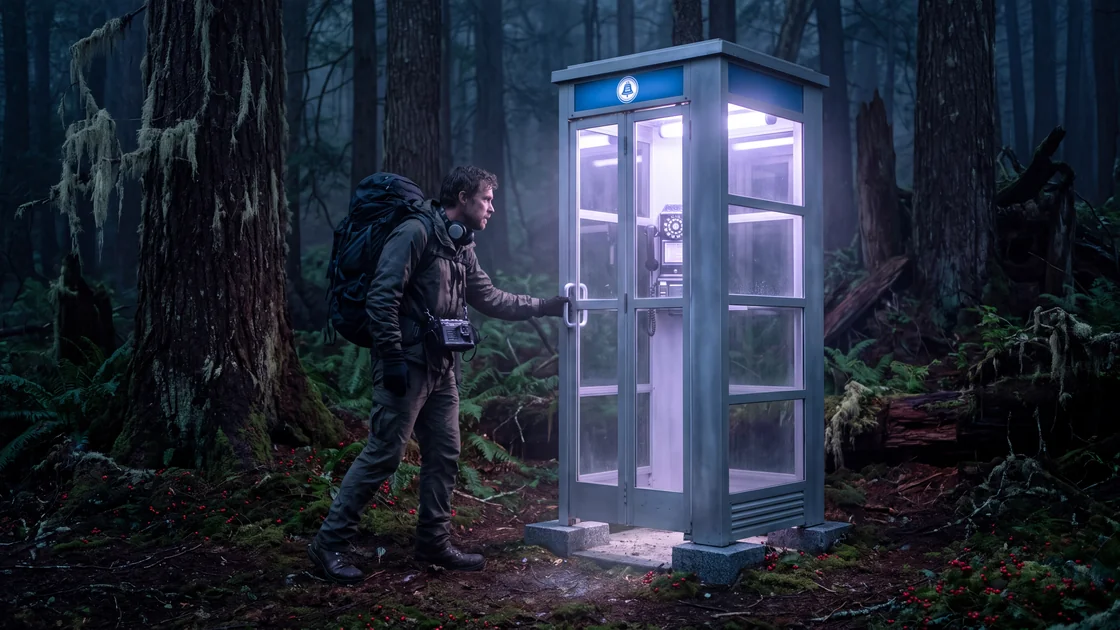
This story chronicles the harrowing expedition of Silas Vance, an experienced urban explorer and acoustic documentarian who journeys into the untamed wilderness of the Blackwood Gorges following rumors of impossible telecommunications relics. Miles past the reach of power grids and cellular towers, Silas discovers an immaculate, powered mid-century Bell System telephone booth standing solitary among virgin hemlocks. When the rotary telephone rings with mechanical precision at twelve o'clock midnight, Silas answers, plunging himself into a recursive temporal labyrinth operated by a forgotten switchboard that connects not across space, but across the fractures of time, grief, and industrial hubris.
Act I: The Topography of Absence
The maps of Oakhaven County produced after 1978 possess a curious blank space between the northern fork of the Sinking River and the limestone bluffs known as the Devil’s Washbowl. To the casual eye, it appears as an unshaded swath of emerald green, labeled simply as State Protected Watershed. But if one were to consult the quadrangle surveys drafted by the United States Geological Survey in the summer of 1962, the green gives way to a spiderweb of dashed logging spurs, coal-prospecting bores, and a single settlement named Halcyon Mills.
Halcyon Mills did not burn down, nor did it drown beneath an artificial reservoir. In the county records office in Blackwood, the town simply ceased filing quarterly tax assessments in November 1974. Its post office charter was revoked without ceremony; its municipal water district was quietly absorbed by the state forestry bureau; and the two hundred and twelve souls listed on the 1970 federal census seemed to evaporate into the humid air of the Appalachian foothills, leaving behind only cellar holes, rusted tin roofs, and an impenetrable wall of rhododendron.
Silas Vance was not interested in ghosts. He was interested in infrastructure.
For ten years, Silas had maintained The Infrastructure of Ruin, an online repository of industrial archaeology, decommissioned missile silos, dry sewer systems, and dead-end transport corridors. He was thirty-four, possessed bad knees, an encyclopedic knowledge of Western Electric manufacturing serial numbers, and a quiet, gnawing estrangement from his own family that made the damp dark of abandoned subterranean spaces feel more hospitable than a holiday dinner table.
His obsession with the Blackwood Gorges had begun with a 1/4-inch magnetic tape spool he had purchased at an estate sale in Cincinnati. The box had been labeled in faded red grease pencil: B-7 Switch Routing / Line Integrity / 14 Oct 74.
When played through his vintage Otari reel-to-reel deck, the tape had yielded twelve minutes of standard automated diagnostic tones, followed by the dry, uninflected voice of a Bell System exchange operator reciting coordinates that corresponded to no public road. Beneath the operator’s mechanical cadence, Silas had detected an anomalous frequency—a low, rhythmic thrumming like an enormous flywheel turning inside a hollow mountain, accompanied by the distinct, periodic mechanical chime of a public payphone’s bell striker.
He had spent three months cross-referencing forestry fire-tower logs, forgotten right-of-way easements granted to the American Telephone and Telegraph Company, and satellite infrared imagery. Most of the old rights-of-way had long since been reclaimed by sumac, black birch, and mountain laurel. Yet, directly along the spine of the Blackwood Ridge, where the virgin hemlocks stood so dense that the forest floor remained in perpetual twilight, Silas found a straight, unnatural seam in the canopy. It was an unpaved survey line cut eighty feet wide through the timber, running dead north-to-south for twelve miles before terminating against the sheer granite face of Mount Moriah.
On the third Thursday of October, Silas parked his battered four-wheel-drive truck at the gate of Fire Road 11, hoisted an internal-frame pack weighing fifty-four pounds, and walked into the trees.
The gear in his pack reflected the dual nature of his compulsion. Alongside the standard implements of wilderness survival—a canvas bivy, a down-filled sleeping system, water filtration pumps, freeze-dried rations, and an emergency locator beacon—he carried thirty pounds of specialized electronics: a Zoom F6 field recorder with a matched pair of Sennheiser omnidirectional microphones, a contact transducer, an electromagnetic field meter, an analog battery tester, and a magnesium-cased Hasselblad camera with four rolls of high-speed black-and-white film.
The air in the lowlands tasted of rotting oak leaves and damp river silt, but as he gained elevation, climbing past the second tier of the bluffs, the humidity thinned into an austere, resinous chill. The forest here was old—not the second-growth scrub that carpeted much of the Eastern seaboard, but primeval timber. The trunks of the eastern hemlocks measured five feet across at the breast height, their scaly bark dark as iron, their lower limbs draped in curtains of pale Usnea lichen.
By four in the afternoon, the sun had dipped behind the western ridge, plunging the gorge into an indigo gloom. Silas’s handheld GPS receiver, which had been tracking his coordinates with six-meter accuracy throughout the morning, began to drift. The satellite constellation indicator flickered; the screen displayed a frantic, spinning compass rose before settling on a flashing error code: DOP VALUE EXCEEDED.
Silas stopped on a plateau carpeted in clubmoss, leaned against the fluted trunk of a dead chestnut tree, and unclipped his mechanical lensatic compass. The needle swung sluggishly, passing north, slipping past east, and finally trembling to a halt pointing southwest—directly toward the granite roots of Mount Moriah.
"Mineral deflection," he muttered to himself, his voice sounding thin and immediately swallowed by the colossal quiet of the woods. "Magnetite pockets in the shale."
Yet he knew the geology of the county didn't support that hypothesis. The bedrock here was Pottsville sandstone and coal measures, non-magnetic and inert.
He pressed on, following the phantom corridor where the survey line met the ancient timber. Here, the ground underfoot changed. The spongy forest duff gave way to a subtle, linear depression—an old roadbed, long compacted beneath decades of leaf mold, flanked by the rotted remnants of cedar fence posts that had lost their wire forty years ago.
Then, through the gloom of the hemlock colonnade, Silas saw the reflection.
It was not the dull, organic glint of wet stone or the wet sheen of a bracket fungus. It was the sharp, razor-edged flash of tempered plate glass catch-lighting the last blue rays of the twilight sky.
Silas froze. He lowered his trekking poles, the breath hitching in his throat.
Thirty yards ahead, perfectly centered in a clearing where no trees grew and even the ferns seemed to peel back in a tidy five-yard perimeter, stood an object of impossible industrial perfection.
It was a Model 1A "Airlight" telephone booth.
Its frame was constructed of anodized brushed aluminum, polished to a dull silver satin that showed no trace of oxidation or moss. Four large panes of three-eighths-inch tempered safety glass formed its walls, completely intact, devoid of scratches, etched initials, or the spiderweb fractures typical of vandalized roadside relics. Upon the transom above the bi-fold door, the blue Bell System seal—the iconic bell inside a circle, redesigned by Saul Bass in 1969—was rendered in crisp, unblemished porcelain enamel.
Silas approached it as one might approach a sleeping predator or an unexploded ordnance.
The forest floor within ten feet of the booth was devoid of fallen twigs. It was carpeted in a dense, uniform mat of creeping partridgeberry, whose red fruit looked startlingly bright against the dark earth, like drops of freshly spilled sealing wax.
Silas stood before the bi-fold door. The air smelled different here. The earthy, damp stench of the hemlock loam was completely absent, replaced by a dry, sterile odor that he recognized instantly from his tours of municipal telephone exchanges: the faint, clean scent of ozone, warm phenolic circuit boards, and chlorinated paraffin.
He looked up through the glass roof of the kiosk. Inside, suspended from the ceiling in a white plastic diffuser, a single twenty-watt fluorescent tube was unlit.
Mounted upon the rear stainless-steel backplate was a Western Electric Model 1D2 three-slot coin collector, finished in black baked enamel. The chrome rotary dial gleamed under the dying twilight. The heavy, black Bakelite handset rested solidly in its cast-zinc cradle.
Silas reached out a gloved hand and grasped the vertical aluminum handle of the bi-fold door.
It opened with a sigh. The mechanical track was clean; the nylon glides slid along their extruded channel without a whisper of grit or rust. As the door reached its fully articulated hinge stop, a small internal microswitch clicked.
The fluorescent fixture overhead flickered twice with a soft lavender strike, caught its ballast, and settled into a steady, brilliant white hum.
Silas stepped inside, his field boots planting firmly upon the grooved rubber floor mat.
The door, counterweighted by a concealed torsion spring, swung smoothly shut behind him. The sudden drop in ambient sound was profound. The whisper of the wind through the hemlock needles cut out entirely, replaced by the dead, padded silence of an acoustic chamber, punctuated only by the sixty-cycle drone of the overhead ballast.
Silas reached for the receiver.
The Bakelite was cold—not the damp chill of the autumn woods, but the dry, conditioned cold of an air-conditioned office suite. He lifted it to his ear.
He expected dead silence. He expected the hollow hiss of open copper wires rotting in an abandoned conduit five feet under the mud.
Instead, the receiver poured into his ear canal a dial tone so pure, so mechanically vibrant, that it made the small bones of his middle ear vibrate: a precise dual-frequency chord of 350 and 440 Hertz.
Act II: The Voltage in the Soil
Silas stood motionless inside the booth for three full minutes, the heavy receiver pressed so tightly to his left ear that his temple ached.
The dial tone did not waver. In standard public telecommunications, a receiver left off-hook without dialing would eventually trigger a steady "off-hook" pulse—the high-amplitude howl designed to alert subscribers that their handset was dangling from its cord—followed by an operator recording, and finally dead battery feed.
Here, the chord remained unbroken. It was smooth, rich, and possessed a velvety analog floor noise that spoke of vacuum-tube repeaters and long runs of pressurized, lead-sheathed paper-insulated cable.
"Impossible," Silas whispered into the transmitter.
The carbon granules inside the circular mouth cap hissed slightly in response to his breath, a faint, metallic reflection of his own voice returning to him via the sidetone circuit.
He slowly replaced the handset upon the chrome fork. The switchhook depressed with a solid, spring-loaded thunk. The dial tone died. The overhead fluorescent lamp remained lit, casting a crisp, rectangular shadow of the booth onto the partridgeberry carpet outside.
Silas exited the booth and immediately dropped his pack to the ground. His hands were shaking with an adrenaline rush he hadn't experienced since he had slipped through the security perimeter of the abandoned subterranean radar complex in upstate New York five years earlier.
He pulled his Fluke multimeter and an induction wand from his technical kit.
First, he inspected the exterior of the kiosk. A standard Bell System 1A booth required an external power feed for its light and signage, typically drawn from an overhead drop wire or a subterranean conduit entering through the base of the concrete foundation.
Silas dropped to his knees and swept the creeping ground cover away from the perimeter.
There was no concrete foundation.
The extruded aluminum corners of the booth rested directly upon four square blocks of dressed gray granite, level to within a millimeter. Between the granite blocks, the underside of the booth was visible: a clean pan of galvanized steel with a central access plate secured by tamper-proof hexagonal bolts. No cables emerged from the pan. No armored steel conduit penetrated the earth.
Silas switched the Fluke multimeter to AC voltage and drove a six-inch copper grounding spike into the damp loam two feet from the booth. He held the negative probe against the spike and touched the positive lead to the aluminum door frame.
The digital readout jumped instantly: 118.4 VAC, 60.0 Hz.
He switched to direct current and touched the leads between the frame and the earth. 48.2 VDC.
Forty-eight volts direct current was the universal standard for telecommunications central office battery plants—the constant, floating voltage maintained by banks of lead-acid cells in exchange basements from coast to coast to ensure the phones would ring even if civilization collapsed and the electrical grid went black.
"Where is the source?" he muttered, standing and looking around at the silent hemlocks. "Where is the battery?"
He took his induction wand—a handheld amplifier designed to detect alternating current through drywall or soil—and switched it on. He swept the wand around the perimeter of the clearing.
Ten feet out from the booth, the wand was silent.
At eight feet, a faint, singing hum emerged from its speaker.
At five feet, the hum resolved into a complex, polyphonic drone: not merely the sixty-cycle buzz of utility power, but a tapestry of overlapping audio frequencies, high-pitched carrier tones, and what sounded like dozens of voices speaking simultaneously, speeded up until they chattered like starlings.
Silas traced the signal. It did not form a line leading out of the clearing toward the valley or the distant highway. Instead, it formed a perfect, concentric circle around the kiosk. The ground itself was an inductor.
He unzipped the top pocket of his rucksack, retrieved his notebook, and began sketching the clearing with rapid, precise strokes.
Field notes: 17 Oct. Station identified as Western Electric Model 1A "Airlight." Unmarked service installation. No pole lines visible within 3-mile radius. Canopy unbroken. Ground shows zero mechanical disturbance. Partridgeberry growth rate suggests the clearing has been undisturbed for a minimum of thirty to forty years. Booth exhibits zero atmospheric corrosion. Dial tone active. Voltage constant.
He checked his wrist watch. It was 6:42 PM.
According to the tape he had transcribed in Cincinnati, the automated routing sequence had terminated with an exchange identification number: Station 7, Blackwood Sub-Station, Sector 4. And beneath the operator’s voice, the mechanical payphone striker had sounded four distinct pairs of rings.
Silas looked back through the clean glass. Above the rotary dial, the small rectangular instruction card, printed in clear black Spartan type behind a celluloid window, read:
BELL SYSTEM
TO CALL POLICE OR FIRE: DIAL 0
STATION CALLS: DEPOSIT 10¢ BEFORE DIALING
NO COINS NEEDED FOR OPERATOR
THIS STATION IS MONITORED BY THE CHIEF TEST
ENGINEER
HALCYON MILLS EXCHANGE
Halcyon Mills. The town that had fallen off the edge of the world fifty years ago.
Silas unholstered his camera, mounted it to his carbon-fiber tripod, and spent an hour documenting the booth from sixteen cardinal and intercardinal points. He captured the reflection of the ancient trees in the glass, the pristine chrome of the coin return bezel, the immaculate yellowing paper of the regional directory hanging from a steel cable beneath the shelf—a directory for Oakhaven and Northern Counties, 1973–1974.
He thumbed through the directory. The pages were uncurled, smelling faintly of old wood pulp and fish glue.
Under the listing for Halcyon Mills Municipal Offices, he found a dozen entries: Borough Secretary, Water Department, Fire Station 1, Road Overseer.
And at the very end of the Halcyon Mills listings:
Vance, Arthur M. — Logging Engineer & Right-of-Way Inspector —
Phone: 489-0012.
Silas’s fingers stiffened against the thin paper.
Arthur Vance was his grandfather.
The grandfather who had disappeared in the late autumn of 1974, leaving behind a locked house in Morgantown, a savings account that remained untouched until it was remitted to the state treasury, and a family that never spoke his name except in bitter, bewildered whispers. The grandfather who, according to Silas’s mother, had "gone off into the woods on company business and forgot how to come home."
Silas stared at the seven-digit number: 489-0012.
His heart slammed against his ribs with such violence that he could feel the pulse in his teeth. He looked at the rotary dial. The black wheel, with its white alphanumeric clusters—G-H-I-4, J-K-L-5, M-N-O-6—glowed beneath the fluorescent light.
He reached for the handset, lifted it, and dropped a vintage silver Washington quarter from his pocket into the coin slot.
The coin fell through the internal track with a musical, triple chime: ding-ding-dong—nickel, nickel, dime. The coin relay tripped inside with a heavy mechanical clack.
The dial tone returned.
Silas placed his index finger into the hole for the number four. He pulled the wheel clockwise until his fingertip met the curved chrome finger stop.
He released it.
The dial whirred back under its internal governor: tick-tick-tick-tick.
He dialed eight. Then nine. Then zero, zero, one, two.
The dial returned to its rest position for the final time.
The dial tone vanished. In its place came the heavy, dead silence of an off-premise copper trunk line. Silas held his breath.
Through the earpiece came the sound of a distant electromechanical switchboard: the dry, rhythmic chug-chug-clatter of a Step-by-Step Strowger switch hunting across a bank of copper terminals. It was an unmistakable sound, one that had been extinct in the modern telecommunications grid for nearly thirty years—the sound of brass wipers sliding across silver-plated contacts, seeking an idle line.
Click.
A pause. Then, the rhythmic ringback tone began: a low, resonant, four-second tone, followed by two seconds of silence.
Buzzzz-burrr. Buzzzz-burrr.
Silas felt the hair on his arms stand up. His mouth was dry as chalk.
The phone rang four times. On the fifth ring, the circuit opened with an abrupt, hollow snap.
The line did not go to an answering machine; there was no digital vocoder compression, no cellular artifacts. There was only the cavernous ambient room noise of a quiet room with a ticking clock and the faint crackle of an open hearth fire.
Then, a man cleared his throat.
"Arthur Vance speaking," the voice said.
The voice was measured, low-pitched, slightly gravelly from roll-your-own tobacco, and entirely calm. It sounded as if the speaker were sitting in the chair next to Silas, looking through the glass into the dark woods.
Silas tried to speak, but his throat locked. A cold wave of vertigo rushed from the soles of his feet to the crown of his skull.
"Hello?" the voice said again, a touch of impatience sharpening the vowels. "Is that you, Morrison? The line from the substation is humming like a bastard. If you’re at the transformer pad, turn the tertiary regulator down two notches before the midnight test."
"Arthur?" Silas managed to squeeze the word past his lips. It was barely a rasp.
The line was silent for two seconds.
"Who's this?" the voice asked, slower now, cautious. "This is a private line. How did you get through the Halcyon central switch? The board is supposed to be locked out for the pressure test."
"Arthur... my name is Silas," Silas stammered, his fingers whitening against the Bakelite handle. "Silas Vance. I’m... you don't know me. You’re my grandfather."
A dry, short chuckle came through the earpiece, followed by the strike of a paper match.
"Whoever this is, you’ve got a strange sense of humor. My son Thomas is twelve years old. He’s at home in Morgantown practicing his long division, and he doesn't have any boys named Silas. Now get off the line, son. The forest line is restricted to company personnel until midnight."
"Wait!" Silas shouted, pressing his face against the cold aluminum frame of the booth. "Don't hang up! What year is it? Arthur, what is the date?"
"It’s October 14th, 1974," the man replied, his tone shifting from irritation to a flat, cold authority. "And you’re trespassing on Consolidation Coal and Bell System right-of-way. If you’re one of those university kids protesting the borehole project, you’d better clear out. When the Midnight Exchange cuts over, the high-voltage bleed is going to saturate the entire gorge. Get out of there, son. Before the bells start."
Clack.
The connection severed.
The dial tone did not return. The earpiece remained dead, cold, and empty, emitting only the microscopic hiss of background thermal noise.
Act III: The Architecture of the Void
Silas stumbled out of the booth, hitting the moist dirt with one knee. His breath was coming in ragged, shallow gasps.
He looked at his hands; they were trembling so hard he could barely unclip his headlamp from his belt.
October 14th, 1974.
The date on the tape spool in Cincinnati. The date of the final entry in the Halcyon Mills county records.
"A recording," he whispered aloud to himself, his voice sounding hollow against the mass of the ancient trees. "It's an acoustic installation. An elaborate hoax. Someone found the old right-of-way, buried a low-frequency induction loop, set up a pirate transmitter with an optical sensor in the coin track, and played back an archival reel."
The explanation was rational, clean, and complete. It was the only explanation that did not require the laws of thermodynamics and time to lie broken at his feet.
Yet, as he inspected the clearing with the clinical detachment of an investigator, the rationalization began to unravel.
To maintain an installation of this caliber in the deep wilderness required infrastructure. A buried induction loop capable of throwing 118 volts of inductive field across a thirty-foot clearing would require a diesel generator or a multi-kilowatt battery array, neither of which could be operated without leaving exhaust residues, fuel odors, or access tracks.
Silas took his trenching spade from his pack and walked to the outer edge of the clearing, twenty feet from the rear of the booth. He knelt and plunged the steel blade into the loam.
The spade bit through two inches of leaf mold, then struck something hard with a dull, ringing clink.
He scraped away the black earth.
Beneath the roots of the hemlocks lay a sheet of woven copper mesh, its wires thick as pencil lead, tarnished with a bright green patina that only formed after decades of subterranean burial. The mesh extended in every direction, knit into the root systems of trees that were three centuries old.
The trees hadn't grown over the mesh after it was laid.
The mesh had been laid through the roots. In several places, hemlock taproots six inches in diameter had grown straight through the half-inch square openings of the copper grid, fusing with the metal, the wood swollen and discolored by decades of copper salt absorption.
This installation had not been built last week, or last year. It had been here for fifty years. Or longer.
Silas walked back to the booth. The fluorescent light remained steady, a cold, unwavering beacon in the Appalachian night.
He checked his mechanical watch: 8:15 PM.
He opened his field kit and set up his recording equipment. He clamped a contact microphone directly to the aluminum transom of the booth, connecting the lead to Channel 1 of the Zoom F6. On Channel 2, he plugged in a wideband electromagnetic sniffer probe, designed to translate stray RF and electrical fields into audible sound. He positioned his Sennheiser stereo pair on a carbon-fiber bar five feet back from the door, aimed at the rotary dial.
He slid on his monitoring headphones and turned the master gain knob.
What he heard in the cans made his skin prickle.
Channel 1—the contact mic on the booth frame—was picking up an internal mechanical rhythm. Far below the sixty-cycle transformer hum, there was a steady, rhythmic cadence: tick... tock... tick... tock.
It was not a quartz movement. It was the heavy, escapement-driven cadence of a master pendulum clock, the kind used in early twentieth-century railway stations and central telegraph offices to synchronize switch relays across whole continents.
Channel 2—the electromagnetic probe—was worse.
It was receiving an acoustic signal that was shifting across the spectrum. Silas heard voices—hundreds of them, stacked upon each other like layers of tissue paper in an old file box.
—we have a collect call from Arthur to the central
exchange—
—the core pressure at bore three is exceeding four hundred
pounds—
—don't let him sign the easement, Sarah, tell him the company
isn't—
—the line is dead, operator, I can't hear anything but the
water—
—twelve o'clock, testing, twelve o'clock—
The voices were not loops. They did not repeat. They faded in and out of the static like swimmers surfacing for air in a turbulent sea before being dragged down into the undertow.
Silas sat on his pack, pulled his wool watch cap down over his ears, and took a sip of cold water from his canteen. The temperature was plunging rapidly. His breath formed clouds that drifted toward the open door of the booth, where they were instantly dissolved by the warm draft rising from the internal light fixture.
He knew he should pack his gear and hike out.
The trail back to Fire Road 11 was five miles of broken, boulder-strewn terrain, and traversing it in the dark with a dead GPS was dangerous. But he had a compass, two high-lumen headlamps, and spare lithium batteries. He could be back at his truck by midnight.
By midnight.
Arthur had said it: When the Midnight Exchange cuts over, the high-voltage bleed is going to saturate the entire gorge.
And the tape in Cincinnati: Line Integrity / 14 Oct 74 / Four rings at twelve.
Silas looked at the rotary phone. It stood there like an altar, illuminated in its glass chapel, waiting for a congregation of one.
"I’m staying," he said to the darkness.
He took out a thermal foil blanket, wrapped it around his shoulders, adjusted his headphone levels, and settled down against the trunk of an ancient hemlock to wait.
Act IV: The Switchboard of the Displaced
Time in the deep forest does not pass in minutes; it passes in degrees of silence.
By ten o'clock, the nocturnal insects—the few crickets that had survived the early frosts—ceased their singing. The small mammals that scurried through the underbrush, the deer mice and short-tailed shrews, vanished entirely.
The forest became an absolute vacuum of biological noise. There were no owls. No wind stirred the high hemlock needles. The only motion was the steady, microscopic descent of fine mist that began to settle out of the cooling air, coating Silas’s jacket in beads of liquid silver.
Through his headphones, the sound changed at 11:30 PM.
The low-frequency master clock cadence did not speed up, but its amplitude increased. The tick... tock began to produce a low-end thump that Silas could feel through his boots, transmitted through the copper mesh buried in the dirt.
At 11:45 PM, the fluorescent fixture inside the booth began to alter its hue.
The sterile white light softened, shifting into an eerie, pale amber—the distinctive chromatic signature of neon-argon glow tubes. Silas stood up, shedding the foil blanket. His joints cracked with the cold.
He walked to the open door of the booth.
The interior was warm now—not merely the slight heat of an electrical ballast, but an ambient temperature of at least seventy-two degrees. It smelled of freshly oiled wood, cold coffee, and the distinctive, resinous tang of hot linoleum.
Silas peered closely at the rotary dial.
The center bezel of the dial, which had previously been empty white paper behind plastic, now displayed a tiny red jewel lamp. The lamp was pulsing slowly, once every three seconds, like a pilot light on an industrial furnace.
He checked his mechanical field watch.
11:58 PM.
Silas stepped inside the booth and pulled the bi-fold door shut.
The acoustic transition was instantaneous and total. The dead, cold silence of the Appalachian wilderness vanished. In its place came a dense, physical atmosphere charged with immense potential energy. Silas felt his ears pop twice, as if he were descending rapidly in a high-speed elevator.
He did not touch the receiver. He held his camera in one hand, the zoom recorder strapped to his chest, his eyes fixed on the black Bakelite cradle.
His watch clicked to 11:59.
The red jewel lamp in the center of the dial stopped pulsing. It clicked on with a brilliant, steady crimson glare.
Deep within the steel casing of the 1D2 coin collector, a relay latched with the force of a solenoid bolt: CLACK.
Silas’s watch reached 12:00:00.
The booth exploded with sound.
It was not an electronic tone. It was the ferocious, physical violence of two hardened brass gongs struck by a high-tension steel clapper operating at twenty cycles per second.
BRRRRRRRRRRR-ING!
The sound inside the glass enclosure was deafening. The acoustic pressure hit Silas in the sternum, rattling the camera lens against his belt buckle. The entire kiosk vibrated, the aluminum frame singing like a tuning fork.
Two seconds of ringing.
Four seconds of silence.
BRRRRRRRRRRR-ING!
Silas’s heart was in his throat. His hand hovered over the handset. Every instinct honed by thirty years of survival in the modern world screamed at him to throw open the door, run into the hemlocks, and never look back.
BRRRRRRRRRRR-ING!
Three rings.
On the fourth ring, Silas grasped the receiver and ripped it from the cradle.
He slammed it against his ear. "I'm here!" he yelled.
The ringing ceased instantly.
The silence that followed was immense, heavy with the weight of an ocean of static. Then, through the earpiece, came the sound of a woman weeping.
It was not a theatrical sob; it was the dry, ragged, exhausted weeping of someone who had been sitting alone in an empty room for days, months, or years.
"Operator," Silas whispered, his voice cracking. "Operator, can you hear me?"
The weeping hitched. A sharp intake of breath whistled through the receiver's carbon microphone.
"Exchange Seven," a voice said.
It was a woman’s voice, but it sounded strange—warped, as if the audio had been slowed down by five percent, then run through an analog filter that smoothed all the edges off the consonants.
"Exchange Seven," she repeated, her tone turning brisk, professional, and chillingly vacant. "What number are you calling, please?"
"I'm not calling a number," Silas said, leaning his forehead against the cold safety glass. "I answered. You rang."
"All circuits are busy at the Halcyon terminal," the operator said, ignoring him completely. "The automated exchange has disconnected the local trunks. If this is an emergency, please hang up and dial the Borough Marshal."
"The Borough Marshal is gone!" Silas shouted. "Halcyon Mills is gone! There is nothing here but hemlocks! It’s the year twenty-twenty-four! Do you understand me? You’ve been dead fifty years!"
A long pause followed. The line became so quiet that Silas could hear the faint, distant sound of papers being shuffled—dry, crisp paper, and the metallic clink of a switchboard plug being dropped into its brass well.
"Silas?"
The voice was no longer the operator's professional monotone. It was Arthur.
Arthur Vance’s voice was coming from the same receiver, but it was closer now, layered directly over the faint sound of the weeping woman.
"Silas, is that you?"
"Arthur!" Silas pressed the handset so hard his ear turned white. "Yes! I’m here! I’m at the booth!"
"Listen to me carefully, boy," Arthur said. His voice was ragged, stripped of the earlier arrogance. Beneath his words, the rhythmic thrum-thrum-thrum of the massive underground flywheel was louder now, shaking the low end of the line. "They lied to us about the borehole. It wasn't an exploratory gas well. They were sinking a waveguide."
"Who was?" Silas asked. "The coal company?"
"Consolidation... and the Department of Defense. Project Echo-Line. They told the town council it was an acoustic radar array for Soviet missile detection. They said the valley had the right limestone acoustics. But they weren't listening to the sky, Silas. They were listening down."
"Down where?"
"To the stratum. The fault line under Mount Moriah. It doesn't move on tectonic time; it moves on... acoustic resonance. They put forty thousand tons of pressurized oil into the cavern at seven thousand feet. They hooked the central switchboard directly into the transducer grid. They wanted an instantaneous, non-interceptible communications exchange that could survive a nuclear strike. A circuit that didn't run on wires, but through the earth's natural resonance."
The line broke into a cascade of sharp, static pops, like dry twigs snapping in a bonfire.
"Arthur, where are you right now?" Silas pleaded. "Where is Halcyon Mills?"
"We’re in the exchange building," Arthur said. His voice was dropping in pitch, the words dragging out. "We’ve been here since the cutover. The pressure didn't hold, Silas. The cavern didn't reflect the signal. It absorbed it. When the switches closed at midnight on the fourteenth, the loop closed on itself. The whole valley... the whole damned valley is inside the coil."
"Inside the coil?"
"The booth is the grounding point," Arthur’s voice was barely a growl now, slipping into the sub-audible frequencies. "It’s the only part of the circuit that still touches the dry earth. If you’re at the station... Silas, look out the glass."
Silas raised his head.
He looked through the plate glass of the 1A Airlight booth.
The forest of ancient hemlocks was gone.
Act V: The Negative Valley
Outside the glass walls, the night was no longer black.
It was bathed in a sickly, monochromatic violet radiance that had no discernible source. The ground-level partridgeberry and clubmoss had disappeared, replaced by a vast, dead plain of pulverized gray stone, flat as an airfield apron, stretching outward for miles into a thick, sulfurous haze.
Rising out of the stone plain were the silhouettes of buildings.
They were not ruins. They were clean, functional, mid-century structures: single-story brick municipal offices, a cinder-block fire garage with its red doors shut, a two-story wooden grocery store with an illuminated neon sign that read MORRISON’S GENERAL MERCHANDISE, and a tall, windowless brick cube with a microwave horn antenna mounted upon its flat roof—the Halcyon Mills Telephone Exchange.
The buildings were pristine, but they were dead.
No cars moved on the paved streets. No smoke rose from the brick chimneys. The neon sign at Morrison’s did not flicker; its red glow was perfectly static, frozen like an insect trapped in synthetic amber.
And across the plain, standing at regular intervals of fifty yards, were hundreds of telephone poles.
Their crossarms were laden with dozens of porcelain insulators, but the wires strung between them were not copper. They were glowing ribbons of lavender light, vibrating with a high-pitched, harmonic whine that pierced Silas’s skull through the glass.
"Do you see it?" Arthur’s voice whispered in his ear.
"My God," Silas breathed. "I'm in the town."
"You’re not in the town," Arthur corrected him. "The town is nowhere. We’re in the storage loop. We’ve been running through the delay line for fifty years, Silas. One millisecond at a time. The switch hunts for an exit, but the exit is grounded."
Silas saw figures now.
They were standing on the sidewalks of the violet-lit ghost town. Men in wool work shirts and chore coats, women in house dresses, children holding school satchels.
They were not transparent like classic phantoms. They were dense, solid, and utterly stationary. They were frozen mid-stride, mid-breath, their faces turned toward the central exchange building.
Silas looked closer at the nearest figure, standing twenty feet from the booth.
It was a man in his late forties, wearing a faded canvas Carhartt jacket and a grease-stained engineer's cap. He held a brass-handled line-tester in one hand and a roll of vinyl electrical tape in the other. His face was weathered, with deep crow’s feet around pale, gray eyes.
It was the man from the photograph on Silas’s mother’s mantelpiece.
Arthur Vance.
Arthur was staring directly at the booth. His lips were parted, as if frozen in the act of shaping a vowel.
"Arthur," Silas said into the receiver. "You’re right outside. I see you."
"That’s not me anymore," the voice in the earpiece replied. "That’s just the charge on the plate. The ghost in the phosphor. I’m down here. In the basement. With the switchboard."
"How do I get you out?" Silas asked, his voice shaking with a sudden, desperate fury. "There has to be a way to trip the line. A circuit breaker. A fuse."
"You can't get us out, Silas. A delay line doesn't release what it holds. It only clears when the power is cut."
"Then I'll cut the power! I'll dig up the mesh! I'll take an axe to the booth frame!"
"No!" Arthur’s voice sharpened into a roar that clipped the audio into harsh square waves. "If you break the ground, the loop doesn't clear—it collapses. The storage collapses into the bedrock. Two hundred people, Silas. We wouldn't even be an echo anymore. We’d just be fifty feet of crushed shale under the washbowl."
"Then what do you want from me?" Silas screamed into the transmitter, tears of frustration and terror cutting tracks through the grime on his cheeks. "Why did you call me?"
A long silence settled over the line.
Outside the glass, the frozen figure of Arthur Vance did not move, but the violet light began to pulse in sync with the master clock’s low-frequency thrum: tick... tock... tick... tock.
"The tape," Arthur said softly. "The Cincinnati tape. You listened to it, didn't you?"
"Yes," Silas said. "I bought it. I listened to it."
"That tape wasn't an archive, Silas. It was a test signal. My test signal. I’ve been routing that transmission through every off-hook line in the state system for thirty years, trying to find someone with the Vance bloodline who still knew how to work a patch bay."
"A patch bay?"
"The booth isn't just an instrument," Arthur said. "Look under the shelf. Beneath the directory."
Silas lowered the receiver to his shoulder, dropped to his knees, and looked beneath the narrow aluminum writing shelf.
Bolted to the underside of the shelf, hidden behind a steel skirt that Silas had assumed was merely structural reinforcement, was a row of six quarter-inch switchboard jacks, labeled with faded Dymo embossing tape:
TRUNK 1 — LOCAL — DELAY IN — DELAY OUT — MONITOR — DRAIN
Between the jacks hung a single, heavy patching cord: a braided cloth-jacketed cable terminated at both ends by heavy brass Western Electric No. 310 plugs. One end was currently plugged into DELAY IN. The other end was inserted into MONITOR.
"I see it," Silas said into the receiver. "A patching bay. Six jacks."
"The plug in MONITOR," Arthur said, his voice dropping to an urgent, ragged rasp. "That’s where we’re bleeding off the excess voltage. That’s why you can hear us. But as long as DELAY IN is patched to MONITOR, the loop runs in a circle. It feeds back into the exchange."
"What happens if I pull it?"
"If you pull DELAY IN, the input stops. The loop empties."
"Into what?" Silas asked.
"Into the DRAIN."
Silas looked at the sixth jack. The label DRAIN was not printed on red Dymo tape like the others. It was stamped directly into the aluminum, filled with black industrial enamel. And beneath the word was a hand-etched warning, scratched into the metal with a scribe:
NON-REVERSIBLE TERMINATION — EARTH POTENTIAL ONLY
"Arthur... what is the Drain?"
The voice on the other end didn't answer immediately. When it did, Silas heard the sound of the switchboard operator weeping again, her breath shuddering against the carbon transmitter.
"It’s the end of the line, Silas," Arthur whispered. "It’s where the signals go when the subscriber hangs up. It’s the ground."
"You’ll die," Silas said.
"We died on October 14th, 1974," Arthur replied. "We just haven't had the decency to lie down yet. We’re tired, Silas. Fifty years of sitting in this basement, smelling the hot transformer oil, listening to the switches hunt for numbers that don't exist anymore. Thomas... my boy Thomas is an old man now, isn't he?"
Silas closed his eyes.
"My father died six years ago, Arthur. He died of a stroke in a nursing home in Roanoke. He waited his whole life for you to come home."
The line fell into a profound, suffocating silence.
The low-frequency thrum seemed to hitch, like an engine missing a stroke. Outside the glass, across the violet-lit plain of Halcyon Mills, the hundreds of frozen figures remained motionless, but their shadows—long, sharp silhouettes cast against the gray stone—began to stretch toward the booth.
"Thomas is gone?" Arthur asked. The voice was no longer that of a rugged lineman or an industrial engineer. It was the voice of an old, broken child.
"Yes," Silas said gently. "He's gone."
"Then there’s nobody left to call," the voice said. "Pull the plug, Silas. Put the exchange to bed."
Act VI: The Cutover
Silas stood inside the booth, his hand hovering over the braided cloth patch cord.
His field recorder was still running, its digital meters dancing in the amber glow of the internal lamp. The Sennheiser microphones outside the booth were picking up a sound that made his stomach heave: the high-voltage whine of the ribbons of light was descending in pitch, turning into an unbearable, resonant howl that shook the glass panes in their aluminum channels.
The violet town was beginning to destabilize.
The clean lines of the buildings were smearing horizontally, like a television image losing its horizontal hold. The brick telephone exchange was stretching upward into the sulfurous sky, its microwave horn twisting like melted wax.
The figures on the sidewalks were beginning to drift, their limbs blurring, their clothes shedding fine particles of lavender light that drifted into the air like luminous snow.
"Silas!" Arthur’s voice screamed through the earpiece. The voice was breaking into shards of white noise. "The borehole is venting! The oil is reaching the contactors! Pull the cord or the whole ridge is going down!"
Silas dropped the handset. It dangled from its armored steel cord, spinning slowly, emitting a furious cacophony of dial tones, busy signals, and the desperate, overlapping cries of two hundred people who had been trapped in amber for half a century:
—goodbye, Sarah—
—the line is clear—
—operator, give me long distance—
—tell him we’re alright—
—cut it—
—CUT IT—
Silas gripped the brass barrel of the plug inserted into MONITOR.
The metal was scorching hot. It blistered the pads of his thumb and forefinger instantly, the smell of scorched skin filling the tiny booth.
He pulled.
The plug resisted. It had been seated in that brass sleeve for fifty years; the metal had suffered galvanic binding, fusing the contacts together with molecular stubbornness.
Silas planted his boots against the opposite aluminum corner of the booth, locked his fingers around the knurled barrel, and heaved with his entire body weight.
SNAP.
The plug ripped free from MONITOR with the sound of a pistol shot. A brilliant, blue-white arc of electrical fire, three inches long, leaped from the open jack to the brass tip of the plug, burning through Silas’s glove and scorching his wrist.
The voices in the dangling receiver cut out instantly.
The violet light outside the booth vanished, plunging the world into an absolute, suffocating pitch-blackness.
"Now!" Arthur’s voice did not come from the receiver. It came from the air itself, resonant, booming through the steel floor of the booth, shaking Silas’s marrow. "INTO THE DRAIN!"
Silas threw his weight forward. He took the sparking, arcing brass plug and slammed it into the final jack: DRAIN.
The contact seated with a wet, heavy thud.
The universe inverted.
Silas did not hear the explosion; he felt it as an instantaneous displacement of mass. The booth did not fall, but the earth beneath it seemed to drop away at the speed of gravity. A sound like the snapping of ten thousand steel cables tore through the granite roots of Mount Moriah.
The fluorescent tube overhead shattered into a cloud of white phosphor dust.
The safety glass panes of the 1A Airlight booth blew outward, disintegrating into millions of tiny, blunt cubes that rained down into the darkness like hail.
Silas fell to his hands and knees on the rubber floor mat, his arms wrapped over his head, screaming into the roaring, rushing void as fifty years of compressed acoustic potential bled down into the deep, cold granite of the Earth.
He felt the current passing through him.
It did not burn him like utility power. It felt like cold water—an infinite, rushing torrent of voices, names, dates, switch signals, ringing bells, and forgotten laughter pouring through his arms, through his spine, through the soles of his boots, and sinking into the ancient, silent stone.
He saw his father as a boy, running through a field of goldenrod with
an iron hoop.
He saw his grandfather sitting at a scarred oak table, soldering a
crystal diode by the light of a kerosene lamp.
He saw the town of Halcyon Mills—not as a ghost, but as a living,
breathing community of muddy roads, laundry drying on lines, woodsmoke
curling into the autumn sky, and people who lived and died without ever
knowing that their lives were nothing more than a spark jumping across a
gap.
Then, the current ceased.
The rushing sound died into a faint, hollow sigh, like air escaping from a punctured tire.
The forest returned.
Act VII: The Ground State
Rain was falling.
It was not the synthetic mist of the storage loop, but the cold, clean, needle-sharp rain of an Appalachian October dawn. It fell through the canopy of the hemlocks, dripping from the needles, splashing upon Silas’s bare neck, washing away the sweat, the phosphor dust, and the soot from his blistered fingers.
Silas raised his head.
The dawn was gray, pale, and vast. The sky through the gaps in the branches was the color of lead, touched at the eastern rim with a bruised strip of dull rose.
He was sitting on a rectangular slab of dressed gray granite, level with the earth, surrounded by a thick, lush carpet of partridgeberry.
The booth was gone.
There was no aluminum frame. No tempered glass. No black baked-enamel rotary telephone.
In the center of the granite slab, protruding from the stone by only six inches, was a severed length of two-inch cast-iron conduit. Its top was threaded, capped with a rusted, hexagonal iron plug that had clearly not been turned in half a century.
A few inches away from the iron conduit, resting on the wet stone, was an object.
Silas crawled forward on his hands and knees, his breath catching in his throat.
It was a Western Electric No. 310 switchboard plug. Its braided cloth cord had been severed, its copper strands frayed and blackened at the end, as if sheared by an enormous pair of bolt cutters.
Beside it lay his field kit.
His camera was intact, resting on its tripod, though the lens cap was missing. His Zoom F6 recorder was still switched on, its small LCD screen reading: RECORDING COMPLETED — FILE 0042 — 06:14:12.
Silas reached out a trembling, blistered hand, picked up his headphones from the wet moss, and slid them over his ears.
He pressed the play button on the recorder.
For five minutes, there was only the sound of the autumn rain falling through the hemlocks, the occasional sigh of the wind, and the dull, rhythmic breathing of a man sleeping on the forest floor.
Then, at the 05:48 mark, the recording captured a sound.
It was faint, distant, muffled as if traveling through fifty feet of solid earth and river shale.
It was the sound of a telephone bell—not the frantic, violent alarm of the Midnight Exchange, but the gentle, cheerful, single chime of a home telephone sitting on a hallway table.
Ding.
A pause.
Then, a voice—faint, warm, and clear as mountain water:
"Central. Your party has answered. Go ahead, please."
And then, the line went dead.
Epilogue: The Archive of the Quiet
Silas Vance did not publish the recordings on The Infrastructure of Ruin.
He returned to his truck at Fire Road 11 by noon that Friday, his pack significantly lighter without the weight of his obsession. He drove south, away from Oakhaven County, away from the blank spaces on the Geological Survey maps, down into the rolling valleys where the cellular towers stood on every ridge, their red clearance lights pulsing in the autumn twilight.
He spent two weeks in the burn unit of the university hospital in Charlottesville, receiving treatment for third-degree electrical burns on his right hand and forearm. When the doctors asked him how he had sustained contact burns that mirrored the exact footprint of an industrial high-voltage switchboard plug, he told them he had been salvaging scrap copper from a farmer’s abandoned transformer yard and had caught the discharge of a residual capacitor.
They believed him, because the truth was a disease that no clinical pathology could name.
In December, Silas took the Otari reel-to-reel deck down from his study shelf and packed it into a wooden crate, alongside the 1/4-inch tape from Cincinnati and the SD card from the Zoom F6. He did not erase the files. He did not burn them.
He took the crate to the small family cemetery outside of Morgantown where his father, Thomas Vance, was buried beside an empty plot reserved for Arthur Vance.
The ground was frozen, hard as iron beneath two inches of crusty snow. Silas took an entrenching tool from his trunk and dug a hole eighteen inches deep into the frozen dirt at the foot of his father’s headstone.
He placed the wooden crate into the hole.
Before he pushed the cold earth back over the wood, he took the severed Western Electric No. 310 plug from his pocket. The brass was cold, tarnished now with a dull, greenish film where his blistered skin had touched it.
He laid the plug atop the crate, oriented dead north, pointing toward the granite roots of Mount Moriah.
"The line is clear, Arthur," he whispered. "The call is finished."
He filled the hole, tamped the dirt down with the heel of his boot, and smoothed the snow over the scar until the ground was level, silent, and indistinguishable from the rest of the earth.
Silas Vance never explored another abandoned missile silo. He never entered another derelict subway tunnel. He bought an old farmhouse in the Shenandoah Valley, three miles from the nearest paved road, where no power lines crossed his land and the only water came from a gravity-fed spring on the hill.
He did not install a telephone.
Yet sometimes, in the deep of the winter nights, when the wind comes down from the northern ridges and rattles the bare branches of the locust trees against his tin roof, Silas will wake up at precisely twelve o’clock.
He will lie still in the dark, his breath slow and even, his scarred right hand resting open on the quilt.
He listens.
And there, in the absolute quiet of the sleeping valley, far beneath the rustle of the dry leaves and the creak of the old timber, he hears it:
The long, smooth, unblemished dial tone of a world that has finally hung up its receiver, waiting patiently in the dark for the morning to come.