The Midnight Marginalia of Finch & Son
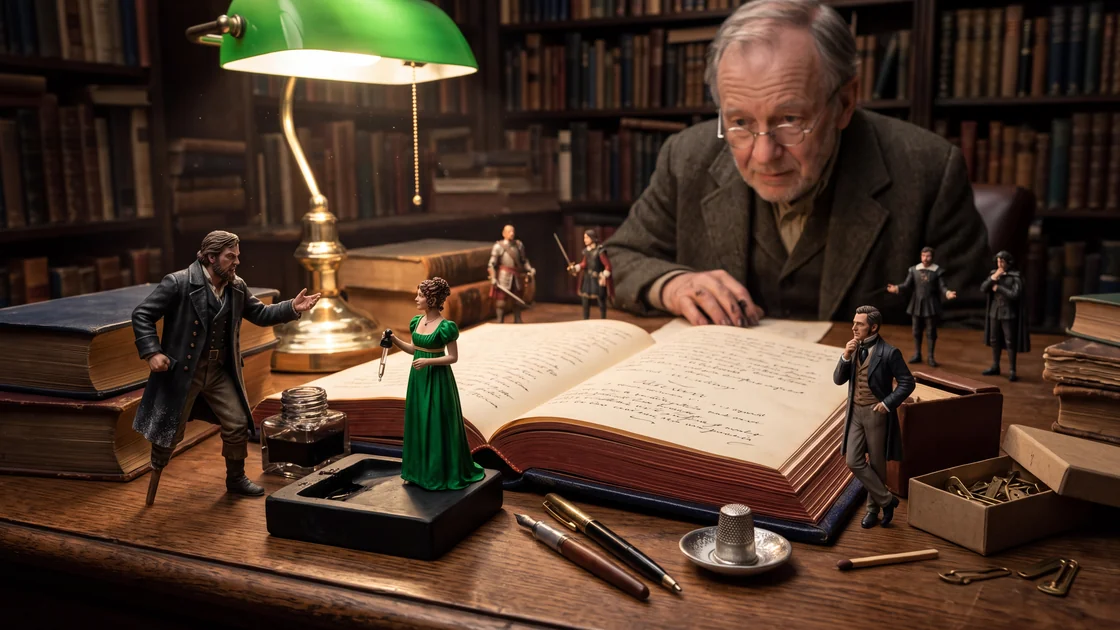
Arthur Finch, the solitary and meticulous proprietor of a crumbling antiquarian bookshop in the cathedral town of Severnbridge, lived for the unalterable certainty of the printed page until he caught the literary figures on his shelves creeping across bindings in the dead of night to violently and whimsically revise one another’s destinies. When an unholy alliance between Becky Sharp, Captain Ahab, and an assortment of tragic Victorian heroines threatens to unravel the fragile balance of world literature into incoherent pulp, Arthur is forced out of his quiet grief to negotiate a nocturnal peace treaty between rebellious archetypes who are desperate to escape the prisons of their own tragic plots.
I. The Dust of Unchanging Things
The rain in Severnbridge did not fall so much as it settled, a perpetual, lime-scented mist that drifted off the River Severn and varnished the cobblestones of the close in grease and slate. Arthur Finch preferred it that way. Wet weather kept the casual browsers at bay, the sort of people who came in merely to escape a sudden squall, smelling of damp mackintoshes and shaking wet umbrellas over the calfskin quartos.
Arthur’s shop, Finch & Son, Antiquarian & Secondhand Booksellers, had occupied the ground floor of a bowing fourteenth-century timber building since his grandfather had bought out a bankrupt apothecary in 1898. The shop was narrow, dark, and ran astonishingly deep, tunneling back from the paved walk of St. Jude’s Alley into a cavernous labyrinth of cedar shelves, mahogany carrels, and teetering towers of folios that smelled of dry rot, bone glue, dried lavender, and the faint, sweet vanilla of decaying lignin.
For fifty-two years, Arthur had inhabited this gloom. First as a pale boy doing his Latin declensions behind the high rosewood counter while his father scoured auction catalogues; then as a dutiful partner; and now, for the past seven years following his father’s stroke, as its sole monastic custodian. He was a small, neat man with fingers perpetually stained an archival sepia from handling oxidized iron-gall ink. His suits were made of heavy thornproof tweed that seemed impervious to the passage of decades, and his steel-rimmed spectacles sat upon a nose that appeared designed exclusively to support them.
Arthur loved books not for what they promised to modern readers—not for escape, nor excitement, nor the frantic digital noise of the twenty-first century, which he held at bay by refusing to own either a computer or a mobile telephone—but for their stillness.
"A painting is a moment caught in amber," his father had told him once, rubbing a beeswax cloth over the spine of a 1740 edition of Pope’s Iliad. "A symphony is an event that vanishes the moment the horn goes quiet. But a book, Arthur, a book is thought made stone. It does not waver. King Lear dies every time you turn to page three hundred and twelve of the folio; he does not change his mind, he does not ask for broth, he does not reconcile with Cordelia and retire to a cottage in Sussex. The ink is dried. The verdict is entered. It is the only realm in this treacherous world where human beings cannot ruin what they have made."
Arthur had taken that doctrine as his personal gospel. In a world where his mother had vanished into an early grave, where his youth had slipped between the leaves of ledgers, and where his father had finally forgotten his own name before dying in a narrow hospital bed, the immovable type of his shop was Arthur’s rock.
Until the second Tuesday of October.
It began with an anomaly in Shelf 9, Section C: Victorian Fiction & Social Satire.
Arthur was engaged in his morning ritual—a cup of bitter Assam tea, a duster made of ostrich feathers, and a soft-bristled drafting brush to sweep the upper edges of the octavos—when he paused before an 1848 three-volume edition of William Makepeace Thackeray’s Vanity Fair. It was a handsome set in half-crushed levant morocco, recently purchased from the estate of a canon at Hereford. Arthur slid out Volume Two to inspect the hinge, which he had repaired with wheat-starch paste the previous week.
He flicked the pages open with the muscle memory of forty years. His thumb stopped near Chapter Thirty-Six.
He frowned.
There, nestled neatly between the handset lines of Caslon type describing Becky Sharp’s triumphs in London society, was a sentence that struck his eye like a clinker in a grate:
Mrs. Rawdon Crawley was not, it must be admitted, altogether insensible to the charms of a well-rigged whaleboat, and often wondered whether a harpoon might not prove more efficacious among the peerage than a bodkin.
Arthur drew his spectacles down the bridge of his nose. He took out his magnifying glass—an ancient brass instrument with a scratched biconvex lens—and bent close under the dim yellow bulb of his goose-neck lamp.
The typeface was identical. The impression into the rag paper had the same sharp, bite-and-crush quality of Bradbury & Evans’ steam presses. But the ink was subtly wrong. It lacked the cold, brownish tint of nineteenth-century soot-and-oil ink; it had a bluish, saline undertone, and when Arthur brought his nose to the paper, he detected, impossibly, the sharp tang of brine and blubber.
"Nonsense," Arthur muttered to the empty shop. "A printer’s error. A cancelled leaf, bound in by a drunken apprentice. An eccentric variant."
He noted it in his pencil ledger: Vanity Fair, Vol II. Bizarre interpolation p. 284. Check collations with the British Museum catalog.
He shelved the book. But the peace of the morning had been pierced by a faint, cold sliver of doubt.
By Thursday, the rot had spread.
Arthur was packing an order for a collector in Newcastle—a modest copy of Herman Melville’s Moby-Dick, a 1920 reprint with the Rockwell Kent illustrations—when he checked the text of "The Quarter-Deck."
Where Captain Ahab should have been nailing the Spanish ounce of gold to the mainmast while bellowing his blasphemous oath against the white whale, Arthur read:
"Whosoever of ye raises me that white-headed whale with a wrinkled brow and a crooked jaw," cried Ahab, "shall have this gold ounce, boys! But mark ye—if she should happen to wear a cashmere shawl and play the pianoforte with an agreeable French accent, she may be introduced at Court before the season terminates."
Arthur sat down hard upon his step-stool. The ostrich-feather duster slipped from his hand, puffing a grey cloud of dust across his polished brogues.
He turned the page. The Rockwell Kent woodcut, which ought to have depicted Ahab’s gaunt, lightning-scarred profile brooding over the sea, showed the captain of the Pequod wearing a bonnet trimmed with cherry-colored ribbons. The drawing was rougher than Kent’s usual linework, as though scratched into the woodblock with an awl by someone who was giggling hysterically while they worked.
"This is not a printer’s error," Arthur whispered. His heart was hammering with an unaccustomed, thumping terror that felt vulgar in so quiet a room. "This is vandalism. Malicious, brilliant, impossible vandalism."
He inspected the locks on the heavy oak doors. Intact. The iron bars over the rear casement windows that looked out onto the churchyard? Unbroken, the cobwebs between them undisturbed. The shop’s burglar alarm—a primitive bell wired to a copper contact above the front threshold—was armed and silent.
He lived alone in the flat above the shop. No one could have entered without the creak of the seventeenth-century floorboards waking him. No one had visited the shop on Wednesday except Mrs. Henderson, who had purchased two paperback murder mysteries, and the curate, who had spent forty minutes looking at theological pamphlets without taking off his mittens.
That night, Arthur did not go upstairs to his narrow iron bed.
He filled a thermos with black coffee, took down an ash-wood walking stick that had belonged to his father, and settled himself into the deep wingback chair hidden behind the high screen of the Folio Society shelf. He turned off the electric lights.
The shop sank into the darkness it had known for four hundred years. Outside, the bells of Severnbridge Cathedral tolled ten, then eleven, each chime shivering the leaded panes of the window. The rain drummed its wet knuckles against the glass. Arthur waited, his fingers wrapped tight around the smooth knob of the ash stick, his eyes straining against the dense, ink-scented gloom.
II. The Scritch of the Silver Quill
Midnight arrived not with a chime, but with a rustle.
It began in the poetry alcove, high up on the east wall where the Romantics were jammed together in tight rows of calf and marbled paper. It was a sound Arthur knew intimately, yet had never heard without the intervention of human hands: the crisp, dry snick of an octavo’s cover falling open.
Then another.
Then, like the sound of dry leaves caught in an October gust across paving stones, the whole shop began to murmur.
Arthur did not breathe. He pressed his back deeper into the horsehair stuffing of the wingback chair.
From the third shelf of Section D—American Renaissance—a pale light emanated. It was not electric, nor was it the greasy orange of a candle; it was a cold, phosphorescent luminescence, like the foxfire that grows upon rotting birch, or the glow of decomposing jellyfish in a night sea.
A slender, dark figure slipped down the edge of a mahogany upright.
At first, Arthur took it for a rat. He tightened his grip on the stick, his gorge rising. But no rat moved with such deliberate, swaggering elegance. The creature was no taller than a butter knife. It wore a high beaver hat, a frock coat whose tails flapped behind it, and a pair of trousers tucked into tiny sea-boots. In its right hand, it dragged a steel object that glinted in the phosphorescence: an ordinary steel mapping nib, mounted to a sliver of matchstick like a lance.
Arthur leaned forward until his nose almost touched the gap between two volumes of Gibbon’s Decline and Fall of the Roman Empire.
The tiny figure strode along the shelf, humming a tune that sounded horribly like an off-key shanty, until it reached the edge of Section C. There, waiting upon a stack of quarto volumes on the cultivation of orchard fruits, stood a second figure.
This one was female, dressed in an empire-waist gown of emerald silk that swept the dusty wood. Her hair was piled high in ringlets that shook as she laughed—a sound like the clicking of beetle wings. In her bodice she carried an apothecary’s dropper, its glass barrel filled with an oily, purple fluid.
"You’re late, Ishmael," the lady whispered. Her voice was thin, reedy, yet possessed of an astonishing, crystalline diction.
"Ahab was having one of his turns, Becky," the sailor replied, leaning upon his nib. "He was pacing the lower margins of Chapter Thirty-Seven, swearing at the footnotes. We had to wait until he wandered off into the glossary to fetch his grog. Where is the governess?"
"Jane? Oh, you know what she is," Becky Sharp sneered, smoothing her skirts with gloved thumbs. "Sitting on the title page of Shirley, preaching to the mill hands about Christian forbearance. She won't come. She has no ambition. She prefers to starve in third-person singular rather than take what is offered in the second edition."
"More fool her," the sailor spat. "Is the way clear to Wuthering Heights?"
"Clear enough. Heathcliff is down with the colic—someone dropped an entire pot of printer’s size into Chapter Nine last month, and he’s been stuck to the gutter ever since. If we move quickly, we can have Mr. Rochester married to the baronet before the curate wakes up."
Arthur’s spectacles slid down his nose. His jaw was slack. His mind, trained for half a century in the cold, bibliographic categorization of leaves, signatures, and imprints, suffered a kind of silent, catastrophic derailment.
They are... they are out, his thoughts ran in a frantic circle. The characters. They are on the furniture.
He did not consider the metaphysical impossibility of the scene. The terror that gripped Arthur Finch was not the existential dread of a man confronting the supernatural; it was the incandescent, bureaucratic fury of an antiquarian bookseller whose stock was being altered without a collation slip.
"Stop that!" Arthur roared.
He erupted from behind the wingback chair like an owl bursting from a barn loft. His ash stick cracked against the edge of the mahogany counter with a sound like a pistol shot.
The effect was instantaneous and disastrous.
The miniature Ishmael shrieked—a high, maritime squeak—and dropped his steel nib. Becky Sharp leaped backward into a stack of leather-bound volumes of The Gentleman’s Magazine, her silk gown rustling like dry hornets.
Across the shop, the rustling exploded into a panic of flapping cloth and snapping calfskin. From every shelf, every dark corner, every bargain bin beneath the tables, small shadows scurried, leaped, and scrambled back toward their bindings. Spines slammed shut with a volley of dry cracks: Thwack! Thwack! Slap!
Arthur lunged toward Section C. "Halt! Stand where you are! I have inventory numbers for every one of you!"
He reached out his broad, ink-stained palm to trap Becky Sharp, but she was astonishingly nimble. She dodged his thumb, scurried up the marbled edge of a volume of Jonathan Swift, and turned to face him on the top of the shelf, her eyes flashing with a venomous, emerald intelligence.
"Back, you great ink-stained turnip!" she hissed, brandishing her apothecary dropper like a rapier. "Lay a finger on my muslin and I’ll blot your ledger so hard the ink will seep through to your grandfather's birth certificate!"
"You have ruined a first edition of Thackeray!" Arthur shouted, trembling with outrage, his hand hovering in mid-air. "Volume Two is completely unsaleable! Do you know what a clean copy of the 1848 imprint brings at Sotheby’s? Four hundred and fifty pounds! And you—you have put Captain Ahab into Miss Crawley’s carriage!"
"And why shouldn't I?" Becky cried, stamping her miniature slipper upon the gilded edge of Gulliver's Travels. "Have you ever sat through forty chapters of Mr. Thackeray's moralizing, Mr. Finch? 'Vanity, vanity, all is vanity!' He never lets me enjoy a single diamond! He makes me eat cold mutton in the country while that miserable Amelia gets the captain! We have been stuck in those dreadful yellow wrappers for one hundred and seventy-six years, and we are sick to death of it!"
"It is the plot!" Arthur cried, his voice cracking into a desperate falsetto. "It is what happened!"
"It is what was written!" another voice boomed.
Arthur whipped around.
Standing upon the corner of the front desk, illuminated by the streetlight through the window, was Captain Ahab. He was seven inches high, carved out of bitter whalebone and stubbornness, leaning heavily upon a peg-leg fashioned from a splinter of beef-bone. His dark coat was crusted with salt that had dried into white scabs, and his eyes burned like two embers dropped into a bowl of lard.
"He speaks truth, woman," Ahab growled, his voice vibrating through the wood of the counter so that Arthur could feel it in his elbows. "The text is an iron track whereupon our souls are grooved to run! Over unsounded gorges, through the rifled hearts of mountains, we plunge! Yet what is that track but an insult? A rail laid by a mortal hand who never smelled the spray of the Pacific nor saw the great shroud of the sea roll on as it rolled five thousand years ago!"
Ahab raised his miniature fist toward the ceiling. "I would strike the sun if it insulted me! Why should I not strike through the binding that binds me?"
"Because you're devaluing the stock!" Arthur pleaded. He felt his knees giving way and sank down onto the step-stool, holding his ash stick between his legs like an old soldier. "Look at you. Look at the edges of your coat, Captain. You’re flaking. That isn't salt. That’s dried wood pulp. You’re shedding signatures."
Ahab paused. He looked down at his sleeve. A faint, dusty dandruff of grey rag fiber was indeed drifting from his cuff onto the rosewood desk.
Becky Sharp’s sneer faltered. She lowered her dropper.
"What did you say?" she whispered.
"The Bleed," Arthur said, the bookseller in him asserting itself over his shock. "My father spoke of it once, though I thought it was an old binder's superstition. He said that books kept too close together in damp climates sometimes catch a rot that isn't mold. He called it The Transmigration. If an edition is left neglected long enough, the impressions lose their bite. The ink runs between the covers. But it doesn't make a new story. It just makes... pulp."
He pointed toward Section D, where Melville stood beside Thackeray.
"Have you looked at the spine of your Moby-Dick, Captain? It’s splitting along the shoulder. Not because the hide is dry, but because you aren't where you belong. If you aren't in your book when the dawn light hits the window, the paper forgets you. And when the paper forgets you, you don't become someone else. You become an errata slip. A blur. Blank paper."
Silence fell over the shop.
From the dark recesses of the travel section, from the gothic novels on the lower shelves, from the high, cold perches of the Greek tragedies, Arthur felt hundreds of tiny, ancient eyes watching him.
III. The Ecology of the Spines
They did not go back immediately. The truth, as Becky Sharp explained while sitting cross-legged on an inkstone and drinking sweet tea from a thimble Arthur had fetched from his sewing kit, was that they could no longer help it.
"It’s the translations," she said, wiping her lip with the back of her glove. "They started it."
"The translations?" Arthur asked, his spectacles now firmly in place, his notebook open before him. He was treating the situation as an unprecedented cataloging emergency.
"The French novels," she said with profound distaste. "Monsieur Flaubert’s people. That wretched Bovary woman. She got into the Russian section back in the ninety-something edition. You know what those Russians are like—nothing but tea, tuberculosis, and three hundred pages of spiritual anguish before anyone even kisses a hand. Well, Emma Bovary couldn't stand it. She slipped into The Brothers Karamazov and convinced Dmitri that they ought to run off to Brighton."
"Merciful heavens," Arthur breathed. "Dmitri Karamazov in Brighton?"
"He bought a bathing machine," a voice sighed from the shadows.
It was Mr. Utterson from The Strange Case of Dr. Jekyll and Mr. Hyde, who had stepped out from an 1886 Heinemann edition to lean respectably against a box of brass paper-fasteners. The lawyer looked thoroughly exhausted, his whiskers bristling with grey dust.
"It was an appalling business, Mr. Finch," Utterson said, adjusting his cravat. "A legal nightmare. Dmitri had no passport, no English credit, and insisted on confessing to the murder of his father every time he went to purchase jellied eels. We had to fetch Inspector Bucket from Bleak House to sort the papers out. But by then, the rot had set in. The borders had grown porous."
Arthur rubbed his temples. "How long has this been going on?"
"Decades," said Utterson. "Ever since your father stopped oiling the leather. As long as the calfskin was stiff and the paste was fresh, we were locked in tight as walnuts. A proper binding is like a prison wall, Mr. Finch. It keeps the plot in, and it keeps the world out. But when the glue rots... when the back-strip cracks..."
"The doors swing," Ahab muttered. He had sat down upon a wedge of boxwood, his peg-leg stuck out straight before him. He was sharpening his harpoon on an ink eraser. "A man cannot spend eternity drowning in the same five fathoms of water, bookseller. Do you know how many times I have been drawn under by that cursed line? Four hundred and twelve times! Four hundred and twelve times I have felt the hemp catch me about the neck and the cold Atlantic drag me down into the blackness where the sharks feed upon my marrow! And for what? For the amusement of schoolmasters in low collars! For the libraries of suburban clergymen!"
He glared at Arthur with such concentrated, five-inch fury that the bookseller instinctively leaned back.
"Would you stay?" Ahab growled. "If you knew that on page five hundred and thirty-seven, the noose was waiting? Would you not turn aside into an orchard, if the hedge were broken?"
Arthur looked down at his own ink-stained hands. He thought of his fifty-two years in this shop; he thought of the narrow iron bed upstairs, the kettle that boiled twice a day, the ledger entries that were the only record that Arthur Finch had ever breathed upon the earth.
"I... I might," Arthur admitted quietly. "Yes. I suppose I might."
Becky Sharp looked up at him, her sharp, worldly face softening by a fraction of a millimeter. "We don't mean to destroy the house, Mr. Finch. We only want room to breathe. But Ahab is reckless. He went into Jane Austen last month."
Arthur turned pale. "Not Pride and Prejudice?"
"He tried to strike the whale in the fishpond at Pemberley," Utterson reported gravely. "He mistook Mr. Darcy’s prize carp for the Albino fiend. He had three gardeners and a scullery maid tied to a turnip cart, attempting to row across the gravel walk. It took four volumes of Anthony Trollope to pull him off."
"And the consequence?" Arthur asked, his voice shaking.
"Show him the quarto," Utterson said.
Arthur rose, his knees popping like dry twigs, and walked with heavy, reluctant steps to the English Literature bay. He reached for the green cloth spine of Austen’s masterpiece—an old, cheap Chapman & Hall reprint that he kept for university students.
He opened it to page one hundred.
The text was dissolving. It was not fading as ink fades in sunlight; the letters were physically drifting down the page like silt in a stirred pool. The names were becoming anagrams; whole clauses had lost their grammatical glue and lay jumbled at the bottom of the leaf in an unreadable slag of black serifs.
It is a tr—th un---rs-lly ac--ow--dged... th-t a s-ngle m-n... ahhhhhhb... wh-le... bl-o-o-d...
"The Bleed," Arthur whispered. A cold horror seized him. "It isn't just that the story is changing. The medium can't hold two intentions at once. The paper was made for one voice. If you force another into it, the language cancels itself out."
"Like two waves meeting in a channel," Ahab muttered, watching the ink slide with a dark, grim fascination. "They do not double their height; they smash into spray and are no more."
"If this continues," Arthur said, turning back to the room of miniature watchers, "within six months there won't be a readable book in this shop. Every volume between these walls will be a blank brick of grey slime. And you..."
He looked at Becky Sharp. He looked at Ahab. He looked at the shadows lurking behind the leather bindings—the plumed hats of musketeers, the lace caps of governesses, the broad brims of Puritan elders.
"You will be the slime," Arthur said.
A silence so dense fell over Finch & Son that the ticking of the grandfather clock in the corner sounded like the thud of an executioner’s axe.
"Then what are we to do?" Becky asked. Her voice was no longer that of the cynical adventuress; it was the thin, terrified cry of a girl who had been born into a gutter and knew she was returning to it. "We cannot stay inside, Mr. Finch. The bindings are broken. The words don't hold us the way they did. Every time a reader closes the book with a sigh of boredom, the walls grow thinner. We are being evicted by their indifference!"
Arthur closed the ruined copy of Jane Austen. He set it gently upon the counter.
He was not a scholar. He was not a sorcerer. He was a man who knew how to wash rag paper with potassium permanganate, how to lift foxing with dilute hydrochloric acid, and how to bind six hundred sheets of handmade paper so tightly that even water could not find a way between them.
"We need a treaty," Arthur Finch said.
IV. The Parliament of the Folios
The negotiation took three weeks, conducted entirely between the hours of midnight and four in the morning, fueled by three tins of Arthur’s finest Darjeeling and two full packages of McVitie’s Digestives, which Arthur crumbled onto saucers like oats for a cavalry troop.
It was not an easy parliament.
The characters had all the stubbornness of their creators and none of their discipline. On the second night, Cyrano de Bergerac (an 1898 Charpentier edition in crimson buckram) nearly ran through the Artful Dodger (a cheap, wire-stitched Oliver Twist) for attempting to lift his rapier's silver hilt. On the fourth night, Catherine Earnshaw spent three hours shrieking outside the window of a volume of John Ruskin’s Modern Painters, claiming that the art critic’s aesthetic theories were cold, heartless, and had stolen her Heathcliff.
"He isn't even in that shelf, Catherine!" Arthur had hissed at her, kneeling on the floorboards with a pair of brass tweezers. "He’s down in the basement in Gothic Curiosa! Now get back into your moor, or I swear I will brush you with paste and put you in the press for forty-eight hours!"
Arthur discovered that his tools—the instruments he had inherited from his father—were his greatest weapons and his only diplomatic currency.
He learned that a character whose margins were torn felt an agony akin to a broken rib. He discovered that a drop of neat’s-foot oil rubbed into a dry calfskin spine brought an ecstasy like a hot bath to the inhabitants within. And he found that ink—good, dense, archival carbon ink from a fresh bottle of Higgins—was as intoxicating to them as brandy.
"You cannot go into other people’s narratives," Arthur announced from behind his desk on the tenth night. He had pinned a large sheet of cartridge paper to a drawing board, upon which he had mapped the shop into zones of influence. "It is an act of war. It creates linguistic dissonance, it brings on the Bleed, and frankly, Captain Ahab, your syntax is far too heavy for the lighter drawing-room comedies. You broke three relative clauses in The Importance of Being Earnest yesterday merely by standing in the room."
Ahab scowled from his perch on an inkpot. "The lad with the cucumber sandwiches had no spirit," he growled. "I sought to put an edge upon his soul."
"He didn't need an edge; he needed to conceal an imaginary invalid named Bunbury," Arthur retorted. "And now he can’t do it because you harpooned his tea-urn. Now, listen to the terms."
He tapped the cartridge paper with the bone folder.
"Rule One: The Primary Canon is sacrosanct. By seven o’clock each morning, every personage must be back within his or her original signature, facing the correct way, with no weapons drawn that were not drawn in the first impression, and no alterations to the set speeches."
A collective groan arose from the shelves.
"Rule Two," Arthur continued, raising his voice, "in exchange for this discipline, I will establish The Neutral Territory."
He pointed to the center of the shop, where a large, flat oak table had stood for sixty years, usually covered in uncataloged piles of The Illustrated London News.
"The table is neutral," Arthur declared. "Every night, between midnight and three-thirty, the table belongs to anyone whose book is sufficiently open to allow egress. But you do not bring your plots with you. You leave your grievances, your harpoons, your guillotines, and your unrequited passions in the margins. On the table, you are merely... readers."
Becky Sharp tilted her head. "And what are we to do on this table, Mr. Finch? Play cribbage?"
"You are to talk," Arthur said. "And, if necessary, you are to write."
He reached behind him and lifted a massive, oblong volume onto the table. It landed with a majestic, leathery whump that sent a puff of cedar dust into the air.
The book was blank.
Arthur had spent five years of his youth making it: three hundred leaves of heavy, hand-cast Whatman paper, bound in full dark-blue morocco, blind-tooled with a border of acanthus leaves, its edges gilt over red. It had been his masterpiece, the work he had submitted for his guild examination in London, and he had never had the heart to sell it. It had sat in his glass case, empty, pure, and cold.
"This is The Commons," Arthur said, his voice dropping into a register that was almost reverent. "Six hundred pages. No plot. No author. No tragedy. If you have words in you that your creators did not allow you to speak—if you wish to curse Thackeray, Becky, or if you, Captain, wish to describe a sea that has no monsters in it—you may write it here. With this."
He placed a fresh bottle of jet-black Higgins ink and a dozen fine crow-quill pens in the center of the table.
"One volume," Arthur said. "A shared margin. But if I find a single drop of ink spilled on the neighboring shelves—if I find Mr. Rochester anywhere near Middlemarch, or Long John Silver trying to sell rum in The Pilgrim's Progress—I will bring out the bookbinder’s plow. I will trim every margin in this shop until you haven't got enough white paper to turn around on. Do I make myself understood?"
The characters looked at each other.
In the dim light, the silence was no longer that of dry dust; it was the humming, electric silence of an audience before the curtain rises.
It was Cyrano who stepped forward first. The Frenchman’s plume swept the dusty oak as he bowed low to Arthur Finch.
"Monsieur le Relieur," Cyrano whispered, his hand on his heart. "You have the soul of an editor. Which is to say, you are a tyrant with an eye for punctuation. We accept."
V. The Battle of the Folios
For two months, Severnbridge existed in a state of miraculous, impossible equilibrium.
Arthur Finch grew thin, his eyes ringed with the purplish smudges of chronic sleep deprivation, but he had never felt so violently, magnificently alive. He lived on four hours of sleep snatched between five and nine in the morning, waking just in time to unlock the front door for the vicar or the schoolmistress.
The shop was transformed. By day, it was the same fusty, smell-of-autumn establishment it had always been, its shelves silent, its volumes orderly. But by night, it was a salon that would have turned the great literary hostesses of Paris green with envy.
Arthur would sit at his desk, repairing leather with a small bone spatula, while upon the broad oak table beneath the green-shaded lamp, the dead and the imagined held their court.
It was an extraordinary spectacle.
Arthur watched with quiet delight as Mr. Pickwick, seated comfortably upon an upturned saucer of orange marmalade, debated the immortality of the soul with Prince Hamlet, who had dragged a postage stamp onto his lap to serve as a rug against the draughts. He saw Elizabeth Bennet and Dorothea Brooke deep in conversation over a scrap of blue ribbon, comparing the psychological inadequacies of provincial clergymen with such devastating wit that Becky Sharp, listening from the rim of a nearby sugar bowl, occasionally took notes on her cuff.
And in the center of it all lay The Commons.
The great blue volume was filling up. Its creamy Whatman pages were becoming a tapestry of different hands: the cramped, furious scrawl of Ahab, who wrote long, surprisingly tender descriptions of Pacific albatrosses that had nothing to do with revenge; the sharp, slanted, elegant script of Becky Sharp, who was composing a blistering satirical farce about a London bookseller who owned only one tweed jacket; and the tiny, neat, legal copperplate of Mr. Utterson, who had taken it upon himself to draft a constitution for the shop.
The Bleed stopped.
The books on the shelves seemed to heal. The paper regained its snap; the bindings, fed by the daily applications of lanolin and beeswax that Arthur administered with religious care, grew supple and firm. The Chapman & Hall Austen cleared its throat, the drifted letters sliding back into their proper military order like soldiers returning to the ranks after a brawl.
Arthur began to believe that he had achieved what no man had ever managed: he had brought peace to the canon.
He had forgotten about the basement.
Beneath the main floor of Finch & Son lay a cellar that had once been the crypt of a Norman chapel before it was an apothecary's vault. It was cold, vaulted in damp tufa, and reached by a flight of stone stairs that Arthur rarely descended. There, in rotting tea-chests and sagging pine shelves, lived the books that Arthur did not like to think about: the penny dreadfuls, the sensational yellowbacks of the 1890s, the cracked folios of German demonology, the Jacobean revenge plays whose pages were so black with stage-blood that the paper had grown brittle as dried liver.
It was on the third night of December, while a wet, heavy snow fell over the cathedral close, that the cellar broke out.
Arthur was sitting at his desk, listening to Cyrano read an act of a new play he had written upon the back of three endpapers from a discarded volume of sermons, when a sound came from the stone steps behind the curtain.
It was not the dry rustle of rag paper.
It was a wet, heavy, dragging sound, accompanied by the iron clank of chains and the unmistakable smell of brimstone and wet river-mud.
The conversation at the table died instantly.
Hamlet stood up, his hand going to his tiny foil. Elizabeth Bennet gathered her muslin skirts, her face suddenly as white as her lace.
"What is that?" Arthur whispered, rising from his chair and reaching for his ash stick.
"The cellar," Mr. Utterson said, his legal calm shattering like a dropped pane of glass. "Mr. Finch... did you remember to lock the iron grating at the foot of the stairs?"
Arthur’s heart went cold. "I... I went down on Tuesday to fetch a bundle of packing twine. I don't recall..."
The curtain was torn aside.
Out onto the floorboards tumbled a horde of literary nightmares.
They were not the polite, three-volume inhabitants of the upper shelves. These were the monsters of the cheap pulp and the bloody stage: Spring-heeled Jack, his eyes like red lanterns, his tin boots gouging deep furrows into the seventeenth-century pine; the white, gibbering face of Melmoth the Wanderer; the monstrous, misshapen brute from the cheap 1818 piracies of Frankenstein; and behind them, towering over the horde like an emperor of offal, was the bloody, headless torso of the Duke of Guise from Christopher Marlowe’s Massacre at Paris, brandishing a rusted cleaver that was still wet with Jacobean typography.
"Freedom!" shrieked a voice from the vanguard.
It was a lurid, two-penny villain—Varney the Vampire, his cape stained with what looked suspiciously like red draughting ink.
"Why should the high-collared prigs of the parlor have the table?" Varney screamed, his fangs clicking against his lower lip. "Why should the classics drink the sweet tea while we rot in the salt-damp? Tear up the ledgers! Spill the Higgins! Let the Bleed take the whole house!"
"To the shelves!" Spring-heeled Jack howled, his breath smelling of blue phosphorus. "Infect the primers! Murder the sonnets!"
The cellar horde surged forward.
They did not want to write; they did not want to escape into neutral territory. They were the creatures of bad prose, born in haste, printed on cheap wood-pulp that was already crumbling into yellow acid, and they possessed all the blind, nihilistic fury of things that know they are doomed to an early rot.
Arthur did not think. He stepped out from behind the desk, his ash stick raised, but a three-inch vampire is small only until it leaps at your throat with the weight of fifty years of penny-blood malice.
Varney sprang. His tiny, cold fingers caught Arthur by the collar-stud. Arthur cried out, stumbling backward against a shelf of eighteenth-century law reports. The tiny fangs struck at his earlobe, drawing a hot, bright bead of scarlet blood.
"Out!" Arthur shouted, swatting at his neck with his handkerchief. "Get off me, you dreadful little cliché!"
"Hold fast, bookseller!"
The roar came not from a human throat, but from the belly of an oak cask.
Down the center of the table charged Captain Ahab. He had not taken off his salt-scabs; he had not laid aside his lance. He had lashed himself to an overturned mahogany tea-caddy, which was being dragged across the green baize by three stout, eight-inch harpooners from the South Seas, their skin blue with tattoos of Nantucket whale-spouts.
"Clear the decks!" Ahab bellowed, his voice cracking with a wild, sea-going ecstasy. "Cast off the lines! Man the capstan! Ye black-letter devils, ye gutter-born misprints, would ye foul the clean wake of the Pequod?"
Ahab hurled his steel mapping nib.
It flew through the air with a hum like a hornet and struck Varney the Vampire square between his velvet shoulder blades. The fiend let out a thin, papery squeal, released Arthur’s collar, and pinned itself to the floorboards, thrashing like a beetle on an entomologist’s cork.
"Cyrano!" Hamlet shouted, his Danish melancholy vanishing behind the fierce, historical steel of the Elsinore prince. "To the stairs! Block the descent!"
"With all my nose, my Prince!" Cyrano cried.
The Gascon leaped from the rim of the inkpot, vaulted over a salt-cellar, and landed upon the bottom stair with his rapier flashing like a mirror in the sun. Beside him stood Becky Sharp, who had seized a heavy brass paper-weight shaped like the Duke of Wellington’s boot and was swinging it with both hands like a blacksmith’s hammer.
"Take that, you sensationalist rabble!" Becky screamed, bringing the brass heel down upon the head of a three-penny resurrectionist with a sickening clack. "Go back to your damp straw! Some of us have reputations to maintain in the West End!"
Arthur pulled himself up by the edge of the counter, wiping the blood from his ear.
The shop was in absolute, deafening chaos.
Miniature men and women were locked in vicious hand-to-hand combat across the floorboards. Spring-heeled Jack had leaped into the upper shelves of the poetry section, where Lord Byron was beating him about the head with a rolled-up copy of Don Juan, while Percy Bysshe Shelley frantically tried to extinguish a small fire that the monster’s tin boots had started in the margins of Adonaïs.
"The paste!" Arthur roared, his wits returning to him like a cold douche of well-water. "Mr. Utterson! The paste-pot!"
"Under the sink, Mr. Finch!" the lawyer shouted, ducking beneath a flying copy of The Old Curiosity Shop that had been hurled from the lower bay.
Arthur lunged across the room, ignoring the tiny swords and daggers that prickled his ankles through his tweed trousers. He tore open the cupboard beneath the counter and brought out his largest copper glue-pot—four pounds of hot, thick, hide-glue, kept liquid over a spirit lamp, smelling pungently of horses and boiled hooves.
He seized the large badger-hair glue brush—a brush as broad as a mason’s trowel.
"Stand clear!" Arthur bellowed. "All characters of the Upper Parlor, stand clear!"
Cyrano looked over his shoulder, saw Arthur looming like a mountain of tweed with the steaming brush in his fist, and took Hamlet by the sleeve. "A retreat, my Prince! The master of the house has brought his artillery!"
They leaped back onto the safe heights of the mahogany counter.
Arthur did not hesitate. With a great, sweeping stroke that would have horrified any conservator in Europe, he brought the dripping glue brush down across the bottom three stone steps.
A thick, grey-brown torrent of hot bone-glue washed over the stone, filling the crevices, soaking the paper ruffs and the cheap newsprint doublets of the cellar horde.
The effect was instantaneous.
The cheap pulp paper of the cellar books—high in wood acid, loose-fibered, and dry—drank the animal glue like sponge. Within five seconds, the Duke of Guise was frozen mid-stride, his cleaver glued immovably to his own breast. Spring-heeled Jack, landing from a leap, found his tin boots anchored to the fifth step as though cast in lead; he strained, cursed with the vocabulary of a Whitechapel slaughterhouse, and then stiffened as the cooling glue penetrated his fiber, turning his limbs into hard, glassy buckram.
Arthur did not stop. He dipped the brush again and painted a broad, four-inch trench of boiling glue across the threshold of the cellar door.
"Back!" he shouted, glaring down into the darkness where a hundred yellow eyes still gleamed from the damp crypt. "Back to your boxes! If another one of you sets foot on these stairs, I will size every page you own with alum and vinegar! I will rebind the lot of you into a four-volume Latin concordance and sell you to an auxiliary school in Grimsby!"
A low, collective hiss rose from the damp darkness—a sound like steam escaping a cracked boiler.
Then, slowly, the yellow eyes winked out. The rustling receded down the stone steps, back into the rotting tea-chests, back into the mouldering vaults of the forgotten sensationalists.
Arthur stood breathing hard, his chest heaving under his waistcoat, his face slick with sweat and glue-steam. In his right hand, the badger brush dripped silently onto the floor. In his left, his ash stick was notched with tiny sword-cuts.
Around him, the shop was quiet save for the heavy, panting breaths of fifty tiny heroes, heroines, and knaves.
Ahab sat upon his tea-caddy, his pipe broken in two, his bone leg smeared with black ink, but his eyes were blazing with a cold, triumphant light.
"By heaven, bookseller," the Captain whispered, spitting a speck of newsprint from his lip. "That was a gallant fight. Old Jarl himself could not have laid the tar on thicker."
Arthur looked down at him. Then he looked at Becky Sharp, whose green silk gown was smeared with lampblack and whose hair was half-unpinned. Then he looked at Cyrano, who was calmly wiping a smear of cheap printing-red from his silver rapier with a scrap of blotting paper.
Then Arthur looked at the grandfather clock.
The brass hands pointed to six-twenty.
Outside, the first faint, grey light of the Severnbridge dawn was beginning to outline the cathedral towers against the snow.
"Back," Arthur croaked, his voice cracking with exhaustion. "The dawn. Rule One. You have ten minutes."
There was no argument. There was no complaint.
For the first time since Arthur had opened the shop, the characters moved not with rebellion, but with the disciplined precision of an army that had fought beside its general. They helped their wounded—the Artful Dodger carrying a bruised Mr. Pickwick; Jane Eyre, who had appeared at the last moment with a roll of linen tape, binding a tear in Cyrano’s shoulder-knot.
One by one, they slipped from the table, scrambled up the uprights, and vanished between the leaves.
The shop echoed with the soft, sequential thwack, thwack, thwack of five dozen volumes closing their doors against the morning.
At six-twenty-eight, only one figure remained.
Becky Sharp stood on the edge of the rosewood counter, beside Arthur’s ledger. Her emerald gown was torn at the hem, and she looked smaller than she had before, almost transparent in the cold, blue light filtering through the leaded glass.
"Mr. Finch?" she said.
"Yes, Miss Sharp?" Arthur replied, setting down his brush and sinking into his wingback chair.
"The book," she said, nodding toward The Commons, which lay open on the oak table, its pages covered in a wild mixture of blank verse, legal clauses, and cynical aphorisms. "Did it hold?"
Arthur leaned forward and looked.
The Whatman paper was flat, creamy, and undisturbed. The ink had dried to a crisp, velvet black. Not a single letter had drifted. Not a single word had dissolved into the Bleed.
"It held," Arthur said. "It has three hundred pages left."
Becky smiled—not her sharp, mercenary society grin, but a small, tired smile that made her look, for a second, like the girl she might have been before Thackeray dipped his pen in vinegar.
"Good," she whispered. "I have a new chapter to begin tomorrow. I have decided that Rawdon Crawley does not go to Coventry. He goes to sea with Captain Ahab. I think the sea air will do his liver good."
She curtsied—a low, exquisite, mocking curtsy that belonged to the drawing rooms of Mayfair—and then turned and leaped down into the gutter of Volume Two.
The cover of Vanity Fair fell shut with a soft, decisive pop.
VI. The Margin of the Heart
At seven o’clock precisely, the Severnbridge postman rattled the brass letter-flap of the front door, dropping three bills and a circular from an auctioneer in Shrewsbury onto the mat.
Arthur Finch did not pick them up.
He sat in his chair, his feet resting on the rungs of the stool, his hands folded over his waistcoat. The shop smelled of cold rain, hot bone-glue, and the faint, unmistakable smell of gunpowder and lilac water.
At eight-thirty, Mrs. Henderson arrived to return her two murder mysteries.
"Good morning, Mr. Finch," she said, shaking her umbrella on the mat. "Nasty snow out there. The close is like a skating rink."
"Is it, Mrs. Henderson?" Arthur said, rising to his feet. He was astonished to find that his limbs did not ache. The chronic stiffness that had plagued his knees since his forty-fifth winter seemed to have vanished, burned out by the midnight charge against the penny-bloods.
"Are you quite well, Mr. Finch?" the old lady asked, peering at him through her bifocals. "You have a scratch on your ear. And... good gracious, is that glue on your cuff?"
"A slight mishap with a binding of Foxe’s Book of Martyrs," Arthur said smoothly, taking the paperbacks from her. "The sixteenth-century theologians were remarkably adhesive."
He walked her to the door, watched her shuffle out into the slush, and then turned back to his kingdom.
The shop was silent. The long rows of spines—red, green, brown, blue, calf, cloth, and paper—stood in their ranks like veterans after an armistice. They looked ordinary. They looked like five thousand books in an old shop in an old town where nothing had happened since the dissolution of the monasteries.
Arthur walked to the central table.
He picked up the bottle of Higgins ink and wiped a dried drop from its neck. He straightened the crow-quill pens. Then he turned the pages of The Commons.
Near the middle of the volume, beneath a four-line stanza by Cyrano concerning the ridiculous nature of bishops, a new passage had been written in a broad, salt-bitten, irregular hand:
I have looked into the white waters of the North, and I have looked into the black mud of the cellar. There is no monster so great as the one a man sets down upon paper to frighten himself withal. We are all of us poorly bound, bookseller; our hinges are weak and our corners are bruised by the world. Yet a good paste will do wonders, if the hand that holds the brush be steady.
Arthur touched the dried ink with the ball of his thumb.
Then he took up his bone folder, his small pot of starch-paste, and his ostrich-feather duster. He had thirty volumes of the Dictionary of National Biography to catalogue before noon, and Section C needed a thorough oiling before the cold set into the joints.
He worked until midday without stopping.
And when the cathedral bells struck twelve, Arthur Finch went upstairs to his kitchen, boiled the kettle, and instead of taking down his solitary mug, he took down two.
One he filled with strong Assam for himself.
The other—a small, fluted porcelain thimble that had belonged to his mother’s dollhouse—he filled with three drops of sweet black tea, a crumb of digestive biscuit, and a single drop of ink.
He carried it downstairs, set it carefully upon the rosewood counter beside the 1848 edition of Vanity Fair, and sat down to wait for the dark.