The Moondial of Aethelgard
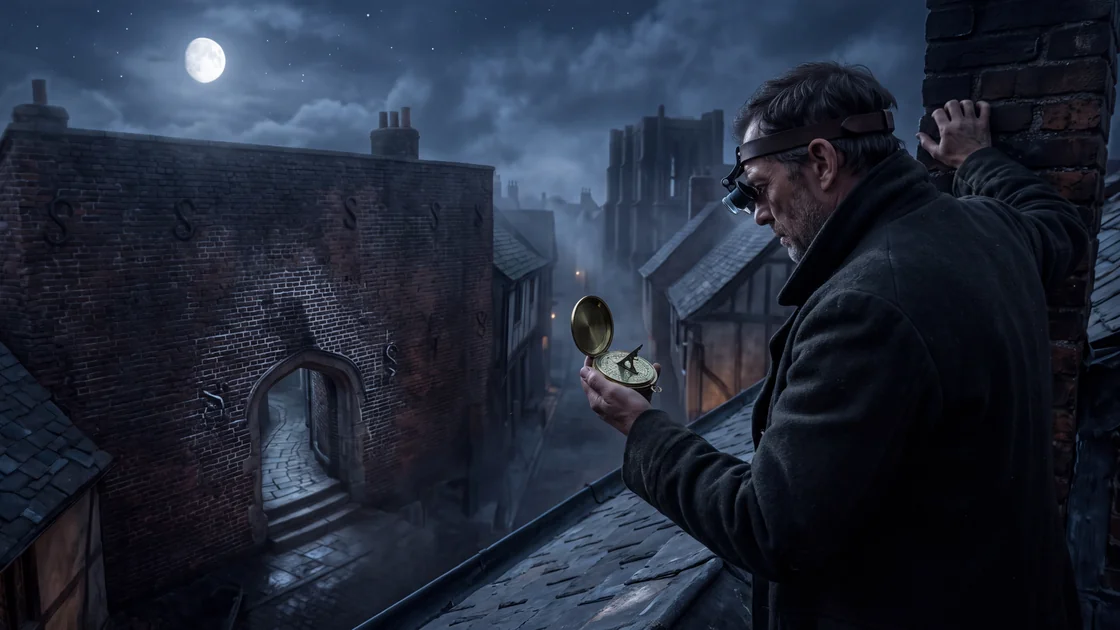
This is the account of Leopold Graves, a solitary master horologist in the fog-bound city of Aethelgard, who spent seven years calculating the erratic luminescence of the lunar cycle to construct a pocket-sized brass moondial. Guided by an alloy of cold-hammered brass, ground selenite, and lunar mathematics, Leopold discovered that when the device was opened beneath specific phases of the moon, its cast shadow did not merely divide the night into hours, but warped the perspective of surrounding masonry, opening seams in the city's ancient architecture. Through these fleeting thresholds, Leopold traversed a secret, suspended metropolis built between centuries of brickwork—uncovering the lost cloisters, forgotten waterways, and sky-bridges of a guild of nocturnal architects who had designed Aethelgard to live two distinct lives, one in the blinding sun and another in the quiet geometry of the dark.
Chapter I: The Escapement of Saint Jude
The rain over Aethelgard did not fall so much as it drifted, a particulate soot that greased the slate roofs and laid a dull varnish over the cobbles of the Clockmakers’ Quarter. In the tall, crooked house at number fourteen Bell-Ringer’s Lane, Leopold Graves worked by the yellow eye of a whale-oil lamp.
The room smelled of neatsfoot oil, jeweller’s rouge, dried elderberries, and the bitter vinegar used to pickle brass. Leopold was fifty-one years old, though his fingers had the pale, unlined precision of a draughtsman half his age. His eyes, enlarged behind a pair of hinged magnification loupes bound to his forehead by a sweat-stained leather strap, were fixed upon a circular plate of brass no wider than the palm of an ordinary hand.
Every clockmaker in the Quarter understood balance wheels, mainsprings, and the reliable click-clack of the deadbeat escapement. They understood the sun, that blunt and predictable furnace that forced the civic clocks of the High Town to strike noon with vulgar regularity. But Leopold had long since grown weary of the sun. The sun was an engine for shopkeepers and magistrates; it demanded that men borrow against tomorrow and account for every wasted grain of dust.
The moon was different. The moon was a stray dog. It dragged its silver hem through the heavens on an orbit that wobbled, accelerated, lagged, and tilted, slipping fifty minutes later each night, teasing the tides and bending the sleep of lunatics. To capture its light upon a dial was not merely an exercise in timekeeping; it was a negotiation with an evasive god.
"A folly, Graves," Master Orlo had told him three years earlier in the guild-hall, over cups of burnt wine. Orlo had been the surveyor of the Municipal Clockwork since the great plague year. "A sundial needs the hard, direct spear of the noon. The moon has no light of her own; she has only a memory of light, diffused and broken by the vapor of the clouds. You cannot cut a crisp shadow with a phantom."
Yet Leopold had persisted. Upon his workbench lay the seventh iteration of the instrument. It was a shallow, hinged hunter-case forged not from commercial plate, but from an ingot of virgin copper melted down with zinc from the deep mines of the Mendips, tempered with minute traces of antimony and silver. When polished, the metal took on not the yellow glare of standard brass, but a cold, greenish-pale lustre that seemed to retain the chill of deep cisterns.
The lid was pierced with seventy-two apertures arranged in a spiraling rose, each hole backed by a sliver of muscovite mica split thin as an insect’s wing. Inside, the dial itself was a marvel of miniature engraving. Leopold had discarded the traditional straight gnomon. In its stead, pivoted upon two micro-machined bearings of pale sapphire, sat an articulated style shaped like the sickle-wing of a swift. It was counter-weighted by an eccentric cam beneath the dial plate—a cam cut from a sliver of meteoric iron that moved in sympathy with an internal ring of twenty-nine teeth, one for each day of the synodic month.
To set it, the user did not look for true north with an ordinary needle. The compass set into the bottom of the case was bathed not in mineral spirits, but in distilled oil of lavender, and its float was an annulus of mother-of-pearl carrying two needles: one aligned to the pole star, the other adjustable against an engraved vernier scale marking the moon’s lunar declination north or south of the celestial equator.
Leopold lowered his tweezers. With a breath held so long his ribs ached, he guided an arbor no thicker than a horsehair into its pivot hole. A tiny drop of refined porpoise-jaw oil—the only lubricant that did not gum in the freezing mountain drafts—touched the shoulder of the pin from the tip of a sewing needle.
"Now," he whispered into the empty room.
He stood, his knees cracking like dry pine, and blew out the lamp.
Darkness rushed into the workshop, thick and heavy with the scent of wet soot from the chimney. For several minutes, Leopold stood blind, waiting for the crimson after-images of the flame to fade from his retinas. Slowly, the window reasserted itself: three panes wide by four high, grimy with coal smoke, looking out across the roof-valleys of Saint Jude-in-the-Mire toward the great, unfinished buttresses of the Cathedral of Saint Eleuthère.
The night was unusually clear. A cold front had swept down from the northern moors at dusk, scouring the river mists from the lower wards. The October moon hung three-quarters full, gibbous and bruised with gray maria, suspended directly above the octagonal bell-tower of the Water Gate.
Leopold took the brass case in his right hand. The metal was dead and cold against his skin. He lifted the iron latch of the casement window and pushed it outward on its groaning hinges. The air of Aethelgard hit him like a wet sheet—smelling of river mud, horse dung, roasting malt, and the faint, sweet decay of the slaughterhouses two districts over.
He stepped onto the lead-sheathed gutter that ran beneath his dormer. It was a perilous perch, eighty feet above the lane, but Leopold had walked these leads since he was a run-nosed apprentice. He braced his hip against the brick breast of the chimney-stack and held the instrument out into the empty air, tilting its face until the lavender-oil bubble centered within the scribed circle on the glass.
The moonlight struck the mica windows of the pierced cover, scattering into pale, pencil-thin filaments that fell across the face of the dial.
Leopold reached down with his thumbnail and flipped back the cover.
The articulated gnomon caught the lunar rays. It did not cast the wide, muddy penumbra of an ordinary stick under the stars. Because of the parabolic curve of the wing-style and the small, plano-convex selenite bead Leopold had set into its tip, the cast shadow was as black and fine as an ink line drawn by a master cartographer. It lay across the hour ring, crossing the fourteenth division of the third nocturnal quadrant.
A faint, metallic vibration hummed against Leopold’s thumb.
It was not a gear ticking; the device had no escapement, no spring. It was the resonance of the metal itself, a high-frequency shudder like that of an iron tuning fork struck against a church flagstone. Leopold looked down at the shadow. It pointed not merely across the numbers, but directly along the diagonal sightline of his window, intersecting the blind brick wall of the tenement across the lane—a monolithic, five-story expanse of Tudor brickwork, blackened by two hundred years of sea-coal fires, completely devoid of openings save for two iron ties shaped like oversized letters S.
Where the shadow’s projection would have theoretically touched that wall, sixty feet away in the darkness, something changed.
The moonlight on the brickwork seemed to lose its flat, dead quality. The soot-stained mortar lines between the courses did not stay gray; they turned silver, then began to recede, drawing inward like threads being pulled from a tapestry. The flat wall developed depth, its perspective stretching back into a sudden, deep courtyard that Leopold knew, with the absolute geographic certainty of an old inhabitant, could not possibly exist. Behind that brick wall lay the crowded tenement rooms of a family of weavers and the back wall of a cooperage. There was no courtyard. There could be no courtyard.
And yet, looking down along the line traced by the brass wing, he saw three stone steps leading downward to a low, four-centered Tudor arch, through which a narrow, flagstoned alleyway curved away out of sight, wet with rain that smelled of salt marsh rather than the city's coal smoke.
Leopold leaned out further, his heart hammering against his collarbone. He swung the dial three degrees to the left.
The alleyway snapped shut. The blind wall was once again a flat, dead plane of soot-crusted brick, adorned only by the iron S-ties.
He moved the dial back. The level bubble settled. The moon reached an angle of twenty-eight degrees above the chimney pots.
The wall yielded again. The three stone steps reappeared, solid, cold, and waiting.
Chapter II: The Geometry of the Forgotten Guild
Leopold sat by the light of a single tallow candle until four in the morning, his notebooks open before him. The paper was heavy, hand-pressed rag, bound in calfskin that had grown warped from damp. He had not written a single word since coming in from the gutter; his fingers were still too cold, stiffened by the night air and by an emotion he had not felt since his youth: the wild, uncalibrated terror of a discovery that had no place in the textbooks of the Worshipful Company of Clockmakers.
He looked at the instruments spread upon his green baize: his set of dividing compasses, his ivory scale, his brass sector, and the moondial, which now lay dormant upon its velvet pad, its sickle-wing folded flat against its belly like a sleeping insect.
"The shadow is not an indicator," he muttered, tracing the scribed lines of his drawings. "It is a key."
He rose and walked to the corner of his workshop where his library was kept—three shelves of cedar planks suspended on hemp cords, sagging under the weight of treatises on ballistics, hydraulics, and astronomical tables. He pulled down a small, calf-bound octavo with no title on its spine: De Secretis Architecturae Sub-Luna, printed secretly in Basel in the year 1542, attributed to one Fra Girolamo of Verona.
The book had been given to him forty years ago by his master, old Nicholas Vance, who had died in the debtor’s prison at Fleet Ditch. Vance had claimed that the architects who raised the cathedrals of northern Europe were not merely stone-dressers and masons, but masters of an art called Stereometry of the Void. They believed that stone was not solid, but merely a temporary crystallization of weight and balance, held rigid by the light of the sun. The sun, they argued, was a fixing agent; its harsh, direct gaze pressed things into their functional, utilitarian forms. Under the sun, a wall was a wall, an enclosure was a prison, and a street was a line between two markets.
The moon, however, was the great solvent.
Fra Girolamo wrote of "interstitial voids"—chambers, corridors, and even broad thoroughfares that had been laid down during the foundation of ancient cities, not in the soil, but in the gaps left between different planes of vision. These spaces were constructed using non-Euclidean angles derived from the moon's apogee and perigee. They were walled in by masonry that was not laid flat, but tilted slightly inward, balanced at the precise shear-angle where gravity could be deceived by shadows.
"When the shadow of the lunar gnomon falleth upon the Joint of Alignment," Girolamo wrote in his crabbed Latin, "the eye of the Beholder is aligned with the Angle of Incidence. That which was shut by the Pride of the Sun is made unburdened by the Modesty of the Night, and the Footman may pass where the Carter cannot go."
Leopold closed the book. A cold draft stirred the shavings of horn on his bench.
He thought of the city below him. Aethelgard was ancient. The Romans had built a castrum upon its low shale bluff; the Saxons had dug moats; the Normans had raised a grim keep of ironstone; and three centuries of merchant princes had heaped high timbered houses upon one another until the alleys were as dark as mine shafts. The city was a palimpsest. If one were to scrape away the timber and the plaster, the coal soot and the modern lead pipe, what lay in the dry pockets between the layers?
He picked up his pocket watch—a plain silver turnip watch with a verge escapement, reliable enough for common things—and checked the hour. It was half-past four. The moon had slipped behind the heavy clouds rolling off the estuary; through his window, the brick wall of the tenement opposite was once again solid, blind, and indifferent.
He would have to wait until tomorrow night. The ephemeris showed that the sky would remain clear, and the moon would reach its meridian at eight minutes past midnight, riding four degrees higher in the sky.
He spent the following day in a state of nervous suspension. Customers came to his shop: a notary with a broken watch-glass; the cook from the Bishop’s Palace with a kitchen clock that dropped fifteen minutes every time the oven was fired; an apothecary who wanted a set of miniature scales adjusted. Leopold received them with the vacant courtesy of an exile. He took their pennies, filed their pivots, and set their weights, but his mind remained fixed upon the brass instrument resting in the inner pocket of his waistcoat, nestled against his ribs like a cold iron heart.
At three in the afternoon, while the pale winter sun was already dying behind the salt marshes, he left the shop and walked out into the streets.
He did not walk with his head down as he usually did, avoiding the slops emptied from upper windows. He walked with his eyes turned up, scanning the joints of the city. He observed the way the second floor of the Old Wool Exchange overhung the narrow lane by six feet, supported by grotesque oak corbels representing the seven deadly sins; he saw the curious, recessed buttresses of the Church of the Holy Sepulchre, which seemed to support no roof at all, but simply vanished into the blank brickwork of the dyer’s drying-sheds; he noted the strange, blind lancet windows in the base of the city wall near the river—windows that had been blocked with ashlar three centuries ago, yet retained their drip-stones and carved finials as if expecting an opening.
The city was riddled with scars that looked like doors.
He bought a pair of thick, ungreased wool stockings from an old woman near the shambles—he wanted no iron-shod heels clicking against stones—and a stout ash walking stick with an iron ferrule. From his workshop, he took a small, bullseye dark-lantern, a horn comb, a ball of oiled twine, and a pocket-knife with a three-inch blade of Sheffield steel.
At ten o’clock, the bells of Saint Eleuthère began their slow, mournful toll for the night watch. The iron gates at the bridges were swung shut, their chains clanking like anchors in the dark. The street-criers fell silent. The link-boys extinguished their pine torches in the iron snuffer cones fixed to the railings of the great houses.
Aethelgard closed its eyes.
Leopold Graves climbed through his attic window, stepped down the lead gutter, and slid down the copper downspout to the flat roof of the baker’s shed below. From there, it was a simple drop of seven feet into the mud of Saint Jude’s Lane.
He stood in the shadow of the blind brick wall, his coat buttoned to his chin, his hand closed around the cool brass of the moondial in his pocket.
The cold was clean and sharp. Overhead, the clouds were tearing apart like dirty wool, revealing a sky of deep, icy indigo. The moon rose above the roofline, yellow as butter at first, then bleaching itself to bone-white as it climbed into the teeth of the north wind.
Chapter III: The Cloister of the Seven Hours
Leopold waited until his watch told him it was midnight. The lane was dead. A mile away, the river Thames—or its dark, local equivalent, the Blackwater—lapped against the weed-hung piers of the merchant ships. Somewhere a mastiff barked twice and went silent.
He took out the moondial.
He set the compass, waiting for the mother-of-pearl float to stop its slow dance in the lavender spirit. He adjusted the declination index to thirteen degrees north. Then, holding the instrument level against his chest, he raised his eyes to the blind wall.
The moonlight struck the gnomon. The black hair-line of the shadow fell across the brass plate, perfectly bisecting the fourth nocturnal hour.
Before him, the air smelled suddenly of dried mint and lime-mortar.
The three stone steps were there. They were not an illusion; they did not vanish when he blinked or turned his head. They were cut from gray Purbeck marble, deeply hollowed in the centers by the passage of sandals or bare feet. They led down into the very foundation of the tenement, where there should have been only solid clay and the damp cellar walls of the cooper’s warehouse.
Leopold stepped forward. His woolen stockings made no sound against the stone.
As his left foot crossed the threshold—the invisible line where the brick of the lane met the Purbeck stone—a sensation like a cold drop of water ran down his spine. The city noise, already distant, vanished with the finality of an iron door slamming shut beneath the water. The wind died. The smell of coal smoke disappeared, replaced by an air that was intensely dry, cold, and utterly still, smelling of lime, old parchment, and the dry skeletons of boxwood hedges.
He was standing in an open cloister.
Above him was no roof, but the sky—yet it was not the sky he had looked at from the lane. The moon was there, hanging high and terribly bright, but the stars were different. They did not twinkle; they were hard, minute points of steel, fixed in patterns that did not match the constellations he had studied in the tables of Tycho Brahe.
To his left ran an arcade of low, pointed arches supported by paired colonnettes of pink granite. The capitals were carved with subjects he had never seen in any church: not saints or martyrs, but figures holding dividers, plumb-lines, water-levels, and instruments whose functions he could not guess. Between the arches lay a square garth, its paths laid out in gravel of crushed oyster shells, overgrown with gray, brittle herbs that had died decades ago without ever falling over.
Leopold did not look back. He knew, with an instinct born of forty years at the craft, that if he looked back before he had fixed the location in his mind, the door would slip its catch.
He took out his ball of twine, tied the free end to an iron bracket that held an empty stone torch-socket beside the opening, and let the ball unwind behind him as he walked.
The arcade led him around the square. At the corner, where two walks met, sat a stone basin fed not by a lead pipe, but by a thin sheet of water that seemed to fall directly out of the empty air two feet above the rim. It made no sound as it fell; it broke upon the surface without a ripple, as smooth as mercury.
Leopold reached out a finger and touched it. The liquid was bitterly cold, but when he drew his finger back, it was dry. There was no moisture on his skin, only a faint, prickling sensation like that of static electricity drawn from an amber bead.
Beyond the cloister, a broad staircase of dressed limestone mounted upward into the wall of a building that had no right to exist in the geography of Aethelgard. It was vast—the scale of a cathedral, but built with the severe, unadorned massiveness of a fortress. Its windows were narrow slits, three inches wide and twelve feet tall, deep within embrasures that showed walls six feet thick.
Leopold mounted the stairs. His breath did not cloud in the air.
At the head of the flight, he found himself upon an open gallery that looked down not upon the lane he had left, but upon an immense, sunken hall. The floor of this hall was paved with concentric rings of alternating black and white slate, resembling the face of an astronomical clock. In the center, thirty feet below him, sat an assembly of huge wooden wheels, their teeth made of hornbeam, their axles as thick as the trunks of ancient oaks. They were not turning. They were frozen in an attitude of eternal readiness, their balance arms weighted with great cages of river gravel, their escapements held by pawls of blackened iron that were chained to the masonry walls.
"The engine," Leopold murmured.
"The reserve," a voice replied.
Leopold did not start. In the absolute quiet of that place, any sudden movement seemed as impossible as an explosion in an empty tomb.
He turned slowly.
Sitting upon a stone bench in the gallery embrasure, his knees covered by a horse-blanket of coarse, undyed wool, was a man. He was old, though his hair was not white; it was the color of zinc that had been exposed to sea salt, dull and ash-gray. He wore the long, pleated gown of a clerk of the fourteenth century, with sleeves so wide they almost brushed his slippers. Across his lap lay a flat board of linden wood upon which a sheet of vellum was pinned with bronze tacks.
The old man did not look up from his work. He was drawing with an iron stylus, using a square of thin horn to guide his lines.
"You have dropped your vernier by two minutes of arc, Master Graves," the man said. His voice was like two dry shingles rubbing together in the wind. "The threshold at the blind wall is sagging. If an ox-cart passes down Saint Jude’s while the line is slack, the wheel-hub will catch the jamb, and we shall have half a tenement in the cellar."
Leopold swallowed. His tongue felt large and dry in his mouth. "Who are you?"
"The Assistant Surveyor of the Second City," the old man said, without lifting his stylus. "I am appointed to the Third Nocturnal Watch. You are using antimony in your alloy. I could smell it as you came through the arcade. A vulgar metal. It makes the gnomon brittle; it introduces an error of three seconds in every transit of the Pleiades."
"Antimony stiffens the brass," Leopold said, his professional pride asserting itself before his fear could master him. "Pure copper and zinc are too soft; the style bends under its own weight when the case is closed."
The old man smiled—a thin, dry parting of gray lips that showed teeth worn down to the gums like those of an old sheep.
"Then you should have used silver from the Joachimsthal," he said. "It has the true lunar virtue. It does not argue with the light. Look down there."
He pointed the stylus toward the great wooden engine in the floor below.
"What is this place?" Leopold asked, stepping to the stone balustrade.
"The city you think you live in," the surveyor said, "is merely the roof. It is the lead flashing laid down to keep the rain off this one. You call it Aethelgard; we call it the Lower Measure. When the sun is up, the merchants run about like mice on the shingles, shouting about their wool and their pepper, building their little timber boxes, piling their stones upon our rafters. They think their houses stand upon the earth. What earth? There is no earth under Aethelgard. There is only the Measure."
He lifted his stylus and tapped it against the vellum.
"Five hundred years ago," the surveyor continued, "the Master Builders saw that the world was growing heavy. Men were multiplying; their carts were growing wider; their stone towers were climbing higher into the clouds. The crust of the world is thin, Master Graves. It cannot support the weight of all that stone if it is allowed to rest upon a single moment in time. If every wall that was ever built were to press upon the soil at once, the earth would crack like an eggshell and sink into the great salt abyss."
"So they divided it," Leopold said, the geometry of the idea opening in his mind like the leaves of a book.
"They divided the burden," the old man agreed. "Half the city stands in the sun; half stands in the moon. When the sun is high, this city—our city, the Great Measure—is folded up. It is withdrawn into the perspective lines, compressed into the mortar joints and the shadows behind the water-butts. It weighs no more than an idea. But when the moon rises, and her light is gathered by the proper stones... then the weight shifts. The Upper City relaxes; its timbers expand; its foundations take breath. And we open our gates."
"And that?" Leopold pointed to the silent wooden machinery below.
"The escapement of the ward," said the surveyor. "It regulates the drop. Every night, Aethelgard falls six inches toward the center of the earth. Every morning, before the market bell rings, the engine winds it back. If it did not, the houses would be under the river by Michaelmas."
The old man finally looked up. His eyes were completely gray, without pupils, like the eyes of fish that lived in cave pools. Yet he looked directly into Leopold’s face.
"You have made a very pretty instrument, Leopold Graves. But you are seven minutes late for your shift."
Chapter IV: The Cartography of the Unbuilt
Before Leopold could answer, the old surveyor reached out with his stylus and tapped the brass dial Leopold still held in his left hand.
The metal rang—a clear, sweet note that sounded like a silver spoon striking a glass goblet.
Instantly, the gallery, the great wooden engine, the stone arcade, and the cold, unrippled water vanished. Leopold felt a sickening drop, as if the floor beneath his feet had been pulled away like a trapdoor at the gallows. He stumbled forward, his knees striking hard against the cold, greasy mud of Saint Jude’s Lane.
He was back.
Above him, the tenement wall was blind, black, and dead. Across the lane, a tallow candle guttered in an upper window where a woman was coughing with the long, rattling wheeze of the consumption. The smell of horse manure and wet river mud rushed into his lungs with the violence of an assault.
He looked down at his hand. The brass moondial was shut. In his other hand, he held the end of his ball of twine; it had been neatly severed, the cut end charred as if it had been held in the flame of an oil lamp.
He lay in the mud for several minutes, unable to stand, his heart fluttering against his ribs like a starling trapped in a chimney. When his breath finally returned, he pulled himself up by the iron S-tie on the wall. The metal was cold, real, and rough with flakes of rust.
He walked back to his shop with slow, shuffling steps, like a man who had survived a shipwreck and found the land uncertain under his boots.
He did not sleep. When the gray dawn broke over the chimney-stacks—that dull, dirty light that Leopold had seen every day of his life—he sat at his table with his loupe screwed into his eye, examining the moondial.
The selenite bead in the gnomon had changed.
It had been clear, like water or mountain crystal. Now, deep within its crystalline structure, a tiny speck of carbon sat suspended, no larger than a grain of gunpowder. When he turned the case beneath the loupe, the speck did not remain stationary; it drifted slowly through the stone, seeking always the direction of the Cathedral of Saint Eleuthère.
"It has taken an orientation," Leopold whispered.
He knew he should destroy the thing. An artisan of the guild had duties: to the civic order, to the Church, to the simple preservation of sanity. What he had seen was either a delusion brought on by the inhalation of mercurial fumes—a common madness among gilders and clocksmiths—or it was a secret that made the entire civic life of Aethelgard an elaborate, fragile lie.
If the city was balanced upon a knife-edge of time, held out of the mud only by a forgotten engine that dropped it and caught it in the dark, then every deed of property, every leasehold, every church altar was built upon nothing more substantial than an angle of incidence.
He spent the morning in the Guild Library in the High Town.
The library was housed above the south porch of Saint Michael-at-the-Wall, reached by an open stone spiral stair. It was a cold room, rarely visited by anyone save the clerk who recorded apprenticeships and the occasional lawyer searching for an ancient boundary mark. The books were chained to iron bars that ran along the desks, their covers protected by iron corners and greasy pigskin.
The librarian was a young deacon named Clara, a man whose skin had the blue-white transparency of skimmed milk, whose eyes were perpetually red-rimmed from reading by the light of tallow dips.
"Master Graves," Clara said, looking up from an inventory of lead pipe. "Are you looking for the charter of forty-eight? The case regarding the blacksmith’s forge on the bridge is settled; the guild lost its appeal."
"No," Leopold said. He sat down upon the oak bench opposite the young man. "I want the plans for the lower foundations of the Cathedral. The ones drawn by Master Elias of Dereham before the tower fell in twelve hundred and eighty."
Clara stared at him through round spectacles with frames of lead. "There are no plans for the foundations, Master Graves. Everyone knows that. Saint Eleuthère has no crypt; it was built directly upon the Roman ballast."
"Every cathedral has a crypt," Leopold said.
"Saint Eleuthère does not," Clara insisted. "In forty-two, when they were digging the vault for Bishop Thomas, they went down twenty feet through the clay behind the high altar. They found nothing but gray gravel and salt water. If they had gone another five feet, they would have drowned the choir. The cathedral sits upon a floating raft of alder trunks, pinned down by its own weight."
"A raft," Leopold repeated.
"A raft," said the deacon. "Though why you should care about stones when you ought to be fixing the escapement on the parish clock—which has gained ten minutes since the frost began—is something of a puzzle."
Leopold leaned closer. The library was silent save for the scratching of a jackdaw on the lead roof above.
"Have you ever heard of the Second Measure, Clara?"
The young man’s pen stopped. A drop of dark iron-gall ink gathered on the steel nib, hung for a second, and fell upon the ledger, spreading into the fiber of the paper like a black spider.
Clara did not wipe it away. He sat entirely still, his pale eyes magnified by his glasses into round, watery globes.
"Where did you hear that name?" Clara’s voice had lost its dry, clerical flatness. It was barely a whisper.
"In a book," Leopold lied. "An old German book."
"Keep your mouth shut about it," Clara said, looking toward the curtain that screened the spiral stair. "The Masters of the Masonry do not like that word. My uncle was a warden of the lodge. When I was a boy, he had a trunk of drawings—vellum rolls, some of them four yards long, showing the city not as it is, but as it was meant to be. He had drawings of streets that cross the river without a bridge, streets made of nothing but air and shadow, where the keystones were set at noon on the solstice and left to cure under the moon."
"What happened to the drawings?"
"The Bishop’s men took them," Clara whispered. "When my uncle died of the quinsy, they came with three carts and two constables. They burned the trunk in the cathedral yard. My aunt tried to save one roll—she thought it was a map of her grandfather’s orchard in the marshes. A priest snatched it from her hands and threw it into the coals. He told her that if she ever spoke of the Nocturlabe of Elias, he would have her walled up in the anchorite’s cell at the bridge-foot."
Leopold felt the brass case in his pocket growing heavy again, as if the small speck of carbon in the selenite bead were tugging at his coat.
"The Nocturlabe of Elias," Leopold said. "Is that what they called it?"
"The great instrument," Clara said, turning his head away to scrape the ink-blot with a bone knife. "The dial that was kept in the iron chest behind the high altar. The one they used to set the engine."
"And where is it now?"
"Gone," Clara said. "Gone these three hundred years. They say the last Warden of the Second Measure took it with him into the North Tower when the spire collapsed in the great storm of thirteen sixty-two. He was never found. Neither was the dial."
The deacon stood up and closed the ledger with a soft, dusty thump.
"Go home, Master Graves. Go back to your clocks. The sun will be down in two hours, and the streets are not safe for old men with notions."
Chapter V: The High Causeway of the North Tower
The second journey was not a matter of curiosity; it was an eviction of the spirit. A man who has seen the under-rafters of the world cannot walk comfortably upon the carpets of his own parlor.
Leopold waited five days for the sky to clear again. A wet, southwest gale blew in from the ocean, thrashing the willow trees along the water-meadows and filling the lanes with two feet of yellow, foul-smelling river overflow. He stayed in his shop, working mechanically on a carriage-clock for the town clerk, his eyes constantly darting to the corner of his workbench where the moondial lay.
He had made a modification.
Using a thin sheet of pure silver beaten out from an old crown-piece of King Edward, he had fashioned a small, sliding diaphragm across the mica aperture of the dial. By shifting this shutter, he could alter the focal length of the moonbeams falling upon the selenite bead, tuning the shadow’s projection to different distances—twenty yards, fifty yards, a hundred yards.
On the sixth night, the wind hauled around to the northwest. The gale broke into long, running fleeces of cloud, between which the sky appeared dark, vast, and polished like a plate of blue steel. The moon had passed its fullness; it was entering the third quarter, that cold, lopsided phase that the country people called the "Hag’s Moon," when the shadows are longer and sharper than at any other season.
At one o’clock, Leopold left his shop by the lane door.
He did not go back to Saint Jude-in-the-Mire. His destination was the North Tower of the Cathedral of Saint Eleuthère.
The Cathedral was surrounded by an iron railing seven feet high, its pickets shaped like inverted lilies. Leopold knew the gate-keeper—a drunken veteran of the French wars who slept in a stone hovel beside the cemetery gate—and he knew that three pennies dropped into the empty tobacco box on the window sill would buy him entry to the precincts without a single question asked.
He slipped through the cemetery, his feet sinking into the rank turf that covered five hundred years of parish dead. The great church loomed above him like a cliff of black basalt, its clerestory windows dark, its pinnacles lost in the scudding clouds.
The North Tower was a stump. Three centuries ago, it had carried a timber-and-lead spire two hundred feet high, the pride of the northern marshes; but the storm of 1362 had twisted its frame, and on a winter’s night it had come crashing down into the nave, carrying two bays of the vault with it. The nave had been patched with cheap rubble-work, but the North Tower had never been rebuilt. It was left a hollow, roofless shell, its stone stairs ending seventy feet above the ground in a platform of weathered ashlar, open to the rain and the droppings of pigeons.
A low, pointed doorway in the northeast buttress gave access to the spiral stair. The oaken door was not locked; it was held shut only by an iron hasp dropped over a staple, intended to keep out sheep and the bolder class of thieves.
Leopold lifted the hasp. The hinge screamed—a dry, iron shriek that made him freeze for five heartbeats—then let him pass.
The staircase was as black as an uncleaned flue. The air was thick with the ammonia smell of bird-guano and the cold, mineral breath of old stones that had never seen the sun. Leopold did not light his lantern. He climbed by the touch of his boots on the steps, feeling his way around the central newel, his fingers tracing the spiral groove worn into the ashlar by the thumbs of twenty generations of bell-ringers.
Seventy steps. Eighty. Ninety.
At the hundredth step, the stair ended abruptly. The newel rose another two feet and then snapped off, a rough stump of stone open to the night air.
Leopold stepped out onto the roof-platform of the North Tower.
The wind here was fierce, cold, and clean, tasting of the sea ten miles away. Below him, Aethelgard lay spread like an irregular, dark hide thrown over the contours of the hill. A few oil lamps flickered along the wharves; here and there, the red eye of a foundry chimney glared through the smoke. The city seemed small, miserable, and infinitely fragile—a heap of combustible chips and slate shingles huddled together against the cold of the marshes.
Leopold walked to the western parapet.
Before him, across an abyss of seventy feet of empty space, stood the South Tower—the surviving sister, complete with its open-work battlements and its great bronze bells hanging silent in their louvred loft. Between the two towers, there was nothing. Nothing save the steep, lead-covered ridge of the nave roof, thirty feet below his level.
He took out the moondial.
The Hag’s Moon was riding high, tilted on her side, shedding a harsh, unsoftened radiance that made the shadows of the stone battlements look like holes cut into the platform floor.
Leopold adjusted the silver diaphragm. He aimed the vernier toward the South Tower, setting the scale to sixty yards.
He flipped back the lid.
The gnomon caught the white light. The black hair-line fell precisely upon the index.
A shudder ran through the stones beneath Leopold’s feet. It was not the vibration of the wind; it was the slow, ponderous settlement of weight that occurs when a dry stone arch receives its keystone.
Across the empty chasm between the two towers, the air did not merely change; it crystallized.
A causeway of pale, ash-colored stone leapt from the parapet of the North Tower, springing across the black void in a single, breathless curve of incredible lightness. It was an arch so flat, so daring, that no mason working under the light of the sun would have dared to strike the wooden centering from beneath it. Its stones were not square; they were cut into interlocking wedges, their joints marked by fine lines of phosphorescence that looked like the trails left by snails on wet slate.
At the center of the span, forty feet above the lead roof of the nave, sat an open octagonal pavilion, its stone ribs meeting in a hanging boss carved with the image of a crescent moon swallowing an open eye.
Leopold did not hesitate. The strange, quiet madness that had been gathering in him since his first journey took the place of fear.
He stepped out onto the causeway.
The arch did not give. It was as rigid as the earth itself. The wind screamed through the tracery of the parapets, but within the walkway, there was no breeze at all. The air was dead, silent, and smelling of lime-dust that had been dry for centuries.
He walked to the central pavilion.
From this vantage point, seventy feet above the city, the true geography of Aethelgard became visible.
The city Leopold had known his entire life—the city of Bell-Ringer’s Lane, the Shambles, the Fish Market, and the guild-halls—was merely a scattered, discontinuous floor. Weaving through it, above it, and below it, was another city, complete and vast, constructed of a pale, bone-white limestone that had no quarry on earth.
He saw aqueducts springing from the high bluffs of the North Common, spanning the tenements on arches so tall that the chimneys of the weavers’ houses smoked against their piers without blackening them; he saw broad, stepped terraces descending into the river—not to the muddy, tidal ditch of the Lower Measure, but to an immense, black canal that ran straight as a carpenter’s rule toward the sea, its waters enclosed by high walls of rusticated masonry; he saw towers that did not end in stubs, but climbed into the thin air, connected to one another by web-like networks of stone walkways, flying bridges, and exterior stairs that wound around the spires like the threads of a screw.
It was a city designed for a population that did not walk upon the earth.
"The Upper Measure," a voice said.
Leopold turned.
Standing on the opposite side of the octagonal pavilion, leaning against the carved parapet with his hands tucked into the sleeves of an architect’s tabard, was a man. He was young—no older than Leopold had been when he finished his master-work—with dark, hollow eyes and a short, spade-shaped beard trimmed in the fashion of the second Richard.
Upon his breast, suspended by a heavy chain of cold-hammered silver links, hung a circular instrument twice the size of Leopold’s pocket dial.
"Master Elias?" Leopold whispered.
The man smiled. His teeth were white and even, unlike the ruined gums of the old surveyor in the cloister.
"Elias is dead these five hundred years, Graves," the young man said. "He died in the marshes, trying to lay the third caisson for the water-gate. I am Julian. I was third warden under him when the spire went down."
"Then you are..."
"A tenant," Julian said. "Like you. Like the old fool in the cloister who still thinks he is recording the drop. We are the keepers of the balance. Why have you made another dial?"
The question was not angry; it was spoken with the tired curiosity of a watchman who finds an unauthorized candle burning in an empty wing of a palace.
"I did not know," Leopold said. "I only wanted to measure the night."
"The night cannot be measured," Julian said, stepping forward. His boots made a sharp, clean click upon the limestone flags. "The night is the only part of time that is infinite. The sun is a clock; it runs down; its oil burns away; it tires itself out dragging the seasons behind it. But the night is the sea from which the sun was pulled. When you measure the night with brass, you are not finding the hour. You are opening the sluice."
He pointed down through the open tracery of the pavilion floor.
Leopold looked.
Through the transparent stone of the causeway, he could see the cathedral roof below. But it was no longer just lead and timber. The lead had turned clear, like greenish water, and through it he could see the interior of Saint Eleuthère—the high altar, the choir stalls, the cold stone tombs of the bishops.
In the center of the nave, suspended thirty feet above the flagstones by chains that vanished into the darkness of the clerestory, was an immense pendulum.
Its bob was an iron sphere the size of an apple-tun, studded with facets of mirror-polished silver. It was swinging—not with the quick, nervous twitch of a parish clock, but with a slow, dreadful sweep that took three minutes to pass from the north arcade to the south.
With each swing, the silver facets caught the moonlight descending through the high lanterns and threw long, knife-edged beams across the floor of the church. Where the light touched the stone, the flagstones seemed to slide open, revealing deep, vertical shafts that dropped straight down into the black heart of the hill.
"Every night," Julian said, "the pendulum swings eighty-four times. With each beat, forty tons of river water are admitted to the lower balance-tanks. With each beat, thirty feet of masonry are transferred from the weight of the Upper City to the foundations of the Lower. It is a hydraulic escapement, Graves. The Master Builders did not build a cathedral; they built a siphon."
"To what purpose?" Leopold asked, his head swimming with the terrible, slow rhythm of the pendulum below.
"To keep the hill from drowning," Julian replied. "Aethelgard sits upon an aquifer of salt silt. It is a sponge. If the weight of the civic buildings were to rest upon it continuously, the silt would liquefy within three generations. The whole ridge—the castle, the cathedral, the bridge, the market—would slide down into the estuary like an over-wet ditch. We balance the town. We lift it by the hair every night while the carters sleep. We let the water run through the stone conduits of the Second Measure, clearing the gravel beds, scouring the piles, and when the sun touches the golden cross on Saint Michael’s, we set the dog back in the ratchet."
He looked at Leopold’s small brass dial.
"Your instrument is dangerous, Master Graves. It is too small. It has no safety-ratchet. If you were to drop it while the threshold is open, or if the style were to jam upon a grain of soot... the angle would remain fixed. The city would not return to the sun."
Leopold felt a cold sweat break across his forehead. "What would happen?"
"The Lower Measure would wake up inside our stones," Julian said quietly. "Can you imagine it? A weaver waking to find an ashlar pier rising through his bedstead? A magistrate opening his parlor door and falling three hundred feet into the Great Octagon? The two cities cannot occupy the same moment in the light. One of them must be a ghost."
Julian extended his hand—a hand that was long, pale, and stained with the gray dust of freestone.
"Give me the dial, Leopold. It is not an instrument for an old man who fixes watches for tallow-chandlers."
Chapter VI: The Shadow in the Glass
Leopold looked down at the brass hunter-case in his palm.
The metal was warm now, heated by the proximity of his body and by the silver light that beat down upon the pavilion. Inside the case, the tiny speck of carbon in the selenite bead was spinning—not drifting, but spinning with the furious, silent energy of a whirlpool.
He thought of his shop in Bell-Ringer’s Lane.
He thought of the forty years he had spent upon his stool: the small, greasy screws; the hairsprings that tangled like spiders’ legs; the complaints of stupid men whose pocket-watches lost three minutes because they dropped them into their beer; the narrow, smoky streets where the sun never reached the cobbles; the smell of the tallow-vats; the small, suffocating routine of an artisan in a dying town.
Down there, he was Leopold Graves, the aging watchmaker who had no wife, no son, and whose eyes were failing behind his loupes.
Here, upon this bridge of impossible stone, looking down upon the great, breathing machinery of the world, he was something else. He was a man who had solved the equation that Master Orlo had called a folly. He had found the seam through which the centuries were sewn together.
"No," Leopold said.
Julian’s face did not darken with anger; it grew sad, with the terrible, patient sadness of a statue that has watched the rain wear away its own fingers.
"Then you must run, Master Graves," Julian said softly. "Because the Third Watch is ending. And the moon is entering the cloud."
A mile to the west, a vast, black wall of sea-fog was rolling up the valley of the Blackwater, swallowing the stars as it came. It was not the thin, drifting vapor of the lanes; it was the heavy, salt-choked fog of the winter solstice, cold as an iron plate and thick as curd.
Leopold turned and ran.
The causeway beneath his feet felt suddenly less solid. The edges of the interlocking stones seemed to blur, their phosphorescent lines of mortar flickering like grease-lamps in a draft. The wind, which had been silent within the magical envelope of the arch, came tearing through the balustrades, striking him with the force of an oar across the shoulders.
He reached the platform of the North Tower just as the shadow on his dial began to flutter.
Overhead, the ragged edge of the fog-bank reached the crescent moon. The light did not fade gradually; it was smothered. The bone-white spires, the high aqueducts, the terraces of cyclopean stone, and the great canal that ran toward the sea vanished into the blackness like ink spilled across a drawing.
Leopold threw himself down the opening of the spiral stair.
Behind him, with a sound like the breaking of a thousand glass panes, the causeway between the towers gave way. There was no crash of falling stones; there was only a high, singing vacuum, as the air rushed in to fill the space where forty yards of limestone had been suspended for twenty minutes.
He tumbled down the winding steps in total darkness, his boots slipping on the guano-crusted stones, his shoulders bouncing off the curved wall of the newel. He fell the last six steps, landing heavily upon the stone floor of the buttress vestibule.
He did not wait to gather his breath. He crawled through the low doorway, pulled the iron hasp over the staple, and stumbled out into the cemetery.
The fog had already reached the ground. It was so dense that the great mass of the Cathedral was invisible from ten paces. The tombstones were gray posts sticking out of a sea of cold milk.
Leopold stood, his left ankle throbbing with a sharp, spraining pain, and pressed his back against the rough ironstone of the church wall.
He looked down at his watch.
It was half-past two. The city was silent, but through the ground beneath his soles, he could feel it: a rhythmic, deep-seated shudder, occurring every three minutes.
One.
The water running into the tanks.
Two.
The chains tightening in the clerestory.
Three.
Aethelgard, that great, dirty, sleeping heap of wood and slate, rising six inches through the mud to meet the coming day.
Chapter VII: The Sunken Octagon
For three weeks, Leopold did not leave his house.
He told the girl who brought his milk that he had twisted his foot upon the cellar stairs. He kept the shutters of his workshop bolted day and night, working only by the light of a single small burner of rape-seed oil.
He did not touch the carriage-clock for the town clerk. He did not repair the apothecary’s scales.
He worked only on the moondial.
He understood now why Master Elias’s great dial had been kept in an iron chest behind the high altar: the instrument was not merely a telescope for looking into the other city; it was an anchor. When the dial was open, it created a strain—a physical tension between the two states of the masonry. The larger the dial, the broader the seam; but the smaller the dial, the more intense the focus.
His pocket-sized instrument, with its small selenite bead and antimony-brass plate, was like a needle driven into a water-pipe. It was too sharp. It was creating leaks.
On the third night of his confinement, while sitting at his bench, he had heard a faint, trickling sound behind the wainscot of his bed-alcove. He had pulled away the oak boards and found, running through the rough Tudor brickwork of his chimney, a vein of pure, white limestone three inches wide. It had not been there when he leased the house twenty years ago. It was cold to the touch, and when he pressed his ear to it, he could hear the distant, hollow roar of water falling through an enormous cistern.
The Second Measure was bleeding into the First.
He took a small steel cold-chisel and a hammer and tried to strike a chip from the white stone. The chisel bounced off with a shower of blue sparks; the stone was harder than any granite he had ever worked, hard as cold iron.
"It is coming through," he said to the empty room. "The balance is slipping."
He knew what he had to do. The dial could not be destroyed by ordinary means; if he melted it down in his crucible, the selenite would explode, and the silver and antimony would retain their orientation, leaving a permanent, ragged knot in the perspective of Bell-Ringer’s Lane. He had to take it back. He had to take it to the only place where the two cities were truly joined: the Great Octagon beneath the nave of Saint Eleuthère, where the pendulum hung.
He waited for the full moon of January—the "Wolf Moon," when the cold was so dry that the river froze from bank to bank, and the night watch stayed inside their round-houses over pots of charcoal.
On the thirteenth of January, the frost was so bitter that the nails in the oak rafters of Leopold’s shop snapped with the sound of pistol shots. The fog was gone, frozen out of the air by twenty degrees of northern frost. The sky was an immense, black bowl of polished crystal, through which the full moon rode with an icy, blinding ferocity.
Leopold wrapped his swollen ankle in strips of greasy wool and pulled on his heaviest boots. He took no dark-lantern this time; he took only the moondial, his ash stick, and an old iron crowbar he used for lifting paving stones when the drain beneath his shop backed up.
He left the shop at midnight.
The city was like a city of salt. The snow was thin, dry, and driven into the crevices of the cobbles by the wind, forming long, white veins that looked like the drawings in Master Elias’s lost book. The cold was so intense that Leopold’s loupes, carried in his coat pocket, cracked in their brass frames with a faint ping.
He did not go to the North Tower. He went to the great western portal of the Cathedral.
The two giant oak doors, studded with five hundred iron nails and banded with iron scrolls representing the Tree of Jesse, were locked with two deadbolts that had not been drawn since the Bishop’s enthronement seven years ago.
Leopold stood upon the third step of the porch, beneath the carved figures of the twelve apostles whose stone noses had been eaten away by two centuries of coal smoke.
He took out the moondial.
He did not open the lid. He did not need to. The moon was so bright, its rays so piercing in the dry frost, that the light passed directly through the seventy-two pierced apertures in the cover, throwing a rosette of pale dots against the oak planks of the door.
Leopold laid the iron crowbar across the face of the dial, aligning its shaft with the shadow of the central gnomon.
Then he pressed the end of the bar against the seam between the two leaves of the oak door.
"In the name of the Measure," he said.
The heavy oak did not swing inward on its hinges. It slid. The two enormous leaves of the door, each three tons of heart-of-oak, slid sideways into the thickness of the stone buttresses with a soft, pneumatic hiss, like a piston entering an oiled cylinder.
Leopold stepped through into the nave.
The interior of Saint Eleuthère was vast, dark, and filled with a cold that made the street outside seem warm. The great stone piers of the nave marched away into the blackness like the trunks of a petrified forest. High above, the clerestory windows caught the moonlight, casting pale, blue-green rectangles across the stone floor.
Leopold walked down the central aisle toward the choir screen.
In the daylight, the floor of the nave was covered with gray, uneven flagstones, worn smooth by the feet of pilgrims, interrupted here and there by the brass effigies of forgotten merchants and canons.
Now, as Leopold walked, his boots made a hollow, metallic ring.
The floor was no longer stone. It was a grid of blackened iron plates, four feet square, each plate secured at the corners by four bronze bolts shaped like five-petaled roses. In the center of each plate was an opening three inches wide, through which he could hear the sound he had heard in his chimney: the deep, slow, rhythmic surge of water running through a subterranean flume.
He reached the crossing—the great square where the nave, the transepts, and the choir met, beneath the four enormous piers that had once carried the central spire.
In the center of the crossing sat the tomb of Bishop Thomas: a box of Purbeck marble carrying the life-sized effigy of the bishop in his cope and mitre, his hands folded in prayer, his feet resting upon a couchant greyhound.
Leopold approached the tomb.
He looked down at the bishop’s stone face. The features were calm, indifferent, and polished by the grease of centuries of visitors’ fingers.
Leopold set the moondial upon the bishop’s breast, between the cold, stone hands.
The shadow of the sickle-wing fell directly across the carved cross of the bishop’s pectoral.
A groan came from the foundation of the church—a sound so deep, so vast, that Leopold felt it not in his ears, but in the teeth of his lower jaw.
The effigy of Bishop Thomas did not move. But the marble chest upon which it lay began to sink. It descended smoothly, vertically, into the floor of the crossing, like a bucket going down into a well. In its place opened a wide, circular shaft, twelve feet across, lined with courses of dressed ashlar that were completely free of moss, lichen, or damp.
A spiral flight of stone steps, without a handrail, wound down the inner face of the shaft into the dark.
Leopold took his stick in his right hand and began to descend.
Chapter VIII: The Turning of the City
He counted three hundred steps before the air changed.
The smell of coal smoke, the smell of the frozen city, and even the dry lime-smell of the cloisters were gone. The air here was warm—not with the heat of an oven, but with the deep, mineral warmth of the center of the earth. It smelled of sulfur, of hot oil, and of iron that had been rubbed with emery until it was as smooth as silk.
The shaft opened out into a hall so vast that Leopold’s eyes, even after forty years of working in small rooms, could not find the ceiling.
It was the Great Octagon.
The walls were built of that same bone-white limestone he had seen from the high bridge, but here the stone was covered with miles of engraved lines: circles, epicycles, vernier scales, and tables of numbers that climbed from the floor into the shadows of the vault sixty feet above.
In the center of the room, swinging from a point so high it was lost in the gloom, was the pendulum Julian had described.
It was terrifying in its immensity.
The iron ball was not small; it was the size of a hay-wain, twelve feet in diameter, constructed of thick plates of boiler-iron riveted together with rivets as large as a man’s fist. As it swung, it made no sound save for the low, rhythmic displacement of the air—a deep whoosh-whoosh that set Leopold’s coat-tails fluttering each time the great ball reached the bottom of its arc.
On either side of the chamber sat two immense, bronze cylinders, thirty feet high, their pistons connected to the rock by balance-beams of forged iron as thick as the masts of first-rate men-of-war.
With each beat of the pendulum, a valve in the base of the cylinders opened with a mechanical thump that shook the limestone floor. A torrent of dark, clear water rushed through an arched conduit beneath Leopold’s feet, turning an undershot waterwheel twenty feet in diameter before vanishing into a black tunnel that sloped away to the south.
Leopold stood at the edge of the pit.
Standing beside the left-hand cylinder, his hands resting upon the great iron spanner used to adjust the valve-tappets, was the old surveyor from the cloister. He still wore his ragged wool blanket over his shoulders, but his gray tabard was pinned up to his waist, and his bare legs were splattered with black machine-grease.
Julian was there too. He was standing upon a raised platform of masonry, his fingers resting upon the brass frame of a giant instrument that sat in the center of the wall: a moondial six feet in diameter, its face carved from a single slab of green serpentine marble, its gnomon a spar of solid silver eight feet long.
"You brought it back, Graves," Julian said. He did not look around; his eyes were fixed upon the vernier of the great dial.
"I did not bring it back to give it to you," Leopold said, his voice small and thin beneath the roar of the water and the swinging iron ball.
Julian turned his head. His eyes, in the silver light that seemed to emanate from the great pendulum itself, were dark and deep.
"Then why did you come down?"
"Because it is leaking," Leopold said. "My chimney is turning to limestone. The water is running through my cellar. If the Third Watch does not set the pawl, the two cities will crush each other before the winter is out."
Julian looked at the old surveyor. The old man spat into the water-trench and gave the spanner a half-turn.
"The antimony," the old man croaked. "I told him. It always splits the line."
"Graves," Julian said, stepping down from the platform. "The balance has been failing for forty years. It is not your small dial that did it. Your dial was only the fly that settled on the balance-wheel. The Lower Measure is growing too heavy. Have you seen the new warehouses by the docks? Have you seen the iron bridge they are building across the reach? Three thousand tons of Scotch iron, all pressing down upon the same three hundred yards of shale. The earth cannot carry it."
"Then let it sink," Leopold said.
"If it sinks," Julian said, "we go with it. We are not spirits, Graves. We are not angels. We are the builders who forgot how to die because our work was never finished. We have lived five hundred years in the three hours between midnight and dawn. If the Upper City slides into the salt abyss, the Great Octagon will burst like an empty cask under forty fathoms of brine."
Julian pointed to the serpentine dial.
"There is only one way to clear the line. The small dial must be introduced to the escapement. Its error must be subtracted from the great wheel."
"And what happens to my shop?" Leopold asked. "What happens to Bell-Ringer’s Lane?"
Julian was silent for a long moment. The pendulum swung past them, its iron face reflecting their two figures as distorted, elongated shadows against the white stone.
"A street that has been opened to the Second Measure," Julian said softly, "can never be completely shut. It will always be five minutes later in Bell-Ringer’s Lane than in the rest of the town. The shadows will always point toward the North Tower, even when the sun is at the noon. But the walls will hold. The people will live their little, smoky lives; they will sell their wool and their grease; they will die in their beds and never know that forty feet below their bolster-pins, Julian and Elias are holding up their floors."
Leopold took the small brass case from his pocket.
The cold-hammered brass had lost its greenish lustre. It had become silvery, almost white, under the intense, focused radiance of the subterranean chamber. The articulated wing of the swift was trembling, its sapphire bearings clicking against their stops with a sound like a death-watch beetle in an old chest.
He walked to the platform.
In the center of the serpentine slab, beneath the silver root of the great gnomon, was a circular recess four inches across and three-quarters of an inch deep. It was empty. It was shaped to receive an instrument precisely the size of the one Leopold held in his hand.
"The last master," Leopold said, "did not die in the spire."
"No," Julian said. "He took the dial out because he grew afraid. He wanted to live in the sun. He wanted to have a garden and watch his daughters marry. He took the key out of the lock, Graves, and he threw it into the crowd. And for three hundred years, the city has been running on the momentum of its old stroke, slipping an eighth of an inch every winter."
Julian stepped back, leaving the stone clear.
"The choice is yours, horologist. You can take your little toy back to your attic. You can make watches for lawyers until your eyes go dark and the river comes through your floorboards. Or you can drop the arbor into the jewel."
Leopold Graves looked down at the instrument.
He thought of the seven years he had spent calculating the epacts; the hundreds of nights he had leaned out of his attic window with frozen fingers, watching the moon ride through the soot-clouds of the city; the cold, solitary pride of knowing something that no other man in the Company of Clockmakers could understand.
He had wanted to conquer the night. He had wanted to make a clock that did not lie about the world.
He held the dial out over the circular recess.
The speck of carbon in the selenite bead stopped spinning. It became an arrow, pointing straight down into the green serpentine marble.
"It will be very quiet in the lane," Leopold said.
"It is always quiet," Julian said, "when the escapement is true."
Leopold dropped the moondial into the stone.
Epilogue: The Hour of White Light
There was no sound. There was no thunder, no cracking of masonry, no sudden rush of displaced air.
There was only a click—a small, precise, beautiful click, like that of a fine lever-escapement dropping into the tooth of an escape wheel.
The great pendulum did not stop, but its sweep changed. It no longer swung with that long, dreadful, shuddering stroke that shook the bones of the crossing. It rose six inches higher at each end of its arc, then settled into a rhythm so smooth, so balanced, that its passage through the air made no more sound than a silk handkerchief drawn across a mahogany table.
The roar of the water in the flumes dropped to a low, musical murmur. The bronze cylinders ceased their mechanical thumping; their pistons moved with the silent, oiled grace of living limbs.
Leopold looked at the great serpentine dial.
His small brass hunter-case was no longer an independent object. It had become part of the larger instrument, its pierced lid flush with the green marble, its mica windows glowing with a soft, steady, phosphorescent light that was neither yellow nor white, but the pale, silver-green color of the sea under the moon.
Julian bowed his head.
"The watch is set, Master Graves."
Leopold did not answer. He turned and walked back to the stone steps that wound up the shaft of the crossing.
He climbed slowly, his ash stick supporting his weight, his bad ankle painless now in the cool, steady air that rose from the Great Octagon. He did not count the steps. He did not look back.
When he reached the top of the shaft, the tomb of Bishop Thomas was back in its place. The marble chest was solid, its seams cemented with old, gray mortar that had not been disturbed for three hundred years. The carved greyhound slept beneath the bishop’s stone sandals.
Leopold walked down the nave of Saint Eleuthère.
The iron plates were gone. The floor was once again the uneven, gray Purbeck stone, covered with the dust of the week’s visitors and the dull, yellow light of the winter morning that was beginning to filter through the east windows.
He pushed open the small wicket in the great western doors and stepped out onto the porch.
The frost was still thick upon the lily-pickets of the railing, but the air had lost its bitter, metallic edge. A milk-cart was rattling down the High Town, its iron wheels making a cheerful, domestic clatter against the cobbles. An apprentice was taking down the shutters of the baker’s shop opposite, whistling an air that was three seasons out of date.
Leopold walked home to Bell-Ringer’s Lane.
His house was still standing. The blind wall of the tenement across the lane was still soot-stained, flat, and solid, its iron S-ties holding the brickwork as they had done since the reign of King James.
He climbed the stairs to his workshop.
The room smelled of neatsfoot oil, cold tallow, and dry shavings of horn. Upon his workbench sat the carriage-clock for the town clerk, its small, brass balance-wheel ticking away with the vulgar, reliable regularity of things that belong to the sun.
Leopold took off his coat and hung it upon its peg. He sat down upon his stool, screwed his loupe into his right eye, and picked up his smallest screwdriver.
He looked at the window.
The glass was clean now, scoured by the night’s frost. Beyond it, the roofs of Aethelgard climbed toward the Cathedral of Saint Eleuthère, their slate shingles shining like fish scales in the pale, pink light of the winter dawn.
They were in their places. Every brick, every timber, every lead gutter was where it had been yesterday, and where it would be tomorrow.
Leopold touched the screw of the carriage-clock's regulator, moving it a hair’s breadth toward the letter S.
"Slow," he murmured to the empty room, his face relaxing into the first smile he had worn in seven years. "A little slow. But the day is long enough."
He turned back to his work, while outside, high above the roofs in the cold, blue morning, the North Tower stood empty against the sky, its missing spire remembered only by the birds and by the quiet, white light that lives between the strokes of the bell.