The Morning Drawer
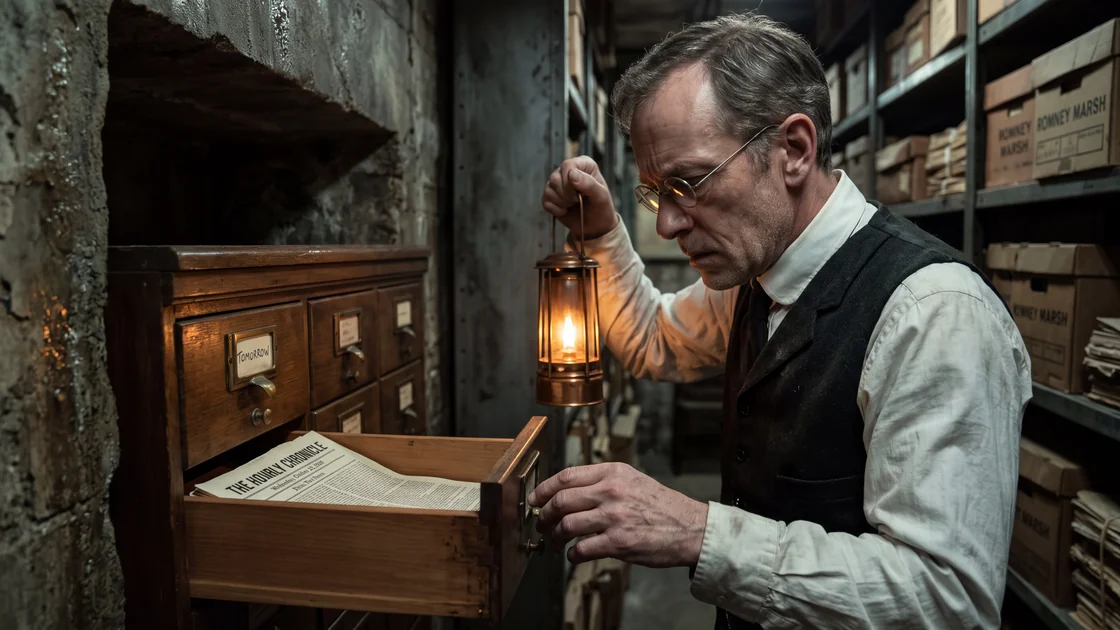
This is the history of Arthur Pendergast, Senior Conservator and Master Cataloger of the National Library, who, while auditing the forgotten subterranean vaults of the North Quadrangle, discovered a brass-bound card catalog drawer bearing the impossible label Tomorrow. Within its oiled walnut housing lay not index cards, but gossamer-thin, damply printed broadsheets detailing the catastrophes, obituaries, market fluctuations, and pedestrian heartbreaks of the day yet to come. Across seven days of mounting dread and frantic moral calculation, Arthur struggled with the terrible burden of foreknowledge—learning that every tragedy prevented exacted an oblique and cruel price, that the machinery of the archive was older and more predatory than the nation it served, and that the ink recording the future does not dry until someone agrees to bleed for it.
Chapter I: The Dust of the Octagon
The National Library was not designed for the living; it was designed to outlast them. Its foundations plunged seven levels beneath the grey silt of the capital river, anchoring four million linear feet of buckram, calfskin, watermarked rag, and fading iron-gall script into the bedrock of the continent. The fifth sub-level, known among the porters and catalogers as the "Octagon of Low Memory," smelled perpetually of dry lime, vinegar-cured bookbinder’s paste, and the slow, sulfurous death of unwashed sheepskin.
Arthur Pendergast was fifty-two years old, had spent thirty-one of those years within the climate-controlled crypts, and possessed the particular sort of pale, rectangular fingernails common to men who handled paper knives more often than dinner forks. His official title was Keeper of the Unclassified Retrospective, a position created in 1894 to soothe the conscience of a Board of Trustees overwhelmed by several thousand crates of unsorted provincial bequests. In practice, Arthur was the cemetery warden of documents that nobody wanted, nobody missed, and nobody could verify.
His lamp was a copper safety lantern fueled by sweet colza oil, which threw an amber circle no wider than a cartwheel onto the damp flagstones. On the morning of October 12, Arthur was carrying out the triennial inventory of Tier Nine, Row H—a corridor so narrow that his wool waistcoat brushed the zinc shelving on either side, picking up a fine fur of oxidized metal.
Row H was supposed to contain churchwardens’ accounts from the drowned parishes of the Romney Marsh. There should have been sixty-four uniform oak boxes, each containing bundle-tied receipts for parish tallow, timber for lychgates, and the burials of unbaptized infants. Arthur knew the sequence by heart; he had checked it in 1911 and again in 1914.
Yet between box forty-one and box forty-two, the zinc gave way to something that did not belong.
It was an upright cabinet of seasoned, dark-grained English walnut, no taller than a man’s hip, recessed into an alcove that Arthur could have sworn had previously housed a disused ventilation flume. It did not rest upon the floor so much as it emerged from the masonry, the mortar around its perimeter pristine, white, and fragrant with wet sand, as though set into the stone only hours before.
The cabinet contained ninety-six drawers arranged in eight vertical ranks of twelve. Each drawer face was fitted with a stamped brass pull and a small, bevel-edged brass label window.
Arthur raised the lantern. The brass was not tarnished. It lacked the greasy, greenish skin that seized all copper alloys in the damp air of the sub-basements within three weeks. It shone with the flat, greasy brightness of fresh brass shavings on an armorer’s lathe.
He squinted through his spectacles. The drawers were labeled with dates.
The rank on the far left began with January 1. The rank to its right bore February. Arthur ran his thumb across the metal. He expected to find historical ephemera—perhaps the scrap-paper journals of some obsessive former archivist who had cross-referenced the daily weather of the previous century.
He let his finger trail down the column labeled October.
October 10. October 11. October 12.
He stopped. October 12 was today. The drawer pull was cold, but when he pressed his finger to the card bracket, he felt a faint, rhythmic thrumming—not unlike the vibration of a telegraph key heard through a hotel partition, or the muffled ticking of an escapement clock encased in lard.
Arthur looked over his shoulder. The corridor stretched behind him, a dim tunnel of green zinc uprights fading into subterranean black. High above, through sixty feet of vaulted stone, lime-concrete, and oak parquet, the boots of readers scuffed across the marble floors of the Main Reading Room. Down here, there was only the hum of the saltpetre and his own shallow breath.
He reached down and slid October 12 open.
It ran out on lignum vitae runners with a sound like silk drawn over ice. It was empty save for a single scrap of lead-weight wool felt at the back, meant to damp the impact of the drawer against the carcass.
Arthur frowned. He leaned closer. There was a smell rising from the vacant cavity: wood-ash and turpentine, and underneath that, the unmistakable, sweet, oily tang of fresh printer’s ink. Not the dried, mineral tang of books that had rested fifty years in the dark, but the warm, biting stink of an ink-ball that had left the stone ten seconds ago.
He pushed the drawer shut.
His hand drifted, almost without his consent, to the drawer immediately below it.
The label was stamped in small, sharp-faced Caslon type: October 13.
Tomorrow.
Arthur hesitated. An archivist does not disturb sequences without cause. To reach into tomorrow's drawer was a violation of grammar, if not of nature. Yet the brass pull seemed to lean toward his hand, its small curve tailored exactly to the joint of his index finger.
He pulled.
The drawer slid out three inches, resisted with a faint suck of air, and then yielded.
It was not empty.
Lying in the bed of the drawer, perfectly squared against the cedar margins, was a bundle of paper. It was folded once across the middle, quarto-wise, the edges uncut and slightly furred, as if taken directly from a hand-lever press before the deckle could be trimmed.
Arthur reached in. The paper was cool, yet it possessed that peculiar, limp softness that rag stock retains while the tub-sizing is still settling. His fingertips left faint, grey-blue smudges on the margins; the ink was not yet skin-dry.
He lifted it to the lantern light.
The broadsheet was four pages, set in three dense columns without illustration. At the head of the first page, set in a woodcut masthead of antiquated, heavy-bellied German text, ran the title:
THE HOURLY CHRONICLE Wednesday, October 13, 1920 Price: Two Pence
Arthur stared at the date. He reached into his waistcoat pocket, drew out his turnip watch, and checked the dial: 11:42 a.m., Tuesday, October 12.
"Nonsense," he said aloud. The word fell dead into the dry lime dust between the shelves. "A commemorative draft. A printer’s proof for a trade union specimen."
He adjusted his glasses and read the lead paragraph of the left-hand column:
TERRIBLE COLLAPSE OF COAL TRESTLE AT NINE ELMS Five Carters Crushed Beneath Slack—The South-Western Line Blocked for Six Hours.
At twenty minutes past six o’clock this morning, the central timbering of the high-level coal discharge stage at the Nine Elms Goods Yard gave way under the weight of seven newly shunted wagons from the Derbyshire pits. The carters John Ellwood, 44, of Vauxhall Walk, and Samuel Prady, 19, an apprentice, were precipitated into the lower roadway together with forty tons of screened anthracite. Both were recovered dead by the municipal fire brigade at nine o'clock. Three others remain in the infirmary with compound fractures of the pelvic bones...
Arthur read the names twice. He knew Nine Elms; his brother-in-law had been a clerk in the locomotive sheds there until the dropsy took him. He knew the peculiar cadence of these reports—the cold, greasy precision of municipal disasters that filled the lower halves of the morning papers.
He turned the page.
On page three, under the heading DOMESTIC OCCURRENCES, his eye was caught by a tiny, three-line notice placed between a lost setter in Camberwell and an auction of cooperage equipment:
FOUND DEAD IN HIS LODGINGS.—Mr. Giles Winter, 68, formerly a cataloger of the Oriental Manuscripts Department of this Library, was discovered lifeless in his bed at No. 14 Regent Square at seven o'clock this morning by his landlady. Death was attributed by Dr. M. R. Crane to a cessation of the mitral valve.
Arthur dropped the paper onto the walnut cabinet. The silence of Row H seemed suddenly to have contracted, like an eyelid closing.
Giles Winter had retired in June. Arthur had taken tea with him only three days ago in the library tea-room; Winter had been complaining of the wind in his stomach and had purchased a winter cabbage from an old woman in the courtyard. He had been cheerful. He had been planning to visit his sister in Dorset on Thursday.
"A hoax," Arthur whispered. "A malicious, filthy practical joke by the junior boys in the bindery."
He picked up the broadsheet again. The paper was not standard newsprint. Newsprint was cheap, wood-pulp stuff that flaked into yellow crumbs under the thumbnail. This was heavy, pure linen rag, thirty-pound weight, watermarked with a device he had never seen before: an open book pierced by a compass, surrounded by the motto Scribitur Advenienti—It is written for the one who comes.
He looked down at the drawer labeled October 13. It sat open, dark and innocent, smelling of old cedar and wet lampblack.
Slowly, carefully, Arthur folded the paper, slipped it inside his coat against his ribs, and closed the drawer. The click of the latch was very small, but it sounded in his ears like the cocking of a pistol.
Chapter II: The Proof of the Dray
Arthur did not return to his desk on the mezzanine. He left his lantern burning upon the inventory table—a violation of library regulations punishable by a three-shilling dockage—climbed the iron stairs to the ground level, and walked straight out of the North Portico into the rain.
The city was grey, greasy, and smelled of horse dung and soft coal. It was twelve o'clock on Tuesday. If the paper was an elaborate forgery, Giles Winter was at this moment sitting in his parlor at No. 14 Regent Square, likely dipping yesterday’s dry roll into his chicory broth.
Arthur took a horse-bus as far as the Tottenham Court Road, then walked through the drizzle toward Bloomsbury. His umbrella was back in the umbrella rack in the conservators’ cloakroom, but he did not feel the water that soaked the brim of his bowler and dripped down the back of his celluloid collar. Against his chest, the broadsheet was stiff and cold, crackling with every heave of his lungs.
No. 14 Regent Square was a tall, flat-faced Georgian terrace with a peeling green door and an area railing from which three spears had been broken during the dock strikes.
Arthur mounted the steps and knocked.
A woman with flour on her forearms and an apron pinned with large brass safety pins opened the door after several minutes.
"Mr. Winter ain't receiving," she said before Arthur could speak. "He’s got his boots off and he’s reading his commentators. He don't like visitors after noon."
"Mrs. Hibbert?" Arthur removed his hat. "I am Mr. Pendergast, from the Library. I am... I was passing on my way to the binders. I only wished to inquire after Mr. Winter’s heart. He looked poorly when last I saw him."
The landlady’s face softened slightly, though her arms remained crossed over her apron. "Well, he’s sixty-eight, ain't he? His chest is wheezy, like an old bellows, but he ate his herring this morning without a grumble. He’s going down to Bridport tomorrow morning on the ten-fifteen from Waterloo."
"He has not... he has felt no distress today?"
"Distress? No more than usual for a gentleman what lived forty years in a vault with old books," she said sharply. "He's upstairs now, sorting out his stockings. If you want to leave a card, you can leave it on the salver."
Arthur stared at the brass tray on the hall table. It contained three circulars from an ironmonger and a tax receipt.
"No," Arthur said. His voice was hoarse. "No card. Tell him... tell him Arthur called to wish him a dry journey. And tell him—" He grabbed the woman’s sleeve, then checked himself and pulled his hand back. "Tell him to take a draught of peppermint before he sleeps. Tell him to keep his window cracked."
The woman looked at him with the cold, diagnostic suspicion of London landladies. "You’ve had one at the public house on the corner, sir. I know the look."
She shut the door before he could answer.
Arthur stood on the wet stone step. A butcher's cart rumbled past, the horse’s hooves sparking against the granite sets. The world was utterly, brutally ordinary. A sparrow fought an old crust in the gutter. Down at the crossing, an urchin with a broom was begging halfpennies from a clerk in an Inverness cape.
He reached inside his coat and touched the paper.
The lead paragraph had named Wednesday, October 13. It had said: At seven o'clock this morning by his landlady.
Tomorrow morning.
Arthur walked. He did not take the omnibus back. He walked down through St. Giles, down through the mouth of the Seven Dials, his boots splashing through puddles of grey sludge. His mind was not functioning with its usual archival calm; it was fluttering like an owl caught in a skylight.
If the paper was false, who had planted it? Who had built a walnut cabinet into the masonry of Tier Nine? The Masonry Office kept records of every bag of lime brought into the building since 1840. No carpenter could have carried eighty feet of seasoned walnut into the sub-basements without a pass signed by the Surveyor of the Fabric.
And why the names? Samuel Prady, 19, an apprentice. Who knew an apprentice carter at Nine Elms?
Arthur stopped at a tea-shop near Covent Garden. He sat at a small, greasy marble table near the tea-urn, ordered a pot of Indian tea he did not drink, and spread the broadsheet under the gas jet.
His fingers were trembling.
He turned to the fourth page. In the lower corner, beneath the market quotations for Baltic tallow and Spanish barilla, was a column headed POLICE AND CASUALTIES: YESTERDAY EVENING.
Arthur blinked. Yesterday evening. If the paper was dated Wednesday the 13th, then "yesterday evening" meant—
Tuesday evening. Tonight.
He leaned forward until his nose nearly touched the lampblack.
FATAL PANIC IN A TUBE LIFT.
At twenty-two minutes after six o’clock yesterday evening, while the lift at the Russell Square Station of the Great Northern, Piccadilly and Brompton Railway was descending with some seventy passengers, the balance-cable fouled the guide-shoe forty feet below the street level. A short-circuit in the lighting circuit caused the car to be plunged into total darkness, whereupon a panic ensued among the occupants. In the crush to reach the emergency gates, Miss Clara Hames, 22, a milliner's assistant of 8 Colville Road, Bayswater, was thrown to the steel floor and sustained fatal injuries from the trampling of the crowd. Several other females swooned and were conveyed to the Royal Free Hospital. The service was resumed after forty minutes...
Arthur’s turnip watch read 3:15 p.m.
Three hours.
He looked at the words: Miss Clara Hames, 22, a milliner's assistant.
He knew Colville Road; his cousin had kept lodgings there thirty years ago. It was a street of lace curtains, cheap gas mantles, and girls who carried cardboard hatboxes through the rain for twelve shillings a week.
Arthur stood up. He did not leave a coin for the untouched tea. The girl behind the urn called after him, but he was already through the glass door and into the street.
The rain had turned to a greasy, yellow fog that smelled of sulfur and bone-boiling works. It was the sort of London fog that muffled the sound of wheels until a dray appeared like a phantom three feet from one’s chest.
He took the Underground at Covent Garden. The station was cold and tiled in white sanitary brick that made it look like a slaughterhouse washroom. He stood upon the platform, his back pressed against a poster advertising Pears’ Soap, watching the little red-eyed train slide out of the tunnel with a screech of iron on iron.
He rode one stop to Russell Square.
The time was 4:10 p.m.
He sat on a bench on the platform, his bowler in his lap, the broadsheet folded inside his umbrella. The electric lights hummed with a low, blue hiss. Every three minutes, the air in the tunnel pushed forward with a warm, foul blast of stale breath and brake-linings, followed by a train; fifty passengers would tumble out, their umbrellas dripping, and scuffle into the great steel cage of the lift.
Arthur watched the girls.
There were dozens of them. They came down from the shops at four, at half-past four, at five. They wore dark skirts, short jackets of imitation astrakhan, and hats pinned with long, steel needles that had colored glass heads. None of them had their names written on their foreheads.
At 5:45, Arthur rose from the bench. His limbs were stiff with damp and terror. He took the lift up to the street level.
The lift was a massive iron cage suspended within a circular shaft of glazed brick. It could hold one hundred people packed breast-to-back. The operator, a boy in a brown uniform with brass buttons that said L.E.R., stood by the hydraulic lever, his face bored and grey with tunnel-dust.
Arthur stood by the street entrance in the ticket hall. The fog had thickened until the street-lamps in the square outside were only orange smears in the tallow-colored dark. People were pouring in from the pavements—clerks from the insurance offices in Holborn, shop-assistants, kitchen-maids, boys carrying damp evening editions of the Star.
6:10 p.m.
Arthur’s heart was beating against his teeth. He felt sick. His collar was choking him.
A girl passed him. She was small, walking quickly, carrying a round, black cardboard box by its cotton string. Her boots were split across the toe-cap, and she was coughing into a damp handkerchief.
Arthur stepped into her path. "Excuse me, miss."
She recoiled, her chin coming up with the sharp, defensive insolence of the pavement. "Here, who are you pushing? Keep your hands to yourself, mister."
"Is your name Hames?"
She stopped. Her eyes, pale and watery in the gaslight, went wide with fear. "What’s that to you? If my brother sees you—"
"Is your name Clara Hames?"
"What if it is? I ain't done nothing. The ribbons was accounted for. Mr. Morrison checked the tray himself."
Arthur felt the skin of his scalp crawl. The names were real. The world was an open book, and the page was turning under his hand.
"You must not take the lift," he said. His voice was too loud; a gentleman in a silk hat turned to look at them with mild disgust.
"Are you balmy?" the girl said. "I’ve got the six-thirty from King’s Cross to see my mother. Get out of it."
She tried to push past him toward the iron gate of the lift, which was already half-full of passengers. The operator was calling out: "Next lift down! Move along there, plenty of room in the center!"
Arthur caught her by the sleeve of her astrakhan jacket. The cloth was cheap and rotten; he felt the seam give under his fingers.
"You cannot go down in that car," he said. He was trembling violently. "The cable will foul. The lights will go out. You will be trampled."
"He’s mad!" she screamed. She did not scream with delicate terror; she screamed with the raw, piercing shriek of a London work-girl who thinks she is being abducted or robbed. "Police! Here, George! He’s got hold of me!"
The ticket collector, a burly man with a red mustache and a railway badge on his cap, stepped out of his wooden kiosk. "Now then! What’s all this? Let go the young lady, sir."
The crowd stopped. A wall of wet wool coats and cold faces closed around them.
"I am Arthur Pendergast, Senior Conservator of the—"
"I don't care if you're the Lord Mayor’s coachman," the ticket collector said, laying a heavy, wet hand on Arthur’s shoulder. "Take your hands off her. Miss, you all right?"
"He’s a lunatic," the girl sobbed, clutching her hatbox. "He knew my name. He tried to drag me back."
The lift gates behind them rattled shut with a heavy, double clang of iron.
Arthur turned his head. Through the diamond-patterned lattice of the gates, he saw the car begin its descent into the black shaft. The faces inside looked out at him—blank, pale, lantern-jawed faces of men going home to their mutton.
He lunged for the gate. "Stop it! Don't let it down!"
The ticket collector threw his arms around Arthur’s middle, lifting him off his feet with a grunt of effort. "No you don't, mate. You’re coming into the office till the constable comes up from the corner."
The crowd murmured. Clara Hames slipped through the circle of onlookers, her hatbox swinging, and vanished down the stone emergency stairs that spiraled around the outside of the lift shaft.
Arthur ceased struggling. He hung limp in the ticket collector’s grip.
His watch, pinned inside his waistcoat, ticked against his ribs.
It was 6:21.
A sound came from the depths of the brick well.
It was not a crash. It was a long, dry, metallic screech, like the sound of an iron tire being forced onto an ungreased axle at speed. Then came a sharp, flat snap—the unmistakable report of an eight-strand steel wire parting under tension—followed by a hollow, drumming thud that vibrated through the flagstones beneath their boots.
Then, from forty feet down, the lights went out. The orange glow that rose through the shaft vanished, replaced by an absolute, greasy darkness.
And then the screams began.
They were muffled at first, like the sound of pigs being driven through a covered chute, then rose in pitch—thin, shrill, frantic screeches that echoed off the white glazed brick of the cylinder.
The ticket collector dropped Arthur. His red face went the color of cold suet. "Almighty God," he whispered. "The balance."
He ran toward the emergency brake lever beside the gate. The ticket hall erupted into shouting. Men were running from the street; someone was blowing a brass metropolitan whistle at the curb, three short blasts and a long.
Arthur stood against the tile wall.
He reached inside his umbrella, his fingers closing around the damp linen broadsheet.
He had stopped her. Clara Hames had taken the stairs.
A strange, dizzying warmth rose from his chest into his throat. He had broken the page. The printed word was not sovereign; it was merely an account of what would happen if no one read the proof. He was an archivist—and what was an archivist but an editor of the past? And if one could edit the past, why not the margins of the present?
Then a man came running up the iron emergency stairs, three steps at a time, his bowler gone, his face white with plaster dust.
"The stairs!" the man yelled, catching the gate to steady himself. "Get a doctor down the stairs! A girl fell from the top landing—tripped over her own skirt in the dark when the lamps failed—broke her neck against the iron riser!"
Arthur’s heart stopped.
"A girl?" someone shouted. "Who is she?"
"Little thing," the man gasped, spitting blood from a bitten lip. "Black coat. Had a hatbox with her. Smashed it to flinders when she went over the rail."
The ticket hall dissolved into a roar of voices, but Arthur heard none of it.
He walked out through the entrance into the yellow fog. No one stopped him; no one looked at him. He moved like an unburied corpse through the cold mist toward the library.
The text had not been denied. It had merely adjusted its syntax.
Chapter III: The Mechanics of the Drawer
He did not sleep.
He sat in his official quarters on the third floor of the Library’s West Wing—a narrow room furnished with a camp bed, a washstand, and six thousand feet of duplicate accession registers. Outside his high, arched window, the great dome of the Reading Room loomed against the sulfur-tinted clouds like the skull of an extinct beast.
On the table lay the two broadsheets.
For there were two now.
At midnight, unable to bear the silence of his room, Arthur had crept down through the four tiers of sleeping books, down through the Octagon, back to Row H.
He had opened October 13 again.
The broadsheet was still there, but it had changed.
Arthur had held it to the lantern with fingers that felt like dry twigs. The lead paragraph about Nine Elms was unchanged. The notice of Giles Winter’s mitral valve was unchanged. But the fourth page, lower corner, had shifted.
The heading was different:
FATAL ACCIDENT ON TUBE STAIRS.
At twenty-two minutes after six o’clock yesterday evening, Miss Clara Hames, 22, a milliner's assistant, while descending the spiral emergency stairs at Russell Square Station, was precipitated over the handrail through a sudden panic occasioned by an electrical failure in the lift shaft. She sustained a fracture of the cervical vertebrae and expired instantly...
The ink was dry now. It had set into the linen fibers with that dead, purple-black permanency that Arthur recognized from fifteenth-century incunabula. It was no longer a proof; it was an accession.
And in the drawer below it—the drawer labeled October 14—there was a new sheet, limp and cold, smelling of vinegar and wet lampblack.
Arthur did not read October 14 immediately. He laid it face-down upon his blotting pad, as a man might lay down an unexploded shell that had dropped through his ceiling.
He sat with his elbows on the desk, his head in his hands, listening to the rain rattle against the leaded panes.
He was not a philosopher; he was a cataloger. When a cataloger is confronted with a phenomenon that violates the order of things, he does not invent a new religion; he looks for the system of cross-referencing.
At three in the morning, he went to the Private Room of the Principal Librarian.
The Principal Librarian, Sir Henry Savile, was seventy-eight years old, suffered from gout of the bladder, and spent his nights in a large leather armchair in his study behind the King’s Library, surrounded by port decanters and portraits of Eighteenth-Century antiquaries.
He was not asleep when Arthur knocked. He was wearing an embroidered dressing gown of quilted damask and was paring an apple with an ivory-handled silver knife.
"Pendergast," Sir Henry said without looking up. "You walk like a bailiff. If you are here about the binders’ wages, the Treasury has refused the supplemental grant. They consider eightpence an hour sufficient for stitching calf."
"Sir Henry," Arthur said, standing in the middle of the Turkey carpet. "Who built the walnut press in Tier Nine?"
The old man’s knife paused against the peel of the apple. A thin ribbon of green skin hung suspended above the silver salver.
"The what?"
"The ninety-six drawer press in Row H. Sub-basement Five. Set into the north wall, between the Romney records and the duplicates of the Patent Rolls."
Sir Henry did not move for several seconds. The gas lamps in the study hissed, a soft, greasy sound that seemed to eat the air in the room. Very slowly, the old man completed the circle of the apple, let the peel drop, and placed the knife upon the plate.
"I had hoped," Sir Henry said, his voice dropping into a dry, whistling register that Arthur had never heard him use before, "that that particular piece of cabinetry had been walled up by the Works Department in '88."
Arthur felt his knees go loose. "Then you know it."
"I know of it," Sir Henry said. He picked up his glass of port, tilted it until the ruby liquid reached the rim, but did not drink. "My predecessor, Mr. Panizzi, spoke of it once. Only once. It was the night after the Tay Bridge went down. He was sitting where you are sitting now, with his boots covered in mud and his waistcoat torn, and he told me that the Library was not a warehouse for the past."
"Then what is it?"
"An engine," Sir Henry whispered. "A recording engine that has slipped its escapement. Or perhaps one that has never had one."
He looked at Arthur then, his small, watery eyes sunken beneath brows like clumps of dry lichen. "You opened it."
"Yes."
"Which one?"
"Tomorrow," Arthur said. "And the day after."
Sir Henry closed his eyes. "Giles Winter is dead, isn't he?"
Arthur went cold. "How do you know that?"
"Because his name was in the margin of the ledger in '74, when he was appointed," Sir Henry said. "Panizzi told me that certain men are listed in the drawers not as subjects, but as... maintenance. Giles spent twenty years in the Oriental Department doing nothing. You knew that, didn't you? He never cataloged a single Persian roll. He was there to oil the runners."
"The runners of the cabinet?"
"The runners of the city," Sir Henry snapped, his old eyes flashing with a sudden, angry vitality. "Do you think four million people can live on an open marsh, breathing their own coal smoke, drinking their own filtered sewage, without a governor? Do you think an empire is held together by red tape and gunboats? It is held together by the catalog!"
He stood up, his dressing gown trailing upon the carpet, and walked to the high bookcase behind his desk. He took down a slender, pigskin-bound octavo with three brass clasps.
"The Library does not collect books, Pendergast. It never has. The books are a screen—a great, dusty blind to explain why we need twenty miles of tunnels and two hundred tons of rag paper a year. We are the depository for the Register of Circumstance."
He threw the book onto the desk between them. It fell with a heavy, dead flap.
"Open it," Sir Henry commanded.
Arthur reached out a hand. The pigskin was greasy with age; it had that yellow, waxy look of leather that had been dressed with neat’s-foot oil in another century.
He unclasped the brass brackets.
The pages were not written in ink. They were printed. Every page was a miniature broadsheet, four inches by six, bearing the same gothic masthead: The Hourly Chronicle.
The first page was dated September 2, 1666.
Arthur read:
GREAT FIRE IN PUDDING LANE.
By reason of the baker's oven remaining unquenched in the house of Mr. Farynor, the timber dwellings adjoining the bridge are become a general conflagration...
"Panizzi told me," Sir Henry murmured, his back turned to Arthur as he stared into the cold grate, "that the fire was listed in the drawer three days before the oven was heated. The Keeper of the Rolls at that time—an idiot named Chillingworth—thought to prevent it. He went to Pudding Lane on the Friday evening. He carried two buckets of water and an order from the Alderman to pull down the bakehouse."
Arthur looked up from the book. "And?"
"He slipped on the offal in the lane," Sir Henry said. "He broke his leg. The lantern he was carrying fell into the straw of the baker's stable. The fire began twelve hours early, but it ended at the same wall in Pie Corner."
The old man turned, his face white and hollow in the gaslight.
"The drawer does not predict, Pendergast. The drawer demands. It is the proof-sheet of the day. If you alter the text in one place, the compositor—whatever devilish linotype sits beneath the gravel of this hill—simply resets the forme with whatever type is at hand."
"The girl," Arthur whispered. "Clara Hames. She died anyway."
"Of course she died," Sir Henry spat. "She had been set in type. Her space in the line was three ems wide. If you did not let her drop in the lift, she had to drop on the stairs. You merely made her death uglier and more painful."
He leaned across the desk, his dry old hand clutching Arthur’s lapel with surprising force.
"You must put the sheets back. You must go down to Row H, push the drawers to their stops, and turn the brass key in the plinth. There is a key—do you hear me? A small, four-flanged key beneath the skirting board of the cabinet. Turn it once to the left. It locks the feeds."
"And then?" Arthur asked.
"And then you forget you have seen it. You return to your Romney Marsh parish receipts. You let Giles Winter be buried by his landlady. And you let the city die its own deaths in its own time."
Arthur looked at the old man. There was something broken in Sir Henry’s face—a terror that was not fresh and sharp like Arthur’s, but ancient, dry, and salted down by fifty years of complicity.
"You have read them," Arthur said. "You have read your own tomorrow."
Sir Henry did not answer. He let go of Arthur’s coat, turned back to his chair, and sat down heavily. He picked up his piece of apple, looked at it with disgust, and dropped it into the ashes of the hearth.
"The key is beneath the plinth," he said to the wall. "If you have not turned it by dawn, I will have the porters carry you out of the gate in an iron basket."
Chapter IV: The Typographer of the Underside
Arthur did not go to the plinth.
He went down. Past the Octagon. Past Tier Nine. He went down the circular iron ladder that led to the drainage sump—the lowest point of the Library, where the pumps groaned night and day to keep the river from filling the foundations with grey mud.
He had the broadsheet for October 14 in his pocket.
He had read it on the stairs, by the light of a single tallow dip.
The lead headline was not about a coal dray or an Underground panic.
It was set in thirty-six-point capitals, the ink so fresh that it had offset onto the blank margin of the facing page:
DESTRUCTION OF THE NATIONAL READING ROOM BY FIRE.
Three Hundred Students and Scholars Suffocated Beneath the Fallen Dome.
At twenty minutes before three o'clock yesterday afternoon, a conflagration of unprecedented fury broke out in the ventilation ducts beneath the North Quadrangle... The central iron ribs of the great dome, heated to cherry-redness, collapsed inward upon the concentric tables... Sir Henry Savile, K.C.B., Principal Librarian, perished in his office while attempting to secure the recovery of the Codex Alexandrinus...
The time listed was 2:40 p.m., Thursday, October 14.
That was thirty hours away.
Arthur reached the floor of the sump. The air here was ten degrees colder than in the catalog corridors, smelling of river-mud, iron rust, and the oily fat used to grease the three-throw pump. A four-inch pipe rose from the flagstones, pulsating with a rhythmic, wet thump-clack, thump-clack as it forced the bilge into the municipal sewer fifty feet above.
Against the southern wall of the sump, half-hidden behind a mountain of broken crate-timber and rusted catalog frames, stood an iron door.
It was not a Library door. It had no brass number, no lead seal from the Office of Works. It was low, round-headed, and secured by three sliding bolts of cold-rolled steel, each as thick as a beer-bottle.
Beside the door, on an upended lard-tub, sat a boy.
He was perhaps fourteen years old, though he had the yellow, wrinkled skin around the eyes that Arthur had seen in children who worked twelve-hour shifts in the gutta-percha factories across the river. He wore a printer’s apron of coarse sacking, stiff with black grease and dried size. In his lap was a composing stick of polished steel, and his fingers—long, thin, and stained a deep, permanent walnut-black to the second knuckle—were dancing among the compartments of a wooden type-case that rested on the floor between his shins.
He did not look up when Arthur’s lantern light struck him.
"You’re early," the boy said. His voice was like two slates being rubbed together in a bucket. "The October 15 formes ain't cast yet. The metal’s still in the pot."
Arthur stopped six feet away. The heat from his lantern seemed to die in the cold draft that blew from beneath the iron door.
"Who are you?" Arthur asked.
The boy picked up a type-slug, his thumb checking the nick with a flick that was almost invisible, and clicked it into the stick. Click. Click. Click.
"Third apprentice," the boy said. "To the Queen’s King’s Master of the Press. Only there ain't been a King since January, has there? Or is there? I don't keep track of the topside. We take the names through the chute."
"What chute?"
The boy pointed with his composing rule toward the ceiling. High up in the brick vaulting, almost lost in the web of water-pipes and gas mains, a four-inch lead pneumatic tube descended from the darkness, terminating in a brass delivery hopper above a low table.
"They come down from the Observation," the boy said. "The cards. We set 'em. We pull the proofs. We send 'em up the dumb-waiter to the walnut boxes. It’s eight quires to the drawer. No more, no less."
Arthur approached the table.
On it lay a heap of small, stiff cards, three inches by five—the standard size used in the Library’s Author Catalog.
He picked up the top card.
It was written in a clerkly, copperplate hand—not in pencil or modern aniline ink, but in the pale, greenish iron-gall ink that Arthur had spent his life deciphering on seventeenth-century charters.
The card read:
Savile, Sir Henry. Death by inhalation of carbonic acid gas and combustion of the thoracic wall. To take place in the private closet of the Principal Librarian, 2:42 p.m., October 14, 1920. Cause: Ignition of methylated spirit from the tea-burner by an overturned reading-lamp. Cross-reference: Codex Alexandrinus (loss of).
Arthur dropped the card. It fluttered down among the greasy shavings on the floor.
"Who writes these?"
The boy laughed—a dry, clicking sound like a rat running over broken glass. "Nobody writes 'em. They drop out of the lead pipe. Sometimes three a minute, sometimes one an hour. When there’s an influenza or a war on, the hopper chokes itself. We had to have two extra boys in '16 just to clear the clinkers from the furnace."
"What furnace?"
The boy nodded toward the iron door.
"The Stereotype Foundry," he said. "Where do you think the type comes from? It’s cast from the lead of the old coffins when they dig up the churchyards for the railway cuttings. It’s good lead. Soft. Takes a sharp face on the minion and the brevier."
Arthur looked at the steel bolts on the iron door. Behind it, he could hear a sound that was not the water pump.
It was the sound of a press.
Not a hand-press—not the leisurely clack-thump of an old Albion or an iron Stanhope. It was the deep, rhythmic, earth-shaking throb of a steam rotary—a monster that breathed with a heavy, oily gasping, turning cylinders three yards wide, shaking the ancient limestone foundations of the city with every revolution.
Whuff-whuff-whuff-bang. Whuff-whuff-whuff-bang.
"You can't print tomorrow," Arthur said. His voice had lost its authority; it was the thin, querulous voice of an old clerk whose inventory had been disputed. "Tomorrow hasn't happened. The fire hasn't started. The methylated spirit is still in Sir Henry’s wicker basket."
The boy stopped his fingers. For the first time, he looked up at Arthur. His eyes had no pupils—only a dull, milky-grey iris that seemed to have been washed out by too many years of gaslight and acid fumes.
"You think because you put the books on the shelves, you know what’s inside 'em?" the boy said. "You're only the paper-keeper, mister. You’re the fellow who wipes the mold off the backs. You think the city happens first, and we print it after?"
"Of course it happens first!"
The boy picked up another type slug. Click.
"If we didn't print it," the boy said softly, "where would it go? Did you ever see a day that wasn't written down somewhere? It’d run all over the edges. It’d spill into the gutter like a burst beer-butt. You’d have Monday getting tangled up with Friday, and people dying before their grandfathers was weaned."
He set three spaces into the line with three rapid taps of his rule.
"The press keeps the road straight," he said. "It lays the rails down six hours before the engine gets there. If the rails ain't laid, the train don't stay on the bank, do it? It goes into the dirt. And you can't live in the dirt, mister. Even the worms don't like it."
Arthur reached out and seized the boy’s wrist. The skin was cold as lard, but beneath it the tendons were like piano wire.
"The fire tomorrow," Arthur said. "Three hundred people. In the Reading Room. They are sitting there now—young men reading for the bar, old women copying genealogies from the heralds' books. They don't know the iron ribs are going to drop on them."
"They'll know at twenty minutes to three," the boy said.
"We can pull the fire-cocks. We can drench the ducts now. We can turn the gas off at the main in Great Russell Street."
The boy looked down at Arthur’s hand on his wrist until Arthur, feeling an unaccountable cold strike into his marrow, let go.
"You tried that with the girl at the tube station, didn't you?" the boy said. He took an oily rag from his pocket and wiped a smudge of lead-dust from the corner of his lip. "How’d that work out for her? Was her neck any less broken because she died on the iron rather than the steel?"
Arthur backed away two steps. The smell of the room was changing; the river-mud was being drowned out by the stink of hot oil, scorching wool, and the faint, sweetish smell of burning bone.
"There must be an errata," Arthur whispered. "Every book has an errata. A cancel-leaf. A slip tipped in between the gatherings."
The boy paused. His blind-looking grey eyes seemed to search Arthur’s face for a long, quiet moment.
"There's cancels," the boy admitted. "Sometimes. When the Master makes an over-set. But a cancel costs."
"Costs what?"
"Type," the boy said. "You can't just take a name out of the forme and leave a hole. The cylinder’d punch through the blanket on the first turn. You take three hundred names out of the North Quadrangle, you got to put three hundred names back in."
"Where do they come from?"
The boy picked up a handful of blank cards from the table and fanned them like a card-player.
"From wherever the ink takes," he said. "You want to reset tomorrow? You better find yourself a composing stick, mister. And you better find something that prints as heavy as three hundred scholars and an old gentleman with the gout."
Chapter V: The Logic of the Cancel
Arthur returned to his rooms at four in the morning. He did not light the lamp. He sat in the grey, pre-dawn twilight that filtered through the soot-stained windows, his knees touching the edge of the mahogany table.
On the table lay three objects:
His bone folder—six inches of polished ox-rib, smoothed by thirty years of pressing down the hinges of morocco bindings.
His pocket watch, ticking with the dry, indifferent industry of its kind.
And the broadsheet for October 14.
He looked at the masthead. He looked at the third column of the front page:
THE ROLL OF CASUALTY. Among those currently identified as having perished beneath the fallen timbering of the Central Desk are the following: Miss Eleanor Mary Calthrop, 31, of 11 St. John’s Wood Park, student of ecclesiastical Latin; Mr. Isaac Benjamin Levi, 64, of 42 Hanbury Street, translator of the Syriac fragments; The Rev. Dr. Archibald Fane, 72, Prebendary of Lincoln...
Arthur knew them all.
Miss Calthrop came every Thursday at ten precisely, carrying two hard-boiled eggs in a tin box and an ink-horn of violet fluid that she was constantly warned not to rest upon the calf bindings. Mr. Levi sat at Table G, his beard tucked into his waistcoat, smelling faintly of caraway seeds, muttering the verbs to himself as he copied the square Aramaic characters onto blue draft-paper.
They were not statistics. They were the furniture of his life. If they were burned to cinders tomorrow afternoon, their places would be filled by other people who would look the same from behind, smell the same in the rain, and leave the same grey skin of dead skin-cells and dandruff between the leaves of the dictionaries.
You take three hundred names out, you got to put three hundred back in.
Arthur stood up.
He went to the small deal press where he kept his conservator’s tools: his scrapers, his sponges, his jars of pulverized pumice, his bottles of spirits of wine, and his inks.
He had six kinds of black ink.
He had modern carbon ink, made from lampblack and gum arabic. He had the government-issue gallotannate, which ate through steel nibs in three weeks. And he had a small, stone jar of sixteenth-century printing varnish—thick, black as pitch, scented with walnut oil and Venice turpentine, which he used for repairing the loose rules on the title pages of the Shakespeare folios.
He took up a fine, split-nib crowquill—the kind used by map-makers for the sixty-four-foot surveys of the Ordnance.
He sat down with The Hourly Chronicle of October 14.
The paper was damp. rag stock never dries fully in an underground room; it lives in a state of suspended thirst, waiting to drink whatever liquid touches its surface.
Arthur laid his bone folder along the column containing the ROLL OF CASUALTY.
His hand was not shaking now. The cataloger’s training—the long, cold habit of precision that had sustained him through thirty years of reading wills and land-grants—settled over his nerves like an ice-pack.
He did not attempt to scrape the letters away. Panizzi had been right: you cannot leave a hole. If you scrape the paper thin, the cylinder breaks the sheet.
He dipped the crowquill into the stone jar of printing varnish.
He must write over the text. He must alter the letters with such demonic ingenuity that the eye of the machine—or the eye of whatever compositor sat behind the iron door in the sump—would accept the correction as a legitimate variant.
He began with the headline:
DESTRUCTION OF THE NATIONAL READING ROOM BY FIRE.
With four strokes of the quill, he joined the legs of the R and the D, turned the E into an O, and tipped the cross-bar of the T.
It was slow, hideous work. His spectacles were so close to the paper that his breath made the fresh varnish bloom with a dull, grey grease. He did not breathe through his nose; he held his lungs half-empty, releasing his breath in tiny, silent puffs at the end of each line.
DESTRUCTION became DISTRACTION.
No—that was meaningless. The grammar of the press did not admit nonsense. It must be an event; it must have weight; it must have a subject, a predicate, and an ending.
He stared at the woodcut-style type.
OBSTRUCTION IN THE NATIONAL DRAINAGE WORKS BY SILT.
He worked for two hours. His fingers cramped until he had to force the joints straight against the edge of the mahogany table with his left hand. The ink was so thick that it stood up from the page in tiny, glittering beads like the eyes of dead spiders.
He changed the venue.
If the fire took place in the ventilation flumes of the North Quadrangle, it would consume the Library. But what if the venue was shifted fifty yards to the west? What lay fifty yards to the west?
The old stone coal-yards of the St. Giles Board of Works—an acre of granite flagging, five hundred tons of wet Welsh steam-coal, and an iron weigh-house with a zinc roof.
A fire in a coal-yard is dirty, stubborn, and expensive. It creates a vast deal of yellow smoke that makes the eyes of the draymen water for three days. But it does not drop an iron dome onto three hundred scholars.
Arthur changed the lines:
ventilation ducts beneath the North Quadrangle became open coke bunkers of the St. Giles Board of Works.
He came to the names.
This was the horror. The boy had said it: The cylinder’d punch through the blanket. The names had to be real. A name that did not belong to a living body was an empty line; it had no density; it did not register upon the balance.
He looked at the name of Eleanor Mary Calthrop.
He could not change her name to an invention. If he wrote John Doe or Richard Roe, the press would know the fraud; it would drop the type back into the case and the fire would return to Table G.
He must replace her with someone whose presence in the coal-yard would be natural, inevitable, and fatal.
Arthur sat with the crowquill suspended over the paper. A drop of black, viscous varnish hung from the nib, trembling with the pulse of his forearm.
Who belonged in a burning coke bunker at twenty minutes before three on a Thursday afternoon?
A coal-heaver. A yard-clerk. A vagrant who had crept behind the timbering to sleep off two-penny gin.
He did not know their names.
He was a National Librarian; he knew the names of three thousand French bishops who had died before the Jacquerie; he knew the names of every stationer who had sold broadsides in St. Paul’s Churchyard between 1580 and 1640. He did not know the name of the man who brought the anthracite to his own cellar on Tuesday mornings.
"God," Arthur whispered. It was not a prayer; it was the dry, flat complaint of a scholar who has found an uncorrected error in a royal folio.
He looked at his own reflection in the dark window-pane.
His face was grey, long, and bordered by thin, scrubby whiskers of pepper-colored hair. His neck was thin, scored by two deep, horizontal wrinkles where his stiff collar bit into the flesh.
He was fifty-two. His pension was secured under the Superannuation Act of 1859. If he lived to seventy, the Treasury would pay him one hundred and forty pounds a year, which he would spend on dry mutton, mustard plasters, and octavo editions of seventeenth-century sermons that nobody else would bid for at Sotheby’s.
He lowered the quill.
Over the name of Miss Eleanor Mary Calthrop, 31, of St. John’s Wood Park, he wrote, in clear, heavy, three-line pica characters:
Arthur William Pendergast, 52, Senior Conservator of this Library.
He did not stop.
If he was to balance three hundred scholars, he could not do it with one old clerk. One clerk has the weight of an ounce; a student of ecclesiastical Latin has the whole potentiality of her unwritten papers, her marriage, her three children who might have become engineers or school-inspectors.
He must give more than his own skin. He must give what he had spent thirty years accumulating.
He must give the books.
Beneath his own name, in the long, three-column roll of the dead, he began to write the shelf-marks of the Unclassified Retrospective:
MS. Add. 44,812: The Account-Book of the Churchwardens of St. Jude-in-the-Fen (vellum, 148 leaves); MS. Add. 44,813: Cartulary of the Priory of St. John of the Ditch (imperfect at the end); The Unique Collection of Provincial Play-Bills from the Theatre Royal, Grantham (four bundles in pigskin wrappers)...
He wrote until the crowquill was split to the shoulder. He wrote until the stone jar was dry, and he had to dilute the varnish with three drops of his own spittle, worked into the pigment with the tip of his penknife.
He wrote forty-six shelf-marks. He offered up the whole of Tier Nine, Row H. Every baptism, every receipt for lime, every ditch-digger’s wage-slip that had escaped the drainage of the fens.
He was trading paper for meat.
When he finished, the clock in the hall was striking six.
The broadsheet was no longer white with black rules. It was a scarred, greasy palimpsest of violet corrections, black-letter blots, and the shiny, raised ridges of fresh printing varnish. It looked like an old chart that had been used by three generations of smugglers to record the shifting of the sands.
Arthur blew upon the ink. It did not dry; printing varnish does not dry by evaporation; it dries by oxidation, which takes three days, or by absorption, which requires a heavy press.
He picked up the broadsheet, folded it once across his own name, and carried it down the stairs into the cellar.
Chapter VI: The Setting of the Forme
The third apprentice was still sitting on his lard-tub.
The pile of blank cards had grown higher; the composing stick was full. The pneumatic tube was coughing every two minutes now, a short, dry plop followed by the slide of a pasteboard rectangle into the zinc hopper.
Arthur laid the corrected broadsheet upon the boy’s knees.
"Cancel," Arthur said.
The boy did not look at the paper with his eyes. He passed the tips of his blackened fingers over the surface, his nails clicking against the raised, sticky lines of fresh varnish like a blind man reading a Bible for the blind.
"This is bad copy," the boy said. "The rules are crooked. The margins are all over the shop. The overseer’ll dock my tea-money for a proof like this."
"It is an author’s correction," Arthur said. "The copy is authoritative."
"There ain't no authors," the boy said, his fingers lingering over the shelf-marks of the Romney parish books. "There’s only the names that drop down the spout. Who told you an account-book has the same weight as a girl from St. John’s Wood?"
"It has the weight of three hundred years," Arthur said. "That vellum was pulled from sheep that grazed on the saltings before the Dutchmen came to cut the dykes. It has sixty thousand names of men who paid their scot and died of the ague. It is worth more than three hundred clerks in the Reading Room."
The boy tilted his head, as if listening to the rotary press behind the iron door. The heavy, subterranean throb—whuff-whuff-whuff-bang—seemed to have slowed slightly, its rhythm dragging like the pulse of a horse that has been galloped up an icy hill.
"The metal’s going to be cold," the boy grumbled. "If I reset the page now, I’ve got to draw the fires on the cylinder."
"Then draw them."
"You don't know what happens when the forme is unlocked, do you?" The boy rose from the lard-tub. He was small—scarcely taller than Arthur’s chest—but he had the thick, square shoulders of an iron-molder. "When the wedges are knocked out of the chase, the whole day comes loose. It don't just stay in the coal-yard. It slops."
"I have balanced it," Arthur said. His hand was resting against his ribs; he could feel his watch, still ticking, but the beats were irregular, like an escapement that had collected lint. "I gave my own line. I gave my space."
The boy looked at him with his dead, milky eyes.
"You’re sixty-four ems wide, Mr. Pendergast," he said. He had not looked at the name on the card; he had known it by the thickness of the ink. "That’s a lot of space for a man who hasn't spoken above a whisper since Gladstone was Prime Minister."
The boy turned to the iron door. He took three large iron keys from his apron pocket, keys that were black with graphite and had no wards, only irregular notches cut into their flat edges like the teeth of a timber-saw.
He inserted them into the three locks.
He did not turn them one by one; he gave them a single, collective twist with both hands, using his hip to force the central bar.
The bolts drew back with a sound like a guillotine falling into its cradle.
The door swung out six inches.
No light came from the room beyond. None at all.
There was only a heat so intense, so dry, that Arthur’s spectacles instantly clouded with a fine web of heat-cracks. It smelled of boiling linseed, antimony, lead, and the cold, mineral breath of the earth’s center.
Behind the door was the machine.
It was not made of green-painted iron like the presses at the Fleet Street offices. It was made of something black, dull, and porous, like the basalt columns of the Giant’s Causeway, held together by bronze tie-rods as thick as oaks. The cylinder was not five feet wide; it was thirty feet across, disappearing upward through an opening in the brick vaulting that Arthur had never seen from above.
The forme was bolted to the cylinder.
It was a field of lead three yards square, set with millions of tiny, glittering points that caught the yellow reflection of the colza lantern. Every point was a letter; every letter was a second; every line was a life being held down against the blanket until the ink could take.
The apprentice did not use a mallet. He took from behind his ear a small, horn-tipped setting pin.
He reached into the basalt frame.
The heat must have been four hundred degrees, yet the boy did not flinch; his sacking apron did not even scorch. He found the line that held October 14, 1920.
He pressed the horn pin into the margin.
A sound went through the foundations of the Library—not a mechanical sound, but a great, long, metallic sigh, like the air escaping from a cathedral organ when the bellows-boy drops the levers.
Arthur felt the floor beneath his boots drop two inches.
The walls of the sump—the ancient, six-foot-thick brick walls that had stood since the foundations were dug in 1848—groaned. Mortar dust fell from the vault in a fine, white spray, settling upon Arthur’s bowler like flour.
The boy was working with the speed of an adder. His hands were inside the machinery, his black fingers flying among the lead lines.
He plucked out three lines of type.
They did not fall to the floor; they dissolved in his palm, the lead turning instantly into grey, liquid beads that ran between his knuckles and fell with tiny pinks into the ash-pit below.
In their place, he laid the lines he had set from Arthur’s copy.
He did not use the crowquill corrections; he used the slugs he had cast from the coffin-lead.
Arthur William Pendergast. MS. Add. 44,812. The Unique Collection of Provincial Play-Bills.
With every slug he dropped into the chase, Arthur felt a cold, sharp prick beneath his sternum—not unlike the sensation of being stitched with a coarse linen thread by an unskillful surgeon.
His breath became short.
The smell of the tea-shop in Covent Garden—the smell of the wet umbrellas at Russell Square—the smell of the sweet oil in his safety lantern—all of them seemed to be retreating from his nostrils, replaced by the bitter, greasy tang of antimony.
The boy stepped back from the door.
He did not use a wrench to lock the chase. He simply spat into the joint between the basalt and the bronze.
The spit did not sizzle. It turned instantly into a grey, crystalline cement that sealed the type into the stone.
"It’s done," the apprentice said.
He slammed the iron door. The three bolts slid home together with a single, flat thud that Arthur felt in the roots of his teeth.
The boy turned back to his lard-tub. He picked up his composing stick, wiped his nose on his greasy sleeve, and reached into the compartment for an e.
"You better get upstairs, Mr. Pendergast," he said without looking up. "The St. Giles coke is dry. It catches quick once the wind gets round to the south."
Arthur did not answer. He could not.
His boots were so heavy that he had to drag them across the flagstones like bags of sand. He mounted the iron ladder one rung at a time, his hands sticking to the cold, rusty rungs, his chest whistling like a broken concertina.
Chapter VII: The Fire at the Yard
It was two o'clock in the afternoon on Thursday, October 14.
Arthur stood in the North Quadrangle of the Library, leaning against the grey granite base of an urn that had been copied from the Villa Albani.
The sky was not grey today; it was a strange, bruised copper color, the clouds hanging low and ragged over the chimney-pots of Bloomsbury. A dry, hot wind was blowing from the river—a wind that smelled of low tide, horse-boiling, and the sulfurous chimneys of the brick-kilns.
The Great Reading Room was full.
Through the tall, arched windows, Arthur could see the three hundred readers beneath the great ribs of the dome.
There was Miss Calthrop. She had her hat off; her hair, of a pale, mouse-like brown, was pinned with two bone combs. She was dipping her pen into the violet ink, her face serene, her lips moving as she parsed some dead monk’s Latin.
There was Mr. Levi. His black skull-cap was slightly askew; he had three great folio volumes of the Biblia Polyglotta propped against his book-rest, and he was turning a page with that slow, reverent care that only old men who have handled manuscripts since their twelfth year can ever master.
They were safe.
The dome above them was cold. The iron ribs, painted in cream and gold, were not cherry-red; they were sixty tons of dead, peaceful English iron, bolted to the stone piers with four-inch pins that had not shifted an eighth of an inch since Panizzi had watched the jacks come down in '57.
Arthur looked at his watch.
It was 2:38 p.m.
Two minutes.
He turned his back on the Library and walked toward the western gate.
The street was quiet. A four-wheeler was standing at the corner of Museum Street, the horse hanging its head into a nosebag of wet chaff. A boy with a tray of hot pies was calling his wares in a thin, melancholy treble from the shadows of the apothecary’s awning.
Then the wind veered.
It did not swing round through the compass; it simply snapped from south to west with the violence of a jibing boom.
A smell came with it.
It was not the smell of paper burning. It was the thick, greasy, choking stench of Welsh steam-coke—coke that had been saturated with coal-tar and piled twelve feet high against the wooden bulkheads of the St. Giles Board of Works.
A bell began to ring.
It was the parish bell of St. Giles-in-the-Fields—three short, frantic clangs, then a pause, then three more.
Arthur turned into the lane that led to the Board yards.
The coke was not burning with red flames. It was a vast, black mountain that was turning internally into an orange furnace, the heat shimmering above the wooden fences in waves three yards high. The tarred timbering was already charring, popping with sharp, pistol-like reports as the resin in the pine knots boiled and burst through the grain.
Three carters were struggling to drag six great Clydesdale horses out of the timber stables at the back of the yard. The beasts were screaming—that awful, thin, human screech that horses make when they smell fire and cannot turn in their stalls.
"Get them out!" a man was shouting from the office roof. He had his coat off, his braces hanging down his trousers, and he was hurling buckets of muddy water onto the zinc roof of the weigh-house. "The timber’s going! The whole yard’s going!"
Arthur did not run toward the street.
He walked into the yard gate.
No one looked at him. No one shouted at him to stand clear. He was sixty-four ems wide, and he was moving into his line.
He felt the heat strike his face. It did not feel like an accident; it felt like a draft from an open furnace door that had been waiting for him since he had first taken his pen to the Romney Marsh accounts thirty-one years ago.
He looked down at his right hand.
The skin was black.
Not black with coal-dust; it was black with the indelible, greasy lampblack of the third apprentice’s forme. The ink had soaked through his pores, had followed the veins up his wrist, had turned his fingernails into ten small, purple-black rectangles of horn.
He reached into his breast pocket.
The broadsheet for October 14 was gone.
In its place was only a lump of grey, cold lead, no larger than a walnut, which was melting against his ribs with a slow, painless heat that smelled of old coffins.
A beam fell from the stable roof.
It did not strike him on the head. It fell across his path, a shower of red sparks and burning tar-paper blowing into his eyes.
Arthur sat down.
The granite flags of the weigh-house yard were hot through his wool trousers, but they were solid. They were not made of paper; they were not made of shelf-marks.
He looked through the gap in the timber fence toward the northeast.
The dome of the Library rose above the brick chimney-pots like a great, grey bubble of lead and stone. It was peaceful. The smoke from the coke-yard was blowing away from it, carried northward toward the open pastures of Hampstead by the southern gale.
Inside the circle, Miss Calthrop was dipping her pen. Mr. Levi was turning his page. Sir Henry Savile was paring another apple in his leather chair, his Codex Alexandrinus safe in its double-cylinder steel safe behind the portrait of Archbishop Tenison.
Arthur laid his head against the wheel of a coal-dray.
The iron tire was cold, but the wood of the felloes was warm and fragrant with the dry smell of seasoned ash.
He closed his eyes.
"Pendergast, Arthur William," he whispered. His voice was very small, no louder than the scuff of a paper knife through a deckle edge. "Senior Conservator. Cataloged."
The smoke closed over the yard. It was not black; it was a pale, beautiful violet, the color of the ink that Miss Calthrop used for her ecclesiastical Latin, and it smelled of nothing at all.
Chapter VIII: The Morning After
On the morning of Friday, October 15, 1920, Sir Henry Savile walked down through the sub-basements of the North Quadrangle.
He was accompanied by two porters carrying heavy iron crowbars, a sledgehammer, and a bucket of quick-drying Roman cement.
The corridors were very quiet.
The fire of the previous afternoon had not touched the building. It had been confined entirely to the coal-yards of the St. Giles Board of Works, forty yards to the west. The papers had reported the total loss of the yard, three Clydesdale horses suffocated, and the death of one elderly man—an employee of the Library, it appeared, who had wandered into the enclosure during the confusion, perhaps having mistaken the gate for his own lodgings in Museum Street.
Sir Henry stopped at Tier Nine, Row H.
The zinc shelves were undisturbed. The sixty-four boxes of Romney Marsh parish records stood in their uniform ranks, their buckram ties knotted according to the regulations of 1894.
Between box forty-one and box forty-two, there was only a flat, grey expanse of lime-mortared limestone.
There was no walnut cabinet.
There was no brass pull.
There were no drawers labeled Tomorrow.
Sir Henry raised his hand. His fingers, spotted with the liver-colored freckles of seventy-eight years, traced the joints of the masonry. The mortar was old; it was grey, dusty, and bore the tooth-marks of the stone-saws that had worked the beds in the year the building was founded.
"Did you find anything, Sir Henry?" the first porter asked, resting his crowbar against his thigh.
Sir Henry did not answer immediately.
He reached into his waistcoat pocket, drew out a small, four-flanged brass key that had no wards, and let it slip between his fingers into the crack between two flagstones. It fell with a tiny, dry chink into the gravel bed beneath the floor, lost forever among the drainage sumps and the river silt.
"No," Sir Henry said. He pulled his cuffs down over his wrists, turning his back on Row H. "There is nothing here. An error in the accession register. Mr. Pendergast was always somewhat over-scrupulous with his cross-references."
"A good man, sir," the second porter said, touching the brim of his cap. "Quiet-like. Never gave no trouble about the sweepings."
"He was an archivist," Sir Henry said as they mounted the iron stairs toward the light. "He understood that some things are preserved by being cataloged, and some things are preserved by being destroyed."
They reached the mezzanine.
The Great Reading Room was open. The clock showed ten minutes past nine.
At Table D, Miss Calthrop was sitting in her usual chair. She had already unpacked her hard-boiled eggs; she had already unstopped her ink-horn of violet fluid.
She had found a small, irregular scrap of printed paper between the pages of her Latin lexicon. It was not larger than a postage stamp, printed on fine linen rag that felt cool and slightly damp to her fingertips.
It bore only five words, set in eight-point Caslon type:
The work will be continued.
Miss Calthrop frowned. She was an orderly woman who did not like to find the margins of her books defaced by previous readers. She took up her bone penknife, scraped the fragment off the page until the paper was smooth and white again, blew the grey dust into the palm of her hand, and cast it down into the wire basket beneath the table.
Then she dipped her pen into the ink and began to write.