The Necropolis of the Vanished Tide
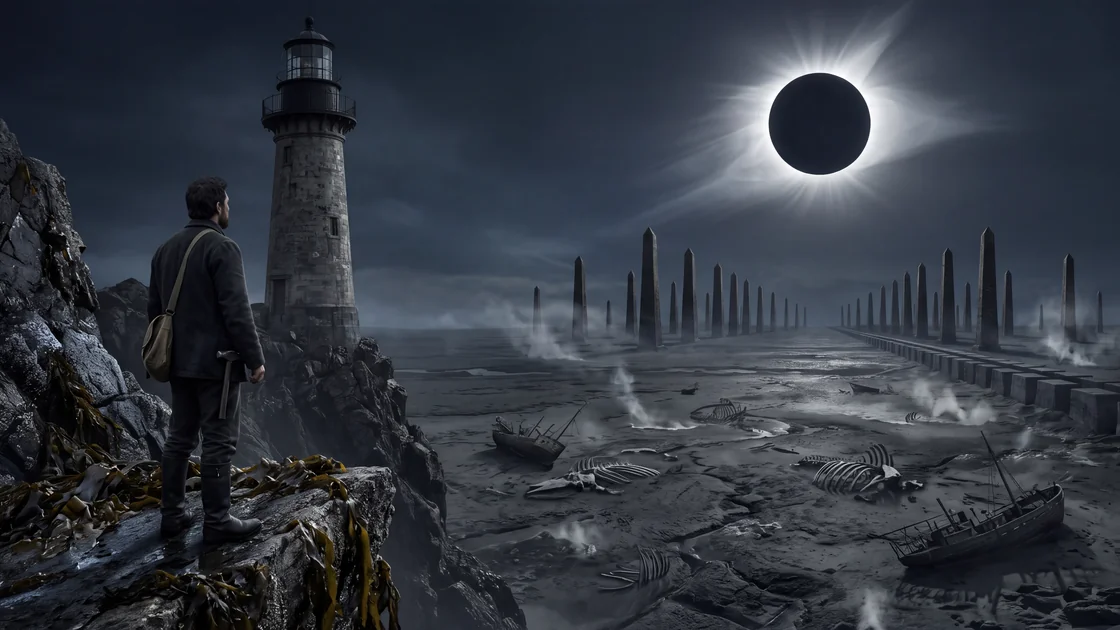
This is the account of Julian Vane, sole keeper of the Desolation Shoal Light, who witnessed the total solar eclipse of August 1888 not as a mere celestial alignment, but as the moment the Atlantic Ocean completely retreated into the mantle of the earth, unearthing an impossible city of pre-human sepulchers across thousands of square miles of bare seabed, and the terrifying journey he made into the depths before the waters returned.
Act I: The Watch on the Tooth
The light was measured in brass, tallow, and revolutions.
At forty-three minutes past every hour, the clockwork cable within the hollow central shaft of the Desolation Shoal Lighthouse reached the limit of its descent, and Julian Vane was required to wind it back up. It was a chore of twenty-eight turns on an iron winch that smelled of rancid suet and cold iron. If he paused at the fourteenth turn, the counterweights would sway inside their masonry tunnel, tapping like a blind man’s cane against the granite blocks of the tower’s spine, a dull, reverberating thump-thump that traveled up through the sole of his boots and lodged itself behind his molars.
Desolation Shoal was not an island; it was a fang. At mean high water, the granite platform upon which the foundation stones were keyed measured exactly seventy paces from east to west and twenty-two from north to south. At low water, it grew only slightly, offering a slick apron of bladderwrack, black mussels, and tide-pools the color of clouded glass. Beyond that apron, the continental shelf fell away into bathymetric drops that the Admiralty charts marked with humiliating brevity: unfathomed, foul ground, deep soundings.
The light itself was a second-order biform Fresnel lens, twelve feet of banded flint glass that hovered in a bath of two hundred pounds of liquid mercury like a diamond spinning on a film of grease. Julian kept it immaculate. In the pocket of his serge jacket he carried three squares of chamois leather, each washed in rainwater and dried upon the interior railing where the salt could not stiffen the nap.
Outside, the Atlantic was never silent. Even in August, when the dorymen out of Port Leven spoke of "the glass," the water against the Tooth was an engine: a rhythmic, bronchial heave that sucked at the barnacled undercuts, rose into white lace along the reef’s lip, and dropped away with a sound like gravel being shoveled down a chute.
On the nineteenth of August, 1888, the barometer did not fall, which was the first obscenity.
Julian sat at the log-desk in the watchroom, beneath the steady ticking of the escapement mechanism. He dipped his steel nib into the stoneware inkwell and recorded the noon observation:
19 August 1888. Wind SSE, force 1. Sky clear, high cirrus. Barometer 30.12, unmoving. Oil consumed: three gallons, one pint. Wick trimmed twice. Sea: long swell from the southwest, period fourteen seconds. Eclipse expected tomorrow at 1:15 post-meridiem per the Nautical Almanac. Note: The birds have not returned to the roosts on the lower shelf.
He laid the pen across the groove in the brass inkstand and walked out onto the gallery. The air had taken on an iron taste, like the water from a pump that had drawn from the bottom of an old cistern.
Southward, where the horizon ought to have been a clean, ruled line of indigo against the pale wash of the summer sky, there was a thickness—not a fog-bank, for it had no fleece or tumble to its edges, but a gray, leaden consolidation of the atmosphere. Beneath it, the swell had stopped breaking.
Julian leaned over the cast-iron railing. The paint was peeling in long, blistered scrolls despite his scraping; the salt was inside the metal now, swelling it from within like a bone disease. Down upon the apron, sixty feet below, the bladderwrack was not floating. Usually, the great rubbery fronds of kelp swayed like horses’ manes in the surge, undulating with an idle, mechanical grace. Now they lay flat upon the stone, glistening like grease, while the water withdrew.
It was not a tide. The tide at the Shoal was eight feet from springs to neaps; it followed the moon with the heavy, predictable stupidity of cattle.
This water was sliding. It was moving outward toward the leaden horizon with an even, oily speed, not breaking into surf, not foaming, but drawing down like bathwater leaving an iron tub. Barnacles that had not seen the sun since the great gale of 1874 emerged dry, their grey shells snapping open with tiny, collective clicks that sounded, through sixty feet of dead air, like dry leaves burning in a garden.
Julian reached into his pocket, took out his brass pocket watch, and clicked the case open. It was half past one in the afternoon. The eclipse was twenty-four hours away.
"The moon has no business with this," he said to the empty iron ring of the gallery. His voice sounded thin, stripped of timbre by the immense blue dome above him.
He went down the spiral stairs, his boots clattering on the perforated cast-iron treads. Past the oil room, where the five-hundred-gallon drums of lard oil stood in rowed silence; past the bedroom, with its narrow iron cot and horsehair bolster; past the kitchen, where a pot of salt pork had gone cold in its grease; down to the cellar-level, where the heavy oak door opened onto the landing platform.
He unbolted the door. The air that struck him did not smell of the sea. It smelled of wet limestone, of ancient river mud, of things that had died under immense pressures and had spent ten thousand years being pressed into petroleum. It was cold—not the refreshing chill of an ocean breeze, but the vault-chill that rolls out of an unventilated cellar when the trapdoor is lifted after a winter of rot.
The sea was gone from the lower landing.
The high-water ring—a dark belt of dried lichen and acorn barnacles—hung four feet above the current level of the water. Even as he watched, an iron mooring ring, bolted into the granite by the builders thirty years prior and submerged since the day the sheer-legs were struck, rose into the air. Water ran off its rusted eye in three thin, parallel braids, then stopped.
The ocean was dropping six inches a minute.
Julian did not go back up to the light immediately. He stood on the bottom-most step of the bronze ladder, holding the salt-pitted handrail, and watched the shelf beneath the reef expose itself. It was an anatomy lesson. He saw the great buttresses of the submarine plateau, usually hinted at only by the white boils of overfalls; they were green-black, draped in forests of oarweed that immediately began to droop, their broad blades collapsing under their own weight, unable to support themselves without the brine. Crabs scuttled frantically in the exposed gutters, their claws clicking against the stone as they pursued the receding life, but they were too slow. The water was outrunning them.
By five o’clock, the horizon had altered.
There was no longer an ocean to the south and west. There was a vast, gray plain of slime, broken here and there by the shining spines of drowned ridges that no man had ever seen from the deck of a ship. The water had retreated past the five-fathom line, past the twenty-fathom shelf; it had rolled back toward the great abyssal trench like a carpet being dragged from a room by an invisible hand.
Julian climbed to the lantern. The sun was going down, but it did not set into the water. It sank into a vast, steaming desert of black ooze that stretched away beyond the curvature of the earth. From that expanse rose a sound that filled the lantern room and made the mercury in the iron trough tremble in concentric rings: not the roar of breakers, but a long, whistling, continental sigh, the voice of millions of square miles of wet silt giving up its moisture to the empty sky.
He did not light the lamp that night. To light the lamp would have been an obscenity, a joke played by a madman on an ocean that had ceased to exist.
Act II: The Great Siphon
He slept none. He sat in the lantern room with the curtains drawn back, his elbows on his knees, watching the dark where the world should have been wet.
In the night, the smells changed. The brine rot passed, replaced by something dryer, older, and vastly more terrible: the smell of cold coal, of sulfur pits, of basalt that had cooled under the weight of three vertical miles of salt water and now, suddenly relieved of that crushing envelope, was exhaling gases that had been trapped since the crust was red.
Around three in the morning, Julian heard the bells.
They were not ship’s bells. Ship’s bells had a bright, thin brassiness that carried over the crests of swells, sharp and urgent. These sounds were enormous, deadened, as if cast of lead or pewter, vibrating with a frequency so deep that he felt them in the hinges of his jaw rather than his ears. They came from thirty miles out—out where the Admiralty charts showed only the white space of the great abyssal plain, two thousand fathoms deep.
Clung.
Then a silence that lasted twenty minutes, filled only by the hiss of distant gas-vents blowing through the silt.
Clung.
He took up his telescope—a three-draw brass Dollond that had belonged to his father, who had been master of a brigantine out of Bristol—and laid it across the sill of the southern storm-pane. The moon was a sliver, a dead white shaving three days before the dark, but the stars were brilliant with a cold, desert fury. The atmosphere, stripped of the ocean’s vast exhalations of vapor, was dry and hard as diamond.
Through the glass, the sea-floor looked like the skin of a flayed beast.
He saw steam rising in white plumes from fissures that ran straight as Roman roads across the mud. He saw the ribbed carcasses of whales—hundreds of them, lying in drifts like sheep in a blizzard—some fresh and glistening, their gray hides glistening in the starlight, others reduced already to gray hoops of ribbing through which the night wind whistled.
And then, just before dawn, twenty miles out along the edge of what should have been the continental drop, the glass caught something that was neither whale nor basalt.
It was an angle.
Nature does not build in ninety-degree corners at the scale of hills. Yet there, through the trembling column of cold air, Julian saw three great terraces of black stone rising from the mud. They were stepped like the foundations of a warehouse, each step fifty feet high, their surfaces encrusted not with sea-growth, but with a thick, vitrified glaze that threw back the light of the rising morning like obsidian.
The sun came up not out of the sea, but out of a crack in the gray clay at the edge of the world. It was red, flat, and dry.
Julian went down to the kitchen. His hands were steady, which surprised him. A man who has spent fourteen years alone with a turning light develops a mechanical relationship with his own nerves; panic is an indulgence that requires company. He made coffee from his cistern—the water tasted flat, of slate and dead lime—and fried two pieces of hardtack in bacon fat.
He sat at the pine table and took out his private diary, not the official log with its printed columns for Wind, Force, Clouds, Oil.
20 August. The water is gone. There is no surf. There is no sound of waves on the rock. If the world has cracked below, the water has gone in. If the moon is pulling, she is pulling with a chain we cannot see. The eclipse is due at eleven minutes past one. The light is useless; there are no ships. If there were ships, they are currently lying on their beams in the mud twenty leagues out, or broken upon the ridges that were never named.
I am going down.
The idea had not come to him as a thought; it had come as an instruction, left in his head like an iron spike driven into a beam.
Why stay on the tower? The tower was an instrument designed to warn men away from an interface: the boundary where the air met the water and the stone waited to tear the wood. But there was no interface now. The world was all air and stone. The tower was nothing more than an absurd pillar of Scottish granite stuck upon a dry hill in the middle of a desert that no foot had trodden since the third day of Creation.
He went to the service room and gathered his gear with the methodical slowness of a diver preparing for a descent.
He took his heavy boots of oiled neat’s-leather, the ones he wore only when chipping ice from the lantern gallery in January. He took an ash-handled coal hammer from the bunker, two fathoms of hemp rope, a bull’s-eye lantern filled with sperm oil, a tin of matches wrapped in waxed silk, and his compass. In his haversack he placed three biscuits, a piece of salt beef, and an ebony-handled clasp-knife.
He looked once at the lens. The great prisms of French flint hung suspended in their brass cages, silent, blind, and cold. He did not cover them with the linen curtains. If the sun struck them, they would focus its rays into a white-hot pencil that would scorch the mahogany wainscoting on the landward side of the lantern room, but it did not matter. The world was burning down from a different wick.
He descended the stairs for the last time. The sound of his heels was flat and short; the masonry seemed to have lost its ring, as if the drying out of the rock beneath its foundations had deadened the stone’s capacity to carry vibration.
He stepped out onto the landing apron.
The smell hit him with the force of a wet sack across the mouth. It was the stench of twenty million years of rotting kelp, dead polyps, dogfish, skate, and the deep, ammoniac beds of worm-casts that had never before felt the heat of the air. The rocks were already dry on their upper faces, their coats of brown weed crisping into black bacon that crunched beneath his boots like charcoal.
He walked to the southern edge of the shelf—the place where, yesterday, sixty feet of water had foamed over the jagged teeth of the reef.
There was a ramp. It was formed of fallen boulders, the debris of centuries of Atlantic quarrying, tumbled together into a wild scree that led down into the basin.
Julian sat upon the edge of the granite ledge, swung his legs over into the void, and let himself drop down onto the first boulder. His boots found purchase on a crust of dead coralline algae, pink and brittle as bone-china.
He did not look back at the tower. He knew how it looked: a white finger pointing at a sun that was already beginning to look sickly in the bronze sky.
Act III: The Descent into the Pelagic Plain
The descent was three miles long before he reached the true floor.
The Tooth was not a solitary rock; it was the chimney of an immense mountain range that ran for eighty miles toward the southwest, an underwater spur of the old continent that had broken off when the rift opened. As Julian descended, the light took on an unnatural, brassy hue. The sky was no longer blue; it had turned the color of tarnished pewter, and around the edges of the sun there was a thin, shimmering halo like oil on vinegar.
The ground was treacherous beyond anything he had known on land. The mud had dried into a thin, deceptive crust, beneath which lay leagues of gray, sulfurous clay that sucked at his boots with the sound of wet lips. Every few yards he passed things that made him stop, his hand resting on the ash haft of his hammer.
Here lay an anchor. It was twelve feet from crown to ring, its iron swollen by two centuries of rust into something massive and club-like, its stock rotted away to a black smear of charcoal in the silt. It had no ship near it; the ship had likely drifted miles before breaking, or had foundered elsewhere, leaving this tooth hooked into the mud.
Further down, at what he estimated to be eighty fathoms below the old surface, he came upon the wreck of a Dutch galliot.
She lay upright, her oak timbers remarkably preserved by the salt, though the ironwork had run down her ribs in long, weeping ulcers of orange rust. Her masts were gone, snapped off clean at the deck-partners by the weight of some ancient storm, but her cargo hatch was open. Julian climbed up her slanting side, his nails digging into the green slime that still clung to her strakes, and looked down into the hold.
There was no gold there, no casks of wine. The hold was full of ballast stones—smooth river-cobbles from the Scheldt—and between the stones, nesting like serpents in an iron basket, were hundreds of immense sea-worms, three inches thick and five feet long, pale as tallow candles, their red gills pulsing faintly in the dead air as they suffocated under the weight of their own dry flesh.
He climbed down and walked on.
The heat was growing. It was an unnatural, geothermal heat that came from the ground itself, warming the soles of his boots until he could feel the pegs through the leather. The mud was cracking into vast hexagonal tiles, like the floor of an unbaked kiln, and from the cracks whistled steam that carried the smell of burnt hair and petroleum.
At noon, the sun was no longer a disc; it was a sickle.
The eclipse had begun. The shadow of the moon was eating into the lower right limb of the sun with a slow, mechanical precision that seemed borrowed from the clockwork of the lighthouse. The light did not dim as it did during an overcast sky; it withered. The colors of the sea-floor—the dead greens, the rust-reds, the tallow-whites—were drained of their blood, leaving only an ash-gray landscape over which the shadows fell long and double-edged.
Julian looked southward.
He was out on the plain now. The reef was a wall of black basalt five hundred feet high behind him, its face carved by the old waters into caves and buttresses that resembled the ruins of Gothic nave-work. Ahead of him, five miles across the baking clay, the structures he had seen through the telescope rose against the dying sky.
They were not ruins.
A ruin is a thing that has been defeated by time. The stone that rose from the bottom of the Atlantic was not defeated; it was resident. It looked as though it had been made specifically for the weight that had rested upon it, as if the two thousand fathoms of black water had been not an environment, but an architectural requirement—a ceiling that had kept the roofs from flying off into the void.
There were four great roads. They were three hundred yards wide, raised twenty feet above the silt on embankments of dressed, slate-colored megaliths that were joined without mortar, so closely fitted that even the dead barnacles had been unable to take root in the joints. The roads did not lead toward the land; they ran parallel to the continental edge, trending southwest toward the great mid-ocean rift.
Between the roads lay the city.
Julian walked up the ramp of the northern embankment. His breath came short and dry, each lungful tasting of bitter lime. The silence was now absolute. The wind had died with the sun; the steam-fissures had ceased their whistling as the crust cooled under the moon’s approach. The only sound was the crunch of his own boot-heels upon the stone road, a sharp, solitary tick-tick-tick that seemed to emphasize the vastness of the empty world around him.
The buildings were not houses. They had no doors that a man could recognize as such.
They were pylons—massive, three-sided obelisks of vitrified black stone that stood in rows like the cypress trees of an Italian cemetery, each one sixty or eighty feet high, their surfaces carved with an intricate, microscopic relief that was not sculpture, but something closer to the teeth of a gear or the wiring of an engine. At the base of each pylon was an aperture: a low, arched opening three feet wide and eight feet tall, leading down into the core of the embankment.
Julian knelt before one of these arches. He lit his bull’s-eye lantern. The yellow flame of the sperm oil looked sickly and thin in the dying afternoon light, a little cone of greasy orange that trembled with the vibration of his hand.
He thrust the lantern into the opening.
The interior was not filled with silt. The builders had sealed it with something—a transparent, resinous gum that filled the arch like a pane of thick glass, six inches back from the stone face. Behind that gum, preserved in a liquid that was clearer than rainwater, lay the occupant.
It was not human.
It was not fish.
It had the long, segmented symmetry of a deep-sea isopod, but it was seven feet in length, carved of pale, nacreous chitin that threw back the light of the bull’s-eye in rainbows of peacock green and oil-slick purple. Its limbs—if limbs they were—were folded across its thorax like the blades of a pocket-knife, sixty or seventy jointed segments tipped with hooks like hawthorn thorns.
Its head was turned downward toward its breast, but upon the crown of its carapace, three dead, faceted eyes, each the size of a saucer, stared through the resin with the dull, crystalline opacity of quartz.
Julian touched the gum. It was cold—colder than the granite of the lighthouse in February—and hard as diamond. There was no rot here. There was no death, in the sense that the sheep-carcasses on the hills of Cornwall were dead. There was only an infinite, suspended waiting, an architecture that had been constructed to sit beneath the weight of an ocean until the ocean was removed.
He stood up. The silence was ringing in his ears now, a high, singing note like the vibration of a wet finger around the rim of a crystal goblet.
He looked up at the sun.
Totality had arrived.
Act IV: The Corona Over the Sepulchers
The sky did not turn to night; it turned to something that had no name in the languages of men who live under the sun. It was an indigo so deep that it appeared white at the edges, a violet vacuum through which the stars did not twinkle, but burned as hard, unmoving needles of frost.
In the center of this void hung the moon: not a disc, but a black hole cut into the fabric of heaven, surrounded by the silver ghost of the corona. The corona was immense, stretching four solar diameters into the dark, its streamers twisting like the tentacles of a medusa, pale, cold, and luminous as phosphorous on stagnant water.
And under that light, the necropolis woke.
It did not wake with movement. Nothing moved. There was no crawling of chitin, no breaking of resin seals.
It woke with sound.
From every pylon, from the miles of stepped embankments that stretched away toward the southern abyss, there rose a vibration that entered Julian’s skeleton through the soles of his boots. It was the same leaden bell-sound he had heard from the lantern room, but now it was multiplied by ten thousand instruments.
Clung.
The air above the pylons began to shimmer. It was not heat-shimmer; it was an optical refraction caused by the immense release of some gas or force that was pouring from the apex of each stone needle. The streamers of the solar corona seemed to reach down from the black sun to meet these plumes of earth-light; they bent toward one another across ninety-three million miles of vacuum, like two fingers of electric fire seeking a spark-gap.
Julian walked. He could not stop. He was a speck of tallow on an iron plate; he had no will beyond the simple, rhythmic placement of one foot before the other along the central road.
The road was leading him down.
The four embankments converged three miles out from the lighthouse shelf, at the lip of the true trench—the place where the continental crust snapped clean and dropped into the Puerto Rico Deep.
Here stood the Great Pylon.
It was not sixty feet high. It was a mountain. It rose from the floor of the trench—which Julian could see now, falling away into an abyss of purplish-gray vapor two miles deep—and its summit reached the level of the old sea surface. It was a triangular tower of cyclopean masonry, five hundred yards on a side at the water-line, its stones not vitrified, but formed of some metallic alloy that had the dull, greenish-yellow sheen of electrum.
Upon its faces, the relief work was five feet deep. It did not show organisms; it showed tides.
Carved into the metal were vast, undulating ribbons that represented the circulation of the world’s oceans: the Gulf Stream, the Labrador Current, the great circular gyres of the South Atlantic, the cold creeping of the Antarctic bottom-water through the trenches. But they were not mapped as men map them, with lines and arrows; they were drawn as veins. The ocean was depicted not as a body of water resting upon a stone sphere, but as a biological system—a fluid engine that was pumped through these stone sluices to cool the burning brain of the mantle beneath.
The water had not been drained by an earthquake.
The water had been called down.
Julian knelt at the edge of the road, where the electrum flags met the gray mud of the trench-lip. He looked down into the gulf.
Miles below, in the dark where the sun’s corona could not reach, he saw lights.
They were not the lights of lanterns or gas-lamps. They were the cold, rhythmic flashes of deep-sea pelagic life, but organized, disciplined, moving in vast geometric files like the lanterns of an army on the march. They were rising. From the abyssal rifts, where the water had retreated into the vast subterranean sponges of the lithosphere, something was coming up through the empty halls of the necropolis.
He heard the water.
It was not a wave yet. It was the sound of a lung filling.
Somewhere five hundred leagues to the south, beyond the curve of the scorched earth, the siphon had reversed. The planet could not hold its breath for long; the eclipse was an alignment, a key turned in a lock that was weighted by millions of tons of stone, and the key was already beginning to slip.
Julian looked down at his compass.
The needle was not pointing north. It was spinning—not frantically, but with an even, dignified velocity of one revolution per second, its brass heart confused by the enormous electrical currents that were rising through the electrum pylon from the roots of the world.
He looked at his watch.
The totality had lasted five minutes. It was beginning to end.
Act V: The Diamond Ring
On the western rim of the black moon, a single point of light appeared.
It was not the soft yellow of morning; it was an electric needle of unbearable brilliance that pierced Julian’s eye like a needle of steel. The corona vanished instantly, swallowed by that single grain of returned sun. The stars blinked out. The sky became gray again—the dirty, bronze gray of an iron foundry floor.
With the light came the wind.
It was not a wind that blew across the surface; it was a downdraft, an atmospheric piston that struck the seabed from above as the air, cooled by the eclipse, collapsed into the low-pressure basin left by the water. Julian was thrown to his hands and knees on the electrum road. His bull’s-eye lantern was torn from his belt and went skittering away across the flags, its tin door flying open, its little pool of sperm oil catching fire for three seconds before being snuffed out by the rush of gravel.
Then, from the south, came the sound.
It was not a roar. A roar is an animal thing; it has peaks and hollows. This was a weight. It was the sound of three hundred quadrillion cubic feet of salt water being discharged through a granite throat at two hundred miles an hour.
The ocean was returning.
Julian stood up. His knees were bleeding through his serge trousers; the skin of his palms was embedded with the black vitrified grit of the necropolis road. He turned his back on the Great Pylon, his back on the abyss, his back on the pale, jointed things sleeping in their amber cells beneath the roads.
He ran.
A man cannot run in a sea-bed. The mud has the consistency of cold axle-grease; even on the stone causeway, the silt blown by the wind formed a slick, treacherous paste that made his boots slide six inches with every stride.
Behind him, thirty miles away, the horizon had become a wall.
It was not white. It had no crest. It was a vertical mountain of blue-black brine, three hundred feet high, traveling across the flat plain with the speed of an express locomotive. Above it hung a cloud of spray that was not mist, but pulverized water, screaming like steam from an exploded locomotive boiler.
The pylons were singing their death-song.
As the edge of the returning tide reached the outer works of the necropolis, the water did not simply knock them down. The water entered them. The low arches, the triangular chimneys, the microscopic relief-work—they were all whistles. The ocean was playing upon the city like an organ of ten thousand pipes, a screaming, discordant blast of hydrostatic fury that rattled the teeth in Julian’s jaw until his vision doubled.
He saw the Dutch galliot go.
She was two miles ahead of the wave. The air displaced by the water struck her first—a solid wall of compressed wind that lifted her oak hull bodily from the mud, turned her twice in the air like a dry leaf, and smashed her against the basalt cliff of the Shoal shelf in an explosion of black splinters.
Julian reached the base of the scree.
His lungs were burning. Every breath tasted of blood and wet salt. He dropped his ash hammer; he dropped his haversack; he dropped his father’s Dollond glass. The brass tube struck a boulder and split, its three lenses rolling out into the dead bladderwrack like sea-glass.
He began to climb.
He did not use the path he had found that morning. There was no time for selection. He climbed like an ape, with his fingers and his toes, hooking his nails into barnacle-shells that tore through his skin to the bone, wedging his knees into vertical cracks in the basalt, hauling his dead weight upward through the freezing, salt-soaked gale that preceded the wave.
At eighty feet above the floor, he looked back.
The Great Pylon was gone.
It had not fallen; it had been swallowed. The electrum summit had thrown up a plume of white spray eight hundred feet into the air as the first wall of water struck it, and then the Atlantic had closed over its head like a fist. The causeways were gone. The pylon cemeteries were gone. The mud-plain, with its whale-skeletons and its steam-vents, was being smoothed away beneath a rolling carpet of green-black fury that erased an empire every three seconds.
He reached the one-hundred-foot mark—the old low-water apron.
The water was at his heels.
It was not a rising pool; it was a vertical lift. The sea was not filling the basin; it was being rammed back into its socket. The pressure of the returning tide against the cliffs of the Desolation Tooth created an updraft of spray that lifted Julian bodily off his feet and threw him twenty feet up the granite face, his shoulder striking the iron landing-stage with a sound like a butchered side of beef hitting a block.
He caught the lowest iron rung of the lighthouse ladder with his left hand.
The sea struck.
It was not water. It had the density of liquid iron. It caught his legs, his waist, his chest; it dragged him horizontal, his boots flying out into the foam like ribbons on a lance. The weight of it pressed his face against the granite blocks until his nose broke, the warm blood washing into his mouth and eyes along with the bitter, ice-cold brine of the deep soundings.
He did not pray. A man who has seen what lies under the sea does not pray to anything that can hear a man’s voice.
He simply closed his teeth on his lower lip and held the iron.
The metal groaned. The bronze bolts that had held the ladder to the granite since 1858 stretched, their lead seatings popping from the masonry with sharp, underwater pings that he felt through his ribs. One rung pulled out; his left hand slipped; he caught the next with the hook of his elbow, his fingers clawing into the joint between two granite blocks where the cement had washed away.
The wave crested.
It rose sixty feet above the foundation—clear to the kitchen floor—before its momentum died against the sheer, rounded wedge of the tower’s profile. For one second, two seconds, three seconds, Julian was suspended in total green darkness, two fathoms deep in the crest of a surge that had traveled from the coast of Guinea to reach this rock.
Then the water fell.
It fell with a tearing, catastrophic suck that nearly pulled his arm from its socket. Millions of tons of foam drained off the ledge in a roaring cataract, dragging with it everything that had been loose upon the apron: the coal-heaps, the spare dory, the iron oil-drums from the lower store, the broken fragments of the Dutch galliot.
Julian dropped onto the slippery platform.
He did not stand. He could not stand. His left arm hung three inches longer than his right, the shoulder-joint dislocated and gray beneath the shredded wool of his sleeve. He crawled on his belly, like the pale things in the amber cells, dragging his broken legs across the slime of the landing stage toward the tower door.
He reached the threshold.
The oak door had been stove in by the wave; it lay in three pieces across the entrance to the oil-room, wedged among the overturned lard-tanks. Julian pulled himself inside, over the splintered sill, and lay upon his face in three inches of greasy water that sloshed with the slow, rhythmic rocking of the whole tower.
The tower was shaking.
The Atlantic was back in its bed, but it was not the Atlantic of yesterday. It was an ocean that had been disturbed in its sleep, an ocean that was now striking the Desolation Tooth with a disordered, psychotic fury, wave upon wave tumbling in twelve directions at once, white water boiling clear over the lantern sixty feet above.
Outside, in the dark, the bell-sound did not return.
The water had deadened it. The ocean was once more in place—two vertical miles of salt, foam, and pressure, holding down the lids of the tombs.
Act VI: The Log of the Shoal
Julian Vane lived thirty-one years after the eclipse of August 1888.
He did not remain in the service of the Northern Lighthouse Board. When the tender Phalarope arrived five days late, her master found the Desolation Shoal light extinguished, the second-order Fresnel lens shattered by the vibration of the tower’s masonry, and the keeper sitting on the kitchen floor with his back against the cold coal-stove, his left shoulder set crooked by his own hand, his serge jacket encrusted with a white, crystalline salt that the surgeon at Port Leven could not identify as the product of common sea-brine.
He had not entered anything in the official log for the twentieth of August.
He had, however, written three lines upon the whitewashed plaster wall behind the kitchen stove, using a piece of charred kindling:
The water is not ours. It was put there to keep them cold. Pray that the moon does not come back.
They took him to the asylum at Morningside, outside Edinburgh, not because he was violent, but because he refused to touch water that had not been boiled three times and cooled in a sealed copper vessel. He would not bathe; he would not walk upon grass that was wet with dew; and whenever the sky took on that particular brassy hue that precedes a summer thunderstorm, he would get down upon his hands and knees and press his ear against the floor-timbers, listening for the bells.
He spoke only once of what he had seen on the road.
It was in the winter of 1904, to a young assistant physician named MacNair, who had taken an interest in the "Lighthouse Madman." MacNair had brought him a copy of an Admiralty chart showing the newly surveyed soundings around the Desolation Tooth—soundings that had been taken with the new Kelvin wire machines, which could reach four thousand fathoms without the drift of hemp lines.
Julian looked at the chart. He did not look at the numbers. He looked at the white spaces between the soundings—the blank, blue-gray fields where no wire had touched the stone.
"You think it is flat down there, doctor?" he whispered. His voice was like two slates being rubbed together in an empty yard. "You think it is mud and dead cods?"
"It is mostly globigerina ooze, Julian," the young man said kindly. "Shells of little things that have died and fallen like snow for a million years."
Julian laughed. It was a short, wet sound that ended in a cough.
"The snow doesn't cover them," he said. He reached out with his crooked left hand—the fingers stiff and claw-like, their tips scarred with white bands where the barnacles had taken his meat—and tapped the center of the chart, thirty miles south of the Shoal.
"The snow doesn't cover them because they don't stay down there for the snow. They built the road before the water was there, doctor. They were there when the moon was an iron stone that didn't move. And when the water went down, they weren't dead."
He leaned forward, his eyes—which had grown milky and blind from staring into the French prisms—fixing MacNair with the terrible, dead focus of a deep-sea thing brought to the surface.
"The water isn't an ocean, boy," he hissed. "It's a bandage. It's a wet rag thrown over a face that isn't cold yet. And every hundred years, the moon takes the rag by the corner and pulls."
He died the following spring, during the partial eclipse of March 1905.
They found him on the floor of his room, his serge shirt pulled open, his ear pressed so hard against the yellow deal planks that the grain of the wood had left deep red grooves in his cheek. His mouth was open, full of the gray dust that collects beneath the skirtings of old institutions, and his fingers were hooked into the seam between two floorboards, as if he were trying to hold himself down against a tide that only he could feel, rising through the stone foundations of the world to take him back.