The Origami of Stone and String
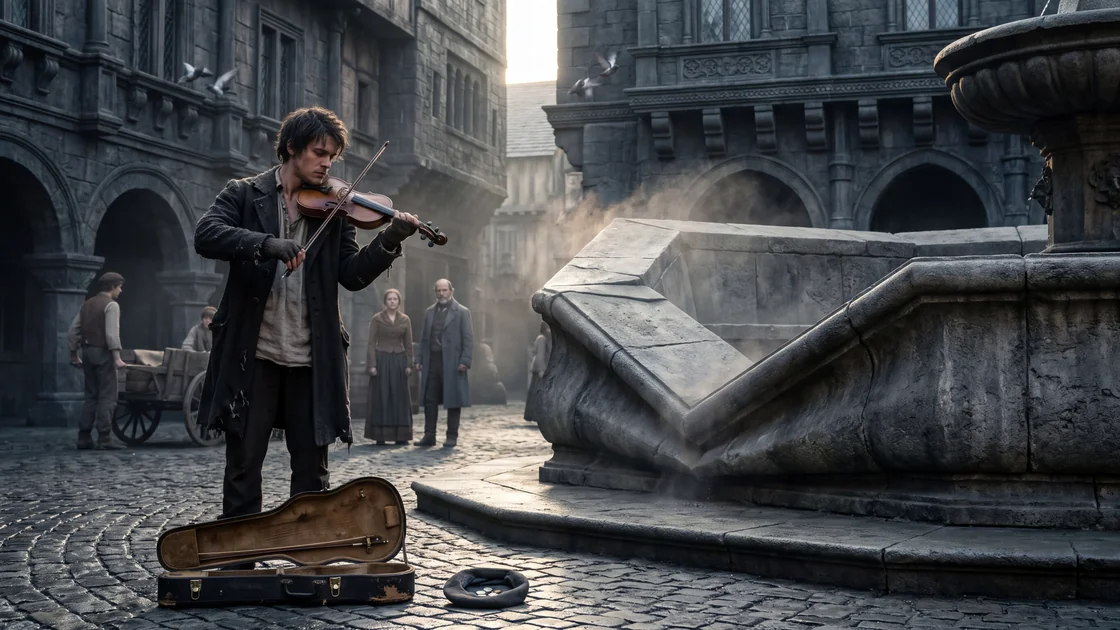
This is the tale of Caelen Voss, an itinerant street musician in the ancient city of Oakhaven, whose scarred spruce violin possessed the singular, terrifying power to soften monumental granite and limestone into the pliancy of fine mulberry paper, folding cathedrals, tenements, and plazas into shifting origami geometries with every stroke of his bow; a gift that transformed his desperate busking into a struggle against the city's rigid Guild of Static Form, culminating in an evening where the entire architectural landscape surrendered its weight to melody, fundamentally altering the boundary between sound and substance.
Chapter I: The Resonance in the Cobbles
The morning light in Oakhaven did not arrive so much as it was begrudgingly admitted by the stone.
The city was an empire of masonry, built from dark river-granite, gray basalt, and a pale, chalky limestone quarried from the southern ridges five centuries before. In the Plaza of the Three Weavers, where Caelen Voss chose his pitch each dawn, the buildings did not simply border the open square; they loomed over it like petrified titans, their cornices jutting like severe brows, their windows narrow and suspicious. Between them, centuries of mortar had hardened into something resembling bone. It was an environment of absolute weight. Everything in Oakhaven was designed to insist upon its own permanence. The city fathers, long interred in the vaults of the nearby Basilica of St. Jude-in-the-Fens, had believed that virtue was a function of density. To be righteous was to be immovable; to be holy was to be heavy.
Caelen, by contrast, owned nothing that weighed more than four pounds.
He knelt upon the dew-slick cobblestones near the dry basin of the plaza’s central fountain, unbuckling the worn leather straps of his instrument case. The case was pine, covered in cracked oilcloth, its brass latches tarnished green. Inside lay his violin—an unlabelled instrument with an uneven, honey-colored varnish that had pooled thickly in the C-bouts and worn away entirely where his jaw rested against the upper bout. It was not a masterwork by any metric taught in the conservatories across the river. The purfling was crude, inlaid with strips of bog-oak that did not quite meet at the corners, and the spruce of the belly had a grain that wandered slightly, as though the tree had grown on a windswept cliff and never quite decided which way was vertical.
Yet when Caelen touched the fingerboard, his fingers did not feel wood; they felt an engine.
Around him, the plaza was beginning its slow, mechanical waking. Apprentices in gray canvas aprons hauled iron-banded casks from the cellars of the bakers along the northern arcade. Pigeons, their feathers dusty with lime from the masonry yards, fluttered from the eaves of the Guild of Scriveners, their wingbeats clapping hollowly against the vertical surfaces. A cart loaded with turnips squeaked on an ungreased axle, the iron rim of its wheel striking a cobble with a sharp, dry tink.
Caelen lifted the violin, tucked it beneath his collarbone, and took a breath of cold air smelling of river-silt and woodsmoke.
He did not immediately play a tune. Instead, he drew his bow across the open D-string—a single, long, meditative stroke. The string was gut, wound with silver, and the sound it produced was round and dark, vibrating with a rich, chesty purr.
Most people in the square ignored it. A street musician was an unremarkable nuisance, no more significant than a stray dog scratching at a barrel. But two feet beneath Caelen’s boots, the earth did something strange.
The cobblestones immediately surrounding him did not crack, nor did they rumble. Rather, they gave off a faint, dry sigh, like the sound of a heavy ledger being opened for the first time in autumn. A thin veil of powdery dust—generations of pulverized silica and street grit—jumped a millimeter into the air, dancing in the morning light like silver sparks, and then settled.
Caelen closed his eyes and shifted his fingers into a minor third, dragging the bow toward the tip with an intentional, dragging pressure that coaxed out a low, singing overtone.
Ten paces away, the stone rim of the dry fountain began to soften.
It was not a thermal softening; there was no heat, no smoke, no scent of molten rock. It was a categorical loosening of the crystalline lattice. To the casual eye, the curb of the basin merely appeared to ripple, as though seen through the rising heat above a furnace. But then, as Caelen sustained the note, leaning his weight onto the front of his left foot, the granite curb lifted cleanly along an invisible diagonal crease.
A triangular section of the heavy, four-inch-thick stone slab folded upward at a precise forty-five-degree angle. It moved with the effortless, papery rustle of a turning page. The rough, pitted exterior face met the smooth interior lining with a dry, papery snick, forming a neat, pointed flap that stood upright, rigid once more the instant the bow changed direction.
Caelen stopped playing. He was breathing quickly, his pulse thumping in his throat.
He looked around. The apprentice hauling turnips was cursing at his donkey, oblivious. The scriveners were still scraping their pens behind high mullioned windows. Only an old chestnut-roaster, setting up his charcoal brazier against the wall of the southern arcade, had frozen mid-motion, his wooden paddle poised above the iron grate. The old man rubbed his eyes, peered at the fountain, and then looked down at his charcoal, evidently concluding that his morning ration of small-beer had been stronger than intended.
Caelen allowed himself a thin, bitter smile.
"Mountain fold," he whispered to the morning air. "D-flat in the lower register. Just as he said."
The "he" was Master Lucian, who had died two winters ago in a freezing garret three alleys behind the fish market, his fingers curled into stiff claws, his chest rattling with the stone-cutter’s rot. Lucian had not been a mason, nor had he been an architect, though he understood the load-bearing limits of every arch between the river and the northern gate. He had been an archivist of discarded things, a man who believed that the entire world had once been soft, and that stone was merely music that had grown cold and tired of dancing.
“The world is not set in its ways, Caelen,” the old man had wheezed, spit bubbling at the corner of his cracked lips. “The world is simply deaf. The stone remembers the voice that shaped it, but it has forgotten how to listen to anything shorter than an epoch. You must speak its dialect. Not the language of birds or lovers, but the language of weight, angle, and crease. You must play the score of the fold.”
Caelen wiped a fleck of white dust from the belly of his violin. He looked up at the facade of the Scriveners’ Hall—a four-story pile of gray ashlar blocks, thirty yards wide, with sixteen identical windows, an ornate cornice depicting allegorical figures of Prudence and Thrift, and two massive stone corbels carved into the shapes of curled rams' horns supporting the second-floor balcony.
The building looked as though it could endure the end of the world.
Caelen raised the bow again. His fingers were stiff with cold, but beneath his skin, the blood was running hot, prickly with an intoxicating, illicit current.
Chapter II: The Geometry of the Crease
By noon, the Plaza of the Three Weavers was crowded with the midday commerce of the lower wards. Clerks in ink-stained cuffs drifted out from the registry offices to buy meat pies from vendors whose carts were parked along the perimeter. Fishmongers’ wives carried shallow baskets of river-trout on their heads, their cries sharp and flat against the hard surfaces of the square.
Caelen stood where he had stood since morning, his empty cap lying upside down on the stones before him. A few copper coins—pennies minted from dull lead-alloy—lay in the lining, cast by charitable souls who found his simple folk-airs pleasant enough to accompany their luncheon.
He was playing the Ballad of the Miller’s Daughter, a banal, cyclical melody that every child in Oakhaven knew by heart. It was safe. It kept the city guards, who patrolled the arcades in pairs with their short truncheons and iron gorgets, from looking at him too closely. But beneath the simple, three-four strumming of the accompaniment, Caelen’s little finger was doing delicate, forbidden work on the E-string.
He was ornamenting the tune with microtonal mordents—faint, needle-sharp chromatic slides that never fully declared themselves to the human ear.
To the ears of the square, however, the ornaments were not music; they were instructions.
Directly across from him stood a small, neglected clockmaker's shop wedged between two larger merchant warehouses. The building was narrow, barely fifteen feet across, constructed of dry-laid yellow flagstones that had settled over the centuries until the lintel over the door sloped noticeably to the left. It was a tired building, hunched like an old man leaning against a garden wall.
Caelen shifted the key from G major into an ambiguous, modal Dorian. He introduced a pulsing, rhythmic stroke near the frog of the bow—a heavy, detached martelé that struck the D and A strings simultaneously.
Snap. Hum. Snap. Hum.
The flagstones around the clockmaker’s second-floor window began to yield.
They did not crack. There was no sound of stone tearing against stone, no shower of mortar. Instead, the mortar joints between the stones seemed to melt into the blocks themselves, transforming the facade from a patchwork of discrete rectangles into a single, continuous sheet of lithic hide. The stone lost its matte texture, taking on the faint, satiny sheen of heavy vellum.
Then came the crease.
An invisible finger, vast and exquisitely precise, pressed against the center of the facade between the two upper casements. The yellow stone gave way inward, creating a deep, recessed trough—a perfect valley fold. Concurrently, the two flanks of the upper wall swung outward like the wings of a triptych, meeting at a sharp, forty-five-degree ridge that projected six feet into the airspace above the street.
The change was soundless, save for a low, dry rustle like an autumn gust blowing through an oak grove.
A clerk who had been leaning against the corner of the shop, chewing a piece of salt pork, suddenly found his shoulder unsupported. He stumbled backward, flailing his arms, his lunch tumbling into the gutter. He landed hard on his buttocks, staring up at the wall.
Where there had been a flat, sagging wall of yellow flagstone, there was now a multifaceted, hexagonal projection, folded with the geometric precision of a scholar’s letter-seal. The window frames had adapted without shattering; the lead cames had bent cleanly along the line of the fold, turning the flat panes of green crown-glass into an angled bay that caught the midday sun and scattered it in a brilliant, prismatic fan across the cobblestones.
"Mercy," the clerk breathed, his greasy chin trembling. "Holy Mother of the Quarry, have mercy."
People stopped. A murmur, initially small and confused, spread out in rings through the crowd like ripples in stagnant water.
"Did that wall move?"
"It didn't move, you fool, it's always been an oriel window."
"It was flat as an iron skillet when I walked past it at tierce! I scraped my basket against it!"
"You're seeing spirits in the grease, Wat. The sun is in your eyes."
Caelen did not stop playing, but he smoothed the martelé into a gentle, singing legato. He played an arpeggio that rose through two octaves and ended on a high, crystalline harmonic.
With the harmonic, the folded stone set. The satiny sheen vanished from its surface, the crystalline lattice locked back into place, and the yellow limestone resumed its ancient, dry, impenetrable hardness. It was no longer paper. It was once again stone, heavy enough to crush a man, cold enough to hold the chill of winter deep into July. But it was stone shaped like a folded crane’s wing, cantilevered out over the cobbles without a single bracket, joist, or drop of mortar to explain its defiance of gravity.
The crowd gathered beneath it, tilting their heads back, their mouths agape.
Caelen lowered his violin. His left arm was trembling; the muscles in his forearm burned as though he had been holding up the building with his own tendons. That was the secret Lucian had never put into words: the stone did not fold for free. The energy had to pass through the wood, through the strings, and through the marrow of the player. Every angle creased into the masonry took a tithe of heat from his blood and strength from his joints.
He bent down, scooped up his cap with its handful of lead coins, and began to pack his instrument away.
"You there," a voice called out, sharp and metallic.
Caelen’s stomach dropped. He did not look up immediately; he methodically placed the violin into its velvet-lined cradle, rested the bow in its spinner, and latched the pine lid before turning toward the sound.
Pushing through the knot of bewildered citizens was an officer of the City Surveyors. Unlike the common watchmen, who wore rough woolen tunics and carried cudgels, this man was dressed in the severe, iron-gray coat of the Guild of Static Form. At his hip hung not a sword, but a brass plumb-bob and a pair of long-legged iron calipers that clacked against his thigh with every stride. On his breast was pinned the Guild’s badge: an anvil resting upon an unbroken square.
His name was Theron Bell, and he was known throughout the ward as the Hound of the Plinth.
Chapter III: The Hound of the Plinth
Bell stopped five paces from Caelen. He was a man composed entirely of vertical lines—tall, gaunt-faced, with skin the color of river-slate and graying hair cropped so close that his skull appeared carved from bone. His eyes did not look at Caelen’s face; they looked at his boots, then at the violin case, and finally up at the folded facade of the clockmaker’s shop.
"Who authorized the alteration?" Bell asked. His voice was low, measured, and stripped of inflection, like the grinding of millstones.
Caelen adjusted the shoulder strap of his case. "Alteration, sir?"
"The canted bay on parcel eighty-two," Bell said, gesturing with his brass calipers toward the yellow stone wing above them. "The master-roll of the ward lists this structure as a flat frontage with three openings of standard square-cut ashlar. It has stood in that configuration since the reign of King Aldous the Fourth. It has no permit for a projection. It possesses no corbeling recorded in the archives."
"I am merely a musician, sir," Caelen said, keeping his eyes on the cobblestones. "I play for bread. I don't know anything about masonry permits."
Bell stepped closer. He brought with him a dry, mineral smell—the scent of lime-pits, drafting ink, and vinegar used to clean vellum. He reached out with the iron tips of his calipers and tapped the side of Caelen’s wooden case.
The wood gave off a dull, hollow thud.
"There is dust on your coat, boy," Bell murmured. "Not road-dust. Not soot. Ashlar-flour. Dolomite grit. The very finest grade, produced only when the crystalline planes of old stone are sheared under impossible shear-loads."
Bell walked slowly around the musician, his boots clicking with terrifying regularity on the stones. He paused behind Caelen’s left shoulder.
"The Guild has received reports," the surveyor continued, his tone conversational, almost clinical. "From the South Gate: a guardhouse whose parapet turned inward like the collar of a leather jerkin during a heavy rain. From the Fish Market: a stone gutter that folded itself into a series of accordion pleats to carry away the offal, while an accordionist was performing for coppers across the street. The elders dismissed it as subsidence. They blamed bad mortar, wet sand, the shifting of the old alluvial deposits beneath the city."
Bell leaned in, his lips near Caelen’s ear.
"I did not blame subsidence. Because subsidence leaves rubble. Subsidence leaves cracked stone and fractured lintels. Subsidence does not leave a valley fold with a ninety-degree interior angle and zero loss of compressive strength along the hinge."
Caelen felt the hair on his arms stand up. "I don't know what those words mean, sir."
"You know," Bell whispered. "You know because your hands are shaped by it. Look at your left fingers."
Caelen did not move his hands, but he knew what Bell was looking at. The fingertips of his left hand were not simply calloused with the smooth, round pads of a common fiddler. The skin was hard, glassy, and marked by tiny, crisscrossing geometric impressions—the permanent scars left by strings that had vibrated with the resistance of fifty tons of metamorphic rock.
"The Guild of Static Form maintains the peace of this realm, Master Voss," Bell said, stepping back into Caelen’s field of vision. "Do you know why?"
"Because you build the walls?"
"Because we preserve the fixedness of things," Bell said, his voice hardening, gaining the weight of an edict. "If a wall can move, it is not a wall. If a house can change its shape at the whim of an air played on sheep-gut, it is not property. If property is fluid, the deed is meaningless. If the deed is meaningless, the tax cannot be levied. If the tax cannot be levied, the crown falls, the law dissolved, and the mob drowns the world in blood. The city is stone because stone does not negotiate. It does not compromise. It stays where it was placed until the stars go dark."
Bell pointed the sharp tip of his caliper directly at Caelen’s throat.
"I do not know how you found the old frequencies. Perhaps you crawled into the crypts beneath the High College; perhaps some lunatic master-mason whispered the harmonic keys to you before he hung himself. It does not matter. You will come with me to the Citadel of the Square. You will surrender that box. And our artisans will examine the mechanics of your fingers until we understand how to extinguish the resonance permanently."
Caelen looked past the iron calipers, past Bell’s cold gray eyes, to the perimeter of the plaza.
Three more men in the gray coats of the Guild were approaching, their heavy leather-gloved hands resting on their measuring rods—rods that Caelen knew were weighted with lead and capable of breaking a man’s collarbone with a single downward sweep.
Caelen had two choices. He could drop his case, submit to their irons, and spend the remainder of his life in a subterranean chamber having his tendons measured with brass gauges while scholars tried to extract a secret that wasn't an intellectual property, but a living, breathing song.
Or he could play.
He did not hesitate. With a motion born of ten years of running through the gutters of Oakhaven, he dropped his cap, brought his left hand up, and snapped the brass latches of the case with his thumb.
"Seize him!" Bell barked, his calm facade shattering into sudden, sharp urgency.
The violin was in Caelen’s hands before the lid had fully fallen back. He did not have time to tuck it under his chin; he held it against his ribcage like an archer holding a shortbow, drew the bow across all four strings at once in an open, jagged, discordant slash of sound, and screamed the fundamental resonance of the plaza into the stones beneath their feet.
Chapter IV: The Creasing of the Forum
The reaction was immediate, violent, and utterly devoid of debris.
The cobblestones beneath Theron Bell’s feet did not shatter; they liquefied their relationships with one another. The square, fifty yards across and paved with tens of thousands of hand-hewn porphyry setts, rose in a series of sweeping, concentric accordion folds.
It was like watching a vast tablecloth of stone being pinched up by a giant hand from beneath the earth.
The ground between Caelen and the surveyors buckled upward into a six-foot-high pleated ridge—a series of sharp, alternating mountain and valley folds that snapped into existence with a rhythmic, percussive whump-whump-whump that rattled the teeth in Caelen’s skull. Bell and his three subordinates were lifted off their feet, tumbling down the newly formed stone slopes as though they had been dumped onto the roof of a barn.
"Stop him!" Bell’s voice came from the other side of the ridge, muffled by the three feet of solid, folded porphyry that now stood between them. "Do not let him draw another stroke!"
Caelen was already running. But he could not run across flat ground anymore; his own music had transformed the flat, familiar floor of the plaza into a labyrinth of geometric terraces.
He scrambled up the face of a twenty-degree stone crease, his leather-soled boots slipping on the dusty inclines. He was playing as he moved. It was a ragged, breathless performance—short, stabbing bow-strokes on the G-string, heavy with vibrato, each note commanding the architecture around him to unfold, to parry, to bar the way.
To his right, the colonnade of the Guild of Scriveners heard the call.
The massive round columns, four feet thick and twenty feet high, carved from single cylinders of gray granite, were designed to carry thousands of tons of roof-slate. Under the influence of Caelen’s frantic, descending chromatic scale, their roundness flattened out. They became polygonal—first octagonal, then square, then thin as laths.
Then they folded.
The stone columns creased in their middles like the elbows of a dancing skeleton. The great entablature they supported did not fall; it was drawn downward and outward along the crease lines, descending gracefully like a theater curtain, forming a sloped, impenetrable rampart of solid granite that sealed off the entire northern arcade, cutting off the reinforcements that were pouring out of the Scriveners’ Hall.
“Caelen, don't force it!” Lucian’s old voice screamed in his memory, cutting through the panic and the roaring in his ears. “You cannot fight the stone with anger! Stone has no temper! It has only geometry! You must fold it along its natural grain, or it will fold you!”
The physical strain was monstrous. A knot of fiery agony seized the muscles between Caelen’s shoulder blades. His breath tasted of copper, and his vision was fringed with dark, pulsing vignettes. Every time he forced a five-ton block of limestone to bend along a forty-five-degree crease, his heart had to supply the thermodynamic differential. His core temperature was dropping; his hands were turning blue, the skin around his fingernails white and bloodless.
He reached the western edge of the plaza, where the narrow mouth of the Rue des Chanoines opened between two six-story tenements.
Behind him, Bell had clawed his way to the crest of the porphyry ridge. The surveyor was bleeding from a scrape on his temple, his gray coat torn at the shoulder, but his eyes were blazing with the fanatic fury of a man whose god of absolute order had been blasphemed. In his right hand he held an iron-tipped mason's crow, snatched from a tool-cart.
"Voss!" Bell screamed. "You cannot escape the city! The city is stone! The city is ours!"
Caelen paused at the alley mouth. He looked back at the plaza he had transformed.
It was no longer a civic space; it was a sculpture of frozen origami. The dry fountain had folded itself into an open, polygonal water-lily of pink granite. The cobbles were a sea of geometric dunes, pleated with mathematical perfection, every ridge straight and true as a draftsman’s rule. The people were cowering in the doorways, their eyes wide with a terror that was not born of violence, but of the absolute collapse of their assumptions about the physical world.
They were looking at the stone not as their master, but as something that could be folded up and put in an envelope.
Caelen raised the violin to his chin one last time before fleeing. He played a single, exquisite, ascending major seventh. It was a sweet, lingering note, full of a strange, melancholic grace.
High above Bell’s head, the stone cornices of the two tenement buildings at the mouth of the alley swung downward toward each other. They met in the center with the delicate, dry click of two playing cards being leaned against each other to form the roof of a house.
The alley was sealed. A vaulted arch of solid, creased stone, four inches thick and thirty feet long, sprang into existence between the roofs, plunging the passage behind Caelen into cool, gray shadow and leaving Bell and his surveyors hammering uselessly on the outside of a door that had no keyhole, no hinges, and no mortar to break.
Caelen turned and vanished into the darkness of the old city.
Chapter V: The Cartographer of Folds
The sanctuary Caelen found was not a house, for every house in Oakhaven was made of stone and therefore belonged to the Guild. It was an abandoned dry-dock along the old canals, where the barges that brought building materials from the southern quarries had once been repaired before the silting of the lower reaches.
The air here was damp, thick with the smell of rotted oak, stagnant water, and the pungent, chemical tang of wood-tar. Overhead, the ribs of an ancient coal-barge arched like the skeleton of a stranded leviathan, draped in frayed canvas that fluttered in the river wind.
Caelen lay on a pile of moldering hemp sacks, his violin clutched to his chest. His fingers were so swollen he could barely uncurl them. He was shivering violently, covered in three coats of coarse wool he had stolen from a washerwoman’s line, yet his skin felt as though it had been packed in salt and snow.
"You're freezing because you're leaking work," a voice said from the shadows near the dock-gate.
Caelen bolted upright, or tried to; his back seized, and he gasped, dropping back onto the sacks with a groan. His hand automatically scrambled for the neck of the violin.
"I wouldn't," the voice continued. "If you play another bar in this condition, your heart will simply stop. A four-stroke arpeggio through that limestone bulkhead this morning cost you at least three thousand calories of body heat. You look like a drowned rat."
A figure stepped through the gray light of the doorway.
It was a young woman, perhaps two or three years younger than Caelen, wearing a scholar’s dark blue smock belted with a broad strip of untanned leather. From the belt hung not calipers, but brass tubes containing rolls of paper, a pocket sextant, and a heavy pigskin notebook with blackened edges. Her fingers, unlike Caelen’s, were stained not with rosin, but with Indian ink and lamp-black.
"Who are you?" Caelen croaked, his throat parched.
"Sola," she said simply. "Apprentice cartographer, third class, to the High Registry of Oakhaven. Or at least I was, until noon today, when my master sent me to measure the changes in the Plaza of the Three Weavers and I realized that my maps were no longer worth the paper they were drawn on."
She walked over to an overturned wooden crate, cleared away some dried fish-scales with the side of her sleeve, and sat down. She pulled a tin flask from her smock and tossed it onto Caelen’s lap.
"Drink it. It's chicory wine and beef broth. Tastes like iron and bilge-water, but it will put sugar back into your blood before your kidneys fail."
Caelen eyed her with profound suspicion. "You're with the Guild."
"I am with the Registry," she corrected, tapping the side of her pigskin notebook. "The Registry records what is. The Guild of Static Form decides what must be. We have despised each other for three centuries. They think we are clerks who waste ink; we think they are blind brutes who build monuments to their own lack of imagination."
Caelen unstoppered the flask with his teeth and drank. The liquid was thick, salty, and hot with pepper, burning his throat as it went down, but almost instantly a knot of warmth began to uncoil in his frozen gut.
"Why are you here?" he asked, wiping his mouth with the back of a bruised hand.
Sola opened her notebook. She turned several pages covered in dense, minute handwriting and intricately shaded elevation drawings. She stopped at a page that showed a series of complex, interlaced lines—not architectural plans, but geometric crease-patterns, looking remarkably like the patterns used by paper-folders to construct decorative boxes or models of insects.
"I’ve been following the scars," she said softly. "The little things the Guild tried to bury. The water-trough on the Street of the Potters that folded itself into an octagonal basin during a midsummer fair six years ago. The lintel over the Blind Gate that developed an accordion crease during a funeral procession for an old fiddler named Lucian."
Caelen’s eyes widened. "You knew Lucian?"
"I never spoke to him," she replied, her eyes fixed on her drawings. "I didn't have to. The stone spoke for him. I am a cartographer, Voss. My job is to see the relationships between lines. For five hundred years, this city has been built on the principle of the arch and the beam—compression and tension, mass and resistance. It's clumsy. It's primitive. It requires millions of tons of dead weight just to keep the sky from falling in on our heads."
She leaned forward, her eyes bright with a feverish, intellectual intensity.
"But the old city wasn't built that way. The foundations beneath the cathedral—the pre-settlement layers, the ones the Guild calls the 'Folk-Stones'—they don't have mortar joints. They don't have keystone arches. They are made of single sheets of folded schist, pleated like cloth, three miles long and six inches thick, carrying the weight of the entire hill without a single crack."
She reached out and lightly, tentatively, tapped the scroll of Caelen’s violin.
"The builders didn't haul those stones with oxen and pulleys, did they?"
"No," Caelen whispered. "They sang them out of the river-bed. Master Lucian called it the Lithic Origami. He said the earth is a skin, and if you know the pitch of its pores, you can fold it like silk."
"The Guild knows," Sola said, her voice dropping into a lower register. "Or at least, the Grand Council does. That's why they want you dead. Not because you damaged the clockmaker's shop. Not because you made a fool out of Theron Bell in the plaza. But because if the common people find out that the stone can be folded by one boy with three feet of gut string and a pine box, the entire social order collapses."
"I don't care about their order," Caelen muttered, closing his eyes against the throbbing in his head. "I just wanted to buy bread without being kicked by their watchmen."
"It's too late for that," Sola said, closing her notebook with a sharp, leather clap. "Bell has declared an emergency of the First Order. They’ve brought up the Great Iron Clamps from the arsenal. They're surrounding the ward with static anchors—massive cast-iron braces bolted directly through the cobbles into the bedrock. They intend to pin the city down. To drive iron nails through the paper so it can never be folded again."
She stood up and walked to the edge of the dock, looking out across the gray, oily surface of the canal toward the silhouettes of the spires rising into the evening sky.
"And if they drive those clamps into the bedrock while the resonance is still humming in the lower strata," she added, turning back to him, "they won't stop the folding. They'll shatter it. The entire riverbank will slide into the water like a plate of broken crockery."
Chapter VI: The Mechanics of the Valley and the Peak
For three days, the city held its breath.
The Guild of Static Form had turned the lower wards into a military engineering camp. Every street leading into the Plaza of the Three Weavers was barricaded with iron-banded baulks of timber, weighted down with lead pigs and secured to the stone facades by massive wrought-iron brackets. Gangs of stone-masons, their skin gray with powdered lime, worked day and night by torchlight, driving five-inch iron spikes into the joints between the cobbles.
They were "pinning" the earth.
From the high rafters of the abandoned dry-dock, Caelen watched the smoke from their pitch-braziers rise into the November sky. His fingers had healed, though the skin over his knuckles remained tight and glossy, like the skin of a burn victim. Sola had kept him supplied with broth, dried beef, and grease-pots for his violin strings.
More importantly, she had given him a language.
Across the dirt floor of the dock, Sola had drawn a massive, charcoal diagram—a transcription of the plaza and the surrounding avenues, overlaid with red ink lines denoting the structural stress-vectors of the city.
"Here," she said, pointing with a long ash stick at the base of the Old Belfry—a square, monolithic tower of black basalt that had served as Oakhaven’s watchtower since the time of the sea-raiders. "This is the primary node. If you strike a C-sharp against the G-string here, the vibration travels down through the foundation plinth and meets the granite shelf thirty cubits down. The Guild thinks this tower is their anchor. They’ve bolted four iron stays to its western face."
"It’s not an anchor," Caelen murmured, his fingers dancing involuntarily along the neck of his violin. "It’s a crease-hub. It’s the center of a bird-base."
Sola looked at him, her eyebrows raised. "A what?"
"A bird-base," Caelen said, kneeling beside the diagram. "Lucian showed me with paper. When you want to fold a crane or a hawk, you begin with four valley folds and two mountain folds that all cross at a single point. If you press that point, the entire sheet collapses inward upon itself, reducing its area by three-quarters while doubling its height."
He traced the lines of the streets radiating out from the tower.
"The Rue des Chanoines is a valley fold. The Alley of the Tanners is another. If you look at the way the gutters run, the old masons didn't pave these streets for drainage; they paved them along the crease-lines. They were preparing the entire district to be folded."
"Why?" Sola asked, her voice hushed. "Why would anyone want to fold a city?"
"To put it away," Caelen said simply. "Master Lucian said there were wars, long before the first king was crowned. Wars where fire fell from the sky like rain. You cannot burn a city that has folded itself beneath the bedrock. You cannot starve a garrison that has tucked its houses into the pockets of the earth like linen handkerchiefs."
He looked up at her, his dark eyes wide and haunted.
"The whole city isn't an empire of stone, Sola. It's an emergency tent. It was designed to pack up when the storm came, and unfold when the sun returned. But the Guild forgot how to take down the tent. They moved in, set their furniture on the flaps, and declared that the tent had always been a mountain."
A dull, rhythmic thudding shook the floor of the dock.
It was a slow, mechanical vibration, so deep it was felt in the marrow of the hips rather than heard with the ears. Thump. Thump. Thump.
"The pile-driver," Sola whispered, dropping her ash stick. "They’ve brought up the Great Ram from the navy yard. They're driving the master-anchor into the plaza center. If they penetrate the basalt shelf, they’ll crack the hinge."
Caelen stood. He picked up his violin. He didn't put on his coat; he wore only his threadbare linen shirt, his sleeves rolled up to his elbows, exposing forearms that were lean, ropy with muscle, and crossed by pale, hairline scars where strings had snapped under extreme tensions.
"It will be dangerous," he said.
"It will be catastrophic," she corrected, buckling her pigskin notebook to her hip. "Which is why I’m coming with you. If we're going to fold five centuries of bad masonry into an origami crane, someone needs to make sure the corners meet."
Chapter VII: The Night of the Great Accordion
They did not enter the plaza through the streets; the streets were blocked by iron and pike-men.
Instead, they moved through the roof-spaces. Sola knew the attic-walks—the forgotten corridors beneath the lead roofs of the old merchant houses where the scriveners had once stored their redundant wool-receipts. They crawled through dormers, stepped across narrow gutters choked with pigeon-feathers and dried soot, and emerged on the high, sloped roof of the Guild of Weavers, fifty feet above the forum.
Below them, the plaza looked like an open-pit iron mine.
Dozens of torches, mounted on iron tripods, cast an angry, smoky glare over the stone. In the center of the square, where Caelen had stood four days before, stood a monstrous timber derrick, thirty feet high. Suspended from its apex was a three-ton block of cast iron, raised by a system of capstans turned by teams of sweating dray-horses.
Beneath the weight stood an iron spike as thick as a man's thigh and twelve feet long, its chisel-point resting against the center of the fountain basin.
Theron Bell stood on a raised platform of planks, wrapped in a heavy fur-lined cloak against the night chill. He was shouting orders through a brass speaking-trumpet.
"Heave!" he bellowed. "Bring the hammer to the trip-pin! When the point takes the rock, drive it until the ring-head is flush with the flags! We will pin this devil’s floor to the center of the world!"
The dray-horses strained, their iron-shod hooves throwing sparks from the wet cobbles. The massive iron weight rose inch by inch toward the release-hook.
"If that hammer falls," Sola whispered, peering over the stone parapet, "the shockwave will shatter the resonance lines. The basalt will split like rotten pine. The whole district will fall into the old catacombs."
Caelen stepped onto the wide, flat coping-stone of the parapet.
The wind off the river was vicious, cold enough to bring tears to his eyes, whipping his thin linen shirt against his ribs. The violin in his left hand felt impossibly small, a fragile box of spruce and maple against the vast, dark expanse of the city below.
He lifted the bow.
"Sola," he said quietly, without looking down.
"Yes?"
"What is the first fold?"
She opened her notebook against the parapet, her fingers tracing a line in the flickering torchlight. "The preliminary crease. A thirty-degree valley along the southern arcade. Key of F-minor, sustained through seven measures. You have to break the seal of the lime-mortar before you can draw the wings."
"Then don't let me go flat," he said.
He drew the bow across the strings.
The sound that left the spruce belly was not a single note; it was a chord—a dense, dark, vibrating pillar of sound that dropped from the high roof like an anvil falling into deep water.
It did not echo. The stone walls did not bounce the sound back; they swallowed it. The facades of the Four Guilds, the arcades, the towers, the thousands of tons of ashlar and mortar—they drank the chord in like thirsty soil drinking rain.
Below, the dray-horses stopped. They did not whinny; they merely sank onto their haunches, their ears flattening against their skulls as they felt the earth beneath their iron shoes begin to change its phase.
Bell dropped the speaking-trumpet. It struck the platform with a brass clatter that sounded tiny, absurdly thin in the sudden, absolute silence of the square. He turned his face upward toward the roof of the Weavers’ Hall.
"You," he breathed.
Caelen did not look at him. His eyes were turned inward, his chin pressed hard against the tailpiece, his left hand shifting up the fingerboard into the high, terrifying positions where the gut strings were taut as wire and could slice through flesh to the bone.
He began to play the Chaconne of the Ten Thousand Folds.
It was not music meant for human ears. It was a structural algorithm. The first phrase was a series of low, rhythmic groans—notes so deep they were barely audible, but which caused the mortar joints between the thousand stones of the southern arcade to whiten, turn to powder, and blow away in the river wind like foam.
Then came the crease.
The entire southern arcade—two hundred feet of two-story limestone arches, shops, chimneys, and tiled roofs—shuddered. It did not collapse. It bent.
With the slow, magnificent grace of a flower opening its petals at dawn, the ground floor of the arcade folded backward along a thirty-degree diagonal. The upper floor, adapting to the displacement, swung forward, its gables dipping like the curtsy of an enormous, stone-clad courtier. The windows did not break; the lead cames stretched, the glass curved, the lintels pleated like ribbons of soft wax.
"No!" Bell screamed, lunging toward the capstan-tripper. "Drop the hammer! Drop it now!"
An engineer reached for the release-lever, but before his hand could touch the iron, Caelen shifted from F-minor to a blazing, incandescent C-major chord, played with the full weight of his shoulder behind the down-bow.
The cobblestones beneath the timber derrick did not simply fold; they inverted.
A square section of the plaza floor, twenty paces across, dropped four feet down along four pristine valley folds, forming a sunken, diamond-shaped courtyard. The timber derrick, its balance destroyed by the sudden shift in geometry, groaned, tilted along the slope of the fold, and slid gracefully into the depression, its three-ton hammer coming down with an impotent thud against a stone face that had already ceased to be rigid.
"Mountain fold!" Sola cried from the parapet, her eyes glued to her diagrams. "Caelen, look to the Belfry! The Belfry is resisting! The masonry is too thick—it's shearing!"
Caelen turned his gaze toward the Old Belfry.
The ancient black tower was groaning. Unlike the younger buildings, its stones were seven feet thick, bound together with a mortar made of blood, lime, and crushed sea-shells that had petrified over six centuries. It was not folding; it was cracking. A jagged, black fissure was racing up its eastern flank, spitting chips of basalt like grapeshot across the square.
If the Belfry broke, the balance was lost. The crease-hub would fail, and the entire mass would collapse in a chaotic heap of rubble that would crush half the ward.
"It needs more heat!" Caelen shouted over the rising roar of the groaning stone. "The gut isn't driving enough work into the core!"
He was already pale as milk, his shirt soaked through with cold sweat. His fingers were leaving smears of bright crimson on the maple fingerboard where the high E-string had sliced into his calluses.
"You can't give it more!" Sola screamed. "It will burn you out!"
"Then it burns!"
Caelen did not use the bow for the next phrase. He hooked his right index finger under the G-string, pulled it six inches from the belly of the instrument, and released it with a vicious, snapping pizzicato.
CLANG.
The string struck the fingerboard with the sound of an iron gate slamming shut.
The shockwave did not travel through the air; it shot down Caelen’s spine, through his boots, through the roof of the Weavers’ Hall, down through forty feet of load-bearing masonry, and into the granite shelf beneath the city.
The Old Belfry stopped cracking.
The black stone tower softened. The seven-foot-thick walls lost their brutal, monolithic grain, taking on the smooth, lustrous pliancy of black cardstock. Then, with a series of four massive, dry whooshes that displaced the night air like the wings of a flock of dragons, the four corners of the tower folded inward toward the center.
The tower did not fall; it compressed.
It pleated down upon itself like a collapsible cup, dropping from eighty feet to forty, then from forty to twenty, its battlements folding outward to form four triangular, projecting balconies that rested flush against the lower walls. What had been a grim, defensive keep was suddenly a compact, multifaceted geometric pavilion, its surfaces angled to deflect the wind, its interior volume preserved, its load distributed across eight new, perfectly creased diagonal buttresses that met the earth with the feather-light balance of an acrobat's toes.
Below, the surveyors were running in circles like ants whose hill had been stepped on.
Theron Bell stood alone in the center of the sunken diamond, his boots ankle-deep in the dry stone-dust that drifted like snow across the floor of the transformed plaza. He was no longer shouting. He had dropped his crowbar. He was looking at his hands, then at the black pavilion of the Belfry, then at the folded arcade that curved around the southern edge of the square like the rim of a porcelain saucer.
His entire world—the world of the fixed plumb-line, the unyielding right angle, the absolute rule of the square—had been unmade in the span of a twelve-bar chaconne.
"It's paper," Bell whispered to the wind, his voice broken, childish, devoid of authority. "It's all just paper."
Caelen lowered the violin.
He could not stand. The roof seemed to tilt beneath him—not because the building was folding, but because his brain was starving for blood. He fell to his knees on the coping-stone, the scarred violin tumbling from his fingers and clattering onto the lead gutter below.
Sola was beside him in an instant, her arms around his chest, hauling him back from the dizzying drop.
"I have you," she gasped, her small frame straining against his weight. "I have you, Caelen. Don't look down. Don't look at the stone."
"Did it... did it hold?" he murmured, his eyelids fluttering, his skin burning cold like ice-water.
Sola looked over the edge of the parapet into the transformed square.
The Plaza of the Three Weavers was no longer a square. It was a cathedral of folds. The walls had arranged themselves into a series of interlocking, self-supporting polygonal facets that caught the moonlight like the cut faces of an enormous diamond. The space was twice as large as it had been, the air within it calm, protected from the winter gales by the outward-flaring stone eaves that curved over the perimeter like the petals of a closed lily.
Not a single stone had fallen. Not a single pane of glass had broken.
The city had not been destroyed; it had been solved.
"It held," Sola whispered, tears cutting pale channels through the soot on her cheeks. "It's beautiful, Caelen. It looks like... it looks like it's getting ready to fly."
Chapter VIII: The City That Unfolds With Dawn
Three months later, the spring arrived in Oakhaven with an unfamiliar lightness.
The Guild of Static Form was no more. You cannot maintain a guild dedicated to the immobility of stone when the stone itself has demonstrated an appetite for dance. Theron Bell had resigned his calipers; it was said he had entered the monastery at the river-mouth, spending his days in a quiet cell illuminated by a single window, trying to learn the art of paper-folding from the old monks who illuminated the psalters.
The High Council, practical men who loved their revenues more than their dogmas, had reached an accommodation with the Registry.
If the city could be folded, it could be cleaned. It could be expanded in the summer to let the river breezes blow through the alleys, clearing away the cholera that had plagued the lower wards for centuries. It could be folded tight in the winter, the roofs drawing together to form a continuous, insulating canopy that kept the warmth of the hearth-fires trapped within the streets like a communal bed.
They needed players.
In the center of what had once been the Plaza of the Three Weavers—now called simply the Folded Forum—a new school had been established in the hexagonal pavilion of the compressed Belfry.
Inside, twenty children sat on low stone benches that had been creased directly out of the floor-flags, their small violins tucked beneath their chins. They were not learning the Ballad of the Miller’s Daughter. They were learning the scales of the angles: the forty-five-degree minor, the ninety-degree augmented fourth, the long, slow, legato strokes that smoothed the rough river-granite into the texture of calfskin vellum.
At the front of the room stood Sola, pointing to a large, linen chart covered in red crease-patterns that hung from the multifaceted ceiling.
"Remember," she said to the class, her voice firm and clear, "the building does not want to resist you. It is merely heavy because it has forgotten how to be light. You are not forcing the wall; you are inviting it to change its posture. If you play with anger, the stone will snap. If you play with pride, the crease will wander. You must play with the precision of a surveyor and the gentleness of a moth."
She looked toward the open archway at the back of the pavilion.
Caelen stood there, leaning against a door-jamb that had been creased into the shape of a braided reed. He was dressed in a clean, dark wool coat, his hair trimmed, though his face still carried the lean, sharp hollows of a man who lived close to the bone.
He no longer played for coppers. His old, unlabelled violin was kept in a case of polished cedar lined with green silk, though he rarely took it out now. The strain of the Great Fold had left its mark; his left hand was stiff on rainy mornings, the little finger permanently curved like a compass-leg.
He didn't need to play often. The city remembered his voice.
Sometimes, when the spring sun struck the high, multifaceted roof of the forum just so, the stone would give off a faint, sweet, dry hum—a lingering harmonic of the great C-major chord that had saved the ward. And whenever that happened, the parapets would tilt an inch higher to catch the light, the windows would angle themselves toward the south, and the children would pause in their exercises, looking up at the ceiling with wide, knowing eyes, waiting for the stone to turn the next page.
Caelen stepped out of the pavilion into the bright, morning air.
The cobbles beneath his feet were smooth, their surfaces marked with tiny, geometric pleats that felt soft through the soles of his boots, like walking upon a carpet of pressed leaves. Above him, the buildings reached toward the blue sky—not like heavy, threatening mountains of dead rock, but like towers of crisp, white paper, folded with exquisite, impossible grace, waiting for the music that would tell them it was time to open their wings.