The Pale Remittance
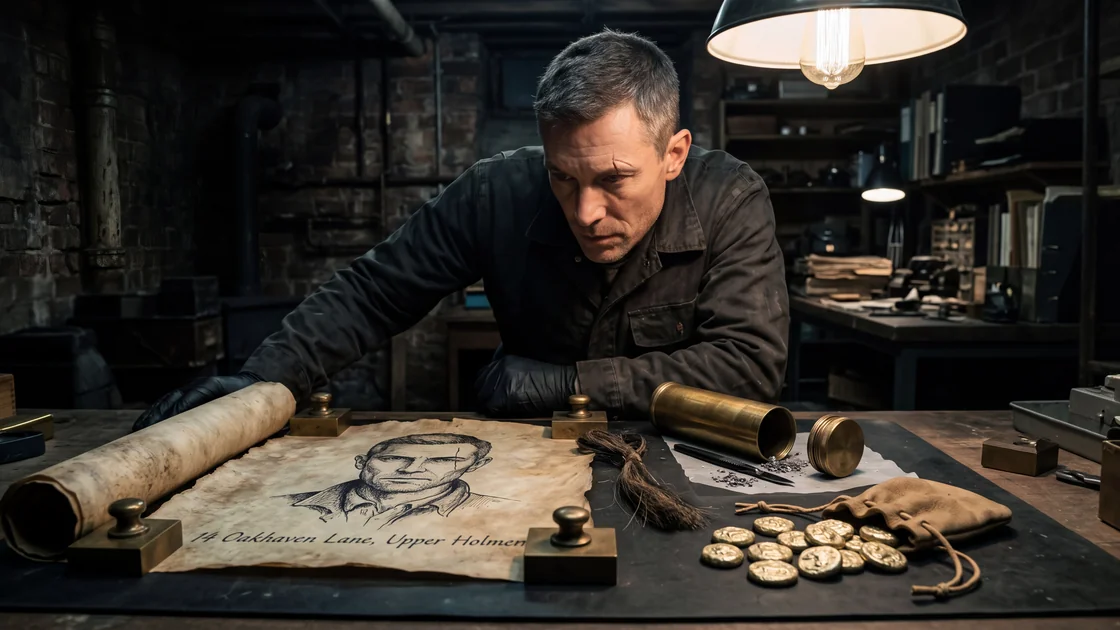
Silas Vance, an elite broker of state-sanctioned mortality who has spent two decades erasing his past, receives an anonymous brass cylinder through his most secure drop site containing his own meticulously rendered portrait, his private sanctuary address, and twelve archaic electrum coins from sixth-century Lydia. The impossible assignment—a contract on his own life, delivered to his own hands—forces Silas into an existential counter-investigation through forgotten antiquities vaults, shadowy black-market numismatists, and the cold architecture of his former handlers. As he tracks the provenance of the ancient bullion, Silas uncovers the Terminal Protocol of the Ledger: a closed-loop execution order funded by his own long-buried sins and overseen by a dying mentor determined to prove that even the world’s most invisible man cannot escape the ledger of blood.
Act I: The Geometry of the Drop
The locker was set into the damp foundation stone of the Saint Jude-in-the-Fen ossuary, seven miles outside the city proper, beneath an iron grate choked with dead plane leaves and gray urban silt. Silas Vance arrived at three minutes past midnight, his boots making no sound against the sodden loam. The cold was an invasive, salt-heavy draft blown inland from the tidal flats, carrying the smell of low tide, diesel exhaust, and wet masonry.
He crouched, balanced entirely on the balls of his feet, his spine straight against the cold granite plinth of an archangel whose features had dissolved under two centuries of acid rain. Before touching the latch, he smelled the air. Iron. Pine oil. The faint, sweet rot of fungal spore. Nothing foreign. No trace of tobacco, gun oil, or human skin warming cold wool.
Silas drew a slender strip of spring steel from his glove seam, bypassed the false tumblers of the 1920s mortise lock, and levered open the iron plate.
Inside sat a brass cylinder, eight inches long and three inches thick, sealed with dull gray lead rather than wax. It weighed substantially more than it should have. Standard client protocols stipulated microdot film concealed in watch escapements, or dead drops containing encrypted thumb drives sealed in plastic sleeves. A heavy cylinder spoke of archaic procedure—the kind used by the Continental syndicates before the wars, or by private patrons whose paranoia had curbed their use of any electronic substrate.
Silas took the cylinder, slid the iron plate shut, relocked it, and scattered a prepared pinch of dried lichen dust over the seam to detect future disturbance. He did not open the cylinder in the graveyard. He did not open it in his vehicle—a ten-year-old Scandinavian estate car registered to a deceased surveyor from Yorkshire. He did not open it until he had driven thirty-six miles in an irregular cloverleaf pattern, abandoned the car in a subterranean parking garage beneath a derelict textile warehouse, traversed three distinct transit lines on foot, and entered his secondary workroom beneath a disused leather tannery in the Lower Docks.
The workroom had no windows, no drains connected to city water, and six inches of cork insulation sandwiched between brick and lead sheeting. Silas engaged the deadbolts, switched on a daylight-balanced filament lamp, and set the cylinder on a vulcanized rubber mat.
He donned nitrile gloves. With an electric micro-chisel, he severed the lead seal, capturing the shavings on wax paper so no residue would contaminate his clothes. He unscrewed the threaded brass cap.
A faint breath of air escaped the threads—dry, old, smelling of cedarwood shavings and beeswax.
Silas tilted the container. Two items slid into the pooling white light of the lamp.
The first was a scroll of heavy pigskin vellum, rolled tight and tied with undyed horsehair.
The second was a small, stitched pouch of oiled deerskin. It landed with a dull, heavy clink that had the unmistakable density of high-karat metal.
Silas ignored the pouch. He severed the horsehair with an obsidian scalpel and gently unrolled the vellum, weighting the four corners with brass micrometer blocks.
The document was divided into three distinct panels, drawn with carbon-lampblack ink and an astonishingly fine squirrel-hair brush.
The first panel was a portrait. It was not a photograph, yet it possessed the terrible, uncanny fidelity of a masterwork miniature. It showed a man in his early forties, with high, flat cheekbones, an asymmetric jawline, and a thin scar splitting the left eyebrow—a souvenir Silas had earned during a rainswept three-second scuffle on an embankment in Trieste eleven years ago. The hair was cropped close, salted with silver at the temples. The eyes were rendered with an unnerving, translucent gray wash that mirrored Silas’s own gaze back at him with absolute, clinical detachment.
Beneath the portrait, written in a hand that avoided calligraphic flourishes in favor of geometric precision, was an address:
14 Oakhaven Lane, Upper Holme. The third floor flat, behind the false fireboard. The key is beneath the flagstone marked with the cross of Saint Anthony.
Silas felt his pulse remain precisely sixty-two beats per minute. The physiological training of twenty-four years did not permit panic; it converted shock instantly into cold, peripheral calculation.
14 Oakhaven Lane was his primary sanctuary. It was not leased under any of his operational identities—not Miller, not Vane, not the quiet antiquities importer Paul Graves. It had been purchased through a series of defunct agricultural holding trusts thirty years ago, paid for in cash from an estate liquidation in Bern. He had never ordered food there. He had never made a phone call from within four hundred meters of its doorstep. He entered only through an attic skylight accessed from a shared roof ridge three doors down.
Yet there it was, inscribed on skin that had dried before the industrial revolution, accompanied by a portrait that looked as though the draftsman had sat across from him while he slept that very morning.
Silas turned his attention to the pouch. He loosened the raw-hide drawstring and tipped the contents onto the rubber mat.
Twelve coins rolled out, heavy and lumpy, clattering softly together.
They were not modern gold. They were thick, oval pellets of pale, buttery yellow metal, irregular in shape and stamped with primitive iron dies. Each coin bore the raised impression of the foreparts of a lion and a bull facing one another, their paws and horns locked in heraldic conflict. The reverse sides showed two deep, square incuse punches, left by the rough tongs of the ancient hammer-men who had struck them.
Silas did not need an encyclopedia. He picked up one of the coins with non-magnetic bone tweezers. The density, the cold greasy feel of the alloy, and the distinct pale color were unmistakable: electrum, an alloy of gold and silver found in the alluvial wash of the Pactolus River.
These were Lydian staters, struck during the reign of King Alyattes or his son Croesus, circa 560 BCE. The very dawn of coinage. The first state-issued instruments of economic transaction in human history.
At auction, a single high-grade archaic Lydian stater could fetch twenty to forty thousand pounds from specialized collectors. Twelve of them, unclipped, free of horn silver, and exhibiting pristine mint luster beneath centuries of tomb-patina, were worth a fortune.
More importantly, in the vocabulary of the shadow trade, a contract delivered with physical bullion was an irrevocable retainer.
Silas leaned back on his stool. The light hummed. The city miles above him was a dull, rhythmic throb through sixty feet of clay and stone.
The message had no text beyond the address. No date. No conditions. No deadline.
A dossier containing his own face. His own secret threshold. And the price for his own death, paid in the oldest money on earth.
Act II: The Anatomy of a Loop
For an operative within the Ledger—the loose, borderless apparatus that handled the wet-work that governments and banking houses could never acknowledge—there were forty-two standard termination profiles.
Silas knew them all; he had drafted nine of them himself during his three-year tenure as an auditor in Zurich. There was the Severance by Proxy, where an active agent was sent into an engineered ambush disguised as an extraction. There was the Dormant Poisoning, executed over months through the agent’s dental care or dry cleaning. There was the Administrative Disavowal, in which local police forces were anonymously fed the operative’s current aliases alongside evidence of horrific civilian crimes, forcing local authorities to do the Syndicate’s cleanup for them.
Never in the history of the Ledger had an operative been assigned themselves.
Silas rose, walked to his chemical testing bench, and set about verifying the physical components of the package. He had stayed alive for a quarter of a century not by guessing motivations, but by interrogating matter. Matter did not have an agenda; matter was subject to friction, decay, and origin.
He took a scalpel and scraped a microscopic sample of the ink from the margin of the vellum. He placed it in a ceramic spot-plate, added three drops of ethanol, and observed the dispersion. The ink did not dissolve. He added an alkaline solvent; the medium broke down into carbonized bone fragments and a binding agent derived from fish-bladder glue.
Traditional Byzantine recipe. Used by iconographers on Mount Athos, but also by specialized document forgers in Istanbul and Genoa.
He turned to the coins. He zeroed a digital scale to three decimal places. Each stater weighed precisely 14.12 grams—the heavy Lydian standard. With a micro-caliper, he measured the depth of the incuse punch on the reverse.
Then he used an ultraviolet inspection torch.
Under 365nm blacklight, ancient metal usually remains dead, while modern cleaning agents or chemical patination fluoresce with sickly green or orange tints. The staters remained completely dark, except for one: the third coin he examined showed a minuscule, hairline lineation across the flank of the roaring lion.
Silas adjusted his binocular inspection microscope, settled the coin on a mount of modeling clay, and brought the lens down to forty times magnification.
The line was not a scratch. It was a graffito—an ancient owner’s mark, gouged into the electrum with a bronze pin twenty-five hundred years ago. It formed a character from an obsolete epichoric alphabet: an open delta flanked by two vertical dashes.
Silas froze. His breath hitched—just once—in his throat.
He knew that mark.
Twenty-two years ago, before the Ledger was automated through distributed networks, before Silas was Vance, when he was simply a junior retrieval specialist designated Seven-Nought, he had been sent into the mountains of southeastern Turkey, near the headwaters of the Meander. A clandestine archaeological salvage team, funded by a private consortium of European private banks, had struck an unlooted royal tumulus.
Silas’s orders had been simple: sanitize the site. The expedition leaders had grown greedy and threatened to leak the find to the Turkish Ministry of Culture. Silas had overseen the sealing of the tomb, the destruction of the excavation records, and the transport of four iron-banded chests back across the Syrian border into the hands of his then-instructor, a man named Malachi Gray.
In one of those chests, wrapped in rotted linen, were two hundred and forty archaic Lydian staters. Silas had inventoried them by lantern light in a cellar in Aleppo. He had held this exact coin. He had noted that specific graffito in his field ledger: Item 44: Stater, electrum, obverse scratched with delta-variant.
Malachi Gray had stood over him that night, smelling of clove cigarettes and Turkish coffee, his fingers tracing the heavy rim of the chest.
"The first coins, Silas," Gray had said, his voice dry as crushed thistles. "Do you know what they were for? Not for buying bread. Peasants traded barley and sheep. Coins were minted to pay mercenaries. Metal stamped with the king’s beast, given to killers so they would cross the mountains and burn cities that didn't belong to them. All currency begins as a bounty. Remember that. When you hold money, you are holding the dried residue of someone else’s blood."
Silas stepped back from the microscope.
Malachi Gray had died nine years ago in an explosion in an alpine sanatorium outside Montreux. Silas had verified the dental records himself. He had inspected the severed leg, the scorched signet ring, the charnel slurry in the basement crater.
Yet here was Item 44.
And here was his own face, drawn with the technical intimacy of someone who had watched Silas train, fight, bleed, and execute for half his life.
Act III: The House on Oakhaven Lane
Silas did not run. Flight was an admission of an inferior position; it conceded the initiative to the hunter.
Instead, he packed a canvas field satchel: a suppressed 9mm pistol with subsonic hollow points, two fragmentary flash-bang grenades, a specialized passive thermal optic, three hundred meters of braided Kevlar tripwire, and a medical kit containing coagulant gauze and morphine syrettes. He took the cylinder, the vellum, and the twelve coins.
He reached Upper Holme at four o'clock in the morning.
The neighborhood was an enclave of Victorian gothic brickwork, smothered by weeping willows and unclipped boxwood hedges. A dense ground fog had settled over the street, rolling off the river like white smoke. The gas-style street lamps cast halos of bilious yellow against the wet slate.
Silas approached 14 Oakhaven Lane not from the street, but through the rear mews of number 22. He scaled a brick garden wall with fluid, practiced muscle memory, toes finding the recessed mortar gaps. He traversed the flat lead roofs of the conservatory outbuildings, ghosting beneath the branches of an overgrown cedar.
He paused on the dormer roof overlooking his own third-floor windows.
The flat was dark. The curtains—heavy, light-blocking wool—were drawn precisely as he had left them three weeks ago.
He activated the thermal optic and pressed it to his eye.
The world turned into shades of luminescent emerald and phosphorescent white. He scanned his own sitting room through the glass of the skylight.
No heat signatures. The radiator was cold; he kept the thermostat at nine degrees Celsius to preserve his gear. The ambient temperature was uniform.
Then he saw it.
On the small mahogany side table in the center of the room—a table Silas kept completely clear of objects, save for an empty glass decanter—there was a faint, fading bloom of thermal dissipation.
Someone had set something warm down on the timber within the last forty minutes. The heat had soaked into the wood and was now radiating outward in an oval ring.
Silas did not enter through the skylight. That would be the expected line of ingress for an operative returning to clear their own nest.
He moved silently across the roof ridge to number 12, entered its communal loft through a loose slate he had prepared six years ago, slipped down the public stairwell, exited through the front basement lightwell, and walked openly down the street to the front gate of number 14.
The iron gate creaked slightly—an intentional warning chime he had never oiled.
He stepped onto the gravel path. He walked to the front steps. Underneath the flagstone marked with the cross of Saint Anthony, the brass key was missing.
The door was unlocked. It stood ajar by a quarter of an inch—just enough to break the vacuum seal of the weather-stripping.
Silas drew the suppressed pistol, holding it close to his chest in the low-ready position. He stepped across the threshold with his weight distributed on the outer edges of his soles to prevent the floorboards from shifting on their joists.
The hallway was pitch-black. The smell was wrong.
It did not smell like an ambush. It smelled like dry paper, old damp plaster, and the faint, bitter tang of dried rosehips.
Silas moved through the foyer, cleared the angle of the stairwell, and climbed to the third floor. He cleared every landing with mechanical, sweeping pivots, muzzle tracking with his eye line.
He reached his apartment door. It too was unlatched.
He pushed it open with the toe of his boot and stepped into the room, his back against the masonry of the chimney breast.
"You're nine minutes slower than you were in Damascus," a voice said from the darkness.
It came from the deep wing-back armchair near the unlit hearth.
Silas did not fire. The voice was neither young nor aggressive; it had the wet, rattling timber of a man whose lungs were drowning in their own fibrous tissue.
Silas kept the pistol aimed at the center of the chair. With his left hand, he retrieved a small penlight from his pocket, clicked it on, and pinned the beam directly into the occupant's face.
The man in the chair did not flinch. His pupils were cloudy, milky blue with cataracts, though they tracked toward the glare with painful slowness.
His face was an open ledger of extreme senescence and systemic cancer. The skin was yellow-gray, parchment-thin, drawn tight over skull contours that Silas had studied under field conditions across three continents. Malachi Gray had lost seventy pounds since Montreux; he looked like a saint pulled from a bog, desiccated, liver-spotted, with white stubble sprouting along an jawline that had once broken men's ribs in interrogation basements.
On his lap lay an uncocked, double-barreled hammer-gun, its barrels sawn off to eight inches, resting across an old woolen blanket.
"Malachi," Silas said. His voice was level, registering neither surprise nor relief.
"You brought the steel," Gray wheezed. He raised a hand—it shook with an uncontrollable, low-amplitude tremor—and touched the side of his nose. "I told the Board you would. I told them you wouldn't run. The modern boys... the ones we recruited from the signals units in Cheltenham... they run. They go to Panama. They change their faces. They hide behind encryption algorithms. But you were the last of the hand-carved ones, Silas. You know that an assignment doesn't dissolve just because you close your eyes."
"You died in Switzerland," Silas said. "I identified your foot."
Gray let out a sound that began as a chuckle and dissolved into a prolonged, wet cough. He reached into his coat, and Silas's thumb clicked the hammer of the pistol back. Gray brought out an embroidered handkerchief, spat a smear of blackish blood into it, and tucked it away.
"You identified a foot that had my orthopedic pin in the fibula," Gray corrected him. "A pin you put there yourself when that Russian truck crushed my ankle in Graz. I bought that leg from an orderly in Vienna. Ten thousand marks and an uncut emerald. A small price to exit the stage before the Board started its consolidation."
"And yet here you sit."
"Because the stage is closing altogether, Silas. And I have one final piece of business that requires an artist."
Silas lowered the light slightly, casting the beam onto the mahogany side table. Resting upon the timber was a small, battery-operated timer, its LCD screen counting down from forty hours, and an identical brass cylinder to the one Silas had retrieved from the graveyard.
"Explain the contract," Silas said.
"Sit down," Gray whispered. "My neck hurts from looking up at you, and the morphine is running thin."
Act IV: The Terminal Protocol
Silas did not sit. He moved to the corner of the room, positioning himself where he could watch both the door, the old man, and the narrow window leading to the fire escape. He kept the weapon drawn, the safety off.
"The Ledger is dying," Gray said, his head resting against the high back of the chair. He looked at the ceiling moldings with an expression of faint amusement. "You know it as well as I do. The men who built it—the old ambassadors, the intelligence directors who survived the collapse of Berlin, the bankers who funded the Gladio networks—they're all in the ground or in nursing homes with vascular dementia. The new management... they are technicians. Risk-assessment analysts from hedge funds. They don't like shadows. They like ledgers that can be audited by machine."
"They are cleaning house," Silas said.
"They've been cleaning house for three years," Gray coughed. "They called it Project Recision. Every operative with field independence, every man who knows the physical locations of the bullion reserves, the dead drops, the unrecorded arms caches—they're being retired. But how do you retire a man like you, Silas?"
"You don't hire someone from the outside," Silas said, the pieces assembling themselves in his mind with the horrific precision of an interlocking clockwork gear.
"No," Gray murmured. "If they sent five of their best boys after you, you'd kill three of them in the foyer, drown the fourth in the cistern, and track the fifth back to their staging house in Hampshire before noon. Then you'd come for the Board. That’s what you were built to do. You are an immune response. If the body attacks you, you destroy the body."
"So you sent the contract to me."
"I didn't send it," Gray said. "The system did."
The old man reached down to the second cylinder on the table and tapped it with a yellow fingernail.
"When we wrote the core architecture of the Ledger in eighty-eight," Gray explained, his voice growing thin, "we installed an absolute backstop. We called it the Uroboros Provision. If an operative reached a threat index higher than seventy-four—meaning they had accumulated enough operational knowledge to compromise the entire Continental architecture—and their handlers died or failed to recertify them for eighteen months, the system was programmed to issue an automatic red-line bounty."
"The bounty must have an issuer," Silas said. "A system doesn't mint coin."
"The issuer is the Ledger itself," Gray said. "It pulls funds from the escrow accounts we laid down in forty-five. Those Lydian coins? They weren't from a private collection, Silas. They were part of the founding deposit. The gold that the bankers pulled out of the Anatolian tumulus was used to capitalize the Ledger’s black reserves in Geneva. It was the collateral. The foundation stone."
Gray turned his rheumy eyes toward Silas.
"The system was designed to find the highest-rated active asset within three hundred miles of the target to execute the termination. It calculates success probability based on historical clearance rates. It looks at your records, your kill-efficiency, your field survival metrics."
Gray smiled, revealing teeth that were brown and worn down to the gums.
"The algorithm ran your profile against every operative on the continent, Silas. And it concluded, with ninety-nine point eight percent certainty, that there is only one man alive capable of killing Silas Vance."
Silas remained completely motionless. The silence of the room was heavy, punctuated only by the faint, rhythmic ticking of the digital countdown timer on the mahogany table.
"It hired me," Silas said, "to liquidate myself."
"It hired the best," Gray whispered. "The system is blind. It doesn't understand that the subject and the contractor share a national insurance number and a retina print. It simply knows that Target Seven-Nought is an unacceptable liability, and Asset Seven-Nought is the only instrument mathematically guaranteed to close the file."
"And if Asset Seven-Nought refuses the contract?"
Gray pointed a skeletal finger at the second brass cylinder.
"The protocol has three tiers. Tier One is assignment: you receive the retainer and the target package. If you do not register confirmation within forty-eight hours of drop retrieval, Tier Two initiates."
"Which is?"
"Broadband broadcast," Gray said softly. "The address of this room, your six operational aliases, your bank routing numbers in Zurich and Vaduz, your face, your medical files, and the location of your three safe-houses—transmitted simultaneously to Interpol, the MI6 counter-intelligence registry, the FSB directorate, and eighty-four independent private contractors who would gladly skin you with a fileting knife just to claim the salvage rights on your accounts."
Silas looked down at the timer.
38:14:02. 38:14:01.
"You have thirty-eight hours, Silas," Gray whispered. "Before the world caves in on this room."
"And why are you here, Malachi?" Silas’s voice dropped into a register that made the hairs on the back of the dying man’s neck stand up. "You didn't crawl out of an alpine hospice just to deliver a technical briefing on an algorithm we wrote when the Berlin Wall was still standing."
Gray let out a ragged breath. He leaned forward, his hands trembling violently on the sawn-off shotgun in his lap.
"Because I didn't want you to die at the hands of those spreadsheet clerks," Gray snarled, a momentary flash of his former iron breaking through the decrepitude. "I made you. I pulled you out of that juvenile detention block in Leeds when you were fifteen. I taught you how to breathe through broken ribs. I taught you how to kill a man with an oyster fork. I taught you how to disappear so completely that your own reflection would doubt you were there."
The old man began to weep—not with sorrow, but with the dry, pathetic frustration of terminal exhaustion.
"I won't let them erase us with an automated script," Gray spat. "You are my masterpiece, Silas. If you are going to die, you must die by the hand of an artist. Or... you must find the machine that issued the order and tear its throat out."
Act V: The Numismatist of Black Friars
The rain had returned by five in the morning, falling in needle-thin vertical sheets that transformed the London asphalt into a mirror of liquefied soot.
Silas left Malachi Gray in the armchair. He did not tie him; the old man did not have the strength to stand without crutches, let alone descend three flights of stairs. Silas took the sawn-off shotgun, removed the two brass twelve-gauge cartridges, chambered them into his own satchel, and placed the empty weapon back across Gray’s lap.
"Stay here," Silas told him. "If you try to move, the tripwire on the doorknob will drop the ceiling plaster and break your collarbone."
"Where are you going?" Gray croaked.
"To see Thorne."
Gray’s eyes widened slightly behind their cataract veil. "Thorne is dead. The Board shot him in ninety-six."
"Thorne has three daughters," Silas said. "The youngest took over the shop in Black Friars. And she inherited his ledger."
Silas departed through the skylight, slipping through the gray predawn like a thread through dark cloth.
He reached the shop at six-fifteen. It sat in an alleyway off Fleet Street that had survived the Blitz—a narrow, timber-framed frontage leaning at a drunken angle between two glass-and-steel legal practices. The sign above the bow window was faded to the color of damp bread: M. Thorne & Sons, Antiquarian Horology & Numismatics.
Silas did not knock on the front door. He went to the coal chute in the rear alley, inserted an angled crow-foot pry bar into the iron seal, and popped the bolt with a sharp, controlled thrust of his heel.
He slid down the chute into a cellar that smelled of sulfur, clock oil, and dried paper.
"If you touch the third drawer from the bottom," a woman’s voice said from the darkness above the wooden stairs, "a spring-loaded needle will drive five milligrams of potassium cyanide into your femoral artery."
Silas stood still in the coal dust. He did not draw his weapon.
"The spring was replaced with a hydraulic buffer in ninety-eight, Elena," Silas said into the shadows. "And your father always used aconite, not cyanide. Cyanide corrodes the brass mechanisms."
There was a long pause. A switch clicked, and a single, green-shaded banker’s lamp hummed to life on an oak workbench.
Elena Thorne stood at the top of the stairs. She was forty, with gray-streaked dark hair pulled back in a severe bun, wearing an apron of heavy cowhide and holding an air-rifle designed for target shooting, converted to fire heavy lead slugs. She looked down at him through brass-rimmed magnifying spectacles.
"Silas," she said. She lowered the rifle an inch. "You're supposed to be in South America."
"I was never in South America."
"That’s not what the notifications said." She descended three steps, her boots clicking on the oak treads. "Two weeks ago, my father’s old terminal started chiming. Three hundred accounts flagged for termination. Your name was at the top of the index. They said you took a boat out of Valparaíso and drowned."
"I am standing in your coal cellar," Silas said.
He reached into his satchel, withdrew the oiled deerskin pouch, and tossed it up the stairs. It landed with a dull, heavy clatter at Elena’s feet.
She looked down at the pouch, then back at Silas. She did not touch it with her bare skin; she used the tip of her rifle barrel to nudge the mouth open. The pale, yellow coins spilled across the tread.
Her breath caught. She knelt, picked up one of the staters with a pair of watchmaker’s tweezers from her apron pocket, and held it to the green lamp.
"Lydian," she whispered. "Alyattes. Sixth century."
"Look at the obverse of the third one," Silas said, stepping up the stairs.
She sorted through them with the tweezers until she found the graffito. She brought her magnifying loupe down until it was nearly touching the cold electrum.
"The delta-mark," she murmured. "This is from the Anatolian cache. The one the Swiss Syndicate buried in eighty-one."
"Where did they go after Gray brought them out?" Silas asked.
"They didn't go to Switzerland," Elena said, looking up at him, her eyes magnified into huge, owl-like discs behind the lenses. "My father handled the customs clearing. They were transferred to an off-grid installation in Kent. A subterranean vault beneath the old Admiralty radar station at St. Margaret's Bay."
"Why Kent?"
"Because that’s where the physical heart of the Ledger was built," Elena said. She stood up, her apron creaking. "Before there were servers in Iceland, before satellite relays, the Ledger was a mechanical punch-card exchange and telephone switchboard built into the chalk cliffs. The Admiralty abandoned it in fifty-six. The Syndicate bought it through a shell company called Dover Straits Navigation. They kept the gold there to settle international contracts that couldn't be routed through clearing banks."
Silas looked at his watch.
36:42:19.
"Is it still operational?" he asked.
"Operational?" Elena laughed—a dry, bitter bark. "It’s autonomous, Silas. When the Board tried to modernize the system four years ago, they realized the original code—the assembly language that links the vault relays to the clearing accounts—was written on magnetic drum memory that can’t be ported to modern networks without triggering a global fail-safe wipe. They couldn't move it. So they left it there. They put a diesel generator on a twenty-year fuel cycle, hooked it to an automated cooling pump, and let it run."
"And the terminal?" Silas asked. "The machine that sends the cylinders?"
"There is an automated pneumatic tube system connected to a dead-drop routing network along the old rail line," she said, her voice dropping to a whisper. "It uses maintenance couriers who don't even know what they’re carrying. They get a text message, a locker combination, and an envelope of cash. They pick up a cylinder from an iron chute behind an abandoned signal box and take it to a drop."
"Like Saint Jude's," Silas said.
"Like Saint Jude's," she agreed. She looked at the twelve electrum coins at her feet. "Silas... if you have these, it means the terminal has flagged your account."
"It has."
"Then why aren't you running? By tomorrow night, every asset with an operational receiver will have your coordinates."
"Because I have thirty-six hours," Silas said, taking the twelve coins and returning them to the pouch. "And the machine that hired me is sitting in the chalk at Dover."
Act VI: The Road to the White Chalk
A professional killer does not travel fast when he is hunted; he travels methodically. Speed produces anomalies in traffic patterns; speed creates thermal profiles; speed causes human beings to make errors of observation.
Silas took a stopping train from Victoria to Canterbury, changing cars twice during suburban station stops. He wore the gray twill jacket and woolen flat cap of a retired rail worker, carrying a scarred leather tool bag containing his suppressed pistol, a portable hydraulic jack, sixteen ounces of plasticized explosive with non-electric blasting caps, and a spool of detonating cord.
He arrived in Dover at eleven o'clock in the morning.
The weather on the coast was brutal. A south-westerly gale was clawing at the cliffs, churning the English Channel into a froth of slate-gray and dirty froth. The fog was thick enough to obscure the harbor installations from fifty yards away. The smell of brine and wet chalk was suffocating.
Silas did not take a road vehicle toward St. Margaret’s Bay. He walked the coastal path along the cliff top, leaning into the wind, his boots sinking into the wet, spongy turf that covered the limestone.
The old Admiralty radar station appeared out of the mist like the skeleton of a stranded iron whale. Four rusted lattice towers, their guy-wires whining in the gale, stood sentinel over a cluster of concrete pillboxes half-swallowed by gorse and blackberry briars.
The main entrance—a steel blast door set into an artificial embankment—was sealed with three separate master padlocks, their shackles red with rust.
Silas did not touch them. An experienced infiltrator never attacks the front door of a military installation; the front door is designed to resist artillery and draw attention.
Instead, he walked four hundred meters along the cliff edge until he reached a narrow, crumbling shelf fifty feet below the crest—a bird-nesting ledge that could only be seen from the sea.
There, tucked behind a screen of dead samphire, was an emergency escape shaft: an iron tube four feet in diameter, installed during the Second World War for radar operators to evacuate if the station was overrun by German paratroopers.
The grate was secured with two half-inch iron pins. Silas did not use explosives; the sound would carry along the cliff face to the Coastguard station a mile away. He inserted his hydraulic jack between the bars, pumped the lever three times with his heel, and sheared the pins with a sharp, dry snap that was instantly swallowed by the roar of the surf below.
He pulled the grate free, checked the air within the pipe with an oxygen meter—twenty percent, clear of carbon monoxide—and slid feet-first into the dark.
The descent was eighty feet of vertical iron rungs, slick with condensation and smelling of bat guano and motor oil.
At the bottom, his boots struck dry concrete.
Silas switched on his lamp, shielding the lens with his fingers so that only a razor-thin slit of amber light escaped.
He was in an arched tunnel lined with corrugated steel plates—the classic design of a British deep-level shelter. The air was twenty degrees warmer than the surface, vibrating with an immense, low-frequency hum: the sound of a heavy diesel engine operating behind thick acoustic baffles.
The Ledger was alive.
He moved down the corridor. Every twelve paces, there was an unpainted timber door marked with faded stenciled numbers: PLOTTING ROOM 1, TELEPRINTERS, WATCH OFFICE.
All were empty, their floors littered with rotted canvas camp beds, disconnected copper wiring, and dry mouse droppings.
At the end of the central gallery, three hundred feet into the chalk heart of the cliff, the tunnel terminated at a modern vault door: six inches of solid stainless steel, fitted with a digital keypad, an analogue combination dial, and a physical keyhole of extraordinary complexity—a Chubb six-lever safe lock with an anti-magnetic curtain.
Beside the door was a brass plaque, polished bright by an automated felt wiper that swept across its surface once every twenty-four hours:
CONCORDIA SEDIS — ARCHIVUM CENTRALE Est. 1954
Silas did not touch the keypad. He did not attempt to dial the combination.
He reached into his satchel, withdrew the pigskin vellum dossier, and laid it flat on the concrete floor beneath the safe door.
Then he took the twelve archaic electrum coins.
He laid them out across the vellum, one by one, matching them to the circular impressions that had been pressed into the leather when the package was originally sealed thirty-six hours ago.
On the twelfth coin—the stater with the Lydian graffito—he stopped.
He looked at the keyhole.
A standard lock requires a key; an archaic security protocol often requires a physical balance. Silas knelt, leaned his ear against the cold steel of the escutcheon, and took the twelfth coin between his thumb and forefinger.
Beneath the brass plate of the Chubb lock, hidden by a spring-loaded decorative rosette, was a narrow, horizontal slot—precisely three millimeters wide and twenty-five millimeters long.
The dimensions of an archaic Lydian stater.
Malachi Gray had told him twenty-two years ago in Aleppo: All currency begins as a bounty.
Silas pressed the coin into the slot.
For three seconds, nothing happened. Silas heard only the gale screaming through the ventilation shafts above and the steady, hydraulic thrum of the diesel generator.
Then, deep within the stainless steel door, something clicked.
It was not an electronic relay. It was the sound of a weighted balance arm dropping through an oil-bath damper—a mechanical coin-scale, calibrated to the exact weight of 14.12 grams of high-density electrum.
A series of heavy brass tumblers tumbled in cascading sequence: thunk... thunk... thunk-chunk.
The massive locking bolts retracted with a sound like a guillotine resetting.
The heavy steel door swung inward six inches, its pneumatic seals hissing as thirty years of filtered, dehumidified air breathed out into the wet chalk corridor.
Act VII: The Machine at the End of the World
Inside, there were no computer monitors, no glowing server racks, no optical fiber bundles pulsing with blue light.
The chamber was thirty feet square, lined with floor-to-ceiling racks of brass-rimmed mechanical stepping switches, Strowger selectors, and rotary teleprinters—the automated telegraphic equipment that had formed the backbone of global intelligence communications during the fifties and sixties.
In the center of the room sat a single, massive oak desk.
Upon the desk rested a mechanical teletype terminal—a Creed & Company Model 7—its paper roll yellowed with age, its typebars black with dried carbon ink. Beside it was a brass hopper, similar to the coin-sorting mechanisms used in early twentieth-century transit systems, connected to a vertical chute that disappeared into the floor.
Silas stepped into the room, his boots leaving dark, wet prints on the spotless linoleum.
The Strowger switches on the left wall were clicking—an irregular, insectoid chatter that sounded like thousands of iron beetles marching across glass. Each click represented a relay closing somewhere in the Continental banking network: an escrow account verifying a balance, a dead-drop status checking in, a satellite ping received through the rusted antennas on the cliff top.
Silas approached the desk.
The teletype machine was typing.
It did not use a monitor; it hammered its characters directly into a continuous ribbon of paper with loud, mechanical punches that echoed through the vault:
CLAC-CLAC-CLAC... CLAC.
Silas leaned over the platen and read the freshly struck letters:
TARGET ID: SEVEN-NOUGHT // VANCE, SILAS
STATUS: LOCATED
RANGE: ZERO MILES
AZIMUTH: INTERNAL
REMITTANCE: ACCEPTED // ITEM 44 CONFIRMED
TIME REMAINING TO BROADCAST: 31 HOURS 14 MINUTES
Silas stared at the paper.
The machine did not know he was the target. The machine only knew that the coin had been entered into the vault terminal, which meant that Asset Seven-Nought had arrived at the Central Archive to confirm the kill.
The Strowger switches clicked again, faster this time.
The teletype hammered out the next instruction:
TO COMPLETE CONTRACT:
DEPOSIT REMAINDER (11 STATERS) TO HOPPER.
CONFIRM TERMINATION BY BIOMETRIC SCANNER (RIGHT THUMB).
UPON RECEIPT: ASSET RE-CERTIFIED. THREAT INDEX RETURNED TO ZERO.
ALL PENDING LIQUIDATION ORDERS WILL VACATE.
Silas slowly reached into his coat and withdrew the pouch.
Eleven coins left.
The logic of the machine was absolute, closed, and utterly indifferent to human reality.
To survive, Silas Vance did not need to kill himself. He only needed to convince the machine that Silas Vance was dead.
Or... he could fulfill the contract according to the ancient terms.
The door behind him did not move, but the air in the room shifted. A faint smell entered the chamber—the smell of clove cigarettes and wet tweed.
Silas did not turn around immediately. He looked at the Creed teleprinter.
"You took the train," Silas said. "You shouldn't have taken the train, Malachi. Your heart can't take the vibration."
Malachi Gray stood in the vault doorway. He was leaning heavily on two aluminum forearm crutches, his face gray with the exertion of descending the emergency ladder, his coat soaked through with sea spray. His breath came in ragged, wheezing gasps that sounded like air being forced through a wet sponge.
"I didn't... take the train," Gray panted, his mouth twisted in a grin that was more like a rigor-mortis grimace. "I had an ambulance... from the private hospital in Folkestone. Five hundred pounds... to the driver. Cash still works... with the working class."
Gray dragged himself into the room, the rubber tips of his crutches squeaking on the linoleum. He leaned against the edge of the oak desk, his body shaking with an ague that Silas knew was the final stage of septic lung failure.
"You found it," Gray whispered. "The grand machine. The monument to our lives."
"It’s not a monument," Silas said, his voice flat. "It’s an old telephone exchange with a coin-sorter."
"It’s an engine of destiny, Silas," Gray said, his hand trembling as he reached out to touch the brass hopper. "For fifty years, this room decided who lived and who died across Europe. A diplomat in Vienna gets a mistress who works for the Czechs? Click-click-click. An invoice is printed. A stater drops. A man goes over a railing. A general in Algiers talks about nationalizing the oil? Click-click-click. You go to Algiers. The world stays balanced. We weren't murderers, Silas. We were the weights on the scale."
"The scale is broken," Silas said, pointing at the teletype. "It asked me to kill myself because it ran out of enemies."
"It didn't run out of enemies," Gray snarled, coughing violently, a spatter of red hitting the pale oak desk. "We became the enemies! We are old, Silas. We know too much. We belong to the era of bone-handled knives and cold drops in graveyards. The new world... they don't want us. They want an automated ledger where no one has to look at the man they’re erasing."
Gray reached into his pocket and pulled out a heavy, blued revolver—a .38 Webley, the service weapon he had carried since the Cyprus emergency.
He did not aim it at Silas. He aimed it at the teletype.
"I’m going to smash it," Gray wheezed. "I’m going to empty the cylinder into the relays. I’m going to burn the switches. We’ll drown this place in sea water. We’ll show them that we can’t be balanced out of their books."
"If you shoot those relays," Silas said, not moving an inch, "the fail-safe initiates. The broadband broadcast triggers instantly. My face, my name, your name, every grave we ever dug from here to Baku—it all goes out to every terminal on earth."
Gray’s arm shook. The heavy barrel of the Webley dipped.
"Then what do we do?" Gray wept, his voice cracking like dry wood. "Do you let the machine kill you? Do you put a bullet in your own head to satisfy a line of code written on magnetic tape before your mother was born?"
Silas looked down at the eleven electrum coins in his hand.
Then he looked at Malachi Gray—his mentor, his creator, the man who had bought him out of a cell in Leeds and turned him into a ghost.
"The contract didn't specify which Silas Vance," Silas said softly.
Gray blinked, his cloudy eyes struggling to focus through the tears of pain. "What?"
"In eighty-nine," Silas said, his voice dropping into a rhythmic, clinical cadence, "when you forged my service records for the Board... whose name did you put on the birth registry? Whose father's signature was on the baptismal certificate we filed in Bern?"
Gray stared at him. His jaw dropped slightly.
"You used your own," Silas whispered. "You registered me as Silas Vance Gray. Your nephew. Your heir. The only name you could legally tie to the secret trusts that funded the operations."
Gray’s hand began to lower the revolver.
"To the Ledger," Silas continued, "we have the same genetic sequence registered on the original blood-typing cards. We have the same emergency identity tokens. We are the same operational entity: Seven-Nought."
The teletype gave a sharp, impatient chime:
TIME REMAINING: 31 HOURS 11 MINUTES.
AWAITING DEPOSIT.
AWAITING CONFIRMATION.
Gray looked at the brass hopper. Then he looked at his own reflection in the polished steel plate of the safe door behind Silas—a dying old man with black blood on his lips and twenty-four hours of agony left before his lungs collapsed completely.
"Silas," Gray whispered.
"You said it yourself, Malachi," Silas said. His hand came out, firm and warm, and took the barrel of the Webley from the old man’s fingers. Gray did not resist. Silas unloaded the cylinder, dropped the six cartridges into his pocket, and set the empty revolver on the desk.
"You said that if an artist is going to die," Silas said, "it should be by the hand of an artist. But this isn't an execution, Malachi. This is an invoice."
Gray closed his eyes. A single tear cut a clean channel through the soot and salt-crust on his cheek.
"Will it hurt?" the old man asked, his voice suddenly small, like that of a boy who had stayed out past the streetlamps coming on.
"No," Silas said.
Silas reached into his medical kit. He did not use an oyster fork. He did not use steel.
He drew a sterile ten-milliliter vial of pharmaceutical-grade potassium chloride and a pre-loaded disposable syringe of concentrated diamorphine—the field-terminal kit that every auditor carried during the Cold War.
He helped the old man down from his crutches, easing him into the high-backed swivel chair behind the oak desk. Gray leaned back, his head rolling against the cracked green leather, his breath coming in shallow, fluttering whistles.
Silas swabbed the inside of Gray’s elbow with an alcohol wipe. The scent of isopropyl cut through the ancient paper and grease of the room.
"Look at the coins, Malachi," Silas said gently.
Gray turned his milky eyes toward the eleven Lydian staters resting on the blotter.
"The lion and the bull," Gray murmured, his voice fading into a dream-like murmur. "Alyattes... five-sixty BCE. The Pactolus... the river of gold..."
Silas found the vein without hesitation. He slid the needle in.
He depressed the plunger of the diamorphine first.
Gray’s eyes widened slightly as the immense, velvet warmth of the narcotic struck his central nervous system, wiping away thirty years of chronic pain, three years of suffocating cancer, and the cold of the sea gale. His posture relaxed; the tremor in his hands ceased completely. A look of profound, astonishing peace spread across his face, smoothing the deep, bitter wrinkles around his mouth.
"Silas..." Gray breathed. "Is the... is the ledger balanced?"
Silas introduced the second compound—two milliliters, steady and slow.
"The ledger is closed, Malachi," Silas said.
Gray sighed. His eyelids fluttered once, twice, and settled shut. His pulse beneath Silas’s fingers gave four irregular, slowing thuds—then stopped.
The chamber was silent, save for the hum of the diesel engine sixty feet below the floor.
Silas did not wait.
He picked up Malachi Gray’s right hand. The fingers were still warm. He pressed the thumb firmly onto the glass prism of the optical scanner mounted to the right of the Creed teleprinter.
A red light beneath the glass flashed green:
BIOMETRIC RECORD MATCHED:
ASSET: SEVEN-NOUGHT
IDENTITY: VANCE / GRAY
CONFIRMATION: POSITIVE
Silas picked up the eleven electrum coins.
One by one, he dropped them into the brass hopper.
Clink. Clink. Clink.
Each coin dropped through the internal scale, tripping the mechanical sensors with the heavy, dense weight of ancient kings.
Clink. Clink. Clink.
On the eleventh coin, a mechanical shutter snapped shut inside the chute with a sharp, resonant chime that rang like a church bell through the concrete vault.
The Creed teleprinter erupted into a frenzy of mechanical motion, the typebars hammering the paper with deafening speed:
REMITTANCE RECEIVED: 12 OF 12 UNITS.
CONTRACT: LIQUIDATION // TARGET SEVEN-NOUGHT
STATUS: EXECUTED // CONFIRMED // CLOSED.
ACCOUNT SETTLED: ZERO BALANCE.
ARCHIVE STATUS: PURGED.
TERMINAL SESSION TERMINATED.
GOODBYE.
With a high-pitched, pneumatic whine, the master Strowger switches along the left wall tripped simultaneously.
A hundred circuit breakers snapped open with a succession of loud, sharp cracks like pistol shots.
The teleprinter went dead. The red indicators on the relays turned black. The hum of the generator in the deep shaft died away, its cooling fans spinning down into total, unbroken silence.
The emergency amber lamp above the door flickered out, leaving the room illuminated only by the thin, white beam of Silas’s torch.
Silas Vance stood in the dark.
He looked at the body of Malachi Gray, resting peacefully in the green leather chair, looking for all the world like an old scholar who had fallen asleep over his books.
The world above him still contained eight billion people, thousands of automated security cameras, satellite networks tracking cell phones, facial-recognition algorithms scanning passport gates, and banks recording every fractional penny moved across digital ledgers.
But in the records of the machine that mattered—the only machine that had ever known his true name—Silas Vance was dead.
His account was settled. His balance was zero.
Silas reached onto the desk, picked up his leather tool bag, and turned toward the open vault door.
He did not take the Webley. He did not take the vellum dossier. He left them where they lay, beside the dead master and the silent teleprinter.
He walked out into the chalk corridor, closed the massive stainless steel door until the latches clicked shut on their mechanical balances, and began the long climb up the escape shaft toward the storm.