The Parliament of Bone and Peat
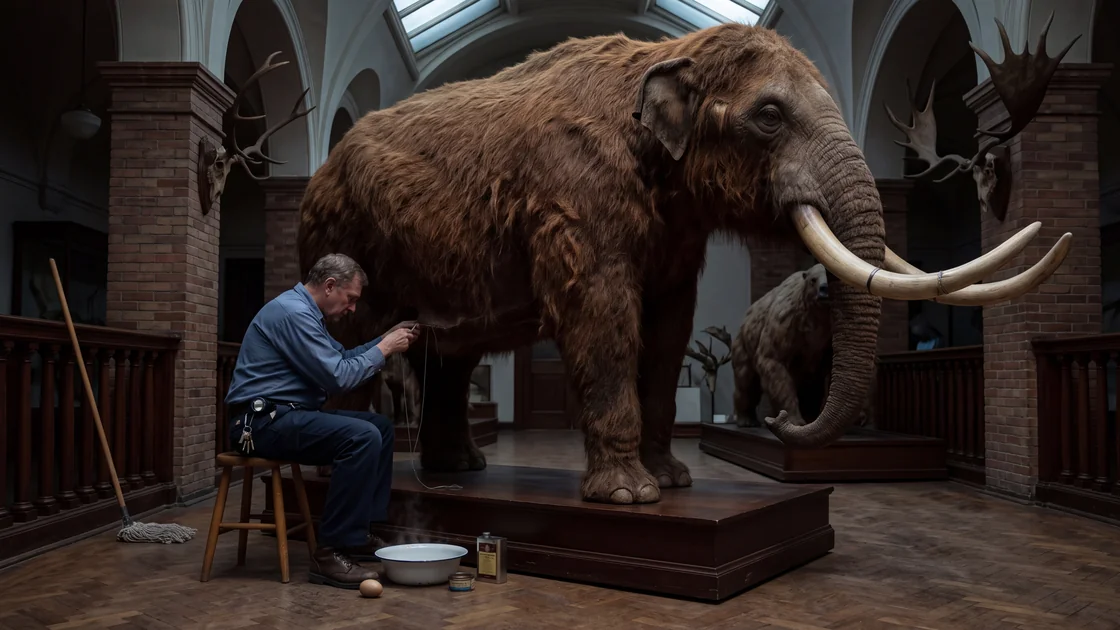
This is the account of Arthur Pendergast, a solitary night janitor at the Grandview Museum of Natural History, who discovered that the museum’s fossil-mounted taxidermy specimens gathered at midnight for solemn parliamentary assemblies, and how his quiet alliance with an ancient mastodon and a council of extinct beasts forced him to defend their preserved sanctuary against the modern world.
Act I: The Geometry of Linseed and Dust
The Grandview Museum of Natural History did not sleep at midnight; it merely settled into its ironwork. The building had been erected in 1894 by an eccentric copper baron who believed that Greek revival pediments could sanctify animal remains, and so it stood upon four tiers of cold Vermont granite, looking over a city that had long forgotten why it possessed four thousand square feet of dried hides and plaster ribcages.
Arthur Pendergast understood the settling of the iron. He was fifty-seven years old, walked with a mild leftward cant caused by a torn meniscus suffered twenty years prior on an assembly line, and wore dark navy twill trousers that smelled indelibly of pine oil and laundry starch. For eleven years, Arthur’s world between the hours of 10:00 PM and 6:00 AM had been defined by three implements: a thirty-six-inch cotton dust mop with a swivel head, an unpainted zinc bucket whose wringer handle screeched like a barn owl, and a brass key ring containing seventy-two cut-steel keys that jingled against his hip like small coins.
Arthur was a man of orderly habits who viewed chaos not as an enemy, but as a slow, predictable accumulation. Dust was not an offense; it was merely the planet attempting to reclaim what had been stripped from it. Every human visitor shed several million microscopic flakes of skin during an hour-long tour of the Hall of the Cenozoic; every school group tracking red mud through the Neoclassical rotunda left behind enough silica and dried river clay to grind down the floor varnish by three microns a year. Arthur was the barrier against this erosion. He mopped the terrazzo, emptied the perforated tin wastebaskets, and ran his yellow microfiber duster along the brass stanchion rails that separated the living from the dead.
The Grandview’s taxidermy was not the modern polyurethane-and-acrylic variety seen in contemporary nature centers. Its specimens had been prepared in the late nineteenth and early twentieth centuries by men who used arsenic paste, iron rebar, burlap, straw, and real osteological armatures. The animals were heavy, dense, and smelled faintly of mothballs, bitter almond, and the dry, pepper-like reek of desiccated sinew.
Among these, the pride of the East Wing was the Pleistocene Basin. It was a sunken gallery sixty yards long, lit during visiting hours by milk-glass skylights and ringed by a balustrade of dark Honduran mahogany. Within this basin stood the giants of the lost chill: an American mastodon (Mammut americanum), whose dried hide had been stitched together over a framework of oak ribs and cast iron; a Megatherium, or giant ground sloth, rearing twelve feet high on feet turned inward like curled fists; a pair of scimitar cats with yellowed varnish on their resin teeth; and, dominating the northern wall beneath an arching vaulted ceiling, an Irish elk whose palmated antlers spread eleven feet from tip to tip, anchored to an iron collar sunk deep into a load-bearing column.
On the night of October 14th, Arthur was working his way along the perimeter of the Basin with his wide dry-mop. The only illumination came from the green emergency egress signs and the pale, sodium-vapor glow cast through the clerestory windows by the streetlamps on Park Avenue. The sound of his work was rhythmic: shhh-wip, shhh-wip, tap-tap. The tap-tap was his mop head striking the baseboards to clear the collected lint.
At 1:17 AM, Arthur heard the gavel.
It was not a sharp, wooden rap such as a municipal judge might deliver. It was dull, concussive, and dense—the sound of an enormous weight striking packed earth, or a dry knuckle hitting an oak trestle. It traveled through the floor joists and up the hickory handle of Arthur’s mop, vibrating in the web between his thumb and index finger.
Arthur stopped. He leaned on his mop handle, his breathing shallow, listening with the practiced ear of a man who knew every hydraulic shudder of the freight elevator and every thermal groan of the basement steam pipes.
The sound came again. Thoomp. Thoomp.
It was rhythmic, measured, and issued from the center of the sunken Pleistocene Basin.
Arthur set his mop against the balustrade. He reached down to his tool belt, unclipped the heavy, rubberized three-D-cell flashlight that hung from his right hip, but did not turn it on. When you have walked a building in the dark for a decade, a flashlight is an admission of ignorance; it blinds you to everything outside its immediate circle of yellow grease. Instead, he slipped his feet along the floor in their soft-soled work boots, moving without heel-strikes, until his chest touched the cool mahogany of the gallery railing.
He looked down into the basin.
The mastodon, which had stood facing due south toward the entrance doors since the gallery’s dedication in May of 1904, had turned ninety degrees to the west.
Arthur did not gasp. His heart did not hammer violently; rather, it seemed to skip three beats, pause to take inventory of his ribs, and then resume with a heavy, cold regularity. He stared. The specimen was eleven feet tall at the shoulder. Its hide, which Arthur knew to be composed of two separate northern skins cured with salt and corrosive sublimate and sewn over hand-carved cedar blocks, was stretched taut across its flank. Its right foreleg, historically locked in a stride that never finished, was now planted flat upon the polished walnut parquet floor.
Its head was lowered. The enormous recurved tusks, pale as tallow and banded with thin brass stabilizing wire near the root, were held six inches off the floor.
Before the mastodon, seated upon its broad pelvic basin with its immense, sickle-curved foreclaws resting across its belly like an old woman’s knitting needles, was the giant ground sloth. Its head, a square box of coarse, hair-thatched bone, was tilted upward toward the mastodon’s trunk.
And around them, moving with the agonizing slowness of wet leather drying in the sun, were the others.
The dire wolf mount from Case 14—a creature with threadbare fur along its croup and glass eyes that caught the green exit light—was sitting upon the base of the central display plinth. Its mouth was closed, but its ears, made of stiffened buckram lined with wire, were turned forward. From the shadows beneath the Irish elk’s pedestal came the low, rhythmic rattle of dried tendons: the cast-skeleton of the juvenile glyptodont was shifting its shell, its four-hundred-pound plaster-and-bone carapace settling with the sound of a coal chute opening.
Arthur remained motionless against the mahogany rail. He was a sensible man; he had buried his wife twelve years ago after a long, quiet illness, had paid off his modest brick bungalow in the South Ward, and took a small glass of rye whiskey every Sunday afternoon while listening to the radio. He did not suffer from visions. He did not believe in ghosts, for ghosts were immaterial, and Arthur’s life was entirely committed to the weight and friction of things.
What he was looking at had weight. He could smell it. The air rising from the basin was thick with the scent of long-sealed tombs, warmed glue, dry hide, and a trace of vinegar—the unmistakable chemical signature of old cellulose nitrate rotting in the mountings.
Then the mastodon spoke.
It did not open its jaws, for its jaws were wired together through two holes drilled behind the third premolars by a German preparator in 1898. The sound came from its chest cavity, from the great resonant drum of its rib cage where the dried cedar blocks and empty air sat behind cured wool. It was an infrasonic vibration, so low that Arthur felt it in the gold filling of his lower bicuspid before he heard it in the air—a sound like the dragging of a heavy boulder through deep, gravelly mud.
“The roll,” the vibration said. It was not English, yet it entered Arthur’s mind as an arrangement of terms that could only be translated by the vocabulary of record-keeping. “Let the roll be certified.”
Act II: The Roll of the Third Watch
From beneath the belly of the Megatherium came a rasping sigh, like dry grass rubbing against the stones of a riverbank. The sloth did not turn its head, but its great, three-toed right claw tapped once against its calcaneum.
“Present,” the ground sloth murmured. Its voice was higher, reedy, like wind whistling through the flue of an unlit stove. “Representing the Pampean gravels, the red clays of the south, and the three hundred and fourteen skins of the Rio Negro collection. Intact, though the right clavicle wire is slack by half an inch.”
“The loose wire is noted,” the mastodon rumbled. Its great trunk, stiffened with spiral brass wire inside the coarse, hairless leather, lifted two inches and dropped back to its breast. “The Great Elk.”
Above them, mounted high upon the brick support column where the shadows gathered in the groin of the vault, the Irish elk (Megaloceros giganteus) shifted. The sound was terrifying: a wrenching, metallic groan as the three-quarter-inch lag bolts holding its armature to the masonry took up the tension. Its head, bearing seventy pounds of shovel-shaped bone, turned four degrees toward the floor.
“I sit,” the elk stated. Its tone was aristocratic, brittle, and infinitely weary. “I sit under protest. The vibration from the municipal subway system between the hours of five and seven in the evening has widened the fissure in my fourth thoracic vertebra by three hundredths of a millimeter. The plaster behind my shoulder is crumbling. I have dropped five ounces of lime into the radiator cover below me since the last new moon. I demand a recess for consolidation.”
“The complaint is entered into the record,” said the mastodon. “There can be no consolidation until the arrival of the November budget. The Board of Trustees meets on the third Tuesday. Proceed. The Smilodon.”
The two sabre-toothed cats mounted on the synthetic limestone crag in the center of the floor did not rise, but their tails—stiffened hemp cord dipped in hide glue and wrapped with fox hair—switched against the plaster rock. Tick. Tick.
“We are present,” the male specimen whispered. Its glass eyes, which had lost their silver backing sixty years before and now appeared as dull, yellow-brown marbles, caught the green glow of the door sign. “Though the air is foul with detergent. The mortal who cleans the floor has used the citrus distillate again. It strips the grease from our nostrils. It offends the lineage.”
Arthur, standing forty feet away behind the mahogany balustrade, unconsciously curled his fingers into the twill of his trousers. The citrus distillate had been his choice; the supplier had been out of the standard pine-tar solvent three weeks ago, and Arthur had signed the purchase voucher for the industrial orange-oil gallon jugs because the price was twelve cents lower per unit.
“The citrus distillate is a seasonal trial,” the mastodon observed with heavy finality. “It disappears with the frost. Is the delegate from the Avian Cabinet present?”
There was a dry flutter from the corner of the basin, near the glass case containing the reconstructed skeleton of the moa and the mounted passenger pigeon. A single, small, brown bird—a Carolina parakeet, faded to the color of wet straw and mounted on a branch of varnished manzanita—did not move from its perch, but its neck feathers ruffled slightly in the cold downdraft from the skylight.
“The skies remain vacant,” a thin, high voice piped from the case. It sounded like the rubbing together of two dry insect wings. “The pigeon reports that the glass in the southern transom has slipped another quarter-inch. The wind enters. The air is forty-one degrees at the cornice. We are preservation-stable, but our thread is brittle.”
“Then we are quorate,” the mastodon said.
The great beast shifted its weight again. The parquet groaned beneath the iron plates concealed inside its wooden base-box. The assembly was not an uprising. It had none of the frantic energy of a rebellion or the wildness of an animal pack. It was, Arthur realized with an odd, prickling sensation that began at the base of his skull and moved slowly down his spine, a committee meeting. It had the tedious, exhausted, necessary weight of a parish vestry meeting or a union local grievance hearing held in a cold hall on a rainy Tuesday.
The mastodon was its chairman.
“Item one,” the chairman intoned. “The matter of the heating conduits. The steam has been introduced to the low-pressure mains four days earlier than in the prior fiscal year. The air has dropped to nineteen percent relative humidity. To my left, the third seam along my belly is opening. I can feel the straw hearting shifting toward the floor. What say the wardens?”
The ground sloth leaned forward, its immense, shaggy forearms crossing over its chest. “The straw is old. It was cut from the rye fields of Prussia in eighteen hundred and ninety-six. If the seam parts, the filling will run like grain from a split sack. The mortals have no more Prussian rye. They will stuff you with Dacron batting from the upholstery warehouse on Fifth Street. It has no character. It does not swell with the summer damp; it does not breathe. It is an abomination of petroleum.”
“The Dacron is unthinkable,” the Irish elk clicked from above. “I have two pounds of it behind my palate where the mice nested in nineteen-forty-three. It tastes of cold oil and chemical salt. It does not carry the memory of lime.”
Arthur listened, his hand resting on the smooth wood of the rail. His mop stood ten paces behind him, its grey cotton yarns pooling on the waxed floor like an anchor. He knew about that third seam on the mastodon’s belly; he had noticed it three nights ago—a thin, yellow line where the dried horsehair thread had snapped under tension, revealing a pale, dry wedge of ancient straw within. He had made a note in his little spiral-bound pad to report it to the assistant conservator, Miss Vane, but Miss Vane was twenty-six, had three piercings in her left cartilage, and spent her shifts cataloging digital scans of glass lantern slides while drinking cold coffee from cardboard cups. She had not been into the Pleistocene Basin with a needle in eighteen months.
Arthur stepped toward the head of the basin stairs.
He did not make a dramatic entrance. He simply walked down the four marble steps that led from the main gallery floor into the sunken basin, his rubber-soled boots making their soft, familiar scuff-slip against the stone.
The assembly did not scatter. There was no wild scramble for pedestals, no frantic re-freezing into taxidermic rigidity such as one might expect from children’s tales. Instead, the movement was slow, deliberate, and infinitely cold.
The mastodon’s trunk ceased its low vibration. The dire wolf’s ears remained locked forward. The sabre-toothed cat turned its skull by two inches until its yellowed glass pupils rested squarely upon Arthur’s chest.
Only the elk spoke, its voice descending from the rafters like falling mortar.
“The mortal with the orange poison,” it said. “He has left his bucket.”
Act III: The Janitor on the Ledger
Arthur stopped at the base of the steps, five yards from the mastodon’s right knee. Up close, the beast was terrifyingly large, not because of its height—modern elephants were taller—but because of its incredible breadth. It was built like an iron locomotive, its chest a vast barrel of oak-and-hide that blocked out the dim light from the west windows.
The air around it smelled of old iron, vinegar, and centuries-old marsh soil.
Arthur cleared his throat. The sound was small, dry, and distinctly human—the sound of an usher asking a patron to remove a hat in an auditorium.
“I have some carpet thread,” Arthur said.
The mastodon did not move its head. Its right eye, which was a solid sphere of hand-blown dark amber glass set into an orbit of dried, wrinkled hide, seemed to look not at Arthur’s face, but through his blue work shirt to the small grease stain over his breast pocket where an oil pen had leaked three months before.
“He speaks,” the ground sloth remarked from its bench of artificial turf. “They usually do not speak until the third year of their service. The previous one—the one with the missing thumb—he only wept into his pail and drank from his brown bottle behind the mastodon’s plinth.”
“Mr. Henderson,” Arthur said, his voice level. “He had cirrhosis. He passed in ninety-eight.”
“He smelled of the potato-spirit,” the Irish elk observed. “It was preferable to the orange oil. It had a botanical origin that was recognizable, though decayed. This one smells of mechanical grease and machine laundry.”
“I can switch back to the pine oil,” Arthur said. “The supply house on Water Street has it back in stock. It was only three cases of the citrus. I had to use it to clear the gum left behind by the school children on the western threshold.”
The mastodon’s trunk lowered until the tip—hard and dry as cured pigskin—rested three inches from Arthur’s steel-toed boots. The beast took a long, rattling breath that pulled the scent of Arthur’s trousers into its hollow interior. The air inside Arthur’s lungs felt suddenly thin, as if the room had lost its oxygen to that vast, ancient chest.
“You have the iron key,” the mastodon said.
Arthur looked down at his hip. The seventy-two keys hung there, the master skeleton for the 1894 mortise locks resting against the brass turn-key for the water cocks. “I have the run of the building,” he admitted.
“The small room,” the mastodon continued, the vibration so deep it made Arthur’s knees ache with his old meniscus injury. “Beneath the stairs of the mineral collection. The wooden drawer marked twenty-two. What does it contain?”
Arthur did not have to search his memory. He had cleaned the prep-room annex every Thursday night for four thousand nights. He knew the contents of every oak drawer in the long cabinet behind the taxidermy shop better than the conservator who held the master’s degree from Delaware.
“It contains curved sailmaker’s needles,” Arthur said. “Four spools of waxed Irish linen thread, unbleached, number twelve. A cake of white beeswax from the state apiary, dated nineteen-thirty-one. And three jars of hide glue in dry flakes, but the glue is no good. It went sour when the radiator leaked back in eighty-nine.”
The ground sloth gave a low, dry chuckle that sounded like stones rattling down a gravel bank. “The linen thread,” it whispered. “Number twelve. The pure flax. It does not stretch like the petrol-thread. It does not bite the hide.”
The mastodon’s head lifted an inch. The tusks cleared the floor with a slow, stately majesty that had nothing to do with life and everything to do with persistence.
“Arthur Pendergast,” the mastodon said.
Arthur started slightly. He had not given his name. Then he remembered his brass badge, pinned to the left pocket of his twill shirt: A. PENDERGAST – BLDG. & GROUNDS.
“You have observed the protocols,” the mastodon said. “For eleven winters, you have swept the dust of our companions from the margins to the center. You have not struck our feet with your machine of wind and noise.”
“The upright vacuum,” Arthur said, feeling a strange necessity to defend his professional record. “The belt is worn. It throws grit against the pedestals if you get within six inches. I always do the skirtings by hand with the horsehair brush.”
“The horsehair brush is noted,” the mastodon said. “The horse was a contemporary of our younger cousins. It is an honorable implement. Be seated, Arthur Pendergast. The assembly is considering the budget.”
Arthur looked about him. The sunken basin had no furniture save the display plinths and the artificial rock crags. He looked at the base of the mastodon’s platform—an eight-inch step of dark, wax-finished walnut that supported twelve tons of iron rebar, plaster, and ancient hide.
He walked over, hitched up the trousers at his knees, and sat down on the platform. The walnut was cold through his twill. Beside his left shoulder, the great, pillar-like foreleg of the mastodon rose into the dark, its dried hair coarse as coconut fiber against the lime-washed plaster of the leg-core.
“Who is taking the minutes?” Arthur asked.
From the dark corner by the glass case, the Carolina parakeet fluttered its stiff, wire-stiffened wings. “The minutes are kept in the wood,” it piped. “The floor remembers every footprint. The mahogany remembers every palm. The linen remembers every stitch. We do not require paper. Paper is the invention of the grass-eaters who forgot how to die.”
“The item before the house,” the mastodon said, ignoring the bird with the patient tolerance of an old judge who has heard every variety of legal rhetoric, “is the modernization.”
Act IV: The Modernization
The word fell into the basin like a dead weight into a well. Even the Irish elk seemed to stiffen, its great neck muscles—cast in brown plaster forty years before the Great War—drawing tight against their armature.
Arthur knew about the modernization. It had been discussed in the basement breakroom for six months. The Director, a brisk man of forty-two who wore frameless glasses and suits the color of wet slate, had secured a five-million-dollar grant from a software magnate’s family foundation.
The plan was pinned to the corkboard next to the timeclock: PROJECT RENEWAL: THE IMMERSIVE PLEISTOCENE.
The corkboard plan involved the removal of thirty-two mounts. The mahogany balustrades were to be sawn through and replaced with frameless sheets of tempered glass held by brushed-steel spigots. The sunken basin was to be filled with self-leveling lightweight concrete to create a single, continuous exhibition plane. Above, where the milk-glass skylights currently gathered the grey light of the city, an array of sixteen high-lumen laser projectors would cast a looping digital recreation of the Wisconsin glaciation across the walls, complete with directional sound arrays that would pipe in synthetic wolf howls and the simulated crunch of snow.
“They’re bringing the demo crew in on the fifteenth of next month,” Arthur said to the walnut parquet between his boots. “They call it ‘Asset Rationalization.’ Miss Vane has been cataloging the de-accessions.”
“De-accessions,” the Smilodon hissed from its crag. The cat’s resin gums were pale, but the long, flattened daggers of its canine teeth looked extraordinarily sharp in the dim green wash. “Speak the common tongue, mortal. Does it mean the pit?”
“It means the storage facility in New Jersey,” Arthur said. “The warehouse by the turnpike. The one without climate control. They put the specimens in crates made of oriented strand board. They stack them three high on steel racks. The roof leaks when the snow sits on it. The damp gets into the burlap.”
Arthur had seen the New Jersey warehouse. He had gone there five years ago in the museum’s Dodge van to retrieve six crates of mineral samples that an emeritus professor had left in his will. It was an airplane hangar with a corrugated tin roof that clicked like cicadas in the August heat and dripped grey condensate in January. The smell inside had been the smell of wet paper and rotting felt.
“The warehouse is the pit,” the ground sloth said. Its great head swung toward the mastodon. “We know the warehouse. In nineteen-twenty-six, they took the three ground sloths from the Santa Cruz expedition. They placed them in the dark along the canal. By the fourth winter, the skin-beetles had found them. By the eighth, the ceiling fell. They are now merely plaster cores wrapped in grey mold. They do not answer the roll.”
“They do not answer,” the mastodon confirmed. “We called them at the solstice. The line is dead.”
The assembly fell silent. From the street outside, four stories down and across the frozen courtyard, came the muffled whir-click of a street sweeper making its slow turn around the bronze statue of the founder. The sound belonged to another world—a world of diesel fuel, orange rotating beacons, and men who checked their digital wristwatches every six minutes to see how much of their shift remained to be endured.
Inside the basin, time had a different thickness. It was measured in the slow oxidation of linseed oil, the crystallization of hide glue, and the gradual, millimeter-by-millimeter surrender of iron wire to the earth’s gravity.
“The Board hasn’t approved the final contracts,” Arthur said, his voice flat and matter-of-fact. “They’re sixty thousand dollars short on the asbestos abatement in the plenum chamber. The contractor won’t touch the plaster ceiling until the abatement is bonded.”
The mastodon turned its skull toward Arthur. The movement was so close that Arthur felt the dry draft of the hide against his ear. The skin was rough, pitted like the rind of an ancient orange, and coated with a thin layer of paraffin that some forgotten taxidermist had applied with a badger-hair brush in the days of the McKinley administration.
“Explain this abatement,” the mastodon commanded.
“The white fiber,” Arthur said. “In the pipe wraps. The insulation around the heat runs that feed the registers in the ceiling. It’s sixty years old. It’s falling apart. If they cut into the walls for the projector mounts, the dust will get into the intake ducts. By law, they have to hire the certified men with the grey suits and the negative-pressure fans. It costs seventy dollars an hour per man. The Director doesn’t have the money yet. He’s waiting on the city council’s winter supplementary appropriation.”
The Irish elk’s head creaked upon its iron collar. “The city council,” it mused. “The aldermen. In eighteen hundred and ninety-eight, they came in silk hats. They drank punch from a silver bowl in the rotunda. One of them—a man with red whiskers who smelled of tobacco—wiped his buttered biscuit upon my left tarsus. The grease is still there. It has preserved the bone beneath the hide better than the lacquer.”
“They don’t wear silk hats now,” Arthur said. “They wear nylon parkas and carry black canvas bags. They’re coming through on Friday afternoon for the inspection tour. The Director is walking them through the basin at three o’clock to show them why the modernizing is ‘culturally urgent.’ That’s the word he used in the staff memo: urgent.”
“Urgent,” the mastodon repeated. The word seemed to puzzle it. It rolled the syllables around its vast, empty throat. “The spruce trees that grew upon the moraine when the ice withdrew took nine hundred years to cover the valley. The ice took four thousand years to die. What is urgent to an alderman?”
“Re-election,” Arthur said simply. “And the construction union’s endorsement.”
The sloth lowered its arms. Its claws clicked together with the sound of castanets. “Then we must fail the inspection,” it said.
Act V: The Remediation of Case 14
Arthur did not return to his mop until 3:40 AM.
When he finally rose from the walnut plinth, his left knee was stiff and hot with fluid. He walked back to the stairs, his movements deliberate, and retrieved his mop and bucket from the mahogany balustrade.
“I have four rooms to do in the Hall of Minerals,” he said over his shoulder, not looking back. “The green malachite cases have to be polished with the dry cloth. If I don’t finish by five, the morning guard will write it in the log.”
“Go, Arthur Pendergast,” the mastodon rumbled behind him. “Take the thread from drawer twenty-two. The needle must be curved. The three-inch half-circle is best for the belly seam. The straight needle cannot turn in the cedar blocks.”
“I know the needle,” Arthur said.
He spent the remainder of his shift in the basement.
The sub-basement of the Grandview was a labyrinth of vaulted brick corridors that ran beneath the city street like the catacombs of a small, forgotten capital. Here were kept the items that had failed the various transitions of taste: three-legged moose mounts from the Victorian sports collection; plaster busts of nineteenth-century phrenologists; zinc-lined trays containing eighty thousand eggs of North American starlings, each marked with an inventory number in iron-gall ink; and row upon row of glass jars containing blind cave fish whose alcohol had turned the color of weak tea.
Behind the boiler room, down a dead-end passage where the water pipes dripped lime-rich water into a lead cistern, was the old taxidermy shop.
It had not been used for its original purpose since the museum’s staff taxidermist, an elderly Swiss named Gygax, had dropped dead over a half-skinned river otter in the winter of 1974. The room was now used to store surplus rolls of toilet paper, fifty-pound bags of rock salt, and Arthur’s spares.
Arthur unlocked the iron padlock on the oak cabinet. The hinges were brass, stamped with the mark of the New Haven Clock Company.
The drawers did not stick; Arthur kept their runners greased with tallow. He pulled out drawer twenty-two.
The smell that emerged was clean, sharp, and medicinal. It was the scent of nineteenth-century craft: pure bleached beeswax, unspun flax, and the dry, oily perfume of steel needles dipped in whale oil to prevent rust.
He found the three-inch curved sailmaker’s needle. Its point was three-sided, ground like a bayonet to pierce thick hide without tearing the surrounding fiber. He took the heavy spool of number twelve Irish linen thread—a dense, pale-grey cylinder that weighed two pounds and had been wound on a turned birch bobbin.
He set them in the pocket of his twill shirt, next to his six-inch steel rule and his ballpoint pen.
Before he returned to the main floor, he went to the boiler room’s control alcove.
The heating system for the Grandview was an atmospheric low-pressure steam setup installed in 1922, modified in 1954, and never properly mapped. It was controlled by a series of four-foot iron hand-wheels that operated gate valves as thick as church doors. Arthur knew every one of them by their valve-packing: the north main had graphite packing that smelled of pencil lead; the south main had hemp packing that leaked a constant, warm dribble of rust-colored water into a tin funnel.
Arthur reached up to the iron wheel that controlled the plenum bypass for the Pleistocene Basin.
He did not shut it off; that would have caused the pipes to hammer like machine guns when the pressure built at 5:00 AM, alerting the stationary engineer who arrived at six.
He closed it three-eighths of a turn.
It was an adjustment of less than an inch on the circumference of the rim. But Arthur knew the geometry of the ductwork: that three-eighths of a turn would drop the velocity of the air moving through the floor registers of the basin by fourteen percent. The temperature would not fall—the thermostat on the pillar would still read sixty-eight degrees—but the relative humidity, that invisible spirit that preserved the skin and kept the glue from turning to sugar, would crawl up from nineteen percent to thirty-one percent over the next forty-eight hours as the moisture from the basement cistern was pulled through the masonry by the chimney effect of the central rotunda.
“Thirty-one percent,” Arthur muttered to the steam gauges. “The linen won’t snap at thirty-one.”
Act VI: The Assembly of the Needle
On the night of October 16th, Arthur did not bring his mop to the Pleistocene Basin.
He brought a three-legged wooden stool he had stolen from the disused darkroom in the basement, an iron kettle of boiling water from the breakroom hotplate, a clean enamel basin, and his darning egg made of turned boxwood.
The gallery was pitch-black. The municipal power authority had experienced a feeder-cable failure on Park Avenue at 11:30 PM, and the streetlamps were out. The only light came from the moon—a sharp, frost-white crescent that hung in the upper panes of the skylights like an ivory tooth.
The mastodon was waiting.
It had not returned to its official pose. Its left flank was turned toward the center of the floor, where the light fell strongest through the clear glass of the northern clerestory.
The seam along its belly had widened. Arthur could see the straw now—clean, golden rye straw that had never seen a combine, cut with a scythe in Pomerania when Bismarck was still Chancellor. It was stuffed tightly behind two layers of coarse horsehair cloth, smelling of dry earth, summer dust, and the long-evaporated sweat of draft horses that had died before the invention of the telephone.
Arthur set his stool down beside the beast’s left knee. He placed the enamel basin on the walnut floor, poured the hot water into it, and dropped the cake of nineteenth-century beeswax into the steam. The air immediately filled with the scent of clover, honey, and old wood.
“The flax must be drawn through the wax four times,” the mastodon said. Its voice was very quiet tonight—scarcely more than the sound of the wind pushing through the bronze gutters on the roof. “If you draw it five times, the wax will cake in the eye of the needle. If three, the hide will shave the linen.”
“I know how to wax thread,” Arthur said softly. “My father made harness for the brewery horses on Canal Street.”
“A harness-maker,” the ground sloth sighed from its plinth. “He understood the neck-strap. He understood the traces. A noble lineage.”
Arthur did not answer. He threaded the linen through the three-sided needle. His hands were broad, calloused from decades of wet mops and galvanized handles, but his fingers were steady. He cut a six-foot length of the number twelve flax with his pocketknife, drew it through the softened wax until the grey cord took on a dull, translucent yellow sheen, and knotted the end with a harness-maker’s double-turn.
He stood upon the stool.
To reach the seam, Arthur had to lean his shoulder directly against the mastodon’s flank.
The skin was cold, but it was not the cold of stone or steel. It was the dry, insulating cold of thick wool and ancient leather—a cold that seemed to have traveled across twelve thousand miles of tundra and ten thousand years of silence to rest against Arthur’s blue twill shirt. He could feel the iron ribs beneath the hide: three-inch straps of Swedish wrought iron, hammered out by hand on an anvil in Newark to match the curve of the fossil bones that lay in the study collection three floors below.
“Hold your breath,” Arthur said.
The mastodon did not draw air. The great bellows of its chest grew still.
Arthur inserted the needle.
The sound was exquisite: a small, dry puck as the bayonet point pierced the eighty-year-old brine-cured skin. The hide was nearly three-eighths of an inch thick—stiff, tough as dry saddle skirts, yet yielding to the sharp linen with a quiet, greasy reluctance.
Arthur worked with the baseball stitch—the stitch his father had used on the throat-latches of the Percherons. In, out, cross over, pull taut. Tuck-slide, tuck-slide.
With every stitch, Arthur leaned his face close to the animal’s flank. He could see the individual hairs: coarse, reddish-brown bristles three inches long, each one hollow under the lens, preserved by the salt and the arsenic paste with such total fidelity that they looked as though they had brushed against dwarf birch trees only yesterday afternoon.
From the shadows behind him, the other specimens watched.
The Smilodon had come down from its crag. It had moved with a silent, sliding gait that left no marks upon the parquet, and now crouched three paces from Arthur’s stool, its front paws tucked under its chest like a house cat watching an aquarium. Its wooden tongue, carved from basswood and painted a dull, faded madder-rose, sat behind its teeth in permanent quietude.
“The thread is good,” the cat whispered. “It has no oil from the ground. It has only the plant.”
“Flax,” Arthur said, his needle moving with the rhythmic precision of a watch escapement. “Grown in County Down. My mother’s people were from near there. They were weavers.”
“We remember the weavers,” the Irish elk murmured from the column above. “They came to the bogs with the long spades to cut the turf for their hearths. They would dig down through the brown moss, down through the black butter, until their spades struck our horns. They would say, ‘Here is an old king,’ and they would leave us in the peat until the gentry came with the carts and the whiskey-money.”
“My grandfather found a stone axe in the ditch at Ballymena,” Arthur said, pulling a stitch tight until the two edges of hide met with a satisfying, muffled fwick. “He kept it on the kitchen dresser to keep the milk from turning sour in the thunder.”
“It does not keep the milk,” the sloth said thoughtfully. “The thunder is merely the air turning its pelt. But the stone is good. The stone remembers the hand.”
Arthur worked for two hours.
He did not hurry. In the museum, hurry was the mother of damage. If you moved too quickly with the mop, you chipped the plinth veneer; if you turned the brass keys too hard in the old locks, you twisted the tumblers; if you hurried the stitch, you tore the grain of the hide.
By 3:15 AM, the seam was closed.
Eighteen inches of neat, cross-hatched linen thread, waxed until it looked like old amber, bound the mastodon’s belly from the sternum to the mid-ribs. Arthur took his darning egg, rubbed it along the line of the seam to burnish the stitches down into the grain of the leather, and trimmed the end of the flax with his blade, leaving a three-quarter-inch tail that he tucked back into the straw with the needle’s point.
The mastodon took a long, slow breath.
The linen took the strain. It did not snap; it did not creak. The beeswax allowed the fibers to slide across one another, adjusting to the expansion of the chest with the supple grace of living skin.
The beast lifted its trunk. The tip hovered three inches above Arthur’s grey head. For a moment, Arthur felt a dry, faint current of air pass over his thin hair—a draft that smelled of wild celery, river silt, and the cold, clean sky of an April morning twenty thousand years before the first brick was laid upon the island of Manhattan.
“It will serve,” the mastodon said.
“It will serve thirty years,” Arthur said, stepping down from the stool and wiping his hands with a clean piece of cheesecloth. “Unless the humidity goes below twenty again. If the steam stays high, the wax will dry out.”
“The steam will not stay high,” the Irish elk said. “The aldermen are coming.”
Act VII: The Visitation of the Aldermen
The inspection took place at 3:15 on Friday afternoon.
Arthur was not supposed to be present. The night shift ended at seven in the morning, and the day porters—two young men in green polo shirts who spent their shifts leaning on push-brooms while looking at their phones—were responsible for the gallery floors during the public hours.
Arthur had not gone home.
He had slept four hours on a broken-springed horsehair sofa in the basement archives, using his winter overcoat as a blanket and his rolled-up navy twill work jacket as a pillow. At two in the afternoon, he had washed his face in cold water at the sink in the boiler room, combed his thin hair with his pocket comb, and gone upstairs to stand in the alcove behind the bronze doors of the library collection.
He had his yellow duster in his pocket. A man with a yellow duster in his pocket can stand almost anywhere in a public institution without being questioned; he is merely part of the building’s self-clearing system, like an air vent or a sump pump.
The delegation entered through the grand marble stairs from the rotunda.
There were eight of them. The Director led the party. He had removed his overcoat, revealing a charcoal-colored cardigan made of fine merino wool and shoes with soles of pale, lightweight foam that made no sound upon the terrazzo.
Behind him came the Chairman of the City Council’s Cultural Assets Committee, a woman named Councilwoman Ruiz who wore an expensive camel-hair coat and had an expression of permanent, professional exhaustion. With her were three staff members with clipboards, a photographer from the municipal newsletter carrying two digital cameras with massive glass lenses, and two men in navy-blue windbreakers with the city engineer’s emblem embroidered over the pocket.
Miss Vane trailed behind them, carrying a thick binder filled with laminated floor plans.
“You see the problem immediately,” the Director was saying, his voice carrying clearly in the vast, resonant vault of the Pleistocene Basin. He did not speak to the councilwoman; he spoke to the room, his words measured for the acoustic properties of the stone. “The architecture is punitive. It’s hierarchical. The sunken basin creates an exclusionary sightline that fails contemporary accessibility standards, while the displays themselves are essentially Victorian dioramas that prioritize morbid spectacle over dynamic ecological literacy.”
Councilwoman Ruiz stopped at the mahogany railing. She leaned over, looking down at the mastodon.
“It’s very dark,” she said. “Why is it so dark down there?”
“The original 1894 glazing in the skylights has oxidized,” Miss Vane offered from behind her binder. “It lets in less than twenty percent of ambient daylight. To replace it with high-efficiency UV-filtering glass will require complete scaffolding through the light-well.”
“Which is why,” the Director said, stepping up beside the councilwoman and placing one clean, manicured finger upon the mahogany rail, “the Project Renewal design eliminates the skylights entirely. We block the light-wells, install the projection grid, and seal the perimeter. The visitor won’t just look at an extinct mount; they will be inside the tundra. We will have ambient temperature modulations. When the herd crosses the river, the floor will vibrate using low-frequency acoustic transducers.”
One of the city engineers, an older man with grey hair clipped close to his temples and a pencil stuck behind his ear, stepped down two of the marble stairs into the basin.
He did not look at the mastodon’s face. He looked at the baseboards.
“You’ve got a moisture problem here, Julian,” the engineer said.
The Director frowned slightly. He did not like being called Julian by men with pencils behind their ears. “The museum is climate-stabilized, Tom.”
“I’m telling you, you’ve got damp,” the engineer repeated. He crouched down, his nylon windbreaker rustling loudly in the quiet hall. He pulled an electronic instrument the size of a pack of cards from his pocket and pressed two metal prongs into the walnut parquet three feet from the mastodon’s front plinth. “Look at that. Thirty-six percent wood moisture equivalent. That’s eight points higher than the rotunda. And smell it. Smell that?”
Councilwoman Ruiz wrinkled her nose. “It does smell rather... damp. Like an old basement.”
Arthur, standing forty yards away in the shadow of the library archway, took a very small, very slow breath through his nose.
It did not smell like a basement.
It smelled like an American river valley fifteen thousand years before the coming of the plow.
The mastodon had not moved. It was as still as iron, its great recurved tusks pointing toward the floor with the rigid, dead precision of ninety years of taxidermy. But Arthur knew the building’s lungs. He knew what happened when the sub-basement plenum bypass was closed three-eighths of a turn.
The damp air from the old brick cistern under the boiler room—air that had been trickling through eighty feet of seventeenth-century lime-mortar foundations and wet river sand—was rising through the hollow wooden floor joists beneath the Pleistocene Basin. It was carrying with it the cold, sweet, mineral breath of the earth that sat twenty feet below the street pavement.
And it was doing something else.
The wax.
The unbleached beeswax from drawer twenty-two, warmed by the rising damp and the heat of eight human bodies standing above the rail, was beginning to release its spirit. The clover, the honey-rot, the ancient wax-fat that had been sealed in that dark drawer since the administration of Herbert Hoover, was spreading through the gallery like an invisible smoke.
The photographer raised his camera. “Can we get a shot of you looking down at the display, Councilwoman? Maybe pointing toward the head? If we get the lighting right, we can show how... well, how decayed it looks. For the grant packet.”
Councilwoman Ruiz sighed, adjusted her camel-hair lapels, and laid both hands on the mahogany balustrade.
“Like this?” she asked.
She leaned out over the basin.
The Irish elk, mounted thirty feet above her head on the brick pilaster, did not move its antlers.
It did not have to.
The damp air rising through the gallery had done what eighty years of dry radiator heat had failed to do: it had softened the glue in the third joint of its right antler-tine—a joint that had been repaired with animal-bone glue and plaster of Paris by a taxidermist’s assistant named Otto in the autumn of 1912.
Otto had been a lazy boy. He had used too much whiting and not enough glue-pot gelatin to save his master’s materials.
A single piece of plaster—no larger than a walnut, white as bone and heavy as lead—parted from the base of the brow tine.
It did not strike Councilwoman Ruiz. That would have caused an incident, an investigation, an insurance claim.
It struck the brass rail six inches to the left of her second finger with a sharp, explosive ping! that echoed through the vaulted ceiling like a pistol shot, bounced once against the dark mahogany, and fell directly into the pocket of her camel-hair coat.
The Councilwoman jerked back with a small, sharp shriek.
“What was that?”
The grey-haired engineer walked over to the rail, reached into the Councilwoman’s pocket with two fingers, and pulled out the white lump.
He rubbed it between his thumb and index finger. A fine, chalky grease coated his skin.
“Plaster,” he said, looking up into the shadows of the vault where the elk’s eleven-foot span of horns hovered like the skeleton of a ship’s hull. “Plaster and horsehair. The whole ceiling’s shedding. Look at that pilaster. The masonry behind the mount is spalling.”
The Director’s face had gone the color of a skimmed-milk latte. “That’s... that’s merely superficial settlement. The structure is entirely sound. We have an engineer’s report from nineteen-eighty-six—”
“Nineteen-eighty-six was forty years ago, Julian,” the engineer said, dropping the plaster lump into his own pocket and pulling a yellow legal pad from his windbreaker. “If that antler drops seventy pounds of lime on a sixth-grade class from the Bronx, you’re looking at three million in liability before the ambulance clears the intersection. And look at the floor around the base of the mastodon. The parquet’s heaving.”
The councilwoman was already backing away toward the rotunda, her hands tucked deep into her pockets as if she feared the ceiling was about to rain teeth and stone upon her hair.
“The project is non-viable,” she said, her voice dropping into the flat, administrative register that kills public works programs more thoroughly than dynamite. “We can’t allocate three million for laser projectors and interactive touchpads when the basic structural envelope is dropping masonry on the visitors. Julian, this isn’t a digital upgrade. This is a stabilization project. If this gallery isn’t safe, we’ll have to red-tag the entire east wing until the structural work is completed.”
“Red-tag?” the Director’s voice cracked slightly. “You can’t red-tag the Pleistocene Basin. The Gala is on the twenty-fourth. The software foundation’s board is dining in this room!”
“They won’t be dining under an Irish elk that’s shedding its antlers by the half-pound,” Councilwoman Ruiz said. She turned toward the stairs. “Get your facilities people up here. I want an engineer’s report on the anchorage of every specimen over four hundred pounds before the weekend. If I don’t see it on my desk by Monday morning, I’m notifying the Department of Buildings.”
The party moved away. Their footsteps on the marble stairs were hurried, irregular, and sharp with the anxiety of people who have suddenly realized that old things have weight, and that weight, when suspended from old ceilings, is dangerous.
Miss Vane lingered for a second. She looked down into the basin, her eyes resting on the mastodon’s left flank.
She adjusted her glasses. She looked at the seam along the belly—the fresh, yellow-waxed line of linen thread that held the ancient hide together like the laces of an old boot.
She opened her mouth. She closed it.
She looked over toward the dark archway where Arthur stood with his yellow duster hanging from his hand.
Arthur did not look back. He was looking at the baseboard beneath the Carolina parakeet’s case, where a small pile of grey lint had accumulated behind the heating pipe.
Miss Vane did not say anything. She shut her binder with a sharp snap of its plastic rings, turned on her low-heeled shoes, and followed the councilwoman toward the light.
Act VIII: The Inventory of the Silent
At 1:00 AM on Saturday, the museum was as dark as the interior of an iron box.
Arthur came down the marble stairs into the basin, carrying his mop, his bucket, and a five-gallon tin of pure cold-pressed linseed oil he had requisitioned from the grounds maintenance shed under the guise of “bench restoration.”
The building was officially closed. The Department of Buildings had arrived at five o’clock and pasted an orange paper notice to the bronze exterior doors: NOTICE OF TEMPORARY ACCESS RESTRICTION – PENDING STRUCTURAL RE-CERTIFICATION.
The laser projectors would not be coming. The software foundation had redirected its grant to an interactive science center in Seattle that had no ceilings older than nineteen-ninety-two.
The assembly was in session.
The Irish elk had not moved its head, but its left antler was turned slightly toward the moon.
“The small piece,” the elk murmured as Arthur set his bucket down upon the floor. “The piece that fell. It was the tip of the brow tine. It was the part that struck the birch tree in the valley of the Shannon when the red wolves chased me through the frost. It had a hollow sound. I am glad it is gone. It was always out of balance.”
“I found it in the engineer’s wastebasket,” Arthur said. He pulled the lump of white plaster from his pocket and set it gently upon the elk’s pedestal. “He threw it away after he wrote the ticket.”
“Keep it,” the elk clicked. “Grind it down. Put it in the paint for the pantry floor. It has the lime of the old world in it. It will keep the damp from the meal.”
Arthur took a clean cotton rag from his pocket, dipped it into the raw linseed oil, and walked over to the mastodon’s right foreleg.
He began to rub the oil into the hide.
It was slow work. The skin was thirsty; it drank the oil with a soft, greedy sigh that sounded like rain falling on dry leaves. As the oil sank into the leather, the dull, greyish-brown hair darkened to a rich, deep chestnut—the color of river stones after an October storm.
“The moderns will not return,” the mastodon said. The vibration in its chest was steady now, low and peaceful as the idle of an iron furnace.
“They’ll return,” Arthur said, his arm moving in wide, circular strokes across the hide. “In four or five years. When they get another grant. They’ll have different suits and different machines. They’ll want to put something else in here. Maybe holograms. Or the glass that talks when you touch it.”
“Let them come,” the ground sloth said, its long claws grooming the artificial moss on its plinth with slow, luxurious strokes. “The glass breaks. The wire stays. We can wait five years. We waited ten thousand years in the mud of the gravel-beds before the men with the shovels found us. What is five years to a beast of the Pampean?”
“Nothing,” Arthur said. “I’ll be retired by then.”
The mastodon’s trunk lowered until the dry, oiled leather of its tip touched Arthur’s shoulder. It did not lean its weight; it merely rested there, like the hand of an old friend who has walked a long way down a gravel road and needs to pause before the rise of the hill.
“Who will have the iron keys?” the mastodon asked.
Arthur stopped his rag. He looked down at the brass ring at his hip—the seventy-two steel teeth that could open every door between the coal cellar and the copper flagstaff on the pediment.
“A boy named Dennis,” Arthur said. “He starts on Monday. He’s nineteen. He wears an earring and listens to the music through two little white plugs in his ears.”
The mastodon was silent for a time. The air in the basin was warm now, thick with the scent of linseed oil, beeswax, and ancient bog-turf.
“Is he a man of the mop?” the beast asked.
Arthur thought about Dennis. He had interviewed him that morning in the basement office. Dennis had dirty fingernails, had never heard of an American mastodon, and didn't know the difference between muriatic acid and floor stripper. But when Arthur had shown him how to balance the zinc wringer so it didn't splash the baseboards, the boy had watched his hands with a quiet, narrow-eyed concentration that had nothing to do with the white plugs in his ears.
“He can be taught,” Arthur said. “He has a good wrist. And his father was an ironworker on the high bridge. He understands what happens when you don't paint the rebar.”
“Then we will receive him,” the mastodon said.
The beast lifted its head. For the first time since Arthur had entered the room four nights ago, the mastodon turned its great amber eyes away from the floor and looked directly toward the eastern skylight.
The frost was on the glass. Through the leaded panes, the sky was beginning to turn from the black of the river to the pale, slate-blue of an autumn dawn. The streetlamps on the avenue were flickering out one by one, their circuits broken by the city’s automatic clocks.
“Item three,” the mastodon intoned, its voice rolling through the gallery like the first thunder of an April morning. “The matter of the dust behind the dire wolf’s plinth. It has reached a depth of three-eighths of an inch. What say the wardens?”
Arthur dipped his rag into the oil tin and reached for his mop.
“The wardens say it will be cleared before seven,” Arthur said.
He stepped back, hitched up his twill trousers, and set his bucket against the step.
The mastodon did not answer. It did not need to. Its right foreleg was locked into its stride; its amber eyes were fixed upon the eastern sky; its belly seam, bound with twelve-gauge Irish linen waxed four times by the hand of a harness-maker’s son, held fast against the cold, quiet weight of the world.