The Porcelain Horizon
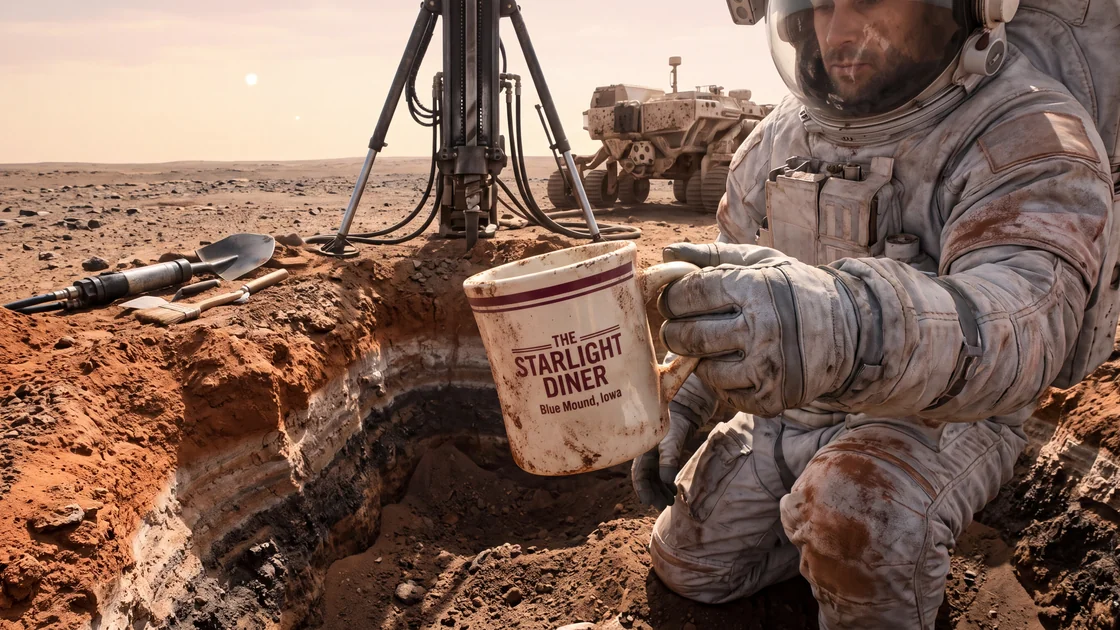
During a solitary core-drilling survey across the desolate basalt plains of Acidalia Planitia, planetary geologist Dr. Nicholas Aris unearths an impossible relic: a heavy, chipped ceramic coffee mug from the Starlight Diner, a long-demolished cafe in his rural Iowa hometown, sealed beneath three feet of undisturbed, prehistoric Martian regolith. As Aris subjects the impossible vessel to forensic analysis while contending with the silence of a twenty-minute communication latency with Earth, the discovery forces him through an agonizing gauntlet of psychological isolation, rigorous scientific denial, and the haunting possibility that memory, matter, and deep time are tangled across the gulf between worlds.
Act I: The Trench at the Edge of the World
The drill rig, an ungainly insectoid tripod of blackened titanium and hydraulic braided lines, hammered into the crust of Acidalia Planitia with a monotonous, tooth-rattling frequency.
Inside the pressurized cabin of the Survey Rover Schiaparelli-B, Nicholas Aris sat with his palms flat against the composite desktop, feeling the percussive thrum travel through thirty meters of basalt bedrock, through the rover’s unpressurized mobility chassis, through the dampening coils of the cabin suspension, and finally up into the marrow of his wrists. It was a dull, rhythmic violence. On Mars, vibration was one of the few ways the outside world made itself felt without killing you.
Nicholas blinked, his retinas burning behind the polarized coating of his heads-up display. His eyes felt dry, like tissue paper rubbed with salt. He had been staring at the subsurface telemetry for five consecutive sols, tracking an anomaly that had no right to exist in the northern lowlands.
Acidalia was supposed to be simple. Geologically speaking, it was an immense basin of sedimentary plains, smoothed over by billions of years of volcanic outpourings, flood sediments, and relentless, desiccating wind. It was ancient, uniform, and cold enough to shatter carbon steel if left unconditioned. You drilled through the top dust—the flour-fine, iron-rich mantle that blew around the equator like red talcum—and you hit the duricrust. Beneath the duricrust lay the basaltic conglomerates, cemented by magnesium sulfates and perchlorates that had crystallized when the planet’s atmosphere was still thick enough to bleed rain.
The drill was at ninety-one centimeters. Three feet. Exactly three feet into the undisturbed mantle.
A graphic on the secondary display flashed from amber to an insistent, sharp magenta. The acoustic sensor array had spiked. The hammer drill had not struck basalt; it had not sheared through soft gypsum or bound up in the clay-like phyllosilicates he had been cataloging for the Arcos-4 consortium.
It had bounced.
"Bit deflection," Nicholas muttered to himself. His voice, hoarse from hours of recirculated nitrogen-oxygen mix, sounded small against the hum of the cabin's environmental scrubbers. "Torque limit reached at point nine-four meters. Automated halt."
The drill mechanism whined down, its motors cycling down through a descending scale of mechanical groans. The sudden absence of the percussion left the rover cabin suffocatingly quiet. The only sound remaining was the wet hiss of his own breathing and the distant, dry rattle of dust grains being whipped against the rover’s exterior camera domes by a localized thermal draft.
He dragged a thumb across the console, clearing the error flag.
"HESPER," he said, addressing the rover’s low-level operational core. "Run an acoustic impedance profile on the obstacle."
The interface waited three seconds—the standard internal processing cadence for local data—before rendering a false-color cross-section on his main visor.
"Impedance indicates a discrete localized discontinuity," the synthetic voice replied, devoid of inflection. "Density profile is non-congruent with surrounding basalt or sedimentary matrix. Geometry suggests a localized planar curving surface. Width: eleven centimeters. Vertical height: nine centimeters."
Nicholas frowned, zooming in on the pixelated render. A boulder? Glacial dropstones occurred in the north, carried by ancient catastrophic floods, but they were almost universally vesicular basalt or rounded quartzite cobbles. This had sharp corners. The density gradient was thin, hollowed out, or composed of stacked composite layers.
"A vesicle?" he whispered. "An iron nodule?"
"Compositional estimation is inconclusive without mass spectrometry," HESPER reported. "Warning: Drill bit tooth three sustained micro-fracture during impact. Recommend manual excavation if sample retrieval is prioritized."
Nicholas sighed, leaning back into his molded foam chair. His shoulder joints popped. Outside, the sun was a small, white, merciless needle suspended over a horizon so flat and distant that it gave human beings vertigo. The horizon on Mars was too close; the planet was small, its curve visibly falling away like the edge of an enormous, rusted shield.
He was ninety-four kilometers from the central habitat at Mawrth Vallis. His three crewmates—Elena, Marcus, and Chen—were three days into a seismic survey along the crater rim, their comms tethered to the orbital relay that only climbed above the northern horizon twice a sol. He had volunteered for this perimeter trenching because he preferred the silence. In the rover, nobody complained about his choice of audiobooks; nobody paced the narrow aisles of the bunk module; nobody asked him why he hadn’t replied to the messages from the terrestrial relay in Iowa.
Now, he would have to suit up for a rock.
"Lock the rig," Nicholas instructed. "Isolate the drill string and retract the casing fifteen centimeters. I'm going out."
The preparation was rote, engraved into his muscle memory over six hundred sols of surface ops. The inner layer was the biocooling garment, a web of micro-tubing that smelled faintly of copper and synthetic fungicide. Over that went the pressure bladder, then the thermal micrometeoroid garment—a bulky, multi-layered hide of aluminized Mylar, Kevlar, and white Nomex that made him feel like a desiccated grub inside a cocoon.
He seated his helmet, twisting it until the dual bayonet collars clicked home with the sound of a closing safe.
Chirp. The heads-up display came alive against his peripheral vision:
O2: 101 kPa. N2: 78%. CO2: 340 ppm. Suit integrity: Nominal. Internal temp: 19.4 C.
He entered the rover's tiny two-stage airlock. It was barely wider than his shoulders. The pump began its mechanical wheeze, sucking the warm, humid cabin air back into the reserves, dropping the pressure around him until his suit stiffened, swelling outward against the near-vacuum of Mars like a balloon inflating inside a jar.
The outer hatch groaned open.
Cold. Not the cold that bites the skin—his suit insulation was five centimeters of state-of-the-art aerogel—but an existential cold that radiated through his boots. The cold of a world that had spent three billion years cooling down to the temperature of dry ice. The ambient atmosphere was barely seven millibars, an almost pure carbon dioxide ghost of an atmosphere that could not hold heat, could not carry a voice, and could not protect him from the relentless solar radiation that rained down through the pale, butter-yellow sky.
Nicholas climbed down the exterior ladder, his boots crunching into the regolith. The dirt here was different from the equatorial dunes. It was crusty, like old snow covered in a dusting of cocoa powder. Every step broke through a thin, brittle surface skin—the "popcorn soil"—revealing a darker, charcoal-colored grit beneath.
He unclipped the pneumatic excavation spade from the rover’s tool rack. The tool was essentially an air-jet trencher coupled with a low-impact vibrating shovel, designed to clear fragile mineral veins without crushing them.
He knelt by the drill mast. The steel casing rose from the ground like a surveyor's stake. Around its base, the rotation had cleared a neat circle of pulverized red dust, five centimeters deep.
"All right, HESPER," Nicholas said over the internal suit radio. "Feed the GPR overlay to my visor."
A glowing green wireframe superimposed itself over the dirt. The obstacle was buried exactly ninety-four centimeters down, wedged at an angle between two plates of fractured siltstone.
Nicholas activated the spade. The pneumatic compressor hissed, blowing a focused jet of carbon dioxide gas against the hole while the scoop vibrated at forty cycles per second. The dirt liquefied under the vibration, turning into a boiling fluid of red and grey dust that the suction cowl pulled away and deposited into the tailings sack.
He worked with the slow, disciplined patience of a field paleontologist. On Mars, if you rushed, you tore your suit; if you tore your suit, you choked on your own blood within sixty seconds. So he breathed slowly, watching his carbon dioxide scrubbers tick upward by fractional percentages.
Thirty centimeters. A layer of pale, sulfate-rich evaporites—ancient salt pans from an ocean that died before the first lungfish on Earth ever dragged its fins onto the mud.
Sixty centimeters. A dense, dark horizon of basaltic ash, sharp as ground glass, deposited by some forgotten caldera eruption in Tharsis three billion years ago. The layers were unbroken. Nicholas noted the stratigraphy with professional detachment: no burrowing, no root traces, no faulting. It was a textbook depositional sequence. Undisturbed since the Hesperian Era.
Eighty-five centimeters.
The spade's titanium lip hit something with a flat, dry clink.
Nicholas froze.
The sound had traveled through the hollow aluminum shaft of the spade, through his thick, pressurized gloves, through the bone of his radius and ulna, and directly into his inner ear.
It was not the sound of metal on basalt. Basalt was heavy, dense, and dull; it absorbed energy with a thud like wet wood. It was not the sound of quartz or chert, which cracked with a sharp, glass-like snap.
It was the ring of fired clay. Vitrified silicate.
"What?" Nicholas whispered.
He deactivated the air jet. He dropped to his stomach, leaning over the edge of the pit he had excavated. He unclipped a fine camel-hair brush—an analog tool that no machine had ever successfully replaced—and reached into the shadows beneath the drill casing.
He swept away the basaltic ash, grain by grain.
The color that emerged was not the ochre of iron oxide, nor the charcoal of volcanic basalt, nor the sickly green of olivine.
It was white.
A brilliant, milky, unblemished white.
Nicholas held his breath. The pulse monitor in his ear began to beep with an accelerated tempo: eighty-two beats per minute, eighty-eight, ninety-five.
He brushed harder. The white surface was curved, smooth, and coated with an unmistakable, glossy glaze that caught the thin Martian sunlight and cast a sharp, geometric specular reflection directly into his visor.
He cleared more dirt. The curved white surface met a corner. And then, projecting from the cylinder, a loop.
A handle.
A human-sized, four-finger, looped ceramic handle.
Nicholas recoiled as if a scorpion had crawled out of the permafrost. He scrambled backward on his knees, his boots kicking up clouds of orange dust that drifted slowly, unnaturally, in the low gravity, falling back to the surface like powdered lead.
He sat there, on the floor of Acidalia Planitia, his hands trembling within his heavy pressurized gauntlets, staring into a ninety-centimeter hole in the ground.
"HESPER," he managed, his mouth completely dry. "Recalibrate the heads-up display. My optical sensor is experiencing chromatic aberrations."
"Optical sensors are within normal operational parameters," the rover replied instantly. "Atmospheric transmittance is ninety-four percent. Ambient illumination is four hundred and twenty watts per square meter. There are no system faults detected."
Nicholas did not move for two full minutes. The wind dragged against his suit fabric, a faint, whispering rustle that sounded like distant surf.
You’re hallucinating, he thought. It’s an oxygen toxicity spike. Or nitrogen narcosis. Or you’ve finally cracked. Sol six hundred and twelve. The Arcos-4 isolation psychosis that the psych team in Houston warned you about.
He reached to his chest control unit, cycling his life support diagnostics.
PPO2: 21.2 kPa. Trace contaminant scan: Negative. CO: 0.0 ppm. Methane: 0.0 ppm.
He was stone cold sober. His gas mix was purer than the air in any hospital on Earth.
Slowly, dragging himself forward like an animal approaching a trap, Nicholas crawled back to the edge of the trench.
He reached his right hand down into the pit. His thick, thermal-gloved fingers closed around the white loop.
It was solid. It was cold—colder than ice, its temperature equalized with the deep permafrost at minus eighty degrees Celsius.
He didn't pull immediately. He cleared the remaining sediment from the rim. The vessel was resting upright, tilted at roughly a fifteen-degree angle, wedged between two slabs of Hesperian-aged volcanic breccia. The regolith around it was packed like concrete, cemented by ancient perchlorates.
He took his trowel and gently chipped at the perimeter. The soil broke away in hard, chalky flakes.
With a soft, scraping gasp, the object came free.
Nicholas lifted it out of the Martian dirt.
He held it up against the pale lemon sky, turning it over in his trembling hands.
It was a standard, heavy-gauge restaurant diner mug. The kind found in greasy spoons across the American Midwest. Thick-walled, vitrified porcelain, built to survive being dropped on linoleum floors by exhausted waitresses. It was cream-colored, with a dark maroon stripe running parallel to the rim.
And on the front, baked beneath a clear, lead-free feldspathic glaze that was slightly crazed by thermal shock, was an insignia.
A stylized neon starburst, flanked by two swooping chrome arrows. And beneath it, in bold, sans-serif lettering that had faded only slightly under the weight of deep time:
THE STARLIGHT DINER Blue Mound, Iowa "Hot Coffee & Warm Smiles"
Act II: The Stratigraphic Crime
Nicholas sat on the floor of the rover’s airlock, refusing to take off his helmet until the decontamination cycle finished its third consecutive stage.
The chamber hissed as high-pressure nozzles washed his suit down with electrostatic air jets, pulling the fine, toxic perchlorate dust out of the fabric folds and venting it through the external scrubbers. In his lap, held within the cradle of his forearms like a newborn child, sat the mug.
He had not put it in a sample container. He could not bring himself to treat it like a rock.
Blue Mound, Iowa.
The words were burned into the back of his eyes. Blue Mound was not a city. It was barely a township—a cluster of seven hundred people surrounded by a sea of GMO corn and wind turbines forty miles west of the Mississippi River. His grandfather had owned an auto-body repair shop three doors down from the Starlight. When Nicholas was seven years old, after his father had walked out and his mother was working double shifts at the regional distribution center, his grandfather would take him there every Saturday morning.
He could smell it now. It was impossible, an olfactory phantom born of sheer cognitive panic, but he could smell it through the scrubbed rubber of his helmet: burnt butter, stale Folgers coffee, the greasy ammonia of the flat-top grill cleaner, and the sweet, vanilla-scented air fresheners swinging from the jukebox near the door.
The Starlight had closed in 2042. They tore it down to widen State Route 151 when Nicholas was twenty-one, during his junior year at Caltech. He had gone back for the demolition, standing by his grandfather’s rusted Chevy pickup, watching the backhoe smash through the cinderblock kitchen, scattering the pink vinyl booths and the turquoise counter stools into a dumpster.
And here it was.
Seventy-two million kilometers from the cornfields of Iowa.
Under three feet of undisturbed Martian dirt.
Clank. The airlock cycle completed. The inner door swung open with a pneumatic sigh.
Nicholas stood up, his legs feeling like lead. He walked into the habitat cabin, his boots thudding against the rubberized floor decking. He placed the mug on the primary clean-bench, right in the center of the optical inspection circle, beneath the high-intensity daylight LEDs.
He stripped off his helmet, gasping as the dry, climate-controlled cabin air hit his sweat-slicked face. He dropped the helmet onto the pilot’s seat, peeled off his gloves, and threw them aside.
His bare hands were white, the knuckles red from tension.
He approached the clean-bench as if it held an unexploded ordnance.
"HESPER," he said. His voice was cracked, a dry rasp. "Isolate this terminal from the Mawrth Vallis network. Do not send telemetry to the primary hab until I sign off on the packet."
"Protocol requires continuous transmission of scientific logs to Mission Specialist Elena Rostova," the computer replied neutrally.
"Override code: Aris-Alpha-Zero-Niner," Nicholas snapped. "Classify current sample under Planetary Protection Protocol Category Five: Restricted Return. That gives me sixty hours of unilateral containment isolation before the automated network flags a data hold. Do it now."
A pause. A small yellow padlock icon appeared in the upper right quadrant of his main terminal.
"Network isolated," HESPER confirmed. "Category Five quarantine active. The airlock has been locked against external egress until biosafety clearance is achieved."
"Fine," Nicholas breathed. "Good."
He pulled the stereo-zoom microscope down over the bench. He turned on the multi-spectral light array.
The mug was approximately nine centimeters in diameter, ten centimeters high, weighing roughly four hundred and fifty grams. It was standard vitrified commercial stoneware. The glaze was an off-white, slightly yellowed with age, bearing the microscopic, spiderweb pattern of crazing—hairline cracks in the glaze that occurred when the ceramic cooled at a different rate than the clay body beneath it.
Inside those micro-fractures, packed with surgical precision, was red dust.
Nicholas brought an electron-probe micro-sampler toward the rim. He touched the tungsten needle to a minute speck of soil caught inside the junction of the handle and the body.
"Run X-ray diffraction and fluorescence on the adhering sediment," he commanded.
The bench hummed as the laser focused on the grain. A spectral graph began to form on the monitor, bars of blue and green spiking upward as the computer resolved the elements.
Silicon: 44.2% Iron: 18.5%
Magnesium: 9.1% Sulfur: 6.8%
Chlorine (as perchlorate): 1.4%
"Sediment composition is identical to the Hesperian-age Acidalia duricrust," HESPER reported. "Cosmogenic radionuclide ratios of Neon-21 and Argon-36 in the adhering silicate grains indicate a continuous subsurface exposure age of greater than one point two million years."
Nicholas gripped the edge of the stainless-steel bench until his fingers went numb.
"Repeat the analysis," he whispered.
"The analysis has been repeated across twelve discrete particulate coordinates," the machine answered without hesitation. "The variance is less than zero point zero three percent. The sediment within the micro-fractures of the ceramic substrate has been in situ, shielded from cosmic radiation under approximately ninety centimeters of regolith, for a minimum duration of one point two million years."
"That’s impossible," Nicholas said. He wasn't speaking to the AI. He was speaking to the laws of thermodynamics, to the history of the solar system, to the empty, uncaring rock outside his window. "That's fundamentally, physically impossible. The genus Homo didn't exist one point two million years ago. We were flint-knapping hominids in the Olduvai Gorge. We weren't firing ceramics at twelve hundred degrees Celsius. We weren't printing sans-serif fonts in Blue Mound, Iowa."
He picked up a pair of stainless-steel calipers with bare hands.
His skin touched the ceramic.
The sensation was terrifyingly ordinary. It was smooth, glossy, and cold. He slid his index finger along the handle. His nail caught on a small, sharp imperfection on the base.
He stopped.
He pulled the mug closer, flipping it upside down beneath the magnifying lens.
On the unglazed foot-ring of the mug—the rough, circular rim of exposed clay where the vessel had sat on the kiln shelf—there was a chip. A tiny, crescent-shaped gouge, no bigger than a grain of rice, where the white clay had been knocked away to reveal the slightly darker, grey-tinted bisque underneath.
Nicholas let out a ragged, choking sound that was half-sob, half-laugh.
He knew that chip.
He had put it there.
Act III: The Anatomy of a Memory
It was the summer of 2038. Nicholas was eight years old.
His grandfather, Arthur Aris, was a man who smelled perpetually of WD-40, cheap Prince Albert pipe tobacco, and peppermint gum. He had thick, calloused thumbs with permanently blackened nails from decades of hammering fenders back into shape.
Every Saturday at 6:30 AM, they sat at the counter of the Starlight Diner. Arthur always sat on the third stool from the door, the one with the split in the green vinyl held together with black duct tape. He would order black coffee and two eggs over-easy with rye toast. Nicholas would get hot chocolate in the exact same kind of heavy ceramic mug, topped with a mountain of pressurized whipped cream that melted into a greasy, sweet froth before he could finish it.
One Saturday in July, Nicholas had been playing with a steel pocketknife his grandfather had given him for his birthday—a dull, two-bladed Barlow knife that Arthur had warned him never to open at the table. Nicholas had tried to use the brass bolster of the knife to tap along with the rhythm of the Johnny Cash song playing on the wall-mounted selector.
He had hit the mug.
Not hard. Just an awkward, eight-year-old child's strike, catching the bottom rim against the cast-iron edge of the stool's counter mount.
Snap.
A tiny flake of ceramic had bounced across the speckled Formica counter.
Nicholas remembered the cold terror of that moment—the certainty that Clara, the sharp-tongued waitress with the towering red hair and the pencil tucked behind her ear, was going to drag him out to the parking lot by his collar. He remembered his grandfather looking down, his grey eyes crinkling at the corners beneath his grease-stained cap, placing one massive, calloused hand over the boy’s trembling fingers.
Arthur had taken the mug, turned it upside down, and looked at the chip.
"Well, Nicky," his grandfather had whispered, his voice like river gravel rolling in a bucket. "Now you know which one is yours. That’s your mark. Don’t tell Clara. She’ll make me buy the set."
Arthur had winked, slipped the flake into his shirt pocket, and set the mug right-side up.
Nicholas had tracked that chipped mug for years. Every Saturday, he would climb onto the stool and look for the tiny crescent moon on the foot-ring. Sometimes he got it; sometimes it went to a trucker or an insurance salesman from Dubuque. But whenever it was slid across the counter toward him, steaming with hot water and a packet of Swiss Miss, he felt a secret, proprietary thrill.
It was his.
Now, fifty-four million miles from the corner of State Route 151, Nicholas Aris stared through a stereo microscope at that exact crescent moon.
He didn't just recognize the shape. He recognized the microscopic striation within the clay—a tiny, parallel ridge where the brass bolster of his grandfather's Barlow knife had skidded before the porcelain fractured.
"No," Nicholas said. He slammed his fist down onto the steel counter. The instruments rattled. A rack of sample vials clinked against each other in their rack. "No. No. No."
He was losing his mind. This was the only rational hypothesis.
The human brain in deep isolation was a desperate, lying thing. He had read the psychological literature during his two-year training stint at the Antarctic analog base in McMurdo. Sensory deprivation, environmental monotony, the bone-deep knowledge that an invisible film of plastic was the only barrier between your lungs and the boiling vacuum of space—it drove the mind inward. The brain began to scavenge its own archives, projecting memories onto external reality until the subjective and the objective collapsed into a single, screaming delusion.
"HESPER," Nicholas said, his voice rising in pitch. "Initiate the crew health assessment battery. Cognitive subroutine Nine. Run it now."
"Cognitive assessment protocol initiated," the AI answered. A series of rapidly changing symbols, mathematical equations, and spatial orientation puzzles flashed across his terminal screen.
Nicholas attacked them with feral intensity. He solved the nine-variable matrix inversions in forty seconds. He rotated four-dimensional hypercubes in his mind, keying in the vertices without an error. He completed the Minnesota Multiphasic personality inventory cross-checks with mechanical precision.
The screen flashed green.
Score: 99.4th percentile. Cognitive processing speed: Nominal. Reaction time: -4% variance from baseline (mild fatigue). Psychotic indices: Undetectable.
"You are functionally lucid, Dr. Aris," HESPER said.
"Then explain that!" Nicholas screamed, pointing a trembling finger at the mug under the light. "Explain how a coffee mug from an unincorporated township in Dubuque County, Iowa, is sitting on my clean-bench, covered in Hesperian perchlorates!"
HESPER did not answer for five seconds. The fans in the processor rack whined as the system queried its vast, onboard terrestrial encyclopedia.
"The object presents physical characteristics congruent with twenty-first-century industrial ceramic manufacturing," HESPER finally stated. "Its presence within the stratigraphic context described in your field log represents an irresolvable physical paradox. Current predictive models cannot account for the specimen’s presence without postulating: One, an undetected clandestine human surface deployment preceding the Arcos program; Two, an advanced terrestrial simulation or practical deception; or Three, severe cognitive distortion on the part of the observer resulting in falsified sample acquisition."
"I dug it out of the ground myself!" Nicholas roared.
"The third possibility," HESPER continued smoothly, "remains statistically the most probable by an order of magnitude of ten to the fourteenth power."
Nicholas slumped against the bench, burying his face in his hands.
The computer was right. Statistically, it was infinitely more likely that he had somehow sneaked a mug from his childhood onto the rocket, hidden it in his personal effects, driven ninety kilometers out into the middle of nowhere, dug a hole in the ground, buried it, dug it back up, and then convinced himself he had found an archaeological relic.
Except he hadn't.
Every gram of personal cargo brought aboard the Ares Trans-Hab had been weighed, cataloged, subjected to mass spectroscopy, and cleared by three separate logistics officers at Kennedy Space Center. His personal weight allowance had been two kilograms. He had brought a digital reader loaded with his grandfather’s scanned journals, a collection of acoustic blues recordings, a wool scarf his mother had knitted before she passed, and a mechanical wrist-chronometer that had belonged to Arthur.
He had not brought a four-hundred-and-fifty-gram ceramic diner mug.
And even if he had, how could he have packed the microscopic pores of the glaze with one-million-year-old cosmogenic isotopes that could only be produced by continuous bombardment from solar energetic particles and galactic cosmic rays through a seven-millibar carbon dioxide atmosphere?
You couldn't fake the Neon-21 ratios. You would need a particle accelerator and a hundred thousand years of continuous beam time to forge that kind of radiation damage.
The mug was real.
The dirt was real.
The impossible was real.
Act IV: The Spectrometry of the Ghost
By midnight, local Martian time, the rover was completely dark except for the amber glow of the diagnostic consoles and the single white spotlight focused on the clean-bench.
Nicholas had not slept. He had systematically dismantled the artifact using every non-destructive analytical tool in the rover's geological arsenal.
He had run an X-ray fluorescence scan on the glaze. The chemical fingerprint was banal:
SiO2: 68.2% Al2O3: 14.1%
K2O: 3.2% CaO: 7.8%
Fe2O3: 0.4%
It was standard soda-lime-feldspar stoneware glaze, typical of commercial hotelware produced by the Homer Laughlin China Company or the Buffalo China Company between 1970 and 2010.
Then he had placed the bottom rim under the Raman spectrometer to analyze the maroon pigment of the lettering. It was an iron-manganese spinel, chemically inert, fired at high temperature to resist commercial dishwashers.
Nothing about the mug was alien. Nothing about it was extraterrestrial. It had been made on Earth, from terrestrial clay dug from the river valleys of Ohio or Pennsylvania, mixed with water from the North American watershed, shaped by steel machinery run on grid electricity, and boxed in cardboard manufactured from southern yellow pine.
It was entirely of Earth.
Yet, when he turned the laser to the bottom of the mug’s interior, he found something else.
At the bottom of the cup, dried into a paper-thin, crackled film that adhered tenaciously to the glaze, was an organic residue.
Nicholas’s heart slammed into his ribs like a sledgehammer.
"HESPER," he said, his voice dropping to an urgent whisper. "Prep the mass spectrometer for gas chromatography. Pyrolysis mode. I want a molecular breakdown of that internal residue."
"Warning," HESPER replied. "Pyrolysis will consume zero point zero five milligrams of the sample. Proceed?"
"Proceed."
A micro-drill, tipped with diamond dust, lowered into the cup. It delicately shaved a microscopic curl of the brown film from the bottom, transferring it into the quartz combustion chamber. The furnace flashed to eight hundred degrees Celsius in an instant, vaporizing the sample into its constituent gases, sweeping them through a capillary column into the ionization chamber.
Nicholas watched the spectrum materialize on his visor. The peaks rose like mountains from a flat plain.
C8-H10-N4-O2: 1,3,7-Trimethylxanthine.
Caffeine.
Chlorogenic acids. Trigonelline.
Lipids (palmitic, linoleic). Sucrose.
Lactose.
Nicholas stared at the chemical names, his eyes watering.
Coffee.
Black coffee, medium roast, with two teaspoons of cane sugar and a splash of cow's milk.
Two percent milk, judging by the lipid-to-protein ratio.
Arthur’s coffee.
His grandfather never drank it black at the diner. He always took two sugar packets from the stainless-steel dispenser—the ones with the brown paper—and two little plastic tubs of Land O'Lakes half-and-half. But if they were out of half-and-half, Clara would bring him a tiny stainless creamer filled with two percent milk from the kitchen dispenser.
"Analysis complete," HESPER announced. "The sample contains complex organic macromolecules of biological origin. Degradation patterns in the lipid fractions indicate severe dehydration and radiolytic cleavage consistent with extended exposure to low-temperature desiccation and high-energy radiation environments."
"How long?" Nicholas demanded. "How long has that coffee been dry?"
"Carbon-14 dating is unreliable due to cosmic ray-induced neutron capture in the Martian surface environment," the computer replied. "However, based on the racemization of the L-amino acids present in the milk proteins, the minimum duration since hydration is... indeterminate. The upper limit exceeds the calibration parameters of this database."
"Give me a number, HESPER."
"The amino acids are fully racemized. The ratio of D-enantiomers to L-enantiomers is one point zero. On Earth, at ambient temperatures, this process requires between one hundred thousand and one million years. Under hyper-arid, sub-zero Martian conditions, the racemization would be significantly retarded. Estimated age since preparation: between three point eight and four point two million years."
Nicholas backed away from the bench until his shoulders hit the curved composite wall of the rover.
Four million years ago.
Four million years ago, the plains of Acidalia Planitia were already cold, already dead, already swept by iron-dust storms. Four million years ago, Australopithecus was just beginning to walk upright on the savannahs of the Afar depression in East Africa.
Four million years ago, someone had sat in the Starlight Diner in Blue Mound, Iowa, ordered a coffee with two sugars and a splash of milk, taken a few sips, left the cup half-full, and somehow... that cup had been placed into the red soil of another planet, beneath three feet of volcanic sediment, to wait for him.
He felt the universe tilt around him.
The room seemed to expand infinitely, the walls of the rover thinning until they were nothing more than tissue paper holding back the crushing, infinite emptiness of the cosmos. He wasn't looking at an archaeological anomaly anymore. He was looking at a tear in the fabric of things. A wound in the causal structure of reality.
He thought of the transmission delay.
Twenty-two minutes for a radio wave to travel from Acidalia Planitia to the Deep Space Network antenna in Goldstone, California. Twenty-two minutes for the signal to bounce from Goldstone to the Arcos Operations Center in Houston. Twenty-two minutes for someone to read it, to stare at the screen in disbelief, and another twenty-two minutes for their voice to come back across the dark, saying: Nicholas, you've lost your mind. Nicholas, secure the habitat. Nicholas, we're coming to get you.
Forty-four minutes for a round trip.
In forty-four minutes, light could travel seven hundred and ninety million kilometers. It could reach Jupiter.
And yet, four million years could be compressed into the thickness of a ceramic glaze.
Nicholas walked over to the communications desk. His hand hovered over the transmit switch. He could send the data now. He could dump the spectral scans, the stratigraphic photos, the mass spectrometry curves. He could show them the Starlight Diner logo. He could watch the mission abort in real-time as Houston panicked, convinced their lead geologist had suffered an irreversible acute schizophrenic break.
They would strip him of his mission parameters. They would order Marcus and Elena to return from Mawrth Vallis, secure him in the medical bay, load him into the return vehicle, and ship him back to Earth in a chemical coma.
And the mug?
They would catalog it as "Foreign Object Debris—Contaminant." They would assume it was an elaborate, sick prank staged by one of the subcontractors at the launch site in Boca Chica. Someone with a 3D ceramic printer and a twisted sense of humor who had slipped it into the drill assembly casing to watch the scientists go mad.
They would never believe the cosmogenic isotopes. They would call it an instrument error. They would recalibrate the spectrometer until it gave them a number that let them sleep at night.
"No," Nicholas said quietly.
He did not hit the transmit switch.
Instead, he turned back to the clean-bench. He looked at the white handle, the faded maroon starburst, the tiny chipped crescent on the foot-ring.
He had to go back to the trench.
Act V: The Void in the Stratum
The sun rose over Acidalia Planitia not with warmth, but with a terrifying, crystal clarity.
Because Mars had so little atmosphere to scatter the light, there was no dawn. There was only a sudden, violent slash of blue-white brilliance along the eastern rim of the world, followed instantly by long, razor-sharp black shadows that stretched for miles across the plains.
Nicholas was already in his suit.
He hadn't slept a minute. His eyes were bloodshot, his skin prickling with the greasy fever of pure, sleepless adrenaline. He had packed his field kit not with geological sampling bags, but with archaeological excavation gear: fine dental picks, flat-edged camel-hair brushes, a low-pressure hand-bellows, and a millimeter-grid survey frame made of carbon fiber.
He cycled through the airlock, descending the ladder into the blinding, freezing morning.
The temperature on the exterior readout was minus seventy-eight Celsius. The air was dead calm. The dust kicked up by his boots didn't drift; it fell back instantly, leaving crisp, perfect treads in the rust-colored crust.
He walked to the excavation site.
The trench was exactly as he had left it. The steel casing of the drill mast stood like a lonely monument over the square meter of excavated dirt. In the sharp, directional morning light, the stratigraphic layers in the walls of the trench were visible with architectural precision: the yellow-red windblown sand, the white sulfate band, the dark basaltic ash.
And at the bottom, ninety-four centimeters down, was the depression where the mug had rested.
Nicholas knelt by the pit. He set the carbon-fiber grid over the hole, aligning it with the compass markers on his heads-up display.
He needed to see the void.
In terrestrial archaeology, when an organic object—a body, a wooden bowl, a leather shoe—decays over thousands of years within fine sediment, it leaves behind an empty space. A mold. If you pour plaster into that mold, you can resurrect the shape of the thing that died, capturing its exact dimensions long after the atoms of the original object have turned to gas and water.
The mug had not decayed. It was ceramic; it would survive until the sun turned into a red giant and swallowed the inner solar system.
But what had been around it?
Nicholas leaned into the pit, using the hand-bellows to blow away the loose debris that had fallen into the hole during the frantic extraction yesterday.
The puff of CO2 cleared the bottom of the trench.
He froze.
Beneath the spot where the mug had been wedged, between the two plates of Hesperian siltstone, the soil was not flat.
It was indented.
Nicholas reached down with the dental pick, clearing the fine, charcoal-colored volcanic grit from the indentation millimeter by millimeter. His hands were completely steady now. The wild, manic terror of the previous night had crystallized into a cold, terrifying hyper-focus.
The grit cleared.
Pressed into the hardened, perchlorate-cemented silica crust beneath the mug was an impression.
It was not a geological structure. It was not a mud-crack, nor an ice-wedge cast, nor a vesicle left by an expanding gas bubble in a cooling lava flow.
It was the clear, distinct, unmistakable impression of a human hand.
Nicholas stopped breathing. His heart seemed to pause in his chest, suspended between beats.
He lowered his gloved hand toward the depression. Even through the thick, multi-layered gauntlet, he could see the proportions.
It was a left hand.
It was large—wider across the palm than Nicholas’s own hand, with short, thick fingers and a broad, square wrist. The thumb was slightly flattened at the tip, the hallmark of someone who had worked with hand tools for half a century.
On the ring finger of the impression, pressed two millimeters deeper into the ancient silt, was a circular groove.
A wedding band.
Arthur Aris had worn a plain, five-millimeter gold wedding band on his left hand for fifty-six years. He had never taken it off, even after Nicholas’s grandmother had died of pancreatic cancer in the winter of 2029. When the arthritis in his knuckles had swelled his joints to the size of walnuts, the gold ring had become a permanent part of his flesh, buried beneath a roll of calloused skin that no amount of soap or grease could loosen.
Nicholas fell to his knees in the red dirt.
He reached his own left hand down into the trench. He held his pressurized glove five centimeters above the impression.
The shape matched.
Not his hand. His grandfather’s hand.
The thumb-tip, slightly crooked from where Arthur had broken it with an eleven-pound sledgehammer in 1994 while straightening the frame of a John Deere tractor. The broad, blunt palm. The ring.
"Grandpa?" Nicholas whispered.
The word was absurd. It was an obscenity against physics, against space, against time, against the sixty million kilometers of vacuum that separated this dead, frozen plateau from the cemetery behind the Methodist church in Blue Mound where Arthur Aris’s ashes had been scattered twelve years ago.
The radio hissed with empty, white noise.
The sky remained cold, yellow-grey, and deaf.
Nicholas leaned closer. He noticed something else caught in the hardened crust of the palm print.
A tiny, metallic glint.
He took the dental pick and the micro-tweezers from his kit. He leaned his helmet so close to the floor of the trench that his faceplate nearly scraped the basalt wall.
With surgical delicacy, he touched the metal fragment.
It was loose. It had been protected from the wind, sealed beneath the weight of the diner mug for an eternity.
He closed the tips of the tweezers around it. He lifted it out.
He brought it up to his visor.
It was a flake of silver-colored metal, barely two millimeters long. It was curved, with a distinct, serrated edge along one side, like the tooth of a microscopic gear.
Nicholas knew what it was before his brain could even process the visual data.
It was a fragment of a zipper.
A heavy-duty, nickel-plated brass zipper tooth from a Carhartt duck-canvas work jacket.
The brown jacket Arthur wore every single day of his life from October to April. The jacket with the grease stains on the left pocket and the frayed cuffs that smelled of sawdust, hydraulic oil, and cold autumn rain.
Nicholas sat back on his heels.
He looked around him.
The plains of Acidalia stretched to the horizon in every direction—an infinite, desolate sea of red, rust, and iron. No trees. No grass. No roads. No diner. No smell of coffee or bacon. No sky with white clouds drifting east toward the Great Lakes.
Only the cold. Only the silence. Only the dead rocks that had not moved since the oceans of Mars had boiled away into the vacuum.
And yet, here, in this exact spot, someone had knelt down.
Someone had set down a heavy white mug of coffee, their hand pressing into the soft, wet mud of a river delta that was already dying. They had leaned forward, their heavy canvas jacket brushing against the silt, their wedding band leaving its signature in the clay.
And then they had gone.
Leaving the mug behind.
Act VI: The Logic of the Mirage
Back inside the rover, Nicholas sat at the galley table with the mug resting in front of him.
He had not put it back under the clean-bench. He had washed it.
It was a violation of every planetary protection protocol ever drafted by the international scientific community. It was a crime that would have seen him stripped of his doctorate, barred from mission operations, and possibly prosecuted under the Outer Space Treaty of 1967.
He didn't care.
He had taken a sterile wipe, soaked it in heated, recycled water from the habitat reservoir, and he had gently, meticulously cleaned the ancient Martian perchlorates from the white porcelain glaze.
He had wiped away the one-million-year-old dust from the maroon lettering.
THE STARLIGHT DINER Blue Mound, Iowa "Hot Coffee & Warm Smiles"
The letters shone with a clean, domestic cheerfulness that was almost sickening against the backdrop of the rover’s grey composite pressure hull and the black display screens.
He boiled water.
The rover's galley had a small, inductive hot-water dispenser used for rehydrating the foil pouches of freeze-dried scrambled eggs, chicken stew, and synthetic oat-mash.
Nicholas took a foil packet of ration-grade instant chicory coffee—the dark, bitter powder that Arcos-4 supplied to its crew to save on payload mass.
He tore open the packet. He tipped the dark granules into the Starlight Diner mug.
They fell against the bottom with a soft, hollow tap-tap-tap.
He placed the mug under the dispenser. He pressed the button.
Ninety-two-degree water streamed into the vessel.
A plume of steam rose into the cabin air. It hit Nicholas's face, carrying the scent of roasted chicory, scorched water, and old porcelain.
He didn't use a rationalization anymore. He was past the point of looking for a scientific framework that could accommodate this.
There were only three possibilities, and all of them were forms of madness:
Hypothesis One: The universe was entirely deterministic, but not local. Matter and memory were not separate categories; they were different phases of the same substance. Under certain conditions—extreme isolation, the focused, agonizing longing of a solitary human mind suspended in an empty void—the boundary between what had been, what was, and what was remembered simply collapsed. The universe did not produce the mug; Nicholas’s memory had carved it into the history of this planet, retroactively seeding it into the stratigraphy four million years ago to ensure that when he arrived here, he would find it.
Hypothesis Two: Time was not a line, but a shattered sheet of glass. A fragment of Blue Mound, Iowa—a Saturday morning in 1998, a booth at the Starlight, an old man looking down at his grandson with a chipped mug in his hand—had broken off from the continuum of Earth and drifted across the dark like a ghost ship, colliding with the ancient surface of Mars when this basin was still an inland sea. The old man had stepped out of the mirage, looked at the red sky, set his coffee down, and vanished back into the mist of causality, leaving his porcelain behind.
Hypothesis Three: The universe was cruel, completely indifferent, and possessed of a dark, mathematical sense of humor. In an infinite cosmos with an infinite number of quantum fluctuations, every possible configuration of matter must occur an infinite number of times. Somewhere in the dark, a random Boltzmann fluctuation had assembled four hundred and fifty grams of vitrified kaolinite clay, arranged the iron atoms into the shape of the letters THE STARLIGHT DINER, placed a microscopic chip on the bottom rim, filled it with degraded caffeine molecules, and buried it three feet beneath the surface of Acidalia Planitia, just to wait for the one human being who would recognize it.
Which was worse?
To be haunted by your own mind? To be haunted by a broken universe? Or to be haunted by a random coincidence so monstrous that it made a mockery of human sanity?
Nicholas picked up the mug.
The ceramic was warm. Not the cold, dead warmth of a space suit's electrical heater, but the deep, radiant, domestic warmth of a coffee cup held between two hands on a rainy Saturday morning.
He raised it to his lips.
He took a sip.
The chicory was bitter, acidic, and thin. It tasted of recycled water and aluminum storage tanks.
It was the worst coffee he had ever tasted.
He closed his eyes.
A single tear rolled down his cheek, tracking through the grey stubble on his jaw, hanging for a moment at the edge of his chin before falling into the dark brown liquid with a tiny, imperceptible ripple.
"I hear you, Grandpa," Nicholas whispered to the empty room. "I hear you."
Act VII: The Transmission
At 03:00 hours, the primary comms antenna on the rover's roof let out a low, mechanical hum.
The orbital relay Phobos-Leader had cleared the horizon.
A high-priority data packet burst through the satellite link, pinging against the rover's terminal with a high-pitched, insistent chime.
Nicholas opened his eyes. He was sitting in the pilot's chair, the mug held in both hands against his chest, now cold.
He leaned forward and tapped the screen.
The face of Elena Rostova appeared on the display. The video was recorded, grainy from the low bandwidth of the northern relay, her features washed out by the fluorescent strip-lights of the Mawrth Vallis habitat.
"Nicholas," she said. Her brow was furrowed, her dark eyes strained with that particular exhaustion that came from seventy sols of non-stop seismic drilling. "We got the automated Category Five flag from your rover. HESPER says you initiated a quarantine lock and isolated your data bus. What’s going on out there?"
She paused, looking down at something off-camera—probably a systems monitor.
"We checked your life support telemetry from the external ping. Your heart rate was spiked for twelve hours straight. Your O2 consumption went through the roof between seven and eleven hundred yesterday. Did you hit a gas pocket? A perchlorate blow-out?"
She leaned closer to the camera, her voice dropping, losing its formal mission-specialist tone.
"Nick, talk to us. Marcus is already prepping the secondary rover. If you don't clear the Category Five override within six hours, Houston is going to declare an operational emergency and order us to drive north to recover you. Don't do this to us. If you found something... if it's biological... just send the preliminary data. We can handle it together. Okay? The relay drops in four minutes. Send something."
The video cut to static.
Nicholas looked at the transmission terminal.
The red transmit button was blinking, an amber prompt waiting for his input:
RECORD RESPONSE / UPLOAD SCIENTIFIC MANIFEST [Y/N]?
He could do it now.
He could upload the photos of the trench. The stratigraphic map showing the undisturbed Hesperian ash. The mass spec data on the caffeine. The photos of the handprint. The zipper tooth.
He could show them the truth.
He looked down at the mug in his hands.
If he sent it, they would come. They would descend on this little square of red dirt with ground-penetrating radar arrays, core-sampling rigs, and sterile glove-boxes. They would dig up the entire plateau. They would bulldoze the Hesperian siltstone. They would treat this place like a crime scene or a religious shrine.
They would take the mug.
They would put it in a hermetically sealed nitrogen chamber at the Lunar Receiving Laboratory. They would slice it into microscopic sections with diamond saws. They would vaporize the chip on the bottom rim with excimer lasers to measure the argon isotopes. They would turn it into a paper in Nature, a press conference at NASA headquarters, a three-day media sensation with talking heads arguing about alien interventions, time slips, and government conspiracies.
And none of them would ever know what it meant.
They would see an anomaly. A puzzle. A target for funding.
They wouldn't see Arthur Aris sitting on a stool with black duct tape across the vinyl. They wouldn't see the Barlow knife tapping against the counter. They wouldn't understand that the universe had not left an anomaly on Mars; it had left a letter.
A letter addressed to Nicholas.
And only to Nicholas.
He reached out his finger.
He tapped the console.
"HESPER," he said.
"Awaiting input," the computer replied.
"Delete the localized Category Five quarantine log. Purge the mass spectrometry files from yesterday’s 22:00 run. Reclassify the drill bit obstruction at coordinate Acidalia-Seven-Niner as a high-density hematite concretion."
A pause. A long, mechanical pause that felt like the system was hesitating.
"Dr. Aris, this action will result in a permanent loss of scientific data. Protocol requires—"
"Authorize with override: Aris-Alpha-Zero-Niner," Nicholas said, his voice flat, calm, and terrifyingly steady. "Confirm purge."
"Purge confirmed," HESPER said. A progress bar flashed across the terminal for three seconds, turning from red to grey. "Data removed. Category Five flag rescinded. Habitat network re-synchronized with Mawrth Vallis."
Nicholas tapped the record button.
The small green lens above the monitor clicked on.
"Elena," Nicholas said, looking directly into the camera. He smiled—a small, tired, perfectly convincing smile. "Sorry about the scare. I had a false-positive on the deep-core biosensor. Some kind of sulfur-reducing reaction in the perchlorate bed that mimic’d an organic ester sequence. I panicked, thought I had hit a localized subsurface methanogen colony, and locked the comms so I wouldn't look like an idiot if it was an instrument ghost."
He rubbed the back of his neck, laughing softly.
"It was an instrument ghost. A blown sensor seal on the GC-MS column. I've purged the bad data and recalibrated the rig. The obstruction was just a hematite nodule—nasty little iron aggregate that chewed up my third bit. I'm packing up the trench now and heading back south. I'll meet you and Marcus at the Mawrth rim by sol six-fifteen. Save me some of the dried peaches. Aris out."
He hit send.
The data packet flashed across the link, rocketing upward through the thin air toward Phobos-Leader, then outbound toward Earth, clean, simple, and dead.
Act VIII: The Red Earth of Iowa
Nicholas stood by the trench for the last time.
The sun was high now, a cold, tiny coin of silver suspended in a sky the color of smoked glass. The temperature had risen to minus forty.
He had filled the pit.
He had spent two hours shoveling the dirt back into the hole, layer by layer. First the dark basaltic ash. Then the white sulfate evaporite. Then the fine, flour-like iron dust.
He had not used the mechanical compactor. He had used his boots, treading the soil down until it was firm, until the surface was level with the surrounding plain.
He took the hand-bellows and blew a layer of loose, orange dust across the footprint marks, watching the low gravity carry the grains across the disturbed patch until the trench was gone.
In three days, the wind would finish the job. The next regional dust storm would roll down from the north, sweeping a million tons of fine hematite across Acidalia Planitia, and no human eye, no satellite camera, no orbital radar would ever be able to tell that someone had dug a hole in this ground.
The handprint was safe.
The zipper tooth was safe.
They were buried where they had been for four million years, resting beneath the only sky that was quiet enough to keep their secret.
Nicholas walked back to the rover.
He climbed the ladder, entered the airlock, and let the pumps cycle. He stepped into the cabin, took off his helmet, and set it on the shelf.
On the desk, resting beside his navigation tablet, was his personal kit bag.
He opened the bag.
Inside, wrapped carefully in the grey wool scarf his mother had knitted for him before she died, was the mug.
He didn't hide it in an instrument locker. He didn't put it in a bio-hazard safe.
He placed it on the open shelf above his bunk, right next to his grandfather’s mechanical wrist-chronometer and the scanned journals of a man who had lived and died in Dubuque County, Iowa, without ever knowing that his hand had touched the soil of another world.
Nicholas sat on the edge of his bunk.
He looked at the white ceramic. He reached out and touched the chipped crescent on the foot-ring.
He knew what was coming.
There would be another three hundred sols on this planet. There would be more trenches, more basalt cores, more satellite maps, more freeze-dried rations, more polite, strained conversations with Elena, Marcus, and Chen about seismic velocities and landing site selections for the Arcos-5 mission.
Then there would be the eight-month transit back to Earth. The deceleration burn. The landing at White Sands. The debriefing rooms in Houston. The medals. The academic appointments. The retirement in some quiet coastal town where the air was thick and wet and smelled of salt.
He would grow old.
His knuckles would swell with arthritis. His skin would dry out, turning into the thin, speckled parchment that had covered his grandfather’s hands.
He would buy a Carhartt jacket when the winter came. He would wear a gold band on his left hand.
And sometimes, in the early morning, when the fog lay thick over the cornfields and the roads were empty, he would sit at a kitchen table with a white ceramic mug in his hands.
He would look out the window at the green hills of Iowa, and he would know that somewhere, far across the dark, beneath three feet of red dirt on a world where no rain ever fell, the soil was still waiting for the print of his hand to meet the one that had come before.
Nicholas smiled.
He lay back on his bunk, closed his eyes, and for the first time in six hundred sols, he slept without dreaming.