The Postmortem Confessions of Mayor Vance
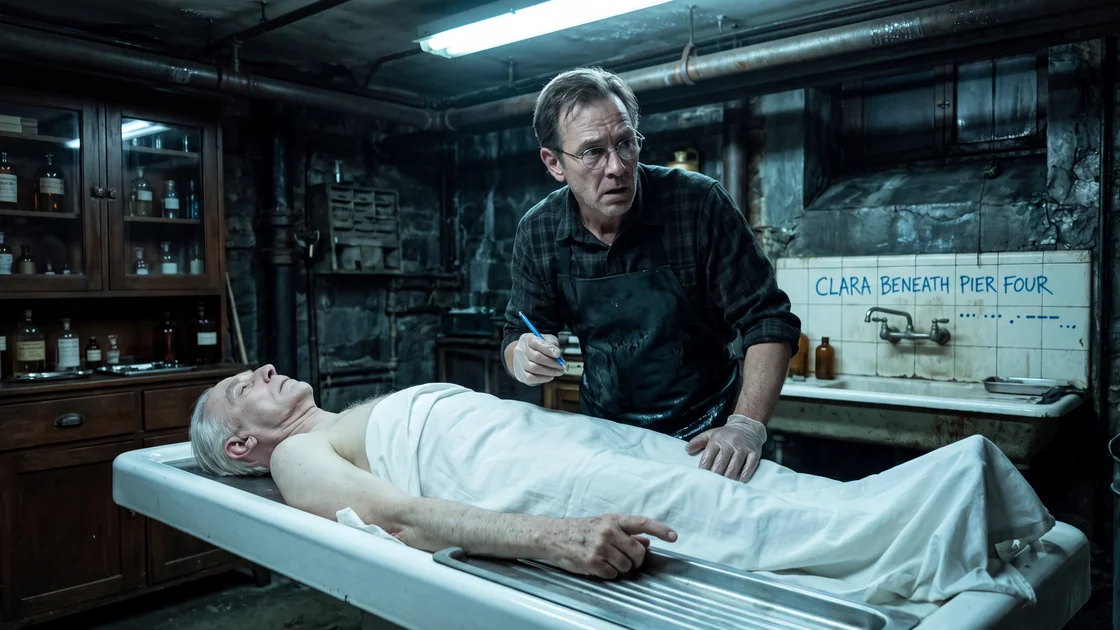
When Arthur Phelan, the solitary mortician of Blackwood Basin, receives the corpse of Mayor Thaddeus Vance—the town’s revered patriarch who supposedly died of a quiet midnight heart attack—he expects an ordinary embalming procedure, only to discover that Vance’s resolving rigor mortis is accompanied by rhythmic, non-random neuromuscular spasms. As Arthur observes the systematic twitching of the dead man’s fingers and facial muscles, he decodes the cadence as a forgotten telegraphic cipher, unlocking a harrowing sequence of deathbed confessions that implicate the town’s ruling elite in historic murders, industrial sabotage, and Vance's own patricidal poisoning. Caught between his duty to the dead and the lethal living conspirators who want the casket sealed forever, Arthur must risk his own life to transcribe the cadaver’s final testimony before the flesh turns permanently cold.
Chapter I: The Architecture of Silence
The embalming suite of Phelan & Sons Mortuary sat seven feet below the water table, cradled in the damp slate of Blackwood Basin. It smelled reliably of glutaraldehyde, damp masonry, and the sharp, wintergreen tang of arterial perfuming agents—a chemical bouquet Arthur Phelan had inhaled since his sixteenth year. To Arthur, now fifty-two, silence was not merely the absence of sound; it was an architecture. It had load-bearing pillars of cedar cabinetry, vaulted rafters of cast-iron plumbing, and an invisible mortar mixed from the ceased respirations of three generations of townspeople.
He knew how the dead behaved. They settled. They lost their moisture to the basement air. Their viscera cooled at a predictable rate of one and a half degrees Fahrenheit per hour, assuming an ambient room temperature of sixty-five degrees. Their cellular membranes ruptured, their tissues softened, and eventually, the stubborn stiffness of actin-myosin cross-linking surrendered to the quiet rot of autolysis.
The dead did not fidget. They did not tap their fingers. They certainly did not speak.
Yet on the fourth of November, at twenty minutes past midnight, Mayor Thaddeus Vance lay upon the porcelain-enameled preparation table, doing something that made Arthur step back so abruptly his rubber apron slapped against his heavy wool trousers.
The left hand of the mayor—broad, age-spotted, and calloused from decades of ceremonial ribbon-cuttings and firm political handshakes—lay supine along the grooved runoff channel of the table. The index finger lifted precisely three-eighths of an inch, tapped the enameled metal with a clean, dry tock, paused, lifted again, tapped twice in rapid succession, and fell still.
Arthur held his breath. In his right hand, he held an aneurysm needle; in his left, a length of waxed linen ligature. The fluorescent tube overhead hummed at sixty cycles per second, casting an unvarnished blue pallor over Vance’s naked torso.
"Fasciculation," Arthur whispered aloud, the sound of his own voice strange in the cavernous room. "Terminal motor-unit discharge. Agonal spinal arc."
It was a sensible, rational diagnosis. Even hours after somatic death, isolated clusters of motor neurons can fire as intracellular calcium leaks into depleted sarcomeres. Every mortician encountered it once or twice in a career: a sigh from an unemptied trachea, a sudden twitch of the sartorius muscle in the thigh, a slow curling of the toes as the body settled into the cold finality of chemical preservation.
Arthur stepped forward again, adjusting the wire-rimmed spectacles on his nose. He reached out with two gloved fingers to palpate the radial artery at Vance’s wrist. The skin was clammy, exhibiting the early doughy consistency of primary flaccidity; the rigor mortis that had locked the jaw and shoulders upon his arrival at ten o’clock had begun to give way under the influence of the warm humectant pre-injection wash Arthur had introduced through the right common carotid.
Then the hand moved again.
Tock.
A beat of three seconds.
Tock. Tock. Tock.
A beat of one second.
Tock.
Arthur froze. He had grown up in the valley when the Great Western Telegraph still maintained a live brass key at the railway depot; his grandfather had been an operator before buying the mortuary from the county coroner in 1938. Arthur had spent long summer afternoons as a boy listening to the chattering relays, translating the arrivals of coal wagons, timber manifests, and distant tragedies into the dot-and-dash grammar of the American Morse code.
The rhythm he had just witnessed was not the chaotic, arrhythmic fibrillating of decaying nerve tissue. It had intervals. It possessed an intentional, measured duration.
Dot. Dash-dash-dash. Dot.
E. O. E.
Nonsense. An accidental sequence born of random ionic transfers within the dying peripheral nervous system. Arthur shook his head, angry at his own imagination. Thaddeus Vance was dead. He had been pronounced dead at nine-fifteen that evening at his lakeside manor by Dr. Kenneth Arbuthnot: massive myocardial infarction, secondary to advanced atherosclerotic cardiovascular disease. The death certificate was already signed and resting in the brass tray beside the office telephone upstairs. The town of Blackwood Basin was already lowering its municipal flags to half-mast.
Arthur set down the aneurysm needle, picked up his scalpel, and prepared to raise the right femoral artery to ensure even distribution of the fluid to the lower extremities.
Under the harsh overhead light, the mayor’s face was a study in ruined authority. At seventy-one, Vance had possessed the kind of face that demanded oil portraiture: an aquiline nose broken in his youth at the naval academy, heavy hooded eyes, and a mouth that had dictated the economic destiny of the valley for forty-two years. He had owned the limestone quarries, the regional water authority, and three-quarters of the town council.
Arthur brought the blade to the skin of the right inguinal crease.
The mayor’s left hand struck the table again.
Tock-tock-tock. Pause. Tock. Pause. Tock-tock. Pause. Tock-tock-tock.
Arthur did not cut. His heart gave a hard, hollow thud against his ribs. He stood motionless, his eyes riveted to the dead man's blanched fingernails.
Three short. One short. Two short. Three short.
S. E. I. S.
No. The spaces were wrong. Arthur tilted his head, playing the acoustic memory back in his mind.
Three short: S. A longer silence. A single short: E. A short and a long? No, the finger had remained elevated for a fraction of a second before descending—a held contraction. Dash-dot-dash-dot.
Arthur reached for a grease pencil from the instrument tray. With hands that were suddenly no longer entirely steady, he scrawled the characters directly onto the white tile of the backsplash behind the sink.
C - L - A - R - A
The breath left Arthur’s lungs in a cold hiss.
The room went absolute, terrifyingly still. The only sound was the drip of water from the secondary rinse line into the waste drain and the low, droning hum of the refrigerated holding vault behind the stairs.
Clara.
There had not been a Clara spoken of in Blackwood Basin in thirty-five years. Not since the autumn Clara Finch, the daughter of the local newspaper editor, had vanished from the edge of the quarry woods, leaving behind only an abandoned bicycle with a warped front wheel and a town plunged into decades of whispered suspicion.
Chapter II: The Reflexive Tongue
Arthur Phelan was not a superstitious man. He did not believe in wandering wraiths, nor did he credit the folklore of the local hill families who claimed that a man’s sins kept his marrow warm three days after his breath departed. Arthur believed in chemistry, in the physical mechanics of systemic circulation, and in the inexorable laws of entropy.
Yet as he leaned over Mayor Vance, he observed something that defied every chapter of his standard manuals on mortuary science.
The spasms were not confined to the flexor digitorum of the left forearm. Beneath the parchment skin of the mayor’s throat, along the sternocleidomastoid muscle, a rhythmic, thread-like pulse was visible. It was not a vascular pulse; there was no hemodynamic pressure, no beating ventricle. It was an electrical flutter, a twitching of the platysma that pulled the corner of Vance’s pale lower lip down and to the left in a repetitive tic.
Short. Short. Short. Long. Long. Long. Short. Short. Short.
S - O - S.
"Good God," Arthur whispered.
He dropped the scalpel. It fell into the porcelain trough with a loud, clattering chime that seemed to ring throughout the entire stone foundation of the building.
Arthur seized the mayor’s shoulders. The flesh was cold, dense, and lifeless. There was no warmth, no breath, no pupillary response to the pocket penlight he dragged across the cloudy corneas. The pupils were fixed, dilated to seven millimeters, showing the dull, milky glaze of corneal dehydration. The thoracic cavity was completely still; Vance’s lungs were collapsed sacks of dead tissue.
"Thaddeus?" Arthur called out, his voice cracking. It was the first time in thirty years he had addressed the mayor by his given name rather than his title. "Thaddeus, can you hear me?"
No answer. Only the mechanical, insectoid twitch of the lips.
Tock.
The finger resumed. It was striking the table with a renewed, frantic vigor, the tendon standing out against the back of the hand like a taut cello string.
B - E - N - E - A - T - H
Arthur frantically copied the letters down with the blue grease pencil.
P - I - E - R
F - O - U - R
The finger ceased. The hand slumped sideways, the palm curling upward like a dying leaf. The platysma muscle in the neck settled into stillness. The room returned to its dense, claustrophobic quiet.
Arthur stood hunched over the porcelain slab, his chest heaving as if he had been running up the shale bluffs outside. The cold grease pencil shook between his index and middle fingers. On the tile, in thick, waxy blue script, the message stared back at him:
C L A R A B E N E A T H P I E R F O U R
Pier Four was not part of the pleasure docks at the lake. Pier Four was the massive, reinforced concrete foundation of the Blackwood Basin Hydroelectric Dam, constructed in 1988 under the direct personal supervision of Mayor Vance’s private engineering firm. Arthur remembered the construction well; the town had celebrated it with a parade. The dam had tamed the Blackwood River, drowned the old lower valley orchards, and provided Vance with the political leverage to dominate county politics for the rest of his life.
Clara Finch had vanished in October of 1987. Six months before the first concrete pour.
Arthur stepped back, pulling off his latex gloves. The rubber snapped against his wrists, the sound sharp as a pistol crack in the silence of the morgue. His mind raced through every rational explanation.
It is impossible, he told himself. The brain dies within six minutes of cardiac arrest. Without oxygen, adenosine triphosphate depletes; ion pumps fail; neurons depolarize irreversibly. By four hours post-mortem, the cerebral cortex is a swamp of necrotic lysis. Even if the lower brainstem retained some bizarre, lingering capacity for rhythmic pacemaker firing, it cannot possess memory. It cannot compose syntax. It cannot confess.
Yet who else knew the telegrapher’s code?
Arthur remembered: during the Korean War, Thaddeus Vance had served as a naval communications officer aboard a destroyer escort in the Yellow Sea. It was an old point of pride; a framed commendation from the Department of the Navy hung on the wall of Vance’s mahogany-paneled study in the municipal building.
The dead man was not dreaming. He was discharging. It was as if some intense, unresolved electrical potential—a profound bioelectric charge coiled into the very architecture of his deep neurological pathways by decades of suppressed panic—was bleeding outward into the peripheral nerves as the dying cell membranes finally collapsed.
Arthur looked down at the trocar lying on the preparation table. Standard procedure dictated that he make an incision two inches above and two inches to the left of the umbilicus, insert the long, pointed steel aspirator into the peritoneal and pleural cavities, puncture the stomach, liver, and lungs, and draw off the visceral fluids before flooding the torso with thirty-two ounces of concentrated formaldehyde.
If he inserted the trocar, he would sever the phrenic and vagus nerves. He would puncture the thoracic sympathetic chain. He would extinguish whatever ghost was conducting its final business through the dead man’s sinews.
A heavy knock rattled the wooden entrance doors upstairs.
Chapter III: The Mourners at the Threshold
Arthur started violently. He looked at the antique regulator clock on the wall: twelve-forty-eight in the morning.
No one came to a mortuary at twelve-forty-eight unless they were the county coroner, the sheriff delivering a highway casualty, or someone who could not wait for the sun to rise to manage their interests.
Arthur tore off his rubber apron, threw it across the corner of the rinse sink, and pulled on a dark wool cardigan over his scrub shirt. He walked up the narrow oak stairs, each riser creaking under his weight with a familiar, grounding groan. He passed through the small viewing chapel—with its velvet drapes, its brass flower stands smelling faintly of stale carnations, and its framed prints of serene, indeterminate valleys—and reached the front vestibule.
Through the beveled glass of the front door, two silhouettes stood framed against the streetlights and the driving November rain. Both wore long, dark overcoats. Both wore broad-brimmed hats pulled low against the squall.
Arthur unlocked the deadbolt and drew the heavy oak door open three inches, checking it against the brass security chain.
"Yes?"
"Arthur. Open the door. It’s freezing out here."
The voice belonged to Julian Sterling, the Deputy Mayor and Vance’s hand-picked successor. Standing just behind his shoulder, his hands jammed deep into the pockets of a wet cashmere coat, was Gregory Vance, the late mayor’s only surviving son. Gregory was thirty-six, a thin, nervous man with his father’s hawkish nose but none of the old man’s iron balance; he had spent his twenties failing at commodity brokerages in Chicago before returning home to live off the family’s real estate holdings.
Arthur hesitated, then unlatched the chain and swung the door inward.
"Mr. Sterling. Gregory. It’s nearly one in the morning."
"We saw the basement lights through the grating," Julian Sterling said, stepping inside without wiping his wet wingtips on the horsehair mat. He removed his fedora and shook a spray of rain onto the parquet floor. Sterling was a compact, fastidious man in his late fifties, with silver hair clipped so tight it exposed the red, weathered skin of his scalp. He had the cold, evaluating stare of an insurance actuary who had transitioned successfully into municipal finance. "We need to speak with you about the arrangements."
"The viewing isn't scheduled until Thursday afternoon," Arthur said, remaining in the entryway, blocking the double doors that led toward the basement stairs. "Per the instructions your father left in his pre-need file, Gregory. A standard visitation, followed by a service at St. Jude’s, and interment in the family crypt at Mountain View."
Gregory did not look at Arthur. His eyes were darting around the dim foyer, lingering on the velvet curtains of the chapel, the brass registry stand, the umbrella rack. He looked ghastly; his skin had the yellowish, waxy hue of a man who had not slept in three days, and his collar was open at the throat, missing a button.
"The plans have changed, Phelan," Sterling said smoothly. He pulled a pigskin document wallet from the breast pocket of his coat. "The family—Gregory, that is—has decided that an open-casket service is inappropriate. The mayor was a private man, ultimately. He worked for the public, but his mortal remains belong to his kin. We want him closed-casket. In fact, we want the preparation curtailed."
Arthur frowned. "Curtailed? I have already raised the carotid. The pre-injection is complete."
Gregory made a strange, choking sound in his throat and turned his back, staring out the front door’s glass at the rain-lashed street.
"What Gregory means," Sterling continued, his voice dropping into a lower, more conspiratorial register, "is that we see no need for a lengthy preservation. We’ve secured an expedited burial permit from Judge Halvorsen. The interment will take place tomorrow afternoon. At two."
"Tomorrow?" Arthur’s voice carried an uncharacteristic edge. "The grave isn’t even dug. The cemetery superintendent won't have the backhoe out in this weather without forty-eight hours' notice. The ground at Mountain View is half clay."
"The backhoe is already at the cemetery," Sterling replied flatly. "I had the road department send a crew up an hour ago. They’re digging under floodlights right now."
Arthur looked from Sterling’s flat, grey eyes to Gregory’s hunched, trembling shoulders. There was a frantic, brittle urgency in the air that did not belong to grief. When families grieved, they moved through molasses; they forgot the names of hymns; they stared at casket swatch-books for forty minutes without turning a page. They did not mobilize municipal road crews to excavate shale in a midnight rainstorm.
"The arterial injection is only half-finished," Arthur said carefully, choosing each syllable with deliberate precision. "If I do not complete the cavity treatment and allow the arterial fluid to fix the deep tissues, the body will purge. Gas will build up within thirty-six hours. Even in a sealed copper casket, the integrity of the remains—"
"We don't give a damn about the integrity of the remains, Arthur," Gregory spat out suddenly, wheeling around. His eyes were bloodshot, the pupils dilated wide despite the vestibule’s light. "Put him in the box. Screw the lid down. That’s all you have to do. Why does it take you people so goddamn long to put meat in the dirt?"
"Gregory," Sterling said softly. It was not a comfort; it was a leash.
Gregory shut his mouth, though his chest continued to heave. He looked down at the floor, grinding his teeth with an audible, rhythmic click.
"You'll be paid your full fee, of course," Sterling said, reaching into the pigskin wallet and extracting a check, already drawn on the Vance Family Trust, made out to Phelan & Sons. The sum was three times Arthur’s standard charge for a top-tier embalming and cathedral casket. "More than full. We appreciate your discretion in this, Arthur. The town is in shock. A prolonged period of public mourning will only disrupt the upcoming referendum on the valley water rights. We need stability. We need Thaddeus laid to rest."
Arthur looked at the check. The ink was still fresh enough to reflect the overhead bulb. The signature was Gregory’s, but the neat, cramped numerals of the amount had been entered in Julian Sterling’s hand.
"I need until dawn," Arthur said.
Sterling’s eyes narrowed. "Why?"
"Because the legal permit requires that the cavity aspiration be certified to prevent biohazard leakage during transport," Arthur lied smoothly, drawing upon an obscure, rarely enforced 1962 county ordinance he doubted Sterling had ever read. "If I release an improperly stabilized body and the casket leaks on the church steps, the state board will revoke my license before sunset. I will finish the preservation tonight. You can have him at noon tomorrow."
Sterling stared at Arthur for a long, silent measure. Outside, a truck rattled past on the wet asphalt, its headlights casting sweeping, rib-like shadows through the mortuary’s front windows.
"Twelve o'clock, Arthur," Sterling said, his voice dropping all pretension of warmth. "Not twelve-fifteen. We will have the hearse from the county livery pick him up. You don't even need to drive. Just have him dressed, locked, and wheeled into the garage."
"Understood," Arthur said.
Sterling touched the brim of his hat with a gloved finger. "A good night to you, Arthur. Don't work yourself to death."
The two men stepped back out into the rain. Arthur waited until their headlights swept away from the curb and the sound of the engine died down toward the lake road before he turned the deadbolt, fastened the chain, and walked back down into the basement.
Chapter IV: The River of Salt
In the mortuary basement, Mayor Thaddeus Vance had moved.
It was not a subtle change. His right arm, which Arthur had left neatly folded across his lower abdomen, had slipped from the torso and now hung straight down over the edge of the porcelain table. The fingers were not twitching; they were curled into a rigid, claw-like grip around the lip of the zinc wash-trough.
Arthur ran to the side of the table. He grabbed the wrist, intending to wrench it back, but the muscles were locked in a profound, stone-hard contracture. This was not the doughy resistance of early rigor mortis; it was an active, violent tetany. The flexor tendons stood out like thick cords of hemp.
"What are you holding?" Arthur whispered, his heart hammering against his ribs.
Then the chest began to move.
It was impossible. Arthur had severed the right common carotid and opened the jugular vein; a pint of diluted blood had already drained into the chemical sump beneath the table. The lungs had no air. Yet the intercostal muscles between Vance’s ribs were contracting in an alternating, rolling sequence that lifted and dropped the sternum with a dry, papery rattle.
Click-shhh. Click-shhh.
Arthur watched, paralyzed by an unholy mixture of scientific fascination and creeping dread. The movements were not random. The contractions traveled from the third intercostal space down to the seventh, then jumped to the pectoralis major.
Dots and dashes. The body was no longer relying on a single finger. The entire muscular armature of the corpse was becoming an organ of transcription.
Arthur grabbed the grease pencil from the floor and flipped open his mortuary ledger to the blank back pages.
D - R - A - N - K
The chest paused. A long, shuddering spasm rippled across the abdominal wall—the rectus abdominis contracting in three distinct, violent twitches.
A - R - S - E - N - I - C
Arthur’s hand stopped. The pencil lead snapped against the heavy rag paper.
"Arsenic?" Arthur spoke to the empty room. "He died of a coronary."
Dr. Arbuthnot had signed the certificate: Acute coronary occlusion. Vance had collapsed in his library after his customary evening glass of port. Gregory had found him slumped across his walnut desk. The doctor had been called, had observed the cyanotic lips, the age of the patient, the long history of hypertension, and had signed the paper without a second thought. There had been no autopsy. In Blackwood Basin, one did not perform an autopsy on the man who built the hospital unless there was a bullet hole in his forehead.
The dead man’s jaw began to work.
The temporomandibular joint, which Arthur had manually freed from its initial stiffness an hour before, began to snap shut with the rhythmic precision of a steel trap. The teeth—heavy, yellowed porcelain crowns—clicked together with a sharp, sickening resonance.
C - U - P
G - R - E - G - O - R - Y
A - N - D
S - T - E - R - L - I - N - G
Arthur backed away until his shoulders struck the cold concrete wall behind him. The grease pencil fell from his fingers, rolling into the floor drain with a small, hollow splash.
The son and the successor.
The memory of Gregory’s yellow, sweat-slicked face in the vestibule flashed before Arthur’s mind: his frantic eyes, the way he ground his teeth, his terror of the basement, his demand that the casket be screwed shut immediately. And Julian Sterling—cold, calculating, holding an expedited burial permit signed by a compliant circuit judge at midnight, with a county backhoe already tearing through the mud at Mountain View Cemetery.
They hadn't come to grieve. They had come to ensure the furnace was ready. They had wanted him buried before the tissues began to break down, before any rogue physician or suspicious relative noticed the telltale gastric burning, the characteristic garlic odor of trioxide, or the strange, persistent electrical fury of a central nervous system dying from heavy metal toxicity.
Arsenic, Arthur thought, his professional mind turning over the toxicology he had studied thirty years ago at the Gupton-Jones College of Mortuary Science. Arsenic binds to sulfhydryl groups in proteins. It inhibits pyruvate dehydrogenase. It halts cellular respiration, but more importantly, it causes extreme, widespread neurological irritation. In massive, acute doses, it leads to violent peripheral neuropathy, profound motor excitability, and terminal convulsions.
Could a lethal dose leave the deep neuromuscular junctions so super-saturated with acetylcholine, so hyper-polarized, that the dying spinal cord continued to discharge structured memory patterns long after the cerebral hemisphere had gone dark? Or was something else happening—something that medicine had no names for, something where the sheer, concentrated malevolence and guilt of a dying tyrant refused to be silenced by the cessation of his pulse?
The teeth clicked once more. A single, long closure.
A dash.
Then Vance’s face went limp. The jaw dropped open, exposing the pale, dry tongue. The intercostal spasms ceased. The hand gripping the rim of the zinc tray relaxed, the fingers uncurling one by one until they dangled limp and gray above the drain.
The basement returned to silence.
Arthur stood pinned against the wall, his breath coming in shallow, ragged gasps. The clock read one-fifteen. He had ten hours and forty-five minutes before the county livery came to take the body to the clay pits of Mountain View.
Ten hours to decide whether he was an undertaker or a witness.
Chapter V: The Pier
The rain had turned into a sleet that coated the asphalt of River Road in a skin of gray grease.
Arthur Phelan drove his 1978 Buick Estate wagon with the headlights switched to low beams. The old car groaned as it climbed the winding grade that led out of the valley basin toward the high concrete wall of the Blackwood Hydroelectric Project. In the back of the wagon, nestled among wool furniture blankets, lay an empty pine transfer box, a heavy iron crowbar, two five-gallon utility buckets, and an electric inspection lantern powered by a six-volt dry-cell battery.
He had left the mortuary locked from the inside, slipping out through the coal chute that opened onto the rear alley. Mayor Vance’s body remained on the preparation table, covered by a white percale sheet, the carotid cannula still inserted, its rubber feed tube clamped with a brass hemostat.
Arthur knew he was committing professional suicide. If Sterling found out he had left the mortuary without finishing the embalming, the license would be the least of his losses. In a town like Blackwood Basin, men who crossed the Vance family did not lose their businesses; their wood-frame properties simply suffered chimney fires in the dead of February, or their cars slid through rotted guardrails into the deep limestone cuts along the gorge.
The road ended at the security gates of the reservoir. A rusted chain-link fence topped with three strands of angled barbed wire stretched into the hemlock scrub on either side. A yellow painted sign, chipped and streaked with rust, read:
U.S. CORPS OF ENGINEERS / BLACKWOOD BASIN WATER
AUTHORITY
STRICTLY CONFIDENTIAL - NO TRESPASSING
Arthur killed the Buick’s engine. The only sound was the drumming of sleet on the steel roof and the distant, deep-throated rumble of the spillway two miles to the west—thousands of tons of dark river water plunging through the concrete sluices into the gorge below.
He pulled on a heavy oiled-canvas coat, took the lantern and the crowbar, and stepped out into the biting wind. The cold cut through his trousers instantly, freezing the damp mortuary smell out of his wool socks.
He knew where Pier Four was. Every boy who had fished the Blackwood River before the valley was flooded knew the old riverbed’s geography. Pier Four was not set into the deep water of the primary reservoir; it was the easternmost abutment, anchored into the limestone bluff where the river made its sharp southern dog-leg. During the construction in '88, they had diverted the stream through a timber flume for six months while they sank the caissons for Pier Four through seventy feet of alluvial silt down to the bedrock.
Arthur skirted the fence line, walking through the wet rhododendrons until he found the place where the creek erosion had hollowed out a run beneath the galvanized mesh. He dropped to his knees, pushed the crowbar and lantern through, and crawled on his belly through the freezing mud, ignoring the cold slime that soaked into his chest.
On the other side, the maintenance road was overgrown with sumac and wild blackberry canes. He kept the lantern low, hooded beneath the hem of his coat, casting only a circular pool of amber light across the cracked tarmac.
Five minutes of walking brought him to the crest of the abutment.
Below him, the concrete wall fell away into the dark like the prow of a buried battleship. A metal cat-ladder, slick with ice and river spray, dropped down the sheer face of the pier toward a dry drainage gallery thirty feet below the present lake level.
Arthur did not like heights. Even the hydraulic lift he used to place caskets into the third tier of the municipal mausoleum gave him vertigo. But he gripped the iron rungs with his gloved hands, tucked the crowbar through his belt, and began the descent.
The wind off the reservoir smelled of dead vegetation, cold mud, and wet limestone. With every rung, the roar of the water grew louder, vibrating through the iron bolts set into the concrete. His boots slipped twice on the slimy green algae that grew wherever the spray touched the wall, but he held on until his feet struck the concrete grating of the lower inspection platform.
Here, tucked behind the massive curved breastwall of the pier, was a low maintenance portal—an opening five feet high, closed with a heavy cast-iron door that had not been painted since the Reagan administration.
Arthur approached the door. A brass padlock hung from the hasp, thick with green verdigris.
He did not need the key. The latch had not been thrown completely when the lock was clicked shut; thirty years of freeze-and-thaw cycles had buckled the frame, tearing the mounting bolts out of the rotten mortar. Arthur jammed the chiseled end of the crowbar behind the hinge plate and threw his weight against it.
With a shriek of tearing metal that was drowned by the roar of the spillway, the screws tore free. The door swung open six inches, releasing an air that made Arthur recoil.
It did not smell like the mortuary. It smelled like a crypt that had been flooded, dried, and flooded again: the dense, suffocating odor of stale river silt, moldering wood, and calcium carbonate leaching from curing cement.
Arthur switched on the lantern and raised it high.
The beam cut through a forest of rusted scaffolding pipes left behind by the pouring crews forty years ago. The gallery was seventy feet long, a narrow, dead-end vault running parallel to the old river bluff. Water dripped from the ceiling stalactites with a steady, metronomic plink-plink-plink.
Arthur walked down the center of the gallery, his rubber boots splashing through puddles of alkaline runoff that burned his nostrils with a sharp, lime-dust tang.
He reached the end of the vault.
Here, where the concrete abutment met the original limestone face of the cliff, the construction crews had filled an exploratory fissure with low-grade aggregate before capping it with a six-inch protective skin of gunite.
In the center of the wall, roughly four feet above the floor, the concrete skin had been patched. The patch was amateurish—rough, uneven, smoothed with a garden trowel rather than an industrial screed. Scratched into the wet mortar before it had hardened were four numbers:
1 0 8 7
October 1987.
Arthur raised the crowbar. He was fifty-two years old, his back stiff from lifting two-hundred-pound cadavers into mahogany vaults, but his arms were roped with the sinew of a man who worked with his hands every day of his life.
He struck the center of the patch.
The steel point bit into the soft, lime-rich mortar with a dull, hollow chuff. A saucer-sized scab of concrete fell away, hitting the floor with a wet thud. Behind it lay not aggregate gravel, but a layer of rotted gray plastic sheeting—the kind used by commercial landscapers.
Arthur jammed the crowbar in again, twisting the blade, ripping the plastic aside.
The lantern light flickered across what lay within the void.
It was not a skeleton—not yet. In the sealed, anaerobic, calcium-rich environment of the masonry pocket, the process of decay had taken a different, more terrible course. The body had undergone saponification. The fats of the subcutaneous tissue had converted into a hard, grayish-white substance that resembled tallow or cheap laundry soap.
The face was preserved in a grotesque, chalky mask. The hair was still there—long, dark auburn, tangled with the rotted fibers of a wool sweater. Around the neck, embedded deeply into the hardened, soap-like flesh of the throat, was a yellow plastic-coated wire.
A telegraph jumper cable. The kind used in naval switchboards.
Arthur stepped back, the crowbar slipping from his numb fingers and clattering to the floor. The bile rose into his throat, hot and sour, and he had to drop to his knees and press his forehead against the cold concrete until the room stopped spinning.
Clara Finch had not run away to New York. She had not fallen into the river. She had been strangled with thirty inches of military-surplus wire, shoved into the exploratory fissure behind Pier Four, and sealed behind six hundred pounds of Portland cement by the man who owned the project, the town, and the river itself.
And for thirty-six years, Mayor Thaddeus Vance had walked across the crest of that dam every Fourth of July, waving to the high school marching band, standing directly above the hollow where his first secret was slowly turning to soap.
Arthur reached out with a trembling hand, retrieved his lantern, and turned back toward the ladder.
He had four hours until dawn.
Chapter VI: The Chemistry of the Dead
When Arthur returned to the basement of the mortuary, the air had grown perceptibly colder. The furnace in the corner had kicked off, its pilot light smothered by a downdraft from the chimney.
He did not relight it. The cold was an ally now; it slowed the autolysis. It kept the tissues firm.
He walked to the preparation table and drew back the sheet.
Mayor Vance looked smaller now. The initial swelling of the tissues had subsided as the fluids drained through the opened vein, leaving his facial features sharper, more predatory. His lips had drawn back slightly from his dentures, giving his mouth the faint, frozen suggestion of a snarling dog.
Arthur did not look at the face. He went to the supply cabinet, unlocked the bottom iron drawer, and removed an amber glass bottle labeled Sodium Formaldehyde Sulfoxylate—a chemical agent used to neutralize heavy metal compounds in industrial embalming—and two sterile fifty-milliliter glass syringes with twelve-gauge aspiration needles.
If he was going to accuse the Deputy Mayor and the dead man’s son of murder, he could not rely on the twitching of a corpse’s finger. A court of law did not accept telegraphic messages from dead men. Judge Halvorsen would have Arthur committed to the state asylum at Warm Springs before noon if he walked into the courthouse with a grease-pencil transcript.
He needed the chemistry.
Arthur inserted the long needle through the right intercostal space, pushing it deep into the inferior lobe of the liver. He drew back the plunger. The syringe filled with a thick, dark, purplish fluid—visceral aspirate, rich in hepatic enzymes and whatever toxins the organ had filtered during Vance’s final twelve hours of agony.
He withdrew the needle, wiped it with an alcohol swab, and transferred the fluid into three airtight glass specimen vials. He labeled each one with the date, the time (03:42 AM), and the name: VANCE, THADDEUS - HEPATIC SPECIMEN.
As he sealed the third vial, the corpse’s right leg jerked.
It was a violent, upward spasm that caused the heel to strike the porcelain table with a sound like a pistol shot.
Arthur didn't jump this time. He moved to the side of the table, his grease pencil ready, his notebook open. The fear had burned out of him, replaced by a cold, clinical fury that felt as sterile as the instruments on his tray.
"I’m listening," Arthur said to the corpse.
The twitching moved to the left shoulder, the deltoid pulsing in rapid, irregular bursts. Then the hand took up the cadence again, striking the zinc edge with a force that chipped the white enamel.
P - E - N - S - I - O - N
Pause.
M - I - N - E
S - E - V - E - N
Arthur wrote. His pencil flew across the blue lines of the ledger.
Mine Seven had been the site of the 1968 cave-in that had killed fourteen men from the lower basin. The company had claimed it was an act of God—an unforeseen shift in the limestone fault. The miners’ pension fund, which held three million dollars in post-war scrip, had mysteriously disappeared into an offshore investment syndicate six months after the disaster, leaving the widows to clean the county offices and wash laundry for fifty cents a bushel.
N - O - T
S - H - I - F - T
The finger hit the table twice, hard.
D - Y - N - A - M - I - T - E
Arthur paused, his pencil hovering an inch above the page. "Dynamite?" he muttered. "You blew the shaft?"
The cadaver’s neck flexed. The head lifted nearly an inch off the rubber headrest, the neck muscles straining with such catastrophic tension that Arthur heard the cervical vertebrae pop against one another like dry twigs. The cloudy, fixed eyes stared directly at the ceiling, unblinking, dead, yet filled with an impossible, horrific physical strain.
C - A - L - L - O - W
The head slammed back down onto the rubber block.
Callow.
Chief of Police Roy Callow. In 1968, Callow had been a young sergeant, the man who had secured the perimeter of Mine Seven, who had kept the weeping families behind the timber barricades, who had gathered the shift manifests from the foreman’s shack before the state inspectors could arrive from the capital.
The entire valley was not a community; it was a slaughterhouse with a municipal charter. Every road, every bridge, every dam, and every municipal election had been paved with the bones of people who had asked the wrong questions, financed by money stolen from dead miners, and cemented with the silences Thaddeus Vance had bought with his checks and enforced with his badge-wearing dogs.
And now, the men who had helped him build this empire of shale and blood were standing in the vestibule with a burial permit, waiting to throw six feet of mountain mud over the only mouth that knew where all the wires were buried.
The dead man’s hand did not stop. It was moving continuously now, the skin over the knuckles turning bruised and purplish from the repeated impacts against the zinc. The rhythm was speeding up, the Morse code becoming slurred, the dots and dashes running together like the speech of a stroke victim:
T - H - E - Y - A - R - E - C - O - M - I - N - G
Arthur froze.
He looked down at the letters he had just scrawled.
T H E Y A R E C O M I N G
The ledger fell from his hand.
Upstairs, the heavy oak door of the mortuary rattled. Then came the sound of a key slipping into the lock—not the front lock, which was secured by the inside chain, but the side carriage entrance that led through the display room.
A key Arthur had not given to anyone. A key that belonged to the building’s deed-holder.
The Vance Estate.
Chapter VII: The Night Visitation
Arthur did not turn off the basement lights. To do so would announce that he was awake, down here, and waiting.
Instead, he moved with the swift, silent efficiency that twenty-five years of working alone in a basement had taught him. He snatched the specimen vials from the tray, slipped them into the deep interior pocket of his canvas coat, and threw the grease-penciled ledger behind a stack of folded burial shrouds on the bottom shelf of the linen cabinet.
He picked up the scalpel. It was an ordinary No. 4 surgical handle fitted with a broad, curved No. 22 carbon steel blade—a tool meant for cutting through tough, leathery dermal tissues, not for defense. He slipped it into his right sleeve, the cold steel resting flat against his forearm.
The footsteps above were not hurried. They were measured, heavy, and familiar with the layout of the floorboards. Two men. One walked with the light, shuffling tread of someone whose shoes were too expensive for the rain; the other had the slow, heel-first stomp of a man who wore regulation service boots.
Julian Sterling. And Chief Roy Callow.
Arthur moved to the preparation table. He seized the trocar—sixteen inches of hollow, nickel-plated cold-rolled steel, ending in a sharp, triangular three-sided point designed to pierce the muscular wall of an abdomen like cardboard. He left it lying on the white sheet across the mayor’s pelvic bone, half-concealed beneath the fold of the cotton cloth.
The basement door at the top of the stairs clicked open.
The light from the stairwell cast a long, narrow rectangle down the wooden steps, terminating at Arthur’s feet. A shadow fell down the stairs, followed by the heavy smell of wet wool and cheap cigar smoke.
"Arthur?"
Chief Callow’s voice was like gravel being turned with a dry shovel. He was sixty, broad-bellied, with a neck that spilled out over his uniform collar like dough over a bread pan. He kept his right hand resting casually on the butt of his service revolver, his thumb looped over the leather strap of his holster.
Behind him came Julian Sterling. Sterling had changed his coat; he now wore a dark rubberized trench coat that glistened with street water. His face was pale, tight, and completely devoid of the polite condescension he had displayed three hours before.
"You’re working late, Arthur," Sterling said, descending the stairs one step at a time, his eyes sweeping over the room—the sink, the chemical bottles, the drain, and finally, the body on the table.
Arthur did not move away from the slab. "I told you I needed until dawn. A proper preservation cannot be rushed. The family deserves—"
"The family is sitting in my Lincoln across the street, drinking scotch from a flask and trying not to lose his mind," Sterling interrupted, his voice flat and level. He reached the bottom of the stairs and stopped four paces from Arthur. He didn't look at the dead man; he kept his eyes locked on Arthur’s hands. "Gregory is an idiot. He always has been. He thought you’d simply pour a gallon of fluid down the old man’s throat, nail the lid shut, and take the check."
"I am a licensed practitioner, Julian," Arthur said, keeping his voice as low and even as the hum of the refrigerator. "I don't nail lids shut on bodies that haven't been aspirated."
"Is that what you were doing at the reservoir, Arthur?"
The question was dropped into the room like a lump of lead into a bucket of water.
Arthur did not flinch. His hand, resting near the edge of the sheet, did not twitch. "I have no idea what you’re talking about."
"Old Man Miller called the station thirty minutes ago," Chief Callow said, stepping off the bottom riser and spreading his boots wide on the damp concrete. "Said he saw the Phelan wagon turning off River Road by the old construction cut. Said he saw a man with an electric lantern crawling under the fence like a dog."
Callow pulled his hand from his belt. He wasn't holding a gun; he was holding the crowbar Arthur had dropped in the gallery beneath Pier Four. The red clay of the reservoir bluff was still wet on the chiseled tip.
"You left this behind, Artie," the Chief said softly. "You shouldn't leave your tools lying around municipal property. Someone might trip over 'em."
Arthur looked at the crowbar. The steel was cold, dull, and smeared with thirty-year-old concrete dust.
"You knew," Arthur said.
Sterling sighed. He took a pair of tortoise-shell spectacles from his pocket, wiped the mist from the lenses with a silk handkerchief, and settled them on his narrow nose. "Of course we knew, Arthur. Who do you think helped him mix the cement? Gregory was twelve years old; he was at military camp in Virginia. It was Roy and me. We carried her down the cat-ladder in a timber sling."
"She was twenty-two," Arthur said. His voice was no longer a mortician’s voice; it was thin, brittle, and hollowed out by rage. "Her father died thinking she had run off with a salesman from Wheeling. He drank himself into an early grave in this very room."
"Her father was an agitator," Sterling replied calmly. "He was printing stories about the water bonds. He was going to wreck the financing for the dam. If the dam hadn't been built, Arthur, this valley would still be an Appalachian swamp with three sawmills and a seasonal gravel pit. Thaddeus Vance made this town. He made every paved road you drive on. He built the high school your niece graduated from. He built the hospital where your mother died."
"And Mine Seven?" Arthur asked, his eyes darting toward Callow. "Did he build that with the miners' pension scrip?"
Callow’s jaw tightened. The cigar moved from one corner of his mouth to the other with a wet, squelching sound. "You've been doing a lot of reading tonight, Artie. Who you been talking to?"
"To the mayor," Arthur said.
Sterling let out a single, dry bark of laughter. "The mayor is dead, Arthur. His heart blew out at nine o’clock. He’s a side of beef on a zinc tray."
"Then why are you here at four in the morning with a crowbar?"
Sterling’s smile faded. The thin line of his lips disappeared entirely into his pale face. He looked at Callow, then back at Arthur.
"Because Thaddeus was a sentimental old bastard," Sterling said. "In the last six months, he began to lose his nerve. He started talking about priests. He started talking about the state attorney general. He had a ledger, Arthur. A small, black leather notebook where he kept every date, every voucher number, every payment made to the inspection board since 1972."
Sterling took two steps forward, closing the distance until Arthur could smell the stale coffee and peppermint on his breath.
"We searched the manor house. It wasn't there. We searched his office at the municipal building. It wasn't there. The only place left is the safe behind the portraits in the library, and that was emptied two days ago." Sterling reached out and tapped the dead man’s chest with the tip of his umbrella. "Where did he put it, Arthur? Did he bring it with him? Did he have it on him when the ambulance brought him in?"
"There was nothing on the body," Arthur said. "A gold signet ring. A pocket watch. I gave them to Gregory three hours ago."
"Search the room, Roy," Sterling said, not taking his eyes off Arthur. "Check the cabinets. Check the furnace."
Callow nodded and began to move toward the linen cupboard—the very cupboard where the grease-penciled ledger lay hidden behind the cotton shrouds.
Arthur’s heart surged into his throat. If Callow moved those shrouds, he would see the blue writing. He would see his own name written in capital letters beneath the word DYNAMITE.
"He didn't hide it in a book," Arthur said loudly, his voice echoing off the stone walls.
Callow stopped, his hand resting on the latch of the cabinet door.
Sterling’s eyes narrowed. "What did you say?"
"He didn't use a book," Arthur repeated, his mind working with a desperate, feverish clarity. "Thaddeus Vance was a communications officer. He didn't leave paper trails. He knew paper could be found, could be burned, could be subpoenaed."
"Then where is it?"
Arthur looked down at the dead face of Mayor Vance. The lips were still parted. The porcelain teeth gleamed in the harsh fluorescent glare.
"He carried it in his head," Arthur said. "And he's still telling it."
Chapter VIII: The Last Transmission
Julian Sterling stared at Arthur for three seconds, his expression shifting from suspicion to disgust.
"You're insane," Sterling whispered. "The chemical fumes have rotted your brain, Phelan. You’ve spent too many years down here with the meat."
"Look at his hand," Arthur said.
Sterling didn't look. But Chief Callow, whose grandmother had been an old woman from the high ridges who believed in corpse-lights and the second sight, slowly turned his heavy head toward the table.
The mayor’s left hand was moving.
It was not a light tap this time. The finger was striking the zinc with the rhythmic, heavy authority of a gavel.
Tock. Tock. Tock.
Dash. Dash. Dash.
Callow took a step back from the cupboard, his boots scraping against the concrete. "Julian..."
"Shut up, Roy," Sterling snapped, though his own voice had lost its flat, iron certainty. He took a half-step toward the table, his eyes fixed on the gray, spotted fingers. "It’s a reflex. A muscular reaction to the injection. He told us himself—it’s just nerves."
Tock-tock. Pause. Tock. Pause. Tock-tock-tock.
The cadence was unmistakable. It was the same rhythm Vance had used when he had dictated his orders to the council floor: deliberate, arrogant, and rhythmic.
"What is that?" Callow’s voice was barely a whisper. "What is he doing with his hand, Julian?"
"He’s not doing anything," Sterling hissed. "He’s dead!"
"He's spelling your name, Julian," Arthur said.
The lie was bold, desperate, and delivered with the cold, absolute certainty of an undertaker reading a scripture.
"He’s spelling the account numbers for the First National Bank of Zurich," Arthur continued, stepping slightly to the side to give them a clear view of the hand. "The ones from the 1984 reservoir allocation. He’s been doing it since midnight. Every time the arterial wash passes through the brainstem, another circuit clears. He's been confessing everything, Julian. Clara. Mine Seven. The three hundred thousand from the bridge project."
Sterling’s face turned from gray to an ugly, mottled crimson. "You're lying. You're trying to save your skin."
"Listen to it," Arthur said, his voice dropping into a rhythmic, hypnotic cadence that matched the tapping of the dead finger. "Dash-dot-dash. C. Dot. A. Dash-dot-dot. L. Dash-dot-dot. L. He’s telling me who bought the dynamite from the Hercules Powder Works in June of '68. He's telling me who signed the delivery manifest with an X."
"Jesus Mary and Joseph," Callow whimpered. The big man was backing away toward the stairs now, his heavy face slack with a primal, superstitious terror that thirty years of carrying a badge could not touch. "He told us he burned those manifests, Julian. He told us the records went into the river!"
"Shut up, you coward!" Sterling lunged forward, not at Arthur, but at the table. He reached out with his bare hands, intending to grab the dead man’s wrist, to crush the fingers, to stop the tapping that was filling the basement with its dry, terrible click.
"Stop it!" Sterling screamed, his veneer of aristocratic composure shattering into a spray of hysterical rage. "Stop it, you old bastard! You're dead! You're in the ground!"
Sterling’s hand closed around Mayor Vance’s wrist.
What happened next was not recorded in any manual of pathology, nor could Arthur Phelan ever explain it through the known laws of biochemistry.
The corpse’s hand did not stop.
The moment Sterling’s warm, sweating fingers made contact with the cold, chemical-soaked skin of the wrist, the mayor’s fingers snapped shut.
They did not merely close; they clamped down with the full, catastrophic force of a terminal myotonia—a muscular spasm so absolute, so complete, that the fingernails cut through the wool of Sterling’s sleeve and bit directly into the meat of his forearm.
Sterling shrieked. It was a high, thin sound like a horse in a burning barn. He pulled back with all his weight, but the dead man’s grip was an iron vise. The fingers did not yield; the tendons were frozen ropes of locked protein.
"Get him off me!" Sterling screamed, thrashing against the side of the porcelain table, dragging the dead man’s shoulder halfway off the slab. "Roy! Cut him off! Cut his fingers!"
Callow pulled his revolver from its holster with a clumsy, shaking hand. "Julian—hold still—hold still!"
"Don't shoot, you idiot!" Sterling wailed, his eyes bulging as the dead man’s other arm—the right arm—began to rise from the sheet, drawn up by the same violent, sympathetic contraction. "Phelan! Unlock it! Use the knife!"
Arthur did not reach for the scalpel.
He reached for the trocar.
He seized the sixteen-inch steel shaft with both hands, stepped between Sterling and the table, and leveled the triangular point not at the dead man, but directly at Julian Sterling’s throat.
"The ledger," Arthur said, his voice terrifyingly calm amid the thrashing and the screams. "Where is the ledger, Julian?"
"There is no ledger!" Sterling sobbed, his heels slipping in the drainage water on the floor, his coat twisted around his shoulders as he tried to pry Vance’s stone-hard fingers from his arm with his free hand. "It was never a ledger! It was a recording! A wire recording from the office safe! Gregory has it—he has it in his coat!"
"Roy," Arthur said, not looking at the policeman. "Put the gun on the table."
Callow was weeping. The Chief of Police, who had watched fourteen men die in the dark at Mine Seven and had buried their names under thirty years of silence, was staring at the dead mayor’s face.
The mayor’s eyes were open.
The violent movement of the head had torn the delicate mucus adhesions that held the eyelids shut. The cloudy, white corneas were fixed on Sterling with a dull, vacant ferocity that belonged to the bottom of a pond.
Callow’s revolver slipped from his wet fingers. It fell onto the rubber mat with a dull, heavy thud.
"Take it," Callow whispered, his knees trembling so violently he had to lean against the stairs for support. "Take whatever you want, Artie. Just let him let go. For Christ's sake, let him let go."
Arthur stepped forward. He did not use the trocar on Sterling. He reached down, found the common extensor tendon on the back of Vance’s dead forearm, and drove the triangular point of the instrument through the wrist, severing the flexor carpi radialis with a single, brutal downward thrust.
The fingers sprang open.
Sterling fell backward onto the wet concrete floor, his arm bleeding where the dead man's nails had gouged four crescent-shaped troughs through his skin. He scrambled backward like a crab, his boots kicking against the empty chemical carboys, until his back hit the cold iron plates of the boiler.
The dead man’s arm fell back onto the table.
The hand struck the zinc once more.
Tock.
A single, final dot.
Then the platysma muscle in the throat collapsed. The jaw dropped open, resting against the hollow of the clavicle. A long, thin rattle of trapped air escaped the trachea with a sound like a distant dry reed in a November marsh.
And Thaddeus Vance was finally, completely, irreversibly silent.
Chapter IX: The Morning Light
The rain stopped at five-thirty in the morning, leaving the valley wrapped in a dense, river-bottom fog that smelled of wet shale and coal smoke.
When the blue-and-white cruisers of the State Police turned off the highway and rolled down the gravel drive of Phelan & Sons Mortuary, their red emergency lights did not flash; their sirens did not wail. They came in the gray, quiet dawn like an administrative necessity, four cars deep, their tires crunching softly on the wet cinders.
Captain Donald Mercer of the State Police Criminal Investigation Division walked down the basement stairs with his overcoat unbuttoned, his hat held in his hand out of an instinctive, professional respect for the dead.
He found Arthur Phelan sitting on a wooden stool beside the preparation table.
Arthur was wearing a clean white lab coat. His hands were scrubbed; his spectacles were clean. On the instrument tray beside him lay three sealed glass specimen vials, a reel of magnetic recording wire retrieved from the pocket of Gregory Vance’s overcoat, and sixty-two pages of transcription written in neat, funeral-director’s cursive in the back of an embalming ledger.
On the other side of the room, sitting on the bottom step of the stairs with their hands secured behind them with steel transport cuffs, were Julian Sterling and Chief Roy Callow. In the back of the first cruiser outside, Gregory Vance sat with his head between his knees, staring at the floorboards, whispering incoherently about arsenic and his father's study.
Captain Mercer looked at the body on the table.
Mayor Vance was neatly dressed. Arthur had spent the final two hours of the morning doing what he had been paid to do: he had closed the incision in the carotid with five neat baseball stitches; he had washed the dried blood from the wrists; he had dressed the old man in his navy-blue three-piece wool suit, his silk regimental tie, and had brushed his white hair back from his broad, patrician forehead.
The dead man looked peaceful. He looked like an elder statesman who had passed away in his sleep, surrounded by the gratitude of a prosperous valley and the love of an obedient son.
"You're sure about the arsenic, Arthur?" Mercer asked, his voice low, his eyes lingering on the specimen vials.
"The toxicologist at the state lab will find between twenty and thirty grains of white arsenic in the hepatic tissue," Arthur said evenly. "He will find it in the gastric lining. And if they exhume Clara Finch from behind Pier Four, they will find the naval wire that matches the spool in the municipal maintenance shop."
Mercer picked up the ledger. He turned the pages slowly, his thumb brushing against the waxy blue grease-pencil letters Arthur had transcribed before the ink ran:
P I E R F O U R
M I N E S E V E N
G R E G O R Y A N D S T E R L I N G
"And where did you get these details, Arthur?" Mercer asked, looking over the rims of his glasses at the mortician. "Some of these dates haven't been spoken in this county since I was a trooper in short sleeves."
Arthur did not look at Julian Sterling, who was staring at the floor with hollow, dead eyes. He did not look at Callow, who was quietly weeping into his sleeve.
He looked at the dead man’s hand, resting serene and motionless across the gold watch-chain on his vest.
"He told me," Arthur said simply.
Mercer stared at Arthur for a long, silent moment. Morticians were an odd breed; everyone in the department knew that. They lived too long in the dark; they breathed too much formaldehyde; they spent too many hours alone with the things other men spent their lives running from.
The captain closed the ledger and tucked it under his arm.
"The coroner’s van will be here in twenty minutes, Arthur," Mercer said. "They’ll take him to the capital for the post-mortem. We’ll need you to come down to the barracks at ten to sign the deposition."
"I have a service at two," Arthur said, his voice flat and routine. "Mrs. Crabtree. An eighty-four-year-old stroke. Her daughters want the rose-colored casket with the satin interior."
Mercer hesitated, then nodded. "Two o'clock will be fine, Arthur. We know where to find you."
The troopers led Sterling and Callow up the stairs. Their boots sounded hollow on the wood, a slow, retreating rhythm that ended with the slam of the upstairs screen door and the ignition of the cruiser engines outside.
Arthur remained on his stool.
The basement was cold again, but it was an ordinary cold now—the cold of November, of wet stone, of an old house that needed its furnace valves cleaned before the first hard freeze of December.
He stood up, walked to the sink, and turned on the hot water. He picked up his scalpel, his aneurysm needle, and his trocar. He washed them with green surgical soap, scrubbing the grooves with a stiff horsehair brush until the steel shone bright and silver beneath the fluorescent bulb.
He dried them with a clean linen towel and laid them back into their velvet-lined mahogany case, one by one, in their proper places: the instruments of incision, the instruments of drainage, and the instruments of silence.
When he was finished, he walked to the foot of the table.
Mayor Thaddeus Vance lay beneath the white light, his chest still, his mouth firm, his eyes closed forever behind their thin plastic caps. He was no longer a mayor; he was no longer an empire; he was no longer a voice.
He was simply a traveler who had reached the end of his county, waiting for the ground to be opened, for the earth to be dropped, and for the long, quiet ledger of the valley to finally be closed.
Arthur reached out, turned off the overhead fluorescent switch, and climbed the stairs into the morning light.