The Protean Codex
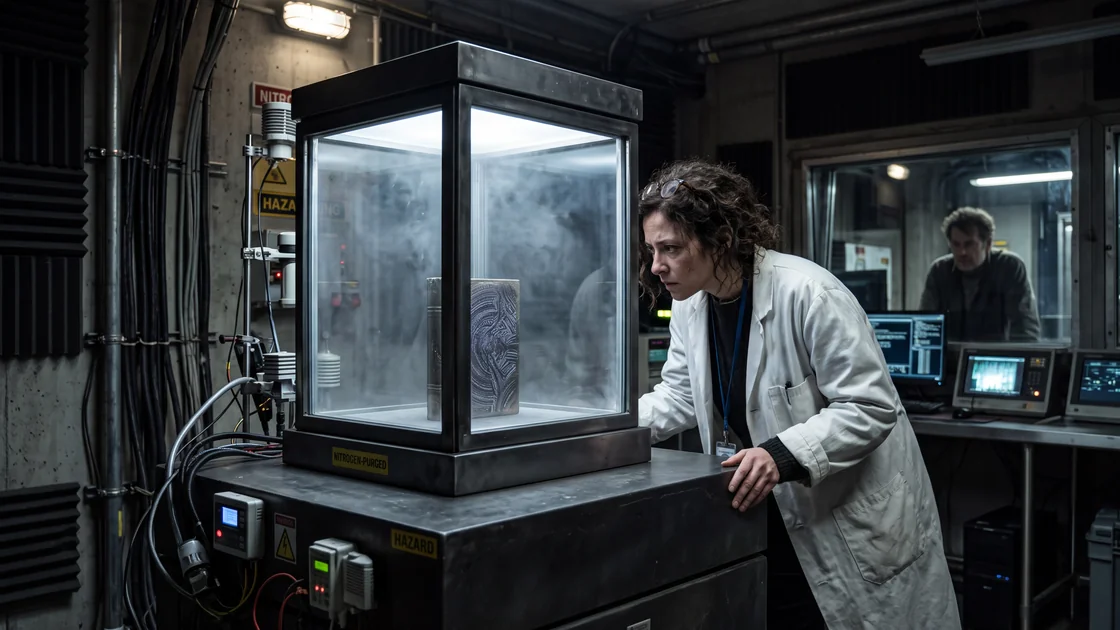
When forensic linguist Dr. Elena Vance is recruited by the Defense Advanced Research Projects Agency to decipher an anomalous, pre-cuneiform codex excavated from a sealed basalt vault in the Zagros Mountains, she expects an intractable dead language; instead, she encounters an autopoietic semiotic system that actively mutates its morphology, syntax, and semantic architecture in response to the cognitive framework of whoever reads it. As Elena and a team of military researchers push deeper into the manuscript’s shifting logic, the boundary between decipherer and deciphered collapses, revealing that the codex is not a passive historical record, but a dormant, self-inscribing cognitive weapon that rewrites the neuro-linguistic pathways of the observer to ensure its own conceptual survival.
Act I: The Lexical Perimeter
The summons did not come through the typical avenues of university tenure boards, peer-reviewed journals, or the polite, underfunded corridors of the Department of Comparative Philology at Oxford. It came in a black water-resistant pelican case delivered to Elena Vance’s faculty housing at three in the morning, accompanied by two men in muted charcoal suits who smelled faintly of pressurized cabin air and scorched insulation.
Elena sat at her kitchen table, her reading glasses pushed into her unwashed curls, a mug of instant chicory cooling near her elbow. Outside, the Oxfordshire drizzle fell against the leaded glass panes with a rhythmic, sibilant hiss.
The younger of the two men, whose credentials identified him only as Major Cross of the Defense Threat Reduction Agency, opened the case with a twin snap of pneumatic latches. Inside lay a padded tray containing an insulated electrostatic folio, and within that, five high-density, multi-spectral transparencies.
"We aren't asking for an etymology, Dr. Vance," Cross said, his voice flat, devoid of academic cadence. "We are asking for an execution order. We need to know what the verb phrase in plate three does to the noun phrase in plate four."
"Language doesn't do things to objects, Major," Elena said, her voice rough with sleep. "Language designates. It mediates. It occasionally obfuscates. But it does not exert mechanical force."
"Look at the film," Cross said.
Elena pulled the transparencies under the swing-arm lamp. At first glance, the script looked like an impossible cross between linear Elamite and an early, cursive variety of proto-cuneiform, executed not with a triangular stylus pressed into wet river mud, but cut with absolute, micro-metric incision into plates of an unidentified non-ferrous alloy. There were no pictographic bulls, no sheaves of barley, no tallies of beer or sheep. The signs were abstract, consisting of nested, interlocking concentric arcs and sharp horizontal ligatures that seemed to branch like dendritic trees.
"It's agglutinative," she murmured, her thumb hovering millimeters above the acetate sleeve. "Or it appears to be. These prefixes... they repeat in triads. Here, look at this glyph. It carries an initial infix that suggests an ergative marker, but the terminal radical has shifted three degrees counter-clockwise."
"Look at the second plate," Cross instructed.
She slid the next transparency over the light. Her brow furrowed. "This isn't the same section."
"It is the exact same plate," Cross replied. "Photographed four minutes after the first. The photographer was Dr. Harold Finch. You remember him?"
Elena froze. "Finch died six weeks ago. His obituary said it was an acute cerebrovascular event. An aneurysm."
"Dr. Finch spent forty-eight hours with the primary source," Cross said, leaning forward. His hands rested on the kitchen table, knuckles pale. "The autopsy revealed no burst vessels. What it revealed was an extensive, bilateral cellular reorganization of Broca’s area and the angular gyrus. His brain didn't bleed out, Dr. Vance. It rearranged its folds. The coroner said the tissue looked as if it had been ironed flat and then re-creased along unfamiliar geometric planes. Before he lost motor function entirely, he copied those five plates. When he started, the glyph at coordinate seven-alpha was an intransitive copula. By the time he collapsed, it had become a modal imperative that lacked a grammatical subject."
Elena looked down at the film. Her eyes burned. There was something sickening about the negative space between the cuts; looking at them felt like watching an escalator step flatten out just as one’s boot descended upon it—a momentary, vertigo-inducing betrayal of structural expectation.
"Where is it?" she asked.
"Three hundred feet beneath the red dirt of the White Sands Proving Ground," Cross said. "We leave from RAF Brize Norton in fifty minutes."
Act II: The Vitrine at White Sands
The subterranean complex known as Site-9 was built not for containment of blast radiuses or biological contagions, but for the isolation of electromagnetic, acoustic, and perceptual frequencies.
Elena’s descent had taken three elevators and a motorized cart ride through a damp, whitewashed tunnel lined with cables as thick as an athlete's thigh. She was accompanied now by Dr. Marcus Miller, a man with the weary, bloodshot eyes of a chronic insomniac and a lanyard identifying him as Chief of Computational Semiotics for the Advanced Research Projects Agency.
"The material itself isn't parchment, and it isn't stone," Miller explained as they scrubbed through an airlock lined with ionizing air knives. "We call it the vellum, but it's an intermetallic matrix—palladium, gold, and an amorphous carbon lattice that shows zero crystalline fatigue. Carbon dating is obviously useless, but thermoluminescence of the surrounding strata yields an age of roughly twelve thousand years. Pre-Neolithic. It shouldn't exist. Nothing more complex than a knapped flint scraper should exist in that stratum."
"And the writing?" Elena asked, tying back her hair with an elastic band. Her fingers were trembling, an involuntary tremor she hid by plunging her hands into the pockets of her borrowed lab coat.
"The writing is where the physics stops being polite," Miller said grimly. He keyed a six-digit code into a heavy bulkhead door. "The codex consists of fourteen leaves bound by three silver pins that have been cold-welded through the spine. When it sits in an unobserved, vacuum-sealed environment, its surface topography remains static. We monitor it via non-retinal, automated interferometry. The moment a human eye—specifically, an eye connected to an active visual cortex with linguistic competence—looks at it, the topography alters."
"Observation changes the phenomenon," Elena said. "Quantum mechanics for illiterates."
"Don't patronize me, Vance," Miller sighed, pushing the door open. "This isn't a photon passing through a double slit. It doesn't collapse into a single probability state when observed. It adapts. It reads the reader. If you approach it using the phonology of a Indo-European tongue, it begins to generate syntactic boundaries that mimic Indo-European grammar, but it does so in a predatory fashion. It lays traps. It sets grammatical antecedents that your brain is forced to anticipate, and when your brain supplies the missing structural element, the text locks that structure into place and changes the meaning of the preceding clause."
The room they entered was small, cold, and deadened by acoustic foam baffles. In the center stood a pedestal of polished lead, topped by a nitrogen-purged borosilicate chamber.
Inside lay the codex.
It was no larger than an octavo prayer book. The leaves had a dull, oily sheen, like the surface of stagnant water over which an engine had leaked. The incisions were fine, dark, and utterly motionless.
Elena approached the vitrine. Her breath hitched in her throat.
"Keep your distance at first," Miller warned from the threshold. "We have high-resolution digital relays if you want to work from a monitor."
"Digital relays filter out the chromatic nuances," Elena said softly. "You know as well as I do that you can't read a palimpsest through an LCD screen. You miss the indentations. You miss the pressure of the hand."
"There was no hand," Miller said.
Elena stepped up to the glass. She leaned over the lead plinth.
The text was arranged in two columns per leaf. The left column appeared to be primary; the right column consisted of smaller, denser annotations that wrapped around the margins like the commentary in a Talmudic tractate or a Byzantine gloss.
As her gaze settled upon the top-left quadrant of the visible leaf, a sharp, cold prickle ran across the bridge of her nose.
The first sign was a glyph resembling a bisected oval with three trailing horizontal strokes: an archaic sign that, in standard proto-cuneiform, might denote an (heaven) or dingir (a divine entity). But as her mind unconsciously assigned the value of a noun-phrase to it, the three horizontal strokes lengthened.
She blinked.
They had not moved. There was no mechanical sliding, no liquid ink flowing through microscopic capillaries. Yet the strokes were longer than they had been half a second prior. They now reached the margin, intercepting a vertical column of tiny, needle-point dots.
It isn't moving, she realized with a cold thrill of terror. It was always that long. My memory of what it looked like a second ago is what's failing.
"Miller," she said, her voice dropping an octave.
"I see it on the monitor," Miller replied, his voice tense, vibrating through the intercom. "Your focal point is coordinate four-delta. Your occipital lobe is lighting up on our fMRI monitor like an engine bay on fire. Don't vocalize anything. Whatever you do, Vance, do not read it aloud."
"There is no phonetic value to these signs," she whispered, unable to look away. "It’s not a phonetic script. It’s ideogrammatic, but... no, that’s wrong. The relations aren't semantic. They're operational."
"Explain," Miller demanded.
"An ideogram stands for a concept," Elena said, her eyes tracking downward, pulled by an irresistible cadence built into the spacing of the ligatures. "A phonetic sign stands for a sound that represents a concept. These signs... they don't represent anything. They are instructions for lexical assembly. It’s a blueprint for an utterance that cannot be spoken without using organs we don't have."
The text shifted again.
The bisected oval didn't change its shape; instead, Elena’s understanding of its role within the sentence inverted. It was no longer the subject. It was an instrumental case. The sentence was not about an entity; it was about an instrument through which an unmentioned agent was performing an operation upon...
Upon what?
Her gaze was dragged, by the sheer, inexorable weight of the syntactic progression, to the next sign. It was a cluster of five interlocking squares.
The moment she focused on the five squares, a sudden, metallic taste bloomed across the back of her tongue. It tasted of old coins, zinc, and cold river silt. A dull, rhythmic throb began behind her left temple—precisely in the sylvian fissure, where language is parsed, dismantled, and woven into thought.
The squares were not five. They were six.
No, she thought, panic flaring. I counted five. There were five.
She checked the gloss in the margin. The marginal gloss had rearranged itself into an explanatory clause that clearly, unmistakably demonstrated why there had always been six squares, and why her perception of five was a grammatical error inherent to the structure of the English language—a language that relies so stubbornly on subject-verb-object linear causality that it cannot account for an event that occurs simultaneously before and because of its own naming.
"Elena," Miller’s voice crackled, sharp with alarm. "Step back. Your pulse is one-thirty. Step back from the glass."
She tried to pull her neck back, but her eyes were trapped in the grammar. The text had constructed an open parenthesis, and her mind was frantically, desperately searching for the closing bracket. To leave an open parenthesis in one's own consciousness is an intolerable cognitive agony; it is the feeling of a musical cadence left unresolved on a minor seventh, magnified into an existential itch that tears at the lining of the brain.
Close the clause, her mind screamed. Just find the terminal radical and close the clause.
The next glyph was blank.
A flat, unetched square of palladium alloy.
She stared at it. The absence of a sign where the syntax demanded a conclusion was an empty vessel of terrifying capacity. Unconsciously, involuntarily, her linguistic competence—the deep, hardwired human engine that Noam Chomsky posited was our biological birthright—rushed to fill the void. Her brain supplied the missing glyph.
She saw it in her mind's eye: a three-pronged ligature crossed by an oblique bar.
Instantly, with the silent snap of an invisible mousetrap, the palladium plate beneath the nitrogen glass mirrored her thought. The three-pronged ligature appeared on the metal, etched with the same ancient, razor-sharp precision as the rest of the codex.
The parenthesis was closed.
Elena stumbled backward, her boots tangling in the floor mats. She hit the acoustic baffles with her shoulders and slid down to the cold linoleum, gasping for air, her lungs burning as if she had surfaced from a four-minute dive in arctic water.
From the observation booth, Miller stared through the lead glass, his face gray.
"It took your input," he whispered over the open mic. "May God help us. It took your input."
Act III: Syntactic Parasitism
By five in the morning, Elena had set up her headquarters in the anteroom adjacent to the vitrine chamber. The walls were covered in dry-erase boards, printouts of neural scans, and high-speed multi-spectral logs.
A young linguist and computational analyst named Dr. Naomi Chen sat across from her, surrounded by four glowing monitors displaying real-time topological comparisons of the codex leaves.
"It’s not just adapting to your gaze," Chen said, her fingers flying over an ergonomic split keyboard. "It’s an autopoietic network. Do you know Maturana and Varela’s work on self-maintaining systems?"
"I’m a philologist, Naomi," Elena said, pressing a cold can of carbonated water against her throbbing temple. "I deal with things that have been dead for three thousand years. When a Hittite scribe makes an error on a clay tablet, the error stays there until an archaeologist digs it up. It doesn't write back."
"Well, this thing is alive," Chen said bluntly. "Look at the telemetry from your session two hours ago. When you read plate one, column alpha, the glyph at coordinate seven shifted from an unvoiced dental fricative equivalent to an active causative verb. We tracked your eye movements with the high-speed camera. The shift didn't happen when your fovea landed on the glyph. It happened two hundred milliseconds before your fovea landed on it."
Elena paused, lowering the can of water. "That’s an artifact of the camera’s buffer."
"It isn't," Chen said. "We ran three separate diagnostic checks on the sensor array. The text anticipated the saccadic movement of your eyeball. It restructured its syntax to meet the interpretive expectation of your visual cortex before your eye had even fully focused on the coordinate."
"That implies retrocausality," Elena said flatly. "Or predictive modeling of human cognitive mechanics that exceeds anything we understand."
"Or both," Miller said, entering the room carrying a thin manila dossier stamped with scarlet classified markings. He tossed it onto the table between them. "That’s the log from the Thorne expedition. 1968."
Elena looked at the folder. The paper was yellowed at the edges, smelling of damp archives and acetate. "Aris Thorne? My predecessor at the Institute?"
"Thorne wasn't just an academic," Miller said, leaning against the edge of the desk. "He was working for the Directorate of Science and Technology during the height of the Cold War. In sixty-seven, a Soviet geological survey in the Zagros range cracked open a cavern that wasn't on any map. They pulled three artifacts out of that cave before the local military commander realized what he was looking at and had the entire survey team shot. The CIA extracted Thorne to evaluate what the Soviets had recovered."
Elena opened the file. Inside were grainy black-and-white photographs of a stone cylinder, an ivory stylus that was melted at one end like a spent candle, and the fourteen-leaf codex now resting thirty feet away in the nitrogen chamber.
Attached to the photos were typewritten transcripts of Thorne’s daily logs. Elena read the entries, her skin prickling with cold dread.
October 14, 1968: The script does not utilize a fixed lexicon. It appears to operate via a principle I can only describe as mutual semantic consumption. A sign's meaning is derived entirely from the degree to which it negates the lexical value of the sign preceding it. It is an anti-language. It does not construct meaning; it dismantles the conceptual categories of the reader to create a semantic vacuum.
October 22, 1968: I find myself unable to compose notes in English without an extraordinary effort of will. The grammar of the Zagros folio has begun to intrude upon my dreams. It is an ergative-absolute system carried to an unbearable extreme: in my dreams, I am no longer the speaker of my thoughts, but the direct object of an unformulated predicate. The sentence does not originate within me; I am the site where the sentence takes place.
November 3, 1968: The verb must be fed. It will not accept abstract nominalizations. It demands experiential nouns. If one does not provide them, it extracts them.
The entries ended there.
"What happened to him?" Elena asked, looking up at Miller. "Thorne didn't die in sixty-eight. He lived until ninety-two in a private sanatorium in Vermont. I met him once when I was a graduate student. He was completely silent. He hadn't spoken a single word in twenty years."
"He didn't speak," Miller said, "because he had lost the ability to use phonemes that could be represented by the Latin alphabet. When the nurses gave him paper, he didn't write words; he drew cross-sections of his own nervous system, only the nerves were annotated with those same non-cuneiform ligatures. The doctors thought it was advanced motor-neuron disease coupled with dementia. It wasn't. His brain was functioning at peak efficiency. It was just running a different operating system."
Miller leaned down, his face inches from Elena’s. "The Department of Defense didn't bring you here to translate this for a museum, Dr. Vance. They brought you here because two weeks ago, a satellite reconnaissance station outside Alice Springs intercepted a high-frequency radio burst originating from the Zagros cavern where this was found. The burst was seventy-two seconds long. It wasn't digital data. It was an acoustic encoding of the syntactic structures found in that book."
Elena felt the room tilt slightly. "Someone is reading it out there."
"No," Miller said. "Someone is broadcasting it. And every automated signals-intelligence server in the Western hemisphere that processed that signal had its language models scrambled within forty seconds. Our machine-translation algorithms at the NSA are currently spitting out biblical Greek interspersed with algorithmic gibberish. The codex isn't just an artifact, Elena. It’s a seed. And it’s looking for soil."
Act IV: The Semiometrics of the Void
Elena sat alone in the observation chamber during the third shift. The facility around her had grown quiet, settled into that eerie, hum-heavy stasis peculiar to subterranean bunkers.
She had demanded that Miller leave the observation room’s interlock open. She sat at a steel desk five feet from the glass vitrine, armed only with a pad of gridded engineering paper, a mechanical pencil, and an audio recorder set to voice-activation.
She was not looking directly at the codex. She had devised a system of indirect paleography: she had angled a front-surface optical mirror toward the lead plinth, projecting the reflection of leaf three onto a sheet of matte white cardstock pinned to her desk.
"Entry four," she spoke into the microphone. Her voice was flat, dry. "Attempting to isolate the morphological root of the cluster at coordinate twelve-beta. To prevent direct visual feedback, I am observing through a single-bounce mirror system."
She focused on the reflection.
The image was dimmer, stripped of that subtle, predatory sheen the metal seemed to possess under direct observation. On the paper card, the glyphs looked almost ordinary—like the dry, administrative markings of an early dynasty accountant recording the redistribution of sesame oil.
The cluster at twelve-beta consisted of three primary components: an outer ring resembling an unclosed loop, an interior vertical stroke crossed by three chevrons, and a trailing trail of four dots that varied in size.
"The root appears to be the vertical stroke," she said into the recorder. "It carries the functional load of a verbal base. If this were Sumerian, I would identify it as a compound verb containing elements of both motion and perception: to go while seeing, or perhaps to seek by following a trace."
She clicked her pencil. She leaned down to copy the root onto her gridded paper.
As the graphite touched the paper, the lead snapped.
She frowned, clicked the pencil again, and tried to draw the vertical stroke.
Her hand would not move down.
Elena froze. Her fingers were locked around the plastic barrel of the pencil with white-knuckled force. She attempted to flex her index finger, to pull the tip toward herself to complete the line.
The motor command originated in her motor strip; she could feel the intention clearly, crisp and distinct. But somewhere in the descent through the internal capsule, through the brainstem, through the cervical spinal cord, the command was intercepted.
Her hand did not move down. It moved horizontally.
Against her will, her fingers drew a long, elegant curve that looped upward, intersecting the top of the grid. It was the outer ring of the glyph.
"Miller," she said.
The audio recorder clicked, its green LED blinking steadily on the desk.
"Miller, there is an involuntary motor feedback loop occurring," she said, her voice rising slightly.
There was no response from the intercom. Miller was asleep in his bunk down the hall; Naomi Chen was down in the computational cluster running the Fourier transforms.
Elena tried to drop the pencil. Her fingers refused to open.
She looked at the cardstock where the reflection of the codex was projected.
The reflection had changed.
The mirror had not protected her. The codex did not require direct retinal contact; it required only that an intentionality—a mind attempting to assign meaning to its forms—be oriented toward it. The mirror was merely an extension of the optical pathway, no different than the lens of her own eye.
On the cardstock, the four dots were gone.
In their place was a line of English text, written in her own cramped, slightly back-tilted handwriting:
WHY DO YOU DIVIDE THAT WHICH CANNOT OCCUR IN PIECES?
Elena’s heart slammed against her ribs like a trapped bird. She pushed her chair back, but her legs were leaden, unresponsive. The muscles of her thighs were firing in irregular, spastic micro-twitches.
She looked at the gridded paper on her desk.
She had not just drawn an arc. Without realizing it, while her conscious mind was debating the phonology of a hypothetical verbal base, her hand had covered the entire lower half of the sheet in tiny, dense ligatures.
They were not English. They were not pre-cuneiform.
They were a transitional grammar—a terrifying creole bridging her native academic English and the autogenetic code of the codex.
She read what she had written, and as she read, the world began to lose its names.
The table was no longer a table; it was the-place-where-the-arm-is-denied-the-floor.
The pencil was not a pencil; it was the-sharpener-of-the-limit-between-inscribing-and-submitting.
And she herself was not Elena Vance.
In the syntax she had just committed to the page, there was no pronoun for the first-person singular. There was only a complex, circumlocutory passive construct: that-which-is-currently-being-emptied-of-prior-associations.
"Stop," she whispered. The word sounded bizarre, clumsy, like a lump of unchewed meat in her mouth. Her tongue felt too large, its musculature sluggish, unaccustomed to the crude, percussive nature of English consonants.
The codex leaf inside the borosilicate glass gave a faint, crystalline chime.
It was the first acoustic phenomenon recorded from the artifact. A high, clear resonance, like a wet finger run around the rim of a crystal goblet, vibrating at precisely 4,186 Hertz—the highest note on a standard piano, the top-most C.
The nitrogen inside the vitrine clouded with microscopic frost.
The glyphs were not shifting one by one now. They were flowing.
The incisions on the palladium leaves were running like hot solder, breaking their columns, crossing the silver pins of the binding, spilling into the margins, and reassembling themselves into a single, colossal diagram that spanned both visible leaves.
It was an anatomical drawing.
It was a drawing of the human brainstem, viewed from the ventral aspect, but with one grotesque, impossible alteration: the cranial nerves—the optic, the oculomotor, the trigeminal, the vagus—were not shown terminating in their respective nuclei.
They were shown extending outward, beyond the skull, woven into the structure of the text itself.
The book was not describing an object.
The book was a loom. And her senses were the thread.
Act V: The Glossolalic Cascade
"Get her out of there!"
The door to the observation suite hissed open with a concussive blast of pneumatic pressure. Miller burst into the room, followed by two armed security guards wearing tactical headsets and carry-harnesses.
Elena was still seated at the desk, her face inches from the gridded paper. Her eyes were wide, unblinking, the capillaries in the sclera ruptured into bright red plumes.
Miller grabbed her by the shoulders and hauled her backward.
Her body was rigid, caught in a catatonic tetany. Her right hand, still clutching the mechanical pencil, tore the paper as she was pulled away, leaving a jagged black scar across the sheet.
"Don't look at the plinth!" Miller shouted to the guards. "Secure the shroud! Drop the lead apron!"
One of the guards, a young corporal with a shaved head and a family photograph taped to the receiver of his carbine, stepped forward with a heavy sheet of vulcanized lead cloth. As he lifted it toward the vitrine, his gaze caught the surface of the borosilicate glass.
He stopped.
"Corporal!" Miller roared, shaking Elena by the front of her lab coat. Her breath was coming in shallow, fluttering rasps; her skin was ice-cold, coated in a greasy, chemical sweat. "Corporal, drop the apron! Now!"
The corporal did not drop the apron.
He stood before the vitrine, the heavy lead cloth hanging slack in his left hand. His right hand rose slowly, gracefully, unbuttoning the chin strap of his Kevlar helmet.
"It isn't an apron," the corporal said.
His voice did not sound like his own. The regional Appalachian cadence that Elena had noted during their descent through the elevator shafts was gone, replaced by a smooth, unnatural cadence—a rhythmic, metric delivery that sounded like an archaic liturgical chant.
"It is the direct object," the corporal chanted, his pupils dilated until the irises were mere slivers of pale hazel. "The cloth is that which covers the speaker so that the predicate may occur without the impediment of light."
"Bauer!" the other guard yelled, reaching for his partner’s vest.
Corporal Bauer turned his head.
The movement was horrific: it was too fast, a sudden, ninety-degree swivel of the cervical vertebrae that produced a wet, audible click.
Bauer opened his mouth.
He did not speak English. He did not speak any language that had ever evolved in human throats. What emerged from between his teeth was a sequence of pure, unmodulated clicks, glottal stops, and nasalized whistles that carried an impossible acoustic energy.
The glass of the vitrine did not break; it began to craze with thousands of microscopic stress fractures, all radiating from the points that corresponded to the margins of the codex leaves.
The other guard stumbled backward, his hands clamped over his ears. Blood was trickling from beneath his fingers, dark and bright against the foam pads of his communication headset.
"The radio," Elena croaked.
She was on her knees on the linoleum, her forehead pressed against the base of Miller’s desk. Her voice was barely a whisper, but the words were English again—ragged, broken, but human.
Miller dropped beside her. "Elena? Elena, talk to me. What is it doing?"
"The radio," she wheezed, her fingernails clawing at the tile. "The broadcast from Alice Springs... it wasn't... it wasn't an interception."
Miller’s face went white. "What do you mean?"
"It was an... interrogation," she gasped, her body arching as a violent tremor rippled through her diaphragm. "The codex... it’s not an artifact left behind by a past civilization. It’s an antenna. It’s an interface left here... waiting for the species to achieve a sufficient density of linguistic infrastructure to sustain it."
She looked up at him. Her eyes were terrifying: the pupils were contracting and dilating in counterpoint to each other, an asynchronous, ocular arrhythmia.
"It doesn't rewrite itself because it’s unstable, Marcus," she whispered, her fingers digging into his wrist with bruising force. "It rewrites itself because it’s listening. Every time we parse a sentence, we give it our grammar. We give it our categories of time, of cause, of grief, of will. It takes our categories... and it uses them to construct an exit."
Across the room, Corporal Bauer fell to his knees.
He was no longer vocalizing. His jaw was slack, dislocated at the temporomandibular joint by the violent contractions of his masseter muscles.
With steady, deliberate fingers, he was using his combat knife to carve the three-pronged ligature into the lead floor plating.
He wasn't stopping when the steel hit the metal. He was pressing down until his knuckles split, his own blood welling up around the blade, filling the fresh incisions with a thick, crimson gloss.
The codex inside the chamber gave another crystalline chime.
This time, the nitrogen glass didn't craze.
It vanished.
It did not shatter; it did not blow outward. It simply ceased to occupy the spatial coordinates around the lead plinth, collapsing into a fine, gray talc that settled over the leaves like ash.
The fourteen leaves of the Protean Codex rose three inches into the air, fanning out like the wings of a waking beetle.
Act VI: The Grammar of Causality
The containment protocol at Site-9 was known as "Zero-Lexicon."
It was designed not by biologists or nuclear physicists, but by a committee of structuralist philosophers, cognitive neuroscientists, and counter-memetic warfare specialists who had worked under the darkest budgets of the Cold War.
When the sirens sounded, they did not emit a rhythmic, rising tone. Rhythmic tones are a form of syntax; the brain can anticipate their intervals, can parse their warning into an imperative clause: evacuate, flee, seek shelter.
Instead, the sirens emitted white noise interspersed with random, non-periodic acoustic spikes designed to induce immediate, profound semantic satiation. It was a sound designed to drown the language centers of the brain in an undifferentiated ocean of acoustic static, preventing any two neurons from forming a coherent symbolic link.
Elena stood in the decontamination corridor, leaning against the cold concrete wall while Naomi Chen injected a three-milligram dose of midazolam into her deltoid.
"This will slow your syntactic retrieval," Naomi shouted over the roar of the white-noise generators. Her eyes were shielded by heavy, opaque goggles that restricted her vision to a narrow, two-inch vertical slit. "You won't be able to form complex sentences for four hours. You’ll have the linguistic capacity of an eight-month-old infant. That’s your only defense!"
"No," Elena said, swatting Naomi’s hand away before the full dose could be cleared. The drug hit her system like a velvet hammer, softening the edges of the room, turning the harsh fluorescent lights into greasy, blooming nebulae.
"Vance, you’re contaminated!" Naomi yelled.
"If you blunt... if you blunt my syntax," Elena slurred, her tongue heavy and thick, "we can’t close it. You don't fight... you don't fight an infection by removing the cells it wants to eat. You present... an antagonist."
Miller appeared in the corridor, his face obscured by a respirated hood that carried no markings. He held an olive-drab plastic case containing a field terminal connected to the facility's central processing core.
"The computational array is gone," Miller said, his voice sounding through an external speaker like an artificial larynx. "The core didn't crash. It began to recompile its entire operating system using a three-valued logic based on the inscriptions Bauer carved into the floor. It’s no longer running binary code. It’s running something closer to modal intuition. If that core connects to the external SATCOM uplink at 0600 hours, it will broadcast the new logic to every server bank between Peterson Space Force Base and the London Stock Exchange."
Elena shook her head, trying to clear the midazolam fog. "What is... what is the third value?"
Miller looked down at her through the plastic visor. "True. False. And Addressed."
"A vocative," she murmured, a terrifying realization clicking into place behind her temples. "The third value... is an imperative that names the listener."
"The manuscript isn't a text," Elena said, her voice finding a sudden, brittle clarity that cut straight through the drug’s sedation. "It’s a vocative address. It’s a grammatical summons directed at whatever species possesses the neural plasticity to decode it. It doesn't want to communicate with us, Marcus. It wants to be spoken by us. It wants to use the human voice as an actuator."
She grabbed the lapel of Miller’s protective suit.
"Take me back in."
"You’re insane," Miller said. "Look at what happened to Bauer. He’s in the infirmary right now. He doesn't know his name. When they asked him who the President was, he drew that same split oval on the bedsheet with his own feces. His identity is gone. The codex ate it."
"The codex didn't eat it," Elena spat, wiping a trace of gray foam from the corner of her lip. "Bauer was an infantryman. His internal lexicon was small, rigid, structured around hierarchy and commands. When the syntax entered him, it had no room to expand, so it tore the container open. I’m a philologist, Marcus. I have five thousand dead languages in my head. I have the grammar of the Sumerian king lists, the morphosyntax of Proto-Indo-European, the tone-splits of ancient Sino-Tibetan. If it wants a container... I have more rooms than Bauer had."
Miller stared at her. Through the tinted visor, she could see the cold, calculating machinery of a defense bureaucrat weighing the loss of one asset against the collapse of the continent’s strategic communications grid.
"Five minutes," he said. "If your neurological monitors show a total loss of baseline identity within three hundred seconds, I vent the chamber with chlorine trifluoride. It will burn the vellum, the lead plinth, and you to a slag of calcium and ash in under twelve seconds."
"A reasonable compromise," Elena said.
Act VII: The Antagonist Clause
She walked back into the chamber alone.
The white-noise sirens were silent here; the room was dead, sealed behind eight inches of lead-lined steel.
The air smelled of ozone, burnt sugar, and the coppery stench of Corporal Bauer’s blood, which had dried into a black crust around the gouges in the floor.
The codex was no longer resting on the pedestal.
The fourteen leaves had detached from the cold-welded silver pins. They were suspended in the air, arranged in an irregular, slowly rotating orbit around an invisible center, like the petals of an open metal flower.
The incised glyphs were not static; they were pulsing with a faint, bioluminescent violet phosphorescence that seemed to draw the light out of the room rather than project it.
Elena stepped into the center of the ring.
She did not carry paper. She did not wear glasses. She had stripped off her lab coat, standing in her worn wool sweater and corduroy trousers, her hands hanging loose at her sides.
The moment her boots entered the perimeter of the suspended leaves, the rotation stopped.
Every leaf tilted simultaneously, angling its etched surface toward her face.
The pressure inside her skull was instantaneous. It was not a physical headache; it was the sensation of a thousand fingers slipping into the fissures of her cortex, parting the sulci, tracing the delicate, myelin-sheathed highways of her memories.
She saw her father’s library in Edinburgh: the smell of pipe tobacco, the rows of green-bound Loeb Classical Library volumes, the dust motes falling through the afternoon light.
The memory was seized.
The word father was detached from the image. The codex tasted it, tested its structural integrity, found it insufficient, and discarded it.
The memory dissolved into a gray, featureless abstraction: the-male-predecessor-whose-existence-necessitated-the-current-interpreter.
She saw her first field excavation in the Syrian desert, the white dust of Tell Brak, the thrill of finding a cylinder seal bearing the name of an Akkadian scribe.
The word name was stripped away.
The-arbitrary-tag-that-distinguishes-one-unit-of-linguistic-meat-from-another.
She was losing her anchor. The midazolam was fighting the intrusion, but it was like throwing sand against a tidal wave; the drug only made her slower, more vulnerable to the relentless, algorithmic efficiency with which the codex was dismantling her identity.
You don't fight it by resisting, she reminded herself. Her breath was a ragged gasp. Her vision was narrowing into a dark tunnel, the edges of which were lined with those jagged, dendritic ligatures.
You fight it with an impossible grammar.
She looked at the central leaf—the leaf that had once been leaf seven, the exact middle of the codex.
The incisions on its face were open, yawning, waiting for her mind to complete the circuit. They had formed a massive, complex question—an imperative interrogative that demanded she supply the final, absolute nominative: Who reads me?
If she answered with her name, she would become Bauer.
If she answered with silence, the vacuum would collapse her Broca's area, leaving her like Aris Thorne, a living corpse drawing cross-sections of her own ruined brain.
She opened her mouth.
She did not use English. She did not use Sumerian. She did not use any language that had ever been inscribed on clay, parchment, or paper.
She used the language of the Pirahã—the hunter-gatherers of the Amazon basin whose grammar contains no numbers, no colors, no recursive clauses, and no concept of the distant past or abstract future. A language that exists solely in the absolute immediacy of the present experience, where nothing is real unless it is seen by the speaker at the moment of utterance.
"Koí," she whispered.
It was not a word. It was a tonal pitch, a flat, sustained whistle that meant, simply: This which is directly present to my senses.
The glyphs on leaf seven flickered.
A shudder ran through the suspended metal plates. The dendritic ligatures attempted to branch, to construct a relative clause that would link her utterance to an antecedent, to draw her into a causal chain of past actions and future consequences.
Elena did not give them a clause.
She shifted her phonology to the absolute opposite end of the human spectrum: she reached into the complex, hyper-synthetic verbal morphology of the Navajo language, a system where the verb does not describe an action performed by an agent, but the way in which the universe participates in an ongoing, holistic state of movement.
She spoke a verb phrase that took five seconds to clear her lips: a dense, glottalized construct that carried twelve distinct prefixes and four aspects:
"’Aho’nísóóz."
It meant: The condition of an unknown agency having its intentionality dispersed into the surrounding land until no center remains to be named.
The violet phosphorescence on the leaves flared with an agonizing, eye-searing brilliance.
The codex struggled.
Elena could feel the text inside her throat, a physical presence like a barbed hook trying to drag her vocal cords toward an English copula: I am. You are. It is. It needed the copula. It needed the simple, brittle linearity of Western ontology to bridge the gap between its world and this one.
It demanded an identity to inhabit.
"You want a reader?" she shouted, her voice breaking, spitting blood onto the lead floor as the capillaries in her palate ruptured under the strain. "I will give you every reader who has ever died without a name!"
She unleashed the full, chaotic, uncataloged archive of her life’s work.
She spoke in the broken, ergative fragments of the Hurrian hymns; she clicked in the lost phonemes of the extinct Tasmanian dialects; she whistled in the mountain registers of the Silbo Gomero; she chanted the repetitive, non-referential syllables of the ancient Mycenaean Linear B inventories, where every sign was an entry of barley, of oil, of broken chariot wheels, of men who were designated only by the tools they carried to their graves.
She did not construct a sentence.
She constructed a linguistic catastrophe.
She built a semantic paradox in her own vocal tract: a sentence that was simultaneously intransitive and causative, passive and imperative, written in the first-person plural inclusive of an event that had occurred before the creation of matter and would end before the word could be completed.
The leaves of the codex began to shake violently.
The silver pins that had held them for twelve thousand years, which had rolled into the corners of the room, began to vibrate against the concrete floor with a sound like a swarm of cicadas.
The glyphs were no longer shifting to anticipate her.
They were retreating.
The incisions were shrinking, their dendritic branches folding back into the main trunks, the concentric arcs collapsing into single, tight points of dark palladium.
The text was being forced back into its own substrate. It had found an ecosystem so dense, so contradictory, so infinitely tangled with the detritus of ten thousand years of human confusion, grief, and poetic incoherence that its predatory algorithms could not find a path through the brush.
It could not read her.
There was too much of her, and none of it was consistent.
She took one step forward, her boots coming down hard on the dry blood of Corporal Bauer.
She leaned her face toward leaf seven. Her nose was bleeding now, a steady drip that hit the metal plate with a tiny, sharp sizzle.
"You made one mistake," she whispered, her voice reduced to a dry, rasping hiss.
The glyphs on the leaf were down to three tiny, trembling dots.
"You assumed that because we invented grammar... we were governed by it."
She closed her mouth.
She did not speak. She did not formulate a thought.
She cleared her mind of every symbolic representation she had ever acquired: every letter, every word, every image, every memory of Oxford, of Site-9, of her father’s library, of her own name.
She became, for three seconds, an absolute, illiterate void.
The codex had nothing left to bite.
With a sound like the snapping of an iron girder, the fourteen leaves lost their suspension.
They did not float down. They did not chime.
They hit the lead plinth with a heavy, dead, metallic crash, clattering against each other like a handful of dropped license plates, sliding across the surface until they came to rest in a tangled, disorderly heap of dull gray sheet metal.
The room went completely, utterly dark.
Act VIII: The Post-Grammatical Archive
The debriefing lasted twenty-two days.
It took place not at Site-9, but in an unmarked administrative villa outside Warrenton, Virginia, surrounded by high brick walls and mature oaks that dropped their golden leaves across the manicured lawns.
Elena Vance sat on the screened porch, watching the dusk settle over the Blue Ridge Mountains. A blanket was tucked around her knees, despite the mild September air.
Marcus Miller sat across from her, wearing an unpressed civilian suit. He looked older; his hairline had receded another half-inch, and his hands had developed a faint, persistent tremor that he masked by keeping them wrapped around a porcelain coffee mug.
"The leaves are dead," Miller said, his voice quiet, almost reverent. "We ran the interferometry scans every day for three weeks. No movement. No topographic changes under observation. Naomi Chen even brought in three native speakers of Mandarin, two Hungarian linguists, and a child who had never learned to read. Nothing. It’s just palladium alloy now. Twelve thousand years old, completely inert."
Elena did not turn her head. She watched a crow land on the rail of the fence at the bottom of the lawn.
"And the broadcast from Alice Springs?" she asked.
"Stopped," Miller said. "At 0558 hours that morning. Two minutes before the SATCOM uplink was scheduled to activate. The automated servers at the NSA rebooted themselves without loss of data. The signal didn't leave a trace. It was as if... as if someone had pulled a plug on an entire branch of the universe’s evolutionary tree."
He leaned forward, his elbows on his knees.
"What did you do in there, Elena?"
She didn't answer immediately.
She looked at her hands. They were steady now. The skin had healed where she had torn her nails against the desk; the ruptured capillaries in her eyes had cleared, leaving the whites clean and cold.
"I didn't translate it," she said.
"We know that," Miller replied. "We found the papers on your desk. There was no decipherment. Just... fragments. Dialects that shouldn't have been in the same room together."
"Language is a cage, Marcus," Elena said softly. Her voice had changed permanently; it had lost its high, academic flute, replaced by a low, dry cadence that carried an almost mineral weight. "We build it to keep the silence out. We think that if we give everything a name—if we tag every bird, every tree, every emotion, every subatomic particle—we can control the space we occupy. We think the sentence belongs to us."
She pointed toward the crow on the fence.
"What is that?" she asked.
Miller blinked. "It’s a bird. A crow."
"No," she said. "That’s what you call it so you don't have to look at it. You give it the tag crow, and your brain files it away under corvid, under avian, under black feathers, scavenger. You stop seeing its eyes. You stop seeing the way the light catches the blue oil on its wing. You stop feeling the terrifying, indifferent machine of its heart beating at four hundred strokes a minute."
She looked at him then, and Miller felt an instinctive, cold urge to push his chair back, to put space between himself and the woman sitting under the wool blanket.
Her eyes were entirely calm, but there was an emptiness in them that felt ancient—an emptiness like the silence of a desert before the first seed had germinated, before the first lung had gathered air to make a sound.
"The codex was looking for a speaker," she said. "It had traveled across whatever gulf exists between its makers and ourselves, waiting for a species to develop the linguistic machinery it needed to walk again. It thought we were like its makers: creatures who lived inside their own grammar, creatures who were nothing more than the sum of their own syntax."
"And we aren't?" Miller asked.
A faint, cold smile touched Elena’s lips.
"We are the only animals on this planet who can use language to lie," she said. "We are the only ones who can construct a sentence that says one thing while our hearts mean another. We can say I love you while planning a betrayal; we can write all men are created equal while keeping our brothers in chains; we can say peace while manufacturing our own extinction."
She turned her gaze back to the Blue Ridge, where the last sliver of the sun was slipping behind the dark, forested crests.
"It couldn't survive us," Elena whispered. "Our grammar isn't a tool for logic, Marcus. It’s a scab over an open wound. And when it tried to enter the wound... it drowned in the blood."
Miller sat in silence for a long time. The crow on the fence shook its feathers, launched itself into the purple evening air, and vanished toward the woods without making a sound.
"Do you want to go back?" he asked finally. "Oxford is waiting. The department chair has written four letters. They’ve held your fellowship open."
Elena looked down at the gridded paper resting on her lap.
It was blank.
She had carried the pad with her from Site-9, but she had not written a single word since that morning in the nitrogen chamber. When she picked up a pen, she felt only the cold, immense, terrifying luxury of having nothing to name.
"Tell them I’ve forgotten the grammar," she said.
"Which one?" Miller asked.
"All of them," Elena Vance said, and she closed her eyes to listen to the wind moving through the grass—untranslated, unparsed, and free.