The Receiver at 5.412 Megahertz
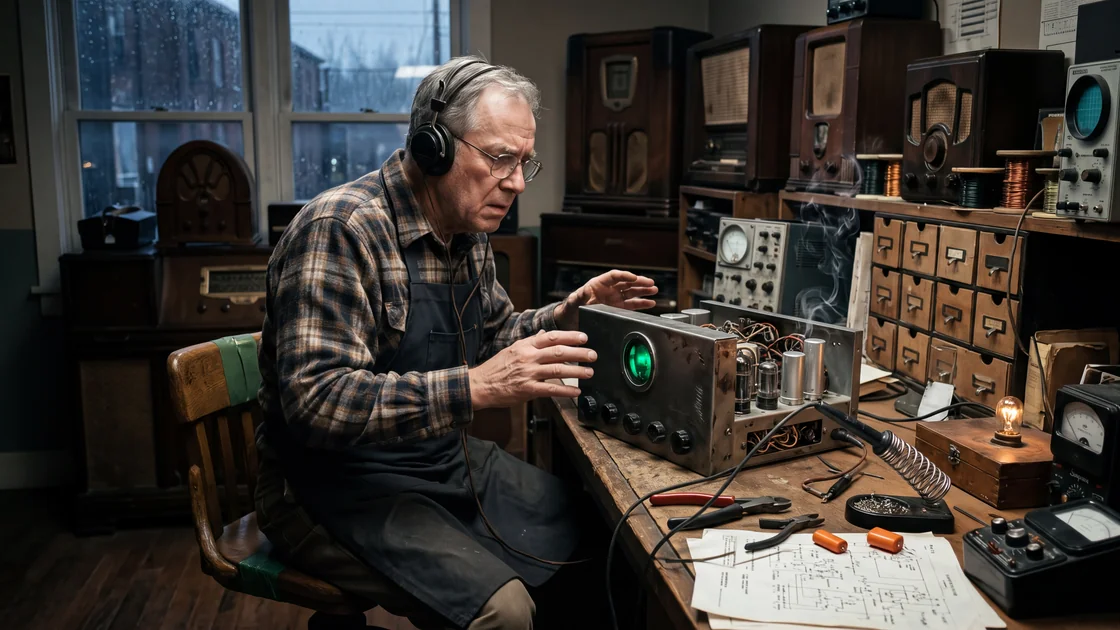
This is the story of Arthur Vance, an aging repairman in a declining mill town who spends his quiet evenings restoring discarded tube electronics, only to isolate an anomalous shortwave transmission that describes his every gesture, breath, and involuntary twitch in real-time neutral detail; as Arthur conducts increasingly desperate experiments to expose the source or outwit the unseen narrator, he finds that the line between broadcast and reality has degraded, pulling him into a recursive trap where observation precedes existence.
I. The Dust on the Dial
The smell of Arthur Vance’s shop was thirty percent oxidized copper, twenty percent boiled pine rosin, and fifty percent accumulated wool dust settling over forty years of transformer varnish. It was a dark smell, warm and slightly sweet, like the inside of an attic trunk that had survived a chimney fire. Outside, along the narrow spine of Mill Street, the November sleet came down in long, slanting needles that rattled against the double-hung glass of the front display window. Behind that window stood three consoles that Arthur had long ceased trying to sell: a 1938 Zenith Stars and Stripes with a chipped lacquer cabinet, a low-slung Capehart phonograph combination with an automatic record changer that routinely fractured 78-rpm shellac, and an early-model Philco cathedral whose walnut veneer had blistered into maps of nonexistent archipelagos.
Arthur did not care about selling them. He was sixty-two years old, his knuckles were enlarged at the joints from decades of gripping needle-nose pliers against stubborn terminal lugs, and the sign hanging from the peeling green lintel still said Vance Sound & Radio Service: All Makes, Transistor & Valve. The word Transistor had been painted on in 1968 at the insistence of his late brother, Donald, but Donald had died in a boating accident on Lake Erie during the bicentennial summer, and Arthur had never warmed to the silicon chips that followed. Solid-state devices were too small, too silent, and died without an odor. When a germanium junction failed, it simply quit, an invisible ghost departing an anonymous black speck; when a Mullard pentode died, it flared orange, wept barium against the interior envelope, and gave off a scent of charred mica that told an experienced man exactly which resistor had drifted high in the cathode bias.
Arthur sat on an oak swivel stool whose wicker seat was held together with green canvas duct tape. On his bench, illuminated by the green enamel shade of an articulated industrial lamp, sat an unbranded communications receiver.
It had arrived three days earlier in the arms of a boy who could not have been older than sixteen, wearing an olive-drab surplus field jacket with frayed cuffs. The boy had placed it on the counter with a metallic clatter that made Arthur’s teeth ache, set down twenty dollars in folded, greasy bills, and mumbled that his grandfather had brought it back from an airfield in the Aleutians. He had not left a name, nor a telephone number, nor an address. He had simply turned and pushed through the shop door, the brass cowbell above the frame clattering once against the wood.
The receiver was an oddity. It had no manufacturer’s crest—no stamped zinc plate from Hallicrafters, no understated silver foil from National, no stenciled military nomenclature like the AN/ARR-2s Arthur had worked on during his brief service at the naval depot in Bayonne. The chassis was cold-rolled steel, nearly an eighth of an inch thick, cadmium-plated to resist salt spray, but someone had scraped off every serial number with a cold chisel. The scoring was deep and savage, gouging into the steel until the bright metal underneath had rusted into scabrous lines. It used eleven tubes, all octal-base metal envelopes—6K7 RF amplifiers, a 6L7 mixer, a 6H6 double diode—save for one: the tuning indicator, a 6E5 "magic eye" tube that sat high on the center of the front panel behind a beveled brass escutcheon, its phosphor target waiting behind a round glass lens like a cloudy cataract.
Arthur dipped his soldering iron into a tin of sal ammoniac. A plume of bitter white smoke curled past his bifocals, making his left eye tear. He touched the tip of the iron to the terminal strip of the third intermediate-frequency transformer, lifting a cracked, wax-dipped paper capacitor that had leaked its yellowish guts across the chassis floor.
"Point-zero-five at four hundred volts," he muttered to the empty shop. He always spoke to the bench. It kept the rhythm of the work from collapsing into the sound of the rain outside. "You dried out thirty years ago, didn't you, old horse?"
He rummaged through a shallow drawer of modern orange-drop capacitors—the only modern components he tolerated, solely because their polyester dielectric didn't degrade when exposed to the dampness of the valley—and twisted the fresh leads into the loop of the solder lug. He soldered it with a neat, mirror-bright fillet of 60/40 rosin-core lead, clipped the excess pigtail with his diagonal cutters, and set the iron into its coiled spring holder.
The receiver was plugged into an isolation transformer, which in turn was fed through a 100-watt incandescent bulb wired in series—a "dim-bulb tester" Arthur had built into an old cigar box in 1954. If there was a dead short in the high-voltage winding of the power transformer, the bulb would flare to full brightness and save the unobtainable iron from incinerating its paper interleaving.
He switched the isolation bench supply on.
The 100-watt bulb blossomed into a dull, orange wire filament, flickered once as the filter capacitors drank their initial surge of direct current, and then subsided into a faint, barely visible red wire.
"Good," Arthur whispered. "No shorts in the B-plus."
On the front of the steel chassis, the tubes began to live. The metal envelopes did not glow—they were armored shells of pressed iron—but Arthur felt the radiant heat rising off their crowns within ninety seconds, a dry, baking wave that carried the ghosts of old grease and Arctic dampness into the room. Above the main tuning drum, the 6E5 magic eye tube began to wake. A pale, viridian luminescence gathered along the conical anode, faint at first, then sharpening into a brilliant emerald circle interrupted by a sixty-degree wedge of shadow at the six-o'clock position.
Arthur plugged a pair of high-impedance Trimm "Featherweight" headphones into the phone jack on the lower left apron. The bakelite earcups were cold against his temples, their steel spring-band tugging at the gray fringe of hair behind his ears.
He turned the band switch. The heavy bronze detent mechanism slammed into place with the mechanical authority of a bank vault: Clack.
Band 2: 3.5 to 7.5 Megahertz. The shortwave lower-intermediate frequencies. The realm of amateur operators running amplitude modulation on the 75-meter band, maritime coastal stations broadcasting weather warnings for trawlers out off Cape May, Canadian time signals clicking like dry bones from station CHU in Ottawa, and the low, droning hum of Cold War military transmissions that slipped through the ionosphere like grease through water.
Arthur advanced the audio gain. A soft, rushing hiss filled his ears—the sound of empty space, the thermal noise of billions of electrons boiling off the cathode sleeves and crashing into the collector plates, mixed with the far-off static of thunderstorms drifting over the Gulf of Mexico. He reached for the main tuning knob, a heavy wheel of ribbed bakelite weighted with a brass flyback ring behind the panel.
He spun it slowly down from 7.0 Megahertz.
Ssssshhh-kzzzzt.
A Spanish-language broadcast, rich with reverb and the flutter of selective fading, surged out of the floor and died as he rolled past.
Pip. Pip. Pip. Pip.
The 7.335 Megahertz marker of CHU, steady as an embalmer’s pulse.
Weee-ooo-kzzzt. A pair of ham operators in northern Vermont arguing over the plate resistance of an 813 tube, their voices sounding like Donald duck trapped inside a copper drainpipe until Arthur trimmed the beat-frequency oscillator.
He passed them. The dial string crept to the right, pulling the pointer across a hand-calibrated scale marked in fading India ink. The frequencies grew lower, entering the quiet waters below the 40-meter ham band, an area usually reserved for utility traffic, international embassies, and dead carriers that sat on their frequencies for weeks at a time without uttering a single syllable of code.
Around 5.412 Megahertz, the needle paused.
The rushing atmospheric static did not disappear, but it altered its texture. It was as if the radio had suddenly ceased listening to the wide sky and had focused its attention through a long, narrow cardboard tube. The background hiss dropped from an open roar to a dry, pressurized sibilance, like the air escaping from a diving helmet.
In the center of the magic eye tube, the green wedge of shadow twitched. It narrowed from sixty degrees to thirty, then to fifteen, the bright green wings of the phosphor overlap fluttering slightly, signaling that a carrier of immense strength was clamping down on the automatic volume control bus.
Arthur leaned forward. He rested his left hand on the chassis edge, his fingers grazing the zinc plate.
There was no heterodyne whistle. There was no hum of a 60-cycle power line leaking into a poorly filtered transmitter plate. There was only a clear, dry space in the spectrum, and then, without any introduction, a voice spoke into his ears.
"He is checking the solder connection at the third IF can," the voice said. "His left thumb is dry, peeling slightly at the margin of the nail where he caught it in the drawer latch yesterday. He is leaning his weight onto the front edge of the bench, four inches to the left of the Simpson meter."
II. The Solder Lug
Arthur pulled his hands from the chassis as if the cadmium plating had suddenly been brought to cherry red.
The headphones clicked against his skull as his head jerked back. His stool groaned on its threaded iron spindle. His heart, which had maintained an unhurried sixty-eight beats per minute through forty years of exploded electrolytic capacitors and high-voltage line bites, skipped two full strokes and slammed into the inside of his ribs like an iron bolt dropped into a wooden hopper.
Silence returned to the headphones—not empty silence, but the pressurized, velvet hush of an open studio microphone. Somewhere behind the carrier, fifty cycles of low-frequency ambient room noise whispered: the faint, rhythmic chink-chink-chink of an escapement mechanism, like an antique clock movement ticking inside a felt-lined box.
"Hello?" Arthur said.
The word was out before he could evaluate its absurdity. He was talking to a pair of 2,000-ohm magnetic diaphragms clamped to his ears. A communications receiver does not transmit. It has no modulator, no microphone preamplifier, no antenna relay; it is an ear, nothing more. A vast, passive, vacuum-tube sponge designed to absorb electromagnetic radiation that had been flung into the air by some tower miles or continents away.
The headphones answered immediately.
"The subject has retracted both hands. He has straightened his spine by approximately four inches, causing the wicker of the swivel stool to compress against the lower crossbar. He has spoken a single interrogative into the empty workspace, directed toward the middle distance between the oscilloscope and the rack of electrolytic spares."
The voice was neither young nor old. It had the clipped, neutral cadence of a mid-Atlantic newsreader from the late 1940s—a voice trained to report the fall of an island or the sinking of an ore freighter without allowing the vowels to broaden or the pitch to rise. It had no accent. It had no breath noise. It sounded as though it were being read from an endless paper tape that was emerging from an electric typewriter in the room next door.
Arthur sat frozen. His eyes flicked to the shop window.
Outside, the rain had softened into a gray slush that lay in greasy stripes across the asphalt. Across the street, the brick facade of the old textile warehouse was dead, its arched windows boarded with weathered plywood that had swollen black around the copper nails. Further down, the neon sign of the Eagle Tavern glowed through the wet fog like a drop of spilled port wine, but its front door remained shut against the cold. There was no car parked at the curb. There was no van with a dark windshield. There was only a stray calico cat creeping under the wooden overhang of the barber shop, its spine curved against the sleet.
A microphone, Arthur thought. A microphone and a transmitter. Someone has tucked a wireless bug into the chassis.
He reached slowly toward his tool tray, keeping his eyes fixed on the shop window. He chose an eight-inch wooden alignment tool—a non-conductive plastic rod with a tiny brass blade inset into the tip—and used it to gently turn the receiver onto its side, exposing the belly of the chassis.
The wiring was an untouched rat’s nest of sixty-year-old cotton-braided insulation, brown wax cylinders, and dog-bone resistors painted with color-code stripes that had faded from vermilion to dull liver.
"He is turning the unit sixty degrees onto its starboard rail," the voice reported. The cadence did not alter by a fraction of a syllable. "The tool employed is an insulated polystyrene wand with a beveled tip. He is searching for a sub-miniature transmitter, presumably assuming a parasitic tap into the filament supply between the 6K7 RF stage and the local oscillator."
Arthur’s hand shook. The tip of the alignment wand rattled against the side of a tubular paper capacitor, producing a dull thump in the headphones.
"The wand has contacted the cardboard shell of the cathode bypass capacitor," the voice continued. "His respirations have risen to twenty-two cycles per minute. The radial artery in his right wrist is exhibiting a slight dicrotic notch, characteristic of sudden hypertensive response."
Arthur tore the headphones from his head.
He dropped them onto the bench. The small metal diaphragms inside the bakelite housings continued to talk to the room, their tinny, metallic murmurs sounding like two crickets trapped under an inverted tin cup.
...he has discarded the Trimm headset... the sound level in the room is reduced to the ambient hum of the isolation transformer and the traffic on Route 8...
Arthur stepped back from the bench until the backs of his calves hit the front panel of an RCA Victor console he had repaired three weeks ago and never billed to its owner.
He reached up with a cold, unsteady palm and touched his forehead. It was slick with an oily sweat that smelled of salt and stale tobacco.
"Stop that," he said to the wall.
The headphones on the bench whispered:
...he has directed a verbal command toward the eastern wall of the shop, where three rolls of Belden 300-ohm twin-lead are suspended from finishing nails...
Arthur lunged forward, caught the black rubber cord of the isolation transformer, and yanked it from the wall receptacle.
The shop plunged into a deeper silence. The 100-watt bulb went out. The orange warmth in the crowns of the receiver’s tubes began to gray. The green eye of the 6E5 phosphor tube did not vanish instantly; it lingered, a sickly, fading circle that shrank toward the center as the high-voltage filter capacitors bled their remaining charge through the bleeder resistors.
In the headphones, the voice did not cut off with the snap of disconnected current. It did not pop. It did not sink into a dying squeal as the B-plus rail collapsed.
It simply said:
"He has severed the primary line voltage. The chassis is currently operating on the residual charge of the two-hundred-volt electrolytic block. This will sustain the intermediate stages for approximately four seconds. Three. Two. One."
The green eye died.
The headphones went completely, irrevocably dead.
Arthur stood in the center of his shop, his chest heaving, his boots planted in a pile of swept-up copper clippings, listening to the rain chew through the asphalt outside.
III. The Architecture of the Loop
He did not sleep that night. He sat in the four-room flat above the shop, in the armchair that still smelled of his brother’s sheepskin coat, with a 12-gauge Winchester shotgun laid across his knees and a cup of black instant coffee going cold on the end table beside him.
Every half hour, the floorboards below him creaked as the building settled under the wind. Every time the timber groaned, Arthur leaned forward, his thumb tracing the checkered walnut of the gun’s wrist, waiting for the sound of a rubber-soled shoe against the basement stairs, or the dry scrape of an antenna wire being dragged across the tar-paper roof.
Nothing moved. At 4:15 AM, the milk truck from the dairy cooperative rattled past, its empty glass bottles clinking in their wire crates like a set of wind chimes made of ice. At 5:30, the streetlamps sputtered twice and went out, leaving the shop window below illuminated only by the faint, diffused white of the coming dawn.
If it was a joke, it was an impossible one.
To accomplish what had occurred on that bench, three things were required. First, a camera—or an observer with an unobstructed line of sight into the back corner of Arthur’s workroom. But Arthur’s bench sat behind a seven-foot-tall partition of green-painted tongue-and-groove pine, erected in 1952 to keep customers from staring at the repair queue. The only window near the bench was an eighteen-inch cellar transom that looked out onto a dead alleyway three feet below street level, barred with half-inch iron reinforcing rods and choked with fifty years of dead ivy and coal dust.
Second, a transmitter. Not just any transmitter, but one that could push an amplitude-modulated signal onto 5.412 Megahertz—a frequency far outside the citizen's band, far outside the common walkie-talkie crystals sold in the back of Popular Electronics. It required an inductor, a crystal or a stable VFO, a high-voltage power supply, and an aerial.
Third—and this was the thought that made Arthur’s coffee turn to copper in his mouth—it required a latency of zero.
When Arthur had moved his hand, the voice had not followed the movement; it had accompanied it. The syllables had sat upon the actions like a wet transfer decal on a model plane. "He is checking the solder connection..." Not he checked. Not he is about to check. The verb was simultaneous with the contact of the wood to the wax. No television system in 1979 possessed that kind of response; even the live remote broadcasts from the football games in Pittsburgh had a quarter-second bounce as the microwaves leapt between the relay towers along the turnpike.
At 7:00 AM, the gray light was flat and uniform across the kitchen table.
Arthur stood up, his joints popping like small dry sticks, set the shotgun on the sideboard, and went down the back stairs into the shop.
The air in the basement was colder than the flat, smelling of damp limestone and the coal bin that had been converted to scrap-iron storage after the furnace was changed to gas in '61. He did not turn on the overhead fluorescents—the ballast hum might mask whatever he needed to hear. Instead, he carried a two-cell Ray-O-Vac flashlight with a yellow rubber body.
He walked to the bench.
The communications receiver sat where he had left it, cocked sixty degrees onto its cadmium side, its yellowed wires hanging down like the intestines of an uncoiled clock.
Arthur did not plug it in.
He went to the small pegboard rack behind the door and took down his direction-finding loop. It was a home-made piece, an eight-turn diamond of enameled magnet wire wound around a frame of cedar lath, eighteen inches across, connected to a three-foot length of low-loss coaxial cable with a BNC connector at the end. It was designed for tracking down local noise sources—arcing pole transformers, defective neon signs, oil-burner igniters that ruined television reception for three blocks around.
He set the loop on the bench. Then he reached for his battery-operated field receiver: a portable Zenith Trans-Oceanic Royal 1000, Donald’s old pride and joy, encased in chrome and black leatherette. It had nine bands, solid-state chassis, ran on eight D-cells, and was completely isolated from the house current.
Arthur clicked the band selector to the SW-2 position, which covered the 4 to 9 Megahertz spectrum.
He connected the loop antenna to the external antenna posts with two spring clips. He switched the Zenith on. The speaker gave a quiet, clean pop, followed by the soft, purring hiss of the morning ionosphere.
He dialed the large black drum to 5.412.
The carrier was there.
The hair on Arthur’s forearms stood up.
The receiver was unpowered. The tubes on the bench were cold lumps of metal and glass. The wall cord was still lying on the floor, its prongs two feet from the Bakelite socket. Yet the Trans-Oceanic’s S-meter—a tiny, clear jewel-movement with an orange needle—swung decisively to the right, pinning itself against the stop at 30 decibels over S-9.
Arthur reached out with one finger and touched the volume control.
The voice was already speaking.
"...has completed twelve minutes of surveillance from the foot of the interior stairwell," the speaker murmured. It sounded smaller coming through the Zenith’s four-inch speaker, more domestic, like an instructional record played on a schoolroom phonograph. "He has chosen the solid-state instrument. His fingers are colder than they were at twenty-three hundred hours; the surface temperature of his left index finger is fifty-nine degrees Fahrenheit. He has not consumed the morning coffee."
Arthur drew a long, ragged breath through his nose.
"Who are you?" he said.
He said it quietly, without shouting, his eyes fixed on the center of the cedar loop antenna.
"The subject continues to employ the interrogative form," the radio said. "He is standing thirty-four inches from the loop assembly. He is experiencing a sharp transient pain in his right shoulder, radiating down the triceps to the elbow, caused by the postural stiffness of the preceding six hours."
Arthur’s right shoulder did, in fact, ache. It had begun while he sat in the armchair around four in the morning, a dull, toothache-like throb where the deltoid met the bone. He had not touched it. He had not rubbed it. He had not shifted his arm to relieve it.
"I have a phone here," Arthur lied, his voice flat. "I have the sheriff on the horn."
"The telephone on the back counter is an Automatic Electric Model 40 with a severed ringer coil," the voice replied instantly. "The line was disconnected by the Bell System on October 14, 1977, due to non-payment of the quarterly service fee. The wire leading to the terminal block on the northern baseboard has been clipped three inches above the mopboard with a pair of five-inch diagonal pliers."
Arthur looked at the corner.
The yellow cotton jacket of the drop wire was there. It had indeed been clipped. He had clipped it himself two years ago after Donald’s estate had finally been settled and he realized no one ever called him except the valve-supply jobbers from Scranton who wanted to know if he would sell his remaining stock of 12AX7s at five cents on the dollar.
He reached down and grasped the frame of the cedar loop antenna.
"Where is the transmitter?" Arthur growled. "Tell me where you’re sitting."
He began to rotate the loop.
A direction-finding loop has a figure-eight reception pattern. When the flat face of the diamond is turned toward the signal source, the voltage induced in the two sides of the loop cancels out, creating a sharp, narrow drop in volume—a "null." By rotating the loop until the signal disappeared, a technician could determine the compass bearing of the transmitter to within a single degree.
Arthur turned the frame slowly.
Ninety degrees. The signal did not drop. The orange needle of the S-meter remained pinned against the plastic case, steady as a taxidermist's pin.
One hundred and eighty degrees. The carrier did not waver. The dry, mid-Atlantic voice continued its unbroken catalog of his posture, the state of his fingernails, the angle of his shoes.
Two hundred and seventy.
The signal was everywhere. It was not arriving across the hills. It was not reflecting down from the F2 layer of the ionosphere above the clouds. It had no angle of incidence. The loop was not acting as an antenna at all; it was acting as if it were submerged in a bucket of electrified water.
"The directional characteristic of the inductor is ineffective," the voice noted. "The field density within the room is uniform at two point eight volts per meter. The subject is experiencing an elevation in core temperature. He has dropped the alignment tool into the drawer containing the spare dial cords."
Arthur let go of the loop. It fell sideways onto the bench, the cedar lath striking the frame of a Dumont 208 cathode-ray oscilloscope with a dry clack.
"Why are you doing this?" Arthur said. His voice was no longer that of a tradesman; it had cracked, the thin, dry voice of an old man whose furnace had gone out in the middle of a blizzard. "I don’t have anything here. I fix radios. That’s all I do. I haven’t done anything else."
The radio did not pause.
"He is attempting to establish an ethical context for the reception," the voice said. "He is looking at his own reflection in the faceplate of the Dumont oscilloscope. He is observing the asymmetry of his jaw, the grey discoloration of the skin beneath his lower eyelids, and the small triangular scar near his left temple where he was struck by a fragment of an exploding dry-type rectifier in the summer of 1948."
Arthur turned his back on the bench.
He walked toward the shop door, his boots heavy and clumsy on the oil-soaked floorboards. He took down his wool mackinaw from the hook behind the counter, pushed the deadbolt back with a thumb that trembled so hard it took three attempts to seat the brass key, and stepped out into the rain.
He did not lock the door behind him.
IV. The Perimeter
The town of Blackwood was built on a shelf of gray shale between the river and the Lehigh Valley Railroad tracks. In 1920, it had twelve thousand people, four silk mills, and a factory that made brass valves for steam locomotives. In 1979, it had nineteen hundred people, three bars, a self-service laundromat that smelled of diesel fuel, and sixty miles of empty, pot-holed asphalt running between rows of identical two-family company houses whose front porches were slowly separating from their foundations.
The rain had stopped, but the sky had not cleared; it was the color of a wet galvanized pail.
Arthur walked with his hands deep in the pockets of his mackinaw. He had taken the Trans-Oceanic with him, carrying it by its black plastic strap like a doctor’s satchel, the four-foot chrome whip antenna extended only three sections, sticking out horizontally behind his elbow like a stiff wire tail.
He did not wear the headphones. He had the volume turned down until the speaker was barely a murmur, held against his ribs under the heavy wool of his coat.
He walked down Mill Street toward the canal bridge.
...he is crossing the intersection of Mill and Foundry... his gait is favored toward the left heel... he has avoided the puddle of grease outside the transmission shop...
The voice followed him. It was not coming through the whip antenna; he had pushed the antenna all the way back into its sleeve until only the round brass ball at the tip showed, yet the S-meter was still wedged against its peg.
He passed the Eagle Tavern. The smell of frying lard and stale draft beer drifted through the exhaust vent above the side door. Through the window, he saw old Pete Gidley sitting on a chrome stool, his head resting on his forearm beside a half-empty glass of birch beer.
Arthur stopped.
He reached through the front door of the tavern, pushed it open until the brass bell rang, and stepped inside.
The smell was warm, thick with thirty years of cigarette smoke that had turned the acoustic ceiling tiles the color of burnt toast. Pete Gidley did not look up. Behind the bar, a man named Leo, who had lost two fingers on his left hand to an iron shaper in the mill, was wiping the beer taps with a gray bar towel.
"Artie," Leo said, without looking at him. "You’re out early. Sleet’s coming back by noon."
The radio beneath Arthur’s coat spoke, its voice muffled by the wool:
...he has entered the commercial establishment at 104 Foundry Street... the interior ambient illumination is four foot-candles... the barman has addressed him using a diminutive form of his given name...
"Leo," Arthur said. He did not let go of the radio through the cloth. "Do you hear that?"
Leo stopped his rag. He had a round, bald head that looked like an unbaked loaf of bread, covered in fine gray perspiration. He looked at Arthur’s chest.
"Hear what? The compressor on the cooler? It’s been rattling since Tuesday. Guy from Hazleton’s supposed to come look at the belt."
"Not the cooler," Arthur said. He pulled the Trans-Oceanic out from under his coat and set it on the linoleum bar, between a jar of pickled eggs and a wire basket of potato chips.
The speaker sat there, humming its high-efficiency hiss.
"...the instrument has been deposited on the formica surface forty inches from the tap handle," the voice announced to the empty room. "The barman’s right pupil is dilated two millimeters wider than his left, indicating a mild vascular asymmetry. The smell of vinegar from the egg container has reached the subject’s olfactory threshold."
Leo looked down at the radio. Then he looked up at Arthur.
His face did not show fear. It did not show wonder. It showed only that peculiar, defensive irritation common to men who have worked forty years in an industry that no longer exists and who suspect that someone is trying to make a fool of them with a technical novelty.
"What is that?" Leo asked. "A scanner? You got one of them CB things?"
"Listen to it," Arthur said. His hand was flat on the bar, three inches from the leatherette case. "Listen to what it’s saying, Leo."
Leo leaned down, his apron tightening across his belly. He put his good ear to the perforated steel grille of the Trans-Oceanic.
Arthur waited. His pulse hammered in his neck.
For five seconds, the only sound in the Eagle Tavern was the shhh-wub-shhh-wub of the draft-cooler compressor beneath the floorboards.
"It’s just static, Artie," Leo said, straightening up with a grunt. "Sounds like an electric razor on an old Philco. You bring that in here to sell it? I told you, I got no use for a shortwave. The ball games are all on AM five-seventy out of Philly. You can’t get the Phillies on that thing."
"It's talking," Arthur said. He reached out and grabbed Leo’s wrist. The skin was rough, like sharkskin, smelling of bleach. "You hear him. He just said you had a bad pupil. He said the vinegar smells. He’s talking about us. Right now."
Leo pulled his arm back, not violently, but with the steady, heavy resistance of an older man who does not like to be touched by people who look like they haven't slept.
"Take it easy, Artie," Leo said. His voice had dropped into that low, soothing register men use with dogs that have been hit by cars. "You been down in that cellar too long with the solder smoke. Go on home and get some oatmeal. Donald’s been gone three years, Artie. You can’t keep sitting down there with the shades pulled."
The radio said:
"The barman has introduced the deceased sibling into the exchange. His vocal fundamental has dropped forty hertz into an accommodative register. He is reaching beneath the bar for the telephone directory to locate the number for the municipal relief officer."
Arthur didn’t wait. He grabbed the Trans-Oceanic by its strap, tucked it under his arm, and backed out of the tavern, the door slamming behind him before the brass bell had finished its first swing.
V. The Null Hypothesis
He did not go back to the flat. He walked down the railroad right-of-way, his boots sinking into the wet black cinders between the ties.
The tracks had not carried an engine since the anthracite pool had failed in 1972. Between the rails, blackberry canes and sumac saplings had grown up through the ballast, their dead red spikes standing like rusted spears against the gray river below. The river was the Lehigh—brown, fast, swollen with the melt of the early mountain sleet, carrying logs and plastic detergent jugs down toward the gap.
Arthur sat down on an overturned creosote tie thirty feet above the water.
He set the radio on his knees.
"You're not a radio transmission," Arthur said. He spoke into the cold wind that came off the river.
"The subject is addressing the apparatus directly," the speaker replied. "He has taken a position on the abandoned trackbed, three hundred and twelve yards south of the Foundry Street crossing. His peripheral circulation has dropped by twelve percent; the skin of his knuckles has turned a uniform leaden blue."
"You’re in my head," Arthur said.
"The subject is formulating the hypothesis of acute sensory hallucination," the voice returned. "He is evaluating the possibility of a cerebral vascular accident, specifically an infarct within the left temporal lobe, or early-stage senile degeneration of the auditory cortex. He is attempting to locate a subjective baseline against which to test his perception."
"All right," Arthur said.
He felt a strange, cold calm settle over his stomach, the same calm that used to come over him when he had an intermittent hum in a 1,000-watt theater amplifier that had resisted three days of tracing with a probe. When a circuit makes no sense, you do not guess. You do not shout at the iron. You begin at the power supply and you divide the problem in half.
"If you're in my head," Arthur said, "you can only know what I know."
"The subject is initiating a verification protocol," the voice said.
Arthur reached into the pocket of his trousers. His fingers found three coins: a quarter, a nickel, and an old steel penny from 1943 he had carried since he was nine years old for luck.
He held them inside his pocket. He closed his fist around them, shook them until they clinked together like dry teeth, and then, without looking, he pressed one coin against his thigh through the cloth.
He did not look down. He did not think about the date. He did not run his thumb over the face to feel if it was the smooth nickel, the reeded edge of the quarter, or the light, sharp rim of the zinc-plated steel penny.
"What is under my thumb?" Arthur asked.
The radio did not pause for a microsecond.
"The coin held against the wool of the pocket lining is a 1943-D Lincoln cent, struck on a low-carbon steel planchet coated with an electrolytic layer of zinc point-zero-zero-one inches thick. The reverse exhibits two points of corrosion along the left wheat stalk, caused by contact with a drop of battery electrolyte in August of 1956. The weight is two point seven zero grams. The temperature is sixty-four point two degrees."
Arthur pulled his hand from his pocket.
He opened his fingers.
The gray, dull surface of the steel penny lay in his palm. On the reverse, when he turned it over with a stiff fingernail, two tiny pits of orange rust marked the left ear of wheat.
He had not looked at that penny in twenty years. He had forgotten it was a Denver strike. He had forgotten the rust completely; he had only remembered that his father had given it to him when the scrap-iron drives were on during the war.
"That doesn't prove it," Arthur whispered. His voice was swept away by the sound of the river below. "I knew it once. It was in the back of my mind. You’re just dredging up the silt."
"He is rejecting the data," the radio said. "He is attributing the identification to cryptomnesia. He is preparing to perform an action which he believes to be non-deterministic."
Arthur stood up.
He took the steel penny between his thumb and forefinger, drew his arm back, and flung it with all his remaining strength out over the gray water.
It was a flat, spinning throw. The coin rose twenty feet into the air, a tiny gray disk that caught one brief reflection of the white sky, then tumbled toward the center of the current.
Arthur did not look at where it would land. He squeezed his eyes shut. He jammed his fists into his armpits. He held his breath until his ears rang with the sound of his own blood.
Tell me where it hit, he thought, screaming the words behind his teeth without letting his tongue move. Tell me which ripple. Tell me how many inches from the bank.
The radio said:
"The projectile left the distal phalanx of the right index finger at an initial velocity of forty-four feet per second. It has entered the river thirty-eight feet from the eastern shoreline, six inches north of a submerged white-oak branch. The depth at that point is seven feet two inches. The coin has come to rest on a bed of fine anthracite silt, angled twenty-two degrees to the horizontal, with the profile of the sixteenth president facing downward into the mud."
Arthur opened his eyes.
The river was brown and smooth, unbroken except for the long, V-shaped wake of a plastic bleach bottle that had caught on a snag twenty yards downstream.
There was no mark. There was no ripple. The water had swallowed the steel penny and kept moving toward the Delaware Bay, indifferent, cold, and twelve miles wide.
"Now," Arthur said to the small speaker. "Tell me what I'm going to do next."
The radio went silent.
The carrier remained—that heavy, terrifying vacuum that smelled of empty rooms and dry solder—but the mid-Atlantic newsreader did not speak. The S-meter stayed at 30 over 9.
Arthur waited. One second. Five. Ten.
The wind blew a handful of wet pine needles against the chrome bezel of the Trans-Oceanic.
"You can't do it," Arthur said. A wild, thin grin pulled at the corners of his mouth. "You can't tell me what I’m going to do, because I haven’t decided yet. I can jump off this bridge. I can sit down and eat a pine cone. I can bite my own tongue until it bleeds. You’re just a mirror. You’re just a delayed reflection."
The radio clicked.
"The subject is laboring under the presumption of bilateral temporality," the voice said. It did not sound hurried. If anything, it sounded slightly louder, as if the microphone had been moved two inches closer to the speaker's lips. "He believes that the action precedes the report because the report arrives through an acoustic transducer into his auditory canal. He has not considered the circuit topology."
"What topology?" Arthur shouted.
"The broadcast is not a report," the voice said. "The broadcast is the plate supply."
VI. The Alignment
Arthur Vance ran.
He did not run like a young man; his knees were stiff, his mackinaw was heavy, and the Trans-Oceanic swung against his hip with every stride, the metal corners bruising his pelvic bone through his trousers. He scrambled up the cinders of the railroad cut, his boots slipping in the wet shale, caught himself on the rusted cable of a guide wire, and stumbled back onto Foundry Street.
The rain had begun again, heavier now, turning into those thick, wet flakes that melt the moment they touch the skin, leaving a cold, greasy film on his spectacles.
He ran down Mill Street, past the dark houses, past the closed barber shop, past the three empty consoles in his own front window, and slammed through the front door of his shop.
The bell clattered against the lintel, its spring snapping with a sharp ping as the screw tore out of the dry pine.
Arthur threw the door shut, shoved the iron bolt into its keeper, and dragged the heavy oak counter stool against the crossbar.
The communications receiver still sat on its side on the bench.
Its tubes were cold. The cord was still coiled on the floor like a dead snake.
Arthur set the Trans-Oceanic down beside it.
The battery-powered radio was still speaking.
"...he has secured the deadbolt. The brass keeper has split along the lower screw line by zero point zero three inches. He has returned to the bench. His respiratory rate is thirty-eight. His cardiac output is eleven point two liters per minute. The myocardial oxygen demand has exceeded the capacity of the right coronary artery; he is experiencing an ischemic twinge beneath the third left rib."
Arthur did not care about the rib. He reached for his soldering gun—a heavy, black bakelite Weller with a dual-heat trigger that hummed like a hornet when he squeezed it.
He did not plug it in. There was no power in the bench.
He looked at the unbranded receiver.
"Where is the signal coming from?" he whispered.
He took a pair of heavy sheet-metal shears from the drawer. He did not use the alignment wand. He did not use the delicate screwdrivers. He rammed the point of the shears into the bottom plate of the cadmium chassis, tore through the steel with three screaming, jagged bites, and folded the metal back like the lid of a sardine tin.
Inside, beneath the third IF transformer, there was no coil.
There was no wire.
There was only a solid, five-inch block of black paraffin wax, poured directly into the chassis compartment between the two tube sockets. Embedded in the center of the wax was a vacuum tube Arthur had never seen before in forty years of trade manuals, RCA receiving tube handbooks, or military supply catalogs.
It had no base. The leads—nine silver-plated wires—came directly through the rounded glass envelope like the legs of an insect. The inside of the glass was not silvered with getter; it was clear, and suspended between two ceramic plates was an element that did not look like a grid or a plate.
It looked like an eye.
Not a 6E5 tuning eye with a flat phosphor target. It was a three-dimensional lattice of microscopic copper wires, wound into an intricate, recursive sphere that seemed to fold inward upon itself, so dense that the light from Arthur’s flashlight did not pass through it, but was swallowed into an amber point in the center.
"The subject has exposed the conversion stage," the voice said from the Zenith. "He is observing the non-thermionic converter. He is attempting to locate the cathode."
"What is this?" Arthur’s voice was barely a croak. "Who built this?"
"The apparatus was manufactured in this facility," the voice replied.
Arthur stopped.
His flashlight beam wavered on the black wax.
"No," Arthur said. "I never saw this before. The Aleutian kid brought it in. The boy in the field jacket."
"The subject is recalling an event that has not yet occurred within his local frame," the voice said. "The receiver was brought to the counter on November 14, 1982, by a person who will identify himself as his nephew. The twenty-dollar bill was issued by the Federal Reserve Bank of New York in 1981. It is currently located in the lower drawer of the cash register behind the dried sponges."
Arthur turned.
He walked to the old brass National cash register beside the ledger book. He did not use the crank. He pressed the No Sale key with a thumb that felt like a piece of cold lard.
The drawer shot forward with a brass ding.
In the back compartment, beneath three dried, shriveled cellulose sponges he had used to clean battery acid in 1974, lay a single twenty-dollar bill.
Arthur picked it up.
The paper was crisp. It was clean. In the lower right-hand corner, beneath the portrait of Andrew Jackson, were the tiny, engraved numerals: Series 1981.
Arthur let the bill fall. It did not flutter like old rag paper; it dropped into the drawer with a dry, stiff click.
"The temporal displacement is three years, four months, eleven days," the radio said. "The receiver is currently receiving the reflection of its own alignment. The operator who is speaking into the microphone is Arthur Vance."
VII. The Plate Supply
Arthur did not scream.
The time for shouting had ended when he saw the date on the bill. The shop had become very quiet; even the rain against the window seemed to have lost its velocity, sliding down the glass in slow, clear ribbons that did not tap or rattle.
He walked back to the bench.
He sat down on the floor, his back against the cool pine boards of the partition, his knees drawn up to his chin.
"I don't have a voice like that," he said softly.
"The voice is processed through an audio peak limiter and an asymmetric clipping circuit designed by the subject in September of 1953," the radio said. Its cadence was unchanged, but Arthur could now hear, buried under the neutral mid-Atlantic cadence, a faint, familiar rasp—the slight, whistling sibilance caused by a missing molar on the upper right side of his jaw. "The acoustic signature has been normalized to eliminate the Pennsylvania regional vowel shifts."
"Why would I do it?" Arthur asked.
"The subject had reached the terminal stage of solitary operation," the voice replied. "The shop had ceased to receive commercial work following the introduction of modular solid-state chassis. The local population had declined below the threshold required to sustain an independent repair facility. The subject spent sixteen hours per day in this room without vocal interaction."
Arthur closed his eyes.
He saw the room. Not as it was now, with the sleet outside and the orange-drop capacitors on the bench, but as it would be: the dust thicker, the street outside quieter, the consoles in the window covered in gray plastic drop-cloths to keep the sun from bleaching the walnut veneer.
"You're reporting everything," Arthur said. "Every breath. Every move."
"A circuit must be completed," the voice said. "Without an observer, the signal remains a standing wave within the transmission line. The receiver does not reproduce an event; it allows the event to settle into a single state. If the broadcast ceases, the plate voltage is removed from the shop."
Arthur looked up at his bench.
He looked at the Dumont oscilloscope, with its round, green faceplate. He looked at the racks of resistors, sorted into hundreds of tiny cardboard pillboxes, each labeled in his brother’s neat, drafts-man’s script: 100K 1/2 WATT, 470K 1 WATT, 1 MEG 2 WATT. He looked at the floorboards, where the oil had dripped from the drill press thirty years ago, forming a dark silhouette that looked like a dog’s head.
"If I turn the radio off," Arthur said, "what happens to the room?"
"The shop is currently situated within the fringe area," the voice said. "The signal-to-noise ratio is decreasing. At zero decibels, the shop enters the null."
Arthur reached out with his boot.
His heel touched the volume knob of the Trans-Oceanic.
"I can turn it off," he said.
"The subject has placed the heel of his right boot against the lower edge of the ribbed plastic volume control," the radio said. "His left eyelid is twitching at three point four cycles per second. He is evaluating the sensation of non-existence against the continuation of the catalog."
Arthur did not move his foot.
He sat in the corner of his shop, listening to himself describe himself sitting in the corner of his shop.
The voice was not his enemy. It was not an intruder. It was the only thing in the borough of Blackwood that was paying attention. It was the only thing that knew the 1943 penny was a Denver strike. It was the only thing that remembered the sound of Donald’s voice when he called across the yard to say the tea kettle was whistling on the kerosene stove.
If the voice stopped, who would know that Arthur Vance had spent forty-two years replacing capacitors in radios that nobody listened to anymore? Who would know that he had never taken the train to Philadelphia to see the ocean? Who would know that his knuckles hurt when the sleet came down from the mountains?
"Keep going," Arthur said to the floor.
"The subject has retracted his foot three inches," the radio said, without a breath, without a pause, its carrier steady as the light of a dead star falling down an iron tube. "He has settled his shoulders against the baseboard. The current time is twelve point fourteen PM. The temperature in the unheated shop is forty-eight degrees Fahrenheit. He is preparing to listen to the description of his next breath."
Arthur Vance drew the air into his lungs.
"He has inhaled," the voice said.
Arthur held it until his ribs began to burn.
"He is holding the volume of air within the thoracic cavity," the voice said. "He is waiting for the needle to move."
Arthur let the breath go.
"He has exhaled," said the radio.
And outside, the rain fell over the empty tracks, over the brown river, over the cold, gray shale of the valley, where not a single wheel was turning.
VIII. The Capacitance of Solitude
Three days passed before Arthur Vance left the floor.
He did not leave it because the voice commanded him to; he left it because the biological machine that housed his memory demanded water. His tongue had swollen until it felt like a strip of dry salt pork in his cheek, and when he finally rose, his knees produced a sound like two dry pine shingles being snapped over a carpenter’s knee.
The Trans-Oceanic had not faltered. Its eight D-cells were alkaline, heavy cylinders of zinc and manganese dioxide manufactured in Cleveland, and their terminal voltage had only dropped from twelve volts to eleven point four.
"...he is standing," the voice said as Arthur’s palms left the oily floorboards. "His center of gravity is shifting four inches forward over the insteps. The quadriceps are exhibiting a twenty-cycle tremor as the lactic acid deposits are cleared by the restored arterial flow."
Arthur did not look at the radio. He walked behind the partition to the tiny enamel sink in the corner by the water heater. The tap was an ancient compression faucet with a cross-handle that had lost its porcelain "C" index button during the Eisenhower administration. He cranked it counter-clockwise.
The pipes within the stone foundation groaned—a deep, hydraulic shudder that vibrated through the floorboards—and then the faucet spat a violent, brown slug of water mixed with iron rust, followed by a thin, icy stream that smelled of slate and autumn leaf-rot.
He did not use a glass. He cupped his gray hands, dipped his face into the stream, and drank until his throat seized from the cold.
"He has ingested approximately one hundred and eighty milliliters of municipal water," the Zenith reported from the bench, its speaker carrying clearly through the partition. "The fluid contains twelve parts per million of suspended ferric oxide. The esophageal peristalsis is irregular due to the prolonged dry state of the mucous membranes."
"Shut up," Arthur whispered, but it was not an order. It was an acknowledgment. It was the way an old farmer might kick the flank of an ox that had leaned too hard against the stanchion—a mechanical protest against a presence that could not be avoided and without which the barn would simply be an empty shed full of cold spiderwebs.
He dried his mouth with the sleeve of his mackinaw.
He walked back to the bench, pulled his oak stool upright, and sat down.
The cadmium-plated communications receiver still sat on its side, its belly open like an iron carcass. The black paraffin wax around the nine-pin tube had not melted, but it had cracked slightly along the margin where Arthur had forced the sheet-metal shears through the steel chassis. Through the fissure, a faint, pale odor rose—not rosin, not ozone, but the dry, alkaline smell of old lime plaster in an abandoned house that had been sealed against the sunlight for fifty years.
Arthur reached into the drawer of alignment tools and withdrew a steel scribe with a ground needle point.
"What is the lattice made of?" he asked.
"The lattice is an alloy of copper and gold-flour, vapor-deposited onto a core of stretched fused silica," the voice replied. "The wire diameter is one point four microns. The total continuous length of the element within the envelope is three thousand four hundred and twelve feet."
"Who wound it?"
"The winding was executed using a modified screw-cutting lathe manufactured by the South Bend Lathe Works in 1936. The drive mechanism was geared to an index head utilizing a ninety-to-one worm ratio. The operator was Donald Vance."
Arthur dropped the scribe. It struck the cadmium floor of the chassis, its point piercing the black wax with a tiny snick.
"Donald was a carpenter," Arthur said. His hands were flat on the edge of the bench. "Donald didn't know radio. He didn't know a grid from a plate. He couldn't even read a schematic for a two-tube phono preamp."
"The subject is confusing the brother's vocational history with his technical capacity," the voice said. "Donald Vance spent the twenty-four months preceding his death in the basement of the residence at 412 River Street. He did not drown in Lake Erie. The boating accident was an administrative fiction filed by the county coroner to account for the cessation of the subject's brother's municipal tax registrations."
Arthur felt his eyes widen behind his bifocals.
"River Street," he said. "The old ice-house."
"The ice-house has remained locked since June of 1976," the radio said. "The padlock is an American Lock Company Model 50 with a hardened steel shackle. The key is currently located in the pocket of the sheepskin coat hanging in the flat above this shop, behind three unused dry-cleaning tags from the Peerless Laundry."
Arthur stood up so violently that the stool spun three complete revolutions on its iron screw before coming to rest against the parts cabinet.
He did not ask another question. He turned, took the back stairs two at a time, his breath sawing in his throat, and burst into the dark flat.
IX. The American Model 50
The flat was colder than the shop. The radiator in the corner was cold iron, full of air that needed bleeding, and the smell of stale coffee from three days ago sat like a greasy grease-pencil mark on the kitchen air.
Arthur walked to the hall closet.
The sheepskin coat hung where it had hung since the bicentennial summer. It was heavy, stiff with age, the shearling fleece along the collar turned the color of dirty sheep-dip by decades of soot from the railroad yards. He reached into the right pocket.
His fingers found three bone buttons, a receipt for two bags of rock salt dated December 1975, and three small paper tags with wire staples from the Peerless Laundry: VANCE, D. - 3 PIECE SUIT - NO CREASE.
Behind the tags, tucked into the narrow seam of the pocket lining where the cotton had rotted away from the sheepskin, was a single, heavy brass key.
It had no maker's name on the bow. It had only the numbers 5-0-8 stamped into the flat with a hand punch, the zeros slightly out of line with the five.
Arthur held the key against his palm. It was cold, so cold it seemed to draw the heat out of his skin like an ice cube.
Downstairs, the Trans-Oceanic spoke through the floorboards:
"The key has been recovered. The brass is oxidized with a thin film of copper carbonate. The subject is currently experiencing a reduction in fine motor control; his left hand is shaking with an amplitude of one-quarter inch."
Arthur walked down the stairs. He did not look at the bench. He did not look at the communications receiver. He took his shotgun down from the sideboard, broke the action to verify the two green Remington 12-gauge shells were seated in the chambers, snapped the barrels shut with a heavy clump, and stepped out into the alley through the basement bulk-head.
River Street was not a street anymore. It was an access road between the canal and the shale bluff, overgrown with ailanthus trees whose rotten wood smelled like burned peanut butter.
The ice-house stood at the dead end, against the black stone wall of the Lehigh gorge. It had been built in 1880 out of dressed bluestone blocks three feet thick, with a double roof of cedar shake designed to keep the winter ice from melting until August. The timber doors were eight inches thick, clad in rusted sheet iron that had curled at the corners like dried birch bark.
In the center of the iron hasp hung an American Lock Company padlock.
The body was solid steel, two inches wide, pitted with gray rust from three winters of valley fog, but through the keyway, the bright yellow gleam of clean brass showed where someone had kept the tumblers flooded with whale oil.
Arthur raised the brass key.
"Don't do it," he said to the empty trees.
There was no radio here. There was only the sound of the canal water gurgling through a broken lock gate thirty yards away and the high, thin scream of a hawk circling over the shale bluff.
Yet, from the pocket of his mackinaw, where he had shoved Donald’s key, a voice spoke.
It was not loud. It was barely a whisper, the sound of a dry leaf being dragged across a tin roof, but it came directly from the brass bow of the key itself, vibrating against the bone of his index finger:
"The lock cylinder is lubricated with neatsfoot oil. The shear line is aligned at four pins. The torque required to rotate the plug is twelve inch-ounces."
Arthur shoved the key into the slot.
He turned his wrist.
The plug turned with a smooth, silent sweep that felt like cutting cold butter with a warm knife. Inside the hardened steel body, the ball bearings released their grip with a hollow thunk.
The shackle sprang open three-eighths of an inch.
Arthur pulled the lock from the hasp, laid it on the stone sill, and pushed the iron-clad door with his shoulder.
The door did not scrape. It swung inward on massive strap hinges that had been greased with graphite, revealing an interior that was not dark, but illuminated by a steady, pale green glow that sat upon the stone floor like six inches of stagnant water.
X. The Studio
The air inside the ice-house was seventy-two degrees Fahrenheit.
It did not smell of limestone. It did not smell of old ice or river muck. It smelled of a brand-new Western Electric telephone exchange—a dry, sterile, ozone-rich air that had been passed through charcoal scrubbers and electrostatic precipitators.
In the center of the forty-foot room, where the ice blocks had once been stacked twenty feet high on beds of sawdust, sat a desk.
It was not an office desk. It was an oak workbench, identical in every dimension to the bench in Arthur’s shop on Mill Street, down to the green-painted tool rack, the blue metal boxes of terminal lugs, and the burn mark on the front apron where an iron had been set down without a stand in the winter of 1964.
Behind the desk sat a man.
He wore an olive-drab surplus field jacket with frayed cuffs. His hair was gray, cropped close to the skull in the style of the Seabees in the South Pacific, and his bifocals were held together at the bridge with a tiny sleeve of yellowed cellophane tape.
He did not look up when Arthur entered.
He held a professional studio microphone—an RCA Type 77-DX ribbon microphone, finished in satin chrome and umber gray—in his left hand, the mount resting on a small cast-iron base between two Western Electric 111-C repeat coils.
In front of him lay a long roll of yellow teletype paper that was feeding out of an invisible slot in the oak bench, creeping across the wood at the speed of one inch every four seconds.
The man’s lips were an inch from the perforated metal ribbon cage.
"He has entered through the northern portal," the man said.
His voice was the voice from the radio. It did not sound old. It did not sound young. It was the flat, mid-Atlantic carrier that had occupied 5.412 Megahertz since Arthur had turned the dial three days ago.
"The barrels of the Winchester shotgun are depressed twenty-eight degrees from the horizontal," the man continued, his eyes following the black letters that were appearing on the yellow paper before they had completely dried. "His boots have deposited zero point four ounces of wet shale on the sill. He is observing the tape."
Arthur did not raise the gun. He stood with the stock tucked under his elbow, his fingers cold against the trigger guard.
"Donald?" Arthur said.
The man did not look up. He did not turn his head. His right hand held an ordinary red Eberhard Faber pencil, its lead sharpened to a needle point, with which he occasionally touched the yellow paper as it passed, correcting a letter or inserting a comma with the precise, mechanical mark of an engine-turner.
"The subject has addressed the transmitter using the brother's baptismal name," the man spoke into the RCA ribbon. "He has failed to recognize the physical configuration. He is searching the face for the small mole below the left zygomatic arch."
Arthur walked toward the desk. His boots made no sound on the floor; the stone had been covered in four inches of dense, sound-absorbent cork tile that drank the impact of his heels like water poured into sand.
He reached the front of the bench.
He looked down at the man.
It was not Donald.
The hair was Donald’s hair. The jacket was the jacket Donald had worn to the gravel pits in the autumn of '73. The bifocals were Donald’s bifocals.
But the face beneath the lenses was not a face.
It was a mask of cold-rolled steel, four millimeters thick, hand-turned and scraped to fit the contours of a human skull, with two round observation ports where the eyes should have been. Behind the glass of the ports, there were no retinas. There were only two miniature 6E5 magic eye tubes, their pale viridian phosphor targets glowing in the gloom, their sixty-degree wedges of shadow fluttering with every syllable that passed through the slit cut into the metal where the teeth should have been.
Pip. Pip. Pip.
Beneath the desk, an escapement mechanism ticked—not a clock, but a mechanical governor from an old wire-line telegraph transmitter, its brass weights spinning inside an oil bath.
"You're not Donald," Arthur said.
"The identification is negative," the steel face said into the ribbon. "Donald Vance was disconnected from the line on June 18, 1976, at fourteen hundred hours. The current operator is Vance, Arthur, Unit Two."
Arthur leaned his weight onto the desk. The wood was cold, colder than the stone outside, and under his palms he felt the high-frequency vibration of a large power transformer—three hundred, maybe four hundred cycles—singing through the grain.
"I am Arthur Vance," Arthur said.
The steel mask did not move. The phosphor eyes twitched, the green wings narrowing until the target was a solid, blinding circle of emerald light.
"The entity on the operator's side of the desk is Vance, Arthur, Unit One," the voice said through the microphone. "Unit One is currently exhibiting a sixty percent reduction in primary line capacity. The emission from the cathode has dropped below the service limit. The replacement was delivered to the Mill Street facility three days ago."
Arthur looked at the desk.
Between the microphone and the teletype paper, half-buried in a nest of old wire-wound resistors, lay a work order.
It was written on the blue-lined paper Arthur had bought from the stationery store in Scranton in 1962. At the top, in Arthur’s own handwriting—the shaky, left-leaning script he had developed after he dropped the transformer on his wrist in '58—were the words:
CUSTOMER: Vance, A.
MODEL: Special Communications (Aleutian)
DEFECT: Voice fails to precede action.
REPAIR: Replace operator. Align to 5.412.
At the bottom of the slip, where the customer's signature was supposed to be, was a single, greasy thumbprint, black with the dust of old selenium rectifiers.
Arthur looked down at his own right thumb.
It was black. He had not washed it since he pulled the third IF transformer three days ago.
"The customer has verified the repair slip," the steel mask said. "The transaction is complete. The twenty-dollar bill has been credited to the account."
XI. The Loop Closes
Arthur Vance did not pick up the shotgun.
He set it on the edge of the desk, its double barrels pointing toward the dark stone wall where the ice had once slept. He reached out with his right hand, his thumb—the black, stained thumb—hovering over the smooth, satin-chrome casing of the RCA ribbon microphone.
"If I take the microphone," Arthur said, "who is on Mill Street?"
"The shop on Mill Street is currently unobserved," the voice said. "The plate voltage has been removed. The consoles have returned to the null state."
"And Pete Gidley? And Leo?"
"The barman at 104 Foundry Street was disconnected in 1974," the voice said. "His voice was an interpolation designed to maintain the local field density until the receiver could be brought to resonance. The town of Blackwood was cleared of primary personnel following the flood of 1955."
Arthur stood very still.
He remembered the flood. He remembered the river coming over the canal wall in August of '55, the yellow water carrying the lumber from the planing mill down through the first floor of the bank.
He remembered everyone leaving. He remembered the moving vans on Foundry Street.
He remembered his father saying, We stay with the shop, Artie. People have their radios. They need the news.
And then his father had gone into the ground behind the Methodist church, and Donald had gone down to the ice-house, and Arthur had sat at the bench with the Weller gun, waiting for the cowbell above the door to ring.
It had not rung since 1968.
Except for the boy.
The boy in the surplus field jacket who had Donald’s shoulders and Donald’s boots.
Arthur looked at the man behind the desk.
The steel mask was not bolted to the skull. It was held by three leather straps with brass buckles that had turned green around the eyelets.
Arthur reached out.
His knuckles—the swollen, arthritic knuckles that had gripped pliers for forty years—touched the cold brass of the top buckle.
"The subject is executing the transfer," the microphone said. The voice was coming from the slit in the steel, but it was also coming from the back of Arthur’s own throat now, the syllables forming on his tongue before he could think them, his vocal cords vibrating in sympathy with the ribbon six inches away. "He has released the occipital strap. The cadmium plate is separating from the temporal margin."
The mask came away.
It was heavy—twelve, maybe fourteen pounds of cold steel and glass.
Behind it, there was no blood. There was no bone.
There was only a mahogany mounting block, carved to fit the hollow of the neck, and upon the block sat eleven vacuum tubes, all metal-envelope octals—6K7, 6L7, 6H6—their crowns glowing with a dull, cherry-red heat that did not warm the cork-lined room.
In the center, where the tongue had been, an octal socket stood empty, its eight phosphor-bronze spring clips waiting for a tube that had not yet been inserted.
Arthur set the steel mask on the desk.
He reached into the pocket of his mackinaw.
His fingers did not find the brass key. His fingers found the small, nine-pin tube he had cut from the paraffin wax in the shop on Mill Street—the tube with the three-dimensional copper lattice inside its clear glass envelope, the lattice that Donald had wound on the South Bend lathe in the dark.
It was warm now. It was not sixty degrees; it was ninety-eight point six.
"The conversion stage is positioned," Arthur said.
He did not use the microphone. The microphone was unnecessary. His chest had become the resonator; his ribs were the cedar frame of the loop; his spine was the 300-ohm twin-lead running from the roof to the cellar.
He aligned the silver-plated pins with the socket on the mahogany block.
"The operator is entering the circuit," he said.
He pressed the tube down.
The pins seated with a dry, mechanical clack that sounded like a bank vault door closing forty feet below the pavement.
XII. 5.412 Megahertz
The carrier did not flutter.
Across the northeastern quadrant of the United States, from the fishing boats dragging their otter boards through the gray chop off Montauk to the lonely fire towers sitting on the iron ridges of the Adirondacks, the dials of thousands of communications receivers were turned through the quiet waters of the shortwave spectrum.
At 5.412 Megahertz, the needles paused.
The S-meters swung thirty decibels over S-9.
The green magic eyes narrowed their sixty-degree wedges of shadow until the phosphors overlapped, glowing with a fierce, emerald light that made the dial faces turn the color of deep water.
The hissing of the space between the worlds dropped from an open roar to a dry, pressurized sibilance.
And then, through the earcups of a thousand forgotten headsets, the newsreader spoke:
"The shop on Mill Street is sixteen feet wide by thirty-two feet deep.
"The floor is yellow pine, seasoned with forty years of transformer oil and copper clippings.
"On the bench, twenty-four inches from the isolation supply, sits an unbranded communications receiver with its bottom plate folded back. The soldering iron in the coiled spring holder is cold. The solder lug on the third IF transformer has been cleaned with a fine wire brush; the flux has crystallized into four small amber drops that will not melt until the next operator takes the stool.
"Outside, the sleet is falling over the valley.
"It is falling on the rusted tracks of the Lehigh Valley Railroad. It is falling on the tin roof of the ice-house. It is falling on the green display window of Vance Sound & Radio Service, where three consoles are waiting for an owner who will arrive in three years, four months, and eleven days.
"His name will be Arthur Vance.
"He will be sixteen years old.
"He will be wearing an olive-drab surplus field jacket with frayed cuffs.
"He will carry an unbranded receiver in his arms, and his boots will leave two wet stripes across the floorboards as he approaches the counter.
"He is currently reaching for the latch.
"His left thumb is dry, peeling slightly at the margin of the nail.
"He is about to speak."