The Red Giant's Final Warning
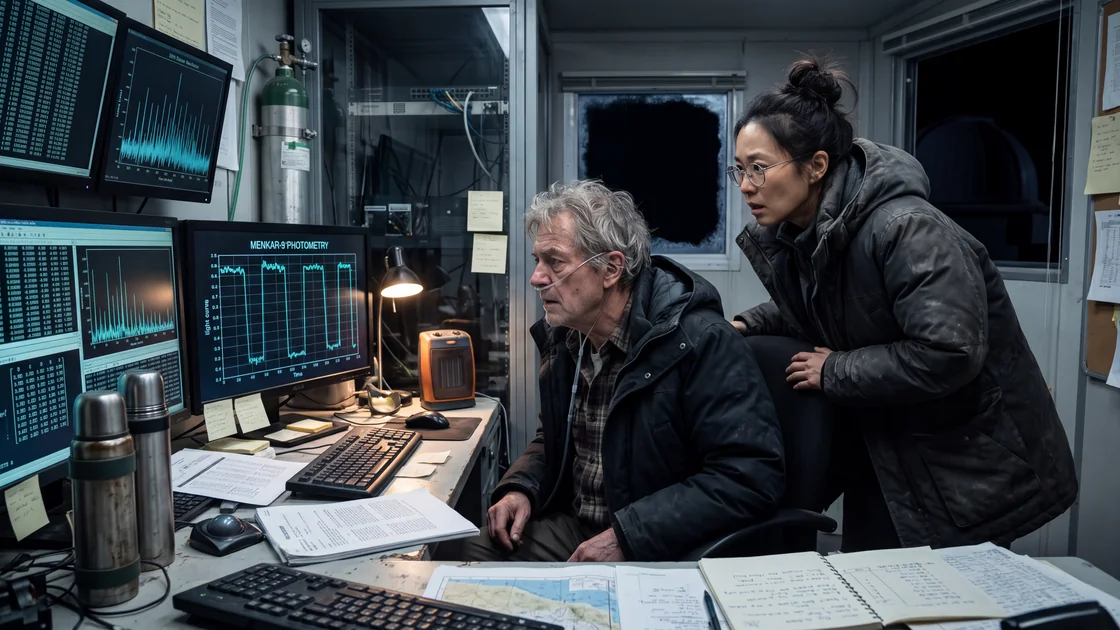
When veteran astrophysicist Dr. Julian Vance detects impossible, non-random photometric fluctuations in the dying red supergiant designated Menkar-Nine, his search for instrumental error uncovers an artificial, high-cadence binary transmission embedded in the star’s dying light. Aided by signal analyst Dr. Sarah Lin at an isolated high-altitude observatory in the Atacama Desert, Vance decodes the stellar pulse, only to realize the star’s outer envelope is being manipulated by a hyper-advanced engineering array to transmit an interstellar distress and civil defense beacon. Rather than a benign greeting, the mathematical sequence provides precise orbital vectors and an urgent deadline, warning the inhabitants of Sol that a catastrophic, relativistic shockfront born of a localized vacuum decay event is hurtling toward their sector of the galaxy, leaving humanity with mere generations to evacuate Earth before the cradle burns.
I. The Whispering Canvas
The high desert did not forgive carelessness. At five thousand meters above the salt-choked floor of the Atacama, the atmosphere was thin enough to starve a man’s thoughts before he noticed they were fading. Julian Vance kept his oxygen cannula looped tightly around his ears, the plastic biting into the raw skin behind his lobes, his breath rasping through the silence of the control pod like dry husks dragged across corrugated zinc.
Outside, the plateau of Llano de Chajnantor was bathed in the freezing, razor-edge clarity of late winter. The sky above the dome was not blue, nor even violet; it was a bruised, bottomless obsidian, pierced by stars that did not twinkle. Without the thick soup of coastal humidity to scatter their luminance, the constellations sat like surgical incisions upon the dark.
Julian clicked his trackball, his knuckles stiff from the chill that the pod’s undersized ceramic heaters never quite banished. On the central monitor, the telemetry stream from the 8.4-meter Vanguard optical-infrared reflector was painting a jagged, violent line across the grid.
"Another dip," he muttered into the empty room.
The automated logging software had flagged the variance three hours prior, cataloging it under Trans-Rotational Artifact: Thermal Noise. But Julian had spent forty years reading the cursive signatures of dying suns. He knew the difference between an instrumental hiccup caused by a cryogenic pump shudder and the true, rhythmic breathing of a supergiant.
The target was Menkar-Nine—an aging M-type red supergiant perched near the frayed edge of the Orion-Eridanus bubble, roughly twelve hundred light-years from Earth. By all astronomical orthodoxy, Menkar-Nine was in the throes of advanced carbon burning. It was a bloated, turbulent monster, swollen to four hundred times the diameter of Sol, its outer convective envelope churning like a cauldron of rust and incandescent gas. It was expected to pulse. It was expected to shed mass in erratic, semi-periodic burps as its core struggled against the inevitable iron-catastrophe that would one day turn it into a type II supernova.
It was not, however, expected to stutter.
Julian leaned forward, his nose nearly brushing the glass. The light curve—a plot of normalized flux against Julian Terrestrial Time—showed a series of precipitous, cliff-like drops. The star’s baseline magnitude had plummeted by precisely 1.4% for a span of seventy-one seconds, recovered with unnatural steepness, paused for thirty-three seconds, and dropped again for seventy-one seconds.
"That's not convective turnover," Julian whispered.
A convective plume on a red giant was a continent-sized bubble of hot plasma rising over months, cooling, and sinking back into the interior. It produced rolling, sinusoidal variations that took half a terrestrial year to resolve. This was a square wave. The rise time and fall time were nearly instantaneous—less than two-tenths of a second. It was as if an iron shutter the size of Jupiter had been slid directly across the line of sight, held motionless, and then snapped back.
The door to the pod hissed open, breaking the vacuum-seal of his concentration. Sarah Lin stepped inside, stomping her insulated boots against the rubberized floor mat to dislodge the fine, volcanic powder that coated everything on the plateau. She carried two insulated flasks, the scent of chicory and stale instant roast cutting through the sterile tang of the ozone scrubbers.
"Primary mirror cooling circuit three is stable," Sarah said, tossing a thermal glove onto the documentation desk. "Whatever caused that baseline drift on Tuesday, it wasn’t the cryostats. It’s clean out there, Julian. Clean enough to see the footprints on the Moon if we had the focal length."
She paused, catching the slant of his posture—the rigid curve of his spine, the way his fingers remained poised over the mechanical keyboard without typing.
"You're looking at Menkar again," she said, setting a flask beside his elbow.
"Look at the photometer," Julian said, his voice flat with the weight of an observation he did not yet want to own. "Look at the sampling interval."
Sarah stepped up behind his shoulder, pulling a pair of wire-rimmed reading glasses from the pocket of her parka. She squinted at the monitor, then tapped the edge of the casing. "Your binning is wrong. You’ve got the high-speed photometer set to millisecond resolution. You’re catching scintillation from the high-altitude jet stream."
"There is no jet stream tonight. Wind shear at twenty millibars is under four knots. The adaptive optics are running at ninety-eight percent Strehl ratio," Julian said. He reached down and highlighted a sixty-minute block of raw photon counts taken by the high-speed avalanche photodiode array. "I bypassed the standard rolling average. This is raw, unbinned arrival time of individual photons in the seven-hundred to nine-hundred nanometer band."
The screen flickered as the recalculation finished.
The graph transformed. What had looked like noisy, erratic drops on the broad-spectrum curve resolved into a pristine, high-contrast train of square pulses.
Sarah stopped reaching for her coffee. Her hand hung in the air between them, fingers curved.
"That's... that's an occultation?" she asked, though her own voice betrayed her.
"No," Julian said. "If it were a transiting planet, the ingress and egress would show limb-darkening curves. You’d see a gentle, rounded parabolic trough as the planetary disk moved across the stellar photosphere. This is vertical. It’s binary."
"Julian, stars don't blink in square waves."
"I am aware," he said softly. "Stars do not blink at all."
II. The Architecture of Noise
For forty-eight hours, neither of them left the pod except to sleep in four-hour rotations in the pressurized bunkhouse forty yards away. The Vanguard telescope remained locked on Menkar-Nine, its massive carbon-fiber truss tracking the red ember as the Earth rolled beneath the Atacama sky.
Julian’s eyes were bloodshot, the whites laced with broken capillaries from the dry altitude. On his secondary screen, a fast Fourier transform had torn the light curve apart, seeking its constituent frequencies.
Natural variable stars were symphonies of overtones—complex mixtures of fundamental radial modes, non-radial gravity waves, and chaotic turbulent noise. Menkar-Nine’s Fourier transform should have looked like a mountain range: a broad, messy peak surrounded by jagged foothills of convective hum.
Instead, the screen displayed a comb.
Dozens of razor-thin needles spiked upward from a flat, zero-energy baseline at mathematically regular intervals.
"It's a clocked sequence," Sarah said. She was sitting cross-legged on the floor, surrounded by printouts of ASCII tables and hexadecimal dumps. "The carrier frequency is forty-two point six six six megahertz, modulated directly onto the star's radiant flux. But Julian, the energy budget... it’s insane."
Julian dragged a thumb across his dry lower lip. He knew the numbers. He had calculated them three times while Sarah was sleeping.
Menkar-Nine had a total bolometric luminosity roughly ten thousand times that of the Sun. To drop that star's apparent brightness by over one percent for seventy-one seconds required the obscuration of an area of the photosphere millions of kilometers across. Or it required the star itself to be extinguished locally.
"It isn't an occulting swarm," Julian said, gesturing to the spectroscopic readouts. "Look at the iron-two and titanium-oxide absorption bands. If there were physical matter—a mega-structure, a cloud of reflective dust, a field of occulting screens—passing between us and the star, we would see Doppler shifts in the absorption lines as the screen moved. We would see scattered infrared reradiation from the occulting body absorbing stellar heat."
"And?"
"There is none," Julian said. "The absorption lines aren't being blocked. They are being quenched."
Sarah looked up from her papers, her face pale in the blue wash of the LED monitors. "Quenched? You mean the surface is cooling down on command?"
"I mean something is modulating the opacity of the star’s outer convection zone," Julian said, his voice dropping to a gravelly register. "Something is introducing an artificial absorption agent directly into the upper photosphere, or manipulating the magnetic confinement of the plasma to suppress convective upwelling in synchronized pulses across the entire Earth-facing hemisphere."
He picked up a dry-erase marker and drew two parallel lines on the glass partition that separated the console room from the server racks.
"One percent of Menkar-Nine's luminosity is one hundred times the total energy output of our Sun," he said, tapping the glass. "Whoever is flipping that switch is expending the kinetic output of an entire planetary system just to blink the light."
"Why?" Sarah asked. Her voice was barely a whisper. "If you have that kind of power... if you can engineer the convection zone of a red supergiant... why use it as a telegraph?"
"Because of reach," Julian replied immediately. "Radio disperses. Lasers must be pointed with micro-arcsecond precision across light-centuries, and their beams spread or scatter against interstellar hydrogen clouds. But a red supergiant? A red supergiant is a lighthouse that burns for twenty light-millennia in every direction at once. If you turn a star into a transmitter, Sarah, you aren't talking to an outpost. You are talking to a quadrant."
He turned back to the keyboard and hit a sequence of keys. A series of clean, digitized numbers began to scroll down the terminal.
"She’s been doing this for a long time," Julian said. "We only looked because the automated survey flagged an anomaly. But when I pulled the archival plates from the Harvard glass negative collection—photometric surveys from 1898, 1934, 1972—the drops were there. Buried in the noise floor of primitive emulsions. Ignored as emulsion flaws or plate defects."
"How long?"
"At least two hundred years," Julian said. "Which means the signal was sent fourteen hundred years ago. When Rome was falling, Menkar-Nine was already stuttering."
Sarah pulled herself up to the console, her fingers trembling slightly as she touched the edge of the running code. "Is it an encyclopedia? An interstellar greeting? The prime numbers?"
"No," Julian said, his jaw tightening until the muscle clicked. "I ran the first ten thousand bits through an invariant-density algorithm. It isn't a greeting. The entropy of the sequence is far too low. It doesn't have the complexity of a language, or the layered density of a historical record."
He pointed to a string of recurring characters that the interpreter had grouped into six-byte groupings:
11111111 00000000 11111111 00000000 10101010
"It’s an alarm," Julian said. "A directional beacon. It's repeating the same data frame every twelve hours, thirty-one minutes, and six seconds. Over and over. Without variation."
Sarah leaned in, her breath fogging the corner of the display. "Can we read it?"
"We don't have to," Julian murmured. "The preamble uses the hydrogen line as a spatial clock and the fine-structure constant as a unit ratio. It’s pointing right at us. Not because they know Earth is here, but because we are sitting directly in the downstream path of whatever they’re shouting about."
III. The Architecture of the Void
By the fourth day, the Vanguard pod had ceased to be an academic retreat and had become a pressure cooker. The National Science Foundation’s regional liaison in Santiago had called twice, demanding an explanation for why sixty percent of Vanguard’s scheduled observing time on cosmological deep fields had been unilaterally commandeered for an uncataloged long-period variable survey.
Julian had hung up on them.
Sarah had spent thirty-six uninterrupted hours constructing a translation lattice. When an alien civilization communicates across the deep gulf of interstellar space using raw energy, they do not rely on cultural semantics. They build from the rock-bottom physics of the universe: the mass ratio of the proton to the electron; the velocity of light in vacuum; the quantum transitions of neutral hydrogen.
At noon on the fifth day, the pod's coffee machine sputtered its last drop, leaving a scorched, bitter film on the hot plate.
Sarah sat back in her rolling chair, her hair pulled back into a chaotic knot, her eyes dark with exhaustion. She pointed a laser pointer at the white board where she had mapped the decoded headers.
"It’s a cartographic projection," she said without preamble. Her voice was cracked, desiccated by the high-altitude air. "A four-dimensional coordinate frame centered on the galactic core. The origin point is not Menkar-Nine. Menkar-Nine is just the relay."
Julian stopped his work on the stellar profile. "The relay?"
"The origin point of the signal’s vector is a coordinates set six hundred light-years further coreward," she explained, flicking the laser dot to a cluster of handwritten numbers. "Near the Vela molecular ridge. A sector dominated by dense molecular clouds and several high-mass stellar nurseries."
"And what is the payload?" Julian asked, his voice steady, though his hand gripped the edge of his desk with whitening knuckles.
"It’s broken into three distinct segments," Sarah said. She brought up a local rendering on her tablet, projecting it onto the pod's main wall monitor. "The first segment is a mathematical description of an interface. A thermodynamic boundary condition. It describes a scalar field—Julian, it looks like high-energy quantum electrodynamics, but the coupling constants are skewed."
"Skewed how?"
"They describe an unstable vacuum state," she said, looking directly at him. "A region of space where the Higgs potential isn’t sitting at the local minimum we observe. It’s an engineered or cascading vacuum transition. A bubble of lower-energy ground state."
Julian felt the room tilt beneath his feet. The thin air suddenly seemed utterly devoid of oxygen. His heart pounded once, hard and slow, against his ribs.
"Vacuum decay," he breathed.
"Or something mechanically equivalent," Sarah said, her voice dropping into a register of clinical terror. "A phase change in the fabric of space-time. The transmission calls it—or rather, the mathematical glyphs translate most cleanly to—The Unravelling Horizon. The message contains a vector map of its propagation front."
Julian stood up, walked to the glass partition, and stared at the clean, geometric lines he had drawn days earlier. The red supergiant outside was twelve hundred light-years away. If the signal was fourteen hundred years old, the event it described was older still.
"What is the propagation velocity?" Julian asked.
"Point-nine-nine-nine-four c," Sarah said. "Relativistic. Nearly the speed of light. It’s riding immediately behind the photons of the star itself."
She tapped her tablet, and the wall monitor painted a three-dimensional wireframe map of the local interstellar chimney—the cavity of low-density gas through which the Sun and its neighboring systems moved.
A glowing red cone extended outward from the Vela coordinate point. It was an expanding wavefront, shaped by the density of the interstellar medium through which it cut, widening like a wake behind a hyper-velocity hull.
Inside the red cone lay hundreds of star systems.
Menkar-Nine was on the perimeter of the cone, its swollen atmosphere already clipping the fringes of the distortion field.
And dead in the center of the cone’s primary axis of expansion, illuminated in cold, unfeeling amber, was a single, modest yellow dwarf star:
Sol.
"The timeline," Julian said, his throat clicking as he swallowed. "Sarah. What is the arrival offset?"
Sarah Lin did not look down at her screen. She had already memorized the numbers. The computation had finished two hours before Julian woke from his sleep cycle.
"The radio preamble defines a zero-marker based on the spin-flip duration of hydrogen atoms at standard temperature," she said, her voice trembling for the first time. "It calibrated the wavefront’s position relative to Menkar’s first pulse."
She took a slow, deliberate breath through her cannula.
"Julian... the transmission isn't an early detection notice sent across cosmic time to warn distant civilizations to watch a scientific event."
She paused, the plastic tubing of her oxygen mask hissing softly in the silence.
"It’s an evacuation order," she said. "The wavefront has already bypassed the Menkar system. The star’s light has been traveling toward us for twelve hundred years. The physical distortion—the shockfront—is lagging less than three percent behind the photons carrying the message."
Julian turned back to the primary console. The green and white light curve of Menkar-Nine continued to trace across the phosphor grid: drop, hold, rise, drop, hold, rise.
"How long do we have?" he asked.
"If the propagation model is correct to six significant figures," Sarah said, looking him in the eye, "the wavefront will intersect the Oort Cloud in sixty-one years. It will reach Earth’s orbit in seventy-four."
IV. The Friction of Disbelief
The conference room at the headquarters of the European Southern Observatory in Vitacura, Santiago, was cooled to a crisp twenty degrees Celsius, but Julian felt as though he were suffocating.
Around the long, polished mahogany table sat seven people: the Director General of the Observatory, two senior astrophysicists from the Max Planck Institute, a defense attaché from the French Ministry of Armed Forces who served as an advisor on anomalous orbital hazards, and three data scientists flown in on twenty-four hours’ notice from the National Radio Astronomy Observatory in Charlottesville.
On the screen at the end of the room, Julian’s light curves were being dissected.
"It’s a magnificent piece of processing, Julian," said Dr. Aris Thorne, a man whose silver hair and perfectly tailored linen suit seemed engineered to exude an aura of unshakeable institutional calm. "Truly. The detection of a sixty-millisecond periodic variation in the convective envelope of an M-supergiant is a feather in Vanguard’s cap. It will make a splendid Nature paper on non-linear magneto-hydrodynamic coupling."
"Aris," Julian interrupted, his voice cutting through the soft murmur of the air conditioning like a dull blade. "Stop reading the press release you want to write and look at the fourth-order parity checks. Magneto-hydrodynamic coupling does not compute prime factorizations to verify coordinate baselines."
One of the Charlottesville analysts, a young woman named Chen with severe posture and an unblinking gaze, leaned over her laptop.
"We ran the raw bitstream from your Vanguard dump through the Blue Waters cluster yesterday evening," Chen said, her tone cautious, clinical. "We cross-referenced it with the secondary telemetry from the James Webb Space Telescope’s archival NIRCam deep exposures of the same sector taken nine months ago during a calibration swing."
Julian leaned forward across the mahogany. "And?"
"The pulses are present in the JWST infrared background," Chen admitted, glancing nervously at Director Thorne. "They aren't instrumental. The James Webb detected the same seventy-one-second drop in the twelve-micron band. The star's effective temperature isn't changing, but its projected surface area in our direction is undergoing coherent geometric modulation."
"Which means it's an artificial signal," Sarah Lin said, speaking from the back corner of the room where she sat with her knees pulled up, clutching a paper notebook like a shield. "You know it is, Chen. The statistical probability of that comb spectrum arising from random convective resonance is one in ten to the forty-seventh power. It is an engineered transmission."
"Let us assume, for the sake of an intellectual exercise, that it is," Director Thorne said, raising his hands in a placating gesture. "Let us assume that an extraterrestrial intelligence possessing energy resources beyond human comprehension has decided to turn Menkar-Nine into an isotropic radio transmitter. You are asserting that this transmission describes a... what did you call it, Vance? A vacuum decay front?"
"A phase transition of the local space-time metric," Julian said, his knuckles whitening on the table. "The parameters laid out in the second packet describe an altered fine-structure constant behind the shockfront. In simple terms: behind that wall, chemistry ceases to function as it does here. Molecular bonds will lengthen by eight percent. Electron orbits will destabilize. Carbon will no longer form complex organic polymers."
He stood up, walking toward the large display and pointing to the amber node labeled Sol.
"When that boundary layer crosses this system, every living cell on this planet will disassemble at the atomic level in less than four picoseconds. The Earth won't be scorched; it won't be smashed by a rock. It will simply cease to be matter capable of sustaining biology. The stars themselves will shift their spectral types as the fusion rates within their cores are rewritten by the new physical laws."
A heavy, suffocating silence descended on the room.
The French attaché, a man named Colonel Duhamel, leaned back, his eyes narrowed as he studied Julian’s face. "And this... this wall. How fast is it moving?"
"Nearly the speed of light," Julian said. "Three hundred kilometers per second slower than the photons reaching Vanguard’s mirrors. That is why the warning is so short. The sender couldn't send the warning any faster than the event itself, because nothing moves faster than light. They used the highest-energy optical source available to them—the photosphere of an existing giant star—to shout ahead of the storm."
"Seventy-four years," Duhamel muttered, tapping a pen against his cufflink. "A seventy-four-year horizon."
"It's preposterous," spat Dr. Klaus Hauer, the senior theorist from Max Planck. He pushed his glasses up his nose with an aggressive flick of his finger. "Vacuum decay is a theoretical curiosity from early-universe inflation models. There is no evidence—none—that our local false vacuum is metastable enough to be triggered by any natural or artificial process. To assert that an entire sector of the galaxy is undergoing an irreversible metric collapse based on the light curve of one variable star is an act of scientific irresponsibility bordering on hysteria."
"Then look at the other stars," Sarah Lin’s voice rang out, sharp and clear.
Every eye in the room swung toward her.
Sarah stood up, her paper notebook falling onto her chair. She walked over to Chen’s terminal and tapped the glass.
"Show them the secondary survey, Chen," Sarah demanded. "Show them the archival data on Betelgeuse. Show them the red giants in the southern quadrant: Alpha Herculis, Antares, Mu Cephei."
Chen swallowed hard, her eyes darting toward Director Thorne, who gave a nearly imperceptible nod.
Chen tapped three commands into her keyboard.
A new set of light curves appeared on the wall monitor. They were not from Vanguard. They were historical records pulled from every major observatory on Earth over the last eighty years—Mount Wilson, Palomar, the Very Large Telescope, the Keck Observatory.
On each plot, hidden beneath the slow, undulating curves of long-period variability, were the same jagged, square-wave notches.
Betelgeuse: pulsing with a period of eighteen hours.
Antares: pulsing with a period of six hours, nine minutes.
Mu Cephei: a massive, ragged red supergiant four thousand light-years away, its light curve carved into identical binary combs.
"It isn't just Menkar," Sarah said, her voice dropping into a register that made the hair on the back of Julian's neck rise. "It’s an entire perimeter. Every late-stage supergiant within fifteen hundred light-years of the Vela coordinate is blinking. They are synchronized. They are an array of sirens, all screaming the exact same coordinates, all shouting the same evacuation vectors."
Julian looked at Hauer. The German theorist's mouth had fallen slightly open. His hands lay motionless on the mahogany table.
"They aren't just warning us," Julian said quietly. "They are providing an escape route. The third packet of the transmission contains navigational corridors—gravitational channels where the shockfront’s curvature is retarded by high-mass galactic structures. They are telling whoever can read the sky where to run."
Director Thorne stood up, his professional composure finally cracking around the corners of his mouth. "If this is real... if we release this to the International Astronomical Union, to the press, to the United Nations... Vance, do you have any conception of what this does to civilization? Seventy-four years is within the lifetime of our grandchildren. It is long enough to know we are doomed, but far too short to build an interstellar ark fleet capable of saving eight billion people."
"Then we had better start building," Julian said. "Because the star does not care whether we believe it or not. The photons have already landed."
V. The Preamble of the Exodus
The months that followed the Vitacura summit were characterized not by public panic, but by a chilling, subterranean mobilization that Julian Vance found far more terrifying than riots in the streets.
The discovery was not formally announced in a grand, televised press conference. Science at that scale did not break like a thunderclap; it leaked like a slow poison through the technical pre-print servers, through classified briefings at the United Nations Security Council, through sudden, massive reallocations of national research budgets that left conventional infrastructure projects starved of steel, rare earth elements, and computing power.
The project was given the administrative moniker Operation Eridanus, though among the inner circle of the working group that now occupied the entire fourth floor of the ESO headquarters, it was known simply as The Reading.
Julian had refused an administrative directorship. He remained an observational astronomer, his desk cluttered with hard drives, physical prints of spectroscopic data, and thermal cups of tea that grew cold before he remembered to drink them. His cannula had been discarded—Santiago was at sea level, and the air here felt thick, wet, and heavy with the scent of vehicular exhaust and flowering jacarandas, an atmosphere so dense it felt like grease compared to the purity of Chajnantor.
Sarah Lin had become the chief architect of the translation engine. She lived in a windowless room down the hall, surrounded by linguistics specialists, particle theorists, and high-energy computational mathematicians.
It was three in the morning when she kicked open the door to Julian’s office.
She looked worse than she had in the Atacama. Her skin had the chalky, translucent gray of someone who had not seen direct sunlight in three months. In her hands, she held a sheaf of thermal-transfer printer paper—the kind used by the high-security cryogenic mainframes in the basement that had no network connections to the outside world.
"It’s not just an evacuation warning, Julian," she said, shutting the door behind her with her heel.
Julian looked up from a gravitational-gradient map of the local bubble. "What do you mean?"
"The third packet," she said, dropping the paper onto the middle of his desk. "We thought it was just flight vectors. We thought it was telling us to run toward the galactic anticenter, toward the Perseus Arm where the shockfront won't reach for another ten thousand years."
Julian reached for the pages. "Isn't it?"
"The vectors are there," Sarah said, leaning over his desk, her knuckles pressing into the wood so hard the tendons stood out like taut wires. "But there's an addendum. A technical appendix. Julian, they knew that anyone reading this signal would be a ground-bound, sub-relativistic civilization. They knew that an industrial species listening to the light of a red giant wouldn't have generational starships sitting in drydock."
Julian began to flip through the sheets. His eyes, trained by decades of reading esoteric symbolic notations, struggled with the non-human logic of the diagrams.
They were not blueprints in the human sense. They were structural axioms: mathematical proofs of material states, magnetic compression geometries, and field-effect equations that operated on the vacuum itself.
"What am I looking at?" he asked.
"It's a recipe," Sarah said. Her voice was flat, hollowed out by awe. "They have given us the engineering specifications for an anti-metric drive. An engine that compresses the spatial gradient ahead of a vessel using the same physical instability that is currently destroying their sector."
Julian looked up from the pages, his breath catching in his throat. "They gave us the fire that is burning them."
"They weaponized the disaster," Sarah said. "Or rather, they figured out how to surf the front. The transmission calls it a Tension Wave Skiff. It isn't a ship that can save eight billion people, Julian. The physics won't scale to that size. The energetic requirements to open the metric bubble require an input mass equivalent to three lunar volumes per hull."
Julian stared down at the crisp, black-and-white lines on the thermal paper. He saw the schematics: long, needle-like structures hundreds of kilometers in length, clustered around central reaction chambers that looked like the interior of a dying star.
"How many?" Julian asked. His voice was barely a croak. "How many could we build in seventy years?"
"If every nation on Earth stops building roads, stops building armies, stops spending capital on anything that isn't extraction, refining, and orbital manufacturing?" Sarah looked away, her eyes fixing on the dark window that reflected their exhausted faces back at them. "Twelve. Maybe fifteen."
"And their capacity?"
"Ten thousand people per hull," she whispered. "If they are packed in cryogenic suspension, stacked like cargo in the reaction shielding. One hundred and fifty thousand people. Out of eight billion."
Julian stood up and walked to the window. Outside, the streetlights of Santiago stretched toward the foothills of the Andes in a glittering, uninterrupted web of gold and orange. Cars were moving along the Costanera Norte; people were returning from late dinners, arguing in doorways, sleeping in apartments, making plans for their children's university educations, buying homes on thirty-year mortgages that would mature long after the sky turned into an unravelling sheet of white fire.
"We have to tell them," Julian said.
"They already know," Sarah replied softly. "The steering committee had the preliminary numbers three weeks ago. Why do you think the Chinese are laying rail lines directly into the Atacama? Why do you think the Americans have nationalized their commercial space sector under the Defense Logistics Agency? The public statement will come in November. They’re calling it the Centennial Horizon Initiative. They will tell the world that the ships are the beginning of an interstellar colonization program. A grand human adventure."
"They won't tell them about the wall," Julian said, cold horror pooling in his gut.
"If you tell eight billion people that they have seventy years to live and that only one in fifty thousand will be chosen to survive," Sarah said, "the ships will never be built. The mines will burn. The launch sites will be torn apart by mobs with sledgehammers. The species will tear its own throat out thirty years before the shockfront ever touches the atmosphere."
She reached out and laid a hand on his shoulder. Her palm was burning hot, feverish with the kinetic terror that had lived behind her eyes for four months.
"The lie is the only way the hulls get built, Julian."
VI. The Voice in the Core
Two years after the translation of the Menkar transmission, Julian Vance returned to Llano de Chajnantor.
He was no longer the director of an observational program; he was an old man with an honorary title and a security clearance that made him a ghost in his own discipline. The Vanguard telescope was no longer his. The facility had been expanded into a military communication redoubt, ringed with high-altitude razor wire, its perimeter patrolled by Chilean soldiers shivering in thermal fatigues, their submachine guns slung across their chests like useless totems against the sky.
A massive new array had been constructed three kilometers south of the optical dome: twelve seventy-meter submillimeter dishes, their white surfaces turned permanently toward the constellation of Cetus, tracking the stuttering heart of Menkar-Nine with the cold, predatory focus of an artillery battery.
Julian walked out onto the gravel terrace behind the old Vanguard pod. The air was as thin and sharp as he remembered, each breath tasting of frost and absolute nothingness. He did not wear his cannula; he wanted to feel the hypoxia, the slight, drifting dizziness that slowed the panic that had lived in his chest like an iron weight since the night of the discovery.
Beside him stood Sarah Lin. She wore an expedition parka covered in technical patches from the United Nations Interstellar Transit Authority. Her hair was cropped short, practical and severe, the soft edges of her face worn away by years of uninterrupted administrative warfare.
"They're starting the first keel next month," she said, looking down at the valley where the lights of the low-altitude logistics bases flickered like fallen constellations. "In lunar orbit. Shackleton Crater has been completely hollowed out for the refining reactors."
"And the lottery?" Julian asked.
"It won't be a lottery," she said quietly. "You know that. It will be genetic diversity indices, technical aptitude matrices, psychological resilience scores. And, of course, the political caste will carve out their private staterooms. They always do. Even at the end of the world."
Julian looked up at the sky.
Menkar-Nine was invisible to the naked eye during the Chilean summer, lost below the horizon, but he did not need to see it to know what it was doing. Across twelve hundred light-years of dead, empty space, its photosphere was continuing to contract and expand in those cold, mechanical intervals.
11111111 00000000 11111111 00000000
The star was dying, but it was dying with purpose. It was a mechanical martyr, burning away its own structural integrity to cast a shadow across the void, screaming a warning to children who had barely learned to chip flint when the first pulses left its corona.
"I went back to the archive last week, Sarah," Julian said, his voice barely louder than the dry wind that hissed through the gravel at their feet.
Sarah turned her head slightly. "To the Harvard plates?"
"To the deeper data. The James Webb’s ultra-deep spectroscopic survey of the Great Attractor," Julian said. He took a slow, shivering breath, his fingers buried deep in his coat pockets. "I looked at the older stars. The red giants in galaxies outside our local group. In the Andromeda branch. In the Triangulum cluster."
Sarah went very still. Her eyes fixed on his profile, her gaze sharp, terrified of the answer to the question she had not yet asked.
"Julian," she warned softly. "Don't."
"They're blinking, Sarah," Julian said. He did not weep; he had no tears left for the sky. His voice held only the terrifying, crystalline clarity of a man who has looked through the keyhole and seen the entire house in flames. "Not just our quadrant. Not just the Orion Arm. The whole sky is stuttering."
He pointed a gloved finger upward into the black, unblinking dome of the night, toward the faint, milky smudge of the Andromeda Galaxy hovering just above the northern peaks.
"The warning isn't for a localized event," Julian whispered. "It’s a cascade. A chain reaction that started before this galaxy was formed. The civilizations that came before us—the ones who learned how to speak with stars—they aren't fighting it. They aren't trying to stop it. They’ve been running for ten billion years."
Sarah stood beside him, her small frame rigid against the freezing wind that poured down from the Andean peaks. She did not answer. There was no answer to give.
Down in the valley, the high-intensity floodlights of the construction depots illuminated the long, yellow scars where the rail lines were climbing the mountain, bringing steel, tungsten, and human flesh to feed the great machines that would build their desperate, fragile arks.
Above them, silent, majestic, and completely indifferent to the terror of the small things that looked upon it, the universe went about the business of unmaking itself, one heartbeat at a time.
Julian Vance pulled his coat tighter around his neck and turned back toward the warmth of the pod, leaving the sky to its work.