The Residual Frequency
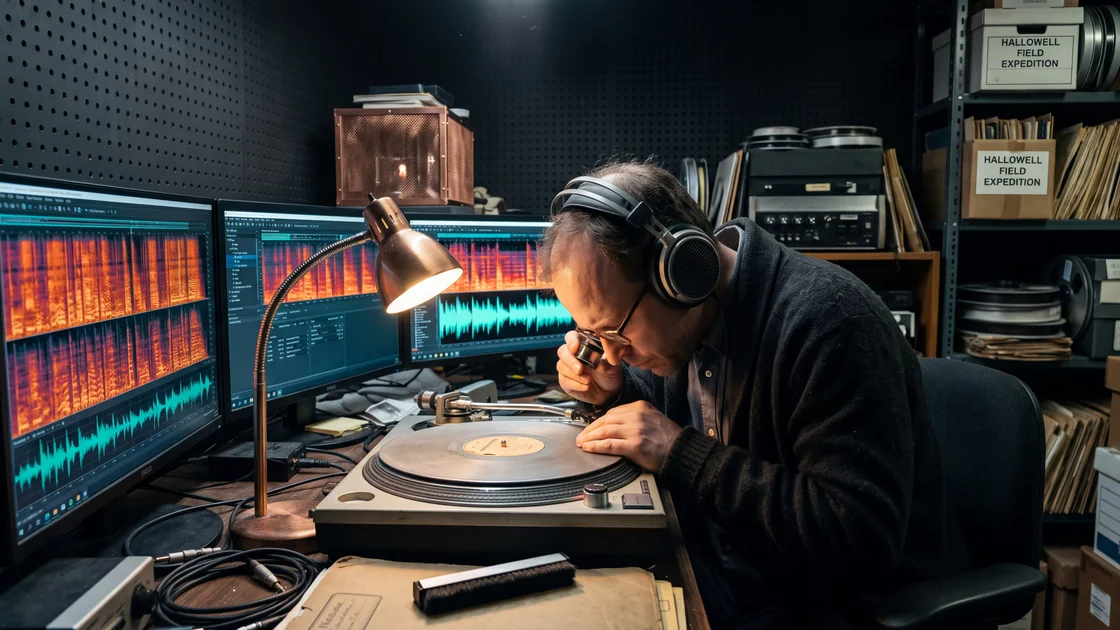
This is the story of Arthur Vance, an obsessive audio archivist at the Library of Historical Sound, who discovers an impossible anomaly while digitizing a fragile 1934 field recording from the Appalachian hills: buried beneath the groove noise and an old ballad singer’s trembling vibrato is the unmistakable, pristine chime of a modern smartphone ringtone. As Vance strips away the layers of dust, scratch, and magnetic decay, his technical curiosity turns into an all-consuming forensic investigation that challenges the boundaries of physical history, leading him down a rabbit hole of forgotten expeditions, temporal echoes, and the terrifying realization that some sounds do not belong to the past they were captured in.
I. The Turntable in the Vault
The Morrison Audio Restoration Laboratory occupied a windowless sub-basement three floors beneath the quadrangle of the St. Jude Endowment for Folk Heritage. It was a room designed for silence, lined with perforated acoustic foam and isolated from the municipal subway lines by twelve inches of floating neoprene pads. In this bunker of preserved vibration, dust was the only mortal enemy Arthur Vance acknowledged. Dust, and the relentless, entropic decay of shellac, nitrocellulose, and beeswax.
Arthur sat in the glow of three 32-inch monitors, his face lit by the cold, turquoise hue of a spectral editing suite. He was forty-two, though his posture—slumped forward like a carpenter leaning over a jointer—suggested an older man whose spine had made peace with chronic confinement. Between his thumbs, he held a carbon-fiber brush. On the platter of the custom Technics SP-10MK3 rested a twelve-inch disc of unlacquered aluminum, gray as pond ice and scarcely thicker than a playing card.
The disc had arrived four days earlier in an archival box lined with acid-free tissue paper, shipped under insurance bond from the estate of a regional historian in Asheville. It was labeled in faded iron-gall ink on an adhesive paper ring:
Hallowell Field Expedition — Black Mountain Gap, Yancey County, N.C.
Track 14: “The True Lover’s Farewell” (Unaccompanied female voice).
Rec. by Dr. Julian Hallowell, September 24, 1934.
Presto portable instantaneous disc cutter. Aluminum substrate, 78 RPM, inside-out cut.
Julian Hallowell was an elusive figure in American ethnomusicology. While John and Alan Lomax were traveling the southern prison farms with a three-hundred-pound recording rig in the trunk of a Ford, Hallowell had operated on a shoestring grant from a defunct Philadelphia normal school, driving a sputtering Dodge panel van into the deepest coves of the southern highlands. He had vanished from academic records by 1938, his field notes largely scattered, his recordings rumored to have been destroyed in an attic fire outside Knoxville. Only thirty-one of his aluminum discs were known to have survived, and Track 14 was the penultimate cut in the lot.
Arthur adjusted his headphones—a pair of planar-magnetic open-backs with planar drivers calibrated flat down to five hertz. He engaged the vacuum hold-down system; the pump hissed softly beneath the bench, flattening the slight warp of the eighty-year-old metal disc against the platter. He cleaned the surface with an anti-static wash of laboratory-grade isopropanol and distilled water, dried it with lint-free photographic paper, and swung the heavy tonearm into place.
Because it was an inside-out cut—a common practice in early instantaneous recording to prevent aluminum swarf from fouling the cutting head—the stylus had to be cued at the center, near the paper label, tracking outward toward the rim.
He lowered the cueing lever. The sapphire stylus settled into the shallow, hand-cut microgroove.
The initial sound was the familiar, comforting roar of pre-war metal: the heavy, shearing rumble of an unpolished cutting sapphire plowing through soft metal in an unconditioned mountain room, accompanied by the steady, broadband surf of sixty-cycle ground hum from Hallowell’s primitive battery-inverter rig.
Then, through the gray fog of acoustic history, the voice appeared.
It was high, reedy, and unmistakably authentic—the mountain voice of an older woman whose lineage had kept English border ballads alive by firelight. She did not sing from her chest; she sang through her teeth, her vowels flat and hard-bitten, carrying the melancholic fatalism of the Scotch-Irish settlers:
“Oh, don’t you see that little turtle dove,
A-skipping from vine to vine,
A-mourning for his own true love,
Just as I shall mourn for mine…”
Arthur leaned back, his eyes half-closed, fingers dancing reflexively over the key commands to set locator points. The signal was recorded hot, with noticeable clipping on the sibilants, likely caused by Hallowell placing the heavy carbon microphone too close to the singer’s chin. The room ambiance was tight—probably a pine-paneled parlor or an enclosed porch. In the background, between her vocal phrases, Arthur could hear the faint clatter of dry leaves outside and the rhythmic, wooden creak of her rocking chair.
The singer paused between the second and third stanzas, taking a wet, shuddering breath.
In that hollow pocket of time—roughly one point four seconds where only the room tone and the cutting lathe hum existed—Arthur heard it.
It lasted no more than six hundred milliseconds. A sequence of five clean, pure, percussive tones, chiming in a bright, ascending-descending arpeggio: G-sharp five, B-five, C-sharp six, E-six, B-five.
Arthur’s hand jerked on the trackball, snapping the playback head to a halt.
He sat motionless in the dead silence of the basement.
The tone was not a mountain bell. It was not a clock chime, nor a hammer striking a distant iron wedge, nor the mechanical ring of a 1930s magneto telephone. It was a synthesized marimba strike, rendered with algorithmic spatial stereo width, high-order harmonic saturation, and the clinical, glossy micro-decay characteristic of an iPhone’s standard “Opening” alert tone.
He took off his headphones and placed them gently on the felt mat of the workstation. He looked across the room.
His own phone, an unremarkable black rectangle, rested inside a small copper-mesh Faraday box on the credenza by the heavy steel door—a strict institutional rule to prevent radio-frequency interference from bleeding into the high-gain phono preamplifiers. The Morrison Lab was a clean zone; no cellular signals penetrated three stories of steel-reinforced concrete, and even if they had, Arthur kept his phone permanently set to a low, silent vibration.
"Artifact," he whispered to the empty room. "Ghost channel."
It was a standard problem in legacy studio workflows. If an old quarter-inch master tape had been stored wound on the reel, the magnetic flux could bleed through adjacent layers of the tape pack, creating a "pre-echo"—the faint sound of the chorus arriving two seconds before the chorus actually played. But this was not magnetic tape. This was an instantaneous disc. A physical stylus had gouged a single continuous spiral into a blank sheet of aluminum on a September afternoon in 1934. Aluminum did not bleed. It did not have magnetic memory. It had only geography: width and depth cut into metal by a blunt jewel.
Arthur picked up the headphones, settled them over his ears, and dragged the cursor backward along the timeline.
II. Forensic Extraction
He zoomed in on the waveform. At the three-minute-and-twelve-second mark, the singing woman ceased. The graphic representation of the sound—the squiggly blue line of amplitude—contracted to a narrow band of baseline floor noise: the cutting motor's mechanical chug, the carbon mic hiss, and the singer's wet inhale.
And there, riding directly on top of the noise floor, sat five tiny, razor-sharp peaks.
Arthur highlighted the selection, looped it, and pressed the spacebar.
Ding-ding-ding-da-ding.
The chime repeated endlessly, ringing out against the hollow background of rural North Carolina in the heart of the Great Depression. It was small, distant, but unmistakably clear. It sounded as though someone had been standing thirty feet away, perhaps in an adjacent hallway or just outside an open window across the dirt yard, when an incoming call had triggered the ringer.
He opened the spectral analyzer.
The screen shifted from a traditional time-domain waveform to a sonogram—a heat map of frequency versus time. The background noise of the 1934 recording was a thick, muddy smear of oranges and deep browns, concentrated heavily below 4,000 Hertz, with the telltale horizontal streaks of 60 Hz mains hum and its odd-order harmonics (180 Hz, 300 Hz) typical of poorly filtered vacuum-tube power supplies.
Above 5,000 Hertz, the aluminum disc naturally rolled off into nothingness. The cutting heads of that era, heavy electromagnetic drivers with crude horse-shoe magnets, simply could not translate frequencies much higher than six or seven kilohertz; the physics of the cutting stylus moving through metal created too much drag.
Yet there, glowing in the high register like bright neon daggers, were five vertical transients cutting straight through the ceiling of the historic frequency band.
The fundamentals sat precisely at 830 Hz, 987 Hz, 1108 Hz, 1318 Hz, and 987 Hz. The overtones stretched cleanly all the way up to 14,000 Hertz—frequencies that Julian Hallowell’s Presto lathe was theoretically incapable of mechanical reproduction.
"That's impossible," Arthur said.
The voice of reason, built over twenty years of physical restoration work, offered immediate explanations:
- Digital cross-talk. A software glitch in the audio interface. The core-audio driver had leaked a system alert from his operating system into the input buffer during conversion.
- ADC clock jitter. A freak harmonic artifact generated by the analog-to-digital converter's delta-sigma modulator.
- Physical contamination. Someone had played the disc in modern times—perhaps in the late 2000s or 2010s—and re-recorded it through a microphone while a phone went off in the room, then pressed a modern dub-plate to look like an original.
Arthur stood up and approached the turntable. He lifted the tone-arm and swung it away. He turned on the halogen goose-neck inspection lamp, pulling it down until the bulb was two inches from the aluminum disc.
He reached into his breast pocket for his 20x jeweler’s loupe.
Holding the lens to his right eye, he found the three-minute mark by tracking the groove circumference with a steel ruler held hovering above the surface. He knew the pitch of the lathe—roughly ninety-six grooves per inch. He found the section where the singer had paused: the groove became smooth, losing the violent lateral undulations of her voice.
He looked closer.
Sound recorded on an instantaneous disc is not abstract data; it is an incision. A human voice makes the cutting stylus kick left and right, carving a snake-like path through the metal wall. If the phone chime had been added digitally during transfer, the groove under his lens would be flat and silent.
Arthur held his breath, stabilizing his wrist against the turntable’s chassis.
In the dead-space between the vocal passes, the groove did not run smooth. It showed five distinct, microscopic, high-frequency serrations—tight, sharp, lateral ripples etched into the inner wall of the aluminum ditch.
The aluminum had not been forged yesterday. The walls of the groove showed the unmistakable, dull, microscopic white patina of oxidation—aluminum hydroxide bloom—that formed only when uncoated metal was exposed to atmospheric moisture over decades. The serrations were not fresh scratches. They had oxidized at the exact same rate as the grooves containing the Appalachian woman’s voice.
Julian Hallowell’s cutting needle had physically carved those modern frequencies into the metal disc on September 24, 1934.
Arthur straightened up, his back cracking with a dry pop. The laboratory suddenly felt colder. The acoustic dampening panels seemed to suck the air out of his lungs, leaving behind the faint smell of mineral spirits, ozone from the high-voltage power supplies, and eighty-year-old dust.
III. The Hallowell Dossier
By eleven that night, Arthur was still in the basement, though he had stopped running audio.
The disc was back in its acid-free housing, safely horizontal on the anti-vibration shelf. On Arthur’s second desk, which was clear of electronics, three oversized brown folders lay open. They were the administrative records of the Hallowell Expedition, retrieved by special permission from the Institute’s rare manuscript room on the fourth floor.
Julian Hallowell had kept meticulous logs until the late summer of 1934. His handwriting was an angular, impatient script common to Ivy League academics of the post-Great War era: black fountain pen ink on watermarked bond paper.
Arthur skimmed through the entries:
August 12, 1934. Green Mountain, Yancey Co.
Rented two mules from a Mr. Teague to carry the heavy wet-cell batteries and the Presto cutter up the branch. The heat is oppressive; dampness threatens the aluminum blanks. If moisture settles in the cases, the stylus chatters and tears the metal rather than clearing it. Collected four fiddle tunes from a boy named Vance Barnett. Fine bowing, archaic modal tunings (AEAE).September 3, 1934. Cane River.
Local suspicion remains our greatest hindrance. They mistake the aluminum discs for tax maps or land-registry equipment. Had to assure an elderly gentleman that the microphone was not an instrument of the Tennessee Valley Authority.September 22, 1934. Higher elevation, near the Black Mountain ridge.
Found boarding at the cabin of Mrs. Arbuthnot. Her mother, Sarah Calloway, is seventy-eight, nearly blind, but retains an astonishing store of Child ballads learned from her grandmother. Promised her two silver dollars to allow the machine into the parlor. The battery charge is running low; must crank the inverter with great care to maintain 78 revolutions per minute.
Arthur turned the page.
The entry for September 24 was different. The handwriting was no longer steady. It showed evidence of violent hesitation; the ink had pooled where the nib had sat motionless on the paper, blooming into small, dark bruises across the fibers.
September 24, 1934. Afternoon.
Recorded Sarah Calloway: “The True Lover’s Farewell.”
During the recording, an interruption occurred which I cannot credit to any natural agency known to me. We were entirely alone in the house; the girl Martha had gone to the springhouse with the churn, and the men were two miles off in the bottom-land timber.
While Mrs. Calloway was singing the second stanza, there came from the breezeway—or perhaps from the space immediately behind the corner wardrobe—a small, crystalline sound. It had the quality of glass bells or struck silver, yet it was distinctly synthetic, cold, and possessed of a rhythmic cadence that was horrifyingly jaunty.
Mrs. Calloway did not cease singing, though she rolled her white eyes toward the shadows with evident terror. She took it for a token. She believes it was the 'harp of death,' which her sister heard before the influenza took her child in '18.
Upon examining the wardrobe immediately after lifting the head, I found nothing. No vermin, no mechanical clockwork, no child’s toy. Yet when I played the disc back using the soft cactus-needle, the bell-notes were plainly present upon the groove.
It was not a bird. It was not a cricket. It had the precision of a celestial automaton.
I have questioned myself as to whether the strain of the mountain travel has unsettled my senses. But the machine does not have senses; it has only diaphragms and sapphire points. The machine heard it.
Arthur stared at the sentence.
The machine heard it.
He turned the page. The entries for September 25 through October 2 were missing; three leaves had been excised from the ledger with a straight razor, leaving only narrow slivers of paper along the binding.
The next legible entry was dated October 14, written from a hotel in Johnson City, Tennessee:
I have ceased recording. I cannot allow the cutter to run again. The hills are not empty; they are crowded with things that possess no bodies, or perhaps bodies that have not yet been born. The aluminum is an aperture. When we cut the metal, we are opening a door that does not swing one way.
I have packed the discs in paraffin. I intend to deliver them to the Department in Philadelphia, but I shall advise that they be melted down for aircraft scrap. We have no business preserving what does not belong to the air.
Hallowell had not delivered them to Philadelphia. He had resigned his post six weeks later, citing nervous collapse, and had spent his remaining thirty years working as an inventory clerk for a retail hardware wholesaler in Camden, New Jersey. He had never married. He had never owned a radio.
IV. The Digital Dissection
Arthur was not a superstitious man. He was an engineer. He believed in the material reality of mass, velocity, acceleration, and the physical deformation of matter. A ringtone could not be cut into an aluminum disc in 1934 because the electronic circuitry, digital-to-analog converters, flash storage, and GSM/LTE radio transceivers required to make that sound did not exist.
If the sound was there, it meant one of two things: either history had an unaccounted-for seam through which physical acoustic energy could fall, or someone had executed an impossibly brilliant, microscopically perfect hoax on the Hallowell disc.
He returned to the spectral workstation.
He set the Fast Fourier Transform (FFT) size to 8192 samples—a resolution so fine it could distinguish between adjacent vibrations of two piano strings tuned to the same pitch.
He selected the five notes and engaged the hum-removal and phase-inversion tools, effectively subtracting the 60 Hz inverter rumble and the background hiss of the aluminum cutting head. The room tone of Mrs. Calloway’s parlor vanished, leaving the five notes floating in a black, synthetic vacuum.
Arthur listened through his monitors.
Chime.
It was clean. Too clean. But now that the noise was stripped away, his trained ear detected something else.
Behind the five marimba notes, there was another sound, extremely quiet, sitting at the limits of the Presto cutter’s dynamic range—roughly thirty-eight decibels below the primary signal.
Arthur boosted the gain by twenty-four decibels, applying a steep brick-wall filter to cut everything below 800 Hz and everything above 4,000 Hz to prevent blowing his monitors.
He ran the loop again.
Behind the ringtone, recorded in the room along with the chime, was the rustle of synthetic fabric—the high-frequency swish of ripstop nylon rubbing against itself, like the sleeve of a modern rain jacket.
And then, a sharp, aspirated gasp.
A human voice, muffled, female, speaking in a frantic whisper:
“—shit, where’s the off—where’s—”
A sharp click. The chime cut off mid-decay, choked by a mechanical button press.
Arthur’s chair rolled back six inches on its casters. The hair on his forearms stood straight out, brushing against the cuffs of his woolen sweater.
The voice was not Sarah Calloway’s. It was not Julian Hallowell’s mid-Atlantic academic baritone. It was the voice of a young, twentieth-first-century American woman, stressed, breathless, using the specific casual profanity and speech cadence of someone who had grown up with a phone in her palm.
“Where’s the off,” she had said.
Arthur rubbed his eyes until he saw spots. His head throbbed behind his temples.
He stood up and walked to the wall phone—the lab’s internal analog landline that connected to the institute’s security desk and front office. He dialed the extension for Clara Webb, the Senior Physical Conservator in the preservation lab on the second floor.
The phone rang three times before she answered, her voice thick with the gravel of late-night work.
“Webb.”
“Clara. It’s Arthur. Are you still at your bench?”
“I’m looking at an eighteenth-century hymnal that someone decided to mend with Scotch tape in 1962, Arthur. I want to die. What do you need?”
“I need you to come down here. Bring the portable X-ray fluorescence spectrometer. And the binocular zoom scope.”
A pause on the line. Clara knew Arthur’s habits; he rarely spoke unless he had spent twenty minutes determining the most efficient arrangement of words.
“Arthur? Are you okay? You sound like you just dropped a wax master.”
“I haven't dropped anything,” Arthur said, his voice flat, low. “I need you to look at an aluminum disc. I need to know if the metal has been tampered with. Microscopically. Chemically.”
“It’s midnight, Arthur.”
“Please, Clara.”
She hesitated. “Give me ten minutes to get the rig off the cart.”
V. Material Truth
Clara Webb was fifty, with gray-streaked hair tied back with a leather lace and fingers permanently stained with iron-gall ink and bone glue. She had spent thirty years determining whether Renaissance parchments were forged and whether nineteenth-century daguerreotypes were genuine. She did not care about the music; she cared about the substrate. To Clara, history was not a narrative of great men or old songs; it was an inventory of degradation: oxidation, fungal hyphae, acid migration, and physical shear.
She placed her binocular microscope on Arthur’s clean-room desk, plugging its ring illuminator into the regulated isolation transformer. Beside it, she set the handheld XRF analyzer—a device resembling an industrial radar gun that used low-level X-ray emissions to identify the elemental composition of materials without taking physical samples.
Arthur sat on his stool, watching her hands.
She placed the Hallowell disc on the stage, centering the area of the three-minute pause under the twin optical barrels. She adjusted the coarse focus, then the fine, her thumb wheel clicking softly.
For five minutes, she said nothing. She adjusted the angle of the LED ring-light, tilting the illumination from brightfield to darkfield to cast the micro-ridges of the groove into high relief.
“Well?” Arthur asked, unable to sustain the silence.
“It’s a standard cut,” Clara said, her eye still pressed to the rubber cup of the lens. “Hand-sharpened sapphire cutter. You can see the slight burr on the left wall—that’s the non-drive side of the groove. Hallowell didn’t have his clearance angle set quite right; the heel of the tool was dragging slightly. Typical for amateur or field work.”
“Look at the lateral modulations at the end of the vocal line,” Arthur said. “Between the third and fourth rotations after the woman stops singing.”
Clara adjusted the cross-slide stage with a calibrated micrometer knob. The disc moved a fraction of a millimeter.
She stopped.
Her shoulders stiffened. She leaned down harder into the eyepiece, her hands leaving the adjustment knobs.
“What is that?” she murmured.
“You tell me.”
“These frequencies are too high for a mechanical diaphragm,” she muttered, more to herself than to him. “The wavelength is… it’s less than twenty microns. A Presto head from thirty-four would have bucked or choked on that kind of transient; the mass of the armature was too great to move that fast. It would have sheared the groove wall right off.”
“Did someone recut it?” Arthur asked. “Could someone take a modern cutting lathe—a Neumann or a Scully with an advanced head—and over-cut those frequencies into the existing groove?”
Clara didn't answer immediately. She reached for the XRF gun, brought its beryllium window down to within three millimeters of the disc surface, and pulled the trigger. On her tablet screen, a spectrum of elemental peaks began to build: massive peaks for Aluminum, with traces of Iron, Silicon, and Copper.
“If someone recut it,” she said, her voice dropping into the clinical cadence of a laboratory report, “they would have had to clean the old oxidation out first. Then the new cut would expose fresh, unoxidized elemental aluminum to the atmosphere. Aluminum oxidizes almost instantly, yes, but it forms an amorphous oxide layer that takes decades to consolidate into the specific crystalline lattice—bayerite and boehmite—that we find on pre-war metal.”
She looked up from the tablet, her gray eyes fixing Arthur with an intensity that bordered on anger.
“The oxide inside those tiny, high-frequency serrations is three hundred nanometers thick,” she said. “It has identical micro-crystalline cracking to the grooves cut on the singer’s voice. It hasn’t been cut twice, Arthur. The voice and the… whatever those ripples are… they were gouged into this sheet of metal at the exact same moment. Eighty to ninety years ago.”
Arthur leaned back, staring at the monitor where the blue spectral line still hung frozen.
“There’s a voice behind it, Clara,” he said quietly. “A woman’s voice. She’s using modern English. She’s swearing about turning off a phone.”
Clara didn’t laugh. She looked down at the aluminum disc, gleaming dull and pale under the cold halogen light, like an unblinking eye.
“That’s not possible,” she said.
“I know.”
“No, Arthur, you don’t know. If that’s true, then the physics of inscription are broken. A sound cannot be recorded before it is made. Sound is not light; it doesn’t travel through the void. It’s an atmospheric pressure wave. It has to exist in the air where the needle is.”
“She was there,” Arthur said. He pointed his finger toward the floor—not at the floor of the lab, but at the earth, at the geography of the Black Mountains three hundred miles to the south. “In that room. In Mrs. Calloway’s parlor. She was standing behind the wardrobe, or on the porch, or in the wall. She was holding a device that didn’t exist, and it rang, and Julian Hallowell’s cutter was so sensitive that it dragged the air of that room down into the aluminum.”
Clara slowly reached out and turned off the microscope light. The disc vanished into the gloom of the desk.
“What are you going to do?” she asked.
“There are thirty more discs in the collection,” Arthur said.
VI. The Ghost in the Transducer
For thirty-six hours, Arthur did not leave the Morrison basement.
He had a cot brought down from the facilities office, but he did not sleep on it for more than twenty minutes at a stretch. The skin around his eyes turned dry and red; his mouth tasted of metallic coffee and antacids. The air in the lab, scrubbed by the HEPA filtration units, felt thin, devoid of seasonal temperature.
He digitized every remaining disc in the Hallowell acquisition.
Most of them were what they appeared to be: raw, brilliant documents of a vanished world. Fiddle breakdowns recorded on courthouse lawns; unaccompanied hymns sung by Primitive Baptists in clapboard meeting houses; children’s counting rhymes shouted across split-rail fences. They contained the standard acoustic aberrations of early field work: dogs barking, wind catching the silk ribbon of the microphone, the rumble of an occasional logging truck on a distant gravel road.
Then he reached Track 28.
Track 28 was an uncataloged ten-inch disc, cut on both sides, labeled only with a location and a date:
Deep Creek, Swain Co. October 2, 1934. Night.
There was no song title. There was no singer listed.
Arthur set the stylus down.
For the first minute, there was only the sound of a forest at night: the rhythmic, pulsing drone of fall cicadas and katydids, recorded with unusual clarity. Hallowell must have set the microphone out on the sill of a window or on the stump of a felled chestnut tree. The night air was heavy, damp; one could hear the soft, heavy drip of condensation falling from hemlock needles onto dry leaves.
At two minutes and fourteen seconds, there was a sound of footsteps.
They were not the heavy, deliberate steps of a mountain man in leather work boots. They were light, irregular, slipping on the damp slope. The snapping of dry twigs.
Then, the breathing: rapid, ragged, hyperventilating.
A woman’s voice, closer this time—no more than fifteen feet from the microphone. She was sobbing, but fighting to keep the sound inside her throat.
“—signal, please, just one bar, come on, come on—”
A high, digital bleep—the distinctive two-tone prompt of a handheld GPS unit or an outdoor smartwatch acquiring or losing a satellite lock.
Arthur slammed his hand onto his spacebar, freezing the track.
His heart was hammering against his ribs with such violence that the pulse sounded like low-frequency thumps through his open-back headphones.
“Deep Creek,” he whispered.
Deep Creek was on the North Carolina side of the Great Smoky Mountains National Park, just north of Bryson City. In 1934, the park was newly established; thousands of acres of timberland were being abandoned by residents as the federal government cleared out the smallholders to create the wilderness preserve.
He hit play again.
The woman’s voice rose in pitch, sharp with panic:
“—the trail is gone. It was just the road, it was paved, and then it wasn't… hello? Can anyone hear me? Hey!”
A distant, low sound answered her from the deep timber.
It was not an animal. It was a prolonged, groaning vibration—the sound of an engine, but not the clean hum of a modern automobile. It was the violent, irregular chuffing of a pre-war internal combustion engine without a muffler, running on low-octane kerosene-blend fuel.
A car or a truck was climbing the logging trail in low gear.
Through the aluminum recording, Arthur heard the woman gasp.
“Oh, thank God,” she whispered. “Hey! Stop! Stop!”
The sound of her feet running through the brush, crashing through rhododendron slicks.
Then, Julian Hallowell’s voice cut into the aluminum, loud, booming, terrifyingly immediate, spoken directly into the microphone:
“Who’s there? Step into the light of the head-lamps. Who are you?”
The sound of a vehicle door creaking open on dry iron hinges. A lantern being shaken; the metallic clank of a bail handle against a glass globe.
A beat of absolute silence, save for the cicadas.
Then, a scream from the woman.
It was not a scream of physical pain; it was a scream of cognitive collapse. The sound of a human mind confronted with an environment whose geometry, whose era, whose very light and air were fundamentally wrong.
“Where are the lights?” she shrieked. “Where is the town? Where is the highway?”
Hallowell’s voice, rising in agitation, barking with the defensive terror of a man who believed in devils:
“Stand away from the vehicle! Martha, fetch the iron from the floorboards! Stand away, I say!”
“Look at your clothes,” the woman cried, her voice cracking into hysteria. “What is this? What year is it? WHAT YEAR IS IT?”
A sharp, metallic clatter—the sound of the cutting stylus jumping the groove.
The needle had skated across the aluminum surface, tearing a jagged, white scar through three inches of spiral track as Hallowell or someone else had lunged toward the machine or the vehicle, knocking the tonearm loose.
The audio dissolved into a horrible, rhythmic screech—the sapphire point scraping helplessly against raw metal, twenty times a second—until the motor ran down, the pitch dropping into a dying, subterranean groan:
Scrrrk… scrrrk… scroooch…
Then, silence.
VII. The Disappearance of Maya Lin
Arthur Vance did not use Google. He used academic databases, LexisNexis, newspaper archives, and the national missing persons registry maintained by the Department of Justice.
He sat in the lab with the lights off, the glow of the dual monitors burning his retinas until his tears were cool on his cheeks.
He searched: Great Smoky Mountains National Park, missing woman, Deep Creek, trail disappearance.
There were hundreds. The Smokies were old, wet, and treacherous; people walked off trails every year, their bodies claimed by laurel hells, sinkholes, and hypothermia within twelve hours of leaving the blue-blazed paths.
He narrowed the search by equipment: iPhone, GPS watch, blue jacket, trail runner.
At three in the morning, he found the incident report from the Swain County Sheriff’s Department, dated October 14, 2021.
MISSING PERSON INVESTIGATION: CASE #2021-0988
Name: Maya Lin
Age: 26
Occupation: Graduate student in Forestry, North Carolina State University.
Last Seen: October 2, 2021, at the Deep Creek Trailhead near Bryson City.
Description: 5'6", 130 lbs. Last seen wearing a sapphire-blue ripstop rain shell, black synthetic running tights, trail-running shoes. Carrying an iPhone 12 in a clear case and a Garmin Forerunner GPS watch.
Circumstances: Ms. Lin was conducting field measurements on soil moisture levels in secondary-growth hemlock stands. Her vehicle, a 2017 Honda Civic, was found locked at the trailhead parking lot. An extensive six-day ground search utilizing National Park Service rangers, dog teams, and thermal-imaging drones yielded no trace. Her cell phone last pinged a tower near Bryson City at 4:18 PM on October 2, after which all signal ceased.
Status: Unresolved. Presumed deceased.
Arthur clicked on the thumbnail image attached to the press release.
A young woman stood on a granite outcrop overlooking a sea of green ridges. She had short, dark hair, tucked behind her ears, and she was smiling against the wind. She was wearing a bright blue jacket—sapphire blue, made of lightweight ripstop nylon. Around her wrist was a wide black rubber watch band.
Arthur stared at her face for ten minutes.
He did not blink. He felt an intense, crushing sensation in his chest—the specific weight of an impossible, irreversible grief.
She had been twenty-six years old. She had gone missing on October 2, 2021.
And she had screamed into the microphone of Julian Hallowell on October 2, 1934.
Eighty-seven years before she was born, her panic had been preserved on a disc of cold aluminum, locked in an archival sleeve, waiting for Arthur Vance to lower a diamond-ground sapphire onto her voice.
VIII. The Acoustic Horizon
The human mind is a conservative organ; it defends its model of reality with the ferocity of a wolf defending its den.
Arthur found himself walking the perimeter of the Morrison basement, touching the walls. Concrete. Steel. Perforated foam. Everything was solid. Everything was four-dimensional. Causes preceded effects. The seed was planted before the tree grew; the vocal cords vibrated before the air moved; the recording lathe cut the groove after the singer inhaled.
Yet, sitting at his console, he knew that sound was uniquely vulnerable to time.
Light travels outward into space forever. A telescope positioned eighty-seven light-years from Earth, equipped with an impossibly large lens, could look down right now and watch Julian Hallowell loading his Dodge panel van in the North Carolina dirt. But sound does not escape. Sound stays in the air. It loses energy, its waves attenuating through friction, their organized kinetic power degrading into random thermal motion—into heat.
Every word ever spoken, every cry of agony, every telephone chime, still existed in the atmosphere as a pattern of microscopic heat differentials. The air was a palimpsest of dead noise.
What if the mountains were not just timber and granite?
What if the narrow coves of the Black Mountains, with their massive deposits of quartz, mica, and magnetic iron ores, acted as a natural delay line—a geological acoustic mirror? Under specific conditions of barometric pressure, electromagnetic storm activity, and geographic focus, could a pocket of air from 2021 fold back against the air of 1934?
Or had Maya Lin simply stepped through a dry gap in the world?
Arthur sat back down at the desk. He pulled Julian Hallowell’s journal back into the light.
He opened it to the very last page—the blank pages following the excised entries. He took an oblique flashlight, holding the beam at an angle of five degrees across the surface of the first torn stub, where the paper had been sliced away.
There were indentations.
When Hallowell had written on the page he later cut out, his steel nib had pressed through the missing sheet, leaving faint, colorless grooves in the paper beneath.
Arthur pulled a soft 4B graphite pencil from his drawer. He did not rub the pencil directly on the page—that was the method of bad detectives in movies, which would destroy the delicate fiber impressions. Instead, he used the lab’s digital forensic imaging scanner: an ultraviolet reflective surface that mapped surface relief down to the nanometer.
The scan took four minutes.
The monitor resolved the pale shadows into black, jagged letters:
...she had no speech that agreed with the country. She held a black tablet of glass, small as a pocket testament, which flickered with a cold, pale light like a swamp-lantern, though there was no wick nor oil within it. When she touched the glass, it showed names that were not names, and numbers that ran like water.
She was not a ghost; her hands were warm and wet with bramble-cuts. She wept until she could not stand.
We brought her into the van. Martha gave her lard-bread and tea, but she could not retain it. She kept crying out for 'the road,' saying that the road had turned into trees.
By dawn, the fever was upon her. It was not the swamp-shivers. It was a violent, burning heat that dried her tongue before the sun cleared the ridge. She did not know her name by noon.
We buried her on the shoulder of the mountain, under the three hemlocks where the creek bends north toward the gap. We did not set a stone; there was no name to put upon it, and the folk here would have dug her out for a witch had they seen the blue cloth she wore.
I burned the black tablet in the forge fire at the sawmill. It did not melt like iron; it burst with a bright, green flash, smelling of lightning and sweet grease.
God forgive me for taking the machine into those trees. The discs must be destroyed. The discs are not records of the past; they are hooks.
Arthur let out his breath.
The screen flickered slightly as the building’s air handling unit kicked into its night cycle.
Maya Lin had not died in 2021. She had died in the autumn of 1934, eighty-seven years before she was born, shivering in the back of an ethnomusicologist’s panel van, her fever watched over by an illiterate mountain girl who had never seen an electric light bulb.
And her phone—the glass tablet that smelled of lightning—had burned to ash in a sawmill forge that had long since rotted into the leaf mold of the Great Smoky Mountains.
IX. The Loop
Arthur Vance looked at his watch. It was 5:14 AM.
In the world above the Morrison vault, the street sweepers were moving through the university campus, their wire brushes scraping the curb with a sound not unlike the lead-in groove of an old 78. Commuter trains were sliding through the tunnels under the river, their steel wheels shrieking against the radius of the rails.
He looked at the two aluminum discs on his desk: Track 14 and Track 28.
According to institutional protocol, his next step was clear. He was to generate high-resolution 24-bit/192kHz archival preservation copies, write the descriptive metadata—including notes on anomalous signal artifacts—and upload the files to the secure servers of the St. Jude Endowment, where they would be mirrored to the Library of Congress.
In seventy-two hours, graduate students, audio engineers, and historians would listen to Track 14.
Someone would hear the marimba chime.
Someone would isolate the high-frequency serrations.
Someone would run the spectral de-noising algorithms and find Maya Lin’s voice, whispering her modern profanity between the stanzas of an eighteenth-century ballad.
And then the search would begin.
They would trace the file. They would examine the disc. Clara Webb’s XRF analysis would be verified by twenty other laboratories. The physical reality of the aluminum oxide bloom would be tested with mass spectrometers and electron microscopes. The scientific community would be forced to confront an artifact that violated the fundamental sequence of cause and effect.
And eventually, someone would look at the missing persons records.
Someone would find Maya Lin’s name.
Arthur sat motionless, his fingers resting on the trackball.
What happens to a girl who has not yet been born, if the world knows she has already died?
What would happen if Maya Lin, as an undergraduate or a high school student, stumbled upon the Hallowell Field Recordings on an academic website? What if she listened to the strange, anomalous recording of an old woman singing The True Lover’s Farewell?
Would she hear her own phone?
Would she hear the five notes of the marimba chime—the alert tone she had chosen for her alarm clock because it felt bright and gentle—ringing out from eighty years before her birth?
Arthur leaned forward. His eyes went wide in the blue monitor light.
The hooks, Hallowell had written. The discs are not records of the past; they are hooks.
A student of forestry, working on soil moisture levels in secondary-growth stands. Why had Maya Lin chosen the Great Smoky Mountains? Why had she chosen Deep Creek?
Had she read an article about an old recording? Had she spent her youth obsessed with a strange, impossible voice in an archival track—a voice that sounded like her own, crying out from a mountain cove she had never visited?
Had the recording created the journey?
Did she walk into those trees on October 2, 2021, not because she had lost the trail, but because she was looking for the machine that had preserved her death?
Arthur stood up so violently that his rolling stool slammed into the acoustic wall behind him.
“No,” he said aloud. The dead acoustic tiles absorbed his voice, flattening it into a dry, powerless thud.
If he published the transfer, the sound would enter the world. It would circulate through the digital ether. It would find its way to her. It would become the acoustic gravity that pulled her off the paved trail, past the rhododendron slicks, and into the dark hollow where Julian Hallowell sat waiting with his wet-cell batteries and his Presto cutting lathe.
The sound had to be silenced.
He reached for the mouse. He selected the digitized session files: the raw PCM audio, the spectral restorations, the metadata logs, the backups on the local network drive.
He dragged them to the trash.
He emptied the trash.
He went to the archival storage system, opened the root directory of the Morrison transfer server, and zeroed out the sector logs.
Then he turned to the desk.
The two aluminum discs sat side by side in their open sleeves, gleaming pale, gray, and dead under the fluorescent tubes.
They were physical objects. Clara Webb had said it herself: sound is an inscription. A human voice makes the cutting stylus kick left and right, carving a snake-like path through the metal wall. As long as the metal existed, the sound existed. The five serrations were cut into the metal. The voice of her terror was cut into the metal.
Arthur looked at the corner of the room, where the tool drawer stood beneath the ultrasonic cleaning tank.
He opened the drawer.
He took out a pair of twelve-inch bench shears—heavy, high-carbon steel shears used for trimming sheet lead and mounting brackets.
He walked back to the turntable.
He picked up Track 28: Deep Creek, Swain Co. October 2, 1934.
He held it between his hands. The disc was cold. It felt shockingly light—no more than three ounces of refined bauxite, shaped by human industry, dragged through the mountain mud by mules, engraved by a vibrating jewel, and survived through ninety years of dark closets and estate sales.
He set the jaw of the shears against the rim.
His hands were shaking so hard that the steel blades chattered against the aluminum, making a high, clear tink-tink-tink—a metallic chime that sounded sickeningly like the marimba notes.
He paused.
If he cut the disc, did he save her?
Or was Maya Lin already in the earth?
Three hemlocks where the creek bends north toward the gap.
She had died in October of 1934. Her body had returned to the acidic soil of the Blue Ridge before his own father had been conceived. The hemlocks had grown thick, their roots wrapping through her ribs, drinking the calcium of her teeth, their needles falling year after year onto the damp loam until the trees themselves had been struck down by the woolly adelgid infestation in the early 2000s.
She was already gone. The past was not a draft that could be edited; it was a stone that had already fallen to the bottom of the well.
If he destroyed the disc, he did not save Maya Lin. He only ensured that her final, terrifying moments would be forgotten—that she would remain an unsolved disappearance on a sheriff’s bulletin board, a girl who vanished into thin air between two paved roads, with no one to know that she had died with someone holding her hand, being fed lard-bread and tea by a frightened mountain girl who had tried to warm her feet.
Arthur slowly opened the jaws of the shears.
He set them down on the felt mat of the bench.
He looked at the disc.
He had spent his whole life believing that the work of restoration was the work of cleaning: removing the noise, the scratch, the hum, the drift, the decay. He had believed that his duty was to present the signal pure and unadorned, stripped of the accidents of time.
Now he understood that the noise was the history. The interference was the only part that mattered.
X. The Master Copy
Arthur Vance worked through the dawn.
He did not delete the files from his workstation’s local scratch drive; he had recovered them from the cache before the blocks could be overwritten.
Instead, he opened the spectral editor once more.
He did not highlight the marimba chime to boost it. He did not run the phase-inversion algorithms to isolate Maya Lin’s voice from the mountain wind.
He did the opposite.
He selected the five sharp vertical transients at the 3:12 mark of Track 14. He selected the tiny, high-frequency serrations that ran between 8,000 and 14,000 Hertz.
He engaged the Spectral Repair tool.
He chose the Attenuate function, setting the interpolation algorithm to Harmonic Surround.
With three strokes of his trackball, he painted over the blue daggers on the sonogram screen. He dragged the surrounding texture—the natural, sixty-cycle hum of Hallowell’s inverter, the warm, broadband roar of the Presto cutter’s motor, and the soft, wooden creak of Sarah Calloway’s rocking chair—and smoothed it across the impossible frequencies.
He smoothed the groove.
He played the track back.
The high, reedy mountain voice filled his headphones, singing her ancient ballad of the turtle dove:
“Oh, don’t you see that little turtle dove,
A-skipping from vine to vine,
A-mourning for his own true love,
Just as I shall mourn for mine…”
She took her wet, shuddering breath.
There was the room tone. There was the wind in the hemlocks outside. There was the rustle of her skirt.
No chime.
No marimba.
Only the empty, quiet air of an afternoon in Yancey County, eighty-nine years in the past.
Arthur closed his eyes and listened to the third stanza. The singer’s voice was steady now, free of the terror she had felt when the harp of death had rung in her corner wardrobe.
Then he went to Track 28.
He did not repair it. He did not upload it.
He took the physical disc, slipped it into an unprinted, neutral-pH archival sleeve, and did not write an accession number on the label. He walked out of the Morrison Audio Restoration Laboratory, climbed the concrete stairs to the second sub-basement, and unlocked the heavy iron door of the Decommissioned Media Vault—a room where thousands of water-damaged shellac discs and shattered wax cylinders sat in gray steel drawers, awaiting an incineration that the endowment’s budget would never fund.
He found an empty drawer near the bottom, labeled Unidentified Lathe Scrap, 1930–1949.
He laid the disc inside.
He pushed the drawer shut. The steel rollers rumbled, a heavy, dull sound that died instantly in the dead air of the vault.
He turned the key in the brass lock, pulled it out, and walked back to his bench.
XI. The Living Air
Arthur Vance stepped out of the St. Jude Endowment building into the October morning.
The sun had just cleared the roof of the library across the quadrangle, casting long, sharp shadows across the wet flagstones. The autumn air was cold, smelling of dying leaves, wet asphalt, and the sharp, vinegar tang of diesel exhaust from the morning delivery vans.
Students were moving along the walkways, their heads down, their shoulders hunched against the wind. Nearly all of them wore white plastic buds in their ears. Nearly all of them carried thin slabs of dark glass in the palms of their hands, their thumbs sliding across the screens with the restless, automatic twitching of people whose minds were being drawn through an aperture.
A girl walked past him, her breath steaming white in the chill. She was wearing a blue jacket—not sapphire, but navy—and her dark hair was gathered under a knit cap.
As she passed Arthur, her pocket chirped.
Five clean, pure, percussive notes, ascending and descending in a cheerful, synthetic arpeggio: G-sharp, B, C-sharp, E, B.
Arthur stopped on the flagstones.
He did not turn around. He did not look to see who she was, or what message had arrived on her screen, or whether she had answered it.
He stood still, his eyes closed, feeling the pressure of the air against his face.
The sound had already left her. It had expanded into the quadrangle at eleven hundred feet per second, striking the limestone facade of the library, bouncing from the leaded glass of the chapel windows, scattering through the branches of the dying elms, losing itself in the roar of the city, fading down into the thermal noise of the morning, down into the microscopic movement of molecules, down into the silence where everything that has ever been spoken is waiting to be heard.