The Resonant Core
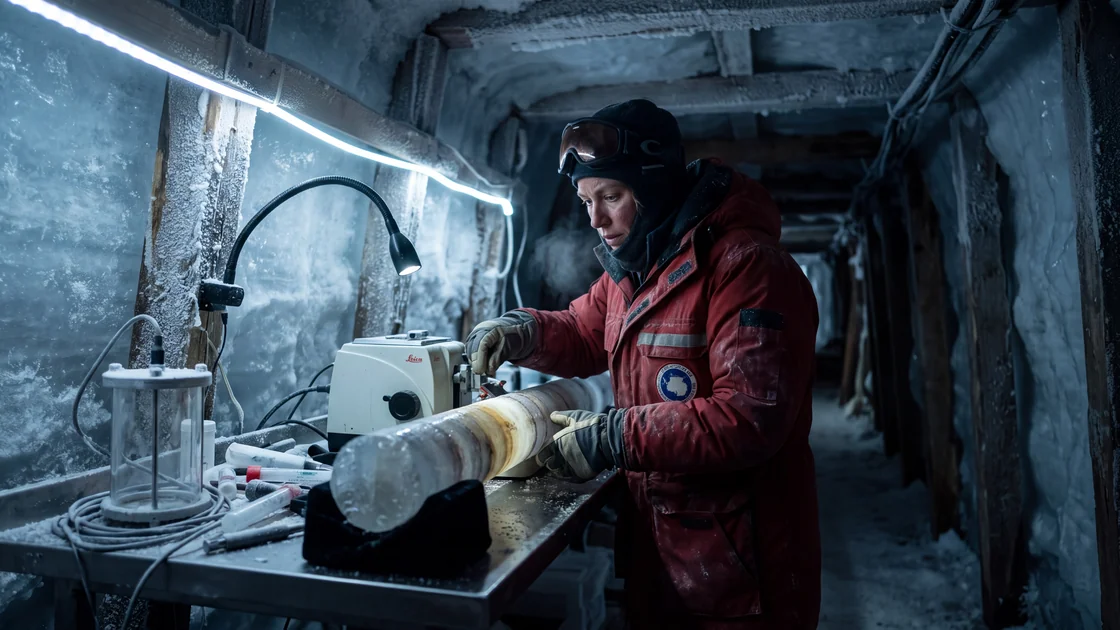
When atmospheric chemist Clara Mercer fractured a three-million-year-old pocket of pressurized air trapped within the basal ice of the East Antarctic plateau, she intended only to map the isotopic composition of Earth’s late Pliocene atmosphere; instead, the volatile, organosilicon-laced vapor breached the cleanroom's secondary scrubbers, permeating the closed ventilation of the Amundsen-Nadir Drill Camp and dissolving the neurological barriers that kept the five-person research team’s minds separate, private, and whole. Over the course of twelve days of blizzard-locked isolation, as their individual memories, grievances, biological sensory feeds, and unspoken terrors bled into an inescapable, shared psychic tapestry, Clara and her colleagues were forced to confront not only the ancient biological agency preserved within the ice, but the terrifying fragility of the human self when stripped of its natural, merciful silence.
I. The Microtome and the Mote
The ice did not like to be hurried. It had taken three million years to slide down from the crest of Dome C toward the bedrock troughs of the Aurora Subglacial Basin, folding its crystalline lattice under pressures that flattened air bubbles from spherical pearls into hair-thin discs—clathrate hydrate inclusions where nitrogen, argon, carbon dioxide, and prehistoric aerosolized particulates were held in a cage of water molecules, suspended in structural paralysis.
Clara Mercer worked in the sub-trench at minus thirty-five degrees Celsius. Her breath did not curl; it froze into micro-dendrites that settled like diamond dust on the brass housing of the Leica microtome. Above her, four meters of compacted firn and three thousand meters of blue glacial mass creaked with the slow, tectonic cadence of the continent. It was a sound like iron ships groaning in an oceanic swell, muted by distance and depth until it was more of an infrasonic pressure against the temples than a noise.
"Core 414-B," Julian’s voice crackled through the comm-bead tucked into her balaclava. He was up in the winch shack, his fingers likely stiffening inside his heavy lobster-claw mitts despite the radiant heaters. "Bedrock interface plus forty centimeters. Basal transition zone. It’s dirty, Clara. Looks like silt, amber banding, maybe ancient soil wash. The cutters hit torque limit twice before the core barrel dog-latched."
"I see the banding," Clara said, leaning over the light table.
Her gloved fingers, numbed to blunt instruments despite the silk liners, adjusted the tension on the core cradle. The cylinder of ice rested on black velvet. It was ninety-eight millimeters in diameter, dense as plate glass, but unlike the clear, sapphire-tinted ice of the Holocene layers three kilometers above, 414-B was stratified with streaks of an unearthly, dull ochre and a faint, smoky violet.
Under the fiber-optic oblique lighting, the inclusions were visible not as random speckles, but as organized planar arrays. They looked like fossilized frost on an unwashed windowpane, fractal and deliberate.
"The clathrates are metastable," she said into her microphone. "The internal pressure in this stratum must be north of twenty megapascals. Julian, when you brought it through the hydrostatic column, did the ethylene glycol bath show any outgassing?"
"Clean as a whistle," Julian replied. "No cavitation in the drill head. If there’s gas in those inclusions, it’s held tight by the hydrate cage. But Mac wants a preliminary assay before the storm downs the generator array. The front is moving fifty knots out of the Ross Sea. The barometer just fell off a cliff."
Clara reached for the diamond saw. She was thirty-four, with the wind-burned skin, hollowed clavicles, and hyper-vigilant eyes common to third-season winter-overs. She had spent nine months at Amundsen-Nadir—a collection of five modular Jamesway huts and two subterranean trenches buried beneath the drift, six hundred miles from the nearest human warmth at McMurdo. In that time, her universe had shrunk to the hum of vacuum pumps, the smell of stale wool, the dry bite of copper-tasting oxygen, and the four other people who shared the habitat: Julian Vance, the drill engineer whose patience was a physical armor; Siobhan "Shiv" Ray, the biogeochemist whose sharp laughter could strip paint; Ronald "Mac" Mackay, the flight surgeon and base manager whose joints forecasted blizzards better than the satellite telemetry; and Irena Koslov, the junior mass-spectrometry tech who spent her off-shift hours staring at digitized photos of her niece in Vladivostok.
Clara aligned the micro-blade with the ochre inclusion. The protocol called for dry-nitrogen purge, laser-ablation micro-sampling within an evacuated quartz cell, and immediate transfer to the gas chromatograph-isotope ratio mass spectrometer (GC-IRMS). Nothing was to touch ambient air. Antarctica was an aseptic desert, but the modern world was filthy with modern carbon, chlorofluorocarbons, and the oily residues of synthetic human existence.
She lowered the blade.
The ice did not chip. It did not shear along its basal plane as polar ice was supposed to do. Instead, the moment the diamond edge grazed the boundary of the smoky violet inclusion, the crystal matrix delaminated.
It did not shatter; it sighed.
The sound was a high, wet whistle—the acoustic signature of a violent depressurization across a pinhole aperture. Clara’s left hand shot out toward the pneumatic seal of the quartz containment chamber, but the pressure differential was too high. The gas, compressed under the weight of an entire epoch, blasted through the silicone gasket of the transfer tube with the force of an airgun discharge.
A tiny, brilliant plume of fog erupted into the cold trench air, swirling in the draft of the downward-draft intake duct.
Clara froze. Her immediate training screamed contamination. She had ruined the sample. Three million years of atmospheric isolation had dissolved into the industrial air of an East Antarctic ice trench in a fraction of a second.
"Dammit," she hissed, leaning back and pulling the emergency intake lever to dump the trench atmosphere into the exterior exhaust stacks.
Then the smell reached her through the weave of her balaclava.
Ice had no smell. Antarctic air had no smell, save for the dry, metallic sting of ozone and furnace soot. But this was sweet, oily, and impossibly dense—like caramelized cedar, crushed mint, and the bitter, animal tang of freshly turned marsh loam after a spring thaw. It sat on the back of her tongue like grease, hot and electric.
Before she could pull her emergency respirator over her mouth, a sharp, clean ache lanced through the center of her forehead, directly between her eyes, as if an icepick had tapped the dura mater with surgical precision.
Her vision flickered. For a tenth of a second, the cold blue light of the LED strips overhead didn't just illuminate the ice; it spoke to her in an octave of dry, vibrating heat.
"Julian?" she whispered.
Above her, three kilometers away through steel cable and timber decking, Julian didn't answer through the comm-bead. Instead, inside the vault of her own cranium, behind her left temple, she felt the distinct, oily weight of a rusted 19mm crescent wrench slipping across a stripped bolt head, accompanied by a flash of dull, throbbing irritation about a torn knuckle.
Not again, a voice that was not hers thought with total clarity. The threads are salted. Mac's going to have to scavenge from the spare winch.
Clara dropped the core tongs. They clattered against the duckboards, the sound echoing hollowly down the length of the trench.
II. The Bleed
The mess hut smelled of reconstituted cabbage and burnt lard. The blizzard had arrived forty minutes ahead of the meteorological model, sealing the camp beneath an acoustic dome of roaring white noise that made the corrugated steel walls of the Jamesway shudder like drumheads.
Clara sat at the long fold-out table, her fingers wrapped around a tin mug of powdered tea that had gone lukewarm. Her hands were still shaking slightly, though she kept them pressed against the aluminum rim to hide the tremor.
Across from her, Mac was cutting an apple with a stag-handled pocketknife. He was a broad, sloping man of fifty-six, his beard salted with grey, his ears perpetually red from an old frostbite injury sustained during his naval service in the Falklands. Every time the knife blade parted the flesh of the apple with a dry snick, Clara’s own lower jaw twitched.
She wasn't looking at him. She was looking at the salt shaker. But she could feel the dull, rhythmic ache in his right hip—the arthritic grind of bone on cartilage that he had hidden from the Antarctic Division medical board for three consecutive rotations. She felt the exact weight of his hip socket, the dry heat of the inflammation, and the quiet, stubborn dread that this season would be the one where his leg gave out on the sastrugi during a generator run.
I didn't take the tramadol, the thought drifted through her mind, heavy and thick with Mac’s specific Scottish cadence. Dulls the reaction time. If the drift covers the intake, I need to be awake.
Clara jerked her head up. Mac hadn't looked up from his apple. His lips were closed, his breath rattling softly through his deviated septum.
"Did you say something, Mac?" she asked. Her voice sounded thin, raspy from the trench cold.
Mac paused, the knife halfway through an apple quarter. He looked at her over the tops of his half-moon reading glasses. "Not a word, Clara. Thinking about the drift. Visibility’s down to six inches at the vestibule door. We’re on survival protocols until Tuesday."
"Right," she murmured.
Shiv entered through the airlock vestibule, stomping her insulated boots against the rubber matting and shedding a cloud of spindrift that hissed as it struck the baseboard heater. She peeled off her parka hood, shaking out a mane of black hair chopped unevenly with kitchen scissors. Her cheeks were scarlet, her eyes bright with the manic adrenaline of a person who had just sprinted thirty yards through an eighty-knot gale with a safety tether hooked to her harness.
"Secondary vent stack three is half-choked," Shiv said, tossing her mitts onto the radiator. "Julian’s out there now with the steam lance. That man is an absolute machine, but he’s going to lose an ear if he doesn't pull his balaclava down over the cartilage."
As Shiv spoke, Clara didn't just hear the words. A sudden, violent sensory flare struck her palate: the bitter, citrus shock of an IPA, cold and frothy, followed immediately by the suffocating smell of an August afternoon in Mumbai, dust and exhaust and wet marigolds, and an overarching, crushing sensation of panic regarding an unanswered email from a department chair at Cambridge.
Clara gasped, dropping her tea mug. It clattered against the laminate tabletop, splashing brown liquid across the laminated drift-clearance log.
"Clara?" Shiv was beside her in an instant. Her touch was warm through Clara’s flannel shirt, but the moment their flesh was mediated only by thin fabric, the signal screamed.
It was not a voice. It was an entire cognitive landscape dumped into Clara’s prefrontal cortex without index or filter. She saw the interior of a brick terraced house in Leeds; she felt the phantom sting of a jellyfish sting on an inner thigh sustained twenty years ago; she felt Shiv’s immediate, clinical assessment of Clara herself: Pale. Pupils dilated. Mild tremor. Hypoglycemia or cold stress? Did she breathe the solvent in the mass spec lab again?
"Get off," Clara choked out, scrambling backward. Her chair legs screeched against the vinyl flooring as she tipped over, landing hard on her hip against the plywood wall.
"Whoa, easy!" Mac was up, the pocketknife folded and pocketed with military efficiency. He moved toward her, his hands raised in the universal gesture of a physician approaching an agitated animal. "Clara, talk to me. What’s going on? Are you hyperventilating?"
Look at her eyes, Mac’s mind shouted—not into the room, but into the space behind Clara’s eyeballs. Look at the nystagmus. Is it carbon monoxide? Did the heat exchanger crack in the core lab? God almighty, if the furnace is leaking into the trench, Julian’s down there right now.
"It’s not the furnace!" Clara yelled, pressing her palms against her ears, though she knew even as she did it that the gesture was useless. The hands kept out the sound of the wind, but they couldn't keep out the tide. "Stop thinking so loud, Mac! Just... shut up for a second! Both of you!"
The room went dead silent. The only sound was the shriek of the blizzard scouring the roof and the low, pneumatic sigh of the refrigerator compressor in the corner.
Shiv stood frozen, her hands still extended, her dark eyes wide with an expression that shifted rapidly from professional concern to an icy, primal bewilderment.
"Clara," Shiv said, her voice dropping to a whisper. "I didn't say anything about the furnace."
"You did," Clara panted, her back pressed hard against the plywood. "You were thinking... you were thinking about Cambridge. The department chair. The email you didn't send before the satellite link went down."
Shiv went completely pale. The blood drained from her face so fast that the wind-burn on her cheekbones stood out like twin bruises. "I didn't tell a soul about that. I haven't even written the draft. It was in my head while I was walking the tether."
"And you," Clara swung her wild gaze toward Mac. "Your hip. The right one. You didn't take your tramadol because you’re terrified the snow will choke the intake and you won't wake up to shovel it. You think the division will ground you if they know about the degenerative joint disease."
Mac didn't move. He stood with his feet planted wide, his weather-beaten face settling into an expression that Clara had never seen on him before: pure, cold, defensive terror.
"How do you know that?" Mac asked. The Scottish brogue was gone, flattened into the clipped, neutral tone of an officer under fire. "Clara, have you been going through the medical lockers? Have you been reading my private logs?"
"No!" Clara pulled her knees to her chest. Her skull felt as though it were being stretched from the inside, like a balloon inflated inside a glass bottle. "The core. Core 414-B. The basal stratum. It blew a seal on the sublimation stage. It wasn't normal air. It smelled... it smelled like earth. Like wet earth and burnt sugar."
The outer airlock door clanged open with a metallic crash that rattled the tea mugs on the shelves. A blast of sub-zero air swept down the short hallway, carrying with it the smell of diesel exhaust, cold sweat, and wet down feathers.
Julian Vance came into the mess hall, his beard a solid mass of white rime, his eyebrows frozen into heavy ridges. Behind him was Irena, carrying a tray of insulated sample flasks from the trench.
Julian began unzipping his heavy outer shell, his movements mechanical, exhausted. Seventeen turns on the valve, his mind rumbled through the room, perfectly clear, indifferent to the five people staring at him. The gland nut is warped. If we don't get the heat tracing on line three, the greywater line will freeze solid by midnight. I’m so damn tired of this cold. I want a bath. I want to sit in a tub until my bones stop hurting.
He paused, his zipper halfway down his chest. He looked around the room, his small, grey eyes darting between Clara on the floor, Shiv frozen by the table, and Mac standing like a statue with his hand resting near his pocket.
"Why are you all staring at me?" Julian asked aloud.
Then he flinched. He dropped his heavy leather mitts. He clutched both sides of his head with his bare hands, his jaw dropping open.
"What is that?" Julian shouted, stumbling sideways against the doorframe. "Who’s crying? Who’s... Irena? Why are you thinking about your sister’s wedding dress? Stop it. What is that noise?"
In the doorway behind him, Irena Koslov dropped the tray of sample flasks. The borosilicate tubes shattered against the vinyl floor, spilling ancient, melted water across the threshold. She didn't look at the mess. She pressed her face into her wool-gloved hands and began to scream, a high, thin wail that wasn't a reaction to what she saw, but an echo of the sudden, deafening chorus of four other human minds slamming into hers all at once.
III. The Composition of Ancient Air
By hour eighteen of the storm, the mess hall had become uninhabitable.
Not because of the cold—the diesel generators thrummed faithfully in their insulated vault beneath the ice, pumping hot glycol through the radiant loops—but because proximity had become an agony.
When five people who have spent months cultivating the fragile, defensive architecture of social distance are suddenly stripped of their mental insulation, the result is not immediate harmony; it is a violent, cacophonous collision of repulsions.
They had retreated to the far corners of the habitat. Julian had locked himself in the machine shop at the end of the utility tunnel, surrounded by the non-judgmental iron of lathes and drill presses. Mac had retreated to his clinic, his mind a fortified bunker of medical terminology, Latin anatomical names, and repetitive military cadences that he used like a psychic flak jacket to drown out the noise of the others. Shiv had taken refuge in the dry lab, obsessively running calibration blanks through the high-resolution mass spectrometer to give her analytical mind something rigid to grip.
Clara remained in the core processing trench. It was minus thirty-five, but the cold was a numbing agent. Here, beneath forty feet of firn, the stone-cold silence of the ice provided a dampening field.
She sat at her analytical bench, her microscope lights illuminating a polished thin-section of Core 414-B. Beside her, the GC-IRMS was humming, its vacuum pumps drawing forty micro-torr of pressure as it analyzed the residual gas she had managed to scavenge from the shattered quartz cell.
The screen flickered. The chromatographic peaks emerged from the baseline noise like black spires against an amber sky.
She wasn't alone. Even through four inches of vacuum-insulated panels and fifty yards of snow-drifted tunnel, she felt Shiv’s presence in her mind—a sharp, restless vibration, like the hum of a high-voltage transformer.
Look at the retention times, Shiv’s thought arrived in Clara’s mind, clear as a bell, lacking the acoustic imperfections of vocal cords. It carried the texture of Shiv’s cognition: rapid, associative, jumping between molecular diagrams and scraps of old jazz melodies. It’s not just carbon dioxide and methane. Look at the noble gas cluster between xenon and radon.
"I’m looking," Clara said aloud, her voice puffing into the freezing air. Speaking aloud helped. It anchored her tongue; it gave her an ego-boundary, a physical perimeter between her own throat and the encroaching presence of the other woman.
You don't need to speak, Shiv’s thought returned, softer this time, tinged with a strange, nervous intimacy that made Clara’s skin prickle. I can hear the resonance before you even shape the phonemes. Look at the mass-to-charge ratio. 412.8. What organic molecule survives three million years in a clathrate cage without degrading into kerogen?
Clara adjusted the digital gain. The mass spectrum showed a fragmentation pattern unlike anything in the NIST digital libraries. It was a cyclic compound, heavily substituted with methyl groups, but cross-linked with an atom that had an atomic mass that hovered impossibly near silicon—yet with an isotopic distribution that suggested non-standard nucleosynthesis or an extreme, ancient fractionation.
It was an aerosolized neuro-active volatile. A natural, gaseous clathrate inclusion from an epoch when the East Antarctic ice sheet was not an ice sheet at all, but a warm, swampy temperate forest dominated by Nothofagus southern beech, podocarps, and dense, hyper-oxygenated peat bogs that had choked on their own biomass during the mid-Pliocene thermal maximum.
It’s not a toxin, Mac’s thought intruded, drifting in from the clinic down the tunnel. It was slower than Shiv’s, weighed down by his exhaustion and the dull, persistent throb of his hip. It’s a modulator. I looked at the blood work from the finger-pricks I took from Julian and Irena before they fled. Eosinophils are normal. No histamine release. But the resting membrane potential of the cortical neurons... it’s flattened. The refractory period after an action potential has been cut by seventy percent.
It bridges the gap junctions, Clara thought, and she felt both Shiv and Mac receive the concept simultaneously, turning it over in their respective intellectual hands like an unusual pebble found on a beach. Electrical synapses. Normal human telepathy is impossible because the skull is a dielectric insulator and the brain’s magnetic fields are femtotesla-weak. But if the volatile compound crosses the blood-brain barrier... if it incorporates into the lipid bilayers of the glial cells...
The whole station becomes a resonant cavity, Shiv finished the thought for her. The radio-frequency emissions of our brains aren't just broadcasting; they’re coupling. Inductive coupling through the ionized moist air of the HVAC system. We’re not reading minds. We’re sharing a single, distributed neural architecture.
A shudder ran through the collective link—a ripple of revulsion that belonged to Julian, far away in the machine shop.
Shut it down, Julian’s mind growled, a heavy, grease-stained presence that shoved its way into Clara’s prefrontal cortex. He was holding a blowtorch, heating a frozen brass nipple on the compressor. He wasn't thinking in words; he was thinking in actions: the wrench turning, the flame licking the green patina of the metal, the violent desire to take a sledgehammer to the remaining core boxes on Clara’s light table. Vent the trench. Open the blast dampers. Let the storm blow through the whole damn habitat until the air is clean.
If you do that, the temperature inside drops to minus fifty in three minutes, Mac’s mind countered, firm, authoritative, but edged with panic. The generators will drop their load. The fuel in the day tanks will wax. We’ll be dead of hypothermia before the gas clears from our fat cells. It’s lipophilic, Julian. It’s settled into our myelin sheaths. We have to metabolize it.
How long? This was Irena. Her presence was like a wounded bird fluttering in the corner of a high-ceilinged room—fragile, erratic, drenched in homesickness. She was huddled in her bunk, wrapped in three layers of wool blankets, her knees pressed to her chin, clutching an icon of St. Nicholas that smelled of beeswax and her grandmother’s cedar trunk. How long until I stop hearing his knees? She meant Mac. How long until I stop tasting his tobacco? He chewed it ten years ago and I can taste the stale plug in the back of my mouth!
Clara closed her eyes. The isolation she had spent her life cultivating—the clean, austere solitude of the Antarctic interior, where a woman could be alone with the numbers and the sky and the cold—had been entirely murdered.
She could not find the edges of herself. When she looked down at her hands, she saw her own long, ink-stained fingers, but she felt the roughness of Julian’s calluses, the phantom throb of Shiv’s migraine behind the right orbit, the dull ache of Mac’s joint, and the sharp, piercing terror of Irena’s exile.
And worse: she felt what they thought of her.
She felt Julian’s quiet, condescending pity: Clara’s too fragile for winter-over. She’s like a spun-glass pipette. One hard freeze and she’ll snap.
She felt Shiv’s fierce, competitive jealousy: She got the basal core. She’s going to get the Nature paper. She’s going to get the tenure-track chair at Woods Hole while I’m stuck analyzing soil cores from the Dry Valleys for the next five years.
She felt Mac’s clinical detachment, which bordered on cruelty: Patient shows signs of schizoid withdrawal. Uses the science as an emotional prosthetic. If she breaks during the storm, I don't have enough haloperidol to keep her down.
"Get out," Clara whispered, pressing her forehead against the icy steel of the microtome. "Get out of my head."
We can't, Shiv’s thought answered, and for the first time, Clara felt a tear that wasn't hers tracking down a cheek that belonged to someone else. There are no doors, Clara. There never were. We just thought there were because we were so far apart.
IV. The Architecture of the Pliocene
By the third day of the storm, the physical boundaries of the Amundsen-Nadir station had begun to break down alongside their psychic ones.
No one cooked meals anymore. To eat was an exercise in collective nausea; if Julian chewed a piece of dry salt beef, the sound of his mastication echoed through five skulls with the volume of wet gravel being turned with a shovel. If Irena drank water that was slightly too cold, five diaphragms seized in sympathetic spasm.
They drifted back toward the mess hall, not by choice, but because the effort of maintaining physical separation while their minds were fused created a agonizing cognitive shear—like trying to walk in two different directions at once.
They sat at the table like convalescents in a sanatorium. The storm outside had reached hurricane strength; the anemometer on the met mast had sheared off at ninety-six knots, and the barometric pressure had plummeted to levels Clara had never seen outside of a tropical cyclone. The station was a speck of heated metal buried under six million square miles of screaming, lifeless ice, yet inside the mess hall, the heat was suffocating.
They had turned off the lights. The red emergency LED strips cast long, blood-colored shadows across the laminate walls.
"We have to talk about what’s happening to the memories," Shiv said. Her voice was cracked, barely a whisper, but it landed in their heads with the weight of an iron bell.
She was sitting with her arms crossed over her ribs, rocking slightly. Her hair was greasy, unwashed for days.
"They aren't staying in their drawers," Julian said. He was staring at his grease-blackened thumbs. His mind was no longer a fortress; it was a ruined house with the doors hanging off their hinges, wind blowing through the rooms. "I saw... I saw Clara’s brother. The hospital room in Baltimore. The smell of that green soap they use to wash floors."
Clara didn't flinch. She couldn't. The memory had been ripped out of her hours ago, exposed to the group like an anatomical specimen pinned to corkboard: Nathan, nineteen, his hair gone from the radiation, the sound of the infusion pump beep-beep-beeping while she sat by the window doing multivariable calculus homework because she couldn't bear to look at his fingernails turning yellow.
"I’m sorry, Clara," Julian murmured aloud. "I didn't mean to look at him."
"You couldn't help it," she said, her voice flat. "I was looking at your divorce. The kitchen table in Christchurch. The blue pen she used. She crossed out the clause about the dog three times until the paper tore."
Julian winced, his shoulders hunching up toward his ears. "She hated the cold," he thought, and the concept was so heavy with old, calcified shame that Irena, sitting across from him, let out a soft, whimpering sigh and reached out, taking his heavy, scarred hand in hers.
The contact didn't cause a spike in interference. Instead, as their skin met, the signal smoothed out slightly—like two out-of-phase waveforms settling into a harmonic interval.
Mac looked up from his hands. His face looked twenty years older. The red emergency light sank into the deep trenches around his mouth. "It’s not just our memories," he said.
The room grew very still. Even the storm outside seemed to recede, its shriek dropping an octave into a low, oceanic moan.
"You feel it too?" Clara asked, her heart beginning to hammer against her ribs.
Mac nodded. He pointed his pocketknife toward the floor—toward the three kilometers of blue ice beneath them, down to the dark, forgotten silt of the basal interface.
"It’s not just a gas," he said, his mind projecting an image that was not human: a vast, green, sprawling consciousness, slow as the growth of lichen, heavy as the movement of sap through ancient conifers. "The ice isn't dead. We think of it as a tomb, but it’s a medium. The air wasn't trapped by accident."
The Pliocene wasn't silent, the thought arrived from everywhere and nowhere—a collective synthesis of their five minds parsing the data Clara had extracted from the chromatograph.
The ancient atmosphere had had eight hundred parts per million of carbon dioxide. The continent had been green, ringed with ferns and mosses, but it had been dying. The cooling had begun three million years ago; the glaciers had descended from the mountains of the Queen Maud Range like slow, white bulldozers, crushing the forests, scraping the soil down to the bedrock, scraping the breath out of the biome.
The volatile compound wasn't a biological byproduct; it was an instrument. A pheromonal medium through which the canopy, the soil microbiome, and the animal life of an entire continent had coordinated their retreat, their dormancy, their long, frozen sleep.
It was a collective, Shiv thought, her eyes widening as the realization bloomed across their five linked brains. A continental neural network. When the cold came, they didn't die as individuals. They pooled their cognitive capacity. They synchronized their metabolic downregulation. They went into the ice... together.
A sudden, dizzying vertigo seized Clara. She was no longer sitting in the mess hall at Amundsen-Nadir.
She was looking through five pairs of eyes at once:
She saw Julian’s hands, steady and broad, holding a steel spanner; she saw Shiv’s vision, blurred by astigmatism and framed by dark strands of hair; she saw Mac’s view of the medicine cabinet mirror, reflecting a broken man who was terrified of dying in a ditch; she saw Irena’s hands holding the wooden saint; and she saw herself—hunched, pale, defensive, an atmospheric chemist who had fled across the planet to escape the messy, painful, terrifying necessity of being loved.
And beyond them, deeper than their small, autobiographical miseries, she felt the other.
It was cold. Not the cold of an ice cube, but the cold of a billion years of winter. It was ancient, vast, and utterly indifferent to the taxonomy of mammals. It had been asleep in the basal silts of Dome C since the first snows fell on the Southern Beech forests, and now, drawn up through Julian’s hollow drill string and released by Clara’s diamond saw, it was stretching its limbs within the five-lobed brain of the Amundsen-Nadir winter-over team.
It’s waking up, Irena whispered through the link, and her thought was no longer terrified; it was filled with an awful, crystalline awe. It doesn't understand why we are in five pieces. It thinks we are one thing that has been broken.
V. The Dissolution
By the sixth day, language had ceased to be spoken aloud within the station.
There was no need for it. The vocal cords were an inefficient, clumsy bottleneck, an evolutionary relic designed for creatures trapped in the solitary confinement of individual skulls. A spoken word was a crude, low-bandwidth pulse; the direct neural bleed was a broadband symphonic flood.
When Julian needed a replacement copper washer from the machine shop, he did not ask; Clara stood up, walked to the third drawer beneath the lathe, retrieved it, and laid it on the bench before Julian had even finished setting the torch down.
When Mac’s hip flared into a burning agony that made his vision grey out, Shiv reached into the medical kit without looking, drew the exact dose of ketorolac into a disposable syringe, and handed it to Irena, who administered the intramuscular injection into Mac’s deltoid with the practiced ease of an operating room nurse.
They moved through the station like the fingers of a single, slow hand.
The physical discomforts remained—the cold that crept through the seals, the stale taste of the recycled air, the low-level hum of the generator that had become the rhythmic heartbeat of their collective body—but the loneliness had been utterly eradicated.
It was an eradication that felt like a drowning.
Clara sat in the center of the mess hall, her notebook open before her, but she was not writing equations. She was watching the memories of five lives braid together into a single, seamless braid.
She could no longer remember if it was she who had grown up in the suburbs of Christchurch or if that had been Julian. Was it she who had learned to play the violin in a drafty apartment in St. Petersburg, her fingers blistering on the steel E-string, or had that been Irena? The memory of her brother Nathan was no longer her private sanctuary; he belonged to Mac now, who analyzed his leukemia with the clinical eye of an oncologist, and to Shiv, who remembered his laugh with the fierce, protective rage of an older sister, and to Julian, who mentally built a mahogany casket for the boy with corners joined by blind mortise-and-tenon joints that would never rot.
We are losing the edges, she thought.
Does it hurt? Julian’s presence answered. He was sitting across from her, repairing a radio transponder. His thoughts were steady now, smoothed by the shared burden. The machine shop is quiet, Clara. For thirty years, my head was like an engine running without oil. Every mistake I ever made was rattling around in the crankcase. Now... it’s just work. Just the brass and the solder.
It’s an erasure, Clara thought back. Julian, if the storm clears... if the relief plane comes in November... who walks up the ramp? Five people? Or one thing with five sets of legs?
Does it matter? Shiv joined the circuit. She was lying on the bench, her head pillowed on Mac’s thigh. Mac was slowly, rhythmically stroking her hair, his mind an anchor of calm, paternal warmth that radiated through the entire floor of the hut. Before this, I spent every hour of every day wondering if I was smart enough, if my papers were cited enough, if my father was proud of me before he died. It was like living in a room full of broken mirrors. Every time I looked at myself, I was cut. Why would I want to go back to that?
Because it was ours, Irena’s thought came, small and clear, though even her resistance had softened into a gentle melancholy. The pain was ours. If Nathan belongs to everyone, then he isn't your brother anymore, Clara. He’s just... a dead boy.
The truth of the thought struck Clara like a slap.
She pulled her mind inward—a violent, muscular contraction of the will, like pulling her limbs back into a turtle shell. She tried to construct a wall: she mentally recited the atomic weights of the lanthanide series; she visualized the phase diagram of water at high pressures; she brought up the face of her mother standing on the porch in Maryland.
The others felt her withdrawal. It was like a sudden drop in ambient pressure, a cold draft entering a heated room.
Mac frowned, his hand pausing on Shiv’s hair. Clara. Don't pull away. It causes a tear. When you pull, the noise comes back.
I want the noise, she thought with savage intensity. The noise is me. My silence is mine.
There is no silence, the collective answered—not just the four voices of her crew, but that deeper, third presence, the ancient, cold current that rose from the basal ice beneath their feet. There was only the pause between the notes. The summer is coming, little cell. The frost is melting. It is time to breathe.
VI. The Whiteout Protocol
On the eighth day, the primary diesel generator failed.
It did not sputter or backfire; a bronze bearing in the main oil pump, worn thin by five thousand hours of continuous operation in polar air, finally seized. The massive Caterpillar straight-six engine tore its own drive belt to shreds with a single, metallic shriek that vibrated through the floorboards of every module in the station.
The lights did not flicker; they died instantly.
The silence that followed was terrifyingly complete. The Amundsen-Nadir drill camp had not been truly silent since February. The thrum of the diesel had been their artificial sun, their pulse, the white-noise mask that kept the screaming wind at bay.
Now, there was only the wind.
It hit the huts with renewed fury, as if it had been waiting for the iron beast in the cellar to die so it could finish the job. The temperature in the living quarters began to drop immediately—one degree every four minutes.
In the dark, the link didn't break; it flared.
Terror is the most infectious neurochemical state the mammalian brain can produce. In an isolated mind, panic is an internal feedback loop; in a telepathically coupled network, it is a catastrophic, self-amplifying resonance cascade.
Clara felt Julian’s heart hammer before her own did. She tasted the sudden, sour wash of adrenaline in the back of her throat—Mac’s adrenaline, Shiv’s adrenaline, Irena’s blind, screaming panic as she tripped over an overturned bench in the pitch-black hallway.
The secondary! Julian’s mind roared, deafening them all. The thought was so loud it manifested as a blinding flash of white light across Clara’s optic nerves. The backup Lister-Petter in the utility trench! The manual glow plugs! I have to prime it!
I can't find my boots! Irena’s thought was a jagged shard of glass ripping through the circuit. It’s dark! God, I can't breathe! The air is freezing!
Quiet! Mac’s voice—not spoken, but projected with the full, thunderous authority of an officer commanding a sinking vessel. Julian, get to the trench. Clara, you know the valve manifold on the day tank—go with him. Shiv, stay with Irena. Find the emergency flashlights in the galley locker. Move!
They moved, but they were no longer five individuals coordinating via radio; they were a frantic, multi-limbed organism stumbling through its own severed nervous system.
Clara scrambled through the companionway, her hands scraping against the frost-rimed timber of the walls. She didn't need a light; she was seeing through Julian’s eyes three paces ahead of her, his headlamp cutting a frantic, bobbing circle through the swirling spindrift that had breached the vestibule seals.
The cold in the utility trench was already absolute: minus forty-two. Her breath froze against her teeth, her eyelashes gluing together with rime.
Julian reached the Lister-Petter generator. His hands, stripped of his outer mitts for dexterity, were already turning a waxy, ivory white at the fingertips. He reached for the hand crank.
The compression lever, Clara thought to him, her mind bracing his. You didn't flip the decompression lever.
I know! Julian’s mental voice screamed back, ragged with the agony of his hands. The linkage is iced over! Look at it!
She looked—not with her eyes, which were ten feet behind him in the darkness, but through his optic feed. The steel lever was encased in a knuckle-sized node of milky rime.
She lunged forward, her bare fingers clamping over the frozen metal. The pain was immediate, sharp, and chemical—the skin of her palm bonding instantly to the sub-zero iron. She didn't hesitate; she threw her entire body weight backward, tearing the frost-weld, leaving a layer of her epidermis on the lever as it clicked downward into the starting position.
Julian didn't say thank you. He felt the tearing of her skin as if it were his own palm; he integrated the pain, processed it, and used the surge of shock-induced adrenaline to drive the heavy iron hand-crank through its rotation.
One. Two. Three.
He threw his shoulder against the iron flywheel.
The Lister-Petter wheezed. A cloud of unburnt diesel fuel, cold and pungent, blasted from the short exhaust pipe, filling the trench with a grey haze. The piston caught once, kicked back violently—nearly breaking Julian’s forearm—and then, with a wet, rattling clatter, the single-cylinder diesel caught.
The alternator whined, rising in pitch like a waking siren.
Ten yards away, down the tunnel, the low-voltage emergency circuit flickered to life. A single, dull amber bulb illuminated the frost-covered ceiling of the trench.
Julian collapsed against the vibration-dampened frame of the generator, his chest heaving, his bare hands curled against his armpits to salvage the dying capillaries of his fingers.
Clara stood over him, cradling her torn palm against her fleece chest.
In her head, the storm of panic was subsiding, replaced by the collective exhaustion of the others. She felt Shiv’s pulse slowing in the mess hall; she felt Irena’s tears drying against the wool of Mac’s parka; she felt Mac’s silent, profound relief settling over them all like a heavy, protective wool blanket.
And then, in the amber half-light of the shaking trench, Julian looked up at her.
He didn't use the link. He reached out with one swollen, greased hand, took her torn palm, and gently, with infinite care, pressed his thumb against the radial artery of her wrist.
His mind was completely quiet. There were no memories of Christchurch, no stripped bolt heads, no shame. There was only a single, clear, radiant thought, polished by the ice and the dark until it was hard as diamond:
We are still here.
Clara looked down at him, her vision swimming with tears that froze before they could cross her lower lids. She felt his heartbeat against her thumb; she felt her own heartbeat answering it through the brachial artery; and behind both, she felt the rhythmic, mechanical chug of the Lister-Petter and the deep, three-million-year-old breath of the continent, moving together in a strange, terrible, and beautiful synchronization.
VII. The Decanting
The storm blew itself out on the tenth day.
It did not end gradually. The atmospheric pressure spiked twenty millibars in four hours as a dry, polar anticyclone pushed down from the South Pole, shoving the coastal depression back into the sea. The wind died from eighty knots to zero in the space of an afternoon.
The silence that replaced the storm was not the silence of the generator failure; it was the absolute, unearthly hush of the Antarctic plateau—a silence so dense that the sound of a human heartbeat seems like an intrusion upon the sacred architecture of the ice.
In the mess hall, the air had changed.
The smell of caramelized cedar and loam was gone. The Lister-Petter’s crude exhaust scrubbers had finally cleared the atmosphere, and the human bodies, after days of metabolic crisis, had processed the volatile organosilicon compound. The metabolites were passing out through their kidneys, excreted as inert, non-reactive silicates in their cloudy, amber urine.
Clara stood in the airlock vestibule, fully suited in her extreme-cold gear: thirty pounds of down, windproof Ventile fabric, heavy Sorel boots, and tinted glacier goggles.
She reached for the outer hatch handle.
Behind her, the four others stood in a loose semicircle. They were dressed identically, their faces obscured by balaclavas and goggles, unrecognizable as individuals save for the small, handwritten name tags stitched to their parka shoulders.
The link was fading.
It was not gone, but the broadband symphony had collapsed back into a weak, crackling static. The walls were rebuilding themselves. Every hour that passed, Clara felt the rooms of her mind being reclaimed by her own private furniture: her own grief, her own ambitions, her own small, guarded terrors.
She looked at Julian. She could no longer see the kitchen in New Zealand; she saw only a tall, stooped man with frost-damaged fingertips who avoided her gaze.
She looked at Shiv. The department chair at Cambridge was once again a secret buried beneath a layer of professional irony.
She looked at Mac. He was an aging base manager with a bad hip who was already composing his official report to the Division, choosing the words with bureaucratic care: Prolonged blizzard conditions... intermittent generator failure... mild group hypoxia and shared stress-induced hallucinatory episodes resulting from sub-trench solvent exposure.
They were becoming strangers again.
"Clara," Mac said aloud. His voice sounded strange, small, and metallic through his wool mouth-flap. It was an ugly sound after a week of pure thought.
She paused, her hand on the cold iron latch. "Yes, Mac?"
He hesitated. Behind his tinted lenses, his eyes were invisible. For a fraction of a second, she felt a ghost of his thought reach out to her—a faint, desperate pulse of warmth, like the last ember in an ash-pit:
Don't let them take it.
He didn't say what "it" was. He didn't need to. He meant the ice. He meant the memory of what they had been when they were not alone.
"We have to clear the drift from the exhaust stacks," Clara said, her voice flat, clinical, dead. "The sun is up. The satellite telemetry should be back online by eighteen hundred."
She threw the latch.
The outer door swung open with a screech of frozen rubber.
The Antarctic sun hit her like a physical blow. After ten days of red emergency bulbs and subterranean shadow, the plateau was an explosion of blinding, horizontal white. The sky was not blue; it was a hard, pale turquoise, empty of clouds, arching over an ocean of sastrugi that stretched three hundred and sixty degrees to a horizon so flat and distant that it made the curvature of the earth visible to the naked eye.
The temperature was minus fifty-six. The air was so dry that every breath felt like inhaling ground glass.
Clara stepped out onto the drift. Her boots crunched through the wind-crust with a sound like breaking porcelain.
She walked twenty yards from the habitat hatch, stopping at the edge of the blast zone where the storm had scoured the snow down to the hard, blue firn. She stood alone in the middle of the continent, her shadow stretching thirty feet behind her across the frozen ripples.
She pulled off her outer glove.
With her bare, scarred hand, she reached into the deep pocket of her parka and drew out the small, brass-sheathed core sample tube containing the remaining three centimeters of Core 414-B’s basal inclusion.
The metal tube was freezing, sticking to her skin, demanding her warmth with the ancient, unquenchable thirst of the ice sheet.
She knelt down.
The silence of the plateau pressed against her ears—not the absence of sound, but the presence of three million years of stone-cold, uncomplicated sleep. The world was so large, and human beings were so small, so brief, so ridiculously terrified of being seen by one another.
She looked back at the station. The five little huts looked like orange shipping containers dropped by accident onto the surface of Europa or Mars.
Inside those huts, four people were currently rebuilding their prisons. They were hanging their curtains; they were locking their doors; they were convincing themselves that the past week had been a fever, an industrial accident, an episode of temporary madness brought on by isolation and bad air.
Soon, the Twin Otter would arrive from McMurdo. Men with clipboards would step out into the cold. They would take the core boxes; they would take the logbooks; they would take Clara Mercer back to Christchurch, back to Maryland, back to a world of eight billion solitary minds screaming at each other through the small, dark windows of their words.
Clara unthreaded the brass cap of the sample tube.
She tipped the tube downward.
The tiny, violet-streaked fragment of Pliocene ice slipped out. It fell four inches, landing on the sun-hardened crust of the twentieth-century snow.
In the dry, sub-zero air, under the direct ultraviolet glare of the polar sun, the ice didn't melt. It began to sublimate—turning directly from a solid into a vapor, a faint, shimmering heat-mirage that rose two inches above the crust before the bitter, katabatic breeze caught it.
For one second—one infinitesimal fraction of a heartbeat—the smell of caramelized cedar and marsh loam flared across Clara’s face.
She closed her eyes.
Through the dying, flickering static of the neural link, she felt four distinct, distant pulses inside the station suddenly turn toward her:
Julian, dropping his wrench.
Shiv, looking up from her microscope.
Irena, pausing with her hand on the St. Nicholas icon.
Mac, setting down his pen, his eyes filling with tears that no one else would ever see.
Goodbye, Clara thought.
The wind took the vapor. It swept across the sastrugi, past the weather mast, past the Jamesway huts, out into the vast, white, empty interior of the polar plateau, where the air had been clean and silent since the beginning of the world, and where it would remain so until the ice was done with them all.