The Resonant Spire
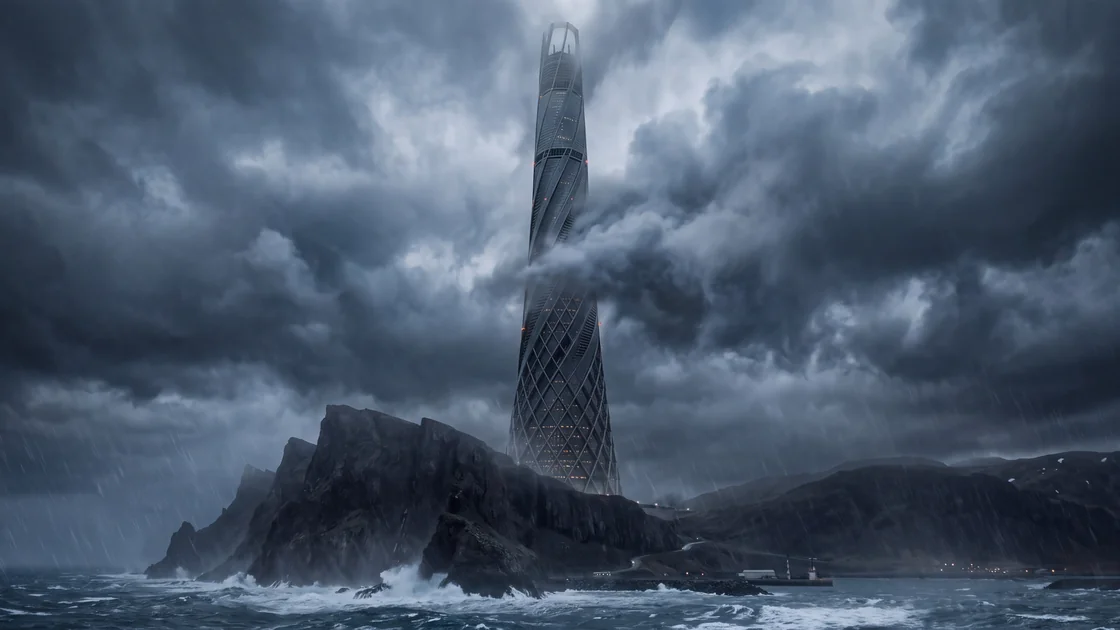
When architect Arthur Phelan finally completed the Caelum Tower—a mile-high needle of interlocking titanium-lattice and structural glass rising over the jagged coast of Cape Desolation—he believed he had achieved the pinnacle of sustainable megastructure design; however, as unseasonal gales begin to channel through the tower’s open-aperture crown, Phelan discovers that late-stage changes forced by his enigmatic financiers have turned the entire skyscraper into a titanic acoustic waveguide, one whose imperceptible, deep-earth infrasound is actively synchronizing with the seismic pulse of an ancient, miles-long entity coiled within the Earth's mantle.
Act I: The Monument of Wind and Bone
The Caelum Tower did not meet the clouds so much as it pierced them like an unthreaded needle.
From the basalt promontory of Cape Desolation, seventy miles north of any metropolitan skyline that could offer it context, the spire rose four thousand feet into the North Atlantic sky. It was Arthur Phelan’s masterpiece, an architectural heresy of post-tensioned carbon composites, aerated steel, and diamond-glazed curtain walls. For six years, the trade journals had called it everything from "a monumental hubris" to "the first true wind-integrated biomechanical skyscraper." Arthur had cared little for the prose of critics. He cared about the load paths. He cared about the way eighty-mile-an-hour gale-force winds did not break against the structure’s skin, but were instead swallowed, redirected, and domesticated by an intricate internal lattice of hollow diagrids and helical aerodynamic flutes.
Standing on the private observation platform of the one-hundred-and-fortieth floor, twenty-four hours before the official commissioning ceremony, Arthur adjusted his glasses against the glare of a winter dusk. Outside, the Atlantic was a plate of hammered pewter, crosshatched by whitecaps that seemed stationary from this altitude. The wind was rising—a standard November squall out of the Arctic shelf—and yet, under his boots, the terrazzo floor did not roll.
It did not sway the four feet of engineered drift typical of megatall structures. Instead, the floor shivered.
"She isn’t bleeding the kinetic energy," a voice said behind him.
Arthur turned. Elena Vane was leaning against the brushed-aluminum reveal of the express elevator vestibule. She was the project’s chief instrumentation engineer, a woman who had spent fifteen years analyzing aerodynamic flutter in the high-alpine bridges of Switzerland before Arthur had hired her away to monitor Caelum’s internal sensor grid. She was pale, her dark hair pinned back with severe efficiency, holding a ruggedized tablet that cast a faint cobalt glow across her jaw.
"The wind shear is eighty-five knots at the summit," Arthur said, his hand resting on the handrail. "The dampening spheres on the upper mechanical decks are designed to hold the platform within two inches of true center. The shear is venting through the transverse wind ports, Elena. That’s what the hum is."
"No, Arthur. That’s what the hum was supposed to be."
She walked to the edge of the glass floor plate, her boots clicking with a sharp, hollow resonance that died unusually fast in the room. The ambient acoustics of the observation deck were wrong. In a space of that volume—nine thousand square meters of uninterrupted ceiling—an echo should have lived for nearly three seconds. Instead, their words fell flat, soaked up by the walls, as if the room itself were under vacuum.
"Listen," she said, holding up a single finger.
Arthur closed his eyes. At first, he heard only the expected sounds: the subtle hiss of the climate-control diffusers, the faint hydraulic sigh of the elevator banks three cores away, the distant buffet of the storm. But beneath it, nested like a black stone under a running brook, was a vibration that did not register through the ear canal so much as it vibrated the soft tissue of his throat and the base of his pelvis.
It was not a sound. It was an absence of stillness.
"It’s at four point one two Hertz," Elena said quietly, tapping the screen of her tablet. "Infrasonic. Below the human threshold of hearing, but right in the sweet spot for visceral resonance. If we increase the amplitude by another six decibels, anyone standing in this room will begin to experience nausea, tunnel vision, and acute panic. By midnight, when the squall reaches its peak, the tower won’t be whistling, Arthur. It will be chanting."
"The mass dampers," Arthur muttered, already moving toward the service terminal embedded in the southern shear wall. "The liquid-tuned sloshing tanks on level one hundred thirty-eight. If their viscosity parameters were improperly calibrated by the contractor—"
"I locked the tanks three hours ago," Elena interrupted. "I drained them into the auxiliary greywater cells."
Arthur stopped, his fingers hovering over the glass interface. "You drained the primary sway stabilization before a gale?"
"Look at the telemetry!" she snapped, thrusting the tablet into his chest. "When the tanks were full, the amplitude wasn’t dropping. It was rising. The liquid wasn’t counteracting the drift. The liquid was being metered. It was acting as an acoustic valve. The entire upper thirty stories of this building are not dispersing the storm’s energy. They are compressing it. It’s an intake, Arthur. The wind is entering the windward nacelles, compressing through the vertical atrium, and being forced down the central utility core."
"Down?" Arthur stared at her. "The intake vents exhaust horizontally out the leeward face. That was the core of my design. The air is neutral-buoyant through the flutes."
"Your design was revised," she said. Her voice had dropped, brittle and cold. "Three months ago. While you were in Tokyo defending the foundation budget before the Board. The structural change orders didn't come from your office. They came from the Abyssal Trust’s engineering liaison."
"Julian Haddon," Arthur whispered.
"Julian Haddon," she confirmed. "He bypassed the mechanical engineering team entirely. He used an off-shore structural detailing firm out of Rotterdam to sign off on the interior duct lining. Arthur, they didn’t use sound-deadening acoustic insulation in the central trunk. They used sintered corundum. Synthetic sapphire. Polished to an optical grade."
Arthur felt the moisture leave his mouth. Corundum had an acoustic impedance higher than almost any non-metallic compound on earth. It did not absorb vibration; it reflected it with zero loss. If one lined a twelve-hundred-foot vertical conduit with corundum, it ceased to be a ventilation chase.
It became a resonance chamber. A waveguide capable of transmitting gigawatts of acoustic pressure without thermal attenuation.
"Where does the trunk lead?" Elena asked, though her eyes told him she already knew. "Where does the central chase terminate, Arthur? You designed the sub-foundations."
Arthur did not answer. He didn't need to. He turned his eyes down toward the floor, looking through the three inches of laminated safety glass, through the eighty feet of structural trusses, down through the five thousand vertical feet of living space, past the grand atrium, past the six levels of underground parking, into the abyssal gloom of Cape Desolation’s bedrock, where forty-eight foundation caissons—each one sixty feet in diameter—drilled two hundred feet deeper than any skyscraper had ever dared to reach.
And deeper still, into the borehole that Haddon had claimed was merely a "closed-loop geothermal energy loop."
The floor shuddered again. This time, Arthur felt it in his molars. A dull, mechanical ache, like the bite of an iron needle.
Act II: The Anatomy of a Flute
To understand the Caelum Tower, one had to understand Arthur Phelan’s lifelong obsession with the physics of reeds.
As a boy on the storm-lashed coast of the Hebrides, Arthur had watched how the sea wind turned hollow sea-kelp into mournful pipes. Later, as an architecture fellow at Cambridge, he had written his dissertation on the acoustic vulnerabilities of Gothic cathedrals—how the massive limestone vaults of Beauvais and Chartres acted as low-frequency amplifiers for the subterranean watercourses running through the crypts below. He had spent his career proving that buildings were not static sculptures; they were instruments upon which the atmosphere played.
The Abyssal Trust had chosen him precisely because of that obsession.
"You understand that wind is not an enemy to be resisted, Mr. Phelan," Julian Haddon had said five years ago during their first meeting in a discreet penthouse in Zurich. Haddon was an ageless man, possessing the dry, desiccated elegance of an antique document. His skin had the tint of parchment that had spent too long in a dark library, and his fingers were abnormally long, tipped with nails that were clipped straight across with surgical precision. "The earth is an active pressure system. Most architects build tombstones that fight the atmosphere. We want you to build an organism that breathes with it."
They had given him two billion dollars and a strip of windswept rock that every survey had classified as unbuildable. Cape Desolation sat directly above a geologic scar—the Desolation Fault, an anomalous, cold-rock subduction zone where a tongue of the North Atlantic oceanic crust was being swallowed down toward the mantle at an angle far steeper than conventional plate tectonics could explain.
Arthur left the observation deck, descending via the private industrial hoist that ran through the heart of the service core. Elena stayed at his elbow, her tablet tethered by an umbilical cable to the wall sensors, mapping the acoustic gradient as they dropped.
Floor 120: 120 decibels at 8.24 Hertz. Floor 90: 126 decibels at 6.18 Hertz. Floor 40: 134 decibels at 4.12 Hertz.
The sound pressure was doubling every thirty floors. It was violating the inverse-square law. In a normal acoustic environment, sound dispersed as it traveled; here, the geometry of the tapering tower was acting as a reverse horn—an acoustic transformer that compressed the massive, low-velocity volume of air from the upper gales into a narrow, high-velocity, ultra-dense infrasonic beam.
"The air velocity in the trunk is approaching Mach 0.3," Elena said, her voice shaking as she read the numbers. "Arthur, the pressure differential between the exterior cladding and the core should be blowing out the drywall on the residential floors."
"It isn't drywall," Arthur whispered, his mind racing through the thousands of procurement manifests he had signed without fully reading during the frantic push to meet the ribbon-cutting deadline. "The interior partitions... they were changed to dense magnesium-phosphate composite panels. Haddon told me it was for fireproofing. To meet the new maritime mega-structure codes."
"It’s not fireproofing," she said, leaning against the hoist cage as a vicious spasm of nausea struck them both. The elevator car swung slightly. "It’s acoustic isolation. The building isn't just a flute. It’s an insulated barrel. None of the acoustic energy is leaking into the inhabited spaces. It’s all being forced downward."
The hoist ground to a halt with a hydraulic shriek at Level B6—the lowest standard basement level.
Here, sixty feet below the churning high-tide line of the Atlantic, the air should have smelled of damp concrete and vehicular exhaust. Instead, it smelled of dry, ionized stone and ozone, like the air inside a particle accelerator. The concrete walls here were twenty feet thick, braced with massive diagonal struts of black structural steel that converged on the central caisson head like the spokes of an iron wheel.
Standing at the center of the vault was Julian Haddon.
He was wearing a bespoke charcoal coat that reached his ankles, completely unfazed by the sub-audible vibration that was rattling the concrete dust loose from the ceiling expansion joints. Behind him, two men in unmarked orange industrial coveralls were monitoring a console of high-pressure hydraulic controls.
The console was bolted directly into the steel cap of Borehole 0.
"Julian," Arthur said, stepping out of the hoist. The vibration here was so intense that his vision doubled at the periphery; his eyeballs were being deformed by the atmospheric pulse. "What have you done to the intake channels?"
Haddon turned slowly. He did not look surprised. He did not look guilty. He looked like a man who had been waiting through a long, tedious twilight for the curtain to rise.
"Arthur," Haddon said, his voice quiet, yet cutting through the infrasonic roar with unnatural clarity. "I was hoping you would remain upstairs until the front passed. The view from the crown when the shear wall hits ninety knots is said to be sublime."
"You modified the corundum trunk," Arthur said, taking a step forward. His balance was uncertain; the floor was vibrating with an elliptical, corkscrew motion that defied normal structural dynamics. "The lateral shear from the squall isn’t being dampened. It’s being directed into the borehole. That borehole doesn't terminate at the six-kilometer mark, does it?"
Haddon smiled. It was a cold, thin parting of his lips that showed no warmth. "Six kilometers? A shallow scrape, Arthur. A mere surface scratch. Humanity has spent its entire history crawling across the dust of the crust like ants across the face of a grandfather clock, never once daring to open the casing to see what drives the pendulum."
"The Desolation Fault," Elena said, her voice rising in pitch. She held her tablet like a weapon. "The deep seismic surveys from the University of Bergen... they flagged an acoustic anomaly at thirty-five kilometers depth. In the lower lithosphere. They called it the 'Cape Desolation Tone.' They thought it was a serpentinization cycle. Mantle rocks reacting with oceanic water."
"It is not a cycle," Haddon said, his eyes fixing on hers. "It is a respiration."
Act III: The Lithospheric Engine
Haddon stepped aside, gesturing toward the bronze-rimmed observation port set into the center of the caisson cap.
Arthur did not want to look. Every rational instinct he had honed over thirty years of professional practice—every calculation of dead load, live load, shear modulus, and wind-drift ratio—screamed at him to activate the basement emergency fire-deluge systems, to trip the main structural breakers, to do anything that might disrupt the flow of air.
Yet, he was an architect. He had spent his life chasing the sublime through form. And the sublime is never free of terror.
He approached the port.
The glass was four inches of synthetic spinel, capable of withstanding forty thousand pounds per square inch. Below it lay the void.
The borehole did not descend into darkness. It descended into a vertical tunnel that glowed with a faint, nauseating violet phosphorescence. For the first two thousand feet, the shaft was lined with the same polished corundum that lined the skyscraper above; but beyond that depth, the lining transitioned into something that Arthur did not recognize. It was a dark, porous stone that had been carved—not bored, but chiseled—with microscopic, logarithmic spirals that narrowed down into the gut of the world like the interior of a fossilized nautilus.
And down that throat, the air was moving.
Arthur could see the distortion. The air was not moving as a gas; at these pressures, forced down from the four-thousand-foot drop of the tower, it had become a supercritical fluid, shimmering like mercury as it was pumped downward into the deep earth.
"The mantle is not uniform, Arthur," Haddon murmured, his voice leaning close to Arthur’s ear. Arthur could smell him now—not cologne, but the scent of cold clay, of deep sea silt that had never seen the sun. "Your geologists believe it is a plastic sludge of iron and magnesium silicates, churned by convection currents like cold porridge. They are children playing in the mud. There are structures down there. Crystalline lattices that cooled three billion years ago, before the first single-celled horror crawled out of the sulfur vents. One of them lies beneath this Cape."
"An organism," Elena whispered, stepping back toward the hoist, her face drained of all color. "You're talking about an organism."
"Organism is an inadequate word," Haddon replied. "Does a coral reef consider itself an organism? Does a continental shelf consider itself a beast? It is a structural entity. A tectonic organ. It has slept since the Triassic, Arthur. Its heart beats once every four hundred years, and when it shifts in its slumber, the Lisbon plates slip. When it draws breath, the oceans recede from the shores. But it cannot wake on its own. The crust has cooled too much. The thermal channels that once fed it its rhythmic stimulus have calcified."
He pointed upward, his long finger tracing the line of the corundum trunk toward the sky.
"It needed an artificial pulse. It needed a valve that could bridge the upper atmosphere—the chaotic, wild kinetic energy of the solar wind—and translate it into an exact, focused harmonic that could pierce twenty-two miles of lithosphere. It needed an acoustic needle."
"You used me," Arthur said. The words tasted like ash. "You used my wind-lattice. The whole project... the LEED certifications, the sustainable architecture awards, the green concrete..."
"Were the only way to get permission to pour forty thousand tons of reinforced composite on a protected coastline," Haddon said simply. "Do you think the international banks would have funded a cyclopean chime designed to awaken the Sleeper of the Desolation Trench? You wanted to build the tallest, lightest, most aerodynamic structure in human history. We merely provided the site. And the geometry."
Haddon pulled a heavy, vellum notebook from his coat. He opened it and held it under Arthur’s eyes.
The drawings were not CAD schematics. They were sepia ink on dried sheepskin, dated 1682, bearing the seal of an invisible college in Prague. They showed a tower—a Gothic monstrosity of lead and timber, designed to be built upon a mountain peak in Bohemia—with the exact same aerodynamic curves, the exact same internal logarithmic flutes, the exact same three-chambered resonant cavity that Arthur had conceived three years ago on his workstation in Manhattan.
Arthur stumbled back from the port. "I designed that," he stammered. "I derived the curves using computational fluid dynamics! I used genetic algorithms to find the shape that minimized vortex shedding!"
"Of course you did," Haddon said, his eyes glittering with a terrible, maternal fondness. "And where do you think those algorithms converged, Arthur? Form is not arbitrary. The physics of resonance are the same for the wind as they are for the stone. There is only one geometric solution that allows an atmospheric squall to be converted into a four-point-one-two Hertz lithospheric hammer. You didn't invent it. You simply... arrived at it. As all great builders eventually do."
A horrific groan rose from the caisson beneath their feet.
It was not the sound of the tower. The tower’s scream was high, clean, and mechanical, like a turbine running at overspeed. This sound was thick. It sounded like two continents of cold slate grinding against each other at an inch per second.
The digital readout on the hydraulic console flashed from green to a pulsing, violent amber.
SEISMIC RETURN: +1.4g. FREQUENCY: 4.120 Hz (PHASE LOCKED). DEPTH: 34.8 KILOMETERS.
"It has heard the first measure," Haddon said softly, taking off his hat and laying it on the console. "The storm has another three hours to build. When the eye reaches the coast, the wind will shift north-northwest. That is when the secondary flutes will open. That is when the spire will play the chord."
Act IV: The Infrasonic Siphon
Arthur did not think; the instinct of an engineer faced with structural failure took over his body.
He lunged for the hydraulic control rack. His hand found the manual dump lever for the high-pressure nitrogen accumulator—the system that held the borehole's corundum intake louvers open against the crushing backpressure of the atmosphere. If he could trip the accumulator, the thirty-ton steel blast doors at the head of the shaft would slam shut by gravity alone.
Before his fingers could wrap around the knurled grip, the two men in orange coveralls moved. They were not security guards; their movements were heavy, clumsy, like men whose nervous systems had been deadened by years of working in high-vibration environments. But they were large. One of them caught Arthur by the collar of his wool jacket, swinging him around and slamming him against the reinforced concrete wall of the vault.
The back of Arthur’s head struck the aggregate. A shower of white sparks burst across his field of vision.
"Arthur!" Elena screamed.
She did not lunge for the lever. She knew better. Instead, she swung the heavy, magnesium-encased diagnostic tablet like an axe, driving the reinforced corner of the chassis into the temple of the second worker. The man went down with a wet, concussive grunt, his knees folding beneath him.
The man holding Arthur turned, his hand reaching into his coveralls for something metallic, but Arthur didn't wait. He brought his right heel down with all his weight onto the instep of the man's steel-toed boot, then drove his elbow into the soft tissue beneath the man's sternum. The worker wheezed, his grip slackening, and Arthur tore himself free.
"The hoist!" Arthur roared, grabbing Elena’s arm.
"The lever!" she shouted back, pointing at the console.
"It’s cross-linked!" Arthur yelled, his eyes scanning the hydraulic lines running from the rack. "Look at the bypass valves! Haddon has welded the accumulators open! If we pull that lever, it’ll just vent the reserve into the room! We have to kill it from the top!"
Haddon did not move to stop them. He stood by the glowing spinel port, his hands clasped behind his back, watching them with an expression of mild, pitying curiosity.
"You cannot silence the spire from the crown, Arthur," Haddon called out as they scrambled into the hoist cage. The low-frequency rumble had grown so loud now that Arthur could feel his shirt vibrating against his chest like the cone of a subwoofer. "The crown is only the mouth! The lungs are the wind itself! You cannot turn off the North Atlantic!"
Arthur slammed the cage gate shut and shoved the manual control lever forward.
The electric winches screamed as the hoist engaged, climbing against gravity through the concrete throat of the central core. As they surged upward, away from Level B6, the sound profile changed. The deep, visceral punch of the borehole was replaced by the ferocious, ear-splitting scream of the air rushing down through the corundum trunk.
They passed Level 20. The air pressure inside the hoist shaft was dropping precipitously; their ears popped with a sound like pistol shots.
"How do we stop it?" Elena gasped, pressing her hands against the sides of her head. Blood was trickling from her left nostril—a thin, scarlet line that crawled down her lip. "Arthur! The mass dampers are drained! If we can’t close the intake, the frequency will reach nominal resonance when the wind hits ninety-five knots! What happens at ninety-five knots?"
"The building won't collapse," Arthur said through gritted teeth, his vision vibrating so violently he had to hold the hoist's wire mesh to remain upright. "I designed the structural envelope to withstand one hundred and forty knots. The building will hold together. That's the horror of it, Elena! It’s too strong! If it were fragile, it would shed its skin, the glass would blow out, the vortex shedding would disrupt the resonance, and the system would self-terminate! But I built it to survive an apocalypse!"
"Then we have to break it," she said, her fingernails digging into his arm. "We have to make it fail!"
"There's only one way," Arthur said, looking upward through the roof of the cage as they rocketed past the seventieth floor. "The tuned mass damper on one hundred thirty-eight. The steel sphere."
"You said it yourself—it's drained! The auxiliary tanks are empty!"
"The liquid dampers are empty," Arthur said, his mind tracing the structural schematics that had lived behind his eyes for seven years. "Not the secondary safety pendulum. The emergency kinetic ballast. Twelve hundred tons of lead-filled structural steel, hung from eight three-inch carbon-fiber tendons. It's meant to catch the building if a category-five hurricane causes harmonic divergence."
"To stop the sway," Elena said, her eyes widening.
"If I release the pendulum while the building is centered," Arthur said, "it won't dampen the sway. It will become a wrecking ball. It will swing directly into the corundum intake trunk. If we breach the trunk, the air pressure will blow outward into the mechanical floors. It will destroy the resonance chamber. It will turn the acoustic beam into an uncoordinated mess of shockwaves."
"And the upper forty floors?" Elena asked, staring at him. "If the corundum trunk shatters at Mach zero point three?"
Arthur looked at her, his face gray in the flashing yellow light of the hoist's emergency beacons.
"They'll shear off," he said simply. "They'll fall into the sea."
Act V: The Choir of the Damned
They burst out of the hoist onto Level 138 into a world that was no longer fully governed by the laws of terrestrial physics.
The storm had arrived in earnest. Outside the wrap-around perimeter glazing, the world was a howling, horizontal blur of black water and frozen sea-spray. The Caelum Tower was leaning—not swaying, but leaning—pinned against the atmospheric wall of the storm front.
The sound was no longer just an infrasonic throb. It had generated harmonics. The building was producing a chord: a massive, open fifth that sounded like a thousand cathedral pipe organs being played by steam hammers. The primary note—the four-point-one-two Hertz subterranean carrier—was now accompanied by an eight-point-two-four Hertz octave and a twelve-point-three-six Hertz dominant.
The air inside the mechanical floor was thick, hot, and smelled of scorched varnish.
Every bolt in the exposed floor trusses was singing. Small washers and metal shavings were dancing on the deck plates like iron filings on a drumhead, arranging themselves into intricate, geometric Chladni patterns—concentric rings, crossed ellipses, and jagged, starry mandalas that shifted every time a fresh gust struck the crown.
At the center of the cavernous, two-story mechanical bay, suspended from a cradle of massive cross-braced titanium girders, hung the Pendulum.
It was a black, spherical monster, thirty feet in diameter, coated in matte neoprene. It looked like an unexploded bomb dropped by some alien civilization, tethered to the ceiling eighty feet above by eight braided carbon cables as thick as a man's thigh. Under normal conditions, four massive, computer-controlled hydraulic rams held the sphere in their embrace, nudging it an inch to the left, an inch to the right, neutralizing the whisper of the Atlantic winds before the occupants below could feel it in their champagne glasses.
Now, the rams were locked in their service cradles.
The corundum intake trunk ran directly behind the sphere—a vertical column of pale, translucent synthetic stone, ten feet in diameter, glowing with an unholy, friction-born violet light. Through its semi-transparent walls, Arthur could see the supercritical air column screaming downward, a vortex of liquid-density atmosphere moving with the force of an artillery barrage.
Elena was already at the local mechanical control cabinet, her fingers flying across the emergency manual override keys.
"The hydraulic latches are pinned by the pneumatic interlocks!" she screamed over the deafening, multi-ton drone of the floor plates. "The system thinks we are in an active seismic event! The safety protocol prevents the manual release of the kinetic ballast if the wind shear is above fifty knots!"
"Bypass it!" Arthur shouted back, climbing the iron access ladder that led to the maintenance gantry directly above the sphere. "There’s a mechanical dog on the winch drum! A physical shear pin! If we blow the pin, the tether release will drop the sphere out of its neutral axis!"
He reached the gantry. The air up here, ten feet below the ceiling trusses, was searingly hot. The friction of the carbon tendons vibrating against their mounts was generating enough heat to blister the safety paint on the girders.
Arthur unslung a heavy, four-foot spud wrench from the tool rack bolted to the gantry rail.
Below him, Elena was screaming something, but her words were swallowed by a sudden, catastrophic shift in the building's acoustic profile.
The storm had veered.
Through the north-facing glass, Arthur saw the low, black ceiling of the squall twist like a wet rag. The wind, which had been striking the spire from the west-southwest, swung through sixty degrees in a matter of seconds. It hit the northern face—the face where the secondary, spiral-cut intake ports had been concealed behind the architecturally celebrated "aesthetic flutes."
The tower did not shake. It stiffened.
The infrasonic carrier dropped from four point one two Hertz to three point eight Hertz.
The change in frequency went through Arthur’s skull like an iron rod. His stomach heaved violently; he dropped to his hands and knees on the steel diamond-plate gantry, vomiting thin, yellow bile. His inner ears felt as though they were being pierced by knitting needles.
Below, on the mechanical floor, the Chladni patterns formed by the iron shavings snapped into a new, impossible configuration: not concentric rings, but a series of interlocking, serpentine curves that seemed to move across the steel floor even though the metal was flat.
And then, through the soles of his boots, through the five thousand feet of titanium, through the twenty miles of basalt and granite, Arthur felt the earth answer.
It was not a tremor. A tremor is an impact; it has a P-wave and an S-wave; it begins with a jolt and ends with a roll.
This was a sustained, rhythmic resonance.
From thirty kilometers down, deep within the serpentinized peridotite of the mantle, something was oscillating. It was an enormous, mass-loaded vibration that matched the tower's new frequency with mathematical perfection. It was as if a tuning fork the size of Ireland had been struck by a god and pressed against the underside of the continental plate.
IT IS AWAKE, a voice seemed to say—not in his ears, but in the marrow of his long bones, in the calcium of his teeth, in the salt water of his blood.
Arthur looked down through the gantry floor. Elena was collapsed against the control console, blood pouring from both her ears now, her hands clutched over her skull as she curled into a fetal ball on the vibrating deck.
If he stayed on his knees, he would die here. His brain would liquefy; the acoustic shear would tear the capillaries in his cerebral cortex within three minutes.
Arthur rose.
He gripped the four-foot spud wrench with both hands. His muscles screamed against the unearthly gravity of the infrasound; every step forward felt as though he were wading through set cement. He reached the central cable cradle, where the eight carbon tendons converged on the master release block.
The emergency shear pin was a cylinder of solid chrome-moly steel, four inches thick, secured with a bronze cotter key. It was designed to hold against five hundred tons of static load.
It was not designed to hold against an architect who knew exactly where the shear planes lay.
Arthur didn't strike the pin. He jammed the tapered handle of the spud wrench into the narrow gap between the release dog and the hydraulic seat—the precise fulcrum point where the mechanical advantage of the building’s own seventy-knot wind-drift was concentrated.
He threw his entire body weight onto the end of the wrench.
"Yield," he whispered.
The tower leaned into a fresh gust of Arctic air. The corundum trunk screamed like a dying star. The mantle below pulsed, a terrible, rhythmic thrum-thrum-thrum that was lifting the floor plates by fractions of an inch.
"Yield, damn you!"
The steel groaned. The wrench bent—ten degrees, twenty degrees.
And then, with a sound like a four-inch naval gun firing in an enclosed room, the shear pin snapped.
Act VI: The Shattered Flute
The release was not clean.
When the twelve-hundred-ton lead sphere broke free from its central cradle, it did not drop like a plumb bob. It was instantly caught by the ferocious, corkscrewing harmonic resonance that was tearing through the upper thirty floors of the Caelum Tower.
The sphere swung.
It swung with an arc of twenty-five feet, its black neoprene skin whistling through the superheated air of the mechanical room. Arthur was thrown from the gantry by the violent recoil of the cable mounts, his shoulder striking an electrical conduit before he landed heavily on a pile of discarded insulation rolls fifteen feet below.
The sphere reached the apex of its first pendulum arc, paused for a fraction of a heartbeat against the gray backdrop of the storm-shrouded window, and then swung back.
Directly into the corundum trunk.
The impact did not sound like stone striking metal. It sounded like the world’s largest crystal goblet being struck by an iron sledgehammer at eighty miles an hour.
A blinding, violet flash illuminated the entire mechanical floor as the synthetic sapphire shattered. The corundum did not break into large fragments; under the unimaginable internal pressure of the compressed air column, it detonated. It transformed into a supersonic cloud of razor-sharp needle-crystals that scythed through the air, ripping through the aluminum siding, tearing through the drywall partitions, and pulverizing the heavy electrical switchgear like confetti.
And then, the air arrived.
The supercritical air column, suddenly freed from the smooth, laminar confinement of its waveguide, exploded outward into Level 138 with the fury of a bursting dam.
The exterior curtain wall didn't merely fail; it vanished. Four hundred feet of heavy, triple-glazed structural glass blew outward into the storm like dust, instantly equalizing the pressure between the screaming interior chase and the ninety-knot gale outside.
Arthur was picked up by the atmospheric fist and slammed across the terrazzo floor. He clawed desperately at the steel floor grating, his fingers hooking into a drainage trough as the air rushed toward the gaping void where the north wall had been.
Beside him, the control console was ripped from its floor bolts, tumbling over and over into the screaming gray abyss of the Atlantic sky. He saw Elena—her body was wedged into the structural corner where two massive exterior columns met, her hands locked around the welded base of an industrial fire hydrant, her clothing shredded by the hail of sapphire needles, but alive.
Above them, the crown of the Caelum Tower began to die.
Without the corundum waveguide to focus the intake, the aerodynamic geometry of the spire turned against itself. The air did not flow down; it fought. Massive, chaotic shockwaves tore through the diagrids, ripping the lightweight aluminum cladding from the upper twenty stories like skin from a carcass.
A terrible, screeching groan of overstressed carbon-fiber echoed through the clouds.
Arthur looked up.
The top eighty feet of the spire—the delicate, open-aperture crown that Arthur had spent two years refining in the wind tunnels of Stuttgart—was bending. It was bending eastward, away from the Atlantic gale, its structural lattice buckling under the uncoordinated turbulence of a billion cubic feet of uncontrolled air.
With the slow, agonizing majesty of a falling redwood, the crown sheared free.
It fell through the cloud deck, tumbling end over end, a hundred tons of composite lattice and gold-plated sensor nodes plunging into the raging surf four thousand feet below.
The acoustic circuit was broken.
The chord died. The high, organ-like scream vanished, replaced instantly by the wild, disorganized roar of a normal North Atlantic hurricane—messy, wet, chaotic, but natural.
The floor stopped vibrating at four point one two Hertz.
The nauseating, bone-deep thrum that had pinned Arthur’s lungs against his ribs evaporated into the salt mist.
Arthur lay on the wet, diamond-plate floor, his chest heaving, his fingers bloody where his nails had been torn back by the drainage grate. The rain—cold, clean, stinging Atlantic rain—was driving horizontally across the floor, washing away the thin layer of sapphire dust and the dried pool of Elena's blood.
Slowly, painfully, Arthur dragged himself across the slick deck toward the corner where Elena was huddled.
She was conscious. Her face was gray, her pupils dilated to the edges of her irises, but she was breathing. When he touched her shoulder, she flinched, then looked up at him with eyes that seemed to be looking through him, into some cold, lightless void that lay deeper than the ocean floor.
"Did you feel it?" she whispered, her voice barely audible over the howl of the wind through the ruins of the mechanical floor.
Arthur sat back on his heels, his back resting against a buckled structural strut. He closed his eyes.
Below them, five thousand feet down, beneath the sixty-foot caissons, beneath the crushed granite of the fault zone, thirty kilometers into the dark, plastic belly of the earth...
The silence was not empty.
The mantle was no longer vibrating with the tower's artificial frequency. The four-point-one-two Hertz hammer had stopped swinging.
But the earth was not asleep.
Arthur could feel it now. Without the screaming distraction of the spire's flute, the natural resonance of the deep plate was perceptible to his architect's sense of balance. It was a faint, slow, staggering cadence.
A pulse.
One.
A pause that lasted twenty seconds.
Two.
It was the heartbeat of something that had been nudged in its bed. Something that had turned its blind, cyclopean head toward the surface, smelled the cold salt of the Atlantic and the faint, bitter scent of human iron, and was now deciding whether to rise, or to wait another thousand years for the builders to try again.
Act VII: The Report on the Ruins
Six months later, the interim report of the Joint Commission on the Caelum Tower Disaster was delivered to the Ministry of Transport and Infrastructure in London.
It was eight hundred pages long. It contained detailed metallurgical analyses of the carbon-composite trusses, high-speed wind-tunnel simulations of vortex-induced vibration during the storm of November 14th, and ninety pages of testimony from sub-contractors, mechanical engineers, and acoustic consultants.
Its conclusion was tidy, professional, and thoroughly digestible by the insurance underwriters:
"The partial structural collapse of the upper twenty mechanical tiers of the Caelum Tower must be attributed to an unprecedented instance of aeroelastic flutter, resulting from the catastrophic failure of the primary liquid-tuned mass damper systems during a documented ninety-two-knot Arctic shear event. The late-stage substitution of experimental corundum linings in the central HVAC chases—carried out without adequate harmonic testing by third-party contractors—created an unanticipated resonance cavity that exacerbated the torsional displacement of the spire's crown, leading to mechanical fatigue and ultimate brittle failure of the anchor pylons. We find no evidence of criminal negligence on the part of the chief architect, Mr. Arthur Phelan, who was injured in the incident while attempting to manually deploy the secondary kinetic ballast."
The report recommended that the remaining one hundred and twenty stories of the structure be demolished using controlled micro-explosives, as the foundation caissons had suffered "irregular micro-fracturing along the bedrock interface" that rendered the site permanently unstable.
The Abyssal Trust did not contest the findings. They did not appear at the inquiry. Their legal representatives in Zurich quietly liquidated the holding company that owned the deed to Cape Desolation, paid the municipal fines without argument, and vanished into the gray mist of corporate bankruptcy.
Julian Haddon was never found.
His name did not appear on any passenger manifest leaving the Cape, nor did his car pass through the automated toll barriers on the coastal turnpike. The two workers in orange coveralls were found dead on Level B6—their lungs collapsed, their middle ears destroyed by acoustic trauma—lying beside the sealed, unyielding steel cap of Borehole 0.
Arthur Phelan did not attend the release of the report.
He had moved to a small, stone cottage on the west coast of Ireland, twelve miles from the nearest village, where the only architecture was sixty-year-old sheep pens built of loose, unmortared fieldstone. He had ceased his practice. He had thrown his drafting tables, his workstations, and his thirty years of computational models into a reclamation furnace in Leeds.
He lived without electricity. He lived without mechanical clocks.
Elena Vane visited him once, in the spring of the following year. She was walking with a cane; the vestibular damage she had suffered during the decompression of Level 138 had permanently destroyed her balance, leaving her with an unsteady, rolling gait like that of an old sailor who had spent too many decades on high seas.
They sat on a low stone wall overlooking the Atlantic. The afternoon was clear, the water a pale, innocent blue that broke against the black limestone shelf with a soft, rhythmic hush-hush-hush.
"They're going to drop it next month," she said, her hands wrapped around a mug of cold tea Arthur had brought her. "The army engineers have placed three thousand shaped charges along the lower thirty stories. They’re going to drop it into the sea-trench. They say the caissons are shifting an eighth of an inch every week."
Arthur stared out at the horizon. His hair had gone entirely white at the temples, and his eyes had the sunken, shadowed look of a man who spent his nights listening through the floorboards.
"They won't drop it," he said softly.
"Arthur, the contracts are signed. The exclusion zone is already active."
"They can blow the concrete, Elena. They can cut the titanium diagrids with thermite. They can drop four thousand feet of engineered stone into the water." He turned his head, his gaze meeting hers with a cold, terrifying lucidity. "It doesn't matter anymore. The borehole is open."
Elena went still. Her knuckles whitened on the stoneware mug.
"They poured five hundred tons of slurry into the caisson head," she whispered. "I saw the manifests."
"The slurry didn't reach the bottom," Arthur said. "It didn't even reach the five-kilometer mark. It hit the supercritical vapor layer and turned into steam. The borehole isn't a hole anymore, Elena. It’s an ear. The acoustic path has been cut. The skin has been peeled back."
He reached down and picked up a smooth, flat pebble of black basalt from the foot of the wall. He balanced it on the palm of his hand, feeling the chill of the Atlantic deep inside the mineral.
"Every building we’ve ever built was an accident," he murmured. "We thought we were building shelters. We thought we were building monuments to our own cleverness. The pyramids, the ziggurats, the spires of the Middle Ages, the steel needles of Chicago and Dubai... none of them were ours, Elena. We are like the wasps that build paper nests under the eaves of an old house. We use our saliva and our wood-pulp to make little hexagonal chambers, and we think the house belongs to the nest."
He let the pebble drop. It fell into the soft turf with an imperceptible thud.
"They're building another one," he said.
Elena looked at him, her breath catching in her throat. "Where?"
"In the Atacama," Arthur said. His voice was flat, devoid of anger, devoid of despair, carrying only the terrifying calm of an engineer who has checked the math three times and found no error. "A consortium called Aura-Lithos. They’re building a four-thousand-foot solar chimney to generate clean thermal energy for the lithium mines. A hollow shaft of reinforced concrete, twelve hundred meters high, built directly over the Atacama Trench. The client... the client was very specific about the interior lining. They insisted on synthetic corundum. For the thermal reflectivity."
Elena closed her eyes. The wind came off the water—a fresh, salt-laden spring breeze that rustled the dry heather on the cliffs behind them.
To her, it sounded like wind.
To Arthur, who sat with his boots flat upon the living rock of the world, it was something else entirely. Beneath the hiss of the salt-spray, beneath the cry of the gulls, beneath the slow, ancient rolling of the North American and Eurasian plates, he could hear the counter-melody.
It was faint. It was thirty kilometers down.
It was the sound of a lung, three billion years old, drawing in the first long, cold breath of the morning.