The Resonator of Final Whispers
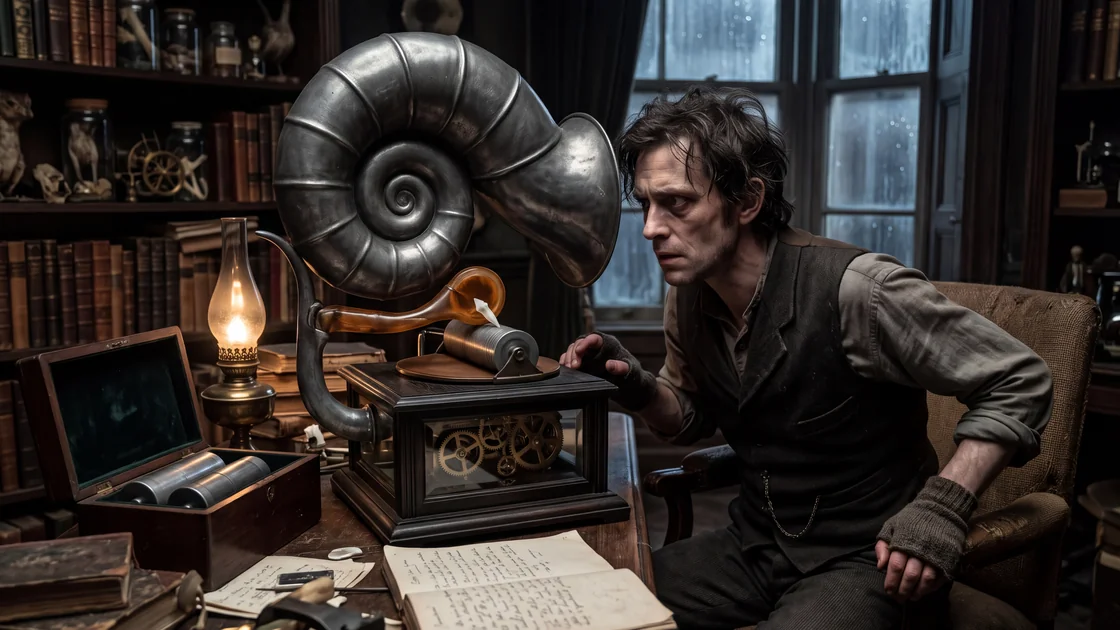
This is the account of Julian Vance, an antiquarian of solitary habit residing in the mist-shrouded quarter of Leith, who came into possession of an uncatalogued acoustic phonograph engineered by the reclusive Victorian natural philosopher Sir Alistair Finch. Unlike ordinary talking machines of the nineteenth century, Finch’s instrument utilized an organic diaphoretic diaphragm and cylinders cast from an alloy of lead, silver, and meteoric iron, designed not to capture the vibrations of atmospheric sound waves, but to register the vanishing electromagnetic and psychic emissions of the human cerebrum at the precise instant of physical dissolution. What began as Julian’s scholarly curiosity concerning an impossible artifact soon mutated into a harrowing descent into the unvarnished, terrified, and profoundly secret final consciousnesses of the historically immortal, driving him to the precipice of his own mortality as he discovered that some recorded voices refuse to remain confined to the grooves of cold metal.
Act I: The Finch Estate and the Lead Cylinders
The rain in Leith did not fall so much as it hovered, a suspended suspension of North Sea brine, chimney soot, and the cold grease of the docks. Julian Vance preferred it that way. For thirty-four years, behind the leaded bay windows of his shop on Queen Charlotte Street—a narrow, three-story premises flanked by an apothecary that smelled perpetually of camphor and a cooperage whose steady thudding marked the daylight hours—Julian had trafficked in things that the living had discarded and the dead had neglected to take with them.
He was not a dealer in bric-a-brac. He did not care for Staffordshire figurines, chipped Delft tiles, or the mass-produced mourning brooches woven from the horsehair-coarse locks of forgotten Edwardian aunts. Julian was an archivist of anomalies. In his drawers of black Spanish walnut lay compasses whose needles swung toward magnetic anomalies undiscovered by Admiralty charts; daguerreotypes whose silvered plates revealed, upon magnification, shadowy silhouettes standing beside the seated subjects; and mechanical chronometers whose complex escapements measured intervals not of twenty-four hours, but of some longer, celestial circuit that made the watchmakers of Clerkenwell cross the street to avoid him.
It was on a Tuesday in late November that the Finch consignment arrived.
Sir Alistair Finch had been dead for seventy-two years, his memory preserved only in footnote references within the more eccentric monographs on the history of acoustic science. In life, he had been an associate of the Royal Society until his abrupt expulsion in 1889 following a paper whose contents had been struck from the minutes as "an affront to Christian modesty and the natural demarcation between life and dissolution." He had retired to a square, basalt house perched upon the black crags of the Fife coast, surrounded by a battery of lightning rods, wind-driven dynamos, and glass carboys filled with distilled vitriol. When he died, his executors had boarded the windows and left the damp to finish his papers. Only the collapse of the carriage-house roof in the winter gales of the previous year had forced the distant collateral heirs to clear the premises.
The auction had taken place in a freezing stable-yard outside Kirkcaldy. Julian had been the only bidder for Lot 414: A wooden chest containing one acoustic instrument of novel design, together with sixteen metallic rolls, late nineteenth century, presumed incomplete.
The carrier’s men had cursed as they hauled the deal crate up the twisting stairs to Julian’s private study above the shop. The wood was damp, smelling of fungal rot and the salt-soaked kelp of the Forth.
"Mind the risers, Mr. Murdoch," Julian murmured, his thin hands wrapped in mittens cut off at the knuckle. "The joists are eighteenth-century pitch-pine. They do not care for sudden shocks."
"The devil’s in the bottom of it, Mr. Vance," the carter wheezed, letting his corner down with a bone-jarring rattle of dry iron. "It weighs as much as an anchor-stock, and there’s a hum to it. A man doesn't like an iron box that hums when the horses stop."
Julian paid the men two shillings more than their fee to ensure their silence and their immediate departure. Once the street door clicked shut and the iron bell above it fell silent, he drew the heavy velvet curtains across the bay windows, bolted the mahogany door of the study, and struck a sulfur match to light the twin argand lamps upon his broad library table.
The crate gave way under the persuasion of a small iron pry-bar. Beneath layers of dry straw and yellowed Edinburgh broadsheets from the winter of 1891 lay the machine.
It was not an Edison cylinder phonograph, nor was it the disc-spinning gramophone of Emile Berliner, though it shared an outward kinship with both. The case was fashioned from bog-oak, black as drowned coal and polished with a hard, resinous lacquer that had resisted both moisture and worms. The clockwork mechanism, visible through side panels of bevelled plate glass, was cut entirely from phosphor-bronze, with teeth so fine they resembled the serrations on an insect’s wing.
Yet it was the horn and the soundbox that arrested Julian’s gaze.
Ordinary talking machines of the era employed a bell of beaten brass, tin, or papier-mâché, flared like the corolla of a morning glory. Finch’s horn was an asymmetrical spiral, cast from an alloy of lead and dull silver that drank the lamplight rather than reflecting it. It curved like the shell of a deep-sea cephalopod, its interior ribbed with concentric rings of fine, hair-like wire.
The reproducer—the circular housing that held the diaphragm—was not fitted with mica, glass, or animal parchment. Within the bronze bezel sat a translucent, amber-toned disc of an oily, flexible substance that Julian, upon drawing near, recognized with a thrill of revulsion. It was dried peritoneum—the delicate, vascular lining taken from a human abdomen, cured with oil of cloves and stretched taut over an ivory ring.
From the center of this biological membrane protruded not a steel needle or a polished sapphire sphere, but a needle of pale, crystalline bone, ground down to an infinitesimal point.
"What were you trying to listen to, Sir Alistair?" Julian whispered to the empty room.
Beside the machine, nested in fitted compartments lined with faded purple plush, lay the sixteen cylinders.
They were not made of brown wax or brittle black vulcanite. They were heavy, cold, and solid, each one turned from a cylinder of lead-pewter into which ribbons of dull reddish metal had been swaged. There were no paper labels, no maker’s stamps, no serial numbers.
Instead, scratched directly into the flat bevel of each cylinder’s rim with a diamond point, were names, dates, and locations.
Julian held the first cylinder beneath the lamplight, adjusting his spectacles.
M. R. — Paris, Place de la Révolution. 10 Thermidor, An II (28 Juillet 1794).
He set it down, his thumb throbbing where the icy metal had rested. He lifted the second.
J. K. — Roma, Piazza di Spagna. 23 Febbraio 1821.
The third:
E. A. P. — Baltimore, Washington College Hospital. October 7, 1849.
Julian sat back in his horsehair armchair. The coal in the small grate hissed as a droplet of water found its way down the chimney flue.
"An elaborate hoax," he said aloud. The sound of his own voice was thin, flattened by the walls of calfskin volumes and stuffed taxidermy specimens that crowded the room. "An eccentric’s cabinet of wonders. Finch was a collector of historical souvenirs, and these are mechanical approximations—fantasias recorded by actors in the late eighties to amuse an old man’s twilight."
Yet, as Julian ran his bare finger over the grooved surface of the first cylinder, his intellect rebelled against his own dismissal. Edison had invented the tinfoil phonograph in 1877. In 1794, the very concept of recording human speech was as distant from scientific thought as the telegraph had been to the Romans. How could an actor have recorded the voice of a man who died under the guillotine nearly a century before the first recording groove was cut into wax?
Unless the recordings were not copies.
Unless the machine did not record the sound of air moving through a throat at all.
Julian opened the small drawer situated in the base of the oak cabinet. Within lay a folded sheaf of thin, onion-skin paper covered in Finch’s cramped, angular hand—the ink faded from iron-gall purple to the color of dried liver.
He unfolded the first sheet. The heading read: On the Retentive Properties of the Great Aether at the Cessation of Vitality.
Julian read through the night, while the rain of Leith beat against the dark panes like the fingers of a man seeking admittance.
Act II: The Physics of the Threshold
Finch’s theory, as set down in thirty-two closely written pages, was as monstrous as it was mathematically rigorous.
He did not believe that thoughts vanished with the brain that conceived them. Sound, Finch maintained, was merely the grossest, most degraded form of wave motion. The human brain, in its operations, generated oscillations of an incomparably higher order—disturbances in the luminiferous aether that radiated outward into the surrounding matter. Under ordinary circumstances, these ripples were faint, scattered into the general noise of the universe like the rings produced by a pebble cast into a stormy sea.
“Except,” Finch wrote, “at the moment of Rupture.
“At the instant when the animal coil is severed—when the soul, or that complex bundle of magnetic currents which simulates the soul, is violently wrenched from its organic seat—there occurs a discharge of catastrophic magnitude. The dying cerebrum emits a singular, coherent pulse of retentive energy. It is an electromagnetic death-gasp.
“For centuries, this emission has expended itself unobserved upon the inert substances surrounding the death-bed: the plaster of the walls, the curtains of the alcove, the metal of the bed-frame, the stone of the executioner’s scaffold. Matter is not dead; it is merely silent. It receives the impression as the prepared plate of Daguerre receives the solar ray, but lacks the chemistry to reveal it.
“I have constructed that chemistry. By subjecting metallic alloys to a steady galvanism while in the presence of stones taken from places of notorious agony, and by translating the residual tension of those relics through my Resonating Needle, I have reversed the polarity of the aetheric impression. I do not play what was spoken into a horn. I play what was thought into the stone.
“I have reclaimed the unuttered.”
Julian set the manuscript down. The lamps were guttering, their wicks crusted with black carbon. The room had grown deathly cold. Outside, the first dray carts were rattling along the cobbles toward the docks, their iron-shod wheels grinding through the grey slush.
His hands were trembling. He had spent his life among the dead—among their letters, their swords, their dried flowers pressed between the pages of forgotten devotionals. He had always believed that history was a silent country, accessible only through the cool medium of print and the quiet contemplation of relics. The past was safe because it was mute.
He looked at the machine. The bone needle caught the dying yellow ray of the argand lamp, gleaming like the fang of an adder.
"If you are a fraud, Sir Alistair," Julian murmured, "you have cost me seven guineas and a night's rest. If you are not..."
He did not finish the sentence.
He rose, trimmed the wicks, and set a kettle upon the small iron stove. He did not eat. When he had wiped his spectacles with a piece of chamois leather, he approached the table with the slow, deliberate movements of a priest preparing an altar for a sacrament of doubtful orthodoxy.
He selected the cylinder marked M. R. — Paris, Place de la Révolution. 28 Juillet 1794.
The cylinder was dense, heavier than lead of the same volume. As he slid it over the phosphor-bronze mandrel, the fit was so exact that it produced a faint, pneumatic sigh. He turned the heavy brass key in the side of the bog-oak case. The mainspring was massive; it fought the turn of his wrist with a muscular, oily resistance. Inside, the governor balls—two polished spheres of dark haematite—began to spin, humming a low, flat B-flat that vibrated through the wood of the table.
Julian positioned the horn toward his armchair. He lowered the soundbox.
The crystal bone needle descended. It did not drop into a run-in groove with the familiar mechanical scratch of a commercial record. The moment the point touched the grey alloy, a sound issued from the interior of the lead horn that caused Julian’s spine to lock against the back of his chair.
It was not a hiss. It was the sound of air being drawn across a dry, severed tongue—a wet, rattling intake of breath that had no breath behind it.
Then came the thought.
Act III: The Grooves of the Scaffold
It did not arrive as an auditory hallucination. It did not sound like a voice coming from the horn. Rather, the horn seemed to act as an acoustic lens, focusing an invisible beam of pure, agonizing presence directly into the center of Julian’s forehead.
The study in Leith vanished.
Julian did not see Paris with his eyes, but he felt it with the terrifying immediacy of another man’s ruined senses.
There was the smell first: the reek of vinegar, stagnant water, horses, and the overpowering, sweetish stench of sun-warmed blood soaked into pine timbers. Then came the pain—an incandescent, throbbing white agony centered in the lower jaw. Julian felt the coarse, dirty linen bandage tied around his own head, holding together the smashed fragments of his jawbone where the pistol ball had shattered it in the Hôtel de Ville the night before. The bandage was soaked through with pus and black blood; it tasted of salt, iron, and the sweat of twenty-four hours of humiliation.
The sky is too blue, the voice within Julian’s skull whispered—not in French, but in a primordial language of pure concept that Julian’s English mind translated instantaneously. A sky of porcelain. A sky that does not care for the Republic of Virtue. Why are the wheels of the cart so loud? They need tallow. Couthon is weeping behind me. Poor Couthon, whose legs are dead wood. He thinks this is the end of the world. It is not the end of the world. It is merely the triumph of the gluttons.
Julian gasped, trying to pull back from the horn, but his limbs were paralyzed by a profound sympathetic catalepsy. He was strapped to a plank. He felt the rough pine through the back of his coat.
They are shouting 'Down with the tyrant!' The same throats that shouted 'Vive l'Incorruptible!' when the sun rose on the Champ de Mars. Their mouths are open like the mouths of carp in the basin at Arras. Fools. If I had given them bread instead of Reason, they would have kissed my stockings. But bread rots. Reason... Reason is a diamond.
A rough hand gripped the linen bandage.
A sensation of cold air, followed by a shock of agony so intense that Julian’s vision went crimson. The executioner had ripped the cloth away so the blade would not be impeded. The shattered lower jaw fell open, hanging by a thread of flesh against the collarbone.
A scream tore from Julian’s own throat in the study in Leith, but from the horn came only a sound like a wet sponge being torn in half.
The wood is wet, the thought raced, frantic now, vibrating with the speed of an electric dynamo. The groove is greasy. The crowd smells of garlic and sour wine. Father, into thy hands... no, there is no father. There is only the Supreme Being, and He is as cold as the moon. The shadow—the shadow is falling before the iron—
CLANG.
The bone needle did not jump. It remained in the groove, but the signal ceased with a finality that struck Julian like an iron mallet.
There was no reverberation. No echo of dying thoughts drifting into the ether. Only the cold, unyielding silence of non-existence, accompanied by the dry, rhythmic ticking of the bronze governor balls within the bog-oak case.
Julian sat in his chair, his arms hanging limp over the sides, his breath coming in shallow, ragged sobs. His mouth was filled with the copper taste of blood; he had bitten through the inside of his lower lip without knowing it. His shirt was drenched with sweat that smelled not of his own study, but of the crowded gutters of the Rue Saint-Honoré in the high summer of the Terror.
"My God," he whispered. His jaw ached with a dull, phantom throb that made his teeth chatter. "My God... he was not thinking of France. He was thinking of the cart grease."
He looked at the machine. The haematite spheres were still spinning, their hum filling the quiet room like the purr of a sleeping cat that had just been fed.
He ought to have stopped the clockwork. He ought to have taken an axe from the coal-cellar and reduced the oak cabinet, the lead horn, and the sixteen cylinders to a heap of splintered wood and twisted metal. Every instinct of a life spent in quiet, orderly scholarship cried out for the destruction of an instrument that violated the primary sanctuary of the human condition: the inviolable privacy of the grave.
Instead, Julian reached out with a trembling hand, lifted the crystalline needle, and checked the spring.
His finger hovered over the cylinder marked J. K.
"Keats," he whispered.
Act IV: The Roman Light and the Baltimore Gutter
The addiction did not take weeks to establish its dominion over Julian Vance; it took hours.
By the third day after the arrival of the crate, the shop on Queen Charlotte Street remained closed. The iron knocker was tied with a black ribbon—a stratagem Julian had employed twice before when he wished to avoid the importunities of creditors or the visits of his sister from Dunfermline. Through the thick glass of the door, the interior of the shop looked like a sunken galleon, the shadows of stuffed herons and brass astrolabes submerged in an unmoving gloom.
Above, in the study, the fire had gone out. The hearth was grey with ash. Julian had moved his mattress from the bedroom and laid it upon the floorboards beside the library table, unable to bear the distance between his bed and the horn.
He had listened to the second cylinder four times.
It was John Keats, dying in the small, square room overlooking the Spanish Steps, with the sound of the fountain trickling below like water poured from an urn.
There was no political horror here, no guillotine blade, but the intimacy of the death was far more terrible. Julian sat in the Roman dusk, feeling his own lungs fill with what felt like boiling milk and crushed gravel.
Severn is sleeping, the dying poet thought. The impression was so delicate that it seemed to float upon the needle like thistle-down upon water. His head is against the mahogany chair-rail. His hair is greasy, poor fellow. He has not washed it since Tuesday. If I move my finger, he will start up and offer me more of that damned broth. I cannot swallow the broth. It tastes of feathers and copper.
The room is growing very small. It is narrowing to the width of a coffin, then to the width of a quill. Is the Piazza empty? I do not hear the English carriages. Only the water. The water sounds like someone turning the pages of an uncut book in another room.
I told them my name was writ in water. What a fool. Water forgets. Water runs down to the Tiber, and the Tiber runs down to the Ostian sea, and the sea is full of salt and fish-bones. It should have been written in lead. Lead stays.
The light on the ceiling is yellow. It looks like the skin of an orange. I should like to taste an orange from the market at Devizes. Just the rind. Just the oil of the rind pressed against the roof of the mouth... Severn... lift me up... I am dying... I shall die easy... don't be frightened... be firm, and thank God it has come...
Then the terrible, bubbling whistle through the lead horn, followed by that flat, impenetrable silence that was not the absence of sound, but the presence of the Void.
Julian had wept. He had knelt on the cold floorboards with his forehead pressed against the lead rim of the horn, his tears falling onto the dark oak base, feeling a grief so pure and personal that it eclipsed any sorrow he had ever known for his own kin. He felt he knew Keats better than Severn had known him; better than Fanny Brawne had known him. He had occupied the center of that brilliant, burning, disintegrating spirit at the very second when the poetry was extinguished by the phlegm.
Yet, after the grief came the hunger.
It was an epistemological lust that burned in Julian’s belly like a tapeworm. He was no longer an antiquarian cataloguing the drift of centuries; he was a necromantic voyeur. He was the only man in the history of the world who knew what the great had kept from their biographers—the final, shameful, petty, or sublime secret that every human soul carries out of the light.
On the fifth day, without having washed or changed his linen, he mounted the cylinder marked E. A. P.
The experience was nearly fatal.
The Baltimore recording was not like the others. Robespierre’s death had been an explosion of terror and physical agony; Keats’s had been a slow, melancholy evaporation. The mind of Edgar Allan Poe in the Washington College Hospital on that rainy Sunday morning in 1849 was an engine of madness that seemed to seize upon the crystalline needle and turn its vibrations back into the electrical circuits of Julian’s own brain with the force of a galvanic battery.
The horn did not emit words; it emitted nightmares that had taken on the geometry of architecture.
The arches are leaning, the mind of Poe screamed, a voice that was like the flapping of a thousand black silk banners in an icy wind. The red brick is porous. It drinks the rain until it sweats ink. Reynolds! Why does he keep the ledger under the bridge? The fourth column is full of names that begin with Z.
The cat is behind the plaster again. Not the black one—the one with the human eye that was drowned in the beer vat at the public house. It is clawing at the laths. Scritch. Scritch. Scritch.
They put me in another man’s coat. The sleeves are too short. The cuffs are crusted with someone else’s vomit. It is a dead man’s coat, taken from the cooping-pen. They made me drink the camphene. It tastes of turpentine and dead beetles. My brain is a furnace filled with wet peat.
Lord help my poor soul... the water is coming in through the baseboards... it is not water... it is oil... it is the heavy, black oil that lubricates the clock of the universe...
Reynolds!
Julian had thrown himself backward out of his chair, overturning the small table that held his tea-service. The china cups shattered against the floorboards, the cold dregs splashing across his slippers. He lay on his back, his fingers hooked into his hair, his mouth open in an involuntary rictus, while from the lead horn the delirium of the dying poet poured out into the room like sewer-gas from an uncapped main.
The needle reached the end of the cylinder, but this time the silence did not bring peace.
Julian lay on the floor, staring up at the dark timbered ceiling. He could hear the rain. But beneath the sound of the rain, he could hear something else.
It was a faint, scratchy whisper—not coming from the horn, but from the corners of his own room. It sounded like someone turning over dry papers in the dark.
"Reynolds?" Julian whispered into the empty study.
No one answered. But the hair on the back of his neck rose, and when he looked toward the window, he saw for a fraction of a second the outline of a man in an oversized, threadbare coat, standing between the velvet curtains with his face turned toward the glass.
When Julian blinked, the silhouette was gone. There was only the shadow of the tall astrolabe.
"I am spending too much time in the dark," he said, his voice trembling like a dry leaf. "I must eat. I must go out into the air."
He did neither.
He crawled back to the table, his eyes fixed on the velvet-lined chest.
There were thirteen cylinders remaining.
Act V: The Great Inventory
Over the next twelve days, Julian Vance ceased to live in the nineteenth century. He ceased to live in the town of Leith. He became an inhabitant of the borderland—that infinitesimal fraction of a second that separates the final thought of a man from the cold indifference of his clay.
He kept a ledger. His former neat, clerkish handwriting deteriorated into an erratic, feverish scrawl that resembled the traces of an earthquake on a seismograph.
Cylinder 4: Hypatia of Alexandria (Relic: Basalt fragment from the Caesareum). Note: The machine can reach back through centuries if the mineral matrix has remained undisturbed. The thought is not Greek; it is geometry. Triangles. She was calculating the precession of the equinoxes while the oyster-shells were scraping the meat from her ribs. She did not feel the shells after the first stroke; her mind took refuge in the fourth proposition of Apollonius. A sublime detachment. No fear. Only an infinite regret that the library at the Serapeum had burned before she could verify the parallax of Sirius.
Cylinder 7: Marie Antoinette (Relic: Scrap of linen from the Conciergerie). Note: The mind was utterly vacant of politics. She was not thinking of the Crown, nor of her children. Her final consciousness was entirely absorbed by a tiny stain of grease upon the executioner’s waistcoat—a yellow circle, the size of a franc, that smelled of fried tripe. She wondered if her mother, the Empress, had ever seen a man with tripe-grease upon his clothes. A profound, infantile silliness that lasted until the iron dropped.
Cylinder 11: Wolfgang Amadeus Mozart (Relic: Parquetry splinter from the Rauhensteingasse). Note: Finch was wrong. There was no music. No Requiem. No lacrimosa. It was a terrifying, mathematical horror of numbers. The mind was counting. One, two, three, four—up to eight hundred and forty-two. He was trying to count the number of carriage-bolts in the hearse that had passed his window three days before. He could not make the sum come out even. The discrepancy drove him into an abyss of numerical madness. The last thought was a scream of fury at the number seven.
Cylinder 14: Sir Isaac Newton (Relic: Lead sash-weight from Woolsthorpe). Note: Blackness. An absolute, terrifying absence of light. He who had spent his life dissecting the rainbow died in a state of sensory extinction that began twenty minutes before the heart stopped. He was thinking of a dog named Diamond. He was wondering if the dog’s soul was preserved in the form of a mathematical point within the divine sensorium, or if it had simply been rubbed out like a chalk figure from a slate. He died in terror of the dark.
Julian’s physical condition was now desperate. His eyes were sunken into purple sockets, his skin had taken on the greasy, greyish hue of the lead horn itself, and his fingernails were broken from constantly adjusting the heavy bronze nuts and screws of the gramophone’s assembly.
He no longer smelled of anything human. He smelled of the cold grease of the clockwork, the clove-scent of the peritoneal diaphragm, and the stale, damp air of a room that had not known a draft of fresh wind in three weeks.
His shop was no longer merely closed; it had become an object of suspicion in the neighborhood. Children ran past it on their way from the docks, dare-devils whispering that old Vance had died in his sleep and was rotting among his stuffed hawks.
Only one person had the courage to mount the stairs.
Act VI: Clara’s Intrusion
Her name was Clara MacIntyre. She was the daughter of a retired ship-chandler whose accounts Julian had kept for years, and she was the only human being who had ever been permitted to touch Julian’s catalogued rarities. She possessed that rare quality in a woman of twenty-eight: a precise, unsentimental intelligence that viewed the past not as a poem, but as a series of ledgers that had been imperfectly balanced.
She did not knock. She had a key to the shop door, given to her two years previously when Julian had suffered from a bout of pleurisy.
When the bell above the shop door jangled, the sound was so alien, so violent, that Julian started from his chair with a cry of terror, knocking his notebook to the floor.
He heard her footsteps on the stairs—firm, measured, the skirts of her dark wool dress rustling against the narrow banisters.
"Julian?"
He stood behind the library table, his hands spread out over the bog-oak case of the machine as if he were a mother shielding a deformed infant from the light.
The door opened. Clara stood upon the threshold, carrying a basket covered with a checked napkin. The grey afternoon light from the stairwell fell across her face, showing her sharp, grey eyes and the tight coils of her dark hair beneath her bonnet.
She stopped. Her hand went to her nose.
"Merciful heavens, Julian. What has died in here?"
"Clara," he croaked. His voice was like two slates being ground together. "You should not have come. I am... I am engaged in a difficult verification. An estate matter."
She did not retreat. She stepped into the room, set her basket upon a chair that was already heaped with dusty volumes of the Philosophical Transactions, and looked at him with an expression that shifted rapidly from annoyance to genuine alarm.
"You look like a corpse pulled from the canal," she said, her voice steady despite her eyes widening. "You have not shaved in a month. Your hands are black with machine-oil. And what is that smell? It smells like a butcher’s shop that has been scrubbed with camphor."
"It is clove oil," Julian said, his eyes darting toward the door as if he expected someone to follow her. "A preservative. A necessary preservative."
Her gaze fell upon the table—upon the asymmetrical lead horn that coiled like a snail, the bone needle resting upon the lead cylinder, and the open notebook with its frantic, spidery scribblings.
"This is the Finch purchase," she said. She had seen the invoice when it arrived from Kirkcaldy. "The acoustic curiosity."
"Do not touch it," Julian whispered, his fingers tightening on the edges of the cabinet until the knuckles were white. "Clara, I beg of you. Do not go near the horn."
She frowned, her natural skepticism asserting itself against his hysteria. "Why? Is it charged with a battery? Has Sir Alistair left some of his chemical deviltry in the base?"
"It is not chemical."
"Then what is it?" She stepped closer, her skirt brushing the debris of the broken teacups on the floorboards. "You speak as if it were alive."
"It is not alive," Julian said, his voice dropping to a low, intense hiss that made her pause. "It is the record of the moment when life becomes something else. It is the unuttered, Clara. The thoughts of the dead at the instant of the knife—at the instant of the hemorrhage—at the instant of the last lungful of air."
She looked at him for a long moment, searching his wasted face for the signs of the fever she assumed must be raging behind his temples.
"You have been reading those cursed German romances again," she said, though her tone lacked its usual sharpness. "You have starved yourself into an hallucination. Come away from it, Julian. I have brought some cold mutton and bread from my father’s table. Let me open the window."
"Listen to it," he said.
"I will not."
"One groove," he pleaded. His face had undergone a hideous transformation; the pride of the scholar had vanished, replaced by the desperate, craving humility of an outcast. "Only one groove, Clara. You think me mad. You think I am a weak-minded old clerk who has lost his wits over an ingenious trick of clockwork. Listen to it. Tell me that Sir Alistair Finch was a charlatan. If you can listen to five seconds of that horn and tell me it is an actor, I will smash the machine with my pry-bar and go with you to the infirmary."
Clara looked from Julian to the machine.
The lead horn seemed to gape at her like the mouth of a deep-sea fish, its interior wires catching the dull grey light of the Scottish sky. The silence in the room was heavy, thick with the smell of old paper, cold tea, and that faint, sickly undercurrent of clove-preserved flesh.
"Very well," she said coldly. "Play your trick. And then you will eat the mutton."
Julian did not smile. He felt no triumph. A feeling of icy dread settled over his chest as he reached for the box of cylinders.
He had not yet played Cylinder 15.
The rim was inscribed:
C. C. — Edinburgh, Calton Jail. 14 May 1832.
It was a local name. A common name. One that every inhabitant of the Lothians over the age of forty remembered with a shudder: Christian Carstairs, the woman who had poisoned her three children with sugar-of-lead so that she might run off to Liverpool with a ship’s carpenter who had forgotten her before her trial had even begun.
Julian slid the cylinder onto the mandrel. He wound the clockwork. The haematite balls began their swift, silent dance.
"Stand there," he whispered. "Do not lean over the mouth. Let the beam find you."
He lowered the needle.
Act VII: The Cry of the Damned
Clara MacIntyre did not scream.
A scream is a defense; it is the animal’s attempt to reject an impression by filling the world with its own noise.
What happened to Clara was far worse.
The needle touched the groove. For three seconds, there was only the dry friction of the bone point upon the metal. Then, her body went completely rigid. Her hands, which had been loosely clasped at the waist of her apron, flew up to her throat, her fingers digging into the flesh beneath her chin with such violence that the nails drew blood.
Her eyes did not close; they bulged, the pupils contracting until they were tiny black points in a field of red-veined white.
From the lead horn, nothing was audible to Julian except a low, greasy purr—the acoustic carrier of the psychic oscillation. But Clara was receiving the transmission.
She was standing in the execution-cell of Calton Jail. She was thirty-two years old again. She felt the heavy wool of the prisoner’s shift against her thighs, wet with the urine that had escaped her when the turnkey had knocked upon the oak door with his wooden mallet.
The rope is greasy, the dead woman’s consciousness poured through Clara’s skull like boiling pitch. It smells of tallow and the fat of the mutton we had on Sabbath. The minister has grease upon his bands. He is praying for my soul. Damn his prayers. Damn his small, white teeth that have never lacked a mutton-chop.
Where is Jem? Jem is at sea. Jem has a blue bird tattooed upon his forearm. If I had put the lead in his ale instead of the bairns' porridge, I would be walking on the quay at Liverpool this day. Little Willie took three days to die. He kept asking for the water from the well. The water was sweet, he said. The sugar made it sweet.
My feet are cold. They did not give me my stockings. They are hanging me barefoot like a beast. The stone is like ice under my soles... There is the bell... Ding. Dong. Ding. Dong.
The noose—it is cold—it is cold like a dead man's finger—
Jem—
Clara fell.
She did not swoon as ladies swoon in the novels of Mr. Scott. She collapsed like an ox struck behind the horns with a poleaxe. Her head struck the corner of the library table with a dull, wet thud, and she lay crumpled upon the floorboards, her limbs twitching in an irregular, rhythmic convulsion that matched the rotations of the lead cylinder.
"Clara!"
Julian lunged forward, his slippers slipping on the oil-stained boards. He caught the horn with his elbow, knocking the soundbox sideways.
The bone needle tore across the metal grooves with a sound like the shriek of an owl, carving a deep, ragged furrow through the name of Christian Carstairs before lifting into the air.
The silence that returned was absolute.
Julian dropped to his knees beside the girl. Her face was the color of skimmed milk, her breath whistling through her clenched teeth in long, shuddering gasps. A thin line of scarlet was trickling from her temple where it had struck the walnut wood.
He gathered her up, his arms trembling under her weight, and laid her upon the mattress. He bathed her face with cold water from the pitcher, his tears falling upon her cheeks, his voice repeating her name with the mechanical monotony of a madman.
It was twenty minutes before her eyes shifted.
She did not look at Julian. She looked at the ceiling, her jaw working as if she were trying to dislodge something foul that had been forced into her mouth.
"The bairns," she whispered. Her voice was not her own; it had the flat, brutal accent of the Fife coast, though she had been born and bred in the New Town of Edinburgh. "The bairns' porridge was sweet. She... she knew it was the lead. She watched Willie's belly swell like a bladder... and she went down to the public house to buy two-pennyworth of gin."
"Clara," Julian wept, clutching her cold, limp hand. "Forgive me. Forgive me. It is over. The needle is up. It is over."
She turned her head slowly, stiffly, as if the vertebrae of her neck had been soldered together. She looked at him with an expression of such cold, infinite horror that he shrank back from the bedside.
"You have been living in this," she said. Her voice was faint, but each word had the weight of an iron ingot. "You have been sitting here... eating their vomit... drinking their last sweat."
"I was seeking the truth," he stammered, his fingers plucking at his greasy waistcoat. "The truth that history hides—"
"There is no truth here," she said. She rose to an elbow, though her whole body shook with a palsy so severe that her teeth clicked together. "There is only... the refuse. The dirt that God meant to be covered by the earth. When a beast dies in the field, Julian, the crows pick the eyes, and then the worms take the rest, and then there is only the clean bone. But you... you are keeping the rot in a box."
She struggled to her feet, supporting herself against the wall. She looked at the bog-oak case, at the lead horn that seemed to watch her with its coiled, metallic eye.
"Destroy it," she said.
"I cannot."
"Destroy it, Julian. Or I will go to the sheriff. I will tell him you have the relics of the Calton executions. I will tell him you have murdered someone in this room. The smell alone will bring the constables."
"Clara, wait—there is one cylinder left."
She stopped at the door, her hand upon the brass latch. Her face was pale, marked by the bruise that was already darkening into purple upon her temple, but her eyes were clear with a terrifying, pitiless sanity.
"Let the dead keep it," she said. "If you put that needle down again, Julian Vance, you will never take it up."
She went out.
He heard her slow, unsteady descent down the stairs. He heard the shop door open, the bell give a single, muffled clink, and then the heavy thud of the door closing upon its iron latch.
He was alone.
Act VII: The Final Cylinder
The house was very quiet now.
The rain had finally ceased, replaced by a frost so bitter that the water in the ewer began to film with needles of ice. Through the leaded panes, the roofs of Leith showed white against an ink-black sky, their chimneys puffing small, straight plumes of smoke into the motionless air.
Julian did not light the lamps. He did not eat the mutton Clara had brought.
He sat in the dark, his hands resting upon his knees, looking at the solitary cylinder that remained in the fitted velvet compartment of the chest.
It was Cylinder 16.
Unlike the others, it had no name inscribed upon the rim. There was no date. No location.
There was only a single word, scratched into the metal with a hand that had been shaking with a violent, terminal agitation:
MEIPSUM.
Myself.
It was Sir Alistair Finch.
Julian did not need to consult the manuscript to know what it was. It was the record of the natural philosopher’s own passage. Finch had died alone in his basalt house on the cliffs of Fife, with his galvanic dynamos humming in the cellar, his organic diaphragms drying in their frames, and his crystalline needles waiting upon the lead rolls.
He had constructed a mechanical trigger. Julian had found the description in the final pages of the journal: an arrangement of mercury switches and counterweights connected to a band fastened around his own chest, designed to lower the reproducer onto the cylinder the moment his heart ceased to expand the leather strap.
Finch had recorded his own damnation.
Julian stood up. His knees made a dry, cracking sound in the silence of the study.
"I must know," he said to the empty room.
The voice did not seem to be his own. It was the voice of the machine. It was the voice of the sixty-four thousand grooves that had been cut into the lead cylinders by the agonies of twenty centuries.
"I must know what lies on the other side of the needle."
He did not light the argand lamps; he preferred the dark. The cold moonlight through the bay window was sufficient to reveal the dull, silver gleam of the cylinder as he slid it over the bronze arbor.
The metal was colder than the others. It felt like a piece of ice cut from the heart of a glacier.
He wound the spring. The bronze gears turned with their familiar, oily whisper. The haematite governor balls spun, their B-flat hum filling the dark study with a vibration that seemed to draw the frost inward from the glass of the windows.
Julian sat in the horsehair armchair. He did not pull back. He leaned forward until his forehead was only six inches from the flared rim of the lead horn.
He lowered the needle.
Act VIII: The Anatomy of the Void
The needle did not bite into the lead with a scratch. It entered the metal as a knife enters soft lard.
At first, there was nothing.
No French crowd. No smell of blood. No trickling Roman fountain. No Baltimore rain.
There was only the sound of a clock.
Tick. Tack. Tick. Tack.
It was not the clockwork of the gramophone. It was the massive, iron regulator that stood in the hall of Finch’s house at Fife. A slow, heavy beat, like the footstep of a watchman pacing an empty warehouse.
Then came the consciousness of Sir Alistair Finch.
It was not disordered like Poe's, nor terrified like Robespierre's. It was cold, analytical, and vast—a mind that had prepared itself for forty years to observe its own destruction with the instruments of natural philosophy.
The pulse in the radial artery has ceased, the dead philosopher observed. The thought had the clarity of an engraved copper plate. The carotid still flutters—forty-two beats to the minute. The peripheral veins have collapsed. The sensation of cold is not unpleasant; it resembles the application of wet sheets in the hydropathic cure at Malvern.
The dynamos are running true. The brush-gear is sparking slightly—I can hear the blue snap of the ozone. Good. The field is saturated.
The eye is losing its curvature. The lamp upon the sideboard is no longer a disc; it has become a yellow cross surrounded by prismatic rings. The red ray is disappearing first. The blue remains. The universe is becoming entirely blue.
Now.
Julian felt the snap.
It was not a metaphor. It was a physical rupture—the breaking of a tension that had held an aetheric structure together for seventy-one years.
The study in Leith did not merely vanish; it ceased ever to have existed. Julian Vance was no longer an antiquarian listening to a machine. He was Finch, and Finch was nothing.
I am outside the capsule, the thought registered.
There was no light. There was no darkness. Light and darkness are conditions of the optic nerve, and the optic nerve was now merely a strip of decaying fat upon a bone shelf.
There was only a limitless, shoreless sea of vibration.
And in that sea, Finch’s dying consciousness was not being extinguished. It was being pulled.
It is not an abyss, the dead man realized, and for the first time, a note of horrific, scientific astonishment entered the recording. It is a collector. The aether is not empty space. The aether is a memory.
Every cry that was ever uttered—every thought that was ever conceived in the blackness of a skull—it does not dissipate. It is stored. The universe is an acoustic cylinder of infinite capacity, and the needle... the needle is descending.
Something is listening.
It does not care for the poems. It does not care for the Republic. It does not care for the poisoned children. It collects the tension. It feeds upon the rupture.
We are not souls, Vance.
Julian’s heart stopped.
The thought had addressed him by name.
We are not souls. We are the fuel of a machine that was built before the stars were struck from the cold iron. I see the horn. The horn is not lead. The horn is the curvature of the void itself. And we are all being gathered into the spiral.
Listen, Julian.
Listen to the great mainspring.
LISTEN.
From the interior of the lead horn came a sound that no acoustic diaphragm of mica or peritoneum should have been capable of producing.
It was the sound of everything.
It was the simultaneous, unharmonized death-cry of every organism that had ever perished upon the earth: the screams of horses in the mud of Waterloo; the dry rattle of plague-victims in the pesthouses of London; the silent, philosophical terror of Roman stoics opening their veins in lukewarm baths; the screech of birds caught in forest fires ten thousand years before the first flint was chipped into an axe.
It was not sound; it was an avalanche of agony that entered Julian’s ears not as vibrations of air, but as an electrical discharge that melted the insulation of his nerves.
He tried to raise his hands to push the horn away.
His arms were dead wood.
He tried to close his eyes.
His eyelids were pinned back by the sheer, physical pressure of the retentive aether that poured from the lead coil like water from a burst dam.
He saw the needle. The crystalline bone point was no longer pale; it was glowing with an incandescent, violet luminescence. It was drinking him.
The needle was not merely playing Finch’s record; it was recording Julian Vance.
He felt the memories being dragged from the cells of his brain like eels pulled from the mud: his mother’s face in the churchyard at Dunfermline; the smell of the old bookseller’s shop in the High Street where he had bought his first volume of Newton; the sound of Clara’s voice saying the bairns' porridge was sweet; the cold, greasy taste of the Leith mist upon his lips.
It was all being turned into a groove.
It was being swaged into the metal of the cylinder, wound into the lead, preserved for some other, unimaginable ear that would turn the crank in some future century.
No, his mind whispered—his last, unuttered thought.
Not in lead.
Let me be writ in water.
The clockwork reached its limit.
The massive phosphor-bronze spring, strained beyond the temper of its metal by the terrible, unnatural drag of the needle, snapped with a sound like a pistol shot.
The governor balls shattered against the bevelled plate glass.
The bone needle broke, its crystalline point remaining embedded forever in the deep, ragged furrow at the end of the unmarked cylinder.
The silence that followed was not the silence of the machine.
It was the silence that has no end.
Epilogue: The Sale of Effects
The notice appeared in the Edinburgh Courant on the second Thursday of January:
Re: Julian Vance, Deceased.
To be sold by Public Roup, on Tuesday the 18th current, within the premises No. 17 Queen Charlotte Street, Leith: The entire Stock-in-Trade of the late Mr. Vance, Antiquary, comprising a large collection of Rare Books, Astrolabes, Mathematical Instruments, Taxidermy, and Sundry Curiosities.
Particular attention is directed to Lot 89: An Acoustic Phonograph of curious workmanship, bog-oak case with bronze mountings, together with sixteen metallic rolls, by Finch of Fife. The instrument being somewhat damaged in the escapement, will be sold without reserve.
The day of the sale was bitter cold, with a driving sleet that turned the horse-manure in the gutters into a yellow paste.
The auctioneer, a brisk, red-faced man from Hanover Street with a silver pencil-case and an impatient manner, stood upon a packing-crate in the center of the study. The room had been aired, but it still smelled faintly of camphor and something else—something that made the prospective buyers from the philosophical societies keep their coats buttoned to their chins.
Clara MacIntyre stood at the back of the room, near the door.
She was dressed in deep mourning, with a heavy veil of crape that concealed the scar upon her temple. She did not bid on the books. She did not bid on the astrolabes.
"Lot 89," the auctioneer cried, tapping his small ivory hammer upon the corner of the library table. "The Finch phonograph. An interesting example of early experimental acoustics, though I am told by the mechanics that the spring is broken and the reproducer-arm has suffered an injury to the jewel-point. What shall we say for the lot, gentlemen? Ten shillings?"
There was no movement in the room. The dealers from Edinburgh looked at the clumsy, snail-shaped lead horn with the disdain of men who knew that Edison’s new wax-cylinder machines were smaller, lighter, and did not weigh eighty pounds.
"Seven shillings?" the auctioneer tried, looking toward the corner where a marine-store dealer was examining an old brass theodolite. "Five shillings? The lead in the horn alone is worth fourpence a pound for scrap."
"Five shillings," a voice said from the back.
It was Clara.
The auctioneer blinked, peering through the tobacco smoke that filled the chilly room.
"Miss MacIntyre. Five shillings I am offered. Any advance on five shillings for the acoustic machine?"
He waited, his ivory hammer poised.
"Going, then, at five shillings. Gone."
The hammer fell with a sharp, dry clack.
An hour later, after the porters had cleared the room and the auctioneer had departed to the Black Boy tavern for his dinner, Clara stood alone in the study with the carter she had hired from the docks.
"Take it down to the pier," she said. Her voice was flat, devoid of any inflection.
"To your father’s house, Miss?" the man asked, wiping his nose with the cuff of his pea-jacket.
"No," she said. "To the end of the Old East Pier. Where the tugs turn."
"It’s heavy as the devil, Miss. The crate’s rotted."
"Here is a half-crown," she said, pressing the silver coin into his palm. Her skin was cold, but her hand did not tremble. "You will load it into the boat. You will row out past the beacon, into the deep water where the Firth meets the channel."
She reached into her reticule and drew out a heavy, cast-iron carpenter's hammer she had taken from her father's bench.
"And before you tip the chest over the gunwale," she whispered, her grey eyes looking straight through the carter into the dark corner where Julian's mattress had lain, "you will take this hammer, and you will strike the lead horn until it is as flat as a flounder. You will strike the lead rolls until there is not a groove left upon them that could hold the point of a needle."
The carter looked at the silver half-crown, then at the girl’s face beneath the black veil. He was a Leith man; he knew the look of someone who had seen a drowning.
"Every one of them, Miss?" he asked.
"Every one," she said. "Especially the one with no name."
She turned and went down the narrow stairs for the last time, her dark skirts rustling against the timber, leaving the machine sitting upon the bare boards in the grey winter light, waiting for the sea.