The Scribe of Living Waters
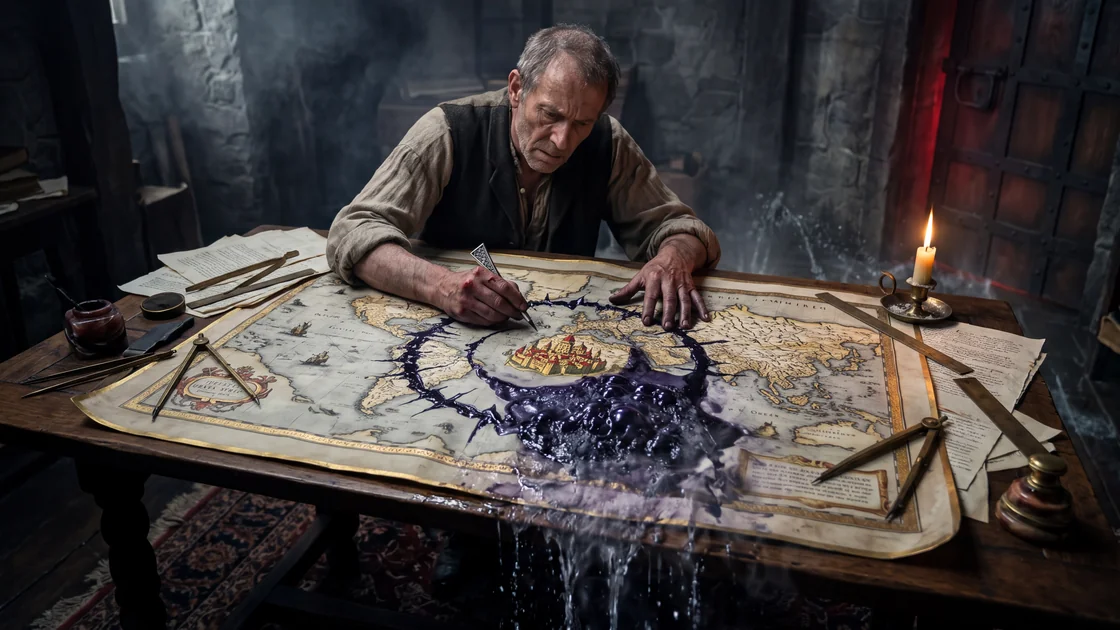
This is the account of Hesper Vael, a sedentary clerk within the Imperial Survey of the Ostran Empire, who discovered that his drafting table held an unspeakable authority over the physical crust of the world. While attempting to rectify an administrative discrepancy across the arid territories of the Marrow-Vale, Hesper drew an idle, corrective stroke of black gall-ink between two desiccated ridges—only to learn that during the night, a violent, roaring cataract of water tore through sixty miles of sun-baked shale, carving a brand-new gorge where families had grazed goats for six centuries. As imperial ministers, war-chiefs, and Hesper’s own fraying conscience collided over the sudden miracle, he was forced to navigate the terrifying boundary between representation and reality, discovering that the ink did not merely reflect the earth, but commanded it to bleed.
Chapter I: The Dust of the Seventh Reach
The Ministry of Topography and Cartographic Integrity smelled exclusively of three things: dried sheepskin cured in saltpeter, stale vinegar used to scour old slates, and the fine, chalky dust that drifted through the high northern clerestory windows.
Hesper Vael had inhaled this trinity of scents for forty-two years. It was in the weave of his gray wool coats; it was embedded in the crescent-shaped ridges beneath his fingernails; it had settled so permanently into his bronchial passages that his cough had the dry, rattling texture of shaken dice.
The Ministry occupied the lower vaulted undercroft of the Palace of the Five Quills, beneath the halls where courtiers argued over corn tariffs and far above the damp, rat-chewed crypts where the treasury kept its bullion. Here, under the cold gaze of tallow-greased lamps, seventy men sat at seventy angled desks of northern birch, each equipped with ox-horn inkpots, bone burnishers, steel dividers, and horsehair brushes.
Their task was neither heroic nor speculative. They were not explorers. Explorers were uncouth men with frostbitten toes and scurvy who returned from the periphery of the Ostran Empire with damp, crinkled notebooks filled with contradictory compass bearings. The cartographers of the Seventh Reach were rectors of order. They took the chaotic, blood-stained surveys of soldiers, the disputed boundaries of tax collectors, and the rough sketches of itinerant wool-mongers, and distilled them into the Imperial Standard Sheet: four feet by three feet of scraped vellum, uniform, unassailable, and immutable.
"A border does not exist because a river runs," Master Praetor Vane was fond of whispering into the ear of young apprentices, his breath warm and sour with aniseed. "A border exists because our stylus says the river is a border. If the river dries, the line remains. The empire rests upon the line, not the mud."
Hesper had believed that doctrine once. When he was twenty, with smooth hands and an unbent spine, he had thought the lines possessed a divine, Euclidean purity. Now, at sixty-one, his joints ached whenever the autumn rains came off the Bay of Cinders, and he knew that the empire rested on nothing more dignified than dried dung, poorly forged harness rings, and the ignorance of provincial governors.
On the third Tuesday of the dry month of Searing, Hesper sat before Sheet 414: The Valley of the Marrow-Vale, Southern Quadrant, Tract Nine.
It was an ugly map. The Marrow-Vale was an ugly country—a wide, fractured basin of cracked gray clay, stunted juniper, and white salt flats that lay four hundred leagues southwest of the capital. No one went there willingly except convicts condemned to the sulfur quarries and the miserable herdsmen of the Aethel tribe, who followed the seasonal seeps with their scraggly, blue-nosed sheep.
For three years, the Marrow-Vale had been gripped by a drought so profound that the cisterns at Fort Malice had cracked like eggs, and the garrison had taken to boiling their soup in horse blood. A dispatch had arrived three days prior from the Viceroy of the South: Tract Nine must be surveyed for a secondary military road. The old trail through the salt-pan is choked with dead mules. Find a passage where the infantry may march without perishing of thirst.
Hesper dipped his crow-quill into an inkwell of aged oak-gall and iron sulfate. The ink was dense, black with a faint violet sheen when wet, mixed with gum arabic from the southern acacias to give it body. He laid his bronze ruler across the gap between the Broken Jaw Ridge and the plateau known as the Kettle.
Between them lay thirty miles of sunken, blinding chalk. There was no water. There had never been water. The ancient sea that once covered the basin had evaporated ten thousand years before the first Emperor had learned to tie a knot. The ground was so dry it would drink a horse’s shadow.
Hesper sighed. He had a headache behind his left temple—a dull, pulsing thud that made the candlelight flicker in his vision.
"Look at this void," he muttered to himself. He was the oldest man in the scriptorium; the younger scribes gave him a wide berth, assuming his habit of talking to his parchment was the onset of second childhood. "Thirty miles of absolute vacancy. If I were the Architect of Heaven, I should have put a trench through here, if only to break the monotony of the stones."
He checked his references: a grease-stained notebook from an engineer named Callow, dated forty years ago; a scrap of goat-parchment from a frontier scout who had been skinned by bandits in the winter of 812; and the latest dry report from the garrison clerk at Fort Malice, which simply repeated the word arid, arid, arid across the margins of the requisition forms.
Hesper’s hand shook slightly. The tremble had begun in his wrist the previous winter. He took a sip of small beer from a pewter mug that sat beside his sand-caster.
His eye drifted to the vellum. It was not common sheepskin. This batch had come from the Master’s private store—a thick, buttery calf-vellum that had been treated with ground alabaster and scented with oil of cloves to preserve it against the book-rot. It was cool to the touch, dense as marble, with a surface so smooth that a pen could travel across it like an ice-skate over a winter pond.
Hesper laid his crow-quill near the southern shoulder of the Broken Jaw Ridge.
He did not mean to draw. Not truly. It was an impulse born of exhaustion, of the terrible boredom that comes from cataloging places one will never see, places that contain nothing but death. He imagined the cool, green sound of water. He remembered the trout-brooks of his boyhood in the western hills of Mor-Thal, the way the cold foam gathered behind the beaver-dams, the smell of crushed mint along the bank.
With a swift, liquid motion of his hand, Hesper drew a line.
It was not a straight line, like a military surveyor would make. It meandered. It looped around the northern tongue of the Kettle, found an imaginary contour along the base of the ridge, narrowed through a nonexistent notch in the granite, and terminated in a broad, serpentine flourish that emptied into the sunken basin of the salt-pan.
He dipped the pen again, this time into a jar of cobalt ground with white lead—a color reserved for the great rivers of the North, the deep, navigable veins of the empire. With fine, three-pronged strokes, he hatched the interior of the line.
The River Sinuous, he thought, smiling weakly at his own childishness. Or perhaps The Brook of Saint Jude the Thirsty.
The ink dried. The cobalt stood out against the pale cream of the calfskin like a fresh bruise on a girl's arm.
Hesper blinked. The headache receded slightly, replaced by a sudden, prickling sensation at the nape of his neck—the feeling that someone was standing directly behind him, looking over his shoulder.
He turned around. The scriptorium was quiet. Across the aisle, young Master Pellas was meticulously stippling the forest of the Black-Hedge with an eight-haired camel-hair brush, his tongue caught between his teeth. Near the door, Praetor Vane was snoozing over a ledger of tithes, his chin tucked into the fat ruff of his beaver-fur collar.
Hesper looked back at the map.
The line was still there. It looked authoritative. It looked ancient. If an imperial general saw that map, he would send a battalion into the basin expecting to water three thousand horses.
"Stupid," Hesper whispered. "Stupid old fool."
He reached for his scraper—a small, crescent-shaped blade of tempered Spanish steel with a polished walnut handle, used to shave away ink-errors without tearing the vellum fibers. He touched the edge of the blade to the beginning of the blue stroke near the Broken Jaw.
A spark—tiny, blue, and cold as a winter needle—jumped from the skin to the metal.
Hesper dropped the scraper with a sharp clatter that caused young Pellas to jerk and ruin a cluster of pine trees.
"Master Vael?" Pellas asked, blinking through his spectacles. "Is your heart troubling you again?"
"No," Hesper said, rubbing his fingertips against his apron. His skin felt numb, as if he had plunged his hand into a snowbank. "No. The tallow... it spat at me."
He picked up the scraper. But he did not touch the line again. A strange, stubborn reluctance seized him. It was a beautiful river. The curves were balanced; the hydraulic logic of the imaginary bed was impeccable, following the natural fault lines of the limestone strata that Callow had noted in his ancient survey.
"I will scrape it tomorrow," Hesper muttered. "When the light is better. Before Vane does his rounds."
He closed the heavy board covers of the folio, slid the bronze clasp into place, and blew out his candle.
Chapter II: The Courier’s Boots
Hesper slept that night in his garret above the tallow-chandler’s shop in the street of the Iron Pot. His sleep was troubled by dreams of bells—not the bronze bells of the Cathedral of Saint Irene, but deep, hollow bells made of stone, ringing underwater. He woke twice with the taste of silt in his mouth and the skin of his throat feeling as parched as salt-beef.
When he reached the Ministry at the seventh hour of the morning, the heavy oak doors were not standing open as they usually were to air out the cellar damp. A knot of three imperial messengers stood on the flags outside, their horses lathered with gray foam, their hide trousers caked with red muck up to the hips.
This in itself was unusual. Messengers from the provinces rarely climbed the hill to the Topographical Survey; they delivered their leather tubes to the War Office or the High Council of the Seal.
Hesper squeezed past them. One of the riders was vomiting into an iron grating, his shoulders heaving with the absolute exhaustion of an eighty-hour ride from the frontier.
Inside, the scriptorium was not in its customary state of monastic quiet. The scribes were not at their desks. They were huddled in a dense circle around the central consultation table—a massive slab of black granite where the Grand Survey of the Whole Empire was laid out beneath iron weights.
At the head of the table stood Praetor Vane. The Praetor’s wig was askew, revealing the bald, liver-spotted skin above his left ear. Beside him stood a man in the blue-and-gold surcoat of the Royal Engineers, his leather coat dark with sweat and grease.
"It is impossible," Vane was saying, his voice shrill as a falcon’s cry. "It is an administrative impossibility! There is no water within forty leagues of the Kettle. We have the tax rolls of the Emperor Justinian the Fourth; we have the survey of Duke Robert; we have the salt-leases from the reign of the Three Brothers! A desert cannot simply sprout an estuary overnight!"
"I am not speaking of estuaries, Praetor," the engineer said. His voice was hoarse, raspy from dust and shouting. He laid a large, cracked palm against the table. "I am speaking of thirty thousand cubic cubits of water per minute. It came through the notch of the Broken Jaw at three hours before dawn yesterday. There was no rain. There was not a cloud the size of a pigeon’s wing between here and the coast. The sky was like iron. And then... the mountain split."
Hesper halted three paces from the group. His knees felt hollow, like dry reeds.
"The mountain split?" Vane repeated, horrified.
"A cleft," the engineer said, tracing a finger across the empty air. "A clean, sheer fissure thirty paces wide. It looked as though it had been sliced by a cheese-wire. And out of it—not clear water, mind you, but water pressurized like the blast from a fire-pump. Red silt at first, then cold, black water carrying fossil-shells and the bones of things that had no eyes. It took the salt-pan in four hours. The garrison at Fort Malice had to abandon their guns on the lower ramparts; the basin is six feet deep in mud and rising. The Aethel herdsmen are screaming about the wrath of their sky-demon, and the Viceroy has had to hang three of them to keep the roads clear for the supply carts."
"A subterranean cavern," Vane said, clutching at his ruff as if seeking comfort from the starch. "An artesian reservoir, compressed by the shifting of the tectonic beds. A purely mechanical phenomenon. A coincidence."
"A coincidence that has drowned forty thousand sheep and washed away the northern third of the rebel camp at the Kettle," the engineer growled. "The Viceroy does not care about your subterranean caverns, Vane. He wants to know why this watercourse was not on the maps. He wants to know if the rebels had prior knowledge of it. If there was a canal—"
"A canal?" Vane shrieked. "In the Broken Jaw? It is solid dolomite! It would take forty regiments of sappers three hundred years to notch that stone!"
Hesper did not speak. He felt the cold iron of his pocket-knife through the wool of his breeches. He walked, as smoothly and silently as his old slippers would carry him, to his desk in the third row.
Folio 414 lay where he had left it. The brass clasp was closed.
His hands were trembling so violently that he could scarcely work the catch. It gave with a dry snick.
He opened the calfskin boards.
The cobalt line was dry. But it was no longer merely pigment on vellum.
Hesper leaned down until his nose was an inch from the surface.
The ink had sunk into the skin, but it had not spread laterally as ink does when it bleeds into parchment fibers. Instead, the surface of the calfskin had depressed. Along the entire length of the blue meandering stroke, from the Broken Jaw to the salt-pan, the skin had contracted, creating a microscopic, three-dimensional groove—a canyon no wider than a horsehair, perfectly formed, within which the cobalt pigment had taken on the glossy, oily sheen of moving liquid.
And there was a smell.
Hesper inhaled. It was not sheep-grease. It was not oak-gall.
It was the smell of wet shale, of ancient limestone newly cracked, and the bitter, sulfurous tang of deep-earth water that had never seen the sun.
Chapter III: The Logic of the Horn-Pot
For three weeks, Hesper lived in a state of suspended terror.
He did not touch his pens. When Vane assigned him the coastline of the Sea of Glass—a routine task of cross-hatching mud-flats and recording the beacons of the lighthouse guild—Hesper hired young Pellas to do the fine ink-work, claiming that his palsy had worsened. He spent his days sitting at his desk, staring at the scarred birch wood, listening to the gossip of the messengers.
The water was real. It was not diminishing.
Indeed, the new river had already acquired a name among the soldiers: The Cleft-Wash.
A trading post had already been established at the ford where the water widened over the chalk-bed. The garrison at Fort Malice had recovered their artillery, dried their powder, and, thanks to the sudden, miraculous supply of clean drinking water, had marched three regiments across the previously impassable basin, falling upon the flank of the Aethel rebels and crushing the secessionist movement in a single afternoon of slaughter.
The Emperor had declared a week of thanksgiving. The Patriarch had held a high mass at Saint Irene, attributing the river to the personal intercession of Saint Jude, who had apparently taken pity on the horses of the Third Legion.
Only Hesper knew the truth.
He knew it because of the notch.
On the third night after the engineer’s arrival, Hesper had gone to the map-chests in the basement, retrieved Callow’s original topographic survey of the Broken Jaw, and compared it with his own careless stroke on Sheet 414.
Where his pen had stuttered—where a tiny grain of sand in the paper had caused his hand to jump by less than the breadth of a fly’s leg—the actual gorge had performed an absurd, ninety-degree zigzag through three hundred feet of solid porphyry before resuming its course. The engineer had described that very zigzag with curse-laden wonder: "The water turns like a struck dog, through rock that would dull a diamond bit, for no reason known to God or nature."
The reason was a speck of unground gall-nut from the apothecary’s shop in the High Market.
Hesper could not bear the silence of his room. He lived in the corner of a world that had become thin, like paper held up to a furnace. When he walked across the cobblestones of the Grand Square, he found himself stepping lightly, terrified that the stone beneath his boots was merely a drawing of stone, and that a careless eraser in the sky might wipe away the pavement and drop him into the black, unmapped void below.
On a rainy Friday, when the rest of the scribes had gone to the chapel for the noon prayers, Hesper remained at his desk.
He had brought something from his lodgings: an old, discarded sheet of the same imperial vellum, salvage from a map of the Northern Marches that had been rejected five years ago because of a grease-stain from an overturned lamp.
The vellum was blank on the reverse.
He set out his tools: his compass, his ruler, and his horn-pot of gall-ink.
He did not use the government ink. That morning, he had gone to a different apothecary, a man who sold strange minerals to the glass-blowers down by the river. He had purchased cinnabar, lapis, gum benzoin, and a small flask of distilled spirits of wine. He had mixed them himself in a clean earthenware bowl, praying with childish incoherence to whatever saint guarded the integrity of distance.
"It was an accident," he whispered. "An accident of the air. A static discharge."
He laid the ruler down. He drew a square—two inches by two inches—in the center of the blank vellum.
Within the square, he wrote with great care, in the small, beautiful cursive of the Seventh Reach: The Orchard of Master Vael.
There was no such orchard. Hesper owned nothing in the world except three pairs of wool socks, a brass watch with a broken spring, and four shelves of theological commentaries in the Low Latin tongue.
In the center of the square, he drew a pond. It was circular, perfectly round, like a coin. He did not fill it with blue. He used the black ink. He made it three lines wide, with four neat willow-trees indicated by feathery cross-strokes at the four cardinal points.
He waited.
Nothing happened. The clock in the vestibule struck the three-quarters. The rain lashed against the clerestory glass with a sound like peas thrown against parchment. The ink dried to a dull, soot-black matte.
Hesper laughed—a dry, bitter rattle that ended in a cough.
"Mad," he said. "The mind goes first. The eyes fail, then the fingers stiffen, and then the brain becomes like an old turnip."
He reached for the vellum to tear it across.
As his thumbs met the edge of the skin, he stopped.
The vellum had not changed, but the ink had.
The black ring of the pond was no longer black. It had turned the color of ditch-water—a gray, leaden hue that seemed to possess depth. He touched it with his thumb.
It was wet.
Not wet with ink. The ink had dried five minutes before. It was wet with cold, greasy water that smelled of stagnant leaves and the slime that forms on the underside of mill-wheels.
He pulled his hand back as if a wasp had settled on his knuckle.
At that moment, the door of the scriptorium flew open with a bang that shook the candle-sconces.
It was not Vane. It was an orderly from the Prefecture of Police, his cape dripping water onto the scrubbed floor.
"Which of you is Vael?" the man barked, looking round the empty room until his eye fell on the solitary old man at the third desk. "Hesper Vael?"
Hesper’s tongue felt like a piece of dry leather. "I am he."
The orderly marched down the aisle, his scabbard clinking against the birch benches. "You have a cousin, yes? One Giles Vael, a carter who keeps a yard behind the Abattoirs?"
"I... I have not seen him these seven years," Hesper stammered. "We do not speak. His father cheated mine over a legacy of copper kettles."
"Well, you had best go down there," the orderly said, wiping his nose with the back of his wet glove. "The entire yard has collapsed into a sinkhole. His dray-horses are up to their bellies in black mud, and an old willow tree has just come through the floor of his wash-house, roots and all, out of the middle of the limestone. The district prefect wants to know if there are old sewer tunnels under the property, and the City Surveyor says your office keeps the underground rolls from the time of the plague."
Hesper looked down at the scrap of vellum on his desk.
The ink-ring was gone.
In its place was a tiny, ragged hole through the calfskin, circular, about the size of a sixpence, its edges charred and pulpy as if burned through by an acid drop. Through the hole, he could see the yellow birch-wood of his desk.
And from that hole, faint as the sigh of a sleeping infant, came the sound of bubbling water.
Chapter IV: The Geometry of Destruction
A man who discovers he has the power of a king is dangerous; a clerk who discovers he has the power of a god is catastrophic.
Hesper did not go to his cousin’s yard. He went to his room, locked the heavy oak door with both the iron bolt and the wooden bar, pulled the ragged linen curtains across the garret window, and lit every tallow stub he possessed.
He laid his tools upon the washstand.
He did not eat that night. He sat on his stool with his knees drawn up, watching the shadows of the candle-flames dance upon the sloping whitewashed ceiling.
He was not an ambitious man. He had never desired wealth; wealth in the Ostran Empire brought with it the attention of the tax-farmers, the envy of the guilds, and the inevitable visit of the Emperor’s inquisitors. He had never desired women; his only love had been a dry-goods merchant’s daughter who had died of the quinsy when he was twenty-four, and since then his libido had been entirely sublimated into the grinding of minerals and the sharpening of steel points.
What he possessed was the clerk’s passion: the lust for order.
The world, as Hesper saw it through the thousands of reports that passed through his hands, was an unruly, poorly drafted document. It was full of absurdities: mountain ranges that ended abruptly without aesthetic balance; deserts that lay three miles from the sea while inland valleys withered into dust; rivers that chose absurd, convoluted paths toward the ocean instead of following the elegant, direct lines that an intelligent draftsman would have laid down with a straight-edge.
The world was a rough draft. And he was holding the master’s quill.
He tested the limits with the methodical caution of an archivist.
On a scrap of vellum from the province of Mor-Thal—his homeland—he found the village of his birth: Cinder-in-the-Fell. It was a miserable hamlet of forty chimneys, wedged between a cold slate mountain and an acidic bog where nothing grew but peat and sour bilberries. The people there were stunted, bow-legged, and died at thirty-five of the lung-rot.
Near the churchyard, where his mother lay under three feet of wet moss, there was a hill called the Crow’s Hump—a dry, sterile mound of black gravel where even the goats refused to feed.
Hesper took his finest pen—an eagle’s quill, cut thin as a bee’s sting.
He dipped it into cobalt.
He did not draw a torrent. He was not a murderer. He drew a line no thicker than a spider-thread from the mountain tarn three leagues above, guiding it with gentle, lyrical curves through the birch-copses, around the foot of the Crow’s Hump, and into the communal grazing meadow.
He did not stop there. In the margins, in the minuscule red script used by the Imperial Rubricators to denote markets and toll-gates, he wrote: A spring of sweet water, cold as glass, containing six-inch grayling.
He blew upon the ink. He held his breath.
A moment of profound, terrible vertigo passed over him. It was not a physical dizziness; it was a sensation that the floor was not made of wood, but of a vast, elastic skin that had suddenly been stretched tight by an unseen hand. The candles flickered, their flames leaning toward the southwest for three seconds before straightening.
Three days later, a peddler from the North arrived at the Red Boar tavern at the corner of Hesper’s street.
Hesper was there, sitting in the dark corner behind the herring-barrels, his pewter pot untouched before him.
"The folk in Cinder-in-the-Fell have gone mad," the peddler told the tapster, sawing through a hunk of salt-beef with his thumb-knife. "They say an angel visited the churchyard on Thursday night. Struck the Crow’s Hump with a silver hammer. Out comes a brook as clear as gin, full of fat, gray fish with silver bellies that you can catch with your bare hands. The priest has already declared it a miracle. He’s taking five copper bits from the pilgrims to wash their eyes in the pool. Says it cures the squint."
Hesper took a slow sip of beer. It tasted like vinegar.
It was not an accident. The ink was not a conduit; it was a commandment.
He went back to his room and took down his great project: The Atlas of the Four Quadrants.
This was not a government map. It was his life’s secret work—sixteen leaves of double-thick vellum, bound in pigskin, upon which he had spent thirty years recording every scrap of true information he could glean from the archives. It was the only true map of the Ostran Empire in existence. The government’s maps were political fictions, drawn to flatter the Emperor or hide the defeats of the frontier legions; Hesper’s Atlas was the world as it actually was—terrible, fragmented, poor, and dry.
He opened the third leaf: The Province of the Iron Marches.
Here, the empire’s iron-mines were situated. Fifty thousand slaves lived in stone hutches beneath the shadow of the Gray Wall, a line of naked granite cliffs that rose three thousand feet into the mist. There was no timber for miles; the furnaces had to be fed with sea-coal brought on the backs of mules over sixty leagues of barren shale. The men died like flies in the winter, their limbs freezing while their faces were scorched by the smelting-fires.
Hesper looked at the Gray Wall.
Why should the cliffs be dry? Behind them lay the great southern sea, the vast, saltless expanse known as the Mother of Waters. A single notch—a gap no wider than a city gate—would bring the sea-barges directly to the mouths of the smelters. It would turn a desert of slag into an inland harbor. It would save ten thousand lives a year.
"It is not pride," he told the dark walls of his room. "It is economy. It is merely correcting a clerical error made by the First Cause."
He picked up his Spanish scraper.
He did not use ink this time. If ink could create, what could the steel blade do?
He rested the curved tip of the scraper against the line denoting the Gray Wall—a thick, black ridge of hatched ink that represented eighty miles of impassable stone.
He pressed down.
The vellum resisted. The parchment was tough, ancient, cured with salt and cedar.
He gave a slight, decisive shove with his right wrist.
A tiny ribbon of dried black ink and white parchment dust peeled away before the edge of the blade. A white gap—a notch less than an eighth of an inch long—appeared in the middle of the Gray Wall.
Chapter V: The Scream of the Granite
The sound was not heard in the city, but it was felt.
It occurred at the second hour after midnight. In the Seventh Reach, three leagues from the sea, the great bronze chandeliers in the throne room began to swing in slow, deliberate arcs, chiming against one another with a sweet, terrible music. The bells in the clock-towers groaned as their counterweights swayed. In the kennels of the Grand Duke, eighty wolfhounds threw their heads back and wailed in unison.
Hesper fell from his stool.
The floor did not shake; it twisted. It was an angular sensation, as though the room were a box being wrenched out of square by an enormous pair of tongs.
From far away—from three hundred leagues to the south—there came a dull, rhythmic thudding that traveled through the bedrock of the earth itself, vibrating through the legs of Hesper’s stool, through the soles of his slippers, through his pelvic bones, until his teeth clicked together in his jaw.
Crack.
Crack.
Crack.
It was the sound of a stone table breaking under the stroke of an axe.
Hesper crawled to the washstand. The scrap of vellum lay upon the table.
Around the tiny white notch he had scraped through the Gray Wall, the parchment was not white.
It was smoking.
A thin, wispy thread of bluish vapor rose from the calfskin, carrying the smell of burned granite and pulverized quartz—the exact smell of a stonemason’s chisel when it strikes an iron-seam.
As he watched, paralyzed with horror, the notch began to widen.
Not by his hand. The vellum was tearing itself apart.
The microscopic fibers of the calfskin, scraped thin by his steel blade, were snapping one by one with tiny, high-pitched pings that sounded like the breaking of lute strings. The gap grew from an eighth of an inch to a quarter, then to a half.
And then the blue ink from the Mother of Waters—ink he had laid down twenty years ago, dry as mummy-dust—began to liquefy.
It did not stay within its borders. It surged forward into the white breach.
"No," Hesper whimpered. He grabbed the sand-caster—a pierced box of lead filled with ground pumice and river-sand—and dumped the entire contents onto the map.
The sand did not absorb the ink. It was swept away.
Hesper watched in the tallow-light as the sand formed tiny, distinct bars and spits along the margins of the widening blue stroke, exactly as gravel is deposited by an alpine flash-flood. The ink climbed over the margins of the valley; it swallowed the red dots that marked the slave-barracks; it obliterated the tiny crossed pickaxes that indicated the great iron-shaft of the Emperor Rudolph; it rushed on, five inches across the leaf, until it reached the edge of the desk and began to drip onto the pine floorboards.
Where each drop hit the floor, there was a sharp hiss.
Hesper thrust his hand beneath the desk.
The drops were not ink. They were sea-water—cold, brackish, and thick with gray foam.
The next morning, the capital was paralyzed.
The couriers did not ride in from the south; there were no roads left for them to ride upon. The first news came by carrier pigeon from the naval station at the Cape of Birds:
THE GRAY WALL HAS COLLAPSED STOP A GAP ONE LEAGUE WIDE HAS OPENED IN THE MAIN RIDGE STOP THE SOUTHERN SEA HAS ENTERED THE MINING BASIN STOP THE FURNACES ARE EXTINGUISHED STOP SIXTY THOUSAND DROWNED OR DISPLACED STOP THE WATER ADVANCES AT TEN KNOTS TOWARD THE INTERIOR STOP SEND BREAD STOP SEND SHROUDS STOP
Praetor Vane did not come to the scriptorium that day. He had been summoned to the Privy Council.
When he returned at sundown, his coat was buttoned crookedly and his wig was gone entirely, showing his red, sweating skull. His eyes were wild, bloodshot, the eyes of an ox that has seen the sledge-hammer in the butcher’s hand.
"A cataclysm," he said to the silent scribes, who sat with their quills suspended above their inks like soldiers waiting for the order to charge. "A general subsidence of the continental plate. The Chief Astrologer says Saturn has entered the House of the Crab. The Arch-Chamberlain has ordered forty-eight heretics burned in the market square to appease the earth-spirits. And..."
He leaned against the consultation table, his breath whistling in his throat.
"And what, Praetor?" young Pellas asked timidly.
"The Arch-Chamberlain has ordered a New Survey," Vane whispered. "Every leaf of the southern provinces must be redrawn by the end of the month. The tax assessments are completely deranged. The Emperor does not know if he owns a province or an ocean."
He looked up, his gaze wandering across the rows of desks until it settled upon Hesper.
"Vael," he said.
"Yes, Praetor?"
"You are the master of the Southern Quadrant. You know the elevations of the Gray Wall better than any living soul. Take the Imperial Standard Sheets—the great silk-backed folios from the Gold Vault. Take them to your lodgings if you must. Work through the nights. If the boundaries are not fixed before the autumn tithes are declared, the Chancellor will have all our heads on the city spikes."
Hesper looked at the old man. For a second, a wild impulse took him—to tell him everything. To show him the scrap of calfskin with its burned edges; to show him the drops of sea-water that had dried into crusts of salt upon his floorboards; to tell him that the world was no longer anchored to its foundations, that it had become a puppet dancing on threads of iron gall-ink.
He said nothing. He bowed his head until his chin touched his ink-stained ruff.
"The work shall be done, Praetor," he said.
Chapter VI: The Visit of Arch-Chamberlain Malcor
They came for him at the third watch of the night, four days after the New Survey had begun.
It was not the city watch. It was six men of the Black Guard—the Arch-Chamberlain’s private security—wearing breastplates of blued steel over black velvet, carrying short, heavy carbines with matchlocks already glowing in the dark.
They did not knock. An iron crowbar severed the oak door-post with a single, wet crunch.
Hesper was sitting at his table. He had not slept in ninety hours. Around him lay the great silk-backed vellums of the Gold Vault—sixteen square yards of imperial authority, illuminated with gold leaf, painted with cinnabar and lapis lazuli, showing the seven hundred cities, the three thousand rivers, and the twelve mountain barriers of the Ostran Empire.
A man stepped through the splintered door.
He was tall, thin as a willow-stake, with a long, horse-like face that had been powdered until it looked like a baker’s shovel. He wore a traveling cloak of black marten fur held at the throat by an ivory clasp carved in the shape of a severed ear.
Arch-Chamberlain Malcor.
He did not look at Hesper. He walked slowly around the small garret, his boots clicking on the rough pine boards, his white fingers lightly touching the tallow stubs, the dry crusts of bread, the chipped wash-basin.
Finally, he stopped before the desk.
"You have no cat, Master Vael," Malcor said. His voice was high, flute-like, completely devoid of inflection.
"No, my Lord," Hesper whispered.
"A pity. Cartographers should have cats. They keep the mice from eating the bindings. Mice have a great appetite for pigskin and calf. They can eat an entire county in a single winter if left undisturbed."
He laid one pale finger upon the corner of Sheet 12: The Province of the Iron Marches.
The ink was fresh. Hesper had been working for sixteen hours to restore the coastlines—not as they were before the flood, but as they must be now: a wide, ragged gulf of blue water where the great iron-shafts had once stood.
"It is very accurate," Malcor murmured. "Our naval captains have just returned from the breach. They report that the water has settled precisely where you have drawn the thirty-fathom line. Exactly along that contour. Not three feet to the left; not three feet to the right."
Hesper felt his heart thudding against his ribs like a bird caught in a chimney. "The... the reports from the coast were very clear, my Lord. The naval surveyors are competent men."
"They are idiots," Malcor said softly. "They are drunkards who cannot read an astrolabe without vomiting into their scuppers. They did not give you that contour, Vael. They could not have. They only reached the new shore at dawn yesterday. Yet this ink... this lapis-wash... has been dry for forty-eight hours."
He reached into his sleeve and drew out a small silver pocket-watch. He did not check the time. He used the flat silver case to press down gently upon the blue stroke that marked the new harbor.
"Do you take me for a fool, Master Scribe?"
Hesper could not breathe. "My Lord... I am a servant of the Ministry. I follow the calculations—"
"Be silent," Malcor said. It was not a command given in anger; it was an administrative directive, cold as an ax-stroke.
He stepped closer. The smell of his clothes came over Hesper: rose-water, ambergris, and the sharp, chemical stench of the nitric acid used by the mint-masters to test gold.
"The Praetor thinks you are a genius," Malcor said. "He thinks you have discovered an ancient method of predictive hydraulic geometry—some lost science of the old Greeks by which one may deduce the location of subterranean faults from the wrinkles in a cow’s hide."
The Arch-Chamberlain smiled. His teeth were very small, sharp, and spaced widely apart, like the teeth of a pike.
"I do not believe in predictive geometry," he said. "I am a practical man. I manage the revenues of four hundred barons who would slit my throat for a brass groat. I know that things do not happen because they were foreseen; they happen because someone made them happen."
He leaned down until his white face was four inches from Hesper’s.
"Who gave you the pens, Vael?"
"No one, my Lord! I swear by the Mother—"
"Who gave you the pens?" Malcor’s hand shot out. His fingers were surprisingly strong, like iron wire wrapped in silk. He caught Hesper by the throat, pressing his thumb into the soft hollow behind the jawbone. "Was it the League of the Red Ridge? Was it the Sorcerers of the Sunken Isles? We found the body of the Grand Astrologer this morning in the moat. His eyes had been put out with a stylus. He had a piece of your parchment in his throat—a scrap showing the constellations of the winter solstice, drawn backwards."
"I know nothing of astrologers!" Hesper choked out, his vision blackening around the edges. "It... it is the vellum! It is the ink!"
Malcor did not let go. "The ink?"
"The Seventh Sheet... the calfskin from the First Well... and the gall... the gall from the deep wells..."
Malcor held him for three more seconds, studying the terror in the old man’s eyes with the detached interest of an apothecary watching an insect die in a bell-jar.
Then he released him.
Hesper fell forward against the desk, coughing violently, his forehead hitting the edge of the great map of the empire.
"Demonstrate," Malcor said.
He pulled a wooden stool from the corner, swept a pile of theological tracts onto the floor with his foot, and sat down. He rested his hands upon his ivory cane.
"Demonstrate. Or my men will take you down to the cellar beneath the Salt Tower. There are no maps there, Master Vael. Only iron tongs, cold water, and a charcoal fire that is never allowed to go out."
Hesper looked at the guards. Their matchlocks were smoldering, the pale gray smoke curling around their helmets like snakes.
"What... what would you have me do, my Lord?"
Malcor tapped the ivory ear on his cane.
"The League of the Red Ridge," he said. "Their army is currently entrenched at the Ford of the White Willow, twelve leagues east of the city. Five thousand horse; eight thousand pikes. They have blocked the grain-barges. The city will be out of meal by Sunday. The Emperor’s regiments cannot dislodge them; the position is too strong, protected by a marsh and three earthen redoubts."
He pointed his cane at Sheet 4: The Valley of the Upper Fluvia.
"Drown them," Malcor said.
"My Lord—"
"Drown them. Not the whole valley. I need the grain-mills intact. Just the camp. The redoubts. The horse-lines. Let the river rise four cubits at the second hour before dawn. That should be sufficient to wash them into the salt-flats without ruining the autumn barley."
Hesper looked at the map.
The Ford of the White Willow was drawn with exquisite care. He remembered drawing it twenty years ago—the tiny, stylized willow trees along the bank, the small red square representing the customs-house, the delicate blue thread of the Fluvia winding through the wheat-lands.
"There are... there are three villages on that bank, my Lord," Hesper said, his voice shaking. "Saint-Mary-in-the-Fens. Cross-Keys. The hamlet of the Weavers. There are twelve hundred people who have no part in the rebellion."
Malcor looked at his pocket-watch.
"It is now half-past three," he said. "If the ink is not wet by four, the sergeant will take your left thumb with his pliers. If it is not wet by half-past four, he will take your right. You will find it very difficult to draw rivers without thumbs, Master Vael."
The sergeant—a huge man with a scarred lip and eyes like small horn buttons—stepped forward, his fingers reaching for an iron case at his belt.
Hesper reached for his pen.
Chapter VII: The Tearing of the White Willow
The quill felt heavier than an iron bar.
Hesper selected an ox-gall ink that had been thickened with lamp-black—an ink usually used for drawing the black ramparts of border-fortresses. His hand had ceased its trembling. When terror reaches a certain hydrostatic pressure, it produces a cold, crystalline stillness that mimics courage.
He found the Ford of the White Willow on Sheet 4.
The Fluvia was a peaceful river. In life, it was eighty paces wide, clear-bottomed, its surface dimpled by the rises of dace and chub. It ran between low gravel terraces crowned with pollarded willows and thatched barns.
He positioned the tip of his quill five miles upstream from the rebel encampment, where the river squeezed through a narrow limestone channel known as the Bishop’s Throat.
"A simple rise?" he asked. His voice sounded like dry leaves scraping over gravel.
"A wall of water," Malcor said without looking up from his watch. "Ten cubits. Fast enough to take the baggage-wagons. I do not want them retreating in good order with their guns. I want them naked and swimming."
Hesper did not draw a gentle curve.
He pressed the quill until the nib split—a hard, brutal bifurcation that left two parallel tracks of dense black fluid across the vellum. He drove the ink straight through the contour lines of the limestone hills.
He did not guide the water along the natural drainage. He drew a line that severed the Bishop’s Throat like a throat cut by a razor, directing the entire volume of the northern watershed not into the wide meadow-bed, but directly across the high clay terrace where the villages stood.
He knew what he was doing.
He was not just killing the rebels. He was executing the geography.
As the ink hit the paper, there was no blue spark this time.
There was a sound.
It came directly from the parchment—a high, wet, sucking noise, like a boot being pulled from a deep peat-bog. The vellum under his wrist turned instantly from cream to a dark, sodden gray. The smell of rotting weed, dead snails, and cold, river-bottom clay exploded into the room, so powerful that one of the black guardsmen gagged into his gauntlet.
The black line began to swell.
It did not stay within the two nib-tracks. It rose from the surface of the map in a rounded, glistening bead of liquid, three-eighths of an inch high, trembling with surface tension. Within that bead of ink, Hesper saw microscopic debris: specks of straw, fragments of bark, and things that looked like tiny, wriggling black threads.
"My Lord," the sergeant whispered, taking a step back, his hand dropping from his pliers to the hilt of his short-sword. "The paper... the paper is bleeding."
Malcor rose slowly from his stool. His eyes were wide; for the first time, the powdered mask of his face showed cracks of real, human terror.
He touched the bead of water with the tip of his ivory cane.
The ivory hissed.
A drop of clear river-water flew from the map and struck Malcor’s white cheek. It left a tiny, red burn-mark, as if he had been splattered with hot lard.
"Sufficient," the Arch-Chamberlain whispered. "Sufficient."
"It is not sufficient," Hesper said.
He was no longer looking at Malcor. He was looking at the map.
The ink was no longer obeying him.
The split stroke had created a siphon. The line was feeding upon the moisture in the air, upon the sweat of the soldiers, upon the tallow grease in the lamps. The stroke was expanding laterally, eating the parchment, its edges ragged as the teeth of a saw.
Saint-Mary-in-the-Fens disappeared under a pool of violet-black gall.
Cross-Keys vanished with a faint fizz that smelled of burning hair.
"Stop it," Malcor commanded. His voice had lost its flute-like control; it was shrill, cracked. "I said the camp only! You are drowning the valley road! The grain-barges will have no tow-paths!"
"I cannot stop it," Hesper said. He dropped the quill. It rolled across the table, leaving a trail of black dots that instantly turned into three-dimensional blisters of water upon the floor. "I have breached the vellum. The skin... the skin has remembered the ox."
"What are you babbling about, you old lunatic?"
"The skin," Hesper said, his voice rising into a strange, musical chant. "It was an ox from the low meadows of Mor-Thal. It was slaughtered in the autumn of 790. It drank from the Fluvia every day of its life for seven years. The vellum remembers the water, my Lord. It wants it back."
"Scrape it!" Malcor shouted, drawing his own dagger—a slender needle of Solingen steel with an ebony grip. "Scrape it away, you dog!"
He thrust the dagger toward the parchment.
Hesper caught his wrist.
The cartographer’s fingers were thin, knotted with arthritis, yellowed with acids, but at that moment they were set with the rigidity of an iron compass.
"If you scratch that skin," Hesper whispered, "you will not scrape the ink. You will scrape the earth. Do you know what happens when you shave the earth with three inches of steel, Arch-Chamberlain? Have you ever seen a mountain turn inside out?"
Malcor stared into Hesper’s eyes.
He saw there what every bureaucrat fears most: a subordinate who has passed entirely beyond the jurisdiction of the rope.
Slowly, very slowly, Malcor pulled his wrist back. He wiped the drop of river-water from his cheek with a silk handkerchief. The silk came away stained with gray river-silt.
"Clear the room," the Arch-Chamberlain said to his men.
"My Lord?" the sergeant asked, bewildered.
"Out. Wait on the stairs. Shoot anyone who attempts to enter. Shoot anyone who attempts to leave."
The guards backed out through the shattered door, their boots slipping on the wet floorboards, their matchlocks hissing as the damp air of the garret quenched their coals.
Malcor turned the key in what remained of the lock.
He stood against the door, his fur cloak wrapped tightly around his thin shoulders, listening to the dark.
From the east—from twenty miles away, beyond the city walls, beyond the orchards of the South Gate—came a sound that was not thunder.
It was the sound of a forest being snapped off at the roots by an avalanche of mud.
Chapter VIII: The Architecture of Dominion
By noon the following day, the Ford of the White Willow was no longer a ford.
It was a lake four miles wide, choked with the corpses of two thousand cavalry horses, five hundred carts of barley, and eleven hundred rebel pikemen who had been caught asleep in their blankets.
The rebellion of the League of the Red Ridge was over.
The survivors had surrendered unconditionally to the imperial scouts, begging only to be taken to the high ground where the water could not reach their chins. The city was saved. The price of bread dropped three coppers on the stone.
In the palace, the Arch-Chamberlain was declared the Savior of the Realm.
In the garret in the street of the Iron Pot, Hesper Vael was no longer a scribe.
He was a prisoner of state.
The room had been transformed. The shattered door had been replaced with one of solid oak, three inches thick, plated with boiler-iron and secured by three deadbolts whose keys were kept on a ring at Malcor’s own belt. The windows had been bricked up, save for a narrow, iron-barred slot at the very top that admitted a pencil of cold gray northern light.
A carpet from Shiraz had been laid over the floorboards to hide the salt-crusts and the water-burns. A brazier of scented juniper charcoal burned in the corner, its sweet smoke failing entirely to mask the underlying smell of the room: the smell of an open grave by a riverbank.
There was a new desk—ten feet long, made of heart-of-oak, braced with bronze angle-irons.
Upon it lay the Theatrum Orbis Terrarum: the supreme, forty-sheet survey of the known world, drawn on vellum prepared from the hides of the sacred white cattle of the Imperial Stud, cured in baths of alum, borax, and lavender, and gilded by the master illuminators of Venice.
Beside the desk stood Malcor.
He had changed his clothes. He wore an imperial robe of cloth-of-gold lined with miniver, the ceremonial dress of the Grand Chancellor. His face was freshly shaved, his wig freshly curled and powdered with violet-dust.
"The Northern King has refused the tribute," Malcor said. He was sipping warm spiced wine from a silver chalice.
Hesper did not move. He was sitting on a low stool, his knees together, his hands resting on his thighs. He wore a clean linen shirt that the Arch-Chamberlain’s valets had brought him, but he had refused the coat of velvet. He looked like an ancient, withered monk waiting for the executioner’s bell.
"The Northern King," Malcor repeated, "is an insolent barbarian. He thinks the Frost-Tooth Mountains protect him. He thinks that because our infantry cannot drag cannon through the snow-passes, he may snap his fingers at the five-percent wool tariff."
He laid a bony, ringed finger upon Sheet 2: The Northern Marches and the Ice-Fell.
"Look here, Vael."
Hesper did not look.
"Look," Malcor said, his voice dropping into that quiet, terrifying register that preceded an order for strangulation.
Hesper raised his eyes.
The Frost-Tooth Mountains were represented on the map by a glorious, jagged spine of white and silver lead-paint, eighty leagues from east to west, crowned with tiny, heraldic eagles and blue glaciers. Beyond them lay the kingdom of the North: a fertile basin of oats, timber, and copper-mines.
"It is three hundred cubits of solid granite," Malcor said. "An inconvenient border. It forces our merchants to take the sea-route through the Sound, where the King collects eight thalers on every barrel of salt."
He pulled an ebony case from his pocket and opened it.
Inside lay three instruments.
They were not cartographer’s tools. They were the instruments of an imperial executioner, refined by the science of the goldsmiths.
The first was a stylus of solid platinum, its tip ground to a triangular diamond-point.
The second was an ink-pot of carved sardonyx, containing a black, viscous fluid that did not settle when the box was moved; it crawled slightly up the inner walls of the stone, like the grease in an oil-lamp.
The third was a scraper of meteorite iron, its handle carved from the thigh-bone of an eagle.
"The King has twelve cities," Malcor said. "I do not want them destroyed. Destroyed cities pay no tariffs. I want the mountains... smoothed."
Hesper felt a cold sweat break out upon his forehead, running down through the deep furrows of his cheeks into his mouth.
"Smoothed?" he whispered.
"Drawn down," Malcor said, gesturing with his chalice. "A gentle gradient. A pass ten leagues wide, through which three regiments of foot may march abreast with four-and-twenty twelve-pounder guns. The road should be wide, gravel-surfaced, with an incline not exceeding one foot in thirty. You will begin at the Pass of the Red Deer and carry the grade through to the plains of Upsala."
"It... it cannot be done," Hesper breathed.
"It was done at the Gray Wall," Malcor said.
"The Gray Wall was a fracture! It was an old fault that wanted to open! You are asking me to grind forty million tons of ancient rock into sand! The earth... the earth will not accept such an erasure!"
Malcor took another sip of wine.
"Then you will make it accept it," he said. "The ink in that pot was not made by the old apothecary, Vael. I had the High Chemist of the Mint work upon it for five days. It contains three ounces of pulverized black diamond from the mines of Golconda, the gall of seven vultures taken while they were feeding upon carrion, and twelve drops of water from the Holy Sepulchre itself, brought by the Templars in an ampulla of lead. It is not an ink of observation. It is an ink of sovereignty."
He picked up the platinum stylus and dipped it into the sardonyx pot.
The liquid adhered to the metal, not in a drop, but in a thin, shining sheath that seemed to consume the light around it.
He held the pen out to Hesper.
"The pass," Malcor said. "Ten leagues wide. Begin now."
Hesper looked at the pen.
He looked at the map of the Northern Marches. He saw the tiny villages nestled in the alpine valleys: St. Moritz, The Black Pine, The Hermitage of the Seven Pities. He saw the high meadows where the cattle wore bronze bells that could be heard across four valleys in the summer air. He saw the great glaciers—those vast, slow rivers of blue ice that had slept since the dawn of creation, holding the world together like iron clamps.
If he scraped those mountains...
The friction would not just crack the stone. It would melt the glaciers.
A hundred cubic leagues of ice would become a wall of water four hundred feet high, descending into the northern basin like the fist of God. It would not create a trade-route. It would create a dead, white lake of gravel and drowned pine, where nothing would move for two hundred years except the gray gulls.
"I will not," Hesper said.
The room became very quiet.
The only sound was the breathing of the two men and the tiny, dry hiss of the charcoal brazier.
Malcor did not shout. He laid the platinum pen down upon the oak table with a faint click.
"Master Vael," he said softly. "You believe you have some moral purchase upon this situation. You believe that because you hold the instrument, you are the arbiter of its use."
He walked to the bricked-up window and touched the iron bars with his white finger.
"There are seventy men in the scriptorium below," Malcor said. "Young Pellas. Old Master Martin, who has the gravel in his kidneys. Little Jan, the boy who grinds the cinnabar and dreams of becoming an illuminator. They are simple men. They have wives who make cabbage soup; they have daughters who need dowries of three silver groats; they have small, miserable lives that begin at seven in the morning and end at five in the evening."
He turned back to face Hesper.
"If that line is not drawn before the candle burns down to the brass ring," Malcor said, "my guards will enter the scriptorium. They will not shoot them. That would be noisy, and the Praetor might complain to the Guild of Clerks. They will take their burnishing knives—the dull ones, used for smoothing the sheepskin—and they will cut their throats from ear to ear, one every three minutes, beginning with the apprentice boy."
He took out his silver pocket-watch and laid it on the table beside the sardonyx pot.
"The candle has five inches left," he said. "That is approximately forty minutes. Master Martin will be the first. His kidneys trouble him greatly; perhaps death will be a relief."
Malcor walked to the door, rapped twice with his knuckle upon the iron plate, and waited for the bolt to be drawn from outside.
"I will return when the hand reaches the twelve," he said.
The door opened an inch. Malcor paused on the threshold, his profile white against the black velvet of his cloak.
"Do not attempt to scrape the imperial cartouche, Vael," he added. "The guards have orders to fire through the oak if they hear the sound of metal on vellum. Use the black ink. The pass must be ten leagues wide."
The door swung shut. The three deadbolts turned with the heavy, definitive sound of a portcullis falling into an iron sill.
Chapter IX: The Map of the Unmade World
Hesper stood alone in the center of the room.
The candle burned. Its flame was yellowish, smoky, fed by mutton-tallow that smelled of sheep-stew. The shadow of the platinum pen lay across the Theatrum Orbis Terrarum like the gnomon of a sundial.
Twenty leagues to the north. Ten leagues wide.
He walked to the table.
He picked up the platinum stylus. It was balanced with incredible precision; it felt neither heavy nor light, but like an extension of his own metacarpal bones.
He did not look at the Frost-Tooth Mountains.
He looked at the center of the map.
Here, in the heart of the Third Quadrant, sat the capital: The Golden City of Ostra.
It was drawn with imperial magnificence. Every church was indicated by a tiny golden cross; the palace of the Five Quills was a square of pure vermilion surrounded by triple moat-lines of the finest lapis-wash. The city walls were drawn with two-hundred-and-forty tiny, square towers, each notched with microscopic battlements that Hesper had spent six months stippling during the long winter of the Great Peace.
Around the city lay the Great Silt Basin—a vast, flat plain of deep, fertile alluvium through which the Grand Canal ran like an arrow, carrying the tribute of seventy provinces to the Emperor’s water-gate.
The Grand Canal was sixty feet deep.
It was fed by the River Phlegethon, which had its origins in the subterranean reservoirs beneath the high limestone plateaus of the West.
Hesper laid the platinum point not upon the mountains of the North, but upon the Western Plateau.
His hand did not tremble. The palsy had vanished. The cold stillness had reached his heart, freezing every doubt, every terror, every memory of his mother’s face into a smooth, unyielding plane of black ice.
"They want an imperial line," he said to the empty room.
He looked at the candle. Two inches of tallow remained.
Downstairs, young Jan was probably cleaning the horn-pots, wiping the dried cinnabar from the wooden spatulas, thinking of the pork-pie his mother had promised him for supper.
"They want an administrative correction," Hesper said.
He did not dip the pen into the sardonyx pot.
He used his left hand to draw his old pen-knife from his waistcoat. With a single, quick stroke, he cut his own right thumb—not a scratch, but a deep, diagonal gash that opened the red meat along the knuckle.
He let the blood fall into the sardonyx well.
The black fluid did not reject the blood. It hissed—a sound like cold water thrown into a lime-kiln—and then it turned from matte black to a deep, terrible, iridescent purple, the color of a thunder-cloud when the sun is setting behind it.
He dipped the platinum stylus.
He did not draw a road.
He drew a circle.
It began at the Western Plateau, where the ancient underground rivers slept in their vaults of black dolomite. He did not follow the valley. He drove the purple line around the city of Ostra, three leagues outside the walls, forming an unbroken, seamless ring of ink that enclosed the capital, the palace, the gardens of the Emperor, the barracks of the Black Guard, and the Ministry of Cartographic Integrity itself.
And then, across the center of that ring—through the Grand Square, through the Throne Room of the Five Quills, through the very garret where he stood—he drew an asterisk.
Six intersecting lines, four inches long, cut with the diamond point deep into the white skin of the white cattle.
The vellum did not tear.
It screamed.
It was not a sound in the ear; it was a sound in the marrow of his teeth. The vellum curled upward at the four corners, its edges charring into gray ash, while from the six intersecting lines there rose not water, not ink, but a pale, luminous mist that smelled of the first morning of creation—the smell of primeval mud before the sun had ever dried it into dirt.
Hesper laid the platinum pen down.
He walked to the narrow, iron-barred slot at the top of the wall.
He could not see the city. He could only see the sky—the cold, gray, iron sky of the northern autumn.
The sky was cracking.
Not with clouds. With lines.
Across the dome of the heavens, five miles above the roofs of the city, thin, violet-black fissures were opening across the gray clouds—fissures that had the precise, ragged, mephitic geometry of his own hand.
Through those fissures, there was no blue sky. There was only the black, starry silence of the uncreated void, and the sound—approaching from all four points of the compass at once—of a million cataracts falling into an infinite trench.
The door shook.
"Vael!" Malcor’s voice was no longer flute-like. It was the howl of a dog caught in a weir. "Vael! Open! The earth is rising through the cellars! The Grand Canal is running backwards!"
The iron plates of the door began to glow cherry-red.
From beneath the Persian carpet, between the wide pine boards, thin, knife-like jets of high-pressure water began to hiss into the room, cutting through the wool, through the wood, through the ceiling below, like saws of liquid diamond.
Hesper sat down upon his stool.
He pulled the ruined, smoking leaf of the Theatrum Orbis Terrarum onto his knees.
He took his scraper—the old one, with the walnut handle and the Spanish blade—and held it between his palms.
"It is an error," he whispered as the walls began to tilt, their stones sliding over one another like wet tiles. "It was an administrative error from the beginning. The world was never meant to be recorded."
The floor gave way.
There was no sound of breaking timber; there was only the immense, soft, swallowing roar of thirty billion cubits of primordial river, rising from the clefts to reclaim the parchment from the scribe.
And Hesper, falling through the white mist, felt upon his face the spray of that first, unmapped sea—cold as glass, clean as salt, and entirely devoid of borders.