The Seven Arches of the River Cynvren
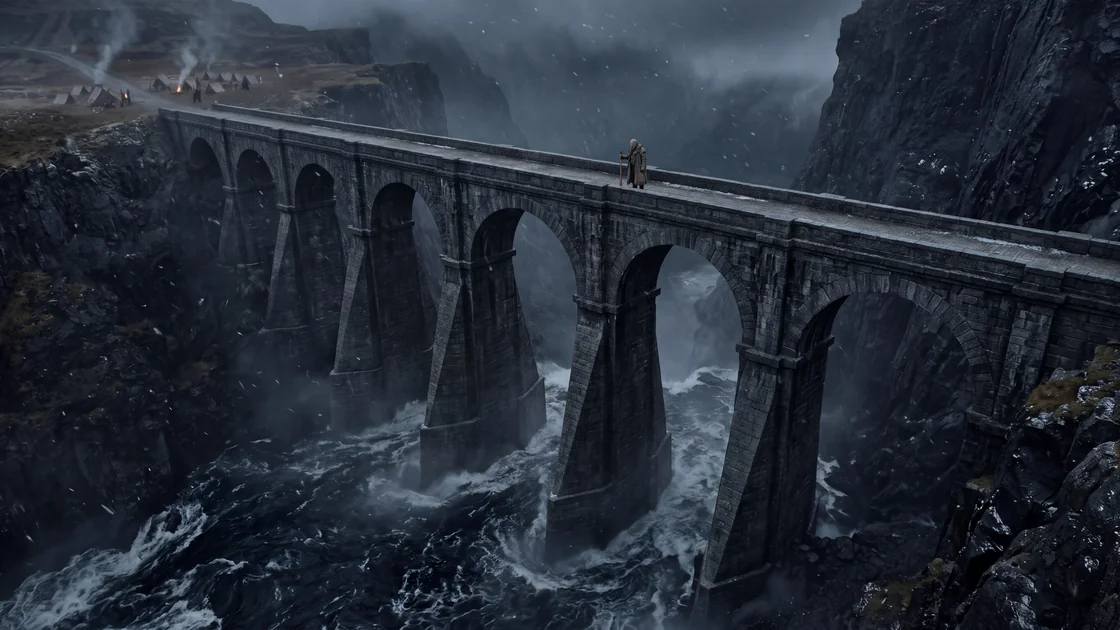
This is the account of Corin Vance, the Arch-Mason of the High Marches, who was tasked by an unforgiving empire with bridging the Cynvren Chasm—a chasm carved by an elder river of liquid malice whose currents tore stone into flour. To secure the riverbed for his foundations, Corin entered into an occult covenant with the ancient water elemental coiled in the depths: for every stone arch raised above the foam, the elemental demanded an untold story, a truth never before uttered to living ear, which once spoken would vanish from the mortal world forever. As the bridge stretched across the abyss arch by arch, Vance sacrificed the forgotten histories of dead kingdoms, the shameful secrets of his guild, and finally the precious, marrow-deep truths of his own life, discovering at the last span that to span an impossible gulf, an architect must be willing to unbuild himself.
I. The Chasm of Black Schist
The wind that lived in the Cynvren Chasm did not blow; it dragged. It was a wet, predator wind that tasted of crushed slate, subterranean moss, and the cold iron rust of deep-tier veins.
Corin Vance stood on the southern brink, his heavy surveyor’s coat of boiled goat-hide stiffened with tallow against the horizontal sleet. In his right hand he held an alder-wood plumb-staff, its bronze shoe scarred by the scree; in his left, three brass calipers clicked against one another in an idle rhythm that steadied his pulse. Below him, four hundred cubits down, the Cynvren ran.
It did not look like water. At that depth, squeezed between cliffs of greasy black basalt that seemed to lean toward one another like conspirators, the river looked like an endless spine of black oil rolling through a slaughterhouse. It had no rapids, only boils—immense, smooth domes of water the color of a bruised spleen that rose to the surface, spun silently, and burst into grey foam with a sound like a distant cathedral collapsing into sand.
"Three pontiffs before you, Vance," said Master-Under-Stone Kael, who stood four paces back from the lip, safely behind the hemlock stakes of the preliminary survey line. Kael was a short, square man whose beard had been dyed with yellow ochre according to the guild tradition of the North-Fold miners; his nostrils were perpetually rimed with dried lime. "Lord Orum’s trestles snapped like dry leeks on the fourth night. The Sunderer’s iron piers? Corroded to lace before the moon rounded once. And old Master Gault didn't even get his caissons sunk; the river took his chain-crane, his barges, sixty oxen, and his nephew. They never found so much as a buckle from the boy’s shoes."
"Gault used spruce cribbing," Corin said without turning. His voice was naturally flat, dried out by thirty years of lime dust and dry-laid quarries. "Spruce rots in acid mist. And Orum thought he could balance load by sheer deadweight. You cannot bully water that has five leagues of mountain weight behind its knees, Kael. You must give it a throat to scream through, or it will choke you with your own foundations."
"It isn't water, Vance," Kael spat into the scree. The wind caught his yellow spittle and smeared it across a boulder. "You’ve spent too many years among the soft limestone of the valleys, carving angels for the Chancellor's tombs. The Cynvren has a spleen. It remembers the world before the stars were named. It has teeth, and those teeth are cold."
"Everything is stone and water," Corin murmured. He set the brass shoe of his staff into a cleft and leaned out. The imperial road ended here, truncated by the sheer void. Behind them, across the wind-scoured tableland of the Grey Marches, forty thousand legionnaires, three wagon-trains of grain, and the Emperor’s iron-wheeled siege guns sat stalled in the mud, waiting for this road to touch the northern empire of the Vael. The Chancellor had given Corin two years, four thousand penal laborers, and eight barges of granite ashlar hauled from the quarries of Mount Mor.
If he succeeded, he would be given the Grand Collar of the Silver Compasses and a manor in the sun-drenched orchards of the southern sea.
If he failed, his name would be struck from the register of the Lodge, his skin would be cured for book-leather, and the Cynvren would have another corpse to grind into silt.
Corin knelt. From his breast pocket he took a small vial of elderberry wine, unstopped it with his teeth, and poured it into the abyss. The red drops were swallowed instantly by the black air.
"Listen," Corin whispered.
Kael frowned, stepping half an inch closer, his leather apron creaking. "I hear the drop. I hear the draft."
"No," Corin said. "Under that. Listen to the stone."
From the depths, muffled by the sheer weight of the drop, came a sound like two continents rubbing their knuckles together. It was not the boom of falling boulders; it was rhythmic, wet, and deliberate. A suck, a grinding turn, and then a long, hollow exhalation that smelled of stagnant well-bottoms and dead lilies.
Not an eddy, Corin thought, his hand tightening on the alder staff until his knuckles flared white. A lung.
II. The Parley at the Silt-Shelf
The descent was made by ropes woven from horsehair and soaked in neat's-foot oil, lowered down a chimney of damp stone where the rock was so soft it could be gouged with a fingernail.
Corin went alone. He took neither trowel nor level, carrying only a horn-lantern whose candle was rendered from mutton-fat and powdered bayberry, and a sheepskin satchel slung across his chest. He descended through three hundred cubits of black mist until the roar of the water was no longer a sound in the ears, but a vibration in the teeth and the groin.
The air at the river’s margin was warmer than the mountain top, but it was a sick, heavy warmth—the air of an oven that had been quenched with ditch-water. He touched the bottom: a narrow shelf of blue-black shingle, ground smooth as pigeon eggs, that sloped sharply into the Cynvren.
Here, the water was so dark that the yellow light of his horn-lantern died three inches below the surface. The river did not flow past; it seemed to be a single, endless beast of liquid basalt that slid through the throat of the gorge, muscular and silent, wrinkling itself against the canyon walls.
Corin hung his lantern on a rusted iron drift-pin left behind by some long-dead prospector, set his back against the wet cliff, and waited.
"You have the shoulders of a man who carries too much lime," a voice said.
The sound did not come from the water, nor from the air; it rose through the soles of Corin’s boots, humming through his shin-bones and rattling the small silver buttons of his vest.
The surface of the Cynvren broke without a splash. A mass rose from the black glide—not a woman, not a serpent, but a shape formed of cold coils and suspended river-drift. It was ten cubits wide: a great, crested head of black current, ribbed with petrified driftwood, with eyes that were merely two whirlpools that spun counter to the river’s flow, sucking the lantern light into twin pinpricks of grease. Where its throat should have been, translucent ribbons of water revealed river-stones—white quartz, red ironstones, river-glass—churning in a perpetual, rattling throat-mill.
"I am Corin Vance," he said. He did not bow. To bow to water is to invite it to cover your head. "Master of the Square, Mason of the First Order."
“You are a flea that has crawled down a crack in the floor,” the thing replied. Its voice was the sound of a gravel-bed sliding down an underwater trench during a spring spate. “Your brothers brought pine and iron. I ate their pine; their iron is now red silt between my lowest stones. Do you bring me more trees to break, little flea?”
"I bring granite," Corin said. "Ashlar blocks, dressed on six faces with the toothed ax, four cubits by two by two. I bring pozzolana mortar from the volcanic vents of the West, which sets harder under cold water than the rock it binds. I am going to build seven arches across your spine, ancient one. Seven arches, forty paces between the piers, with cutwaters shaped like the prow of an imperial galley to split your ribs as you run."
The whirlpool-eyes widened; a thin sheet of water rose like a cobra’s hood behind the great head, throwing a cold spray that hissed against the glass of Corin’s lantern.
“I have drowned kings who wore crowns of river-gold,” the Cynvren hissed. “I have smoothed the faces of the stone gods your grandfathers carved into the crags until they have neither noses nor names. You will sink your piers into my silt, and I will undermine them. You will set your keystones, and I will swell in the winter night, freeze in your mortar-joints, and burst your arches like eggs in an old woman’s apron.”
"You will try," Corin said, his heart hammering against his ribs like a mallet against a wedge. "And my Emperor will send another thousand men to replace the ones you drown, and they will dump mountains of rock into your bed until you are nothing more than a swamp choked with slag. You will be a puddle, Cynvren. An ugly, stagnant gut under a gravel road."
The elemental surged forward. A tongue of black foam rose three cubits up the shingle shelf, licking Corin’s boots. The leather hissed; the cold of the water bit through his stockings like iron needles.
“You speak with the insolence of things that must rot,” it rumbled. “Why should I allow you three feet of rock in my bed?”
"Because you are lonely," Corin said.
The river went dead still. The immense boil of water that formed the creature's crest flattened into an oil-slick sheet. For three heartbeats, the only sound was the drip of condensation from the chasm roof three hundred cubits above.
“I am the blood of the mountain,” the entity whispered, the gravel in its throat rattling low. “I have the companionship of blind newts and the dead who sleep in my troughs. I have the snow-melt from the highest peaks and the cold dark that lives before the world’s morning. What does a thing of dirt know of loneliness?”
"You have everything that falls into you," Corin said, stepping forward until the toes of his boots were submerged in the freezing edge. "You have shields, bones, broken buckets, drowned mules, and the screams men make before their mouths fill with silt. But you have no beginnings. You have only the things that ended in you. You have no stories that were not already ruined before they reached your bed."
The twin whirlpools focused upon Corin’s face. He felt a terrible pressure in his sinuses, as though he had dived forty feet into a frozen pond; the water seemed to be reaching through his nostrils, tasting his thoughts, sniffing his blood.
“A story,” the elemental mused. The sound was like gravel scraping against the hull of an overturned skiff. “The world is choked with them. The wind brings them down from the cities—screams of priests, songs of whores, the barking of heralds. They are cheap as dried leaves.”
"Not those," Corin said. "Those are told stories. They are worn smooth like the pebbles in your craw, handled by ten thousand tongues until they have no edges left. I speak of the untold."
He set his plumb-staff into the shingle between them.
"Seven arches," Corin said. "Seven piers rooted in your bedrock. For every arch my masons turn, before the keystone is dropped into its cradle, I will come down to this shelf. I will give you a story that has never been written, never sung, never whispered to a lover or confessed to a priest. A truth kept under the tongue until it grew moss. And once I speak it to you, it belongs to the Cynvren. I will forget it. The world will never know it. It will become part of your cold mud forever."
The water-head tilted. A stray spray of foam caught the lantern light, fracturing it into seven dull sparks.
“And if the story is a lie?”
"You will know," Corin said. "You are the deepest thing in this valley; you know the weight of a stone that is hollow."
“And if the story is small? A peasant’s stolen turnip? A child’s hidden pebble?”
"Then the arch will fall," Corin answered steadily. "The weight of the arch must match the weight of the silence it buys. If the truth is light, the Cynvren will throw the stones back down upon my head."
The creature stared at him for a long time. The smell of the deep rock grew so intense that Corin felt his lungs thickening with lime. Then, slowly, the great head dissolved, sliding back into the current like lard into hot broth.
Only the voice remained, shivering through the shingle:
“Sink your first caisson, Mason. Let us see if your silence is as heavy as your granite.”
III. The Arch of the Silt-Cutter
The work began in the mud and the blood of late autumn.
Twelve hundred men worked the winches at the canyon head, lowering baulks of seasoned white oak sixty feet long, strapped with band-iron that had been quenched in whale oil. They built the caisson for the first pier thirty paces from the southern cliff, where the water curled back in a sullen, deep eddy over a reef of rotten shale.
Corin lived on a scaffold of split ash suspended forty cubits above the foam. His beard grew out, grey and stiff with salt; his fingers were perpetually split at the corners from the sharp edges of the drafting slates. He slept in two-hour spasms, woken always by the same sound: the dull, thudding chunk of the iron-shod pile-driver engines pounding the oak piles down toward bedrock.
"The silt won't hold!" Kael shouted up through the mist on the forty-second morning. He was clinging to the cross-struts of the timber crib, his face smeared with grease. "We've driven the piles thirty cubits and we're still finding river-muck! The shoes are hitting timber—old logs, thousands of them, buried five hundred years ago! Every time we set a timber, the under-boil rolls it out like a toothpick!"
Corin climbed down the hemp ladder without answering. His joints popped like dried twigs.
At the water level, the noise was madness. The Cynvren was rising with the early mountain snows; the water was thick and yellow-brown, foaming like barm against the outside of the caisson. Inside the enclosure, sixty men stripped to the waist were hauling buckets of greasy mud from the bottom with hand-windlasses, their muscles knotting under skin grey with chill.
Corin reached into his boot, took out an iron chisel, and struck the water-face of the outermost oak pile.
The vibration that came back through the iron was wrong. It did not have the dry, ring-bone snap of timber biting granite; it had the dead, squelching shudder of an axe hitting a carcass.
"Clear the crib," Corin commanded.
"Vance, the shifts—"
"Clear the crib. All of them. Send them to the lower timber-yard to haul braces. Leave me the lantern."
Kael stared at him with small, piggish eyes that held both hatred and an absolute, superstitious dread. He wiped his nose on his sleeve and waved his hand. "Out! Up the ropes, you dogs! The Master wants to pray to his trowel!"
When the last man had hauled his shivering weight up the hemp ladders and the sound of their hobnails on the upper staging had faded into the scream of the canyon wind, Corin leaned over the edge of the crib.
The water inside the caisson was rising, bubbling through the gaps in the sheet-piling in little spurts of grey grease.
"Nai-Uthe," Corin called. It was the name he had found in the margins of a three-hundred-year-old Monastic survey of the river-basin—the name the fish-worshipers had used before the Empire cleared the valley with iron and fire. "Nai-Uthe. The first arch is pitched. The centring is built. The river-bed must take the foot."
The surface of the black pool inside the crib roiled. A single, smooth lump of wet stone rose three inches above the water, its top carved by the current into the rough likeness of a mouth.
“The first span is forty cubits,” the water hissed. “A small arch. A common arch. What is the meat of it, Mason?”
Corin sat on the cross-beam, his legs swinging out over the dark water. He took a slow breath. His mind went back forty years, to the quarries of the High Wynd, where the stone was pink marble and the boys who cleared the gravel had neither boots nor names.
"My father," Corin said, "did not die of the white lung, as the Guild records tell."
The river-mouth remained motionless, but the water around it ceased its boiling.
"The lodge books in the capital say he was a Master of the Work," Corin continued, his voice steady, low, and stripped of ornament. "They say he died under a falling block while setting the high pediment of the Basilica of the Seven Martyrs. They struck his likeness in lead and gave my mother seven pennies every Michaelmas."
He leaned down, his eyes fixed on the cold dark of the pool.
"It was not a block. It was an iron dog—a three-inch wedge of pig-iron. He was not a Master; he was an overseer’s dog-boy who stole scrap metal from the tool-sheds and sold it to the northern tinker-caravans. I was nine years old. I found his cache under the floorboards of the lime-kiln: seventy pounds of stolen steel, four imperial stamps, and two guild-chisels with the seals ground off."
“And you gave him to the magistrates?” the river murmured. The gravel in its craw seemed to churn with a pleasant friction.
"No," Corin said. "The magistrates would have hanged him, and his family would have been sold to the salt-boilers to pay the theft-fine. I said nothing. But on the third night of the Great Frost, when he was drunk on parsnip wine and went to check the fires under the second kiln, I pulled the hemlock stay-pin from the top loading hatch. He fell twelve feet into the quicklime."
The Cynvren’s mouth opened slightly. A thin thread of steam rose from it.
"It takes three hours for quicklime to eat a man," Corin whispered. "If the stone is fresh and the fire is high, the moisture in his skin slakes the lime. It cooks him in his own fat. I stood on the hatch-rim and held the trap shut with my boots. He hammered on the sheet-iron until his nails came off; I could hear the clicks against the plate. Then he stopped. In the morning, I dumped three barrows of Mor-chalk over him and ran the blowers until the whole mass melted into white mortar. We used that batch for the third pier of the Martyrs' choir."
He paused. His palms were wet, but his tongue felt like a piece of salted beef.
"My mother lived forty years on the seven Michaelmas pennies. Every time I take the Sacrament in the Basilica, I know that the Host rests on the lime made from the bone-ash of a thief who was my father, whom I cooked like a hog in a trench."
Silence fell upon the caisson—a silence so dense that the roar of the river outside seemed like something happening in another country.
The water-mouth sank.
For ten heartbeats, nothing happened. Corin leaned forward, his alder-wood staff balanced across his knees.
Then, deep down—twenty cubits beneath the foul sludge at the bottom of the crib—came a sound like an anvil falling onto a flagstone. A clean, ringing CLANG that shook the oak piles until the braces groaned.
The water inside the caisson did not bubble; it dropped. It fell two feet in five seconds, sucked down into some subterranean throat that had suddenly opened to swallow the silt. The ground at the bottom was no longer mud; it was hard, blue-veined granite, scoured as clean as a monk’s trencher, with four deep, natural sockets in the stone, precisely positioned to receive the iron shoes of the first pier.
Corin stood up.
He reached into his mind to find the face of his father.
There was only a blank space, shaped like a lime-kiln hatch, filled with grey fog. He knew the name Vance; he knew the trade; but the memory of the voice, the smell of the parsnip wine, the sound of the nails clicking against the sheet-iron—they were gone. When he tried to remember the boy who had stood on the hatch, he saw only a stranger whose clothes he had once inherited.
"Drop the first course!" Corin yelled up into the rain. His voice cracked with a strange, high pitch he had never heard before. "Set the ashlar! The bed is clear!"
IV. The Arch of the Broken Balance
By the second spring, the first three arches were turned.
Seen from the southern cliffs, they looked like three bone fingers reaching out from the rock to claw back the water. The masonry was beautiful: dark granite voussoirs, three feet across at the intradox, joined with mortar so thin it was merely a grey line like the edge of a manuscript leaf. Under Corin’s direction, the masons had curved the cutwaters upstream into long, wedge-shaped spurs that cut the Cynvren’s force in half, sending the spray singing into the gorge in white plumes forty feet high.
The imperial inspectors had arrived in the sixth month—three young gentlemen in lambskin cloaks with wax tablets and silver scribers, sent by the Chancellery to verify the accounts.
"Master Vance," the eldest had said, adjusting his spectacles as he stood on the staging of the third pier, while the river shook the scaffolding beneath their heels. "You have expended forty more barrels of lime than the estimate of the Guild of Saint Jude allowed. And the laborers speak of night-works. They say you dismiss the guards at the turn of the watch."
"The river does not keep Saint Jude’s calendar, my Lord," Corin had answered, his eyes fixed on the third keystone, which was swinging from the sheer-legs sixty feet above them. "And if you wish to check my measurements, the rope is there. You may take the lead-line down into the caisson yourself."
The inspector had looked down at the black swirl, smelled the dead-lily stench of the gorge, and signed the tablet without another word.
Now came the fourth arch—the mid-span.
Here, the chasm was at its most terrible. The bed dropped into an abyss that the lead-lines could not find; fifty fathoms of line came up slack and cold, coated in a thick, green fat that smelled of ancient peat. The water here did not flow; it boiled upward from some subterranean wound, lifting waves of dead foam three cubits high even when the mountain above was dry as a bone.
The centring had collapsed twice.
The centring was a great crescent of pine carpentry, an enormous wooden cradle built to hold the stone voussoirs in the air until the center stone—the keystone—was driven home to lock the arch into mutual compression. Both times the falsework had been set, the river had waited until the last three stones were hoisted, then kicked the mid-river support-boat from under the cradle, dropping three hundred tons of dressed granite into the gulf like hail.
Twenty-two masons had died in the second collapse. Their bodies had not surfaced.
"We cannot build the falsework," Kael said. He was sitting on a block of half-trimmed granite on the third pier, his fingers wrapped in greasy bandages. A flying splinter from the last collapse had torn his left ear in half; it was stitched with coarse hog-thread. "The water lifts the barges from underneath. It's like trying to set a ladder on a bucking mule's rump, Vance. We need an anchor in the trough. And there is no bottom to drop an anchor to."
Corin looked across the gap. The fifth pier, grounded on a natural needle of basalt on the northern bank, was already three courses high. Between them lay forty paces of screaming black water—the Cynvren’s heart.
"Rig the bosun’s chair," Corin said.
"Vance, the wind is hauling west. It’ll dash you against the piers like an egg—"
"Rig the chair, Kael. And tell the rope-tenders if they let the haul-line go slack while I am below, I will come back from the water with my stone-ax and trim their toes square."
He went down in the dark of the new moon.
The chair was a simple sling of ash-plank held by four hemp bridles. Corin was lowered into the center of the gap, suspended between the unfinished horns of the fourth arch. The spray was so violent that it stripped the oil from his coat; the roaring was so vast it ceased to be sound and became a paralysis of the skull.
He pulled the release pin on his signal lantern. The green light flared three times against the foam.
The boiling water beneath his feet parted.
It did not rise as a head this time. It rose as an immense, vertical ribbon of black current that looped around his suspended chair like an anaconda, circling him forty cubits above the gulf. The spray from its coils smelled of rot, of deep mountain veins, of things that had died before the sun had a name.
“You have lost twenty-two men, little flea,” the river hummed, its voice vibrating through the four hemp ropes until the chair bounced like a child's swing. “Their lungs are full of my black sand. They are very quiet now. They tell me no stories. They are merely lard in my stomach.”
"They were stone-cutters," Corin shouted into the spray. "They had no stories to tell you that you would care to keep. They knew only the weight of the sledge and the price of salt-meat."
“And what do you have, Pontifex?” The water-coil tightened. A ribbon of liquid ice grazed Corin’s cheek, drawing a line of cold fire that bled instantly. “The fourth arch is the arch of the middle. It must carry the thrust of the south and the thrust of the north. It must be heavy, Corin Vance. It must be very heavy, or I will drop your pine cradle into the trough again, and your emperor will make a purse of your scrotum.”
Corin closed his eyes. The wind swung him out over the void. His fingers, stiff with cold, found the silver compass that hung on a small cord inside his shirt.
"The Queen's child," Corin said.
The water-coil hesitated, its great loop hovering six inches from his face. The twin counter-spinning whirlpools formed within the crest of the wave, level with his eyes.
“Which Queen?”
"There is only one Queen who died in the White Tower during the Great Mortality," Corin said, his voice flat as an iron square. "Queen Teresa. The books say the pestilence took her. They say she died with the black spots in her groin, and that her infant daughter followed her three days later into the vault of the Kings."
“A common death,” the elemental sneered, its spray stinging the mason’s lips. “Kings and fleas die the same in the dark. That is not an untold story. The monks have forty quires of sheepskin about her prayers.”
"They do not have the quires about her physician," Corin said. "They do not know what was found in the child’s throat."
The whirlpool-eyes leaned in. The cold was so absolute that Corin’s eyelashes froze together; he had to squint through the grey ice on his lids.
"I was the Junior Surveyor of the King’s Works," Corin said. "They needed the vault enlarged to take the double sarcophagus. The plague was at its height; the dead-wagons were rolling day and night until the wheels came off. The Lord Chancellor brought me to the vault at midnight. Not to measure the stone—to set a seal."
He took a breath. The air tasted of ancient lime.
"The child was not dead of the spots. She was three months old, fat and fair-skinned. Her mouth was filled with wet gypsum—plaster of Paris, mixed with almond milk to keep it slow-setting until it was down her gullet. It had hardened in her windpipe like an iron bolt. The King’s brother stood by the bier with an iron ladle still white with the wash. He told me that if I did not trim the stone to fit the small coffin within the hour, my sister’s sons would be recruited for the lead-smelters in the Red Hills."
“And you trimmed the stone?”
"I trimmed the stone," Corin whispered. "I carved the inscription myself: Teresa, Innocent, Sleeping in the Lilies. And when I set the cover-stone with the lead-joints, I used the leftover gypsum from the ladle to butter the bed-joints of the King’s own memorial tablet. I held the brother’s horse while he rode away to claim the regency. And that winter, when the children of the city were eating boiled leather because the grain-ships were burned for fear of the plague, I took forty gold sovereigns from the Chancellor’s purse and bought my partnership in the Lodge."
The elemental’s coils shivered. The gravel in its deep recesses ground together with a sound like teeth cracking in a vice.
“A small, white throat,” the river breathed. “Filled with your own mason’s mud. That is... very cold, flea. That has the weight of an unworked quarry.”
"Take it," Corin said. "Take it and give me the foundation."
The water did not strike him. It dropped.
The great coil fell back into the river with an explosion that shook the cliffs for half a league. From the depths of the chasm came a subterranean groan—not the snap of timber, but the horrific scream of compressed air being driven out of deep caverns.
A basalt column, black and square as if dressed by a giant’s adze, rose slowly through the foam in the dead-center of the gap. It came up twelve cubits above the flood, its top flat, dry, and pitted with three sockets shaped precisely to take the heel of the center falsework boat.
Corin’s rope swung violently as the air surged.
He reached into his breast, touching the small silver compass. He tried to remember the name of the sister whose sons he had saved.
He remembered he had a sister. He remembered the smell of the tallow-candles in her kitchen. But her face was gone; her name was gone; and the memory of the small white coffin in the crypt was now merely a line in an account book he could read about without a single flutter of his pulse. He knew the crime had happened, but it was no longer his crime. It was merely a piece of stone that had been placed into the foundation of the world.
"Haul away!" he screamed at the mist. "Haul the chair! Bring up the timber-frame! The middle boat has its footing!"
V. The Arch of the Salt-Wife
By the third autumn, the Cynvren Bridge was a monster of stone that dominated the territory.
The fifth and sixth arches were closed. The bridge now lacked only the seventh—the northern land-span, which would leap from the last mid-river pier to the cliff of the Mor-Vael, where the northern road had already been cut by the imperial sappers.
The Emperor himself had sent a letter, penned in vermilion ink on vellum of calf-skin: To Our Well-Beloved Corin Vance, Pontifex. He was promised the title of Count of the Chasm, a pension of five thousand silver talents, and the right to carry a square of gold upon his family coat-of-arms.
Corin sat in his site-hut on the southern cliff.
He was sixty-two years old, but his hands were those of a man of eighty. The skin was yellow, shiny, and split like dry gut; he could no longer hold a drafting scriber without binding his fingers to the wood with strips of linen. He had lost three stone of flesh; his eyes were sunken so deeply into his grey skull that his apprentices avoided looking at him when they brought the morning reports.
"The seventh arch will not carry," Master Kael said.
Kael had aged too, but in another way: he had grown thick, greasy, and suspicious. He carried an iron truncheon in his belt at all times and had hanged three laborers the previous week for stealing tallow from the crane-hoists.
"The span is fifty cubits," Kael said, leaning over the great drawing table where the ink lines of the seventh arch were laid out. "The northern cliff is rotten, Vance. It isn't granite; it’s grey chalk with veins of blue soapstone. The moment we strike the centring, the thrust will push the northern abutment into the gulley. The whole thing will peel off like a scab."
"It will carry," Corin said. His voice was little more than the rustle of dry shavings under a carpenter’s bench.
"It will not! The lodge calculations are clear. We need another ten thousand cubits of ashlar on the northern face to build a counter-weight—a rampart forty paces wide—or the seventh arch will kick the rock into the ditch. And the snow is coming tomorrow, Vance. The first flakes were falling on the Mor this noon. If we don't drop the keystone before the freeze, the frost will get into the green mortar of the sixth pier and the whole three years of work will come down like a house of slates."
"Go to the forge," Corin said. "Tell them to cast the lead-shoes for the keystone. Seven inches thick. Pure lead, no antimony."
"Vance—"
"Go, Kael."
Corin waited until the door closed, then blew out the lantern.
He did not use the rope-chair this time. The bridge was solid beneath his feet for six spans; he walked out along the wet pavement of the roadway, forty cubits above the roaring dark.
The bridge was magnificent. The parapets were breast-high, dressed with water-mouldings that flung the rain clear of the joints; the cutwaters below split the Cynvren with a hiss like a dozen blacksmith’s troughs. It was a masterpiece of human geometry, an eternal line of order drawn across the savage chaos of the gorge.
At the edge of the sixth arch, the roadway ended in a ragged tooth of granite voussoirs, suspended above the black gap that separated the bridge from the northern crag.
Corin knelt on the edge. He did not call. He merely dipped his maimed, bandaged fingers into the spray that rose from the darkness.
The Cynvren rose to meet him.
It was no longer an engine of foam and gravel; it had grown subtle. The entity that climbed the masonry of the sixth pier was formed of glassy, deep-water blackness, moving with the terrifying smoothness of oil. It draped itself over the raw stones of the unfinished span, its head resting on the unmortared voussoirs two feet from Corin’s knees.
Its whirlpool-eyes were enormous now, deep as wells, and within them Corin saw the reflections of all the stones he had sunk: the pink granite of Mor, the black oak caissons, the iron shoes, the bones of the twenty-two masons sitting upright in the mud, holding the foundations on their shoulders.
“One arch, Mason,” it whispered. The voice was sweet now—the terrible, seductive sweetness of water sliding over a dam. “Only fifty cubits of air. And then your road is whole. And then the Emperor’s iron guns can roll across to kill the men of the North. What will you give me for the chalk cliff? The northern rock is soft as cheese; I have licked its roots for ten thousand years. It will not hold your stone unless I give it my own bone to brace it.”
"I have no more kings," Corin said softly. "I have no more empires. I have built four cathedrals, three palaces, eighteen bridges, and forty-two miles of sea-wall. I have forgotten the names of all the men who paid for them. I have forgotten my mother’s voice. I have forgotten the town where I was born."
“You have your own life, Corin Vance.” The water-head rose an inch higher. A tongue of ice-cold moisture licked the horn buttons of his coat. “You have the thing you keep in the locked cedar box under your bunk. The thing you take out when the wine runs low and the wind screams down the chimney.”
Corin’s hand went involuntarily to the small bronze key that hung beside his compass.
"She has been dead forty years," he said.
“Then she will not care if I eat her,” the river replied.
"She was not a Queen," Corin whispered. "She was the wife of a lime-burner in the South-Fold. Her name was Maren."
“Give her to me,” the Cynvren murmured. The water seemed to lean in, fragrant with the memory of river-mint and summer mud. “Give me her, or let your bridge fall. Let the Emperor’s guns rot in the mountain mud. Let the three pontiffs laugh at you from their cold graves. Give me the woman, Mason.”
Corin gripped the edge of the granite block. The stone was cold, but the river was colder; it seemed to be drawing the blood out of his palms through the pores of the ashlar.
"I took her from her husband," Corin said.
His voice broke; he had not spoken her name in forty years. The sound of it in the vast, roaring emptiness of the chasm was small, like the snap of a cricket's leg.
"He was a cripple. His hip had been crushed by an ox-cart in the quarries. She lived in a turf-hut at the edge of the kiln-spoil, where the white dust settled on the cabbage leaves until they looked like stone. She smelled of wild thyme and wood-smoke. I was twenty-four. I had the Emperor’s survey-commission in my pocket and a horse with two silver shoes."
He leaned out, his face inches from the black, revolving eyes of the elemental.
"I told her I would take her to the sea. She had never seen water that did not run in a ditch. She thought the sea was a great blue pasture where the sheep were white as salt. She left him in the night. She left him three cold potatoes on the hearth and his wooden crutch by the bucket."
“And you took her to the sea?”
"No," Corin said.
The river-head was very still.
"We rode three days north. My horse went lame at the Ford of the Crow. The bailiffs were behind us—not for the woman, but for me; I had stolen forty pounds of imperial copper-wire from the telegraph-stores to pay for the horse. If they caught me with her, they would have known I was not on the Emperor’s business. They would have stripped my Master’s badge."
He stopped. He could feel the heart inside his ribs; it was fluttering like a bat caught in a chimney-flue.
"The Ford was deep," Corin whispered. "The spring spate was running, just as it runs here. Not so large, but fast enough to take a horse off its feet. She could not swim. She sat behind me on the crupper, holding my coat with both hands. Her knuckles were red from the lime-water of the kilns."
“And?”
"I unbuckled the coat," Corin said.
The wind howled down the chasm, whipping the sleet against his face, but Corin felt nothing.
"I unbuckled the coat and slipped my arms from the sleeves as the horse entered the gut. When the current took the horse's flank and it began to roll, she screamed and grabbed for my shoulders. She grabbed the coat. The leather was greased, and it slipped from my arms. I let the horse go with the current; it brought me to the gravel spit half a league down. She stayed in the gut, wrapped in forty yards of imperial hide."
He looked into the black whirlpool-eyes.
"I found her body two days later, caught in a wicker fish-weir near the salt-marshes. Her hair was full of green river-weed. I did not bury her. I took my brass compass from the pocket of the coat she was still holding, took my seven silver groats from her skirt-lining, and told the weir-keeper she was a camp-follower who had jumped from the ferry-flat."
Corin laid his forehead against the cold granite of the sixth arch.
"I kept her wooden hair-comb," he whispered. "The one her brother had carved for her from an alder-bough, with three wild ducks on the back. It is in the box under my bunk. It still has three strands of her yellow hair caught in the teeth."
The elemental watched him. Its water-form seemed to shiver, not with rage, but with an immense, slow satiation.
“The hair is yellow,” the river said, its voice now as thick and heavy as mountain honey. “The river-weed was green. The coat was brown. That is a good story, Corin Vance. That has the true weight. That is the mortar that does not crack.”
The entity sank.
It did not splash; it seemed to dissolve into the masonry of the pier itself.
A second later, from the northern side of the chasm, came a sound that made the hair on Corin’s arms rise. The cliff of the Mor-Vael—the soft, grey chalk-face—began to groan. In the darkness, Corin could see the rock changing color. A deep, blue-black stain spread through the white stone, as if an ocean of ink were rising through its pores. The chalk was not falling; it was vitrifying. The lime, the clay, and the flint-veins were melting together under some horrific, cold pressure, turning into a rock harder than jasper, black as basalt, with three massive buttresses curving out of the cliff-face like the ribs of an iron ship, perfectly aligned to receive the thrust of the seventh arch.
Corin stood up slowly.
He looked down at his right hand.
He felt the bronze key in his pocket. He took it out, unlocked the small cedar box he had brought in his satchel, and looked inside.
There was a piece of wood inside—an old, grease-blackened comb with broken teeth.
He picked it up. He smelled it.
It smelled of old cedar and dust. He turned it over. Three birds were carved on the spine. He looked at them with a mild, vacant curiosity, as if looking at a shard of pottery dug from an ancient ditch by an illiterate spade-man.
Whose is this? he thought.
He could not remember. He remembered the Ford of the Crow; he remembered the horse; he remembered the sound of the imperial telegraph-wire singing in the wind. But the woman with the yellow hair was gone. The face was gone; the name was gone; the sin was gone.
There was only a piece of broken wood and forty leagues of cold water running to the sea.
He dropped the comb into the abyss. It turned twice in the green flare of the lantern light and was swallowed by the Cynvren without a sound.
"Set the centring!" Corin whispered to the empty air. "Set the timber for the seventh span. The cliff will hold."
VI. The Keystone of White Water
The first day of November brought the Great Freeze.
The army of the Empire had arrived at the southern cliff: twelve thousand men of the Vanguard, their red coats covered in sheepskin surcoats, their bronze helmets tied under their chins with rags against the mountain bite. At their head was Duke Sylvan, the High Marshal, his mustache stiff with rime, his war-horse stamping in the frozen scree.
"The Chancellor gave you until the first frost, Master Vance," the Duke said, peering through the driving snow at the seventh arch.
The bridge was complete, save for a gap two cubits wide in the very crown of the northern span. The wooden falsework still stood beneath it—an immense web of larch-poles and iron brackets that groaned under the weight of the granite voussoirs. The keystone—a four-ton block of Mor-granite, dressed like a jewel, with two iron lifting-rings set into its crown—hung from the great gallows-crane sixty feet above the gap, swaying gently in the sleet.
"The stone is ready, my Lord," Corin said. He was wrapped in three coats of frieze, but he could no longer feel his legs below the knees. His voice was a thin whistle through teeth that had all loosened in his gums.
"Then drop it," the Duke barked. "My horses are freezing in their lines. We cross by noon, or I burn your timber-yards for firewood and hang your foremen from the crane-arms."
Corin walked out onto the bridge.
The army watched him. Thousands of men stood in the snow, silent as a forest of pine-stakes, watching the small, bent figure of the Arch-Mason limp along the stone highway he had carved out of the sky.
Master Kael was waiting at the crown of the seventh arch, beside the trip-lever of the great crane. His hands were tucked into his sleeves; his beard was a mask of yellow ice.
"The lead-sheeting is in the bed-joints, Vance," he said, not looking at Corin. "The block is centered. One blow to the dog-pin and she drops into the wedge. But she won't seat."
"Why won't she seat?"
"Look at the water," Kael whispered.
Corin leaned over the parapet.
The Cynvren was not flowing.
The cold had done what three centuries of engineers had failed to do: the river was freezing. But it was not freezing into smooth ice. It was freezing into a nightmare of black, jagged needles that rose out of the gorge like the teeth of a harrow. The water was fighting the cold, writhing beneath the crust like an animal caught in a net, throwing up immense, sulfurous plumes of steam that coated the lower stones of the bridge in rime three feet thick.
And directly beneath the seventh arch, rising through the ice-needles like a tower of frozen grease, was the Elemental.
It was no longer liquid. It was a pillar of black, petrified current, sixty cubits high, its crest level with the road-deck. Its face was a mask of jagged river-flint; its whirlpool-eyes were frozen into two flat plates of green ice that held neither motion nor depth.
The stone would not drop because the breath of the river was pushing against it—an immense, freezing column of updraft that held the four-ton keystone suspended in the air like a thistle-seed.
"Clear the bridge," Corin said.
"Vance, the Duke—"
"Take the men. Take the winches. Clear the bridge, Kael. If you are here when the stone seats, the shock will break your ankles."
Kael looked at Corin’s face. He did not argue. He turned and ran back toward the southern bank, his boots slipping on the rime-covered flags, waving his arms and screaming at the apprentices to abandon the staging.
Corin stood alone at the crown of the seventh arch.
The wind had died. The only sound was the clicking of the freezing river below—the vast, subterranean sound of ice expanding in the dark, splitting boulders and crushing the drift-logs against the canyon walls.
“The last stone, flea,” the frozen thing said.
The voice did not come through his feet now. It came from the air; it came from the rime on his coat; it came from the inside of his own skull, like the cracking of dry parchment in an empty room.
"The bridge is built," Corin said. He leaned his forehead against the cold granite of the suspended keystone. "The seven arches are turned. Your bed has the piers; the piers have the road; the road will have the Empire."
“The seventh arch is empty,” the river replied. “The keystone hangs on a rope of hemp. Hemp rots, Corin Vance. Wood splits. A single kick of my thigh when the spring thaw comes, and your seventh arch will fall into my belly like a handful of gravel.”
"I have given you everything," Corin said.
His voice was very quiet. He felt the cold iron of the crane-tackle above him; he felt the granite beneath his feet.
"I gave you my father’s death. I gave you the Queen’s child. I gave you the woman who smelled of thyme. I have no more deaths. I have no more sins. My mind is as clean and empty as an abandoned quarry. There is nothing left in me but lime-dust and cold grease."
“You have the story you have never told yourself,” the river whispered.
The flat plates of its green eyes cracked. A thin line of black, unfrozen water leaked from the center of each, running down its face of flint like tears of tar.
“Why did you build the bridge, Mason?”
Corin laughed—a dry, hacking cough that spat a fleck of blood onto the white rime of the stone.
"For the Emperor's gold," he said. "For the Grand Collar of the Compasses. To be Count of the Chasm. To have my name carved on the high pylon at the road's end."
“A lie,” the river groaned, and the column of frozen current shifted an inch toward the bridge. The granite voussoirs under Corin’s feet screeched as the pressure took them. “You cared nothing for their gold. You spent your five thousand talents before you had them, buying lead and pozzolana from the south. You have no sons to inherit your county. You hate their Emperor; you spat on his letter before you used it to light your pipe.”
The ice-needles beneath the bridge cracked with the sound of a battery of cannons firing together.
“Tell me the truth, flea. Tell me the last truth, or I will let the cold have the seventh pier. I will let the frost split your granite into flour, and for the rest of your short, rotting life you will sit on this cliff and watch my water run over your ruins.”
Corin closed his eyes.
He looked inward, into the great, hollow chamber that had once been his memory.
The shelves were bare. The portraits were turned to the wall. The books were burned. He could not remember the face of his mother. He could not remember the name of his first master. He could not remember what his own voice had sounded like when he was a boy singing in the choir of the High Wynd.
And yet, in the very center of that vast, cold room, there was a single, tiny spark—a spark that had not been quenched by sixty years of lime-dust, nor by the blood of the men he had drowned, nor by the silence he had bought.
"I hate the stone," Corin whispered.
The river went very still.
"I have always hated it," he said.
He laid his bare palm against the frozen cheek of the keystone. The skin stuck to the frost-bitten granite; he did not pull it away.
"It is dead," he said, his voice rising, gaining a terrible, rhythmic weight that sounded like the iron shoe of the pile-driver hitting the oak. "It is cold, it is stupid, it is silent. It sits in the ground for ten million years, blind and fat, caring for nothing, loving nothing, waiting only for the sun to die so it can have the world to itself."
He looked into the green ice-plates of the elemental's eyes.
"And you," he said. "You are worse than the stone. You are water. You are formless. You have no shape but the ditch you run in; you have no purpose but to fall down a hole until you find the sea, and then rise up as rain to fall down another hole again. You are an idiot beast that eats everything and builds nothing. You are a mouth without a brain."
He leaned out over the void, his face two inches from the flint-mask.
"I did not build this bridge for the road," he said. "I did not build it for their guns, nor for their empire, nor for my name. I built it because I wanted to put an iron bridle in your mouth. I wanted to drive seven stone nails through your spine. I wanted to force the dead, blind mountain to reach out its hands and hold itself in the air forever, by the sheer, cold insolence of number and line."
He stepped back. He took the iron sledge from the frame of the gallows-crane.
"I built it because I wanted to look at the sky and know that forty thousand cubits of granite were staying in the air because I told them they must. Because I wanted to build a thing that had no right to exist, in a world that wants only to rot and slide down to the mud."
He raised the hammer.
"And I knew that to do it, I would have to become like the stone. I would have to become cold, and dead, and remember nothing. I would have to give you every warm thing I ever touched, until I was as empty as the gap between the arches."
He met the elemental's gaze.
"That is the untold story, Cynvren. I did not build the bridge to cross your chasm. I built it to murder you with geometry."
For three long heartbeats, the world was suspended on the point of an alder-wood plumb-staff.
Then, from the deep throat of the elemental, came a sound that was not a groan, nor a hiss, but a long, shuddering sigh. The green ice-plates of its eyes did not crack; they dissolved. The immense column of frozen current did not fall; it seemed to bow, leaning back from the masonry of the seventh arch like a dog that has been struck across the muzzle with an iron rod.
“It is... the weight,” the river breathed.
The sound was very small, like the whisper of dry snow sliding from an eave.
“It is... the true stone.”
The updraft died.
Corin Vance swung the sledge with both hands. His shoulders, old and stiff with lime, gave everything they had left to the blow.
The hammer struck the dog-pin.
The iron wedge flew out, singing like a swallow as it dropped into the chasm.
The four-ton keystone fell.
It did not smash; it did not shudder. It dropped seven inches into the prepared bed-joints, sliding between the lead-sheets with a dull, hydraulic thud that drove the breath from Corin’s lungs. The lead squeezed out of the joints in thin, grey ribbons like lard from a sausage-skin.
The seventh arch closed.
The thrust was taken. The stone found the stone; the stone found the pier; the pier found the bedrock. Through the three hundred cubits of the Cynvren Bridge, from the northern chalk-buttress to the southern basalt-cliff, ran a single, clear, musical note—a high, silver vibration of four hundred thousand tons of granite finding mutual compression and locking itself against the earth.
The falsework beneath the seventh span groaned, went slack, and dropped two inches away from the stone intradox, its work finished forever.
Corin stood on the keystone.
Below him, the ice of the river was breaking. The Cynvren was rising, not in fury, but in a vast, grey spate of mud and shattered ice, roaring through the seven arches, splitting its ribs against the wedge-shaped cutwaters, foaming and screaming through the seven throats the mason had given it.
It threw its spray forty feet into the air, but the spray touched only the stone under Corin’s boots, hissed, and ran back down the granite water-mouldings into the dark.
Corin looked at his hands.
He did not know who he was.
He knew that he was an old man who was cold. He knew that the hammer he held was heavy. He knew that the men in red coats on the southern cliff were shouting his name—Vance! Vance!—and that their bronze helmets were catching the first rays of the winter sun that was breaking through the grey clouds of the Mor.
He looked north, along the great, flat highway of dressed stone that leaped across the abyss, touching the northern crag as lightly as a dragonfly touches a reed.
It was very straight. The joints were very tight.
"A good bridge," he murmured to the wind.
He sat down on the curb-stone of the seventh parapet, rested his chin upon his alder-wood staff, and waited for the horses to come.