The Shepherd of the Phosphor Tide
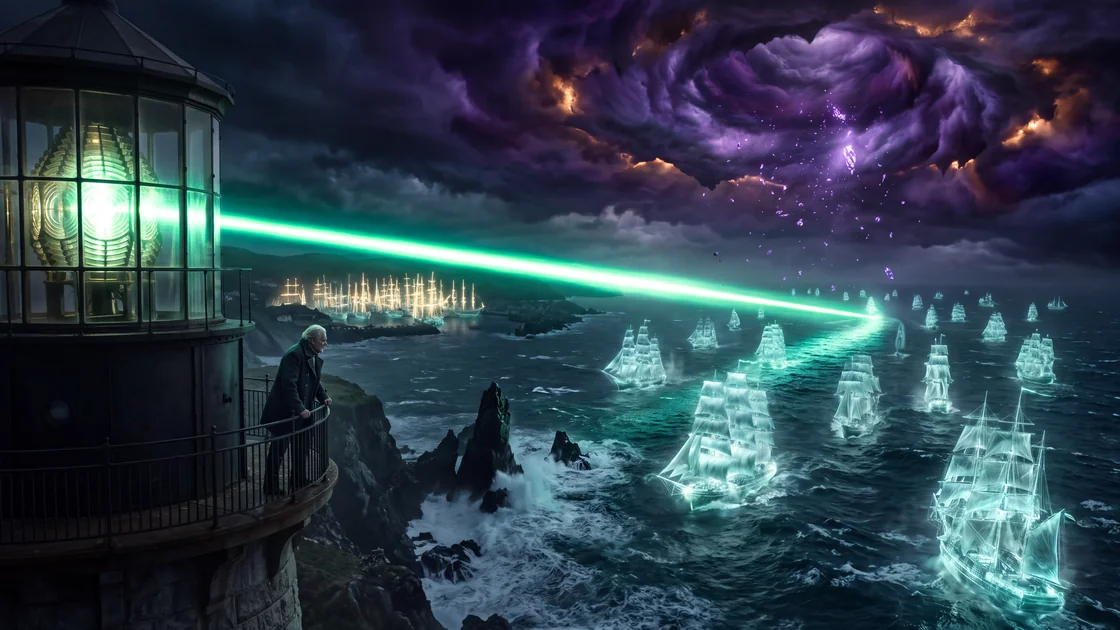
When an unprecedented rift between dimensional planes tore open the storm-lashed sky over the remote coastal haven of Oakhaven, Harbor Master Walter Crane found himself faced with a crisis beyond all maritime reckoning. Armed only with his ancestral knowledge of the Great Pharos, a mechanical lighthouse designed to pierce metaphysical veils, Walter stood vigil through a night of shattering celestial turbulence to guide a lost fleet of phantom clipper ships—vessels forged of bioluminescent mist and forgotten memories—away from the jagged basalt reefs and into the safe, still waters of the inner harbor before the cosmic gale could tear their souls from existence.
Act I: The Clockwork of the Spit
The brass clockwork inside the lantern room did not tick in seconds; it ticked in fathoms.
Walter Crane knew the cadence the way an aging cellist knows the scrape of horsehair across gut. Three beats of the escapement meant forty fathoms of clearance at the mouth of the bay; five beats meant the tide was slacking over the sunken ribs of the colliery schooners that had perished there in the Great Gutter of 1888. But tonight, the pendulum was shuddering. It dropped with a dull, wet clack that vibrated through the floorboards of the watchtower, rattling the glass flutes of the paraffin lamps and setting the ink in Walter’s ledger shivering in its stone well.
He was seventy-two, with wrists like weathered mooring bitts and knuckles scarred white from half a century of hemp burns and cold salt water. For forty-four years, he had been Harbor Master of Port Oakhaven, an outpost wedged into an iron-bound crook of the northern Atlantic where the sea was the color of slate and the land offered nothing to humanity but granite, scrub pine, and bitter gales. Oakhaven was a port of refuge—the last place a vessel could tuck her nose before the gray desert of the high latitudes swallowed her whole.
Walter laid his pen across the calfskin ledger. Outside, the wind had ceased, yet the sea was not calm.
That was the first unnatural thing. The Atlantic did not go quiet without a payment. Normally, when the barometric pressure fell through the bottom of the world, the gales out of the northeast shrieked like steam engines through the stays of the lighthouse tower, spitting frozen spray against the seaward panes until the glass was blind with rime. Tonight, the air was dead, greasy, and smelled not of kelp or rotting bladderwrack, but of scorched copper, sulfur, and distilled lightning.
Walter pushed himself up from his rush-bottomed chair, his hip joint grinding in its socket. He reached for his wool reefer coat, heavy with grease, and stepped onto the iron gangway that circled the interior of the lantern.
Above him, the lens turned.
It was not an ordinary Fresnel lens. The crown of Oakhaven Light had been ground in Paris in 1851 by an artisan named Augustin-Jean Fresnel himself, but its central drum had been altered decades later by an eccentric polymath named Theophilus Crane—Walter’s grandfather. Theophilus had not been content with merely bending the light of burning whale oil; he had ground strange curves into the flint-glass prisms, etching them with hyperbolic spirals that deviated from Newtonian geometry. Theophilus had believed that the ocean was merely the surface of a deep pond whose bottom opened into another sky altogether, and that light, properly folded, could serve as a tether between what was tangible and what had slipped between the floorboards of creation.
For three generations, the townsfolk of Oakhaven had regarded the Crane family as harmless cranks who kept the wick trimmed and never let a vessel run aground on the Black Teeth. The lantern was fueled not by kerosene or whale fat, but by an alembic in the cellar that distilled sea-brine, vitriol, and an iridescent oil skimmed from the deepest abyssal trenches by the old seal-hunters. When the flame caught, it did not burn yellow. It burned with a pale, cold azure brilliance that cast shadows three yards longer than they ought to have been.
Walter walked to the outer gallery door, unlatched the heavy bronze dogs, and stepped onto the iron balcony suspended two hundred feet above the surf.
The horizon was missing.
There was no line where the water met the sky. Instead, fifteen miles out to sea, where the shipping lanes normally drifted toward the Grand Banks, the dark had torn open. It was not a cloud bank, nor was it the aurora borealis, though it had the green-white hue of the northern fires. It was a fissure—a vertical split in the fabric of the night, wider than a continent and as jagged as broken window glass.
Through that crack, the wind was not blowing outward; it was sucking inward. Walter could feel the air of the Atlantic being pulled off the cliffs, drawing his breath from his lungs with the terrible, hungry vacuum of an open furnace door.
He looked down at the Barometer of the Seven Tides, mounted in an alcove beside the gallery door. The mercury had not fallen. It had boiled. Small, silvery beads of quicksilver hung suspended in the vacuum at the top of the tube, shivering against the glass like captive gnats.
"God preserve the poor souls on the water," Walter murmured, though his voice sounded thin, robbed of resonance by the vacuum of the sea.
Then the sound reached him.
It was not thunder. It was the sound of iron cables snapping under the strain of an unmeasurable winch; the sound of ancient timber being twisted against its grain; the sound of five thousand church bells chiming simultaneously underwater, muffled by miles of brine and distance.
And beneath the sound, moving against the tide, against the current, against every law of hydrodynamics that had governed the seas since the first log was hollowed into a canoe, came the lights.
They were not white or red. They were the color of stagnant marsh gas, the eerie phosphorescence that clings to the rotting bellies of deep-sea fish brought up too fast from the canyons: pale beryl, vaporous pearl, and smoldering turquoise.
Walter lifted his long-glass to his eye. He adjusted the knurled brass ring until the sea came into focus through the crosshairs.
His breath caught. His ancient heart gave a double-flutter, like a gull trapped in an attic.
"Clippers," he whispered.
They were three-masted, square-rigged, their lines long and lean, with the raked stems and sharp bows of the extreme clippers of the 1850s—the kind built in East Boston and Medford to race around the Horn to San Francisco before the gold dust settled. But they were not made of oak or yellow pine. They had no copper sheathing on their hulls.
They were composed entirely of condensed sea-fog, lit from within by an interior luminescence that pulsed like the mantle of a jellyfish. Their sails were billowing clouds of glowing vapor, sheeted home with running rigging made of spinning silver threads. Their masts were shafts of pale, frozen light that reached three hundred feet into the fractured heavens, their truck lights burning with cold, silent fire.
And there were dozens of them.
Behind the lead ship came another, and another, spilling out from the glowing wound in the firmament like a spilled drawer of silver needles. They were sailing hard, all canvas set—stunsails, skysails, moonrakers—running before a storm that did not exist in the three dimensions of the earth, fleeing from a darkness that was tearing through their ghostly wake with jaws of violet void.
They were heading straight for the Black Teeth.
Act II: The Anatomy of the Rift
The Black Teeth were three spires of volcanic basalt that sat three miles off Oakhaven Head, hidden just six feet beneath the low-water spring tide. Over two centuries, they had broken the backs of fifty-eight documented vessels. If an ordinary ship struck them, her timbers burst like dry casks.
If ships made of glowing mist struck them—Walter did not know what would happen, but the hair on his arms stood on end with a violent, electrostatic terror. These were not mere hallucinations; they were vessels displaced, torn from the memory of the ocean and cast adrift upon the dimensional undertow. If they broke upon the stone, whatever tenuous spirit held them together would be shredded into the great cold void between the stars.
"They have no lead-line," Walter said aloud to the empty night. "They have no pilot."
The sky was changing rapidly now. The tear in the heavens had begun to twist, forming an enormous cyclonic spiral that revolved with sickening slowness directly above the bay. The clouds were not vaporous; they had crystalline edges, like sheets of mica sliding over one another, grinding out sparks of purple static that drifted down through the air like radioactive snow. Wherever these sparks struck the water, little plumes of steam hissed upward, leaving behind patches of oil that didn't disperse, but formed intricate, geometric mandalas upon the swells.
The wind had returned, but it did not blow from a compass point. It blew downward.
It pressed upon Walter’s skull like the palm of a giant. The lighthouse itself, built of three-foot-thick blocks of interlocking gray granite, groaned beneath the atmospheric shear. Down in the town of Oakhaven, half a mile behind the cliffs, the lights had all gone black. The electric grid had tripped the moment the rift opened; Walter could see the town crouched in the dark like a frightened beast, its chimney pots trembling, its citizens surely huddled in their root cellars with their bibles and their hunting rifles, thinking the Book of Revelation had finally caught up with them.
There was no help coming from the town. No tug would fire its boilers tonight. No life-saving crew would launch a surfboat into an ocean that was beginning to glow with the colors of a bruised plum.
Walter turned on his heel and re-entered the lantern room.
The clockwork was slowing down, bogged by the strange gravity of the rift. The heavy lead weights that dropped down the center of the lighthouse tower seemed to have doubled in mass, pulling the chain so taut that the links wept rust.
Walter went to the pedestal of the Great Pharos.
Below the rotating brass apron sat an array of controls that no other lightkeeper on the coast would have recognized. There were brass levers connected to slate diaphragms, lead-weighted dampers that adjusted the flow of the abyssal distillate into the burner, and a series of secondary prisms mounted on swinging arms made of cast gunmetal. These were the "Translating Prisms," as his grandfather’s journals had called them.
Theophilus Crane had written in 1894: “The light must not merely illuminate the darkness; it must define it. When the Etheric Tide rises, the ray must become an iron rail upon which the lost may steer. For light is the only constant between the world that is made and the world that is unmade.”
Walter reached out with his right hand, his fingers knotting with rheumatism, and grabbed the first prism lever. It was frozen with fifty years of salt-grease and disuse.
He threw his weight against it.
A crack like a pistol shot echoed through the lantern room as the dried tallow broke free. The brass arm swung out over the flame. The secondary prism—a trapezoid of dark, smoky quartz cut with seventy-two facets—slid directly into the focal path of the main lens.
Instantly, the beam of the Oakhaven Light changed.
The azure beam contracted. It ceased to scatter into the mist. It became a solid, pencil-thin lance of emerald light, so dense, so intensely coherent that it seemed as if one could walk out upon it from the balcony into the empty air. Where it struck the ocean, three miles distant, the water did not merely reflect it; the water parted, forming a luminescent trench two feet deep, rimmed with phosphorescent foam.
Walter leaned over the brass sight-bar, squinting through the sighting vane at the lead ship of the ghost fleet.
She was less than four miles out now, coming on at a terrifying clip—twelve, fourteen knots, her ethereal stunsails belly-full of the dimensional wind. Through his telescope, Walter could see her name carved inletters of white fire across her square counter:
CELESTIAL EMPIRE — BOSTON — 1853.
Walter’s breath hitched. The Celestial Empire. He had read of her in the old archives of the Boston Marine Society. She had cleared the Boston Light in October of 1853, bound for Canton with a cargo of ice, clocks, and quicksilver. She had spoken with a whaler off the Cape of Good Hope three months later, and then she had simply ceased to be. No wreckage, no spars, no bodies had ever washed ashore. She had vanished into the blue with forty souls aboard.
Now, she was bearing down on the Black Teeth at racing speed, her bow throwing up sheets of cold, weightless spray that hung in the air like dust in a sunbeam.
"A point to the leeward, you fool," Walter snarled through his teeth, his hands white on the brass traverse wheel. "A point to the leeward, or you’ll leave your keel on the stone!"
He began to crank the hand-traverse. The entire two-ton lens assembly, balanced on its circular trough of liquid mercury, began to pivot. Walter ground the gears by hand, his shoulder muscles screaming against the unnatural drag of the rift.
The emerald lance of light swept across the face of the waters. It tracked over the churning shoals, over the white water boiling around the Black Teeth, and struck the Celestial Empire full across her fore-topsails.
Act III: The Voice of the Glass
The moment the light touched the ship, a sound struck the lantern room.
It was not a physical noise; it was an impact against Walter’s mind, like the ringing of a great bronze shield held close to his ear. The ship had felt the light. Through the emerald beam, a circuit was completed—a connection between the heavy granite reality of Oakhaven Head and the vaporous, desperate existence of the lost clipper.
Through his glass, Walter saw a figure standing on the Celestial Empire’s quarterdeck.
It was a man in an ancient, high-collared frock coat, his whiskers like spun glass, his face gray and translucent as parchment. He held an octant to his eye, but he was not looking at the sky—he was looking along the path of the lighthouse beam.
He lowered the instrument. He looked directly down the throat of the light, straight into Walter’s eyes across four miles of screaming empty air.
The phantom captain raised his hand, two fingers pressed together in the old naval salute of the Merchant Marine. Then, he spun toward his wheelhouse.
Walter could see four men at the wheel, their shapes shifting like smoke blown by a draft, their hands buried in the spokes. The great helm turned.
Out on the sea, the Celestial Empire heeled.
Her glowing spars dipped until her lower yardarms nearly touched the black water. She carved a turn so sharp that no wooden vessel could have survived it without her bottom dropping out or her topmasts whipping over the side like dry twigs. She cleared the outermost fang of the Black Teeth by less than half a cable’s length. As she swept past, the basalt rock seemed to reach for her, the black stone hissing as if burned by the passing aura of the ship’s mist.
She was through the outer hazard. But she was not safe.
Behind her came the others.
Walter pulled his eye from the glass and looked up into the rift. The sky was no longer merely tearing; it was disintegrating.
The stars above Oakhaven had been replaced by a swirling vortex of deep violet and abyssal black, ringed with burning rings of amber light that turned like the wheels of Ezekiel’s chariot. From this vortex, pieces of the upper atmosphere were falling—not as rain, but as flat, crystalline sheets of frozen vacuum that shattered against the sea with dull, concussive thuds.
The sea itself was rising in mounds. Not swells, but smooth, hemispherical hills of water that formed without wind, stood ten feet high for several seconds, and then collapsed into concentric ripples.
Through this nightmare sea, the fleet was pouring.
Walter counted twelve—no, twenty—no, thirty-four vessels. They were of all rigs, though the extreme clippers dominated: three-masted ships, barques with cloud-like spankers, rakish brigantines that looked like greyhounds of the sea. Among them, he saw vessels that had no place in the nineteenth century: low, long-hulled galleons with high poops that glowed with the dull, bruised orange of ancient wood; Roman grain hulks with square mainsails of silver silk; and at least one two-decked man-of-war whose thirty-two gun ports showed lanterns of cold violet fire.
They were all caught in the same draft, dragged out from whatever dimensional doldrums they had inhabited for centuries, drawn toward the rift like driftwood toward a whirlpool. And the rift was closing behind them with the violent, shuddering spasms of a dying heart.
If they could not reach the shelter of Oakhaven’s inner basin—a deep, granite-walled pocket carved out by glaciers and protected by two massive breakwaters—they would be caught in the final shear of the rift. When that seam snapped shut, the vacuum would take everything left in the outer roadstead, stone and ship alike, and compress it into a smear of atoms no thicker than a grease mark on a mirror.
"God help me," Walter gasped, wiping sweat from his eyebrows with the wool sleeve of his coat. "The channel isn't wide enough for three abreast, let alone thirty."
He needed more light. He needed to project a channel of safety that was not merely a line, but a passage—a road of coherent geometry that the dead could follow through the living sea.
He turned toward the basement stairs.
Act IV: The Distillate of the Deep
The descent down the spiral stairs of the Oakhaven Light was a journey through ninety feet of solid granite. At every landing, the vibration of the storm was different.
In the upper third of the tower, the air hummed like an electric dynamo. In the middle third, where the living quarters were, the dishes in Walter’s cupboards were smashing themselves against the walls as the tower leaned under the dimensional torque. Books were tumbling from their shelves; Walter stepped over his father’s annotated copy of Bowditch’s American Practical Navigator, its pages fluttering like the wings of a dying bird.
In the lower third, down beneath the roots of the cliff where the foundations were keyed directly into the Precambrian gneiss, there was no sound at all.
There was only pressure.
The air in the basement was thick, cold, and smelled of the beginnings of the earth. Here sat the apparatus that Theophilus Crane had built during the dark winter of 1889—the winter when he had not emerged from the cellar for four months, while the townsfolk whispered that he was melting church plate to make gold.
He had not been making gold.
In the center of the vaulted cellar sat three massive iron cylinders, bound with hoops of cold-rolled steel two inches thick. They were connected by an intricate maze of lead piping, copper cooling coils, and sight-glasses through which a thick, iridescent fluid flowed with the sluggish grace of cold honey.
This was the Deep Alembic.
It did not burn wood or coal. At the base of the machine, a small furnace door stood open. Inside, resting on a bed of river stones that never cooled, sat a single, fist-sized nodule of some black, greasy substance that Theophilus had recovered from the gut of an eighty-ton sperm whale harpooned in the waters south of the South Shetland Islands—a stone that fell from the sky before there were men to name the stars.
It did not produce heat. It produced density.
Walter approached the control manifold. His breath plumed in the freezing air of the cellar. The temperature here was always thirty-three degrees, summer or winter; the machine drew all warmth out of its surroundings to feed its strange distillation.
On the wall hung an instruction card, written in his grandfather’s spidery, faded hand:
“If the Veil should tear, the secondary distillation must be introduced to the burner without delay. Take care: the light produced by the Phosphor-Salt will blind the common eye, but to those who sail the Gray Roads, it is the only star that does not wander. Turn the seventh cock three inches. Do not look directly into the retort.”
Walter reached for the seventh valve. It was made of cast iron, shaped like a cross. It was covered in a thick coat of white grease to protect it from the cellar’s damp.
He took a breath, gripped the handles with both hands, and turned.
A sound came from inside the cylinders—a sound like a thousand wet hides being dragged over gravel. Through the thick glass of the sight-tubes, the honey-colored fluid suddenly turned bright, screaming violet. The pipes began to hammer in their hangers, jumping two inches with every pulse of the internal pump.
Walter watched the pressure gauge. The needle, a slender sliver of silver wire, crawled up through the green sector, entered the red, and passed it entirely, burying itself against the brass stop-pin.
A smell filled the room—a smell so clean, so ozone-sharp that it made his gums ache and his sinuses burn with the taste of cold zinc.
Up the central conduit of the lighthouse, ninety feet straight up through the heart of the stone, the distillate was being forced under three thousand pounds of pressure toward the burner in the lantern room.
Walter turned and began the climb back up the stairs.
His legs were heavy as lead weights. Every step was an argument between his worn-out cartilage and the impossible gravity that was now pulling at the tower. At the forty-foot landing, his heart began to trip, stuttering in his ribcage like an exhausted bird. He fell to his knees on the cold iron steps, his hands grasping the railing.
"Not yet," he wheezed, his forehead resting against the cold iron of the riser. "Not yet, you old bastard. The ships are outside the bar."
Through the slit window of the stairwell, he saw a flash of light that turned the stone walls incandescent.
It was not lightning. One of the phantom vessels—a small, two-masted schooner that had been trying to follow the Celestial Empire—had slipped out of the light beam.
She had been caught by one of the gravity shears.
Through the narrow arrow-slit, Walter saw her hull stretched like a ribbon of dough. Her glowing masts elongated, twisting into spirals, her vaporous sails pulled apart into thin, glowing filaments that were drawn up, up, up into the center of the sky-vortex like threads into the eye of a needle. There was no sound of an explosion; there was only a high, clear ping, like a crystal wineglass breaking on a marble floor, and the schooner was gone.
Forty men, or the memory of forty men, dissolved into the cold geometry of the rift.
The sight gave Walter what his heart could not: the sheer, furious anger of an old sailor who has seen the sea take too many good lads.
He hauled himself to his feet by the iron handrail, his teeth bared in an ugly snarl, and took the remaining fifty steps two at a time, ignoring the hot knives of pain driving into his lumbar spine.
Act V: The Broad Road
When Walter burst back into the lantern room, the world was screaming.
The primary burner was no longer producing a flame; it was producing an arc of coherent luminescence three feet long, suspended between two spheres of solid tungsten. The light was so bright that even through his dark leather welder’s goggles, Walter could see the bones in his fingers when he raised his hand to shield his face.
The Great Pharos was no longer merely casting a beam. The secondary prisms, fed by the violet distillate, were projecting a fan-shaped field of light that covered the entire entrance to the bay—a radiant, emerald carpet that smoothed the crazy, heaving hills of water into a channel as flat and calm as a millpond.
Within this lane of light, the water did not behave like water.
It became viscous, luminous, its surface tension increased a hundredfold. The foam did not break; it formed rolling, pearlescent beads that ran alongside the hulls of the ships like ball bearings of liquid silver.
Walter seized the helm that controlled the dispersal vanes.
"Come on, then!" he roared into the gale. "Come into the basin! All of you, damn your eyes, run down the light!"
He threw the dispersal lever forward.
The emerald road widened. It reached out two miles, three miles, five miles, anchoring its far end directly into the maw of the dimensional rift.
The lead ship, the Celestial Empire, had already rounded the southern breakwater. She came gliding into the inner harbor, her glowing hull throwing reflections of impossible beauty across the black granite piers and the rusted iron hulls of Oakhaven’s lobster boats.
As she entered the basin, where the water was quiet, her speed did not slacken naturally—there was no water resistance against her phantom skin. But her captain understood.
From the lighthouse balcony, Walter saw the phantom crew leap into the rigging.
They did not climb like mortal men, slowly and with care for their footing; they flowed up the ratlines like luminous grease, fifty men spreading out along the yards simultaneously. In an instant, the ghostly canvas was clued up, the sheets let fly, the great sails gathered into the gear with the silent precision of a naval drill.
The lead ship drifted toward the ancient granite quay that had been built during the Revolutionary War to load timber for the King's navy.
She did not touch the stone.
She hovered two inches off the granite, her mist-hull pushing against the air with a soft, pneumatic hiss. Walter saw a sailor—a boy of no more than fourteen, his striped wool shirt glowing with the soft green of foxfire—lean over the bulwarks with a heavy hempen line that was woven of braided moonlight.
The boy dropped the eye of the hawser over an ancient, rust-eaten iron bollard on the Oakhaven quay.
The moment the phantom rope touched the iron, a shower of cold, white sparks sprayed out across the wharf. The iron groaned, but it held. The rope went taut. The Celestial Empire came to rest, her great bowsprit pointing toward the shuttered windows of the Oakhaven Baptist Church, her truck lights illuminating the weathercock on the steeple half a mile away.
Behind her came the second vessel: the Canton Sovereign, her three decks of timber glowing with the pale, washed-out gold of old varnish, her stern decorated with a carved dragon whose eyes burned with small, contained fires.
She, too, found an open berth, slipping alongside the town’s commercial pier, her phantom rigging passing straight through the modern wooden pilings without disturbing an inch of splintered wood.
Then came the third: a barque named the Sea Witch, her sails torn into ragged ribbons of silver lace, her hull scarred by encounters with things that had left long, parallel claw marks across her ethereal sheer-strakes.
And behind them, thirty more.
Walter worked the traverse levers like a man possessed. His reefer coat was soaked through with sweat; his hands were blistered from the heat that radiated off the prism brackets. Every time a vessel entered the lane of light, he felt a distinct, physical pull in his chest—a momentary tug of inertia, as if his own soul were being used as the bollard to snub down the momentum of fifty thousand tons of displaced history.
The sky above the light was reaching its cataclysm.
The rift was no longer a tear; it was a mouth. It was opening wide, revealing an interior that had no color, no shape, no light—only a vast, mathematical terror that Walter Crane could only comprehend as a profound and total absence.
The edges of the rift were beginning to fray. Huge tendrils of black, fibrous darkness were reaching down into the sea, slapping the surface of the water with the sound of cannon fire, scouring the waves into foam. One of these tendrils struck the southern breakwater, three hundred yards from the light.
A section of granite wall thirty feet wide simply ceased to be.
There was no debris, no pulverized rock, no splash. The stone was unmade, replaced by a smooth, semicircular notch as clean as if it had been cut by a diamond hole-saw.
Walter felt the lighthouse lurch beneath him. The granite blocks under his feet shifted an eighth of an inch, the lime mortar turning to white dust that puffed out from the seams between the stones.
"The light," he whispered, his vision graying at the edges. "Keep the light on the gate."
He lunged for the alembic bypass valve on the gallery wall.
This was the final reserve—the "Crown Charge" that his grandfather had warned him should only be spent if the light itself were about to be swallowed by the sea. It vented the entire remaining volume of the abyssal distillate directly into the tungsten arc at once, bypassing all the regulators, all the dampers, all the cooling coils.
It would burn out the lens. It would melt the flint-glass prisms that Augustin-Jean Fresnel had ground in Paris. It would probably set the lantern room on fire and Walter Crane with it.
He looked down into the harbor.
The basin was full. Thirty-four ships were moored there, their masts forming a luminous forest of silver and turquoise that turned the miserable, salt-bitten harbor of Oakhaven into an enchanted port out of an ancient saga. On their decks, hundreds of men—men who had died of scurvy in the Roaring Forties, men who had drowned in their bunks when their hulls were crushed by icebergs off Cape Horn, men who had starved in the doldrums under a brass sun—stood motionless, looking up at the lighthouse tower with eyes that were clear, patient, and full of an unutterable, ancient gratitude.
And outside the channel, the last vessel was still struggling.
She was the smallest of the fleet—a little fore-and-aft schooner, no more than sixty feet on the deck. Her foremast was gone, snapped off ten feet above the deck, and her crew was gathered on the quarterdeck, three men and a woman holding a bundle to her chest, their glowing forms flickering like candles in a draft as the black tendrils of the rift snapped at their heels.
They were fifty yards from the entrance to the lane. They were losing headway. The suction of the closing rift had them by the sternpost; they were being pulled backward, inch by inch, toward the void.
Walter Crane did not hesitate.
He struck the bypass valve with the heel of his scarred hand, driving the brass dog home.
Act VI: The White Fire
The sound that followed was not a roar. It was a single, pure, unbearable musical note—a high C that seemed to come from the center of the world.
The lantern room vanished into a sphere of pure, magnesium-white incandescence.
Walter was thrown backward across the gallery. He hit the granite wall of the tower with his shoulder, his breath driven from his lungs, his goggles shattering against the stone. Even with his eyes clamped shut, his eyelids were entirely transparent; he could see the network of veins in his own eyeballs, the bones of his eye sockets, the outlines of the iron rafters above his head, all drawn in sharp, black silhouette by a light that did not care about flesh or stone.
The beam that left the Great Pharos was no longer a ray.
It was a solid pillar of sun-fire, four feet thick, that bored through the night with the kinetic fury of a falling star. It did not merely illuminate the ocean; it ignited the sea itself, turning the salt into an incandescent highway that arched over the Black Teeth like a bridge of solid diamond.
The light struck the little schooner.
It did not gently guide her; it seized her. It hauled her out of the maw of the void with a sound like a wet cork being pulled from a bottle. The vessel surged forward, her missing foremast replaced for a single, magnificent second by a pillar of pure, white flame that reached the clouds. She shot through the gap in the breakwater, clearing the rocks by inches, and slid into the quiet water of the inner harbor, her wake leaving behind two tracks of glowing emerald embers that drifted upon the dark tide.
And then, the rift closed.
It did not fade. It did not shrink.
It snapped together with the catastrophic violence of two mountains colliding at the speed of sound.
The air that had been drawn out of the Atlantic came rushing back in a wall of wind that hit Oakhaven Head with the force of a hurricane. The seaward panes of the lantern room—half-inch thick plate glass that had withstood ninety years of winter gales—imploded in a thousand screaming slivers.
The shockwave hit Walter Crane where he lay against the wall.
He felt the cold, salt-laden Atlantic wind, real wind, heavy with rain and the smell of dead kelp, smash into his chest. He felt the sting of flying glass against his cheeks, the warm crawl of his own blood running down his collar, and then the dark took him by the heels and pulled him down into the fathoms where there was no light at all.
Act VII: The Salt and the Anchor
He woke to the sound of gulls.
Not the screaming, panic-stricken gulls of the storm, but the lazy, petulant gulls of a Tuesday morning in August, quarreling over fish guts on the cannery wharf.
Walter opened his eyes. The sky was gray.
It was that flat, soft, pearlescent gray that comes after a three-day northeaster, when the sea has beaten itself into exhaustion and the clouds hang low over the pines like dirty fleece. The wind was a gentle breeze out of the west, smelling of woodsmoke from the Oakhaven chimneys and wet balsam needles.
He was lying on the floor of the lantern room.
His reefer coat was covered in a thick blanket of white salt and shards of broken glass. His right ear was deaf, his mouth tasted of zinc and dried blood, and when he moved his right arm, a jagged pain in his clavicle made him gasp.
Slowly, carefully, like a crab emerging from under an overturned rock, Walter Crane rolled over and pulled himself up by the brass rung of the lens carriage.
The Great Pharos was dead.
The secondary prisms were melted. They hung in their gunmetal frames like lumps of burned sugar, their surfaces blackened, their sharp, mathematical facets rounded into useless blobs of slag. The tungsten spheres in the burner were pitted and hollowed out, their surfaces looking like the surface of the moon. The great flint-glass lens that Theophilus Crane had altered had cracked from top to bottom; a single, clean fissure ran through the center of every bullseye, dividing the world into two halves.
Walter dragged himself to the shattered seaward opening of the lantern room. He leaned his forearms against the iron sill, his head hanging down between his shoulders.
Below him, the ocean was its ordinary, slate-gray self.
The swell was long and heavy, breaking with a regular, booming pulse against the Black Teeth. The three basalt fangs were there, unchanged, wet and dark as seals’ backs in the morning light.
He looked into the harbor.
The water was still. There were no clippers.
There was no Celestial Empire. There was no Canton Sovereign. There was no forest of glowing mist-masts reaching for the clouds.
There was only the Lizzie B., an eighty-foot diesel dragger with a rusted deckhouse, her green paint peeling, tied to her usual slip at the town pier; and four or five dories bumping against the floats with the dull, hollow clunk of wet cedar.
Walter Crane let out a long, ragged sigh that turned into a cough.
"A dream," he croaked, his voice like dry grass under a boot. "Just an old fool who breathed too much paraffin smoke when the glass went out."
He turned to look at the ruins of his lantern room. He would have to report this to the Lighthouse Board in Boston. They would send an inspector down on the noon train to Rockland. There would be an inquiry. They would look at the melted prisms, at the strange piping from the cellar, at his grandfather’s journals. They would say he was mad. They would put him in the asylum at Augusta, and Oakhaven Light would be automated—replaced by one of those ugly, steel skeleton towers with a battery-powered flashing beacon that didn't need a man to love it, didn't need a man to watch the tides.
He reached down to pick up his wool cap from the floor.
As he bent over, his eyes caught the granite sill of the gallery door.
Embedded in the stone, three inches deep, was an iron eye-bolt. It was old, black with decades of tar, used to secure the safety lines when the keepers washed the exterior panes.
Around that iron eye-bolt, tied in a neat, professional fisherman’s bend, was a piece of rope.
Walter dropped to his knees, his pain forgotten.
He reached out his trembling, liver-spotted hand and touched the line.
It was not hemp. It was not manila. It was not nylon or wire.
It was woven of seven strands of some fiber that was cold to the touch—colder than sea-ice, so cold that the moisture from his fingertips froze to it instantly. It had no color; or rather, it was the color of sea-water seen at fifty fathoms, a deep, translucent jade that seemed to absorb the gray morning light rather than reflect it.
And as he leaned closer, he smelled it.
It did not smell of Oakhaven. It smelled of cinnamon, of green tea, of camphor wood, of drying sandalwood in the sun of some harbor that had not seen a western sail since the year of the Great Plague.
He followed the rope with his eyes.
It went over the iron sill, dropped down the vertical ninety-foot face of the granite tower, and disappeared straight into the black water of the harbor basin.
The line was bar-taut.
Something was anchored down there. Something enormous, deep in the mud beneath the keel of the Lizzie B., holding fast to Oakhaven Head with a grip that neither tide nor time could break.
Walter Crane pulled his pocketknife from his trousers with shaking fingers. He opened the worn carbon-steel blade with his thumbnail.
He set the edge against the seven-stranded jade rope.
He raised his arm to saw through the fiber—and stopped.
Down in the town, a church bell began to toll. It was eight o'clock. The chimney smoke was rising straight into the gray morning air. He heard the distant, rhythmic chug-chug of a one-lunger marine engine as old man Higgins started up his lobster boat to go check his traps out by the seal rocks.
The world had survived.
The rift had closed, the morning had come, and the town of Oakhaven was eating its salt cod and fried potatoes, entirely unaware that thirty-five ships from the deep roads of eternity had spent the night sleeping in their harbor, sheltered from a storm that would have unmade the sun.
Walter closed his knife with a soft, oily snap.
He slipped it back into his pocket.
He reached down, took the jade rope in both of his raw, salt-crusted hands, and gave it two firm, ritual pats—the harbor master’s sign that the vessel was properly moored, the dues were paid, and the berth was secure until the turn of the Great Tide.
"Rest easy, lads," the old harbor master whispered to the granite and the deep water. "The glass is high. You’re in port."
Then he turned, picked up his broom from behind the door, and began to sweep the broken glass from the floor of the lantern room.