The Signal Beneath the Ice
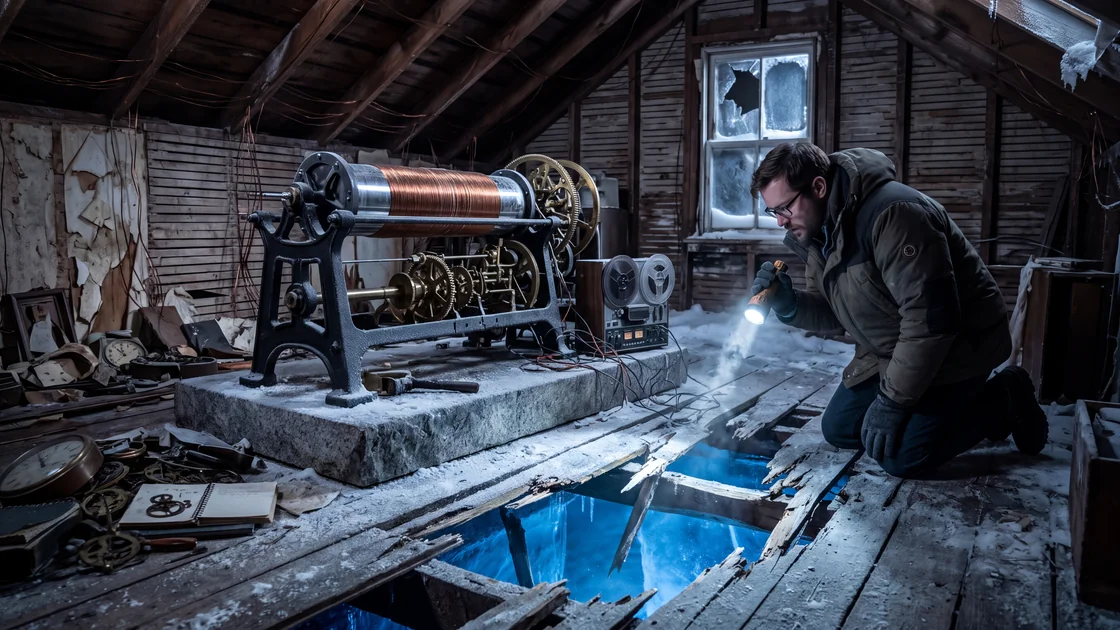
This is the account of Dr. Julian Gale, a radio astronomer stationed at the Submillimeter Array on Mauna Kea, who captured an anomalous, narrow-band transmission from the cryovolcanic plumes of Saturn’s moon Enceladus. When the repetitive pulse was decoded from International Morse code into standard geodetic coordinates, it did not point to a terrestrial observatory, a military installation, or a scientific landmark; instead, it pinpointed a patch of floorboards inside the attic of his abandoned childhood home in rural Maine. Driven by the impossible confluence of deep-space telemetry and intimate memory, Julian abandoned his post to cross an ocean and a continent, returning to the decaying house where his clockmaker father had vanished years earlier, only to uncover a terrifying, silent communion between the frozen depths of an alien ocean and the forgotten machinery of his family's grief.
I. The Whispering Plume
The high altitude of the summit did strange things to the blood, but stranger things to the sleep. At four thousand meters above the Pacific, the atmosphere was a thin, dry membrane, stripped of moisture and shielding. Julian Gale had lived in that membrane for eight consecutive weeks, long enough for his fingernails to turn brittle and his dreams to take on the jagged, hyper-vivid clarity common to monks, mountaineers, and solitary observers of the sky.
He sat in the control annex of the James Clerk Maxwell Telescope, though his telemetry was tied through the fiber link to the Submillimeter Array down the ridge. It was three in the morning, Hawaiian Standard Time. Outside, the trade winds battered the cinder cones of Mauna Kea with a dry, continuous hiss that sounded like sand pouring through an hourglass. Inside, the only light came from four mismatched LED monitors and the dull, amber pilot lights of the cryostat racks.
Julian was running a spectral baseline survey on the plume activity of Enceladus. It was an unfashionable project, the sort of observational grunt work typically pawned off on graduate students or underfunded postdocs. Ever since Cassini had plunged into Saturn’s crushing mantle in 2017, the scientific community had been hungry for a dedicated return mission to the sixth moon. Enceladus was small—scarcely five hundred kilometers in diameter, a clean marble of water ice reflecting ninety-nine percent of the sunlight that struck it—but its south pole was fractured by four deep, parallel rifts known colloquially as the Tiger Stripes. From those rifts, cryovolcanoes vented tons of water vapor, silica nanoparticles, simple organic molecules, and salts into space every second, feeding Saturn’s diffuse E-ring.
Julian’s objective was to measure the isotopic ratio of deuterium to hydrogen in the venting water vapor at 225 gigahertz. It required hours of continuous integration time, waiting for the moon to swing past its western elongation, where the Doppler shift from Saturn’s enormous gravitational well separated the plume’s spectral lines from the noise floor of the interplanetary medium.
He took a sip of lukewarm instant coffee, grimaced at the film of grease on the surface, and clicked the mouse to refresh the waterfall plot.
The spectrum should have been a gentle Gaussian curve—a soft, thermal hump rising from the grass of ambient cosmic noise, representing the kinetic temperature of the vented gas.
Instead, the baseline was severed by a spike.
Julian set the mug down on a coaster made of cork and pressed his glasses against the bridge of his nose. He leaned in until his nose was six inches from the screen.
"Artifact," he muttered to the empty room. "Local oscillator leak."
He opened an SSH terminal to the receiver cabin and queried the local oscillator’s lock status. The synthesized sweep generator was stable to within three parts in ten to the twelfth; the phase-locked loop had not slipped. He switched to the auxiliary correlator, an entirely independent set of field-programmable gate arrays designed to catch stray microwave interference from the military base down at Pohakuloa.
The spike remained. It was centered precisely at 1420.405751 megahertz—the neutral hydrogen line, Doppler-shifted by exactly forty-two kilometers per second, the precise line-of-sight velocity of Enceladus relative to the summit of Mauna Kea at that second.
"That’s impossible," Julian whispered.
The hydrogen line was protected by international treaty; radar, satellite downlinks, and terrestrial broadcast communications were strictly forbidden from transmitting within that quiet band. But even if some rogue amateur or military radar in the Pacific had violated the covenant, the Doppler shift made no sense. A terrestrial signal would have zero line-of-sight velocity relative to the dish, save for Earth’s own rotation. A signal from a geosynchronous satellite would have a fixed offset.
This signal was moving with the icy moon. It was embedded in the moon’s cold shadow, rising from the south polar terrain, Doppler-stretched by the celestial ballet of the Saturnian system.
Julian reached for his mouse and zoomed in on the time-domain representation. The carrier wave was not continuous. It was pulsing.
He brought up the raw voltage capture from the intermediate-frequency stage and dumped it into a fast Fourier transform buffer. The waveform rendered across the screen as a series of square pulses against the ragged white noise of the cryostat.
Dit. Dit-dit-dit. Dah-dah-dah. Dit-dit.
Julian stared. The hair on his forearms, beneath his fleece jacket, rose until it pressed against his sleeves.
He had not heard that language since he was twelve years old, sitting beside his father in the back bedroom of the house in Cranberry Ridge, watching the old man’s arthritic index finger bounce against the silver contact of a brass J-38 telegraph key.
Dah-dah-dit-dit-dit. Dit-dit-dit-dit-dah.
It was Morse code. It was not a mathematical sequence of prime numbers, not the golden ratio, not the universal physical constants that SETI pioneers had theorized for seventy years would be the greeting cards of an alien intelligence.
It was an archaic, terrestrial, military-grade radio code, pulsing out from under thirty kilometers of ice, through a vacuum of a billion kilometers, directly into his receiver.
II. The Arithmetic of Cranberry Ridge
Julian did not wake Miriam Chen, the site director. He did not notify the Central Bureau for Astronomical Telegrams. He did not log into the SETI post-detection protocol slack channel, where three hundred astronomers around the globe kept watch for the civilization-shattering event that had never come.
Instead, he locked the heavy steel door of the annex, closed the blinds against the pale, pre-dawn pink that was beginning to bleed into the eastern clouds above Hilo, and began to log the raw binary.
The signal was faint—less than three janskys at its peak—but it was astonishingly clean. The pulses occurred with mechanical regularity. The base unit, the length of a single dot, was precisely sixty milliseconds. A dash was exactly one hundred and eighty milliseconds. The inter-element spacing was sixty; the inter-character spacing was one hundred and eighty; the inter-word spacing was four hundred and twenty.
It was machine-timed. No human hand had keyed it; no flesh could maintain an Allan deviation so low.
Julian grabbed a yellow legal pad and an HB pencil from a drawer filled with desiccated Sharpies and coaxial connectors. As the waveform scrolled across the screen, he transcribed the symbols by hand, his fingers shaking so violently that the lead snapped twice.
--. .-. --- ..- -. -..
G R O U N D
Julian stopped breathing. The pencil hovered over the paper. The paper absorbed a tiny drop of sweat that fell from his brow.
The sequence continued.
....- ....- .-.-.- ..... ..--- --... --... --... -....
4 4 . 5 2 7 7 7 6
-.
N
Julian’s throat seized. He knew those numbers. He did not need to consult an atlas. He did not need to run an inverse geodetic transformation using the WGS-84 reference ellipsoid.
He wrote the next line before the correlator had finished processing the dashes.
-.... ---.. .-.-.- ...-- --... ----. ..--- ..--- ..---
6 8 . 3 7 9 2 2 2
.--
W
--- .-.. -
A L T
..--- ----. .-.-.- --...
2 9 . 7
--
M
The signal ceased.
The waterfall plot collapsed into the uniform, blue-gray snow of background thermal emission. The neutral hydrogen line flatlined. On the auxiliary monitors, Enceladus quietly slipped behind the limb of Saturn, occulted by the vast, ringed bulk of the gas giant, severing the line of sight between Mauna Kea and the plume for the next thirty-six hours.
Julian sat in the humming gloom of the annex. The only sound was the coolant pump cycling in the floor below, a rhythmic, hydraulic thump-shhh, thump-shhh that had provided the baseline to his entire adult life.
He looked down at the pad.
GROUND
44.527776 N
68.379222 W
ALT 29.7 M
Forty-four degrees, thirty-one minutes, thirty-nine point nine
seconds North.
Sixty-eight degrees, twenty-two minutes, forty-five point two seconds
West.
Altitude: twenty-nine point seven meters above mean sea level.
Julian opened a private browser tab and typed the coordinates into a satellite imagery engine. The screen flashed white, then resolved into the dark, spruce-choked topography of Hancock County, Maine.
The virtual camera dove from low Earth orbit, past the serrated coastline of Frenchman Bay, past the blueberry barrens of Ellsworth, into the deep, unpaved tracts of timberland along the Union River. It descended upon a narrow, winding driveway that had not been plowed since the winter of the Obama administration.
At the center of the crosshairs sat an L-shaped farmhouse with an asphalt-shingle roof that had buckled beneath the weight of three decades of nor'easters. Attached to the rear was a sagging barn, its cedar shakes weathered to the color of wet slate.
Julian zoomed in until the pixelation fractured the image into digital noise.
The coordinate was not merely the farm. It was not the yard. It was not the rusty hulk of the 1978 International Harvester tractor sinking into the sumac behind the woodshed.
The coordinate hit the north-by-northeast corner of the main house. The second story. The room with the single dormer window that faced the Atlantic, where the ceiling slanted so steeply that a tall man had to walk with his chin tucked into his collarbone.
His father’s workshop.
The altitude—twenty-nine point seven meters—was not the ground. The ground elevation at Cranberry Ridge was twenty-four meters.
Five point seven meters above the frozen mud.
That was the height of the tongue-and-groove white pine floorboards Arthur Gale had laid with his own hands in the summer of 1984, using cut square nails pulled from a burned-out church in Surry.
Julian pushed himself back from the desk. The casters of his swivel chair shrieked against the linoleum. He stood up, his heart hammering against his ribs with the blunt, erratic force of an unbalanced turbine.
A signal had just crossed nine hundred million miles of vacuum, passing Jupiter’s radiation belts, piercing the asteroid belt, cutting through the solar wind, to land on an eight-meter submillimeter dish on a volcanic peak in the middle of the Pacific Ocean.
And it was telling him to go to his bedroom.
III. The Architecture of Arthur Gale
Julian’s father had been an horologist, but he was not the sort who repaired Swiss wristwatches for summer people in Bar Harbor. Arthur Gale was a master of long-case pendulum clocks, gravity escapements, and dead-beat regulators. He was an artisan of inertia.
Julian remembered the house in Maine not as a home, but as an enormous, multi-chambered instrument constructed of brass, lead, seasoned walnut, and dried tallow. The basement had been occupied by a coal furnace that smelled of sulfur, but the attic—the room directly beneath the rafters—had belonged to the clocks.
There were sixty-two clocks in the house when Julian was seven years old. By the time he was fifteen, there were more than two hundred. They lined the stairwells; they stood like sentinels in the corridors; they sat upon the mantels and were bracketed into the hemlock studs of the interior walls.
None of them were synchronized.
"If they all strike together, Julian," his father had told him one November afternoon, his thumbs black with graphite lubricant, "they will destroy the frame of the house. The resonance will shake the sills loose from the fieldstone foundation. Sympathetic vibration. Huygens discovered it in 1665. Two pendulums hanging from the same timber will inevitably couple their periods until they swing in unison, trading momentum through the wood. A house must have dissonance. A house must have friction, or it becomes a tuning fork."
Arthur Gale was a rail-thin man who smelled of wintergreen oil and tobacco. He had been an infantry radio operator in the Korean War, a career that had left him with a perforated right eardrum and an obsession with precision timekeeping that bordered on the theological. He believed that the second was not a measurement invented by humans, but a fundamental grain of the cosmos, like a photon or a lepton, that could be harvested if an escapement were ground with sufficient accuracy.
When Julian’s mother, Eleanor, died of an undiagnosed aortic aneurysm on the kitchen floor while stirring a pot of strawberry preserves, Arthur did not weep. He had gone up to the attic, wound the four-hundred-day torsion clock he had built out of invar steel, and stayed there for three weeks.
When he emerged, he had stopped repairing clocks for clients. He had begun building what he called the receiver.
Julian remembered the copper wire. Miles of it, shipped in heavy wooden spools from an industrial salvage yard in Newark. Arthur had stripped the attic walls down to the bare lath, winding the lacquered wire through the framing in massive, rectangular coils that transformed the entire upper floor of the house into an induction loop of monstrous proportions.
"What are you listening for, Dad?" Julian had asked him. He had been fourteen, his hands raw from helping his father pull forty-gauge copper through holes drilled in ancient oak joists.
Arthur had looked at him through his magnifying visor, his gray eyes magnified to three times their natural size, wet and pale behind the lenses.
"Everything moves, Jules," he had said. "The tides move the crust. The Moon pulls the dirt up six inches twice a day. The Sun drags the whole solar system through the galactic plane like a hooked cod being hauled through the surf. You think that doesn't make a sound? You think five billion tons of rock swinging through a magnetic field doesn't sing?"
"Is it music?"
"No," his father had said, snapping a piece of solder with his pliers. "It’s a ledger. It’s an accounting."
Julian had left Cranberry Ridge two years later, on a full scholarship to the Massachusetts Institute of Technology. He had chosen radio astronomy precisely because it sanitized his father’s madness. Astronomy was the same obsession—listening to the sky through wire and brass—but it was protected by the clean, cold armor of mathematics, peer review, and academic tenure. In astronomy, you did not talk about the earth singing; you talked about synchrotron radiation, blackbody curves, and Faraday rotation.
Arthur had not attended Julian’s graduation. He had not answered Julian’s letters. For ten years, their communication had consisted of a single postcard sent every December: a photograph of an antique clock movement with a hand-written line on the back noting the drift rate of the local atomic fountain in Boulder, Colorado.
Then, six years ago, the postcards had stopped.
The Hancock County Sheriff’s Department had found the farmhouse empty. The doors were unlocked. The stove was cold. On the kitchen table, a single china cup contained three dry tea leaves and a dead wood-boring beetle. Arthur’s truck was parked in the barn, its battery dead and its tires flat. His wallet, his social security card, and his Korean War dog tags were lined up neatly on the dresser in the master bedroom, alongside a receipt for sixty pounds of crystalline paraffin wax and five gallons of battery-grade sulfuric acid.
The state police had searched the woods with tracking dogs. They had dragged the Union River. They had sent two divers down into the flooded granite quarries near Blue Hill.
They had found nothing. Arthur Gale had simply ceased to occupy space.
Julian had signed the papers authorizing the bank to pay the property taxes from his father’s modest veteran’s pension. He had refused to sell the land. He had never gone back.
Until now.
IV. The Flight to the Margin
Julian sat in the middle seat of an Airbus A321 somewhere over Nebraska. His laptop was open on the tray table, its battery draining faster than the under-seat AC outlet could supply current.
He had left Mauna Kea without packing his cold-weather gear. He had told Miriam Chen that his uncle had suffered a stroke in Bangor—an absurd lie, as his mother had been an only child and his father's siblings were all buried in the cemetery behind the Congregational church in Castine. Miriam had looked at him with that quiet, clinical skepticism common to senior researchers who have watched too many colleagues crack under the altitude and the isolation.
"Take two weeks, Julian," she had said, her hand resting on the handle of her tea mug. "Go down to sea level. Get your blood oxygen back up to ninety-eight percent. Eat some green vegetables. But leave your terminal logged out. You’ve been looking at the baseline noise until you’re seeing faces in the foam."
Julian had nodded, packed his passport, his notebook, and his spectrum analyzer into a canvas duffel, and caught the morning shuttle down to Hilo.
Now, at thirty-seven thousand feet, he was running a secondary cross-correlation on the data he had saved to an encrypted flash drive.
The transmission had not originated from the surface of Enceladus.
That was the conclusion of the ephemeris calculation he had run while waiting for his connection in San Francisco. The plume was the exit point, but the source was deeper. Cassini’s radar soundings had shown that beneath Enceladus’s thirty-kilometer ice shell lay a global ocean of liquid water, kept warm by tidal dissipation from its eccentric orbit around Saturn. At the floor of that ocean, forty kilometers down, was a rocky core, fractured by hydrothermal vents where water met hot, porous silicate rock at pressures exceeding four thousand bars.
The signal’s phase profile showed an unmistakable dispersive delay—the high frequencies had arrived micro-seconds before the low frequencies. The dispersion measure did not match the interplanetary medium between Saturn and Earth.
It matched the dielectric properties of pressurized water ice mixed with an ammonia hydrate brine.
The signal had traveled through thirty kilometers of ice before venting through the plume into the vacuum.
Julian opened a terminal and re-read his father’s handwriting, transcribed from an old letter he had found folded inside his copy of Birney's Radio Astronomy, which he had carried in his briefcase for twenty years:
Julian,
The sea has a memory, but ice is a phonograph. If you freeze a wave, you trap the strain. When the pressure changes, the lattice slips. Every dislocation in a crystal of hexagonal water ice is a dipole. If you have enough of them, and they slip together, you don't need a vacuum tube. You have an engine.
Julian closed the laptop. He pressed his face against the double-paned window of the aircraft. Below, the patchwork of the Midwest was covered in a skin of late-autumn snow—dull, gray, and flat under an overcast sky.
How could Arthur have known?
The Tiger Stripes of Enceladus were not discovered until 2005, when Cassini performed its first close flyby. Before that, Enceladus was just a bright pixel in the field of the 200-inch Hale telescope at Palomar, a featureless ball of white frost.
Yet his father had died—or disappeared—in 2018, having spent forty years building an induction loop inside an attic in the Maine woods, listening to a frequency that no human being had monitored before the launch of the Space Age.
And why the coordinates?
Why would a transmission from the Saturnian system, encoded in a system of dots and dashes invented by an American portrait painter in the 1830s, give the latitude and longitude of an attic bedroom on a dirt road in Maine, accurate to within four inches?
There were only three possibilities, and Julian’s rational mind rejected all of them.
First: it was a hoax. A colleague at the SMA, or some technologically sophisticated hacker with access to the submillimeter array’s receiver network, had spoofed the signal to drive him mad. But that was impossible. The signal had been Doppler-shifted with the orbital mechanics of Saturn; to fake that, someone would need to place an unauthorized transmitter on an interplanetary probe currently orbiting Enceladus. There were no active probes at Saturn. Cassini was ash.
Second: Julian was insane. He was experiencing a severe, high-altitude dissociative fugue, and the numbers on the pad were the projections of his own unresolved trauma regarding his father’s disappearance.
Third: Arthur Gale had not disappeared. He had found a way to speak through the ice.
V. Cranberry Ridge
Julian rented a four-wheel-drive Subaru at the Bangor airport. The air in Maine was different from the air on the summit of Mauna Kea; it was heavy with the smell of wet soil, rotting spruce needles, woodsmoke, and the distant, briny iron of the low tide. It was four in the afternoon, but the sun was already slipping below the horizon, a bruised plum-colored streak behind the naked birches.
He bought a fiberglass snow shovel, a four-cell Maglite, a crowbar, and two heavy wool blankets at a hardware store in Ellsworth, then drove south along Route 179.
The pavement gave way to washboard gravel, then to frozen mud rutted by logging skidders. The trees closed in—hemlock, red maple, and dense stands of scrub pine that slapped against the car’s quarter panels as he navigated the overgrown tracks of Cranberry Ridge Road.
He reached the driveway just as the last twilight died.
The Subaru’s headlights cut through the gloom, illuminating the farmhouse. It was worse than it had appeared on the satellite imagery. The roof of the back porch had collapsed entirely, its crossbeams resting on the snow like the broken ribs of a whale. The paint had long since surrendered to the salt winds, leaving the clapboards the color of a drowned man’s skin. The windows of the ground floor were dark, their panes filmed with decades of dust and lichen.
Julian turned off the engine.
The silence that rushed into the cabin of the car was absolute. It was not the thin, whistling silence of the mountaintop, but the thick, claustrophobic silence of the Maine woods in November, where every leaf had already fallen and the snow had not yet accumulated enough to provide a crust for the wind to rattle.
He sat for five minutes, his hands gripping the steering wheel.
"You're an idiot, Julian," he said aloud. The sound of his own voice in the car was small, pathetic, and flat.
He grabbed the Maglite, the crowbar, and his duffel bag, and stepped out into the cold.
The ground was frozen hard as basalt. His boots crunched on the gravel-frost. He walked up the three stone steps to the front door, avoiding the rotten boards of the stoop.
The front door was not locked. It had never been locked in his lifetime; his father had thrown the brass key down the privy when Nixon was still in the White House, claiming that a lock was an insult to the neighbors, who were all too poor to steal anything worth having anyway.
Julian pushed the door open. It groaned on its rusted iron strap hinges, scraping a wide arc in the debris that had collected in the entryway: dry oak leaves, birch bark, and the papery husks of thousands of dead flies.
He swept the flashlight beam across the hallway.
The wallpaper—an ancient pattern of faded blue cornflowers—hung from the plaster in long, dry scrolls that rustled like silk skirts in the draft from the open door.
The clocks were still there.
They were everywhere. Their weights had all run down decades ago; their pendulums were frozen in their downward bobs; their silvered dials were tarnished to leaden gray. A grandfather clock by Simon Willard, built in Roxbury in 1802, leaned drunkenly against the hall closet, its waist door hanging open to reveal an empty cavity where a squirrel had built a nest of shredded newspaper.
Julian took a breath. The air was five degrees colder inside than it was in the yard. It smelled of damp lime, creosote, dry rot, and that faint, metallic tang he had forgotten for thirty years: neat’s-foot oil and solder.
He walked past the kitchen, not wanting to look at the linoleum where his mother had dropped her wooden spoon, and approached the staircase.
The stairs were steep, built according to eighteenth-century proportions, each riser nine inches high. He climbed them slowly, his boots testing each tread before committing his weight. The house made no sound. It did not settle; it did not creak. It felt braced, as if the massive copper coils wound through its bones had turned the timber into a single, rigid truss.
He reached the landing.
Before him was the door to the attic. It was narrow, made of single-beaded boards of pumpkin pine, secured by a wrought-iron thumb-latch.
Julian placed his thumb on the latch. His hand was steady now. The terror that had hovered over him since Mauna Kea had crystallized into a dull, cold curiosity—the professional detachment of a man entering an ancient tomb to catalog its pottery.
He pressed the latch down. The bar lifted with a sharp, iron clack.
He pushed the door inward.
VI. The Attic Resonator
The flashlight beam cut through the freezing dust of the attic room.
It was not empty.
Julian had expected dust, cobwebs, perhaps the scattered remnants of Arthur’s workbenches—boxes of files, old horological journals, the detritus of a hermit’s life.
Instead, the attic was immaculate.
The center of the room was dominated by an apparatus that occupied thirty square feet of the floor, extending upward into the rafters. It was not a clock, though it utilized clockwork components.
It was an engine.
At its base was a massive granite surface plate, eight inches thick and four feet on a side, resting on four lead isolation pucks. Mounted to the granite was a lathe bed made of hand-scraped cast iron. Suspended within the frame was a cylinder of fused quartz, four feet long and eight inches in diameter, its interior filled with a pale, silver-gray liquid that Julian recognized instantly with a sickening lurch of the stomach: mercury.
Around the quartz cylinder, thousands of turns of fine copper wire were wound with the fanatical precision of an optical grating. The wire did not terminate on batteries or a wall outlet; it ran upward into the rafters, where it was spliced into the enormous induction coils that Arthur had laced into the framing of the house fifty years ago.
The dormer window was open two inches at the bottom. A thin drift of snow had blown across the sill, forming a white triangle on the floorboards.
Julian stepped closer, his boots clicking on the square-headed nails.
The coordinate: 44.527776 N, 68.379222 W, ALT 29.7 M.
Julian dropped his duffel bag and pulled out his GPS surveyor’s unit, an Trimble Geo7X he had taken from the observatory’s engineering shop. He set the unit down on the granite slab, turned it on, and waited for it to lock onto the constellation.
One satellite. Four. Eight. Twelve.
The differential correction clicked in via the cellular link from the Bangor CORS base station. The horizontal accuracy dropped to four millimeters. The vertical accuracy dropped to six millimeters.
Julian looked at the digital readout.
LAT: 44° 31' 39.993" N
LON: 68° 22' 45.199" W
ELEV: 29.704 M
He was standing on the millimeter.
The coordinates were not pointing to the room. They were pointing to the quartz cylinder. More specifically, to a point three inches from its western end, where a single, hair-thin platinum electrode penetrated the quartz wall, dipping into the pool of liquid mercury.
Julian directed his flashlight down into the guts of the machine.
Mounted beneath the quartz cylinder was an escapement. It was not a dead-beat or an anchor; it was a detached gravity escapement, identical to the one designed by Lord Grimthorpe for the Great Clock of Westminster, but miniaturized with terrifying precision. Its pallets were made not of steel, but of polished synthetic sapphire.
And it was not moving.
Beside the escapement lay a stack of notebooks—standard composition books with black-and-white marbled covers. Julian picked up the top one. The cover was warped by humidity, the edges of the pages foxed with brown spots of mold.
He opened it.
The handwriting was his father’s—tight, upright, written with an old Esterbrook fountain pen in blue-black iron-gall ink.
The entry was dated October 14, 1977.
Calculated the orbital resonance of the inner moons of Saturn. The Laplacian relation is not merely dynamical; it is acoustic. Enceladus orbits at 3.94 kilometers per second relative to the barycenter. Its orbital period is 32.9 hours. The tidal pulse strikes the south polar core every 118,440 seconds. This is 8.44 microhertz.
A frequency so low cannot be received by an antenna of wire. An antenna for 8.44 microhertz must be forty light-years long, or it must be made of ice under tension. The entire moon is an antenna. When the tidal stress peaks, the ice groans at the fundamental. If one can construct a local oscillator that matches the mechanical impedance of the lunar crust, the Earth’s core will provide the ground.
I have laid forty miles of wire in the frame. The house is ready.
Julian flipped the pages forward. Decades passed between the sweeps of his thumb.
July 3, 1989.
Julian left today. He thinks I am counting the hours until I die. He does not understand that time is not a sequence. It is a stationary wave. The future is already frozen; we are simply the escapement that clicks through the teeth.November 12, 1998.
The plume has spoken. It is not hydrogen gas; it is a displacement. Cassini will see it in seven years. They will think it is steam. Fools. They will measure the temperature and call it geology. They do not have ears to hear forty microhertz.January 4, 2018.
The quartz is stable. The mercury pool has reached thermal equilibrium with the attic floor. The system is resonant. I can hear the cracks forming in the south polar basin. The Tiger Stripes are breathing. Every thirty-two hours, the rift widens three inches. The ice slips. When it slips, it sends the name.It knows where I am. It has known since the house was built in 1842. The surveyor who ran the county line was using a compass with a needle touched by an iron meteorite that fell in Penobscot Bay in 1789. The iron was from the same cloud that formed Saturn. The house was always tuned to the moon.
I am going to close the loop.
Julian stopped.
The last entry was dated January 9, 2018. The handwriting had lost its architectural control; it was sprawling, frantic, gouged so deeply into the paper that the nib had torn through the page in three places.
The moon does not call to Earth. The moon is a mirror.
What I hear from Enceladus is not their voice.
It is mine.
I must take the key down to the ice.
There were no more entries. The remaining one hundred and twenty pages of the notebook were blank.
Julian lowered the book.
The attic had grown colder. His breath hung in the flashlight beam like a silver plume of its own, rising toward the rough-sawn rafters.
He looked at the machine. He had spent his entire career studying signals from space—quasars, pulsars, the cosmic microwave background, the whispers of neutral hydrogen that had left their sources before the first amphibian crawled out of the Devonian mud. He had been taught that the universe was an indifferent expanse of thermodynamics, a vast, cooling engine governed by non-linear differential equations that cared nothing for the little primates clutching their iron rocks.
Yet here was this thing.
Julian reached into his pocket and pulled out his digital multimeter. He set it to measure millivolts of direct current and touched the black probe to the cast-iron frame of the machine.
He hesitated, then touched the red probe to the platinum electrode that disappeared into the quartz cylinder.
The digital display flickered, hunting through the megaohms, then locked.
- 1.420 V
The value was not drifting. It was pinned, rock-solid, to the fourth decimal place.
One point four two zero. The rest frequency of the hydrogen line, expressed in volts.
Julian swallowed. "Dad?" he said.
The word was torn from him before he could stop it—a child’s cry in an old, rotten house, thirty years too late.
There was no answer, save for the wind outside, which had begun to rise, whistling through the two-inch opening of the dormer window.
Then, from within the quartz cylinder, there was a sound.
Tink.
VII. The Escapement Drops
It was the sound of sapphire striking steel.
Julian dropped the multimeter. It hit the floorboards with a dull plastic thud.
The horizontal arm of the Grimthorpe escapement had moved. It had lifted half a millimeter, its jewel pallet clearing the locking face of the wheel, and then dropped back into place.
Tink.
A pause of precisely one second.
Tink.
Julian stepped back, his shins hitting the edge of a wooden crate filled with old brass gears.
The quartz cylinder was glowing.
It was not a light that would have registered on a photographic plate; it was an ultra-low-level sonoluminescence, a ghostly, violet luminescence that flickered along the axis of the mercury pool. The liquid metal inside the tube was not sitting flat; its surface was ridged with concentric standing waves, like the skin of a pond during a heavy rain.
Julian grabbed his spectrum analyzer from the duffel bag, whipped the whip antenna out until it extended five feet, and turned the dial to 1.420 gigahertz.
The speaker on the analyzer hissed with white noise, then cut out entirely as the automatic gain control was crushed by a massive signal.
Dit. Dit-dit-dit. Dah-dah-dah. Dit-dit.
It was in the room.
The attic was not receiving the transmission from Enceladus.
The attic was generating it.
Julian felt the room tilt around him. The vertigo was sudden and violent; he had to drop to one knee, his hand flat against the cold pine floor to keep from falling.
The coordinates.
The signal he had detected on Mauna Kea had not been beamed to Earth by some alien intelligence on Enceladus that had miraculously obtained the latitude and longitude of an obscure house in Maine.
The signal had been transmitted from this room. It had been launched from this house, channeled through the forty miles of copper wire in the walls, focused by the magnetic anomaly of the meteorite-iron foundation, and coupled into the deep crust of the Earth. From Earth, it had bounced through the interplanetary plasma, resonated through the Saturnian magnetosphere, plunged through the thirty kilometers of ice on Enceladus, and then bounced back from the hydrothermal core, Doppler-shifted by the moon’s orbital flight, to be caught by the submillimeter array on the mountain five days later.
It was an echo.
Arthur Gale had not been receiving a message. He had been shouting into a cosmic canyon for forty years, waiting for the reflection to return from the ice.
And the time delay—the light travel time between Saturn and Earth—was eighty-two minutes at its minimum, more than an hour and a half for a radio photon to cross the dark and return.
Julian looked at his watch.
The signal he had received on Mauna Kea had arrived at 3:14 AM Hawaii time.
That meant it had left Enceladus an hour and twenty minutes earlier.
Which meant it had left this attic eighty-two minutes before that.
Julian scrambled across the floor on his hands and knees, dragging the Maglite behind him, until he reached the base of the cast-iron machine.
Mounted to the end of the lathe bed was a tape transport mechanism from an old Ampex instrumentation recorder. The five-inch reels of half-inch magnetic tape were not moving, but the pinch roller was engaged against the capstan.
The capstan was not driven by an electric motor. It was geared directly to the Grimthorpe escapement, which was powered by a seventy-pound lead weight suspended in the stairwell through a hole cut in the floorboards.
The escapement was clicking.
Tink. Tink. Tink.
Every second, the tape advanced one-tenth of an inch.
On the tape, recorded in microscopic pulses of magnetic flux, was the message.
It had been running for six years.
Arthur had not died in 2018. He had simply wound the weight to the top of the tower, set the escapement in motion, and stepped out into the night, leaving the house to broadcast his final telemetry into the dark.
Julian reached out his hand toward the tape. He wanted to stop it. He wanted to grab the heavy brass balance wheel and force it to a standstill, to silence this monstrous, sixty-mile-long voice that was polluting the quietest band of the cosmos with the coordinates of his own misery.
He caught the rim of the wheel with his fingertips.
The metal was not cold.
It was forty degrees below zero.
The instant his skin touched the invar steel, the moisture on his pads flashed into frost. A searing, chemical burn tore through his nerves, accompanied by a sound that did not come through his ears, but through the bones of his teeth: a low, resonant, sub-audible moan that vibrated his diaphragm and loosened the marrow in his femurs.
Julian screamed, yanking his hand back. A strip of gray, frozen skin from his index finger remained stuck to the wheel.
The wheel did not stop. It did not even slow down. It had the momentum of a locomotive; it was coupled to the mass of the granite block, and through the block, to the bed of the farmhouse, and through the house, to the crystalline granites of the Appalachian chain.
The room began to speak.
Not in Morse code. Not in numbers.
The copper wire in the laths—the forty miles of lacquered red thread that wound through the ceiling, the floor, the walls, the door frames—began to sing.
It was the voice of a man who had not used his vocal cords for twenty years: thin, dry, hoarse with the inhalation of spruce smoke and iron dust, modulated by the sixty-cycle hum of the continent’s power grid and the whistling static of the northern lights.
"Julian."
VIII. The Closed Loop
Julian backed away until his shoulders struck the lath-and-plaster wall beneath the eaves. The dry plaster crumbled behind his coat, raining white lime down his collar.
The sound did not come from a loudspeaker. There were no speakers in the room.
The wire itself was moving. The massive magnetic field generated by the mercury resonator was interacting with the Earth’s natural field, causing the forty miles of copper coil to twitch within the walls, transforming the entire wooden frame of the house into an acoustic transducer. The very timber—the old-growth hemlock that had been felled when John Quincy Adams was president—was speaking.
"Julian. You are late."
"You’re dead," Julian choked out. He was pressing his bleeding finger against his wool trousers, shivering with such violence that his teeth clicked together like the escapement. "You died in the woods. They searched the river. You’re not here."
"The river is just cold water," the house creaked back. The sound had a horrible, phase-shifted quality, coming from above, from below, from behind the baseboards. "The ice on Enceladus is three hundred degrees below zero. It doesn't melt. It flows. Like pitch. Like cold honey. Julian, look at the tape."
Julian forced his eyes back to the machine.
The magnetic tape was not running off the reel. It was an endless loop—a thirty-foot Möbius strip of brown mylar that looped through a series of polished brass pulleys mounted to the attic rafters, passing over the playback head again and again and again.
The message had not changed in six years.
It was not sending a coordinate to invite someone home.
It was an addressing header.
Julian crawled back toward the machine, keeping three feet between himself and the frozen invar wheel. He leaned in, pointing the flashlight beam at the playback head.
Beneath the head, where the tape passed over the Permalloy core, the track was split into two channels.
Channel A was the coordinates. The dots and dashes. The signal that had bounced off Enceladus and returned to Mauna Kea.
Channel B was not Morse.
It was an analog audio waveform, recorded with the wide-bandwidth frequency modulation used by deep-space telemetry units in the 1970s.
Julian pulled his notebook from his duffel, his hand shaking so badly he could barely turn the pages. He had copied the raw binary from the JCMT correlator down to the last hex byte. He had assumed the non-Morse components were phase noise, the scattering of the carrier wave by the silica grains in the plumes.
He looked at the raw numbers he had transcribed at 3:00 AM in Hawaii:
7E 04 19 B2 C3 01 FF 00
41 72 74 68 75 72 20 47
He had not decoded the ASCII. He had stopped at the coordinates.
Julian stared at the second line.
41 72 74 68 75 72 20 47
In hex, 41 was 'A'.
72 was 'r'.
74 was 't'.
68 was 'h'.
75 was 'u'.
72 was 'r'.
20 was a space.
47 was 'G'.
Arthur G.
"What did you do?" Julian whispered to the ceiling. "What did you build here?"
The house groaned. The copper coils hummed, their pitch rising from a low, intestinal drone to a sharp, mosquito-like whine that set Julian’s ears ringing.
"I built a repeater," Arthur’s voice murmured from the laths. "A pendulum cannot swing in a vacuum, Julian. It needs a point of suspension. A knife-edge. A flat stone. I needed a mirror with enough mass that it wouldn't move when the wave hit it. The moon is the mirror. But the mirror doesn't reflect what you send it. The mirror reflects what is behind you."
"The plume," Julian said, his mind racing through the physics, trying desperately to find a framework—any framework—that did not dissolve into madness. "The signal on the hydrogen line... it wasn't a broadcast. It was an interrogation pulse."
"It was a ping," the voice said. It sounded tired now. The mechanical regularity of the escapement was beginning to falter; the ticks were growing longer, seventy milliseconds, eighty, ninety. The weight in the stairwell must have reached the bottom. There were only a few inches of drop left before the lead block settled into the cold dirt of the cellar.
"The ice answered thirty minutes ago," the voice said.
Julian froze.
"What do you mean?"
"The round-trip time, Jules. You calculated it from Hawaii. But you were looking at the reflection from five days ago. The one I sent when the moon was at elongation. The moon swung back. It reached periapsis at two o'clock this morning. The rift opened. The tiger's mouth is wide."
Julian stood up. His knees cracked like pistol shots in the quiet attic.
"The second signal," he said.
"It’s not an echo this time," his father whispered from the walls. "The ice has finished the calculation."
IX. The Cryosphere
The light in the quartz cylinder did not go out. It turned white.
It was a brilliant, magnesium-flare white that illuminated every corner of the attic, throwing the sharp, skeletal shadows of the rafters against the underside of the cedar roof. The mercury inside the tube did not splash; it crystallized.
Julian watched in horror as dendritic needles of solid mercury frost shot through the liquid metal, growing at inches per second, freezing from the inside out at room temperature.
The temperature in the attic plummeted.
It did not drop gradually. It was as if an open bulkhead had been kicked out into the interplanetary vacuum. Julian’s breath froze into a dense cloud of ice crystals that fell to the floorboards with a faint, dry rustle. The glass in the dormer window shattered inward, blown into diamond dust by a sudden, violent drop in atmospheric pressure.
The spectrum analyzer on the floor screamed.
A new carrier wave had appeared. Not at 1.420 gigahertz.
It was broad-band. It was white noise, but structured, contoured by thousands of sharp absorption lines that represented the molecular spectra of complex hydrocarbons, purines, pyrimidines, and amino acids.
The plume of Enceladus was not venting water.
It was venting an archive.
Julian grabbed the edge of the granite slab to keep his footing as the floorboards began to hump and buckle beneath him. The square-headed nails were pulling free from the joists with high, metallic screeches, popping out of the wood like corks from champagne bottles.
The foundation was lifting.
The house—the entire two-and-a-half-story timber frame—was being drawn upward, toward the sky, toward that invisible point in the southern horizon where Saturn hung behind the daytime blue, three degrees above the trees.
Julian looked down through the gaps in the pulling floorboards.
In the darkness of the second-story bedroom below, he saw no furniture. He saw no plaster.
He saw ice.
It was not river ice. It was not the milky, air-filled ice that forms on Maine ponds in December.
It was the ice of the deep crust: sapphire-blue, black at its heart, dense as armor plate, and traversed by hairline fractures that glowed with the cold, pale fire of high-pressure piezoelectricity.
The house was not built on fieldstone.
The house was resting on an outcrop of the Enceladean core that had punched through the mantle of the Earth like a needle through leather, an impossible, non-Euclidean bridge between two worlds separated by a billion miles of dead space.
"Julian," the voice said. It was not coming from the wire now. It was coming from the ice below his feet.
He looked down through the splintered gaps.
Deep within the blue transparency, twenty feet down, suspended in the eternal frost of the alien ocean, was a shape.
It was a man.
He was wearing a wool mackinaw coat with a red-and-black check, green wool trousers, and rubber-bottomed hunting boots. His hands were bare, their fingers curled into the shapes of keys. His face was turned upward, toward the floorboards, toward Julian.
Arthur Gale was not rotting. He was preserved in the pristine, sterile brine of the Saturnian sea, his gray eyes open and clear beneath six feet of crystal ice, his hair floating in the frozen water like white weed.
His lips were not moving, but the voice was his:
"You left the summit, Jules. You weren't supposed to leave the summit."
Julian dropped to his knees, his bare hand pressed against the ice that was now rising through the splintered floorboards. The cold burned him, eating through his skin, through his fascia, numbing the bone until he could not feel whether his fingers were still attached to his wrist.
"Why?" Julian screamed into the blue depths. "Why did you send the coordinates to Hawaii? Why did you make me come here?"
The frozen eyes of Arthur Gale did not blink.
"I didn't send them to Hawaii, Julian," the ice answered. "I sent them to Enceladus. You were the only one who had the dish pointed at the plume. You were the only one listening to the quiet band."
The machine on the granite slab gave a final, catastrophic shudder.
The fused quartz cylinder, unable to withstand the expansion of the frozen mercury within, fractured along its longitudinal axis with a sound like a rifle shot. A spray of mercury shards and liquid nitrogen frost exploded into the attic, coating the walls in a mirror-bright skin of silver.
The Grimthorpe escapement stopped.
The sapphire pallets shattered.
The lead weight in the stairwell struck the cellar floor with a hollow, dead thump that shook the entire frame of the house one last time.
The violet light vanished.
The white carrier on the spectrum analyzer died into a flat, level hiss of ambient cosmic noise.
The silence returned.
X. The Core Sample
It took three days for the state police to find Julian.
A timber cruiser for the Great Northern Paper Company had spotted the Subaru parked at the end of the overgrown driveway, its windshield buried under eight inches of fresh, dry powder.
They found Dr. Julian Gale sitting on the snow-covered sill of the attic window, his legs dangling over the yard. His hands were tucked deep into his armpits, his face blackened by frostbite, his glasses lost somewhere in the debris behind him.
He was alive, though he had lost three toes on his left foot and the index finger of his right hand.
The house was condemned by the town building inspector forty-eight hours later. The report noted that the central chimney had collapsed, the framing had suffered "catastrophic torsional failure consistent with an unrecorded seismic event," and the second-story floor had caved into the cellar.
There was no mention in the report of the ice.
When the volunteer fire department entered the house with their axes, they found only six inches of standing, brackish water in the basement, smelling strongly of ammonia and iron sulfide. The locals assumed the old well had backed up during the freeze.
The machine on the granite slab was never cataloged. It was sold for forty dollars as scrap iron to a peddler from Bangor, who melted the lathe bed down for sash weights and threw the broken quartz cylinder into a ditch along Route 1A.
Julian Gale did not return to Mauna Kea.
He resigned his appointment with the University of Hawaii by email from a rehabilitation bed at Eastern Maine Medical Center. He gave no explanation, and when Miriam Chen flew to Bangor to see him, he refused to admit her to his room.
He lives now in a three-room cedar cottage in West Tremont, on the back side of Mount Desert Island, where the tourists rarely go.
He has no internet connection. He has no telephone. He does not own a watch.
His living room contains a single table made of unfinished spruce, upon which sits a three-inch refracting telescope he bought from an estate sale in Blue Hill, and a shortwave receiver powered by a twelve-volt marine battery.
Every night when the sky is clear, he sets the telescope on the back deck, pointing it south toward the constellation Sagittarius, where Saturn moves through its long, twenty-nine-year circuit of the sun.
He does not look at the rings. He does not look at Titan.
He centers the crosshairs on that tiny, faint point of eighth-magnitude light: the icy marble of Enceladus.
He sits beside the telescope with the shortwave receiver tuned to the open, unmonitored frequencies of the low band, the antenna wire running down the deck railing and into the salt grass of the cove.
There is no Morse code now.
The Tiger Stripes have closed for the season; the moon has moved past periapsis; the tidal friction has dropped to its minimum, and the ice has healed its rifts with fresh, frozen brine.
The receiver emits only the soft, continuous rustle of the sea wind, the thermal static of the cold ocean, and the distant, rhythmic clicking of the tide against the rocks below the house.
It sounds like a clock that has been wound to the top of its case.
It sounds like an escapement that is waiting for the weight to fall another millimeter.
Julian sits in his wooden chair, his bandaged hand resting on his knee, his eyes fixed on the pale white dot that hangs above the spruce trees.
He knows that the light he is seeing left the moon an hour and twenty minutes ago.
He knows that forty miles down, beneath the thirty kilometers of ice, the water is dark, warm, and saltier than the Atlantic.
And he knows that somewhere on the floor of that ocean, wedged into a fissure where the rock meets the fire of the core, an old brass clock is ticking, counting down the long, cold seconds until the next periapsis, when the rift will open again, and his father will ask him if he has finally finished the calculation.