The Silver Grain Vigil
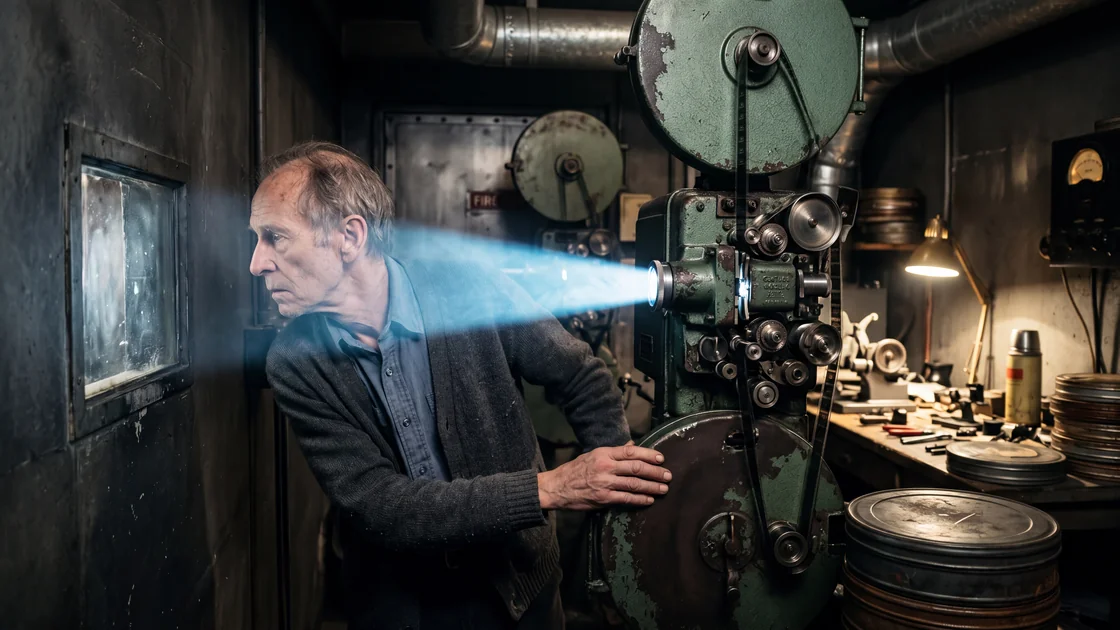
This is the story of Arthur Finch, the solitary projectionist of the decaying Rialto Theater, who discovers an unmarked, rusted canister of 35mm film in the deepest recesses of the basement vaults. When he mounts the mysterious reels onto his vintage Century Model C projectors during an empty midnight test, the 1949 domestic melodrama plays normally until its midway point—at which moment the actors suddenly abandon their script, turn away from their fictional staging, and fix their unblinking eyes directly upon the small square of optical glass behind which Arthur sits. As Arthur is drawn into an obsessive, frame-by-frame investigation of the celluloid, the boundary between the mechanical reproduction of light and the conscious intent of the photographed dead begins to dissolve, culminating in a night where the beam of the projector reaches across the auditorium not merely to illuminate a screen, but to draw the observer into the emulsion itself.
Act I: The Geometry of the Booth
The booth was twenty-four feet wide, nine feet deep, and suspended like a concrete gondola above the sloping velvet sea of the Rialto’s auditorium. To reach it, one had to ascend an iron spiral staircase tucked behind the water heater in the second-floor janitorial closet, slip through a low fire-door clad in tin, and enter an environment governed entirely by the smell of machine oil, ozone, and acetate.
Arthur Finch had worked within these dimensions for forty-two years. He understood the room not as an occupation, but as a living apparatus of which he was merely the softest component.
To Arthur’s left sat Projector One; to his right, Projector Two. Both were Century Model C heads mounted on heavy cast-iron pedestals that had been bolted to the floorboards in the autumn of 1951. They were painted an industrial hammertone green, chipped at the corners to reveal raw, dark iron beneath. Above the sound heads sat the lamphouses—vast, vented black iron housings that had once burned hiss-and-pop carbon arcs, smoking white cerium soot into overhead galvanized flues, before being retrofitted in the late 1970s with two-thousand-watt xenon short-arc bulbs.
Arthur disliked the xenon bulbs. Their light was flat, clean, and mercilessly blue—the color of a hospital corridor at dawn. The old carbon rods, though they burned Arthur’s fingers and left fine gray snow across the lens barrels, had possessed a human temperature. They had fluctuated with tiny, respirating shifts in voltage, casting a warm, candle-fat amber across the faces of women who had died before Arthur was born.
It was a Tuesday evening in late October, the season when the city outside smelled of wet leaves and the sulfur from the nearby railyards. Down below, in the damp cavern of the stalls, four people were sitting through the tail end of an archival double bill of Jacques Tourneur films. Arthur stood with his forearms resting on the velvet-wrapped sill of the observation port—a rectangular aperture six inches high and ten inches wide, glazed with quarter-inch plate glass that had been wiped clean with vinegar every Tuesday afternoon since the Eisenhower administration.
Through the glass, the beam cut a long, milky trapezoid through the dust-motes. It struck the perforated plastic screen fifty feet away, where Robert Mitchum walked down a sun-blinded California street, his trench coat stiff with shadows.
A faint buzz sounded from the buzzer box on the wall behind Projector Two. It was the cue. In the upper-right corner of Mitchum’s world, a small, circular black smudge flickered for a fraction of a second—the motor cue.
Arthur did not rush. His movements were the slow, rhythmic ballets of muscle memory. He stepped to Projector Two, rested his thumb on the green START toggle, and watched the upper right of the screen through the port. Four seconds later, the changeover cue flashed—a second black dot, punched into the corner of the frame with a hand-held scribe thirty years ago.
Arthur pressed the toggle with his left thumb and simultaneously stepped on the mechanical douser foot-pedal of Projector One.
Inside the mechanisms, a solenoidal clatter snapped. The shutter on Projector One dropped like a guillotine; the shutter on Projector Two sprang open. Mitchum turned a corner without a seam, his dialogue flowing between the optical sound heads with only the barest, imperceptible thud of low-frequency pop to mark the jump from reel four to reel five.
Arthur clicked off the lamp on Projector One, opened the upper magazine, and touched the metal flange of the take-up reel. It was warm from friction. He threw the rewinder lever, the motor groaned into gear, and the celluloid began to whistle as it skipped across the guide rollers, racing backward into its can.
This was the rhythm. Twelve minutes of quiet watching; three minutes of preparation; thirty seconds of absolute synchronization; twenty minutes of rewinding, inspection, and cooling. In the interludes, there was only the hum of the exhaust fans, the rhythmic, sewing-machine chatter of the Geneva drive intermittent movement—tick-a-tick-a-tick-a-tick, twenty-four beats per second, forty-eight interruptions of the light blade every heartbeat—and the city outside, fading into the wet autumn night.
The Rialto was dying, of course. Arthur knew this without rancor. The multiplex down by the interstate had sixteen screens with digital DLP units that were fed from hard drives the size of paperbacks. Those booths had no smell. They had no heat. A computer in a server rack in Kansas triggered the house lights, lowered the masking, fired the projector, and shut off the lamps at 11:14 PM without a single hand touching a dial. The boys who worked there wore polo shirts with embroidered logos and didn't know what a framing knob was. When a pixel died, they waited for a regional technician to fly in with a pelican case.
Arthur was seventy-one. His knuckles were swollen at the joints from decades of handling cold aluminum split-reels, and the crease between his eyebrows had been cut deep by sixty thousand hours of squinting through the port to check whether the focus was drifting soft on the edges. When the Rialto closed its doors for good in December—as the bank had already promised—Arthur would walk down the iron spiral stairs, drop his brass key into the mailbox, and wait to die in his three-room apartment above the laundromat. He had no wife, no living siblings, and his collection of original one-sheets from the 1940s was slowly silvering in acid-free cardboard sleeves beneath his bed.
At 11:30 PM, the four patrons shuffled out through the heavy double doors into the drizzle. Mr. Henderson, the theater’s seventy-eight-year-old manager, whose ankles were now so swollen he rarely left the box office, clicked off the marquee lights from the downstairs switchboard. The neon tubes of the word RIALTO hissed, buzzed, and fell dark with three distinct hollow pops.
Arthur heard Henderson’s cane tapping along the lobby tiles, followed by the muffled groan of the front street doors being locked with the heavy brass deadbolt.
"Arthur?" Henderson’s voice came up through the speaking tube beside the workbench. It sounded tinny, like a voice recorded on an early cylinder.
Arthur leaned into the brass horn. "Still here, Douglas."
"I’m heading out. Rain’s turning to sleet. Don't forget to kill the exhaust fans before you lock the alley gate. And Arthur?"
"Yes?"
"Those estate cans are by the boiler. The widow of that fellow from the university—Vance, the old fellow who taught history and had all those nitrate shorts—she had the city drop them off before they bulldozed his carriage house. If there’s anything worth saving, pull it. If it’s all vinegar or red rot, chuck it in the dumpster out back. The city inspector’s coming Thursday about the clearance."
"I’ll look at them," Arthur said.
"Goodnight, Arthur."
"Goodnight, Douglas."
The street door closed with a pneumatic sigh that Arthur felt through the soles of his shoes. The building settled into its deep, structural silence—the groan of timbers unburdened by heat, the tick of the radiator pipes, the faint hiss of moisture seeping through the basement limestone.
Arthur did not leave. He took his thermos from beneath the rewinder, unscrewed the plastic cap, and poured three fingers of black, lukewarm tea into the cup. It was midnight. The city was asleep, the house was dark, and the booth was his.
Act II: The Iron Canister
The basement of the Rialto was reached through a door behind the screen, down a flight of wooden steps that smelled perpetually of damp coal dust and hydraulic fluid from the old orchestra lift that had been decommissioned in 1938.
Arthur took his yellow flashlight and walked down the center aisle of the auditorium. The silence in the house was different when the projector was dead; it wasn't empty, but pressurized, as if the fifty years of sound that had bounced between the plaster cherubs and the heavy velour swags had never quite escaped, merely vibrating at frequencies too low for human ears, soaking into the horsehair stuffing of the seats.
Behind the stage, the dampness was sharp. He found the five film cans stacked on an old wooden pallet next to the idle coal furnace. Four of them were modern twenty-minute shipping cases—cheap stamped tin with faded yellow transit labels from the 1960s. Arthur inspected them with his beam: Educational Films: Soil Conservation 1954; March of Time: Vol. XII; a half-can of what looked like an industrial safety demo on lathe operation. He popped the latches on the top can; the unmistakable, sharp stench of acetic acid—vinegar syndrome—hit his nostrils like ammonia. The celluloid inside was already buckling, shrinking within its metal ring, sweating greasy droplets of plasticizer.
"Dead," Arthur whispered to the darkness.
He moved to the fifth canister.
It was unlike the others. It was larger—a two-thousand-foot shipping can, nearly eighteen inches in diameter, but made of heavy, unpainted lead-coated iron. It had no carrying handle, no paper lab slips, and no shipping label. Instead, someone had scratched a single mark into the lid with an awl: an irregular, five-sided box surrounding the Roman numeral I.
The metal was cold, distinctly colder than the ambient basement air. Arthur gripped the edges of the lid. It had no latches; it was a slip-fit friction lid, sealed with black cloth friction tape that had desiccated into a brittle, tarry crust.
He took his pocketknife, slipped the small blade beneath the tape, and scored it all the way around the rim. The tape crumbled like dried seaweed. He worked his fingers under the lip of the lid, grunted with the effort, and pulled.
With a dull, hollow shhhk, the lid gave way.
Arthur held his breath, bracing for the eye-watering vinegar stench of decomposed safety base or the sweet, deadly ether smell of decomposing nitrocellulose.
Neither came.
The odor that rose from the open can was dry, cold, and entirely unfamiliar. It smelled of ozone, powdered chalk, and something metallic, like the copper taste that comes into the mouth during an electrical storm.
Inside lay a single reel of 35mm film, wound onto an ancient, heavy brass core instead of a standard plastic hub. The film was black—not the gray-green of modern polyester or the deep mahogany of triacetate, but a rich, velvety obsidian. The edges of the pack were perfectly flat, as if it had been wound on a precision lathe.
Arthur touched the edge of the celluloid with the tip of his finger. It was supple. It was not warped, not cupped, and showed no sign of the brittleness that plagued sixty-year-old stock.
He pinched the leader between thumb and forefinger and drew out twelve inches into the flashlight beam.
The leader was opaque black acetate, spliced not with modern polyester tape or pink cementing fluid, but joined with a thick, glassy lap-splice that had been scraped with a hand-file and welded with glacial acetic acid. Scratched into the black emulsion of the leader with the same erratic hand that had marked the can was a single word:
THE SPECIMEN
Beneath it, in smaller characters: Test Print 1A – Vance – Not for Exhibition.
Arthur felt a small, familiar flutter in his chest—the specific collector’s tachycardia that had possessed him as a young man scouring church basements and flea markets for lost two-reelers. Vance had been an eccentric. A professor of European history who had spent the last two decades of his life as an unwashed hermit, barricaded in his stone house with ten thousand books and a private collection of early silent prints. Rumor had it he had spent his family’s remaining money in the late 1940s funding an experimental film unit out of an abandoned warehouse in the river district—a project that had never yielded a release, never registered a copyright, and had vanished from the records following a fire that had killed his lead cameraman.
Arthur checked his pocket watch. It was twenty minutes past midnight.
He set the heavy iron lid aside, lifted the reel from the can—it weighed nearly fifteen pounds, surprisingly heavy for two thousand feet—and carried it back through the screen door, up the aisle of the darkened auditorium, and up the iron spiral staircase into the warmth of the booth.
Act III: The Threading
In the booth, Arthur laid the reel onto the flat rewinder on his workbench. He switched on the light-box beneath the frosted glass insert.
He pulled the first few feet of footage over the illuminated glass, using his jeweler’s loupe to inspect the frames before he dared feed them into the Century’s sprockets.
The film was nitrate-gauge, but the safety imprint was clearly visible in the margins between the sprocket holes: EASTMAN – SAFETY – 1948, marked with the small solid diamond that indicated that specific year of manufacture.
Arthur adjusted the loupe.
The frame was an interior. A room constructed with unusual geometric severity. The walls were paneled in dark, unstained wood that showed the tight, fine grain of Douglas fir. In the center of the frame sat an oval dining table covered in a white linen cloth that was so brilliant it appeared to have been dusted with ground mica. On the table were three items: a glass tumbler half-filled with clear water, an empty white porcelain saucer, and a small, mechanical brass metronome with its pendulum locked in the upright position.
There were two figures in the frame.
To the left sat a woman. She appeared to be in her early thirties, dressed in an unadorned, high-collared dress of dark gray wool. Her hair was parted severely down the center, rolled into tight victory rolls that rested behind her ears like coiled snails. Her features were handsome, but sharp—her cheekbones prominent, her lips thin and unpainted.
Opposite her sat a man. He was slightly older, perhaps forty, wearing a heavy, three-piece wool suit that looked slightly too large through the shoulders, as though he had shrunk since it was tailored. His hair was sparse, swept straight back from a high, waxen forehead.
Neither was moving.
Arthur slid the film across the light-box, frame by frame, his thumb turning the rewind crank a single click at a time.
For twelve frames—half a second of screen time—the two figures remained perfectly motionless. Then, the man’s hand began to rise toward the water glass.
The photography was extraordinary. Arthur had inspected prints struck by Technicolor, original nitrate masters from Pathé and UFA, and the finest German prints from the twenties, but he had never seen an emulsion with this degree of resolution. The depth of field was unnatural; both the weave of the linen cloth in the extreme foreground and the grain of the wood paneling thirty feet behind the man’s head were in knife-edge focus. There was no grain—or rather, the grain was so infinitesimally fine that even under the ten-power loupe, it did not resolve into the usual salt-and-pepper swarm of silver halide crystals. It looked like an ink drawing executed on glass.
He examined the soundtrack.
It was an optical track, variable area, running down the left side between the image and the perforations. But unlike the jagged, saw-toothed mountains of typical sound tracks, this track was composed of smooth, undulating waveforms that resembled the traces of an oscilloscope—clean, solitary ribbons of light that widened and narrowed with mathematical elegance.
Arthur turned off the light-box.
He carried the reel to Projector One.
The machine was cold now. He flipped the breaker for the exhaust fan; the motor spun up with its familiar, low drone. He struck the xenon lamp. The bulb ignited with a violent snap, the blue-white glare spilling out through the lamp vents and painting lines of bright grid-light across the booth ceiling.
He opened the film gate. He wiped the polished steel shoes with a lint-free velvet pad.
He dropped the heavy reel onto the upper feed spindle. The brass core settled onto the keyed shaft with a heavy, musical clack.
He pulled the black leader down through the upper roller assembly, across the fire roller, and into the upper sprocket gate. He took care to set the loop—precisely two fingers of slack between the upper sprocket and the top of the gate, no more, no less. If the loop was too small, the intermittent movement would yank the perforations, tearing the sprockets; if it was too large, the film would slap against the interior of the housing with a sound like deck shoes on wet concrete.
He guided the celluloid through the film gate, closing the polished chrome door until the latch clicked home. He formed the lower loop, threaded the track through the optical sound head—looping it around the fluid-damped flywheel, slipping it between the exciter lamp and the photoelectric cell—and finally engaged the lower take-up sprocket.
He hooked the end of the leader into the slot of an empty sixteen-inch steel take-up reel on the lower spindle. He gave the take-up reel three turns by hand to tension the pack.
He reached for the framing knob. He turned the manual inching knob on the motor shaft, watching the shutter blade spin down across the lens. The intermittent shoe pulled the film down—click, click, click—until a single frame rested squarely in the aperture gate.
Arthur stepped to the observation port. He leaned down, his eyes level with the glass.
He reached up with his right hand, found the toggle switch for Projector One, and flipped it to RUN.
Act IV: The Screening
The Century groaned, the belts whipped tight, and the machine climbed instantly to its governing speed: twenty-four frames per second. Fourteen hundred and forty frames per minute. One foot of film every second.
Arthur tapped the mechanical douser lever. The steel plate swung down out of the light path.
The white beam burst through the projection port, crossed the eighty feet of dark air, and struck the screen.
The image appeared with such abrupt, razor-sharp clarity that Arthur blinked. There had been no production logo. No distributor card. No music. No title card.
Only the room.
The gray wool dress. The white tablecloth. The Douglas fir panels. The water glass.
Arthur stepped to the sound rack and turned the gain knob on the primary theater amplifier from zero up to four—his standard setting for late-night repertory.
What came out of the Altec Lansing Voice of the Theatre speakers behind the screen was not silence, but an immediate, immersive weight of air. It was the sound of an enclosed space. A room tone so dense, so detailed, that Arthur could hear the microscopic scrape of wool fiber against wool fiber as the woman at the table took a shallow breath.
She was speaking.
Her voice was low, dry, and possessed a strange, rhythmic cadence—neither British nor mid-Atlantic, but the flat, uninflected speech of the northern plains, drained of any theatrical cadence.
"...we have stayed past the frost," she said. Her mouth moved with precise, small articulations. "The cistern will have ice on it by morning, Edward."
The man—Edward—did not look at her. His gaze was directed down at the linen cloth, about six inches in front of his empty saucer.
"The ice doesn't matter," he replied. His voice was thinner than hers, slightly reedy, with a faint, metallic whistle on the sibilants that Arthur recognized as the acoustic signature of an early ribbon microphone positioned just inches out of frame. "The wagon will not come back over the ridge. He was clear on that point."
"He was not clear," she said. "He was frightened."
"He was informed."
The scene was shot in a single, unmoving master take. There were no cuts. No reverse angles. The camera sat at an eye-level height, approximately twelve feet from the table, perfectly square to the rear wall. It was the visual language of primitive cinema—the staging of Melies or early Griffith—yet the photographic quality was decades ahead of its time. Arthur could see the faint, yellowing nicotine stain on the second knuckle of the man’s right hand; he could see the tiny, dry flake of skin caught in the corner of the woman’s left eyelid.
Arthur reached out and touched the lens barrel of the projector. He adjusted the knurled focus ring a fraction of a millimeter. The image was already in absolute focus; turning the ring only softened the incredible grain of the wooden wall behind them. He returned it to its stop.
The dialogue continued. It was mundane, circular, and increasingly disjointed. They spoke of agricultural ledgers, of cousins whose names were never repeated, of an inventory of iron nails, of the temperature of salt water. Yet there was an undercurrent of strangeness: neither character used pronouns with any natural ease, and both spoke with long, unmotivated pauses between sentences—pauses during which the sound of their breathing filled the empty auditorium like the respirations of sleeping cattle.
Five minutes passed. The footage counter on the projector head ticked steadily: 350 feet... 360 feet...
Arthur stepped back from the machine and leaned his shoulder against the painted cinder-block wall of the booth. He crossed his arms.
He was waiting for the cut.
In any standard narrative film from 1948, a scene of this length would have been broken up by coverage: a medium close-up of the woman, an over-the-shoulder shot of the man, an insert of the water glass or the metronome. A single master take that ran longer than three minutes was technically difficult, requiring immense magazine capacity and actors who could deliver six pages of dialogue without a flub.
Yet the camera remained inert. It didn't pan; it didn't track. It held them in its wide, symmetrical vice.
Seven minutes. 500 feet.
The man reached out his right hand, took the tumbler of water, and lifted it three inches from the linen.
"I don't think we should wait for the light," the man said.
The woman did not answer immediately. She sat with her hands folded in her lap, her back perfectly straight, not touching the backrest of her chair.
"The light is already here," she said.
The man paused. His hand remained suspended in the air, the water in the glass absolutely still.
"No," he said. His voice was slightly lower now, dropping into a register that made the horn drivers behind the screen vibrate with a faint, dry rattle. "That isn't what was agreed."
"Look at it," she said.
Arthur frowned.
The dialogue did not sound like a scripted disagreement between two actors playing characters named Edward and Mary. The quality of the speech had shifted. The rhythmic, artificial cadence was gone; it had been replaced by something hesitant, brittle, and unpracticed.
The man’s fingers tightened on the glass.
He did not drink. He did not put the glass down.
Instead, his head moved.
It was not a dramatic movement. It was a slow, mechanical rotation of the cervical vertebrae. He did not turn toward the woman. He did not turn toward the dark corner of the room.
He turned toward the camera lens.
Arthur, watching through the four-by-eight-inch glass port, felt an immediate, visceral prickle of unease at the base of his scalp. It was a rule—the most fundamental, sacred rule of classical narrative filmmaking—that an actor never looked into the barrel of the lens. To look into the lens was to shatter the illusion, to spit in the face of the spectator, to destroy the invisible fourth wall that separated the world of fiction from the world of the audience. When amateur actors accidentally glanced at the camera, the director called CUT and the take was discarded on the cutting-room floor.
Edward’s eyes did not merely drift past the lens.
They locked onto it.
His irises were pale gray, ringed with dark limbal bands that showed with startling clarity on the screen. He was looking directly down the axis of the optical center.
Then, across the table, the woman moved.
She did not turn her head quickly. She turned it with the same measured, agonizing slowness, rotating her chin over her left shoulder until her gaze, too, met the lens.
The dialogue stopped entirely.
The sound track did not go dead. The room tone remained—the faint, rushing hiss of the microphone preamp, the minute creak of the floorboards under their weight, the dry, distant sound of someone's throat clicking as they swallowed.
On the screen, the two actors sat motionless, their bodies angled toward the table, their heads turned at identical, unnatural angles, staring out out of the black-and-white frame.
Arthur stood rigid in the booth.
His first thought was purely technical: An outtake. A gag reel. They’re playing a joke on the crew. Vance told them to hold it for ten seconds to see how long the cameraman would let the motor run.
He waited for the man to crack a smile. He waited for the woman to drop her chin, to laugh, to shake out her shoulders and break the tension. He waited for a slate to drop into the frame, or for the director’s voice to bark from the darkness off-camera.
Ten seconds passed.
Twenty seconds.
The footage counter clicked: 620 feet... 630 feet...
Neither of them blinked.
The light from the xenon arc was intensely bright. On the screen, fifty feet away, the faces of the two actors were magnified twenty times life-size. Arthur could see the pulse in the man’s carotid artery—a tiny, rhythmic twitch beneath the loose skin of his collar. He could see that the woman’s eyes were watering slightly from the glare of whatever set lamps had illuminated the scene forty years ago.
Yet their gaze was not vacant. It was not the glassy, unfocused stare of an actor looking at a piece of tape stuck to the matte box.
They were looking through the lens.
Arthur stepped to the left of the observation port, moving toward the shadow behind Projector Two.
On the screen, the woman’s eyes did not track with him—she was a photograph, trapped in the two-dimensional plane of the silver screen—yet the sensation was so intensely direct, so mathematically aligned with the height of the projection booth, that Arthur felt a sudden, cold contraction in his stomach.
They were not looking at the empty seats of the orchestra.
They were not looking at the balcony.
Their sightlines converged precisely upon the small, rectangular window of the projection booth.
Upon him.
"Stop it," Arthur muttered to himself. His voice sounded thin and foolish in the empty booth.
He reached for the dowser lever to cut the light.
As his fingers brushed the cold steel handle, the man on the screen did something that made Arthur’s hand freeze mid-air.
The man’s mouth parted. His lips, dry and pale, peeled apart with a faint, sticky sound that came through the theater’s high-frequency horns with sickening intimacy.
He did not speak English. He did not speak words.
He drew in a long, shuddering breath through his teeth—a sound of immense, physical exhaustion, like a man who has been held underwater until his lungs are about to burst—and his eyes widened by a fraction of a millimeter.
Then, without turning her head, the woman’s left hand rose from her lap. She placed her fingers flat onto the white tablecloth, her fingertips pointing directly toward the bottom edge of the frame.
She tapped the wood.
One. Two. Three.
The sound of the taps through the speakers was not the dull thud of wood on wood. It was sharp, clear, and high-pitched.
It was the exact sound of someone tapping a fingernail against the outside of the booth’s observation window.
Act V: The Anatomy of the Strip
Arthur slammed the dowser down.
The white beam was cut off instantly. The auditorium fell into pitch blackness.
He slapped the motor toggle to OFF.
The Century died with a descending whine, the heavy balanced flywheel slowing gradually, the intermittent shoe chattering to a halt: tick... tick... tick... tick-tock... tock.
The booth was silent except for the roar of the xenon exhaust blower.
Arthur stood in the dark, his hand resting on the hot paint of the projector housing, his heart hammering against his ribs like a bird caught in a chimney. His palms were slick with cold sweat.
"Nonsense," he said aloud. "A mechanical trick. An optical effect. A scratch track."
He did not turn on the house lights. He did not want to see the empty theater. He flicked on the small, gooseneck work-lamp above the projector gate, its forty-watt yellow bulb casting a small, greasy pool of light over the sprockets.
He reached down, popped the gate release, and pulled the chrome shoe back.
The film was warm to the touch. The smell of the heated acetate was stronger now—that dry, alkaline odor that had come from the can.
He used his fingers to roll the motor by hand, backing the film up three frames.
He leaned down, peering directly into the gate where the film sat against the aperture plate.
In the tiny, one-inch-wide rectangle of the gate, Edward’s face was frozen in miniature.
Arthur took his loupe from his breast pocket, clamped it into his right eye socket, and leaned within two inches of the gate.
He adjusted the small brass barrel of the magnifier until the surface of the film came into focus.
What he saw made him reach for the projector frame to steady his knees.
A standard motion picture frame is comprised of light and shadow formed by microscopic clusters of reduced metallic silver grains suspended in a gelatin binder. Under high magnification, the edges of an actor’s face break down into random, chaotic constellations of these grains. There is no line; there is only probability.
The frame in the gate did not have grain.
The image was constructed of microscopic, crystalline lines—infinitesimally thin, like the scratches left by a diamond point on glass—that curled and interlocked in dense, concentric spirals. The lines were not random. They followed the contours of the actor's face, wrapping around the bridge of his nose, the hollow of his orbit, the dry curve of his lip, like the contour lines on an ordnance survey map.
Even more terrifying was the pupil of Edward's eye.
In a frame of that size—barely sixteen millimeters tall—the pupil was smaller than the point of a needle. Yet under the ten-power loupe, Arthur could see that the pupil was not an opaque black circle of silver.
It was an aperture.
Etched into the emulsion, with a precision that exceeded any mechanical or optical process Arthur had ever encountered, was a microscopic reflection of the room he was looking at.
Arthur shifted the loupe, his breath fogging the small glass lens. He wiped it with his sleeve and looked again, pressing the loupe directly against the acetate base.
Inside the tiny, pin-prick reflection of Edward's pupil was the Rialto’s auditorium.
It was tiny—no larger than a dust mite—but perfectly distinct. Arthur could see the curved rows of empty seats. He could see the decorative plaster proscenium arch. And high above the seats, at the back of the house, he could see the small, bright square of the projection window.
And inside the projection window, rendered in four or five microscopic, curling strokes of black crystal, was the silhouette of a man leaning forward with a round loupe pressed against his right eye.
Arthur dropped the magnifier.
It hit the iron base of the projector with a sharp, brassy clink and bounced onto the rubber matting on the floor.
He backed away from Projector One until his spine hit the switchboard on the rear wall. His breath was coming in short, ragged gasps.
"No," he whispered. "No. That was drawn. Vance was an engraver. It’s an etching. It’s a trick film. Like Melies. An animation. A composite."
He looked at his hands. They were shaking violently.
He was a man of machines. He understood tolerances. He understood intermittent sprockets, forty-tooth gears, six-hundred-ohm sound inputs, and the thermal expansion of optical glass. He had spent his entire life in the service of an art form that was entirely explicable: twenty-four pictures every second, persistence of vision, an optical illusion based on the retinal lag of the human eye. There was no magic in cinema. There was only chemistry, mechanics, and geometry.
He looked at the film can sitting on the rewinder bench.
The lead-coated iron was dull under the booth’s naked bulbs. The scratched numeral I seemed deeper now, as if the awl had cut through the metal into some dark substrate beneath.
He had to see the rest of it.
The thought was not born of curiosity; it was born of the desperate, clawing panic of an engineer who finds a crack in the foundation of his house. If he did not run the rest of the reel—if he left it sitting in the gate, uninspected, unverified—he would never be able to enter this booth again. He would be sixty-six years old, broken, sitting in his room above the laundromat, wondering if the world had slipped its sprockets while he wasn't looking.
Arthur took a deep breath. He picked up his loupe from the floor, wiped the lens with his handkerchief, and slipped it back into his pocket.
He stepped back to Projector One.
He did not look through the gate again. He simply reached out, closed the gate door, latched it, and checked the take-up loop.
He reached up to the wall panel and flipped the house lights completely off. He wanted no ambient reflection.
He turned on the sound rack. He did not set the gain to four this time. He set it to two—low, muffled, safe.
He struck the arc. The blue-white glare ignited.
He waited five seconds for the lamp to stabilize, then pushed the motor toggle to RUN.
Act VI: The Assembly
The machine leaped into motion.
Tick-a-tick-a-tick-a-tick.
Arthur dropped the dowser.
The beam struck the screen.
The image returned instantly. But it was no longer the dining room.
The cut had occurred during the few seconds the projector had been dark.
The screen now displayed an exterior. It was a vast, open field of gray grass—perhaps salt marsh, or high tundra—stretching flat toward a horizon that sat unnaturally low in the frame. The sky was an unbroken ceiling of smooth, leaden cloud, without sun, without bird, without movement.
In the center of the field stood twelve people.
They were arranged in a single, straight line that stretched from the left edge of the frame to the right. They were dressed in the clothing of various decades: a woman in the hoop skirt of the 1860s; a boy in the short trousers and flat cap of an Edwardian schoolchild; a man in the denim overalls of a Depression-era laborer; a woman in a tailored 1940s service uniform.
They were not standing at ease. They were standing at absolute, rigid attention, their arms pressed straight down against their sides, their fingers extended along their thighs.
And every single one of them was staring directly at the projection booth.
The sound track had changed.
The room tone was gone. In its place was a sound that made Arthur’s ears ache with a strange, pressurized thrum. It was not static. It was not white noise.
It was the sound of thousands of people whispering simultaneously, recorded from a great distance. It sounded like the roar of the ocean heard through an iron pipe, but within the roar, Arthur could distinguish individual cadences, tiny fragments of inflection, prayers, names, numbers being recited in German, in French, in English, in languages he did not recognize.
The camera began to move.
It was not a cut. It was a slow, agonizingly smooth forward dolly.
The lens was creeping across the field, moving toward the line of figures. As it drew closer, the figures did not shift their eyes to meet the approaching camera. Their gaze remained fixed on the high, distant point above the frame—on the booth window eighty feet beyond the screen.
The camera moved between the woman in the hoop skirt and the boy in the short trousers.
It passed so close to the boy that the wool of his jacket filled the left half of the frame for three seconds. The weave of the fabric was impossibly sharp; Arthur could see the tiny burrs of dried thistle caught in the gray yarn.
Then the camera was past them.
It was moving out into the empty field behind them.
There was nothing in the field. Only the gray grass, flattened by a wind that made no sound, and the low, heavy sky.
The camera continued to dolly forward.
800 feet... 900 feet...
The footage counter ticked with an erratic, dry speed that seemed disconnected from the rhythm of the intermittent sprocket. Arthur looked down at the counter. The red numbers were rolling faster than they should: 1100... 1200... 1300...
A standard two-thousand-foot reel running at twenty-four frames per second takes precisely twenty-two minutes to pass through a projector. Arthur had checked his watch when he threaded the head. It was now 12:48 AM.
The film had been running for twenty-six minutes.
The feed reel on the upper spindle was not getting smaller.
Arthur looked up at the upper magazine.
The pack of celluloid on the brass core was as thick as it had been when he lifted it from the iron can. The black, glossy disc of film had not shrunk by a single inch. Yet the lower take-up reel was also full, its steel flanges groaning under the weight of thousands of feet of tightly wound stock.
"That's impossible," Arthur whispered.
He reached out to touch the feed reel.
The moment his fingers came within two inches of the spinning celluloid, a sharp, cold spark of blue static electricity snapped from the edge of the film to the tip of his middle finger.
Arthur yelped, pulling his hand back.
The pain was not like an electrical shock from a wall socket. It was cold—bitterly, piercingly cold, like touching dry ice or liquid nitrogen. His finger went completely numb, the skin turning a dead, waxy white around the nail.
On the screen, the camera stopped moving.
It had reached the center of the field.
Sitting in the grass, directly in front of the lens, was an object.
It was a Century Model C projector head, mounted on an iron pedestal, hammertone green, chipped at the corners to reveal raw black iron beneath.
Beside it sat an empty wooden chair.
The camera held the image for ten feet of film.
Then, from the left side of the frame, a figure walked into the shot.
It was Edward.
He was no longer wearing the heavy wool suit. He was wearing Arthur’s gray work cardigan—the one with the missing horn button on the right cuff, the one Arthur had left hanging on the coat peg behind the booth door twenty minutes ago.
Edward walked to the projector in the field. He did not look down at it. He stood behind it, his hands resting lightly on the lamphouse vents, his pale eyes looking straight out of the screen, through the beam of light, through the plate glass of the observation port, into Arthur’s face.
His lips moved.
This time, the sound came not from the speakers behind the screen, but from the brass speaking tube on the booth wall—the tube that led down to the locked lobby.
The sound was low, wet, and clear.
"Arthur," the tube whispered.
Arthur spun around.
The booth was empty. The tin-clad fire door was shut, its deadbolt turned. The small yellow bulb above the rewinder bench flickered with a faint, rapid pulse that matched the forty-eight-cycle hum of the projector shutter.
"Arthur," the voice came again. It was not Henderson’s voice. It was the flat, reedy voice of Edward from the screen. "You haven't set the framing. It’s drifting high."
Act VII: The Inversion
Arthur turned back to the port.
On the screen, the image was indeed drifting. The frame line—the thick, black horizontal bar that separated one frame from the next—was slowly creeping down from the top of the screen, revealing the bottom of the previous frame.
In that upper frame, Arthur saw the Rialto’s booth.
He saw the back of his own head.
He saw his own gray hair, thin and untrimmed at the neck. He saw the sweat-stained collar of his blue work shirt. He saw his own hands gripped white-knuckled around the brass edge of the observation port.
He was looking at himself from behind, from a vantage point high in the dark corners of the auditorium—perhaps from the disused spotlight platform above the proscenium.
"No," Arthur said. His voice was cracked, dry as old leader.
He reached for the framing knob on the Century head.
The knob was made of knurled cast iron, three inches in diameter. Usually, it turned with a smooth, grease-damped resistance.
When Arthur gripped it, it did not turn. It was locked as solidly as if it had been welded to the housing.
He threw his weight against it, his leather-soled shoes slipping on the rubber mat. The iron teeth of the framing gear bit into the flesh of his palm, but the knob didn't budge a millimeter.
On the screen, the frame line continued to drop.
The image of the booth grew larger. The camera behind him was descending from the ceiling, floating down through the dark air of the auditorium like a falling leaf. It was five feet behind him now. Four feet.
Arthur could hear the sound of the camera.
It was not coming from the speakers.
It was in the room.
Behind him, in the nine-foot space between the rear of Projector One and the locked fire door, something was clicking.
Tick-a-tick-a-tick-a-tick.
It was the dry, rhythmic sound of an intermittent sprocket advancing film at twenty-four frames per second.
Arthur let go of the framing knob. He did not want to turn around. Every instinct he had honed over seventy years of life—the instinct that tells a child not to look under the bed, the instinct that tells an old man not to look at the hospital chart—screamed at him to keep his eyes on the glass port, to keep looking at the screen.
If he looked back, he would acknowledge it.
If he acknowledged it, the gate would close.
"Arthur," the voice came from behind his left ear. It was no longer coming from the speaking tube. It was in the air of the booth, smelling of ozone, powdered chalk, and cold iron.
Arthur Finch turned around.
The booth was no longer twenty-four feet wide.
The walls had receded into a vast, shadow-drowned grayness that looked like the Douglas fir paneling from the first scene of the film, but stretched upward into infinity like the pillars of an underground cathedral.
In the center of this space sat the oval dining table.
The white linen cloth was clean, brilliant, and dusted with mica.
On the table, the small mechanical metronome was ticking. Its brass pendulum was swinging from left to right with a slow, heavy beat that matched the forty-eight interruptions of the projector's shutter.
Sitting at the table was the woman.
Her hands were folded in her lap. Her gray wool dress was immaculate. Her dark eyes, ringed with sharp, fine lines, were fixed upon him with an expression of quiet, terrible patience.
Opposite her, the chair was empty.
Beside the empty chair stood his Projector One. Its beam did not shoot across an auditorium; it shot directly into the darkness between the fir pillars, a solid bar of blue-white light that had no end.
The woman looked at the empty chair.
Then she looked at Arthur.
She did not speak, but her mouth curved into the faintest, thinnest ghost of a smile—a smile that held neither warmth nor cruelty, but the absolute, mathematical satisfaction of an archivist who has finally found the missing volume in a sequence that had remained incomplete for forty years.
She raised her hand. Her forefinger was pale, her nail cut square and clean.
She tapped the white linen.
One. Two. Three.
Act VIII: The Inventory
On Thursday morning at 9:15 AM, Douglas Henderson arrived at the Rialto with a brown paper bag containing two lemon pastries and a half-pound of Colombian coffee.
His ankles were particularly bad; the cold sleet had settled into his joints, and he had to use his rubber-tipped cane on every step as he came through the lobby.
"Arthur?" he called out as he passed the candy counter.
The auditorium was dark, but that was not unusual. Arthur often worked in the dark.
Henderson climbed the spiral iron staircase, his breath coming in wheezing gasps, his cane clanging against each metal tread.
He reached the tin-clad fire door.
It was unlatched. It stood open about three inches.
"Arthur? The city inspector will be here at ten. We’ve got to clear those pallets out of the furnace room."
Henderson pushed the door open.
The booth was freezing cold.
The exhaust fan above Projector One was still running, its belt whining with a dry, rhythmic squeak that had developed over the last month.
Projector One was off. The breaker was tripped. The xenon lamp was cold.
On the workbench, the light-box was dark. The two-thousand-foot shipping can sat on the rewinder bench, its lead-coated lid resting upside down beside it.
Henderson walked to the projector.
"Arthur?"
The booth was empty. Arthur’s gray work cardigan was hanging from the brass coat peg beside the door. His pocket watch—the gold-plated Waltham his father had given him when he joined the union in 1958—was lying on the felt pad beside the framing knob, its balance wheel ticking with a faint, metallic regularity.
Henderson frowned. He took off his spectacles, wiped them on his necktie, and peered around the booth.
"Where’d you go, you old fool?"
He looked down at Projector One.
The machine was threaded.
A reel of 35mm film was mounted on the upper feed spindle, but it was empty—only the bare brass core remained, caught on the keyed shaft.
The lower take-up reel was completely full. The celluloid was wound onto the spool with such tight, machine-perfect precision that the pack felt like a solid disc of polished ebony beneath Henderson's thumb.
The leader had cleared the gate. The tail of the film was flapping slowly against the lower casting as the take-up spindle drifted on its clutch: flip... flip... flip.
Henderson reached down and stopped the reel with his hand.
The film was cold. Not just room-temperature cold, but freezing, like metal brought in from a blizzard.
He looked down through the glass of the observation port.
The auditorium was dim, lit only by the gray daylight that filtered through the dirty transom windows above the fire exits. The screen was an eighty-foot sheet of gray-white plastic, yellowed at the margins, marked with the faint water stains of a roof leak that had been patched in the seventies.
Henderson looked back at the film on the take-up reel.
Tucked into the outer wrap of the pack was a slip of white paper—a fragment of a standard lab routing slip, yellowed with age.
Henderson took it out and held it up to the daylight coming through the port.
Written in purple indelible pencil, in a handwriting that was sharp, cramped, and entirely unrecognizable, were three lines:
THE SPECIMEN
Unit: 1 (Finch, A.)
Definitive Print – Master Stored – Do Not Screen.
Henderson shook his head, crumpled the paper, and dropped it into the galvanized trash bin beneath the rewinder.
"Damned collectors," he muttered.
He turned off the exhaust fan. The booth fell into a profound, suffocating silence.
Henderson stepped out onto the spiral landing, pulled the tin-clad door shut until the latch clicked, and began the slow, painful descent to the lobby to wait for the man from the city.
Behind him, in the darkened booth, the cold iron canister sat open on the bench.
Inside the dark circle of the gate of Projector One, caught between the polished steel shoes and the aperture plate, rested the final frame of the tail-leader.
It was opaque black.
Except in the extreme lower-left corner, where someone had scratched a single, microscopic image into the emulsion with the tip of an awl:
A small square window.
And behind the glass, an old man, standing in the beam of light, his hand raised to the frame line, waiting for the changeover that never comes.