The Soles of Saint Jude
This is the account of Barnaby Finch, an aged cordwainer in the river-dampened city of Oakhaven, who possessed an inherited art: crafting boots from cured hide and marrow-temper that compelled those who wore them to walk without deviation toward the soul they were appointed to love. It chronicles the arrival of Julian Vane, a rigid cartographer who believed only in lines drawn with ink and ruler; Clara Hallowell, a woman who cultivated winter roses and had ceased believing in tomorrow; and Barnaby’s own long-delayed reckoning with the pair of unworn boots resting beneath his workshop floorboards, proving that while leather may bend the stride, only the heart can decide to stay.
Chapter I: The Shop on the Alley of the Ropemakers
The sign swinging above the door did not promise miracles. It was carved from heart-of-oak, bleached by forty seasons of salt mist and coal smoke until the letters were shallow indentations filled with lichen: B. Finch, Cordwainer & Currier. Sturdy Work for Difficult Roads.
The shop sat at the crooked elbow of St. Jude’s Lane, where the cobblestones were permanently slicked with river grease and the hulls of merchant ketches groaned against the pilings fifty yards distant. Oakhaven was a city of thresholds—built where the cold estuary water met the inland clay—and its people walked with their chins tucked into their wool mufflers, their eyes fixed on the wet flags. They wore out their heels unevenly. They dragged their toes. They had the scuffling, apologetic gait of people who spent half their lives attempting to avoid the mud and the other half attempting to avoid each other.
Inside Barnaby Finch’s shop, however, the air was warm, thick with the sharp vinegar tang of oak-gall dye, the buttery richness of dubbin, the wood-smoke of a hearth that never quite went cold, and the deep, sovereign smell of well-cured calfskin. Hides hung from the ceiling beams like bats—russet belly-leather, stout black cowhide from the uplands, pliable morocco in wine and indigo, and, kept in oiled paper within an oak chest, several cuts of pigskin tanned with sumac and elderberry.
Barnaby sat upon his low stool, the crease—a grooved piece of polished horn—tucked into the ball of his thumb. He was seventy-one years old, though his shoulders retained the broad, stooped width of an ox that had spent half a century in the yoke. His knuckles were knobbed like burr-walnut; his aprons were stiffened with layers of beeswax, pitch, and dried paste until they could have turned a skinning knife.
Before him on the bench sat a pair of boots, their uppers held to the beechwood last by rows of square-headed brads. They were ordinary to any eye that lacked the trade: three-quarter height, five-eyelet, pegged at the waist with hornbeam pegs, their welts stitched at twelve to the inch.
Yet Barnaby did not hammer. He held a length of hemp thread between his lips, moistening it, while his right thumb rested against the inner sole. He closed his eyes.
Under his skin, through the dried horn of his calluses, he felt the faint, persistent shudder that belonged neither to the river tides nor the coal carts rumbling along the quay. It was a draw. It felt like the hair-thin pull of a hairspring inside an escapement; it felt like the weight of an anchor dragging through soft silt when the current turns.
"Left-leaning," Barnaby murmured to the empty room. "Turn of the ankle toward the north-northeast. A quick, hurried tread. Someone who thinks she is late, though she has an hour to spare."
He opened his eyes. The lamp flickered as the wind rattled the bottle-glass panes of the shopfront. He threaded his bristle—the stiff whisker of an upland boar—through the waxed end of the hemp. With an awl made of Sheffield steel that had been ground down by his grandfather until the blade was no longer than a bee’s sting, he pierced the welt and the upper.
One. In through the grain. Two. Out through the flesh. Three. Pull taut until the wax sang against the hide.
It was not sorcery. Barnaby disliked the word; it smelled of charlatans, tea-leaf readers, and the women who sold bottled well-water at the Michaelmas fair. It was simply the Older Mechanics. The leather had once belonged to a creature that ran, that sought water, that grazed alongside its kind, that moved by pulse and appetite. If a man knew how to lay the grain against the grain of the world; if he steeped the counter-linings in rainwater gathered from the roof of a house where an old couple had died in each other’s arms on the same winter night; if he pegged the heel with hornbeam felled under a waxing moon while thinking without bitterness of the face he had lost—then the leather remembered how to seek.
It did not find the easiest path. It found the inevitable one.
The brass bell above the lintel gave a harsh, tinny cough.
Barnaby did not look up immediately. He finished his stitch, looped the thread, and drew the knot deep into the groove of the welt where the gravel of the street could not saw it apart. Only then did he lay his awl upon the oil-cloth and wipe his hands upon his leather apron.
"A moment," he said, his voice like gravel shifting under an outgoing wave. "The glue is cooling."
"I have twenty minutes before the tide turns," the visitor said. The voice was clipped, brisk, and entirely devoid of the river’s slow cadence. It belonged to dry paper, brass dividers, and tea served in cups thin enough to see sunlight through.
Barnaby raised his chin.
The man who stood upon his coir doormat was neither old nor young, though he had adopted the clothing of someone who wished to appear fifty: a greatcoat of dark bottle-green broadcloth, cut narrow in the skirts, and a beaver hat that had suffered from the drizzle. Under his arm he carried a japanned tin cylinder, sealed with red wax at the cap. His eyes were gray, small, and sharp as watchmaker’s screws, set behind wire spectacles that caught the yellow gleam of the hanging lamp.
"Mr. Finch?" the visitor asked.
"I am Finch."
"My name is Julian Vane. Hydrographer to the Trinity Board, Assistant Surveyor for the Port of Oakhaven. I require walking boots."
Barnaby looked down at the man’s feet. Julian Vane wore boots of town calf—thin-soled, neatly blacked, with decorative punching across the toe-caps. They were boots made for walking over parquet, stone flags that had been swept that morning, and the dry gravel of the cathedral close. One of the heels was worn down at the outer edge, and the vamp of the left boot showed three distinct salt-lines where river bilge had soaked through and dried into the leather.
"You walk upon your heels," Barnaby observed. "You strike the ground as if you have a quarrel with it."
Julian Vane adjusted his tin tube. "I walk five miles every afternoon along the mud-flats and the training walls. I am charting the shifts in the Low Channel. My present boots were made in London by Hoby, and they are an insult to the kingdom’s drainage. The salt rots the seams. The heels suck off in the blue clay. Alderman Thorpe informed me that you make boots that last."
"Thorpe’s boots have lasted eleven years," Barnaby said. "He has had them resoled four times, but the uppers are the same bull-hide I cut during the year of the frost. He doesn't go near the mud-flats, though. He goes to the Exchange, and then he goes home to his garden."
"Can you do the work or not?" Vane’s fingers drummed once upon the japanned tube. "I need triple soles, wood-pegged, oil-tanned cowhide, impervious to salt-sludge. No decoration. Square toes. A heel no higher than an inch and an eighth."
Barnaby stood up. He was a head shorter than the surveyor, but his neck was thick and his shoulders did not yield. He walked around the counter, reached into a wooden bin, and drew forth an oblong box filled with damp, yellow sand.
"Remove your boots, Mr. Vane."
"I know my size. I am an eight and a half, regular fitting."
"A size is a number invented by lazy cobblers who wish to sell twelve pairs of shoes to twelve men whose only commonality is that they are all fools," Barnaby said placidly. "Remove your boots. Step into the box."
Vane hesitated. He looked at the sand with the profound distaste of a man who spent his life translating the wild, muddy curves of the world into neat, ruled parallels. Then, with an irritated sigh, he sat upon the low oak settle, unbuttoned his gaiters, unlaced his thin town boots, and peeled off his gray wool stockings.
His feet were white, long-toed, and cold. Barnaby knelt before him.
The cobbler did not touch the sand yet. He took Julian Vane’s left foot between his two leather-stained palms.
Julian flinched. "Your hands are like bark, man."
"They are warmer than your feet," Barnaby said. He closed his fingers over the arch, pressing his thumb into the small hollow beneath the ankle-bone—the place the old books called the Well of the Step.
For three breaths, Barnaby sat motionless.
A sensation ran up his forearms—not lightning, not heat, but a rhythm, like the cadence of a distant church bell when the wind is blowing away from you. It was a cold rhythm. It spoke of long tables covered in draft-paper; of lonely suppers of cold mutton and salt pickle; of ink dried under fingernails; of an immense, cavernous room inside the man’s skull where every door was kept locked and the keys were filed in alphabetical order.
And beneath that—deeper, where the bone grew dense—a thrum.
A compass needle, spun hard on its jewel, seeking not the magnetic pole of the frozen north, but something situated three miles east, down among the lower marsh, where the willows leaned into the brackish ditch.
Barnaby’s breath caught. He looked up into Julian Vane’s gray eyes. The surveyor was staring at the wall-clock, his foot twitching with impatience. He knew nothing of it. He believed his heart was an engine that pumped six quarts of blood an hour through tallow-lined veins to keep his brain supplied with ink.
"Stand," Barnaby commanded softly.
Vane stood into the sand box. The yellow grains surged up around his white toes.
"Put your weight on both heels. Now lean forward, as if you were looking over the edge of a quay into forty feet of black water."
Vane leaned. The impression deepened.
"Good," Barnaby said. He took a flat strip of lead from his pocket and pressed it over the bridge of Vane’s instep, molding the metal to the bone. With a bone pencil, he marked the spread of the joints, the angle of the great toe, the faint inward collapse of the right arch.
"Twelve weeks," Barnaby said, rising and wiping the sand from the man’s ankles with a coarse towel.
"Twelve weeks? For boots?" Vane frowned. "A regiment could be outfitted in twelve weeks."
"A regiment walks where its sergeant tells it to walk," Barnaby replied, setting the sand box carefully aside. "You do not strike me as a man who cares to walk where another points."
Vane pulled on his stockings. "I have no desire to be told where to walk. I go where the survey demands. Make them black. Double-waxed."
"They will be the color the leather wishes to be after the tallow is struck in," said the cobbler. "Seven sovereigns. Three now. Four when you carry them out."
Vane did not argue with the price. He laid three gold coins upon the cutting block. They were crisp, new coins bearing the young Queen’s likeness, untarnished by fish-scales or grease.
"The twenty-fourth of November," Vane said, lifting his tin tube. "I have the soundings for the lower shoal to complete before the winter ice sets in. I expect them ready."
"They will be ready," Barnaby said, "when the salt has done its work."
When the door clicked shut and the surveyor’s quick, nervous steps had died away down the alley, Barnaby did not return to the bench. He stood by the cutting board, staring at the three sovereigns. Then he reached beneath the counter and drew out a hide he had kept rolled in cedar-shavings for nine years.
It was French calf, tanned with sweet chestnut and sumac, dense-grained and heavy, yet when he stroked it with his thumb, it felt like the inside of a horse’s ear. It had taken the dye poorly; the color was not black, nor brown, but the dark, bruised purple of elderberries after the first hard freeze.
"You have been waiting," Barnaby whispered to the leather. "You will not care for him. He is a dry stick. But you will take him there all the same."
Chapter II: The Conservatory by the Marsh
A mile and a half from St. Jude’s Lane, where the town began to fray into market gardens and drainage dikes, stood the municipal conservatory. It was a strange, glassy beast, constructed forty years prior by an ironmonger who had made a fortune in scrap iron and died before he could see his palms reach the dome.
Inside, it was eighty degrees, and it smelled of rotting peat, damp lime, and the sweet, heavy perfume of night-flowering jasmine. Outside, the rain beat a continuous, muffled funeral march against twenty thousand panes of green glass.
Clara Hallowell stood upon an iron ladder, three rungs from the floor, with a pair of brass snips in her apron pocket and an oiled cloth in her hand. She was wiping the dust from the broad, leathery leaves of a Monstera deliciosa.
She was thirty-four years old. She had the pale, clear skin of women who do not spend their days in the sun, and hair the color of roasted chestnuts tucked behind her ears with plain bone pins. Her hands were scarred with small, white nicks from the teeth of pruning saws and the thorns of Cape roses. She was neither pretty nor plain; she had the sort of face that passed through crowds like water through a sieve, leaving no memory of itself behind.
Her employer, Mr. Archibald Crane—a man whose waistcoat buttons were in a state of permanent structural crisis—stood at the foot of the ladder, holding a letter by its corner as if it were a dead mouse.
"The committee," Crane wheezed, "has seen fit to reduce the coke allowance for the western wing by two tons a month. Two tons, Miss Hallowell! They expect the orchids from the Orinoco to survive on patriotic pride and the warm thoughts of the town council."
"The orchids will freeze before New Year’s," Clara said calmly, not turning around. "The draft from the river penetrates the lower lead-work. We must move them into the palm house."
"There is no space in the palm house. The Caryota has expanded again."
"Then we will cut back the ferns," she said.
Crane looked at her shoes. They were made of split-cowhide, cracked across the toes, the soles fastened with copper tacks that had begun to green and rot through the welt. Clara’s skirts were pinned up with large brass safety-pins to keep them from the wet flagstones, revealing her gray woolen ankles.
"You are limping, Miss Hallowell," Crane said.
"The damp gets into the tacks," she replied. "The tacks press against the heel. It is of no consequence."
"It is of consequence if you drop an eighty-pound tub of Agave because your foot gives way. Why have you not bought proper shoes? I pay you twenty-two shillings a week."
"Because," Clara said, coming down the three rungs with slow care, "the shoemakers in the High Street make shoes that look like bread loaves and fall apart if one spills a bucket of water upon them. And I will not spend twelve shillings on town slippers that are meant for women who sit by a coal fire and wait for their cousins to visit."
Crane grunted. He reached into his coat pocket and produced an old trade-token, stamped with the image of a three-legged stool and a shoemaker’s hammer.
"Go to the lane behind the Trinity House," he said, flicking the token onto the potting bench. "Barnaby Finch. He was a cousin of my mother’s first husband—or perhaps his father was. An intolerable man. Treats customers as if they were begging for crusts. But he built the boots my father wore when he drained the North Fen forty years ago. They are still sitting in the scullery, greased once a winter, and the leather is softer than my cheeks."
Clara looked at the token. "I do not need bespoke work, Mr. Crane."
"You need to not break your neck in my glasshouses," Crane said, already turning to scold a boy who was dragging a bag of river-loam across the floor. "Tell him I sent you. He won't give you a penny discount, but he might use the better thread."
That evening, after the lamps in the conservatory were quenched and the green glass turned black as the night sky, Clara walked home to her two rooms above a baker’s shop in Friar’s Gate.
She did not hurry. She never hurried. If she hurried, she arrived at the rooms while the tea-kettle was still cold and the grate was full of gray cinders from the morning. If she walked slowly, her landlady’s daughter would have already brought up the small scuttle of coal, and the smell of the day’s bread would have risen through the floorboards, filling the room with an illusion of domestic warmth.
She sat upon the edge of her narrow iron bed, took off her right shoe, and looked at her foot.
There was a red circle on her heel, raw at the center where the copper tack had worked its way through the felt inner-lining. Her foot was narrow, the toes straight, the skin tough along the outer rim from seventeen years of standing on flagstones, brick pavers, and wooden ladders.
She reached beneath her pillow and drew out a book. It was not a Bible, nor was it a volume of poetry. It was a botanical ledger, its margins filled with her own precise, spidery script. On the flyleaf was written, in an ink that had faded to the color of dried thyme:
Clara Hallowell. Her Book. Begun at the Rectory, Morston, 1841.
Ten years.
Ten years since the fever had cleared the Morston rectory in fourteen days—father, mother, and the young curate with the timid smile who had promised to show her how to press seaweeds when the spring came. He had died with his hand in hers, but his eyes had been turned toward the window, looking at the gray sea, not at her. She had not wept then; she had scrubbed the floor with carbolic, packed her three aprons and her botanical press, and taken the carrier’s wagon to Oakhaven to earn her bread among people who did not know that she had once been expected to pour tea for the archdeacon.
Since then, she had walked between two points: the conservatory and her bed. Her life was twenty-eight hundred yards long and four feet wide. She did not wish it to be wider. When a life was wide, the cold came in from the corners.
She picked up the brass token from the potting bench, which she had dropped into her apron pocket. It was cold. It felt heavy for its size.
"Sturdy work," she murmured, quoting the words Archibald Crane had used. "Sturdy work for difficult roads."
She looked at her red-spotted heel. Then she reached for her darning needle, held it in the candle flame until it glowed orange, and set about lancing the small, stubborn blister that refused to heal.
Chapter III: The Drawing of the Lasts
Barnaby Finch’s shop had two kinds of wood in its racks: seasoned beech for the lasts, and hornbeam for the pegs.
A last is not a foot. A foot is an untruthful thing—it swells after a pint of small beer; it contracts when the wind blows from the east; it flattens when the pocket is empty and rises when the wearer is proud. A last must be what the foot wants to be when it has forgotten the small miseries of the day.
Barnaby took a block of straight-grained beechwood from the seasoning shelf. It had been cut six years ago in the high woods behind the abbey, split with the grain, and left to dry in the dark until it was light as cork and hard as bone.
He laid it on his chopping block. With his draw-knife—its two handles worn smooth by the palms of three generations—he began to rough out the profile.
Shwick. Shwick. Shwick.
The shavings curled up like dried butter, falling over his leather-aproned knees.
He was carving Julian Vane’s last.
A cartographer’s last was always difficult. Men who measured the earth were suspicious of curvature; their feet fought against the natural camber of the world. They wanted everything to be a plane. Barnaby carved the instep thin and high, leaving no room for ease, but he hollowed the heel-seat until it would cradle the bone like an egg in a spoon.
And into the heart of the wood, beneath the place where the arch would rest, he bored a hole with an auger—three-eighths of an inch wide, two inches deep.
He reached into a drawer beneath the cutting board. It was partitioned into forty small compartments, each containing things that no modern inspector of factories would have recognized as materials of manufacture:
Dried rose-hips from the hedge of an abandoned cottage. A thimbleful of magnetic sand from the shore of the White Sea. Two small shavings of silver from a coin given to a girl by a boy who was drowned three days later in the Bay of Biscay. A pinch of saffron. And, in a lead-sealed bottle, clear water drawn from the spring of Saint Jude-in-the-Fens before the drainage engine was built to suck the marsh dry.
Barnaby did not use the silver. Silver was for the frantic lovers—the young clerks who wrote bad verses and jumped into the dock when their mistresses looked at a drayman. They needed a swift, burning draw that burned itself out in five years and left them sitting by the hearth wondering who the fat woman opposite might be.
For the surveyor, he took three grains of the magnetic sand, a single dried seed of the common field-mustard, and a drop of the clear water.
"You have spent your life looking through glass at lines you made yourself," Barnaby whispered as he tipped the mixture into the hole. "You think the road is something you draw upon a card."
He plugged the hole with a turned peg of dry willow, hammered it home with one blow of his flat-faced mallet, and planed the head flush with the beechwood.
The bell rang.
It was not Julian Vane’s sharp, double-peal. It was a single, hesitant clink, followed by the sound of the door being closed with exaggerated care, as if the person entering were terrified of cracking the glass.
Barnaby did not look up from his rasp. "Wipe your feet on the coir," he said. "The mud in this lane has more iron in it than the smithy’s floor; it ruins the oak boards."
The woman did not apologize. He heard the sound of her soles—the scuff-scrape of loose tacks—rubbing methodically against the coconut fiber. Three times. Four. Then the silence of someone who knows how to stand still.
Barnaby set the rasp upon the bench, blew the beech-dust from the wood, and looked over his spectacles.
She was wearing a cloak of coarse frieze, gray as a wet slate, with the hood thrown back. Her hands were tucked into her sleeves, but he saw the dirt under her nails—not town grime, which was black and greasy with coal-fat, but sweet, reddish-brown potting mould.
"Mr. Crane sent me," she said. She did not offer the brass token; she laid it on the edge of the cutting board with the tip of her forefinger. "He said you were his cousin’s relation, and that you were rude, but that your seams did not pull."
"Archibald Crane is an idiot who eats too many pork pies and will die of an apoplexy before the year is out," Barnaby said. "His father’s boots were stitched by my uncle. They were stitched with boar-bristle and tallow-hemp, and they were too good for him."
"Can you make boots that will keep the water out of my feet?" Clara asked. "I work upon cold flags. When the frost comes, the water freezes in the cracks of the stone and comes through my soles like knives."
"Sit," Barnaby said.
She sat upon the oak settle without the sigh that most women gave when they rested their limbs. She unbuttoned her worn shoes with fingers that were nimble and accustomed to cold.
Barnaby brought the sand box.
When he took her right foot in his hand, he felt the scar on her heel immediately. It was small, hard, and hot with the beginning of inflammation. But deeper—in the tendons that ran up into the calf, in the delicate network of bones that supported the ankle—he felt the other thing.
It was not the cold, locked room of Julian Vane.
It was a garden that had been walled up and forgotten until the nettles had grown higher than the lintel. It was the silence of a house where the clocks had all run down at five minutes past three on an afternoon in November, and no one had ever had the heart to wind them again.
Yet the thread was there.
It ran through her ankle like an iron rod, vibrating with a low, deep note that matched—beat for beat, measure for measure—the cold compass-needle he had found in the surveyor two weeks before.
Barnaby’s hands tightened on her foot. His old thumbs pressed into the Well of the Step.
Clara did not pull away, but she inhaled sharply through her teeth. "Is something wrong with the bone?"
"No," Barnaby said, his head bent low so she could not see his eyes. "The bone is good. The bone has carried you ten miles a day for ten years and never complained."
"Then why do you look at it so?"
Barnaby looked up. His gray eyes, rheumy and wet at the corners with age, held hers.
"Do you walk where you wish to go, Miss Hallowell?"
The question was so quiet, so flat, that it seemed to belong to the wood-shavings and the smell of the hide rather than to the man.
Clara’s brow furrowed. "I walk where I must. To the glasshouses in the morning. To my rooms in the evening. On Sundays to the chapel in the fish-market, because it is quiet and the minister does not shout."
"And if you had boots that would carry you elsewhere?"
"There is nowhere else," she said. Her voice was not sad; it had the dry, hard finality of a stone dropped into an empty cistern. "My people are in the churchyard at Morston. My cousins are in the Canadas, and they do not write. The town is very large, Mr. Finch, and when one has no business in a street, one has no right to tread upon the stones."
"A foot," Barnaby said, rising with an effort that made his knee-joints crack like dry twigs, "has a right to any stone it can touch without breaking."
He brought the lead strip and the bone pencil. He measured her instep, her heel-to-ball, the spread of her five straight toes.
"What color?" he asked.
"Black," she said. "Or brown. It does not matter. Something that will not show the muck from the leaf-mould."
Barnaby looked at the shelf where Julian Vane’s elderberry calf lay rolled in its cedar paper. Beside it was another skin—a hide of young ox, tanned with bark from the river-alders, which had taken on a pale, greenish-gold hue like the water in a willow-pool on a gray afternoon.
"They will be the color of the ditch-willow," Barnaby said. "Eight shillings for the work. Two now, the rest when you take them away."
Clara looked at him with surprise. "Mr. Crane said you would charge a pound at least."
"Mr. Crane is an alderman’s cousin and has more money than sense," the cobbler snapped. "You work for twenty-two shillings a week and you have a blister on your heel that will go to the bone if you do not wash it with salt-water and tallow. Give me your two shillings and leave me to my work. I have sixty pegs to drive before the lamp goes out."
She took two silver shillings from a worn leather purse that had belonged to a man—her father’s purse, with his initials faint on the flap—and laid them beside Julian Vane’s three bright sovereigns.
The silver looked small and gray beside the gold. Barnaby did not move them apart. He left them lying side by side upon the dark oak, three inches from his cutting awl.
Chapter IV: The Crafting of the Snares
A man who makes boots for the market thinks of the eye; he polishes the grain with bone until it shines like glass, he blacks the edges with lamp-oil and vitriol, he pastes paper inside the heel to save three farthings’ worth of sole-leather.
Barnaby Finch worked in the dark of the hide.
For Julian Vane, he cut the outsoles from the butt of an ox that had died in its sixth winter—leather three-eighths of an inch thick, so dense that the knife screamed as it pared the welt-strip. He soaked the soles in river-water for three days, until they were as pliable as tripe, then pounded them upon his lap-stone with the broad head of his rounding hammer.
Clang. Tock. Clang. Tock.
The sound went on through the rainy afternoons. The neighbours on St. Jude’s Lane were used to it. Old Finch was pounding leather again; someone was going to have to walk a hard road.
Into the grain of Vane’s right sole, Barnaby cut three small, diagonal slits—scarcely visible to the eye, no deeper than the skin of an onion. In these he laid three strands of thread made not of hemp, but of flax grown in the marsh-meadows behind the conservatory, where the water from the ditch ran through the roots of the wild celery.
For Clara Hallowell, he cut uppers from the greenish-gold alder-calf. The hide was soft as wool, but tough as horn; he lined it with thin goat-skin that had been rubbed with oil of birch-tar until it smelled like a forest after a fire.
And into the heel of her left boot, between the lifts of sole-leather, he placed a single square scrap of dried vellum cut from an old marine chart that Julian Vane had discarded three years before in the surveyor’s office—a chart of the low-water marks, showing where the mud gave way to the sand, and where the sand gave way to the channel that ran out to the deep sea.
"The needle goes where the thread pulls," Barnaby sang to himself. His voice was thin, cracked, an old man’s croon that had no melody, only the cadence of the awl:
Bone to the stone, And hide to the clay, The mouth may say no, But the heel knows the way. Turn him about, And point him again, The road through the water Is dry for two men.
He worked late into the nights, while the city of Oakhaven slept beneath its pall of bituminous coal-smoke. The gas-jets in the High Street sputtered and died as the pressure dropped; the watchmen huddled in their boxes with their gin-flasks; the mud-larks scoured the low-tide muck beneath the quays with their lanterns.
Barnaby did not burn gas. He burned tallow candles made from sheep’s fat, which smelled of mutton and sheep-folds. They gave a yellow, steady light that did not jump when the wind found the chimney.
As he stitched Clara’s boots, his thoughts went back—as they always did when he reached the waist of the sole—to thirty-eight years ago.
To Martha.
Martha had been the daughter of a sailmaker in the spit-houses. She had possessed ankles so slender that he could have spanned them with his two fingers, and a laugh that made the apprentices in the rope-walk drop their spindles. He had made her a pair of shoes—his first great work. He had used white lamb-skin, and he had put into the heel the dried petals of a wild geranium he had plucked from the cliff where they had sat together on Trinity Sunday.
He had thought he was clever. He had thought he was the Master of the Way.
He had not known then that the leather does not create love; it only clears the gravel from the track. He had put his own longing into the shoes, not hers. He had made the soles pull toward him—toward his shop, toward his stool, toward his dark little life among the hides.
And she had worn them. And she had come to him, three nights a week, walking with a strange, dragging, painful step, her eyes wide and frightened, her lips pale. She had sat upon that very settle, looking at him not with wonder, but with the horror of a creature that finds its limbs moved by a string it cannot see.
"I do not wish to be here, Barnaby," she had said to him on an evening in October, when the rain was driving against the glass just as it was driving tonight. "I do not love you. When I am away from you, my heart is my own. But when I put my feet into these shoes, they bring me here, and I could weep until I die."
He had looked at her feet. He had seen the blood on the white lamb-skin where the upper had cut into her arch because her bone fought the turn of his stitch.
He had taken his knife from the bench. He had cut the shoes from her feet while she sat there—slit the welts, sliced the uppers, snapped the hemp until the leather fell away in strips upon the floorboards.
"Go," he had told her.
She had gone. She had run down St. Jude’s Lane in her stocking feet through the coal-mud, and she had never looked back. Two years later she married a cooper from Yarmouth, and he had heard she had six children and was fat and content.
Barnaby looked down at his own hands. They were trembling.
He set down the bone folder. He stood up, went to the small hearth, and took down the iron kettle.
"You are an old fool, Barnaby Finch," he said to the empty kettle. "You are seventy-one years old, and you are still playing with the strings of the world as if you were a boy with a kite."
He looked at the two pairs of boots sitting side by side upon the bench.
Julian Vane’s boots were dark, grim, and formidable—iron-shod at the heel, triple-welted, their tongues sewn high to keep out the salt-tide. They looked like they could march through an empire and leave nothing behind but crushed flint.
Clara Hallowell’s boots were slim, willow-green, their lines gentle as the slope of a dune, yet the waist was stiffened with whalebone and the stitching was fine as the veins in an ivy leaf.
They were not made to hold people together against their nature. Barnaby had learned that much in thirty-eight years. They were made to ensure that when two people who were already walking through the same mist crossed the same ditch, they would not miss each other by eighteen inches because their eyes were fixed upon the ground.
"Destiny," Barnaby muttered, pouring boiling water over three leaves of dry sage in a cracked mug, "is nothing more than a road with very high hedges on either side. A man may still sit down in the ditch if he has the mind for it."
Chapter V: The Cartographer’s Walk
Julian Vane received his boots on the twenty-fourth of November, precisely as promised.
He arrived at three in the afternoon, with his tin tube under his arm and his gold in his hand. He did not sit upon the settle; he kicked off his town boots while leaning against the door-post, took the new boots from the counter without looking at the stitch-work, and thrust his feet into them.
They fit him with a strange, tight perfection that made him draw a sudden breath.
"They are too narrow," he said instantly.
"Walk to the door," Barnaby said.
Vane took two steps. His heels struck the oak floor. The sound was not the hollow tack of town shoes; it was a deep, solid thud, like the rammer of a cannon going home.
He paused. He took three more steps.
His brow cleared. He looked down at his feet with an expression that was almost resentment. The leather did not pinch; it seemed to gather his arch, his ankle, the small, cold bones of his instep into an embrace so firm and balanced that he felt three inches taller. His center of gravity, which had lived for thirty years in the back of his throat, dropped down into his hips.
"The pitch of the heel is high," Vane said, searching for an error.
"The pitch of the heel is where your spine needs it," Barnaby said. "Four sovereigns."
Vane paid the gold. He did not ask for his old shoes to be wrapped; he left them upon the floorboards by the settle like two dead crows.
"I am going to the South Spit," he said, adjusting his beaver hat. "The tide is low at four. If these leak through the welts, Finch, I shall bring them back and demand the return of my seven sovereigns."
"If they leak through the welts," Barnaby said, sweeping the coins into his palm, "you may throw them into the dock and me after them."
Julian stepped out into St. Jude’s Lane.
The wind was coming from the east, off the gray waste of the German Ocean, smelling of cold salt, rotten kelp, and dead dogfish. It was the sort of afternoon that Julian Vane enjoyed: sharp, mathematical, devoid of sentiment. The world was divided into gray stone, gray water, and gray sky.
He turned toward the quays.
His intended path was simple: down the Lane to the Custom House, through the fish-market to the training wall, and along the mud-dikes to the South Spit, where he had three benchmarks to verify with his spirit-level.
He took forty paces.
At the corner of St. Jude’s Lane and the Fishmarket, his right foot—the elderberry calf, with its three hidden threads of marsh-flax—did not turn to the left toward the Custom House.
It swung three inches wider than usual, planting its heel firmly upon the wet cobblestones that led toward the North Canal.
Julian stopped.
"What is this?" he muttered.
He corrected himself, turning his torso toward the Fishmarket. He took a stride.
His left foot followed, but it felt heavy, sluggish, as if he were walking through three inches of cold treacle. When he forced it down onto the stones of the Fishmarket, the boot seemed to roll slightly on its outer edge, throwing him half an inch off his stride. It was not painful; it was simply that the stone seemed to be tilted the other way.
He tried three more steps toward the Custom House. Each step felt like walking up an eight-degree incline. The muscles in his shin began to ache with an unfamiliar, unnatural resistance.
He stopped again. He turned his face toward the North Canal.
Instantly, the tension in his calves dissolved. The boots seemed to lighten upon his feet, as if the three-eighths-inch leather had suddenly become thin glove-kid.
"Ridiculous," Julian said aloud. "A flaw in the heel-lift. The man has pared the outer edge higher than the inner."
He was an educated man; he had read his Newton; he was a corresponding member of the Philosophical Society of Hull. He knew that if an iron tire were set upon a wagon wheel with an eighth-of-an-inch bias, the wagon would describe a circle within three miles unless the carter leaned upon the reins.
"I have paid seven sovereigns for a physical defect in the hornbeam pegs," he said with contempt.
He turned around, fully intending to march back into Barnaby Finch’s shop, lay the boots upon the cutting block, and demand his money.
He took four steps back toward St. Jude’s Lane.
His feet moved, but they moved with a strange, dragging hesitation, like a dog being hauled by its collar away from a butcher’s cellar. His left heel clipped the curb; his right toe caught between two flags. He stumbled, catching himself against the brick wall of a salt-warehouse.
A drayman sitting upon an empty beer-wagon laughed into his beard. "Lame of an afternoon, sir? The beer at the Swan has an uncommon pull to the legs today!"
Julian glared at the man. He straightened his greatcoat, adjusted his tin tube, and squared his shoulders.
"There is nothing wrong with my legs," he said coldly.
He would not go back to Finch. To go back to Finch was to admit that an illiterate cordwainer who smelled of sheep-dip had out-thought him. He would walk out the defect. A new pair of boots often required forty miles to break the grain and settle the insoles.
He set his face toward the North Canal—not because he wished to go there, but because the road was flat and his feet seemed to prefer it.
"Very well," he told his boots. "We shall go around by the Iron Bridge. It is three-quarters of a mile longer, but the ground is firm, and I shall see if you still pull to the ditch when the flags are even."
He walked.
He had not gone four hundred yards before the rhythm took him. It was a terrible, magnificent rhythm. The boots did not strike the stones; they seemed to drink them. His stride lengthened from twenty-eight inches to thirty-one. The cold wind from the river blew against his left cheek, but his feet were warm—warmer than they had been since he was twelve years old and had sat by the kitchen fire with his mother before the bankruptcy.
He did not look at the houses. He knew them: miserable brick boxes inhabited by watermen and the women who mended herring-nets.
Yet he found his eyes drawn to the gutters.
In the gutters, green things were growing—little tufts of chickweed, liverworts clinging to the lime-mortar between the stones, small rosettes of wild plantain that had survived the passage of three hundred coal-carts.
He had never looked at a weed in his life. Weeds were errors of nature; they were the undefined margins between his surveyed chains.
Now, as he walked, his eyes followed the line of green that ran along the curb like an ink-stroke. It led away from the river, away from the docks, away from the Trinity House and the comfortable office where his coal fire was even now dying down to white ash.
It led toward the glasshouses of the North Fen.
"This is not the road to the spit," he said to himself.
His feet did not answer. They carried him forward with the steady, merciless cadence of a pendulum:
One-two. One-two.
Chapter VI: The Green Boots of Friar’s Gate
Clara received her boots three days later, on a Saturday night when the fog was so dense that the lamps on the town bridge looked like greasy yellow eggs hanging in a bowl of milk.
Barnaby gave them to her wrapped not in paper, but in an old linen towel that had been washed so often it was soft as silk.
"Do not wear them to church," he said as he took her six remaining shillings.
She looked at him with her quiet, gray-green eyes. "Why not? Are they sinful?"
"They are not sinful," Barnaby said. "They are honest. The church in the fish-market is full of people who are pretending they are not what they are. The boots will make you uncomfortable among them."
"Mr. Finch," she said, holding the bundle against her chest, "you are a very strange man."
"I am an old man," he said, turning his back to her and picking up his rasp. "When one has seen five thousand pairs of feet come through that door and go out again, one discovers that there are only two things people are looking for: someone to walk with, and someone to lay them in the earth when they are done walking. Everything else is just tallow and shoe-string. Go home, Miss Hallowell. The fog is coming up from the marsh, and your feet are thin."
Clara walked back to Friar’s Gate with the bundle under her arm.
She did not wait until morning. In her cold bedroom, with the single tallow candle guttering in its brass dish, she took off her broken, copper-tacked shoes and set them behind the door.
She unwrapped the linen towel.
The willow-green calf caught the candle-light with a faint, oily sheen. The leather was supple as dough; when she slipped her foot inside, she felt none of the cold, hard resistance she had associated all her life with new shoes.
It was not like putting on leather.
It was like stepping into water that was the exact temperature of her own skin.
She stood up.
Her foot did not hurt. The small, angry red spot on her heel—the one that had leaked a pale yellow fluid for three weeks—rested in a hollow of the inner-lining that seemed to have been carved out by someone who had known the shape of her pain before she was born.
She walked across her small room.
One. Two. Three.
She reached the window.
Below her, Friar’s Gate was empty. The baker’s shop was closed, its iron shutters padlocked for the night. The mist was curling around the lamp-posts like white hair.
She should have taken them off. She should have laid them upon her sea-chest, climbed into her bed, pulled her four thin blankets over her shoulders, and read her three pages of botanical notes.
Instead, her hands went to her cloak.
She did not make a choice. It was not a thought that came from her brain; it was a movement that began in her heels, ran up her calves, through her hips, and settled in the small hollow behind her collarbone.
"I will walk to the corner," she told herself. "Only to the corner, to see if the leather keeps the damp out."
She pinned her cloak. She pulled her hood low. She blew out the candle, went down the dark stairs that smelled of stale yeast and sour flour, and unlocked the street door.
The mist was freezing. It clung to her eyelashes like dew.
Her willow boots touched the flags of Friar’s Gate.
They did not make a sound. The leather was soft; the pegged waist had no iron in it. She moved through the alley like a shadow, her skirts held an inch above the grease.
At the corner—where she should have turned to the right to go toward the church or to the left to return to her door—her left foot did not stop.
It carried her out into the middle of the road.
It was a strange sensation. It was not as if someone were pulling her with a rope; it was as if the stones themselves had become concave, like a dry creek-bed down which water must inevitably flow. She could have turned back. She knew with absolute clarity that if she stopped her legs, planted her sticks, and said No, she could turn her body around and walk back to the baker’s door.
She had the will.
She stood for five breaths in the middle of the empty crossing, the fog swirling around her knees.
"Why?" she whispered.
The boots were silent. But through the alder-tanned hide, through the linen counter-lining that Barnaby had steeped in the rain from the dead lovers' roof, there came a thrum—a small, persistent rhythm like the pulse of an insect in a summer hedge.
It was saying: There is someone who has the other half of the line.
It was not an argument. It was a fact, like the number of stamens in a marsh-marigold or the depth of the clay beneath the fen.
Clara took a breath. Her nostrils filled with the sharp, clean smell of her own boots—birch-tar, sweet tallow, and the wild, green scent of the alder-bark.
"Very well," she said to the fog.
She walked.
Chapter VII: The Intersection of Glass and Iron
Julian Vane had spent three days in a state of growing intellectual fury.
He had walked to the North Canal on Tuesday. He had walked to the Gasworks on Wednesday. On Thursday, he had attempted to walk to his club in the Assembly Rooms, and he had found himself, after three-quarters of an hour of furious, calf-straining combat, standing upon the canal bank two miles out of town, staring at an abandoned brick-kiln with his teeth chattering in his head.
His boots were possessed of a single, immutable idea: they did not wish to be in the town.
They wished to be where the town ceased to be town.
He had taken them off on Thursday night. He had laid them upon his mahogany table, taken his six-inch ivory ruler, and spent three hours measuring them.
The heels were identical to the thousandth of an inch. The soles were flat. The balance was true.
When he laid them on a sheet of plate-glass and gave them a spin, they stopped at precisely the same angle every time—the toe of the right boot pointing twelve degrees east of north.
"It is a magnetic property in the tacks," he had declared, his spectacles reflecting the twin flames of his candles. "The man has used bog-iron that has taken a polarity from the earth’s field. It acts upon the iron nails in my heel-irons."
He had taken a hammer and knocked the heel-irons off.
On Friday, he had put them on again.
They had carried him four miles through the drizzle, directly to the gate of the municipal conservatory, and had refused to turn toward the road until he had stood by the green-glass wall for twenty minutes, listening to the drip of the condensing water from the iron guttering.
Now it was Saturday night. The mist was the worst he had seen since the winter of forty-four.
He was not surveying. He was not charting. He had his greatcoat on, his beaver hat shoved down to his ears, and his tin tube left behind upon his desk like an abandoned commission.
He was walking because his feet were miserable when he sat still.
When he sat in his horsehair armchair, his ankles felt cramped, his insteps felt hollow, and a strange, cold ache began in the center of his chest that could only be cured by putting his feet into that bruised-purple calfskin and stepping out onto the stones.
He was on the Marsh Road.
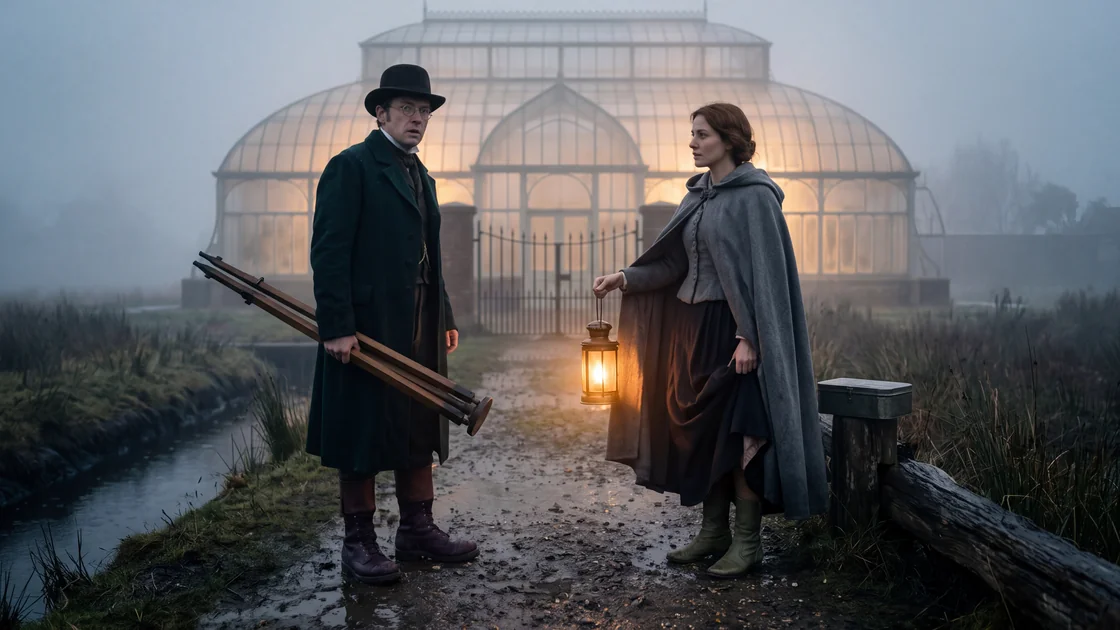
The Marsh Road had no houses. It had only the drainage canal on one side—full of black, stagnant water that smelled of dead rushes—and on the other, the immense, looming bulk of the conservatory, its glass roofs white and luminous under the mist, looking like the rib-cage of a stranded whale.
Julian walked along the edge of the ditch.
His boots were happy. They moved with a smooth, silent ease that made him feel as if he were skimming over the mud.
Then, fifty yards ahead of him through the white wool of the fog, he saw a light.
It was not a street-lamp; there were no lamps within a mile. It was a hand-lantern, swinging low near the ground, its rays revealing a pair of skirts—gray frieze, pinned up with brass pins—and beneath them, a pair of boots.
The boots were willow-green.
Julian stopped.
His right boot—the one with the marsh-flax in the grain—gave a sudden, unmistakable lurch. It was not a physical slip; it was an inward leap, like a dog that has heard the latch of the yard gate lift.
The woman with the lantern stopped too.
She was standing twenty paces from him, by the low iron gate that led into the conservatory’s potting yards. The fog was so thick between them that he could see only her silhouette—the round hood, the narrow shoulders, the lantern casting long, yellow spokes across the ditch-water.
"Who is that?" Julian called out. His voice was sharper than he had intended; it cracked in the wet air.
The woman did not scream. She did not run.
She raised the lantern until its yellow beam struck his face.
Julian blinked behind his wire spectacles. He saw a face he had never seen before—pale, calm, with gray-green eyes that looked at him not with fear, but with the quiet, devastating scrutiny of someone who was accustomed to looking at the underside of leaves for scale-insects.
"You are Mr. Vane," she said.
Julian stared. "How do you know my name?"
"Your boots," she said, lowering the lantern three inches until its beam fell upon his feet. "They are the elderberry calf. Mr. Finch had them on his bench when I went for my measurement."
Julian looked down at his own feet, then at hers.
Her boots were the willow-green pair he had seen resting on Finch’s cutting board—the ones he had dismissed as the work of an eccentric leather-carver for some farmer’s wife.
"You," Julian said, his brain struggling to assemble a chain of cause and effect that did not reduce him to an idiot. "You are the woman who works for Crane."
"I am Clara Hallowell," she said.
They stood three yards apart on the Marsh Road.
The wind had died completely. The only sound in all of Oakhaven was the faint, rhythmic chug-chug-chug of the municipal drainage engine two miles away in the fen, and the drip of the water from Clara’s lantern-rim onto the wet grass.
"My boots," Julian said, clearing his throat, "have a defect in the welt. They have brought me here four times this week."
Clara looked at his boots. Then she looked up into his face.
"Mine have no defect," she said softly. "They are stitched true. But they have brought me here too."
"Why?" Julian asked.
Clara did not answer immediately. She set the lantern down upon the top rail of the iron gate. The yellow light spread out between them, making a small circle of dry, amber ground in the middle of the wet marsh.
"Mr. Finch asked me," she said, "if I walked where I wished to go. I told him there was nowhere else to go but my room and the glasshouses."
"A rational answer," Julian said. "The only rational answer."
"It was not an answer at all," she said. "It was an excuse. I was afraid of the road."
Julian felt his collar growing tight. He took off his beaver hat and held it against his stomach. His hair, which was thin and graying at the temples, was damp with the mist.
"I am forty-two years old, Miss Hallowell," he said, speaking as if he were reading an inventory of government stores. "I have no family. I live in rooms over the Trinity Office. I have three hundred books, all of them dealing with trigonometry, hydrography, and the variation of the tides. I do not like poetry. I do not like company. I am very particular about my breakfast bacon."
Clara looked at his hat. "I am thirty-four. I have lived alone since I was twenty-four. I have eighty-two varieties of fern in the glasshouse, and I know the names of all of them in Latin, and none of them can speak a word when the frost gets into the pipes."
She paused.
"And," she added, "I have spent three days attempting to turn my ankles toward the church in the fish-market, and my boots have nearly broken my shins because they wished to be here."
Julian looked down at his elderberry calf.
The right boot was quiet now. It was resting upon the mud with a flat, relaxed certainty that he had never felt in any piece of leather in his life. It was not pulling. It had arrived.
"He is an intolerable old villain," Julian said, but his voice lacked conviction.
"He is," Clara agreed. "Mr. Crane said he was."
"Would you," Julian said, hesitating, his hand going to his wire spectacles to push them up his nose, "would you permit me to carry that lantern as far as the High Street? I believe... that is to say, my boots seem to have no objection to the High Street, provided we go by way of the canal path."
Clara looked at him for three long seconds. The lantern-light showed the fine lines around her mouth—not lines of bitterness, but lines of patience, of waiting for seeds to break through three inches of cold leaf-mould.
"The canal path is very dark," she said.
"I have excellent eyes," said the hydrographer. "I have surveyed it twice."
"Then you had better take the lantern," she said, handing it to him. "Your boots have triple soles, Mr. Vane. Mine are only willow-calf, and the gravel on the canal bank is sharp."
Chapter VIII: The Box Under the Floorboards
In the shop on St. Jude’s Lane, Barnaby Finch sat by a cold hearth.
The oil in the hanging lamp had burned down to the wick; it was sputtering with a dry, clicking sound, sending up small threads of greasy soot that smelled of rape-seed.
He did not light another candle.
He sat with his knees apart, his apron still on, his hands resting upon his thighs.
For four hours he had listened to the city.
He knew its night-sounds as an old pilot knows the sound of the surf on the outer shoals. At ten, the dray-horses had stopped their clatter. At eleven, the revellers from the Harp and Anchor had shouted their drunken songs down by the slipway and been silenced by the fog. At twelve, the night-mail had rattled over the bridge, its four horses blowing steam like whales.
And then—silence.
The heavy, cold silence of a town wrapped in three miles of sea-mist.
Except for two treads.
They were very far away—nearly two miles distant, out by the canal bridge—but Barnaby heard them through the soles of his old slippers, through the oak floorboards, through the very piles that supported the shop above the river-clay.
A heavy tread: Thud. Thud. Thud. Triple-soled ox-hide, wood-pegged, striking the earth with the deliberate, stubborn certainty of a man who has ceased to fight the compass.
And beside it, a lighter tread: Step. Step. Step. Willow-calf, quiet as a deer in the bracken, matching the cadence stride for stride, two inches shorter, but never falling behind.
Barnaby closed his eyes.
A long, slow breath went out of him—a breath he seemed to have held since the twenty-fourth of November.
"They have met," he whispered.
He rose from his stool. His joints were stiff; his hip gave a dry, grinding click that made him catch his lip with his teeth.
He walked behind the counter. He took his broad pairing-knife—the one he used only for splitting sole-leather—and knelt upon the floorboards behind the cedar-chest.
There was a board there that had no nails. It was held only by the tight fit of the tongue-and-groove. He inserted the thin blade of the knife into the seam, levered it upward with a sharp jerk, and lifted the oak plank.
Beneath it lay a cavity between two joists, filled with dry sawdust to keep out the river-damp.
And in the sawdust lay a pair of boots.
They were old. They were forty years old if they were a day.
They were made of white horse-hide—the leather that shoemakers call cordovan, taken from the flat muscle of the rump—tanned with alum and oil until it was white as bone. But they had not been greased for thirty years; the white hide was yellowed, cracked like old porcelain, and covered in a fine, powdery bloom of gray mould.
The welts were stitched with nine to the inch. Barnaby had stitched them when his eyes were sharp and his fingers could split a hog’s bristle into three parts.
They were his size.
He reached down and lifted them from the sawdust. They were light—strangely light, as if the leather had lost its substance over the decades and become nothing more than the dried husk of a grasshopper.
He laid them upon the counter beside his awl.
He sat upon his stool, took a rag from the dubbin-pot, and began to wipe away the mould.
"You were a proud piece of work," he said to the white boots. "You were going to walk to Yarmouth. You were going to find her among the fish-casks, and you were going to stand before her door until she had to open it."
The leather was stiff. It crackled under his thumb like parchment.
He had never put them on.
He had built them in three days after Martha had run away in her stocking feet. He had bored the hole in the beechwood last; he had put into it three hairs from her comb that he had found upon the settle, and a scrap of blue ribbon she had dropped in the lane.
He had finished them on a Sunday morning while the bells of St. Jude were calling the righteous to sit in their high box-pews.
He had sat upon this very stool, with the boots in his lap, his fingers on the laces.
And he had realized:
If he put them on, they would take him to her.
And she would open the door. And she would look at his feet, and she would see the white horse-hide, and she would know that he had used the craft to hunt her down like a hare in a gap.
She would not see Barnaby. She would see the trap.
He had taken the laces out. He had wrapped the boots in an old sail, lifted the board behind the cedar-chest, and dropped them into the sawdust.
And for thirty-eight years he had stayed in St. Jude’s Lane, making boots for people who were blind, or stupid, or lonely, using his thread to give them the one thing he had denied himself: the courage to be found.
The rag moved slowly over the leather. The white horse-hide did not take the grease well; the oil sat upon the surface in yellow beads, refusing to sink into the dead pores.
"You are too old," Barnaby told the boots. "The marrow has gone out of you. If a man tried to walk to the corner in you now, the welt would snap at the first gutter."
He laid the rag down.
He looked at his own feet. He was wearing slippers made of carpet-scraps, bound with wool tape—shuffling, miserable things that an old man wore to save his corn-plasters.
He picked up the white boots.
He did not put them on. He took his pairing knife, laid the boots upon the cutting block, and with three quick, deep strokes—his wrist still strong enough to sever an ox-tendon—he sliced through the outsoles, through the welts, through the beechwood shanks, until the shoes fell into four pieces of yellowed leather and dry thread.
From the hollow heel of the right boot, three small objects fell onto the oak block:
A pinch of black, dried dust that had once been geranium petals. A withered white hair. And a scrap of faded blue silk, no larger than a ladybird’s wing.
Barnaby did not pick them up. He blew them with a single breath.
They drifted across the cutting board, fell into the wood-shavings by the hearth, and were lost among the curled shavings of Julian Vane’s beechwood last.
Chapter IX: The Sounding of the Shoals
Spring did not come to Oakhaven with flowers; it came with wind.
It came with a great, roaring gale from the southwest that blew the coal-smoke out of the lanes, tore the tiles from the roof of the Custom House, and sent the river-tide six feet over the high-water mark, drowning the cellar-kitchens along the quay.
On a morning in April, when the sky was a hard, brilliant blue like new-broken flint, Julian Vane walked along the South Spit.
He did not walk alone.
Beside him walked Clara Hallowell. She was not wearing her gray frieze cloak; she wore a coat of dark blue wool, and on her head was a straw bonnet tied with a green ribbon that matched her boots.
Her willow-green boots were no longer new. They were stained with salt-lines around the welts; the toes were scuffed from the flint of the canal bank; the green had deepened to the color of river-moss after a hard winter.
Julian’s boots were battered. One of the brass eyelets had pulled out, and he had replaced it with a ring of copper wire twisted with his survey pliers. The elderberry calf had turned almost black from six months of daily greasing with mutton-tallow and neatsfoot oil.
Julian carried his level upon his shoulder like a fowling-piece. Clara carried an oblong tin box with perforated lids, inside of which three dozen small marsh-ferns were bedded in damp sphagnum moss.
They reached the end of the Spit—the place where the river Oakhaven lost its name and became the sea.
The tide was out. A half-mile of wet, brown sand stretched before them, ribbed by the waves into thousands of tiny parallels, shining in the cold April sun like sheets of beaten copper.
Julian set his tripod into the sand. He leveled the brass plate with three turns of his screws, looked through the telescope toward the buoy that marked the outer shoal, and took his notebook from his pocket.
He wrote three numbers.
Then he looked at Clara.
She had set her tin box upon a dry balk of driftwood. She was kneeling on the sand, her skirts tucked between her knees, looking at a small, translucent sea-anemone that had been left behind in a pool between two stones.
Her willow boots were three inches from his triple-soled calf.
They did not pull.
The sensation had vanished three months before. It had died quietly, on an evening in January when they had sat together in Clara’s room above the baker’s, with a dish of salt herrings between them and a chart of the river spread out upon the bed.
The boots were no longer snares.
They were simply leather. They were five pounds of cured hide, hornbeam pegs, and waxed thread that kept the cold water from their feet.
"The shoal has shifted ninety yards to the south," Julian said.
Clara did not look up from her pool. "Is that good?"
"It is neither good nor bad," Julian replied. "It is what the water does. The Trinity Board will have to move the buoy. If they do not, the Dutch galliots will go ashore on the sand-bar before the month is out."
Clara touched the edge of the pool with her finger. The sea-anemone closed its pink tentacles, becoming a small, shiny button of jelly.
"Mr. Crane has given me notice," she said.
Julian’s pencil stopped above his notebook. "Notice? Why?"
"He says the conservatory is to be sold to the railway company. They are going to run the line from Hull through the marsh. The glass is to be pulled down."
Julian adjusted his spectacles. He looked through his level again, though he had already verified the cross-hairs.
"I have been offered the post of Chief Surveyor for the Humber Conservancy," he said to the brass barrel of the instrument. "It includes a house at Paull. It has six rooms, an orchard of three-quarters of an acre, and a brick wall that faces south. The garden is entirely uncultivated. It is full of couch-grass and dock."
Clara stood up. She wiped the wet sand from her fingers with her handkerchief.
"Couch-grass is very difficult to eradicate," she said. "The roots go down eighteen inches. One has to turn the soil with a four-pronged fork and pick them out by hand."
"I have six survey chains and three spades," Julian said. "And the house is forty yards from the high-water line. You can hear the gulls from the bedroom window."
Clara looked out across the brown sand toward the buoy. The sea was blue-gray, cold, and wide—infinitely wider than the twenty-eight hundred yards between Friar’s Gate and the municipal glasshouse.
"I shall need a sturdier pair of boots for the orchard," she said. "The alder-calf is too light for digging."
"Finch," Julian said with a small, dry smile that reached his eyes for the first time in ten years, "would charge you twelve shillings and give you a lecture on the depravity of the railway system."
"Finch," said Clara, "is dead."
Chapter X: The Empty Stool
Julian lowered his pencil. "Dead? When?"
"On Thursday," Clara said. "The girl who brings his milk found him. He was sitting upon his low stool with his apron on, his head resting against the counter. He had a pair of children’s shoes on his lap, half-welted."
They were silent. The wind came off the sand, bringing the sharp, iodine smell of the low-water banks.
"Did he have family?" Julian asked.
"None," she said. "The parish is to bury him tomorrow at Saint Jude’s. Mr. Crane went to the shop to see if there were any accounts owing. He said the shop was full of old lasts—hundreds of them, each one with a name written on the heel with ink. He said there was one with your name, and one with mine."
Julian picked up his tripod. He folded the three legs together with a hollow clatter of brass and ash-wood.
"We will go to the shop," he said.
They walked back together along the South Spit.
They did not take the canal path. They took the High Street. Their boots struck the flags in a steady, unhurried unison that made the clerks in the bank look up from their ledgers as they passed. It was the tread of people who knew precisely where they were going, even if the road was new.
St. Jude’s Lane was dark, even in the April noon. The high brick walls of the warehouses kept out the sun, and the mud between the cobbles was still black and wet.
The sign above the door was gone. The parish beadle had taken it down that morning to prevent it falling upon the heads of passers-by; it stood against the wall, its lichen-filled letters obscured by dried mud: B. Finch, Cordwainer.
The door was not locked. In Oakhaven, when an old tradesman died without kin, his shop remained unlatched until the bailiff had taken the inventory for the town council.
Julian pushed the door open. The brass bell gave its old, familiar clink.
The smell was the same: oak-gall, dubbin, leather-shavings, and the dry, sweet scent of seasoned beechwood. But the fire was cold. The white ashes lay undisturbed in the grate, and a spider had already begun to spin its web between the teeth of Barnaby’s iron rasp.
Upon the cutting block lay a single pair of boots.
They were small—made for a boy of seven or eight—rough-stitched from split cowhide, unfinished at the heel. Beside them lay Barnaby’s awl, its horn handle worn thin by forty years of thumb-pressure, its steel point stuck an eighth of an inch into the oak to keep it from rusting.
Clara walked to the racks where the lasts were kept.
They were arranged in rows like skulls in a catacomb: long lasts, short lasts, lasts with bunion-plates screwed to the joints, lasts with high, arched insteps that had belonged to the town dandies of forty years ago.
She found hers on the third shelf.
It was beechwood, grayed by the oil of Barnaby’s hands. On the flat of the instep was written in Barnaby’s broad, uneven hand:
Clara Hallowell. Narrow. A straight walker who looks at the ground.
Beside it sat Julian’s last.
Julian Vane. High arch. A man who thinks his feet belong to the Trinity Board.
Julian came and stood behind her. He reached out his hand and touched the two blocks of wood.
He looked at the bottom of his own last. In the center of the arch, beneath the beech-grain, he saw the small, circular plug of willow-wood where Barnaby had bored his hole six months before.
He took his pocket-knife—a small, horn-handled knife he used for sharpening survey pencils—and opened the blade.
"What are you doing?" Clara asked.
Julian did not answer. He dug the point of the blade into the soft willow plug. It resisted, then gave way with a small crunch. He levered the wood out.
The cavity was empty.
There was no magnetic sand. There was no water from the fen. There was no mustard seed.
There was only a small curl of dry wood-shaving, left behind by the auger when Barnaby had bored the hole, and the dry, sweet smell of the seasoning shelf.
Julian stared into the three-eighths-inch hole.
He tapped the last against the palm of his hand. Nothing fell out.
He reached for Clara’s last. He dug the plug from her beechwood arch with the same quick, nervous twitch of his wrist.
It was empty too.
Clara looked at the two empty holes. Then she looked down at her own feet—at the willow-calf boots that had carried her through the snow, through the ditch-water, through the cold mud of the canal path to the Marsh Road.
She looked at Julian.
Her eyes were wide, and in the yellow gloom of the cold workshop, they were green as the leaves of the Monstera when the sun broke through the glass dome.
"There was nothing in them," she whispered.
Julian stood with the two beechwood lasts in his hands. His knuckles were white. His wire spectacles had slipped down his nose, but he did not push them up.
He looked at the bench—at the low oak settle where he had sat six months before, cursing the mud on his town boots; at the sand box in the corner, its yellow grains still holding the faint, blurred impression of someone’s heel; at the empty hearth where Barnaby had burned his sheep-tallow candles.
"No," Julian said. His voice was very quiet—not the voice of the Hydrographer to the Trinity Board, but the voice of a man who has looked through forty feet of green water and seen the bottom of the channel. "There was the leather."
"And the stitch," Clara said.
"And the road," said Julian.
He laid the two lasts back upon the shelf, side by side, their beechwood toes touching, their empty auger-holes facing the dark wall.
He walked to the cutting block. He picked up the small bone folder—the horn tool that Barnaby had used to smooth the seams—and slipped it into his waistcoat pocket beside his brass dividers.
"We will go to Paull tomorrow," he said.
"Yes," she said.
They turned toward the door.
Julian did not look back. He opened the unlatched door, held it for her, and followed her out into the wet light of St. Jude’s Lane.
Behind them, in the dark shop, the wind from the river came down the chimney, blowing a handful of white ash from the cold grate across the oak floorboards. The brass bell gave one last, faint clink as the latch caught, and then was still.
Outside, upon the flags of the alley, their four boots struck the stones together—a heavy tread and a light tread, double-soled and willow-calf—moving away from the river, away from the old lane, out toward the high, sunny turnpike that led through the salt-meadows to the wide Humber and the open sea.