The Sovereign Board
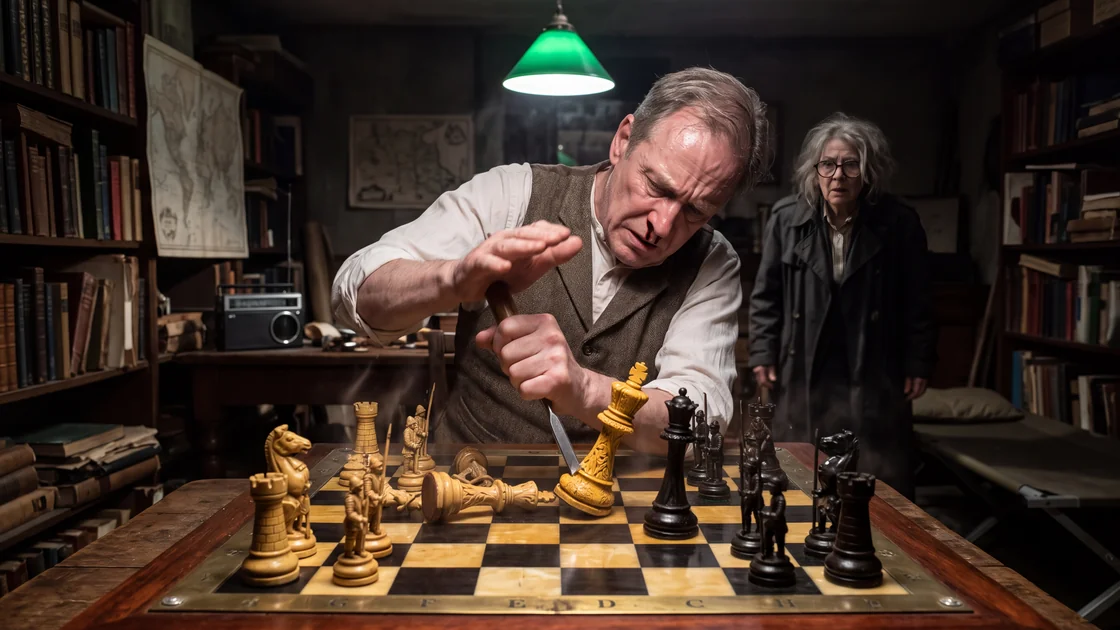
When Arthur Pendelton, an aging dealer of rare antiquities in London’s Mayfair, acquired an eighteenth-century ivory and bog-oak chess set from the estate of a reclusive Cold War diplomat, he believed he had simply found the crowning centerpiece for his catalog; instead, he uncovered an impossible mechanism whose intricately carved pieces glided across the polished squares in tandem with real, undeclared military skirmishes across the globe, transforming his quiet backroom into a silent war room where every phantom move presaged the fall of cities and forced him to confront the horrifying realization that he was no longer merely a spectator to history, but its custodian.
Act I: The Estate in the Weald
The rain over West Sussex did not fall so much as hang, suspended in the cold October air like a shroud woven from damp wool and chimney smoke. Arthur Pendelton adjusted the collar of his tweed overcoat, his leather-soled brogues crunching softly over the gravel drive of Highfield Manor.
The house was an Edwardian monstrosity of red brick and sullen gables, surrounded by neglected yew hedges that had long since grown out of their ornamental shapes, taking on the hunched silhouettes of gargoyles. It had belonged to Sir Julian Vance, a man whose career had existed entirely within the classified footnotes of Her Majesty’s Foreign Office. Vance had served in Vienna in 1953, in Nicosia in 1960, and in Islamabad during the long, shadow-draped autumn of 1979. He had died three weeks prior, unmarried, friendless, and intestate, leaving behind a house choked with five decades of diplomatic plunder.
"Most of it is junk, frankly," said Henderson, the estate solicitor, jiggling a brass key in the stiff lock of the front door. Henderson was a thin, wheezing man who smelled faintly of lozenges and stale paper. "Vance was a hoarder of sorts. Books, survey maps, consular reports that ought to have been pulped in Whitehall, and trunks from postings nobody remembers. The Crown took what it wanted from his papers. The rest is for the auctioneer’s hammer—or for you, if you see anything worth sparing the cataloguer's trouble."
Arthur smiled politely, his breath misting before him as the heavy oak door gave way. "The best things are usually found in the rooms the cataloguers find too dreary to inspect, Mr. Henderson."
Arthur’s business, Pendelton & Finch, Antiquarians, occupied a narrow, bow-fronted shop on Cecil Court, just off Charing Cross Road. For thirty-five years, Arthur had traded not in gilded ostentation, but in provenance. He possessed an instinct for the quiet history of objects: the microscopic scratches on a silver snuffbox that betrayed a nervous general at Waterloo; the peculiar ink-stains on an astronomer’s desk that spoke of sleepless nights in Prague. He had survived the digital age by catering to a dwindling caste of collectors who believed that matter retained memory.
They walked through damp corridors lined with water-stained engravings of the Levant, through a dining room where dusty Venetian glass clinked in sympathy with their footsteps, and up a secondary staircase to what had once been Vance’s private study.
The room was circular, perched within the house’s modest tower. Tall, narrow lancet windows looked out over the dripping Sussex woods. The walls were lined with bookshelves that reached to the ceiling, their contents stripped, leaving only rectangular ghosts of unfaded wallpaper. But in the center of the room, standing upon a low table of solid Jacobean walnut, sat the table Arthur had traveled sixty miles through the gloom to see.
"That," Henderson said, waving a limp hand toward it, "was specifically noted in the Foreign Office inventory, but marked non-classified, personal chattel. Heaven knows why he kept it under a dustsheet."
Arthur approached the table. He did not pull the linen cloth away immediately. He stood before it, listening to the drum of rain against the glass, letting the room yield its silence. When he finally lifted the yellowed cotton, he drew in a sharp, involuntary breath.
It was an ivory chess set, though the description in Henderson’s brief did it a profound injustice. The board was housed in a shallow cabinet of weathered padauk wood, approximately two and a half feet square. The surface was an alternating mosaic of fossilized mammoth ivory, polished to a milky, translucent honey, and deep, lustrous panels of jet-black fossil wood.
Around the perimeter ran a broad border of incised brass, engraved with an intricate network of cartographic coordinates, zodiacal symbols, and Latin mottoes in a dense, seventeenth-century humanist script. The corner plates were pinned with heavy, hand-beaten silver rivets shaped like coiled serpents.
Upon the sixty-four squares stood the thirty-two pieces.
Arthur leaned closer, his magnifying loupe already in his fingers. They were not made of ivory alone; they were a startling synthesis of materials. The white army was turned from dense, unblemished Narwhal horn and pale birch, each piece standing upon an octagonal base of lead-weighted boxwood. The black army was carved from Ukrainian bog-oak—wood pulled from riverbeds where it had cured in oxygen-starved mud for three millennia, harder than iron, its grain like petrified smoke.
The craftsmanship was terrifyingly precise. These were not the stylized, abstract Staunton figures of modern tournaments, nor the clumsy allegories of folk craft. They were portraits of statecraft.
The White King was depicted as an enthroned emperor whose face, scarcely half an inch high, bore the unmistakable weariness of an autocrat whose edicts were written in iron; his crown was a band of beaten silver, and his miniature scepter ended in a terrestrial sphere. The Black King was an austere, hooded sovereign, his mantle drawn tight, his countenance hollowed by ascetic malice.
The Pawns were foot soldiers: the Whites carried arquebuses and pikes, their faces distinct from one another—some terrified, some resolute, some sneering; the Black pawns were irregulars, bearded and cloaked, bearing scythes and matchlocks, carved with an organic ferocity that made Arthur’s thumb hesitate before touching them.
"Remarkable," Arthur whispered, his loupe roving over a White Knight—a rearing warhorse whose flared nostrils showed microscopic veins carved into the wood. "Late seventeenth century, perhaps early eighteenth. Northern European. Possibly Baltic. Look at the tooling on the carapaces of the rooks; they aren't castles, Henderson. They're star-forts. Vauban bastions."
"Fascinating, I'm sure," Henderson murmured, checking his gold pocket watch. "Can we put a number to it, Arthur? The probate court has no sentiment for bastions."
Arthur straightened his back, hiding the tremor in his fingers. In the world of rare antiquities, hunger was an amateur’s error; one had to feign mild curiosity in the presence of masterpieces, lest the executor realize what he held.
"The padauk casing has some shrinkage at the joints," Arthur said, his tone dry and clinical. "And the ivory shows hair-line craquelure along the southern rank. It is an eccentric piece, hard to place with the usual tournament collectors. But the craftsmanship is undeniably fine. I can offer twelve thousand pounds for the set and the table it rests upon, subject to my examining the underside for a maker’s mark."
Henderson’s eyes widened slightly. Twelve thousand was clearly double what he had expected from a local auction house. "Twelve thousand? Payable upon collection?"
"A certified draft this afternoon," Arthur said. "Provided you allow me to pack it myself. I have velvet-lined crates in the boot of my Rover."
Twenty minutes later, Arthur knelt before the table with a penlight, peering into the shallow underside of the padauk box. There was no maker’s mark, no label from a Nuremberg guilds-man or a Paris artisan. Instead, flush with the wood, was a small, circular medallion of tarnished bell-metal. Inscribed upon it was a single Latin sentence, encircling a relief of a broken compass:
LUDUS NON VERBA SED SANGUIS EST.
The game is not words, but blood.
Arthur felt a sudden, inexplicable prickle of cold at the nape of his neck. Outside, a branch of the overgrown yew whipped against the lancet window, sounding like knuckles rapping sharply upon the glass.
Act II: The First Opening
The basement workshop of Pendelton & Finch was Arthur’s sanctuary. Here, forty feet below the rumbling buses of the Strand, the smells of refined beeswax, hide glue, rectified turpentine, and century-old dust formed an atmosphere as predictable and safe as a monastic cell.
For three days after returning from Sussex, Arthur did not touch the board. He had installed it upon a sturdy oak trestle in the center of the study behind the showroom. A heavy green baize lamp hung directly above it, casting an oval pool of emerald light over the squares.
He had cleaned the ivory with dry sable brushes, refusing any solvent that might disturb the faint, yellowed patina that had settled into the grain over three centuries. He used a tiny air-bulb to clear the grit from the crevices of the pawns’ matchlocks and the rooks’ embrasures.
The pieces were set in their standard starting positions. The White army occupied the first and second ranks along the southern edge, its king centered on e1; the Black army glared across the board from the seventh and eighth ranks, its sovereign rooted on e8.
It was on a Tuesday evening, the twenty-fourth of October, that the first disturbance occurred.
Arthur had closed the shop at six. He had dined on cold roast beef and half a pint of bitter at the Salisbury, returned to his rooms above the shop, and spent an hour reading through Sir Julian Vance’s sparse biographical file, which a friend at the Foreign Office library had quietly photocopied for him.
The file was curiously blank for a man who had held the rank of minister-plenipotentiary. It contained dozens of long sabbaticals labeled simply Special Duties: Cartographical Service. Vance had been present in Budapest in November 1956; he had been registered at the British mission in Dacca in December 1971; he had spent the summer of 1982 in the South Atlantic, aboard a fleet auxiliary vessel whose movements were still sealed under the Official Secrets Act.
At ten o’clock, Arthur came downstairs in his dressing gown to fetch a book on Renaissance automaton mechanics from his office shelves.
He did not turn on the main chandeliers, relying instead on the green glow of the baize lamp above the chess table. As he passed the table, he stopped dead.
He had set the pieces with surgical precision forty-eight hours earlier. He knew the alignment of every base; he was an antique dealer whose living depended upon spatial memory. The grain of the wood under each piece had been aligned north-to-south.
The Pawn at e2 was no longer on e2.
It sat squarely in the center of the e4 square.
Arthur stood rigid, his hand hovering over the edge of the board. The room was utterly still, save for the dull, subterranean thrum of the Northern Line far below the foundations.
"Nonsense," he said aloud. His voice sounded thin, foolish in the vault-like quiet.
He leaned over the table. The white pawn—a young arquebusier with a leather jerkin and a resolute, upturned chin—stood plumb in the center of the ivory tile. There were no scratches in the wax, no tracks in the microscopic film of dust that coated the jet-and-ivory veneer.
Arthur looked at the locks on the heavy mahogany door leading to the street: double-bolted, the mortise set. The window grates in the rear lightwell were padlocked from the inside.
Had he moved it himself?
He rubbed his temples. He was sixty-two years old. His memory, though sharp for auction lots and watermarks, had begun to show those tiny, frightening seams of fraying that come with age: a misplaced set of keys, a teapot left cold on the trivet. Perhaps, while lost in thought about Vance’s file, he had walked over, fingered the piece, and executed the standard King’s Pawn opening without registering the act. It was the natural move for any player trained in the Classical school.
He reached down to pick up the pawn and return it to its square.
The moment his skin touched the carved Narwhal horn, a sharp, metallic vibration passed into the bone of his index finger. It was not an electric shock; it was the sensation of touching a tuning fork that had been struck a mile away—a high-frequency, icy resonance that seemed to whistle through his marrow.
Simultaneously, an odor flared in his nostrils: sharp, hot, and instantly recognizable to anyone who had lived through the Blitz.
Cordite. Burned diesel. Wet lime.
Arthur jerked his hand back with an involuntary cry. The pawn remained on e4, unmoved, utterly inert.
His heart hammered against his ribs like a bird caught in an attic. He backed away from the table, hit the switch for the overhead lights, and flooded the room with clinical yellow brilliance. The board looked magnificent, pristine, and dead.
He sat in his leather armchair until two in the morning, watching the table. Nothing moved. The room smelled only of old calfskin and floor polish. Eventually, chiding himself for an old man’s vapors, he went up to bed, leaving the pawn on e4.
At dawn, Arthur was awakened by the paperboy sliding the morning editions through the letterbox. He went down in his slippers, picked up the Times, and carried it to the kitchen to boil the kettle.
He unfolded the broadsheet on the oilcloth table. The headline across the front page, printed in bold, leaden type, arrested him mid-breath:
SURPRISE INCURSION IN THE SOUTHERN STEPPE Artillery Barrage Shatters Armistice Along the Vardar Salient; Mechanized Brigades Advance Twenty Kilometers Overnight.
Arthur dropped his teacup. It did not break, but spilled a brown ribbon across the kitchen table.
He read the dispatch with wild, darting eyes. At 21:45 Greenwich Mean Time—precisely fifteen minutes before he had come downstairs to fetch his book—an armored force under an unnamed regional command had launched an unprovoked offensive across a disputed river boundary in Eastern Europe, shattering five years of frozen negotiations. The military operation, the correspondent noted, had been executed with classical simplicity: an opening thrust through the central plains, aimed directly at the regional capital.
The military code-name for the offensive, intercepted from tactical radio nets and quoted by the Ministry of Defence, was Operation White King.
Act III: The Logic of the Squares
Arthur did not open the shop that day. He turned the sign on the glass door to CLOSED, drew the heavy velvet curtains across the front windows, and locked himself in the backroom.
He sat before the board with a pad of graph paper, three reference atlases, and a portable radio tuned to the BBC World Service.
For forty-eight hours, nothing changed. The arquebusier stood alone on e4, gleaming beneath the baize lamp. On the radio, commentators spoke in breathless, grave cadences of diplomatic ultimatums, emergency sessions of the Security Council in New York, and the mobilization of reserves.
Then, on Thursday at 3:12 in the afternoon, while Arthur was sitting at his roll-top desk writing up an invoice, he heard a sound.
It was faint, no louder than the click of a fingernail against bone.
He spun around in his swivel chair.
The Black Pawn at c7—a squat, bearded irregular carved with an axe over his shoulder—was no longer on c7.
It stood upon c5.
The Sicilian Defense.
Arthur did not touch the piece. He gripped the edge of the trestle table with both hands, his knuckles turning white, staring at the square.
The air in the room had cooled dramatically, dropping three or four degrees in an instant. The green-shaded lamp swung microscopic fractions of an inch, though there was no draft.
He leaned close to the c5 square. He could see no clockwork, no track in the padauk wood, no magnets beneath the ivory. The piece had not slid; it had simply ceased to be on its home square and had reappeared two ranks forward, its carved bog-oak face turned slightly toward the white center.
Arthur reached for his pen. His hand was shaking so violently he could barely hold the nib to the page.
Move 1: e4 — c5. Time: Thursday, 15:12 GMT.
He turned up the volume on the portable radio. For two hours, there was only the routine hum of market reports and classical interludes. Then, at 17:30, the programming was interrupted.
"We interrupt this broadcast to bring you a special bulletin from the Foreign Office. Reports from the Vardar basin indicate that the defending forces have refused a general engagement on the plains. Instead, an asymmetric counter-offensive has been launched through the western marshlands, threatening the supply lines of the advancing Northern column. Military analysts in London describe the counter-stroke as an unorthodox, highly aggressive flank attack..."
A flank attack. The Sicilian. The most combat-heavy, asymmetrical defense in the history of the game.
Arthur sank into his chair, the room spinning around him.
The board was not a novelty. It was not a clockwork toy from the Enlightenment, nor a clever parlor trick engineered with lodestones and concealed iron plates.
It was an engine of synchronization.
He picked up Vance’s diaries again, his eyes scanning the cryptic notations with an entirely new understanding. He flipped to the pages Vance had written in 1962, during the Cuban Missile Crisis.
There were no political musings in the entries, no names of ministers or ambassadors. There were only rows of algebraic chess notation:
Oct 22: Nf3 — d6 Oct 24: d4 — cxd4 Oct 27: Nxd4 — Nf6 Oct 28: Nc3 — a6. Board stilled. Hand stayed.
Below the final line, Vance had written in red ink: The King stepped back from the rank. The world breathed. God preserve us from the White Queen.
"He didn't just watch it," Arthur whispered into the empty shop. "He monitored it. He was the watcher."
Arthur stood up and began pacing the narrow perimeter between the bookshelves and the filing cabinets. The implications rose before him like an abyss.
Who moved the pieces?
Were the world’s leaders—the generals in their concrete bunkers, the presidents leaning over green felt maps, the tank commanders peering through periscopes—merely biological transistors executing the cold, inevitable logic of these thirty-two figures? Or were the figures responding to the collective will, the violent pressure of millions of minds leaning into slaughter?
And more terrifying still: what happened if someone touched the board?
Arthur looked down at the white pawn on e4.
If the game was currently in progress, what would happen if he, Arthur Pendelton, dealer in scrap paper and dead men’s sideboards, reached out his hand and picked up that pawn?
He reached out his right arm. His fingers hovered two inches above the arquebusier’s silver helmet.
Instantly, a sensation of suffocating weight descended upon him. The room went silent—not the silence of an empty shop, but the vacuum-like silence of a high altitude. The smell of burning rubber and ozone flooded the room so fiercely that his eyes watered. A low, vibrating hum began in the floorboards, rising through the soles of his shoes, into his pelvis, into his teeth.
It felt as though the atmospheric pressure of an entire continent were concentrated upon that single ivory square.
He pushed his fingers downward, straining against an invisible, viscous resistance, as if trying to force two like poles of enormous, planetary magnets together.
One inch.
His breath caught in his throat. In his ears, he heard not the traffic of the Strand, but a sound like thunder rolling over a vast steppe: the squeal of steel tracks, the guttural screaming of men in languages he did not know, the distant, dull whump of high-explosive shells impacting frozen ground.
Half an inch.
A sharp, searing pain shot up his wrist. A blood vessel in his right eye burst with a soft pop, filling his field of vision with a red crescent.
"Stop," he choked out, speaking to the air, to the room, to the padauk box. "Stop."
He pulled his hand back.
The pressure vanished instantly. Arthur collapsed to his knees, gasping for air, clutching his trembling wrist to his chest. The floor was solid beneath him. The radio was playing Elgar. The pawn remained on e4, silent, immovable, eternal.
Arthur lay on the Persian rug for several minutes, his chest heaving, his face slick with cold sweat.
You could not interfere. You could only watch.
Act IV: The Expert
Arthur knew he could not carry the secret alone.
He was a merchant, not a philosopher, and certainly not a strategist. If he kept this vigil in the dark, he would either lose his sanity or suffer a stroke upon the carpet.
The following morning, he telephoned Dr. Miriam Sterling.
Miriam was an emeritus fellow of the Warburg Institute, an authority on Renaissance hermeticism, and perhaps the only person in London who knew more about the occult cartography of the seventeenth century than Arthur himself. She was seventy, possessed a mind like a razor-strop, and lived in a house in Bloomsbury that was so overburdened with books that the floorboards had been reinforced with steel girders.
"Arthur," she said through the receiver, her voice crackling with forty years of chain-smoking. "If you are calling about that fraudulent John Dee scrying glass from the Sotheby's sale, don't waste my time. It was Belgian glass, eighteenth-century, and poorly polished at that."
"It isn't John Dee, Miriam," Arthur said, his voice quiet, flat, and urgent. "I have something here. An object from Julian Vance’s estate."
There was a long pause on the line. The crackle of her lighter was distinctly audible.
"Vance?" she asked, her tone entirely changed. "Julian Vance is dead?"
"Three weeks ago. I bought the chess board."
Another pause, so long Arthur thought the exchange had disconnected them.
"I will be there in thirty minutes," Miriam said. "Do not move the pieces. Do not put any metal near it. And for God’s sake, Arthur, keep the door locked."
She arrived not in thirty minutes, but in twenty, stepping out of a black cab with an oversized leather satchel and a silver-tipped cane. She swept through the shop door without greeting him, her gray hair pinned in a ferocious knot, her trench coat smelling of damp wool and Balkan Sobranie tobacco.
Arthur led her down to the study.
The moment she saw the table beneath the green baize lamp, she stopped. Her hand tightened on the crook of her cane until the veins showed blue through the paper-thin skin.
"The Tabula Belli," she murmured, her voice stripped of its customary sarcasm. "The Sovereign's Tusk. I thought it was burned in the Dresden firestorm."
"You know it?" Arthur asked, standing back.
"I know its pedigree," she said, stepping slowly toward the table, her eyes wide behind thick, horn-rimmed spectacles. "Or rather, the legend of its pedigree. It does not appear in the standard inventories. It was commissioned in 1698 by the Elector of Saxony, Augustus the Strong, but the design was not his. It was designed by an apostate Jesuit named Jean-Louis de Vigny, who had worked in the imperial archives in Prague."
"The Latin inscription on the base," Arthur said. "Ludus non verba sed sanguis est."
"De Vigny believed that warfare was not an instrument of politics, but an autonomous thermodynamic system," Miriam said, reciting as if from a monograph. "He believed that human conflict was governed by an absolute, underlying geometry—a mathematical substrate that existed prior to human decision. He spent twenty years gathering relics: ivory from the tusks of elephants that died during Hannibal's crossing of the Alps; oak from the keels of flagship galleys broken at Lepanto; lead melted from the bullets dug out of the walls of Magdeburg."
She reached out a gloved hand, hovering it precisely where Arthur’s hand had hovered, sensing the boundary of the field.
"He intended to build a computational model of Providence," she said, her voice dropping to a whisper. "A mirror that would allow a prince to see the inevitable outcome of any campaign before the first musket was primed. But Augustus took one look at it, had de Vigny imprisoned in the fortress of Königstein, and had the board locked in the green vaults."
"How did Vance get it?"
"The Great Game," Miriam said, turning her sharp eyes to Arthur. "Vance’s grandfather was with the intelligence staff in Berlin in 1945. They plundered the secret vaults beneath the Reich Chancellery. The Ahnenerbe had been looking for it for a decade. Vance’s family kept it hidden, passing it down like a hereditary disease. It was Vance's private compass during the Cold War. Whenever the board moved, he knew where the next proxy war was about to break."
Arthur pointed to the board.
"Miriam, look at the squares."
She leaned over.
Since dawn, two more moves had been executed.
White had developed his Kingside Knight to f3.
Black had answered with a sharp, aggressive thrust: d6.
"An Open Sicilian," Miriam said, her eyes narrowing behind her lenses. "The Najdorf variation, or something close to it. This is not a local border incident, Arthur. This is an existential opening. White is committing his central reserves. Black is preparing a counter-strike against the heart of the White infrastructure."
"The news from the East," Arthur said, pulling his radio forward. "The coalition forces have launched air strikes against the rail heads. But the defending forces have unveiled advanced anti-ship batteries along the coast. They’re threatening to close the straits."
Miriam took off her glasses and cleaned them with the hem of her scarf. Her face looked suddenly exhausted, the lines around her mouth deepening like dry riverbeds.
"De Vigny left a manuscript," she said softly. "It is preserved in the library at Uppsala. I read a transcription thirty years ago. He wrote that the board does not merely predict."
Arthur felt his stomach drop. "What do you mean?"
"The board is a closed system, Arthur. It possesses a finite amount of mass and momentum. When a game begins, it creates an entropic link between the wooden figures and the human command structures. It acts as an attractor—a gravitational well in the collective consciousness of the commanders."
"You’re saying it forces them to move?"
"I am saying," Miriam whispered, "that once the opening is entered, human free will ceases to operate at the strategic level. The generals think they are making decisions based on radar telemetry, logistics, and cabinet orders. In reality, they are merely acting out the geometry of the squares. They are chess pieces who believe they are players."
"And the end?" Arthur’s voice cracked. "What happens at the end?"
"Checkmate," she said, looking directly into his eyes. "In an ordinary game, the king is tipped over, hands are shaken, and the pieces are returned to the box. But upon this board, Arthur... checkmate means the total elimination of the opposing command structure. Annihilation. The fall of an empire, the burning of a capital, or the nuclear decapitation of a state."
The grandfather clock in the corner of the shop struck four. The sound seemed to linger in the room, muffled by the heavy weight that hung over the sixty-four squares.
Act V: The Middle Game
For twelve days, Arthur and Miriam lived in the backroom of Pendelton & Finch.
They brought in an electric kettle, a toaster, and two camp cots, which they set up against the shelves of seventeenth-century folios. Arthur took down the shop’s awning and bolted the outer shutters. To the world on Cecil Court, the shop was closed for stocktaking. Inside, the two scholars sat like monks in a scriptorium, keeping their terrified registry of the world’s undoing.
The game had entered the Middle Game, and it was a bloodbath.
Move 7: d4 — cxd4 Move 8: Nxd4 — Nf6 Move 9: Nc3 — a6 Move 10: Bg5 — e6 Move 11: f4 — Qb6
The Sicilian Najdorf: the Poisoned Pawn Variation. One of the most violent, razor-sharp systems ever devised in the history of chess. A single misstep by either side meant instant tactical destruction.
With every move of the pieces, the world outside descended further into madness.
Arthur’s portable radio had become an oracle of doom. The conflict, which had begun as an obscure skirmish along an Eastern European river, had metastasized. Three major powers had mobilized their strike carrier groups. A naval clash in the Aegean had resulted in the sinking of two destroyers. In the desert to the south, proxy forces had ignited an oil terminal; the sky over three provinces was reported to be as black as coal at noon.
The board moved with an inexorable, rhythmic cruelty.
Whenever a piece fell, the event was marked by a sickening physical transformation in the room.
On the fifth of November, the White Bishop on g5 took the Black Knight on f6.
Arthur and Miriam were sitting at the table when it happened. There was no visible movement of hands. The White Bishop—carved as a stern, mitred prelate holding an iron crozier—was suddenly standing upon the f6 square.
The Black Knight, a fierce warrior mounted upon a charger of bog-oak, had not been set to the side of the board.
It lay upon the padauk border, cracked cleanly down its center.
A sharp, pungent reek of scorched hair and burning meat filled the basement. Arthur retched, covering his nose with his handkerchief.
Ten minutes later, the BBC newsreader broke down in the middle of a broadcast:
"We are... we have just received confirmation... the headquarters of the Third Army Corps has been struck by an intermediate-range missile. The command bunker, located sixty feet beneath the limestone plateau at... it has been completely pulverized. Casualties are estimated in the thousands. General Sidorov and his entire operational staff are among the dead..."
Miriam wept silently, her face buried in her liver-spotted hands. Arthur stood over the shattered black knight. He reached out with a pair of ivory-tipped specimen tweezers, lifted the two halves of the broken piece, and placed them into a velvet tray.
The wood was hot to the touch. When he examined the fracture under his loupe, the interior grain of the three-thousand-year-old bog oak did not show the dry rings of ancient timber; it showed a porous, carbonized structure that looked like bone that had been exposed to an atomic furnace.
"We cannot let this finish, Miriam," Arthur said, his voice flat, deadened by shock. "If this continues to mate, what happens?"
"The board will demand its King," she whispered, without looking up. "The King is the center of the nation. It means the launch of the strategic reserves. Full exchange."
"There must be a way to halt it."
"There is no way to halt an open game!" she snapped, raising her tear-streaked face. "It is an axiomatic machine! Do you not understand? It is a machine made of wood and bone and human blood! It does not have an off switch! It has only one terminal state: the King must fall, or the board must reach an insoluble stalemate!"
Stalemate.
The word hung in the damp air of the basement like an unexploded bomb.
"Stalemate," Arthur repeated slowly. "A draw. The pieces remain on the board, but no legal move can be made."
"De Vigny considered it," Miriam said, her voice trembling. "In his notes, he wrote of the Paz Incompleta—the Unfinished Peace. But to force a stalemate in the middle of a Poisoned Pawn Najdorf? It is nearly impossible. Both players are locked into an aggressive tactical loop. Look at White's pawns! They are rolling down the Kingside like a wall of fire. Look at Black’s Queen! She is ravaging the Queenside!"
She pointed a gnarled finger at the table.
The Black Queen had advanced to b2. She stood deep within the White territory, carved as an imperious, crowned matriarch with her robes swirling about her feet, holding a naked blade.
The news from the Mediterranean was catastrophic: a drone strike had penetrated the defenses of the capital city’s government district. The ministerial palace was burning. The civilian population was fleeing into the subway tunnels.
Arthur looked at the White King.
The old autocrat stood on e1, his silver scepter resting upon his knee, his eyes staring straight ahead into the slaughter.
He was vulnerable. White’s defense had been stripped away. In three moves, the Black Queen would swing across to e2, delivering checkmate.
"How many moves until mate?" Arthur asked.
Miriam leaned over the board, her breath rattling in her lungs. She traced the lines with her finger, careful not to cross the perimeter of the field.
"If White plays Rb1, Black answers Qa3," she muttered, her eyes darting like those of a mathematician solving an equation of doom. "Then White pushes f5. Black counters with e5. Then White plays Ndb5... No. No, White has an escape square on d2... unless..."
She stopped. Her jaw fell open.
"Unless what?" Arthur demanded.
"White has a forced repetition," she whispered. "If White sacrifices his Rook on b3, the Black Queen must take it. Then the White Queen can check on d8... Black King must move to f7... White Queen checks on h5... Black King back to e8... White Queen back to d8..."
"A perpetual check," Arthur said. His heart leaped into his throat. "A draw by threefold repetition! The game ends without a winner!"
"Yes," Miriam said, her eyes wild with a sudden, desperate light. "The board would be forced to freeze. The geometry would collapse into an infinite loop. The attractor would lose its momentum!"
"Will the board play it?"
Miriam looked down at the White King. Her face turned ash-gray.
"No," she said.
"Why not?"
"Because White is winning on material," she said, her voice sinking to a despairing moan. "The engine does not seek peace, Arthur! It seeks resolution! White’s tactical algorithm will choose the attack on g7. It will attempt to win the game! It will choose total victory over a draw! And in doing so, it will allow Black to deliver checkmate two moves later! White will commit suicide in order to destroy his enemy!"
Arthur stared at the little emperor on e1.
On the radio, the British Prime Minister was addressing the nation. His voice was cracked, hollowed by a fear that could no longer be concealed by rhetoric:
"...we have entered consultations with our allies... the threshold of conventional response has been exceeded... we urge all citizens in major metropolitan areas to review their civil defense pamphlets... may God have mercy upon this realm..."
Sirens began to wail in the distance. Not the sirens of ambulances or fire brigades, but the deep, rising and falling howl of the London air-raid system, being tested for the first time in sixty years.
Arthur looked at his hands. They were the hands of an old man, spotted with sun-freckles, the skin worn smooth by decades of handling dead men's treasures.
"Arthur," Miriam said, grabbing his sleeve with claw-like fingers. "What are you doing?"
"I am an antique dealer, Miriam," Arthur said softly. "I have spent my life pricing things that other men made. I have never made anything myself."
"Arthur, you cannot touch it! You saw what happened! It will kill you! The field will stop your heart!"
"Then it will stop," Arthur said.
He walked over to his workbench. He picked up a pair of heavy brass jeweler’s pliers and a small, hardened-steel chisel he used for levering ivory veneers from broken cabinets.
"Arthur, no!" she screamed.
Act VI: The Sovereign's Sacrifice
Arthur did not hesitate. If he hesitated, the fear would solidify like lead in his veins, and he would be unable to move his limbs.
He stood before the board.
The air above the squares was no longer clear; it was shimmering with heat-distortion, like the asphalt of a desert highway at midsummer. The smell of burning flesh, cordite, and wet soot was so dense it was difficult to draw breath. The low, subterranean hum had risen to a deafening roar that vibrated through his teeth, his skull, his very eyeballs.
The pieces were trembling upon their squares. The White Rook at a1 was sliding forward, millimeter by millimeter, drawn by an invisible, demonic tide toward the aggressive square b1.
Arthur stepped into the field.
The blow hit him like a wall of water thrown from the prow of an ocean liner.
The air was sucked from his lungs in a single, agonizing gasp. His vision went black at the edges, the backroom of Pendelton & Finch dissolving into an infinite, roaring void.
He was no longer in Mayfair.
He was standing in the center of an endless plain under a sky the color of bruised iron. All around him, extending to the horizon, were millions of men—gray, featureless legions standing in silence, their faces turned toward him. Above them, towering into the clouds like black monoliths, stood the giant, petrified forms of the bog-oak pieces; and behind him, blazing with an unbearable, cold brilliance, rose the ivory kings and bishops.
The roar of artillery was not a sound; it was the pulse of the earth itself. He felt the heat of burning cities upon his skin; he felt the cold iron of bayonets entering his ribs; he heard the collective, unvoiced scream of three billion human beings who did not want to die.
The weight pressed upon his shoulders, trying to force his knees to the stone. His spine creaked under the load. Blood burst from both his nostrils, hot and copper-sweet, dripping onto his tweed waistcoat.
LUDUS NON VERBA SED SANGUIS EST.
"I know," Arthur choked out into the hurricane. "I know."
He dragged his right arm forward. It felt as though it were cast in lead, encased in an invisible sleeve of solid ice. Every muscle in his shoulder screamed in agony; the tendons in his neck stood out like whipcord.
His fingers reached the board.
He ignored the White Rook. The Rook was what the machine wanted to move. The machine wanted war; it wanted the glorious, suicidal advance.
Arthur’s hand moved toward the White King.
The moment his skin touched the imperial figure of Narwhal horn, a bolt of blinding agony shot through his arm, straight into his chest. His heart seized, stopping mid-beat like a grandfather clock whose pendulum had been caught by an iron hand.
His teeth clicked together so hard that an incisor shattered in his mouth.
Move, he commanded his hand. Move.
He did not lift the King. He could not. The piece weighed ten thousand tons; it was anchored to the bedrock of the planet itself.
Instead, Arthur brought the steel chisel up in his left hand.
He slipped the thin, razor-ground edge of the chisel beneath the octagonal boxwood base of the White King.
"Arthur! You'll destroy it!" Miriam’s voice seemed to come from the end of a tunnel miles away, thin as a spider’s silk.
"Not destroyed," Arthur gasped through the blood in his mouth. "Adjusted."
With a final, desperate convulsion of his entire body, channeling every ounce of strength remaining in his sixty-two years of quiet, solitary life, Arthur slammed his palm down upon the butt of the chisel.
Crack.
The sound was not loud, but it possessed a terrifying, crystalline finality.
The boxwood base did not splinter; the ivory-and-narwhal torso of the Emperor sheared cleanly away from its leaded footing.
The figure did not fall.
It was deflected.
The ivory king, sheared from the invisible magnetic alignment of its base, was knocked diagonally across the border of the square. It bounced once upon the milky ivory of e1, skittered over the edge of the board, and came to rest upon the square d1.
A square that, according to every law of the game, was illegal.
A square already occupied by the White Queen.
Two monarchs on the same square. A spatial paradox. A structural impossibility in the geometry of the engine.
The roaring stopped.
The silence that followed was so violent, so absolute, that Arthur felt as if his eardrums had ruptured.
The heat vanished. The smell of cordite and burning oil was replaced in a single heartbeat by the dry, cool scent of old paper, beeswax, and damp London rain.
The air-raid sirens outside ceased their wailing, cutting off mid-howl as if their power cables had been severed with an axe.
Arthur collapsed.
He did not hit the floor; Miriam caught him under the arms, her astonishingly strong old hands dragging him back from the table, lowering him gently against the bottom shelf of the history section.
Arthur lay there, his head resting against a folio of Gibbon’s Decline and Fall of the Roman Empire, his chest hitching as his heart, after three seconds of terrifying stillness, kicked back into a ragged, fluttering rhythm.
He spat the mouthful of blood and broken tooth onto his handkerchief.
Miriam was kneeling beside him, her spectacles hanging from one ear, her hands covered in his blood.
"You broke the rule," she whispered, her voice shaking with awe. "You didn't make a move. You broke the syntax."
Arthur turned his head with an effort that felt like lifting an anvil.
Upon the table, the green baize lamp hung motionless.
The White King lay on its side upon the padauk border, its little silver crown dented, its scepter snapped off at the wrist.
The Black Queen, frozen upon b2, did not move.
The Black Pawns, their axes and scythes raised in mid-strike, stood utterly still. The faint, high-frequency vibration had vanished completely. The board was just wood. It was just ivory, jet, brass, and bone. It was an antique—nothing more than an expensive, eccentric curiosity from the century of powdered wigs and secret diplomacy.
From the little transistor radio on the desk, the voice of the BBC newsreader returned. The man was panting, his voice trembling with an emotion that no British broadcaster was ever permitted to display:
"We... we have an extraordinary development from the peace talks in Geneva. An immediate, unconditional ceasefire has just been announced by both sides. The order to stand down was issued simultaneously from both supreme commands less than sixty seconds ago... I repeat, the strategic strike has been aborted... Military units are remaining in place, but all offensive operations have ceased. The automated launch systems have been placed on standby... It appears... ladies and gentlemen, it appears the crisis has passed."
Miriam let out a long, ragged sound that was half-laugh, half-sob. She sat back on the floorboards, her trench coat sprawling around her, and pulled a crumpled pack of cigarettes from her pocket. With hands that shook like aspen leaves, she struck a match and inhaled deeply.
"A draw," she said, blowing a blue cloud of smoke toward the ceiling. "A bloody, impossible, illegal draw."
Arthur closed his eyes.
His body was covered in bruises that looked like the prints of iron fingers; his wrist was swollen to twice its normal size, and his chest felt as though a team of dray horses had trampled it. But he was breathing. The air was cool and sweet.
"Miriam," he murmured.
"Yes, Arthur?"
"The bill for the repairs to that king."
She looked at the severed piece of ivory lying in the dust.
"I don't think you should repair it, Arthur," she said quietly. "If you glue him back together... the game might resume."
Arthur looked at the little emperor, lying broken upon the edge of the world.
"No," Arthur said. "He stays off the board."
Act VII: The Custodian
Three months later, the January sun cast long, pale rectangles of light across the floorboards of Pendelton & Finch.
The shop had reopened. Cecil Court was once again filled with students browsing the print bins, collectors hunting for first editions of Graham Greene, and the steady, reassuring rumble of London cabs turning into St. Martin's Lane.
The world had returned to its normal, chaotic, imperfect equilibrium.
The war in the East had settled into a sullen, bureaucratic peace conference that looked set to drag on for a decade. The borders had been frozen where the pieces had stopped. No treaties were signed, no victories were declared, and no empires fell. The commanders had returned to their barracks, complaining to journalists that an inexplicable paralysis had seized their communication networks at the critical moment, preventing the final blow. Historians were already writing books calling it the Miracle of Geneva.
Arthur sat behind his mahogany counter, a woolen scarf wrapped snugly around his neck.
His right wrist was still bound in an elastic support, and he walked with a slight limp that the doctor attributed to an uncharacteristic bout of severe sciatica, but his eyes were clear, their gray depths calmer than they had been in thirty years.
The basement study had been cleared.
The trestle table was gone. The ivory chess set was no longer set up beneath the green baize lamp.
In the corner of the showroom, upon a high shelf between a Victorian brass tellurion and a set of Dutch navigation charts, sat a heavy, padauk-wood cabinet.
It was bound with three bands of hand-wrought iron, each secured with an antique Chubb padlock whose keys resided at the bottom of the Thames, dropped from the center of Waterloo Bridge on a foggy midnight in December.
Inside the cabinet, wrapped in layers of oiled silk and acid-free tissue paper, lay the thirty-one pieces of the Tabula Belli.
The White King did not lie with them.
Arthur reached into his waistcoat pocket. His fingers touched the smooth, cold shape of the Narwhal horn emperor.
He had not thrown it into the river. An antique dealer could never bring himself to destroy a unique piece of carving. He kept it in his pocket, next to his pocket watch and his magnifying loupe.
Whenever he read the morning papers—whenever he saw the headlines about saber-rattling in the Pacific, border skirmishes in the Himalayas, or tense summits in Vienna—he would slide his thumb over the little sovereign’s broken neck, feeling the smooth ivory, completely cold, completely still.
A young man entered the shop, the bell above the door chiming with a cheerful brass ring. He had the sharp, hungry look of a junior academic from the London School of Economics, his eyes darting across the shelves of old maps.
"Good morning," the young man said. "I’m looking for something specific. I was told you might have it. An estate piece from the Vance collection?"
Arthur looked up from his ledger. His face was a mask of polite, professional disinterest.
"Sir Julian Vance’s library was dispersed at auction in Chichester, sir," Arthur said smoothly. "I acquired only a few minor topographical surveys. Most of it was rather dry."
The young man looked disappointed. He stepped closer to the counter, lowering his voice.
"I’m not looking for books," he said. "I’m doing a paper on the diplomatic history of the early Cold War. There were rumors... Vance had a collection of seventeenth-century games. Kriegsspiel devices. Mechanical decision-making tools. He called one of them the Sovereign's Tusk."
Arthur did not blink. He picked up his bone folder and smoothed the crease of an invoice.
"A myth, I’m afraid," Arthur said, his voice as steady as granite. "Vance was an eccentric. He suffered from delusions toward the end of his life, as many of those old Foreign Office men did. The isolation of the postings, you know. He had an ordinary Staunton set of boxwood and ebony, made by Jaques of London in 1910. I sold it to a gentleman from Guildford two weeks ago for eighty pounds."
The young man lingered, his gaze roving over the shelves, brushing past the padauk cabinet with its three heavy iron padlocks without a flicker of recognition.
"A shame," the young man said, turning toward the door. "It would have made a wonderful footnote. The idea that someone could sit in a room and watch the whole world play itself out on a board."
"History is not a game, young man," Arthur said, his voice softening slightly as he looked out through the bow-fronted window at the gray London drizzle. "Games have winners. History only has survivors."
The young man smiled politely, touched the brim of his cap, and stepped out into the street. The door clicked shut, the brass bell gave its solitary chime, and Arthur was left alone in the quiet shop, his hand resting in his pocket, keeping watch over the peace of the world.