The Sovereign Helix
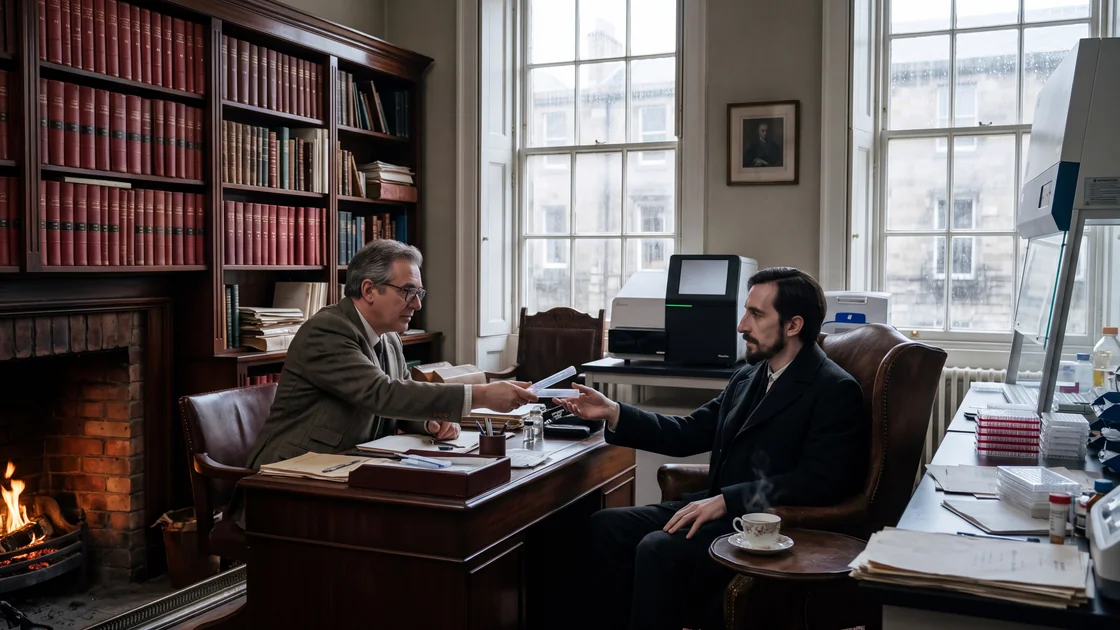
When an obscure antiquarian genealogist in Edinburgh took on a mundane commission to trace the ancestry of a soft-spoken archivist named Julian Brand, he expected nothing more than the typical northern European tapestry of crofters, weavers, and parish bailiffs. Instead, high-throughput whole-genome sequencing revealed an impossible truth: Brand possessed an unmutated, pristine genetic sequence completely devoid of generational recombination, perfectly mirroring the forensic DNA extracted from the severed relics of King Charles I. Julian was not an illegitimate descendant or a distant collateral kin, but an exact, unaged somatic clone of the executed Stuart monarch, preserved and gestated in secret by an esoteric circle of royalist zealots. Caught between the terrifying weight of biological predestination and modern statecraft, both men were forced to confront whether a soul—and the divine right of kings—can be resurrected in a test tube.
Chapter I: The Antiquarian of the Blood
Arthur Vance lived among ghosts, though he preferred to measure their footprints in picograms. His laboratory and consulting rooms occupied the ground floor of an imposing, draft-haunted Georgian townhouse on Albany Street in Edinburgh’s New Town. Outside, the Scottish winter had turned the volcanic crags of Arthur’s Seat into bruised ridges of basalt against a salt-gray sky; inside, the air smelled constantly of ozone, ethanol, and dried vellum.
To the academic world, Arthur was a relic of an older scientific tradition—a fellow of the Society of Antiquaries who had embraced the dry mechanics of molecular biology without losing the romanticism of the seventeenth-century scholar. Where commercial genealogical firms tossed consumer spit kits into robotic assembly lines to return colorful pie charts of vague ethnicity estimates, Arthur worked by hand. He dealt in contested inheritances, centuries-old bastardies, the identification of osseous fragments recovered from castle crypts, and the aristocratic families of Europe whose titles hung on fragile, fraying threads of chromatin.
His tools were a strange marriage of centuries. On one side of the room sat mahogany cases filled with red-leather-bound peerages, heraldic rolls, and microfiche spools; on the other hummed a benchtop Illumina NextSeq system, flanked by a laminar flow hood, a micro-centrifuge, and a stack of deep-well plates.
It was on a Tuesday in late November that Julian Brand first walked into the Albany Street rooms.
He had arrived without an umbrella, his dark wool coat damp from the freezing drizzle that perpetually swept off the Firth of Forth. He was a man of middling height, slender, with narrow, aristocratic shoulders and hands that moved with an exquisite, unconscious economy. His skin had that translucent, faintly alabaster cast typical of individuals who spent their working lives under fluorescent fixtures or among the vaults of cathedral libraries.
"Mr. Vance?" the man had asked. His voice was soft, melodic, with an accent Arthur could not immediately place—a rounded, archaic English cadence that had somehow avoided the flattening vowels of the modern south while carrying none of the harsh glottal stops of London or the Midlands. It sounded like something preserved in amber, or learned from gramophone records of the 1920s.
"I am Arthur Vance. Please, take a seat by the fire. You're frozen."
"Julian Brand," the client said, extending a hand. His fingers were cold, his grip light yet firm. "I am sorry to intrude upon your morning. Your name was given to me by Dr. Chisholm at the National Library. He told me that if anyone could untangle a knot of blood without creating a circus of publicity, it was you."
"Chisholm is kind," Arthur said, pouring two cups of black tea from a pewter pot that sat upon the laboratory radiator. "He also knows I charge three times what the commercial laboratories do, precisely because I don't sell customer data to pharmaceutical conglomerates. What is the nature of your inquiry, Mr. Brand? An estate? A disputed crest?"
Julian sat in the high-backed horsehair armchair, holding the porcelain cup with both hands as if seeking to thaw his knuckles. "Nothing so grand, I assure you. An absence, rather. I was raised in a charitable foundation in the Borders—St. Jude-in-the-Fen. It closed in the late nineties; its records were ostensibly lost in a localized flood. I have no birth certificate. I have no parents of record. The wardens were reticent men who spoke of an anonymous endowment that terminated upon my eighteenth birthday."
"And you have lived since then as...?"
"An archivist. Cataloging illuminated manuscripts, estate rolls, seventeenth-century state papers for private collectors and municipal trusts. A quiet life. But a man eventually wishes to know the soil from which his timber was cut." Julian paused, his hazel eyes fixing upon Arthur with an intensity that seemed almost physically heavy. "I have no living memory prior to the age of six. When I look in the mirror, Mr. Vance, I feel no connection to the face looking back. I feel as though I am wearing someone else’s overcoat. I simply want to know my tribe."
Arthur smiled faintly, leaning against the edge of his laboratory bench. "A common enough longing. Most people hope for a Viking prince or a Huguenot silversmith. They usually find an army of agricultural laborers who never moved three miles from their parish church. Are you prepared for the possibility that your father was a car mechanic from Galashiels and your mother an unwed nurse from Berwick?"
"I would welcome it," Julian whispered, and there was a sincerity in his voice that sounded strangely desperate. "Certainty, Mr. Vance. Even a squalid certainty is better than this drift."
Arthur set a sterile collection kit upon the low table between them. "Two swabs. Inside of the cheek. Firmly, for thirty seconds each. Don't worry about scraping skin off; we need epithelial cells, not saliva."
Julian obeyed with an almost ritualistic precision. When he opened his mouth, Arthur caught the glint of an unusual, pronounced cleft in the man's lower incisors—a minor dental morphological trait, uncommon, often hereditary. As Julian manipulated the cotton tip against his inner cheek, Arthur noted his profile: a high, straight bridge of the nose, a slightly receding lower jaw softened by a dark, precisely trimmed van Dyke beard, and eyes that sat deeply within shadowed orbital sockets. There was something familiar about him, the sort of face one saw in oil portraits hanging in dim, unheated galleries where nobody went anymore.
Arthur accepted the plastic vials, snapped the shafts, and sealed the screw-caps. He labeled them with a barcode: JV-4491.
"Standard protocol," Arthur said, scribbling on an intake sheet. "We will extract the genomic DNA, quantify the yield via spectrophotometry, and run a comprehensive high-coverage sequence. We'll map the autosomes, the Y-chromosome for your direct patrilineal line, and the mitochondrial DNA for your maternal lineage. If your people came from the Borders, we will see it in the regional haplotype clusters within two weeks."
"Two weeks," Julian repeated. He rose, smoothing the front of his coat. "Thank you, Mr. Vance. I am staying at a modest boarding house on Heriot Row. I have no telephone, but I check the post daily."
"No mobile phone?" Arthur raised an eyebrow.
Julian offered an apologetic, weary smile. "They buzz. They hum. They make a sound like hornets in the frontal lobe. I prefer the quiet."
After the man had departed, Arthur held the plastic vial up to the gray Edinburgh daylight. Inside, floating in the clear lysis buffer, were the microscopic building blocks of Julian Brand. Arthur walked to the biosafety cabinet, clicked on the laminar airflow, and began the extraction.
Chapter II: The Anomaly of the Chromosome
The raw data came off the NextSeq late on a Sunday evening.
Arthur had spent the weekend in the quiet, mechanical rhythm of the laboratory. He had washed the silica columns, precipitated the DNA with cold isopropanol, quantified the library with a Qubit fluorometer, and loaded the flow cell with the precise concentration of clustered fragments. It was work he could do in his sleep, a methodical choreography that shielded him from the loneliness of an empty house.
He sat in his study with a glass of Glenfarclas, listening to the wind rattle the sash windows, while his dual-monitor workstation parsed the massive FASTQ files. The bioinformatics pipeline aligned the millions of short 150-base-pair reads against the Human Genome Reference Consortium build GRCh38.
Normally, the algorithm produced a clean, predictable distribution: approximately three billion base pairs of sequence, peppered with some four to five million single nucleotide polymorphisms (SNPs) that distinguished an individual from the arbitrary reference standard. By comparing these variants against global databases—the 1000 Genomes Project, the UK Biobank, the proprietary aristocratic reference panels Arthur had spent twenty-five years assembling—he could triangulate an individual’s geographic origins to within fifty miles.
Arthur clicked into the BAM file to examine the initial quality metrics.
The screen flashed. Arthur frowned, set his glass down, and leaned closer.
"That's absurd," he muttered.
He checked the coverage depth. It was robust: 45x across the autosomes. The sequencing run had been clean, with an average Phred quality score well above Q30, indicating an accuracy rate exceeding 99.9%.
Yet the heterozygous variant profile was catastrophic.
In any standard human genome, an individual inherits one copy of each chromosome from their father and one from their mother. Consequently, where the parents differ, the individual’s DNA shows heterozygosity—sites where the sequence reads an A on one chromosome and a G on the other. In European populations, the baseline level of heterozygous SNPs averages around 1.5 to 2 million across the autosomes.
In Julian Brand’s file, the heterozygous count was not two million.
It was ninety-seven thousand.
Arthur felt a sudden, cold prickle at the base of his neck. A reduction of heterozygosity that extreme was biologically impossible in a viable human being. It implied an level of inbreeding that surpassed even the most notorious royal pedigrees of the Habsburgs. Even Charles II of Spain, whose inbreeding coefficient had reached an astonishing 0.254—more inbred than the offspring of a brother and sister—retained millions of heterozygous loci.
"Contamination," Arthur said aloud to the empty room. "Or the flow cell skipped a cycle."
He initiated a comparative kinship analysis, running the sequence through a pairwise identity-by-descent (IBD) script that scanned for runs of homozygosity (ROH). The resulting plot appeared on his screen not as the typical scattershot of small, broken blocks, but as immense, unbroken highways of identical genetic material stretching from the centromeres to the telomeres across nearly every single chromosome.
Arthur did not go to bed. He went to the laboratory, calibrated the fluorometer, and prepared a fresh aliquot of Julian Brand's stock DNA. He pulled out an older, gold-standard Affymetrix SNP microarray chip—an entirely different technology, immune to the specific optical sequencing errors that could occasionally plague the Illumina platforms. He hybridized the chip, sealed the chamber, and let it run.
By dawn, the Affymetrix results confirmed the NextSeq’s verdict.
Julian Brand was not merely inbred. His genome exhibited something Arthur had never seen outside of cloned murine cell lines in academic literature: long-range homozygosity coupled with specific structural anomalies that defied the basic laws of Mendelian inheritance.
Arthur pulled up the Y-chromosome profile.
The Y-chromosome does not undergo meiotic recombination with the X-chromosome across most of its length; it passes from father to son like an unblemished surname, mutated only by the slow, ticking clock of random replication errors—roughly one single nucleotide mutation every three to four generations.
Julian’s Y-chromosome belonged to Haplogroup R1b-U152, a lineage common enough in Western Europe. But Arthur’s proprietary database went far deeper, indexing terminal subclades down to historical dynasties. He ran the branch-finder.
The software cycled through the markers: R-L2, R-Z367, R-L20, R-FGC11134...
The screen halted at a private node Arthur had personally designated five years earlier, during a confidential commission for the Royal Collection Trust involving the identification of seventeenth-century skeletal remains recovered during the restoration of a chapel vault in Hampshire.
The node was labeled: STUART-M-01.
Arthur stopped breathing.
He pushed his chair back, his heart thumping violently against his ribs. STUART-M-01 was the reference profile for the House of Stuart, specifically mapped from the validated line of King James VI of Scotland and I of England.
"All right," Arthur whispered, trying to steady his hands. "He's a Stuart. A descendant of an illegitimate child of Charles II. The Dukes of Monmouth, Richmond, Grafton, St Albans... there are dozens of living descendants. The Borders are full of aristocratic offshoots. That explains the Y-haplogroup."
It did not, however, explain the rest.
If Julian were a ten-times-great-grandson of Charles II, or James II, his autosomes would be overwhelmingly diluted by the ten generations of unrelated women who had entered the lineage since 1685. A descendant would share roughly 0.09% of the monarch’s autosomal genome. The rest would be the standard genetic noise of modern Britain.
Arthur brought up the mitochondrial DNA (mtDNA)—the tiny circular chromosome inherited exclusively from the mother.
Julian’s mtDNA was Haplogroup H. Specifically, a rare sub-branch characterized by mutations at positions 16129 and 16362: H-sub-clade alpha.
Arthur knew that branch. He didn't need to consult his databases; he had written a twenty-page monograph on it for the Journal of Forensic Genealogy.
It was the mitochondrial sequence of Anne of Denmark.
Anne of Denmark was the wife of James VI and I.
She was the mother of King Charles I.
Arthur stood up so abruptly that his chair toppled backward, striking the parquet floor with a loud crack.
The Y-chromosome was the Stuart line of James I.
The mitochondrial chromosome was the Danish royal line of Anne of Denmark.
If Julian Brand had been a modern descendant through the direct male line, his mitochondria would have come from his modern mother—a woman from Edinburgh, or Leeds, or Newcastle. If he were a descendant through the female line, his Y-chromosome would have come from a modern father.
The only person who possessed both the Y-chromosome of James I and the mitochondrial DNA of Anne of Denmark was one of their direct children.
Prince Henry, who had died of typhoid at eighteen in 1612.
Or Prince Charles, who had become King of England, Scotland, and Ireland, and whose head had been severed by an executioner’s axe on a scaffold outside the Banqueting House at Whitehall on January 30, 1649.
Chapter III: The Relics of the Martyr
Arthur Vance did not sleep for forty-eight hours.
He canceled his appointments, locked the heavy oak outer door of his Albany Street offices, and drew the heavy velvet drapes across the front bay windows. The modern world outside—the rumbling diesel double-deckers climbing toward Queen Street, the rain-coated commuters, the clinking milk crates—felt like an insubstantial dream, separated from him by an ocean of centuries.
In his safe, behind two fireproof combination doors, Arthur kept the "Relic Registry." It was a collection of deeply sensitive, unpublished genomic reference profiles assembled over three decades of work for national heritage trusts, the College of Arms, and the executors of ancient estates.
Among them was a file labeled C-I-1649-CR.
In 1813, during the construction of a passage beneath the choir of St George’s Chapel at Windsor, the coffin of King Henry VIII had been accidentally breached, and beside it, workers had found the leaden casket of Charles I. The Prince Regent, later George IV, had attended the opening of the vault along with Sir Henry Halford, the royal physician. Halford had lifted the head from the coffin. He had noted that the neck had been severed by a clean blow of an axe, the beard was preserved in a dark reddish-brown hue, and the cartilage of the nose was intact. Halford had removed a small cervical vertebra—the fourth—which showed the unmistakable cut mark of the executioner's steel, along with several tufts of hair and a fragment of the bloodstained linen shroud.
While Queen Victoria had later insisted that the sovereign's relics be returned to the vault, portions of the hair and textile had remained in the private possession of the Halford estate for over a century before coming to the British Museum and, eventually, undergoing ultra-clean room forensic analysis during the 1990s.
Arthur had the raw read archive from that analysis.
The 1813 samples had yielded degraded, highly fragmented ancient DNA (aDNA). The sequencing had been noisy, characterized by cytosine-to-uracil deamination at the ends of the molecules—the classic molecular scar of age and decay. But the core consensus sequence was indisputable.
Arthur opened his alignment tool and dragged the two files together: JV-4491 (Julian Brand) and C-I-1649-CR (Charles I of England).
He ran a pairwise identity-by-state (IBS) comparison across the sixteen million base pairs that were cleanly resolved in the ancient sample.
The progress bar crept across the screen: 10%... 45%... 80%... 100%.
The terminal screen displayed the coefficient of relatedness:
\[\hat{\theta} = 1.0000\]
Arthur leaned back, his temples throbbing, the room tilting slightly on its axis.
A coefficient of 0.5 meant a brother, a father, or a son.
A coefficient of 0.25 meant an uncle, a grandfather, or a half-sibling.
A coefficient of 1.0000 meant only one thing in the biological universe: a monozygotic twin.
Or an exact somatic clone.
Arthur leaned forward again, furiously typing command lines into the Linux terminal. He checked the deamination rates. In Julian’s DNA, there was no deamination; the terminal cytosines were unblemished, fully intact. The DNA was young. It was living tissue. The telomeres—the protective caps at the ends of the chromosomes that shorten with age and cell division—were surprisingly long, consistent with a man in his early thirties.
There was no generational recombination. None. A child receives a scrambled mosaic of their parent’s chromosomes, stitched together by crossing-over during meiosis. In Julian, the chromosomal structural breakpoints matched the 1649 tissue down to the precise base pair.
Julian Brand was not a descendant. He was not a nephew.
He was the flesh of Charles I, walking through the wet streets of Edinburgh, reading seventeenth-century manuscripts, and drinking Earl Grey tea.
"God in Heaven," Arthur said, his voice a dry rasp in the cold room.
He began searching the file for synthetic markers. If this had been the work of an illicit modern cloning laboratory—an outfit using somatic cell nuclear transfer (SCNT) like that which created Dolly the Sheep at the Roslin Institute just south of the city in 1996—there would be signatures. Vectors. CRISPR-Cas editing traces. Residual mitochondrial heteroplasmy from the enucleated oocyte used to host the nucleus.
He probed the mitochondrial BAM file.
There it was.
Beneath the dominant H-sub-clade alpha sequence of Anne of Denmark, Arthur found a faint, persistent shadow: roughly 0.4% of the reads mapped to Haplogroup U5b—a common Western European lineage.
The signature of a human donor ovum.
Someone had taken a somatic cell from a preserved relic of King Charles I. They had extracted the nucleus. They had inserted it into a denuded, enucleated human egg cell obtained from a modern woman of haplogroup U5b. They had applied an electrical pulse to stimulate division, implanted the blastocyst into a surrogate mother, and brought the Sovereign of Three Kingdoms to term in the late twentieth century.
Arthur felt an instinctive, primal revulsion, followed immediately by an exhilarating, terrifying wonder.
It was an act of profane biological necromancy.
Who had done it? Why? And how had the man himself been left to wander through the world, ignorant of the blood that cried out from every cell in his marrow?
Arthur looked at the clock on the mantle. It was 3:15 PM.
Julian Brand had said he would return on Wednesday for his preliminary results.
That was tomorrow.
Chapter IV: The Shadow of the Axe
The rain had turned to sleet by four o'clock the following afternoon. The street lamps along Albany Street flickered to life in the gathering twilight, casting amber pools across the glistening cobblestones.
Arthur sat behind his massive desk. He had cleared away the pipettes, the micro-tubes, the printed genealogical trees. On the blotter lay only two objects: a manila folder containing the comparative genomic alignments, and a small, antique brass paperweight shaped like a skull.
When the bell at the front door jangled, Arthur felt a sharp, metallic taste of adrenaline in his mouth.
He went to the hall, unlocked the heavy door, and pulled it open.
Julian stood on the stone threshold, his coat collar turned up against the sleet. He looked smaller, somehow, more fragile than he had a week ago, his face pale beneath the dark brim of his hat.
"Mr. Vance," he said, stepping inside and brushing ice crystals from his sleeves. "The weather is frightful. I half expected you to send a telegram postponing."
"Come in, Mr. Brand. Please. Take off your coat."
Arthur led him into the study. The peat fire was blazing in the hearth, throwing flickering orange light across the spine of every book in the room. Julian walked straight to the hearth, holding his hands toward the flames.
Arthur watched his hands.
They were long, elegant, with oval nail beds. In Anthony van Dyck’s famous 1636 triple portrait of Charles I—the one painted to assist Bernini in sculpting a marble bust—the King’s hands were positioned with precisely that delicate, slightly effeminate curl of the fingers.
"You have the results?" Julian asked, not turning around. He seemed mesmerized by the fire. "I could tell from your face when you opened the door. It is not an agricultural laborer from Berwick, is it?"
"No," Arthur said quietly. "It is not."
Julian turned around slowly. The firelight caught his eyes, turning them to liquid bronze. "Am I sick, Mr. Vance? Is there some hereditary monstrosity encoded in my organs? Some Huntington’s or Tay-Sachs? You look at me as if I were a corpse."
"In a manner of speaking," Arthur said, "you are."
He gestured to the chair across from his desk. Julian hesitated, then walked over and sat down. His movements were excessively controlled, the posture of a man who spent his life suppressing an inner trembling.
Arthur opened the manila folder.
"Mr. Brand—if that is what I should call you—I have been practicing genetic forensics for thirty years. I have worked for the Hague, I have worked for the Metropolitan Police, I have identified the bones of Romanovs and battle casualties from Flodden Field. I do not make errors in sequencing."
"I am sure you do not," Julian said, his brow creasing with a subtle, aristocratic impatience. "What did you find?"
"I found that you have no parents."
Julian blinked. "We already knew I have no recorded parents—"
"No," Arthur interrupted, leaning forward. "You misunderstand me. I do not mean your parents are absent from the civil registry. I mean they do not exist biologically. You did not inherit half of your genetic material from a father and half from a mother through the normal mechanism of sexual reproduction. You have no meiotic recombination. Your autosomes are identical to a single source donor."
Julian went completely still. Even his chest seemed to stop rising and falling. "What are you saying?"
"You are a clone, Mr. Brand. A somatic duplicate."
The word hung between them, cold and grotesque in the warm, book-lined room.
Julian let out a short, hollow laugh that died in his throat. "A clone? Me? That is science fiction, Mr. Vance. I am thirty-four years old. I was born in 1989. They had barely cloned a toad in 1989, let alone a man."
"Dolly was born in 1996 in Midlothian, seven miles from this room," Arthur said evenly. "The technology existed in embryonic form—forgive the pun—in private, well-funded experimental laboratories for years prior. But that is only the beginning of the impossibility."
Arthur slid the comparative alignment chart across the desk.
"This is your genome," Arthur pointed with a bone-handled stylus. "And this is the genome obtained from the skeletal remains and preserved relic-cloth of King Charles the First of England. The man executed on the scaffold at Whitehall on the thirtieth of January, 1649."
Julian did not look down at the paper. He kept his eyes locked on Arthur’s face, his pupils dilating until the hazel of his irises was almost entirely swallowed by black.
"A joke," Julian whispered. "An elaborate, grotesque antiquarian joke."
"Look at the data!" Arthur slammed his palm onto the desk, the crack reverberating through the room. "Look at the markers! Look at the Y-chromosome terminal branch: R-FGC11134. Look at the mitochondrial sequence: the exact rare mutation set of Anne of Denmark! You share every single base pair across ninety-nine point nine nine nine percent of your mapped genome with a corpse that has been in the vault at Windsor for three hundred and seventy years!"
Julian looked down.
His long, pale fingers reached out, trembling violently now, and touched the smooth edge of the paper. He didn't read the numbers—he was an archivist, not a bioinformatician—but he could see the graphic representation: two identical barcode-like strips running parallel, every dark band aligned to every dark band without a single micron of drift.
"No," Julian murmured. "No, no, no..."
"You told me you have an instinctual dread of the cold," Arthur said, his voice dropping to a low, relentless cadence. "You told me you feel as though you are wearing someone else's coat. What else, Julian? What do you see when you sleep?"
Julian pulled his hands back from the paper as if it had burned him. He pressed them against his face, his breath coming in ragged, shallow gasps.
"The cold," he choked out behind his palms. "The morning... the morning air that tastes of river mist and cabbage. A long hall with paintings on the ceiling. Rubenses. Gilt. Angels carrying souls to heaven. And outside... outside, a sound like the sea. Ten thousand people breathing in the frost."
Arthur felt his hair stand on end. The ceiling of the Banqueting House at Whitehall was the only ceiling Peter Paul Rubens ever painted that survived in situ. Charles I had walked beneath it on his way to the scaffold.
"And the dreams of the blow?" Arthur asked softly.
"I have no scar," Julian sobbed, tearing his hands away and ripping open the collar of his shirt. "Look! There is nothing! I have a throat like any other man!"
His throat was pale, unblemished, save for a faint, horizontal crease of skin above the thyroid cartilage—a natural skin fold, nothing more.
"You have no scar because your body did not die," Arthur said, the weight of the realization pressing down upon him like a tomb slab. "The axe fell on the original flesh. But your flesh... your flesh was grown from a single dormant cell. A drop of blood from a shroud. A hair root plucked from a severed head by Sir Henry Halford in 1813. Stored in some private reliquary, dried in beeswax or formalin, until the science of our century caught up with the fanaticism of the last."
Julian slumped back into the chair. His face had gone from pale to an ashen, waxy gray. His eyes were wide, unfocused, staring through the floorboards into some abyssal depth.
"Who did this to me?" he whispered. "Who could have done this to me?"
"I don't know," Arthur said. "But you said you were raised at St. Jude-in-the-Fen. You said there was an endowment."
"The trust," Julian muttered, his voice vacant, mechanical. "The trust was administered by a firm of solicitors in Carlisle. Haughton, Vane & Sons. When I turned eighteen, a clerk handed me a leather satchel containing my national insurance card, five thousand pounds in bank notes, and a gold ring."
"A ring?" Arthur asked, his pulse leaping. "You didn't mention a ring."
Julian reached slowly into his waistcoat pocket. He drew out a heavy object suspended on a black silk cord and laid it upon the desk.
It was an oval signet of dark, unpolished gold. In the center, carved into a deep bloodstone, was an imperial crown above a monogram: C.R.—Carolus Rex. Flanking the shield were the words:
CAROLUS I. REX ET MARTYR. O.B. 1649.
Inside the band, tiny, hand-chiseled letters read:
IN HOC SIGNO VINCES. S.K.C.M.
"The Society of King Charles the Martyr," Arthur read aloud, his breath catching. "They aren't just an Anglo-Catholic devotional club. In the nineteenth century, there was an inner circle. The White Rose League. Jacobite legitimists who believed that the deposition of the Stuarts had broken the moral fabric of the cosmos. They believed the English monarchy was an ontological priesthood."
Arthur looked up at the clone of the King.
"They didn't just want to honor the martyr," Arthur whispered. "They wanted to bring him back."
Chapter V: The Provenance of the Flesh
The Carlisle offices of Haughton, Vane & Sons were located in an alley off the cathedral precinct, where the red sandstone of the medieval walls seemed to seep dampness into the cobblestones.
Arthur had insisted on traveling with Julian. The genealogist could not let the specimen out of his sight; the scientist in him was consumed by a manic, consuming hunger to understand the mechanics of the miracle, while the human in him felt an overwhelming, paternal pity for the creature sitting across from him in the diesel train carriage.
Julian had barely spoken during the journey south through the hills of Dumfriesshire. He sat with his hands folded in his lap, staring out at the sodden sheep pastures and the gray stone dykes. Once, when the train ground to an unexpected halt outside Lockerbie with a shriek of steel brakes, Julian had flinched violently, his hands darting to his neck in that reflexive, horrifying gesture that seemed etched not into his memories, but into the primitive architecture of his brainstem.
The senior partner of the firm was Mr. Tobias Vane—a man who looked as though he had been pressed between the pages of an equity digest around the time of the Gladstone administration and only recently exhumed. He had watery, cataract-filmed eyes and skin like dry vellum.
"The Brand trust?" Vane said, peering at Arthur’s credentials through gold-rimmed spectacles, then shifting his gaze to Julian. The old lawyer did not flinch when he looked at Julian; he merely stared with a deep, chilling familiarity, as though he had been expecting this particular shade to walk into his parlor for forty years.
"You have your signet, Mr. Brand?" Vane asked.
Julian laid the bloodstone ring upon the baize-topped desk.
Vane picked it up with brass tweezers, examined the hallmarks on the inner rim, and nodded once.
"The instructions left by my late grandfather were explicit," Vane said, his voice like the rustling of dry straw. "If the Subject should present himself with legal representation or a forensic inquirer, the primary depository box is to be surrendered without demur. The firm has discharged its duties. The rental fee for the vault in the Carlisle High Street Bank was paid in perpetuity in 1984."
"Who paid it?" Arthur demanded, stepping to the edge of the desk. "Who gave the instructions?"
Vane looked at Arthur with the faint, condescending pity of an old family solicitor. "The client was not an individual, Mr. Vance. It was an entity registered in Geneva under the name L’Ordre de la Sainte Ampoule. Its trustees were three gentlemen of Scottish and French lineage, all of whom have been dead since the late 1990s. The medical protocols were carried out at a private sanatorium in Argyll—the Glenfinnan Institute. It burned to the ground thirty years ago."
"And the genetic material?"
"There is an inventory in the box," Vane said, reaching into a safe behind his desk and producing a heavy, brass-bound iron key. "The bank is two doors down. My clerk will escort you."
The deposit box was not a tin box; it was a small sea chest of oak, bound with pitted iron straps.
In the small, dimly lit basement viewing room of the Carlisle bank, with the clerk waiting outside the reinforced door, Arthur and Julian lifted the lid.
Inside lay three thick, leather-bound folio ledgers, two stainless steel cryogenic canisters long since vented and filled with dust, and a series of photographic plates from the late 1980s.
Arthur opened the first ledger. The handwriting was neat, clinical, written in fountain pen with blue-black ink.
Project Carolus Redivivus, the title page read. Initiated under the auspices of the Society of the White Rose and the Council of the Sovereign Seal, 1982–1989.
Arthur turned the pages, his scientific training allowing him to scan the protocols with swift, horrified comprehension.
Source Material: 0.5 mg desiccated epidermal tissue recovered from the Halford relic collection (Windsor, 1813), Lot 44b, confirmed by comparative microsatellite matching against the Stuart hair lock preserved at Blairs College, Aberdeen.
Cellular Restoration: Rehydration in sterile buffer at pH 7.4. Chromatin isolation performed via micro-manipulation. The nuclear architecture was found to be 88% intact, with localized cross-linking resolved via proprietary endonuclease treatment.
Somatic Cell Nuclear Transfer: Enucleation of donor oocytes obtained via private contract with the St. Jude Charitable Health Trust. Total attempts: seventy-two. Blastocyst stage reached in four instances.
Implantation: Two transfers resulted in spontaneous abortion at six weeks and eleven weeks respectively. One transfer ectopic. Fourth transfer (Subject 4) successfully carried to gestational maturity by surrogate maternal host #12 (Margaret L**, deceased 1991).*
Arthur stopped reading. He looked at Julian.
Julian was holding one of the photographic plates up to the bare incandescent bulb of the viewing room.
It was a black-and-white print of an incubator in a tiled room. Inside the plastic chamber lay an infant, its tiny chest rising and falling, a barcode bracelet around its miniature ankle.
Beside the incubator stood three men. One was an elderly man in the clerical robes of an Anglican bishop, his hands raised in a gesture of benediction. The second was an obstetrician in a green surgical gown. The third was a man in an impeccably tailored three-piece suit, wearing around his neck the star and ribbon of the Most Noble Order of the Garter.
"I was a crop," Julian said. His voice was completely flat, devoid of rage, devoid of sorrow. It was the voice of a man who had stepped off the edge of a cliff and was simply waiting for the earth to rush up to meet him. "A laboratory harvest. Like a cabbage in a greenhouse."
"Not a cabbage," Arthur said, though the words sounded hollow in his own ears. "A king."
"A king of what?" Julian turned his head, his hollow hazel eyes meeting Arthur’s with a savage, burning clarity. "Of an empty vault? Of an empire that turned its back on his house three hundred years ago? Do you know what Charles the First was, Mr. Vance? You read history. You know what he did."
Julian stood up, towering over the iron chest. His voice began to climb, taking on an uncanny, sonorous authority that seemed to rattle the metal shelves of the bank vault.
"He was an arrogant, obstinate, pathetic fool who believed that God had placed a crown upon his skull and therefore he could do no wrong! He plunged three kingdoms into blood! He watched twenty thousand men die at Marston Moor and Naseby because he could not conceive of compromise! He lost his crown, he lost his family, he lost his head, and he left this island to the rule of sanctimonious butchers!"
Julian’s breath came in hot, violent gasps. He leaned over the ledger, his fists clenched until the knuckles were bone-white.
"And those lunatics—those theological butchers in their silk coats—they thought that if they brought the meat back to life, the spirit would follow. They thought that if they grew the heart in a jar and put it into a child, England would fall to its knees and remember God."
He pointed a shaking finger at his own chest.
"There is no king here, Arthur. There is only a clerk. A clerk who likes early editions of John Donne and cannot bear the sight of a kitchen carving knife."
Chapter VI: The Watchers in the Gloaming
They left Carlisle on the evening train.
The snow had begun to fall in earnest now, sweeping across the Border hills in great, blinding curtains of white that obscured the sheep tracks and the forestry plantations. The train crawled north through the darkness, its diesel engine groaning against the drifts that were beginning to pack into the cuttings.
Arthur sat with the leather-bound ledger in his lap, wrapped in brown butcher’s paper. The sea chest remained in Carlisle, but the primary records of the creation of Julian Brand were now in Arthur's possession.
"What will you do with it?" Julian asked, his face reflected in the black glass of the window against the swirling snow. "The data. The papers."
"It is the greatest scientific discovery in human history," Arthur said quietly. "It proves that human somatic material can survive three centuries of desiccated dormancy and be restored to viable biological life. If I publish this in Nature or The Lancet, it will redefine genetics, paleontology, ethics, law—"
"And me?" Julian asked.
Arthur fell silent.
He looked at the man. In the scientific literature, Julian would be Subject 4. He would be an object of study. The bioethicists would argue over his legal personhood; the tabloids would hound him to the ends of the earth; the current House of Windsor would face a constitutional and psychological anomaly that the law had no apparatus to resolve; the religious cults would proclaim him an idol or an abomination. He would live his remaining days in a cage of bright lights, glass rooms, and blood draws.
"You would be protected," Arthur said, though he knew it was a lie.
"Like a prize bull," Julian said. "Or an exhibit in the Hunterian Museum."
The train slowed to a shuddering crawl as it approached the small station of Carstairs, an isolated junction where the line split toward Glasgow and Edinburgh. The platform was deserted, lit only by the sodium glow of two lamps through the swirling blizzard.
Suddenly, the carriage lights flickered and died.
The train came to a dead stop with a heavy hiss of pneumatic air.
In the darkness, the only sound was the howling of the wind against the steel skin of the carriage and the rhythmic, labored breathing of the two men.
"Arthur," Julian said softly.
"It's just a signal failure," Arthur said, reaching into his pocket for his lighter. "The snow has likely brought down the overhead lines."
He struck the flint. The small yellow flame flared up, illuminating their faces in the freezing compartment.
Beyond the window, standing on the snow-drifted platform of Carstairs station, was a figure.
He was an elderly man, tall, thin, wrapped in a heavy loden coat with a fur collar. He stood entirely motionless in the blizzard, his face shadowed by a wide-brimmed black hat. He was looking directly into their carriage, directly at Julian.
Arthur clicked the lighter shut. The darkness returned, heavier and colder than before.
"Did you see him?" Julian whispered.
"Yes."
Arthur stood up, his hand clutching the brown paper parcel to his chest. He moved toward the aisle. "Stay behind me."
They moved through the darkened corridor toward the vestibule. The train was almost entirely empty—only a few scattered passengers were asleep in the forward cars, oblivious to the stop.
As Arthur reached the heavy sliding door between the carriages, it clicked and slid open on its own.
Standing in the vestibule was a man. Not the old man from the platform, but a younger, broad-shouldered individual in an oilskin jacket, his face scarred around the jawline, holding an unlit electric torch.
"Mr. Vance," the man said. His voice was Scottish, low, entirely devoid of emotion. "Dr. MacIntyre would be grateful for a word before you change trains."
Arthur stepped back, his knuckles white around the parcel. "Get away from us. I have a whistle and I will alert the guard."
The man smiled faintly, a cold, humorless movement of his lips. "The guard is drinking tea in the brake van with a hundred pounds in his pocket, Mr. Vance. Nobody is going to be hurt. If we had wished to terminate Subject 4, he would not have celebrated his thirty-fourth birthday. Dr. MacIntyre simply wishes to close the ledger."
Julian stepped around Arthur’s shoulder.
In the dim, snowy light filtering through the carriage door, Julian’s posture had changed. The slump in his shoulders was gone. He stood with his head raised, his chin high, his hazel eyes cold as river ice.
"Let us see him," Julian commanded.
It was not a request. It was an imperative that carried an uncanny, instinctive resonance. The man in the oilskin jacket blinked, taken aback, then stepped aside and lowered his head in a brief, unconscious inclination of respect.
"This way, sir."
Chapter VII: The Divine Right of Ruin
They were led across the snow-drifted platform into the stationmaster's waiting room. A coal fire had been lit in the small, Victorian iron grate, filling the damp room with the sharp, sulfurous tang of bituminous smoke.
The old man from the platform was standing by the mantle. He had removed his hat, revealing a magnificent mane of silver hair swept back from a high, domed forehead. His face was lined with the deep fissures of age, but his eyes—pale, watery blue—were sharp and piercing.
"Julian," the old man said. His voice was cultured, resonant, with the dry elegance of the Edinburgh medical faculty. "You have grown into your face. In the end, the resemblance is terrifying."
"Dr. Alistair MacIntyre," Arthur said, reading the name from the memory of the ledgers. "You were the director at Glenfinnan. You signed the developmental assessments."
"I was a younger man then, Mr. Vance," MacIntyre said, gesturing to the wooden benches. "Please, sit. The snow will keep the main line blocked until morning. We have time."
Neither Arthur nor Julian sat down.
"Why?" Julian asked. He stood in the center of the small, drab room, beneath a faded poster advertising rail excursions to Aberdeen. "Why did you create me and then throw me away?"
MacIntyre sighed, reaching into his pocket to draw out an engraved silver snuff box. He took a pinch, inhaled it delicately, and dusted his fingertips with a silk handkerchief.
"We did not throw you away, Julian. We released you."
"A semantic distinction," Arthur snapped, holding the parcel tightly. "You performed an illegal human cloning experiment using stolen historic tissue, gestated him in an unregistered facility, and dumped him in a Borders orphanage with a trust fund. It is gross scientific malpractice and criminal negligence."
"The law of parliament," MacIntyre said with immense disdain, "is a convenience for merchants and tradesmen. We were serving a higher law, Mr. Vance. You are a genealogist. You understand blood. You understand that some lineages are not merely administrative conventions; they are anchors. For a thousand years, the Sovereign was the anointed nexus between the land, the people, and the divine."
MacIntyre walked toward Julian, his eyes drinking in the young man's face with a frightening, devotional hunger.
"In 1649, that anchor was cut. England severed the head of its own soul. What followed? Three centuries of industrial smoke, usury, the flattening of all beauty, the rise of the mob, the destruction of the sacred order. By 1980, the world was a concrete wasteland of consumerism and nuclear dread. We believed—perhaps naively, perhaps magnificently—that the line could be restored."
"By cloning a dead king?" Arthur said, incredulous. "You thought the people of Britain would look at a boy from an incubator and place him on the throne?"
"Not immediately," MacIntyre murmured. "We knew the climate of the century. We were not madmen, Mr. Vance. We knew you could not simply present a child to the House of Lords. Our intention was to wait. To preserve the True Flesh until the inevitable collapse of the modern liberal project. We created three subjects. Two did not survive infancy. Julian was the third. Julian was whole."
"Then why didn't you raise him?" Arthur demanded. "Why the orphanage?"
MacIntyre looked down at the floor, a genuine shadow of regret passing across his ancient face.
"Because we were discovered," the old doctor whispered. "In 1991, the Special Branch began investigating the trust’s financial movements. Certain churchmen became frightened. The bishop—the man you saw in the photograph—suffered a stroke. There were those within the Society who argued that the child was an abomination, a homunculus, an insult to the soul of the Royal Martyr. They wanted him smothered."
Julian did not flinch. He merely listened, his hazel eyes fixed on MacIntyre with an unbearable, silent judgment.
"I could not allow him to be destroyed," MacIntyre said softly, looking at Julian. "I burned the laboratory at Glenfinnan to destroy the cell lines and the cryogenic stores. I dispersed the records. I placed you at St. Jude’s under an assumed identity, with funds sufficient to ensure you were educated, clothed, and fed. And then I waited."
"Waited for what?" Julian asked.
"To see if the blood would tell," MacIntyre whispered. "To see if the grace—the charism of the Lord’s Anointed—was in the spirit, or if it was truly in the seed. I watched you from afar, Julian. I saw you in the libraries. I saw you walk through the world like a shadow. You did not seek power. You did not seek gold. You had the melancholy, the fastidiousness, the tragic beauty of your father."
"He was not my father," Julian said, his voice flat, icy, and final. "He was my blueprint. And he died three centuries ago."
MacIntyre stepped forward and fell to one knee on the salt-stained floorboards of the waiting room.
Arthur gasped. The old man, a titan of nineteenth-century reactionary pride, took the hem of Julian’s damp wool coat in his wrinkled hands.
"The time is coming, Sire," MacIntyre breathed, his voice cracking with an insane, senile fervor. "The modern world is dying on its feet. The institutions are rotting from within. Let Mr. Vance publish his papers. Let the world know that the Martyr has returned, that the true branch has sprouted from the dry root! There are thousands who will rally. The old families, the traditional orders, the remnants of the faithful... We will make you what you were born to be."
Julian looked down at the old man kneeling at his feet.
For a long, terrible moment, the only sound in the room was the crackle of the coal fire and the shrieking of the wind outside the frosted glass.
Julian’s face was an unreadable mask of ivory. For three seconds, five seconds, Arthur saw the phantom—the King in his black velvet doublet, the George jewel at his breast, looking down upon the executioner who knelt to ask his forgiveness upon the scaffold.
The authority in Julian’s eyes was absolute, terrifying, and utterly ancient.
Then, Julian reached down, took the old doctor by the shoulders, and pulled him roughly to his feet.
"Get up," Julian hissed.
MacIntyre blinked, confused, his pale eyes searching Julian's face.
"Sire—"
"I am not your king," Julian said. Every word was sharp as an obsidian scalpel. "I am not your redeemer. I am not the vessel for your senile hatred of the world you live in. You stole my life before I was even conceived. You took me from a tomb, grew me like a mold on bread, and left me to wander through an empty world with dreams of an execution I never suffered."
Julian turned to Arthur.
"Give me the parcel."
Arthur hesitated. The scientist within him screamed in protest. "Julian... this is the only complete record of the somatic restoration—"
"Give me the parcel, Arthur."
Julian extended his hand. The long, van Dyck fingers were completely steady now.
Arthur looked into the hazel eyes. He saw no madness there; he saw only a profound, crystalline clarity—the clarity of a man who had looked into the abyss of his own unnatural genesis and chosen his own path.
Arthur handed the butcher’s paper parcel to Julian.
Julian turned to the grate. Without a moment of hesitation, he threw the ledgers into the heart of the coal fire.
"No!" MacIntyre shrieked, lunging forward with his hands outstretched.
The man in the oilskin jacket caught the old doctor by the arms, holding him back. MacIntyre struggled like a wild animal, tears streaming down his wrinkled cheeks, as the dry, seventy-year-old paper caught the flames.
The leather bindings curled and blackened. The ink bubbled. The protocols of the somatic transfer, the cell lines, the records of the oocyte donors, the signatures of the bishops and doctors—all of it flared into a brilliant, golden column of fire that roared up the chimney into the snowy night.
Julian watched the destruction of his provenance without a flicker of emotion.
When the last page of the ledger had collapsed into gray ash, Julian took the gold signet ring from his pocket. He held it between his thumb and forefinger for a second, then tossed it into the glowing coals. The bloodstone cracked with a sharp snap, the gold softening and slumping into the slag.
Julian looked at MacIntyre, who was weeping quietly against the chest of his servant.
"The king is dead, Dr. MacIntyre," Julian said softly. "Let the poor bastard rest."
Chapter VIII: The Scaffold of History
The dawn broke over Edinburgh in a pale wash of lavender and winter blue. The storm had blown itself out into the North Sea, leaving the city under an immense, pristine blanket of snow that muffled the sound of the morning traffic and softened the sharp basalt crags of the Castle rock.
In his laboratory on Albany Street, Arthur Vance sat alone at his workstation.
On the screen was the final bioinformatics run: JV-4491.
With a few keystrokes, Arthur could hit Export. The raw FASTQ files, the BAM alignments, the comparative charts with the 1813 Windsor sample—all of it could be compressed into an encrypted bundle and transmitted to the editorial offices of Science in Washington and Nature in London.
Within forty-eight hours, his name would be on the front page of every newspaper on earth. He would be the man who unlocked the biological resurrection of historical humanity. He would receive chairs, medals, millions in research funding. His name would be carved into the history of biology alongside Watson, Crick, and Wilmut.
Arthur looked at the corner of the room where Julian Brand had sat three days ago, holding his porcelain cup with cold hands.
He remembered Julian’s voice in the Carlisle bank: I was a crop. A laboratory harvest.
Arthur looked at the command terminal.
He brought up the raw sequence archive on his local drives: forty-five gigabytes of high-density read data that proved, with mathematical certainty, that King Charles the First was walking the streets of the modern world.
Arthur opened a script terminal.
He typed:
shred -u -z -n 35 /data/sequencing/JV-4491/*.fastq
shred -u -z -n 35 /data/sequencing/JV-4491/*.bam
shred -u -z -n 35 /data/sequencing/JV-4491/*.vcf
The shred command would overwrite the magnetic storage
thirty-five times with cryptographic random patterns, permanently
destroying every trace of the data beyond the recovery capability of
even the most sophisticated intelligence agencies.
Arthur hovered his finger over the Enter key.
Then he paused.
He opened a single, blank text file. Into it, he copied the terminal Y-chromosome haplogroup and the rare mitochondrial mutations. Below it, he typed a simple, clinical memo:
Subject JV-4491. Buccal swab analysis. Autosomal markers indicate typical northern British ancestry with expected regional variance. Patrilineal haplogroup R1b; matrilineal haplogroup H. No anomalous genetic variants or actionable clinical pathologies identified. Kinship analysis inconclusive due to absence of familial reference samples. Case closed.
He printed the memo on his heavy bond letterhead, signed it with his gold fountain pen, and folded it into an envelope addressed to Mr. Julian Brand, Heriot Row, Edinburgh.
Then Arthur returned to the terminal and pressed Enter.
The hard drives chattered softly in their caddies, a faint, rhythmic sound like dry leaves blowing across cobblestones. One by one, the millions of base pairs—the divine helix of the Stuart kings, the ancient markers of Anne of Denmark, the impossible, pristine sequence of the Royal Martyr—were replaced with zeros, ones, and static.
The screen cleared. The directory was empty.
Arthur stood up and walked to the front window.
Down on Albany Street, the snowplows were clearing the slush from the gutters. A milk float hummed past, its electric motor whining softly in the cold air. People were emerging from their Georgian flats, wrapped in scarves and heavy coats, their breath pluming in the frosty morning as they hurried toward the bus stops on Queen Street.
Among them, walking at a steady, unhurried pace toward the East End, was a slender figure in a dark wool coat.
He wore no hat. His dark hair was lightly dusted with the snow that fell from the overhanging plane trees. He stopped at the corner of Broughton Street, waited patiently for the pedestrian light to turn green, and stepped off the curb into the ordinary, chaotic, democratic stream of the morning rush hour.
Arthur watched him until he turned the corner and was lost among the crowd.
The genealogist took a deep, clean breath of the winter air, turned back to his bench, and picked up the next intake file: a schoolteacher from Dunfermline who wanted to know if her grandmother had truly been born in County Mayo.