The Static at the End of the World
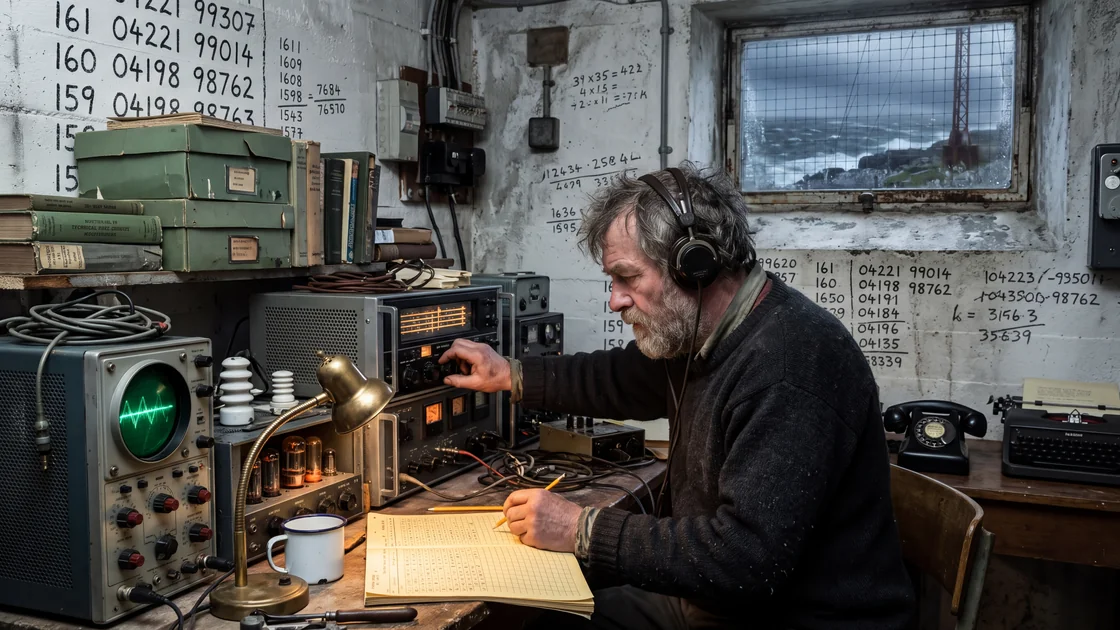
Arthur Vance spent forty-two years inside the concrete throat of Station Blackwood, a decommissioned Admiralty listening post perched on the slate cliffs of North Uist, listening to the dead languages of the Cold War. For decades, he cataloged the mechanical, chime-driven cadences of shortwave numbers stations—the synthetic German girls, the distorted folk melodies, the droning Soviet buzzers—treating them as cryptographic ghosts of an empire that had forgotten to turn off its transmitters. But when a routine tracking of the legendary transmitter known as "The Lincolnshire Poacher" revealed an impossible negative phase-drift in the ionospheric skip, Vance broke protocol to apply an asymmetric non-linear key to the carrier wave. What he unlocked was neither diplomatic cipher nor espionage rendezvous, but an inverted temporal telemetry: the numbers were not coordinates of latitude and longitude, but casualty tallies, atmospheric pressure deficits, and diminishing hours. The stations were not relics of a forgotten past; they were distress buoys deployed by humanity’s last survivors, broadcasting backward through time across the burning ionosphere to warn an indifferent world of its final, unavoidable collapse.
Part I: The Salt and the Valve
The Eddystone 770R receiver was warmer than a living thing. When Arthur laid his palm against the perforated steel housing, the heat of nine thermionic valves seeped into the cracked skin of his knuckles, carrying with it the faint, familiar odor of baked dust, lead solder, and sea-damp. Outside the double-glazed, wire-reinforced casement of the listening room, the Atlantic Ocean tore itself to grey lace against the basalt pillars of the Hebridean shelf. Rain did not fall here so much as it was propelled horizontally by the gale, finding every seam in the concrete, turning the iron bolts of the antenna masts into swollen orange nodules of rust.
Station Blackwood had officially ceased to exist in October of 1983. The Ministry of Defence had stripped its radar gantries, unbolted its teletype consoles, and severed the direct landline to RAF Buchan, leaving only a wind-scoured shell of reinforced pebble-dash and three seventy-foot guyed masts that moaned like cello strings in the winter gales. They had offered Arthur an administrative desk at Cheltenham—a windowless cubicle bathed in the hum of fluorescent ballast, sorting signals logs from satellite downlinks. He had refused it without looking up from his logbook. He had bought the headland, the bunker, and twelve crates of surplus military radio spares for the nominal sum of three hundred pounds and his pension rights, signing away his name to become the solitary tenant of the shortwave spectrum.
For twenty years, the world had presumed him an eccentric eccentricities. The local crofters on North Uist saw his battered Land Rover twice a month at the co-op in Lochmaddy, where he bought porridge oats, tinned kippers, paraffin, and black ribbon for his Erika manual typewriter. They knew him only as the Sgàire, the gull-man who lived among the wires.
He did not monitor the modern web. He kept no computer in the bunker; the microprocessors produced spurious electromagnetic emissions that muddied the lower frequencies between three and eight megahertz. Instead, he inhabited an earlier architecture of information: copper wire, ceramic insulators, magnetic tape, and the ionosphere itself—that shimmering, sun-struck atmospheric pelt forty miles above the earth that caught the high-frequency voices of the planet and bounced them around its curve like stones skipped across dark water.
Arthur set his enamel mug of tea on the cork mat and pulled the Bakelite headphones down over his ears. He turned the main tuning vernier of the Racal RA17 receiver with two fingers. The heavy brass flywheel inside the chassis spun with a silk-smooth resistance, sliding the optical film scale past the hairline.
Ssssshhhh-crackle-pop.
The sound of the high-frequency spectrum was never silence. It was the ambient friction of the cosmos: galactic noise from Sagittarius, lightning discharges crackling in the Congo Basin, the rhythmic pulse of radar sweeping the Barents Sea, and the oceanic wash of white noise generated by billions of unshielded alternators across Eurasia.
He checked his wristwatch—a mechanical mechanical Omega with an antimagnetic inner iron cage. 03:14 UTC.
He rolled the drum to 6,802 kilohertz.
The noise floor dipped. An empty, unmodulated carrier wave cut a trench through the static, a clean column of silence that announced the presence of an immense amount of electrical power. Someone, somewhere between the Baltic and the Urals, was pumping one hundred kilowatts of pure radio frequency into a directional rhombic antenna array.
Arthur leaned forward. His pencil hovered above the gridded sheet of the Ministry of Supply Form 410.
Then came the interval signal.
It was an electronic organ, shrill and tinny, playing the first two bars of an English folk song: The Lincolnshire Poacher. The melody repeated twelve times, mechanically brisk, completely devoid of vibrato.
Ta-da-da-da-da-da-dum. Ta-da-da-da-dum.
Arthur had listened to this specific station, cataloged in the GCHQ monitors' handbook as E03, since he was an apprentice intercept officer at Famagusta in 1968. In those days, everyone knew what it was: the British Secret Intelligence Service transmitting operational instructions from their relay station at RAF Akrotiri to agents behind the Iron Curtain. Five-figure groups. Enciphered with one-time pads—the only mathematically unbreakable system known to man. The agent in Prague or Sofia would sit in a darkened bedsit with a battery-operated transistor radio, transcribe the numbers, subtract them from a single sheet of silk-paper containing random digits, and burn the paper in an iron ashtray.
The Berlin Wall had fallen. The Soviet Union had evaporated. Akrotiri’s antennas had been turned toward the Levant. Yet E03 still breathed. It had vanished for months at a time, moved frequencies, dropped its signal power, but like an unquiet heart, it always returned to the wet heather of 6,802 kilohertz.
The folk tune ceased. A brief, cold click of a relay.
Then, the voice.
It was not a live human being. It was the voice of a young woman recorded onto a magnetic drum in the late 1960s, her vowels clipped and southern-English, flattened by an early digital speech synthesizer into something neither dead nor alive.
"Three," she said. Her voice had the brittle texture of dry autumn leaves crushed underfoot. "Nine. Zero. Two. Seven."
Arthur’s pencil moved across the log sheet with automatic precision.
3 9 0 2 7
"Three. Nine. Zero. Two. Seven."
The cadence was invariable. Five digits, repeated twice, followed by a half-second pause of hiss.
7 1 4 0 8
7 1 4 0 8
0 0 1 9 4
0 0 1 9 4
Arthur transcribed thirty groups. His hand never tightened on the lead. He had written thousands of these pages. They sat in green cardboard document boxes stacked three deep along the eastern wall of the bunker, organized by frequency and call sign: The Spanish Lady, The Swedish Rhapsody, The Babbler, The Attention Signal, The Cherry Ripe. They were the meaningless debris of an obsolete craft. The codes were impossible to read without the corresponding pads, and the pads had all been pulped or incinerated thirty years ago.
The transmission reached its conclusion.
"Zero. Zero. Zero. Zero. Zero."
The synthetic woman spoke her final phrase:
"Out."
The carrier wave lingered for three seconds, a blank hiss of pressurized steam, and then died. The high-frequency noise of the empty night flooded back into Arthur’s ears like black water into a punctured hull.
Arthur sat back, exhaling slowly through his nose. He took off the headphones and laid them across the steel casing of the Racal. The room was dead silent save for the drip of condensation from the ceiling cable gland into an old sardine tin on the floor.
Drip. Plink.
He picked up the log sheet. He was about to slide it into the wire basket marked E03 / UNRESOLVED when his gaze snagged on the third group of the second line.
0 0 1 9 4
He blinked, reaching for his spectacles. He took a sip of his cold, brackish tea.
Three nights ago, he had logged E03 on 7,335 kilohertz. He stood, his knees cracking in the chilly damp of the bunker, and walked over to the shelves. He pulled down the brown folder for November. He flipped through the sheets until he found the intercept from Tuesday.
He laid the two pages side by side beneath the brass goose-neck lamp.
Tuesday’s third group: 0 0 1 9 7.
Arthur frowned. He pulled the intercept from the previous Friday.
Third group: 0 0 2 0 1.
The fundamental axiom of the one-time pad, drummed into his skull by the instructors at the Joint Services School of Linguists in Crail, was absolute, non-negotiable randomness. The numbers were generated by physical chaos—the thermal noise of gas-discharge tubes, the radioactive decay of cobalt-60 isotopes, the irregular bounce of lottery balls in a pneumatic cage. In true cryptography, there were no patterns. No rhymes. No sequences. If a one-time pad contained an arithmetic progression, even for three digits, the cryptographer who generated it was shot or sacked, because a single thread of order was a crowbar that could shatter the entire edifice of the cipher.
Arthur pulled six more sheets from the box. He lined them up across the zinc-plated bench like a hand of cards.
October 12: 0 0 2 2 4
October 19: 0 0 2 1 7
October 26: 0 0 2 1 0
November 02: 0 0 2 0 3
November 09: 0 0 1 9 7
Tonight: 0 0 1 9 4
The difference between the first and the second was seven. Between the second and the third, seven. Between the third and the fourth, seven. Between the fourth and the fifth, six. Between the fifth and tonight, three.
Arthur sat down slowly. The leather of his swivel chair groaned beneath his weight.
It was not a random sequence. It was a counter.
And it was running down.
Part II: The Velocity of Silence
To understand a transmission, one had to understand the path it took. Radio waves did not travel through the earth; they climbed into the sky, entered the cold plasma of the ionosphere, and were refracted downward by the electrical density of the layers—the D layer that swallowed signals in the daylight, the E layer that lingered like a faint mist, and the twin F layers that merged at night into a single, polished mirror of ionized nitrogen and oxygen.
Arthur owned an antenna system that had cost the taxpayers of the United Kingdom forty-two thousand pounds in 1962: a triple-beamed Bruce array, terminated with non-inductive carbon resistors, aimed precisely along the great-circle bearing of seventy-two degrees east of north. It was aimed directly at the heart of the Russian landmass.
For forty-eight hours after his discovery of the counter, Arthur did not sleep.
He bypassed the audio output of the Racal RA17 and ran the intermediate frequency—455 kilohertz—directly into a surplus Tektronix 545B oscilloscope he had restored with parts scavenged from an abandoned radar installation at Benbecula. The green trace on the circular CRT was a dancing green filament of light, a phosphorescent thread that twitched with every atmospheric murmur.
If the numbers were a countdown, they were not the only component of the signal that had changed.
At 14:00 UTC, when the sun was high over the North Sea and the D-layer absorption should have wiped out any signal below ten megahertz like grease smeared across a lens, Arthur heard the voice again. Not on 6,802 kHz, but on 11,430 kHz.
"Five," the synthetic woman said, her voice dropping into his headphones through a flurry of solar hash. "Two. Eight. Six. One."
Arthur did not write down the numbers. His fingers were locked to the calibrated knobs of the oscilloscope's time-base delay.
The waveform was wrong.
In an ordinary amplitude-modulated transmission, the carrier wave sat flanked by two symmetrical sidebands. The phase of the carrier was fixed by the crystal oscillator in the transmitter. But when Arthur expanded the time scale to five microseconds per division, the sine wave did not maintain its coherence. The peaks of the wave were drifting. They were not drifting to the right—which would indicate a positive frequency error or the physical movement of the transmitter away from the receiver, like the horn of an ambulance receding into the rain.
They were drifting to the left.
Negative phase delay.
Arthur adjusted the sweep trigger. The trace refused to lock. The signal was arriving at the copper elements of his antenna array with its phase envelope reversed. It was an anomaly so severe, so physically offensive, that he felt a sudden, sour surge of nausea in the back of his throat.
In electromagnetic theory, negative phase velocity could be produced in artificial metamaterials—substances engineered with negative permittivity and permeability at microwave frequencies. But this was shortwave radio. This was three tons of vacuum tubes and copper coils sitting on a mudbank, radiating into the natural air of the planet. For a radio wave to arrive with negative group delay through the ionosphere meant only one of two things: either the ionosphere had suddenly acquired the electrical characteristics of an inverted dielectric mirror five hundred miles wide, or the wave had not traveled through space alone.
It had traveled through the temporal coordinate with a negative sign.
Arthur rose from his bench, his breath coming in shallow, ragged puffs. He went to the iron stove in the corner of the operations room, threw two sods of dry peat onto the dying embers, and held his trembling hands over the iron rim.
"Don't be a fool," he whispered aloud to the empty concrete walls. "You're sixty-eight years old. The valves are gassy. The phase-inverter tube in the Tektronix is leaking through its mica spacer. You're measuring your own ghost."
He had an old telephone—a heavy, black GPO 706 model connected to an ancient copper pair that ran four miles across the bogs to the exchange at Bayhead. It worked only when the wind was not blowing hard enough to short the uninsulated wires against the telegraph poles.
He lifted the receiver. The dial tone was a low, mournful drone.
He dialed nine digits. He knew them by heart; he had not called them in five years.
The line clicked four times. Then a long, hollow ring.
"Mercer," a voice answered. It was brittle, dry, and irritated by the intrusion.
"Sean," Arthur said. His voice sounded strange to him, like a tool that had been kept in a damp drawer. "It’s Arthur. From Blackwood."
A silence fell over the wire, long enough for the Atlantic wind to whistle through the eaves of the bunker.
"Arthur?" Sean Mercer’s voice softened slightly, but retained its defensive edge. "Good God. I thought you’d frozen to death in that cairn of yours. I’m in the middle of a department meeting on the radio-astronomy budget cuts."
"Sean, listen to me," Arthur said, leaning his shoulder against the peeling green gloss of the bunker wall. "I need you to run an ionospheric sounding for me. Tromsø or Slough. Check the Digisonde records for the F2 critical frequency over the last seventy-two hours."
"What are you on about? The sun has been quiet. Sunspot number is twelve. The F2 layer is as flat as ditchwater."
"Look at the phase coherence," Arthur said, his hand tightening on the handset until his knuckles went ivory. "Look for an inverted Doppler shift on the five-megahertz standard transmissions. On MSF Rugby. Or the Moscow time signal."
Another silence. Mercer was a physicist; he had worked with Arthur in the seventies at the Royal Radar Establishment at Malvern, measuring the radar signatures of Soviet ballistic reentry bodies. He was not a man who enjoyed jokes.
"Why would there be an inverted Doppler shift?" Mercer asked slowly. "The transmitter isn't moving. Rugby hasn't moved since 1927."
"It isn't the transmitter that’s moving," Arthur said.
"Then what is?"
Arthur looked across the room at the oscilloscope. The green line was still shivering, a tiny, glowing nerve that refused to settle on the screen.
"The time-domain," Arthur said quietly. "The wave isn't being reflected by the plasma. It’s being refracted by an energy gradient that hasn't happened yet."
Mercer let out a harsh, barking laugh that dissolved into a cough. "You've been up there too long with the sheep, Arthur. The damp has got into your brain. The universe doesn't run backward because an old man in the Hebrides has a faulty oscilloscope."
"Sean. Check the records. The third group on E03 was 0 0 1 9 4 at zero-three-hundred. On Tuesday it was 0 0 1 9 7. It is counting down by days. Not hours. Days."
"E03?" Mercer’s voice hardened again. "The numbers station? Akrotiri closed that transmitter down six months ago, Arthur. They sold the mast site to a mobile-phone consortium. The Poacher is gone. There is nothing on six-eight-zero-two."
Arthur felt the blood drain from his ears, leaving only the sound of his own pulse hammering against his temples.
"I am listening to it now," Arthur said.
"Then you’re listening to an echo," Mercer said, and the line went dead.
Part III: The Anomaly of the Pad
Arthur did not call back. He hung up the telephone, walked back to his desk, and looked down at the paper.
Akrotiri is closed.
He knew Mercer did not lie about administrative facts. Mercer was on the defense advisory committees; he knew which transmitters had their power cut, which sites were bull-dozed, which frequencies were reallocated to commercial maritime paging. If the physical plant at Akrotiri had been dismantled, then the signal he was receiving with sixty decibels of signal-to-noise ratio was coming from somewhere else.
Or from some when else.
He sat down and pulled his technical library toward him. It was not vast, but it was total: The Admiralty Handbook of Wireless Telegraphy (1938); Terman’s Radio Engineers’ Handbook; Davies’ Ionospheric Radio; and three thick, red-bound volumes marked TOP SECRET: BRUSA / GCHQ MATHEMATICAL PAPERS (1954), which he had neglected to return when Blackwood was decommissioned.
He opened the red volumes.
In classical cryptography, the one-time pad was defined as:
\[C_i = (P_i + K_i) \pmod{26}\]
Where \(C\) was the ciphertext, \(P\) was the plaintext, and \(K\) was the keystream. If \(K\) was truly random, the probability of any given plaintext resulting from the ciphertext was identical to that of any other plaintext of equal length. You could decode the message to read "ATTACK AT DAWN" or "BUY TWENTY APPLES" or "GOD IS A CIRCLE"—each interpretation had the exact same mathematical validity without the key.
Except.
Arthur turned the yellowed pages until he found the section written in 1952 by Dr. Alan Turing’s former assistant at Manchester, Dr. Robin Gandy: On Asymmetric Boundary Conditions in Non-Ergodic Sequences.
Gandy had posited a theoretical flaw in physical one-time pad generators. If a pad was produced by a system whose physical state was entangled with its future state—if, for example, the radioactive source used to generate the random noise was subject to a boundary condition that ceased to exist at some point in the forward timeline—the numbers generated would cease to be truly Gaussian. They would develop a subtle, infinitesimal skew—a statistical "drag" toward the terminal state. The sequence would not appear ordered to the naked eye, but its entropy would begin to fall.
Arthur looked at the six groups he had logged that morning.
3 9 0 2 7
7 1 4 0 8
0 0 1 9 4
6 2 2 1 1
8 5 0 9 3
He took a clean sheet of paper and his mechanical pencil. He did not look at the letters. He looked at the intervals.
He began to calculate the second-order differences of the digits—not the values themselves, but the gaps between them.
\[3 \xrightarrow{+6} 9 \xrightarrow{-9} 0 \xrightarrow{+2} 2 \xrightarrow{+5} 7\]
He worked for four hours without a sound in the room save the scratch of his graphite and the rhythmic hiss of the paraffin lamp he had lit when the electric generator began to surge.
The intervals were not random.
When arranged into a five-by-five matrix, the numbers did not satisfy the Latin square distribution required for an unbreakable cipher. Instead, they formed a set of eigenvalues. The matrix was an operator—a state transition tensor.
Arthur recognized the form. He had seen it once before, in a classified monograph sent from Fort Meade during the Cuban Missile Crisis, detailing the atmospheric ionization profiles of high-altitude thermonuclear detonations—Operation Starfish Prime.
The numbers were not words. They were physical constants.
3 9 0 2 7 was not five letters.
\(390.27\).
Arthur reached for his shelf and pulled down the International Geophysical Reference Tables.
\(390.27\) microbars. The mean surface atmospheric pressure of an altitude of twenty-two kilometers. The lower stratosphere.
He moved to the next group: 7 1 4 0 8.
\(714.08\) Kelvins. Four hundred and forty degrees Celsius.
He moved to the third group: 0 0 1 9 4.
One hundred and ninety-four.
One hundred and ninety-four what?
Days.
He looked at his calendar on the wall. It was November 14.
One hundred and ninety-four days from November 14 was May 27 of the following year.
Arthur pushed his chair back so violently that it struck the metal document cabinet with a loud, ringing gong. He stood in the center of the bunker, his arms hanging limp at his sides, staring at the penciled grid on his desk.
The numbers were not instructions to a spy.
They were a meteorological report.
A report of a stratosphere heated to seven hundred degrees, an atmosphere compressed to four hundred microbars, and a remaining lifespan of one hundred and ninety-four days.
Part IV: The Chorus of the Dead
Once a man knows what he is listening for, the radio ceases to be an instrument of reception and becomes a window into a burning house.
Arthur ceased to monitor only E03. He stayed at his consoles for twenty hours a day, sleeping in two-hour snatches on an army surplus cot pulled beside the Racal, with the headphone lead wrapped loosely around his wrist so that any sudden spike in signal level would jerk him awake.
He found them everywhere. The bands were full of them.
They had always been there. For decades, shortwave listeners had logged them as curiosities, artifacts of bureaucratic inertia, automated transmitters forgotten in the birch forests of Belarus or the swamps of Pinar del Río. But now, through the prism of Gandy’s non-ergodic reduction, Arthur heard them for what they truly were: an orchestra of distress buoys, tethered to different points in a future that was sliding down an incline into an abyss.
On 4,625 kilohertz, the Russian station known as The Buzzer—UVB-76—had droned since the late 1970s. A dull, flat, two-second rasp, repeating twenty-five times a minute, day and night, without change. Western intelligence had long assumed it was a dead-man's switch for the Soviet nuclear arsenal, an automated trigger that would launch the silo-based SS-18s if the carrier wave was broken by a strike on Moscow.
Arthur tuned the Racal to 4,625 kHz.
Buzzz. Buzzz. Buzzz.
He ran the signal through an audio spectrum analyzer, an old Hewlett-Packard with an amber display that showed frequency against time.
The buzz was not a simple electronic pulse. Deep inside the low-frequency skirt of the modulation, masked by the deliberate distortion of an overdriven carbon microphone, there were sounds. He had always known this; monitors had occasionally heard faint Russian voices in the background of the broadcast, as though the transmitter were sitting in an open room where guards played cards or discussed logistics.
Arthur turned the selectivity filter to its sharpest setting—three hundred cycles wide—and engaged the notch filter to kill the main carrier tone.
The buzz vanished. What remained was the room behind the buzz.
There were voices. But they were not playing cards.
"...twenty-two on the surface," a man was saying. The voice was hollow, hoarse, thickened by the dry rattle of a damaged throat. The Russian was colloquial, fast, stripped of military formalities. "...the borehole at Perm has breached. The water came up at ninety degrees. It’s boiling the sump pumps. Sasha, tell them to stop the return feed. Tell them the seal has failed."
A woman’s voice, younger, thin as paper: "There is no one on the return feed, Nikolai. The Voronezh line went dark at midday."
"Then switch it to the automatic loop," the man said. "Set the interval to forty. If the phase holds, it will drop twenty years back. Maybe thirty. Someone will hear it."
"No one heard it twenty years ago," the woman replied. Her voice did not contain anger; it was empty, bleached by an exhaustion so profound that it sounded almost peaceful. "We were there twenty years ago. We were children. Did anyone tell you the sky was going to burn?"
"Set the loop, Katya."
A metal switch clicked.
Buzzz. Buzzz. Buzzz.
Arthur pulled the headphones off. His skin was cold, covered in a film of greasy sweat. He stumbled to the small sink in the corner of the bunker, turned the brass tap, and splashed the freezing, peat-stained water over his face and neck.
The water smelled of earth, iron, and centuries of decaying moss.
They were not sending messages to spies. They were not even sending messages to us. They were bailing out a sinking ship with an iron cup, throwing the water over the gunwales, not caring where it landed as long as it left their hands. They had turned every high-power transmitter left on the planet into a distress beacon, slaved them to automated generators, and aimed them down the throat of the past.
And because the shortwave spectrum was an open circuit—because the ionosphere had no memory, only a resonance—the waves had traveled along the negative paths of least resistance, skipping backward across decades of solar cycles, landing on the wire antennas of cold men sitting in forgotten listening posts on the edges of the world.
Arthur looked at his hands. They were shaking.
"May twenty-seventh," he whispered.
He went to the small, oil-stained table where his tea had grown mold. He picked up his pen and began to write a letter.
Part V: A Letter to Glasgow
My Dear Maren,
You will not thank me for writing to you after three years of silence, and you will thank me even less for what this letter contains. You will show it to your mother, or perhaps to your colleagues at the university, and they will tell you that the old man on North Uist has finally slipped from eccentric eccentricity into senile dementia.
I do not blame them. I would say the same if our positions were reversed. You are an atmospheric chemist; you deal with ice cores, parts per million of carbon dioxide, and the gradual, measurable warming of the troposphere. You believe in models that take centuries to unfold. You believe that the world has time to be saved or ruined by inches.
It does not.
I am listening to the air, Maren. I have been listening to it since before you were born. The signals coming through the high-frequency bands are not what they were last winter. The ionosphere is changing—not because of the sun, but because of something that is occurring six months from now.
There is an event. I do not know its nature. The transmissions speak of surface temperatures exceeding four hundred degrees, of the failure of deep mantle boreholes, of the complete desiccation of the lower atmosphere. The numbers stations—the old Cold War relics you used to laugh at when you were a girl sitting on my knee in the Akrotiri monitoring room—they are not dead. They are counting down to May twenty-seventh.
The British transmitter, E03, is currently at one hundred and eighty-eight days. The Russian buzzer is repeating a casualty coordinate set that terminates at the Caspian Basin. The Spanish Lady (V02) has ceased broadcasting its three-note chime and is now transmitting only a single, looping sequence: 00000 99999 00000.
I do not ask you to believe me on faith. You have access to the high-altitude spectrometer at the Ben Nevis observatory. Aim it at the twilight airglow on five megahertz. Look for the Cherenkov signature in the non-thermal emissions. You will find that the sky is already glowing with the friction of what is coming back toward us.
Leave Glasgow, Maren. Come to the island. Not because the bunker will save us—the concrete is four feet thick, but it is only concrete, and four hundred degrees will turn this headland into a slag of black glass—but because I do not wish you to be alone when the count reaches zero.
I have enough paraffin for the winter. I have your room ready. The heather is dead now, but the sea is still here.
Your Father,
Arthur.
He folded the paper twice, placed it into a brown envelope, and addressed it to Dr. Maren Vance, Department of Earth and Planetary Sciences, University of Glasgow.
He walked out into the gale to post it.
The wind nearly took him off his feet as he cleared the bunker’s concrete storm-porch. The Atlantic was white, a boiling cauldron of salt and froth that sent spray flying three hundred feet up the basalt cliffs, coating his wool coat in a cold, briny glaze. The sky was the color of a bruised plum, low and heavy with sleet.
He climbed into the Land Rover. The engine turned over five times, sluggish against the cold oil, before catching with a clattering diesel roar.
He drove the four miles across the moorland road, avoiding the deep water-filled potholes that threatened to break the half-shafts. The landscape was desolate: brown peat bogs, grey outcrops of Lewisian gneiss, and the occasional huddled blackface sheep turning its tail to the storm. There were no trees. There had been no trees here for three thousand years.
At the Bayhead post office—a low, white-washed croft with a red cast-iron post box set into the dry-stone wall—he did not go inside. He did not want to speak to Mrs. Morrison. He did not want to see her cheerful, domestic face, or hear about her grandson’s wedding in Stornoway.
He slipped the letter through the brass slit of the box.
Clack.
The sound of the envelope falling into the empty zinc bottom was small, dry, and final.
He stood there for a long moment with his hand resting on the wet iron of the box, watching the rain run down his knuckles.
Behind him, through the roar of the surf three miles away, he heard a sound.
It was not the wind.
It was a low, rolling thrum—a frequency so deep that it was felt in the marrow of the shinbones rather than heard with the ear. It was the sound of a massive electrical current discharging through a resistive medium. The air over the moor smelled suddenly of ozone, sharp and metallic, like the interior of a transformer substation on a humid August night.
Arthur looked up.
Above the grey blanket of the rain clouds, where the ionosphere should have been invisible in the mid-afternoon gloom, there was a ribbon of light. It was not the green, shimmering curtain of the aurora borealis. It was a straight, narrow line of pale, electric violet, perfectly horizontal, cutting across the sky from east to west along the great-circle bearing of sixty-eight hundred kilohertz.
It hovered for three seconds, vibrating with a high-pitched, crystalline singing that set the telegraph wires along the road into a sympathetic hum.
Then it snapped out.
The rain returned, cold and grey, pattering against the roof of the Land Rover like handfuls of dry rice.
Part VI: The Anatomy of May
By December, the count had fallen to one hundred and sixty-one.
Arthur no longer used the logbooks. The green folders were full; they sat stacked in the kitchen area, their cardboard covers curling in the damp. He had begun to write directly on the whitewashed concrete walls of the operations room with thick sticks of black grease pencil.
The numbers marched across the walls in long, vertical columns, six feet high, wrapping around the doorframe, crawling beneath the power distribution boards, terminating only at the floor:
161  04221  99014  11209  00000
160  04198  98762  11208  00000
159  04170  98501  11206  00000
He had decoded the second and third columns.
The second column was sea-surface temperature in the North Atlantic, recorded by the automated oceanic buoys of the future. It was rising at zero-point-four degrees per day.
The third column was atmospheric density at sea level, in grams per cubic meter. It was falling.
The fourth column was the one that kept him awake until his eyes were bloodshot and his vision blurred at the edges.
It was a population coefficient. A planetary total.
It had begun in October at seven point two billion.
It was now at six point eight.
Four hundred million people had vanished from the ledger in fifty-three days.
He knew how it would happen now. The transmissions were no longer merely numbers. The one-time pads were failing completely; the non-ergodic drag had become so severe that the automated systems were now transmitting raw plaintext, the vocoders struggling to articulate words that had never been programmed into their vocabularies.
On December 21, the winter solstice, Arthur sat by the Eddystone receiver with a bottle of Scotch whisky he had bought three years ago and never opened. He did not pour it into a glass; he drank directly from the neck, the raw spirit burning his throat and chest.
At 23:00 UTC, a new station appeared on 5,000 kilohertz—the frequency reserved by international treaty for standard time-and-frequency signals from the National Physical Laboratory.
There were no seconds ticks. There was no fifty-cycle tone.
There was only a human voice. A man, speaking through an oxygen mask, the sound of his breathing loud and wet inside the microphone cup.
"To anyone monitoring this channel," the man said. He spoke with the flat, neutral accent of an air traffic controller from Prestwick. "This is the Ministry of Defence Emergency Relay at Ben Macdui. The subterranean galleries are breached at Level Three. If you have not secured your air supply to the deep filters, do not attempt to surface. The surface temperature at the Cairngorm plateau is currently one hundred and twelve Celsius. The cloud deck is composed of sulfuric aerosols and superheated steam."
A pause. The sound of a valve turning, metal on metal.
"We are maintaining the beacon on automatic until the diesel runs out. We estimate forty-eight hours of fuel remaining. If you are hearing this... if anyone is listening..."
The voice broke. The breath hitched in the mask, a wet, rattling gasp that ended in a dry sob.
"We didn't know," the man whispered. "The sun didn't do it. It wasn't the sun. It came from underneath. The mantle... it was the core rotation. It slowed down by two seconds. The friction... the whole thermodynamic balance had to go somewhere. It came up through the rifts. It boiled the floor. The sea... there is no sea left at Aberdeen. It's just salt. Miles and miles of white salt."
The transmission was cut short by a burst of loud, white static that sounded like a shovel scraping across gravel.
Arthur sat in the dark. The Scotch bottle was warm in his hand.
He did not move to the wall. He did not pick up the grease pencil.
He looked at the floor between his feet. A tiny spider, brown and long-legged, was crawling across the cracked concrete, moving toward the warmth of the Eddystone's transformer. It moved with infinite care, testing each pebble, each grain of dust with its front legs, entirely unaware that the air it was breathing was already indexed, accounted for, and priced down to the last six months of its existence.
Arthur reached down and let the spider crawl onto the back of his thumb.
"Where are you going, little friend?" he murmured. "There’s nowhere to hide. Even the rocks are going to melt."
He lifted his hand and gently placed the spider on top of the warm steel housing of the receiver, next to the tuning meter. The spider curled its legs for a moment, then began to groom itself, its tiny pedipalps flashing in the yellow dial-light.
The door to the bunker groaned.
Arthur did not start. He turned his head slowly, his neck stiff with cramp.
The outer iron hatch, which he had left unbolted, had been pulled open. Cold, wet air rushed down the concrete stairs, smelling of salt, dead wrack, and the diesel fumes of a distant car.
Footsteps descended. Slow, hesitant, the boots slipping on the slick, lichen-covered steps.
A figure appeared in the doorway of the operations room.
She was wearing a yellow oilskin coat, dripping with rain, her dark hair plastered to her forehead by the gale. She was carrying a canvas rucksack and a notebook bound with an elastic band.
She stood there, blinking against the dim light of the paraffin lamp, her chest heaving as if she had run a long way.
"Maren," Arthur said. His voice was cracked, barely more than a whisper.
She looked at him. She looked at the grease-penciled walls, at the thousands of numbers running from ceiling to floor, at the glowing amber trace of the oscilloscope, at the stacks of cardboard boxes, and finally back at his face—at his grey, sunken cheeks, his uncombed beard, his eyes that were wide and dark with the madness of sixty-eight hundred kilohertz.
"I went to Ben Nevis, Dad," she said. Her voice was shaking so hard she had to grip the strap of her rucksack to hold herself steady.
Arthur did not stand. He sat with his hands between his knees, looking at her.
"And?" he asked.
Maren dropped her rucksack to the floor. It hit the concrete with a heavy, wet thud.
"The twilight airglow," she said. She reached into her pocket, pulled out a strip of thermal photographic paper, and laid it on the desk between the Eddystone and the empty tea mug. "It’s inverted. The whole upper mesosphere is ionizing from the top down. The temperature gradient has flipped."
She looked at the numbers on the wall behind him.
"It’s not May twenty-seventh, Dad," she whispered.
Arthur frowned. "The counter... the intervals on E03..."
"You calculated it from Akrotiri’s latitude," she said, her voice dropping into a dry, flat cadence that was terrifyingly identical to the synthetic girl on the radio. "You didn't account for the orbital precession. The magnetic pole is migrating toward Siberia at four miles an hour. It’s compressing the timeline."
Arthur felt the room begin to tilt around him. The concrete walls, the iron racks, the glowing valves—everything seemed to lose its weight, to become thin and transparent, like paper held up against a furnace door.
"When?" he asked.
Maren walked over to the desk. She did not take off her wet coat. She picked up the black grease pencil from the bench.
She walked to the end of the wall, where the numbers stopped at 161.
She did not write 160.
She drew a single, thick, black horizontal line across the wall, from the corner of the ceiling to the corner of the floor.
"February," she said. "Three weeks. Maybe four."
Part VII: The Resonant Cavity
They did not speak of the world that was ending.
When people understand that their death is private, they rage, they weep, they search for doctors, they pray to their gods. But when death is collective—when it includes the grass, the gulls, the lichen on the stones, the books in the libraries, the salt in the sea, and the memory of every child who ever stumbled on a pavement—rage becomes an absurdity. It has nowhere to land. It is like shouting at the sea for being wet.
Instead, they worked.
For twenty days, Arthur and Maren Vance rebuilt Station Blackwood.
They did not attempt to build a shelter. They did not hoard tinned beef or fill oil drums with fresh water. They knew the physics of a planetary crust losing its thermal equilibrium: four hundred degrees meant the oceans would lift into the sky as superheated steam, the air pressure would rise until the lungs were crushed inside the ribcage, and the basalt rocks of the cliffs would crack like hot glass in a bucket of cold water. Nothing made of carbon and water would survive.
They worked on the transmitter.
In the lower basement of Blackwood, submerged beneath two feet of stagnant, brackish water, sat the carcass of an Admiralty transmitter built in 1958: a Marconi Type TBM, a five-kilowatt monster designed to communicate with submerged submarines in the Greenland Sea using very low frequencies. Its valves were the size of milk churns, their copper anodes cooled by oil that had long since leaked into the bilge.
Together, using a chain hoist hung from an iron I-beam, Arthur and his daughter hauled the five-hundred-pound transformers out of the cellar. They dried them with paraffin blowtorches, testing the windings with an old hand-cranked Megger insulation tester until the needles stopped pointing to dead earth.
"Why VLF?" Maren asked on the eighth day. Her hands were black with sixty-year-old grease; she had torn her fingernails down to the quick on the casing bolts. "The high frequencies skip further."
Arthur was soldering a replacement mica capacitor into the driver stage, his breath holding steady through the smoke of the rosin core.
"The high frequencies skip on the ionosphere," he said, not looking up. "When the mesosphere goes, the ionosphere will be stripped by the solar wind. It will be gone in thirty hours. But very low frequency—ten to twenty kilohertz—doesn't bounce off the sky. It uses the earth and the ionosphere together as a waveguide. A resonant cavity. The Schumann resonance."
Maren stopped her work. She looked at the iron chassis.
"The whole planet will ring like a bell," she said.
"Like a bell," Arthur agreed. "If you hit it hard enough, the wave doesn't just go around the world. It goes through it. And if the boundary conditions are non-ergodic... if the future is a wall of heat... the energy has only one direction to run."
"Back," she said.
"Back," he said.
They were not trying to save the future. The future was a corpse that had already begun to stink. They were trying to complete the circuit.
"They heard us," Arthur said, his iron touching the lug with a soft sizzle. "In 1968. In 1944. In 1912. Every operator who ever sat in a shack with an aerial wire and heard a ghost in his headphones—they were hearing the discharge. If we don't transmit, the signal doesn't exist. If the signal doesn't exist, they don't know what killed them. And if they don't know what killed them, they won't build the stations."
"It's a loop," Maren said. Her voice was flat, dry. "It doesn't save anyone. It doesn't change anything. It just repeats."
Arthur laid his soldering iron on the brick. He looked at his daughter—the only thing he had ever produced that was not made of wire and paper.
"A memorial doesn't change the war, Maren," he said softly. "It just says: We were here. We were men. We were broken, but we were here."
On January 28, the sky over North Uist turned white.
There were no clouds. The rain had ceased four days ago. The wind had dropped to an absolute, unnatural calm that left the Atlantic as flat and grey as a lead sheet. The temperature on the cliff-top had risen to twenty-nine degrees Celsius—the heat of an Egyptian noon sitting over an Outer Hebridean winter.
The sheep were dying in the ditches. They did not understand the heat; their heavy wool fleece boiled their blood where they lay, their tongues swollen and blue, protruding from their jaws.
Arthur and Maren carried the last heavy lead-acid battery into the operations room.
The Marconi TBM stood in the center of the room, its sheet-metal panels removed, its valves glowing with an intense, blinding orange radiance that filled the bunker with a dry, suffocating heat. The cooling fan wailed like a circular saw cutting through oak.
Arthur sat at his desk.
The Racal receiver was silent. E03 was no longer broadcasting numbers. The Poacher had stopped three days ago at 0 0 0 0 3.
Now, on 6,802 kilohertz, there was only a low, rhythmic heartbeat.
Thump... thump... thump.
The sound of an empty carrier wave being modulated by the seismic groaning of the North Atlantic ridge.
Arthur pulled the Ministry of Supply microphone toward him. It was a heavy, black bakelite cup on an iron stalk, its cord covered in frayed brown cotton.
He looked at Maren.
She was sitting on the wooden box by the door, her notebook open on her lap. She had her father’s pencil in her hand.
"Ready?" he asked.
She nodded once. She did not look afraid. Her face was very pale, her eyes very bright, reflecting the orange light of the eight-hundred-volt mercury-vapor rectifiers that hummed on the floor between them.
Arthur reached out his hand and threw the main antenna contactor.
CLACK-WHIRRR.
The huge knife-switch on the wall slammed shut. A blue spark three inches long leapt across the copper contacts, filling the room with the smell of fried air.
The three guyed masts outside the bunker began to sing. It was not the moaning of the wind; it was the fifty-kilowatt RF field vibrating the steel guys against their ceramic insulators, turning the seventy-foot towers into glowing violet brushes that crackled against the dead, dry air of the Hebrides.
Arthur keyed the microphone.
He did not use a code. He did not use a one-time pad.
He spoke with the voice he had used for forty years—the voice of an intercept officer who had spent his youth reporting the movements of trawlers and bombers to men who were now dust.
"Three," he said clearly into the bakelite. "Nine. Zero. Two. Seven."
Maren’s pencil moved across her pad.
3 9 0 2 7
Arthur paused for half a second. The carrier wave roared in his headphones, a deafening waterfall of white fire that seemed to be burning the copper elements off the masts.
"Three. Nine. Zero. Two. Seven."
He looked at the wall where the black line was drawn.
"Seven," he spoke, his voice rising above the scream of the Marconi’s cooling fans. "One. Four. Zero. Eight."
"Seven. One. Four. Zero. Eight."
The air in the room was ninety degrees. The perspiration was running down Arthur’s forehead, stinging his eyes, dripping off the end of his nose onto the metal desk. The glass of the Tektronix oscilloscope cracked with a sharp, pistol-shot snap, a hairline fracture running across the green phosphorescent graticule.
He did not look at it.
"Zero," he said.
He looked at his daughter.
"Zero."
She looked back at him across the orange glare of the valves. She laid the pencil down on the open paper.
"One," he said.
A sound began outside the bunker. It was not the sea. It was the sound of the earth itself—a low, tearing screech, like a sheet of copper being ripped across a knee. The concrete floor beneath their feet heaved upward three inches, cracking the foundation slab, sending a jet of grey dust puffing out of the cable trenches.
The sea on the horizon was no longer grey. It was white, rising in a wall of steam that reached five miles into the sky, moving toward the cliffs at the speed of a falling aeroplane.
"Nine," Arthur whispered into the microphone.
He reached his hand across the desk, stretching his arm as far as it would go across the iron casing of the radio, his fingers spread wide.
Maren stood. She did not run. She walked through the blast of heat coming off the rectifier tubes, stepped over the cracked floor, and took his old, dry hand in both of hers.
Her skin was hot. His was cold.
"Four," Arthur said.
The carrier wave did not die. It rose. It climbed through the spectrum, escaping the limits of the copper wire, escaping the band, escaping the dying atmosphere, boring its way backward through the years, through the rain of 1983, through the salt of 1968, through the cold bedsits of Prague and the listening stations of Cyprus, until it became a five-note chime, a folk tune played on an electronic organ, a synthetic girl who would never die because she had never lived, singing to an old man sitting in a concrete room by the sea, waiting for him to pick up his pencil and begin to write.
"Out," Arthur said.
He let go of the switch.
The white came through the window. It did not break the glass; it dissolved it. It was not fire; it was the light of the earth turning itself inside out, beautiful, clean, and silent as the first morning of creation.
The last thing Arthur heard was not the scream of the rock.
It was the Eddystone receiver, its valves melting into a single lump of lead and glass on the bench, whispering through the fire with the voice of his own daughter, fifty years young, speaking through the static from the other side of time:
Three. Nine. Zero. Two. Seven.
We hear you.
We are coming.
Out.