The Stellar Consignment
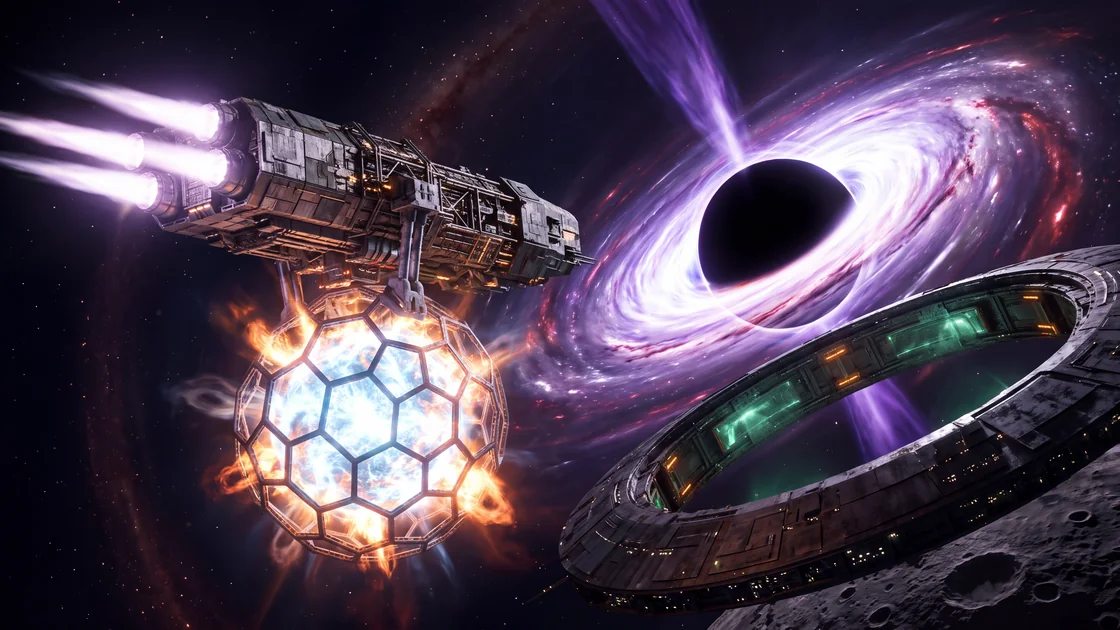
This is the account of Jonathan Vane, a veteran courier of the Pan-Galactic Postal Directive, who undertook the delivery of an embryonic O-type protostar across the Great Arid Rift to the senescent dwarf galaxy of Cassiel Prime; pursued by stellar privateers and strained by the catastrophic gravitational tides of a supermassive black hole on the brink of total ingestion, Vane and the crew of the heavy-freight hauler Coriolis Drift risked permanent relativistic exile to deposit their thermonuclear parcel into an ancient stellar forge, thereby igniting a cosmic cradle and forestalling the final, dark collapse of an entire galactic rim.
Act I: The Waybill at the Edge of the Dark
The seal on the manifest was made of flash-cured iridium foil, the kind they only pressed onto crates when the contents could either buy an empire or erase three star systems from the astronav charts.
Jonathan Vane rubbed his thumb over the embossed ridges. His skin was dry, patterned with the faint, chalky cross-hatching that comes from twenty-six standard years of breathing scrubbed, triple-filtered nitrogen-oxygen mix. The manifest read:
PAN-GALACTIC POSTAL DIRECTIVE — SPECIAL PARCEL CLASS-0
CONSIGNMENT IDENTIFIER: 909-OMEGA-SOL-NASCENT
ORIGIN: The Nurseries of the Carina Veil (Sub-Station 4)
DESTINATION: The Forge of Al-Nasr, Core Ingress, Dwarf Galaxy
Cassiel (NGC-9912)
RECIPIENT: The Remnant Council / Planetary Coalition of the Last
Redoubts
CONTENTS: One (1) Unstable Protostellar Core; Stellar Class O-Early;
Mass Equivalent: 1.18 × 10³⁰ kg (Compensated)
SPECIAL HANDLING: Maintain Active Penning-Meitner Gravitational
Envelopes at 104% Resonance. Do Not Allow Core Temperature to Drop Below
1.2 × 10⁷ Kelvin. Do Not Allow Containment Breach. Deliver Before
Chrono-Stamp T-Zero or Void All Salvage Rights.
Vane let out a short, nasal puff of air that didn't quite become a laugh. He looked through the reinforced observation pane of Berth 44 at the Gantry of Acheron.
There it hung: Cargo Container 909. It was not a crate in any conventional sense. It was a geodesic sphere the size of an orbital citadel, anchored to the ventral spine of his vessel, the Coriolis Drift, by eight colossal interlock stanchions. Each stanchion was thick enough to drive a rail-shuttle through, ribbed with supercooled superconducting leads that wept plumes of vaporized helium into the vacuum. Through the three-meter thick viewport of quartz-spinel at the hull's center, the parcel didn't look like an envelope or a package.
It looked like God’s own eye, peeled open and bleeding liquid magnesium.
"It’s twitching," a voice said behind him.
Vane turned. Tess Drake was wiping hydraulic oil from her knuckles with a frayed piece of microfiber. Her flight suit was tied around her waist, revealing a gray undershirt salted with dried perspiration and arms patterned with the blue-black geometric tattoos of the Jovian Drydock Guild.
"It’s not twitching, Tess," Vane said evenly. "It’s convective churning. It hasn’t found its hydrostatic equilibrium yet. The magnetic field is just breathing."
"Call it what you want, Jonathan. When an envelope breathes, I get nervous. When an envelope has a mass that makes my deckplates groan at dock, I start checking the emergency escape tether." She stepped up beside him, leaning her shoulder against the bulkhead. The metal gave off a low, subterranean hum—a bone-deep vibration that rattled the fillings in their teeth. That was the cargo. Even held at zero-point suspension inside twelve nested fields of magnetic counter-torque, a baby star makes itself known. It leaned against the fabric of local spacetime like an iron bowling ball sitting on wet silk.
"The waybill says we have thirty-two days ship-relative," Vane said. "Cassiel Prime isn't waiting."
"Cassiel Prime is dead, Jonathan. It just hasn’t stopped kicking yet."
"Not dead. Starving." Vane tapped the manifest against the console. "Their metallicity collapsed six hundred millennia ago. The whole cluster burned through its hydrogen stock like cheap gutter-wax. If Al-Nasr doesn't get this core into its compression array before the aphelion of the Maw, the black hole at the center drags their last three populated systems down the well. Two billion souls, Tess."
"Two billion people who didn't pay for priority shipping," she muttered, but her eyes stayed fixed on the sphere. Inside the container, a loop of white-hot plasma—a solar prominence fifty thousand kilometers long—arced against the inner magnetic wall. The diagnostic displays along the berth flashed an angry amber, then settled to dull yellow as the field dampeners adjusted, howling in sub-audible frequencies through the vessel's framework.
"The Postal Service doesn't look at the passenger lists, Tess," Vane recited. It was the catechism of the Guild, drilled into every apprentice who ever strapped a navigational compass to their wrist on the rim of Sol. "We look at the stamp. The stamp is paid. The seals are intact. The route is plotted."
"The route is through the Maw's teeth," she said.
From the shadows near the hatchway, the third member of their company emerged. Ostra was a synthezoid of the old pattern: tall, long-limbed, with an chassis of unpainted titanium that had long since oxidized to a dull slate gray. Where his face should have been, there was only a concave sensory plate of dark obsidian glass, behind which two tiny emerald optical sensors shifted with the rhythmic click-whir of miniature stepper motors.
"The path is nine percent less optimal than our initial projection," Ostra said. His vocal synthesizer was flat, dry, modeled on the accent of an ancient university rector from an ocean-drowned continent on Old Earth. "The outer spiral arms of Cassiel have already begun their final shear. The supermassive object—cataloged as Ereb-0—has entered an active accretion state. It is consuming the planetary remnants of the Thirteenth Ward. The resultant relativistic jets have ionized the intergalactic medium across four hundred square light-years. If we travel via the conventional slipstream, our hull will be stripped down to the structural ribbing within seventy hours of crossing the boundary."
Vane looked at the synthezoid. "And if we ride the gravitational wake of the star itself?"
Ostra’s optical sensors pulsed once. "The infant star possess an intrinsic gravitational dipole moment due to its artificial stabilization fields. If we drop into the slipstream with the parcel unshackled—functionally using its mass as a wedge to part the relativistic bow shock—we will survive the transit. However."
"I hate your 'howevers,' Ostra," Tess sighed, tossing her rag into a recycling chute.
"However," the machine continued without cadence, "the margin for thermal divergence is zero point zero four percent. Should the infant star's core initiate runaway deuterium burning before we reach the Forge, the Coriolis Drift will cease to be a postal vessel and will become, for approximately twelve picoseconds, the filament inside an uncontained thermonuclear incandescent bulb."
"Then we'd better make sure our cooling jackets are clean," Vane said. He signed the bottom of the iridium sheet with his stylus. A small laser etched his retinal signature into the foil with a hiss of blue smoke.
The dockmaster’s chime sounded over the ship-wide horn—a dull, brassy gong that echoed through the miles of corrugated catwalks and pressurized holds.
CLEARANCE GRANTED. BERTH 44 VENTING ATMOSPHERE. DEPARTURE VECTOR LOCKED FOR CASSIEL INGRES. POSTMASTER GENERAL EXTENDS WISHES FOR SPEEDY TRANSIT. NEITHER NIGHT, NOR COLD, NOR GRAVITATIONAL SHEAR.
Vane turned toward the bridge tube. "Tess, fire the pre-heaters on the thruster quads. Ostra, feed the coordinates into the core. We have an infant to nurse across an abyss."
Act II: The Great Arid Rift
The gap between galaxies is not merely empty; it is an insult to the senses.
Within a galactic disk, the void is alive. It is cluttered with cosmic dust, the faint, comforting glow of distant nebulae, the navigational chatter of beacons, the stray hydrogen atoms that hum against the sensors like road grit under the tires of a planetary lorry. But out in the Great Arid Rift—the three-hundred-thousand-light-year dead zone between the Milky Way's outer fringe and the isolated dwarf cluster of Cassiel—there is nothing.
There are no stars ahead, save for the faint, pale smudge of the dying galaxy, which looks like a smeared fingerprint of greasy ash upon black velvet. There are no stars behind; the Milky Way has flattened into a slim, indifferent line of pale diamond chips.
In the center of this absolute privation, the Coriolis Drift screamed.
The ship was four hundred meters of industrial brutality: slab-sided, patched with panels of lead-doped tungsten, propelled by four massive fusion torches that burned with the pale violet glare of magnetically confined boron-proton reactions. But clamped to its belly, the cargo container outshone the ship’s engines by an order of magnitude.
It was impossible to keep the parcel entirely quiet. The infant star inside was an untamed monster, a newborn god trapped in an iron crib. Its mass was small for a star—only a fraction of Sol's bulk, artificially concentrated by the Carina Veil harvesters to keep it from sprawling into a diffuse cloud of gas—but its heart was pure fury. Through the feedback conduits, Vane could hear it singing.
It was a sound conveyed not through the air, but through the structure of the hull itself: a low, resonant thrum-thrum-thrum that set the cutlery dancing in the galley and made the coolant pipes pulse like living arteries.
"Temperature is climbing in Sector Four," Tess reported from the engineering pit on the lower bridge. She was strapped into a harness that suspended her over an array of holographic flux-maps. Her hair was pulled back into a severe knot, slick with sweat. Even with the heat-sinks radiating full-bore through the dorsal sails, the ambient bridge temperature had crept to thirty-four Celsius. "The magnetic coils are sweating. Liquid lithium flow is down six percent on the secondary circuit. Jonathan, that baby is kicking its blankets off."
Vane sat in the command cradle, his spectacles reflecting the amber cascade of telemetry. He didn't use an optical jack; he preferred glass lenses. It was an affectation that annoyed modern port inspectors, but Vane maintained that if a man couldn't see his instruments with his own biological corneas, he had no business carrying the mail.
"Vent thirty liters of liquid neon into the inner jacket," Vane ordered.
"We do that, we drop our reserves for the deceleration burn at Cassiel," Tess warned.
"If we don't do it, we won't have a ship to decelerate. Vent it, Tess."
She swore under her breath, her fingers dancing across the virtual inductors. Far below, deep within the spine of the ship, valves groaned. Through the hull, a shrill hiss signaled the flash-boiling of the coolant. On the schematic, the fiery red ball at the ship’s keel cooled to an angry, bruised orange. The vibration settled from an uneven shudder to that rhythmic, heavy pulse.
"Core temperature stabilized at fourteen million Kelvin," Ostra reported from the navigation dais. The synthezoid stood motionless, his fingers plugged directly into the navigational bus via high-speed fiber-optic tendrils that sprouted from his knuckles. "Containment stress is at ninety-two percent of design yield. We have crossed the midpoint of the Rift. We are entering the outer gravitational shelf of the Cassiel dwarf."
"Show me the sky," Vane said.
The forward projection field flickered, then resolved.
Cassiel Prime was not beautiful. To the romantic, all galaxies are swirling pinwheels of light, silver fountains of youth and eternity. But Cassiel was an old, sick creature in its death throes. It was an irregular dwarf galaxy, its spiral structure long since ruined by multiple passes through the gravitational field of larger neighbors. It had no bright blue clusters of youth, no pink glowing clouds of hydrogen nursery.
It was red. A dull, rust-red, the color of dried ox-blood on concrete.
Thousands of ancient red dwarf stars, their fuel supplies nearly exhausted, drifted like dying embers in a cold hearth. And in the center of the smudge, there was a hole.
It was not merely an absence of light; it was a physical tear in the scenery. Ereb-0. A supermassive singularity of four hundred million solar masses. It was not silent. Around its throat, a massive accretion disk spun at ninety-eight percent of the speed of light—a ring of white-hot gas stripped from the inner systems, radiating lethal bursts of gamma radiation and hard X-rays. Two vast, violet jets of relativistic particles erupted from its poles, stabbing out into the void like lances of cold lightning.
The gravitational field was so vast that it had begun to draw the outer rim of the galaxy inward upon itself. The entire system was folding, collapsing into the Maw like water swirling toward an open drain.
"Look at the drift rates," Tess whispered, her harness swinging slightly as she leaned forward to peer at the main plot. "The inner stars aren't orbiting anymore. They’re falling. It’s an avalanche."
"A slow-motion avalanche," Vane corrected. "Takes ten million years for an avalanche to clear the slope out here. But for the folk on those rocks... it’s fast enough."
"The signals have ceased from the outer perimeter," Ostra noted. His head tilted three degrees to the left, processing incoming radio emissions that had taken eighty years to cross the void. "The relay stations at Cassiel-Four and New Antwerp are silent. Atmospheric loss is indicated on all major habitations. The population has retreated to the Forge of Al-Nasr."
"Al-Nasr," Tess said, her voice dropping. "It’s an antique, Jonathan. It was built by the First Builders before our people even figured out the wheel. It was meant to maintain the balance of the core, not hold off a black hole. It’s an engine with no fuel."
"Which is why," Vane said, pointing his finger at the glowing geodesic sphere on the ventral camera, "we are bringing them the coal."
Suddenly, the Coriolis Drift bucked.
It was not a smooth roll or a gentle yaw. It was a violent, structural twist that threw Vane against his five-point harness, the nylon webbing biting hard into his collarbones. The bridge alarms shrieked—a high, two-tone klaxon that indicated a primary hull displacement.
"Proximity alert!" Tess shouted, her hands flailing to catch her control plane as her harness swung wildly. "We’ve got a massive gravitational signature dropping out of the dead-angle! Four o'clock low!"
Vane cleared his vision, blinking back the red dots that danced in his eyes. "A ship? In the Rift?"
"Not one ship," Ostra corrected. The synthezoid’s voice remained perfectly level, though the stepper motors in his optical block were whining like hornets. "Seven vessels. Displaced tonnage: two million metric tons combined. Configuration: non-standard. Heavy armor plates, high-output tractor assemblies, unshielded pulse cannons. They are flying the broken-wheel insignia of the Rim-Scavengers."
"Carrion birds," Tess growled. "They’re not even waiting for the corpse to go cold."
On the tactical display, seven red wedges had materialized from the shadow of a rogue iron asteroid that had drifted into the intergalactic gulf. They were moving with aggressive speed, their thruster plumes dirty with the unburned carbon of primitive fission engines.
A tight-beam radio signal hammered into the Coriolis Drift’s communication array.
"Open it," Vane said, wiping a trickle of sweat from his eyebrow.
The audio was thick with static, distorted by the immense magnetic storm emanating from Cargo Container 909.
—heave to, Postal hauler! Cut your torches and decouple the ventral assembly! We know what’s in the egg! We have teeth on your drives! Cut your fires or we’ll crack your pressure hull and let the cold sort you out!—
Vane reached down to the communication pedestal, clicked the broadcast toggle to OPEN, and cleared his throat.
"This is Captain Jonathan Vane of the Pan-Galactic Postal Directive, vessel Coriolis Drift, registry Sol-88219. We are carrying bonded mail under the Universal Transit Treaty of the Third Arm. Any interference with our trajectory constitutes an act of inter-species piracy punishable by immediate orbital interdiction and forfeiture of navigation licenses. We are on a scheduled route. Clear our path."
A harsh, barking laugh came over the speaker.
—Listen to the mailman! Look around you, old man! There is no Postal Directive out here! There are no courts! There’s only the Maw! That little sun in your belly has enough unburned deuterium to run our fleet’s drives for ten thousand generations! It can get us across the void to the Andromeda Arc! You’re bringing coal to a burned-out furnace! You’re throwing life into the grave! Jettison the cradle, and we let your crew take the life-skiff back to the perimeter! Refuse, and we will peel you like a tin can!—
The transmission cut.
"Tactical assessment, Ostra?" Vane asked quietly.
"Their vessels are antiquated, but their armaments are significant," the synthezoid replied. "They possess magnetic mass-drivers capable of penetrating our forward shields at ranges under forty thousand kilometers. If they strike the container’s stabilization struts, the harmonic resonance will cause an uncontrolled Penning collapse. We will detonate within eight seconds."
"Can we outrun them?" Tess asked, her voice tight. "We’ve got the Carina engines—"
"We are towing a star, Tess," Vane interrupted. "We have the mass of a small moon and the maneuverability of a brick church. We can't outrun them."
He stood up from his cradle, unbuckling his harness. He grabbed the overhead handrail and pulled himself toward the forward observation bay.
The seven scavenger ships were fanning out into a standard wolf-pack formation, attempting to encircle the Coriolis Drift. Their bows were notched like crude arrowheads, their hulls scarred by decades of radiation and debris. They were desperate men, Vane knew. Men who had seen their homeworlds stripped of warmth, who knew that the darkness of Cassiel was coming for them, and who saw in his cargo the only thing that could buy them another century of survival in the empty wastes between the galaxies.
"Captain?" Tess asked. "What are the orders?"
Vane didn't turn around. He looked at the lead scavenger vessel, which was already opening its torpedo ports, the dull silver tubes glinting in the pale light of the embryonic sun.
"The Directive has seven thousand regulations concerning non-delivery," Vane said softly. "Regulation One: The parcel must go through. Regulation Two: The courier must defend the parcel with all available means. Ostra, what is the magnetic saturation of the container's outer shroud?"
"It is currently holding ninety-four thousand Tesla of counter-flux," Ostra said. "It is saturated to maximum tolerance."
"Good," Vane said. He walked back to the console and unlocked the red safety cover over the central cargo interface. "Tess, disengage the magnetic ground leads on stanchions three and six."
Tess’s eyes widened. "Jonathan, that will dump forty percent of the star's solar-wind buildup directly into the ship's skin!"
"Not into the ship," Vane said. "Into the directional deflector array. We aren't going to outrun them, Tess. We are going to give them a taste of the morning."
Act III: The Solar Siphon
The bridge of the Coriolis Drift became a cathedral of alarm sirens.
"Disengaging ground leads three and six!" Tess shouted, her knuckles white on the controls. "Warning! Hull potential is climbing! Ten thousand volts... fifty thousand... one million volts!"
The entire ship began to glow. Out in the vacuum, the stray hydrogen atoms of the intergalactic medium were pulled toward the Coriolis Drift’s hull by the immense electrostatic charge, then instantly vaporized into blue sparks. The hull groaned, the plates expanding under the sudden, furious wave of heat leaking through the primary insulators.
Through the forward quartz, the scavenger ships were closing. The lead vessel was less than twenty thousand kilometers away—point-blank range in the geometry of the void. Its mass-driver barrels flashed with pale yellow ionization as it prepared to fire its first salvo of armor-piercing tungsten slugs.
"Ostra, transfer thruster authority to my pedals," Vane said.
"Authority transferred," the synthezoid said. "Structural integrity of the cargo spine is decreasing. We have forty seconds before the Penning fields suffer an unrecoverable phase shift."
"Forty seconds is three times what a good postman needs," Vane muttered.
He jammed his right foot forward, firing the starboard RCS thrusters. The Coriolis Drift rolled twelve degrees along its longitudinal axis, swinging the bottom of the ship—and the massive, blazing belly of Cargo Container 909—directly toward the converging pirate formation.
"Open the solar valve," Vane commanded. "Discharge the coronal trap."
For two seconds, nothing happened. Then, deep within the geodesic sphere, a mechanical aperture eight meters wide dilated against the vacuum.
It was not an explosion; it was an expulsion. The infant star, sensing an exit from its magnetic cage, vomited an immense column of superheated hydrogen plasma directly into the void. It was an artificial coronal mass ejection, a tongue of white-violet fire five hundred thousand kilometers long, guided by the ship's flared magnetic fields like water through a high-pressure nozzle.
The beam struck the lead scavenger ship dead center.
The pirate vessel did not break apart. It did not have time. The titanium-tungsten armor of its forward hull vaporized instantly, flashing into an expanding cloud of incandescent green gas. The ship’s ammunition stores cooked off in a fraction of a millisecond, followed by the catastrophic detonation of its fission core. The blast was lost entirely within the fury of the solar jet; it was like throwing a match into an active blast furnace.
The two flankers tried to bank, their RCS thrusters firing frantically in full reverse, but the magnetic funnel of the Coriolis Drift swept across their vectors like a scythe.
Their radiator wings melted into slag, peeling back against their hulls like burning paper. One of the ships lost its bridge tower to the thermal wave, its windows blowing out in a brief, silent jet of frozen air before the vessel began to tumble out of control, spinning through the void like a blazing ember.
The remaining four ships broke formation. They fired their main drives in full panic, scattering in four directions like water drops dropped onto a red-hot skillet.
"Valve closed!" Tess screamed, slamming her fist onto the manual override. "Valve closed! God above, Jonathan, stanchion three is warped! Containment balance is down to eighty-one percent! The infant is crying!"
The Coriolis Drift surged forward as the reaction mass from the solar dump pushed them ahead with violent, bone-snapping force. The inertial dampeners wailed, their cooling oil bubbling through the floorboards.
Vane pulled himself back into his seat, his teeth clicking together as the acceleration pressed him flat. "Ostra! Get us into the Cassiel boundary! Use the impulse from that blast! We’re riding the flare!"
"Trajectory confirmed," Ostra said. The machine's obsidian face-plate was covered in a network of micro-fractures from the intense heat that had radiated through the bridge windows, but his emerald lights burned with cold, mathematical precision. "We have entered the gravitational sphere of Cassiel Prime. Relativistic shear is increasing. The Maw of Ereb has registered our signature."
Vane looked ahead. The smudge had become a wall.
They had crossed the threshold. The Great Arid Rift was behind them. Ahead lay the cemetery of Cassiel, its sky burning with the dark, bruised violet of a star-eating hole.
Act IV: The Senescent Shore
The outer systems of Cassiel were dead worlds, grey balls of rock and iron that had ceased to rotate, locked in tidal trances by the immense mass at the galactic center.
The Coriolis Drift flew low through this graveyard. Vane kept their trajectory close to the ecliptic of the shattered systems, using the gravitational shadows of dead moons to shield their fragile cargo from the monstrous radiation storms pulsing from Ereb-0.
Every thirty minutes, the ship passed another ghost.
Here was a ring-world, its carbon-fiber spokes snapped like dry twigs, its biosphere long since frozen into sheets of nitrogen ice. There was a generation ship, three kilometers long, floating dead with its drive bells crushed by tidal shear, its hull cold and dark as an iron gravestone.
"We have received a signal from the Forge," Tess said. She was working by the dim orange emergency lights; the primary circuits had burned out during the solar vent, and the bridge smelled of scorched bakelite and melting wire insulation. "It’s weak. The carrier wave is being dragged down the red-shift slope by the Maw. But it’s them, Jonathan. They’re still there."
"Put it through the audio scrubbers," Vane said.
The voice that came through the speakers was thin, raspy, ancient. It sounded like dry leaves being crushed under an iron boot.
—Forge of Al-Nasr to approaching vessel... our sensors detect... an O-type signature. It is... is it the Consignment? Did the Sol Directive... actually answer?
Vane picked up the hand-mic. "This is Courier Captain Jonathan Vane, Directive vessel Coriolis Drift. We have Waybill 909-Omega in our clamps. One nascent protostar, class O-early, mass verified, seals unbroken. We are twelve hours behind schedule due to pirate interdiction, but the parcel is intact. Prepare your intake cradles."
There was a silence on the line so long that Vane thought the signal had been swallowed by the gravitational rip of the accretion disk. Then, a low, shuddering breath.
—Courier... you are forty years too late for the outer systems. The Third Coalition is gone. The orbital cities are gone. There are only six hundred thousand of us left down here in the deep shafts of the Forge. Our compression array is operating on its final capacitor banks. The Maw has already consumed the inner star lanes. If you drop below the Roche limit of the core, you will not have the fuel to pull back out.
"I don't need fuel to pull back out," Vane said. "I have a scheduled delivery. If you have the magnetic nets to catch this baby, we will put it on your doorstep."
—The Forge is ready, Courier. But look behind you. Ereb is reaching.
Vane didn't need to look at the rear sensors. He felt it.
Gravity is not an abstract number when you operate near a supermassive singularity. It is a physical weight. It is a hand that reaches inside your ribcage and pulls your lungs toward the floor. It is a slow, cold nausea that makes the blood pool in your feet and turns every movement of your arms into an argument with the universe.
The Coriolis Drift was descending into the throat of the dwarf galaxy.
To their left, three light-years wide, the accretion disk of Ereb-0 spun like a saw blade of pure, screaming radiance. The disk was made of whole planets, crushed into dust and heated by friction to millions of degrees. It glowed with an unholy, violet-white light that cast hard, razor-sharp shadows across the interior of the Coriolis Drift's bridge.
"Gravitational gradient is steepening," Ostra said. The synthezoid’s fingers were twitching rhythmically against his thighs, his internal processor running millions of orbital solutions every second. "Frame-dragging is now observable. Local spacetime is being pulled along the direction of Ereb's rotation. Ship time is diverging from coordinate time by a factor of one point four."
"Every hour we spend down here," Tess muttered, "two hours pass out in the Rift."
"Then let's not waste our time," Vane said. "Tess, what's the status of the parcel?"
"She’s waking up," Tess said, her voice dropping to a whisper.
Vane looked at the cargo monitor. The infant star was no longer a quiescent ball of plasma. Straining against the immense tidal forces of the nearby black hole, the protostar was trying to ignite. The gravitational pull of Ereb was competing with the internal magnetic fields of the container, pulling the star's core into an egg-like elongation.
Inside the container, fusion was accelerating. The needle on the core pressure gauge was bouncing off the red pin.
"The container can’t take much more tidal pull," Tess said, looking up at Vane with eyes wide with exhaustion and terror. "The outer hull of the sphere is buckling. If we drop into the Forge's orbit, the tidal differential between the front of the container and the back of the container will crack the Penning struts like dry pasta."
"Then we don't drop into orbit," Vane said.
Tess stared at him. "What does that mean?"
"It means we deliver on the fly," Vane said. "We drop the cradle along a parabolic insertion vector. We slingshot past the Forge at three thousand kilometers per second, release the clamps at perigee, and let the Forge’s magnetic capture-funnels pull the egg down into the compression chamber."
"And us?" Tess asked. "At that speed, if the release isn't clean within two milliseconds, the recoil will flip the Coriolis Drift ass-over-teakettle straight into the event horizon!"
"Then make sure the release is clean, Tess."
Vane leaned forward, clicking his intercom to the ship-wide channel.
"All hands, this is the Captain. Secure all loose gear. Rig for high-gravity transit. We are making our final run down the well. We have a delivery to complete. Postal Directive rules apply. Neither night, nor cold, nor the edge of the pit."
He looked at Ostra. "Take us in, Ostra."
The synthezoid’s fingers locked back into the console. "Trajectory engaged. Down the slip, Captain."
Act V: The Descent into Ereb
The Coriolis Drift tipped its nose downward into the dark.
The ship ceased to be a mechanical creature; it became an instrument of celestial mechanics. It fell. With every second that passed, the engines burned at maximum thrust not to speed them up, but to keep them from tumbling headlong into the accretion disk.
The sky disappeared.
There was only the white, blinding glare of the accretion disk on one side, and the black, lightless abyss of the event horizon on the other. Between them lay a narrow corridor of relatively stable space—the knife-edge ridge of the photon sphere, where light itself was bent into circles, orbiting the black hole like trapped moths.
In that corridor, clinging to the rim of an ancient, hollowed-out iron moon, sat the Forge of Al-Nasr.
It was a structure from the dawn of time: a ring of black hyper-alloys twelve hundred kilometers in diameter, braced with immense field-projectors that hummed with the power of thirty planetary cores. It was built to hold a star. In the center of the ring was a void—an empty mouth waiting for its food.
"Distance to Forge: eighty thousand kilometers," Ostra reported. His vocal box was beginning to distort, the deep gravitational field slowing the clock pulses of his electronic brain. "Velocity: zero point zero one two cee. Frame-dragging is causing three-degree yaw per second. Correction burns are consuming six percent of remaining attitude fuel."
The Coriolis Drift was groaning like an old wooden galleon in a typhoon. Bulkheads were warping. The deck under Vane’s boots felt like it was rippling, the atoms of the steel undergoing microscopic tidal shearing.
"Container status!" Vane yelled over the roar of the engines.
"Stanchion eight has sheared!" Tess screamed back. She was bleeding from the nose; the high-G burn was pulling the blood into her capillaries despite her pressure suit's best efforts. "Stanchion two is bent forty degrees! The infant has initiated carbon-nitrogen-oxygen cycle burning! Internal pressure is three hundred billion atmospheres! Jonathan, the shell is cracking!"
Through the observation port, Vane could see it.
The geodesic sphere was no longer dark. Thin, brilliant white lines were tracing the edges of its hexagonal armor plates. A jet of pure, cobalt-blue light was leaking from the southern hemisphere of the container, drilling a hole through the ship's lower radiator wing like a cutting torch through butter.
"Distance to release point: twenty thousand kilometers," Ostra intoned. "Ten seconds to perigee."
"Arm the explosive decouple bolts," Vane ordered.
"Bolts armed," Tess gasped. She grabbed the manual firing lever, her arm shaking violently under the three-G load. "Jonathan... the Forge’s capture fields aren't at full strength! They’re flickering!"
"Forge control!" Vane shouted into the mic. "Bring your fields up! We’re coming in hot!"
—We... we can’t!— the voice from Al-Nasr cracked through the roar of static. —The accretion storm has knocked out our primary collector arrays! We only have twenty percent field strength! If you release that star, our magnets won't catch it! It will overshoot the ring and fall straight into the Maw!
Vane looked at the telemetry. The old man was right. The Forge was dark, its vast field coils glowing only with the dull red of dying capacitors. The infant star had too much velocity. It would fly right through the ring, plunge into the black hole, and be digested in an hour, leaving the last survivors of Cassiel to freeze in the dark.
"Ostra," Vane said, his voice dropping into a strange, deadly calm. "What is our current trajectory relative to the Forge’s intake axis?"
"We are offset by two point four degrees south," the machine replied.
"If we maintain our burn," Vane said, "and do not decelerate... if we use our own ship as the brake..."
Tess snapped her head around, her eyes wild with understanding. "No! Jonathan, no! The reaction mass—"
"If we flip the Coriolis Drift and fire the main torches into the cargo's face," Vane said, "we can kill its forward momentum. We can drop it right into their lap."
"And the back-blast will push us down the well!" Tess screamed. "We won't have the delta-V to climb back out of the horizon! We’ll be inside the ergonomic limit!"
"Postal Directive Regulation Eighty-Two," Vane said, his hand moving to the master thruster override. "The integrity of the consignment takes precedence over the recovery of the transport unit."
"Damn the Directive!" Tess sobbed, her fingers clawing at the console. "Jonathan, look at the screen! Look at the hole!"
Vane looked.
The Maw was right there. It was so close that it filled half the universe. It was a blackness that had texture: a swirling, greasy velvet that drank every photon and seemed to draw the thoughts out of his brain. It was the end of all things. The place where time stopped, where names were forgotten, where every letter ever written was torn into its constituent syllables and swallowed into silence.
He thought of the two billion dead in the outer systems. He thought of the six hundred thousand left in the cold iron tunnels of the Forge, holding their children in the dark, waiting for a mailman who had died on the road.
He thought of the stamp.
The iridium foil with the retinal seal. A promise made on a drydock berth three hundred thousand light-years away, signed with the blood of Sol.
"Ostra," Vane whispered. "Flip the ship."
The synthezoid didn't hesitate. "Understood, Captain."
The Coriolis Drift swung its four-hundred-meter bulk around. The massive fusion engines swung forward, facing directly into the teeth of the approaching Forge. Clamped to their tail, the geodesic sphere was now blazing like a torch, its outer plates peeling away to reveal the raw, naked fire of the newborn star within.
"Fire main torches," Vane said. "One hundred and ten percent."
The boron-proton engines ignited with a roar that shattered the bridge display panels into a thousand spider-webs of frosted glass.
The wall of fire from the Coriolis Drift’s engines slammed directly into the infant star, acting as a colossal cushion of kinetic energy. The ship shuddered, the deceleration so violent that Vane’s vision went entirely black. He could hear the hull screaming—a long, agonizing shriek of titanium beams buckling, rivets popping like pistol shots, hydraulic lines bursting and spraying mist into the air.
Through the red-out of his failing brain, he heard Tess’s voice, small and distant, like someone shouting through a long iron pipe:
"Release... bolts... NOW!"
A dull, hollow THUD vibrated through the floor plates.
The stanchions blew. The eight-meter iridium pins severed.
Cargo Container 909 separated from the Coriolis Drift.
Free of the ship’s mass, slowed by the monstrous back-blast of the four fusion torches, the infant star drifted into the center of the Al-Nasr ring.
For a second, the universe held its breath.
Then, the Forge woke up.
The ancient machines, sensing the presence of thermonuclear matter within their focal zone, triggered their automated sequences. Immense rings of pale green gravitational force sprang into life around the perimeter of the twelve-hundred-kilometer structure. The fields caught the infant star like a ball in a catcher’s mitt.
The geodesic sphere completely disintegrated. The newborn sun—released from its artificial womb—expanded into its true form.
A brilliant, pristine sphere of blue-white fire blossomed in the dark heart of Cassiel.
It was not the dying, rust-colored light of the old dwarfs. It was the fierce, arrogant light of a new dawn. It cast its rays across the ancient iron moon, illuminating the spires of the Forge with silver brilliance, pushing back the shadows of the accretion disk, throwing a wall of solar radiation into the face of the Maw.
The gravitational shockwave from the star’s ignition rippled through the sector, dynamic pressure pushing against the falling gas streams of the black hole, creating an eddy in the cosmic drain—a pocket of stable, living space that would hold its ground against the dark for another five hundred million years.
"Delivery confirmed," Ostra’s voice said, flat, steady, and beautiful through the smoke and the scream of alarms.
Vane blinked the blood from his eyes.
On the tactical display, the green checkmark had appeared over the manifest.
WAYBILL 909-OMEGA: DELIVERED.
SIGNATURE: AL-NASR RECEPTACLE (AUTOMATED).
CONSIGNMENT COMPLETE.
"Now," Vane croaked, his mouth full of copper-tasting blood. "Tess... what’s... what’s our vector?"
The bridge was quiet, save for the hiss of leaking nitrogen and the low, guttering rattle of a dying engine.
Tess sat slumped in her harness, her face gray, her eyes fixed on the forward screen.
The star was behind them now. Ahead of them was only the Maw.
The recoil from their deceleration burn had done its work. The Coriolis Drift had dropped below the photon sphere. They were caught in the final shear. The ship’s main engines had flared out; their fuel lines were dry, their reaction chambers melted into lumps of radio-opaque slag.
They were falling.
"We don't have a vector, Jonathan," Tess said softly. Her voice was no longer angry. It was peaceful, with the terrible, smooth clarity of a mountain lake. "We’re over the lip."
Vane looked at the navigation plot. The line representing their flight path didn't lead to Cassiel Prime. It didn't lead back to Sol. It curved into a tight, infinite spiral that terminated at the central singularity.
"Time to event horizon?" Vane asked.
"Ship-relative?" Ostra replied, his obsidian faceplate entirely cracked, a single green light flickering behind the quartz. "Fourteen minutes. To an observer at the Forge... our descent will take eleven thousand years."
Vane leaned back into his headrest. The nylon straps were damp with his sweat. His fingers were stiff, but he managed to reach into his breast pocket and pull out his brass-bound logbook and his mechanical pencil.
"Jonathan," Tess said, turning her head to look at him through the dim orange light. "Was it worth it?"
Vane looked through the fractured quartz of the bridge window.
Behind them, through the severe gravitational lensing that turned the universe into a warped, shimmering kaleidoscope, he could see the infant star. It was small against the vastness of the black hole, but it was there. A spark of pure, defiant fire burning on the edge of the grave.
He thought of the six hundred thousand people down in the shafts. He thought of the children who would grow up under that blue-white sun, who would look up through the atmospheric domes and see a sky that was not black, not dying, but alive with the light of a star that had traveled across the great desert just to find them.
"The postage was paid, Tess," Vane said simply.
He opened the logbook to the last page. The paper was yellowed, smelling of cedar pulp from Old Earth—a private luxury he had carried with him through four decades of service.
He wrote the date. He wrote the vessel’s name: Coriolis Drift.
He wrote the coordinates of the Forge of Al-Nasr.
Then, in the neat, rounded script of a clerk who had spent his life keeping accounts for the stars, Jonathan Vane wrote the final entry of the manifest:
Arrived on schedule. Cargo intact. No damage to consignment. The route is clear for the next carrier.
He closed the book with a soft, dry snap.
He clicked the mechanical pencil once, twice, and tucked it back into his pocket over his heart.
Outside the windows, the light began to stretch. The blues shifted to violets, the violets to deep, infinite blacks. The stars in the distance did not fade; they smeared into rings of pure silver, circling the ship like crowns of cold iron.
Vane took Tess's hand across the gap between their consoles. Her fingers were cold, but she squeezed back with the stubborn, unyielding grip of a Jovian miner.
Ostra stood behind them, his slate-gray hands resting lightly on the backs of their seats, his broken optical plate reflecting the final, beautiful curve of the horizon.
"Neither night," Vane whispered into the gathering dark.
"Nor cold," Tess answered.
"Nor the edge of the pit," the machine concluded.
The Coriolis Drift slipped over the threshold, carrying its crew into the great, eternal archive of the void, where every letter ever delivered is preserved in the light that never leaves.