The Strata of Babel
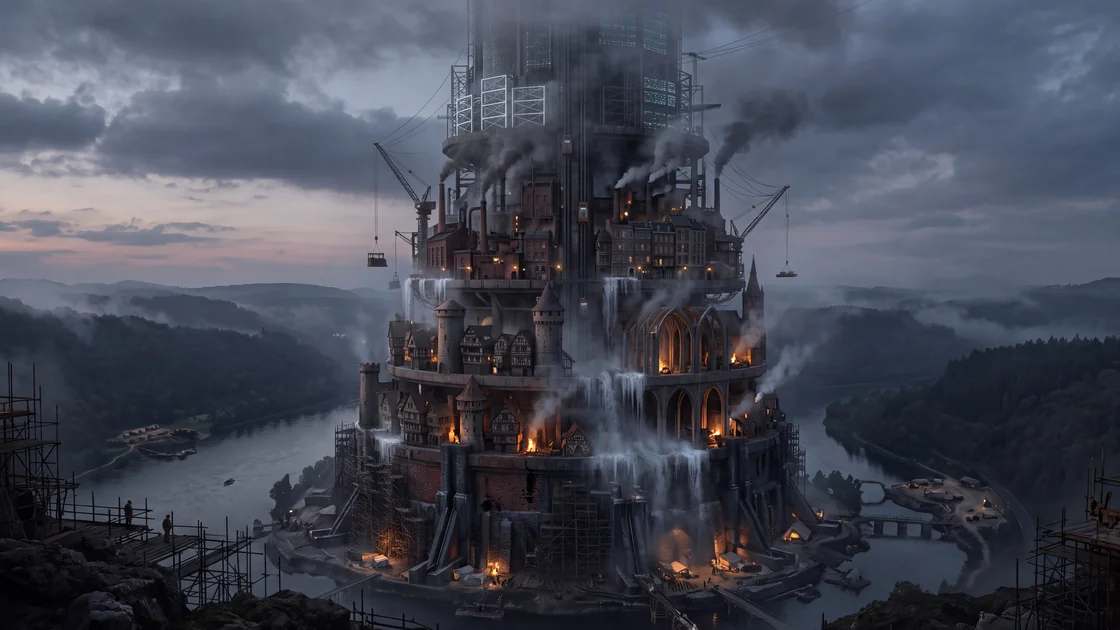
Julian Vance spent twenty-four years designing and erecting the Strata, a solitary spire of eighty-four hundred meters whose hundred modular tiers did not merely simulate human history, but were mechanically and chronologically grafted into the actual temporal coordinates of the centuries from which they drew their breath. What began as the ultimate architectural triumph of the twenty-third century—a vertical continent where scholars could take a service elevator from a Roman insula directly into an eighteenth-century coffeehouse—inevitably deteriorated into a crucible of temporal imperialism, resource plundering, and structural exhaustion. When the load-bearing manifold of the sixth century snaps beneath the weight of industrial extraction from above, Vance is forced to descend the central service core on foot, confronting the human and physical wreckage of his hubris to prevent every era of human civilization from pancaking into a singular, catastrophic present.
Act I: The Poured Foundation
The blueprints did not smell of ink or electrostatic toner; they smelled of ozone, cold river mud, and wet limestone.
Julian Vance unrolled the velum across a desk constructed from petrified swamp cypress. The desk had taken forty men and a crane to haul into the observation cupola above the construction zone, but Julian insisted on materials that had already survived the weight of epochs. Beneath him, the valley of the Upper Rhine was a ring of raw dirt, ribbed with hydraulic caissons the size of cathedral domes.
"You are confusing stability with continuity," Helena Rostova said, not looking up from her telemetry array. Her fingers rattled against the haptic interface, tracing the blue pulse of the primary chronal wells. "A building settles into soil, Julian. It sinks an inch every thirty years, it tilts toward the sun, the mortar cures over centuries until it is harder than the rock it binds. You cannot ask a foundation to sit simultaneously in the silt of the post-Roman floodplains and the basalt bedrock of the Holocene baseline. The sheer stress alone will shear your bolts before you reach the fourth mezzanine."
"The bolts are not steel, Helena," Julian replied, his voice calm, pitched in the low, resonant baritone of a man who had spent forty years convincing municipal boards and sovereign wealth trusts to finance impossibilities. "The bolts are tungsten-carbide collars sleeved in zero-point dampening fields. We are not anchoring the tower to the dirt. We are anchoring the tower to the event."
He tapped the center of the blueprint. At the center of the site, three hundred meters below the riverbed, sat the Spindle: a monolithic column of crystallized iron-nickel, bored down into the continental mantle and threaded with localized quantum-tether arrays.
To the lay public, the press releases had described it with comfortable metaphors: a ladder through time, a high-rise of human memory, a vertical archive. But Julian knew there was no metaphor in the stress equations. The Strata was an eighty-four-hundred-meter stack of discrete spatial-temporal envelopes. Floor 1 was locked to the year 54 BCE, the damp, mist-choked morning when Caesar’s legionaries felled the first oak for their bridge across the Rhine. Floor 2 was pegged to the second century, smelling of garum, kiln-fired tile, and provincial bureaucracy. Each successive floor ascended through the centuries like rings in a sequoia turned inside out, culminating at Floor 100—the empty, pressurized steel cage waiting for the twenty-third century to expire and hand over its keys.
"Look at the shear load on Tier Fourteen," Helena insisted, turning her monitor toward him. A wireframe spire twisted on the glass, its midsection glowing an angry, arterial red. "The fourteenth century is too violent. The demographic collapse, the sudden drop in regional agricultural output—the microclimate inside that envelope is thirty percent wetter than Tier Thirteen. You have the Little Ice Age sitting directly on top of the High Medieval optimum. The thermal gradient across that twenty-meter ceiling slab will crack two meters of aerated ceramic every winter."
"Then we thicken the thermal break," Julian said. "We introduce an interstitial service floor. Six meters of vacuum and circulation ducts. Let the fourteenth century rain on its own tiles. The drainage will feed the cooling towers for the industrial levels on Tier Nineteen."
Helena leaned back, her face washed pale by the phosphor screens. She was forty years younger than him, her hair cropped close to her skull in the severe fashion of the Geneva institutes, her collar stiffened with carbon-fiber stay-plates. She looked at him not with anger, but with the cold, exhausted curiosity one reserves for an architect who has begun to view physics as a negotiating partner.
"You think they will stay there," she said softly.
"Who?"
"The people on the floors. The ones you brought in to seed the envelopes. The stonemasons from Speyer, the weavers from Flanders, the printers from Mainz. You think they’ll tend their gardens and strike their iron and stay behind the airlocks."
"They have everything they had before," Julian said. "Clean water, their own sky, their own stars. Better food. Immunity from the ague."
"They have a glass ceiling above them that vibrates every time an express elevator drops four hundred tons of copper wire down from the nineteen-fifties," she said. "You haven't built a museum, Julian. You’ve built a mine. And Soren Kane is already ordering the drills."
Julian did not answer. He turned his eyes out the panoramic quartz of the cupola. Down below, the primary anchor was firing for the first time.
There was no sound—sound required an atmosphere to displace, and the anchor worked within the deep, silent grain of the vacuum between electrons. Instead, the Rhine valley seemed to flinch. A ring of silver frost bloomed across the concrete footing, spreading outward in geometric fractals. In the sky above the worksite, the clouds did not move with the wind; they tore into horizontal ribbons, each layer sliding at a different speed, reflecting different suns. At three hundred meters, the light was the bruised amber of a late-autumn evening in the fifth century; at eight hundred meters, the noon sun of the eleventh century glared white against cold, scrubbed blue; and at the summit, the stars of the twenty-third century blinked through the haze of high-altitude jet streams.
The Strata had taken its first breath. It was no longer a structure in the world; the world was now an annex of the structure.
Act II: The Vertical Ascent
Ten years after the commissioning, the express elevators had names, schedules, and insurance policies that filled three subterranean vaults in Basel.
Julian rode the central pneumatic hoist—Car Seven—alone. His knuckles were chalk-white where he gripped the bronze handrail. At seventy-one, his spine had begun to take on the slight, persistent curve of a Gothic arch under deadweight load, but his eyes were as clear and merciless as ground plate glass.
The elevator was not glass-walled; human optics could not reconcile the sight of eight dozen horizons spinning at different rates without inducing immediate, violent inner-ear trauma. Instead, the cabin was lined with English walnut, salvaged from a dismantled manor house on Tier Sixteen, fitted with small, brass-rimmed analog dials that registered atmospheric pressure, ambient carbon dioxide, temporal variance, and structural drift.
Ping.
The brass dial labeled ERA flicked its needle from
IV to V.
The elevator did not stop, but it slowed, sliding past the open airlock of Tier Five. Julian pulled back the brass shutter on the observation slit.
The smell entered through the filtration vents first: wet thatch, wild garlic, horse dung, and woodsmoke so thick it tasted of mutton grease. Outside the wire-glass, the floor stretched away into an engineered horizon that curved gently upward at the periphery, an artificial basin five hundred meters across.
It was mid-afternoon on a drizzling November in the year 476 CE. A cluster of timber-framed longhouses clung to the concrete support pilings like barnacles to a pier. A woman wrapped in a rough woolen mantle dyed with woad stood by a drainage ditch, watching the elevator tower with the dull, habitual indifference of someone who lived beneath an angry god that occasionally whistled through its teeth. A hundred yards beyond her, three men were hacking at an alder stump with iron adzes, their breath puffing white in the forty-degree air. Overhead, sixty feet above their mud, the smooth, ribbed belly of Tier Six hung like an iron sky, its riveted seams sweating condensate that dripped down into the cabbage patches below.
Julian took a small leather notebook from his breast pocket and made a notation: Tier 5: Condensation baffles failing at Column 12-B. Thatch rot imminent. Instruct maintenance to adjust thermal ceiling by 1.5 Kelvin.
He released the shutter and pulled the brass lever. Car Seven groaned, its magnetic induction coils whining as it climbed through the expansion joint.
The transition between floors was always marked by a brief, sickening sensation of weightlessness—not because gravity altered, but because the Earth’s rotational momentum differed by millimeters per second across two thousand years of axial precession. To the elevator car, it felt as though the world were constantly trying to slip out from under its boots.
Ping.
TIER XII.
Julian stepped out. He did not need his identification badge here; the guards at the pressure seal were Swiss mercenaries hired from Tier Fifteen, armed with poleaxes and modern ceramic stun-batons—a combination that seemed absurd only until one watched them suppress a grain riot.
"Master Vance," the sergeant said, striking his breastplate with an open gauntlet. The sound was flat and dry.
"Has the stone arrived from the quarry floor?" Julian asked.
"Six wagons this morning, sir. But the carters are spitting blood. The teamsters on Tier Nineteen left two crates of industrial caustic on the cargo hoist, and it leaked through the floorboards. Burned three mules down to the bone before they could get the harnesses cut."
Julian grimaced, stepping past the turnstile into the twelfth century.
Here, the air was sharp, smelling of fresh-hewn limestone, wet lime mortar, and horse sweat. The sky above this tier was artificial—an array of polarized mirror-louvers reflecting natural sunlight channeled down from the spire's external heliostats—but the light it cast was magnificent, the clear, unpolluted gold of the high medieval summer.
Before him rose the south transept of a cathedral that would never be finished. It was Julian’s personal commission: a basilica dedicated to no saint, but to the principle of Equilibrium. The nave was fifty yards wide, its ribbed vaults springing from the living structural columns of the Spire itself.
A man in a leather jerkin, his arms white to the elbows with slaked lime, was arguing with a clerk who balanced an electronic tablet on top of a calfskin ledger.
"Master Julian!" the mason called out, spotting him. It was Alain, brought down from the Ile-de-France when the tier was first stabilized twelve years ago. He had aged ten years; his beard was salt-and-pepper, his fingers thickened by the mallet. "Look at this ledger! This pencil-pusher from the modern floors tells me I cannot have more Caen stone until the next fiscal quarter! The arch is half-turned! If I don't drop the keystone before the autumn damp gets into the centering, the whole groin will kick out!"
"The requisition is stalled in logistics, Alain," the clerk said, adjusting his spectacles with a nervous, twitching finger. "Tier Twenty-One has priority on all vertical freight. They're moving three turbine assemblies up to the electrical plant on Eighty."
Julian walked to the base of the half-built pillar. He ran his hand over the stone. It was cool, toothy, and slightly damp. The chisel marks were fresh—the rhythmic, herring-boned cuts of a man who worked by the sun rather than the clock.
"Use the tufa from Tier Eight," Julian said quietly.
Alain spat on the ground. "Tufa? That porous volcanic rubbish? It won't bear the deadweight of the vault, Master! This isn't an Italian barn; it's sixty feet of span!"
"The deadweight isn't what you think it is, Alain," Julian said, his voice dropping. He leaned closer so the clerk would not hear. "The gravity on this floor is drifting. Look at your plumb line."
Alain frowned. He turned toward the scaffolding, where a lead bob hung on a linen cord from the capital of the crossing pier. It was not still. It was swaying—a tiny, regular oscillation of perhaps three millimeters, tracing an ellipse in the lime dust on the pavement.
"The wind?" Alain muttered.
"There is no wind inside this nave," Julian said. "The core is vibrating. The nineteenth century is running eight steam engines day and night to run their rolling mills, and Tier Twenty-Two is drilling three hundred anchors into the sub-frame for their data arrays. The whole spire is humming like a cello string. Your keystone won't save this vault if the column underneath it is dancing."
Alain stared at the swaying lead bob, his leather-brown face suddenly pale. He lived in the twelfth century, but he was a builder; he knew the language of stone, and stone never lied. Stone hated movement. Stone was an agreement between the earth and the sky to remain quiet.
"What is holding us up, then?" Alain whispered.
Julian looked past the cathedral’s unfinished clerestory to the ceiling above—a massive, hexagonal grid of cast titanium-duranium girders that held the floor of Tier Thirteen twenty-four feet above their heads.
"I am," Julian said. "And the bolts."
Act III: The Market of Eras
By midday, Julian had reached Tier Eighteen.
If Tier Five was a muddy ditch and Tier Twelve was an open quarry, Tier Eighteen was an overcrowded, smoke-stained parlor that smelled of bergamot, roasted coffee, sea coal, and printing ink.
The avenues here were narrow, paved with rounded cobblestones taken from the bed of the Thames. The modular ceiling had been painted with a trompe-l’œil sky of pale, watery blue, but it was almost invisible through the haze of twelve hundred chimney pots. The buildings were four-story brick townhouses with sash windows, their ground floors converted into shops, counting houses, and taverns where the noise was deafening.
Julian sat in the corner booth of The Hand and Compass, a tavern whose license had been purchased by the Trans-Era Municipal Authority from an estate in Southwark. Across the mahogany table sat Soren Kane, the Director of Operations.
Kane was forty-five, sleek as an otter in a bespoke three-piece suit cut from wool that had been shorn, spun, and woven on Tier Fourteen by fourteenth-century weavers using fifteenth-century looms, but stitched by a tailor on Tier Twenty-One using laser-guided hem-liners. He was eating oysters from a silver tray packed with crushed ice.
"They're real natives," Kane said, gesturing with an oyster fork toward the half-shell. "Dredged from the Colchester beds, 1782. Before the microplastics, before the heavy metals, before the river warmed up. You can't buy an oyster like this outside the Spire for ten thousand credits. Out there, the sea is soup. Here, it’s cold brine."
"The anchors are slipping on Tier Fourteen, Soren," Julian said. He hadn't touched his tea. The porcelain cup was chipped, a genuine Spode transferware piece from the dawn of the factory system.
Kane swallowed the oyster, washed it down with a glass of Madeira, and smiled. "Everything slips, Julian. That’s what expansion joints are for. You built thirty percent tolerance into the slip-rings. We’re only at eighteen."
"We were at eighteen last month. We’re at twenty-two today. Tier Fourteen had an earthquake three days ago. A three-point-four on the Richter scale."
"A tremor. The floor re-indexed. Rostova told me it was an harmonic anomaly from the magnetic lifts."
"It wasn't an anomaly. It was the mass differential," Julian said, leaning forward, his palms flat on the wood. "You’ve moved eighty thousand tons of raw pig iron from the nineteenth century down to the fourteenth to trade for agricultural surpluses, and you’re shipping five hundred tons of eighteenth-century timber up to the modern hospitality suites every week. The mass balance is completely inverted. The Spire was designed as a pyramid of mass: heavy stone at the bottom, light alloys at the top. You’ve put a lead weight in the middle and you’re spinning it like a top."
Kane set down his fork with a tiny clink. The smile didn't leave his face, but his eyes hardened, the pupil contracting behind his corrective lenses.
"Julian. Look around you." Kane waved his hand at the room.
At the next table, two men in powdered wigs and stained satin waistcoats were deep in conversation with a woman wearing an augmented-reality visor and a neoprene jump-tunic. They were trading packets of handwritten letters—the private correspondence of a minor diplomat in the court of George III—for ampoules of broad-spectrum synthetic antibiotics.
"Do you know what this floor generates in intellectual property alone?" Kane whispered. "We have the lost scores of Bach’s third son. We have the missing third volume of Adam Smith's economic journals. We have three hundred crates of seed-grain that haven't existed in the wild for five hundred years. The agricultural trusts are paying us fifty million a year just to study the mycorrhizal fungi in the soil of Tier Seven."
"This wasn't meant to be a commercial harbor," Julian said, his throat tightening. "The Strata was an inquiry. A spatial proof that time is not a sequence of lost moments, but a continuous structure. An architecture of human presence."
"Architecture is real estate, Vance. It has always been real estate," Kane said. "You spent sixty billion credits of other people's money to hang your philosophy on a titanium coat hanger. Did you really think they were going to let you leave it empty? A monument to your ego where scholars could sit around in Roman sandals and stroke their chins?"
Kane reached into his leather portfolio and pulled out a sheaf of printouts. They were not velum. They were glossy, thermal-transfer documents stamped with the red seal of the Executive Directorate.
"We’re opening the valves on Tier Twenty," Kane said.
Julian stared at him. "Tier Twenty? The twentieth century? That’s an industrial core. The air is leaded. The coal smoke—"
"Not the coal smoke. The manufacturing. We’re moving three assembly lines for solid-state batteries down to 1923. The labor costs are twelve cents on the dollar. The unions don't exist yet—not the ones that can fight our contracts. We give them penicillin, clean dental care, and kerosene that doesn't blow up their lamps, and they will work sixteen hours a day stamping out circuit housings."
"The airlocks won't handle that volume of transit," Julian breathed. "The atmosphere will contaminate. If you blow the seals between Nineteen and Twenty, the carbon monoxide alone—"
"The seals will hold," Kane said, standing up. He left a stack of silver coins on the table to pay for the oysters—eighteenth-century shillings minted from Mexican silver, perfect and uncirculated. "And if they don't, that's why we have you on the retainer, Julian. To tighten the bolts."
Julian sat alone in the tavern long after Kane had left.
The tavern’s grandfather clock ticked in the corner. It was a handsome piece in a mahogany case by a maker named Thomas Tompion. Its brass pendulum swung with an even, ponderous stroke: tick, tock, tick, tock.
Julian took out his pocket watch—a modern chronometer synced to the atomic clock in Braunschweig.
He held them side by side.
The atomic watch showed the second hand sweeping smoothly through sixty increments. The Tompion clock’s pendulum fell behind by three beats every minute. Then, with a sudden, jerky shudder that made the tavern floorboards groan, the pendulum leapt forward, catching up three seconds in a single, spastic twitch.
The room had not moved. The table had not moved. But Julian felt a cold wire drag through the marrow of his shins.
The floor was slipping its hitch.
Act IV: The Bleeding Seams
He found Helena Rostova three hundred meters higher, in the core laboratory of Tier Thirty.
This level had never been opened to the public or the merchants. It was an engineering void—a fifty-meter-tall cavern of exposed structural framework, lattice-work trusses, and humming cryo-coolant lines that hissed like nesting vipers. Here, the raw spine of the Strata was naked: twelve massive columns of forged composite, arranged in a circle sixty meters in diameter, braced by diagonal hydraulic struts that could expand or contract by twenty feet to compensate for wind sway or thermal expansion.
Helena was suspended in a technician’s cradle forty feet in the air, her face illuminated by the blue arc of a plasma torch. The air was cold, smelling of burnt freon and machine oil.
"Helena!" Julian’s voice was lost in the cavernous roar of the ventilation fans. He struck the metal catwalk with a steel spanner. Clang. Clang.
The cradle winched down with a mechanical whine. Helena swung out onto the grated floor, pushing her protective goggles up into her tangled hair. Her face was smudged with graphite and sweat.
"I told Kane," she said before Julian could speak. "I sent three memos. The Board filed them under 'Operations Friction.'"
"What did you find?" Julian asked.
She didn't answer with words. She walked to the base of Column Four—the primary eastern support—and unclipped an ultrasonic transducer from her tool belt. She pressed it against the grey surface of the composite leg and plugged her earphones into the monitor.
"Listen," she said, holding one earpiece out to him.
Julian pressed it to his ear.
He expected the hum of the magnetic lifts or the high-frequency vibration of the helium pumps. Instead, he heard something like the song of a dying whale: a low, groaning slide that rose slowly in pitch until it became a shriek of tearing metal, followed by a dull, hydraulic thud that vibrated through the bones of his feet.
"That's not metal fatigue," Julian said, his eyes widening.
"No," Helena said. "It’s time. The anchors aren't holding the centuries apart anymore. They’re rubbing."
She led him to a computer terminal bolted to the web of a massive box girder. The screen displayed a vertical diagram of the Strata, but the neat, horizontal bands of color that represented the floors were no longer level. They were warped. They dipped toward each other like the layers of a cake that had been dropped on a table.
"Look at Tier Fourteen and Tier Fifteen," she pointed with a graphite-blackened finger. "The boundary layer is five meters thick. It’s an aerogel seal and three expansion membranes. But the pressure differential between the fourteenth-century harvest failures and the fifteenth-century recovery has created a chronal siphon."
"A siphon?"
"The centuries are equalizing," she said bluntly. "Nature doesn't like having two thousand years of thermodynamic gradients stacked in an eight-kilometer chimney. The entropy from the upper floors—all the heat, all the waste, all the industrial exhaust from the twenty-first and twenty-second levels—it’s sinking. It’s leaking downward into the colder eras. And the past is rising to meet it."
"Give it to me in structural terms, Helena," Julian said, his voice tightening with the defensive reflex of an architect who refuses to hear that his building is falling. "What is the deflection?"
"The deflection is eight inches at the core. The entire fourteenth floor has dropped four hundred millimeters on its southern rim. If that rim drops another six inches, the shear pins will strike the safety stops. And when they strike those stops at eighty miles an hour..."
She didn't need to finish. If the shear pins struck the mechanical stops while the chronal anchors were still locked, the physical floor would remain in the fourteenth century, but the support columns would remain in the present. The Strata would snap its own neck. It would shear off at the waist, throwing eighty floors—six miles of metal, concrete, and three hundred thousand human beings—across the Rhineland in a firestorm of temporal and physical debris.
"We have to purge the anchors," Julian said.
Helena laughed, a short, barking sound that had no humor in it. "Purge them? Kane has forty private security platoons on the gates. He’s running five trains of bulk freight an hour out of the nineteenth floor. If you try to power down the Spindle, he’ll have you locked in an isolation cell on Tier Two before your hand touches the breaker."
"Not from the control room," Julian said quietly. "From the base."
Helena went still. She looked at him through the gloom of the maintenance floor, her eyes searching his wrinkled, grey face.
"The root-joint," she said.
"The mechanical manual release. Below the first century. Below the mud."
"Julian, you haven't been down to the sub-basement since the commissioning. The pressure down there... the quantum drag... it’s four atmospheres of raw temporal torque. You won't have an elevator to bring you back. If you drop the anchors from the bottom, the lifts die instantly. The whole tower becomes a dead stick."
"Then I’ll take the stairs," Julian said.
Act V: The Descent
The stairs were four feet wide, made of galvanized industrial grating, suspended inside the dead center of the primary core column.
To Julian Vance, walking down them was like descending through the core of an ancient tree, peeling back the rings of growth one by one with the soles of his boots.
He had left his coat on Tier Thirty. He wore only a heavy wool sweater, corduroy trousers, and a pair of surveyor’s boots with rubber lugs. Strapped to his back was an aluminum frame carrying eighty pounds of hydraulic jacks, manual bypass wrenches, and three canisters of liquid nitrogen.
Eighty.
Seventy.
Sixty.
He passed the industrial tiers first. The stairwell here was hot—ninety-five degrees—and the steel walls hummed with the thunder of the modern floors. Through the pressure seals on the landings, he could hear the sound of dynamos, the scream of pneumatic drills, and the muffled shouting of foremen in three languages. Smells leaked through the silicone gaskets: sulfur dioxide, ozone, synthetic cutting fluid, and the burnt-sugar smell of overheating processors.
On Tier Fifty-Two, he had to stop.
The landing was flooded with two inches of warm, oily water. A hairline crack had opened in the concrete riser where the modern floor met the seventeenth-century casing. It was weeping.
Julian bent down, dipped his finger into the water, and brought it to his tongue.
It was brackish. It tasted of salt, iron, and rotting river grass.
"The seventeenth century," he murmured. The great Rhine flood of 1651. It was leaking through the ceiling of the stairwell, three hundred years out of place, falling in warm, greasy droplets onto the structural steel of the twenty-first.
He stood, his knees cracking like dry twigs, and adjusted his pack. His breath was coming shorter now. The air in the core was growing denser, heavier with the weight of centuries pressing down from above.
Forty.
Thirty.
Twenty.
At Tier Fourteen, the door to the landing was missing.
Not open—missing. The steel fire door had been torn from its hinges as if ripped by an enormous hydraulic claw. Julian stepped out onto the landing, his boots crunching on broken glass and splintered oak.
The sight made him drop his tool pack with a hollow thud.
The fourteenth century was gone.
Or rather, it was no longer only the fourteenth century.
The floor had ruptured upward through the ceiling of Tier Thirteen and downward through the floor of Tier Fifteen. The three levels had collapsed into a single, terrifying amphitheater of mismatched reality.
Before him, a field of black, rot-choked barley stretched away under an impossible sky that flickered between the soot-black smoke of nineteenth-century chimneys and the pale, cold grey of a medieval winter. A row of half-timbered peasant cottages, their wattle-and-daub walls smeared with lime, stood half-submerged in a lake of industrial slurry that had spilled from a ruptured reservoir on Tier Nineteen.
In the middle of this swamp, twenty men in woolen tunics were huddled around a fire made of broken plastic packing crates. They did not move. They sat with their knees drawn to their chests, their faces hollow, their skin marked with the dark, purplish buboes of the pestilence.
Above them, suspended sixty feet in the air by a tangle of high-voltage cables that had ripped through the ceiling, hung the front half of a twentieth-century steam locomotive. Its boiler had exploded, its cowcatcher was twisted like tinfoil, and its iron driving wheels spun slowly in the empty air, driven only by the wind that howled through the torn seams of the outer wall.
"Julian?"
He turned. Standing on a mound of slag twenty feet away was a girl.
She wore a sheepskin coat over an orange flight-suit, her hair tied back with a strip of electrical wire. She had a shotgun slung over her shoulder by a hemp rope—a nineteenth-century double-barreled ten-gauge with rusted hammers.
"Cora?" Julian’s voice cracked.
It was his daughter. He had not seen her in seven years—not since she had walked out of his office on Tier Eighty, cursed his name, and bought a one-way transit ticket down into the middle tiers.
"You took your time," she said, her voice dry, flat, stripped of whatever music it had possessed when she was a student in Basel. She did not come toward him; she remained standing on the slag, her hand resting on the break-action of her gun.
"Cora... what has happened here?"
"What happened?" She laughed, gesturing with her chin toward the smoking landscape. "You happened, father. Kane brought down three hundred laborers from the nineteenth century to dig out the drainage ditches because the locals were all dying of the plague. Then the plague got into the nineteenth-century barracks. The nineteenth-century men had no resistance—they hadn't lived through the three hundred years of selection the rest of us had. They died in three days. Then their machines caught fire. The fire burned through the floor seals, and the floor above dropped its coal storage into the middle of the parish church."
She stepped down from the mound, her boots sinking an inch into the wet, black ash.
"You can't fix this with an allen wrench, Julian," she said, looking at his pack. "The floor isn't level anymore. It’s six hundred feet down to Tier Thirteen on the north side, and on the south side, Tier Fifteen has buckled up so high that the vines from their vineyards are growing into the chimneys of the weavers."
"I have to reach the Spindle," Julian said, his eyes pleading. "If I drop the manual release at the root, the anchors will decouple. The floors will slide back. They’ll return to their own times."
Cora stopped five feet from him. Her face was smudged with soot, but her grey eyes—his eyes—were wide, fixed on him with a terrible, lucid pity.
"Do you know what happens to the people who were born here, Julian?"
Julian froze.
"I have a child," she said.
The silence that followed was louder than the spinning wheels of the suspended locomotive.
"A child," Julian whispered.
"A boy. His father was a wheelwright from Tier Twelve. He died of the typhus three months ago." She pointed down at the floor beneath their feet. "Where does my son go when you pull the plug, father? Does he go to the twelfth century? The twenty-first? Does he split down the middle like a log under an axe?"
Julian could not speak. The calculations—the millions of lines of tensor equations, the stress models, the chronal elasticity tables that had lived in his mind for forty years—suddenly spun into nonsense, like numbers written on water.
"He doesn't belong to any century," Cora said. "He’s a Strata child. There are twelve thousand of them now, Julian. In the middle tiers. We aren't Romans, and we aren't your clean, scrubbed moderns with your data slates and your dental implants. We are the people who live in the cracks."
She raised the shotgun. Not at him, but toward the stairwell behind him.
"Go back up," she said. "Go back to your glass cage and let Kane have his mine. At least while the machines are running, the lights stay on."
"If I don't release the anchors, Cora," Julian said, his voice dropping into a register she had not heard since she was seven years old, the voice he used when he explained why a bridge had to have a crown, "the core snaps. Not in ten years. Not tomorrow. In three hours. When Column Four fails, the whole seventy thousand tons of steel above us will drop into this hole. There will be no twelfth century, no fourteenth, no boy. There will only be a crater in the mud forty miles wide, filled with broken metal and dead men."
Cora held his gaze. The barrel of the ten-gauge did not tremble, but her jaw tightened until the tendons stood out like cordage under her skin.
Above them, Column Four shrieked—a sound like a freight train locking its brakes on a downhill grade. A shower of red-hot rivet heads rained down through the ceiling, hissing as they struck the slurry pool.
Cora looked up at the twisted belly of the floor above. Then she lowered the gun.
"He's in the crypt," she said, her voice barely audible over the hiss of the steam. "Under what's left of the chapel. If you're going to kill this tower, Julian... do it before the ceiling hits him."
She turned and walked away into the smoke, her boots splashing through the poisoned mud of three centuries, not looking back.
Act VI: The Bedrock
The final five hundred meters were silent.
Below Tier Five, the elevators had never run. There were no service lights, no ventilation ducts, no drainage pipes. There was only the core shaft—a cylinder of rough-bored granite, twelve feet wide, through which the iron-nickel Spindle plunged straight into the Earth’s crust.
Julian descended by the yellow light of an emergency headlamp.
The air was freezing here—not the crisp cold of an autumn morning, but the dead, dry cold of a stone vault that had not seen a sunbeam since the glaciers retreated. The rungs of the iron ladder were coated with a thin rime of hoarfrost that burned his palms through his leather gloves.
Every thirty feet, a brass plate was bolted to the rock:
54 BCE
120 BCE
450 BCE
1200 BCE
He was below the human floors now. This was the deep foundation—the non-human anchor that pinned the entire artificial mountain to the stable crust of the pre-historic world.
Here, the Spindle did not hum. It rang.
It was a single, pure, terrifying tone, like the sound of a crystal glass struck by a bronze hammer, sustained forever in the granite dark. It was the sound of the planet’s rotation fighting the drag of eighty thousand meters of human history stacked upon its skin.
Julian reached the floor of the shaft.
The space was twenty feet wide, circular, its walls lined with hydraulic release valves the size of locomotive cylinders. In the center, rising from the floor like the stump of an amputated limb, was the Spindle head: an eight-foot cap of forged beryllium-copper, secured to the bedrock by twelve massive explosive bolts, each one three feet long and thick as a man's thigh.
This was the Dead Man’s Joint.
If the tower were ever attacked, if an uncontainable paradox ever initiated in the upper tiers, the protocol was absolute: blow the bolts, decouple the Spindle, and let the tower snap back into its primary era, shedding the past like a ship shedding its anchor line.
Julian unslung his pack. He knelt in the frost, his joints screaming with pain, his lungs burning from the thin, icy air.
He pulled the detonation interface from its protective case. It was not digital. It was an old-fashioned mechanical firing box—a mahogany casing with a heavy brass t-handle and two dry-cell batteries. He plugged the copper leads into the terminal ring on the Spindle cap.
He sat back on his heels, his back resting against the cold granite wall.
Above him, eight thousand meters of steel and stone were groaning. He could feel it through the rock: the tiny, frantic vibrations of three hundred thousand people living, trading, dying, praying, and stealing across twenty-four centuries. He could feel the weight of Alain’s unfinished cathedral; he could feel the rumbling of Kane’s battery factories; he could feel the cold, wet mud of Cora’s cabbage patch; he could feel the weight of his own seven decades of arrogant, magnificent, murderous ambition.
If he pulled the handle, what would happen?
The physics were clear: the chronal fields would collapse at the speed of light. The fourteenth century would snap back to 1348, with all its mud, its plague, and its dead. The twelfth century would return to its clear, sunny summer, Alain would drop his keystone, and the cathedral would stand for eight hundred years until the tourists came to take pictures of its ruins. The twenty-first century would find itself standing on an empty concrete footing in the Upper Rhine, looking up at an empty sky, its billion-dollar investment reduced to a ring of frosted caissons and a lawsuit that would last three generations.
And Cora’s boy?
Julian looked at his hands. They were covered in grease, lime dust, and dried blood from a scrape he had taken on the ladder at Tier Ten.
They were the hands of a builder. A builder does not tear down his work because the roof leaks. A builder does not burn the house to kill the rats.
"You were wrong, Helena," he whispered to the empty stone. "It isn't a museum. And it isn't a mine."
He reached into his tool pack. He did not touch the brass t-handle of the firing box.
Instead, he pulled out the three canisters of liquid nitrogen, his torque wrench, and the heavy manual bypass collars he had hauled down five miles of iron stairs.
He crawled to the base of Column One.
The release valve was jammed. The temporal torque had twisted the hydraulic piston by three degrees, locking the bronze sleeve against the casing. It was this jam that was killing the tower: the north side could not slide, while the south side was slipping free.
Julian cracked the valve on the first nitrogen canister.
The white, boiling gas roared out of the nozzle, coating the twisted piston in an instant shroud of blue-white ice. The metal shrieked as it contracted, the sound shrill and deafening in the tiny stone chamber.
Julian hoisted the sixty-pound bypass collar onto his shoulder. He staggered to his feet, his spine screaming under the load, his boots sliding in the frozen slurry on the floor.
"Equilibrium," he grunted, the word tearing through his cracked lips with a spray of red spit. "Equilibrium, you bastard."
He slammed the collar around the frozen piston.
The teeth of the collar bit into the steel. Julian dropped his full weight onto the four-foot extension bar of the wrench.
Nothing moved.
Above him, through eight kilometers of stone and iron, he heard a sound like thunder: the shearing of the primary bolts on Tier Fourteen. The floor was falling. The collapse had begun.
Julian Vance closed his eyes. He did not think of his blueprints, his awards, his honorary doctorates from Zurich and Cambridge, or the portraits of him that hung in the corporate lobbies of Tier Eighty.
He thought of the lead plumb bob swinging in the unfinished nave of the twelfth-century cathedral.
He thought of the three millimeters of error that separated a monument from a tomb.
He did not pull down; he threw his entire body outward, using his mass, his age, his seventy years of deadweight load, driving the heel of his heavy surveyor’s boot down onto the end of the lever with everything he had left in his heart.
CRACK.
The sound was not an explosion. It was the sound of a mountain clearing its throat.
The frozen piston sheared its burr and slammed forward three inches into its socket. The bypass collar locked with a double click that Julian felt through his teeth.
The Spindle stopped ringing.
The high, screaming vibration died away into a deep, vast, liquid silence.
The hydraulic system sighed—a long, oily exhalation that smelled of castor oil and cold copper—as the three hundred thousand tons of the Strata settled onto its new, manual stops. The load was no longer dynamic; it was balanced. Imperfect, twisted, leaning by three inches toward the west, but balanced.
Julian fell to his hands and knees on the frozen rock.
The nitrogen canister hissed out its last breath, frosting his hair and his eyelashes with white needles.
Above him, the stairwell was quiet. The thunder had ceased. There was only the distant, rhythmic thump-thump-thump of an auxiliary hydraulic pump, three miles up, beating like a tired heart through the iron skin of the Spire.
He lay down on the stone, his cheek pressed against the cold granite of the year 54 BCE.
He could not climb back up. He knew that. His legs were done; his heart was fluttering in his chest like a moth trapped under an overturned glass; his oxygen was nearly spent.
He reached out his hand and touched the Spindle cap.
The metal was cold, smooth, and greasy with ancient oil.
Beneath his fingers, through forty feet of bedrock and two thousand years of human noise, he felt a faint, rhythmic vibration.
It wasn't a machine.
It was the slow, steady, indifferent pulse of the river—the ancient Rhine, running high and cold through the spring mud, carrying the silt of the Alps down to the sea, oblivious to the towers men built to measure its passing, content to wait until the bolts rotted and the stone remembered how to fall.
Julian smiled, closed his eyes, and let the building rest upon him.