The Tectonic Escapement
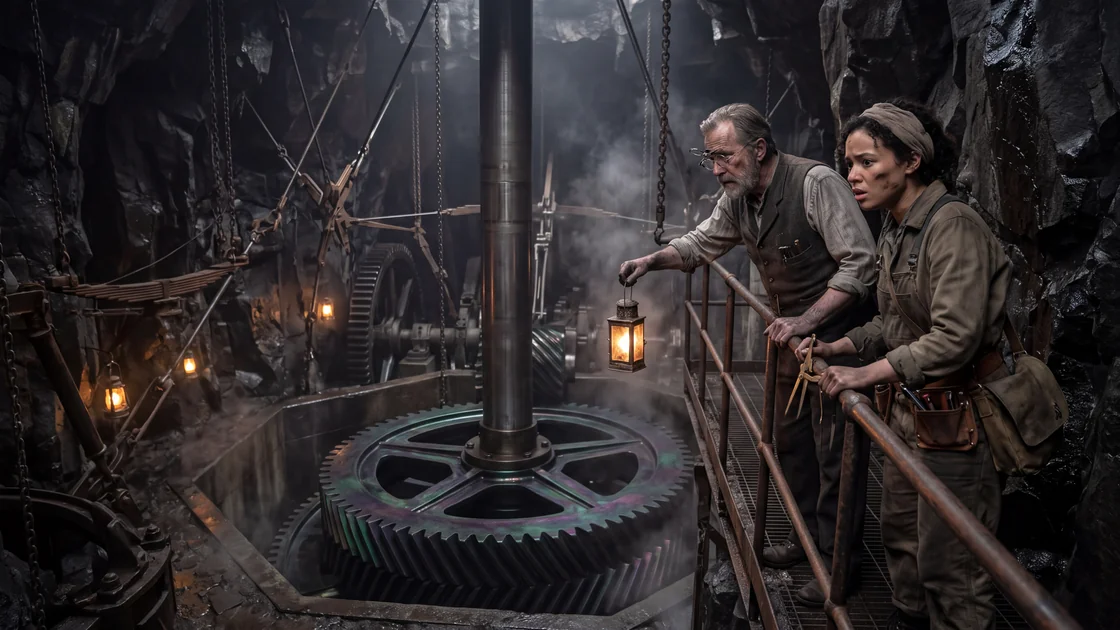
When Master Horologist Thaddeus Vance is summoned to rectify a minute mechanical variance in the Great Bastion Horologe—the colossal municipal clock tower that dictates the heartbeat, commerce, and curfew of the sovereign city of Veridia—he expects to find nothing more than a sheared gear-tooth or warped counterweight. Instead, as the city prepares for its grand Centennial Jubilee, Vance uncovers a subterranean labyrinth of cyclopean drivetrains, deadbeat escapements, and seismic resonance rods descending thousands of feet into the unstable mantle beneath the streets. Rather than a civic monument to human industry, the clock is revealed to be a catastrophic failsafe: an automated tectonic trigger designed by the city’s paranoid founding oligarchy to liquidate Veridia into the molten abyss at the first stroke of the hundredth year, leaving Vance in a desperate race against the unyielding tick of brass and steel to dismantle a mechanical apocalypse.
Act I: The Irregularity
The oil in the high bearings smelled of whale tallow, rancid wintergreen, and pulverized brass. It was an aroma Thaddeus Vance had inhaled for forty-two years, one that had settled into the pores of his knuckles, dyed his cuticles an indelible charcoal-gray, and permanently flavored his morning bread.
At seven hundred feet above the cobblestones of the Grand Plaza, the wind did not merely blow; it carved. It screamed through the bronze filigree of the four dial-faces, each seventy feet across, vibrating through the three-inch-thick plates of rolled plate glass that insulated the dial room from the gray mist of the Bay of Cinders.
Thaddeus knelt upon the narrow iron catwalk that hung suspended beneath the Great Escapement. His left hand, calloused until it resembled boiled leather, rested lightly against the primary arbor of the deadbeat pallet. Through his fingertips, he felt the pulse of Veridia.
Tick.
A shudder that rattled the teeth in his skull.
Tock.
A counter-recoil that pushed two hundred tons of counterbalanced steel back against the driving weight.
To the eight hundred thousand souls living below in the soot-slicked terraces of the valley, the Bastion Horologe was God made manifest in metal. It told the long-shift spinners when to bleed their fingers into the looms; it told the harbor captains when the tide-gates would drop; it told the Grand Senate when their speeches had expired; and every quarter-hour, its nesting carillons chimed a hymn of civil order that could be heard all the way to the salt flats ten miles inland.
"It is late," Thaddeus murmured into his beard.
Behind him, holding an open tin of graphite lubricant and a lantern hooded with mica slates, Clara shifted her weight. She was twenty-four, half his age, with fingers longer and nimbler than his own and an instinctive understanding of logarithmic curves that routinely terrified the senior fellows at the Guild of Ironmongers.
"Late by what metric, Master?" she asked, her voice competing with the rhythmic clack-whirrr-groan of the motion works. "The meridian transit through the zenith lens at midday was dead center. I checked the shadow across the silver vernier myself. The sun entered the crosshair precisely as the noon cannon fired."
"The sun is an amateur, Clara. The sun is subject to atmospheric refraction, the tilt of the planetary axis, and the wobble of an imperfect world." Thaddeus did not look back. He drew a brass-cased stop-chronometer from his waistcoat—a pocket-sized marvel of his own making, three-jeweled, with an invar balance spring impervious to thermal expansion. "The Horologe does not follow the sun. The sun is merely invited to agree with it."
He pressed the split-second pusher.
"Seven-tenths of a second across seventy-two hours," he said. "The escapement is dragging."
Clara frowned, stepping closer. The light of her lantern washed over the cyclopean machinery. Above them, the escapement wheel—a spiked disk of cold-cast phosphor bronze, twenty-two feet in diameter, bearing sixty curved teeth—turned with terrifying deliberation. Each tooth was as long as an infantry sabre and thick as a butcher’s block. When a pallet dropped into the space between teeth, it caught the momentum of a driving mass weighing sixty thousand imperial pounds, currently suspended on four braided steel cables inside the central hollow core of the masonry tower.
"Seven-tenths?" Clara arched an eyebrow. "Master Vance, the thermal gradient dropped four degrees when the sea fog rolled in yesterday. The main arbor is forty feet of cast iron; the coefficient of linear expansion alone would account for—"
"I accounted for the thermal gradient," Thaddeus snapped, though without malice. "I compensated for the contraction using the Graham zinc-steel expansion tubes on the pendulum rod thirty years ago, before your mother had finished weaning you. The pendulum length is constant to within three microns. It is not the pendulum."
He stood, his knees cracking in dry imitation of the gear train. He took the mica lantern from her hand and directed its beam downward, past the mesh of the iron catwalk, down into the roaring gloom of the tower’s throat.
The Bastion Horologe was built like an inverted fortress. While its crown climbed eight hundred feet into the maritime clouds, its roots were anchored deep into the basalt shelf upon which the entire city was founded. Below the dial chamber lay the Great Motion Train: nine tiers of reduction gears, stepped down from the colossal weight-drums to the arbor that drove the minute hands. Below that lay the Carillon Wells. And below that, behind triple-locked vault doors of manganese steel, lay the Sub-Arbor: the foundation pit where the cables descended into the dark.
"Listen," Thaddeus said.
Clara leaned over the railing, her dark curls whipping in the updraft from the lower louvers. She closed her eyes.
In the Bastion Horologe, hearing was a diagnostic tool far more potent than sight. A master horologist did not look for wear; he listened for the scrape of a dry tooth, the hydraulic hiss of an air-brake dashpot, the chattering resonance of a shaft that had developed an eccentricity of a thousandth of an inch.
For several minutes, there was only the familiar cathedral of sound: the low, foundational thrum of the driving drums, the percussive thwack of the pallets, the high-pitched singing of the bronze pinions as they engaged the cast-iron bull gears.
Then, she stiffened.
"There," she said, pointing not toward the motion train, but straight down into the black abyss of the counterweight shaft. "A second strike. A sympathetic resonance?"
"Not sympathetic," Thaddeus said grimly. "Subordinate. A secondary train is engaging."
"That's impossible. The blueprints don't show a secondary train below the fourth floor. The carillon hammers are tripped by the barrel drum on tier three. Below that, there is only the deadweight travel-shaft and the emergency sand-buffers."
"Blueprints," Thaddeus said with a bitter twist of his mouth, "are political documents, Clara. They show what the City Council is willing to pay for, and what the Grand Prefect is willing to let the public know."
He took a ring of heavy, unornamented steel keys from his pocket—keys that did not belong to the Guild register, keys that had been passed to him by his predecessor, Master Aris Thorn, on the night the old man had drunk a lethal dose of laudanum twenty years prior.
"Get the secondary diagnostic kit," Thaddeus ordered. "The depth-gauges, the magnetic compass, and the seismic plumb. We are going below the foundation."
Act II: The Anatomy of Brass
The city of Kaldras—known colloquially as Veridia after the blue-green copper roofs that carpeted its jagged topography—was a marvel born of panic. Nestled in the throat of the Caldera of the Seven Kings, it was wedged between the sea and a sheer wall of volcanic granite. Space was so scarce that the houses were built three, five, eight stories high, leaning against one another like drunken soldiers, bridged by iron sky-walks and crisscrossed by hydraulic mail tubes.
Through this vertical hive, the voice of the Horologe was the only constant. It was the spine of their civilization.
Thaddeus and Clara descended the spiral stone stair that clung to the perimeter wall of the tower. With every hundred feet they descended, the air grew warmer, shedding the salt chill of the bay and taking on the stifling, mineral stench of deep stone.
They bypassed Tier Two, where the automated bell-ringers—monstrous automatons of beaten copper shaped like armored saints—stood frozen in their tracks, waiting for the Centennial strike that would occur in forty-eight hours. They bypassed Tier Three, where the great brass barrels, spiked like the music boxes of the gods, held the programmatic chimes for every wedding, execution, and state funeral for the past century.
At ground level, behind the marble narthex where tourists bought commemorative brass medals and watched the secondary dials display the phases of the moon, Thaddeus inserted an angular key into a seam between two blocks of rusticated granite.
The stone swung inward with an oily, silent grace that spoke of counterweights far heavier than the door itself.
"No dust on the hinges," Clara observed, her fingers tracing the edge of the granite.
"Someone has been down here," Thaddeus replied. "Recently. And they didn't requisition the keys through the Master's Office."
Beyond the door, the stair changed. The smooth, dressed granite of the high Victorian era gave way to older, rougher work—hewn basalt, marked with the tooth-prints of steam-drills from the early industrial expansion, and older still, sections of dressed dry-stone that dated to the Founding.
Down they went. Fifty feet below street level. A hundred. Two hundred.
Here, the sound of the Horologe changed. The crisp, mechanical cadence of the escapement was muted, filtered through hundreds of feet of stone, transformed into a low, infrasonic heartbeat that vibrated not in the ears, but in the marrow of the femur and the base of the stomach.
Boom.
Thud.
Boom.
"Master," Clara whispered, stopping on a landing where water seeped through a fissure in the rock, slicking the basalt with orange iron-crust. "The compass."
She held up the brass casing. The needle was not pointing north toward the Pole Star. It was spinning slowly, lazily, in time with the distant heartbeat of the machinery.
"High electrical charge? Or a mass of moving iron?" she asked.
"Both," Thaddeus said. He had taken an old miner’s safety lamp from his bag and struck the flint. The blue flame burned steady, but around the rim of the gauze, a faint yellow halo fluttered. "Air is thin. Firedamp or carbon dioxide leaking from the deep faults. Keep your wits about you."
At three hundred feet below the foundations of Veridia, the stair terminated at an observation gallery that made Clara gasp.
They were standing inside a subterranean chamber the size of a cathedral. The ceiling was lost in shadows, but from the darkness hung thousands of steel rods—some as slender as a rapier, others as thick as the trunk of an oak—laced together in a dizzying lattice of scissor-joints, rocker-arms, and hydraulic dampers.
In the center of the floor, sunk into an octagonal pit that vanished into the guts of the earth, was a gear.
It was not made of brass or cold-rolled iron. It was forged from a dark, iridescent alloy that swallowed the lantern light—a metal that looked like oil on water, shimmering with dull peacock greens and deep purples. Its diameter was at least ninety feet. Its teeth were not square or cycloidal, but cut at a double-helical herringbone angle that curved with the geometry of an ammonite shell.
"God in the gears," Clara breathed, dropping to her knees to peer over the edge of the pit. "This... this isn't part of the motion work. This isn't keeping time."
"No," Thaddeus said. He was examining the drive shaft that entered the chamber from the ceiling.
It was a vertical column of solid nickel-steel, five feet in diameter, descending directly from the axis of the Bastion Horologe above. It was turning. Not fast—a single revolution took perhaps an hour—but the torque was beyond human calculation. It was the concentrated potential energy of the Horologe's multi-ton counterweights, geared down through centuries of mechanical advantage until it possessed the power to shear mountains.
Thaddeus knelt beside a secondary mechanism mounted on a bronze plinth at the edge of the pit. The plinth bore an engraved plate, black with age, but preserved by the dry heat of the deep rock.
He wiped his oily thumb across the inscription.
PROJECT TERMINAL ESCAPEMENT Authorized by the Council of Seven, Year of the Foundation, 892 Ignatius Sterling, Chief Mechanician ‘In the Event of the Final Contagion, Let the Earth Swallow the Seed.’
Clara read over his shoulder, her voice trembling. "Ignatius Sterling? The architect who built the Great Wall and the Sea Dike? He died in an asylum."
"He didn't die in an asylum," Thaddeus said, his voice flat, hollowed by a sudden, sickening clarity. "He died down here. Look."
He shifted the lantern beam. In the corner of the plinth, curled like a dry grub against the iron housing of a centrifugal governor, lay a heap of moldering tweed and calcified bone. A brass drafting compass was still clutched in the skeletal right hand, its points driven deep into a lead sheet upon which thousands of tiny, desperate corrections had been scribed.
Act III: The Logic of the Trap
Thaddeus sat beside the bones of his intellectual ancestor, his magnifying loupe screwed into his right eye-socket, reading the lead sheet by the sputtering flame of the safety lamp.
Clara was down in the trench, running her calipers along the teeth of the iridescent bull gear. Her engineer's detachment had taken over, that cold, clinical defense mechanism that horologists employ when faced with a machine so vast it threatens to unseat the mind.
"It’s an epicyclic step-down train," she called up, her voice echoing strangely in the octagonal cavern. "Master Vance! The teeth on the outer ring... there are thirty-six thousand, five hundred and twenty-five of them."
"One for every day in a century," Thaddeus said without looking up from the lead plate.
"And the sun-and-planet pinions inside the carrier plate," she continued, "they’re stepped to a ratio of one to ten. Then another one to ten. It’s an integration engine. It’s accumulating revolutions. It has been accumulating them for ninety-nine years and three hundred and sixty-three days."
"Look at the escapement trigger at the base of the central arbor," Thaddeus commanded.
Clara squeezed between two massive structural columns of gray cast iron, her skirts tucked into her tool-belt, heedless of the black grease that coated her arms.
"I see it," she said after a moment. A pause followed—a silence so long and brittle that Thaddeus could hear the slow, rhythmic drop of mineral water hitting the hot rocks below. "Master... this isn't an escapement. It’s a trip-hammer. A hydraulic release for a counterweight system."
"Read the plate to me, Clara. Tell me what is suspended in the deep well."
"There's... there's a bore-hole," she whispered. Her voice was cracked, robbed of its youth. "It goes down. The gauge says... twelve thousand feet. Master Vance, it penetrates the Sub-Basaltic Siphon. The magma chamber beneath the Bay of Cinders."
Thaddeus closed his eyes. The lead plate had told him the same story, but hearing it aloud from his sharpest pupil made it real. It dragged the nightmare out of the realm of mathematics and into the realm of iron and stone.
"Ignatius Sterling was not merely a horologist," Thaddeus said, speaking to the dark. "He was a disciple of the old Cleansing Cults during the Great Siege of '91. The Council of Seven didn't build Veridia as an eternal city. They built it as a redoubt. They were terrified of the Northern Armies, terrified of the Red Plague, terrified of their own underclass. They believed that if the city fell, it should not be occupied. It should be unmade."
He tapped the lead sheet with his fingernail.
"Sterling designed the Bastion Horologe as a century-fuse. A mechanical dead-man’s switch. The weights that drive the clock are not merely iron ingots. They are coupled to six thousand tons of lead ballast suspended over a hydraulic piston. For ninety-nine years, the slow descent of the clock's driving train has been pumping liquid mercury into an accumulative pressure cylinder."
Clara emerged from the gear pit, her face the color of wood ash. She wiped a hand across her forehead, leaving a broad smear of coal-dust and sweat.
"And the Centennial Jubilee," she said. "The hundredth anniversary. In forty-eight hours."
"At midnight on the final day," Thaddeus said, "the thirty-six thousand, five hundred and twenty-fifth tooth on that bull gear will clear the pallet of the primary release. The mercury accumulator will trip the dead-weight valves. Six thousand tons of lead will drop down the central shaft like the hammer of a rifle."
"And the bottom of the shaft?"
"A wedge," Thaddeus said simply. "A tungsten-carbide splitting wedge, seated directly into the primary shear-fault of the Caldera. It will drive the oceanic plate down and let the sea into the magma chamber. The steam explosion alone will hollow out the bay. The entire plateau—the palaces, the slums, the ironworks, the children sleeping in the garrets—will drop four hundred feet into a boiling sea of basalt."
Clara looked up toward the ceiling—toward the eight hundred feet of masonry, the great bronze dials, the hundreds of thousands of people walking the streets in the midday sun, buying ribbon for the Jubilee, practicing hymns, polishing the ceremonial silver.
"We have to tell the Council," she said.
Thaddeus let out a sound that was half laugh, half cough. He looked at the skeleton of Ignatius Sterling.
"The Council?" he asked. "Look at Sterling's skull, Clara. Look closely at the occipital bone."
Clara leaned down, her lantern held close to the calcified remains. In the back of the cranium was a neat, circular hole, half an inch in diameter, surrounded by the green staining of a corroded copper-jacketed bullet.
"He didn't commit suicide," she said.
"He tried to stop it," Thaddeus said. "The Horologe was completed in 895. In 899, the Siege was lifted; the Northern Armies collapsed; the plague burned out. The emergency was over. Veridia was safe. Sterling came down here to disarm the trigger. And the Council sent someone down the stairs behind him with a service pistol."
"Why?" she cried, her voice cracking. "Why wouldn't they want to stop it?"
"Because power does not surrender its levers," Thaddeus said, his voice darkening. "Do you think the current Council doesn't know? Or perhaps they don't know the exact mechanism, but they know what the Horologe represents. No... more likely, the knowledge was lost during the Fire of '44, when the Council Archives burned. The current Prefect, Vane, thinks the Horologe is just a clock. Or worse: he knows, and he believes he can use the threat of the Cleansing to hold the city hostage. Or perhaps... perhaps the machine has simply outlived its masters, and we are all just fleas living on the balance-wheel of an engine that doesn't care about our lives."
He stood up, his joints protesting with loud, wet clicks. He took his heavy spanners from his leather satchel and laid them out on the bronze plinth with ceremonial precision.
"We don't go to the Council," Thaddeus said. "The Council has six hundred armed Praetorians and thirty bureaucratic sub-committees. If we tell them, they will debate it for thirty-six hours, arrest us for treason for sixteen, and the city will drop into hell while they are drafting the third amendment to the requisition order for a wrench."
"Then what do we do?"
Thaddeus picked up an eighteen-inch adjustable jaw-spanner.
"We do what engineers do," he said. "We break the machine."
Act IV: The Resistance of Metal
It sounded simple.
A gear train, no matter how vast, is fundamentally an arrangement of levers and fulcrums. If you jam a tooth, if you sever an arbor, if you drain a hydraulic line, the transfer of force ceases.
"We’ll throw a dog into the primary pinion," Clara said, her eyes racing across the gear teeth. "A wedge of cold-rolled steel between the driving tooth and the follower. It will shear the teeth off the brass arbor above, decouple the tower from the sub-train, and let the weights run wild on their governor."
"No," Thaddeus said, pointing his wrench toward the ceiling. "Look at the suspension arbors. The whole system is counter-sprung. Ignatius Sterling was not an idiot; he anticipated someone trying to jam the works. Look at the balance arms above the secondary train."
Clara followed his gaze. Suspended thirty feet above them were six colossal leaf springs, each made of laminated steel plates ten inches wide, identical to the springs used on heavy railway locomotives.
"A torque sensor," she realized, her jaw dropping. "If the resistance on the bull gear exceeds fifty thousand foot-pounds—"
"—the springs flex," Thaddeus finished. "And when they flex, they trip an auxiliary sear. It’s an anti-tamper escapement. If you stop that gear by force, the sear drops immediately. The dead-weight falls now, instead of in forty-eight hours."
Clara sat back on an iron casting, her hands trembling so violently she dropped her calipers. They clattered against the stone floor with a bright, crystalline ring that seemed to linger in the stagnant air for far too long.
"Then we can't stop it," she said. "We can't slow it down. We can't jam it."
"We cannot stop it," Thaddeus agreed. "So we must make it lie."
He pulled a greasy roll of drafting parchment from his satchel, along with a piece of charcoal. He smoothed the paper against the bronze flank of the plinth.
"A clock does not know what time it is," Thaddeus said, his eyes glittering with the strange, manic energy that Clara had seen only once before, when he had redesigned the three-way balance for the Cathedral bells in three days without sleep. "A clock knows only how many times it has dropped its pallets. The trigger mechanism down here is an escapement. It trips when the counter reaches zero."
"Thirty-six thousand, five hundred and twenty-five days," Clara recited.
"Precisely. And how does it know a day has passed? By the rotation of the main vertical arbor from the clock above. One revolution per twelve hours. Two revolutions per day. The gear down here does not measure time; it measures the displacement of the Bastion's primary weight."
He began to draw: rapid, ferocious strokes of black carbon, laying out the geometry of the escapement pallet.
"If we cut the drive line, the anti-tamper drops the weight. If we jam the gear, the sear trips. But what if the gear continues to turn... while the deadbeat pallet never disengages?"
"A circular escapement," Clara murmured, her brow furrowing as she leaned over the sketch. "A runaway loop. You want to modify the deadbeat pallet into an endless slip-ring."
"Not a slip-ring. A differential bypass," Thaddeus corrected. He drew an epicyclic gear set—three small gears revolving inside an internally-toothed ring. "We don't stop the torque. We redirect it into an idle loop. We must insert a sun-and-planet differential between the main drive-shaft and the primary century-cam. The shaft will continue to turn; the Horologe above will strike the Centennial Jubilee; the citizens will drink their cheap ale and throw their paper streamers; the Council will pin gold medals to their fat chests; and down here, the century-gear will simply... stop."
Clara looked from the sketch to the monstrous machine. Her expression was pale, her lips pressed into a thin, bloodless line.
"Master Vance," she said softly. "Look at the scale of those gears. To cut a differential that can handle fifty thousand foot-pounds of torque... we need a foundry. We need thirty tons of cast steel. We need six weeks in a heavy rail-yard machine shop."
"We don't have six weeks," Thaddeus said. "We have forty-seven hours and twelve minutes."
"Then what are we going to build it from?"
Thaddeus turned his head toward the dark archway that led deeper into the subterranean levels, where the hydraulic maintenance pipes for the city's high-pressure water system roared behind moss-grown masonry.
"We aren't going to build it," he said. "We're going to steal it."
Act V: The High-Pressure Sector
The underbelly of Veridia was not merely an arrangement of stone foundations; it was an industrial intestines.
Above them, the wealthy lived in the Terraces of the Sun, where the air was filtered through linen screens and perfumed with lavender water. Below that was the Middle Rim, the domain of merchants, clerks, and master craftsmen. Below that was the Sump, where two hundred thousand factory hands lived in the perpetual twilight of the sulfur vents, working the Great Looms and the chemical leaching vats.
And below the Sump lay the Hydraulic Veins.
To move coal, sewage, and drinking water through a city that rose a thousand feet from sea level to mountain peak, Veridia relied on a steam-driven high-pressure system designed forty years prior by the Ironworks Syndicate. In the cavernous pumping stations beneath the Western Docks, three monstrous triple-expansion steam engines—each the size of a five-story tenement—pumped water into accumulator towers at two thousand pounds per square inch.
It was here that Thaddeus led Clara, through forgotten drainage tunnels and maintenance conduits lined with lead-sheathed telegraph cables.
They emerged onto a narrow catwalk overlooking Pumping Station No. 4. The noise was an assault: the wet, rhythmic thwack-slap of six-foot-wide gutta-percha belts, the groaning protest of cast-iron steam cylinders twenty feet tall, and the hiss of superheated steam escaping through packing glands. Men stripped to the waist, their skin gleaming with sweat and lard, worked the stoke-holes with long iron pokers, shoveling black anthracite into the white-hot mouths of the Cornish boilers.
"The auxiliary gear-sets for the hydraulic cranes," Thaddeus shouted over the roar, pointing to a stack of spare parts crated in grease-soaked timber beside the maintenance siding.
Clara looked at the gears. They were bronze-rimmed, with high-nickel steel webs—rugged, over-engineered pieces meant to lift twenty-ton locomotives from the holds of merchant ships.
"The pitch is wrong!" she yelled back. "The module on the Bastion bull-gear is four inches. These are three-and-a-half!"
"Then we cut them down!" Thaddeus yelled. "We have the mobile lathe in the tower workshop! We have twenty hours before the inspection crew does their rounds!"
"And how do we get three tons of nickel-steel up through the Sump and into the Bastion foundation without the Gate-Keepers seeing us?"
Thaddeus didn't answer with words. He pointed toward the ceiling of the pumping station.
Running along the crown of the vault was an overhead service gantry—an electric monorail used during the installation of the boilers, long since abandoned to the spiders and soot. It ran straight through the ancient volcanic wall, following the line of the old municipal coal-haulage drifts, emerging directly beneath the Bastion Horologe’s lower counterweight well.
"We requisition it," Thaddeus said.
"Master," Clara said, grabbing his arm. Her grip was surprisingly hard. "Look down there. On the platform."
Thaddeus pulled his glasses down his nose and peered through the steam-haze.
Standing on the central observation deck of the pumping station, flanked by four officers of the Iron Guard in their polished steel cuirasses and black plumed helmets, was a man in an ankle-length coat of midnight-blue wool.
Grand Prefect Malakor Vane.
He held an ivory-tipped cane in his gloved hands, leaning on it with the practiced languor of a man who owned everything he could see and half of what he couldn't. Beside him, unfurling a wide blueprint over an iron bench, was Master Horologist Edwin Croft—Thaddeus’s chief rival at the Guild, a man whose clocks were always gilded, always five minutes fast, and always popular with the Senate.
"...must proceed according to the original register," Vane’s voice drifted up, thin and clipped, carried by the draft of the cooling towers. "...the Centennial strike must be absolute. The pressure in the lower accumulators must reach maximum by the twenty-fourth hour."
Croft was bowing, his round, soft face shiny with perspiration. "Of course, Your Excellency. The escapement has been verified. The timing train is precise to within a fraction of a beat. When the twelfth stroke falls, the... the civic transition will be instantaneous."
"Civic transition," Clara whispered, her knuckles whitening on the handrail. "They know."
"They know," Thaddeus said, his voice dropping into a register colder than the iron beneath his feet. "They don't think of it as a tectonic bomb, Clara. Look at Vane’s face. To him, it's not a cataclysm. It’s an eviction."
The pieces fell into place with the sickening precision of an interlocking cam.
The lower city—the Sump—had been organizing for three years. The strikes at the textile mills, the mutinies in the harbor works, the pamphlets calling for a Democratic Assembly that had flooded the middle districts. The Senate had tried machine guns; they had tried bread subsidies; they had tried martial law.
They had failed.
"They aren't going to collapse the whole plateau," Thaddeus whispered, realization dawning on him like the cold light of an executioner's lantern. "Sterling’s plans were total, but Vane... Vane has modified them. Look at the pressure lines they’re tapping into. They aren't going to blow the magma chamber. They’re going to drop the lower shelf. The Sump. The foundation of the working districts."
"They're going to prune the city," Clara said, her voice trembling with a rage so pure it seemed to steady her limbs. "They’re going to drop two hundred thousand people into the bay, and keep the Sun Terraces for themselves."
"And the clock," Thaddeus said, "will be their alibi. An act of God. A sudden, tragic failure of the ancient geology during the Centennial celebration. They will hold a day of mourning, raise taxes to rebuild, and spend the next fifty years with an obedient, terrified population."
He turned back toward the dark gantry.
"We aren't modifying the escapement to save our skins, Clara," he said, checking the ratchet on his wrench. "We’re going to steal their differential, we're going to break their trigger, and then I am going to climb the eight hundred feet of that damned tower and spit in Malakor Vane’s face."
Act VI: The Long Night of the Lathe
For eighteen hours, the sub-basement of the Bastion Horologe was transformed into an illegal machine shop.
The noise had to be smothered. Every strike of a cold-chisel had to be timed to coincide with the Great Escapement's tick; every pass of the hand-lathe had to match the low, rumbling groan of the carillon winding drum.
Clara worked with her hair tied back in a greasy rag, her sleeves rolled past the elbow, her slender arms corded with strain as she turned the crank of the portable treadle-lathe. Thaddeus held the high-carbon cutting tool, his eye inches from the spinning bronze blank they had dragged through the coal drifts on an iron trolley.
The curls of metal came off like smoking golden ribbons, hot enough to scorch their boots, smelling of sulfur and tin.
Thump. (Cut.)
Thump. (Advance the carriage half a turn.)
Thump. (Check the vernier gauge.)
Thaddeus’s back was a single, continuous ache. His lungs burned from the charcoal dust and the stale, nitrogen-heavy air of the deep cavern. Twice, Clara had to catch him by the collar of his shirt as his knees buckled from exhaustion.
"Sleep, Master," she whispered during a pause while the Horologe above chimed three in the morning. "Thirty minutes. I can turn the internal keyways."
"If you miss the taper by half a degree," Thaddeus croaked, his eyes bloodshot and swollen behind his spectacles, "the sun-gear will seize when the tooth load hits thirty tons. Then we have thirty seconds of mechanical scream before the anti-tamper sear drops and the world falls out from under our boots."
He took another swig of cold chicory water from his tin flask and picked up the micrometer.
"Two inches and three hundredths," he said. "Take off another six thousandths. Polish it with the emery paper and tallow. It must be slick as a wet eel."
By dawn of the final day, the differential was assembled.
It was an ugly thing, a brutal bastard of high-pressure hydraulic gears and hand-cut bronze spacers, held together by six-inch steel tie-bolts that Thaddeus had heated and quenched in old whale oil. It sat on an iron cradle they had anchored into the basalt bedrock with lead expansion bolts.
Beside it lay the bypass line: a heavy, counter-weighted lever that would engage the differential at the eleven-hour mark, just sixty minutes before the Centennial strike.
Clara slumped against the masonry wall, her head resting on her knees, her breathing shallow and ragged. Thaddeus stood over the machine, his hands resting on the cold iron of the carriage.
Above them, through eighty feet of solid stone and six hundred feet of vertical tower, the celebration was beginning.
Even down here, the vibrations of the crowd were palpable. It was not the crisp, mechanical click of the clock, but a low, oceanic roar—the combined voices of half a million people packed into the Grand Plaza and the Sun Terraces. Bands were playing brass marches; firecrackers popped like distant musketry; the bells of the lesser churches—the ones that took their time from the Bastion—jangled in sloppy, undisciplined joy.
Thaddeus looked at his pocket-chronometer.
Eleven hours, fifteen minutes until midnight.
He climbed the iron ladder to the upper observation deck of the vault, where the primary drive shaft plunged through the ceiling. He pulled a plumb line from his pocket and dropped it along the vertical axis of the shaft.
He froze.
"Clara," he called down. His voice was very quiet.
The girl stirred instantly, her hand darting to the heavy hammer she had kept by her side. "What is it? The Guard?"
"The shaft," Thaddeus said. "It's running fast."
She scrambled up the rungs, her boots slipping on the oily iron. She stood beside him and laid her hand against the five-foot column of spinning nickel-steel.
The vibration had changed. The slow, regal dignity of the shaft had vanished. It was humming like a cello string, throwing off a faint, high-pitched whistle as the air was sheared by its keyways.
"How much?" she whispered.
"The Centennial strike," Thaddeus said, his heart turning to cold tallow in his breast. "They aren't waiting for midnight. They’ve advanced the escapement pallets in the high tower. They’ve added twenty tons of water-ballast to the driving drums."
He pulled his chronometer from his vest and checked it against the revolution counter on the wall.
"The clock isn't set for twelve o'clock," he said. "It’s set for noon. High noon."
Clara looked at her watch.
Eleven hours, forty-eight minutes.
"Twelve minutes," she screamed. "We have twelve minutes!"
Act VII: The Race for the Arbors
There was no time to hoist the differential into position with the block-and-tackle. There was no time to run the full diagnostic sequence. There was no time to pray.
"The bypass lever!" Thaddeus roared, descending the ladder with a speed that defied his age, sliding down the iron handrails until his boots struck the stone floor with a bone-jarring impact. "Clara, take the sledge! Knock the safety chocks out from beneath the hydraulic bypass!"
Clara swung the twelve-pound hammer with both hands, her teeth bared in an animal snarl.
Clang!
The iron chock flew across the pit, striking a bronze pillar with a sound like a small cannon.
The hydraulic bypass cylinder, counterbalanced by three tons of pig-iron, dropped into its cradle. The hand-cut bronze gears of their makeshift differential engaged the teeth of the iridescent century-gear with a scream that sounded like a dying horse.
A shower of white-hot sparks erupted from the teeth as the mismatched profiles collided. The stench of friction-burned oil filled the cavern in an instant.
Grrrrr-clack!
The differential shuddered. The heavy tie-bolts groaned, stretching under a torque so immense that droplets of oil were squeezed out of the pores of the cast iron like sweat from a dying man's forehead.
"It’s not seating!" Clara yelled, coughing through the blue smoke. "The pitch... the four-inch module on the main gear is trying to spit our sun-pinion out of the frame! It's walking out of the teeth!"
Thaddeus saw it. The cradle—their solid, lead-bolted iron cradle—was bending. The steel expansion bolts in the basalt were pulling free, the rock around them powdering into gray dust under the upward thrust of the differential.
If the cradle lifted another two inches, the gears would slip out of mesh. The accumulated torque would bypass the differential completely, the primary sear would trip, and the dead-weight would drop into the siphon.
"The pry-bar!" Thaddeus pointed to a ten-foot crowbar of forged manganese rail-steel that lay beside the scrap heap. "We have to hold the arbor down!"
"We can't!" she wept, even as she ran to the bar. "Master, the torque will throw us to the ceiling!"
"Get on the end of the lever!" Thaddeus shouted. He jammed the chisel-end of the heavy bar beneath the structural flange of the main bearing-block, using the rim of the octagonal pit as a fulcrum. He threw his entire weight—two hundred pounds of gristle, bone, and sixty years of engineering fury—onto the steel handle.
The bar bowed like a hunting bow.
The cradle settled half an inch back into the basalt. The teeth mashed together with an agonizing crunch, but they held. The iridescent century-gear slowed. Its majestic, terrifying forward creep hesitated, then stopped.
The central shaft continued to turn, spinning the differential’s idle planets in a frantic, humming blur, while the century-gear—the trigger of the apocalypse—remained motionless.
Eleven hours, fifty-four minutes.
"It’s holding!" Clara cried, throwing her weight onto the bar beside him, her boots dangling three inches above the stone floor as she hung from the steel rail. "Master, it’s holding! The differential is eating the torque!"
Crack.
The sound was not metal. It was stone.
The basalt ledge beneath the fulcrum of their lever was disintegrating. A fissure, black and thin as a spider's silk, opened between Thaddeus’s boots and raced toward the edge of the pit.
"She’s blowing the rock!" Thaddeus shouted. "Clara, drop! Get off the bar!"
"No! If I let go, the teeth will cam out!"
"Get off, girl! That's an order!"
He did not wait for her to obey. With his right boot, he kicked her sideways, sending her sprawling across the grease-soaked floor toward the safety of the archway.
In that single, fractured second of lost counterbalance, the lever kicked.
The manganese bar leaped like a living thing. The handle struck Thaddeus across the chest with the force of a charging dray-horse. He heard his ribs go—a dry, splintering crunch like dry kindling beneath an iron heel—and then he was flying.
He hit the bronze plinth of Ignatius Sterling’s memorial and slid to the floor, his vision graying at the edges, his mouth filling with the hot, salty taste of arterial blood.
Above the pit, the cradle screamed.
With only one side held down, the differential had tilted. The sun-pinion was climbing the flank of the thirty-six-thousandth tooth. Sparks poured from the mesh in a continuous, blinding waterfall of orange fire.
Eleven hours, fifty-eight minutes.
Through the ringing in his ears, through the agony that turned every breath into an iron file drawn across his lungs, Thaddeus heard the Horologe above.
The Carillons were engaging.
The Saint’s bells—the sixty-ton monsters of cast bell-metal—began their descent into the Centennial Hymn. The vibrations were so immense that small stalactites broke free from the cavern ceiling, shattering like glass on the floor around him.
Dong.
Dong.
Dong.
The first three strokes of the twelve.
In the gear pit, the sun-pinion reached the crest of the tooth. One more inch, and it would slip into the void, the counterweight would fall, and the Sump would die.
Clara was on her feet. Her face was bloody where her cheek had struck an iron flange, her left shoulder hung at a grotesque, dislocated angle, but she was crawling toward the pit, dragging the twelve-pound sledge with her good right hand.
"Clara..." Thaddeus tried to say, but only a red bubble of froth broke on his lips.
She didn't try to lift the sledge. She couldn't. Instead, she jammed the heavy steel head of the hammer directly between the frame of the cradle and the descending tooth of the primary bull gear.
It was an act of mechanical heresy. It was the absolute violation of everything Thaddeus had ever taught her: Never wedge a gear; never foul an arbor; never insult the balance.
The tooth came down.
The bronze of the tooth met the forged steel of the sledge-head. The hammer did not crush; it wedged. It drove the cradle down by brute force, locking the planetary gear train into a solid, immovable mass of iron, bronze, and stone.
The vertical drive shaft from the high tower stopped dead.
Act VII: The Tower Screams
Seven hundred feet above the city, in the Great Dial Room of the Bastion Horologe, Grand Prefect Malakor Vane stood with his pocket-watch in his hand, a thin, aristocratic smile curling his lips.
Beside him, Master Horologist Edwin Croft was watching the primary escapement with the nervous pride of a dog that had performed a difficult trick.
The tenth stroke of noon had just rung through the sound-louvers. The crowd below in the plaza was roaring—a sound of drunken, patriotic hysteria that shook the glass dials in their lead frames.
"A magnificent strike, Croft," Vane said, not looking at the craftsman. "Truly, the beginning of a... more orderly era for Veridia."
"Thank you, Your Excellency. The additional weights have provided a most satisfactory acceleration. When the twelfth stroke falls, the secondary hydraulic seals will—"
Croft stopped.
The Great Escapement did not drop its pallet for the eleventh stroke.
The sixty-foot wheel of cold-cast phosphor bronze, turning with the momentum of thirty tons of moving metal, did not slide smoothly into the Graham pallet.
It struck something that had no give.
Down in the foundations of the world, five miles of interconnected mechanical systems had ceased to move. The torque had nowhere to go. It could not dissipate; it could not compress; it could not turn the locked planetary gears.
It traveled back up the shaft.
It traveled at the speed of sound through nickel-steel, a kinetic shockwave of thirty million foot-pounds of stored energy, reversing its path through the nine tiers of reduction gearing.
"Croft?" Vane’s smile vanished. "What is that sound?"
It did not sound like machinery. It sounded like an artillery battery opening fire inside a cathedral.
On Tier Nine, the six-foot cast-iron reduction pinions did not merely strip their teeth; they exploded. Shards of iron, two inches thick, ripped through the timber floors and the plaster walls like canister shot.
BANG.
BANG.
CRACK.
The great motion-work arbors, four inches of cold-rolled steel, twisted like sticks of warm licorice. The driving cables—four-inch ropes of braided Swedish steel—snapped under the sudden, violent deceleration.
The ends of the cables whipped through the tower like thirty-foot scythes. One of them sheared clean through the stone masonry of the southwest corner pillar; another lashed through the great plate-glass dial facing the Sun Terraces.
A sheet of glass fifty feet wide disintegrated into three million jagged daggers, showering down into the crowded plaza below like a crystalline guillotine.
"The escapement!" Croft shrieked, his hands flying to his head as brass splinters peppered his face. "The counterweights are loose! The arbor is—"
A three-ton bevel gear, thrown from its seat by the shearing of its bearing blocks, crashed through the ceiling of the dial chamber. It struck Edwin Croft squarely, erasing him from the floor as if he had never existed, before punching through the outer wall and tumbling out into the empty air, spinning down toward the Grand Plaza like a flaming coin.
Vane fell to his knees, his ivory cane snapping beneath his weight.
The Bastion Horologe was tearing itself to pieces from the inside out. The tremendous kinetic energy that had been accumulated over ninety-nine years, denied its subterranean release, was discharging into the masonry of the tower itself.
Huge, jagged fissures opened in the dressed granite walls. The copper roof of the lantern dome ripped open with a scream of tearing metal, and the great bell—the eighty-ton Saint Jude—slipped from its cracked bronze gudgeons.
It fell through three floors of timber and iron, its massive lip striking the masonry core of the tower with an impact that shook the entire mountain shelf.
CLANG.
It was not a musical note. It was the death-rattle of an empire.
Vane crawled through the debris, his coat shredded, his fine wool trousers soaked in hydraulic oil and the blood of his chief horologist. He reached the broken rim of the dial face and looked down.
The Sump had not fallen.
The chimneys of the lower city still smoked; the tenements of the mill hands still stood, leaning against one another in their stubborn, filthy resilience. The people in the streets were not drowning in boiling magma; they were looking up, pointing their fingers at the high tower that was currently shedding its skin of bronze and granite in a continuous, magnificent ruin.
The Horologe was dead.
The time had stopped at eleven hours, fifty-nine minutes, and fifty-two seconds.
And as the smoke cleared from the shattered dial, Malakor Vane saw the iron monorail service car climbing slowly up from the lower levels through the exposed skeleton of the weight-shaft, carrying two figures: a girl with a shattered shoulder holding an iron lever, and an old man with a ruined chest who was looking at him through cracked spectacles with eyes that held no fear, no reverence, and no mercy.
Act VIII: The Legacy of the Broken Tooth
They buried Master Horologist Thaddeus Vance six months after the Jubilee that never was, in the small, wind-scoured cemetery of the Guild of Ironmongers that overlooked the Bay of Cinders.
He did not die of his broken ribs, though they had left him with a breath that whistled like a dry air-pump for the rest of his days. He died, as he had lived, with his boots on, leaning over the restoration plans for the city’s water-works in the small shop on the Middle Rim he shared with his new partner.
The funeral was not attended by Grand Prefect Malakor Vane. Vane had resigned his seat on the Council three days after the disaster, citing "failing health and melancholia," and had retired to an estate in the far south, three hundred miles from the nearest clock tower.
The Council itself was gone, replaced by the provisional Revolutionary Committee that had formed in the days following the Great Shattering, when the workers of the Sump and the craftsmen of the Middle Rim had marched on the Sun Terraces, armed not with rifles, but with the stripped gears and shattered drive-rods of the machine that had been meant to kill them.
Clara stood by the open grave.
Her left arm was stiff, the shoulder set with a permanent hitch that made it impossible for her to lift a twelve-pound sledge, but her right hand was as steady and delicate as it had ever been. She wore the dark broadcloth coat of a Master Horologist—the first woman to wear it in the four-hundred-year history of the Guild.
At her throat, instead of a gold brooch or a ribbon, she wore a single tooth of cold-cast phosphor bronze, polished until it shone like the morning sun, suspended from a steel cable-wire.
Beside her, the young apprentices from the municipal school stood in their clean aprons, their caps held against their chests, watching their new Master with eyes wide with something approaching worship.
"Will we ever rebuild the Horologe, Master Clara?" one of them asked as the first shovelful of yellow clay struck the pine coffin below.
Clara looked up toward the mountain peak.
The Bastion Horologe still stood, but it was no longer a monument to unyielding order. Its top two hundred feet were gone, leveled down to a jagged tooth of dark masonry that had been capped with lead. Inside the hollow carcass, the great bells had not been re-hung.
Instead, the new Committee had installed three simple, open water-clocks—clepsydras of transparent glass—whose mechanisms were visible to anyone who cared to climb the lower stairs. They did not chime the hours; they did not drop heavy weights; they did not command the city to wake, sleep, or die.
They merely measured the passage of the water as it flowed down from the mountain streams into the public fountains of the market square, free for any citizen to drink.
"No," Clara said, her voice carrying the dry, iron certainty of the man who lay beneath the clay. "We will never rebuild it."
She reached down and picked up a handful of earth, mixing it with a pinch of graphite lubricant from the tin she still carried in her pocket.
"A city that needs an eight-hundred-foot clock to tell it how to live," she said, letting the black-stained soil slip through her fingers into the grave, "is a city that is waiting for the hammer to fall. Let the people buy their own pocket-watches. And let them keep their own time."
She turned her back on the cemetery and walked down the hill toward the Sump, where the sound of three thousand small, imperfect workshops clattered in the bright morning air, each running to a rhythm of its own making.