The Temperament of Stalled Hours
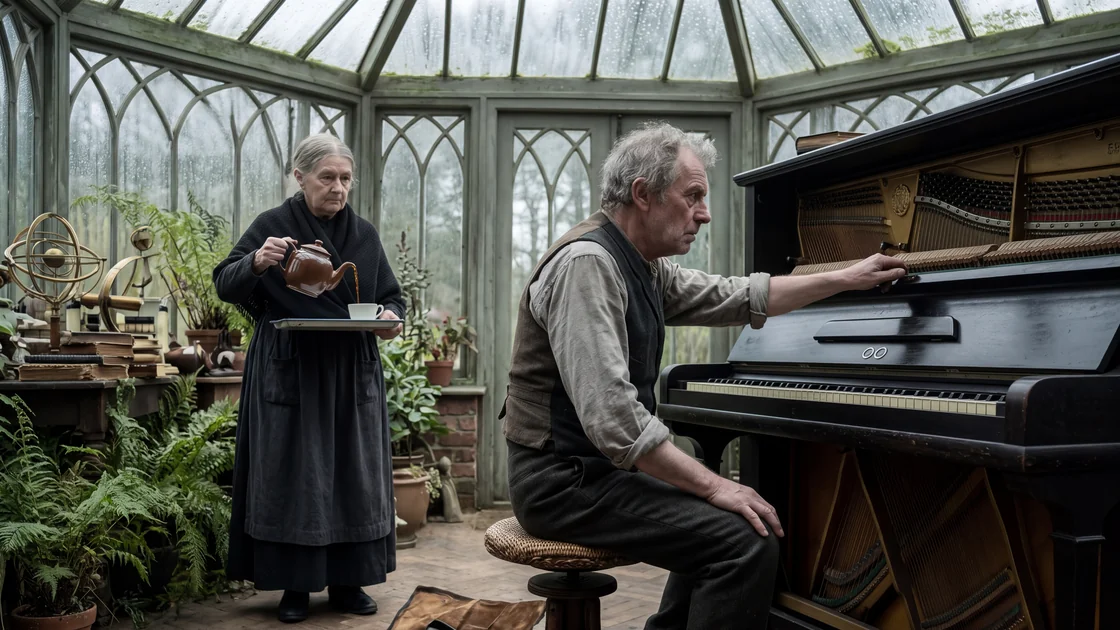
This is the account of Arthur Finch, an aging piano tuner of solitary habit and deteriorating hearing, who was commissioned to regulate a bespoke upright piano in an abandoned conservatory on the rain-swept edge of Yorkshire. While attempting to eliminate an elusive wolf tone in the lower-middle register, Finch discovered an undocumented micro-interval—a coincidental alignment of inharmonic partials and sympathetic wire resonances—that locked the instrument’s soundboard into an infinite standing wave. Upon striking the resultant chord, he inadvertently arrested the physical progression of time across the world, marooning himself within a silent, petrified reality where rain hung suspended like glass beads, tea refused to pour, and human lives stood frozen between breaths. This narrative chronicles his solitary investigation of the phenomenon, the psychological burden of absolute stillness, and his desperate mechanical effort to tune the universe back into motion before the vibrating string snapped under its impossible load.
Chapter I: The Architecture of the Compromise
The human ear does not desire truth; it desires an agreeable lie. This was the first principle Arthur Finch had learned forty-two years ago as an apprentice in the damp workshops of Broadwood & Sons, and it was the only principle that had never betrayed him.
A mathematically pure musical scale is an impossibility within the geometry of our universe. If one tunes a circle of twelve true fifths according to the pure arithmetic of Pythagoras—each ratio a clean three-to-two—the final note, seven octaves above the start, will not meet the fundamental note in unison. It will overshoot it by a sharp, intolerable sliver of sound known as the Pythagorean comma. The circle refuses to close; it forms an agonizing spiral that climbs forever away from harmony. To make an instrument capable of playing in all twelve keys without sounding like an abattoir of discordant brass, one must lie. One must rob a tiny measure of purity from every fifth, narrowing them until they fit within the locked cage of the octave.
This lie was called Equal Temperament. Arthur made his living by administering it with small wooden wedges, an ebony-handled tuning lever, and forty years of concentrated exhaustion.
He sat on a swivel stool whose dry wicker seat groaned under his slight frame. The room around him was an octagonal winter-garden conservatory attached to the rear of High Beck House, an Edwardian pile built on the gritstone bluffs overlooking the valley of the River Calder. The house had belonged to an eccentric natural philosopher named Alistair Thorpe, who had died six months earlier, intestate and unmourned, leaving behind rooms packed to the rafters with brass orreries, botanical presses, and stacks of The Philosophical Magazine bound in crumbling buckram.
Before Arthur stood the piano.
It was an upright, but an upright of grotesque proportions. It rose nearly six feet from its clawed brass castors, its casing constructed not of the customary burl walnut or rosewood, but of quarter-sawn English bog-oak so dark it seemed to absorb the gray, weeping daylight that fell through the leaded skylights overhead. There was no maker’s name stamped upon the fallboard. Where the gold-leaf script of Steinway, Bechstein, or Chappell ought to have rested, there was only an inlaid strip of dull nickel wire, shaped into an open lemniscate—an infinity sign whose right-hand loop was slightly deformed, terminating in an open hook.
"The late Mr. Thorpe was particular about it," said Mrs. Gable, the caretaker, who stood four paces behind Arthur’s left shoulder. She was a woman constructed entirely of wool shawls and vinegar, holding an enameled tin tray upon which rested a brown stoneware teapot, two cups, and a half-empty jug of whole milk. "He would not let the local men touch it. Said their ears were clogged with church hymns. He had a man come from Leipzig once, thirty years back, but the German went mad in the night, packed his kit, and walked all the way to the railway station in his stocking feet. Left his coat behind. Mr. Thorpe kept it. Still hangs in the scullery."
"Pianos do not drive men mad, Mrs. Gable," Arthur said, his voice dry and dusty as the interior of an unplayed soundboard. "The damp drives them mad. Or the isolation. Or the realization that their trade has ruined their posture and left them with tinnitus."
He leaned forward, resting his forehead against the upper front board of the instrument. He did not play. A tuner rarely plays; playing was for those who consumed sound rather than those who inspected its joinery. Instead, he pulled his tuning lever from the battered cowhide roll on the floor, slotted the star-shaped socket over wrestpin C4, and depressed the key with his right thumb.
The hammer, headed with compressed felt as hard as horn, struck the three strings of the trichord.
The note was flat, but not merely flat in pitch. It possessed an unnatural weight, a dense, leaden timber that seemed to die not by natural acoustic decay, but by being sucked back into the bridge. It had no bloom, no air around it. Arthur frowned. He muted the two outer strings with a wedge of split deerskin, leaving only the center wire free to sound.
He struck it again.
Clang.
High Beck House had been unheated for half a year, and the soundboard—a massive panel of Romanian spruce visible through the opened bottom door—was swollen with moorland damp. But there was something else inside the belly of the instrument. When Arthur ran his fingertips along the iron frame, he felt that the plate had not been cast from ordinary gray iron. It was cold, colder than the room, and when he tapped his knuckle against the upper web, it did not ring with the customary bright metallic tink. It thudded softly, like lead, yet the vibration lingered in his finger bones for ten seconds after the strike.
"You'll take a cup before you begin?" Mrs. Gable asked, her voice tinged with the impatient civility of an old woman who wished to return to her scullery fire. "The kettle was only just on the boil."
"Leave it on the side table, if you please," Arthur murmured. He had already slipped into the tunnel of his work, that peculiar sensory blindness where the visual world receded into a blur of gray shadows, leaving only the three-dimensional geometry of sound. "This will take until twilight. The wrestpins are tighter than coffins. It hasn't seen a lever in four decades."
He heard the soft clink of the teapot spout kissing the rim of the earthenware mug. He heard the faint, wet hiss of the rain increasing its assault on the glass roof sixty feet above. He heard the heavy, rhythmic sigh of Mrs. Gable’s breath as she tilted the pot.
Arthur slipped his deerskin mute between the strings of D#3 and struck the key.
Chapter II: The Ghost Fifth
The anomaly lay in the transition between the bass bichords and the lower tenor trichords—the break where the string scale passed from wound copper wire over the auxiliary bridge to plain steel over the main bridge.
In any standard instrument, this crossing is a structural compromise. The strings change length abruptly; their tension jumps; their inharmonicity—the degree to which their overtones are pushed sharp by the physical stiffness of the wire—shifts violently. A tuner must disguise this joint through careful "stretching" of the octaves, softening the transition so that a running chromatic scale does not betray the moment the hammer leaves copper for iron.
Here, however, the builder had done something monstrous.
The bridge was not continuous. It had been carved with three micro-steps, each no wider than a tobacco leaf, and behind the hitch-pins, the waste ends of the wire—the non-speaking lengths usually deadened with green listing cloth—had been left entirely bare. More than that: they were spanned by tiny, movable brass agraffes that could be slid along the iron plate on threaded tracks.
"A duplex scale," Arthur muttered to himself, his eyebrows knitting until his gray, wiry brows met over the bridge of his nose. "No. Not duplex. Duplex is tuned to the octave or the twelfth. This is... what is this?"
He took his pocket magnifying glass from his waistcoat. He peered into the gloom behind the dampers.
The brass sliders were marked with microscopic Roman numerals, stamped with hand-punches so fine they resembled the tracks of wood-boring beetles: VII, XI, XIII, XVII, XIX.
The prime partials. The untamed harmonics. In standard acoustic theory, these overtones were the outlaws of music. The seventh partial is an unbearable, flat minor seventh that ruins the sweetness of a chord; the eleventh is an ambiguous, half-sharp fourth that belongs to no church mode known to Europe; the thirteenth is a wailing, microtonal neutral sixth. Piano makers spent centuries designing hammers of specific density and placing their strike-points precisely at one-seventh to one-ninth of the string’s length specifically to murder these partials at the moment of birth—to strike them dead so they could not poison the clear, clean water of the fundamental tone.
The maker of this instrument had not murdered them. He had gathered them. He had provided them with their own secondary bridges, their own resonating lengths of bare brass and steel wire behind the speaking length, inviting them to speak back into the body of the soundboard.
"Madness," Arthur whispered. "Pure German idiocy."
Yet as he plucked one of the waste lengths with his thumbnail, a strange, prickling sensation ran across the roof of his mouth, like the taste of a copper penny or the ozone smell that heralds a lightning strike. The little length of wire did not sound a musical pitch; it sounded a dry, metallic tick, yet that tick seemed to repeat itself inside the cavities of his skull, echoing between his temples three times before vanishing.
Arthur sat back on his wicker stool. He rubbed his hands together. His knuckles were swollen with the rheumatism that had begun to claim his right ring finger two winters ago. His trade was dying; the player pianos had begun their march across the parlor rooms of Leeds and Manchester, and the wireless was already humming in the parlors of the wealthy. Soon, no one would pay five shillings to have an old man spend four hours listening to the slow, agonizing beats between F and A. The world wanted its music loud, unconsidered, and mechanical.
"Well," he told the empty bog-oak cabinet, "we are both obsolete. Let us at least agree upon a middle C."
He began his temperament octave. He took his tuning fork—an old, heavy fork of Sheffield steel stamped C - 517.3 Hz Philharmonic—and struck it against his kneecap. He held the stem to the bog-oak casing.
The wood did not hum. It gripped the pitch. The tone flared instantly, loud and dry, without the warm, blooming spread of spruce. It sounded as though the fork were vibrating inside a stone vault.
Arthur adjusted his lever on the pin of C4. The wrestpin was octagonally shaped, requiring a special socket he had not used since his youth. When he applied torque, there was no smooth, greasy give of chalked beech; the pin turned with an excruciating, high-pitched screak, microscopic and dry, like an iron gate swinging open after a century of rust.
He played the C4 with his thumb, striking with steady, firm strokes, three per second.
Thump. Thump. Thump.
He adjusted the fourth below: G3. A fourth must not be pure. If a fourth is pure, it does not beat, but it leaves the rest of the scale broken. It must be tuned slightly wide—just one slow beat every two seconds. A lazy, rolling wave, like the swell of a summer tide against an anchored skiff.
Waw-waw-waw.
There it was. He caught the beat between his teeth, counting the pulses by the movement of his tongue against the back of his incisors. One. Two. Three.
Then came the intrusion.
From somewhere beneath the soundboard—not from the speaking length of the G3 wire, but from the complex tangle of sympathetic waste lengths behind the bridge—a third tone introduced itself.
It was not a fourth. It was not a fifth. It was an impossible interval that had no business existing between steel and iron. It was a note that sounded simultaneously higher than the highest treble wire and lower than the 16-foot stop of a cathedral organ. It possessed a dry, rhythmic pulse that did not roll like the wave of a tempered interval, but clicked.
Tck. Tck. Tck.
Arthur froze. He did not remove his hand from the lever. His knuckles remained locked under tension.
"The bridge pin is loose," he murmured aloud, his voice sounding thin in the cold conservatory. "A split in the wood. The waste length is rattling against the plate."
He leaned in closer. The smell of the instrument rose up around him: old horsehair, bone glue, zinc dust, and a curious, alkaline odor that reminded him of the battery houses at the telegraph exchange in Bradford.
He struck the G3 again, this time with the full weight of his forearm, a hard, concussive blow intended to "settle the pin" and force the wire to reveal its true seating against the bridge.
The hammer struck the three wires.
The three wires spoke to the bridge.
The bridge transferred its lateral thrust to the spruce soundboard.
The soundboard, through its peculiar bog-oak braces and lead-weighted ribs, drove the prime partials back into the sympathetic rear scale.
The instrument did not make a musical sound. It made a sound like a wet linen bedsheet being torn down its center by two immense, indifferent hands. A dry, white, tearing crack that did not radiate outward through the room, but seemed instead to fold inward, collapsing the air toward the black oval of the open bottom door.
Arthur felt a sudden, violent pain behind his eyes—not an ache, but a sharp, cold pressure, as though two marble marbles were being forced into his sockets from the inside. His breath was caught in his throat, trapped behind a closed glottis.
The sound did not die.
In any piano, even the finest concert grand with the longest, heaviest bass wires, a note struck with force decays according to the natural damping of the metal and the air. The sound swells for a third of a second, plateaus, and then slides down an exponential curve of silence: twelve seconds, twenty seconds, thirty seconds until the wire returns to rest.
This sound did not decay.
Five seconds passed. Then ten. The chord—that jagged, unholy cluster of the tempered fifth, the flat seventh, and the unnamable prime partials—remained standing in the air of the conservatory. It stood with an architectural solidity, as unmoving as an iron pillar. It did not fade by a single decibel. It did not shift its color. It hovered at the precise volume of its birth, a frozen, screaming ribbon of steel-and-bog-oak resonance that filled the room until the glass panes in the skylight ceased their rattling and became rigid, fixed under the grip of an absolute acoustic standing wave.
Arthur let go of the tuning lever.
The lever did not fall.
It remained where his hand had left it, jutting horizontally from wrestpin G3, suspended in the air at an angle of thirty-five degrees, defying the pull of the earth.
Chapter III: The Stalled Tea
Arthur Finch sat completely motionless on his wicker stool for two full minutes, his eyes locked upon the floating lever.
His first rational thought was that he had suffered a cerebral apoplexy. His father had died of one at sixty-three: a sudden, silent pop in the dark corridors of the brain, followed by an immediate collapse into wordlessness, one side of the face falling like wet tallow. Arthur checked his fingers. He opened and closed his hands. He could feel the cold wicker beneath his thighs, the wool of his trousers against his knees, the dry grit of dust between his palms.
"Mrs. Gable?" he said.
The word left his lips, but it did not behave as words usually did. It had no resonance. It dropped from his mouth like a lump of cold lead falling onto grease-cloth. The air offered no bounce, no echo, no reverberation. The room was choked with the standing chord of the piano, which continued to whine—a single, unvarying, razor-edged E-flat/B-double-flat/eleventh-partial drone that felt less like a sound and more like a physical wire stretched taut through the center of his brain.
He stood up. His knees made their customary dry click, but the click had that same truncated, dead quality.
He turned toward Mrs. Gable.
The housekeeper stood precisely where she had been four minutes earlier, between the small bamboo side table and the archway leading to the scullery. She had not left. She was not looking at him.
She was tilted forward at an angle of fifteen degrees, her right hand holding the brown stoneware teapot by its wicker-wrapped handle. From the spout of the pot, a stream of Earl Grey tea was emerging.
It was not falling.
It hung between the spout and the rim of the cup like an icicle of polished amber. It was six inches long, slightly thicker at the spout, tapering toward a rounded, suspended droplet that hovered precisely two millimeters above the rim of the bone-china mug. In the center of the stream, Arthur could see three minute, dark flakes of broken tea leaves, held immovably within the translucent brown curve of the liquid.
He took a step toward her. His boots made no sound against the parquet floor. It was as though the parquet had been transformed into solid lignum vitae.
"Mrs. Gable?" he repeated, his voice small, flat, and hollowed out.
He reached out a trembling index finger—the finger whose cuticle was permanently blackened by graphite and oil—and brought it toward the frozen column of tea.
He did not touch the liquid at first. He felt the air around it. The air was not cold, nor was it warm; it possessed a strange, greasy viscosity, like the surface of a stagnant pond covered in duckweed. When his skin finally met the tea, he did not get wet.
The tea was hard.
It was not frozen into ice; it had no coldness, no crystal structure. It was simply rigid. It felt like a rod of warm glass, smooth, slightly oily, and utterly unyielding. He pushed against it with the pad of his finger, applying enough force to move an ordinary cup, but the stream did not break. It did not budge. It was anchored to the geography of the room with an authority greater than the stone bluffs outside.
Arthur moved his gaze up the column of tea to Mrs. Gable’s face.
Her eyes were wide, her pupils slightly contracted, fixed on the empty space three inches above the rim of the cup. Her mouth was half-open, shaped around the beginning of a syllable—perhaps the W of "Will you be needing sugar?" or the H of "How long do you intend to stay?" A stray wispy hair from her gray bun hung three inches from her right temple, frozen in the act of being blown aside by a draught from the drafty door. It was curved like a small silver sickle, motionless against the gray shadow of her cheek.
He looked down at her chest.
There was no movement. The black bombazine of her bodice did not rise; it did not fall. The small silver cameo brooch at her throat, depicting the profile of some forgotten Hanoverian prince, did not tremble.
Arthur felt his own heart slamming against his ribs like an iron pig in a slaughterhouse chute. Thump-thump. Thump-thump. The contrast was sickening: his own interior rhythm—chaotic, terrified, pulsing with red blood—against this absolute, petrified museum of an exterior world.
He backed away from her until his shoulder-blades struck the damp glass of the conservatory wall.
He looked up at the skylight.
Above him, the storm had been gathered in its full moorland fury when he had begun the G3. Now, through the lead-framed rhomboids of glass, he saw the rain.
It was not a gray sheet. It was a forest of crystal needles.
Millions of individual drops hung in the space between the clouds and the glass, each one perfectly distinct, pear-shaped, their rounded bottoms reflecting the dull, pewter light of the Yorkshire sky. Some were so close to the glass that Arthur could see the tiny air bubbles trapped within their bellies. Two inches above the central mullion, a large drop was in the very process of shattering against the lead; it had flattened into a tiny, six-rayed star, its delicate splinters radiating outward like the petals of a frost-flower, caught at the precise fraction of a microsecond where liquid surface tension gives way to kinetic destruction.
Beyond the rain, the sky did not move. The great, bruised clouds of coal-smoke and Atlantic moisture, which had been scudding across the valley at thirty miles an hour toward Leeds, sat piled like sacks of gray flour against the shoulder of the moor.
There was no wind. There was no sound of wind.
There was only the piano.
Behind him, the upright continued to sing its single, unholy, prime-saturated drone. It was not getting softer. It was not getting louder. It sat in the room like an engine that had caught fire and could not be extinguished, its iron heart pumping out an endless, petrifying frequency that had seized the world by the throat and held it fast.
Chapter IV: The Horizon of the Octave
Arthur Finch did not run.
A man who has spent forty years chasing five-hundredth-of-a-semitone errors across eighty-eight iterations of iron wire does not possess the instinct for frantic movement. His life had been an exercise in small, disciplined interventions: the half-turn of a wrestpin, the paring of a millimeter of felt from a hammer’s shoulder, the insertion of a paper shim beneath a balance rail.
He went to his tool roll.
He took out his brass pocket watch—a heavy English lever by Rotherhams of Coventry. He held it to his good ear.
Silence.
The tick was gone. He looked through the crystal. The small, blued-steel second hand, which had been sweeping across the bottom sub-dial with steady, six-beat-per-second precision, was pinned halfway between the forty-two and forty-three-second marks. It did not vibrate. It did not twitch against its gear train. The balance wheel beneath the balance cock had stopped at the extreme limit of its excursion, its hairspring coiled like a hair from an old man’s beard, held under full tension yet unable to unwind.
Arthur reached into his waistcoat, took out the winding key, inserted it into the square arbor on the back of the movement, and turned.
He could not turn it. The arbor was as solid as the rock of High Beck. The spring would neither accept nor release energy.
"The second has ceased to divide," he said.
His voice was becoming more difficult to produce. It required a physical effort of his lungs to drive air through his vocal cords; the air in the conservatory felt thick, heavy, packed with an invisible, fine silt that resisted being displaced. When he waved his hand rapidly before his face, he did not feel a clean breeze between his fingers; he felt the air parting with a faint, oily resistance, like cold treacle or liquid paraffin, closing behind his hand with a slow, silent suction.
He walked out of the conservatory.
The door to the house stood open. He stepped through the archway into the main hall of High Beck House.
Here, the gloom was nearly total. The hall was panelled in black oak, its high ceiling lost in the shadows of heraldic beams. At the foot of the great staircase, a grandfather clock by Thomas Tompion stood in a case of burled walnut. The long brass pendulum, visible through the oval glass in the waist-door, was arrested at the apex of its swing to the left, four inches above its lowest point of equilibrium. It looked like a brass moon glued to the interior of the case.
Arthur walked toward the front entrance. The massive oak door was unlatched, held slightly ajar by a wrought-iron foot-scraper that Thorpe had used as a doorstop.
Arthur squeezed through the opening into the outer air.
The silence that met him was not the silence of the countryside at night, nor the silence of a snowbound valley. Those silences were full of secret movements: the settling of earth, the breathing of owls, the distant, faint roar of water running through culverts three miles away.
This silence was a physical wall. It had no bottom and no top. It was an absolute vacuum of event.
Before him, the carriage drive curved down toward the valley road between two rows of giant, dripping rhododendrons. On the gravel path, thirty feet from the porch, stood a tradesman’s cart—the butcher’s boy from Hebden Bridge, Arthur recognized him: young Tommy Clough, who had twice delivered mutton to Arthur’s lodgings in the town.
Tommy was frozen in the act of leaping down from the cart’s box.
He was entirely airborne. His boots were fourteen inches above the wet crushed shale of the drive. His knees were slightly bent to take the landing; his coarse linen apron was flared out behind him, stiff as folded tin. In his right hand he held a basket containing a leg of beef wrapped in blood-spotted greaseproof paper; three drops of fat, melted by the warmth of the butcher’s shop and shaken loose by the cart’s springs, hung between the wicker basket and the earth, three small scarlet pearls held motionless in the gray light.
The horse—a heavy, hairy-heeled bay mare—stood between the shafts with its left front hoof raised two inches from the ground. A single white plume of steam, breathed from its flared nostrils into the raw autumn air, hung before its muzzle like an exquisite, spun-glass cloud, every curl and vortex of its expansion caught and preserved with impossible clarity.
Arthur walked down the gravel steps. The gravel did not crunch beneath his leather soles. The stones did not shift, roll, or click against one another. Walking upon them was like walking across a single, continuous sheet of granite.
He approached the boy.
"Tommy?" he said softly.
He knew there would be no answer, yet the sight of the boy’s face filled Arthur with a sudden, suffocating pity. Tommy’s eyes were bright with some mundane, boyish thought—perhaps he was thinking of the tea he would have when his round was finished, or the girl who worked the counter at the draper’s. His skin had the pink, scrubbed look of a northern lad in November; his cap was tilted back on his head, showing a cowlick of greasy brown hair.
Arthur reached out and touched the edge of the flared apron. It was stiff as an iron plate. He tried to press it down; he put his whole weight against it, leaning his chest into the linen.
The cloth did not bend by a fraction of an inch. It was no longer cloth. It was the idea of cloth, rendered indestructible by the cancellation of time.
If nothing can move, Arthur thought, nothing can yield. If nothing can yield, nothing can break. The universe had become an infinite, diamond-hard cabinet of curiosities, containing everything that had ever been, frozen at the instant an old man in Yorkshire struck a fourth that was not a fourth.
He turned and looked back at High Beck House.
From the conservatory at the rear, the sound still came. Even out here on the driveway, thirty yards away, through stone walls two feet thick, the tone reached him. It did not pass through the air as waves; it seemed to be already present within Arthur’s own marrow, vibrating in the sutures of his skull.
E-flat. B-double-flat. The prime partial.
He realized then why he alone was able to move.
He had been holding the key. When the hammer struck the strings, his thumb had been depressed upon the ivory; his hand had been on the lever; the lever had been on the wrestpin; the wrestpin was set into the wrestplank; the wrestplank was bolted to the iron frame. He was not outside the circuit. He was the earth of the circuit. He was the damper that had failed to fall, the single human node through which the acoustic current was discharging itself without consumption.
"I am the hammer," Arthur said to the bay mare’s frozen steam. "And the world is the wire."
Chapter V: The Cartography of the Interval
He spent what felt like six hours—though the concept of an hour was now an absurdity, an ancient unit from an empire that had fallen that morning—exploring the limits of his prison.
He walked down the hill toward Hebden Bridge.
The journey was a monstrous nightmare of perspective. The road was a steep, winding ribbon of macadam, cut into the side of the valley between high gritstone walls. Every fifty yards, some ordinary, microscopic incident of life had been arrested and elevated into a monument.
A blackbird, startled from a hawthorn hedge by the approach of the butcher’s cart three minutes before the end of the world, was suspended five feet above the road. Its wings were fully spread, the feathers separated like the fingers of a glove, showing the delicate, slate-gray ribbing of each barb. Arthur stopped beneath it. He could see the yellow ring around its eye, the moist, wet shine on its black beak, the three tiny grains of red sandstone stuck to its left claw. He blew upon it. His breath simply divided around the bird as though it were a stone carving set into an invisible wall.
Further down, near the canal basin, a coal barge lay half-in and half-out of a lock.
The water was the most terrifying thing of all.
The lock-keeper had been in the act of opening the lower sluice paddles. A great, roaring jet of black canal water ought to have been boiling out into the lower chamber, covered in brown foam and diesel scum. Instead, the water stood as a carved, ribbed muscle of dark glass. The turbulence had been stopped in mid-revolution: vortices that looked like green crystal snails, foam that resembled cauliflower heads carved from parian porcelain, sheets of spray that stood like fans of frosted celluloid.
Arthur walked out onto the surface of the canal.
His boots did not sink. The water was as unyielding as the macadam road. He looked down through the black, peat-stained ice-that-was-not-ice. Four feet below his soles, a large pike hung suspended above a bed of water-milfoil, its pectoral fins extended, its cold, predatory jaw slightly open, waiting for a roach that hung four inches before its snout. Neither hunter nor prey had moved a micron since Arthur had turned his wrist in Thorpe’s conservatory.
He walked to the center of the town.
Hebden Bridge was dead. Not dead as in abandoned; dead as in painted.
On the bridge itself, two weavers from the cotton mills were leaning over the parapet, their pipes in their mouths. A cloud of blue tobacco smoke hung between them, a delicate, stationary lace curtain whose every swirl and filament could be traced back to the blackened clay bowls. One man was pointing with an index finger toward the river; Arthur followed the line of the man’s sight and saw a dead rat caught on a gravel spit, its belly bloated, its gray fur spiked with wet.
In the market square, a dog—a rough-coated lurcher—was frozen in mid-stride, all four feet off the cobbles, chasing a butcher’s cur that had stolen a rind of bacon. The bacon rind was suspended in the air between them, having slipped from the cur’s teeth, hanging like an orange crescent moon two feet above the mud.
No one blinked. No one bled.
A girl had tripped on the kerb outside the chemist’s. She was falling. Her body was at an angle of thirty degrees to the stone flags, her arms thrown forward to break the impact, her mouth wide in a round O of terror. Arthur stood beside her for a long time. He wanted to catch her. He put his hands beneath her shoulders, trying to lift her, to set her back upon her heels, but she was like an iron statue weighing ten thousand tons. He could not budge her by the width of a hair. If he had struck her with a sledgehammer, he knew with a terrible certainty that the hammer would simply have bounced back, leaving her flesh unbruised, her dress unwrinkled, her scream unbroken.
The horror of it was not that they were dead.
If they had been dead, their souls would have fled, their meat would have begun its long, necessary return to the earth, their stories would have closed. But they were not dead. They were merely postponed. Their thoughts were still there, trapped inside the chemical structures of their brains like flies in amber. Tommy Clough was still falling; the girl was still screaming; the lurcher was still hungry; the pike was still watching the roach. The world had been robbed of its predicate. It had been left as an endless series of subjects that could never, through all eternity, find their verbs.
And everywhere, through every brick, every pane of glass, every yard of solid peat, the tone of the bog-oak upright hummed.
It did not grow fainter with distance.
When Arthur reached the railway station—three-quarters of a mile from High Beck House—the tone was precisely as loud as it had been in Thorpe’s hall. He walked onto the platform. A passenger train from Burnley was entering the station, its massive green locomotive halted with its cowcatcher six feet past the signal-box. The steam from the safety valve had erupted into a great, billowing column sixty feet high, standing against the gray sky like a pillar of salt.
Arthur laid his ear against the cold iron of the rail.
The steel rail was not singing with the rumble of the train’s wheels. It was singing with the piano. The entire railway network of the United Kingdom—hundreds of thousands of miles of wrought iron and steel, spiked to sleepers from Scotland to Dover—had become a single, vast extension of the piano’s soundboard. The world was being held in a tuning clamp.
"Why?" Arthur asked the green locomotive.
His voice was a croak. His throat was parched. He had had nothing to drink since morning, and though there was water all around him—in the canal, in the rain, in the kettle at High Beck—he could not drink a drop of it. He could not part the molecules of water to swallow them. They were locked together by the suspension of their kinetic life. If he took a knife to the canal, the blade would not enter the surface; it would skitter across the water as though it were cold plate-glass.
He was the only thing in the universe that could die.
The thought arrived with the sudden, quiet clarity of a bass trichord dropping into unison.
If time did not move, he could not gather water. He could not eat bread; the loaves in the baker’s window were as hard as basalt. He could not consume, because consumption is an act of exchange, an exchange that requires time to unfold. His own body was still burning its interior fuel—his pulse, his breath, his thoughts were still slipping away down the slide of his own personal duration—but the world around him was an absolute, non-porous wall.
When his lungs had used the air currently within them, would the air in the street enter them?
He tested it. He inhaled deeply.
It was possible, but it was an agony. He had to use the muscles of his diaphragm with the force of an iron pump, sucking the stubborn, viscous atmosphere into his trachea against its will. The air felt heavy and cold, like breathing powdered chalk.
If he did nothing, he would starve to death within a week, or die of thirst within three days, an old man lying across the rigid, unyielding skirts of a falling girl, while the butcher’s boy hung forever fourteen inches above the gravel of High Beck House.
He turned his back on the town and began the long climb back up the hill.
Chapter VI: The Papers of Julian Hauer
The library of High Beck House was colder than the conservatory, but it smelled of paper rather than wet iron.
Arthur needed light. The pewter sky outside was not dimming—it could not dim, the sun being pinned behind the cloud-deck like a silver coin held between two gray fingers—but the interior rooms of the house were full of deep, brown shadows. He took a box of matches from his pocket.
He struck a match against the sulfur-paper on the side of the box.
The match did not ignite.
He struck it again, harder, tearing the wood of the thin cedar splint. Nothing. A dry, friction-less drag. The sulfur head left a dark brown streak on the paper, but there was no spark, no flare, no sudden yellow tongue of fire. Fire is a chemical velocity, an accelerated process of consumption; it cannot exist where the rate of event is zero. His own body’s warmth was the only heat left on the planet.
"Books, then," he muttered.
He carried a small pile of Thorpe’s journals to the wide French window of the drawing-room, where the dead, gray daylight fell across the carpet.
Alistair Thorpe had not been an astronomer, despite the orreries. He had been a disciple of Julian Hauer.
Arthur had heard the name once, forty years ago, whispered in the back room of a music engraver’s shop in the Minories. Hauer had been an acoustic physicist from the University of Halle, who had been expelled from the Royal Society in 1878 after presenting a paper titled On the Elimination of the Commatic Leak: Time as an Acoustic Tensor.
Arthur opened Thorpe’s leather-bound journal for the year 1891. The handwriting was frantic, narrow, and sharp, the ink dried to the color of dried blood.
14th August.—The error of Pythagoras was not mathematical; it was ontological. He believed the comma was an imperfection in the design of the Creator. He did not see that the Pythagorean comma is the hinge upon which the sequence of events turns.
Why does time flow? Why does one second succeed another, rather than all seconds existing simultaneously in a single, infinite, frozen chord?
Because the circle does not close.
The universe is an acoustic system constructed under an open scale. The twelve fifths do not equal the seven octaves. That tiny, irreducible remainder—that 531441:524288 fraction which we call the Comma—is the leak through which the future pours into the past. It is the unbalance. It is the perpetual fall. Because the scale can never resolve its fifths into its octaves, the universe must constantly take another step forward to correct the dissonance. Time is merely the attempt of the cosmic soundboard to resolve the Pythagorean comma.
Arthur turned the page. His fingers left gray dust-prints on the thick vellum.
29th September.—If an instrument could be constructed in which the comma was not distributed—not smeared across the twelve notes as the tuners do with their equal temperament, nor left as an open wound at the back of the wolf-interval—but trapped... what then?
If the partials of the seventh, eleventh, and thirteenth degrees could be turned inward upon the waste lengths of the wire, so that they cancel the comma precisely... if the beat-rate between the fundamental and the overtone could be reduced to absolute zero...
The balance would be achieved.
The leak would be plugged.
The need for the next second would disappear. The universe would find its final, perfect cadence. It would rest. It would cease its restless, vulgar stumbling into the future and sit forever within the sweet, immutable architecture of a closed Fifth.
Arthur dropped the book.
The words did not sound like philosophy to him. They sounded like the talk of an amateur who had never had to replace a broken bass-bridge or haul an eighty-pound iron plate up three flights of stairs in a tenement in Oldham.
"A closed Fifth," Arthur spat into the dead air. "A closed Fifth is a corpse."
He looked toward the conservatory. The drone was louder now, or perhaps his ears were simply failing, his brain amplifying the only sensory data it was receiving from the outside world.
E-flat. B-double-flat.
It was not a harmony. It was an execution.
Thorpe had not built a musical instrument; he had built a brake. He had constructed an iron clamp that had seized the great, turning wheel of the world and brought it to a smoking, screeching halt, all because he could not bear the small, imperfect lie of an equal-tempered scale. He could not bear the five-hundredth-of-a-semitone error that allowed men to play both in C major and in F-sharp minor. He had wanted the truth, and the truth was a world where young girls hung forever between the kerb and the stone, where butcher’s boys never came down to earth, and where tea refused to fall into a waiting cup.
Arthur looked down at his own right hand.
The skin was gray with lead-dust and rust. The knuckle of his middle finger was swollen, red, and hot with the inflammation that had plagued him all autumn.
"I have spent forty-two years lying," he whispered to the books on the floor. "And I am not going to let a dead philosopher tell me how to set an octave."
Chapter VII: The Anatomy of the Struck Wire
Arthur returned to the conservatory.
The room had not changed by a hair’s breadth. Mrs. Gable still offered her stone-hard amber tea to the empty air; the droplet still hovered two millimeters above the rim; the rain-stars still stood upon the skylight like an array of glass badges.
The piano sat in its corner, black, massive, and indifferent.
Arthur stood before the open lower door. He knelt down on the cold floor-boards. He brought his face within three inches of the spruce soundboard.
Now that he knew what he was looking for, he saw the mechanism with absolute clarity.
The bog-oak upright was not strung according to the usual pattern. In an ordinary piano, the wires run from the wrestpins down across the upper bearing, through the speaking length to the bridge, and then terminate at the hitch-pins driven into the iron plate at the bottom.
Here, the hitch-pins were not fixed.
They were mounted on a secondary, floating bar of cast bronze—a bar that was suspended above the plate on four heavy, square-threaded lead screws. From each hitch-pin, a secondary wire—a thin, silver-plated hair of steel—ran backwards, under the soundboard itself, passing through tiny ivory-bushed holes in the spruce, connecting to a bank of forty-eight tiny steel reeds mounted inside a vacuum chamber behind the ribs.
It was an acoustic feedback loop.
The energy of the struck wire did not dissipate into the room. It was picked up by the reeds; the reeds drove the secondary wires; the secondary wires pulled upon the floating bronze bar; the floating bar rocked the hitch-pins, which in turn fed the energy back into the speaking lengths of the strings at the precise frequency of their prime partials.
It was a self-sustaining node. An acoustic engine that fed upon its own resonance, holding the air in a state of permanent, high-frequency paralysis.
Arthur reached out and touched the G3 trichord with the tip of his thumb.
The wire was not vibrating to the eye. It looked as thick and solid as a bar of lead. But when his flesh met the steel, an intense, cold shock passed through his arm, so violent that his shoulder jerked back. It was not an electric shock; it was the sensation of immense, infinite velocity compressed into zero space. The wire was moving, but it was moving across a distance smaller than the diameter of an atom, vibrating at a frequency so high that it had folded the space around it into a knot.
He looked at the tuning lever.
It was still sticking out horizontally from the wrestpin, floating where he had abandoned it.
To undo the node, he would have to turn that pin.
He reached up his right hand and took the ebony handle of the lever.
The wood felt colder than the air. It felt as cold as the deep rock beneath the moor. When he gripped it, his palm stuck to the polished ebony as though he were touching ice in a Siberian winter.
He set his feet against the floor. He prepared to pull.
To lower a pitch, one must turn the wrestpin counter-clockwise. One must slacken the string. If the tension is dropped, the frequency must fall; if the frequency falls, the node must break; if the node breaks, the feedback loop between the reeds and the soundboard will starve, and the standing wave will collapse.
"One-quarter of a turn," Arthur told himself. "No more. Just enough to introduce two beats a second. Just enough to let the comma breathe."
He threw the weight of his body against the lever.
The lever did not move.
Arthur gasped, his breath tearing at his throat like dry hay. He set his left foot against the lower casing of the piano, hooked both hands over the ebony handle, and hauled back with every ounce of strength in his sixty-year-old body.
The pin was set into the quarter-sawn beech wrestplank with sixty tons of hydraulic pressure. But it was not the wood that was holding it.
It was time.
To turn a pin, the pin must pass from this position to that position. It must have a before and an after. But there was no after. There was only this single, petrified, eternal now. The wrestpin could not turn because there was no time for it to turn into. The universe had no room for the next micro-millimeter of rotation.
Arthur dropped his hands. He fell to his knees on the wicker stool, his chest heaving, his heart pounding in his temples like a muffled bell.
"You fool," he wept. "You old, dry fool."
He had brought his tools, his deerskin mutes, his forks, his star-headed levers, as though he were dealing with a Broadwood in a drawing-room in Ilkley. He had treated the instrument as an assemblage of wood and wire, when it was in truth a tomb—a tomb that had closed upon him from the outside.
He looked at his deerskin mute, lying on the floor where it had fallen.
A mute does not turn a pin.
A mute does not require the passage of hours.
A mute simply absorbs.
Chapter VIII: The Density of Felt
In the craft of piano regulation, there is a tool called the voicing needle.
It is a small, brass-bound handle holding three sharp, fine steel needles, used to prick the hard felt of the hammerheads. If a piano sounds harsh, brassy, or thin, the tuner does not alter the wire; he stabs the hammer. He breaks the tiny, compressed fibers of wool, creating small air pockets within the felt, softening the blow, allowing the hammer to dwell against the string for an extra thousandth of a second. This dwell-time deadens the higher partials—the shrill, cold overtones—and leaves only the warm, round belly of the fundamental.
Arthur reached into his tool roll.
He did not take the voicing needles. He took his regulating iron—a heavy, chisel-headed lump of copper set into a thick ash handle, used for iron-bedding the damper felts.
He looked at the G3 hammer.
The hammer was resting against the three strings. Because he had struck the key with force and had not released it—his thumb having held it down during the moment of transition—the hammer had not bounced back to its check. It was pinned against the wire, its compressed white wool nose flattened against the steel.
The hammer was not moving. The damper—a wedge of dense, green Melton cloth—was lifted two inches clear of the wire, held up by the brass damper wire.
If the damper could fall, it would lay its heavy, oiled wool across the trichord.
Wool does not reflect sound; it swallows it. Wool is a chaotic tangle of organic fibers, the hair of dead sheep that have spent their lives wandering through the Yorkshire rain, absorbing the damp and the wind. It has no geometry. It has no scale. It knows nothing of Pythagoras, nothing of Halle, nothing of Julian Hauer. It is the absolute opposite of iron.
Arthur took the heavy copper regulating iron in his right hand.
He did not attempt to swing it. He could not swing it through an atmosphere that refused to be parted.
Instead, he brought the copper wedge up to the top of the damper wire—the thin brass rod that held the green felt away from the vibrating G3 strings.
He placed the copper edge against the brass.
He could not strike. Striking requires acceleration, and acceleration requires the second to yield.
He leaned.
He put his shoulder against the ash handle. He placed the heels of his boots against the iron claw of the piano’s left leg. He locked his spine. He used his body not as a source of dynamic blow, but as a mass—a static, dead load, like an iron sash-weight hung from a rope.
"Yield," he whispered through his clenched teeth. "Yield, you bastard."
Nothing moved.
The conservatory remained dead. The amber tea remained hard. The rain remained hung from its sky-hooks.
Arthur Finch closed his eyes.
He thought of his wife, Martha, who had died fifteen years ago in the small stone cottage in Mytholmroyd. She had died slowly, over seven months, her breath growing shorter each week as the dropsy claimed her. He remembered sitting by her bed in the evenings, holding her swollen, cold hand, listening to the small, irregular clock on the mantelpiece.
Tick.
Tick.
How he had hated that clock. How he had wished, in the dark hours between two and four in the morning, that he could reach out his hand and stop the brass pendulum—that he could seize the wheel and hold her there, in that room, even in her pain, even in her silence, rather than let the seconds carry her away down the dark race toward the churchyard.
Now he had what he had wished for.
He had the world without the clock. He had Martha’s eternal, frozen bedroom expanded to the limits of the stars. No one was dying in Hebden Bridge. The girl on the kerb would never break her wrists against the flags. The rat in the canal would never rot. The butcher’s boy would never grow old, never lose his teeth, never have his sons sent to die in the mud of the Transvaal or the Crimea.
It was peace.
It was the peace that Alistair Thorpe had sought: the peace of a musical scale that had no comma, no error, no movement, no death.
"No," Arthur said.
He opened his eyes. His sight was dim, the gray light failing not because the sun was setting, but because his own retinas, deprived of circulation by his laboring heart, were beginning to starve.
"A world that cannot die," Arthur snarled into the bog-oak casing, "cannot live."
He shifted the copper iron. He did not press against the brass wire.
He pressed against the felt.
He forced the sharp copper edge of the tool into the small, tight gap between the green Melton cloth of the damper and the speaking length of the G3 center string.
He did not try to move the tool. He tried to become a wedge.
He let his weight fall forward, abandoning his balance, letting his head strike the edge of the iron plate. The pain was sharp, immediate, and cold—a red gash opening across his forehead—but he did not pull back. He drove his shoulder down through the tool.
The felt had been compressed into a stone by forty years of silence. But it was not wire. It was wool.
Under the immense, focused pressure of the copper edge, a single, microscopic hair of sheep’s wool—a hair that had grown on the spine of a Cheviot ewe in the summer of 1888—shifted.
It did not slide. It crushed.
Its cellular core, dry and dead, collapsed.
The gap narrowed by the thousandth part of an inch. The copper edge touched the side of the center wire.
A spark.
Not the yellow flame of a sulfur match. A small, cold, violet spark that leaped from the steel to the copper, passing through Arthur’s thumb, down his forearm, through his collarbone, and into his heart.
It was the comma.
It was the remainder. It was the five-hundredth-of-a-semitone error that had been trapped inside the loop, the tiny sliver of jagged, unmanageable life that Julian Hauer had tried to squeeze from the universe.
The spark did not sound like a note.
It sounded like a clock being dropped onto a stone hearth.
Crack.
Chapter IX: The Resumption of the Beat
The damper fell.
It did not fall with the clean, oiled snap of a regulated action. It dropped like a dead crow falling out of a walnut tree, crooked, heavy, and wet.
The green Melton cloth met the three G3 wires.
The center wire was choked. The two outer wires, deprived of their sympathetic partner, wavered.
The standing wave did not collapse instantly; it stumbled.
Arthur heard it—not with his ears, which were full of the roar of his own blood, but with his teeth. The single, razor-edged, prime-saturated drone broke into two distinct, warring pitches.
Waw-waw.
A beat.
The first beat the universe had heard since ten o'clock that morning.
A long, slow, agonizing wave that rolled through the bog-oak casing like the groan of a ship’s timber in an ice-pack. One beat. Two seconds later, another:
Waw.
The suspended lever on wrestpin G3 dropped two inches. It struck the upper panel of the piano with a sharp, wooden thwack.
Above Arthur’s head, the rain-star on the lead mullion shattered.
The six delicate petals of liquid collapsed inward; the droplet became a wet smear; the smear ran down the lead; and then, with the sudden, deafening roar of a thousand canvas sails being unfurled at once, the sky fell.
Rattle-clatter-crash.
The rain did not descend in needles; it hit the conservatory glass like buckets of lead-shot thrown from the clouds. The roof roared. The water found the cracks between the lead cames, running down the interior ribs in greasy, yellow rills that splashed across Arthur’s boots, soaking the wool of his trousers, real, wet, cold, and dirty.
"Oh, Lord," a voice said behind him.
Arthur did not turn around. He could not. His forehead was resting against the cold iron plate, his blood dripping slowly down the web of the casting, mingling with the rain that was now leaking through the glass.
He heard the sound of liquid hitting china.
Splish.
Then the heavy, rhythmic thud of a stoneware pot being set down upon a bamboo table with enough force to rattle the saucers.
"There now," Mrs. Gable muttered, her skirts rustling with the brisk, impatient friction of life. "It’s over-poured. Look at that saucer. A full half-ounce in the ring. The damp’s got into the spout, Mr. Finch. It doesn't run true."
Arthur stayed on his knees.
Outside, down the driveway, came the sudden, violent sound of iron-shod wheels biting into wet gravel.
Scritch-crunch.
"Whoa! Steady, girl! Steady, you great hairy beast!"
Tommy Clough’s voice, shrill with the annoyance of a lad whose horse had shied at a shadow. A heavy thump as twenty stone of boy and butcher’s beef hit the crushed shale. The wet, rhythmic snort of the bay mare as she shook her harness, the brass buckles chinking against the leather, the steam from her nostrils tearing away into the gray wind, tumbling across the rhododendrons, shredded and dissolved within three seconds.
Down in the valley, the Burnley train shrieked.
A long, mournful, brass-throated scream that echoed off the gritstone bluffs of the Calder, full of sulfur, steam, and late passengers.
The clock in the hall began to speak.
Tock.
Tock.
Tock.
The pendulum was falling. The escapement was pallets-and-teeth, steel on brass, dividing the day into seventy-two hundred discrete, dying pieces, each one smaller than the last, each one irrecoverable, each one bearing the world six feet closer to the dark soil of the valley.
Arthur Finch let go of the copper regulating iron.
The tool fell to the parquet floor, bouncing twice before coming to rest against the leg of the wicker stool.
He looked at his hands.
The skin was gray, but beneath the dirt and the graphite, the pulse was beating in the crook of his wrist. One. Two. Three. Four. The blood was moving toward his fingers, carrying the red iron away from his heart, burning it, consuming it, spending it like a drunken sailor in a dockside tavern.
"Mr. Finch?"
Mrs. Gable was standing over him now, her face screwed up into a knot of disapproval as she saw the dark red smear on the iron plate.
"Have you cut yourself on them wires? I told Mr. Thorpe them wires was dangerous. They're too sharp. Everything in this house is too sharp. A man ought to have an ordinary instrument, like my sister has in Todmorden. A nice walnut cottage upright with a silk front. You don't get these turns with a silk front."
"No," Arthur said.
He reached up his arm, caught the edge of the keyboard, and hauled himself up onto the wicker stool. His joints shrieked; his back felt as though it had been beaten with an ash spar; his mouth tasted of sulfur and salt.
"No, Mrs. Gable. You do not."
He picked up his tuning lever.
The wrestpin C4 was still where he had left it forty-two minutes—or an eternity—ago. He slotted the socket over the pin. He reached for his old Sheffield fork.
He struck it against his knee.
The fork sang. It did not hold the room in an iron clamp. It hummed—a sweet, clear, frail little tone that began to die the instant it was born, fading down through its harmonics, growing softer, thinner, more desperate, until it disappeared into the ordinary, noisy clatter of the rain on the glass.
A-435.
The French pitch. The human pitch. The pitch that knows it must die before the measure is out.
Arthur laid his thumb upon the ivory of C4. He laid his index finger upon the G3.
He struck the fifth.
It was not pure. It was narrow. It had a beat in it—a slow, limping, imperfect pulse that rolled every two seconds, like an old man walking down a wet hill toward a town full of smoke and tea.
Waw... waw... waw...
"Is it right, then?" Mrs. Gable asked, holding out the cup of lukewarm, over-poured tea, her thumb dipped into the edge of the brown liquid.
Arthur Finch took the cup. His hand was shaking so badly that the tea slopped over his knuckles, hot and wet and real.
"No, Mrs. Gable," he said, and for the first time in forty years, he smiled with the left side of his mouth. "It is not right at all. It is nearly five cents flat. It is an absolute, disgraceful lie."
He drank the tea down to the dregs, set the cup upon the pin-block of the bog-oak piano, and raised his lever to continue the work.