The Thrum Beneath the Ice
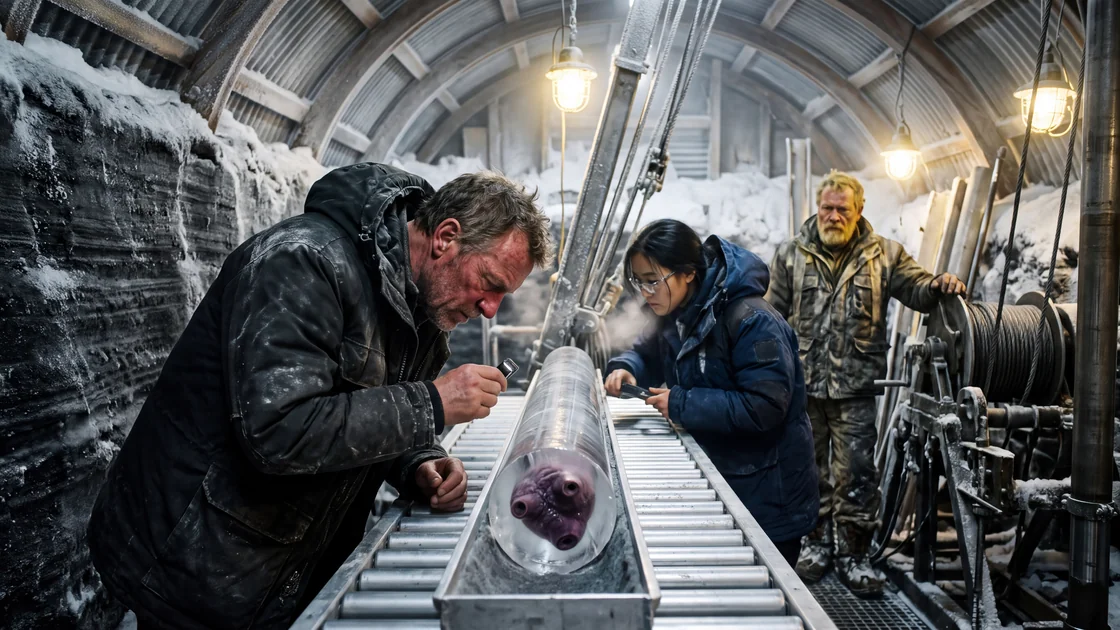
This is the account of Dr. Julian Ward, a veteran paleoclimatologist stationed at an isolated drilling camp on the Agassiz Ice Cap in northern Ellesmere Island, who recovered a continuous ice core from three kilometers beneath the polar plateau. Encased within the ancient, highly pressurized basal ice, Ward and his three-person research team found a pristine, uncalcified biological structure—an anatomical organ of indeterminate classification that defied cryonic arrest by maintaining an active, rhythmic pulse. Over seventy-two hours of escalating containment protocols, extreme weather isolation, and sensory disruption, the specimen’s metabolic emissions and resonant frequency began to systematically alter the camp's environment and unravel the psychological cohesion of its crew, revealing that the sample was not an isolated relic of an extinct ecology, but a functioning node of a planetary organism still slumbering in the bedrock beneath the ice sheet.
I. The Deep Cut
The drill head did not bite into the bedrock; it hesitated.
Julian Ward had his hand resting on the vibration collar of the Hans Tausen drill rig when the pitch altered. For forty-six days, the machine had spoken in a single, monotonous register: an industrial scream muffled by three thousand meters of firn, bubbly transition ice, brittle zone clathrates, and the dark, ductile laminar flow of the deep Pleistocene sheet. It was a sound that settled into the bone marrow, vibrating upward through the insulated soles of his Sorel boots, through the tibia, seating itself permanently beneath his ribs until even during his four hours of sleep in the dome tent his dreams were measured in revolutions per minute.
Then came the slip.
It was not the jarring shriek of diamond carbide striking gneiss or basalt. When the cutters hit granite, the drill mast shuddered like a harpooned skiff, the torque gauges spiked into the crimson, and the glycol-based drilling fluid backed up through the collar in a violent, foaming disgorgement. Julian had lost two strings that way over twenty seasons in Greenland and Antarctica: shearing three tons of high-tensile steel in an instant, leaving three hundred thousand dollars of hollow pipe welded forever into the dark by its own friction.
This was different. The torque needle did not leap; it slumped. The engine note softened from a furious baritone to a wet, churning hum, as if the three-blade head had punched out of the crystal lattice and plunged into a pocket of warm grease.
Across the trench, Ronald Vane looked up from the winch drum. Ronald was a man composed entirely of gristle, tobacco ash, and northern Canadian cynicism, his beard yellowed around his mouth from roll-ups smoked inside the exhaust hoods.
"Julian," Ronald said, his hand hovering over the kill switch. "She’s freewheeling. We lost the head."
"Don't trip it," Julian said, lunging forward, his breath plume cutting through the vapor lamp’s yellow cone. "Look at the tension. We didn't break. The string is hanging full weight."
"Then what’s it turning in? Air?" Ronald spat into the sawdust trough. "There ain't air down there, Ward. There’s three hundred atmospheres of hydrostatic squeeze. If we hit a subglacial lake, the head should be kicking back on the water column."
Julian stared at the digital depth readout: 3,184.62 meters.
Beneath their feet lay the frozen memory of the world. The top hundred meters were modern industrial poison and volcanic ash from Pinatubo, Tambora, Laki; at eight hundred meters lay the dust of the Younger Dryas; at two thousand, the Eemian interglacial, where Ellesmere Island had been a swamp of dwarf birch and pond-lily seeds; and here, down in the dead basal muck where the ice melted under the geothermal flux and refroze into dark, silty accretions, they were scraping against the late Neogene. Three million years. Four million. Perhaps the dawn of the Quaternary itself.
"Pull the barrel," Julian ordered. His heart had taken up an erratic rhythm that had nothing to do with the engine.
"We’ve only got a half-meter stroke on this run," Ronald grunted, reaching for the winch hydraulics. "Cost us four hours of haul for fifty centimeters of gravel."
"Pull it."
The electric winch whined, taking up the strain on the four-millimeter Kevlar-wrapped cable. Three kilometers below, the core barrel—a three-meter tube of electropolished stainless steel tipped with synthetic diamond cutters—parted from the bottom with an audible shuck that traveled up the steel housing like a plucked cello string.
The drill trench was carved twenty feet deep into the firm snow of the ice cap, roofed over with arched timber and corrugated steel, insulated from the shrieking Arctic surface where the wind was currently clocking forty-two knots out of the southwest, driving needles of drift across the barren expanse of the Agassiz Plateau. Inside the trench, the temperature was held at a steady, merciless minus twenty-six Celsius. It was the temperature required to keep the cores from suffering thermal shock, from boiling their ancient gases through structural micro-fractures before they could be cataloged, logged, and sealed in polyurethane sleeves. Julian’s cheeks were leathered, the skin under his cheekbones permanently stained the color of raw beef by twenty years of polar cold.
The winch groaned for fifty minutes, the spooled cable rising like a wet black snake from the casing pipe, reeking of n-butyl acetate and ester oil.
Mira Chen arrived from the science trench, carrying three fresh core troughs and a digital caliper. She was twenty-eight, her spectacles taped at the bridge where the plastic had snapped in the cold, her parka stained with blue core-marking ink. She smelled of kerosene and instant coffee.
"What did we hit?" she asked, setting the aluminum troughs on the roller table. "The seismic survey said we had at least thirty meters of basal till before we kissed the rock."
"We don't know," Julian said. He couldn't take his eyes off the wellhead. "Torque collapsed to five foot-pounds. No chatter."
"Void?"
"Can’t be a void," Ronald said, throwing the dog-clutch on the winch drum. "Rock under three miles of ice flows like cold butter. Any hole closes in a week. Here she comes. Stand clear of the collar."
The stainless-steel inner barrel emerged from the outer sleeve with a hiss of displaced fluid. It hung suspended from the gantry, swinging slightly in the draft from the trench stairwell, dripping clear, odorless solvent onto the packed snow floor.
Julian stepped forward with the inspection light.
Normally, basal cores were ugly, bastardized things. They were packed with pulverized silt, brown clay clods, angular granite pebbles ripped from the Canadian Shield when the continent had groaned under its first white mantle. They were fractured, cloudy, full of shear planes and frozen bubbles of ancient methane that popped like firecrackers as the pressure dropped.
The core visible inside the lower window of the barrel was not brown. It was not fractured.
It was an unbroken cylinder of optical-grade clarity, seventy millimeters in diameter, clear as lead crystal.
"That's bizarre," Mira murmured, leaning close, her breath fogging her glasses until she impatiently shoved them up onto her forehead. "Basal ice should be sheared to hell. There should be crystal boundary migration from the geothermal gradient. This looks like... it looks like artificial ice. Like an ice sculpture."
"Get the core pusher," Julian said. "Ronald, engage the dogs. Gently. Gently, damn you."
Ronald clamped the hydraulic pusher onto the barrel head. The nitrogen-driven piston began to slide, forcing the thirty-inch cylinder of ice out of the steel tube onto the felt-lined aluminum trough.
The ice slid out in a single, continuous billet.
As the first ten inches emerged, the light from the trench's hanging halogen work-lamps passed through the core, refracting across the snow wall behind them in a pale, prismed band of violet and sulfur.
Then the core pusher struck something soft, and the core came to a halt.
Julian reached down with gloved hands, gripping the aluminum trough. "Hold the pressure. Don't force the seal."
Inside the ice, suspended nine inches above the basal break, lay a dark mass.
At first, Julian’s mind, trained on millions of years of inorganic sedimentology, tried to force the shape into known categories: a lens of organic peat; a raft of interglacial bryophyte moss; a hunk of bituminous shale dragged down from some hidden Arctic basin.
Then the light hit it directly.
It was roughly the size of an ostrich egg, though asymmetrical, tapering toward an upper blunt apex with three thick, truncated conduits protruding from its superior margin like the sawn stems of heavy winter squash. Its surface was not fibrous or decayed; it was covered in an intricate, micro-ribbed tunic of deep plum-colored tissue, cross-hatched by a network of translucent vessels that were not red, but a faint, opalescent slate-gray.
It was entirely intact. It had not been crushed by the three hundred and twenty atmospheres of pressure that had turned the surrounding ice into a high-density hexagonal solid.
"What is that?" Ronald muttered, squinting over Julian’s shoulder, his pipe forgotten in his teeth. "Is that a seal? A carcass?"
"At three thousand meters?" Mira whispered. Her voice had dropped all its scientific clinicality; it was thin, childlike. "The ice at this depth is pre-glacial. There weren't seals. There weren't even whales when this sheet began to form. Julian... look at the ice around it."
Julian leaned down until his nose was an inch from the cold cylinder.
The ice encasing the plum-colored mass was not frozen against it. There was an interface—a hairline sheath, no thicker than a cigarette paper—where the ice crystal lattice terminated in a curved, perfectly smooth meniscus, as if the tissue had repelled the crystallization front. And within that sheath, suspended in a microscopic film of liquid water that should have been impossible at minus twenty-six degrees, the tissue moved.
Julian blinked. He felt the cold iron of the trench table through his parka.
"Julian," Mira said again, her hand coming down hard on his forearm.
The mass contracted.
It was not a tremor caused by the winch engine, nor the relaxation of pressurized gas clathrates venting into the Arctic atmosphere. It was a rhythmic, radial contraction: a slow, muscular inward draw that pulled the three superior conduits down toward the central mass, followed by an elastic, hydraulic rebound.
One.
A pause of four seconds.
Two.
Julian reached for his pocket magnifier, his fingers clumsy through the double wool liners. He stripped the left glove off with his teeth, ignoring the stinging kiss of the metal bench as his bare skin grazed the aluminum. He pressed the lens against his eye and leaned into the core.
Through the seven-power magnification, he could see the gray-blue vessels. They were not static. Inside their walls, which were dusted with microscopic, iridescent spicules resembling silica needles, a pale, milky slurry was moving. It did not flow with the fast, frantic pulse of a mammal; it surged in long, viscous strokes, each surge accompanied by a microscopic dilation of the plum-colored tunic.
The organ was pumping.
"It’s not dead," Julian whispered.
Ronald backed up two paces, his boots squeaking in the sawdust. "Julian, that’s impossible. That ice has been down there since the continent sat over the Pole. It’s solid rock-ice. It’s four hundred degrees below freezing if you count the heat capacity."
"It's pumping," Julian repeated. He felt a drop of his own sweat fall from his eyebrow, hitting the cold aluminum with a tiny, sharp ping. "Mira, get the infrared thermometer from the clean lab. Now. Run."
She didn't ask questions. She turned and scrambled up the wooden ramp toward the surface connector, her boots slipping on the ice-rind.
Julian stood alone over the trough, Ronald watching him from ten feet back with the heavy steel wrench held loosely in his right fist like a club. The Long Tom’s drill engine was still idling, its diesel exhaust drifting in thin, blue curtains across the ceiling timbers before being dragged out by the ventilation ducts.
The thing in the ice pulsed again.
Three.
Julian took out his digital voice recorder, pressed the button, and held it to his dry lips.
"Core Eight-One-Four," he said, his voice sounding flat, foreign, stripped of timbre in the frozen trench. "Depth: three thousand one hundred eighty-four point six meters. Basal transition zone. We have recovered... we have recovered an unidentifiable biological structure. Approximately twenty-two centimeters in length, fourteen in transverse diameter. Encased in clear, unfoliated ice. Gross morphology resembles an asymmetric, multi-chambered circulatory organ. A heart. It... it exhibits active mechanical kinematics. Pulse rate is approximately twelve beats per minute. Enclosing ice appears to remain liquid at the biological interface."
He stopped. He wanted to say more, to reach for the vocabulary of comparative anatomy, of paleontology, of cryobiology. But the language of his training felt dry and papery, like dead leaves swept across a concrete runway.
Beneath the clear lens of the core, the three conduits twitched, their cut edges curling outward like the petals of a carnation seeking the sun.
II. The Thermal Inversion
The clean lab was an insulated fiberglass box set into a natural drift fifty paces north of the drill trench. It was pressurized to prevent the ingress of drill fumes and diesel soot, warmed to a miserable eight degrees Celsius—the maximum temperature the core sections could tolerate for short periods of analysis before the ancient atmospheric gases dissolved within the ice began to expand and rupture the bubble walls.
The core lay on a pair of V-blocks lined with virgin Teflon.
Mira had set up the thermal imaging camera on a tripod thirty inches above the specimen. The monitor screen threw a lurid, false-color wash over the stainless-steel counters: the ambient air was deep Prussian blue; the ice cylinder was a pale, cyan tube; but the center—the dark plum mass—showed on the screen as a brilliant, glowing emerald, tipped at the conduits with flares of hot, electric amber.
"It's radiating," Mira said. She had her hands shoved deep into her pockets, her shoulders hunched against the chill of the lab. "The surface temperature of the organ is minus point three Celsius. The ice four millimeters away is minus eighteen. Julian, it’s not just surviving the cold; it’s an open thermodynamic system. It’s generating an entropy gradient inside an ice block."
"Where is it getting the energy?" Julian asked. He had not taken off his coat. He sat on an aluminum swivel stool, his eyes bloodshot, watching the screen.
"It shouldn't have any," she said. "There’s no glucose, no glycogen reserves that could sustain this without oxygen. We’ve had it in the room for three hours. It’s performed over two thousand contractions. If it were burning ATP, it would have exhausted its tissue mass in twenty minutes. It should be charcoal."
"Look at the conduits," Julian said.
Mira adjusted the focal ring.
The conduits were not hollow pipes like mammalian aortas. They were packed with spiraling internal septa—baffles made of a stiff, semi-translucent material that looked like horn or amber. As the organ contracted, these baffles rotated, screwing through the lumen like the vanes of a high-pressure turbine. The milky slurry wasn't circulating through an external circuit; it was being driven downward toward the inferior tip of the organ, where it passed into an intricate, labyrinthine chamber that glowed with the highest thermal intensity on the infrared display.
"It's a heat engine," Mira whispered. "It’s not just a pump. It’s... it’s an acoustic radiator."
"What do you mean, acoustic?"
"Listen."
She turned up the gain on the lab’s piezoelectric contact microphone, which she had couped to the surface of the ice core using a drop of low-temperature silicone oil.
At first, there was only the room sound: the high, sixty-cycle hum of the diesel generator out on the ice, the flutter of the intake fans, the distant, hollow moan of the wind worrying the guy-wires of the meteorological mast.
Then Mira switched on the low-pass filter, cutting everything above one hundred hertz.
The sound that came through the speakers was not the wet, fleshy slap of a heart valve. It was a metallic, resonant clink, followed by a long, descending groan that sounded like a heavy iron plate being dragged across coarse granite.
Tshhh-onk.
Gronnnn.
The tone was sixteen hertz. It was right at the lower limit of human audibility, more a pressure in the eardrum than a note, a sensation that made Julian’s lower incisors ache in their gums.
"That's not blood moving," Julian said.
"No," Mira said, looking at the waveform on her oscilloscope. The green line was not a sine wave; it was a series of jagged, saw-toothed spikes that rose with impossible steepness and decayed in complex, fractal harmonics. "It's grinding something. Or it’s shearing something. Every time it contracts, the micro-needles in the tunic—the ones we thought were silica—they change their orientation. They’re polarizing."
Ronald came into the lab, kicking the snow off his overshoes against the doorframe. He brought with him a blast of forty-below air that caused the thermal camera’s display to smear with purple interference. He didn't look at the core. He looked at Julian.
"Comms are down," Ronald said.
Julian didn't turn around. "The blizzard?"
"Blizzard’s bad, but it ain't that. The HF rig is spitting nothing but grease. Wideband static from ten kilocycles up to fifty megacycles. I went out to check the antenna arrays. The lead-ins are singing."
"Singing?" Mira asked.
"Vibrating," Ronald said, his voice flat, hard, defensive. "Like somebody hung a five-hundred-pound weight on the wire and whacked it with a hammer. The whole mast is humming. You can feel it through the guy-pegs in the firn. I had to ground the chassis twice to keep from getting knocked on my ass by inductive charge. There's an electric field out there thick enough to light a fluorescent tube in your hand."
Julian stood up, walked to the core, and rested his bare fingers on the cold Teflon trough.
He could feel it now.
It wasn't an auditory sensation. It was coming up through the floorboards of the clean lab, up through the two feet of structural styrofoam and the four hundred feet of compressed firn snow beneath it. A heavy, rhythmic cadence that was identical to the sixteen-hertz pulse from the speaker.
One.
Two.
Three.
"It's not just the core," Julian said.
Ronald took his pipe out of his pocket, looked at it, and shoved it back in. "What are you talking about?"
"The borehole," Julian said. He grabbed his parka from the back of the stool. "The core barrel didn't hit a void, Ronald. It took a sample."
"A sample of what?"
Julian didn't answer. He was already out the door, plunging into the whiteout of the surface trench.
III. The Basal Horizon
The drift was blinding.
Even within the trench cut, the wind had found an eddy, whipping the fine, powdered snow into a horizontal river that choked the nostrils and turned eyelashes to combs of ice within thirty paces. The halogen lamps hung at twenty-meter intervals, glowing like dull, sulfurous moons through the white soup.
Julian reached the drill shelter. The long, corrugated arch was groaning under the wind load, the steel structural ribs popping with sounds like rifle shots as the gusts hit fifty knots.
The Long Tom was silent. Ronald had cut the main engine an hour ago, but the rig was not still.
The four-millimeter cable—hanging down through the center of the rotary table into the three-kilometer casing pipe—was taut as an iron bar. It was vibrating with such violence that the water droplets frozen to its steel strands had been shaken off, leaving the metal bone-dry and burnished to a mirror sheen.
Julian approached the wellhead.
The hole was whistling.
It was not the sound of wind over an open bottle. It was a dry, pulsing respiration: air being drawn down into the three-kilometer conduit for four seconds, followed by a violent, pressurized exhalation that reeked of something neither chemical nor biological.
Julian leaned over the casing. He pulled down his balaclava and inhaled.
The smell was astonishing. It was the scent of ozone after a lightning strike on dry sandstone, mixed with the sharp, alkaline tang of lime-wash and something else—an ancient, wet, vegetal odor like the floor of a hemlock forest that had been sealed under a cellar floor for ten thousand years. It was cool, entirely dry, and carrying an electrostatic charge that made the hairs on his forearms stand up straight inside his wool sleeves.
Ronald arrived behind him, followed by Mira, who was carrying a portable geophone and an aluminum field notebook.
"We shouldn't be breathing that," Ronald said, his voice muffled by his fleece collar. "God knows what kind of Pleistocene rot is down in that sump. Anaerobic spores. Anthrax. Something that hasn't seen an immune system since the apes were in the trees."
"It's not rot," Julian said. His voice was distant. "Rot is disordered. Rot is the breakdown of structure. This is... this is an atmosphere."
"Julian, look at the load cell," Ronald pointed a mittens-clad thumb at the strain gauge on the drill mast.
The indicator had crept up from zero.
The drill string was not down the hole; the barrel was sitting on the bench twenty yards away. The hole was empty except for the three-inch steel guide-line they had left dropped to keep the casing clear of ice-slump.
The guide-line was under four thousand pounds of tension.
Something was pulling on it.
"The hole is necking," Ronald said, his face gray in the lantern light. "The ice is closing in. Basal plastic deformation. We’re losing the borehole, Julian. If that line gets pinched, we’ll never get a drill down there again. We’ll have to abandon the site."
"Drop the acoustic sonde," Julian said.
"Are you out of your mind?" Ronald shouted over the wind. "The cable will shear! We’ll lose five thousand dollars of telemetry!"
"Drop it," Julian barked. "Use the secondary winch. I want to know what’s at three thousand one hundred meters. I want to know what the drill head cut through."
Mira was already setting up the sonde on the auxiliary deck. Her hands were shaking, whether from cold or terror Julian could not tell, but her movements were precise. She slipped the three-foot brass torpedo into the casing pipe, connected the coaxial lead to her ruggedized laptop, and nodded to Julian.
Ronald cursed, a long, foul string of Newfoundland dockside blasphemy, but he stepped to the secondary winch and threw the dog.
The brass cylinder dropped into the dark.
The screen on Mira’s laptop began to scroll: depth markers ticking down in green phosphor numerals.
500 meters... 1000 meters... 1500 meters...
The temperature profile down to two thousand meters was standard: a gentle cooling curve down to minus thirty-two at the brittle-ice inflection, then a slow warming toward the bottom as the heat of the Earth's mantle pushed up against the immense weight of the overburden.
2500 meters... 2800 meters... 3000 meters...
At three thousand meters, the temperature curve should have leveled out at minus two Celsius—the pressure-melting point of water under three kilometers of ice.
Instead, the trace broke.
The line plummeted. Minus ten. Minus thirty. Minus eighty.
"That's impossible," Mira said, tapping the display with a fingernail. "The sensor's glitched. The cold-junction compensation must have frozen out."
"It hasn't glitched," Julian said. "Look at the density log."
The acoustic trace—a gray-scale waterfall display showing the acoustic impedance of the borehole walls—was no longer showing the crystalline, granular texture of basal glacier ice.
The walls of the hole were smooth.
They were not made of ice. The impedance was thirty times that of solid water; it was higher than basalt, higher than forged steel, closer to the acoustic signature of diamond or high-density metallic alloys. And it wasn't three inches wide anymore.
At 3,150 meters, the borehole opened out.
The sonde had entered an expanse. The lateral reflection signals were not bouncing back from three inches away; they were traveling outward fifty meters, a hundred meters, three hundred meters before returning faint, diffuse echoes that suggested an enormous, vaulted chamber.
"A cavern," Ronald said, his jaw hanging open. "A sub-glacial cavern. Under three miles of ice? The pressure... it would squash an empty space flat in a millisecond. It’s impossible."
"Not if the pressure inside is equal to the pressure outside," Mira said.
"Pressure of what?" Ronald yelled. "The air down there would have to be at five thousand pounds per square inch! The sonde would be crushed like a beer can!"
"The sonde isn't crushed," Julian said softly. "The acoustic transponder is still pinging. Look at the return."
On the screen, in the center of the immense, phantom void three kilometers beneath their boots, something was moving toward the sonde.
It was not falling; it was ascending.
A massive, crescent-shaped return was climbing the borehole, moving at four meters per second. It was not a mechanical ascent; it was a rhythmic, pulsing progress.
Contract.
Ascend.
Expand.
Pause.
The frequency of the movement was sixteen hertz.
"Cut the cable," Ronald said.
Julian turned to him. "What?"
"Cut the cable!" Ronald reached for the bolt-cutters that hung from the drill frame on a leather lanyard. "Cut the goddamn line, Julian! It’s coming up the pipe!"
Julian caught Ronald’s wrist. The older man was strong, seasoned by forty years of hauling iron in the high latitudes, but Julian was possessed by a cold, manic lucidity that gave his grip the finality of a vise.
"We don't cut," Julian said. "We watch."
"It's three miles down, Julian!" Ronald’s voice cracked into a high, ragged screech that was almost lost in the boom of the storm against the roof. "There ain't nothing alive down there! Nothing can be alive down there! It’s been dark since the world cooled! If you don't cut that wire, I’m pulling the power on the whole rig!"
"Touch that breaker," Julian whispered, his face inches from Ronald’s frost-caked mustache, "and I’ll leave you out on the plateau without a compass."
They stood there for four seconds, locked together over the spinning drum of the secondary winch, the bitter draft from the wellhead blowing between them like the breath of an iron mine.
Then the cable went slack.
The secondary winch did not stop; it simply ceased to feel the forty-pound weight of the brass sonde. The wire hung loose from the sheave, looping down in graceful, silver spirals over the edge of the rotary table.
The laptop screen went black.
Not a software crash: the display’s backlight remained on, but the data stream had ceased. In the center of the black panel, a single line of machine code appeared, flickering once, twice, before the internal battery began to vent a thin, acrid ribbon of white smoke from the vent port.
Mira dropped the machine on the bench as if it had turned red-hot.
Beneath them, deep in the guts of the Agassiz Ice Cap, the sixteen-hertz tone stopped.
The silence that followed was worse than the wind. It was absolute. The drill trench, the long, blue vaults of the core storage pits, the insulated dome tents on the surface—all of it seemed to hang suspended on an infinitely thin needle of frozen time.
Then, from the open mouth of the casing pipe, something began to weep.
It was not drilling mud. It was a thick, pale, slate-gray fluid that welled up over the lip of the four-inch steel sleeve, flowing without a sound down the threaded collar and out across the snow floor of the trench. It did not freeze. At minus twenty-six Celsius, it moved with the easy, oily viscosity of warm glycerin, spreading out in radial, searching fingers that followed the seams between the plywood decking boards.
Julian dropped to his knees.
He did not put on his gloves. He touched the edge of the puddle with the pad of his middle finger.
It was not cold.
It was thirty-seven degrees Celsius. It was the precise, calm temperature of human blood.
IV. The Cellular Morphology
In the clean lab, the door was barricaded.
Ronald had not helped them drag the three fifty-gallon fuel drums against the outside latch. He had gone to his bunk in the berthing hut, taken his 12-gauge Remington pump from its canvas slip behind the oil heater, and sat on his cot with four boxes of lead slugs laid out on the wool blanket. He had not spoken another word to Julian or Mira.
Julian didn't care.
He had the core on the microtome stage.
He had shaved off the front two inches of ice, exposing the anterior surface of the plum-colored mass to the nitrogen-purged atmosphere of the glove box.
The organ had changed.
It was no longer pumping with the mechanical regularity of an engine. It had flattened slightly, spreading outward over the Teflon V-block like an anemone settling onto a reef. The three superior conduits had relaxed, their internal spiral vanes uncoiling until they extended out from the main body like six-inch tendrils, their tips questing through the air with slow, serpentine revolutions.
Mira was seated at the phase-contrast microscope, her face illuminated by the green light of the binocular tube.
"Julian," she said. Her voice was flat, hollowed out by twenty-four hours without sleep and the terrifying, cold beauty of what she was seeing. "You need to look at this field."
Julian stepped to the microscope and pressed his sockets against the rubber eye-guards.
The slide was a smear of the slate-gray fluid that had risen from the wellhead, mixed with a drop of sterile saline.
There were no red blood cells. There were no white blood cells.
The medium was teeming with millions of microscopic, polyhedral structures—regular dodecahedrons of some dark, amber-colored material that measured less than two microns across. They were not drifting brownian-style; they were moving in coordinated, formation swarms, like starlings over an autumn stubble field.
As he watched, four of the polyhedrons converged on a grain of quartz silt that had contaminated the slide from the drill tools.
They did not engulf it. They did not secrete digestive enzymes.
They touched the quartz grain with their facets, and the quartz vanished.
It did not dissolve. It did not shatter. The crystal lattice of the silicon dioxide simply collapsed, its boundaries smearing into a gray, amorphous grease that was instantly drawn into the interior of the polyhedrons through micro-pores on their geometric faces.
And then they multiplied.
They did not divide like amoebae. They did not undergo mitosis.
The four polyhedrons stood together, their amber facets flush against one another, and between them—out of the empty, liquid vacuum of the saline—a fifth polyhedron crystallized into existence, complete, geometrically perfect, and immediately beginning its own frantic, self-guided dance.
"It's not life," Julian whispered, his hands gripping the focus knobs until the brass gears groaned. "It's a manufacturing process."
"It's both," Mira said. She was standing behind him, her arms wrapped around her ribs, shivering uncontrollably despite the lab’s heater. "Julian, I ran the mass spectrometer on the gas venting from the conduits."
"And?"
"It’s thirty percent oxygen. But the rest... the rest isn't nitrogen or argon. It's high-molecular-weight fluorocarbons. It’s industrial refrigerants, Julian. Compounds that don't exist in nature. Compounds we invented in 1950 to keep meat cold."
Julian looked up from the microscope.
Through the glass of the glove box, the organ was watching them.
It had no eyes. It had no sensory pits that he could identify. But the three questing conduits had turned, their flared, petal-like tips oriented directly toward the pane of laminated safety glass that separated them from the lab.
The sixteen-hertz pulse had returned.
It was louder now. It wasn't coming from the contact microphone; it was coming from the air itself. The glass of the glove box was trembling in its silicone seals, throwing off microscopic, crescent-shaped reflections that danced across the stainless-steel ceiling.
Thrum.
Thrum.
Thrum.
The frequency had dropped to twelve hertz.
Julian felt a sudden, sharp pain behind his left ear—a sensation like an uninsulated wire touching his mastoid bone. A line of bright, electric fire ran down his jawline, settling into his molars.
"Do you hear that?" Mira asked, her hands flying to her ears. "Julian, make it stop."
"I can't hear it," Julian said, his own voice sounding thick, distorted, as if he were speaking under twenty feet of cold sea water. "I feel it."
"It's not in the room," she cried. She was sinking down against the wall, her knees drawn up to her chest, her fingers clawing at the thick wool of her balaclava. "It's in the ice, Julian! It’s the whole cap! It’s waking up!"
Julian walked to the lab window.
The storm had reached its height. The wind was screaming over the Agassiz Plateau at sixty-five knots, driving a wall of drift that should have made the drill shelter, thirty paces away, completely invisible.
It was not invisible.
The drill shelter was glowing.
A dome of soft, coherent, violet luminescence was rising through the firn snow around the wellhead, illuminating the structural ribs of the building from below. It was not the flickery, green silk of the Aurora Borealis; it was a steady, solid column of cold light that rose straight up through the screaming drift into the Arctic stratosphere, undisturbed by the gale, unbent by the sixty-knot wind.
And in the center of that light, the snow was not drifting.
It was melting.
On an Ellesmere Island plateau where the temperature had not risen above zero since the retreat of the Laurentide sheet, the snow around the drill trench was turning to clear, steaming water that was cascading down into the trench in three-foot cataracts, drowning the generators, shorting the floodlights, and vanishing into the three-kilometer throat of the casing pipe.
Julian looked down at his own hand.
The skin between his knuckles was no longer red from the cold.
It was smooth. The fine, dry wrinkles that fifty-four years of life and twenty years of polar sun had etched into his epidermis were filling in, flattening out, the skin turning a clear, opalescent slate-gray that had the cool, dry texture of polished soapstone.
Beneath the nail of his middle finger, a tiny, golden dodecahedron was moving through his capillary bed, tumbling through his bloodstream like an amber pebble in an alpine stream.
He felt no fear.
He felt only an immense, oceanic stillness—the sensation of a man who has stepped off the edge of a high crevasse and realized, in the second before the rope snaps, that the air is dense enough to swim in.
V. The Biopsy
The gunshot was not loud.
Inside the screaming whiteout between the clean lab and the berthing hut, the report of the 12-gauge was reduced to a flat, sodden thump, like a heavy rug being beaten over a clothesline.
Julian did not run.
He walked through the knee-deep slush that had once been the firm snow of the surface trail. The air was warm—almost tropical. It was twelve degrees above zero now. The wind was still blowing at hurricane velocity, but it had ceased to carry the bitter, needle-sharp frost of the polar wastes; it smelled of salt water, wet shale, and ancient, rotting kelp.
He found Ronald standing at the entrance to the generator trench.
The mechanic was wearing only his wool long-johns and his unlaced boots. The shotgun was hanging from his left hand, the muzzle resting in the gray slush that was already swirling around his ankles. His right hand was pressed against his cheek, where a thin, black line of liquid was weeping from his ear canal.
"I shot it," Ronald said. His voice was conversational, reasonable, entirely devoid of inflection.
Julian stopped three paces away. "What did you shoot, Ronald?"
"The core barrel." Ronald didn't look at Julian; he was looking down into the generator trench, where the two hundred-kilowatt Caterpillars were drowned to their air filters in boiling, gray foam. "It was coming up the ramp. It didn't have legs, Julian. It didn't need 'em. It was just... sliding. Like a slug made out of wet pig-iron. It had my grease gun in its mouth. It was eating the lithium grease."
"Where is it now?"
Ronald raised his left hand and pointed the shotgun toward the surface dome.
"It ain't in the dome," Ronald said. "It is the dome. Look at the arches, Julian. Look at the timber."
Julian looked up.
The two-by-six spruce framing that supported the corrugated steel roof was no longer wood.
The grain had widened, the pale spruce fiber darkening into thick, purple-black cables of muscle that were weeping a clear, odorless resin into the slush. The knots in the wood had opened; they were dark, wet apertures that dilated and contracted with the twelve-hertz pulse that was now shaking the entire plateau.
Thrum.
Thrum.
The structural steel ribs were disappearing. The rust was being stripped away, the zinc galvanization dissolving into an intricate network of gray, triangular facets that spread across the metal like frost on a windowpane, turning the steel into a flexible, segmented armor that groaned as the roof rose and fell in time with the deep well.
"We shouldn't have drilled here," Ronald said. He sat down in the slush. He didn't seem to notice the water soaking through his wool underwear. "This wasn't an ice cap, Ward. It was a bandage."
"A bandage?" Julian asked, his voice calm, rhythmic, his vowels falling into the twelve-hertz meter.
"To keep it cold," Ronald said, his head nodding forward onto his chest. "To keep it from thinking. You know how much water is in this sheet? Three million cubic miles. That’s a lot of weight to keep something pinned down. And we went and punched a four-inch hole right through the center of its forehead."
"It's not a forehead," Julian said. "It's an organ. A heart."
Ronald looked up then, his eyes milky with cataracts that were forming in geometric, polyhedral patterns across his corneas.
"If that’s the heart," he whispered, "what do you think the bedrock is?"
Julian didn't answer. He turned and walked back toward the clean lab.
Behind him, Ronald did not move. He sat in the warm, gray river that was carrying the Agassiz Ice Cap down into the Arctic Ocean, the shotgun slipping from his fingers into the silt, his skin turning the pale, iridescent color of a mussel shell under a summer sun.
VI. The Resonance
In the clean lab, Mira was gone.
The fiberglass door had been torn from its piano hinge—not kicked inward, but drawn outward, as if the pressure inside the room had reached fifty atmospheres before the latch sheared.
The glove box was shattered.
The three-foot cylinder of ice core was no longer on the Teflon V-block. In its place lay a pool of clear, heavy fluid that had the surface tension of mercury, forming a single, massive drop that rose four inches above the stainless-steel counter without spilling over the lip.
And in the center of the drop sat the organ.
It had expanded to the size of a sheep’s carcass. Its plum-colored tunic had split along four longitudinal seams, revealing an interior structure that was entirely composed of thousands of tightly wound, golden coils that were spinning in alternating clockwise and counter-clockwise banks.
The three conduits had grown.
They were no longer six inches long; they had extended across the floorboards like thick, vascular vines, burrowing into the two-foot styrofoam insulation of the lab walls, drinking the synthetic insulation, turning the polyurethane into more of the gray, polyhedral slurry that was now dripping from the light fixtures.
Mira was sitting in the corner, behind the overturned desk.
She had stripped off her parka, her flannel shirt, her thermal undershirt. She was naked to the waist, her thin ribs rising and falling with an amplitude that seemed impossible for a human thorax.
Her chest was no longer white.
Between her breasts, a dark, plum-colored node had formed beneath her skin, the size of a walnut, beating in perfect, phase-locked synchrony with the golden coils on the table.
One.
Two.
Julian knelt beside her.
She looked at him with eyes that were entirely black, the irises having expanded to the margin of the sclera, reflecting the violet light that was now pouring through the cracks in the ceiling boards.
"It doesn't hurt," she said. Her voice was not human; it was a dual-tone, an overlay of her normal, light soprano with the sixteen-hertz groan that they had first heard through the contact microphone. "Julian... it doesn't hurt at all."
"What does it want?" Julian asked. He felt his own sternum thrumming, his ribs vibrating like the teeth of a comb held against tissue paper.
"It doesn't want anything," she whispered, her lips splitting into a smile that showed her gums, which had turned the dark, purple-black color of the organ's tunic. "Does your liver want something? Does your marrow want something? It's just... circulating."
"Circulating what?"
"The planet," she said.
She reached out and took Julian’s hand.
Her skin was not cold; it was searingly hot, forty degrees, forty-five degrees, the heat of an engine running under full load. Her fingers did not have nails; the keratin had been replaced by fine, amber-colored blades that curled around his wrist, sinking through his skin without pain, without bleeding, entering his radial artery with the ease of roots finding wet gravel.
Julian did not pull away.
He felt the golden polyhedrons enter his arm.
They did not destroy his cells; they dismantled them. They took the carbon, the hydrogen, the nitrogen of his muscles, his tendons, his blood, and they reassembled them into the ancient, non-decaying geometry of the basal floor.
He saw the history of Ellesmere Island.
It was not a sequence of glaciations. It was not a cycle of interglacials, of mammoths, of dwarf birch, of tundra wolves and Paleo-Eskimo hunters trailing muskoxen across the scree.
It was a single, three-billion-year afternoon.
He saw the continent before the cold: an endless, unbroken desert of gray, polyhedral stone that stretched from the Pole to the equator, an enormous, thinking engine that had used the oceans as its coolant and the atmosphere as its exhaust. He saw the arrival of the water—the terrible, blinding white blight of the ice that had descended from the north like a cataract over an eye, freezing the conduits, choking the rotary vanes, pinning the great golden hearts to the bedrock with three miles of frozen lead.
The ice had not been an ecosystem.
The ice had been an infection. A cold, white leprosy that had silenced the world, turning its great acoustic engines into silent, frozen stone, while the ape-things crawled across the crust, building their little fires out of whale grease and coal, thinking they were the masters of an earth that was merely holding its breath.
And now, the hole was open.
VII. The Basal Sea
Julian stood on the edge of the borehole.
The drill shelter was gone. The wind had stripped the corrugated iron away, carrying it miles out across the ruined ice cap, but the wind did not touch him now.
The temperature on the Agassiz Plateau was thirty-two degrees Celsius.
The three-thousand-meter sheet was collapsing.
Not by melting: it was sublimating. The ice was turning directly into high-pressure steam that rose in three-mile columns into the black Arctic sky, forming a great, rotating cyclone of purple-violet vapor that centered on the borehole like the eye of an ancient hurricane.
Around him, for fifty miles in every direction, the surface of the plateau was sinking.
The white was vanishing.
Beneath the three miles of stripped ice, the bedrock was rising.
It was not granite. It was not the gray gneiss of the Canadian Shield.
It was an endless, geometric plain of dark, purple-black tissue, ribbed with amber aqueducts that were three hundred meters wide, through which rivers of slate-gray slurry were already flowing toward the Arctic basin.
Julian looked down at his own chest.
His parka was gone, dissolved into the warm, tropical rain that was falling from the steam-cyclone.
His skin was entirely gray now, smooth and seamless as the tunic of the organ. In the center of his chest, through the transparent wall of his sternum, the golden coils were spinning.
One.
Two.
Three.
He could hear the other hearts now.
They were not three kilometers down. They were everywhere.
There was one beneath the Disko Bay in Greenland, beating at twelve hertz beneath three miles of basalt. There was one beneath the Vostok trench in Antarctica, five miles under the frozen shelf, its golden vanes uncoiling in the dark. There was one beneath the Siberian permafrost, one beneath the deep trench of the Marianas, one beneath the floor of the Baltic Sea.
They were all waking.
The four-inch hole they had drilled on Ellesmere Island had let the air in. It had broken the vacuum of the long Pleistocene sleep.
Beside him, Mira stood.
She was no longer Mira Chen, graduate of McGill, daughter of a Vancouver pharmacist, author of three papers on basal ice chemistry.
She was an anterior conduit.
Her arms had lengthened, her fingers trailing into the warm, gray river that was rising from the wellhead, her voice joined with the sixteen-hertz roar that was shaking the stars out of the polar night.
"Julian," she said.
He did not speak. He did not have lungs anymore; his chest was an acoustic chamber, his throat an open resonator that caught the steam-wind and turned it into a descending third.
"Julian," she said again. "It's time to go down."
He looked at the borehole.
It was not three inches wide now. The steel casing had been digested, the four-millimeter cable incorporated into the walls of the conduit as a structural reinforcement.
The mouth of the hole was fifty meters across.
It was a vast, plum-colored throat, lined with spiraling vanes of amber that were turning with a slow, majestic cadence, drawing the warm, salt-rich waters of the Arctic summer down into the basal sea.
Julian took her hand.
Their amber-tipped fingers locked together with the dry, solid precision of well-cut gears.
Together, they stepped over the lip of the casing.
They did not fall.
The pressure of the rising steam, the heavy, oily density of the slate-gray air, held them suspended as they sank into the three-kilometer shaft.
As they descended through the layers of the past—past the drowned centuries of the frost, past the white, dead desert of the ice, down toward the warm, geometric engine of the earth’s true crust—Julian felt the last human thought dissolve in his brain like a grain of salt in a warm ocean.
He did not mourn it.
It had been very cold in the ice.
It had been cold for such a very long time.
Below them, in the dark that was not dark, the heart of the world contracted, and the planet, after its three-million-year winter, took its first breath.