The Turnstile of St. Jude
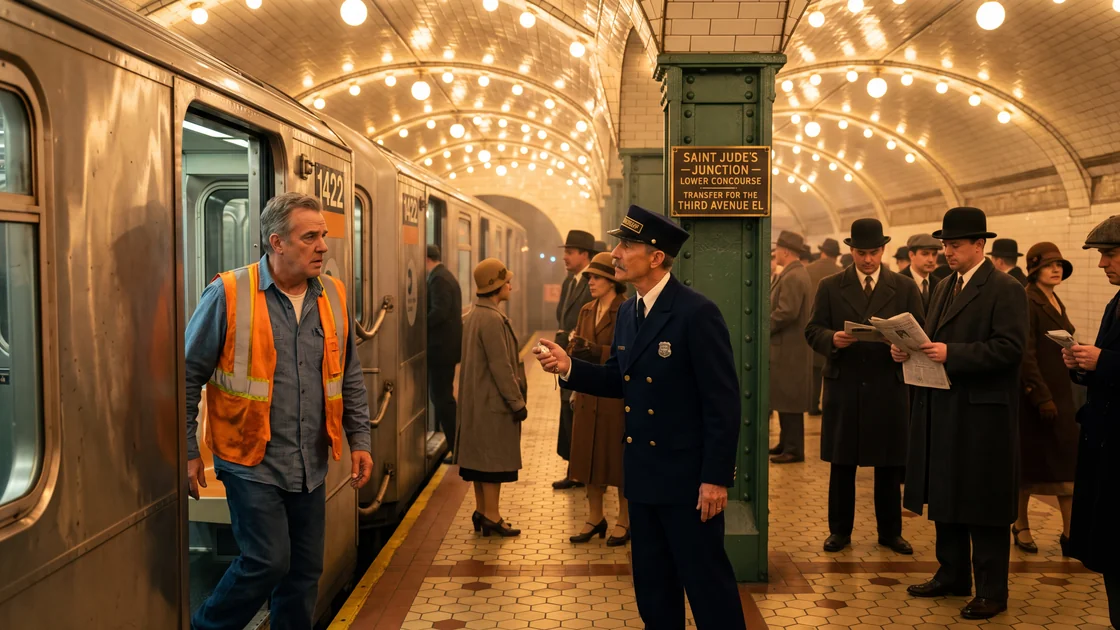
This is the story of Arthur Finch, a veteran motorman on New York City’s Lexington Avenue line who, during a rain-drenched midnight run, followed an impossible amber signal down an unmapped maintenance spur and emerged into a fully operational, incandescently lit subway terminal preserved in the year 1926. Caught between his lonely, fluorescent-lit modern life and a bustling subterranean world of wool-coated commuters, brass turnstiles, and living ghosts on the eve of the Great Depression, Arthur found himself forced to choose between the safety of his modern routine and the fragile, fleeting warmth of a forgotten past before the rails between the centuries permanently rusted shut.
Act I: The Midnight Iron
The rain above Manhattan did not fall so much as it weighed upon the city, filtering down through sidewalk gratings as a warm, diesel-tainted mist that slicked the stairwells and turned the ballast between the ties to black porridge. Down in the cut, sixty feet below the theater district, the air was seventy-eight degrees and smelled of ground iron, ozone, and old brake shoe linings.
Arthur Finch sat in the narrow operating cab of the lead car of Train 1422, a six-car consist of R62A stainless-steel rolling stock. His right hand rested with practiced, almost unconscious ease on the master controller handle—what the old-timers still called the dead-man’s peg—while his left hovered near the independent air brake valve. Arthur was fifty-four years old, thirty-two of which had been spent staring down the twin silver ribbons of the Interborough Rapid Transit. He knew the Lexington Avenue line not as a sequence of tourist stops or street names, but as an anatomy: a spine of ribbed concrete and steel uprights, a circulatory system of 600-volt direct-current third rail, and an irregular, pounding pulse that traveled through the soles of his work boots.
It was 02:47 on a Tuesday morning. The graveyard shift stripped the city of its manic daytime armor, reducing the subway to its true nature: a colossal drainage ditch through which the night’s wanderers, the exhausted night nurses, the kitchen staff from Chinatown, and the solitary dreamers were sifted and sorted. Behind Arthur’s cab bulkhead, forty-three passengers were scattered across six cars, most of them slumped against the orange-and-yellow fiberglass benches, their heads rolling with the rhythm of the trucks beneath them.
Clack-clack. Clack-clack.
Track 4 South was running on yellow blocks due to track maintenance near 14th Street. Arthur had been crawling at fifteen miles per hour since Grand Central, his running lights cutting cones through the oily gloom. He knew every bolt along this stretch. He knew where the ground-water leaked through the bedrock behind the tiles at 28th Street, leaving mineral deposits shaped like a weeping lung; he knew the exact tie between 33rd and 28th that had settled half an inch into the mud, causing a distinctive, dull thunk under the front axle.
Then came the signal that was not in the rulebook.
Just south of the old, curved platform at 18th Street—a ghost station sealed back in November of 1948—the tunnel widened into a vaulted pocket that had once housed an emergency crossover. For seventy years, the switch points there had been spiked shut with iron wedges, the frogs long since filled with poured tar, and the home signal had displayed an unblinking, rusted-over lunar red.
Tonight, as Arthur rounded the sweeping reverse curve, the red lantern was dark.
In its place, mounted on a dripping cast-iron dwarf stanchion bolted directly into the schist wall, burned a double-amber aspect. It did not hum with the sharp, LED intensity of the modern signals installed during the signaling modernization of the nineties; it burned with a thick, syrupy, oil-wick glow, the color of burnt marmalade.
Arthur’s hand immediately nudged the controller toward neutral, his knuckles whitening. "What the hell is that?" he murmured to the greasy cab glass.
The radio on his shoulder harness gave a faint, rhythmic static—a sound like dry corn husks rubbing together—but Dispatch was silent. The radio channel was dead, showing three dashes on the digital display.
He reached for the whistle cord, checked himself, and laid his hand on the air brake. The protocol was simple: an improper aspect was a red aspect. You stopped the train. You dropped your flag, tripped the emergency valve, and picked up the handset to call the control center at Brooklyn Bridge.
Yet the train did not seem inclined to stop.
As Arthur moved the handle to full service, the brass valve hiss was strangely muffled, like someone whispering into a feather pillow. The train didn't jolt; it leaned. Beneath the wheels, Arthur felt the unmistakable mechanical heave of a switch point sliding across its tie plates. The front truck took a sudden, greasy divergence to the right, into a gap in the tunnel wall where Arthur had never seen anything but weeping limestone and bundles of dead telephone trunk cables.
"Hey!" he yelled into the empty cab, slamming the handle into the emergency notch—the big hole.
The air blasted out through the exhaust port, but the train did not grab the rail. There was no screech of shoes on steel, no violent throwing of Arthur against the console. The train simply glided, smooth as an oiled knife entering tallow, down a downward-sloping grade that dropped three, four, five percent into the dark.
The cab lights flickered once, twice, and died.
In the sudden darkness, Arthur did not smell the familiar stink of overheated electrical insulation or the scorched copper of an arching shoe. The air coming through the front cab vent changed instantly. It lost the damp, cellar-rot chill of the modern Manhattan under-belly and became dry, sharp, and laden with the fragrance of things long since banished from the underground: the dry, mineral tang of coal smoke, the cedar-shavings scent of fresh matches, the sweet fat of roasting nuts, and the clean, tallowy odor of whale-oil grease.
"Dispatch, this is Finch on 1422," he said into the radio mic, his voice tight, his throat constricting. "I’ve got a runaway on an unlisted lead south of 18th. Brakes aren't taking. I am in emergency and rolling."
No reply. Not even static.
The tunnel walls outside were no longer modern concrete ring-segments or heavy H-beams smeared with black sludge. They were lined with small, pristine, square white tiles that caught the yellow headlamp of the R62A and shattered it into thousands of tiny, diamond-bright reflections. Arthur stared through the glass. The tiles were clean. Not a single drip of rust ran from the grout; not a single scrawl of spray paint marred the corners.
The train began to decelerate on its own accord, drawn by some unseen mechanical friction that felt less like air brakes and more like the gentle, massive drag of a cable system or an incline counterweight. Up ahead, through the straight bore, a light appeared.
It was not the dim grey of the street grates at dawn, nor the flickering orange of track crews' lamps. It was a vast, warm, golden wash of brilliance, accompanied by a sound that Arthur Finch had not heard in thirty years of railroading: the swell of a thousand human voices unmediated by digital static, the sharp, hollow tock-tock-tock of leather-soled shoes on stone, and the distant, tinny swing of a ragtime band played through a horn speaker.
The front of Car 1422 slid past a massive, green-enameled cast-iron pillar bearing a brass plate:
SAINT JUDE’S JUNCTION — LOWER CONCOURSE TRANSFER FOR THE THIRD AVENUE EL AND NINE-MILE TROLLEY
Arthur’s train came to a dead, soft halt. The platform doors remained shut, but through the cab windows, the scene that opened before him caused the seasoned motorman to drop his brass reverser key to the steel deck with a sharp, echoing ping.
Act II: The Platform of the Living
The platform was twenty feet wider than any station Arthur had ever seen on the old IRT network. The vaulted ceiling was set with hundreds of ground-glass globes that glowed with warm, filament-stringed incandescence, bathing the expanse in an amber hue that smoothed the edges of everything it touched.
There was no concrete. The floor underfoot was laid in hexagonal ceramic pavers—pale cream and oxblood red—scrubbed so fiercely that they mirrored the petticoats and trouser cuffs of the crowd.
And the crowd was thick.
Men in dark, heavy woolen coats with high lapels, stiff-collared white shirts that pinched their throats, and round derby hats or flat newsboy caps moved with brisk, purposeful cadence. Some carried folded broadsheets whose mastheads Arthur could read even through the cab window: The New York Evening Graphic, The World, The Sun. Women in wool drop-waist dresses, their hair tucked beneath close-fitting cloche hats trimmed with silk ribbons, walked arm-in-arm, their lips painted in sharp, dark Cupid’s bows.
No one looked at a screen. No one had white wires dangling from their ears. No one wore nylon, sneakers, or synthetic down. The sound they made was a strange, dense, rhythmic rustle—the sound of wool, serge, leather, and spit.
"Open the doors, Artie," Arthur whispered to himself, his hand trembling as he reached for the master door switch on the rear cab wall. "Don't do it. Just stay in the box. Put it in reverse and find the battery ground."
He looked down at the reverser on the floor. He hadn't picked it up. He couldn't. His fingers felt heavy, numb with an adrenaline so sharp it tasted like aluminum foil against a filling.
A sudden, sharp rap sounded on the glass of the cab door that opened onto the platform.
Arthur flinched so violently his knee struck the air brake manifold.
Standing on the platform outside his cab window was a man in a navy-blue wool uniform with double-breasted brass buttons that bore the embossed, interlocking letters IRT. The man wore a pillbox-style conductor’s cap with a gold-wire wreath around a center medallion that read: STATION MASTER. His face was lean, weathered by wind that seemed impossible fifty feet underground, and he sported a thick, graying mustache waxed into two stiff points.
The man tapped the glass again with the edge of a nickel-plated pocket-watch casing.
Arthur hesitated, then reached down and pulled the manual dog-latch on the cab’s exterior door. The steel door groaned on its hinges—a heavy, mechanical sound—and swung inward three inches.
The air that rushed in was intoxicating. It was cold, dry, and carried the smell of roasted chestnuts, pipe tobacco—Prince Albert or Lucky Strike—and the slightly sweet, sharp reek of kerosene stoves.
"Come along, brother," the man outside said. His voice was a flat, sharp New York bark, but without the modern nasal drag; it was crisp, theatrical, the accent of an immigrant’s son raised in the Five Points who had spent twenty years hollering over the clatter of steam locomotives. "You’re fouling the clearance for the 2:55 from Mott Haven. Pull her up to the bumper or drop your staff."
Arthur stared at him. "I... I’m on a diversion. Track 4. The switch was set for an auxiliary run."
The Station Master squinted past Arthur into the cab, taking in the digital speedometer (now dark), the dead radio, the gray plastic-and-steel controls, and the high-visibility orange safety vest Arthur wore over his blue chambray work shirt. The man’s eyebrows rose, not in fear, but with the cool, irritable skepticism of an official who has seen every variety of carnival crank and patent-medicine vendor come through the tubes.
"What is that contraption, mister? Westinghouse test car? The folks from General Electric said they was bringing down a turbine-electric unit from Schenectady, but they didn't say it’d look like a silver lard-can."
"It's an R62A," Arthur said dumbly. "Kawasaki Heavy Industries. 1985. Overhauled in Hornell, 2002."
The Station Master stared at him for three full seconds, then spat a brown jet of tobacco juice neatly between the rubber rub-strip of the train and the granite platform coping.
"Never heard of 'em. Sound like krauts to me. Come out of the box, son. You're blocking the loop, and Mr. Hedley’s inspector is down here tonight from the uptown office. If he sees you in that funny yellow vest without an official badge on your cap, he’ll have your skin for a doormat."
"Mr. Hedley?" Arthur’s mouth felt like chalk. "Frank Hedley? The general manager of the IRT?"
"Who else? King George?" The man shook his head, stepped back, and hooked his thumbs into his waistcoat pockets. "Out of the cab, son. Bring your trip sheet. We’ll sort it out at the registry."
Arthur looked back at the darkened, empty passenger compartment behind him. Through the small rectangular window in the cab door, he could see his modern passengers. They were still there. But they were... still.
Not dead. Not frozen like statues. They were like figures viewed through thick oil: their movements had slowed to an imperceptible drift. A young man who had been checking his phone at 18th Street was caught with his thumb half an inch above the screen; a woman in a puffy green jacket had a single droplet of rainwater clinging to the collar of her coat, suspended in the amber air like a tiny glass bead.
"They won't wake up while the shoes are off the iron," the Station Master noted, his tone softening with a sudden, eerie understanding. "They ain't here, see. They’re up in the drift. You're the only one who stepped over the tongue."
"Stepped over what?"
"The tongue. The switch point." The man tapped the heel of his boot against the platform edge. "Name’s Vance. Bartholomew Vance. Night Superintendent, St. Jude’s Division. Come on, boy. You look like you need a cup of java from the counter before the whistle blows."
Arthur Finch, who had not left his cab without a safety harness and high-vis gear since 1994, reached down, unclipped his radio, let it drop to the seat, and stepped out onto the bricks of October 14, 1926.
Act III: The Gilded Mezzanine
The station was enormous, built on a scale that suggested the cathedral of some lost religion dedicated to momentum.
Above the platform level, reached by twin staircases of cast iron with treads of white Italian marble worn down in their centers into shallow troughs, was the main mezzanine. Here, the low ceiling of the track level gave way to a grand, three-story barrel vault tiled in cream-colored Guastavino brickwork that arched over a hall forty yards wide.
Arthur walked beside Vance, his steel-toed boots making a heavy, clumping sound that drew curious glances from the throngs. The commuters did not look at him with terror; they looked at him the way people on Fifth Avenue might look at a milkman who had forgotten to comb his hair.
"Where are we?" Arthur asked, his voice swallowed by the cavernous acoustics. "There’s no St. Jude’s station on the IRT map. There never was. The only abandoned stations are 18th, City Hall, and the lower level at 9th Avenue."
Vance chuckled, a dry sound like coal rattling down an iron chute. "Of course it ain't on your map. Your map’s for the folks who want to go from Harlem to the Battery without thinking about the hole they're traveling through. St. Jude’s is the waste-gate."
"The waste-gate?"
"Every system has one," Vance said, stopping near a newspaper kiosk constructed entirely of polished oak and plate glass. "You got a million pounds of steam in a main boiler, you got a safety valve. You got five million folks in a city made of granite, all of 'em running, all of 'em thinking about tomorrow, all of 'em wanting to be five minutes ahead of where their feet are... where do you think that pressure goes?"
He didn't wait for an answer. He slapped a three-cent piece down on the kiosk’s marble counter.
"Give him The World, Toby," Vance barked to the boy behind the counter, a lad of twelve with soot-smudged cheeks and an oversized newsboy cap that covered his ears.
Arthur took the paper. The ink was still damp; it smelled of turpentine and linseed oil.
The headline blared:
QUEENSBORO TUNNEL LEAK SEALED; MAYOR WALKER PLEDGES 5-CENT FARE FOR PERPETUITY DODGERS LOOK TO NEXT YEAR AS CARDS BASK IN WORLD SERIES GLORY
"Look at the date," Vance said quietly.
Arthur’s eyes drifted to the small print beneath the eagle logo: Thursday, October 14, 1926.
"This is impossible," Arthur said, though the words lacked conviction. He reached out and touched the oak wall of the kiosk. It was solid. It was cold. A splinter caught the flesh of his index finger—a tiny, sharp prick of pain that brought a bead of bright red blood to the surface. He sucked on it; it tasted of iron and salt.
"Nothing’s impossible under fifty feet of schist," Vance said. "The stone don't care about the years. Stone just sits there. You put enough copper through it, you spin enough dynamos over at the Hell Gate plant, and every now and then the tracks jump the groove. They buckle sideways. Not in space, neither. In the when."
Arthur looked around the hall. In the center stood a circular information booth topped by an immense bronze four-faced clock. Its hands crept forward with a heavy, mechanical tock that seemed to sync with the beating of his own heart. Above the booth, suspended from the ceiling by chains of blackened bronze, hung an indicator board whose wooden slats flapped and spun like the wings of captive birds:
MOTT HAVEN LOCAL — 2:58 — TRACK 1 FLATBUSH EXPRESS — 3:02 — TRACK 3 YONKERS VIA SPUR — 3:05 — TRACK 2 THE PHANTOM SPECIAL (NON-STOP TO TERMINUS) — DELAYED
"Who are they?" Arthur gestured toward the hundreds of people moving through the hall. A young woman with a long cigarette holder was laughing at the arm of an officer in the uniform of the United States Navy; three men in bowler hats were arguing intensely over a ledger book open between them on the brass ledge of a water fountain. "Are they dead?"
"Dead?" Vance looked offended. "Do they look dead to you? That’s Mrs. O’Leary over there, her husband runs the drayage firm on West Street. That fellow with the horn-rims is an actuary for Met Life. They ain't dead. They’re just here."
"Where is here?"
"I told you. The waste-gate. The hour that don't belong to nobody. When they built the system back in '04, Mr. August Belmont had some engineers from the old country—men who worked the Alpine tunnels. They found places down here where the rock wasn't empty. Pockets of time, caught like air in a water pipe. They didn't seal 'em; they bridged 'em. If you don't give the extra minutes somewhere to go, the whole city would shatter like a cold lamp chimney."
Vance took Arthur’s arm. The wool of Vance’s coat sleeve was rough and bristling, smelling of mothballs and damp horse-hair canvas. "Come on. The coffee counter’s this way. You look like you caught your finger in the third rail, Finch."
Act IV: The Counter at the End of the Night
The luncheonette was situated under the southern arcade of the concourse, behind a series of frosted glass panels etched with intertwined ivy patterns. A long counter of black-and-white veined marble stretched fifty feet from the door to the kitchen partition, fronted by thirty round stools with seats of red leather studded with brass tacks.
Behind the counter worked two men in starched white duck jackets and paper caps, moving between gleaming nickel urns that hissed jets of steam into the warm air.
"Two mugs of the mud, Leo," Vance said to the older counterman, dropping two heavy nickels onto the stone. "And two crullers. Fresh ones, not the ones from the Monday delivery."
Arthur sat down on a stool. His legs were shaking. The seat swiveled beneath him with an easy, well-greased glide. Beside him, an empty stool was occupied by a leather violin case, worn at the corners and covered in faded luggage labels: Milan, Paris, Leipzig, Boston.
"Is this heaven?" Arthur asked, staring at the marble, which was stained with decades of coffee rings.
"Heaven?" Vance laughed, a short, barking laugh that turned into a phlegmy cough. "In New York? Don't be a dunce. In heaven, the trains are always on time, the ballast is made of crushed sugar, and you don't have to sweep up the cigar ends at four in the morning. This is just the station between the stations. The yard where the cars go when the yardmaster ain't looking."
"Can I go back?"
Vance didn't answer immediately. The counterman slid two thick, heavy ceramic mugs across the marble. The coffee was nearly black, topped with a thin rim of yellow froth. It didn't smell like the thin, bitter swill from the deli near Arthur’s terminal in the Bronx; it smelled like chicory, roasted barley, and real, dark-fired Java beans.
"That depends," Vance said after blowing across the surface of his mug.
"On what?"
"On whether you still got steam in your cylinders, son. Most who come through the spur, they come because their air ran out. They had an open throttle up above, their head was hurtin', their wife was gone, or the city got too loud, too tall, too full of them electric signs. They take the turnout because the dark looks softer than the daylight. You took it with a full train behind you."
"I was on duty," Arthur said defensively. "The signal showed an auxiliary aspect. I had to follow the lead."
"Nobody has to follow a lead down here," a soft voice said from Arthur’s right.
He turned.
The violin case didn't belong to an old musician. It belonged to a woman who had just slipped back onto the stool beside him.
She had removed her cloche hat and laid it on the counter; her hair was cut in a severe, glossy black bob that curved against the pale skin of her jawline like two strokes of India ink. Her eyes were wide, gray-green, and shadowed by the kind of fatigue that had nothing to do with lack of sleep and everything to do with watching the world move too fast. She wore a simple charcoal coat of heavy tweed with deep pockets, and her hands, though small, had the long, calloused fingertips of a string player.
"Miss Clara," Vance said, tipping his cap with an easy familiarity. "You're late for the local."
"The local didn't come, Mr. Vance," she said. Her voice was low, musical, with a slight, clipped cadence that Arthur recognized from his grandmother’s old 78-rpm records. "The board says delayed. It’s always delayed."
"This is Arthur Finch," Vance said, thumbing toward Arthur. "He’s an engineer from the high line. Came down in a silver box with no fire and no coal."
Clara looked at Arthur. Her eyes flicked from his scuffed, rubber-soled work boots to the nylon safety vest with its bands of silver retroreflective tape, which seemed to glow with an unnatural, sour luminosity in the warm incandescence of the luncheonette.
"You look like a soldier from a war that hasn't happened yet," she said softly.
Arthur looked down at his vest, feeling suddenly ridiculous. He reached up and tore the Velcro front open with a loud, raspy rip.
Several people along the counter turned to stare at the sound.
"It's just... safety gear," Arthur muttered, balling the orange fabric up and shoving it onto his lap. "Track regulations. If you're on the right-of-way without high-vis, they pull your certification."
"Certification," Clara repeated the word as if it were an odd shell she had picked up from the sand. "How orderly. Is everyone so careful where you come from?"
Arthur thought of the platforms at 59th Street at 5:15 PM on a Friday. He thought of the crowds shoving against the yellow safety stripes, the smell of burnt electrical motors, the kids blasting music through distorted speakers, the people screaming at each other over dropped bags, the cold, gray monitors hanging from the concrete ceilings blinking out delays in bloodless orange pixels.
"No," Arthur said. "Nobody’s careful. They're just tired."
"Then why do they run?" she asked.
"Because they have to be somewhere else. Always."
Clara picked up her coffee mug with both hands, warming her fingers against the thick earthenware. "I had an audition this evening. At the Aeolian Hall. On 43rd Street. Do you know it?"
"It’s... it was torn down," Arthur said, the historical fact tumbling out before he could check it. "A long time ago. It’s an office building now. Or a bank."
Clara didn't flinch. She merely nodded, as if he had told her that yesterday’s clouds had dispersed.
"I played the Brahms," she said. "The D major. My hands were cold. The man who listened—a German with gold spectacles and a beard that smelled of dry schnapps—he didn't look at me once while I played. He looked at his ledger. He looked at the window. When I finished the second movement, he said, 'Very competent, Miss Davenport. But we have twenty girls from the institute who can play the notes. What New York needs is fire. Can you play with fire?'"
She took a sip of her coffee.
"I didn't answer him. I packed my violin, walked down the stairs, and went into the station at Times Square. I intended to go home to my mother’s flat in Flatbush. But the platform was so hot, and the people were pushing so close to the edge... I saw a dark staircase behind an iron gate that had a sign: EMPLOYEES ONLY. The gate was an inch ajar. I slipped through."
"How long ago was that?" Arthur asked.
Clara smiled—a small, crooked expression that didn't reach her eyes. "I’ve had three cups of coffee. And I read the morning paper twice. Mr. Vance says time doesn't pool here; it just circles like a dog trying to find a place on the rug."
"You can't stay here," Arthur said. "You have a family. You have... you have 1926."
"And what is 1926?" she asked, leaning closer to him. He could smell her perfume now—lavender and something clean, like cold starch. "Everyone is shouting. Everyone is buying shares in companies that make aluminum pots or Florida swamps. My brother says if you don't have five thousand dollars in the market by Christmas, you're a beggar. They're building towers eighty stories tall, Mr. Finch. They're building them so high the birds get confused and hit the windows. I feel like... like the city is a locomotive that’s had its governor pinned down with an iron spike, and everyone’s shoveling coal into the box and singing hymns about the future."
Arthur closed his eyes.
He knew what was three years down the track for her. He knew what October 1929 looked like: the ticker-tape machines stuttering into silence, the men standing on window ledges along Wall Street, the breadlines in the snow along the Bowery, the Hoovervilles springing up in Central Park like grey fungal growth.
He opened his eyes and looked at her smooth, pale forehead, untouched by the catastrophe waiting thirty-six months ahead.
"It gets worse," he whispered.
"Does it?"
"And then it gets different. And then it gets louder."
"And your silver train?" she asked, looking toward the door that led back to the platform. "Where does that go?"
"To 2024," Arthur said. "Back to the yard. Back to the maintenance schedule. Back to my apartment in Sunnyside where I watch television until my eyes burn, and then I get up and drive the six-car consist again."
Clara looked at him for a long time. Her fingers moved against the latch of her violin case, a tiny click-clack that sounded like the relay of an old telegraph.
"Is there music there?" she asked.
"Too much," Arthur said. "Billions of songs. In the air. In little plastic boxes in people's pockets. You can hear anything you want, any second of the day."
"And does anyone listen?"
Arthur opened his mouth to say yes, but the lie died behind his teeth. He thought of the kids with their earbuds, their eyes glazed, their bodies braced against the car posts, using the sound not as an offering, but as a shield—a wall of noise to keep the city from chewing through their ribs.
"Not really," he said. "They use it to keep from hearing each other."
Act V: The Pendulum Interlocking
Vance finished his cruller, wiped his mustache with a linen handkerchief that had seen many washings, and stood up.
"Come on, Finch. If you're going to keep your consist on the main, we got to see the Switchman. The 3:15 is due through the throat, and if we don't drop the dogs, your silver lard-can is going to have four tons of Baldwin steam engine embedded in its rear vestibule."
Arthur rose, but his hand lingered on the back of the stool. He looked at Clara.
"Will you be here?" he asked.
"I haven't got a token for the gate," she said softly, touching the empty pocket of her tweed coat. "And the man at the turnstile doesn't take IOUs."
"I have money," Arthur said. He reached into his pocket and pulled out his leather wallet, extracting a crumpled twenty-dollar bill—Andrew Jackson’s modern, oversized face staring out from the green paper with high-tech watermarks and security threads.
Clara took the bill and turned it over in her hands, her brow furrowed. "It looks like play money. It feels like cloth. And who is this old man with the wild hair?"
"Keep it," Arthur said. "Maybe the collector’s market... no, never mind."
"Follow me, Finch," Vance called from the doorway.
Arthur followed the Station Master out into the mezzanine, past the grand bronze clock. The hands had not moved. They still pointed to 2:54.
"Why doesn't the clock move, Vance?"
"Because nobody’s missed their train yet," Vance replied without turning around. "The minute hand only moves when somebody gets left behind. As long as folks are still waiting, the minute stays right where it is. It’s a courtesy of the management."
They walked past the grand staircases and entered an iron service corridor marked: TOWER 12 — INTERLOCKING & POWER.
The corridor was long, narrow, and walled with unpainted brick. Every ten paces, a small electric bulb sat within a heavy wire cage, throwing diamond patterns across the damp floor. The sound here was different: not the human murmur of the concourse, but a rhythmic, metallic chunk-clank... chunk-clank... that sounded like an enormous grandfather clock operating underwater.
At the end of the hall was an octagonal room projecting out over a vast subterranean cavern. Through its leaded-glass bay windows, Arthur could see the true scale of the terminal’s throat.
There were not two tracks, nor four. There were dozens.
They converged from every direction, looping over and under each other in a dizzying maze of flying junctions, single-slip switches, and diamond crossings. Some of the tracks were the standard 4-foot-8½-inch gauge of his own line; others were narrow, two feet wide, carrying small, battery-powered mine locomotives that hauled carts of crushed ballast; others still were three-railed, four-railed, or slotted down the middle for the plow of an old cable-car system.
And the trains!
To the left, a wooden elevated consist from the late 1890s, its cars painted a deep, varnished Tuscan red with gold leaf lettering (MANHATTAN RAILWAY COMPANY), was discharging passengers onto a wooden island platform. To the right, a massive, streamlined steam locomotive with a bullet-shaped nose of fluted steel—something that looked like Raymond Loewy’s sketches for the Pennsylvania Railroad—stood panting, its side rods dripping oil while a gang of men in denim overalls shoveled lump coal into its tender from an overhead hopper.
"Look at that," Arthur whispered, pressing his forehead against the cool glass. "That’s an S-1 class. That was never down in the subway. That ran on the water level route."
"Everything that runs on steel comes through St. Jude’s sooner or later," an old voice spoke from the corner of the tower.
Sitting on a high wooden stool before a fifty-lever mechanical interlocking machine was a man so thin and dried-out he looked like an anatomy specimen wrapped in blue serge. His sleeves were held up by red silk garters, and a green celluloid eyeshade was pulled low over his brow, casting his face in a cool, emerald shadow.
In his right hand he held an iron wrench; his left rested on the heavy brass latch of Lever 24.
Above the levers, an illuminated model board represented the track layout—not with digital LEDs, but with hundreds of tiny brass discs that dropped with a sharp clack whenever a train occupied a circuit.
"This is old man Gidley," Vance said. "He’s been throwing the iron since the Blizzard of '88. He was on the Ninth Avenue El when the snow drifted twenty feet deep at the curve on 110th Street."
Gidley didn't look up from his board. "You got six minutes, Vance. The highball from New Haven is already at the portal. I can't hold the iron for this scrap-heap from Queens."
"He came in on the double-amber, Gidley," Vance said.
Gidley paused. His hand left the latch. He raised his green-shaded eyes and looked at Arthur. His eyes were milky at the edges, the pupils small and sharp as needle points.
"Double-amber?" Gidley rasped. "The St. Jude aspect?"
"The same," Arthur said. "The dwarf at 18th Street."
Gidley spat into a brass spittoon that sat on a rubber mat by his stool. The sound was like a small pistol shot. Ting.
"Then you didn't take a wrong turn, son," the old man said. "The iron called you."
"The iron didn't call me," Arthur said, his voice rising with a sudden, desperate anger. "I’m thirty-two years on the job. I have a clean safety record. No derailments. No signals passed at danger. I followed the signal because it was displayed. That’s the rule. Rule 281: Proceed on indication."
"And what if the indication was for you, Finch?" Gidley pointed with his wrench toward the tracks below. "Look down there. You think those people are ghosts? You think you're better than them because your train’s made of tin instead of white oak? Every man who drives the iron carries a weight. Some carry their old mothers. Some carry the girl they didn't marry. Some carry the war. You’ve been running up and down that hole between 241st Street and Flatbush for thirty years, Finch, and every year you get a little quieter, a little colder, a little more like the steel you're riding on."
Arthur stepped toward the machine. The brass levers were polished to the brilliance of gold by thousands of greasy palms.
"I have a home," Arthur said.
"Do you?" Gidley asked. "Who’s sitting at the table tonight, Finch? Who’s waiting for the key in the latch?"
Arthur stopped.
The silence in the tower was broken only by the tock-chunk of the pendulum clock on the wall and the distant, lonely wail of a three-chime steam whistle from the throat cavern.
There was no one.
His sister had died in Ohio seven years ago. His ex-wife, Martha, was somewhere in Arizona with a contractor who built stucco houses with swimming pools. His apartment in Sunnyside smelled of old newspapers, frozen pot-pie crusts, and the dust that drifted off the elevated tracks outside his window. When he went to sleep, he could still feel the vibration of the trains in his teeth; when he woke up, he checked his watch to see how many hours remained until he had to put his uniform back on.
"The modern run don't end, does it?" Vance said gently from behind him. "It just keeps going in a circle. You drive 'em to work so they can earn the rent, you drive 'em home so they can sleep, and tomorrow you do it again so they don't lose the lease. Nobody gets off. Nobody looks at the river."
"And here?" Arthur demanded, turning on them both. "What do they do here? They sit in a station that doesn't exist, drinking coffee that’s eighty years cold, waiting for a train that’s delayed forever!"
"Not forever," Gidley said, his hand dropping back to Lever 24. "Just until they’re ready to board."
"And Clara?" Arthur asked. "What train is she waiting for?"
"The 3:05 to Yonkers," Vance said. "Her father had a house there, on the hill above the water. Roses in the front yard. A porch where you could hear the night boats blowing for the landing. She left it to come down here to play the fiddle in a cellar for a man who didn't even look at her face. She’s just trying to remember what the porch smelled like before she gets on the cars."
Gidley reached up and pulled a heavy iron chain that hung from the ceiling.
A brass bell above the board began to ring: Clang! Clang! Clang!
"The third-rail polarity is shifting, Vance," Gidley said, his voice dropping into professional urgency. "The morning load is coming on the high line up above. The dynamos at 59th Street are starting their cycle for the 4:00 AM rush. If Finch don't clear the throat in four minutes, the ground will short out. His shoes will weld to the rail, and he’ll be stuck in the cut until the next surge—and that might not be for fifty years."
Vance grabbed Arthur’s elbow. "You heard the man, Artie. Make your move. Stay or roll."
Act VI: The Choice on Track 4
Arthur ran.
His heavy boots pounded down the iron stairs of Tower 12, their clatter echoing through the brick corridors. Vance was behind him, surprisingly nimble for a man with a wool coat and a pocket watch, his keys jingling at his belt.
They burst out into the grand concourse.
The bronze clock’s hands had begun to shudder. The minute hand was twitching—tock... tock... tock—fighting against the weight of the mechanism. The lights in the Guastavino ceiling were flickering, their amber incandescence dipping toward a dull orange as the modern current from eighty years away began to drag at the system’s roots.
The passengers were moving faster now, their murmurs rising into a confused, collective hum.
Arthur reached the luncheonette arcade.
Clara was still there. She had her violin case in her hand now, her cloche hat pulled down over her ears, her coat buttoned to the chin. She was standing by the door, watching the ceiling with the alert, nervous posture of an animal that smells smoke in the woods.
"Arthur!" she called as he skidded to a halt on the hexagonal tiles.
"The train’s leaving," he said, chest heaving, his breath coming in hot, painful rasps. "My train. The modern one."
"The silver one?"
"Yes."
"Are you going with it?" she asked.
He looked at her. Her gray-green eyes were bright with a terrifying mixture of hope and grief. He looked at the white marble counter, where the two mugs of coffee were still sending up thin, delicate ribbons of steam. He looked at the newspaper boy, who was now crying out:
EXTRA! EXTRA! ALL QUIET ON THE HUDSON!
"Come with me," Arthur said.
The words came out without thought, without calculation.
Clara took a half-step back, her fingers clutching the leather handle of her case until the knuckles were ivory-white. "To your time? To the city with the boxes in their pockets?"
"It’s not better," Arthur said, the truth burning his throat. "It’s louder. It’s meaner. The buildings are taller and they don't care about you. But you can play your music. You don't have to stay in this hole waiting for a house in Yonkers that was demolished before I was born."
"And what would I be there?" she asked. "A girl who fell out of a wall? A ghost who eats their bread?"
"You’d be alive," Arthur said. "You'd be now."
The bell on the platform began to chime—a deep, bronze stroke that rattled the glass in the arcade panels.
BONG. BONG. BONG.
"Track 4!" Vance shouted from behind them. "She’s arcing, Finch! Your shoe-beams are smoking!"
Arthur grabbed Clara’s hand. Her skin was freezing, like marble left out in the October dew. She didn't pull away, but she didn't move forward either. She stood anchored to the tiles of 1926 by the weight of everything she had ever known: her mother’s parlor in Flatbush, the smell of her father’s cigar, the sheet music of Brahms sitting on the upright piano with the yellowed keys.
"Arthur," she whispered.
"Come on!"
"I can't," she said. A tear broke from the corner of her left eye and ran through the powder on her cheek, leaving a thin, clean line down to her jaw. "The porch in Yonkers... I remember the roses now. They were yellow. My mother planted them the summer before the war. If I go with you, they're dead. They’ve been dead for fifty years."
"They are dead, Clara," he said gently, his heart tearing in two.
"Not while I’m here," she said.
She pulled her hand from his grip, not with violence, but with a firm, devastating grace. She reached into her coat pocket, took out the modern twenty-dollar bill he had given her, and tucked it into the breast pocket of his work shirt, right over his heart.
"Take your passengers home, Mr. Finch," she said. "They don't know where they are. They’ll be frightened when they wake up in the dark."
The floor heaved beneath them. A low, electric growl—the 60-cycle hum of modern alternating current, alien and harsh—vibrated through the soles of Arthur’s boots. The smell of burning insulation and stale commuter-rail exhaust began to bleed through the scent of roasted chestnuts.
"Artie!" Vance roared, his face red, his arm windmilling toward the stairs. "Now, you damn fool, or you're walking the ties till judgment!"
Arthur looked at Clara one last time. She raised her hand, her fingers spread—the hand that could play the Brahms second movement without looking at the sheet—and pressed it against his cheek. Her fingers were warm now.
"Go," she said.
Arthur turned and ran for the stairs.
Act VII: The High Line at Dawn
He hit the platform just as the first massive blue arc erupted from the third rail beside Car 1422.
The modern R62A was shuddering like a living thing caught in a net. The interior fluorescent tubes were flickering on and off with a violent, machine-gun rattle—snap-snap-snap—and inside the cars, the frozen passengers were beginning to twitch. The droplet on the woman’s coat collar fell; the young man’s thumb struck his smartphone screen; an old man in the third car shifted his shoulder against the window and groaned in his sleep.
"Get in the box!" Vance was standing by the cab door, holding it open against the draft of ozone that was rushing into the station.
Arthur threw himself through the cab door, his boots hitting the steel diamond-plate deck.
He reached down, seized the brass reverser key from the floor where it had lay since he dropped it, and slammed it into the drum. He seized the controller handle with his right hand, his left dropping onto the brake valve.
"Vance!" Arthur yelled through the open door.
The Station Master was standing on the hexagonal tiles, his cap straight, his brass buttons catching the violent blue light of the third-rail arcs.
"Keep her on the brass, Finch!" Vance shouted over the rising scream of the modern traction motors. "And if you see Hedley... tell him the St. Jude spur don't need no turbine cars! We run just fine on the old iron!"
Vance reached out, caught the handle of the cab door, and slammed it shut.
Arthur threw the master controller forward into the maximum power notch.
The train surged.
It didn't glide this time; it struck the rails with the full, furious, 4,000-horsepower violence of modern electric traction. The steel wheels screamed against the frogs as the train was dragged through the crossover, the trucks shuddering, the car body groaning as the drawbars took the strain.
The light of St. Jude’s terminal vanished.
It didn't fade; it went out like a gas lamp snuffed by a bucket of wet sand.
The darkness that hit the cab windows was total, absolute, and freezing. The smell of chestnuts and tobacco was ripped away in an instant, replaced by the familiar, stale, iron-and-puddle stench of the Lexington Avenue subway. The cab was cold again. The air coming through the vents smelled of sulfur, damp brake linings, and seventy years of dead skin and subway dust.
Arthur Finch kept the controller pinned to the wall.
Clack-clack. Clack-clack.
The digital speedometer on the console flickered, showed nonsense characters for two seconds, and then locked onto a reading: 28 MPH... 34 MPH... 41 MPH.
Up ahead, through the grease-filmed front glass, the small, round white tiles gave way to the rough, soot-crusted H-beams and weeping bedrock of the Track 4 South main line.
A hundred yards ahead, an automatic block signal burned with a clean, modern, unblinking green aspect.
The radio on his shoulder harness hissed, popped, and then exploded with the sharp, irritable voice of the dispatcher at Brooklyn Bridge:
"...train 1422, acknowledge. Finch, where the hell have you been? You dropped off the board at 18th Street for forty seconds. We had an occupancy loss on the circuit. Finch, do you read?"
Arthur’s hand shook as he reached up and keyed the microphone.
He looked down at his breast pocket.
The twenty-dollar bill was gone.
In its place, tucked into the pencil slot of his chambray shirt, was a single slip of heavy, card-stock paper, three inches long and one inch wide, yellowed at the edges and punched twice with an oval die:
INTERBOROUGH RAPID TRANSIT CO. GOOD FOR ONE PASSAGE — ST. JUDE’S TO YONKERS OCTOBER 14, 1926 PLATFORM CHECK — NOT TRANSFERABLE
Arthur Finch took a deep, slow breath. The air tasted of iron and grease, but beneath it, clinging to the wool of his collar and the cuff of his sleeve, was the faint, sweet trace of lavender water.
He keyed the mic.
"Dispatch, this is Finch on 1422," he said, his voice level, steady, and clearer than it had been in thirty years. "I’m sorry for the delay. We had a brief power surge through the old crossover near 18th. Everything is normal now."
"You clear to proceed, Finch?"
Arthur looked through the cab window. The tunnel was widening out toward the grand, tiled expanse of 14th Street-Union Square. On the platform ahead, a dozen modern night-birds were waiting in their puffy jackets and their running shoes, their heads bent over the blue glow of their screens, waiting for the train to carry them through the dark.
"Yeah, Dispatch," Arthur Finch said, his hand easing the controller back to coasting speed as the brakes took the rail with a familiar, screaming sigh. "I'm clear to proceed. All the way to the end of the line."