The Twilight Weaver of the Iron Basin
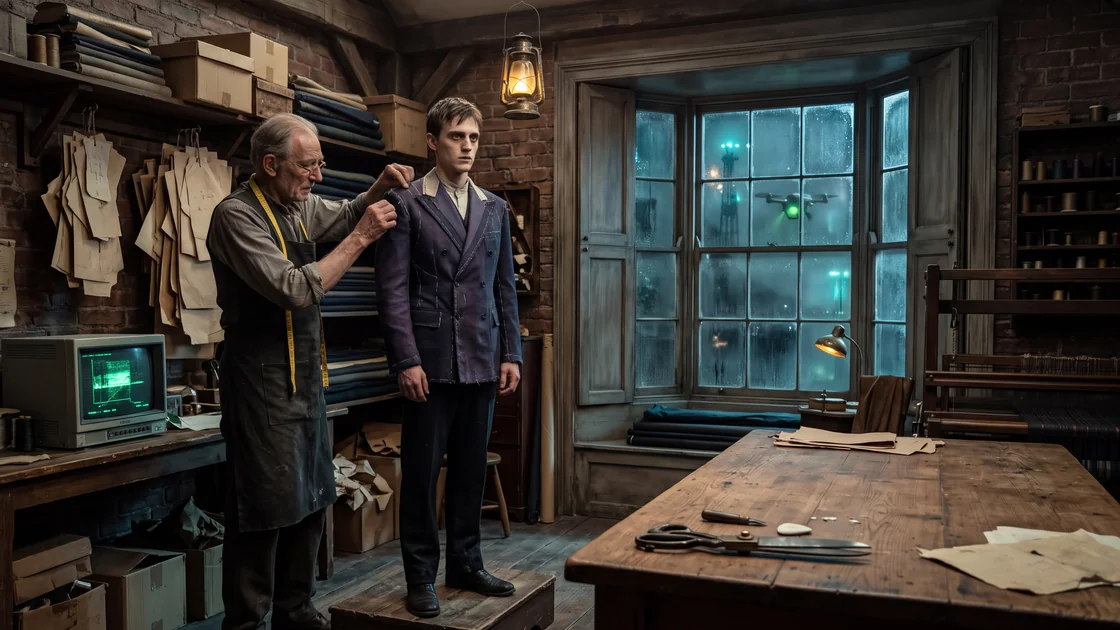
In a surveillance metropolis choked by algorithmic panopticons, an aging tailor named Maester Corvo preserves the lost art of true privacy by weaving bespoke garments from silk steeped in captured twilight. These garments exploit the exact optical and temporal discontinuities of dusk, rendering their wearers completely non-existent to the predictive lenses, neural cameras, and facial-recognition swarms that govern the city. When an outcast cartographer carrying the coordinates of the regime's central memory core seeks refuge in Corvo's hidden atelier, the old tailor undertakes his magnum opus: a three-piece traveling suit capable of walking through the heart of the machine state. As the Enforcers close in, the garment becomes more than a cloak of invisibility; it transforms into an irreversible threshold between the registered world of quantified flesh and the unrecorded wilderness of human freedom.
Act I: The Optics of Absence
The shears did not merely cut; they measured silence.
They were seventy-year-old Sheffield shears, heavy in the palm, their pivot-screw made of cold-rolled brass that had smoothed under the friction of three generations of thumbs. When Corvo worked them through the bolt of cloth on the cutting table, they made a sound like dry autumn leaves being crushed under the foot of a retreating animal—a crisp, soft shhh-tuck, shhh-tuck.
Outside the shuttered, second-story bay windows of the shop, the district of Lower Oakhaven hummed with its perpetual electronic fever. It was a mechanical vibration that lived in the fillings of one’s teeth: the collective pulse of twenty thousand sensory masts, five hundred thousand micro-apertures embedded in brickwork, lampposts, and train tracks, and the low, predatory whine of the Cherubim—the three-rotor surveillance drones that drifted through the soot-stained canyons between tenement towers like blind, sniffing hounds.
To the civic authorities, the system was known simply as the Synapse. It was a marvel of totalizing peace. Every face was an index of thirty-six nodal vectors; every gait was an equation of acceleration, skeletal asymmetry, and weight distribution. Even the temperature of a citizen's clavicle, flushed with the sudden guilt of a contraband thought or the elevated cortisol of an impending crime, was logged into the regional databanks before the citizen had turned the corner. There was no cruelty in it, the broadcasters insisted; there was only the elimination of ambiguity.
Yet in the belly of the Basin, beneath the dripping iron aqueducts where the sun arrived only as a grey rumor at noon, Corvo made ambiguity his trade.
He was a tall man, bent at the thoracic curve from sixty years over the drafting board, his skin the color of parched parchment and his knuckles swollen like the burl of an elder tree. Around his neck hung an unspooling yellow ribbon of waxed cotton, marked in both inches and imperial millimeters, though he rarely needed it. He could gauge the drop of an armscye to within a thirty-second of an inch by watching a man reach for a pocket handkerchief.
On the table lay the raw material for the new commission.
It did not look like fabric. It looked like a square yard of the sky taken five minutes after the sun has dropped behind the sea—not blue, not black, but an impossible, bruised violet that seemed to slip inward when the eye tried to fix upon its grain.
Corvo rested his calloused fingers on the edge of the cutting board. He looked at the material with neither reverence nor pride, but with the weary wariness of an apothecary handling dried nightshade.
"The sensor is a naive reader," he said aloud. He was alone in the room, save for the fat, grey cat sleeping on the hearth-rug, but Corvo had spoken to his workshop for so long that the tools were his natural congregation. "The sensor believes that light is a ledger. It balances the photons entering its silicon wells like coins dumped into an iron till. If a man stands under an arc-light, the coin is bright. If he stands in an alleyway, the coin is dark, but the till still knows the weight of the dark coin. It amplifies. It compensates. It infers."
He picked up a piece of tailor’s chalk—not the modern calcium-wax squares sold in the shops of the New Concourse, but a stick of compressed talc and pulverized shale he had ground himself.
"But twilight," Corvo whispered, bringing the chalk down onto the cloth with a light, singing stroke, "twilight is not dark. It is the failure of the equation."
He dragged the edge of the shears across the table, catching the selvedge.
To understand the silk, one had to understand how Corvo harvested it. The thread was not from common mulberry silkworms. It came from an archaic, wild strain—Bombyx vespera—which he cultivated in absolute darkness in the root cellars beneath the old churchyard of Saint-Jude-in-the-Fen. The worms were nourished exclusively on the leaves of white poplars that grew in the high salt marshes along the estuary, trees whose roots drank water rich in suspended bismuth and copper salts.
When the worms spun their cocoons, they produced a fiber triangular in cross-section, with microscopic ridges that functioned not as reflectors, but as asymmetrical prisms. The real work, however, did not belong to the worm; it belonged to the hour.
The dying was a ceremony that took place only twelve days out of the solar year, during the equinoctial transitions when the troposphere cooled with sudden, violent clarity.
Corvo kept three zinc vats on the roof of the tenement. He would climb the sixty-four rungs of the rusted fire escape with his glass demijohns, his lungs whistling against the cold soot of the chimneys. There, crouched between the terra-cotta chimney pots as the bells of the cathedral began their six o'clock peel, he waited for the interval.
It lasted precisely eight minutes.
It was that razor-edge of time when the direct rays of the sun have fallen beneath the curve of the planet, but the high-altitude ozone layer still scatters the shorter wavelengths of ultraviolet light, mixing with the low-lying dust of the coal-fired city. In that specific wedge of atmospheric decay, the ambient spectrum underwent an optical phase cancellation known to eighteenth-century painters as l'heure bleue, but recognized by Corvo as a mathematical null-space.
The mordant was the secret: a decoction of elderberry juice, zinc oxide, distilled rain collected from the slate roofs of lead-works, and three drops of oil of vitriol. When the silk hanks were plunged into the steaming vats at the exact instant the streetlights flickered from dead iron to yellow gas, the porous fibers absorbed not merely the pigment, but the spectral gap itself.
The finished cloth was not invisible.
If a man stood before you in a suit of twilight silk, you saw him clearly. You saw the roll of his lapel, the neat, suppressed waist of his jacket, the gentle drape of his trousers over his boots. You would remark that he was an exceptionally well-dressed gentleman, perhaps a little sober in his tastes, wearing a shade of deep, slate-violet that was both distinguished and unassuming.
But to the lenses of the Synapse—to the CCD arrays, the infrared scanning cones, the predictive algorithmic tracking nodes that parsed every millisecond of movement across the metropolitan grid—the cloth was an unresolvable error.
The light bouncing from the silk did not enter the lens as an image; it arrived as a destructive interference pattern. The digital processor, attempting to calculate the boundary between the garment and the surrounding air, found only an infinite decimal. It was a physical zero-day exploit woven into three-ply twill. The neural nets did not register a shadow; they simply pruned the branch of data. They decided, by the very laws of their optimization code, that nothing was there, because to admit the existence of that particular frequency would cause the frame buffer to overflow and crash the node.
The wearer was edited out of reality in real-time, erased not by magic, but by the machine’s own intolerance for an unanswered question.
The bell above the shop door gave a muffled, metallic chink.
Corvo did not flinch. He did not drop his shears. He laid them flat on the table, their points facing away from his body, and covered the twilight cloth with a broad sheet of brown butcher’s paper.
"We are closed for the evening," Corvo said toward the drafty corridor. "The trade licenses are expired. If you want mending, take it to the girls behind the railway arches."
A voice came from the dark passage—thin, wet, and ragged, like a spade turning over gravel.
"The girls behind the arches use nylon thread," the voice said. "It stretches when it rains. By November, a man’s sleeves are past his knuckles. I need something that will not stretch. Even under the weight of an empire."
Corvo turned slowly.
The man who stepped into the lamplight was young, but he had the eyes of an old horse that had been whipped up too many steep hills. He wore a heavy wool pea-jacket, soaked through with the sleet that had begun to fall outside, its horn buttons mismatched and hanging by loose loops of thread. Under his arm he held a square package wrapped in oiled sailcloth, bound with three rounds of telegraph wire.
"Silas Thorne," Corvo said, recognizing neither the face nor the name, but the particular angle of the neck: the head held low, the chin tucked into the collar, the eyes flicking automatically to the four corners of the ceiling where, in any standard room, a sensor pod would be nested.
"I was told to ask for the man who remembers how to make sheep’s wool out of twilight," the young man said.
"Then you were told by an idiot," Corvo said smoothly, "who knows nothing of textiles. Silk is not wool. Silk comes from a caterpillar that drowns in its own house so that you might have a collar that doesn't chafe. Come inside, Mr. Thorne. And shut the heavy door behind you. The damp is bad for the irons."
Act II: The Anatomy of a Trace
Silas Thorne did not sit in the client’s armchair—a comfortable, threadbare wingback stuffed with horsehair that had held the backsides of aldermen, smugglers, and retired opera singers. He paced the narrow length of the cutting room, his boots leaving dark, brackish smudges on the pine boards.
"They have the river docks cordoned from the Coal Basin to the spit," Silas said. His fingers were raw, the nails bitten down to the quick and rimmed with carbon grease. "They have deployed the mobile towers—the Mark IVs with the thermal sweeps and the ocular arrays that read retinal pulses through window glass. I have forty-eight hours before the perimeter tightens to the street level. After that, they sweep every cellar with microwave probes."
Corvo was at the small iron stove, using a pair of brass tongs to shift a coal briquette. He lifted a blackened tin kettle and poured two cups of chicory broth—he had not seen real coffee beans since the blockades began twenty years ago.
"The Mark IV is a clumsy beast," Corvo observed, handing one chipped mug to the young man. "It relies on temporal continuity. It expects you to be where you were half a second ago, plus your vector of momentum. Drink that. It tastes like roasted soil, but it will stop your hands from shaking."
Silas took the mug, but his gaze remained fixed on the long brown paper on the table.
"Is that it?" he asked.
"It is paper," Corvo said. "Underneath is nothing for you to concern yourself with until we have established whether you can afford the bill."
"I have gold," Silas said quickly. He reached into his coat, but Corvo raised a single, chalk-dusted hand.
"Gold is heavy," the tailor said with distaste. "It rattles in the pockets. It spoils the hang of the trousers. When a man walks with forty sovereigns in his fob, his left shoulder drops an eighth of an inch, his pelvis shifts to the right, and the neural cameras on the streetlights flag him for an abnormal gait before he has crossed three flagstones. Keep your gold for the ferrymen, if you ever reach them. What is in the package?"
Silas paused, his hand inside his coat. Then, with slow, calculated movements, he laid the square bundle wrapped in sailcloth onto the corner of the sideboard, away from the chalk and the shears.
"The registry plates," Silas whispered.
Corvo did not move toward the bundle. He blew across the surface of his chicory. "The copper ones?"
"The master matrices from the Ministry of Demography," Silas said. "The physical plates from which the civic IDs are etched. For three districts—Oakhaven, the Basin, and the Iron Quay. If these are introduced into an acid bath, sixty thousand souls cease to have a computational history. The Synapse will have the records of their births, their vaccinations, their infractions, their family trees—all rendered as null pointers. A ghost population. Men and women who can walk into a market and buy bread without their balance being deducted, because the ledger will have no place to write the debit."
Corvo looked at the boy over the rim of his mug. Silas was perhaps twenty-four. He had the high forehead and the hollow temples of the copyists who spent their youths in the deep administrative basements of the Ministry, squinting through micro-fiches and typing the endless punch-cards that fed the great mechanical analytical engines.
"You believe you are liberating them," Corvo said.
"I am giving them back their names."
"A name," Corvo remarked, "is the first tag the government attaches to a sheep’s ear. It makes it easier to call the animal to the shambles. The sheep thinks the shepherd loves it because he knows its name is Daisy."
Corvo set his mug down on the edge of the stove. He walked to the brown paper and drew it back with a theatrical flourish that had survived from his younger days in the theater district.
Silas took a step back.
The twilight cloth caught the yellow light of the single kerosene lamp. It did not shine; rather, it seemed to swallow the light, softening it, turning the harsh glare of the oil flame into a smoky, bruised twilight that hovered an inch above the weave.
"It looks... bruised," Silas said, his voice dropping.
"It looks like an evening in October," Corvo corrected. "It looks like the moment your mother called you in for supper, when you could no longer see the ball you were throwing in the street, but you could still see the chimney smoke against the clouds. That is the only moment the machine cannot digest. Because in that moment, the human eye ceases to see shapes and begins to see associations. The camera has no associations. It has only thresholds."
Corvo picked up his tape measure.
"Take off your coat, Mr. Thorne."
"Now?"
"No, next week, when the Enforcers have you pinned against the damp brick of the dock wall with an iron bar across your throat. Of course now. A bespoke suit is not a sack you buy from a peg in a department store. If the shoulder is wide by three millimeters, the cloth will catch the cross-draft of an alleyway. If the cloth ripples, the interference pattern breaks. If the interference breaks for the tenth of a second, an aperture on the corner of Market Street will log a pixel irregularity. Once you are an irregularity, you are a target. Strip."
Silas hesitated, then unbuttoned his salt-crusted pea-jacket. Beneath it, he wore a thin, greasy waistcoat of cheap wool and a collarless shirt of coarse gray linen.
Corvo stepped behind him. His hands were suddenly different—no longer the hands of an old man who struggled with a kettle, but the instruments of an anatomist. His long, calloused fingers pressed into the boy’s shoulders, feeling for the blade of the bone, the slope of the trapezius, the tiny, nervous twitching of the muscles along the spine.
"Stand straight," Corvo commanded. "Do not present yourself to me as you present yourself to the world. Do not hunch to hide your fear. The suit will hide your fear; that is its duty. Your duty is to provide the skeleton."
The tape measure flicked through Corvo’s hands like a yellow adder.
"Chest: thirty-six and a half," Corvo muttered. He reached for a stub of pencil behind his ear and scribbled the number directly onto the unfinished wood of the cutting table. "Waist: twenty-nine. You have not been eating the civic rations, Mr. Thorne."
"They put potassium bromide in the flour," Silas muttered. "To keep the population quiet. It makes your fingers numb after a month."
"A little numbness might have saved you from this folly," Corvo said, measuring from the nape of the neck down to the hollow of the small of the back. "Back length: eighteen and a quarter. Arm: thirty-one. Your right shoulder is lower than your left by five-eighths of an inch. You carry your package under the right arm. Stop doing that. You are tilting your balance. If you tilt your balance, the algorithm does not need to see your face; it knows you by the way your heel strikes the pavement."
Corvo moved to the front. He brought his face close to the young man’s chest, measuring the cross-front, his breath smelling faintly of peppermint and old dry paper.
"Tell me, Mr. Thorne," Corvo murmured, his eyes fixed on the tape, "do you think the machine is evil?"
"It has turned the city into a slaughterhouse where no blood is spilled," Silas spat. "It assigns every man his work, his rations, his burial plot. It knows when you wake. It knows when you turn out the lamp. If you walk two miles outside your designated commute, the barrier gates drop. It is a cage."
"It is an engine," Corvo said softly, measuring the rise of the trousers. "It does what engines do: it consumes fuel to maintain momentum. The tragedy is not that the machine is evil. The tragedy is that men like you believe it has an opinion about you. It does not care that you stole those plates. It will not hunt you out of vengeance. It hunts you because an equation cannot have an unclosed parenthesis. You are a dangling syntax, Mr. Thorne. It simply wishes to insert the period at the end of your sentence."
He dropped the tape measure.
"Double-breasted," Corvo announced, turning back to the twilight cloth. "Six buttons, two to close. A high gorge. Peak lapels—wide, sharp, like the knives used for filleting herring. The peak lapel draws the human eye upward, away from the hips, toward the jawline. If a human watchman looks at you, he must see an aristocrat down on his luck, a dandy who has spent his quarter’s allowance on brandy and fine wool. The human watchman must dismiss you as an ornament. The electronic eye must not see you at all."
"Can it be done in time?" Silas asked.
Corvo picked up his shears. He looked through the dusty windowpanes. Down in the street, three stories below, a Cherub drone drifted past, its round ventral lens glowing with the dull, sickly green of a phosphorescent beetle. It paused, hovering level with the window, its three rotors beating the wet air into a rhythmic chop-chop-chop.
Corvo did not duck. He did not step aside. He remained motionless, holding his heavy shears against his apron.
The drone’s green lens flared once—a pulse of infrared query—and then, finding only the cold reflection of soot-covered glass and the empty profile of an old shop that had been marked on the city registry as an abandoned leather storehouse since the time of the cholera, it tilted its rotors and slid away into the rain.
"Forty hours," Corvo said, his voice flat and steady. "Do not leave this room. Do not light the lamp if you walk past the window. And above all, Mr. Thorne, do not touch the silk with your naked skin. The oils of the human finger are acidic; they will sour the twilight, and where your finger touched, the machine will see a bruise."
Act III: The Weft of Ruin
To weave silence into cloth, one must first break the silence of the room.
The loom occupied the entire rear chamber of Corvo’s shop—a room that had once, perhaps a hundred years ago, been a carriage stable. The floor was paved with damp granite sets, between which grew pale, sunless moss that smelled of saltpeter.
The loom was not iron; iron had an inductive field that interfered with the static balance of the threads. It was built of black pearwood and aged walnut, held together with mortise-and-tenon joints secured by ash pegs. When Corvo worked the treadles, the entire frame groaned like a ship coming about in a heavy sea: clack-whirrr-thump, clack-whirrr-thump.
Silas sat on an upturned wicker hamper in the corner, his knees drawn up to his chin, wrapped in a coarse horse-blanket Corvo had tossed to him. He watched the old man’s feet—shod in soft lambskin slippers without heels—dance over the four treadles in an intricate, unending sequence: left, right, double-pump, hold.
The shuttle was carved from the heartwood of a boxwood hedge. It flew across the warp threads like a small, yellow fish darting through reeds.
Whirrr-clack.
With every pass of the shuttle, Corvo’s left hand brought the heavy reed batten down against the fell of the cloth with a dull, resonant thunk.
"My father," Corvo said, his voice rising effortlessly above the rhythmic clatter of the machine, "was a vest-maker for the court of the third regent. In those days, a vest was a political statement. If you favored the French alliance, you wore three rows of covered buttons made of Lyons silk with an ivory shank. If you favored the maritime league, you wore silver filigree buttons cast with the image of a dead whale."
He threw the shuttle. Clack.
"Men believed then that clothes were meant to display the self," Corvo continued. His eyes were wide, fixed on the thousands of hair-thin purple threads that stretched from the warp beam down through the heddles. "They wished to be visible from across the plaza. They wore canary yellow and scarlet broadcloth. They wore waistcoats embroidered with peacocks and the names of their mistresses. Fools. All of them. They did not understand that visibility is a debt that must eventually be settled with the hangman."
Thunk.
"When did it start?" Silas asked from the shadows of his blanket. "The silk?"
Corvo’s feet did not miss a beat. Left, left-heel, right.
"It started when my daughter was fifteen," Corvo said.
The rhythm of the batten did not change: thunk, clack, whirrr.
"Her name was Clara. She had a laugh that sounded like coins dropping into a brass basin. She worked in the telegraph office at the Central Station. In those days, the Synapse was not an empire; it was merely an efficiency experiment run by the railway directors. They wanted to know why the trains from the coal-fields were always four minutes late. They set up three cameras at the junction. Then they set up twelve at the switchyards. Then they set up forty along the platforms to track the crowds."
Corvo caught the shuttle in his right palm. He did not throw it back. He held it, the slick boxwood warm from his sweat.
"One afternoon," Corvo said, his voice dropping an octave, becoming level and hollow, "she stayed after her shift to help an old woman whose ticket had been swallowed by the turnstile. Clara walked back through the switchyard after the lights had been turned off for the evening. The cameras had just been upgraded to the second generation—the ones that used the early predictive logic. The machine did not recognize her coat; it was an old red wool thing her grandmother had knitted from uncarded fleece. In the fog, the camera saw the red as an anomalous thermal signature. It calculated that she was an intruder carrying an incendiary device toward the signal box."
He paused. In the street above, a long, rumbling convoy of steam-tractors shook the foundation of the house, rattling the rows of wooden spools on the walls like dry bones.
"The gate was automatic," Corvo said. "It was iron, balanced on counterweights. It dropped from the archway in two-tenths of a second. It was designed to crush cattle if they wandered onto the tracks."
He looked down at his slippers.
"The machine," he whispered, "was cleared of all mechanical failure. The inquiry found that the camera had behaved within the parameters of its risk-minimization protocol. It had saved the signal box from a hypothetical fire. That night, I burned her red coat in the hearth. And then I went down into the cellars to see what the worms were doing in the dark."
He released the treadles. The heddles dropped with a dry rustle of string.
Corvo picked up a small iron bottle from a shelf beside the loom. He drew the glass stopper and touched it to the tip of his finger. A smell filled the stable—the sharp, wild smell of ozone after a lightning strike on dry heather, combined with the sweet, sickening smell of fermented pear juice.
"The weft is nearly finished," he said, turning back to the loom. "Come here, Thorne."
Silas dropped the horse-blanket and stood. The cold of the granite floor bit through his socks. He approached the great pearwood beast.
Now that he was close, he could see that the fabric was not uniform. Across the violet field ran microscopic, broken lines of grey and copper thread—so fine they were almost invisible unless one stood within arm's reach. They did not form a pattern; they formed an anti-pattern. They were arranged in irregular clusters, like the noise on a broken radar screen or the speckling of lichens on a gravestone.
"Run your hand across it," Corvo said. "Slowly. From left to right."
Silas hesitated, remembering the warning about skin oils.
"The mordant is set now," Corvo said. "It is thirsty. Touch it."
Silas reached out. He laid the palm of his hand against the cloth on the breast-beam.
He gasped.
It was not cold, nor was it warm. It felt like nothing he had ever touched—it felt like the absence of a surface. It was as if his fingers were sliding through a pool of mercury that had no weight, or through the cool air that rises from the grass of a cemetery just as the stars begin to show. His skin did not seem to stop where the cloth began; the boundary of his own flesh felt blurred, smeared across the microscopic ridges of the silk.
"Do you feel it?" Corvo asked softly. "It is the edge of the world. It is the three minutes of the day when God forgets to watch the house."
"It makes my eyes water," Silas said, blinking.
"That is because your brain is trying to find the plane of focus," Corvo said with grim satisfaction. "Your crystalline lens is hunting forward and backward, trying to find where the surface sits. It cannot find it because the light is bouncing off the triangular facets at three different angles simultaneously. If your eye cannot find it, think of what will happen to the poor, stupid silicon eye of the Cherub. The logic gate will check its arithmetic once. It will check it twice. It will ask the central engine for a correction factor. And while it is waiting for the correction factor, Mr. Thorne... you will have walked past the gate."
Corvo picked up his curved cobbler’s knife and sliced the warp threads from the loom.
The sound was like twenty small harps having their strings cut at once: twang-ping-shiver.
The cloth fell into Corvo’s arms like a dead emperor’s standard. He held it against his chest, his eyes closed, his breathing deep and slow.
"Now," the tailor said, opening his eyes, which were clear and terrible in the yellow light. "We cut. Bring the lamp to the front board. And pray that my scissors do not slip on your destiny."
Act IV: The Tailoring of a Shadow
The next sixteen hours were a nightmare of chalk, steel pins, and the sharp hiss of the pressing iron.
Corvo did not sleep. Silas tried to doze on the wicker hamper, but every hour he was hauled to his feet by the collar of his shirt to stand before the triple cheval glass in the fitting alcove.
The suit was taking form, not as an aggregate of panels, but as a shell—a secondary hide designed to alter the geometry of the creature inside it.
"A tailor," Corvo muttered through a row of brass pins held between his lips, "is the only artist whose work must survive the laws of gravity while accommodating the peristalsis of the intestines and the vanity of the soul. Stand still, damn you. If you breathe into your belly like a hog, the vest will gap at the third button."
He was fitting the canvas interlining—a coarse fabric woven from horsehair and unbleached flax that sat between the outer twilight silk and the inner silk lining.
"The canvas is the soul of the coat," Corvo explained, his voice muffled by the pins. He drove a needle through the lapel with a rhythmic, circular flick of his middle finger, which was capped with an open-ended tailor's thimble of pitted silver. "A cheap suit is glued together. They use thermoplastic films. It is quick, it is flat, it is dead. When you sweat, the glue rots; when it rains, the coat bubbles like a leper’s face. But a canvas coat is held together by thousands of loose stitches—floating stitches. The wool and the hair move against each other. The coat learns your body. After three weeks, it fits you better than your skin, because your skin is prone to rashes and remorse, while horsehair remembers only its own curve."
He snatched a pin from his mouth and stabbed it through the shoulder seam.
"Look into the glass," Corvo ordered.
Silas looked.
In the middle mirror, he could see himself, but he looked strange to his own perception. The jacket was still in its basted stage—the sleeves were held to the armholes by coarse white tacking thread, the collar was a raw strip of grey tailor’s felt, and the lapels were stiffened with criss-crossing rows of pad-stitching that looked like the veins on the back of an oak leaf.
Yet the silhouette was already miraculous.
The roundness of his scholar’s shoulders had vanished. The high, peaked lapels framed his neck in such a way that his jaw seemed broader, more decisive. The skirt of the coat flared just enough over the hips to balance the breadth of his chest, creating an illusion of military proportion that Silas had never possessed in his life.
"Now," Corvo said, reaching for a small switch on the wall beside the mirror. "Let us see what the Enforcer sees."
He clicked the switch.
A salvaged surveillance lens—a grey, hexagonal unit salvaged from a downed patrol drone, wired to a battered oscilloscope and a cathode-ray screen on a side bench—hummed to life. The camera was mounted directly above the center glass of the mirror, looking down at Silas from an angle of forty-five degrees: the standard perspective of a street-corner mast.
On the small, circular monitor across the room, the green line of the raster scan swept down the glass.
Silas turned his head to look at the screen.
He saw the shop. He saw the dark pine boards of the floor. He saw the wicker hamper. He saw Corvo’s bent figure, rendered in sharp, emerald-tinted vector outlines—the tailor’s skull, his apron, his bony hands holding the shears, all tagged with small, jumping numbers indicating his height, his estimated body mass, and his threat classification: CLASS D - NON-COMBATANT / DOMESTIC / RECORDED.
Where Silas Thorne was standing, there was a hole.
It was not a black silhouette. It was a shimmering tear in the green raster field. The monitor displayed no vector tags, no recognition nodes, no skeletal wireframe. The scan lines reached the edge of the basted twilight cloth, warped violently like water passing around the prow of a canal barge, and reassembled themselves on the other side without recording a single hit.
At the bottom of the screen, a line of green alphanumeric text flashed with frantic, rhythmic persistence:
SYNAPSE ERR: 0x0088F - SCAN CONFLICT (PARITY RECOVERY FAIL)
ALGORITHM SUGGESTION: AMBIENT REFLECTION / CLEAR TO FRAME
"It doesn't see me," Silas whispered, his skin prickling with cold gooseflesh.
"It sees you," Corvo said, not looking at the monitor, but focusing entirely on the roll of the left lapel. "It sees you with the frantic, terrifying clarity of an idiot who has found a word that isn't in his dictionary. But its instructions are to discard what cannot be indexed. If it admitted you were there, it would have to admit that the square root of two has an ending. It would have to stop the world until it found the last digit. And the world, Mr. Thorne, cannot stop for you. The trains must run."
He pulled a pair of basting threads with a sharp snip.
"Take it off," Corvo said. "I must fell the armholes and face the facings. You have five hours before dawn. If you intend to take those copper plates through the North Wall, you must be at the water-gate before the seven o'clock shift-change."
Silas slipped his arms out of the sleeves. The moment the coat was off his body, the screen on the bench screeched—a thin, electronic whine.
On the cathode tube, Silas Thorne suddenly appeared in blinding, violent emerald vector lines. A red box snapped around his skull with the speed of an iron rat-trap:
TARGET ACQUIRED: THORNE, SILAS
MINISTRY ID: 884-219-J
STATUS: OUTLAW / EXECUTION WARRANT PENDING
Corvo reached out with his left hand and flipped the toggle switch down. The screen died with a soft, falling whistle, its center green dot shrinking into nothingness.
"You see?" Corvo said, laying the unfinished coat back onto the cutting board. "Without the wool, you are merely meat with a number attached. Go into the back, Thorne. Eat the cold heel of bread by the hearth. And leave me with the needle. The needle dislikes an audience."
Act V: The Thread of the Spider
The hours between two in the morning and five are the dead-water of the human spirit.
In those hours, the city did not sleep, but it fell into a cold, mechanical delirium. Outside, the rain turned into sleet—hard, grey grains that clicked against the glass like thrown rice. Every twenty minutes, the heavy thump of the steam-sluices at the water-works shook the house, followed by the hiss of high-pressure pipes venting into the river.
Corvo sat on a low stool under the kerosene lamp, his spectacles balanced on the tip of his nose by two loops of thread tied behind his ears.
He was lining the sleeves.
For the lining, he had not used twilight silk; twilight silk against the arm would cause a man to lose his sense of his own limbs—the sensory feedback of the material was so slight that one’s forearms felt as if they were dissolving into thin air. Instead, he used a heavy, slippery twill of black mulberry silk, cold to the touch and slick as glass, which allowed the coat to jump onto the shoulders without catching on the linen of the shirt.
His needle—a short, number-nine between—flicked in and out of the seam with a rhythmic, liquid movement that had no beginning and no end.
In, out, pull. In, out, pull.
With every stitch, he caught three threads of the silk and two of the horsehair canvas. No more, no less. If he caught four, the stitch would show on the outside as a tiny, dimpled hollow—a "tailor’s bite"—which would catch the street-lamp light and break the continuity of the surface.
"The Enforcers," Silas said, speaking from the darkness of the alcove where he sat on the hamper, "have three men to a squad. Two carry the automatic rifles; the middle one carries the terminal."
"I know what they carry," Corvo said, not lifting his head.
"The middle one doesn't look at the street," Silas continued, his voice obsessive, dry from lack of water. "He looks at the green screen strapped to his chest. He wears a rubber cup over his eyes to keep out the sun. He doesn't look at the houses. He doesn't look at the women. He doesn't look at the dead dogs in the gutter. He looks at the vectors. If his screen tells him to point his finger at an empty barrel and say 'Shoot,' the other two empty their drums into the barrel. They don't ask why. They are the hands; the box is the head."
"Then you must give the box nothing to think about," Corvo said.
"What happens if they touch me?"
"If they touch you, they will find that you are thirty-six inches around the chest and made of bone," Corvo said, his needle never pausing. "The suit is an optical instrument, Thorne, not an iron turret. It will not turn lead. It will not stop an enforcer’s cudgel if you walk into him like a drunkard. It gives you the privilege of the spider on the ceiling: you may exist, provided you do not drop into their soup."
Corvo stopped. He held the needle in mid-air.
From two streets away—perhaps near the junction of St. Jude's Lane and the Iron Market—came a sound.
It was not the sound of the steam-sluice. It was a short, sharp, mechanical cough: the report of a pneumatically launched tracer dart, followed three seconds later by the dry, flat rattle of an eight-millimeter submachine gun fired in two short bursts.
Tup-tup-tup-tup.
Then, silence.
No screaming. No sirens. The Synapse did not use sirens; a siren was an admission that order had been broken, that an emergency was taking place. The Synapse preferred the quiet efficiency of a butcher who cleans his knives between carcasses while the next steer waits behind the gate.
"They have reached the fourth precinct," Silas whispered. His face was white in the half-dark. "They are sweeping the cellar clubs."
"The fourth precinct is six hundred yards away," Corvo said calmly. He set his needle into the hem and reached for his pressing iron.
The iron was an eight-pound monster of solid cast iron—a "tailor’s goose"—which had been heating directly on the coals of the stove. He lifted it with a thick rag of oiled leather, swung it to the board, and spat on its flat base.
The spit turned into a tiny, spinning marble of water that hissed and vanished in half a heartbeat.
"The heat is true," Corvo muttered.
He laid a damp linen cloth—the press-cloth—over the finished lapels of the twilight jacket. Then he brought the great iron down with the full weight of his shoulder, leaning his chest into the handle.
HISSSSSSS.
A cloud of fragrant, hot steam erupted from the cloth, smelling of scorched linen, mountain water, and the faint, metallic tang of the bismuth dye.
Corvo did not slide the iron back and forth; that was the mistake of a washerwoman. He pressed. He held. He let the heat and the moisture soften the fibers of the wool and the silk, forcing them to accept the shape he had determined for them with his chalk and his shears. He was shrinking the fullness out of the gorge, forcing the peak of the lapel to roll over the chest with the soft, unbroken curve of an ocean swell.
When he lifted the iron, the cloth did not rebound. It lay flat, permanent, its shape fixed until the fibers should rot away in the grave.
"Get up, Thorne," Corvo said, setting the iron back on the stove.
He took the trousers from the pressing buck.
They were high-waisted, cut in the English style with two deep, forward-facing pleats at each side of the waistband, designed to sit three inches above the hip bone, held by button-braces of woven mohair. The legs tapered gently to a narrow cuff that had a three-quarter-inch drop toward the heel—a "fish-mouth" bottom that would cover the laces of Silas’s boots and prevent any glimpse of his socks from breaking the line of the ankle.
"Put them on," Corvo said.
Silas dropped his horse-blanket and stepped into the trousers.
The silk twill was cold against his shins for a fraction of a second, and then it seemed to vanish. There was no sensation of weight; there was only the slight, dry friction of the fabric against the hair of his calves. He reached down to button the fly—five horn buttons, carved from the hooves of highland cattle, each sewn with four-ply waxed linen.
Corvo held out the waistcoat.
It was four-buttoned, cut straight across the waist, with two tiny welt pockets designed to hold nothing larger than a railway key or a folded slip of identity paper.
Silas slipped it on. Corvo stepped behind him and pulled the cinch-strap at the back of the waistcoat. The brass buckle bit into the cloth, drawing the silk tight against Silas’s spine.
"Now," Corvo said, lifting the coat from the tailor’s dummy.
The dummy was made of papier-mâché, covered in black jersey, its neck ending in a turned wooden finial. For forty years it had stood in the corner of the shop, bearing the unfinished clothes of dead men.
Corvo held the jacket by the collar, the lining turned outward, presenting the armholes to Silas with the formal, ceremonial grace of a valet-de-chambre at Versailles.
"Arms," the old man commanded.
Silas put his arms into the sleeves.
The silk lining was so smooth that his hands seemed to fall through them without touching anything. The coat settled onto his shoulders with a light, even pressure that distributed itself across his clavicles, his shoulder blades, and his ribs like a thin layer of second muscle.
Corvo stepped in front of him. With slow, rhythmic movements, his long fingers buttoned the lower of the two closure buttons on the double-breasted front. He took the two lapels between his thumbs and forefingers and gave them a sharp, downward tug—seating the collar against the back of Silas’s neck so firmly that not even a hair could have been inserted between the wool and his skin.
"Look at yourself," Corvo said.
Silas walked to the cheval glass.
He was not there.
He looked down at his own hands; they were visible, protruding from the crisp, dark cuffs of the sleeves like two pale islands of skin. He could see his neck, his face, his hair—tangled, oily, with dark circles of terror carved around his sockets.
But between his chin and his wrists, and between his waist and his boot-tops, there was only a gap in the glass.
The room behind him was visible through his torso.
He could see the cutting board, the stacks of brown butcher's paper, the dusty shelves filled with spools of thread—all seen through the bruised, violet haze of the twilight silk, as if his body had been replaced by a pane of tinted window-glass that looked out onto an empty evening.
"It is not transparent," Corvo said, his voice coming from behind Silas’s shoulder. The old man’s face in the mirror looked infinitely tired, his grey eyes sunken beneath his shelf of brow. "To a man standing in front of you, you are dressed in charcoal-violet cloth. But to the mirror—to the mercury on the back of the glass, which reflects only the rays that are perpendicular to it—the cloth is a bypass. And to the camera above the mirror..."
Silas looked up at the drone eye.
The screen on the bench was still off, but the red pilot light on the camera housing was dark. The lens sat dead in its socket, its aperture wide, unable to trigger the shutter because its balance circuit could find no light level to calibrate against.
"The package," Corvo said.
Silas went to the sideboard. He took the heavy, wire-bound bundle of copper registry plates.
"Under the coat," Corvo said. "There is a poacher’s pocket inside the left breast. It is anchored to the shoulder seam with double-ply webbing. It will carry ten pounds of iron without pulling the front edge out of true."
Silas unbuttoned the coat. He slipped the package into the deep internal pocket. The silk yielded, took the weight, and closed over it. When he buttoned the jacket again, the coat fell flat, smooth, without a single bulge or telltale crease along the line of the ribs. The weight was there—Silas felt it pressing against his diaphragm—but to the outside world, he was as thin and unburdened as a dandy taking his morning constitution along the promenade.
"Take this," Corvo said.
He picked up a wide-brimmed hat from the shelf—a fedora made of rabbit felt, dyed in the same twilight vats as the silk, its underside lined with an eight-inch band of the prismatic weave.
"Keep the brim low," Corvo said, setting it on Silas’s head. "The Cherubim look down from fifteen feet. If the brim is down, the camera sees only the crown of the hat. To the lens, the crown is an empty patch of pavement. Your boots will look like two loose paving stones kicked up by the frost."
Silas turned toward the door. His breath came fast and shallow.
"What is your price, Maester Corvo?"
Corvo looked at his cutting board. On it lay the shears, the yellow tape measure, and a dozen small scraps of violet silk—the "cabbage," the waste left over from the cutting.
"My price," Corvo said softly, "is that you do not come back. If you are caught, tell them you stole the cloth from a corpse in the marshes. If you reach the sea, drop one of those copper plates into the salt water for Clara."
Silas reached for the tailor's hand, but Corvo stepped back, his hands retreating into the pockets of his brown linen apron.
"Go," the old man said. "The morning shift begins at six. The light will be gray in twenty minutes. Grey light is clumsy; it has none of the subtleties of dusk. Go while the city is still blind."
Act VI: The Passage of the Phantom
The street smelled of coal gas, cold river mud, and the ozone stench of three hundred drone charging pads idling on the roofs.
Silas stepped through the narrow service door of the tenement into the alleyway known as Dead Dog Lane.
The sleet had stopped, but the fog had settled into the Basin—a thick, yellow "London particular," yellowed by the sulfur from the coking plants and cold enough to make a man’s teeth ache in his gums. Every twenty yards, a municipal lamp-mast stood like an iron gallows, its head crowned with an arc-light that cast a harsh, circular puddle of white-blue glare onto the wet cobbles.
Above the lamps, the cables hung.
They were everywhere—thick bundles of telephone wire, high-voltage lines, and the black coaxial trunks of the Synapse, strung from roof to roof like the webs of a garden spider that had been given poison until its patterns grew thick and mad.
Silas walked.
He did not run. He remembered Corvo’s voice: The runner is an anomaly. The runner has an acceleration vector. Walk as if you were going to your own funeral, Mr. Thorne; a man on his way to his grave is never in a hurry.
His heels clicked on the stone: tock... tock... tock.
At the corner of the Iron Market, fifty yards from the entrance to the North Gate, he saw the first patrol.
There were three of them, just as Silas had said. They wore the long, gray rubberized coats of the Municipal Registry, their faces concealed behind respirator masks of dark green rubber that made them look like snout-faced beetles. Two held short, black carbines with perforated barrel-shrouds, their fingers resting inside the trigger guards.
The third stood in the middle of the road.
He had a metal harness across his chest that held a square black box with a three-inch cathode tube. A rubber viewing cowl was strapped to his head, covering his eyes completely. He moved not by watching his feet, but by swinging the box from side to side, his fingers turning two knurled brass knobs on the housing with the tiny, twitching adjustments of a safe-cracker.
Above them, hovering at the level of the first-story windows, was a Cherub.
Its three rotors made a sound like a wet sheet being whipped in a high wind: flack-flack-flack-flack. Its ventral camera was down, tracking in tandem with the patrolman’s box.
Silas felt his legs go hollow. The copper plates against his ribs felt like forty pounds of river ice, freezing his heart through his linen shirt.
He stopped.
No, Corvo’s voice murmured in his ear—the memory of the old man’s breath smelling of chicory and peppermint. If you stop, you are an obstacle. An obstacle must be cleared. Step through the puddle. The water has no algorithm.
Silas walked forward.
He entered the white-blue glare of the arc-light.
The light hit the twilight silk.
To Silas, looking down, his hands seemed to tremble at the ends of sleeves made of bruised, violet smoke. The buttons on his coat—those six horn buttons carved from Scottish cattle—caught the light with two tiny, dull points of white, like the eyes of an animal watching from a thicket.
The middle Enforcer—the one with the box—swung his cowl toward Silas.
The machine between the man’s hands gave a short, high-pitched chirp.
The Enforcer froze. His fingers twitched on the brass knobs. He tilted his head to the side, exactly like a hound that has heard a sound too high for its ears.
The Cherub above them dropped four feet, its rotors blasting a circle of freezing air down onto the street, whipping the skirts of Silas’s coat against his trousers.
The lens on the drone’s belly rotated with a dry, plastic clicking: step-one, step-two, zoom.
Silas was five paces from them. He could smell them: the smell of the Enforcers was rubber, wet wool, and the sour grease they used to keep their carbines from rusting in the river damp.
The man with the box did not raise his hand. He did not say "Halt."
He was staring into his rubber cowl.
Inside the box, Silas knew what was happening. The raster was sweeping. The sweep line hit the edge of the hat brim, slipped across the peak of the lapel, slid down the curve of the trousers, and was discarded.
On the screen, the Enforcer saw only the street behind Silas: the wet cobbles, the puddle of yellow water, the iron cellar-grate of the butcher shop, the dead cat lying beside the coal chute.
The Enforcer saw an empty puddle.
He heard the sound of footsteps—the tock... tock... tock of Silas’s boots on the granite—but his screen told him the sound was an auditory artifact of the wind in the chimney pots.
The human brain, trained for ten years to believe the box more than its own ears, made its choice.
The Enforcer with the carbine on the left looked directly at Silas.
His human eyes saw a young man in a well-fitted, dark violet coat, wearing a fedora with the brim pulled low, walking with his hands in his pockets like an apprentice who had stayed out all night with a girl from the docks.
The Enforcer’s eyes flicked to his sergeant’s chest-screen.
The screen showed no vector. The screen showed no box. The screen showed no identity tag.
The Enforcer looked back at Silas. His mouth moved behind his green rubber snout. He was confused. The eye of his face said man; the eye of the state said air.
Silas took three more steps.
He was now between the two riflemen. He could have reached out his hand and touched the cold, corrugated iron of the carbine barrel.
He did not look at them. He kept his chin tucked, his eyes fixed on the puddle forty feet ahead where the gate archway began.
The sergeant with the box gave the housing a sharp, irritated rap with his knuckles. He thought the tube had an air-bubble in its vacuum. He swore—a wet, muffled curse behind his rubber diaphragm—and twisted the gain knob to the maximum.
The machine shrieked—a high, feedback howl that made the Cherub overhead tilt wildly, its rotors fighting the static charge that had suddenly bloomed across the intersection.
Silas passed them.
He did not look back. He did not increase his stride.
He walked under the dripping granite teeth of the North Water-Gate.
Ahead of him, two hundred yards down a rotting timber pier, the river boat The Stork of Goole lay against the pilings, its single boiler puffing small, gray clouds of steam into the yellow fog. A man in a fisherman’s blue guernsey was standing at the gangplank, an unlit clay pipe turned upside down in his mouth against the drizzle, waiting for the seven o'clock bell.
Behind Silas, in the market place, the sound of the machine state continued its unending computation.
A Cherub rose back into the mist, its rotors whining as it sought a new sector. The three Enforcers turned their backs to the gate, their rubber boots splashing through the same puddle Silas had just crossed, their screens searching the dark alleys of the Basin for an anomaly that had already slipped through their fingers like river water through a lace curtain.
Act VII: The Cabbage and the Coal
In the shop on Dead Dog Lane, Maester Corvo was cleaning his board.
It was six o'clock in the morning.
The great city had begun to wake. Through the floorboards, he could hear the distant, collective clatter of thousands of wooden clogs on the pavements—the workers of the sixth ward marching toward the carding mills and the iron foundries.
The fire in the stove had burned down to a mound of pale, grey ash, with only a single, cherry-red eye of coal glowing at its center.
Corvo did not have a suit of twilight silk for himself.
He had never made one for his own body. A tailor who wears his own masterpieces is like a priest who drinks the sacramental wine in the vestry after the congregation has gone home: he is a man who confuses the vessel with the grace.
On the table lay the "cabbage"—the strips of violet cloth, the triangular clippings, the short snips of horsehair canvas, the tangled skeins of grey thread that had been pulled from the edges of the panels.
Corvo gathered them up.
He did not use a broom. He gathered them with his bare hands, gently, pressing the scraps into a small, tight bundle between his long, swollen palms.
The silk felt cold. It felt dead. Without a body inside it, without the heat of a man’s blood to expand its weave and the movement of a man’s joints to set its prisms into motion, it was merely an expensive, difficult fabric that had cost three years of his old age and twenty-four demijohns of river rain.
He walked to the stove.
With the brass tongs, he lifted the circular iron lid on the top of the range.
The small red eye of the coal looked up at him through the darkness of the firepot.
Corvo held the bundle of silk cabbage over the opening.
He knew what would happen if the Enforcers came. They would come eventually; not because Silas Thorne had betrayed him, but because the machine was thorough. The machine would look at the Ministry records and find that sixty thousand identities had been erased. It would calculate the center of the erasure. It would draw circles on its copper maps. The circles would narrow. In six months, or twelve, or eighteen, an Enforcer with a green snout would kick in the service door and find the pearwood loom and the bottles of bismuth mordant.
And when they found him, they would not hang him. They would take his shears. They would register his fingers. They would make him weave twilight cloth for the Archons and the Chief Inspectors, so that they might walk through their own city without being seen by the people they governed.
"No," Corvo said to the cold room.
He dropped the silk into the stove.
The fabric did not burn with an ordinary flame. It did not crackle like wool, nor did it melt into a black, chemical tar like the modern synthetic fibers.
It flared once—a brilliant, silent flash of deep, bruised violet that filled the small kitchen from floor to ceiling, turning the walls, the dresser, the rows of pewter mugs, and the sleeping grey cat into a single, sharp silhouette that had no grain and no shadow.
For the tenth of a second, the room was neither light nor dark.
It was the eighth minute of the equinox. It was the moment between the setting of the sun and the rising of the stars. It was Clara’s laugh dropping into the brass basin. It was the memory of a city that had once been built of bricks and names, rather than lenses and equations.
Then the flash collapsed inward upon itself.
The iron lid dropped back into its seat with a heavy, hollow clink.
Corvo stood by the stove for a long time, watching the thin line of gray smoke that rose from the chimney fitting, until it was carried away by the draft and vanished into the cold, indifferent sky above the Basin.
Then he went back to the cutting table.
He picked up his Sheffield shears. He picked up his piece of slate chalk.
He had an order for an alderman’s morning coat—a sensible, heavy garment of dark bottle-green broadcloth, with two flap pockets, three bone buttons on the front, and a velvet collar that would need to be brushed every Sunday morning before church.
It was an ordinary coat. It would be visible from forty yards away. The cameras on the bridge would log its arrival at nine-fifteen, and its departure at five-twenty, and the registry would note that the alderman was a man of predictable habits and good civic standing.
Corvo laid the green wool onto the board.
He brought the shears down with a crisp, soft shhh-tuck.
The machine was listening. And for this morning, at least, Corvo had decided to give it something simple to write down.