The Vessel of Forgotten Sounds
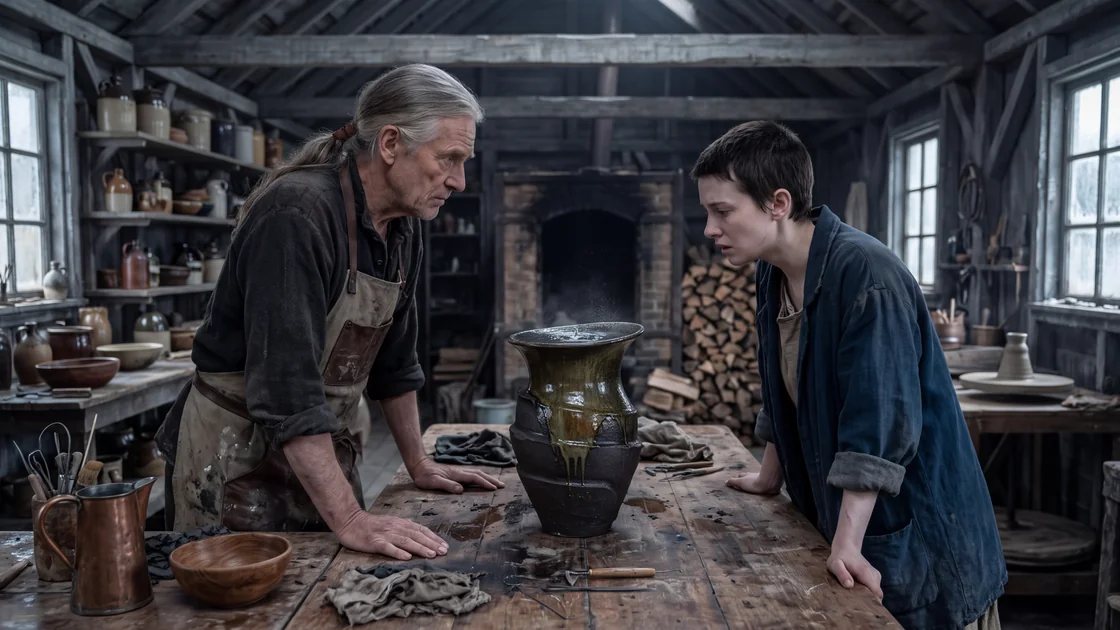
This is the story of Julian Morrow, a reclusive ceramicist living at the edge of the coastal marshes of Oakhaven, whose hand-thrown clay vessels possess a quiet, miraculous property: when filled to the brim with clean, unclouded water, their fired hollows resonate with the lost, pristine acoustic memory that their owner holds dearest yet can no longer recall. For decades, Julian lives in self-imposed exile, brokering these delicate restorations for the broken, the grieving, and the curious, while strictly forbidding himself from ever filling the solitary, dust-covered jar he threw for his own hands in his youth. Yet when Clara Vane—a woman whose past has been scrubbed entirely blank by tragedy—arrives at his workshop with a silence so profound it threatens to crack the greenware on his wheel, Julian is compelled to throw a vessel that defies his craft's oldest boundaries, ultimately forcing both artisan and patron to confront the terrifying mercy of what we leave behind to survive.
I. The Weight of Silt
The Skiffle River did not run so much as it bled into the sea. At low tide, the low-lying estuary outside Julian Morrow’s workshop resembled an uncoiled beast of bruised slate and ochre mud, its banks laced with ancient sedge and the rotting skeletons of cedar traps. Most men looked upon that silt and saw only the menace of stuck boots or the slow, indifferent death of salt meadows. Julian looked upon it and saw pitch, interval, and lung.
He dug his own clay. Twice a year, when the neap tides withdrew and left the deep river bends exposed like bare ribs, Julian walked out in hip waders, carrying an ash-wood spade and two split-oak baskets. The silt at the four-foot stratum had spent three centuries under cold water, crushed beneath the weight of alluvial gravel and decaying eelgrass. It was extraordinarily dense, dense enough that when he drove the blade home, it made the wet, sucking sound of an opened chest.
Back in the workhouse—a sprawling, timber-framed salt barn whose rafters were grayed by sea fog and soot—Julian refined the mud with a patience bordering on the liturgical. He slaked the clay in cedar vats, stirred it with birch paddles until it reached the consistency of heavy cream, and passed it through horsehair sieves to catch the errant grains of quartz and river mussel. Then came the wedging.
Wedging was where the world entered the earth. Standing before his slab of oiled maple, Julian pressed the gray mass forward with the heels of his palms, rolling it, cutting it with a wire of wound brass, slapping the halves together to drive out the stubborn pockets of air. Air in the clay was ruin; in the kiln, a trapped pocket of breath expanded until the pot exploded in shards. But more than that, air was dead noise. A vessel could not hold a true note if its flesh was pocked with emptiness.
Julian was sixty-one years old, though his back was straight and his forearm muscles had the stringy hardness of cured ham. His hair, long and tied with a strip of tanned calfskin, had faded from the color of wet river clay to the color of dry pipe-slip. He lived alone with two gray cats that slept on the cooling tops of the kilns and an old brass clock whose escapement was so worn it ticked only when the humidity rose before an ocean gale.
He did not advertise his trade. There was no swinging shingle over his gate, no printed catalogue sent by courier to the parlor tables of High Harbor. Yet they found him. They came in spring carts, in hired broughams, or on foot with salt-crusted hems, having heard the rumor whispered through the tea rooms and the taprooms: If you go to the estuary, to the man who digs the blue clay, he will make you a jar. And if you pour clear well-water into that jar, your youth will speak back to you.
Most people did not understand what they were asking for. They believed memory was a picture book—a series of sunlit tableaus of garden parties, departed dogs, and dead mothers smiling over loaves of rye bread. They did not understand that memory was fundamentally physical, an acoustic agitation of the air that had never truly ceased, but had only drifted into the porous silence of the world, waiting for an ear shaped correctly enough to gather its scatter.
Julian knew. Every vessel he threw was an ear.
II. The Principles of Acoustic Vitrification
The art had not begun with a miracle; it had begun with an accident of grief thirty years before.
In those days, Julian’s workshop had been filled with the ordinary crockery of survival: wide-lipped milk crocks, porous butter coolers, salt-glazed pickling crocks, and grease lamps. His wife, Maura, had died during the dry winter of the yellow fever, when the estuary froze so hard the gulls starved on the ice. She had died in the small bedroom above the throwing room, while Julian sat below at his kick-wheel, working through the night because the sound of the treadle’s rhythmic slap was the only thing capable of drowning out the sound of her shallow, rattling breath.
Two days after they lowered her pine box into the sandy graveyard at the head of the bay, Julian went to the workshop to throw away the vessels he had formed during her dying. They were misshapen, thick-walled, thrown with fingers that had been trembling with terror and exhaustion. Among them was a bulbous, short-necked jug of iron-rich red marl, unglazed and fired hastily in the back of the small test kiln.
He had taken the jug to the rain butt outside the eaves to wash the ash from its neck. He tilted the pail, pouring clear rainwater into the dry, porous belly of the pot.
As the water reached the jug’s shoulder, Julian stopped.
He did not hear the rush of the liquid. He heard a low, hoarse voice—sharp with the dry heat of fever, yet laced with an infinite, heartbreaking tenderness—saying: Julian, the latch is rattling. Mind the latch, or the wind will take the lamp.
Julian dropped the pail. The sound did not vanish; it echoed, trapped in the wet throat of the jar, repeating the phrase with the exact grain, the exact catch of her dry tongue against her palate, until the water settled. When the water was perfectly still, the voice hung suspended in the vessel’s mouth like an exhalation. When he tipped the jar and let the water splash into the weeds, the voice died instantly, crushed back into the clay’s dark silence.
It had taken Julian ten years of ruinous experimentation to understand what had occurred.
Clay, he discovered, was not inert mud; it was a crystalline suspension of aluminum silicate plates, millions of microscopic leaves resting upon one another like the scales of an adder. When clay was worked upon the wheel, these plates were sheared, oriented by the pressure of the potter’s palms and the rhythmic pulse of the maker’s heart. But more than the maker, the clay took the imprint of the room’s dominant acoustic gravity.
Yet ordinary throwing recorded nothing but the ambient clatter of hammers or the squawking of roosters—useless noise that burned out in the heat of the fire. To capture a memory—a forgotten memory—the potter had to construct a sympathetic field. The subject had to sit across the wheel from him, breathing the same air, their skin shedding heat into the damp atmosphere of the room, while Julian cleared his own mind until it was as cold and flat as a slate hearth.
In that state, Julian did not invent the pot; the pot was pulled out of the invisible tension between what the visitor had loved and what the visitor had buried. The iron particles within the Skiffle clay acted as magnetic compasses, aligning not to north, but to the particular frequency of the patron’s most significant acoustic loss: the sound that had once defined their world before the world hardened into duty, age, and regret.
Then came the firing. It required an anagama kiln—a long, sloping cave of firebrick that climbed the hillside behind the workshop like the burrow of a dragon. For sixty hours, Julian fed the belly of the kiln with split cordwood: first resinous jack pine to bring up the heat, then mountain birch to produce a sweet, clean ash, and finally red oak to sustain the roaring cone-ten temperatures of two thousand three hundred degrees Fahrenheit.
In that white-hot fury, the clay melted into itself. The quartz melted into glass; the iron bloomed like rust blossoms under the skin of the slip; the microscopic plates of silicate fused into a resonant stone bell. The fire did not erase the acoustic imprint; it vitrified it, locking the sonic geometry into stone for a thousand years.
The water was merely the key. Dry clay was mute, deadened by its own dryness. But clean, unpolluted water—water drawn from deep wells or gathered from the heart of a thunderhead—had a refractive index that allowed acoustic vibrations to leap from the silicate walls back into the air. Water gave the stone a tongue.
III. The Procession of the Deaf
They sat upon the low three-legged stool of peeled alder across from Julian’s wheel. They came with their hands folded in their laps, smelling of camphor, horse-grease, peppermint, or fear.
There had been Master Orson, the chronometer maker from the capital, whose left eye was permanently wider than his right from forty years of squinting through a jeweler’s loupe. Orson was a man of cold precision, who claimed he had no sentimentality for his youth. "I want to hear the bell of the cathedral at Saint Jude’s," he had told Julian, his voice clipped. "I was an apprentice there in the year of the frost. The great bell was melted down during the rebellion. It was the purest C-sharp in Christendom. I must verify my calculation of its thickness."
Julian had said nothing. He had centered a ten-pound lump of river clay, wetted his palms with warm slip, and dropped his thumbs into the spinning center. Orson had sat there for three hours while the wheel hummed. Julian had watched the old watchmaker’s temple—not his mouth, but the blue, thready vein that pulsed beside his eye. The clay had risen under Julian’s palms like a grey, living neck, widening at the base, narrowing to an austere, narrow mouth that seemed suited for an ecclesiastical bell.
Three weeks later, when the vessel had cooled and was pulled from the kiln’s smoky gut, Orson had returned. He brought with him a bottle of spring water from a mountain limestone cave, corked and sealed with wax.
They stood together at the long bench. Julian tipped the bottle. The water sloshed, clear and bright, filling the belly of the jar.
The watchmaker leaned his ear to the opening, his loupe dangling against his tweed vest.
No cathedral bell rang from the jar. There was no bronze strike, no holy C-sharp rolling over frozen roofs.
Instead, from the dark, wet mouth of the clay, there came the dry, frantic scurrying of mice in dry oats, followed by the thin, breathless giggle of a young girl—a sister Orson had not mentioned, perhaps a sister who had died of the croup before he ever learned to file a brass escapement—whispering: Orson, catch him, he’s got the crust! Don't let him into the cellar, you ninny, he’s got the crust!
The old watchmaker had stood frozen for a full minute, his hands gripping the edge of the workbench so hard his knuckles looked like peeled turnips. Then, without a word, he had taken the jug by its ear, clutched it against his ribs like a stolen loaf, left three gold sovereigns on the sawdust, and walked out into the rain without his hat.
There had been Lady Marigold, who had believed she would hear the voice of the prince who had danced with her at the Midsummer Masque forty years ago, but heard instead the rhythmic, thudding crunch of her grandfather’s wooden leg walking back and forth across a veranda in Barbados while a thunderstorm rolled through the sugarcane. She had wept until her rouge ran in pink gutters down her powdered throat, whispering: I thought he was angry with me. All those years, I thought he paced because he was angry with me. He was only watching for the ships.
And there had been the boy, Nicholas, sent by a farmer who thought the lad was simple because he would not speak after falling into the sheep dip at age seven. Julian had thrown a small, wide-lipped bowl for him. When filled, the bowl did not produce human speech at all, but the deep, subterranean rumble of a draft horse’s chest as the animal rested its muzzle against the boy’s collarbone in a dark stable, breathing out warm hay and molasses. The boy had smiled—his first smile in nine years—and dipped his fingers into the singing water, wetting his eyelids with the sound.
Julian took their money—only enough to buy firewood, salt, and flour—and watched them go. He never kept their vessels. A vessel filled with someone else’s past was a parasite; it drew the room’s air toward itself, filling the quiet workhouse with ghost-murmurs that made his cats twitch their ears in their sleep.
On the highest shelf of his barn, wrapped in an oiled canvas cloth that had grown stiff with salt spray, sat the only vessel Julian had ever thrown for himself. It was a slender, high-shouldered amphora of grey stoneware, its surface pitted with the marks of his own thumbs from the night Maura died.
In thirty years, he had never poured a single drop of water into it.
He knew what was in it. Or rather, he feared that what was in it was not Maura’s voice at all, but the terrible, empty sound of his own breath counting the seconds until she was gone. He preferred the silence of the dry clay. Dry clay was honest; it made no promises of resurrection.
IV. The Arrival of Clara Vane
She arrived on a Tuesday in the middle of November, when the tide was low and the marsh grass was the color of rusted iron.
The wind had been blowing out of the northeast for three days, driving cold salt spume through the chinks in the timber walls. Julian was at the trough, washing his arms with vinegar to cut the alkalinity of the clay, when the small side door of the barn groaned on its hinges.
She did not look like the women who usually found their way to his estuary. She wore no traveling cloak of heavy wool, no mourning crape, no bonnet with silk ribbons. She wore an ill-fitting man’s coat of dark blue fustian, its sleeves rolled twice at the wrists, and heavy work boots tied with tarred twine. Her face was pale, thin-boned, and sharp, like the skull of a plover, and her eyes were a strange, washed-out grey that seemed not to reflect the light of the grease lamp.
She stood in the doorway with the sea wind whipping the hem of her coat, looking at the rows of drying pots on the slatted shelves.
"You're Morrow," she said. It was not an inquiry; it was an inventory.
Julian dried his hands on a strip of sacking. "I am. The kiln is hot today, miss. It's not a safe place for walking."
"I haven't come to walk," she said. She stepped inside and closed the door behind her, shutting out the wind. In the sudden quiet, her presence seemed to fill the barn with an odd, vacuum-like pressure. The cats did not rise to greet her; they retreated to the warm darkness beneath the flue of the drying stove. "I have two silver crowns and a gold half-guinea. It's all the coin in the world I have left. I was told that was enough for a gallon of earth."
"It depends on the earth," Julian said, studying her. Her skin had the yellowish tinge of someone who had recently recovered from a long confinement or a profound starvation. But it was her voice that caught him. It was completely level, entirely stripped of vibrato, flat as a lead sheet. "Who gave you my name?"
"A man who makes watches," she said. "Orson. He lives in the attic above the apothecary in Blackfriars now. He doesn't make watches anymore. He sits in his bed and listens to a red jug. He told me that if I wanted to know who I was before the fire, I had to bring my face to you."
Julian walked to the wheel and picked up his trimming wire. "Orson talks too much. And he doesn't understand the work. The clay doesn't tell you who you were. It tells you what you heard when you were happy. They are rarely the same thing."
"I have never been happy," Clara Vane said.
She spoke with such casual, absolute certainty that Julian stopped wiping the maple board. He looked at her closely. Her hair was tucked into an oilskin cap; beneath the brim, along the left line of her jaw, ran a white, puckered seam of old scar tissue that disappeared down the neck of her collar. A fire scar.
"Then the vessel will be mute," he said. "The clay needs an anchor. If there is no memory of joy—no resonance to catch—it remains only fired stone. You would be throwing your silver into the mud."
"I am already in the mud," she replied, taking a step toward the wheel. "Three years ago, I woke up in the charity ward of the Infirmary at High Harbor. The roof of the linen mill on Saint Ann’s Street had fallen in during the night. Sixty girls were in the dormitory. Two came out alive. The other one died of the smoke three days later."
She reached up and pulled off the oilskin cap. Her hair was short, cropped unevenly like a boy's, dark as wet slate.
"They told me my name was Clara Vane because there was a Clara Vane on the mill master’s roster who had not been accounted for among the corpses. But I don't know who Clara Vane was. I don't know her mother's face. I don't know the house she was born in. When I try to look behind the night the beams came down, there is only a grey wall like a wet sail. Nothing. No songs, no voices, no names. Just the sound of the loom going clack-whack, clack-whack until the roof fell."
She reached into her coat pocket and took out three coins, laying them on the edge of the maple slab. They were scratched, grease-filmed, and cold.
"Orson said you make jars that listen," she whispered. "Make me one. If it stays silent, you may keep the silver, and I will walk into your marsh until the tide comes over my mouth. I am tired of living inside an empty box."
Julian looked from the coins to her face. He had seen many forms of grief in that room: the theatrical despair of the rich, the sweet, wine-soaked melancholia of old poets, the stunned numbness of widows. But he had never seen an absence like this. She was not grieving a life; she was a ghost hunting for the body she had left behind.
"Sit down," he said quietly, pointing to the three-legged alder stool.
V. The Pulling of the Ghost
The wheel was of beech-wood, massive and low, mounted on an iron spindle that Julian had turned himself. Its flywheel was a circle of red granite three feet across, weighing two hundred pounds. Once set in motion with a kick of his bare right foot, it ran with a terrifying, smooth momentum that hummed through the floorboards like the engine of a steam packet.
Clara sat upon the stool. She did not take off her heavy fustian coat, though the workshop was warm from the firebrick of the chimney. Her boots rested flat on the shavings.
Julian went to the earthen cellar beneath the floor and brought up a ball of clay he had been saving for three years. It was not the common Skiffle marl; it was clay taken from the deepest bend of the marsh, where an ancient birch forest had been drowned by the sea a thousand years ago. It was nearly black, filled with microscopically fine particles of decayed sweet-wood and blue iron vivianite. It smelled of cold rain and prehistoric moss.
He dropped the lump—twelve pounds of wet, resistant flesh—onto the wheel-head with a dull, wet thwack.
"Take off your coat," he commanded.
"I'm cold."
"The clay doesn't care if you're cold. It needs the heat of your wrists. If you keep yourself wrapped in that wool, you might as well be in the churchyard."
Clara hesitated, then stripped the coat away. Beneath it, she wore only a stained linen smock. Her arms were pale, thin, but corded with the stringy muscle of the weaving sheds, her forearms crossed with faint, white lines where the flying shuttles had nicked her skin over the years. She sat with her hands open upon her knees.
Julian kicked the flywheel.
The stone groaned, then began its long, rhythmic purr. The sound filled the barn: whir-shhh, whir-shhh, whir-shhh.
Julian dipped his hands into a wooden bowl of warm slip. He seized the black clay between his palms, bearing down with his entire body weight. The lump resisted, wobbled, then, under the steady, merciless pressure of his wrists, was forced into the exact center of the spinning disk. It ceased to thrash; it became a smooth, dark dome that looked like a rounded stone rising from the river.
"Look at the spindle," Julian said. His voice had dropped an octave, entering the work-register—the low, gravelly cadence he used when he was no longer a man talking to a woman, but a mechanic adjusting an engine. "Do not look at my hands. Look at the brass nut at the top of the spindle. Keep your breath slow. In through your teeth, out through your ribs."
He drove his thumbs into the center of the spinning clay.
The clay parted with a wet, squelching sigh. Julian felt the resistance of the iron grains against his skin. Usually, when he opened a vessel for a patron, he felt a quickening in the earth—a subtle twitching against his fingers, like the pulse of a hooked perch. With Orson, the clay had felt brittle, dry, full of small, sharp tugs that made his fingernails ache. With Lady Marigold, it had felt heavy, warm, almost oily, resisting the height of the walls.
With Clara Vane, the clay felt like ice water.
It was dead. His thumbs pressed deep toward the bat, three-quarters of an inch from the iron, and there was nothing. No acoustic resistance, no sympathetic vibration, no micro-tremor. It was like sticking his fingers into axle grease.
He kicked the stone harder. The flywheel whistled.
Whir-shhh, whir-shhh.
He began to pull the wall. With his left hand inside the dark hollow and his right hand cupped against the outside, he squeezed the clay, drawing it upward. The vessel rose like a black chimney—four inches, eight inches, twelve inches. The walls were thin, incredibly thin for such dense earth, translucent almost in their wet state.
"Think of nothing," Julian murmured. "Let the room be empty. You are not Clara Vane. You are not the mill. You are not the fire. You are only a mouth that has not yet spoken."
Clara’s breath hitched. Julian didn't look up, but he saw her boots tighten against the floorboards.
The clay began to wobble.
It was a strange, erratic shudder that did not come from his hands. Julian kept his wrists locked against his knees, his forearms rigid as iron stays. The wobble was inside the cylinder. The clay was fighting the centrifugal force, trying to pull itself off-center, tearing at the base.
"Steady," he hissed. "Do not clamp your teeth."
"There is a bell," she whispered. Her voice was cracked, no longer flat. "A bell that hurts."
"No," Julian said. "The bell is the fire. Pass the bell. Go deeper than the bell."
"I can't."
"You have no choice. You gave me your three coins. I don't give refunds for cowards."
It was a cruel thing to say, but cruelty was sometimes the only chisel that could break a calcified spirit. Clara let out a sharp, ragged gasp—a sound that was half sob and half curse.
At that instant, something passed through the wheel.
Julian felt it in his elbows, then in his collarbone, then in his jaw: an acoustic shock like the twang of a snapped steel cable under deep water. The black clay under his fingers suddenly changed its nature. It softened, warmed, grew slick and porous, drinking the slip from his palms like a thirsty beast. The iron particles within the slurry oriented themselves with such violent alignment that Julian felt his own fingertips tingling as if he had plunged them into a basket of nettles.
He did not shape the vessel into a traditional form. He did not give it the proud, round belly of a wine jug or the tidy mouth of a water pitcher.
The hands did the work without him. The base grew wide, heavy, flat-bottomed like an anchor-stone. The body rose in a series of strange, asymmetrical terraces, ribbing out like the bark of a wind-stunted pine, narrowing not into a graceful neck, but into a wide, trumpet-shaped throat that tilted slightly toward the left—toward the side where her scar lay. It looked less like pottery and more like the calcified shell of some deep-sea mollusk that had grown under the immense, crushing silence of an abyss.
With a length of brass wire, he cut the vessel free from the wooden bat. The wheel slowed, groaned, and stopped.
The workshop was dead silent, save for the ticking of the brass clock and the dripping of water from Julian’s elbows onto his leather apron.
The vessel sat upon the wheel-head, black, wet, and glistening like fresh coal. It was hideous according to the standards of the High Harbor guild: it had no symmetry, no classical proportion, no decorative fluting. But it possessed a terrifying, concentrated presence. It looked as if it were inhaling the light from the oil lamp.
Clara sat staring at it, her chest heaving beneath her thin linen smock. Her hands were clenched into white fists upon her knees.
"What is it?" she whispered.
"I don't know," Julian said, his voice trembling slightly as he wiped the slurry from his arms. "It isn't a jug. It's a bone. We will see what meat grows on it when the fire is done."
VI. The White-Hot Cave
For three days, the vessel dried in the warmest corner of the barn, beside the flue.
Julian watched it as he worked on his common orders. As the water evaporated from the black clay, the pot changed color, shifting from slick ebony to a dry, pale slate-blue that looked like the skin of a drowned whale. The terraces he had thrown into the walls became sharper, looking like ridges of limestone carved by acid rain. It was light—surprisingly light for its size—indicating that the microscopic structure of the earth had opened up, creating millions of tiny, interconnected chambers.
On Friday morning, Julian loaded the anagama kiln.
The kiln was his master and his jailer. Built thirty years ago into the slope of the hill behind the workshop, it was an arched tunnel forty feet long, lined with silica brick that had long since vitrified into a greenish, glassy crust. Loading it was an architecture of faith: three hundred vessels—bowls, crocks, tiles, and at the very center, the heart of the setting, Clara Vane’s vessel—placed upon shelves of carborundum, each separated by small wads of refractory clay dusted with shell-sand to keep them from fusing together when the earth turned liquid.
He placed Clara’s vessel on the second tier, right where the flame was forced to dive through a narrow throat before reaching the chimney. It would take the full fury of the draft; it would be licked by wood-ash, lashed by flying embers, and bathed in the reduction smoke that stripped the oxygen from the iron.
He walled up the loading door with soft brick, sealing the cracks with a daub of sandy mud.
At noon, he struck a match and touched it to the kindling in the firebox.
For the first twelve hours, the firing was gentle—a "water-smoke" fire of dry cedar to drive the last chemical moisture from the greenware. A thin, sweet, white smoke rose from the low chimney on the hillside, smelling of resins and riverbank.
Then Julian began the stoke.
He worked in twelve-hour shifts, alone. He had no apprentice; he trusted no one to read the color of the flame. Wood firing was not a science of gauges and dials; it was an act of sensory divination. By midnight on Saturday, the kiln had reached a cherry red. By Sunday morning, it was an incandescent orange that made the bricks of the exterior wall too hot to touch. By Sunday night, the interior was white-hot—Cone 10, two thousand three hundred and fifty degrees.
Julian stood before the firebox wearing thick leather gauntlets and a mask of green glass to protect his retinas from the blistering radiance. With a rhythmic, mechanical cadence, he hauled open the iron stoke-door, hurled four-foot billets of split oak into the white roar, and slammed the door shut before the cold air could drop the temperature.
Every time the wood hit the embers, the kiln gave a deep, coughing shudder—a sound like the intake of breath from a furnace-lung.
Huuu-whuff.
The draft was so strong that it drew the salt air from the estuary through every seam in the brickwork. Julian could hear the pots inside. They did not sit in silence; at that temperature, as the clay approached the edge of collapse, where it was half-stone and half-liquid, the vessels sang. It was a high, thin, glass-like keening, hundreds of pots vibrating in the fiery gale like cicadas in an August meadow.
Julian leaned his forehead against his gloved forearm, peering through a mica spy-hole into the heart of the kiln.
Through the shimmering heat-haze, he saw Clara’s pot.
It was no longer grey. It was glowing with a fierce, blinding yellow-white light, its silhouette vibrating in the river of flame. The wood-ash, carried by the draft at forty miles an hour, was striking its terraced shoulders, melting into a natural glaze that ran down its flanks in glassy, green tears. It looked alive—a creature being hammered upon an anvil of wind and fire, its acoustic pores being welded into their final, immutable geometry.
"Hold," Julian whispered into the roar of the firebox. "Don't crack. Hold the note."
He stoked until Monday dawn. When the pyrometric cones had bent double, their tips touching the shelves like praying monks, he threw in a final dozen billets of resinous pitch-pine to choke the air, creating a dense, black reduction cloud that turned the iron to steel, and then he sealed the firebox with brick and wet sand.
The silence that fell upon the hillside was immense, sudden, and terrifying.
The kiln would take four days to cool. Four days of waiting while the stone settled back into its sleep.
VI. The Opening of the Tomb
Clara returned on Friday morning, before the mist had lifted from the salt marshes.
She sat on the stone wall by the woodpile, her hands tucked into the sleeves of her fustian coat, watching Julian with those washed-out, grey eyes as he dismantled the brick door of the kiln.
The bricks were still warm to the touch, smelling of wood-ash, sulfur, and baked granite. Julian worked with a mason’s hammer, tapping each brick loose and stacking it on the grass. With every row he removed, a wave of dry, fragrant heat rolled out of the dark opening, like the breath of an oven that had been baking bread made of stone.
When the opening was wide enough, Julian lit a tallow candle and climbed into the narrow, soot-stained cave.
The pots stood in the dimness like soldiers after a siege. Some had cracked—a dozen common bowls on the lower shelf had spalled, their rims broken by some pocket of moisture in the clay. But most had survived, their surfaces painted with the wild, unpredictable calligraphy of the ash: flashes of rust-red, pools of olive-green celadon, and patches of dry, matte charcoal where the smoke had kissed them.
Julian reached into the second tier.
Clara’s vessel was cold enough to handle with bare hands, though it still retained a faint, blood-like warmth in its base. He lifted it.
It had shrunk by a seventh, as all clay does in the fire, becoming denser, more compact. The ash had done extraordinary things to its terraces. The front of the vessel—the side that had faced the blast—was covered in a thick, lustrous glaze the color of sea-water over dark rocks, crackled with thousands of tiny, hair-like fissures that looked like frozen lightning. The back was dry, rough, and black as basalt, retaining the tooth of the river silt.
When he tapped the rim with his knuckle, it did not ring with the bright, bell-like ping of common stoneware.
It produced a low, hollow thrum—a sound that traveled down Julian’s arm and settled directly in the pit of his stomach, like the distant vibration of a church organ played three streets away.
He climbed out of the kiln and carried the pot into the workshop. Clara followed him without a word, her boots clicking softly on the flagstones.
He set the vessel on the maple slab. In the daylight that filtered through the dusty salt-windows, the pot looked ancient, as though it had been pulled from the ballast-pile of a Phoenician galley drowned three thousand years ago.
"Is it done?" Clara asked.
"It is fired," Julian said. "Whether it is done depends on the water."
VIII. The Common Well
Julian kept a cedar tub of well-water in the center of the workshop, drawn that morning from the three-hundred-foot bore behind his house. The water was cold, limestone-filtered, pure enough that it left no film upon a clean blade.
He took a copper pitcher from the shelf, dipped it into the tub, and lifted it. The water caught the morning light, sparkling like melted glass.
"This is the moment," Julian said, his hand resting on the handle of the pitcher. "If we do this, Clara, you cannot undo it. Some people hear things they would give their legs to forget again. Orson lives in an attic because he cannot bear the sound of the street anymore; the street does not sound like his sister. The clay does not lie, but it does not comfort, either."
"Pour," she said.
Her voice didn't waver. She stood with her arms hanging straight at her sides, her face turned toward the dark mouth of the vessel.
Julian tilted the pitcher.
The water fell in a smooth, clear arc, striking the bottom of the pot with a hollow, wet splash. Plink. Plash.
Julian poured slowly, keeping the stream centered so it would not disturb the walls. The water rose up the terraces—two inches, four inches, six inches—darkening the dry interior slip to the color of wet licorice.
Julian stopped when the water reached the narrow, trumpet-shaped throat.
He stepped back and held his breath.
The water settled. The ripples bounced against the glassy terraces, crisscrossing in diamond patterns until the surface became a dark, liquid mirror reflecting the gray rafters of the barn and Clara’s pale plover-face leaning over the lip.
Julian waited for the sound.
Usually, the resonance began within five seconds of the water stilling. It began as a whisper, a rustle, a tiny prick of acoustic needle-work in the throat of the clay: the bark of a spaniel, the hum of an iron kettle, the scrape of a bow across horsehair.
Ten seconds passed.
Twenty seconds.
A minute.
The vessel was dead silent.
There was no voice. There was no loom. There was no wind. The only sound in the barn was the slow, rhythmic tick... tock... of the old brass clock on the wall and the muffled cry of a gull circling the low tide out on the flats.
Clara leaned closer, her nose an inch from the surface of the water. Her eyes were wide, straining, her pupils dilated until they swallowed the grey of her irises.
"There is nothing," she said.
The flatness was returning to her voice—that terrible, dead-lead weight Julian had heard on Tuesday.
"Wait," Julian said. "The water may be too cold. The clay needs time to drink."
They waited another five minutes. Julian leaned down, pressing his ear against the rough, basalt flank of the pot.
He did not hear a memory. He heard only what an empty shell hears: the faint, rushing static of his own blood pumping through his inner ear, mixed with the distant, indifferent hiss of the estuary grass outside.
Clara let out a short, dry breath that sounded like dry paper tearing.
"I told you," she whispered. She did not cry. Her face was set in a terrible, triumphant rigor—the terrible triumph of someone whose worst suspicion about their own worthlessness has been proven correct. "I told you there was nothing there. I am an empty skin. The girl in the mill wasn't anyone at all. She was just a pair of hands that knew how to change a bobbin."
She turned toward the door, reaching for her heavy fustian coat.
"Clara," Julian said.
"Keep the coins," she said, her back to him. Her hand was on the iron latch. "You worked the kiln. You burned your wood. It isn't your fault the mud found nothing to mimic."
"Clara, look at the water."
Julian’s voice was sharp enough that she paused, her hand frozen on the latch.
She turned slowly.
The water in the vessel was no longer still.
It was not rippling from the wind; there was no draft in the shop. But across the smooth, black surface of the water, tiny, circular patterns were forming—microscopic concentric rings that appeared, dissolved, and reappeared with the frantic speed of a water-strider’s legs.
The water was vibrating. But it was vibrating at a frequency so high, or so low, that the human ear could not catch the sound. It was like watching a bell strike without hearing the chime.
Then, from the bottom of the pot, there came a sound.
It was not a voice. It was not music.
It was a scratch.
Scritch... scritch... tick... scritch.
It was dry, rhythmic, and infinitely small, like an insect trying to burrow through an oak door. It would sound for three beats, pause for a second, and then repeat: Scritch... scritch... tick.
Clara walked back to the bench slowly, as if she were walking through four feet of river mud. She looked down into the dark circle of water.
"What is that?" she asked, her voice trembling for the first time. "Is it an insect in the clay?"
"There are no insects in two thousand degrees of fire," Julian said. He, too, was leaning over the vessel, his brow furrowed. He had thrown three hundred memory jars in his life; he had never heard a sound like this. It had no tone, no melody, no human warmth. It was merely a mechanical abrasion. "It is what the clay found. But it's choked. Something is stopping the throat."
Clara stared at the water. The tiny rings were still dancing, but the sound remained tiny, distant, like a voice screaming at the bottom of an abandoned mine shaft through fifty feet of wet gravel.
Scritch... scritch... tick.
"It's no good," she said, her voice dropping into her chest. "It's like looking through keyholes in the dark. It's worse than the silence."
She raised her hands to take the pot—to fling it, Julian realized with a start, against the stone flags of the hearth.
Julian caught her wrists.
Her skin was burning hot, despite the coldness of her cheeks. Her wrists were thin, the bones like the leg-irons of an eagle, but they possessed a frantic, wiry strength.
"Don't touch it," Julian barked. "The water is wrong."
"The water is clean!" she cried, struggling against his grip. "You took it from your own well! It's clear as gin!"
"Clear is not clean," Julian said, his eyes fixed on the vibrating rings. "The well water has traveled through fifty feet of limestone and iron-pan. It has the weight of the mountain in it. It's too heavy. It’s pinning the voice down."
He let go of her wrists and grabbed the copper pitcher.
"Where are you going?" she asked, rubbing her arms where his fingers had left red marks.
"To the marsh," Julian said, his coat already over his shoulders. "Get your boots. If you want to hear what's scratching at that door, you have to help me find water that has never touched the dirt."
IX. The Water from the Clouds
They walked three miles into the northern salt marsh, toward the spit of sand the fishermen called The Tongue.
The sky had turned from slate to the color of wet curd, heavy with a squall that had been gathering out past the lightship since dawn. The wind was cold, smelling of iodine, dead kelp, and the electric ozone of coming rain.
Julian carried an enameled milk-pail with a linen cloth tied over its rim; Clara walked beside him, her head down, her hands buried deep in the pockets of her fustian coat. They did not speak. The only sounds were the squelch of their boots in the black peat, the harsh kree-kree of the turnstones rising from the pools, and the distant, dull thudding of the sea against the gravel bar.
"My mother had a ring," Clara said suddenly, after they had crossed the second salt-ditch.
Julian didn't look at her. "What kind of ring?"
"Brass. With a blue glass bead instead of a stone. She used to let me turn it on her finger when she was nursing my brother. That's what I thought the sound would be. I thought it would be her singing to him. Or the sea. I thought we lived by the sea."
"You don't remember if you lived by the sea?"
"I don't remember anything before the weaving shed," she said bitterly. "Sometimes I think I was born out of an ash-pit behind the mill, twelve years old, with grease in my hair and lint in my lungs. When the girls talked about their christenings, or the orchards their fathers had, I just nodded. I stole stories from the girls who died of the lint-cough. If one died who had an uncle with a white pony, I took the uncle with the white pony and put him behind my grey sail. But they weren't mine. When I tried to look at them in my sleep, the pony was made of wood and the uncle had no eyes."
"A stolen memory has no weight," Julian said. "The clay knows the difference. You cannot trick the earth with things you have only imagined."
"Then what is scratching in that jar?"
"We will know when the sky breaks."
They reached The Tongue—a narrow finger of white granite stones that jutted half a mile into the ocean, completely bare of vegetation save for crusts of orange lichen that grew on the lee-side of the boulders. Here, the air was entirely free of the marsh-rot and the chimney-soot of Oakhaven. It was pure salt and high air.
Julian set the enameled pail upon the highest boulder, wedging it with three heavy stones so the gale would not overturn it.
"Now we wait," he said.
They sat in the hollow of a cleft rock, huddled against the wind. The clouds were lowering, trailing dark, ragged curtains of rain across the grey face of the sea. Julian took a heel of hard rye bread from his pocket, broke it in two with a dry snap, and handed half to her.
She took it, looked at it, and began to chew with slow, mechanical obedience.
"Why don't you have a jar?" she asked, her mouth full of dry bread.
Julian watched a cormorant skimming three inches above the grey troughs of the swell. "I have one."
"Orson said you didn't. He said you were like the man who makes shoes for the whole village while his own children go barefoot with frozen heels."
"Orson is an old woman who thinks because he knows how to balance a watch spring, he understands the mechanics of the soul," Julian said gruffly. "I have a jar. It sits on the top shelf of the salt-barn."
"Why don't you fill it?"
"Because I know what is inside it."
"Then you are luckier than I am."
"No," Julian said, turning his head to look at her. The wind had whipped two red spots into her pale cheeks, making her eyes look less washed-out, more human. "Ignorance is a grey wall, Clara. But knowing what you have lost—knowing the exact pitch of the voice that will never speak to you across a breakfast table again—that is not a wall. That is an iron cage you carry inside your ribs for the rest of your life. Every time you hear it, the bars grow thicker. I have lived thirty years without hearing her latch rattle. I prefer the silence."
"You're a coward," she said.
The word was spoken without malice, simply as an observation of fact, like her statement about the mud.
Julian felt a sharp, cold prickle in his throat. No one in Oakhaven had spoken to him in that tone for three decades. They treated him with a superstitious, tiptoeing reverence, as though he were an executioner or a priest—someone who dealt with things too uncomfortable to look in the face.
Before he could answer, the first drop struck his cheek.
It was not a gentle mist. The squall hit the granite spit with the sudden, violent slap of a wet sail. The sky opened, dumping cold, hard, unpolluted water that smelled of nothing at all—water that had been drawn from the mid-Atlantic by high winds and carried three miles above the earth before falling back to stone.
Julian rose and stood over the pail, watching the rain hit the linen cloth. The cloth strained out the salt-spume that blew from the breakers, letting only the pure, vertical cloud-water pass into the white enamel.
Within twenty minutes, the pail was half-full.
Julian lifted it, took a clean glass demijohn from his wicker basket, and poured the rain through a horn funnel. He hammered home the cork, wrapped the bottle in his woolen scarf, and nodded to her.
"Come," he said. "Before the marsh paths drown."
X. The Resonance of the Scratch
They returned to the salt-barn soaked to the skin, their hair plastered to their skulls, their boots heavy with blue mud.
The workshop was warm and smelled of dry cedar shavings. The asymmetrical vessel still sat upon the maple slab, the limestone well-water within it resting flat and dead, the tiny rings having ceased their dancing.
Julian did not hesitate. He picked up the heavy clay pot, carried it to the door, and tipped it.
The well-water splashed across the threshold, soaking into the gravel. The vessel made a dry, sucking gasp as the water left its belly—a hollow shwump that sounded like someone drawing in a sudden breath of cold air.
He brought it back to the bench.
With a clean linen towel, he dried the interior walls as far down as his hand could reach, wiping away the mineral film the well-water had left behind.
Then he uncorked the demijohn of rainwater.
"Listen," Julian whispered.
He poured.
The rainwater fell into the pot. It did not sound like the well-water. It was lighter, clearer, producing a musical ting-ting-ting against the vitreous celadon terraces as the level rose.
When the water reached the shoulder—the same point as before—Julian set the demijohn down on the shavings.
Clara did not wait. She stepped forward, her wet hands gripping the edge of the workbench, and thrust her face over the mouth of the vessel.
For three heartbeats, there was only the sound of their own dripping clothes hitting the floorboards.
Then the pot spoke.
It did not begin with a scratch. It began with a boom—a low, cavernous, wooden thud that made the copper pitcher on the shelf jump and clatter against the wall.
THUMP.
Clara flinched, her eyes widening.
THUMP... creak... THUMP.
It was the sound of heavy wood moving against wood, accompanied by the immense, sucking groan of a great weight rising and falling in water. Julian knew that sound; it was not a loom. It was the groan of a dock—a floating slipway of heavy hemlock logs, grinding against its iron pilings under the surge of a heavy swell.
Then came the voice.
It was not one voice. It was three.
A man’s voice, rough, cracked with salt, shouting through the roar of wind: Stand by the painter! Clara, let go the cleat, you'll foul the hawser! Let it run, girl!
And then a child’s voice—high, wild, completely fearless, laughing with an ecstasy so pure it made the hair on Julian’s forearms stand up: I have it, Da! I have the rope! Look at the foam! Look at the white horses!
And beneath the laughter, cutting through the crash of the surf and the screaming of the gulls, came the sound that had made the scratch in the dry well-water:
It was the frantic, rhythmic, scraping sound of an iron boat-hook being dragged across wet granite pebbles, followed by the sharp clack-clack-clack of a cod-line’s lead sinker dancing against the floorboards of an open skiff.
Scritch... scritch... tick.
It was not an insect. It was the lead sinker. A child sitting in the bottom of a dory, tapping the lead weight against the ribs of the boat while her father fought the sea to bring them into the slipway before the gale broke.
Clara stood over the jar, her mouth open, her chest frozen.
The water was no longer clear. It was rippling violently, throwing little drops of spray against the glazed terraces, the acoustic waves so intense they were atomizing the surface of the rain into a fine mist that smelled of brine, wet hemlock, and fried salt-pork.
Clara, hold the lantern high! the man’s voice roared from the stone hollow. Hold it high so your mother can see the slip! That's my brave girl. That's my girl.
And then the high, child-voice began to sing. It was not a church hymn. It was a crude, nonsensical slip-song, shouted rather than sung, against the teeth of the gale:
The mackerel has a yellow eye,
The flounder has a flat one,
We’ll put the herring in the pot,
And give the dog the fat one!
The child laughed again—a great, ringing, whole-bellied roar of pure, triumphant childhood delight, while the water in the jar rose in a final, frantic fountain of tiny bubbles.
And then, with a soft sigh, the sound died.
The ripples on the surface slowed, smoothed, and disappeared. The water became flat again, reflecting only Clara’s face.
The silence that returned to the salt-barn was not the dead silence of the mud. It was the silence that follows the end of a church service, when the bells have ceased but the timber of the belfry is still humming with the bronze.
XI. The Salt-Daughter
Clara did not move. She stood with her fingers curled over the edge of the maple slab, her knuckles white, her head hanging so low her wet hair touched the surface of the water.
A single tear—not the theatrical weeping of Lady Marigold, but a heavy, slow drop that had been thirty years in the gathering—fell from the tip of her nose.
It hit the center of the water with a tiny, sharp ping.
The vessel did not speak again. It did not need to.
"My father," she whispered. Her voice was no longer flat. It was cracked, ragged, broken open like a split walnut, but it was full of blood. "My father was Caleb Vane. He was the keeper of the beacon at the spit. We lived in the cottage with the three hemlock trees."
She raised her head. Her face was transformed; the plover-skull look had vanished, replaced by an expression of stunning, terrifying clarity.
"I wasn't in the linen mill," she said, her voice rising. "I was never in the weaving shed. I was sixteen when the fever came. They took my father first, then my little brother. I was the one who kept the light burning for three nights while they lay in the kitchen. When the relief boat came, I was out of my head. I ran into the woods. I walked thirty miles down the pike in the snow. When they found me in High Harbor, I was half-frozen on the church steps, and when they asked me who I was, I told them I didn't know because I couldn't bear to look at the three hemlock trees without the light."
She reached down, took the vessel by its rough, terraced neck, and lifted it from the bench.
She held it against her breast, exactly as Master Orson had held his red jug, uncaring that the wet, ash-glazed exterior was soaking the front of her fustian coat.
"The mill was the only place that would take a girl who had no name," she said, looking at Julian. "I let them call me Clara because that was the name on the ledger. But I wasn't the mill girl. I was the girl with the lead sinker. I had the herring in the pot."
She began to laugh—a small, breathless laugh that sounded so much like the child in the water that Julian felt an ache in his jaw.
"You knew," she said. "When you threw it. You made the bottom like an anchor-stone."
"I knew nothing," Julian said, his hands resting on his apron. "The clay knew. The Skiffle mud remembers the sea. It only needed someone who had loved the sea enough to give it a tongue."
Clara looked at the vessel. She did not tip the water out. She held it level, balancing the heavy stone bell with the ease of someone whose forearms had been shaped by hauling hemlock painters and holding lanterns against the gale.
"What do I owe you?" she asked.
"You gave me your silver crowns," Julian said. "And the half-guinea."
"It isn't enough," she said. "This is my life. You pulled my life out of a ditch."
"It is all the earth asks for," Julian said. "Take your jar, Clara Vane. Go back to your beacon, or go where you will. But take it with you."
She looked at him for a long moment. Then, her eyes shifted to the high shelf above the kiln flue, where the solitary, canvas-wrapped amphora sat gathering the grey salt-dust of thirty years.
"Fill yours," she said.
Julian’s face tightened. "That is none of your concern."
"You called me a coward," she said, stepping toward the door with her vessel cradled in her arm. "You said I was running from the grey wall. But you're worse, Morrow. You're sitting in this barn like a spider in a woodpile, listening to everyone else’s dead sing to them, while your own are rotting behind a piece of oiled canvas."
She kicked the latch open with her boot.
The wind swept into the barn, clean and cold from the sea, scattering the birch shavings across the flags.
"Fill it," she said again. "Or smash it. But don't let it sit there like a tooth in a skull."
She walked out into the rain, her boots sure upon the gravel path, heading south toward the spit where the three hemlock trees had once stood.
XII. The Sound of the Latch
Julian stood in the center of the workshop for a long time after the latch fell shut.
The rain beat against the salt-encrusted windows with a steady, drum-like cadence: tat-tat-tat-tat. The old brass clock ticked on the wall. The cats came out from beneath the flue, sniffing at the spots of rainwater that had splashed upon the floorboards, their tails twitching in the cold draft.
Julian walked to the high shelf.
He had not climbed the ladder in seven years. His knees were stiff, the cartilage grinding like sand under his kneecaps as he stepped up the rungs.
He reached into the dark space between the joists and took down the vessel.
It was heavy—heavier than Clara’s, thrown from the coarse, red marl he had dug with Maura during their first summer in the valley. The canvas was stiff with dust, cracking like dried leather as he pulled it away.
The amphora was plain. It had none of the violent, terraced asymmetry of Clara’s jar. It was classical, simple, its surface unglazed save for a thin, yellowish smear of salt-slip that had caught the smoke thirty years before. The marks of his young thumbs were still visible at the base of the handles—deep, desperate depressions where he had held the wet clay while Maura coughed in the room above.
He brought it down to the maple slab.
He picked up the demijohn of cloud-water. There was still a quart left in the bottom—clear, unburdened, gathered from the high wind over the spit.
His hands were shaking. Not with the palsy of age, but with the cold, sick terror of a boy about to jump from a high trestle into black water.
"A coward," he whispered to the empty barn.
He uncorked the demijohn.
He tilted the mouth.
The water fell into the red amphora.
Gloop... gloop... splash.
It made a dry, dusty sound as the thirsty clay drank the first few ounces. Julian poured steadily until the water reached the narrow, slender neck.
He set the demijohn down.
He did not breathe. He closed his eyes.
He waited for the cough.
He waited for the dry, rattling agony of the winter that had frozen the gulls upon the ice. He waited for the voice that had haunted his dreams for thirty years—the voice that had said: Mind the latch, Julian, or the wind will take the lamp.
A minute passed.
The barn was silent.
Then, from the throat of the red jar, came a sound.
It was not a cough.
It was the sound of a summer morning.
He heard the dry, buzzing hum of a horsefly circling an oilcloth table. He heard the rhythmic, wet scrape of an ash-wood paddle turning butter in a cedar tub.
And then he heard Maura laugh.
It was not the weak, thin laugh of the sickroom. It was the loud, vulgar, beautiful bray of a twenty-year-old girl with flour on her nose and her sleeves rolled above her elbows, shouting out the kitchen window at someone in the yard:
Julian! Julian, you great fool, come look at the calf! He’s got his head stuck in the lard-tub again! Bring the pry-bar before he knocks the churn over!
And beneath her voice, coming through the open window of the sound, Julian heard himself.
He heard his own young voice—a voice he had forgotten had ever existed, high, clear, ringing with an idiot, invincible happiness that had no knowledge of graveyards or yellow fever—answering from across the meadow:
Let him wear it, Maura! It suits him better than his horns!
Then came the sound of her apron flapping in the wind, the wooden screen door banging shut on its leather hinge—slap-thump—and her voice, humming three notes of a reel Julian had not heard in forty years, while her bare feet padded across the pine floorboards toward the buttery.
The water in the red jar stilled.
The horsefly buzzed once more, faint and small, like a speck of dust floating in a sunbeam, and then was gone.
XIII. The Remainder of the Dust
Julian Morrow did not close his workshop, but he never threw another memory jar.
When the merchants came from High Harbor with their purses of gold, or the old women with their embroidered handkerchiefs, he pointed them to the slatted shelves where his milk crocks, butter pots, and grease lamps sat in neat, honest rows.
"I make only things for the living now," he told them. "If you want to hear your past, go sit by the river and listen to the mud. It knows more than I do."
Some were angry; some wept; most went away believing the old man had lost his wits or his nerve.
Julian did not care.
He kept the red amphora on his workbench, between his trimming tools and his water-bowl. Every morning, before he kicked the flywheel into motion, he took a cup of clean rainwater from the butt under the eaves and poured it into the vessel’s mouth.
He did not listen for the calf, or the lard-tub, or his own young voice shouting across the meadow.
He listened only for the sound of the wooden screen door banging on its leather hinge.
Slap-thump.
It was a small sound, an ordinary sound, a sound that five hundred houses made in the valley every day between breakfast and noon. But it was enough. It was the sound that proved she had lived, that he had loved, and that the world, for all its terrible, grinding fury, had once held a morning so bright that even the fire could not burn it out of the stone.
When Julian Morrow died eight years later, during the hard winter of the great frost, the men who came from the village to clear his shop found two hundred and forty common pots, three cords of split birch, and two vessels sitting side by side on the long bench.
One was a strange, terraced thing the color of drowned seawater, which had been returned to the shop three years earlier after an old woman named Clara Vane had died quietly in the cottage by the reconstructed beacon.
The other was a plain red amphora, unglazed and pitted with thumb-marks.
Both were empty. Both were dry.
A young apprentice from the capital, who had been sent to value the dead potter’s tools, picked up the red jar and turned it over in his hands.
"Coarse work," the boy said, tapping the dry rim with his brass rule. "Lacks symmetry. The walls are too thick at the belly. It wouldn't hold wine without sweating."
He set it down on the sawdust, where it made a dull, hollow thump like a closed door, and walked out into the cold morning to see what the kiln-bricks would fetch at the wharf.