The Vintages of Ash and Iron
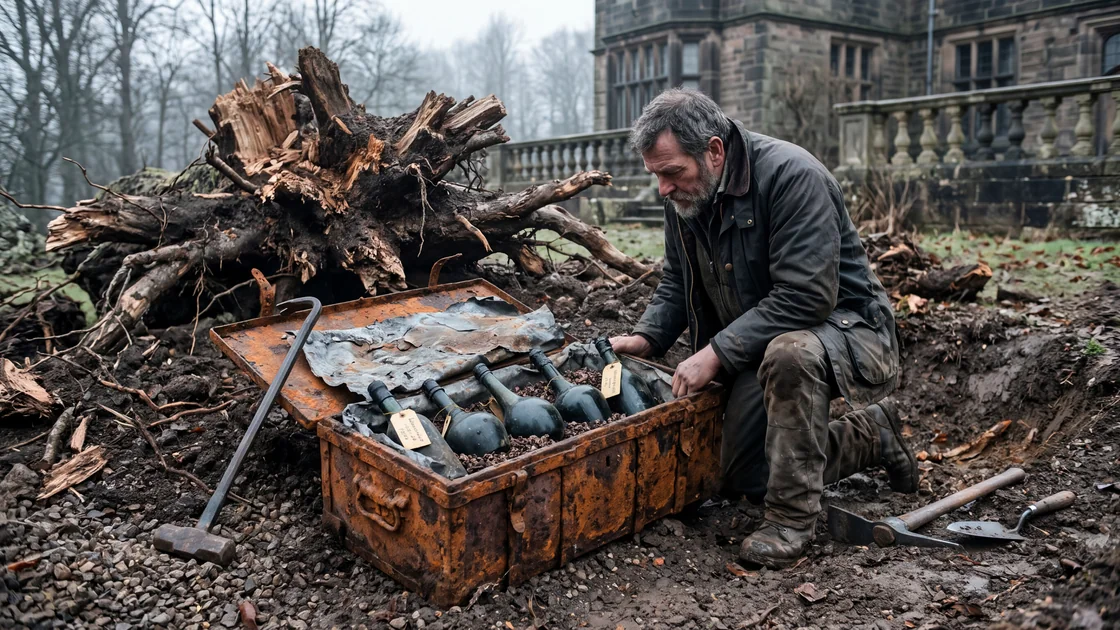
This is the account of Tobias Finch, head gardener of Blackwood Grange, who, while clearing the dead roots of a centuries-old mulberry tree, unearthed an iron chest containing seven pitch-sealed wine bottles. Each vessel bore an iron-gall ink label detailing with terrifying specificity the dates, coordinates, and human tolls of future disasters across the nineteenth, twentieth, and twenty-first centuries. As the predicted horrors began to pass with mathematical precision, Finch was pulled from the quiet rhythms of compost, seed, and pruning into a solitary war against inevitability, wrestling with the moral agony of foreknowledge, the failure of his attempts to warn a blind world, and the dreadful secret preserved within the final, unlabelled bottle resting at the bottom of the iron box.
I. The Mulberry and the Mattock
The soil of Blackwood Grange had a memory of its own, but it was generally a polite one. For thirty-two years, Tobias Finch had turned its dark, alluvial crumb, finding little more than the broken stems of clay pipes, corroded brass livery buttons, copper farthings worn smooth by the thumbs of dead carters, and the occasional fossilized oyster shell dropped by an eighteenth-century scullery boy. The earth in this corner of Northumbria was cold and patient; it smelled of damp slate, decaying sweet-chestnut leaves, and the sour tang of ironstone that seeped out of the escarpment above the orchard.
Tobias was fifty-eight, though his knees and the knuckles of his left hand belonged to an older man. He measured his life not by calendars or church bells, but by the slow rotation of chores: pruning the espaliers before the sap rose in February; trenching for the winter leeks when the frost-smoke hovered over the lower lawn; lifting dahlia tubers before the black frost could turn their stems to jelly. He was a widower of eleven years, childless, and untroubled by his own silence. The house itself—a sprawling Jacobean pile of dark millstone grit—had sat empty since the death of the last Blackwood in the bitter winter of 1974. A firm of solicitors in Newcastle paid his modest wage from a trust fund that seemed perpetually on the brink of exhaustion, sending him a quarterly draft and a short, typewritten letter asking if the boundary walls were still standing.
The walls stood. Tobias kept them standing.
The black mulberry had fallen on the third night of November, felled not by rot, but by the sheer, unreasonable violence of an Atlantic gale that had screamed over the Pennines and twisted the old tree until its heartwood snapped like dry bone. It was an ancient creature, recorded in the parish register as having been planted in 1688 to commemorate the landing of William of Orange. Tobias had felt a dull, hollow ache in his chest when he found it sprawled across the flagstones of the lower terrace, its massive limbs splintered, its black-green canopy crushed beneath its own weight.
Clearing it took three weeks. He worked with a two-man crosscut saw which he operated alone, dragging the steel blade through the dense, yellow-and-amber grain until his shoulders burned. By the second week of December, the trunk was corded into neat ricks beside the boiler shed, and all that remained was the bole: a gnarl of taproots as thick as the thigh of a draft horse, anchored deep in the terrace gravel.
On a Tuesday morning, with a pale sun hanging low over the birch woods like a salt-scalded eye, Tobias drove a steel mattock into the clay beneath the root crown.
The blade did not strike stone. Stone yielded with a sharp, percussive clack; gravel crunched with a sullen, gritty scrape. This sound was a flat, deep, hollow thunk, vibrating up the ash handle and setting his arthritic knuckles singing with a sharp ache.
He paused, leaning on the haft, his breath rising in white plumes against the gray terrace wall.
"Cast iron," he murmured to the robins that followed his digging.
He cleared the clay with an edging trowel. It took an hour of scraping to reveal the corners. It was not a water pipe or a drain culvert; it was a rectangular chest, three feet long by eighteen inches wide, bound with heavy straps of cold-hammered iron. The metal was pitted by two centuries of damp, coated in an orange skin of rust that flaked off in greasy scabs, but the seams were sealed with thick, black caulking—pitch, mixed with cow hair and sulfur by the smell of it.
Tobias knelt in the damp clay, his trousers soaking through at the knees. He fetched a heavy crowbar from the potting shed, along with a bottle of penetrating oil and an eight-pound sledge.
The lock was a massive box-hasp, seized into a single lump of red decay. Tobias did not possess the romantic curiosity of a boy looking for Spanish gold; he was a gardener, and a buried obstruction was merely an insult to clean earth. He poured the oil over the shackle, set the cold chisel against the hinge pins, and struck.
The third blow fractured the iron. It did not give with a groan; it shattered like frozen tallow, releasing a sudden, faint hiss of air that smelled profoundly of dry dust, myrrh, and the stale vinegar of turned spirits.
Beneath the lid lay a lining of lead sheet, beaten thin and folded over like the skin of a pasty. Tobias levered it back with his fingers. His skin dragged against the gray, powdery oxide of the metal. Inside, packed in dark, dried husks of buckwheat and dried lavender flowers that had long since lost their purple hue, were seven bottles.
They were not modern wine bottles. They were heavy, asymmetrical, hand-blown cylinders of thick, greenish-black glass—the kind collectors called "onion bottles" or early mallets, though these were longer in the neck, broader in the belly, and possessed of deep, jagged punts that could hide a man’s fist. Each neck was dipped several times in black sealing wax that had crazed into a network of fine lines, like dried river mud, but remained stubbornly intact.
Tied to the neck of each bottle by a loop of tarnished copper wire was a square of parchment, stiff and yellow as dried lard.
Tobias took the first bottle from its nest of chaff. It was surprisingly heavy, cold as river ice, and the liquid inside shifted with a sluggish, syrupy cadence that felt heavier than water. He carried it to the pale light of the terrace balustrade, wiping away the buckwheat meal with his thumb.
The ink was iron-gall, faded to a deep, bruised sepia, written in a hand that was furious, precise, and spidery:
Vintage I: The Breath of Lisbon
November 1, 1755. The third hour of the morning.
The earth shall open its maw below the Tagus; the sea shall retreat like a coward and return as a mountain.
Sixty thousand souls rendered to dust and foam.
A bitter vintage, smelling of candle-smoke, collapsed lime, and the salt of the deep shelf.
Tobias blinked. He turned the tag over. On the reverse was written:
Cellared by Silas Blackwood, May 1749. Drawn from the vine before the grape was born.
He frowned, his thumb rasping over the brittle parchment. He knew the name Silas Blackwood; he had seen it on the ledger books in the estate office, and on the brass plate beneath the stained glass of Saint Jude’s down in the village. Silas had been the third baronet, an eccentric who had traveled in the Levant and died in a lunatic asylum in York in 1762.
"A joke," Tobias said aloud to the empty garden. "A madman’s game."
He laid the bottle on the grass and lifted the second.
Vintage II: The Furnace of the East
August 27, 1883. The Island of Krakatoa.
The mountain shall tear its own belly out; the sound shall compass the earth four times.
Thirty-six thousand consumed in boiling ash and gray water. The sunsets of Europe shall weep blood for three years.
Poured thick with sulfur, pumice, and the silence of crushed forests.
Tobias took a slow breath. He was not an uneducated man; his father had been a schoolmaster before he had taken to the soil, and he had read his way through the Grange’s small library during thirty winters of long evenings. He knew of Krakatoa. He knew the sunsets of the eighteen-eighties had indeed turned lilac and bronze, as painted by the water-colorists whose works hung in the morning room. But Silas Blackwood had died in 1762. Krakatoa had exploded more than a century later.
His fingers were trembling now, not from the Northumbrian wind, but from a strange, low thrumming that seemed to vibrate out of the neck of the bottle itself. It was faint—scarcely more than the sensation of holding a telegraph wire in a gale—but it was there.
He reached into the chest and lined the remaining bottles upon the frost-bitten grass of the terrace.
The third bottle:
Vintage III: The Mud of the Somme
July 1, 1916. The sun upon the Picardy chalk.
Nineteen thousand two hundred and forty British dead before the shadows turn.
A heavy, thick liquor; notes of copper, wet khaki, chlorinated lime, and the grease of guns.
The fourth:
Vintage IV: The Iron Blossom
August 6, 1945. The city of the delta.
A sun dropped from the heavens to wither seventy thousand bodies in the striking of a flint.
Tastes of ozone, charred cedar, evaporated marrow, and black rain.
The fifth:
Vintage V: The Sinking of the Steppes
April 26, 1986. The northern swamps of Ukraine.
The invisible fire shall break its concrete kettle. The pine woods shall turn red before they die.
A dry, metallic spirit. The tongue is salted with lead, graphite, and bitter wormwood.
Tobias stood up. His knees made a dry, cracking sound. The world had gone very quiet. The wind had dropped, and from the birch woods came the single, melancholy whistle of a bullfinch. The four bottles lay on the turf like four black cannonballs, patient and terrible.
There were two bottles remaining in the chest.
Tobias took out the sixth. The glass was darker than the others, almost purple when the weak winter sun caught its rim.
Vintage VI: The Shaking of the East
March 11, 2011. The coast of Sendai.
The ocean floor shall twist like an adder; twenty thousand carried out to sea; the reactors shall boil without water.
An astringent draft; flavored with diesel, brine, crushed concrete, and the chill of March mud.
Tobias set it down. His hands were wet with perspiration despite the freezing cold.
2011.
Today was the fourteenth of October, 2018.
He had lived through 1986; he remembered the radio reports about sheep in Cumberland that could not be sold because the grass was poisoned with Welsh rain. He remembered 2011; he had watched the black wave lift houses and trawlers on the television set in the village pub while the old men stared in silent, paralyzed incomprehension.
Every single date on those five bottles was dead history. Every tragedy had unfolded precisely as the spidery iron-gall ink had decreed, written down by a man who had rotted to grease and bone two hundred and fifty years ago.
Slowly, his breath caught in his throat, Tobias reached into the chest for the seventh and final bottle.
It lay alone in the rotten buckwheat husks. Unlike the others, it was not an early mallet shape. It was longer, slimmer, shaped like an ancient Rhine flagon, of a glass so dense and lightless that it seemed to absorb the reflection of the sky rather than return it.
The parchment tag was not yellowed; it was stark, chalky white, as though it had been dipped in wax or milk.
Tobias turned it over.
Vintage VII: The Severing of the Thread
November 18, 2018. The hour of the setting sun.
The Great Fault beneath the Bay of Biscay shall sunder. The wall of water eighty cubits high shall cleanse the western coasts of England, Ireland, and Armorica.
Three million dead before the dawn.
The wine of the end: sea-salt, hemlock, the blood of drowned cattle, and the cold iron of an extinguished hearth.
Tobias Finch sat down heavily upon the roots of the fallen mulberry.
He looked at his watch. The second hand ticked with monstrous, indifferent regularity.
It was October 14.
There were thirty-five days left.
II. The Terrarium of the Damned
A man who has spent forty years tending plants does not easily run into the street screaming. The habits of horticulture are an inoculation against panic. When the blight takes the potatoes, one does not burn the house down; one cuts away the haulms, burns the infected foliage in a slow, smokeless fire, and considers what might be planted in the vacated soil that will not feed the spore.
Tobias brought the bottles into his potting shed.
The potting shed had once been an orangery, built onto the south wall of the kitchen gardens. It smelled comfortably of steamed bone meal, damp peat, dried mint, and sulfur candles. A long bench of scrubbed deal ran beneath the high, arched windows, covered in rows of terracotta pots of every size from two-inch "thimbles" to fifteen-inch "seakale pots." On the wall hung his tools: bright steel hoes, nickel-plated secateurs, and leather-sheathed knives with handles worn into smooth depressions that matched the pads of his fingers.
He laid the seven bottles on the potting bench upon a bed of dry sacking.
He sat on his wooden stool, picked up his horn-rimmed reading glasses, and examined the seals.
The wax was not normal sealing wax. When he touched the seal of Vintage I (Lisbon), his finger recoiled. The wax was cold—colder than the shed, colder than the glass, cold as the meat inside an icehouse. But when he touched the wax of Vintage VII (Biscay), it was lukewarm. It felt like the wrist of a sleeping child, pulsing with an almost imperceptible, rhythmic heave that sent a faint, nauseating vibration through the horn of his fingernail.
"Silas," Tobias muttered. "What did you do?"
He got up and went to the back of the estate office, a dusty room behind the scullery that had not been aired since the solicitors had taken over the trust. The keys hung on an iron ring behind the scullery door. The lock was stiff, but after two applications of oil, the latch gave with a dry clatter.
The room was filled with tin deed-boxes painted with the names of forgotten leases: The Low-Ghyll Tenancy, 1812; The Coal Rights of High-Leazes, 1844; The Blackwood Settlements.
He ignored the deed-boxes and went to the tall mahogany bookcase against the chimney breast. The books were bound in calfskin that had dry-rotted into brown powder that coated his fingers like cocoa. Here were the records of Silas Blackwood’s father, Sir Peregrine: treatises on livestock breeding, volumes of sermons, the journals of the Royal Society.
Near the bottom, tucked behind an edition of Evelyn’s Sylva, he found three manuscript volumes bound in limp vellum, tied with green silk ribbons.
The title page of the first volume was dated 1745. In the same sharp, sloping script that appeared on the wine tags, it read:
A Speculum of Time, wherein is demonstrated that History is not a River which floweth from the Past into the Void, but a Great Arbor or Vine, whose Grapes are already formed in the Invisible Air, waiting only for the Heat of God's Wrath to swell them into Manifestation.
Tobias sat at the mahogany table, amidst the smell of mouse droppings and old parchment, and read until the sun dipped behind the western fells.
Silas Blackwood had not been a drunkard; he had been a man cursed with an intolerable mechanical curiosity. He had studied in Leiden under Boerhaave; he had corresponded with Swedenborg; he had spent three years in the monasteries of Mount Athos copying Greek manuscripts that the monks themselves refused to touch.
On page sixty-two of the second volume, Tobias found the passage:
It was shown unto me that Calamity is not an accident of Nature, but the fruit-bud of Time. Just as the vine must concentrate its sugar into the berry through the distress of drought and rocky ground, so does the World concentrate its spirit into certain moments of horrific Release. These moments are fixed. They are the Nodes of the Vine.
By the use of the Cold Salt of Paracelsus, and the extraction of the subtle liquor from the roots of the Tree of Knowledge—which I have found growing in the dark places beneath the soil of this ancient Priory—it is possible to tap the Sap of the Future before it reaches the branch.
I have laid down seven flagons. Each flagon contains the Spirit of the Event itself, drawn through the mineral marrow of the earth. As the year of the event approacheth, the wine shall ferment within its glass. When the hour striketh, the wine is mature. He who tasteth thereof shall not merely know the Event; he shall participate in its Agony, and by that participation, he shall know that Time is a circle of iron, forged without a seam.
Tobias leaned his head in his hands.
Outside, the first crows were coming home to the high Scots pines behind the stables, their cries sharp and ragged in the dusk.
"A circle of iron," Tobias whispered.
He looked down at his own garden-hardened hands. He was a man who spent his whole life altering the future: he cut back the rose to make it bloom three months hence; he poisoned the bindweed so the asparagus might live; he turned the soil so the worms might air it for next spring's cabbage. The entire premise of his existence was that what a man did today changed what the world would look like tomorrow.
If Silas Blackwood was right, Tobias Finch was not a gardener. He was merely an insect crawling across a canvas that had been painted before the foundations of the hills were laid.
He closed the vellum notebook, took it with him, and walked back out into the blue dusk of the potting shed.
The seventh bottle sat on the scrubbed bench.
In the gloom, its white label seemed to give off a faint, phosphorescent shimmer, like the gills of certain poisonous mushrooms that grow in the leaf-litter of beech woods.
III. The Test of the Second Vintage
Tobias was not a fool. He was an Englishman who had survived six decades by trusting nothing that could not be tested with a spade or a level.
The five historical bottles were dead evidence; anyone could write a label after the fact and claim it was prophecy, if one were clever enough to simulate old ink and age parchment. Silas Blackwood had died in 1762, yes, but who was to say the chest had not been opened in 1990 by some cynical Blackwood heir who had planted the whole apparatus under the roots of the mulberry to drive a future gardener mad? The mulberry had fallen only three weeks ago, but a cunning man with a long-handled auger might have bored beneath the roots from the lower terrace wall...
It was absurd, but it was more comforting than the alternative.
Tobias took a small, round-bladed grafting knife from his rack. He approached the bottles.
He could not test the seventh bottle without breaking it, and if it contained three million deaths, he had an instinctual, superstitious terror of touching its wax. But the others...
He picked up Vintage II: The Furnace of the East (Krakatoa, 1883).
The wax was hard, cold, and brittle as rosin. He slipped the blade beneath the edge of the seal. It chipped away with a sharp snick, falling onto the bench in dark, crumbly flakes that smelled faintly of sulfur and old mutton fat.
Beneath the wax was a cork—not the spongy, pale oak-cork of modern wine merchants, but a plug of blackened wood, bound with bladder skin and held fast by a copper staple driven directly into the lip of the glass.
Tobias took a pair of small pincers and worked the staple free.
With a slow, twisting motion, he levered the cork out.
There was no sound of effervescence, no cheerful hiss of air. There was only a sudden, deep thrum, like the sound of an iron water pipe vibrating under monstrous pressure four miles beneath the pavement.
A smell rolled out of the neck of the bottle.
Tobias Finch stumbled back two paces, his hip striking the deal table and sending a terracotta saucer crashing to the flagstones.
The smell was not wine. It was not vinegar.
It was the smell of a beach when the tide has been dragged out five miles into the deep, exposing miles of rotting kelp, dead starfish, and boiling volcanic mud. It smelled of sulfur so pure it burned the back of his palate like swallowed lye; it smelled of scorched basalt; it smelled of the scorched hair of horses; and beneath it all, faint and terrible, was the sound—not heard with the ears, but felt in the mastoid bone behind his temples—of an engine the size of a continent tearing itself in half.
He stood frozen, his eyes watering, his lungs refusing to take in the air.
For three seconds, five seconds, he was not in the potting shed at Blackwood Grange. He was standing on the deck of a wooden ketch in the Sunda Strait, looking up at an ink-black cloud that reached to the stars, while pumice stones fell out of the heavens like burning coals and the sea around the hull began to boil into white foam.
He dropped to his knees, retching dryly onto the dirt floor.
With a violent effort of will, he crawled forward, grabbed the wooden plug from the bench, and jammed it back into the bottle’s neck with the heel of his hand.
The smell did not vanish, but the sound ceased.
The potting shed returned: the quiet drip of water from the zinc cistern in the corner, the dry rattle of dried honesty pods in the rafters, the pale gray rectangle of the window showing the silhouette of the old greenhouse.
Tobias sat on the floor with his back against the brickwork, his knees drawn up to his chest, his hands over his ears. He was shivering so violently that his teeth clicked together.
"It is real," he whispered into the damp dark. "God help us, it is real."
The bottles did not describe the events. They were not books.
They were vessels. Silas Blackwood had trapped the essence of the calamities within the mineral matrix of the glass, drawing the future through the loam like a vine draws water from an unmapped well.
And the seventh bottle was warming.
IV. The Anatomy of Biscay
The following morning, Tobias did not light his pipe. He did not eat his porridge.
He took the local bus from the crossroads into the market town of Hexham, walking with his head down against the spitting drizzle. In his leather rucksack, wrapped in a woolen car-rug, was Vintage VII.
He did not go to the police. He was not simple. If an old gardener in tweed trousers and muddy boots walks into a police station and tells an inspector that a tidal wave eighty cubits high will wipe out the western seaboard of the British Isles on the eighteenth of November because a bottle in his rucksack told him so, he does not receive an audience with the Home Secretary; he receives seventy-two hours in a secure psychiatric assessment unit in Carlisle, while the eighteenth of November approaches unchecked.
Instead, he went to the public library, a Victorian brick building near the abbey with high, ecclesiastical windows and an atmosphere of damp macintoshes and floor polish.
The reference librarian was Miss Maren Vance. She was forty, with gray-streaked brown hair pinned into an untidy knot with a bone bodkin, and sharp, humorous blue eyes behind tortoise-shell spectacles. Her family had lived in the valley since the time of the Border Reivers; she knew Tobias, and she knew that when he asked for an atlas of geological faults, he was not looking for information on prize-winning leeks.
"You're out of your parish, Tobias," she said, leaning over the counter. "I thought you'd be getting the grease-bands on your apple trees this week."
"The apple trees can wait, Miss Vance," he said quietly. He set his rucksack down between his feet. "I need maps. Not road maps. The floor of the sea."
Maren Vance looked at him for a moment, her smile fading as she took in his gray skin, the red rim around his eyes, and the tremor in his thick, soil-stained hands.
"The sea?"
"The Atlantic," he said. "South of Ireland. West of France. The place they call the Bay of Biscay."
She did not ask questions. She led him to the deep reference section, where the large folio drawers were kept. She pulled out a green canvas-bound Admiralty folio: Bathymetric Charts of the North-East Atlantic and the Armorican Basin.
She spread it across the wide oak table.
Tobias leaned over it, his horn-rimmed glasses sliding down his nose. His finger, calloused and square, followed the contour lines from the shallow, yellow shelf of the English Channel down to where the color dropped into the terrifying, ink-dark blues of the abyssal plain.
"There," he said, his nail tapping the paper.
"The Armorican Escarpment," Maren said, reading the fine print over his shoulder. "It’s a subduction zone. Or rather, a fossil one. They thought it was inactive."
"Can it break?" Tobias asked.
"Anything can break, Tobias, if you hit it hard enough. Why are you looking at this?"
Tobias did not answer immediately. He looked at the library window. A funeral was passing Saint Andrew’s church across the square; four men in black coats were carrying a small, polished elm box beneath an umbrella.
"If a shelf of rock fifty miles long were to slide into that deep water," he said, his voice flat, "what would happen to the sea above it?"
Maren frowned. She took off her spectacles and cleaned them with the hem of her cardigan. "You’ve been watching that programme about the Canary Islands. The mega-tsunami."
"I don't have a television," Tobias said. "What would happen?"
"It would displace thousands of cubic kilometers of water," she said slowly. "The wave would travel at five hundred miles an hour. It would hit Cornwall in twenty minutes. It would enter the Bristol Channel like a piston into an engine. It would reach Gloucester. It would drown the levels. It would take Galway, Cork, Brittany, the Basque country..." She stopped, her eyes narrowing as she looked at his face. "Tobias. What is this?"
Tobias reached down, unbuckled the strap of his rucksack, and took out the flagon.
He did not show her the label first. He placed the heavy, dark bottle on the Admiralty chart, right over the white letters that read ABYSSAL PLAIN.
"Touch it," he said.
Maren Vance hesitated. "Tobias, that’s an eighteenth-century vessel. Where did you get that? From the cellars?"
"Touch the glass."
She reached out a hand—a neat, white hand with ink on the middle finger—and laid two fingertips against the shoulder of the dark bottle.
She pulled them back instantly, as if she had touched the hot plate of an Aga.
"It’s... it's hot," she whispered. "It’s vibrating."
"It’s not hot," Tobias said. "It’s thirty-seven degrees. Blood temperature. It’s been rising half a degree every three days since I took it from the earth."
He turned the bottle so the parchment tag faced her.
She adjusted her glasses. She read the iron-gall script. She read it once; she read it twice; she reached out to touch the paper, but her fingers hovered half an inch above it, trembling.
"November eighteen," she read. "The hour of the setting sun... Silas Blackwood."
She looked up at him, her face suddenly pale as chalk. "Silas Blackwood was mad. Everyone in the valley knows that. He tried to build a tower of lead in the west garden to catch the lightning."
"I opened the second bottle yesterday," Tobias said.
"The... the second?"
"Krakatoa," he said. "1883. I pulled the plug. I didn't see it, Miss Vance. I was in it. For five seconds, my lungs were full of the smoke that killed thirty thousand people fifty years before my father was born."
Maren Vance sat down in the nearest oak chair. The library was warm, heated by ancient cast-iron radiators that groaned and clicked in the corners, but she drew her wool cardigan tight around her shoulders as if a window had been broken to the east wind.
"It’s a forgery," she said, but her voice lacked conviction. "Someone... someone found old bottles. Someone with an antiquarian bent. Julian Thorne, maybe? He’s been buying up estate papers from the solicitors..."
"Can Julian Thorne forge an earthquake?" Tobias asked. "Can he make cold glass beat like the heart of a hare?"
He leaned across the table, his face six inches from hers. For the first time, she saw the terrible, hollow clarity in his eyes—the look of a soldier who has been in the sap-trenches long enough to recognize the sound of the enemy’s miners working beneath his feet.
"There are five others," he said. "Lisbon. Krakatoa. The Somme. Hiroshima. Chernobyl. Fukushima. I checked every one against the history books in the Grange library. Silas wrote down the dead to within a hundred men. He wrote down the weather. He wrote down the smell."
Maren looked down at the Admiralty chart. Her finger traced the coast of Cornwall, the long, delicate finger of Land’s End, the wide, vulnerable mouth of the Severn.
"Three million," she whispered.
"If the wave hits at the hour of the setting sun," Tobias said, "it will be five o'clock. The children will be home from school. The offices in Bristol and Cardiff will be clearing out. The roads along the coast will be full of motor cars with their headlamps on. The ferries will be between Dover and Calais. The fishermen will be coming in for the evening tide."
"We must tell someone," she said, her voice rising slightly. "The Coastguard. The Ministry of Defence. The university at Durham—they have a seismology department..."
"And what do we take them?" Tobias pointed at the bottle. "A flagon of turned wine and a dead madman's diary? What do you think they will do, Miss Vance? Will they evacuate sixty towns and three million people on the word of a parish librarian and a man who digs up parsnips?"
"We can’t just sit here!" she hissed, her fists clenching on the edge of the chart. "We can't just let it happen!"
"No," Tobias said, his voice dropping into the deep, quiet register he used when he was setting a difficult graft. "We cannot. That is why I came to you. You know the books. You know the family. We have thirty-four days to find out if Silas Blackwood ever learned how to un-cork what he had cellared."
V. The Terrarium of the Future
They spent three weeks in an agony of research that felt less like scholarship and more like digging through a collapsed tunnel with their bare fingernails.
Maren took an indefinite leave of absence from the library, claiming a family emergency in Leeds. She moved into the gardener’s cottage at the Grange, bringing with her four cardboard boxes of parish records, old county histories, and the transcribed correspondence of the Newcastle Philosophical Society from 1740 to 1770.
The potting shed became their laboratory.
They did not dare bring the seventh bottle into the cottage; its rhythmic pulsing had grown louder, until it could be heard through the glass like the ticking of a grandfather clock wrapped in wet wool. It sat on the center of the potting bench, surrounded by measuring calipers, thermometers, and Tobias’s pruning knives.
Every twelve hours, Tobias measured its temperature.
"Thirty-nine point two," he reported on the morning of November 3. "It has a fever."
The liquid inside was no longer still. When held against the light of a paraffin lamp, they could see tiny, luminous threads—like the filaments of a sea-creature or the mycelium of a fungus—spinning through the dark purple fluid, rising from the deep punt at the bottom and vanishing into the neck.
Maren had found Silas Blackwood’s personal letters to his brother, a captain in the East India Company, dated October 1754.
"Listen to this," she said, sitting on an upturned apple crate, her hair falling across her face. Her spectacles were smudged with soot from the stove. "'I have walked in the orchard by the light of the moon, and I have seen the branches of the years to come. Brother, it is not that God wills these horrors; it is that the Machine of the World must discharge its humors, as a steam-boiler must vent its damp, or the whole must crack into a thousand shards.'"
"Read the next part," Tobias said, without looking up from where he was sharpening a billhook.
"’I sought to break the first flagon—that of Lisbon—when the terror of what I had sealed grew too great for my breast. I took it to the smithy at Corbridge; I laid it upon the anvil; I bade the smith strike it with his twelve-pound hammer.’"
Maren stopped.
Tobias paused his stone upon the steel blade. The scraping sound died away. "And?"
"’The hammer flew from his hands as if he had struck a ball of solid Indian rubber,’" she read. "’It shattered his wrist. The glass was not scratched. It cannot be broken from without. The event within is too vast; the bottle is held together by the weight of forty thousand deaths pressing against the inner wall. Nothing can un-make the vessel save the arrival of the Hour, or...’"
She stopped again. The page was torn.
"Or what?" Tobias demanded, rising from his stool. "Or what, Maren?"
"The page is gone," she said, her voice cracking. "It’s been cut out with a razor. Look."
She held up the yellow sheet. The lower third had been sliced away with a clean, surgical cut. The ink-line of a letter—an E or an O—lingered on the jagged margin like a broken tooth.
Tobias took the page in his hand. He smelled it.
"Not old," he said.
"What?"
"The cut," he said. He brought the paper to the lamp. "The edge of the paper is white. Old paper yellows where the air touches it. This was cut recently. Within five years. Ten at the most."
Maren stared at him. "Julian Thorne."
"Who is he?"
"I told you," she said, her breath quickening. "He’s an antiquarian from London. He’s been buying up estate papers across Northumberland for twenty years. He specializes in the 'curious'—the occult, the Rosicrucians, the early scientific societies. He was in the parish office three years ago, going through the Blackwood leases. I gave him the keys to the deed room myself."
Tobias looked at the seventh bottle.
Its temperature was rising. It was now forty degrees.
If Julian Thorne had the missing fragment, he knew what the bottle was. He knew what was coming.
"Where does he live?" Tobias asked.
"He has a house in Hexham," Maren said. "Near the priory. An old timber-framed place with a walled garden."
Tobias took his billhook, wiped the oiled blade with a rag, and placed it inside his leather work-coat.
"Get your coat, Miss Vance," he said. "We’re going to call on the collector."
VI. The House of the Horologist
Julian Thorne did not look like a sorcerer. He looked like an expensive dentist who had retired early to breed spaniels.
He was fifty-five, with silvery, thinning hair brushed flat against a round, pink head, wearing a waistcoat of plum-colored velvet and small, circular spectacles with gold frames. His house smelled of beeswax, lemon verbena, and the dry, sweet tang of three thousand leather bindings.
He received them in his study, a long room lined with glass cases containing astrolabes, brass compasses, eighteenth-century microscopes, and dried anatomical specimens preserved in clear spirits.
"Mr. Finch," Thorne said, smiling with teeth that were remarkably white and even. "And Miss Vance. To what do I owe the honor? The library hasn't decided to sell the 1711 parish maps after all, have they?"
Tobias did not sit down. He stood in the center of the Persian rug, his muddy boots looking like two clods of turnip ground against the crimson silk.
"I have the seventh bottle," Tobias said.
Thorne’s smile did not vanish; it simply turned to stone. The flesh around his eyes tightened, and his hands, which had been resting casually on an ivory paper knife, became very still.
"I see," Thorne said after a three-second silence. "The mulberry came down, then. I had an arrangement with the previous head gardener—old MacIntyre—to let me know when that particular quadrant of the terrace was to be replanted. But he died, and you... you were somewhat uncommunicative, Mr. Finch."
"You knew it was there," Maren said, her voice shaking with rage. "You had the letter. You cut the piece out of Silas’s journal."
Thorne sighed. He picked up the ivory knife and balanced it on his forefinger.
"My dear Maren," he said softly. "The Blackwoods were my mother’s people. The family eccentricity did not die with Silas; it simply took a more... commercial turn. My great-uncle preserved the collection of letters, but he lacked the courage to look into the soil. I did not."
"You knew about the eighteenth of November," Tobias said. "You know what is going to happen to three million people."
"Of course I know," Thorne said.
"And you have done nothing?"
"What would you have me do?" Thorne stood up, his velvet waistcoat straining over his stomach. He walked to the window, looking out over the neat, box-hedged garden. "Should I go to the Prime Minister? Should I tell the BBC? Let us suppose they believed me, Mr. Finch. Let us suppose the entire British government fell into a spasm of panic and evacuated three million people from the coasts. Where do they put them? Where do they feed them? What happens to the financial system? What happens to the cities when the panic begins?"
He turned back to them, his eyes bright behind his gold rims.
"And more to the point: what if they could not prevent it? Silas discovered the great, humiliating secret of existence: the future has already happened. We are simply the needle crawling along the groove of the record. The music was cut into the wax two hundred and fifty years ago. You cannot change the song by shouting at the needle."
"The letter," Tobias said, stepping forward. His hand under his coat closed around the haft of the billhook. "What was on the piece you cut out?"
Thorne looked at Tobias’s coat. He was not a coward; he had the cold, clinical curiosity of his class, but he saw the dirt under Tobias’s fingernails, and he knew what forty years of digging graves and root-balls did to a man’s wrists.
"Silas was an optimist," Thorne said quietly. "Like all eighteenth-century mechanists, he believed that if a machine could be wound up, it could be stopped."
"How?" Tobias took another step. The floorboards under the Persian rug creaked.
"A counter-vintage," Thorne said. "He called it the Antidote of the Vine."
"Where is it?"
"It does not exist, Mr. Finch."
"You’re lying," Maren said.
"I am not lying!" Thorne’s voice rose, losing its polished veneer. "Do you think I want to die in a salt-marsh? My mother’s house is in Salcombe; everything I own is in the West Country! I searched every square foot of the Priory cellars with ground-penetrating radar four years ago! I found the foundations of the chapter house; I found the lead coffins of three abbots; I found the drainage vaults of the Great Kitchen. There is no other bottle."
"The letter," Tobias repeated, his voice dangerously low. "What did Silas write?"
Thorne stared at him for five seconds. Then he walked to an iron safe behind his desk, dialed the three-letter combination, and pulled out a small, red morocco leather wallet.
From it, he took a scrap of paper three inches wide.
He laid it on the desk.
Tobias did not pick it up; he leaned over it, his heavy hands resting on the edge of the mahogany.
...or the Vessel be made to drink of its own Blood.
If the Node cannot be moved, it may yet be Drowned. He who would avert the Harvest must take the Pruning-Knife to the Vine itself: the Vessel must be carried to the place of its Conception, and there un-sealed before the Sun hath reached the Node.
Yet let the Operator beware: the Spirit of the Calamity, once liberated without its Field, must find Habitation in that which is nearest.
The Man who draweth the Cork must become the Vessel.
Tobias read it twice.
He looked at Maren. Her hand was over her mouth, her eyes wide behind her lenses.
"He must become the vessel," Tobias said softly.
"You see?" Thorne said, his voice dropping to a whisper. "It is suicide. Worse than suicide. You would not simply die, Finch. You would contain the pressure of three million deaths within a single nervous system. You would burn like a moth in an arc-lamp. Your heart would rupture in three seconds; your mind would be scattered across the sea like handfuls of ash."
"The place of its conception," Tobias said, ignoring him. "Where did Silas make the bottles?"
"He didn't make them in the Grange," Thorne said, his eyes shifting toward the window. "He made them at the old glasshouse. The one down on the estuary. At Highfield Ghyll."
Tobias turned toward the door.
"Finch!" Thorne called out, taking a step after him. "It won't work! The mechanics of time are absolute! You cannot pour an ocean into a watering-can!"
Tobias did not look back. "I’ve seen an oak tree three hundred years old grow out of an acorn the size of my thumb, Mr. Thorne," he said at the threshold. "It all depends on the quality of the soil."
VII. The Gathering of the Must
The seventeenth of November was a Saturday.
A gray, sullen twilight settled over Northumbria at three o'clock in the afternoon. The wind had hauled around to the south-south-west, blowing warm and greasy from the direction of the Channel, carrying with it a smell of dead wrack and low pressure that made the barometers in the hall drop like stones down a dry well.
In the potting shed, the seventh bottle was singing.
It was no longer a vibration; it was an audible drone, low and hollow, like the sound of a great iron bell being struck miles away under twenty fathoms of sea-water. The glass was so hot that when a drop of condensation fell from the roof iron onto its shoulder, it hissed and turned to steam with a sharp tiss.
The parchment tag had turned the color of old bone. The ink was glowing with a faint, violet luminescence.
Tobias sat at the bench, wearing his Sunday suit of dark wool under his oilskin coat.
Beside him sat Maren Vance. She had not slept for three nights. Her face was hollowed out, her cheekbones sharp and red, but her hands were steady as she wrapped a twelve-inch length of hemp cord around the neck of the bottle to make a carrying sling.
"The tide at Highfield Ghyll will be at the full at four," she said.
"Aye," Tobias said.
"The sun sets at twenty-four minutes past four."
"Aye."
He picked up his tools from the bench: his bone-handled grafting knife; an iron corkscrew with a cross-handle of turned walnut; and a half-pint pewter mug that had belonged to his father.
"Tobias," she said, her voice small against the low, vibrating roar of the bottle. "You don't have to do it alone. I can... we can divide it. Two glasses."
Tobias looked at her. For the first time in thirty years, a faint, gentle smile broke through the gray bristles of his beard.
"Miss Vance," he said, "you’re a fine scholar, and you’re a better woman than this valley deserved. But you don't know the first thing about trenching."
"This isn't gardening, Tobias!"
"It’s all gardening," he said. "It’s deciding which root gets the sun, and which root gets the spade. Silas was right about one thing: the vine has to be pruned. If nobody cuts it, it grows wild until the whole arbor pulls down the wall."
He took the bottle by the hemp sling.
It felt like holding a living piglet; it kicked against his knuckles, a heavy, blind, muscular spasm that nearly tore it from his fingers. The air in the potting shed smelled suddenly of ozone, brine, and the wet hair of seals.
They went out to Maren’s car, a battered blue Morris Minor that sat in the gravel of the stable yard like an abandoned beetle.
The thirty-mile drive to the coast was spent in complete silence.
The roads were quiet. It was the hour when people were coming home from the Saturday football matches in Newcastle; through the windows of the roadside cottages, Tobias could see the blue flicker of television screens, the orange warmth of kitchen lights, the silhouettes of women setting kettles on stoves, the forms of children running through hallways with plastic toys.
Three million of them.
From the cliffs of Penzance to the low dunes of Cardigan Bay; from the stone quays of Kinsale to the slate cottages of Port Isaac. They were drinking tea; they were complaining about the rain; they were arguing about the price of winter petrol; they were putting clean sheets upon the beds of their guest rooms for relatives who would arrive tomorrow.
None of them looked at the sky.
None of them noticed that the cattle in the roadside fields were not grazing, but standing in tight circles with their heads down, facing away from the western sea, their tails tucked between their hocks, shivering without a sound.
VIII. The Glasshouse at the Mouth of the Ghyll
Highfield Ghyll was an estuary where the Northumbrian hills died into the North Sea: a landscape of mud-banks, black slag-heaps from forgotten coal-pits, and salt-marshes through which the river crawled like an eel through wet ashes.
The ruins of Silas Blackwood’s glasshouse stood on a spit of shingle that projected out into the gray water, half-submerged at high tide.
It had been built in 1748, an enormous brick cone fifty feet high, like a truncated pyramid or an ancient kiln, designed to burn coal from the sea-mines to melt the sand of the estuary into green glass. The roof had fallen in during the great gales of 1824, leaving only the brick shell—a blackened tooth rising out of the sea-weed, surrounded by heaps of vitreous green slag that looked like lumps of frozen ocean.
The tide was running fast. The water was not blue or green; it was the color of a lead coffin, greasy and slick, rolling in long, oily swells that did not break against the shingle, but rose and fell with a sick, hydraulic power.
The sun was an orange coal sliding down the greasy slope of the western clouds behind them.
It was four-fifteen.
Tobias and Maren walked out along the narrow spit of shingle. The stones crunched under their boots with a wet, hollow rattle. The wind was warm—unnaturally warm, like the breath of a dog that has been eating carrion.
They stepped through the arched breach in the brick wall of the glasshouse.
The interior was circular, thirty paces across. The floor was covered in six inches of tidal water, through which green sea-lettuce waved like drowned hair. In the center, rising out of the water like an altar, was the remains of the old melting hearth: a circular platform of fire-brick, cracked and blackened by furnaces that had been dead for two centuries.
Tobias waded through the cold brine, his trousers soaking to the calf.
He set the seventh bottle upon the center of the brick hearth.
The bottle did not sit still; it danced upon its base, the liquid within churning into a white, luminous foam that threw wild, web-like reflections across the wet brickwork of the cone.
The sound was no longer an iron bell.
It was a voice.
It was not a human voice; it was the sound of millions of voices—shouting in Welsh, in English, in Breton, in French, in Gaelic—crying out from the decks of trawlers, from the promenades of Victorian resorts, from the bedrooms of coastguard cottages, all mashed together into a single, whistling roar like the escape-valve of an ocean liner.
"Tobias!" Maren shouted, her voice nearly lost against the rising scream of the glass. She was standing at the edge of the brick hearth, her water-boots submerged, her hands clenched against her chest. "Look at the sea!"
Tobias looked out through the collapsed arch of the glasshouse.
The horizon was wrong.
It was not flat. It was rising.
A line of white—thin as a chalk mark drawn across an indigo board—was visible ten miles out, moving against the tide with a speed that defied the eye. The sky above it had turned the color of bruised plums, and the air smelled suddenly of crushed kelp, dead sharks, and the cold mud of the continental shelf that has never seen the sun since the morning of creation.
The sun’s lower limb touched the western fells behind the hills.
Four-twenty-one.
Tobias took the grafting knife from his coat.
He did not look at Maren. If he looked at her, he would think of the potting shed, the smell of mint, the clean white pots, and the three-inch thimbles waiting for the sweet-pea seedlings in March.
He set the knife against the seal of Vintage VII.
The wax was not hard; it was soft as lard, hot as tallow, and it gave off a smell of boiling tar and human blood that made his eyes stream with tears. He scraped it away with three quick, brutal strokes of his blade.
The copper staple was red-hot. He seized it with his gardening handkerchief; the cotton scorched instantly, turning black and smoking with the smell of scorched linen. He twisted the wire free.
He took the iron corkscrew.
He set the steel screw into the center of the blackened wooden plug.
"Tobias, no!" Maren screamed, taking a step forward into the deeper water. "Not all of it! Let it vent! Let it go into the air!"
"If it goes into the air, it finds its field!" Tobias roared back, his voice tearing in his throat. "The letter said it! It must find habitation in that which is nearest!"
He looked down at the pewter mug.
He threw the mug into the sea.
"No," he said to the water. "There’s no measure for this."
He planted his boots on the fire-brick hearth. He took the neck of the bottle in his left hand—the glass scorched his palm, the skin crackling with the sound of a steak on a grill—and he set the cross-handle of the corkscrew against his right palm.
He looked at the setting sun.
The orange rim had flattened to a line of crimson fire.
Four-twenty-three.
Tobias Finch pulled.
IX. The Vintage of the Deep
The cork did not come out with a pop.
It came out with the sound of a sixty-pounder siege gun firing inside a stone cellar.
A column of black, oily spray shot twenty feet into the air of the glasshouse, striking the brickwork and falling back down in a shower of thick, warm droplets that smelled of sulfur, petroleum, and the marrow of whales.
Tobias did not wait.
He brought the lip of the bottle to his mouth.
He did not drink. The liquid invaded him.
It did not wait for the swallowing reflex of a man’s throat; it leaped down his gullet like an adder striking into a rabbit hole, cold as absolute zero, heavy as molten lead, burning with an electrical fury that turned his teeth to chalk and set every nerve in his spine singing with three thousand volts of agony.
His eyes were forced wide open.
He did not see the brick cone. He did not see Maren Vance. He did not see the North Sea.
He saw the Atlantic shelf.
He was five hundred miles off the coast of Brittany, four miles down in the lightless, crushing dark of the abyssal plain. He felt the weight of forty million tons of blue granite groan, tilt, and fracture with a sound that tore through the crust of the earth from Iceland to Gibraltar.
He felt the water drop.
He was the ocean falling into the trench; he was the six-hundred-foot wall of black foam lifting against the stars; he was the fishing boat The Maiden of Rye being snapped like a dry twig in the gray troughs; he was the coastguard at the Lizard watching his radar screen go blind with interference; he was the three-year-old child in Swansea whose plastic bucket was torn from her hand as the sea climbed the seawall and smashed the Victorian promenade into gray meal.
He was sixty thousand drowning horses; he was the collapse of four hundred bridges; he was the silt of the river Severn being driven twenty miles inland into the orchard grass of Gloucestershire.
It was inside him.
His heart was not beating; it was being squeezed by an iron fist the size of a church. His ribs were groaning beneath the pressure; he could feel the small blood vessels in his retinas popping one by one, like the sound of dry gorse burning in a spring fire.
Let it go, a voice whispered in the dark behind his eyes. Let the vessel crack. If the vessel cracks, the wave rolls.
Tobias Finch—gardener, widower, carter of dung and trimmer of box—planted his feet deeper into the mud.
No, he said.
He did not say it with his voice; his voice was gone, his tongue turned to leather by the sulfur of the deep. He said it with his back. He said it with the thirty winters of cold rain he had taken upon his shoulders without complaining. He said it with the three thousand spade-cuts he made in the leek trenches every November; he said it with the patience of an old man who has waited for three years for an asparagus crown to show its first pale spear through the grit.
You don't take the crop, he told the sea. The crop isn't ripe.
He clamped his jaws shut.
He swallowed the last of the black liquor.
He felt the iron bands of his chest contract until his breastbone fractured with a sharp, dry snap like a dry hemlock stalk in winter. His lungs filled not with air, but with the cold, bitter grease of the abyss.
He dropped the bottle.
It did not break on the brick hearth. It rolled into the six inches of seawater, bobbed three times like a dead bird, and lay still against a cluster of bladder-wrack.
Tobias fell forward onto his knees.
He looked out through the broken arch of the glasshouse.
The chalk line on the sea was gone.
The horizon was flat.
The water in the mouth of the ghyll was not rising; it was falling back, returning to the normal, indifferent cadence of the evening tide, lapping against the slag-heaps with a soft, regular hush-wash, hush-wash that sounded like an old woman sweeping a brick floor with a broom of birch twigs.
The sun was gone.
The sky in the west was a clean, pale green, clear as an apple leaf in May, without a single streak of smoke or blood to mark where the sun had died.
Tobias looked down at his hands.
They were not flesh. They were gray, encrusted with a white skin of sea-salt that did not brush off, but remained embedded in the pores like lime in an old wall.
Maren was kneeling beside him in the mud, her arms around his wool coat, her face wet with salt and tears, her voice coming to him from a great distance, across forty miles of cold water.
"...Tobias... Tobias, look at me... Tobias..."
He could not turn his head. His neck was iron.
"The... the ground," he whispered. It was not a voice; it was the sound of shingle sliding down a beach after the wave has spent its force.
"The ground is safe, Tobias," she wept. "It’s gone. The wave is gone. The sea is down."
Tobias Finch looked down at the dark water between his knees.
"Good," he said. "The... the mulch was getting thin... on the... on the winter leeks."
He closed his eyes.
The silence that came was not the silence of an empty church or a deserted garden. It was the vast, clean, indifferent silence of the ocean bed, where five miles of blue water sit upon the stone, patient as God, waiting for the seed to rot before it begins to grow.
X. The Empty Cellar
The inquest was held in the coroner’s court at Alnwick on the twenty-second of November.
The verdict was natural causes: acute cardiac arrest brought on by sudden immersion in cold water and long-standing cardiovascular disease. The coroner, a dry man with a thin nose who had known Tobias’s father, remarked that it was an extraordinary thing for a sensible man of fifty-eight to go wading in the salt-marshes at Highfield Ghyll in the middle of November, but gardeners were an idiosyncratic race, and Tobias Finch had lived alone too long with his own thoughts.
Miss Maren Vance gave evidence. She spoke clearly, her hands folded in her lap, her eyes fixed on the mahogany rail of the witness box.
She confirmed that Mr. Finch had been interested in the old industrial ruins of the estuary; that he had been showing her the remains of the Blackwood glass-kiln; that he had suffered a seizure while crossing the shingle spit; that she had pulled him from the water, but he had expired before the ambulance could reach the mouth of the ghyll.
She did not mention the bottles.
She did not mention Julian Thorne, who had closed his house in Hexham three days after the eighteenth of November and taken a train for Dover, leaving his library in the hands of an auctioneer from Edinburgh.
After the funeral at Saint Jude’s—which was attended by forty people from the village, three estate workers from the upper valley, and the junior partner of the firm of solicitors from Newcastle—Maren went back to Blackwood Grange.
The potting shed was cold.
The fire in the stove had gone out five days before; a thin skin of ice had formed over the water in the zinc cistern, and the smell of sulfur and sea-wrack had been replaced by the honest, familiar stench of damp peat, bone meal, and old cabbage seed.
The six bottles were gone from the bench.
Tobias had buried them on the night of the sixteenth, while she had been asleep in the cottage. Where he had put them, she did not know. He might have trenched them under the asparagus; he might have dropped them down the dry well behind the brew-house; he might have laid them four feet deep in the orchard beneath the roots of the fallen mulberry.
The earth at Blackwood Grange kept its secrets. It was a polite soil.
Maren sat on the wooden stool where Tobias had sat for thirty winters.
On the deal table, lying between a pair of horn-handled secateurs and an empty clay saucer, was a small square of card.
It was not eighteenth-century parchment; it was an ordinary seed packet, cut open and flattened out, written on the clean white reverse with an ordinary carpenter’s pencil in Tobias’s square, heavy hand:
For Miss Vance.
The grease-bands must go on the damsons before the hard frost.
Do not dig the lower border until the snow has melted; the clay is too heavy, and it will set like brick if you turn it wet.
If you find the others, do not break them.
Leave them in the cold ground.
The world can bear only one harvest at a time.
Maren Vance took off her spectacles. She folded the card and put it inside the pocket of her wool cardigan, next to her handkerchief and the iron key to the library archives.
She got up from the stool.
She took the heavy steel spade that stood in the corner behind the door, its ash handle polished smooth by thirty years of Tobias Finch’s grease and calluses.
She went out into the cold November afternoon.
The sky over the fells was the color of slate, heavy with the promise of the winter’s first snow. The wind was from the north-east now, whistling thin and clean through the bare branches of the orchard, carrying the smell of the moors, the frost, and the clean, salt spray of an ocean that had remained within its bed.
She walked to the lower terrace.
She planted the blade of the spade into the clay, set her boot upon the shoulder, and began to dig.