The Welded Threshold
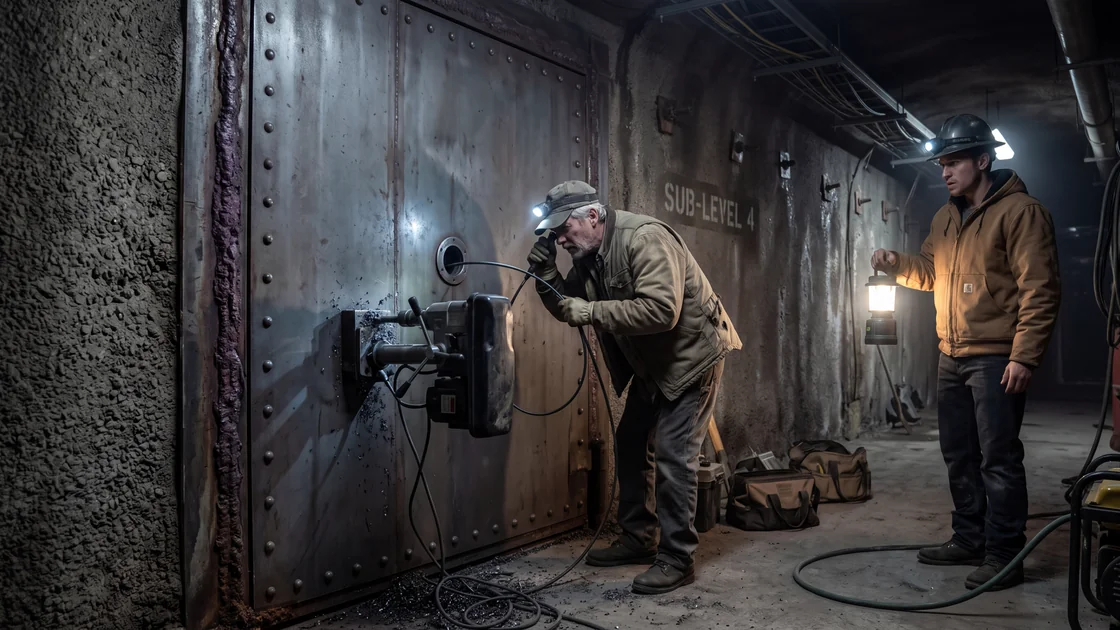
When veteran industrial locksmith Arthur Finch was contracted by a private reclamation firm to unseal a subterranean blast door inside the condemned St. Jude of the Pines Sanatorium, he anticipated a stubborn mechanical puzzle involving seized tumblers, calcified brass, and decayed hydraulic dogging pins; he did not expect to find an eight-inch-thick slab of Krupp-manganese steel whose locking bars, slide-bolts, case-hardened padlocks, and perimeter seams had all been meticulously, irreversibly drawn, welded, and dog-bolted strictly from the inside face of the threshold.
Act I: The Descent through St. Jude
The gravel track leading up the shoulder of Mount Defiance had long since ceased to be a road. It was merely a furrow of cracked shale and invasive sumac, flanked by rotted utility poles whose crossarms hung like broken gibbets against a slate-grey autumnal sky.
Arthur Finch drove his battered Ford F-350 with the low-range transfer case engaged, the four-ton utility box on the rear swaying against heavy leaf springs. In the back, neatly racked in oiled felt and birch cabinetry, rested three generations of bypass equipment: diamond-coring drills, high-frequency acoustic monitors, flexible German fiber-optic borescopes with articulation collars, pneumatic ram sets, and six cases of hand-filed picks, torsion wrenches, and decoding shims. Arthur was fifty-eight years old, his knuckles scarred with the white calligraphy of slipped drill chucks and sheared pinions. He was a man who believed in the sanity of simple machines. A key was an algorithm made of brass; a lock was merely a mechanical gatekeeper that obeyed the laws of leverage, shear lines, and tolerances. A lock had no politics, no malice, and no secrets that could not be solved by an ear pressed to cold metal and a micrometer gauge.
Beside him on the passenger bench sat Marcus Vance, an agent for the Sterling-Barrow Industrial Trust. Vance was thirty years younger than Arthur, dressed in clean Carhartt canvas that had never seen grease, smelling of expensive tobacco and mint chewing gum. He had spent the two-hour drive from the regional airport checking a satellite phone that had lost its carrier five miles past the valley checkpoint.
"The county records are useless," Vance said, tapping his knee. "St. Jude closed in 1968 after the federal consolidation act, but the lower infrastructure was grandfathered under an emergency defense designation dating back to fifty-four. The state highway department wanted the hill leveled for a reservoir bypass, but the site surveys kept stalling. Sterling-Barrow bought the underlying deed at auction forty days ago. We have thirty days to clear the physical plant, catalog any recoverable machinery, and confirm the sub-basement vaults are empty before the demolition team sets charges on the lower foundations."
"And the blast door?" Arthur asked. His voice was gravel, smoothed by tobacco smoke.
"Found three days ago by the advance survey crew," Vance said. "Sub-Level Four. They thought it was a fallout shelter for the administrative staff. But the outer face is dead. No handle, no dial, no emergency release. Just a bare plate set into eight feet of reinforced volcanic concrete. They tried taking an oxy-propane torch to the perimeter, but the heat dissipation was too fast. The firm called the regional association in Pittsburgh; they said if anyone between the Ohio River and the Atlantic could map a dead bolt without blowing the frame, it was you."
"A door is only as good as the frame it’s hung in," Arthur murmured. "Most blast doors aren’t built to keep men out. They’re built to absorb an overpressure wave coming down an intake shaft. If it’s dead on the outside, it was designed to be handled from a central gallery."
"You'll see it soon enough," Vance said, pointing through the cracked windshield.
The sanatorium emerged through the hemlocks like a washed-out bone. St. Jude of the Pines had been constructed in 1904 as a private tuberculosis retreat, an era when sunlight and thin mountain air were considered the only cures for a rotting lung. The upper floors were red-brick Gothic, featuring wide open-air verandas with copper balustrades that had oxidized into streakings of pale turquoise. Over the decades, as the disease yielded to streptomycin, the institution had morphed into an asylum for chronic epileptics, then an auxiliary psychiatric hospital, and finally an anonymous node in the Department of Civil Defense’s regional containment network.
Two laborers—men in muddy orange vests named Loomis and Ruiz—were waiting near the ambulance sally port. They stood beside a diesel compressor that clattered rhythmically, pumping air down a thick yellow snake of hose through a basement window whose iron grates had been severed with an abrasive wheel.
"Air is clear down to Level Three," Loomis said, spitting into the dead nettles as Arthur climbed down from the cab. "Level Four is sour. Smells like sulfur and dry lime. We hung a four-hundred-watt halogen stringer, but the junction boxes keep blowing out. Take a lantern."
Arthur walked to the rear of the truck, unlocked the rolling steel shutter, and selected his equipment with the methodical slowness of an old surgeon. He loaded a heavy canvas shoulder rig with his favorite instruments: a custom-ground set of Peterson picks in 0.015-inch government-grade steel; a low-speed Milwaukee variable drill with diamond-grit annular cutters; a five-millimeter Olympus industrial borescope with a right-angle optical prism and an independent LED fiber line; a brass depth micrometer; and two cans of chlorinated solvent to flush out dried grease.
"No torches yet," Arthur told Vance. "A torch is what you use when you don't know what you're doing. A torch warps the slide-pins, drops the anti-drill ball bearings into the gate, and turns a one-hour bypass into a four-day excavation."
"Take what you need, Mr. Finch," Vance said, strapping on a composite hard hat. "We’re on a per-diem agreement, but the demolition firm moves in on the first of the month. If that door isn’t swung by Friday, they drill six-inch blast holes from the crown and drop thirty sticks of ammonium nitrate into the void."
"Then you’d better stay out of my light," Arthur said.
They entered through the receiving ward.
The interior of St. Jude was a monument to institutional neglect. Water had filtered through three levels of cedar shingles and pine joists, leaving the upper plaster bloated and dripping with stringy curtains of black mold. Iron bed frames, stripped of mattresses, sat in the former hydrotherapy rooms like the ribs of stranded cattle. Arthur stepped carefully, his steel-toed boots crunching over floor tiles made of asbestos and linseed oil that had shattered into grey crumbs.
At the central core of the building, the architectural tone shifted abruptly. The 1904 brick and heart-pine gave way to a square elevator shaft clad in cinderblock, bordered by a concrete stairwell with unpainted pipe railings. A cold, steady draft rose from below—air that carried no vegetative rot, no moisture, but instead the sterile, alkaline tang of dry limestone, copper oxide, and old transformer oil.
"Level One," Vance noted, his flashlight beam sweeping over a row of padlocked administrative offices. "Level Two was the isolation ward. Level Three was staff quarters and backup boilers. Level Four doesn't show on the 1952 civil architectural blueprints. It was logged as an excavation for an auxiliary cistern."
They descended the concrete steps. The air grew perceptibly heavier, pressing against their eardrums. Arthur noted the changes in the construction: the walls were no longer poured slabs with wooden form-board marks; they were twelve-inch shotcrete over heavy steel mesh, anchored with two-inch rock bolts set into the living granite of the mountain. Every fifteen feet, a yellow-stenciled circle marked the location of a subterranean survey datum.
At the landing for Level Four, the stairwell terminated in a steel blast-lock—two light-gauge submarine hatches, both swung wide and rusted into their collars. Beyond them lay a horizontal corridor thirty yards long, its arched ceiling hung with dead cables in galvanized trays.
At the far end of that corridor stood the door.
Act II: The Anatomy of an Anomaly
Arthur stopped five paces back, allowing his flashlight to travel the perimeter of the installation.
It was not a commercial vault door. It bore no maker’s mark, no gold-leaf filigree, no chronometer cases or ornate dial rings. It was an industrial bulkhead of high-tensile steel, approximately seven feet high, five feet wide, and set flush into an immense lintel of basalt-aggregate concrete. The face of the door was completely smooth, interrupted only by four heavy rows of conical rivet heads and a single central aperture, three inches in diameter, that resembled an observation port.
"Show me the frame," Arthur said quietly.
He stepped forward, unhooked his loupe from his vest, and leaned his face within three inches of the perimeter.
The tolerance between the door edge and the cast-steel jamb was shockingly narrow—scarcely more than a sixteenth of an inch. But it was not the mechanical tolerance that made Arthur’s spine prickle with an ancient, trade-learned apprehension.
It was the seam.
"Bring the lantern," Arthur said.
Vance stepped up, lifting the heavy rechargeable battery pack. The bright white beam struck the gap between the door and the frame.
The seam was not open. Running down the entire vertical height of the door, from the top hinge pocket to the sill, was a continuous, irregular bead of electric arc-weld. It was old—the slag had oxidized into a brittle, purplish-brown crust—but it had been laid with absolute, cold-handed precision. The welder had used heavy stick electrodes, likely E6010 cellulosic rods, laying down a root pass that had bitten deep into both the door’s beveled edge and the structural jamb, followed by two weave passes that completely sealed the threshold.
Arthur knelt on the concrete floor. The bottom edge, where the door met the brass-faced floor sill, had been treated with the same ferocity. Two steel angle-irons had been dropped across the junction and welded flat to the threshold.
"Somebody didn't want this opened," Vance said, his voice dropping an octave in the dead acoustic of the tunnel.
"No," Arthur said. He touched the slag with the tip of his scraper. A flake came away, revealing bright, silvery steel beneath that had not rusted in sixty years of subterranean isolation. "Look at the direction of the ripples. Look at the weave."
Vance squinted. "What about it?"
"The welder wasn't out here," Arthur said. He stood up, aiming his light at the central observation port. "The crown of the weld is on the other side. This bead was pushed outward through the gap. The operator was standing in the dark on the inside of the room, running his rod down the seam through a bevel, sealing himself into the concrete."
Vance stepped back, his eyes darting to the blank walls. "That doesn't make sense. Why weld a door from the inside? If you're building a shelter, you lock it. You don't burn sixty pounds of rod and gas yourself with ozone and carbon monoxide."
"Let's look at the port," Arthur said.
The three-inch circular port was capped from the outside with a threaded steel plug. Arthur set a two-pin spanner into the plug’s indexing holes, braced his shoulder against the door, and leaned into it with his weight. The threads were dry, shrieking in high-pitched protest as sixty-year-old lead-paste sealant crumbled. He turned it five full revolutions until the plug dropped into his leather-gloved palm.
The aperture was through-bored through the entire thickness of the door—nearly seven inches of laminated steel and compressed carborundum grit, an anti-penetration matrix commonly used in the mid-fifties to defeat core-drilling.
Arthur reached into his case, pulled out the Olympus borescope, and threaded the flexible shaft into the hole. He clicked the light source on, seated the rubber eyepiece against his right socket, and dialed the focus wheel.
For a full minute, he did not speak. The only sound in the tunnel was the distant, muffled thump of the diesel compressor three levels above and the slow, rhythmic drip of condensation somewhere along the conduit run.
"What do you see?" Vance asked.
"Loomis," Arthur said, his eye still glued to the glass. "Go back to the truck. Bring me the three-foot extension rod for the probe, the mirror head, and the bottle of denatured alcohol."
"Finch," Vance said firmly, stepping between Arthur and the light. "What is in there?"
Arthur straightened up, his face grey in the lantern glare. His hand, normally as steady as a cast-iron lathe, reached down to massage his forearm.
"It’s not a shelter," Arthur said.
"What is it?"
"It’s a vault. But it wasn't locked by the manufacturer. The dogging mechanism—the four-way rack-and-pinion that drives the perimeter bolts—has been stripped. The drive gear was cut out with a torch. The dogs were driven home with a sledgehammer into the frame pockets, and then someone welded three-inch bridge steel across the linkages."
He paused, clearing his throat.
"And that's not all," Arthur continued. "There are three Master No. 5 hardened steel padlocks looped through the internal bell-cranks. And the keys are gone. They're hung on a wire nail driven into the interior face of the door, just out of reach of this port. And someone ran two lengths of two-inch mine cable through the handles of the secondary dogs, cinched them with Crosby clamps, and took the tail of the cable back into the dark."
Vance stared at the circular hole. "Why? Why padlocks if you've already welded the seam? Why chain it if the bolts are hammered home?"
"Redundancy," Arthur said. He looked at the massive steel slab with a look that was almost reverent, almost terrified. "Whoever was in there wanted to make sure that even if someone had a drill rig, even if someone had three days with an oxygen lance, they couldn't turn the dogs. They were terrified that the door would fail."
"Fail how?" Vance asked. "Fail from the outside?"
Arthur looked at the cold, clean welds on the exterior seam. "The padlocks are on the inside, Mr. Vance. The welds are on the inside. The angle-iron is on the inside. They weren't afraid of someone breaking in. They were afraid of something pushing its way out."
Act III: The Forensic Locksmith
By noon, the corridor outside the blast door resembled a precision machine shop.
Arthur had refused to allow Loomis and Ruiz to touch the door with their sledgehammers or their rough-cut demolition torches. "You touch this frame with a torch," Arthur had told them, his voice cold and flat, "and the heat will expand the manganese core. It’ll lock the latch-bolts into the keeper pockets so hard that a hundred tons of hydraulic pressure won't shift them. You do this with a micrometer, or you don't do it at all."
He set up a heavy magnetic-base drill press, anchoring its four-hundred-pound electromagnetic foot directly to the outer plate of the door, six inches to the left of the blind observation port.
His objective was not to cut the door down. To cut through seven inches of laminated armor plate, carborundum matrix, and structural steel would take sixty hours and hundreds of cubic feet of oxygen, which would poison the stale atmosphere of the lower levels. Instead, Arthur intended to perform an acoustic surgical strike: he would drill three pilot holes, each precisely three-eighths of an inch in diameter, through the outer casing to intercept the three locking dog bars at their balance points. If he could reach those bars, he could tap them, thread them, and use a hollow-bore hydraulic porting ram to drag them back out of their frame pockets, one millimeter at a time.
"The padlocks first," Arthur muttered to himself as he adjusted the drill's feed lever.
Through the borescope, he had mapped the interior arrangement. The three Master padlocks were classic 1950s laminates—four brass pins each, cold-rolled steel bodies with case-hardened shackles. Simple enough to pick on a bench in thirty seconds. But Arthur was not on a bench; he was looking through a four-millimeter optical tube with an inverted image, working through an angled hole three feet away, using three-foot-long piano wire linkages that flexed and wobbled under the slightest hand pressure.
He set his acoustic sensor against the steel plate just above the observation port. The sensor was plugged into a transistorized amplifier, and Arthur wore a pair of bulky Bakelite headphones over his ears.
Every sound within the door was magnified ten thousand times: the dry scraping of the drill bit, the crystalline ping of steel swarf curling off the cutter, the low, oceanic rush of the air current sliding past the interior seals.
"Vance," Arthur said without looking back. "Hold the fiber line. Keep the beam centered on the shackle of the upper lock. If the light flickers, I lose the shear line."
Vance, who had grown increasingly quiet since seeing the interior welds through the borescope, took the rigid wand with two hands. His palms were sweating.
Arthur picked up his tool—a six-foot length of tempered spring steel, necked down at the end and ground into a delicate half-diamond profile. He inserted it through the central port beside the borescope.
Through the eyepiece, the interior of the vault was a world of harsh highlights and abyssal shadows. The brass bodies of the Master locks were green with verdigris, hanging like heavy fruits from the steel dog-bars. Just beyond them, barely visible at the edge of the fiber-optic cone, was a work table, overturned, its wooden legs splintered. Further back, the light died in an absolute, suffocating darkness that seemed to swallow the illumination without reflection.
"Pin one," Arthur whispered.
His long, thin pick entered the keyway of the topmost padlock. The tool was so long that the slight tremble of his heart registered as a wave in the slender steel rod. He braced his forearm against a wooden cribbing block.
Click.
The sound in his headphones was like an anvil falling on stone.
"First pin seated," Arthur murmured. "High spool pin. They used serrated drivers in fifty-six. Cheap bastards."
"Finch," Vance said, his voice straining under the effort of holding the light steady. "The air coming out of that port. Smell it."
Arthur didn't move. "I smell it. Dry lime. Formalin. Carbolic."
"That's not all," Vance muttered. "It’s warm. It’s six degrees warmer than the tunnel out here. Where is the heat coming from? This facility has been off the grid since the Nixon administration."
"A mountain is a heat sink," Arthur said, though he knew the geothermal gradient for this part of Pennsylvania didn't account for a seven-degree differential at forty feet below ground. "Keep the light steady."
Click. Tock.
"Pin two. Pin three... false set on four."
Arthur applied counter-rotation with a secondary wire hook wedged into the bottom of the keyway. The plug turned three degrees. He felt the minute kick of the cylinder through his fingertips—that faint, exquisite mechanical dialogue between brass and steel that had been his life's language.
Clack.
The shackle of the first padlock sprang open under its internal spring. It swung down, striking the door plate with a dull, hollow thud that reverberated through the steel.
"One," Arthur said.
He did not celebrate. His eyes were burning from the strain of the eyepiece. He pulled back, blinked into the yellow gloom of the corridor, and took a drag from a cold cigarette he had tucked behind his ear.
"The padlocks are nothing," Arthur said, looking down at his sketches. "The real problem is the weld. Whoever laid that bead didn't just stitch it; they filled the entire rebate. Even if I pull the dogs, the door is effectively a solid forging with the jamb."
"Then we're back to explosives," Vance said, leaning his back against the shotcrete wall. "I'll call the firm. We tell them the chamber is non-accessible, they drop the charges down the ventilation flues, and we write the whole sub-level off as an unstable collapse."
"No," Arthur said sharply.
Vance looked at him, one eyebrow raised. "You having an attack of professional pride, Arthur? It’s an old hole in the dirt. Some poor bastard with a welding machine lost his mind during the Cuban Missile Crisis and bricked himself up. We don't need to see his bones."
"Look at the blueprints you gave me," Arthur said, thrusting a yellowed, coffee-stained sheet of linen paper at Vance’s chest. "Look at the ventilation layout."
Vance unfolded the paper under his flashlight. "Intake shaft A. Exhaust shaft B. Both capped at the surface with four-foot concrete mushrooms."
"Exhaust shaft B doesn't terminate on the surface," Arthur said, pointing a calloused finger at the faded drafting ink. "It drops another eighty feet below this floor into the limestone beds. It was an open drainage sump. If whoever was in there wanted to commit suicide, they didn't need to spend eight hours with an arc welder, chaining three padlocks and dogging twelve hydraulic pins. They could have just walked down the sump stairs. But look here."
Arthur leaned in close. His grey eyes were wide, the pupils pinned under the harsh white work-lights.
"The sump stairs were blown," Arthur said. "Look at that notation from November twenty-third, 1961. 'Sub-Level Four lower access severed by controlled demolition. Three hundred pounds of nitrostarch.' They didn't seal the door to die in a corner, Vance. They blew the stairs behind them, then retreated to this door, closed it, and spent their last air welding it against whatever was down in that sump."
A heavy silence settled over the corridor. From the central port in the blast door, a faint, rhythmic sigh of air seemed to pass through the three-inch hole—a slow, shallow respiration that smelled faintly of dry paper, old grease, and something metallic, like the copper taste in your mouth when you touch a nine-volt battery to your tongue.
"Ruiz!" Vance called out toward the tunnel mouth, his voice cracking. "Ruiz, where’s that compressor line?"
There was no answer from the tunnel. Only the steady, monotonous rattle of the air hose vibrating against the concrete floor.
Act IV: The Blind Shear
By four in the afternoon, Arthur had cleared the second and third padlocks.
The process had been grueling. His hands were cramped into claws, the muscles along his cervical spine knotted like hemp rope. But the three locks now hung limp on their hasps, shackles cleared of the dog-levers.
Now began the work of the hydraulic ram.
Arthur had drilled three parallel holes through the four-inch outer skin into the bolt channels. Using a high-speed tap lubricated with sulfur oil, he cut half-inch national-fine threads directly into the bodies of the hardened steel locking dogs.
"This is the dangerous part," Arthur explained to Vance, who was sitting on an upturned milk crate, his satellite phone lying useless between his feet. "Each of these dogs has a sixty-degree shear pin that anchors it to the central drive ring. If the welder melted those pins when he laid his interior bead, the dogs won't slide. They'll snap. And if they snap inside the frame pockets, we'll have to core the concrete around the hinges, and this mountain will come down on our heads before the door gives."
He mounted the first Enerpac hydraulic cylinder to the face of the door, threading its high-tensile pull-rod into the hole he had tapped. He connected the cylinder to a hand pump with an analog pressure gauge.
"Pump it," Arthur said to Vance.
Vance hesitated, then stood up, took the knurled handle of the hand pump, and pressed down.
The gauge needle jumped: 1,000 PSI... 2,500 PSI... 4,000 PSI.
The heavy hydraulic hose stiffened like a live serpent. The steel pull-rod groaned, a sound that traveled through the entire structure like the note of an enormous, out-of-tune cello.
"Hold at four thousand," Arthur commanded, his ear pressed to the steel through a hardwood dowel he used as a listening rod.
Inside the door, sixty-year-old rust and machine grease was screaming under the tension. Arthur tapped the face of the blast door with a two-pound brass mallet, directly over the keeper pocket. The shock wave traveled through the plate, vibrating the loaded shear surfaces.
BANG.
The sound was like an M-80 exploding in a metal drum. Vance jumped back, dropping the pump handle.
"Did it shear?" Vance panted, his hand to his mouth.
Arthur smiled for the first time in six hours. It was a tight, ferocious little grin that showed his tobacco-stained teeth. He pointed at the depth gauge mounted to the pull-rod.
The rod had moved out by three-quarters of an inch.
"The pin broke clean," Arthur whispered. "The dog is free in its channel. Pump it again, Vance. Walk it home."
One by one, the four perimeter dogs were dragged out of their deep basalt pockets. The top bolt, the bottom bolt, the two horizontal latch-bars—each yielded to the steady, unpitying leverage of forty tons of hydraulic fluid.
By seven in the evening, only the interior weld remained.
Arthur stood before the door with a tool of his own design: an internal milling bit mounted on an articulated drive shaft, driven by an air motor that could be passed through the central observation port. It was an agonizingly slow method; the carbide cutting head could only nibble at the interior weld bead a few thousandths of an inch at a time, throwing sparks into the sealed chamber that flared like fireflies through the borescope’s lens.
Arthur worked the feed screw with his left hand while his right hand held the scope.
Through the flickering spray of orange sparks, he began to see more of the room beyond.
The chamber was approximately twenty feet square. The walls were lined with heavy steel instrument racks, their dials smashed, their vacuum tubes shattered into heaps of silvery glitter on the linoleum floor. In the center of the room sat a massive wooden desk, bolted to the concrete with heavy angle brackets.
Behind the desk sat a chair.
And in the chair was a shape that did not move.
Arthur froze his fingers on the milling feed.
"There's someone in there," Arthur said, his voice dropping to a whisper that barely carried over the whine of the air motor.
Vance stepped up to the second eyepiece that Arthur had rigged via an optical beam-splitter. He peered through the lens.
The figure was dressed in the heavy, quilted canvas flight suit common to cold-weather military personnel in the mid-fifties. Over the face was an M9A1 protective field mask, its rubber snout turned down toward the chest, the twin glass lenses reflecting the orange sparks of Arthur's milling tool like two vacant, silver eyes. The figure's left arm was resting on the desk, fingers curled around an empty leather-bound logbook.
The right arm hung down toward the floor.
Directly beneath the limp right hand lay an empty Lincoln Electric electrode holder—the "stinger" used by arc welders. The thick, rubber-jacketed welding lead was still attached to it, snaking across the floor to a massive 300-amp motor-generator unit that sat dead in the corner, its fuel tank plumbed into an external line that had long since rusted dry.
"He finished the bead," Vance murmured, his voice trembling. "He sat down in the chair, took his mask off... no, he left the gas mask on. Why would he leave the gas mask on?"
Arthur didn't answer. He had adjusted the borescope’s focal plane downward, toward the bottom edge of the interior door face.
There, welded to the heavy steel plate, were three rows of railroad iron—massive sections of ninety-pound rail, cut into three-foot lengths and laid in an interlocking lattice across the door's lower third. They had been welded with dozens of passes, great sloppy heaps of filler metal that showed the operator had been working in blinding smoke, in heat that must have blistered the paint off the walls, in air that was rapidly running out of oxygen.
"He didn't just weld the seam," Arthur said, his voice hollow. "He reinforced the lower panel against an impact. He was bracing the door against something low. Something that hits near the floor."
"Finch," Vance said, grabbing Arthur's shoulder with sudden, violent intensity. "Stop the drill. Turn the air off."
Arthur pulled the pneumatic lever back. The air motor whined down to a silence that was immediate and suffocating.
"What is it?" Arthur asked.
"Listen," Vance whispered.
Arthur pulled his headphones down around his neck.
For five seconds, ten seconds, there was nothing. Then, from deep within the observation port—from beyond the dead man in the flight suit, beyond the smashed vacuum tube racks, beyond the blown sump stairs that led eighty feet down into the dark limestone beds of the mountain—came a sound.
It was not the wind. It was not the compressor.
It was the slow, wet, heavy sound of something shifting against stone. A dragging sound, punctuated by the faint, rhythmic metallic scrape of iron against iron—like a heavy chain being drawn across the edge of a broken rock step.
Ch-shhh. Ch-shhh.
The sound was faint, separated from them by forty feet of sealed vault and eighty feet of shattered limestone shaft, but it was there. It was rhythmic. It was purposeful.
And then, through the three-inch hole of the observation port, the air current reversed.
The sour draft of lime and formaline ceased. In its place came a sudden, violent intake of air—a low, vacuum hiss that sucked the dust from the corridor floor, pulling it toward the aperture, into the dark, as if some immense subterranean lung had just expanded in the depths beneath the floor.
Vance stumbled back, his boots tangling in the hydraulic lines. He fell against the shotcrete wall, his face the color of wood ash.
"Pack it up," Vance said, his voice a dry croak. "Pack it up, Finch. We're leaving."
Arthur didn't move. He stood before the blast door, his hand resting on the heavy steel handle of the milling cutter.
"We have two inches of weld left," Arthur said.
"Did you hear that?" Vance hissed, scrambling to his feet. "Did you hear that down there? That wasn't a dead room! There's an open shaft! There's something in the drainage beds!"
"The door has been sealed for sixty-four years," Arthur said, though his own heart was hammering against his ribs like an iron piston. "Nothing lives sixty years without food, Vance. It’s a barometric displacement. The surface pressure is dropping. A cold front is moving over Mount Defiance. When the atmospheric pressure falls outside, the air in the deep karst caves expands and vents through the old drainage runs."
"And the sound?" Vance shouted, his eyes wild. "The scraping? Was that the weather?"
"Rock settling," Arthur said, his voice dropping into that flat, unshakeable register he used when an eighty-ton vault door was hanging from a crane over his head. "The weight of this sanatorium is shifting into the old excavation. If we don't drop this weld now, the frame will rack. If the frame racks, the door will pinch, and we’ll never know what that man died to protect."
"I don't care what he protected!" Vance reached to his belt, pulled a small, black-framed automatic pistol from beneath his canvas coat, and leveled it at Arthur’s chest. "I am the representative of the deed-holder. I am ordering you to secure the site and withdraw."
Arthur looked at the gun. He didn't even blink. He had seen three wars, two wives, and four bankruptcies; a nine-millimeter slug held very little terror compared to the prospect of walking away from an unsolved lock.
"Put that away, boy," Arthur said softly. "You pull that trigger down here, and the muzzle report in this concrete tube will blow both your eardrums out. You won't be able to walk up those stairs without vomiting from the vertigo. And besides—you can't leave."
Vance’s hand shook. "Why can't I?"
Arthur pointed with his brass scraper toward the dark corridor behind them.
"Ruiz and Loomis left two hours ago," Arthur said. "They took the truck. I heard the four-wheel drive kick in when the compressor died. They heard that sound through the exhaust flues forty minutes before we did. You want to walk six miles through sumac and timber rattlesnakes in the dark? Or do you want to help me swing this door, get the logbook off that desk, and find out what we’re dealing with?"
Vance lowered the gun. His chest rose and fell in short, jagged gasps. He looked at the heavy steel slab, then at the black tunnel behind them.
"Two inches?" Vance asked, his voice broken.
"Two inches," Arthur said.
He turned the air valve back on.
Act V: The Breach
The final section of the weld bead did not cut clean; it failed under tension.
At eight-fifteen in the evening, with the pneumatic motor screaming at fifteen thousand revolutions per minute, the last remaining bridge of manganese-alloy weld metal reached its yield point.
The blast door did not swing open gently.
With a sound like the crack of an artillery piece, the entire eight-inch-thick, four-ton slab of steel leaped outward three inches from its frame, propelled by a profound, violent surge of pressurized air from within the chamber.
The blast of wind knocked Arthur off his feet. The air was ice-cold—far colder than the autumn night outside—and smelled of things that had never seen the sun: wet shale, ancient guano, stagnant mineral salts, and a strange, oily sweetness that made Arthur’s eyes water and his gorge rise.
The work-lights flickered, their halogen bulbs hissing as the cold air struck the hot glass. One of them shattered with a sharp pop, plunging the tunnel into a chaotic dance of yellow shadows and deep, swaying pockets of black.
Arthur pulled himself up by the magnetic drill frame.
The door hung open on its massive, grease-packed ball hinges, suspended at an angle of fifteen degrees. The interior of the chamber was now fully visible, framed by the jagged, silver-bright scars where the interior welds had torn free from the structural jamb.
Vance stood ten feet back, the automatic pistol gripped in both hands, his knuckles white.
"Finch," he warned. "Don't."
Arthur took his heavy five-cell flashlight from his belt, clicked it on, and stepped over the high brass threshold.
The linoleum floor beneath his boots was dry and brittle, snapping like peanut shells under his weight. The air was dead, still vibrating with that profound, low-frequency hum that seemed to come from the floor rather than the walls.
The room was exactly as the borescope had shown, but larger, more desolate in the naked beam of the hand lantern. The instrument racks along the left wall were not communication sets; Arthur recognized them now as seismic monitoring equipment—old Sprengnether horizontal-component seismometers, their smoked-paper drums torn to ribbons, their delicate galvanometer styluses bent double.
On the central desk, the dead man sat in his flight suit.
Arthur approached the desk slowly. The light traveled over the quilted shoulders, the grey rubber of the M9A1 mask, the rusted buckles of the harness. The man’s hair, visible beneath the edge of his woolen watch cap, had turned into a white, lichen-like fluff that had drifted down onto the shoulders of the jacket.
The leather logbook lay open before him.
Arthur leaned down, his flashlight beam pinning the yellowed, ruled paper. The entries were written in pencil, the graphite faded but legible, the handwriting tight, crabbed, and deteriorating toward the end into an erratic scrawl.
Arthur read aloud, his voice dropping into the quiet of the tomb:
"October 14, 1962. Project Deep Core suspended by order of the Directorate. The boring at ninety feet intersected the cavern floor of the lower limestone series. They thought it was an extension of the Luray system. It isn't.
"October 19. Dr. H. tried to drop the geophone array into the fissure. The cable didn't stop at eight hundred feet. It was taken. We heard the winches spinning from the floor of the generator room. The brake shoe burned through three inches of asbestos.
"October 22. It came up the sump stairs at 0300. We blew the stairs with the nitrostarch, but the rubble didn't fill the throat. It climbed the debris. It doesn't have bones, Finch. It moves like fat. It moves like cold lard through an auger.
"October 24. Only the shop equipment left. I sent the boys up to the main hospital with orders to evacuate the lower wards. They won't make it to the highway. I heard the boiler room floor give way an hour ago.
"I have the Lincoln set up. I am going to run five passes of seventy-eighteen on the frame. If I can get the padlocks on the dogs before the fumes get me, the door will hold. It cannot pull a door that sits flush in a Krupp jamb. It has no leverage on a flat plate.
"If you are reading this from the outside: do not break the seal. Do not clear the frame. It has been down there in the cold for sixty years, waiting for the air to come back."
Arthur stopped reading.
He looked at the name mentioned in the log: Finch.
Arthur reached out with a trembling hand, his leather-gloved thumb brushing the edge of the watch cap on the dead man’s skull. He tilted the head back slightly.
Pinned to the left breast of the quilted canvas flight suit was a laminated civil service pass, its plastic yellowed and cracked with age. Beneath the thumb-sized black-and-white photograph was a name:
FINCH, HAROLD E.
Chief Master Locksmith & Physical Security Consultant
Department of Defense – Civil Containment Division
Arthur stepped back, his breath catching in his throat.
Harold.
His great-uncle. The one who had supposedly died in an industrial boiler explosion at the naval shipyards in Philadelphia in the autumn of sixty-two. The one whose gold-plated pocket watch—presented to him by the Master Locksmiths’ Association of America—sat at that very moment in Arthur’s tool chest on the bed of his truck three floors above.
"Arthur," Vance whispered from the threshold.
His voice was not the voice of an executive or a contractor. It was the high, thin whimper of a terrified child.
Arthur turned.
Vance was not looking at him. He was looking down at the floor between the desk and the back of the room.
There, half-hidden behind the rusted frame of the seismic monitoring rack, was the blown sump shaft.
The hole was eight feet across, its ragged edges fringed with the twisted remains of steel reinforcement bars that had been sheared by nitrostarch sixty-four years ago. Below it, the darkness was absolute, vast, and silent.
Except it was no longer silent.
From the throat of the shaft, something was rising.
It was not a creature of skin and blood. It was a vast, cold displacement—an ascending column of thick, viscous, greyish-white vapor that did not disperse into the air, but rolled across the linoleum floor like an ocean of heavy mercury. It moved with a slow, peristaltic crawl, pooling in the low spots, flowing around the desk legs, its forward edge curling upward in small, blind questing tendrils that smelled of tallow, ammonia, and ancient, stagnant salt.
And within that rolling, heavy mass of cold matter, something was clicking.
It was a sound Arthur knew. A sound he had heard every day of his adult life.
It was the sound of tumblers falling.
The sound of brass pins dropping into their chambers. The sound of steel gates sliding against fence bars. A thousand tiny, mechanical clicks, repeated over and over, like an army of blind clocks ticking in the dark.
Click. Tock. Click.
"The door," Arthur whispered.
"What?" Vance stammered, his gun lowered, his knees shaking so violently he had to lean against the steel door jamb to stay upright.
"The door," Arthur said, his voice rising into a roar that shattered the dead air of the vault. "HELP ME WITH THE DOOR!"
Arthur lunged across the linoleum, his boots splashing through the freezing, grease-like vapor that had already reached the center of the room. The moment the mist touched his leather boots, the hide shriveled, the stitching frosting over with an instantaneous, crystalline rime of white ice. A cold so absolute it felt like red-hot iron bit through his wool socks, numbing his toes to dead wood.
He reached the threshold, threw his shoulder against the interior face of the Krupp-manganese slab, and shoved.
The four-ton door did not move.
The hinge pins, which had been free sixty seconds ago, were seizing. The immense cold radiating from the sump was contracting the outer steel casing faster than the cast-iron jamb, pinching the ball-bearing races within their housings.
"Vance! The hydraulic ram!" Arthur screamed, pointing at the Enerpac cylinder still bolted to the exterior face. "Set it to push! PUSH THE SLAB!"
Vance didn't move. He stood in the corridor, staring through the gap at the floor beneath Arthur's feet.
The grey vapor had reached the desk. It had risen around the chair of Harold Finch, engulfing the quilted suit, the rubber mask, the dry white hair. And as Arthur watched in paralyzed horror, the dead man’s hand—the hand that had held the Lincoln welding stinger sixty-four years ago—began to slide across the yellowed pages of the logbook.
The fingers weren't moving by their own muscle. The cold, lard-thick vapor was flowing into the sleeves, under the canvas, filling the empty skin like a glove being inflated with grease. The arm rose, the five fingers extending, reaching toward the threshold with the blind, searching motion of an anemone under twenty fathoms of black water.
"Vance!" Arthur roared.
Vance dropped the pistol. He didn't touch the hydraulic pump.
He turned and ran.
His boots clattered away down the concrete corridor, his breath shrieking in his throat as he fled toward the stairs, toward the daylight, toward the high, cold summit of Mount Defiance, leaving his work lights, his truck, and his contractor’s contract behind.
Arthur stood alone at the seam.
The mist was at his ankles now. It was heavier than water, heavy as molten lead, pressing against his shins with a dull, hydraulic weight that threatened to sweep his feet out from under him. The clicking in the dark was deafening now—ten thousand shear lines aligning in the blackness of the sump, a mechanical cacophony that sounded like a colossal safe being cracked by an invisible hand four hundred feet beneath the earth.
He didn't run.
He was Arthur Finch. He had never left a job open. He had never walked away from a dropped bolt.
He reached down to the floor of the threshold, where his heavy canvas tool roll lay half-submerged in the creeping grey rime. His fingers, numb and stiffening, bypassed the picks, bypassed the borescopes, bypassed the micrometer depth gauges.
He seized the four-pound cross-peen sledgehammer he had brought to seat the hydraulic pins.
He stepped back out of the chamber, planting his feet on the exterior concrete sill of the tunnel. He reached through the six-inch gap, caught the interior release handle—the one Harold had cut with the torch—with the claw of his hammer, and pulled with every ounce of sinew left in his fifty-eight-year-old body.
The door groaned. A single grease-cup on the upper hinge shattered, spraying frozen brass pellets across the corridor.
The door moved an inch.
From the dark within, the vapor surged forward, striking the steel plate like a breaker of grey foam. The weight behind it was monstrous—not the weight of air, but the weight of an immense, soft mass that had no shape, no structure, only a boundless, gelatinous hunger to fill the void of the upper world.
Arthur dropped the hammer.
He reached into his pocket and pulled out his private key-ring—fifty years of master keys, skeleton keys, detention-lock bypasses, and church-door blanks. He dropped them into the gap between the door and the frame, right at the bottom keeper pocket where the primary locking dog had rested.
Then he seized his thirty-ton Enerpac porting ram, laid the body of the jack against the opposite concrete wall of the corridor, and extended its five-inch steel piston directly against the door's outer face.
He didn't pump it with his hand. He kicked the lever.
He kicked it with his heel, over and over, his boot heel cracking against the knurled steel bar.
Clack. Clack. Clack.
The hydraulic gauge needle pinned itself at 10,000 PSI—the absolute burst limit of the high-pressure rubber line.
The four-ton door shrieked. It scraped across the brass floor sill, throwing a rooster-tail of yellow sparks that lit the corridor like an arc-welder's torch.
The gap narrowed: four inches... three inches... two inches.
Through the final one-inch fissure, a tendril of grey mist whipped out like the tongue of an adder. It struck Arthur's left forearm, dissolving his canvas coat sleeve instantly, turning the flesh beneath into a white, frosted swath of dead marble that had no sensation, no pain, only the cold of absolute space.
Arthur gritted his teeth until his molars cracked.
He gave the pump lever one last, desperate kick with his good leg.
BANG.
The blast door slammed into its rebate.
The sound was not an ending; it was an impact. The steel slab hit the Krupp jamb with such force that the shotcrete ceiling five feet above cracked, showering Arthur's hard hat with a bushel of fractured aggregate and rock dust.
Inside the frame, the key-ring Arthur had jammed into the lower keeper caught the corner of the primary locking dog. The steel keys—hardened nickel-silver, tempered tool steel, four dozen unique profiles—were crushed into a single, solid lump of distorted metal, jamming the dog into its pocket with three tons of mechanical interference.
The latch was home.
Act VI: The Seal
Arthur lay on the cold concrete of the corridor for three hours, listening to his own shallow breath and the slow, rhythmic thump of the piston deep within the door.
From inside the seven-inch plate of Krupp-manganese steel, something was hitting the door.
Not with a hammer. Not with a fist.
It was the dull, heavy, rhythmic slap of several hundred pounds of wet weight dropping against the lower third of the plate—right where Harold Finch had spent his last air welding three rows of ninety-pound railroad iron.
Thump.
The steel rang like a muffled bell.
Thump.
Five seconds of silence. Then the faint, distant, frantic sound of brass pins clicking, searching for a shear line that did not exist.
Arthur pulled himself up against the wall.
His left arm was dead. It hung at his side, useless, the fingers curled like tallow candles, white and bloodless. He didn't look at it. He knew what frostbite was; he knew what cellular necrosis was. He would lose the hand before the week was out.
He walked to the utility cart with his right arm.
He did not call for Vance. He did not look for the truck.
He picked up the spare Lincoln electric portable welding machine that Loomis had left near the compressor line—an old gasoline-driven rig that had three gallons of fuel left in its small, red-painted tank.
He pulled the starter cord with his right hand, bracing the frame with his good knee.
The two-cylinder Wisconsin engine sputtered, coughed a cloud of blue oil smoke into the tunnel, and then settled into a steady, roaring thrum that filled the corridor with noise and heat.
Arthur picked up the stinger.
He clamped a quarter-inch E7018 low-hydrogen rod into the copper jaws. He pulled his dark glass helmet down over his face with his chin.
He stepped up to the blast door.
The cold was still coming through the plate; the steel was so chilled that his breath was frosting on the rivet heads, turning the manganese skin into a field of tiny, hexagonal crystals that sparkled in the green glare of the arc.
He struck the rod against the seam.
A burst of lavender light illuminated the tunnel. The heat of the arc—six thousand degrees Fahrenheit—hit the frozen metal with an agonizing hiss of steam.
Arthur began to weld.
He did not weld like an amateur. He did not lay down slag-filled beads that would crack under a chisel. He held the arc short, weaving the tip of the rod in a tight, steady figure-eight, bridging the gap between the door and the frame, filling the seam with a dense, silvery caterpillar of molten steel that fused the two plates into a single, seamless monolith.
He burned one rod. He dropped the butt into the dirt, reached into his pouch with his right teeth, pulled out a second, seated it against his knee, and struck again.
He welded the top hinge.
He welded the bottom hinge.
He welded the central observation port, driving a three-inch steel drift into the hole with his hammer and then filling the entire circumference with three layers of weave passes until the hole was nothing more than an irregular mound of purple-and-gold slag.
And finally, kneeling on the floor with his good knee in the pool of oil and rock dust, he welded the floor sill.
He welded his own tools into the seam. He laid his Peterson picks, his depth gauges, his diamond-tipped cutters across the junction, melting them into the joint, turning the instruments of his life's work into a barrier of fused iron and tungsten carbide.
When the gasoline engine on the Lincoln welder finally ran dry, sputtering into silence around four in the morning, the corridor was hot, thick with the blue fog of vaporized cellulose and iron oxide.
The door was no longer a door.
It was a wall. A wall eight inches thick, backed by eight feet of basalt concrete, three rows of railroad rail, three frozen padlocks, and sixty-four years of silence.
Arthur Finch sat down on his tool chest.
He took his good right hand, reached into his vest pocket, and pulled out his great-uncle's pocket watch. The crystal was cracked, but through the glass, the gold hands still turned, ticking with that steady, indifferent precision that has nothing to do with mountains, nothing to do with monsters, and nothing to do with men.
He looked at the welded seam.
It was cold now. The silver metal had oxidized into a dull, leaden blue.
From beyond the plate—from eighty feet beneath the concrete floor, down in the black limestone beds where the water never runs and the sun never shines—there came no more sound.
No clicking. No scraping. No dragging of chains.
Only the mountain, settling its immense, blind weight upon the vault, closing the account forever.
Arthur closed the watch with a sharp snap.
"Job’s done, Harold," he said to the dark.
Then he stood up, turned his back on the door, and began the long climb up the concrete stairs toward the cold grey morning of the world.