The Well of Unborn Stars
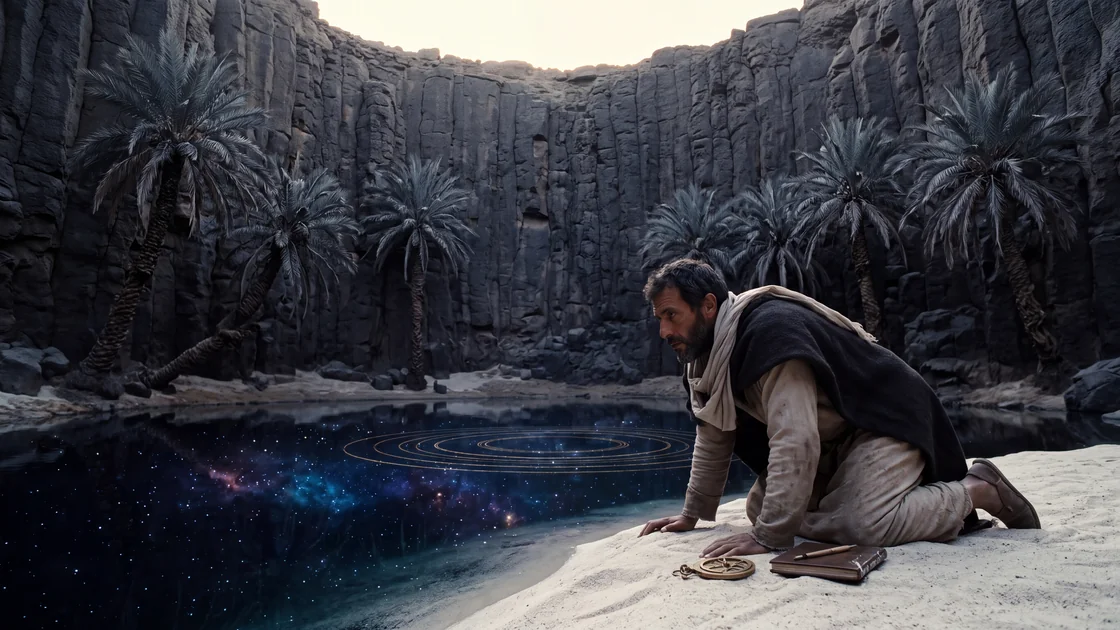
This is the chronicle of Idris al-Mursi, a solitary nomad of the deep wastes who, driven to the brink of madness and dehydration by a catastrophic sandstorm, stumbled into a sunken basin of black stone and discovered an impossible sanctuary: a mirror-calm oasis that defied the laws of heaven, reflecting not the blinding glare of the midday sun, but an unfathomable velvet night filled with foreign constellations, cold nebulae, and alien gods unknown to any terrestrial astrolabe. Bound between the scorching silence of the desert above and the icy infinity beneath his knees, Idris remained at the water’s edge for forty days, charting the celestial drift of another universe and unraveling the cosmic isolation of humanity, before paying the inevitable price exacted by sights not meant for mortal eyes.
Part I: The Crucible of Dust
The wind possessed neither voice nor charity; it was merely an immense abrasion that wore down the world.
For six days, the samum had blown from the south, carrying with it the fine, red powder of the interior plateaus. It was not the coarse grit of the gravel plains that rattled against leather and bone like thrown seed, but an impalpable silt, as soft as flour and as suffocating as hot ash. It found its way into the seams of Idris’s oiled calfskin boots, past the linen wrappings of his litham, through the tear-ducts of his squinted eyes, and into the dark, moist passages of his lungs, until every breath smelled of baked copper and powdered lime.
On the third day of the storm, his dromedary, a rangy, dun-colored mare bred by the northern oasis tribes for endurance rather than speed, had coughed once—a hollow, bubbling sound like water poured into a cracked amphora—and collapsed onto her knees. Idris had pulled on the halter, pleading in the guttering dialect of his mother’s people, but her eyes had already glazed over with the cloudy, dull film of abandonment. He had slit her throat not out of anger, but to salvage what moisture remained in the first stomach before the sun curdled it. He had filled two bladders with the pale, bitter green fluid, salt-heavy and reeking of fermented thorn-bush, and walked north-northwest, guided solely by the angle of the wind against his left cheek.
By the fifth day, the wind had died, but it left behind a world stripped of all contour. The dunes, once crested with knife-sharp ridges that cast predictable blue shadows at sunrise, were smoothed into rounded, featureless mounds, like the linen shrouds thrown over furniture in an abandoned palace. The sky was not blue; it was a pale, incandescent yellow, bleached of all humidity, radiating an omnidirectional heat that seemed to press inward from every horizon at once. There was no shade. To pitch a tent of camel-hair felt was impossible; the ground radiated such fury that the trapped air beneath the wool became an oven that would have boiled the marrow in his shins. He could only walk, pausing during the four hours when the sun stood directly overhead, crouching beneath his own shadow with his knees drawn against his ribs, his mouth clamped shut over a polished carnelian pebble to coax forth a thread of thick, metallic saliva.
His water was gone. The second bladder had begun to leak on the sixth morning, its hide dry-rotted by the salt and scorched by the sun, weeping its precious, brackish cargo into the sand before he realized the dark stain spreading along his hip. When he squeezed the leather between his palms, only three drops of greasy, pungent slime rolled onto the cracked skin of his thumb. He had swallowed them, closed his eyes, and waited for the fever to claim him.
The desert did not kill quickly. It stripped a man layer by layer, beginning with his vanity, then his memories, then the coherence of his senses, until he became nothing more than an ambulatory tendon propelled across the stone by the blind memory of motion.
Idris was thirty-four years old, though his skin was cross-hatched like dried mud and his beard had turned the color of dry alkali. He was the last of the Banu Hilal who remembered the old ways of navigating by the qibla of the dunes—by reading the ripples of sand as if they were the script of an unreadable book. His family had died of the coughing sickness in the winter of the great flood, his goats had been confiscated by the tax collectors of the Sultanate, and his presence here in the Empty Quarter was neither trade nor pilgrimage, but an extended act of subtraction. He had wished to find a place where nothing was demanded of him, where the silence was not the absence of sound, but an entity unto itself.
Now, as the sun climbed toward the zenith on the seventh day, the silence was complete. The horizon trembled, dissolving into a shimmering, watery illusion that the poets called sarab—the phantom lakes of the djinn.
To his left, a mountain range of violet glass rose and collapsed within the space of three heartbeats. To his right, an army of horsemen with banners of green silk trotted silently across the burning sky, their mounts without legs, their lances bending like willow wands in the convection currents. Idris did not look at them. He knew the grammar of delirium. If one answered the calls of the ghul, one simply walked into the salt flats and lay down to let the ants hollow out the eye-sockets.
Then, his foot struck stone.
It was not the crumbling, iron-stained sandstone that formed the ribs of the erg, but something dense, cold, and utterly black. He fell forward, his knees striking the edge of an escarpment he had not seen. The sand had ended; beneath him lay an abyss.
Idris lay on his belly, gasping for air that tasted of scorched iron, his forehead resting against the dark rock. The stone was smooth, almost polished, like the rim of a basalt mortar used for grinding henna. He raised his head, blinking against the salt that crusted his eyelashes.
Before him, the earth dropped away into a vertical funnel, perhaps three hundred paces across. It was a caldera of sheer, basalt cliffs, descending into a depression so deep that the sunlight did not reach its floor, save as a pale, amber ring that crawled around the upper terraces. While the desert above was a flat, roaring expanse of heat, this pit was still. The air that rose from it did not sear his nostrils; it was damp, smelling faintly of sulfur, crushed reeds, and something else—something so ancient and cold that it reminded him of the snow he had seen once, as a child, on the highest shoulders of the High Atlas.
He looked down. In the center of the depression, ringed by a narrow apron of white sand and stunted, black-leaved date palms that resembled iron spikes, lay a pool of water.
It did not gleam with the brassy, yellow brilliance of the midday sky. It did not reflect the pale dust-haze that turned the sun into a blinding silver coin overhead.
Even from three hundred feet above, Idris could see that the water was black. Not the muddy, stagnant black of a brackish sinkhole, but the bottomless, terrifying black of an open shutter into an infinite void. And across its surface, like diamond dust strewn across velvet, points of cold, brilliant light were shivering in the stillness.
Part II: The Descent into the Cistern
There was no path, only a series of fractured shelves where the basalt had cracked along its crystalline planes during some primordial cooling. Idris climbed down not with the agility of a youth, but with the desperate, clawing tenacity of an insect whose wings have been burned away.
His palms left pale smears of skin against the basalt. The stone here was strange; it did not store the sun’s fury as the sand did. Six feet below the lip of the crater, the air cooled abruptly, dropping twenty degrees within the span of a single downward step. It was like stepping from the floor of a furnace into the vaulted undercroft of a mausoleum.
His breath came in ragged wheezes. His tongue was a dry wedge of wood between his teeth, but the scent of water—not the bitter, alkaline wash of the desert wells, but pure, heavy, subterranean water—drew him down like a lead weight on a plumb-line. Twice, his footing failed. He slid down a ten-foot incline of shale, the sharp stones tearing through his linen tunic and furrowing his ribs, but he felt no pain. Pain belonged to the sun; here, in the shadow of the caldera, there was only the gravity of thirst.
When his feet finally touched the white sand of the basin floor, the world went momentarily black. He collapsed onto his hands and knees, his face inches from the soil.
The sand here was unlike any he had traversed. It was not quartz or limestone; it was composed of tiny, spherical beads of translucent calcite, perfectly uniform, that clicked together like miniature pearls as his fingers sank into them. It did not cling to his sweat. It was dry, cold, and clean.
He lifted his gaze.
The pool was thirty paces in diameter. It occupied the absolute center of the amphitheater, surrounded by seven ancient palms. These were not the tall, feather-crowned trees of the Tafilalet; their trunks were gnarled, twisted like ropes of dark hemp, and their fronds were a dull, slate-grey, stiff as beaten tin. They did not rustle, for there was no wind down here. The atmosphere was dense, heavy, and silent, as though the air had pooled in this hollow for centuries, undisturbed by the storms that leveled dynasties above.
Idris crawled toward the water.
He was ten paces away when he first noticed the impossibility of the light.
The sun was directly overhead. He could see it if he craned his neck: a blazing, furious hole in the pale sky, framed by the circular lip of the black cliffs. It poured down a cylinder of relentless, white glare that should have turned the small oasis into a cauldron. The cliffs should have been blinding; the calcite sand should have reflected the light like snow.
Yet the light died as it approached the water.
It was not absorbed as heat; it simply ceased to exist, swallowed by an invisible gradient that began three feet above the water’s edge. Beneath that invisible boundary, the air grew dim, taking on the deep, purplish tint of twilight. And the pool itself...
Idris halted on his knees, his hands suspended over the white grains.
The water was as flat as a sheet of poured obsidian. There were no ripples, no insects skating upon its surface, no drifting leaves. And looking down into it, he did not see the sky above.
He did not see the pale yellow vault of the desert noon. He did not see the white disk of the sun. He did not see his own face—the gaunt cheeks, the wild, salt-white beard, the hollow, bloodshot sockets of his eyes.
He saw the night.
It was an abyss of such absolute, impenetrable darkness that his mind refused at first to accept the surface as a physical plane. It seemed as though the earth had been bored through, hollowed out by an artisan who had cut through the soil, the bedrock, the deep foundations of the world, and punched an opening out into the other side of reality—into a space that had never known a dawn.
Floating within this blackness were stars.
Not dozens, not hundreds, but tens of thousands of cold, needle-sharp points of fire, grouped in clusters of terrifying density, burning with colors that Idris had never seen in the dry, clear skies of the Atlas or the Nefud. There were stars the color of frozen milk; stars that pulsed with the sick, greasy green of copper verdigris; stars like embers of charcoal, glowing with a dull, menacing orange that seemed to expand and contract with the rhythm of a slow pulse.
And between them hung vast, curdled curtains of dust—nebulae that twisted like the disemboweled viscera of cosmic beasts, glowing from within with a faint, bruised violet and the pale blue of sulfur flames.
Idris reached out. His hand was trembling so violently that he could scarcely guide his fingers.
"Water," he whispered, the word nothing more than a click of tongue against palate. "It is only water."
He dipped his palm into the surface.
The reflection did not shatter. When his skin touched the liquid, there was no splash, no ripple that rolled outward to distort the constellations. Instead, a circle of coldness—so profound that it felt like iron fresh from the snow—gripped his wrist. The stars beneath his fingers did not blur; they seemed to shine through his flesh, as if his hand had become translucent glass, cast into an ocean of space.
He brought his cupped hand to his lips.
The water was tasteless, yet its weight was extraordinary. It felt heavier than common water, sliding down his parched throat like melted silver, instantly freezing the fire in his chest. It did not shock his heart; rather, a wave of profound, tranquil numbness spread outward from his gullet, through his veins, into his aching temples and behind his retinas.
He drank again. He submerged his entire face in the pool.
He opened his eyes within the water.
There was no bottom.
Beneath the surface, there was no sand, no shelving rock, no tangle of palm roots searching for moisture. There was only the down-going dark, stretching away into distances that made his skull ache with a sudden, violent vertigo. He saw a great, spiraling wheel of stars—an immense, flat millstone of white fire—drifting miles below his face, turning with a majestic, imperceptible slowness. Beside it, two smaller, irregular clouds of blue-white stars hung like scraps of torn veil, static and eternal.
He jerked his head back, gasping, and fell backward onto the calcite sand.
His heart was hammering against his ribs like a bird trapped in a wicker cage. He wiped the liquid from his eyes with the sleeve of his robe. When he looked up, the sky was still there—the yellow, merciless desert noon, the circular frame of black cliffs, the silent palms.
When he looked down, the universe was still there, patient, frozen, and vast, looking back at him from the mirror of the earth.
Part III: The Celestial Dial
The first night in the crater brought no change to the pool.
When the desert sun finally sank behind the western rim of the caldera, bleeding a swift, violent crimson across the sky before the purple dusk swallowed the plateaus, Idris expected the water to change. He expected the true night to assert itself, for the familiar stars of the nomad—the Seven Sisters, the balance of the Scales, the red eye of Aldebaran by which his grandfather had steered the camel trains—to descend into the pool and replace the alien vision.
He sat on a block of fallen basalt, his knees wrapped in his wool blanket, chewing on the bitter pulp of a date stone he had found in his pocket. The air grew bitter, as it always did in the erg after sundown, the dry rock radiating its warmth into the vacuum of space within an hour.
The sky above became the sky of Earth.
It was glorious, as the desert sky is always glorious: a dark dome set with familiar, reassuring diamonds. Idris leaned his head back against the stone and identified them one by one. There was Al-Dubb al-Akbar, the Great Bear, prowling along the northern rocks; there was Al-Thurayya, the cluster of the Pleiades, like a handful of silver coins dropped upon a merchant’s table; there was Canopus, solitary and proud in the south, guiding the wanderers toward the sea. He knew their names, their ascensions, their stories. They were the clocks of his people, the measures of the harvest, the indicators of the winter rains.
Then, he crawled back to the edge of the pool.
He looked down.
The pool did not care for the Earth.
Beneath the black surface, the sky was utterly different. The familiar stars were nowhere to be found. The great, spiraling wheel of light he had seen at noon had shifted slightly, turning three or four degrees on an invisible axle, but its configuration remained alien, indifferent, and immense.
Idris laid his astrolabe—a brass instrument crafted sixty years before by an artisan in Isfahan, passed down from his uncle—beside him on the sand. Its surfaces were scratched, its rete inscribed with the names of forty stars known to the astronomers of Baghdad and Cordoba. He took his brass sighting tube and aimed it at the reflection in the water.
"Where is the pole?" he muttered, his fingers numb with the cold that seemed to radiate constantly from the pool’s edge. "Where is the nail of heaven?"
In the sky above, Polaris hung steady, the fixed pivot around which the night revolved.
In the pool, there was no pole. Or rather, the pivot was not a star, but an absence: a circular void of absolute blackness, three times the width of the full moon, around which seven small, blood-red points of light crawled in an eccentric, interlocking orbit. They were not planets; they did not wander along an ecliptic path. They moved like the weights of a clock, tracing complex, epicyclic petals around that central gulf of nothingness.
He watched them for hours.
The water was so clear that it offered no resistance to the sight. After a time, the sensation of looking down vanished. Idris felt himself suspended on a narrow ledge of stone between two infinite chasms: one above, familiar and shallow; the other below, terrifying, ancient, and deep beyond all comprehension.
As the hours passed, he realized that the heavens within the water were not merely strange; they were impossible.
The constellations bore no resemblance to the shapes human imagination had imposed upon the night. There was no hunter, no scorpion, no lion. Instead, the geometry of these stars seemed derived from a different logic altogether.
He saw five stars arranged in a perfect, equilateral pentagon, linked by a faint, phosphorescent web of interstellar dust that glowed like green glass. In the center of this pentagon, a single blue star flickered with a rapid, irregular cadence, like a lamp whose oil was nearly spent.
He saw an immense chain of suns—thousands of them, tightly packed like pearls on a string—that stretched from one side of the pool to the other, undulating in a slow, serpentine wave that seemed to drift across the void over the course of the night. It looked like the spine of some colossal, celestial serpent that had died before the creation of the world, its bleached vertebrae left to float in the dark.
And towards the southern edge of the basin, half-submerged beneath the reflection of the basalt rim, burned an object that was not a star at all.
It was a wheel of gold, composed of three concentric rings that rotated in opposite directions around a blindingly white core. Even reflected in the dark water, the light of this core was so intense that it cast faint, razor-sharp shadows of the palm fronds across the white calcite sand around Idris’s feet—shadows that moved as the rings turned, though the air remained as dead as a tomb.
Idris held his breath. He pressed his palms into the cold sand to steady himself.
"This is not the sky of the Sultan," he whispered to the silence. "This is not the sky of the Prophet, upon whom be peace. This is the sky of the others."
He did not know who the others were. The djinn, who were created from smokeless fire before the clay of Adam was wetted? Or beings who lived so far beyond the borders of the world that the light of their suns would never, in ten thousand times ten thousand years, touch the eyes of a child born in the cities of men?
He reached into his leather pouch and pulled out his sketchbook—a bound sheaf of rag paper, yellowed and stiffened by sweat, where he had recorded the lineages of his goats, the wells that had dried up in his youth, and the routes of caravans that were now only bones and broken pottery. He pulled his reed pen from its tin case and dipped it not in ink, for his ink was dry as horn, but into the water of the pool.
The water took to the paper strangely. It did not bleed into the fibers like common river-wash. It lay upon the page in dark, viscous beads that dried instantly into a deep, purplish black, leaving behind a line that possessed a faint, metallic sheen, like the trail of a snail upon slate.
With careful, deliberate strokes, his hands shivering against the basalt chill, Idris al-Mursi began to draw the heavens that did not belong to the world.
Part IV: The Anatomy of the Void
A man can grow accustomed to anything, even to miracles that threaten to tear his sanity from its moorings.
By the seventh day of his residence in the crater, Idris had established a rhythm of life that was as rigid and austere as that of a monk in the Nitrian desert.
His body did not demand food in the quantities it had previously required. The heavy, cold water of the pool seemed to sustain him in a manner that defied the laws of digestion. A single cup of the fluid, swallowed at dawn, kept the gnawing void in his belly quiet for twenty-four hours. His limbs, previously withered and trembling from the horrors of the crossing, had regained a strange, fibrous strength. His skin had lost its red, inflamed hue, turning a pale, waxy olive that seemed impervious to the sun that continued to hammer the rim of the cliffs every day.
During the noon hours, when the heat above would have roasted a lizard on the open shale, Idris sat in the dim, purple twilight of the water’s edge, his notebook upon his knees, charting the celestial bodies that were visible only when the sun was highest.
For he had discovered a second impossibility:
The sky in the pool was not static; it moved through seasons of its own, seasons that had no correspondence with the four quarters of the terrestrial year. And the view changed not merely from night to morning, but from noon to noon.
In the broad daylight of his eighth day, the great spiral wheel had slipped entirely beneath the eastern edge of the pool, replaced by an expanse of such terrifying emptiness that Idris could not look into it for more than a few minutes without feeling a sickening pull in the center of his chest.
It was a void within the void—a gulf of three hundred degrees where not a single star burned. It was not blackness caused by dust, for there was no edge, no nebula to mark its borders. It was simply an absence of creation, a hole in the fabric of the night that went on for distances that made the entire Sahara seem no larger than a grain of mustard seed.
Yet, floating in the center of this nothingness, Idris observed a structure.
It was too small to be seen clearly with the naked eye, but by using his brass sighting tube, bracing it against a level slab of basalt, he could resolve its form.
It was an architecture of bone and brass: a three-sided pyramid, immensely tall, whose surfaces were covered in geometric incisions that flickered with a pale, cold green light. It was tumbling through the vacuum, turning end over end with a slow, mechanical precision that suggested intention rather than accident.
As he watched it, Idris felt an icy prickling along the nape of his neck.
The object was not infinite. It had scale. It had maker’s marks.
"Who built the roof of that house?" he murmured, his eye pressed to the brass cylinder.
The object turned, and for a fraction of a second, one of its triangular facets aligned directly with the axis of his tube.
Idris pulled his head back as if he had been struck with an awl.
He had not seen a light; he had seen a gaze.
It was not a face, nor an eye, nor any organ of perception that a man could name. It was a consciousness that felt his inspection across the unfathomable abyss between them—a mind that was cold, ancient, and completely unconcerned with the existence of dust-motes that walked on two legs upon a world of red sand.
He lay on the calcite beads for an hour, his hands pressed over his eyes, waiting for his heart to cease its frantic, arhythmic fluttering. The air smelled of sulfur and old snow. Above him, three hundred feet up, a pair of desert ravens drifted across the circle of the sky, black silhouettes against the yellow fire of the sun, calling to each other in their harsh, croaking dialect.
They belonged here. The ravens, the sand, the bleached bones of his camel—they were the proper furniture of the world. They were small, they were mortal, and they were bounded by the mercy of an end.
The thing in the pool had no end. It had been tumbling through that starless desert since before the mountains of the earth had been squeezed from the mud, and it would be tumbling there when the sun above had turned into a cinder of cold lead.
He looked at his drawings.
His sketchbook was half-filled now. He had mapped eighteen distinct constellations, none of which had ever been named by the astronomers of Greece, Persia, or the Frankish lands.
He had named them himself, using the language of his desert:
Al-Qilada—The Broken Collar: seven blue stars linked by filaments of gas that resembled a necklace torn from a bride’s throat.
Al-Manjal—The Sickle of the Abyss: a curved sweep of twenty-three orange suns that ended in a massive, throbbing ruby that grew brighter and dimmer over a period of twelve hours.
Al-Bahr al-Aswad—The Shoreless Sea: a dense cloud of dark nebulae within which tiny, needle-sharp flashes of light appeared and disappeared like fireflies in a swamp, which he suspected were not stars at all, but the explosions of dying worlds.
And then there was the constellation he called The Watcher of the Threshold: four stars of pale sulfur that formed an irregular diamond, within which hung that dead, revolving eye of bone and brass.
He closed the book. He dipped his fingers into the water and rubbed his temples. The liquid was so cold it made his teeth ache, but it brought an extraordinary, crystal clarity to his thoughts.
He realized that he had not thought of his mother’s face in three days. He could no longer remember the name of his grandfather’s clan, nor the color of the mare he had ridden into the waste. His past was evaporating like dew off an iron shield, boiled away by the strange, unearthly light that rose from the depths beneath his feet.
He was becoming like the pool: a flat, reflective plane that had no history, only an infinite depth of foreign stars.
Part V: The Inscription of the Predecessor
On the fourteenth day, Idris discovered that he was not the first.
He had wandered to the western edge of the caldera, where the basalt cliffs were undercut by the action of some ancient, dried-up torrent that had flowed into the depression during the green era of the Sahara, thousands of years before. The rock here was soft, porous, and covered in a thick, dry crust of white salt that cracked like parchment under his sandals.
Beneath an overhanging ledge of basalt, out of reach of both the sun and the pale twilight of the pool, he found a niche.
Within the niche lay a skeleton.
It was not the skeleton of a prehistoric hunter, such as one found sometimes in the limestone caves of the Tassili, surrounded by flint points and the shells of ostrich eggs. The bones were yellow, clean, and dry, resting upon a rotting mat of woven palm fiber that had turned to grey dust.
Beside the skeleton lay an iron-banded chest of cedar, its wood split by the dryness, its lock rusted into a solid lump of orange scale.
Idris knelt beside the remains. The skull had fallen forward onto the breastbone, as if the traveler had died in the act of prayer, or perhaps in an effort to look down between his own feet one last time.
Around the neck hung a bronze medallion on a silver wire. Idris touched it with the tip of his knife; the wire parted like cobweb, and the medallion fell into the dust. He picked it up and wiped it with the hem of his tunic.
It was inscribed with characters in the Kufic script, angular and stiff, of the type used during the reign of the early Abbasid Caliphs in Baghdad, four hundred years before Idris was born.
It read:
Ja'far ibn-Sulayman, Astrolabist to the House of Wisdom. May the Merciful forgive him his curiosity, for he measured that which was not divided for man.
Idris set the medallion down upon a flat stone and turned to the chest. He did not need his knife to open it; the wood had lost its resin centuries ago. He placed his thumbs against the lid and pressed; the brittle cedar groaned, cracked, and crumbled inward like dried biscuit.
Inside were three scrolls of sheepskin vellum, rolled tight and tied with strips of lead foil, along with several cracked clay inkpots and a bronze measuring rod divided into fractional units that corresponded to no scale Idris had ever seen.
He took the first scroll and unrolled it with infinite care, terrified that the parchment would turn to powder between his fingers. The skin had yellowed to the color of horn, but the ink—the iron-gall ink of the scribes of Baghdad—was still black, bold, and precise.
It was written in the classical tongue, ornate and balanced, though the script grew increasingly jagged toward the bottom of the page, as if the writer’s hand had been shaken by an ague.
Idris read by the dim, purplish light that rose from the center of the depression:
"In the name of Him who set the stars as signposts for the wanderer in the dark of land and sea.
Know, O traveler who finds this place after my breath has returned to the air, that you stand at the bottom of the world’s eye.
I was brought here by three Tuareg of the Kel Rela, who had blinded themselves with red-hot wire so that they might never be forced to reveal the path through the Great Salt Waste. They left me with five skins of water and my instruments, having received forty gold dinars from my brother in the markets of Sijilmasa. They told me that this was the 'Bir an-Nujum'—the Well of Stars—and that here the sky was turned inside out.
I believed it to be a fable of the barbarians. I believed that the water merely held some metallic salt that acted upon the humors of the brain, creating an optical deception, as the air of the plains creates the appearance of water where there is only gravel.
I was wrong.
For nine moons, I have observed the pool through the instruments of Abu Ma'shar and the lenses of Alexandria. I have calculated the parallax of the points of fire that shine within its belly. I have measured the speed of the three concentric rings of gold.
Hear my testimony, for my eyes are weeping a clear oil that tastes of salt and stone, and I know that my sight will not outlast the month:
The pool is not a spring. It has no source in the limestone beneath the sand. It is a lens of solidified nothingness—a drop of the primordial waters that existed before the Word was spoken, preserved in this hollow of the stone by the weight of the heat above.
It does not reflect a night sky that exists anywhere upon the circumference of our world.
Through calculations of the motion of the constellation which I have named 'The Great Wheel,' I have proven that the sky within the pool is the sky of an older creation—or of a universe that runs parallel to our own, separated from us by the thickness of an eyelid, yet distant by more leagues than an arrow could travel if it flew from the beginning of time until the Day of Doom.
The stars you see are not suns of fire. They are suns of cold. Their light does not illuminate; it clarifies. It strips from the mind the illusion that man is the center of the design.
Do not drink of it too often. It will replace the moisture of your eyes with its own heavy fluid, and when that occurs, you will no longer be able to see the world of men. You will see only the chasm.
I leave these maps for those who have the courage to know their own insignificance.
The Tuareg were wise. They took the gold, and they blinded themselves."
Idris let the scroll roll back into its cylindrical shape.
He looked at the skeleton. The empty sockets of the skull were turned toward the floor of the niche, where a small pile of white powder—the residue of dried-up eye-humors—lay against the basalt.
"Ja'far," Idris said aloud, his voice flat in the dead air. "You were a scholar from the great schools. You had instruments of brass and the books of the Greeks. Why did you not leave when your water was half-spent?"
The skull did not answer, but Idris already knew the answer.
He looked at his own hands. The skin along the margins of his nails was turning dark, the color of wet slate. When he touched the corners of his eyes, his fingers came away not with the hot, greasy moisture of sweat, but with a thin, viscous oil that had no smell, cold as the bottom of a well.
He had drunk from the pool that morning. He had drank from it every morning for fourteen days.
He felt no hunger. He felt no thirst. He felt no grief for his dead mare, his dead family, or his lost clan.
He felt only the terrible, magnetic pull of the deep sky, calling him to return to the water’s edge, to take up his pen, and to watch the three rings of gold rotate through the eternal dark.
Part VI: The Shifting Heavens
By the twenty-first day, the character of the oasis began to change, or perhaps the change was in the apparatus of Idris’s skull.
The sun above seemed to lose its authority. When he stood at the center of the depression at midday, the yellow disk of the sun no longer appeared as a source of light. It appeared as a dull, smoky coin of bronze, suspended in an atmosphere that had darkened from bleached bone to the deep, bruise-like indigo of late twilight.
He could look directly into the sun without squinting. Its edges were ragged, surrounded by a fringe of pale green flames that licked the black sky—prominences of gas that his altered eyes could now perceive with absolute clarity.
The desert was dying to him. The real world—the world of heat, sand, wind, and bread—was receding like an image drawn upon the sand when the tide comes in.
Conversely, the pool was growing brighter.
Not brighter in the manner of a lamp, but clearer, its depth more aggressively present. The water had ceased to appear as a flat plane; it was a transparent lens through which he looked down into hundreds of leagues of space.
He saw that the stars were not scattered at random.
They were bound together by vast, geometric structures composed of dark matter and lines of force that glowed with a faint, lavender phosphorescence. He saw that the entire system within the pool was rotating around an axis that did not exist in three dimensions.
He spent four days observing a single star system.
It consisted of two suns: one a massive, sluggish sphere of deep crimson, thirty times larger than the sun of Earth; the other a tiny, blinding needle of blue-white light that moved around its gigantic brother with a terrifying velocity, completing an orbit every three hours.
Between these two suns, like a shuttle in a loom, drifted an object that Idris could only describe as a city.
It was a lattice of black struts and crystal spheres, hundreds of miles across, anchored to the gravitational balance-point between the two stars. Within the crystal spheres, even across the unfathomable chasm of space, he could see movements—not of men, but of shapes that moved like curtains of water, shifting their colors from amber to grey, pulsing in response to the blue star’s rapid transit.
He drew it in his book. His strokes were no longer careful and tentative. They were feverish, dense, the lines overlapping until the pages became black with the heavy, metallic ink.
He had filled Ja'far’s scrolls as well, writing in the margins between the scholar’s elegant Kufic sentences, adding his own observations:
"The blue star does not burn by wood or oil. It consumes the red star’s breath. A stream of scarlet gas is being torn from the belly of the giant, flowing into the maw of the small one like water through a sluice-gate.
The dwellers in the crystal spheres do not pray. They are listening to the sound of the blue star’s rotation. It rings like a bell of lead. I can hear it in my molars when I lay my jaw against the stone.
Their time is not our time. In the space of one breath of mine, their city has turned seven times. They live ten thousand lives while I dip my pen into the horn.
Why did God make them so far away? Or are they near, and are we the ones who are cast out into the corner of the house, where the broom does not sweep?"
On the twenty-seventh day, the constellation of The Broken Collar vanished.
It did not set; it was extinguished.
Idris was watching through his brass tube when it happened. One of the seven blue stars suddenly expanded, blooming outward like a white flower of fire that filled half the visual field of his instrument. It was a light of such ferocity that it cast no reflection; it burned the eyes not with brightness, but with an absolute, terrifying purplish-white heat that seemed to crack the very lens of his astrolabe.
Then, it collapsed.
It did not return to its original form. It shrank into a speck smaller than the head of a pin, surrounded by an expanding smoke-ring of emerald gas. And then, the speck went out.
Where the star had been, there remained only a round, black scar that seemed to pull the neighboring stars toward it, bending their light into curved arcs, like reflections in a polished copper basin.
Idris dropped the tube. It rolled into the water.
He reached down to catch it, his arm plunging into the pool up to his shoulder.
The water was so cold that he could not scream. It seized his arm like a vice of solid lead. He tried to pull his arm back, but the weight of the down-going void was immense; it was not a fluid resistance, but a gravitational pull that seemed to originate from the black scar he had just seen formed in the deep sky.
He was being drawn into the water.
His face was inches from the surface. Looking down, he saw his brass sighting tube falling through the abyss.
It was not sinking as an object sinks in water. It was falling through the stars like a stone dropped from a minaret. It tumbled past the emerald smoke-ring, past the five sulfur stars of The Watcher, growing smaller and smaller, a tiny speck of terrestrial brass drifting among the ancient suns, until it was swallowed by the central gulf.
With a desperate, tearing heave that ripped the muscles along his collarbone, Idris jerked himself backward onto the calcite shore.
He lay there, gasping, clutching his right arm to his chest.
His arm was white. Not the pale white of sickness, but the dead, translucent white of marble. He could feel no pulse in his wrist. When he touched his fingers, they were as hard as flint, completely numb, and when he held them up against the dim light of the sky, he saw that his flesh had become semi-opaque. He could see the dark silhouettes of his bones through his skin, but his veins were filled not with red blood, but with a clear, shimmering fluid that moved with the slow, viscous rhythm of the stars below.
He laughed. The sound was like the dry rattle of palm fronds in a gale.
"I am becoming an astrolabe," he whispered to the seven twisted palms. "A brass instrument for measuring that which has no end."
Part VII: The Forty-Day Convergence
On the thirty-ninth day, the water of the pool began to rise.
It did not rise by rainfall, for the sky above remained clear, its yellow fury now replaced by a permanent, oily twilight that hung over the desert like a shroud of soot.
The liquid rose because the chasm below was exhaling.
Small, circular waves—the first Idris had ever seen upon the mirror—began to roll outward from the center, lapping against the white calcite sand with a sound like the clicking of dice in a leather cup. Each wave brought with it a wave of cold so intense that hoarfrost began to form on the trunks of the gnarled palms, coating their iron-black fronds in a delicate, crystalline pelt of white.
Idris did not move from his stone.
He could no longer walk. His right leg had succumbed to the same marble petrifaction that had claimed his arm. It lay stretched out before him, stiff and heavy as a column of alabaster. He had bound his sketchbook to his chest with the strips of lead foil from Ja'far’s cedar chest, beneath his wool blanket.
His eyes were weeping continuously now. The fluid that ran down his beard did not dry; it dripped onto the stone and froze into tiny, glassy pearls that rattled when he shifted his weight.
He looked down into the rising water.
The alien heavens were converging.
The constellations he had mapped over the past forty days—the Sickle, the Spine, the Golden Wheel, the Watcher—were being drawn together by some immense, irresistible current toward the center of the pool.
The three concentric rings of gold were turning so rapidly now that their forms had blurred into a single, blinding torus of amber fire that illuminated the entire floor of the caldera with a sick, yellow glare. The red giant and its parasitic blue brother were colliding, their gases mixing in an apocalyptic spiral of amethyst and turquoise flame that seemed to fill the chasm with silent thunder.
And through the center of that golden torus, rising from the deepest part of the void, something was ascending.
It was not a star. It was not a world.
It was an architecture of light, vast beyond the scale of continents, shaped like a hand whose fingers were composed of clustered galaxies, each joint marked by a burning nebula, each nail a cluster of globular suns.
It was reaching upward toward the surface of the pool.
Toward the tiny, three-hundred-pace circle of water that sat in the belly of the Sahara.
Idris watched it with eyes that felt no terror, no wonder, no awe. He felt only the supreme, terrifying clarity that Ja'far had described in his scroll: the clarity of the dust that knows it is dust, and that knows the wind is coming.
He understood now what the oasis was.
It was not a mirror. It was not a window.
It was a puncture.
A tiny, pin-prick hole through which two entirely separate creations were leaking into one another, drawn together by the mutual hunger of their voids. The desert above, empty of all life, and the chasm below, empty of all meaning, were leaning toward each other through this funnel of basalt, seeking to balance an equation that had been written before the separation of the heavens from the earth.
The fingers of light approached the surface.
The water in the pool domed upward, forming a smooth, black meniscus that rose four inches above the level of the white sand, held together only by the terrifying tension of the abyss below.
Idris heard a sound.
It was not a sound in the air; it was a sound in the bone of his forehead.
It was a word.
It had no consonants. It had no vowels. It was the sound of an iron gate, fifty miles wide, being swung shut upon its hinges by the weight of an ocean of sand.
The water touched his left sandal—the foot that was still flesh.
A shock of cold ran up his spine, not like ice, but like an electric needle that transfixed his brain, pinning his consciousness to the very center of the axis that ran between the two skies.
He saw everything.
He saw the desert of Earth: a tiny, yellow patch of dust clinging to the shoulder of a round ball of stone, spinning through a sunlit void so small, so young, so narrow, that it was no more than a droplet of water clinging to the wheel of a watermill.
And he saw the other: an expanse of such monstrous, glorious, and indifferent complexity that the stars he had mapped were merely the sparks thrown off by the sharpening of a single chisel. He saw suns that were cold and black, around which worlds of frozen methane revolved, inhabited by beings who thought in centuries and whose prayers were the movements of glaciers. He saw spaces where light had never existed, and spaces where light was so dense that it had crystallized into mountains of green diamond that drifted through seas of liquid vacuum.
He saw that there was no God who knew his name.
There was only this: the vast, beautiful, indifferent wheel, turning through the eternity of its own design, requiring neither worship nor comprehension, existing simply because it could not do otherwise.
The water reached his knees.
The hand of galaxies broke the surface.
There was no splash.
There was only a flash of light that had no color—a light that was seen not by the eyes, but by the memory of every cell that had ever lived in his body.
The desert noon snapped like a dry twig.
The sky above became black.
The sky below became black.
And Idris al-Mursi, the last nomad of the Banu Hilal, fell forward into the mirror of the stars.
Part VIII: The Salt of the Senses
Three months later, a caravan of sixty camels belonging to the Kel Tamasheq, traveling south from Ghadames with loads of salt, tallow, and dried figs, was forced five days off its course by a dry storm that had obliterated the landmarks between the plateaus.
The guide, an old man named Akhamuk who had lost his left eye to an iron arrow in his youth, was following the drift of the fine, red powder that piled against the northern flanks of the gravel mounds.
Near noon on the third day of their detour, his remaining eye caught the glitter of something unusual in the hollow of a black basalt outcrop that rose like a jagged tooth from the floor of the erg.
"Stop," he called to the camel drivers, raising his lance with its tuft of ostrich feathers. "There is water or salt in that cleft."
Four men, armed with matchlocks and water-bags, climbed the loose shale of the escarpment and looked down into the depression.
They found no oasis.
There were no palms. There was no water.
There was only a circular basin of sheer, black stone, three hundred paces across, its floor covered in a layer of dazzlingly white, spherical calcite sand that clicked under their leather soles like dry peas.
In the absolute center of the basin lay a shallow, circular depression, thirty paces wide, lined with slabs of smooth, polished basalt that were cracked along their seams, as if they had been subjected to the action of an extraordinary cold that had split the rock like winter frost.
The depression was completely dry.
At the bottom of the dry basin, half-buried in the white calcite beads, they found a man.
He was alive, though when they turned him onto his back, two of the younger drivers cried out and raised their hands to make the sign against the evil eye.
The man’s body was strange. His right arm and right leg were completely white, hard as gypsum, and when the guide tapped the flesh of his shin with the horn handle of his dagger, it produced a dull, mineral clink, like stone striking stone. He had no water-skin, no camel, no food.
Bound to his chest with strips of lead foil was a bundle of stiff, blackened sheepskin and rag paper, covered in intricate, geometric diagrams and lines of text written in a heavy, purplish-black fluid that smelled faintly of copper and old snow.
His face was turned toward the sky.
It was noon. The desert sun hung directly over the crater, a blazing ball of silver fire that beat upon the white sand with a fury that forced the Tamasheq to narrow their eyes to slits beneath their veils.
Yet the man’s eyes were wide open.
He did not blink. He did not squint.
His pupils were not black; they were a pale, milky blue, completely clear, like two spheres of polished sapphire. And looking into those eyes, the old guide Akhamuk felt a strange, cold sickness in his stomach, for he saw that the man was not looking at the sun.
He was looking through it.
His retinas did not register the yellow light, nor the pale dust-haze, nor the faces of the men who leaned over him.
Beneath the clear cornea of his eyes, frozen upon the surface of his dead sight, was the reflection of a night that had never ended: an arrangement of tiny, needle-sharp points of fire, grouped in a strange pentagon around a rapidly pulsing spark of blue, and a chain of thousand upon thousand of cold suns that stretched across his vision like the bleached vertebrae of a great serpent, drifting forever through an abyss that had never heard the name of earth.
They tried to give him water from their skins.
When the liquid touched his lips, he did not swallow. The water rolled off his skin without wetting it, dropping onto the calcite sand, where it dried instantly into a ring of salt.
His lips moved once.
The men leaned down, their breath catching in their throats, their muskets clattering against their iron belts.
"The wheel," he whispered. His voice was not the voice of a man dying of thirst; it was smooth, clear, and cold as the air beneath a tombstone. "The wheel has passed the nail. The second house is open."
They carried him up the cliffs on a litter made of two lance-shafts and a camel-blanket. It took four men to lift him, for though he was as gaunt as a dried branch, his limbs were as heavy as quarried marble, as if his flesh had absorbed the weight of the bedrock upon which he had lain.
They brought him to the town of In Salah, where the French priests had an infirmary and the merchants of the salt road traded their cakes for gunpowder and tea.
He lived for eleven days in the whitewashed courtyard of the mission, sitting on a wooden bench beneath the shade of a fig tree, though he never moved his head to follow the shade as the sun climbed and fell. He did not eat. He did not sleep.
Every day at noon, when the bells of the chapel rang and the muezzin called from the clay tower of the ksar, Idris al-Mursi raised his alabaster hand, aimed his stiff, unbending fingers at the blinding, empty yellow of the desert sky, and traced with terrifying precision the invisible motion of the stars that were not there.
When he died, on the night of the full moon, they tried to close his eyes, but the lids were as hard as horn and could not be moved.
The priests buried him outside the wall of the Muslim cemetery, for the kadi said that a man who carried another sky in his head could not lie among the believers who faced Mecca in their sleep.
And the book—the sheaf of paper with its lead-wrapped margins and its purple constellations—was sold by a camel driver to an Armenian dealer in antiquities in Algiers for three French francs and a handful of tobacco.
It was taken across the sea to a city of stone and rain, where men who had never seen the desert placed it upon a shelf in a vast room filled with old paper, where it remained for eighty years, silent and cold, waiting for someone whose eyes were sufficiently empty to read the script of the abyss.
Outside, in the great erg, the wind blew from the south.
The samum rose again, carrying the red powder across the basalt cliffs, filling the circular hollow of the caldera grain by grain, until the calcite sand was buried three feet deep beneath the shifting yellow silt, and the well of stars was closed, as a man might close his eye against the dust of an approaching storm.