Where the Needles Fall Upward
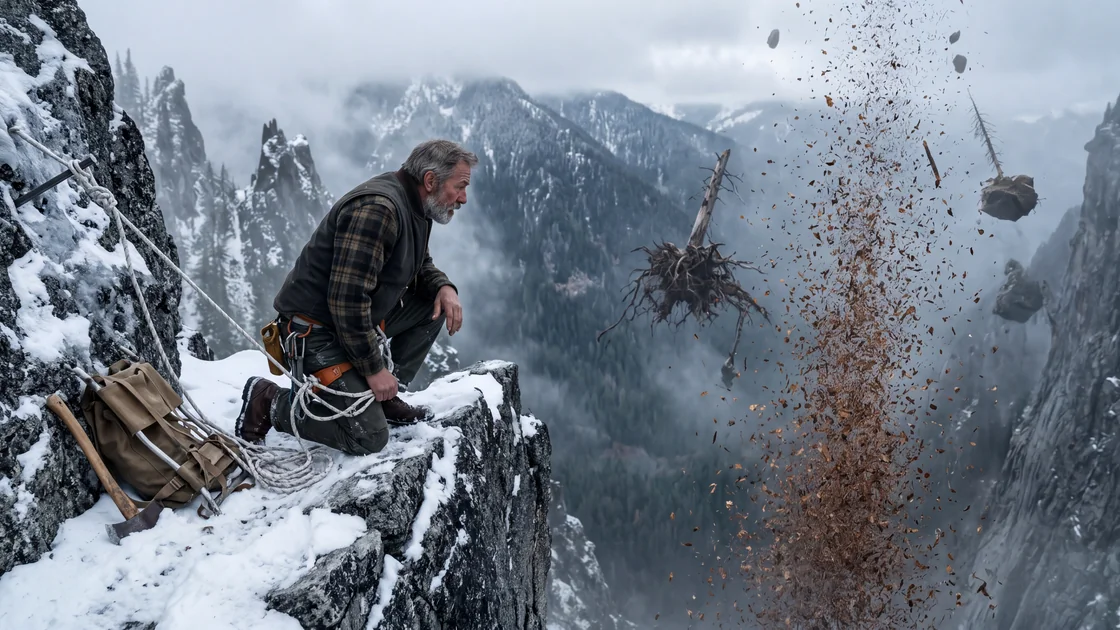
This is the story of Jesse Vance, an aging backcountry ranger in the northern reaches of the Bitterroot Range, who, while investigating the sudden silence of a remote watershed, discovered a hidden glacial cirque where the laws of gravitation had fractured. Within this nameless granite bowl, the earth released its hold on all loose matter, sending centuries of fallen lodgepole and ponderosa needles, river gravel, and dry autumn leaves drifting upward in a vast, silent fountain into the low-hanging mountain clouds. Caught between his duty to report an impossible geographical anomaly to a world that would inevitably dissect and destroy it, and his own profound grief following the death of his wife, Jesse spent four solitary weeks living at the precipice of the inversion, constructing a series of perilous tethers to descend into the sky, where he found both the terrifying fragility of the physical world and a quiet, weightless absolution.
I. The Margin of the Map
The radio at the Elk Creek Ranger Outpost did not fail with a burst of static; it simply died in the middle of a syllable.
Jesse Vance had been leaning over the zinc sink, scraping the black grease of three days’ bacon from the bottom of an iron skillet with a piece of pumice, when dispatch out of Orofino had begun reading the mid-week fire-weather outlook. It was late October. The tamaracks had already dropped their gold along the creek bottoms, turning the dark spruce benches into patterns of tiger-stripe rust, and the high country smelled of frozen loam, wet horse hair, and the sharp, vinegar tang of rotting alder.
"...winds east-northeast, eight to twelve knots along the Selway crest," the voice of Karen Lind had said through the five-inch speaker, her voice flat and rhythmic with the cadence of someone who had spent thirty years translating the moods of the atmosphere into standardized dispatch forms. "Barometric trend falling slowly from three-zero-point-one-two. All wilderness personnel are advised that Compartment Seven trail clearings are suspended until the pack string returns from—"
Then the speaker clicked. Not the sharp crackle of an antenna struck by dry lightning, nor the dying wheeze of a dry-cell battery losing its alkaline heart, but a soft, wet drop, like a lead sinker falling into deep lake mud.
Jesse paused with the pumice suspended between his calloused fingers. The grey light of six-thirty in the morning was barely sufficient to show the grain of the fir planks in the outpost floor. Outside, the horse in the small log corral, an old dun gelding named Buster whose knees were as swollen as burl knots, gave a single, low snort that stopped short of a whinny.
Jesse walked to the corner desk, his grease-stained wool socks making no sound on the floorboards. The dial of the Motorola Micor was illuminated with its small, sickly green lamp, but the meter needle—which usually trembled with the phantom hum of atmospheric static from the Seattle marine bands—lay completely prone against its rubber stop on the left-hand pin. He tapped the glass with his knuckle. Nothing. He twisted the squelch knob back and forth until the potentiometer rasped internally; the silence remained total.
He did not immediately assume disaster. In the high Bitterroots, three ridges south of the Lochsa and eighty miles from the nearest paved two-lane, silence was the default state of the universe, and machinery was merely an opinion that the mountains frequently rejected. Telephone lines were torn down by moose in the willows; repeater towers on the high granite horns were crushed like tin cups by winter rime that built four feet thick on the windward struts; solar panels were coated in lichen or pecked through by raven fledglings with an appetite for silicone.
Yet there was a quality to this particular quiet that made him reach for his spectacles on the shelf above the fire logs.
Jesse was fifty-nine years old, with skin the color of salt-cured venison and eyes that had developed the squint peculiar to lookouts and sheep-hunters—eyes that spent more time focusing on ridges four miles distant than on print eight inches from his nose. For thirty-two years he had carried the green badge of the Forest Service in these drainages, long enough to remember when the wilderness was still measured in leagues instead of sections, and long enough to have watched the Service trade its pack saddles for spreadsheets and satellite monitors.
Since Martha had died four years back—her heart stopping quietly in her garden while she was pulling the last of the parsnips before the frost—he had volunteered for the late-season postings that nobody else wanted: the damp, cold months between the departure of the summer trail crews and the first eight-foot dump of snow that locked the gates until June. He liked the stove when the wood was dry birch; he liked the sound of the wind in the stovepipe; he liked the absence of voices explaining things that did not need explanation.
He set the skillet down, took his heavy flannel shirt from the peg by the door, and stepped out onto the porch.
The horse was standing by the corral rail, his neck stretched out toward the south, his upper lip curled up in the flehmen response, tasting the air. There was no wind. The smoke from Jesse’s cookstove chimney had not formed a plume; it had hung in a flat, milky pancake over the shake roof before drifting, unnaturally low, toward the creek.
Jesse looked south. Beyond the yellow lodgepole benches lay the wall of the crags: three jagged thousand-foot spires of grey quartz-diorite that separated the drainage of Elk Creek from the unmapped cirques of the North Fork of the Moose. The map there was mostly blank contours, compressed so tightly together that the brown lines merged into solid stripes of ink. There were no trails through those gaps; the blowdown was thirty years deep, a jumble of pick-up-sticks five logs high, covered in devil’s club and hidden sinkholes where a man could snap a tibia and lie until his pack rotted off his shoulders.
In the saddle between the second and third spires—a notch known locally as the Devil’s Scythe—something was wrong with the light.
It was not smoke. Smoke had body, a blue or white density that frayed at the margins and rolled with the convective currents of its own heat. Nor was it cloud, for the sky above was a high, thin sheet of cirrostratus that let the sun pass through as a pale, silver disk.
Between the granite walls of the notch, there was a column of dull, amber-green haze. It rose straight up, perfectly vertical, perhaps three hundred yards wide, rising from behind the ridge and piercing the belly of the cirrostratus without dispersing. It looked like a pillar of dirty amber glass, or a waterspout made of dry dust, standing utterly motionless against the dark rock.
Jesse watched it for five minutes. He went back inside, retrieved his eight-power Bausch & Lomb binoculars from the tin breadbox where he kept them safe from wood rats, and returned to the porch rail.
Through the glass, the column resolved into something that made his fingers tighten on the knurled center-focus wheel until his knuckles went pale.
It was not dust. It was not smoke. It was a dense, unending fountain of pine needles.
Millions of them. Tens of millions. They were rising from the hidden basin on the other side of the ridge with the steady, furious velocity of sparks drawn up a blacksmith’s chimney. They did not tumble or spiral as they would in a dust devil; they flew straight, needles pointed skyward like tiny green and copper darts, an inverted avalanche ascending into the stratosphere with a terrible, mechanical regularity.
Jesse lowered the binoculars. He heard the creek below the station—the cold, clear gurgle of water over gravel—and he heard the horse shift its weight in the mud. Everything in the meadow was subject to the same old, weary law that pulled water toward the sea and horse manure into the grass.
He stood there until his coffee grew a skin of cold grease on the kitchen table. Then he went inside, buckled his leather chaps over his trousers, pulled his cruising vest over his flannel, and took down his five-pound double-bit axe and his thirty-inch pack frame from their hooks.
"Just going up to the Scythe, Buster," he said to the horse as he tossed a flake of meadow hay into the feed trough. "Keep your ears up."
The horse did not look at him. It kept its yellow eyes fixed on the notch, where the mountain was bleeding its floor into the sky.
II. The Incline of the Unseen
The climb through the timber took five hours.
Jesse did not take the creek bed, though it was the gentlest grade; the water was already fringed with ice that would shatter under a boot and soak a wool sock to the skin within forty yards. Instead, he took the western shoulder through the hemlock, where the duff was thick and dry under the closed canopy. It was steep, brutal work for a man whose hip joints had begun to grind like ungreased wagon skeins, but he had the slow, rhythmic step of the old mountain men—a pace that looked like a crawl from a distance but never stopped for breath.
At three thousand feet above the station, the hemlocks gave way to the stunted, twisted forms of whitebark pine and subalpine fir. Here the ground was broken by slides of shattered granite, slabs the size of kitchen tables that had peeled off the face of the Scythe during the post-glacial freezes and lay tilted at the angle of repose, waiting for the weight of an elk or a careless man to send them rumbling into the gorge.
Jesse stopped beneath an overhanging horn of rock to grease his lips with lard from a small tin and eat a cold biscuit he had shoved into his pocket before leaving.
He took out his compass—a heavy, brass-cased pocket transit made by the Keuffel & Esser Company in 1914, which had belonged to his grandfather, an engineer for the Great Northern.
He opened the lid. The needle did not point north.
It did not point south, nor did it spin erratically as it did in the iron-rich deposits over near Iron Mountain. The needle was pinned hard against the cover glass, pointing up. The southern counterweight, the tiny coil of fine silver wire wrapped around the south end of the steel to balance the dip of the earth’s magnetic field, was dragged down against the brass floor of the well, while the northern diamond tip was pressed against the beveled crystal with such force that it appeared slightly curved under its own strain.
Jesse tilted the case ninety degrees, then upside down. The needle fought the pivots, scratching against the brass with a tiny, dry hiss that he could hear through the cold air.
"All right," he whispered. "All right, then."
He put the compass away and looked at the ground.
Ten yards ahead of him, where the scree slope flattened into a small bench before the final rise to the notch, the character of the terrain had changed. It was subtle, but to an eye that had spent forty years reading the slope of gravel to tell whether a trail would hold through a June runoff, it was as loud as a gunshot.
The small stones—shards of slate and quartz-diorite the size of plums—did not rest in the hollows between the larger rocks. They were balanced on their sharpest points.
A handful of coarse granite gravel, kicked up by the toe of his heavy White’s boots, did not rattle back down the slope. It flew forward, arching slightly, and then rose. It did not shoot away like a stone from a sling; it drifted upward at the speed of a dry thistle seed caught in a summer updraft, gaining speed as it cleared the height of his shoulders, then accelerating suddenly until it vanished against the grey glare of the sky.
Jesse knelt. He did not step onto the bench. He reached out with his gloved right hand and removed the glove with his teeth, stuffing it into his pocket.
The cold was sharp, about twenty-four degrees by his pocket thermometer, but when he extended his bare palm over the line where the gravel hovered, the air felt neither hot nor cold. It felt thin. It had the texture of the air inside an empty root cellar when the hatch is opened in the spring—a vacuum that seemed to draw the moisture directly out of the pores of his knuckles.
He picked up a dry fir cone from the duff behind him. It weighed half an ounce, grey and weathered, with the scales curled open from the previous autumn’s drought.
He held it out between thumb and forefinger over the line of the bench and opened his fingers.
The cone did not fall.
It hung there in the space between his knee and the granite gravel. It bobbed twice, like a dry cork dropped into a bucket of water, settling at an equilibrium point about fourteen inches above the stone. Then, as if an invisible thread had tightened from the clouds, it began to slide upward.
It rose past his face. He smelled it: the sharp, turpentine ghost of resin preserved in the wood. It passed the crown of his hat. At twenty feet, it hit a current of cross-air that should have tumbled it toward the canyon bottom, but the cone did not tilt. It maintained its orientation, stem down, apex up, and accelerated. Within four seconds it was a speck; within six, it was gone into the amber column that towered above the ridge.
Jesse pulled his hand back. He looked at his fingers. The hair on the back of his hand was standing straight up, each follicle pulled taut against the skin like the skin of a plucked goose.
He looked down at his boots. The heavy Vibram soles were planted firmly in the crushed hemlock needles on his side of the line. But five inches ahead, the needles were not lying down. They were standing on their heads.
The floor of the forest for three yards ahead was a carpet of vertical brown hair, every dry spine of lodgepole pine balanced upon its blunt end, vibrating with a high, tiny frequency that produced no sound Jesse could hear with his ears, but which made the fillings in his back molars thrum with a sour, metallic ache.
He stood slowly, his back pressed against the cold face of the diorite bluff behind him. He took his axe from the loop of his pack, held it by the hickory handle, and extended the steel head into the column.
The axe weighed five pounds. When the steel crossed the line, the weight vanished.
It did not merely become light; the poll of the axe dragged upward with a sharp, insistent tug that jerked his wrist against his forearm. The balance reversed completely. The handle, which had been a lever to control the heavy bit, became a tether holding down a five-pound bird that wanted to fly into the sun.
He pulled it back. The head dropped instantly, the steel ringing against a rock at his feet with a spark that smelled of sulfur.
"Great God," Jesse said.
The words did not echo. The sound went out of his mouth and seemed to be sucked straight into the sky, clipped off at the lips, leaving the silence behind it larger and colder than before.
III. The Basin of the Ascending Spire
He crawled the last thirty yards to the crest of the Devil’s Scythe on his belly, using his elbows and the toes of his boots, keeping his mass pressed into the fissures of the native granite where the root-anchors of old alpine willows still held the soil.
When his chin cleared the knife-edge of the ridge, he looked down into the hidden cirque that the old maps called the Moose Lake Pothole.
There was no lake.
If there had ever been one, the basin had disgorged it centuries ago, or perhaps the water had never been allowed to gather. What lay below him was an amphitheater of grey rock, roughly three-quarters of a mile in diameter, ringed on all sides by vertical cliffs that dropped twelve hundred feet from the divide to a floor of white, water-swept gravel.
Except the gravel was not being swept by water.
The entire floor of the cirque was in motion, but it was not a landslide. It was an exhalation.
Across the circular floor of the basin, the forest had died not by rot, but by unmooring. Thousands of trees—huge, ancient Engelmann spruce and mountain hemlocks that must have stood since the Little Ice Age—lay not on the ground, but were suspended in the air.
They did not float loosely like driftwood on a pond. They were arranged in a great, tapering colonnade that reached from the floor of the cirque to the cloud level, hovering at various altitudes according to their mass and dryness.
The deadfall had risen until the balance of its weight and the mysterious upward draw of the void found their centers. Near the bottom, fresh slabs of granite, torn from the valley floor with roots and black earth still clinging to them, hovered six feet above the scars they had left in the bedrock. Above them, a stratum of lighter boulders—shattered quartzite, grey schist, drifts of rounded river pebbles—hung in a vast, stationary sheet like an explosion caught by a high-speed lens.
And through them, through this suspended archipelago of shattered stone, rose the needles.
They were coming off the dead trees in long, winding ribbons, like wool being carded from a spindle. Every dead branch of every suspended hemlock was shedding its russet coat. The needles streamed off the twigs in brown braids that braided together as they rose, converging toward the center of the cirque where the amber column he had seen from the valley outpost was rooted.
It was not a storm. There was no wind. The air on Jesse’s face was as dead and cold as the air inside a tomb.
The only sound was the frou-frou of millions of dry conifer needles brushing against one another as they accelerated—a sound like the dragging of silk skirts across a dry floor, or the rustle of a plague of grasshoppers moving through August wheat.
Jesse lay on his stomach, his chin resting on the granite lip, his fingers hooked into a crevice where a dwarf juniper clung to life.
He looked directly beneath him.
Directly below the knife-edge where he lay, the mountain did not slope down into a normal scree apron. The cliff curved inward, undercut by some ancient glacial plucking, forming an overhanging roof that shadowed the northern rim of the cirque.
In that shadow, something was rising that was not gravel.
It was an elk.
It was an old bull, an eight-pointer, dead perhaps two days. It had not been torn by wolves or scavenged by bears; it was whole, its winter coat thick and grey-brown, its antlers tipped with ivory points. It was rising through the hemlock canopy fifty feet below the rim, floating belly-up, its legs stiff and reaching toward the sky like four weathered fence posts.
It rose with a stately, terrifying dignity, turning slowly on its vertical axis once every thirty seconds, its heavy head dipping slightly under the weight of the horn-spread.
Jesse watched it pass his position. It was no more than twenty feet out from the rock face. He could see the milky cloud over its glazed eyes; he could see the frost that had formed on its whiskers; he could see the dry gravel embedded in the cleft of its hooves.
As it cleared the level of the ridge, it entered the faster current of the central column. The elk did not break apart. It simply tilted, head upward, as if it were leaping over an invisible log in the sky, and then it gathered speed.
It went up through the pale silver belly of the cirrostratus clouds. Jesse followed it with his eyes until it was no larger than a horsefly, then a flea, then a dark speck that was swallowed by the flat white ceiling of the world.
He laid his head down on his arms. The stone beneath his forehead was cold, hard, and real. It smelled of sulfur and dry lichens. It was five billion years of gravity, four billion years of things staying where they were put, and it did not move.
He stayed there until the sun turned the clouds over the Pacific slope to the color of cold tallow.
His boots were frozen to his socks; his fingers were stiff yellow claws. He knew that if he stayed on the ridge, the night frost would take his toes before midnight.
Yet he did not want to move. The thought of going back down the five hours of deadfall to the Elk Creek station—to the silent Motorola, to the cold skillet, to the empty room where Martha’s sewing basket still sat on the radio cabinet with her bone-handled shears and her three spools of green button thread—felt like a descent into an iron trap.
The world down there was heavy. It was so heavy that a woman’s heart could simply crush itself under the weight of eighty pounds of atmosphere and seventy years of carrying water from the spring. Down there, everything was falling down: the leaves fell into the mud to turn black; the snow fell and broke the roofs; the gravel washed into the rivers and choked the salmon; the bodies of people you loved went down six feet into the clay and stayed there while the grass roots went through them.
Here, things went up.
He pulled himself backward by his elbows, an inch at a time, until he was ten feet from the knife-edge, back on the bench where the gravel was still balanced on its points.
He stood up. He did not feel afraid. He felt a strange, cold lightness in the pit of his diaphragm, the feeling he had had forty years ago when he had jumped from the skid of an old Bell helicopter onto a fire line on the Middle Fork with forty pounds of tools on his back—that split second between the jump and the landing where the earth had not yet made up its mind about what to do with him.
"I’ll be damned," he told the pines.
The needles did not answer; they simply rose, one by one, five by five, thousand by thousand, embarking on their long journey to the stars.
IV. The Mechanics of the Void
He returned to the outpost in the dark, finding his way down the ridge not by the beam of his five-cell flashlight—which died an hour down the slope, its dry cells drained by the field—but by the memory of his boots and the white trunks of the birch trees that marked the old horse trail along the creek.
He did not light a lamp when he reached the cabin. He worked by the red light of the woodbox embers.
He was methodical. A wilderness ranger who does not possess method does not survive thirty seasons; he gets turned around in a November blow, or he cuts his own femoral artery with an axe forty miles from a surgeon, or he lets his matches get damp and dies of hypothermia while holding a dry candle.
Jesse did not touch the radio. He did not write in the station logbook that lay open on the desk with its blue lines waiting for the daily entry: Oct 24. Patrol to Devil’s Scythe. Trail clear to mile 4. Weather fair.
Instead, he went into the tack shed behind the cabin.
From the leather-scented darkness he dragged out two five-hundred-foot coils of seven-sixteenths nylon climbing rope—static line that had been dropped by the smokejumper rescue units five years before during the search for a downed Cessna on the Crags and had sat since then in an oiled cedar chest. He inspected every foot of it by the light of a kerosene lantern, running the white braid through his palms, feeling for soft spots, sheath slippage, or dry-rot.
He found three steel pickets used for anchoring high-lead cables, a heavy four-pound drilling hammer, two alpine harnesses with forged steel D-rings that the trail crews had used when scaling the loose rock off the Moose Creek cliffs, and six large screw-gate steel carabiners, each stamped with an eight-thousand-pound test mark.
He loaded these into two canvas pack bags, along with six cans of sardines, three tins of pilot bread, his down sleeping bag, a small primus stove, and two one-gallon canteens of spring water.
He walked to the corral.
The gelding came to the rail, its breath blowing white in the lantern light. Jesse rubbed the dry space between the horse’s ears.
"You’re going down to the lower meadow, Buster," he said softly. "I’m opening the drift gate. There’s three tons of standing fescue down in the bottom that hasn't seen an elk since September. Don’t you stay up here by the station."
He led the horse through the gate, slapped its rump with the flat of his palm, and watched it trot off into the dark, its shoes striking sparks from the flint river-stones. The sound of its bells faded down the trail toward the lower country, toward the ranches on the Clearwater where people were turning on their televisions and checking the oil levels in their sedans.
Then Jesse shouldered the pack frame—eighty-five pounds of rope and steel that made his spine compress until his knees popped—and began his second ascent of the mountain.
It was four in the morning when he reached the Devil’s Scythe for the second time.
The amber column had changed in the night. The clouds had dropped, and now a dense fog, saturated with the smell of high-altitude ozone and pulverized needles, lay over the notch.
In the dark, the inverted avalanche was luminous.
It was not bright, but each dry pine needle, rubbing against its neighbors at twenty miles per hour as it rose from the floor of the cirque, had developed a coat of pale, greenish St. Elmo’s fire. The column was a pillar of cold, phosphorescent hair, twelve hundred feet high, humming like a turbine in a cellar.
Jesse did not hesitate. He had thought it through during the long climb through the hemlocks.
He found a massive horn of solid granite—a rib of bedrock six feet thick that projected from the ridge like the bollard of a wharf—twenty yards back from the threshold of the inversion.
He set his pack down. With the drilling hammer and the steel pickets, he drove three points of steel into the natural frost-wedges of the rock, driving them home until the hammer rang with the high, dull clink that meant the steel was bottomed in solid quartz.
He equalized the three pickets with loops of one-inch tubular webbing, tied a figure-eight on a bight in the end of the first five-hundred-foot coil of static line, and clipped it to the master point with three opposing carabiners.
He tied the other end to the harness he had buckled around his thighs and hips.
He checked the harness three times: the buckles doubled back through the friction bars, the leg loops snug over his wool pants, the chest strap cinched across his cruising vest so that if he were inverted, he would not slip out of the seat like an eel out of a skin.
He stood at the edge of the bench.
The pine needles were still standing on their heads around his boots, like millions of spectators waiting for a procession.
"Well, Martha," he said to the fog.
He did not look down. He did not look up. He took one step forward.
V. The Fall into the Deep
The first sensation was not of falling. It was of being seized.
It was as if he had stepped into a vat of cold, viscous oil that moved in the wrong direction.
His feet did not drop toward the stones of the cirque floor; they were whipped upward, over his head, with a violence that made his ribs groan against the chest harness. For a terrifying two seconds, he was upside down, his boots kicking at the grey sky, his face looking directly down at the twelve-hundred-foot cliff he had just abandoned.
Then the static line came taut.
The rope did not jerk him like a gallows drop. Because the gravity was reversed, the rope was not catching a falling weight; it was anchoring a buoy that had been pulled under water.
The harness dug into the fleshy parts of his buttocks and the crests of his pelvic bones with a steady, hydraulic lift. Jesse hung forty feet out from the cliff face, suspended horizontally in the amber current, his arms trailing behind him like the fins of a sculpin in a mountain brook.
He cried out, but the sound was stripped from his tongue and carried up into the clouds before it had cleared his lips.
Around him, the world was moving with an astonishing, terrifying speed.
The needles were not sparse here; they were an ocean. They struck his canvas vest, his leather chaps, the wool of his sleeves, with a dry, continuous hiss like the sound of salt thrown into an open fire. They were cold, but they smelled intensely sweet—a concentrated extract of five centuries of mountain autumns, distilled into an upward river of turpentine, cedar-gum, and dry mold.
He reached out with a gloved hand and closed it.
When he opened his palm, three dozen ponderosa needles were pressed against the horsehide. They did not lie there. The moment his fingers parted, they rose vertically off the leather like iron filings lifted by an electromagnet, their pointed tips leading the way, disappearing into the mist above.
He tilted his head back—or down, for his body no longer understood the difference.
Above him—where the earth should have been—was the inverted floor of the cirque.
Seen from this perspective, it was a terrifying ceiling of shattered white diorite, scarred with the round, pale holes where the boulders had been pulled loose. The roots of the dead trees reached toward him like the legs of drowned spiders.
He could see the amphitheater in its entirety now: it was not merely the floor of the cirque that was inverted. It was a perfect cylinder of space, nine hundred yards across, extending from the bedrock up to an unknown height in the sky.
Outside the cylinder, twenty yards to his left, he could see the cliff wall.
The division was as sharp as the edge of a timber cut.
On the left, outside the field, a small seep of water was trickling down a black moss-covered slab of granite, dripping down, drop by drop, toward the valley floor twelve hundred feet below, exactly as water had done since the mountains were pushed out of the sea.
On the right, six inches away, the spray from that same seep was not falling. The moment a drop of water detached from the moss and was caught by the air of the cylinder, it was seized by the upward draw. It transformed into a silver bead, paused for a fraction of an instant as if considering its lineage, and then shot straight up into the clouds like a lead shot fired from an air rifle.
Jesse reached to his chest harness. He had rigged a Petzl Grigri—a self-braking descender—into the master line so that he could pay out rope and let himself "rise" deeper into the sky.
He laid his hand on the lever.
His heart was hammering against his ribs with the frantic, irregular thump of a grouse drumming on a rotten log. His fingers were shaking so violently that he could scarcely clear the safety catch.
"Go on," he said to himself. The words were small and grey, but they were his own. "Go on, then."
He pulled the lever.
The rope hissed through the cam.
He did not drop. He rose.
He soared thirty feet, fifty feet, eighty feet into the white fog, moving upward through the stratum of suspended deadfall.
He passed a thirty-foot mountain hemlock that hung motionless in the void. Its root-wad, twelve feet across and caked with dried clay that had turned to white powder, was positioned toward the sky; its broken top pointed toward the earth below.
Jesse drifted past its middle branches. A pair of mountain chickadees were clinging to the upside-down twigs. They were not dead. They were sitting with their feathers fluffed against the cold, their little black-capped heads turning to watch him pass with the mild, incurious indifference of birds that have lived through a change in the weather.
They did not fly. When one of them hopped from a twig, it did not fall into the cirque; it hopped upward, caught the next branch five feet higher, balanced itself with a quick flutter of its grey wings, and began to search the cracks in the bark for bark-beetle larvae.
Jesse let out another hundred feet of line.
He was now three hundred feet above the ridge. The mountain had ceased to look like a mountain; it was a dark, jagged coast seen from the sea, receding below him into a floor of white cloud that was not cloud at all, but the lower boundary of the normal atmosphere.
He was in the needle stream.
It was thicker here. The amber light had intensified. The needles were not rising at random; they had organized themselves into long, spiraling ribbons that wound around the central axis of the cylinder like the rifling in a Springfield barrel.
They brushed his face with dry, sharp whispers. They caught in his grey beard; they drifted under his collar; they filled the pockets of his cruising vest with little bundles of dry pine-tallow.
He stopped his ascent with the cam. He was four hundred feet out on the rope.
The silence here was absolute. It was not the dead silence of the outpost cabin, nor the menacing silence of the ridge. It was the vast, indifferent silence of the interplanetary spaces—a silence that seemed to have been waiting behind the screen of gravity since the first day of creation, waiting for a crack in the floor through which it could breathe.
Jesse looked down at his boots.
Beneath them, eight miles to the south, he could see between two breaks in the cloud sheet.
He saw the Selway River.
It was a silver wire, infinitely thin, infinitely distant, winding through its purple canyon of cedar and hemlock. He saw the white roof of the lookout on Moose Peak, no larger than a grain of table salt. He saw the round, brown domes of the mountains rolling away toward the Salmon River Breaks, ridge after ridge, wave after wave of iron and stone, holding up the sky with their immense, dumb, ancient patience.
And then he looked up.
Above him, three hundred feet higher, where the rope ended in the belly of the cloud, there was an island.
VI. The Skyward Moraine
It was not a cloud. It was a raft of earth.
It hung at the equilibrium point of the anomaly, roughly seven hundred feet above the floor of the cirque—a mass of turf, granite boulders, and ancient sod the size of a city block, held together by the matted roots of heather and bearberry.
It had not fallen up; it had risen there, perhaps centuries ago, when the inversion had first opened in the floor of the cirque, lifting the entire topsoil of the basin in a single, circular plug before the rock had been stripped clean down to the diorite pavement.
The island hung motionless in the grey light, surrounded by its court of suspended trees and its ascending halo of needles.
Jesse worked the Grigri lever, paying out the remaining hundred feet of his first coil.
When his boots touched the under-surface of the island—which was actually its upper surface, covered in dry alpine turf that had died long ago and been cured by the high, dry cold into the consistency of peat—his knees buckled.
The gravity did not reverse back to normal. The island was simply another body held in the same upward tension as his own.
He did not stand on it; he pressed against it from below, his boots finding purchase in the matted roots of the heather, his head pointing toward the distant earth, his heels held against the sod by the upward draw of the void.
He tied off the Grigri, clipped his backup safety hitch into the root-mass of a mountain willow that had been dead for two hundred years, and unhitched his pack frame from his shoulders.
The pack did not fall. It hovered at his chest like a dog waiting for a biscuit.
He sat down—or rather, he wedged himself beneath the low overhang of a granite boulder that projected from the sod-mass—and let his legs dangle into the seven-hundred-foot gulf between him and the cirque floor.
He reached into his pocket, took out his tin of sardines, and peeled back the lid with the little brass key.
The oil in the tin did not spill. It rose in three clear, yellow spheres from the surface of the fish, hovered two inches above the tin like tiny amber marbles, and then, caught by the updraft, drifted away into the fog, followed by the silvery tails of two small fish that had broken loose from the pack.
Jesse ate the rest with his fingers, chewing slowly, his eyes fixed on the distant Selway.
He was not afraid.
The fear had stayed down in the valley, in the tack shed, with the dead radio and the horse that had only three more winters in its knees. Here, there was no weight. His limbs felt long, light, and hollow, like the bones of an osprey.
The ache in his right hip, which had made him limp every morning since the winter of the big snow on the North Fork thirty years back, had vanished. The skin across his cheekbones felt smooth and cool.
He reached into the inner pocket of his cruising vest—the pocket where he kept his badge when he was off duty, his timber tally book, and his extra spectacles.
He pulled out a small leather folder containing three photographs.
One was his father, taken in 1910 at the Great Northern yards in Whitefish: a broad-shouldered man with a grease-spotted cap, standing on the footboard of a 4-6-2 Pacific with an oil-can the size of a tea-kettle in his hand.
The second was the crew of the Moose Creek Ranger District in the summer of 1962: eight young men in stagged dungarees, sitting on the tongue of a supply wagon, their faces grinning through the dust of forty miles of trail clearing, every one of them dead now, or living in rest homes in Lewiston and Spokane, their knees ruined, their lungs full of chain-saw exhaust and hemlock dust.
The third was Martha.
It had been taken thirty-five years ago, on the porch of the old log cabin at the mouth of the Lochsa, before the highway had been paved with asphalt. She was wearing a blue gingham dress that she had made herself, her arms bare to the elbows, her brown hair pinned up with bone combs to keep it off the wet nape of her neck. She was holding a wooden tub full of wild huckleberries—eight quarts of them, black and shining like wet shoe-buttons—and she was laughing because Jesse had just told her that a black bear was standing behind the smokehouse, waiting for her to turn her back.
Jesse held the photograph between his thumbs.
The corners of the paper were silvered with age; the gelatin emulsion had developed that fine, spider-web crazing that comes to old portraits that have been carried through thirty seasons of rain, sweat, and stove-smoke.
He looked at her face.
He had looked at it every night for four years, by the light of tallow candles, kerosene wicks, and five-cell flashlights, trying to find in the flat grey chemicals of the paper the voice that had said, Jesse, bring me two armfuls of the dry tamarack, the biscuits are ready, or the hand that had reached out in the dark to touch his shoulder when the night wind had torn the stovepipe off the roof and the cabin was filling with hemlock smoke.
He had found nothing.
The photograph was just paper. It was heavy. It had the weight of the past—that terrible, inert weight that does not move, that accumulates on a man’s back like wet drift-snow, year after year, until he can no longer straighten his knees to look at the trees.
Jesse loosened his grip on the photograph.
The little paper rectangle did not drop into the abyss.
It lifted from his fingers.
It rose two inches, then paused, turning slowly on its axis, as the old bull elk had done.
Martha’s face turned toward him once, then toward the clouds, then toward the high Selway crest seven miles below. The paper was so thin, so dry, that it offered no resistance to the upward draft.
It did not accelerate instantly. It drifted with a slow, circular grace, rising through the colonnade of upside-down hemlocks, its white margins catching the pale amber luminescence of the ascending needles.
Jesse did not reach for it.
He sat with his knees drawn up against his chest, his hands clasped around his shins, watching her go.
She rose past the thirty-foot hemlock. She passed the two chickadees, who did not leave their twigs. She passed the suspended boulders, the drifts of river gravel, the ribbons of amber needles that wound around the central spire of the inversion.
She went up into the cirrostratus.
She was a speck; then she was a spark of white light where the sun, low on the Idaho-Montana line, caught the silver of the emulsion; then she was gone.
Jesse took a deep breath.
The air smelled of needles. It was cold, clean, and empty. He felt his ribs expand against his vest with an ease he had not known since he was twenty years old.
"All right, girl," he whispered.
He pulled his down bag from the pack frame, shook it out—it expanded instantly, its feathers floating inside the nylon baffles until the bag looked like a blue, inflated sausage—and slid his legs into it.
He did not sleep on the earth. He slept against the underside of the skyward island, his head resting on a pillow of dead bearberry roots, the rope around his waist humming its low, single note against the granite anchor sixty feet above.
Below him, through the long, freezing hours of the mountain night, the needles fell upward into the stars.
VII. The Boundary Line
He stayed on the island for twenty-two days.
A man cannot live indefinitely on pilot bread and sardines, but Jesse found that his body required almost nothing in the inversion.
Without the ceaseless, downward drag of gravity—the four thousand pounds of pressure that presses a man’s heels into the rocks with every stride, that forces his blood through four miles of vessels against the weight of his own meat—his pulse slowed to thirty-four beats a minute. His breath became a light, occasional sigh that barely fogged the wool of his muffler.
He caught his water from the silver beads that rose past his ledge from the mossy seep on the cliff face.
He would reach out with an empty canteen, its neck pointing down toward the valley, and hold it in the path of the rising spray. The water would strike the funnel of the opening and shoot into the interior, filling the tin vessel in three minutes with water so cold, so pure, that it tasted like distilled lightning.
His field logs, which he began to write on the back of old cruiser tally sheets with an indelible pencil, became shorter, their entries stripped of all administrative weight:
Oct 28. Fog total. No wind. Needles rising at approximately 18 mph. Counted twelve whitebark cones per minute passing the south ledge. The compass needle remains vertical. There is no sound.
Nov 2. The clouds cleared at noon. Saw the town of Pierce, forty miles NW. The smoke from the mill was drifting south, but the column from this basin does not drift. It enters the jet stream at approximately 14,000 feet and shears off toward the Great Plains. Somewhere over the Dakotas, it must be raining pine needles.
Nov 7. Three bull elk and two cows now suspended in the middle stratum. They do not decompose. The cold here is dry and continuous. They appear to be sleeping, their heads tucked toward their chests. Their antlers collect the rising needles like sieves.
Nov 11. I do not think I will go down.
On the fourteenth of November, the first true blizzard of the winter struck the Bitterroots.
It did not come from the west, as the autumn storms did, but down from the Canadian Barrens—a blue norther that dropped the temperature at the Elk Creek station to thirty-five below zero in six hours and brought four feet of powdery, dendritic snow on a gale that leveled forty square miles of jack-pine along the Clearwater.
On the island, Jesse felt the storm not as a wind, but as a change in the weight of the sky.
The cylinder of the inversion was immune to the horizontal blast of the norther. Outside the circle, the blizzard shrieked against the granite spires of the Devil’s Scythe, tearing fifty-foot limbs from the whitebarks and plastering the north faces of the cliffs with four inches of hard blue rime.
Inside the circle, the snow did not fall.
It rose.
The flakes, drawn from the valley floor where the drift had begun to accumulate, were swept into the cylinder and transformed into an upward blizzard.
It was a spectacle that Jesse watched for eighteen hours without moving.
The white needles of the snow met the green and amber needles of the pines in mid-air. They did not collide and break; they braided together into a towering, crystalline cord that reached from the floor of the cirque to the top of the troposphere—a column of white and copper light that illuminated the entire mountain range in the dark.
The snow flew upward with such fury that the air became opaque. Jesse was enclosed in a small, spherical world of white silence, suspended seven hundred feet above the earth, his beard frozen into a solid shield of ice, his eyes stinging with the cold luminescence of the frost-crystals.
And then, in the middle of the third night of the storm, the tether gave a single, dull thrum.
Jesse reached out in the dark.
The static line—his seven-sixteenths nylon lifeline that connected him to the granite horn on the Devil’s Scythe—was vibrating with a new frequency.
It was not the high, clean note of tension; it was a rhythmic, chattering jerk that meant one thing to a man who had worked high-lead cables: the anchor was failing.
The frost was working in the fissures of the diorite.
The three steel pickets he had driven into the rock were being pried loose by the expansion of the ice. The diorite, shattered by millennia of freezes, was splitting along its cleavage planes under the six-hundred-pound upward pull of Jesse’s island encampment and his own body.
He sat up in his down bag.
The rope groaned. He heard—faintly, across the four hundred feet of void—the sharp, dry tock of a steel picket levering out of stone.
One.
Then, four seconds later: tock.
Two.
Only the center picket remained. It was a three-quarter-inch octagonal bar of high-carbon drill steel, driven fourteen inches into what he had thought was the living spine of the mountain. But the mountain was no longer living; it was being plucked apart by its own silence.
If the last picket went, the rope would not drop him.
It would release him.
He would not fall into the cirque. He would leave the island. He would rise through the cloud ceiling, through the jet stream, through the thin, blue ozone where the stars were visible at noon, trailing his five hundred feet of white static line behind him like the tail of a kite, until the cold took his breath and his blood turned to red frost inside his veins.
He laid his hand on the rope.
He could feel the third picket turning in its hole. It was loose. It was rattling like an old tooth in a skull.
He had sixty seconds.
He could take his pocketknife—the three-bladed Stockman he had carried since his father had given it to him at the depot in Whitefish—and open the sheepfoot blade. He could cut the static line above the Grigri.
He would stay with the island.
Perhaps the island would remain here, suspended at its balance point, until the mountains themselves were ground down to sand by the glaciers of some future age. He would become like the old bull elk—dry, whole, unrotted, his face turned toward the Selway, his hair full of the amber needles that never ceased to rise.
Or he could pull the Grigri lever.
He could haul himself down the rope, hand over hand, foot over foot, fighting the upward draw with the strength of his arms, dragging his body down into the weight, down into the gravity, down into the cold mud and the dead needles that lay at the bottom of the world.
He looked up—down—at the storm.
Through a rift in the ascending snow, he saw a light.
It was not a star. It was too low, too yellow, too small.
It was seven miles to the north, at the mouth of Elk Creek.
It was the lamp in the kitchen of the outpost cabin.
Someone had arrived.
A pack string had come up from the Selway, breaking through the four feet of drift-snow with four-horse teams and snowshoes. Someone had found the dead radio; someone had found the empty corral; someone had lit the kerosene lamp on the zinc sink and was putting dry birch into the cookstove, waiting for Jesse Vance to come down off the mountain with his axe and his tally book.
He saw the light flicker.
It was tiny. It was an ember that could be snuffed out by a wet thumb. It had the weight of seventy years of carrying water, of five-pound axes, of boots that wore out at the heels, of graves that had to be dug through two feet of frozen clay with a mattock and a bar.
The rope gave a third jerk.
The last picket had slipped two inches. He heard the steel scrape against the quartz crystals in the crevice—a high, dry scream of iron under strain.
Jesse reached to his belt.
He did not take out the knife.
He gripped the static line with both wool-mittened hands, set his boots against the underside of the skyward island, and pulled.
VII. The Descent to Weight
The journey down the line took three hours.
Every foot of rope had to be conquered. The inversion did not want him to return. It held him by his shoulders, by his hips, by his boots, with the steady, hydraulic stubbornness of a whirlpool that does not want to yield its driftwood.
His arms burned with a dull, iron fire that turned his biceps to water. His fingers, locked around the seven-sixteenths nylon braid, grew so numb that he could not tell whether he was holding the rope or whether his bones were simply hooked over the fibers like butcher’s meat on a rack.
The needles fought him.
They were no longer companions; they were an ascending torrent of spears that drove into his eyes, his nostrils, his ears, tearing at the wool of his shirt, stripping the skin from his knuckles where his mittens had worn through against the rock.
Twenty feet from the ridge, the last picket gave way.
With a sound like a rifle shot, the drill steel pulled from the fissure.
The rope did not go slack; it went loose.
Jesse felt the master anchor whip past his shoulder—a three-pound cluster of iron pickets and steel carabiners that shot straight up into the clouds like a plumb-bob dropped into an abyss.
He reached out with his right arm.
His fingers caught the horn of diorite.
It was the native rock—the living bone of the Bitterroot Range, cold, rough with black lichen, anchored sixty miles deep in the basalt roots of the continent.
He hooked his elbow over the spur.
His legs were trailing in the sky, pulled straight out behind him by the twelve-hundred-foot draft of the cirque, his boots vibrating in the current like the tail-fins of a trout held in a mill-race.
He pulled his chin toward the stone.
He dug the toes of his White’s boots into a fissure that was not in the inversion—a crack four inches to the left of the line, where the snow was lying flat and heavy on the granite scree.
His left foot found purchase.
He felt the weight.
It hit him like an anvil dropped upon his neck.
It was the weight of his fifty-nine years; it was the eight-pound pack frame; it was the blood in his arteries rushing toward his boots; it was the iron of his axe, the water in his canteens, the grease in his joints, the memory of his wife’s face when she had turned to him on the porch thirty-five years ago and said his name.
It was so heavy that it drove the air from his lungs with a ragged, bloody cough.
He fell forward onto the scree, his face burying itself in four feet of powdery northern snow.
He lay there for a long time, his fingers hooked into the frozen lichens, his body pinned to the mountain by the old, weary law that had held the stars together since the beginning of time.
Above him, three feet over his head, the needles were still rising.
They did not stop. They would never stop. They would rise until the basin was hollowed out to the mantle of the earth, or until the sky fell down to meet them.
Jesse did not look back.
He pulled his legs out of the current, one by one, dragging them across the threshold into the deep snow of the normal world.
He lay on his back, looking up at the grey sky where the blizzard was howling across the Scythe.
The snow was falling on his face.
It was falling down.
It fell on his cheeks, on his beard, on his closed eyelids, heavy, wet, and cold, melting against his feverish skin and running down his temples like tears that had taken forty miles of mountain trail to find their way home.
IX. The Return of the Cruising Vest
They found him three miles above the station, at the crossing of the middle fork of Elk Creek.
It was Karen Lind herself who had come up with the pack string, accompanied by two young state troopers from Grangeville who carried their carbines at the ready and looked at the eight-foot drifts with the wide, white eyes of men who had never been beyond the reach of a county maintainer.
Jesse was sitting on a downed spruce log, his five-pound axe resting across his knees, his hands tucked into his armpits to keep the frozen stumps of his fingers warm.
He had lost his pack frame. He had lost his ropes. His cruising vest was torn to ribbons at the shoulders, and his beard was so full of dry pine needles that he looked like an old root that had been dragged out of a swamp.
The two troopers stopped twenty paces back, their hands on their holsters, their breaths rising in short, white gasps.
"Ranger Vance?" one of them called out, his voice thin against the sound of the creek. "Jesse Vance?"
Jesse looked up.
His eyes were very clear. The squint was gone; they were wide and dark, like the eyes of an animal that has lived in a deep cave and has forgotten that there is such a thing as kerosene.
"You boys don't need those guns," he said. His voice was cracked, like two dry shingles being rubbed together. "There’s nothing up here that wants to be shot."
Karen Lind stepped past the troopers, her snowshoes making a dry crump-crump in the drift. She looked at his face; she looked at his hands; she looked at the ridge behind him, where the clouds were hanging low and black over the Scythe.
"The radio died, Jesse," she said simply. "We thought you were under the blowdown on Compartment Seven."
Jesse stood up.
He felt his weight. It was enormous. It was an iron mountain that he had to carry on his two boots, every step an argument with the center of the earth.
He leaned on his axe handle until the hickory bowed.
"The radio didn't die, Karen," he said. He took a handful of dry needles from his pocket—copper-colored, scented with cedar-gum and ozone—and let them fall.
They did not float.
They dropped into the snow at his feet, making five tiny, grey punctures in the white crust, and stayed there.
"The radio just didn't have anything to say that the mountains hadn't already heard," he said.
He walked past the troopers, his boots dragging through the four-foot drift, his shoulders hunched against the snow that was falling from the hemlock boughs, his face turned toward the valley where the smoke from the outpost chimney was rising—slowly, heavily, with great effort—into the cold, dark floor of the afternoon.