Where the Sleepless Run
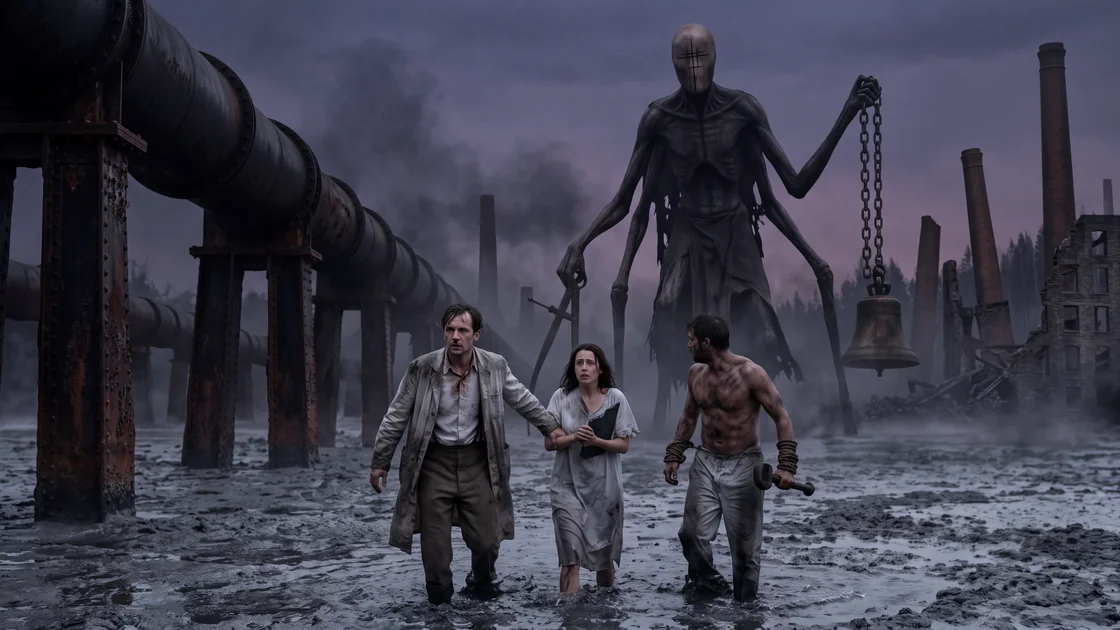
Dr. Julian Mercer, a somnologist at an experimental psychiatric clinic, discovers that several unrelated patients suffering from severe parasomnia are not merely hallucinating similar nightmares, but are physically inhabiting the exact same subterranean dreamscape. When physical abrasions and environmental residue begin crossing the boundary between sleep and wakefulness, Julian utilizes an experimental neuro-synaptic bridge to project his own consciousness into the landscape. Inside, he finds a desolate city constructed from iron, ash, and petrified bone, where his patients are being hunted by a towering, faceless entity that feeds upon their terror and seeks a biological conduit into the waking world.
Act I: The Geometry of Terror
The recording tape in Room 4B hissed like steam escaping through a frozen radiator.
Dr. Julian Mercer leaned forward, pressing the foam padding of his headphones against his temples until the plastic headband pinched his scalp. Outside the observation glass, the sleep ward of the Highfield Institute for Applied Somnology was submerged in thirty-cycle amber light. It was an unnatural hue, specifically calibrated by the German lighting engineers to preserve circadian chemistry while allowing the clinical staff to navigate the narrow corridors without tripping over the umbilical bundles of monitoring cables.
On the central cathode-ray screen, Elena Vance’s vital signs flickered in phosphor green.
Heart rate: 142 beats per minute. Blood oxygen saturation: 91 percent. Electroencephalogram: a violent, jagged sawtooth that defied every classical classification of rapid eye movement sleep.
"She’s spiking again, Julian," Nurse Miriam Holt said, her voice dry from hours of drinking burnt chicory coffee from a thermos. She sat to his left, her fingers poised over the calibrated sliders of the Nihon Kohden polygraph. "Frontal lobes are running cold, but her motor cortex is lighting up like a munitions factory. Look at that delta-theta drift. She shouldn't be dreaming. She should be comatose."
Julian adjusted the audio gain. Beneath the hiss of magnetic tape, Elena’s voice came through the boom microphone suspended six inches above her mouth. She was thirty-two, an architectural draftsman who had checked herself into Highfield three weeks ago after losing forty pounds and half her hair. Her eyes were taped shut with medical silk to prevent her from scratching her own corneas during the spasms.
"The ground is cold," Elena whispered. Her vocal cords were so desiccated that the words sounded like dry leaves scraping over slate. "The salt... it gets into the seams of my shoes. If I stop, the bell rings. Julian, don't let him pull the chain."
"She’s addressing you," Miriam murmured, glancing sidelong at the doctor. "She’s never done that before. Julian, she’s under fifty milligrams of phenobarbital."
"I know what she was given," Julian said softly. He didn't take his eyes off the glass.
In the bed, Elena did not look like an architect. She looked like a drowned effigy. Her wrists were secured to the cold-rolled steel rails of the hospital cot with double-ply leather cuffs—not out of cruelty, but because during her third night at Highfield, she had managed to pry off her own fingernails against the acoustic plaster of the wall while attempting to "dig a trench for the water."
"He's walking past the cistern," Elena breathed. Her respiration hitched, a sharp, wet gasp that caused the stylus on the polygraph to slam against its brass mechanical limiters. Click-clack. Click-clack. "His sleeves are wet. He smells like wet copper and lime. He’s looking for the door with the iron latch. Marcus... Marcus is already behind the well."
Julian froze. His thumb remained pinned against the tape deck's plastic toggle.
"What did she say?" Julian asked.
"She said 'Marcus,'" Miriam replied, her brow furrowing under her graying bangs. "Who is Marcus? Does she have a brother?"
"No," Julian said. His voice dropped into a register that made the hairs on Miriam’s forearms stand up. "Marcus Reed is in Room 7C. He checked in thirty-six hours ago through the emergency intake at St. Jude’s. Acute terrors, atypical motor fugue, resistant to neuroleptics."
"Did they meet in the dayroom?"
"There is no dayroom access for acute parasomniacs, Miriam. You know the protocol. Elena hasn't left that room since Tuesday. Marcus has been under continuous observation in the north wing since his intake."
Julian stood up, the vinyl cushions of his swivel chair groaning under the shift in weight. He was tall, gaunt at thirty-eight, with the hollowed-out look characteristic of men who studied other people's unconsciousness at the expense of their own. His lab coat was perpetually crumpled, smelling faintly of tobacco and the silver-nitrate emulsion used to develop neurological film plates.
He walked past the central console toward the bank of secondary monitors on the western wall. Highfield was an old building, an Edwardian brick monolith originally built to house victims of shell shock after the First World War, later retrofitted with miles of shielded coaxial cable, lead-lined conduits, and the bulky, temperamental computing equipment of the late 1980s.
On the screen labeled BED 07—REED, M., the green wave was identical.
Not similar. Not merely convergent in frequency.
Julian pulled a transparent plastic drafting ruler from his breast pocket and laid it across the glass of Marcus Reed’s monitor, then stepped back to compare it to the tracing coming off Elena Vance’s machine. The micro-volt spikes—three high-amplitude peaks followed by an irregular trough that dipped into total electro-cerebral silence for seven-tenths of a second—matched to the millimeter.
"Miriam," Julian said, his hand trembling slightly against the ruler's edge. "Run the sync-clock on both machines. Check the time codes from the mainframe."
Miriam keyed the numeric pad. The vacuum-fluorescent displays flickered, then spat out identical numbers: 03:17:42.08.
"They're locked," she said, shaking her head. "It’s line cross-talk. It has to be. The cables run through the same floor trench in the sub-basement. We've got induction bleed between the pre-amps."
"Cables don't bleed proper nouns," Julian said.
He didn't wait for her to argue. He pushed through the heavy acoustic door of the control booth and stepped into the carpeted corridor. The air out here was three degrees colder than in the booth, chilled by the air handlers to keep the vacuum tubes from melting their solder.
He walked swiftly down the hall, his soles squeaking on the industrial linoleum, until he reached the heavy oak door of Room 7C.
He slid the observation shutter aside.
Inside, Marcus Reed, a thirty-eight-year-old former long-haul driver from Leeds, was suspended in the same agonizing posture as Elena. His sheets had been kicked to the foot of the bed, tangling around his shins like shroud-wrappings. His torso was bare, ribs standing out like the spokes of an overturned carriage wheel. His chest was slick with perspiration, but it was not the hot sweat of a fever. It had the thick, oily sheen of extreme adrenal panic.
Marcus’s lips were moving.
Julian unlatched the heavy brass handle and stepped inside. The room smelled of iodine, cold sweat, and something else—something that Julian’s mind took several seconds to register because it had no place in a psychiatric clinic in Yorkshire.
It smelled like sea-salt and burning asphalt.
Julian stepped toward the bed, the linoleum cold beneath his leather brogues. He leaned over Marcus Reed’s face. The man’s eyes were moving frantically beneath swollen, dark-veined lids.
"...can't get past the mill," Marcus muttered. His voice was lower than Elena's, a gravelly Northern rumble choked with phlegm. "Elena... drop the stones, girl. Drop the bloody stones. He's got the calipers out. He's measuring the distance between the tracks."
Julian felt a sensation like cold grease running down the back of his neck.
"Marcus," Julian said clearly, using the flat, clinical tone designed to reach through dissociative stupors. "You are at Highfield. You are in a hospital bed. I am Dr. Mercer."
The man didn't flinch. He didn't acknowledge the auditory stimulus at all. Instead, his left arm, which was free of the restraint because of an old surgical pin in the elbow, jerked violently upward. The fingers curled into an unnatural, rigid claw, tearing at the coarse weave of the institution’s mattress cover.
Rip.
The fabric gave way with a sound like a small bone snapping. Marcus’s fingers clawed at the horsehair stuffing beneath, shoving his hand into the tear as if he were trying to anchor himself to the bed against a hurricane.
"He's coming through the gate," Marcus whispered. "He’s twelve feet tall if he’s an inch, and his hands are full of gray string."
Julian reached down to touch Marcus's shoulder, to ground him with physical pressure, when his gaze was drawn to the man's right leg.
The cuff of Marcus’s white flannel pajamas was pushed up to mid-calf.
On the pale, hairless skin over the anterior tibialis, there were three parallel abrasions. They were fresh, bright crimson welts, weeping clear lymph fluid onto the cotton sheet. They did not look like the ragged scratches of human fingernails; they were spaced exactly four centimeters apart, perfectly straight, cut with the surgical precision of an engineer’s scriber.
And clinging to the rim of the center cut, glittering under the fifty-watt nightlight, was a cluster of coarse, gray crystals.
Julian did not touch the wound. He took a sterile specimen slide from the metal tray on the nightstand, clicked open his penknife, and gently scraped the crystals off Marcus’s flesh.
They fell against the glass with a dry, mineral clink.
He held the slide to the light. It was not dried medication. It was not plaster dust.
It was coarse, unrefined sea-salt, dark with soot.
Act II: The Specimen and the Symphony
By six in the morning, the rain had turned the limestone walls of Highfield into the color of wet slate.
Julian sat in his private study on the third floor, beneath a ceiling that had once been decorated with plaster laurels and was now crossed by galvanized iron conduit. A single green-shaded banker’s lamp cast a pool of light over three folders spread across the mahogany desk.
The first belonged to Elena Vance. The second belonged to Marcus Reed. The third belonged to Chloe Zhang, a nineteen-year-old student at the Royal Northern College of Music, admitted forty-eight hours earlier for acute catatonic twilight states.
Julian looked down at the microscope stage. Under twenty-times magnification, the crystals scraped from Marcus’s leg were cubic, their edges pitted and blackened by inclusions of elemental carbon—industrial slag.
He looked at the handwritten clinical notes beside him.
PATIENT: VANCE, ELENA. Entry: Nov 14. "Patient reports recurrent somnambulic visions of a 'low city' constructed along an inland basin. Describes the ground as composed of crushed salt, slag, and pulverized bone. Claims to be pursued by 'The Tall Surveyor' or 'The Cinder Man.' Physical symptoms upon awakening: extreme dehydration, micro-lacerations to the soles of the feet."
PATIENT: REED, MARCUS. Entry: Nov 20. "Patient describes an identical topographic landscape. Mentions an 'endless aqueduct' made of black cast-iron pipes that emit low-frequency groans. Claims the pursuit is coordinated. 'He doesn't run,' patient states. 'He walks because he already knows the length of your stride.'"
PATIENT: ZHANG, CHLOE. Entry: Nov 21. "Refuses speech. When provided with charcoal and paper, patient drew twenty-four sheets of identical geometric figures: an elevated railroad trestle passing over an endless field of gray water, beneath which several drowned chimneys are visible. In the corner of each sheet, a silhouette is depicted: a man with disproportionately long limbs, lacking facial features, holding what appears to be a heavy iron bell or surveying plumb."
The door to the study opened without a knock.
Dr. Arthur Campbell, the clinical director of Highfield, walked in holding an unlit briar pipe. Campbell was sixty, with the heavy, jowly face of an ex-military surgeon who had spent forty years convincing himself that the human soul was nothing more than eight ounces of salt water and three pounds of fat.
"You’re terrifying Miriam," Campbell said, his voice a dry baritone. He pulled the leather visitor’s chair back and sat down without being invited. "She says you’ve been cross-referencing files from separate wings without administrative clearance. She says you took biological scrapings from an open lesion on Reed without a nurse present."
"Look through the eyepiece, Arthur," Julian said. He didn't look up from the charts.
Campbell sighed, leaned forward with the creak of old tweed, and pressed his watery blue eye to the microscope’s rubber cup. He stayed there for thirty seconds, the silence broken only by the clock on the mantelpiece and the distant gurgle of the steam pipes.
"Halite," Campbell muttered, leaning back. "Dirty salt. With coal dust. Reed worked the docks in Hull before he took up haulage, didn't he? It’s probably embedded under the stratum corneum from twenty years ago. The body expels foreign particulate during hyper-hidrotic episodes. You know this, Julian. It’s a standard dermatological response to acute neuro-endocrine stress."
"And the synchronized EEGs?" Julian asked. "The simultaneous 03:17 spike across three independent patients in separate rooms on two different floors?"
"We are using obsolete equipment in a building with wiring that was condemned during the winter of seventy-nine," Campbell said sharply. "The transformer in the yard drops voltage every time the municipal tram runs down High Street. We get a pulse on the ground loop. It triggers the pre-amplifiers. It’s an artifact, Julian. You are building a cathedral out of electrical interference."
"Elena Vance has never set foot in Yorkshire until three weeks ago," Julian said, his voice dropping into a dangerous, steady rhythm. "She was born in Bristol. She worked in London. Marcus Reed has never left the North. Chloe Zhang arrived from Guangzhou fourteen months ago. They have no common social sphere. They have no shared acquaintance. They do not share a language, strictly speaking—Zhang’s English is rudimentary at best."
Julian reached into his desk drawer and pulled out four sheets of thin, translucent tracing paper.
He laid the first sheet down. It was Elena Vance’s sketch of the landscape from her initial intake: a long, straight line representing an iron aqueduct, crossed at a seventy-three-degree angle by a sunken canal.
He placed the second sheet directly over it. It was Marcus Reed’s attempt to draw the area where he had hidden: the canal was there, marked with the word STINK, and the aqueduct was there, marked with the words PIPES RUN COLD.
He placed Chloe Zhang’s drawing on top.
The lines aligned to within three millimeters. The three patients had mapped the same four square miles of a non-existent territory.
"A collective unconscious archetype," Campbell said, though his fingers toyed nervously with the stem of his pipe. "Jung’s work on the industrial nightmare—"
"This isn't an archetype, Arthur!" Julian slammed his palm down onto the desk, rattling the microscope. "Archetypes don't have broken grease-traps! They don't have rust-flaking on the third support column from the left! Look at the perspective! Vance is looking down from an elevation of sixty feet—she drew it from the roof of a brick house. Reed is at street level, behind a retaining wall. Zhang is looking up from the mud beneath the trestle!"
Julian rose, leaning over the desk until he was inches from Campbell’s face.
"They aren't imagining the same thing," Julian whispered. "They are standing in the same room. And whatever is in that room with them is driving them into metabolic collapse."
Campbell looked at the tracings for a long moment. When he spoke, his voice had lost its administrative edge, replaced by the weary irritation of a man who saw his pension disappearing into an inquiry.
"Even if I conceded this lunacy," Campbell said quietly, "what are you proposing? They are chemically unmanageable. If I push their neuroleptics any higher, I’ll induce tardive dyskinesia or fatal neuroleptic malignant syndrome. They’re dying of exhaustion, Julian. Their hearts are giving out from forty-eight hours of continuous sympathetic overdrive."
"We use the Somno-Sync," Julian said.
Campbell’s face went white.
"The rig in the basement? Absolutely not. That machine was decommissioned by the Ministry of Defence eight years ago for a reason. Two researchers at Porton Down suffered permanent vegetative arrests during the trials."
"Because they were using it for sensory deprivation and interrogation," Julian retorted. "They were trying to induce psychosis. I’m not trying to induce anything. The Somno-Sync was designed as an electro-synaptic bridge—it matches the thalamo-cortical oscillations of two subjects using frequency-following responses. If Elena Vance, Marcus Reed, and Chloe Zhang are already synchronized, the machine won't have to force them into alignment. The path is already open."
"And who," Campbell asked with heavy sarcasm, "is going to cross that bridge? You?"
"I am the only one who knows the topography," Julian said. He tapped the three stacked drawings. "I’ve memorized their map. If this is a shared delirium—a contagion of hysterical parasomnia—I can break the loop by introducing a foreign cognitive anchor. If it’s something else..."
"If it’s something else," Campbell interrupted, "you won't wake up to write the paper."
"Then you can finally turn the third floor into that administrative suite you’ve been begging the board for," Julian said.
Act III: The Descent into the Salt
The Sub-Basement of Highfield smelled of grease, damp earth, and ozone.
The Somno-Sync apparatus occupied what had once been the hospital's morgue during the 1918 influenza epidemic. The white ceramic tiles on the walls were crazed like old porcelain, held together by dark grout that had never fully dried. In the center of the room sat four heavy wicker reclining chairs, each retrofitted with adjustable copper-mesh headbands, silver-plated electrode cups, and intravenous drip lines that ran to a central chrome manifold.
Miriam Holt was crying silently as she adjusted the rubber straps around Julian’s temples.
"This is madness, Julian," she whispered, her hands smelling of medicinal spirit. "Look at them. They aren't patients anymore. They’re... they’re like radios that have been left on between stations."
Across from Julian, in three identical chairs, sat Elena, Marcus, and Chloe. They were already under the induction protocol: an intravenous cocktail of low-dose methohexital, scopolamine, and a synthetic ergoline derivative that Julian had spent three years synthesizing in the university’s pharmacology laboratory.
They did not look asleep. They looked like corpses strapped into an executioner's battery. Their jaws were slack, but their eyeballs moved behind their lids with a rhythmic, violent velocity that looked like the flutter of dying moths.
"The recording needles are inked," Miriam said, her voice shaking as she walked back to the control desk. "Tape is rolling. Pulse monitors are set to chime if anyone exceeds one-sixty or drops below forty."
Julian settled back into the wicker chair. The copper mesh against his scalp was freezing, smeared with conductive chloride jelly that made his skin sting.
"Miriam," he said, staring up at the bare, vaulted ceiling where an iron drain-pipe ran across the bricks. "Whatever happens on the trace—do not administer the reversal agent unless my core temperature drops below thirty-five degrees. If you pull me out while the thalamic loop is engaged, you’ll tear the cortex to pieces."
"Julian—"
"Engage the bank," he commanded.
He heard the heavy, industrial clunk of a knife-switch being thrown.
At first, there was only the hum. It was not a sound heard through the ears, but a vibration that began in the fillings of his molars and spread outward into the sphenoid bone behind his eyes. It was sixty cycles, then eighty, then one hundred and twenty. The light in the room shifted from white to a sickly, prismatic violet.
The smell of the clinic disappeared.
The first sensation was not sight, but weight.
Julian felt as though his chest were being compressed by a slab of wet sandstone. His lungs could only draw shallow, burning sips of air. His mouth filled with the taste of old metal—a copper coin held under the tongue until the saliva turns sour.
Then came the cold.
He opened his eyes.
He was no longer in the basement. He was not in a chair.
He was standing knee-deep in a gray, viscous slurry that extended in every direction under a sky the color of a bruised plum. There were no stars, no sun, no clouds—only a vast, uniform vault of twilight that seemed to press down upon the earth like the palm of a giant's hand.
The air was dead. There was no wind, yet the slurry around his shins rippled with small, regular concentric circles, as if something deep beneath the mud were beating like a sluggish heart.
Julian looked down at himself. He was wearing his gray wool flannel trousers, his white shirt, and his clinical coat, but the fabric was soaked through with the gray grease of the swamp. He reached up to touch his face; his skin was numb, coated in a fine, gritty powder that blew against his cheeks.
He rubbed his fingers together.
Salt.
To his left, rising out of the brine like the skeletons of prehistoric leviathans, was the iron aqueduct.
It was colossal. The black cast-iron pipes were forty feet in diameter, supported by massive pylons of riveted boiler-plate that were pitted with orange cancer-growths of rust. Every few seconds, a sound traveled through the iron—a hollow, hydraulic thung-thung-thung that vibrated through the mud and into the soles of his shoes.
"Elena?" Julian called out.
His voice was swallowed immediately by the landscape. There was no echo. The air had the acoustic deadness of an anechoic chamber lined with lead wool.
"Elena Vance!"
Fifty yards ahead of him, half-hidden behind the massive square pedestal of an aqueduct pylon, something moved.
Julian waded through the slurry, his legs aching with a strange, leaden resistance. Every step required a conscious command of the will; his motor cortex felt as though it were processing through a three-second delay, the classic lag of synthetic neuro-synapsis.
He rounded the pylon.
Elena Vance was crouching in the hollow between two iron girders. Her clinical gown was shredded at the hem, plastered to her thighs by the gray mud. She had built a small, pathetic parapet out of flat, blackened stones and lumps of dry salt, arranging them in a circle around her knees.
In her hands, she held a piece of jagged slate.
"Elena," Julian said, dropping to one knee before her. The mud soaked through his trousers, cold as well-water. "It’s Dr. Mercer. It’s Julian."
She looked up. Her eyes were not taped now; they were wide, the pupils dilated until there was only a razor-thin rim of brown iris remaining. She looked at him not with recognition, but with the feral, exhausted hatred of a cornered animal.
"You brought your coat," she hissed. Her breath smelled of river silt. "He likes coats. He takes the buttons off first. He keeps them in his mouth."
"Elena, listen to me," Julian said, reaching out to grasp her shoulders. His fingers sank into the flesh through the thin cotton. She was solid. She was not a projection, not a phantom of light. She was dense, warm, and her muscles were knotting under his palms. "This is a dream. You are in Room 4B at Highfield. You are under fifty milligrams of phenobarbital and an experimental neuro-synaptic link. I am here to collapse the waveform."
Elena let out a short, wet laugh that ended in a cough. She spat a globule of gray saliva onto the stones.
"Touch the iron," she whispered, pointing with the slate toward the pylon behind her. "Go on, doctor. Touch the rust. Tell me how many milligrams of phenobarbital it takes to make three thousand tons of iron sweat."
Julian turned his head. He reached out with his left hand and pressed his bare palm against the pylon.
The surface was freezing, rough with crystalline corrosion that bit into his skin. But beneath the cold, he felt the undeniable, rhythmic pulse of fluid—millions of gallons of thick, heavy liquid surging through the conduit with the hydraulic force of a severed artery.
When he pulled his hand away, a strip of his skin remained stuck to the frozen iron.
Blood welled from the raw, pink patch on his palm—bright, arterial red, dripping down his wrist to drop into the gray mud.
Drip. Drip. Drip.
In the silence of the waste, each drop sounded like a pistol shot.
"You shouldn't have done that," a voice said from above them.
Julian looked up.
Standing on an iron inspection catwalk thirty feet above their heads was Marcus Reed. He was wearing his torn hospital trousers, his chest smeared with soot and dried blood. He had wrapped his forearms in thick lengths of greasy hemp rope, and in his right hand he held an iron coupling pin eighteen inches long.
"He can smell the salt in the blood from five miles out," Marcus said, looking down at Julian with eyes that were sunken into black hollows. "He was at the canal basin. Now he’s turned around. You’ve brought him right onto our necks, you clever bastard."
"Marcus," Julian shouted, the air burning his throat. "Come down! If we gather the three of you together, I can use the bridge to force an EEG interruption! Miriam has the controls—"
"Miriam isn't here, doctor," Marcus said. He spat over the rail. The spit never hit the ground; it seemed to vanish into the purple mist that hung between the catwalk and the mud. "There's nobody here but the runners and the man with the shears. Look toward the mill. He’s already past the second culvert."
Julian stood up, wiping his bleeding hand against his coat.
He looked south, along the line of the aqueduct.
In the far distance, three miles across the gray flats, where the horizon should have met the sky, there was an architecture of ruin. It was a forest of square brick chimneys, thousands of them, none of them smoking, all of them cracked and leaning like drunken sentinels. Between them stood the vast, windowless bulk of a textile mill, five stories of black stone, its roof collapsed in the center like a crushed spine.
And walking through the chimneys, stepping over them with the lazy, deliberate gait of a man striding through high grass, was a figure.
It was not a man.
It was a silhouette that had been cut out of the world’s fabric and filled with something darker than night. It stood perhaps forty feet high, its limbs absurdly thin and articulated at multiple joints like the legs of a harvestman spider. It wore a long, tattered garment that dragged through the chimney-tops with a sound like tearing canvas—a sound that reached Julian’s ears across three miles of silence as a dry, rhythmic shuck-shuck-shuck.
Its head was narrow, bald, and featureless, save for two deep, vertical slits where the ears should have been.
From its right hand, suspended by an iron chain that was fifty yards long, hung a bronze bell the size of a hay-wain. With every fifth step the entity took, the bell swung, its clapper striking the rim with a sound that was not a chime, but a deep, intracranial shockwave.
CLANG.
Julian’s vision blurred. The mud beneath his feet jumped six inches into the air. A wave of intense nausea hit him so hard that he dropped to his knees, vomiting bile that tasted of salt and iron.
"He knows you’re here, Julian," Elena whispered, curling into a ball within her circle of stones. She pulled her hair over her face. "He’s been waiting for someone with a bigger brain. The little ones... we run out of breath too fast. We die before he can finish the measuring."
Act IV: The Cartography of the Damned
"We can't stay here," Julian said. He grabbed Elena by the arm and hauled her upright with a strength he didn't know he possessed. She fought him, her fingers clawing at his sleeves, but he held her fast. "Marcus! Down! Now!"
Marcus hesitated for a second, then slid down an iron ladder that hung from the catwalk, his bare feet slapping against the rusted rungs with wet thuds. He dropped the last eight feet into the mud, landing with his knees bent, his iron pin held low.
"Where are you going to run, doctor?" Marcus asked, his breathing ragged. "The flats go on forever. If you go north, you hit the deep water. If you go west, you hit the cinder heaps, and the ground’s hot enough to melt your soles off. The only thing with a roof is the mill."
"Then we go to the mill," Julian said.
"That's where he lives," Marcus snarled, his face twisting in terror. "That's where he keeps the string!"
"It's where Chloe is," Julian said, pointing.
Through the mist toward the mill, a sound was carrying across the salt flats.
It was not the sound of the bell, nor the clanking of the aqueduct. It was the sound of a piano—a battered, upright instrument with half its felts missing, playing the opening bars of Chopin’s Prelude in E Minor over and over again. The melody was warped, the pitch sagging as if the strings were being pulled by lead weights, but the rhythm was precise, mechanical, relentless.
"She’s in the boiler house," Marcus muttered. His grip on the iron pin loosened slightly. "She’s been playing since yesterday. Every time she stops, the bell gets closer."
"We reach her, we create a closed circle," Julian said, his clinical mind fighting through the fog of terror that threatened to freeze his thoughts. "The Somno-Sync works on inductive resonance. If four minds in this space achieve perfect thematic and auditory cohesion, the signal will overload the clinic's receivers. Miriam will be forced to trip the circuit-breakers. It’s an emergency failsafe—if the resistance spikes beyond eight hundred ohms, the bridge cuts out."
"And if it doesn't cut out?" Marcus asked.
Julian looked toward the south.
The silhouette had cleared the first bank of chimneys. It was closer now—no more than two miles off. He could see the texture of its skin; it was not flesh, but something that resembled charred cedar, cracked into long, vertical fissures through which a pale, sickly light leaked like phosphorus. In its left hand, it carried a pair of iron calipers fifteen feet long, the points dragging through the salt, cutting two parallel furrows that filled immediately with black, bubbling oil.
CLANG.
The sound struck Julian's ears like an physical blow. His nose began to bleed, the warm crimson running over his upper lip and into his mouth.
"If it doesn't cut out," Julian said, wiping his face with his sleeve, "then we die of massive cerebral hemorrhage in the Highfield morgue. Which means we have nothing to lose by running."
They ran.
The crossing of the salt flats was an exercise in pure anatomical torment. The mud was not uniform; it was interspersed with pockets of deep, freezing brine that came up to Julian's hips, dragging at his wool trousers until they felt like lead greaves. Elena ran between them, her small frame surprisingly light, her breath coming in short, rhythmic whistles. Marcus brought up the rear, his head constantly turning over his shoulder to watch the horizon.
With every step, the sound of the piano grew louder.
The mill rose before them like a mountain of dead coal. The walls were sixty feet high, built of rough-dressed gritstone blocks that had been mortared with something that looked like animal grease. Most of the slate roof had fallen inward, creating a vast, amphitheater-like space filled with the twisted corpses of spinning mules, carding engines, and iron driveshafts that hung from the ceiling like petrified intestines.
Julian pushed through a low, arched doorway that had once held a wooden door. The wood had long since rotted away, leaving only the iron pintles embedded in the stone.
Inside, the air was warm—horrifically warm. It was eighty-five degrees, humid and thick with the smell of wet wool, rancid lard, and decomposing bone.
In the center of the vast, ruined weaving shed, beneath a hole in the roof that revealed the plum-colored sky, sat an upright piano made of unpainted deal wood.
Chloe Zhang was sitting on a wooden bench with no legs, balanced on three stacked firebricks.
She was barefoot. Her white hospital nightgown was black with soot around the collar. Her fingers—thin, long, with the nails worn down to the quick—were hammering against the ivory keys with a terrifying, rhythmic intensity. Her face was completely blank, her eyes staring straight ahead at the piano’s soundboard, where someone had scratched hundreds of tiny, parallel marks into the varnish with a needle.
One, two, three, four, five. One, two, three, four, five.
Beside her, sitting on a heap of oily rags, was a young boy.
Julian stopped dead. His heart seemed to miss three consecutive beats.
The boy was eight years old. He was wearing an Eton collar, a dark blue wool jacket with pewter buttons, and short gray trousers. His hair was parted neatly on the left side, plastered down with water.
"Tommy?" Julian whispered.
The word left his lips before his intellect could stop it.
Tommy. His nephew. His sister’s boy, who had died six years ago in an isolation hospital in Leeds from tuberculous meningitis while Julian had sat in the waiting room, reading a treatise on electro-encephalography and convincing himself that the boy’s brain waves were merely experiencing a temporary metabolic depression.
The boy did not look up. He was holding a spool of gray linen thread between his small, pale hands, unwinding it six inches at a time, then winding it back up again.
"It’s not him, Julian," Elena said, her voice dropping into a flat, dead calm. She had let go of Julian's coat. She was looking at the child with a terrible, ancient pity. "It’s never them. It’s just what he uses to bait the hooks. He took that out of your desk drawer before you even sat in the chair."
Julian stepped closer. The child’s skin had the waxy, yellowish translucency of a specimen preserved in formalin. When the small fingers turned the spool, there was no sound of friction—no rustle of wool, no creak of tendons.
The piano stopped.
The silence that followed was worse than the bell. It was an absolute, suffocating void that pressed against their eardrums until Julian could hear the hissing of his own capillaries.
Chloe Zhang did not turn around. She remained sitting on the three bricks, her hands hovering an inch above the keys, her head tilted toward the sky.
"He's over the culvert," she said. Her voice was flat, devoid of accent, the English perfect and cold. "He’s folding his legs to come through the arch."
Act V: The Anatomy of the Stalker
The roof of the mill did not collapse; it was pushed aside.
The black cast-iron girders that spanned the stone walls groaned with a sound like dying whales. Screws sheared off with the sharp, explosive cracks of rifle fire, their lead heads whistling through the air to embed themselves in the floorboards.
A hand came over the masonry.
It was eight feet wide across the palm, the fingers tipped not with nails, but with long, blackened iron plates that had been riveted directly into the phalanges with copper studs. The skin was dry, cracked like dried riverbed mud, leaking the faint, pale glow that Julian had seen from the distance.
Then the head appeared.
It did not have a mouth. It did not have eyes. Where the face should have been, there was only a vast, smooth expanse of grayish-white skin, stretched tight over a massive, angular skull that had the proportions of a horse’s cranium.
Across this blank canvas, two lines had been scored with an iron tool: one horizontal, running from ear to ear, and one vertical, running from the crown of the head to the base of the throat. Where the two lines crossed, a small, dark hole was bubbling, leaking the black, oily fluid that smelled of lime and dead fish.
The entity looked down into the mill.
Julian felt a sensation that was not fear, but a profound, systemic failure of his nervous system. His vision desaturated; the violet sky went gray, the red of his blood went black, the pale light of the entity’s fissures turned the color of dirty tallow.
His ears did not register sound, but an overwhelming, physical pressure—an infrasonic rumble that shook the teeth in his gums and made his eyeballs oscillate within their orbits at seventeen cycles per second.
IT IS NOT MEASURED, a thought dropped into his brain.
It was not a voice. It was an alien cognition, heavy and cold as an iron pig dropped into an empty hull.
THE SPAN IS THREE INCHES TOO SHORT. THE FOUNDATION CANNOT BEAR THE ROOF. THE CAVITY MUST BE CLEARED.
The entity reached down.
Its arm was seventy feet long, a telescoping lattice of black wood and bone that unfolded with the dry, multi-jointed snap of a carpenter’s rule. The hand descended toward the heap of rags where the child sat.
"No!" Julian shouted.
He didn't think of the Somno-Sync. He didn't think of the four-hundred-ohm resistance limit, nor of the clinical protocol for parasomnic fugue.
He lunged forward, his brogues slipping on the oily boards, and snatched the boy by the collar of his Eton jacket.
The fabric was real. It tore in his hand with a sharp zip.
The child was weightless. He did not feel like a boy of eight; he felt like a bundle of dry straw wrapped in wool. Julian swung him backward, behind his own body, toward Marcus Reed.
"Catch him!" Julian roared.
Marcus did not catch him. Marcus swung the iron coupling pin with both hands, striking the child across the temple with a sickening, hollow thump.
The boy did not bleed.
The head split open like a dry gourd, revealing that the interior was entirely filled with tightly packed, gray linen thread, centuries old, through which dozens of small, black carrion beetles were crawling in frantic circles.
"I told you!" Marcus screamed, his face spattered with thread-dust. "It’s not a lad! It’s just the string!"
The entity paused.
The hand, which had been descending toward the child, stopped four feet above Julian’s head. The long, iron-plated fingers spread outward, clicking like shears.
The horizontal slit across its face widened.
A sound emerged—not the bell, but a thin, reedy whistle that rose in pitch until it passed beyond the range of human hearing, leaving only the sensation of needle-pricks across the surface of the brain.
The iron calipers in its other hand were raised. The two points, sharp as harpoons, were positioned thirty feet apart.
It began to bring them together.
"Julian!" Elena was at his side now. She was not running. She had picked up two halves of a broken brick from the floor. Her eyes were clear, bright, and terrifyingly lucid. "The bridge isn't an exit. The bridge is the caliper! It’s using your machine to measure how far the hospital is from the salt!"
Julian looked at her, his mind struggling through the screaming pressure in his head.
"The frequency," he gasped, blood now running from both his nostrils and the corners of his eyes. "The sync-clock... 03:17..."
"It’s not 03:17 in the morning, doctor," Elena said, her voice cutting through the reedy whistle like a scalpel. "It’s 03:17 on the dial! The machine isn't recording us! It’s broadcasting us!"
The truth hit Julian not as an idea, but as an anatomical impact.
The Somno-Sync had not been decommissioned because researchers had suffered vegetative arrests.
It had been decommissioned because it was an antenna.
The Ministry of Defence had not been studying sleep; they had been looking for what lay beneath the sleep of shell-shocked men—the common, ancient foundation of human terror that had been opened like a salt mine by four years of high explosives and mustard gas in the trenches of the Somme.
Highfield had not been chosen for its quiet.
It had been built over the trench.
The entity was not an invader. It was the resident. It was the architect of the low ground, and for seventy years, the clinic had been feeding it a steady trickle of broken men and women, one bed at a time, until Julian had built a four-channel copper-plated horn and shouted directly down its well.
THE MEASUREMENT IS COMPLETE, the thought fell into him.
The points of the calipers touched the stone walls of the mill.
SIX HUNDRED FEET TO THE BRICK. EIGHTY-FOUR BEDS TO THE ASH. THE FOUNDATION IS ADEQUATE.
Act VI: The Severing of the Loop
"Marcus! Chloe!" Julian screamed. He turned his back on the entity, dropping to his knees between the three patients. "Break the rhythm! Don't run! If you run, you’re tracing the perimeter!"
"What do we do?" Marcus shouted, his face gray with the lime dust falling from the ceiling. "He’s coming through the girders!"
"Sing!" Julian shouted.
"What?"
"Sing! Anything! Something that doesn't have a meter! Break the forty-cycle wave!"
Chloe Zhang looked at him. For the first time, her face cracked. A single, dark tear cut a path through the soot on her cheek.
She opened her mouth.
She did not sing Chopin. She did not sing an English hymn.
She began to scream a Cantonese street song—a harsh, rising-and-falling nursery rhyme about water chestnuts and market boats, her voice cracking into shrill, discordant quarter-tones that had no mathematical relationship to the hydraulic thung-thung-thung of the aqueduct.
Marcus stared at her for a second, then threw his head back and began to bellow an obscene rugby song from Leeds, his voice a roaring, beer-hall baritone that clashed violently with Chloe’s high-pitched lament.
"Elena!" Julian yelled. "Now!"
Elena Vance began to recite, at the top of her lungs, the specification tables for load-bearing steel from the 1974 British Architectural Standard:
"Section four-point-two! Universal beams in grade forty-three! Yield stress twenty-four point seven tons per square inch! Elastic modulus six point one eight! Maximum deflection under distributed dead load one-three-hundred-and-sixtieth of the span!"
Julian joined them.
He did not sing. He did not recite standards.
He leaned forward, pressed his forehead against the freezing, salt-caked floorboards of the mill, and began to speak directly to the woman thirty miles away in the basement control booth:
"Miriam. Miriam Holt. If you are watching the polygraph, you are seeing an impossible tracing. I am not in delta sleep. I am not in REM. I am in an irreversible grand mal state. Miriam, throw the knife-switch. Throw the switch and dump the wet-cell battery into the ground line. Kill the transformer, Miriam. Kill it."
Above them, the entity shrieked.
It was not a sound of pain; it was the sound of a machine being stripped of its gears.
The calipers shook in its hands. The two iron points slipped from the masonry, gouging sixty-foot furrows down the gritstone blocks that showered the floor with orange sparks.
The reedy whistle became a jagged, rhythmic stutter.
The silhouette began to lose its edges. The long, tattered coat did not blow in the wind; it began to fray into thousands of dark, thin strips of magnetic tape, each one curling and twisting as if exposed to an open flame.
THE SPAN IS BROKEN, the thought came, smaller now, thin and reedy as an echo in an empty cistern. THE VOID CANNOT RETAIN THE STRIDE.
The roof of the mill did not fall back into place.
The sky tore.
It was not a poetic figure; the purple vault of the heavens split down the center with the sound of a dry bedsheet being ripped from top to bottom.
Behind the purple, there was no light—only the green, glowing screen of a cathode-ray oscilloscope, fifty feet high, upon which a single, thin line of phosphor was trembling like a dying wire.
Julian saw Miriam Holt’s face.
It was vast as the moon, distorted by the curved glass of the observation booth, her eyes wide with horror as she looked down into the tank where his body lay.
Her hand came out of the sky.
It was not a flesh hand; it was an iron lever, four feet long, with a red plastic grip.
She pulled it.
Act VII: The Cold Salt of the Waking
The return was not a rise; it was an impact.
Julian’s chest slammed against the wicker back of the recliner with a force that cracked his fourth left rib. His mouth opened, and he vomited a half-pint of dark, gray fluid onto the white ceramic tiles of the basement morgue.
It was not bile.
It was brine, thick with coarse, black salt and the chitinous legs of small carrion beetles.
The room was filled with white smoke that smelled of burning bakelite and scorched rubber.
The central transformer of the Somno-Sync was on fire, a lazy, yellow flame licking at the varnished cotton insulation of the secondary coils. Miriam Holt stood over the main electrical cabinet with a two-gallon brass fire extinguisher, her face black with soot, coughing hysterically as she directed a jet of chemical foam into the guts of the machine.
Across from him, the three wicker chairs were occupied.
Chloe Zhang was slumped sideways over the armrest, her breath coming in long, deep, regular snores—the profound, healing delta sleep of a child who had run thirty miles in the sun.
Marcus Reed was sitting bolt upright, his hands clutching the copper headband, his eyes wide and clear. He was looking at his right hand.
The iron coupling pin was not there.
There was only a deep, circular bruise in his palm, shaped like the head of an iron bolt, purple and yellow against the pale skin.
"He lost the span," Marcus whispered, his voice trembling between laughter and sobs. "The bastard lost his span. He couldn't find the marks."
Julian tried to move, but his limbs were leaden, cold as the mud beneath the aqueduct.
He looked toward the third chair.
Elena Vance was not snoring. She was not laughing.
She was sitting with her head tilted back, her eyes open, looking up at the vaulted brick ceiling where the sixty-cycle lights had been smashed by the over-voltage.
Her skin was pale, waxy, and her lips were parted.
"Elena?" Julian rasped, his throat feeling as though it had been scrubbed with wire wool.
Miriam dropped the fire extinguisher with a hollow clang. She stumbled through the foam, her rubber boots squeaking on the tiles, and pressed her fingers against Elena’s carotid artery.
She stayed there for ten seconds.
"Miriam?" Julian asked.
Miriam did not look at him. She looked down at Elena’s hands, which were resting peacefully on her lap, palm up.
In each of her palms, there was a neat, square hole, two inches wide, through which the white tiles of the floor were visible beneath the chair.
The edges of the wounds were not bleeding.
They were cauterized, black and crusty with the residue of high-voltage industrial arcing, and resting in the center of her left palm was a single, small brass button, green with verdigris, of the type used on the uniforms of the 1915 West Yorkshire Regiment.
"Her heart stopped, Julian," Miriam said, her voice dropping into a register that had no tears in it, only the flat, mechanical emptiness of a telegraph machine. "It stopped at 03:17."
Julian turned his head toward the wall clock.
The clock had stopped.
The hands—thin, black iron needles—were welded to the face by an electrical flash that had blackened the glass.
They pointed to three seventeen.
Act VIII: The Inventory of the Highfield Archives
Dr. Arthur Campbell resigned his post three days after the incident in the morgue, citing ill health and an unspecified disorder of the inner ear that left him permanently unable to tolerate the sound of church bells or municipal clocks.
Highfield was closed by the regional health authority six months later, its remaining twelve patients transferred to modern, single-story facilities in Leeds and York where the corridors were carpeted in nylon and the light was fifty-cycle fluorescent, without exception.
Julian Mercer did not accompany them.
He took a small flat in Whitby, two miles from the sea, where the salt air was clean and did not smell of burning coal. He never practiced somnology again. His license was quietly retired by the General Medical Council following an informal inquiry into "the irregular use of high-voltage experimental apparatus resulting in the accidental death of a patient under sedation."
He spent his mornings walking along the high shale cliffs, his left leg stiff from a persistent muscular contracture that the orthopedists in Newcastle could neither explain nor relieve.
On a Tuesday in October, eleven months after the night in the basement, a package arrived at his door.
It was wrapped in heavy brown butcher’s paper, tied with three yards of greasy, four-ply hemp string that had been knotted with naval half-hitches. There was no return address. The postmark was illegible, smeared with a greasy thumbprint that smelled faintly of paraffin.
Julian carried the box to his kitchen table, where the morning sun cut through the salt-crusted windowpanes to illuminate his breakfast dishes.
He did not use a knife to cut the string.
He untied the knots patiently, using his fingernails, his hands steady despite the cold that had never entirely left his knuckles.
Inside the paper was an old, octavo-sized ledger bound in black oilcloth—one of the administrative logs from Highfield’s predecessor institution, the Queen Mary Convalescent Home for Officer Casualties, dated July 1916 to November 1918.
Tucked into the front cover was a letter from Marcus Reed.
Doctor, the letter read, the handwriting small, cramped, and jagged, written with a hard-nibbed fountain pen that had repeatedly torn the cheap lined paper.
They’re clearing out the south wing to build the new ring road. Chloe found this in the dry-well under the old laundry. She works in a music shop in Bradford now. She doesn't play the German pieces anymore, only the tunes she learned from her grandfather, but she says she still hears the pipes every time the water main freezes.
She thought you ought to have this.
Page 412. Look at the names.
I’m leaving the country on Friday. Signed on with an iron ore carrier out of Middlesbrough, running down to Monrovia. Deep water, Julian. Water that’s three miles deep and has never had an aqueduct laid down into the mud.
Don't look for the girl’s grave. They moved the stones when they laid the sewer.
Yours, M. Reed.
Julian closed his eyes for a long moment, listening to the gulls screaming over the harbor.
Then he opened the ledger to page 412.
The ink was sepia, written in the beautiful, copperplate hand of a long-dead military clerk who had probably died of the Spanish flu within weeks of making the entry.
JULY 14, 1916. SPECIAL INTAKE—THE SOMME CASUALTIES. The following personnel, having survived the destruction of the 10th Battalion trench line at the village of Ovillers-la-Boisselle by subterranean mine detonation (Craters No. 2 and 3), are admitted for continuous observation under the care of Major H. Vance, RAMC.
Julian’s eye ran down the list of names.
Vance, Harold. Major. (Commanding). Reed, Thomas. Lance-Corporal. (Missing, presumed buried). Zhang, A. (Attached, Chinese Labour Corps, No. 4 Company). Mercer, Julian. Captain. 3rd West Yorkshire.
Julian stopped.
He reached up to touch his own collarbone.
His birth certificate, locked in the tin deed-box beneath his bed, recorded his birth on June 12, 1950, in the cottage hospital at Knaresborough. His father had been a solicitor’s clerk; his mother had been a schoolmistress who played the harmonium at the Methodist chapel.
He looked down at the entry again.
Beneath the name Mercer, Julian, the clerk had written three lines in red ink, using a fine-pointed crow-quill:
Subject exhibits profound sensory-motor dissociation following forty-eight hours of entombment in the chalk galleries. States repeatedly that he has 'found the surveyor's house.' Incessantly measures the perimeter of the ward using a thirty-inch length of hospital cord.
Died in sleep, Nov. 21, 1918. Cause: Acute exhaustion accompanied by bilateral perforations of the palms. Remains interred in Plot C, beneath the north chimney.
Julian sat back in his chair.
Outside, the tide was going out, exposing two hundred yards of wet, brown sand that glittered in the cold Yorkshire sunlight like pulverized slate.
A half-mile down the beach, near the low-water mark where the old wooden groynes had rotted down to a few jagged stumps of oak, two children were playing.
They were running in long, looping circles through the wet salt, their small figures black against the blinding reflection of the morning sun on the sea.
Julian watched them through the glass.
They were not running toward each other. They were not chasing a dog.
They were running with their heads turned backward over their shoulders, looking at the long, empty line of the cliffs, where the black shadow of the headland was creeping slowly across the sand, stride by measured stride, thirty feet behind their small, bare feet.
Julian looked down at his own hand on the table.
The scar on his palm was cold.
He curled his fingers inward, one by one, until the skin was pulled tight over the bone, and for the first time in his life, he did not look at the clock on the mantelpiece to see how many minutes of light were left before the dark came in.